

Schneider Shorts of 18 September 2026 – nobody is answering in Edinburgh and in Leeds, with a naughty professor in West Virginia, a retirement party in Paris, a lost paper in Strasbourg, some more retractions, and a sexual harasser who ran a Scottish university in Bahrain.
Table of Discontent
Science Elites
- Go where the data takes you – Edinburgh refuses to investigate anyone who’s not Bulgarian
- Fostering a strong research culture and environment – Andrew Macdonald must investigate himself in Leeds
- Send pictures – Strathclyde University divests of a sexual harasser
- Clarify yourself and who you represent – Yehenew Agazie thinks there is no manipulation
- Pot de départ – Martin Crespi, an expert in research integrity, retires
Retraction Watchdogging
- Additional concerns were identified – Jean-Philippe Loeffler loses another paper
- Prohibited from publishing – IEEE confused about a papermiller
- A non-verifiable cell line – Sage retractions with an usual reason
Science Elites
Go where the data takes you
On 7 September 2026, I was in the audience of a research integrity symposium which my sleuth colleagues held at the University of Edinburgh in UK. But not just the sleuths spoke – also Thamarai Dorai-Schneiders, Deputy Dean for Research Culture and Integrity at the College of Medicine & Veterinary Medicine, and Rowena Lamb, university’s Head of Research Governance, Compliance & Risk. They gave corporate talks about how totally serious, dedicated and uncompromising they are on research fraud.
Which prompted me to report again the old cases I reported to them before. Especially that of their boss David Argyle, who not only published fudged trash about non-existent heart stem cells, but also was determined to be a bullying psychopath and therefore promoted to Vice-Principal and Head of College of Medicine & Veterinary Medicine.

David Argyle – brave, resilient and progressive
“I have worked at several universities in my career, and never have I encountered the degree of bullying, harassment, intimidation, and discrimination that I have here. The atmosphere is utterly toxic, and everyone is scared to say anything in case it is heard and reported to [David Argyle] or [Richard Mellanby]. It is like working…

I also tried to report old cases of Argyle’s friend Ted Hupp, Hupp’s close associate Kathryn Ball, Irina Stancheva‘s associate Richard Meehan, and most recently, that pathetic cheater Andrea Caporali, who was trained by Paolo Madeddu and Costanza Emanueli and whom the University of Edinburg promoted last year from senior lecturer to reader. Back then, all I’ve got from the University of Edinburgh was this standard text:
“The University of Edinburgh is committed to ensuring that all research is carried out to the highest standards of rigour and integrity. Research misconduct has the potential to threaten the good name of our researchers, to harm the integrity of the scientific record and is completely unacceptable to us. We take any allegation of research misconduct seriously and are committed to ensuring that each one is handled fairly, thoroughly and in a timely manner, in line with our Research Misconduct Policy.”
And nothing ever since.
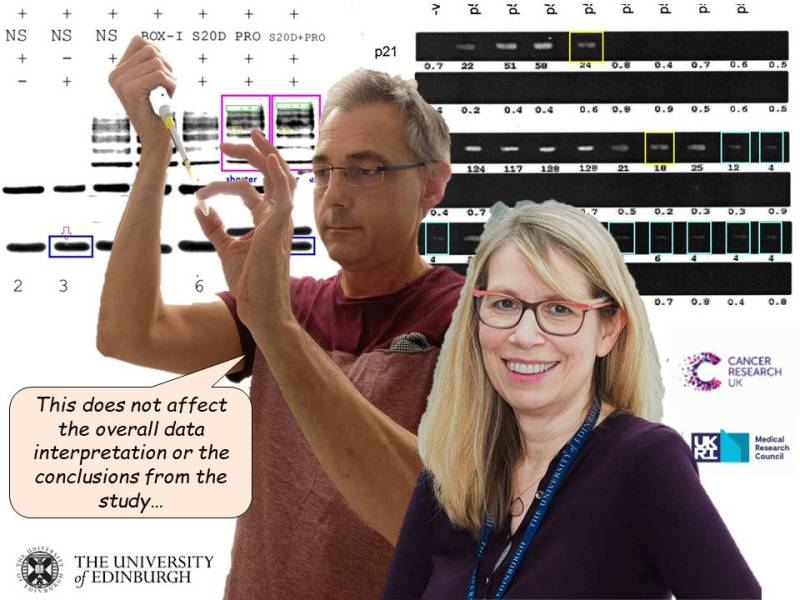
The Hupp and Ball Game
“Ted Hupp and Kathryn Ball may very well feel like kissing David Argyle on both cheeks.”
Now, I did not get even the standard reply. Even after reminders. Not even from the accused scientists. Even Argyle kept quiet, although he probably went out and bit someone to vent his anger about me.
So here is another Edinburgh celebrity I also tried to report to them, now and in February 2022.
Meet Margaret Frame, former Dean of Research in the College of Medicine and Veterinary Medicine, former director of the CRUK Edinburgh Centre, and until recently director of the Institute of Genetics and Cancer. Frame featured very briefly in this article:
Obituaries for explosive developments in cancer research
“Michael Waterfield,a key figure in the explosive developments in cancer research in the late twentieth century [….] leaves an enormous legacy, not just in the landscape of cancer therapies which he did so much to transform, but also in the training and promotion of the careers of so many leading scientists”
In 2018 Frame received the order of the British Empire (OBE) for her contribution ot cancer research. Allow me to duly celebrate this contribution as recorded on PubPeer. Like this:
N.O. Carragher, B.D. Fonseca , M.C. Frame Calpain activity is generally elevated during transformation but has oncogene-specific biological functions Neoplasia (2004) doi: 10.1016/s1476-5586(04)80053-8


In April 2022, Frame announced on PubPeer to “contact the journal to discuss next steps and a potential note/correction.” Let’s wait four more years then?
A collaboration with US colleagues, and Edinburgh’s Professor Paul Brennan (BSc (Hons) MB BChir FRCS (Ed), PhD):
Noel A. Warfel, Matt Niederst , Michael W. Stevens , Paul M. Brennan, Margaret C. Frame, Alexandra C. Newton Mislocalization of the E3 ligase, β-transducin repeat-containing protein 1 (β-TrCP1), in glioblastoma uncouples negative feedback between the pleckstrin homology domain leucine-rich repeat protein phosphatase 1 (PHLPP1) and Akt Journal of Biological Chemistry (2011) doi: 10.1074/jbc.m111.237081

Elisabeth Bik: “Could the authors please check Figures 2B and 6B?
- Bands in the P473 panels appear to overlap, but do not represent the same cell lines”
Here a paper with Owen Sansom, who was recruited by Frame as group leader to her CRUK Beatson Institute in Glasgow, and then inherited her office of Beatson’s director after she moved to Edinburgh:
Kathryn Graham , Kim Moran-Jones , Owen J. Sansom , Valerie G. Brunton , Margaret C. Frame FAK deletion promotes p53-mediated induction of p21, DNA-damage responses and radio-resistance in advanced squamous cancer cells PLOS One (2011) doi: 10.1371/journal.pone.0027806


In May 2022, Frame replied on PubPeer regarding the issues in Fig 2D and 4C: “These are marks on different autorads developed at similar time, likely from ECL developing autorad process.” She chose not to comment on the obviously duplicated gel bands in other figures.

Mind over Antibody
“I considered whether I should email Abcam and ask them to change the name of the ab51243 antibody on their website to reduce confusion, but […] I will instead continue to watch the carnage, perhaps it has only just started!” – Sholto David

This paper by Sansom and Frame was corrected:
Jennifer P. Morton, Paul Timpson , Saadia A. Karim , Rachel A. Ridgway , Dimitris Athineos , Brendan Doyle , Nigel B. Jamieson, Karin A. Oien, Andrew M. Lowy , Valerie G. Brunton , Margaret C. Frame , T. R. Jeffry Evans , Owen J. Sansom Mutant p53 drives metastasis and overcomes growth arrest/senescence in pancreatic cancer Proceedings of the National Academy of Sciences of the United States of America (2010) doi: 10.1073/pnas.0908428107


In March 2021, Sansom announced a correction on PubPeer, which was published in April 2022, and simply replaced the duplicated figures without comment or explanation. Also this was corrected by Samson, it features Stancheva’s mentee Kevin Myant (now Chair of Cancer Biology in Edinburgh):
Gabrielle H Ashton , Jennifer P Morton , Kevin Myant , Toby J Phesse , Rachel A Ridgway , Victoria Marsh , Julie A Wilkins , Dimitris Athineos , Vanesa Muncan , Richard Kemp , Kristi Neufeld , Hans Clevers , Valerie Brunton , Douglas J Winton , Xiaoyan Wang , Rosalie C Sears , Alan R Clarke, Margaret C Frame , Owen J Sansom Focal adhesion kinase is required for intestinal regeneration and tumorigenesis downstream of Wnt/c-Myc signaling Developmental Cell (2010) doi: 10.1016/j.devcel.2010.07.015

The June 2025 Correction “amended Figure 4A to include the correct original images“, mentioned additional changes to Figures S1H and S1I, and assured that “these errors […] do not affect the results described in the figures or the conclusions of the article.“
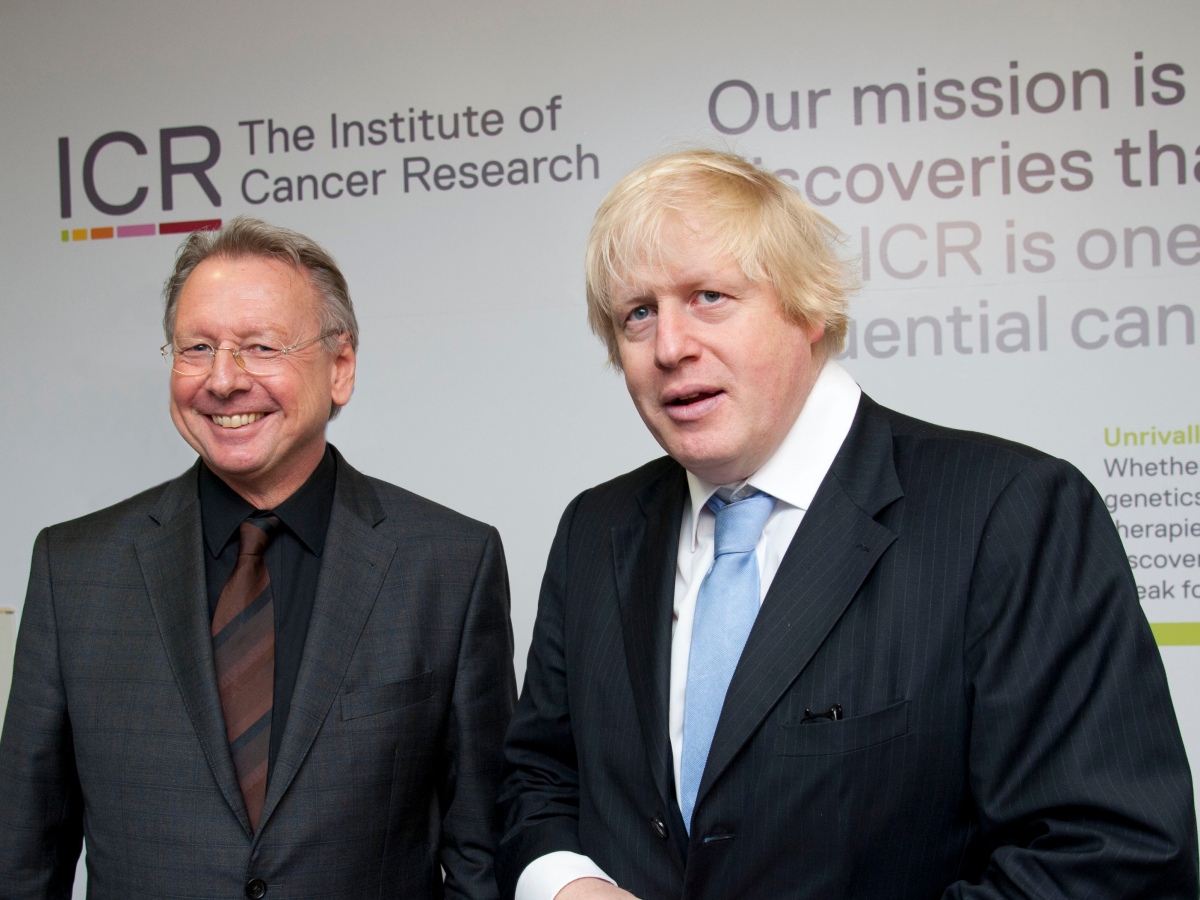
Fake data, untouchable men and guilty women at ICR London
With nobody above him, ICR director Paul Workman was seemingly investigating himself, and found two female colleagues guilty of placing fake data into his papers, primarily the ICR emeritus Ann Jackman. One paper was retracted, another received an outrageous correction. The previous ICR CEO, Alan Ashworth, together with his right-hand man Chris Lord, have their…
This was also corrected by Samson, it features former President of ICR London, Alan Ashworth:
Jennifer P Morton , Nigel B Jamieson , Saadia A Karim , Dimitris Athineos , Rachel A Ridgway , Colin Nixon , Colin J McKay , Ross Carter , Valerie G Brunton , Margaret C Frame , Alan Ashworth, Karin A Oien , T R Jeffry Evans , Owen J Sansom LKB1 haploinsufficiency cooperates with Kras to promote pancreatic cancer through suppression of p21-dependent growth arrest Gastroenterology (2010) doi: 10.1053/j.gastro.2010.04.055

In the Correction from August 2024, the authors admitted that “the wrong image was included for IgfBP7 staining of KLC mice in Figure 5B” and also addressed another duplication with “additional information in the legend for Figure 6E to highlight that a higher magnification image of KC PanIN is shown in Figure 4A“.
The papers above also featured Frame’s former postdoc Valerie Brunton, who previously trained with another former President of ICR London, Paul Workman.

Collages by Paul Workman, from the Golden Age of Biological Imaging
Before biology became digital, with its -omics and big data, there were mostly gels and microscopy images. The peak of image use in biomedical papers was reached at the turn of the century, those became the golden times of Photoshop-assisted data manipulation. To celebrate that period, I selected an example of the British cancer researcher…
Brunton is now chair of Cancer Therapeutics at the University of Edinburgh and has many papers on PubPeer, mostly with Frame. Like this:
Marta Canel , Alan Serrels , Derek Miller , Paul Timpson , Bryan Serrels , Margaret C. Frame , Valerie G. Brunton Quantitative In vivo Imaging of the Effects of Inhibiting Integrin Signaling via Src and FAK on Cancer Cell Movement: Effects on E-cadherin Dynamics Cancer Research (2010) doi: 10.1158/0008-5472.can-10-1454

Here, Frame announced to publish a correction, but the journal went for a permanent Editor’s Note instead:
Valerie G. Brunton, Egle Avizienyte , Valerie J. Fincham , Bryan Serrels , Chester A. Metcalf , Tomi K. Sawyer , Margaret C. Frame Identification of Src-specific phosphorylation site on focal adhesion kinase: dissection of the role of Src SH2 and catalytic functions and their consequences for tumor cell behavior Cancer Research (2005) doi: 10.1158/0008-5472.can-04-1949

July 2022 Editor’s Note: “We were informed by the authors that in Fig. 6A, the same image showing phospho-FAK tyr-925 staining was used in error in both Fig. 6M (Vector) and Fig. 6P (SrcMF).”
Frame’s former lab member Bryan Serrels is now in biotech, his presumed brother and another Frame mentee Alan Serrels is now reader at University of Edinburgh:
Marta Canel , Adam Byron , Andrew H Sims , Jessy Cartier , Hitesh Patel , Margaret C Frame , Valerie G Brunton , Bryan Serrels, Alan Serrels Nuclear FAK and Runx1 Cooperate to Regulate IGFBP3, Cell-Cycle Progression, and Tumor Growth Cancer Research (2017) doi: 10.1158/0008-5472.can-17-0418


Alan Serrels, Tom Lund , Bryan Serrels , Adam Byron , Rhoanne C. McPherson , Alexander Von Kriegsheim , Laura Gómez-Cuadrado , Marta Canel , Morwenna Muir , Jennifer E. Ring , Eleni Maniati , Andrew H. Sims , Jonathan A. Pachter , Valerie G. Brunton , Nick Gilbert , Stephen M. Anderton , Robert J.B. Nibbs , Margaret C. Frame Nuclear FAK controls chemokine transcription, Tregs, and evasion of anti-tumor immunity Cell (2015) doi: 10.1016/j.cell.2015.09.001
Another one by Serrels, Brunton, Sansom and Frame:
Alan Serrels , Iain R.J. Macpherson , T.R. Jeffry Evans , Francis Y. Lee , Edwin A. Clark , Owen J. Sansom , Gabrielle H. Ashton , Margaret C. Frame , Valerie G. Brunton Identification of potential biomarkers for measuring inhibition of Src kinase activity in colon cancer cells following treatment with dasatinib Molecular Cancer Therapeutics (2006) doi: 10.1158/1535-7163.mct-06-0382

Frame is long past retirement age, the new generation carries the flame and the brunt. Here a paper by Brunton without her mentor Frame:
Helen Creedon , Laura Gómez-Cuadrado , Žygimantė Tarnauskaitė , Jozef Balla , Marta Canel , Kenneth G. MacLeod , Bryan Serrels , Craig Fraser , Asier Unciti-Broceta , Natasha Tracey , Thierry Le Bihan , Teresa Klinowska , Andrew H. Sims , Adam Byron , Valerie G. Brunton Identification of novel pathways linking epithelial-to-mesenchymal transition with resistance to HER2-targeted therapy Oncotarget (2016) doi: 10.18632/oncotarget.7317

It looks like Frame installed her highly capable people everywhere in Edinburgh and Glasgow. Well, surely these heroes will cure cancer any time now. Frame once gave this advice to younger scientists:
“A scientific career is based on the research that you do and I think the important thing is to always keep the scientific question in mind and go where the data takes you. Don’t start with any preconceptions.”
Apparently the University of Edinburgh has a rule never to sanction anyone who isn’t Bulgarian like Stancheva.
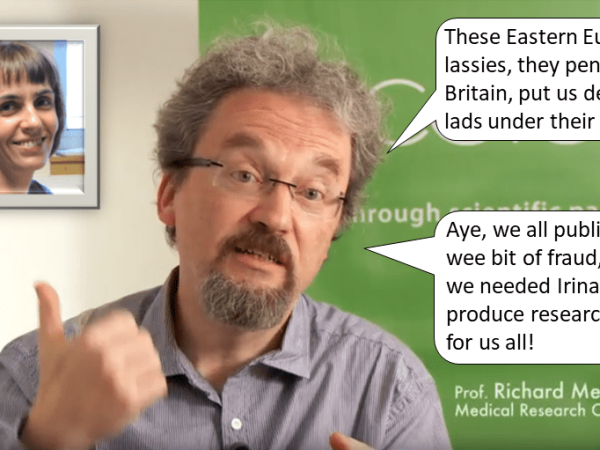
Edinburgh saves Bird men from clutches of Bulgarian Jezebel
Irina Stancheva was investigated in Edinburgh for fraud at least twice, in 2009 and 2017, yet retraction and correction decisions were not implemented. Apparently to protect the reputation of Nobel Prize candidate Sir Adrian Bird and his male mentees, primarily Richard Meehan. One wonders: how much of Bird research in past two decades was actually…
Fostering a strong research culture and environment
I reported another, somewhat more recent research integrity case to another British university. Also this one was flagged by the pseudonymous sleuth Claire Francis.
Specifically, I send the following to the Pro-Dean for Research and Innovation for the Faculty of Biological Sciences of the University of Leeds, Andrew Macdonald:
Ethan L. Morgan , Andrew Macdonald Autocrine STAT3 activation in HPV positive cervical cancer through a virus-driven Rac1—NFκB—IL-6 signalling axis PLoS Pathogens (2019) doi: 10.1371/journal.ppat.1007835


I also reported to Professor Macdonald this case, since his job description includes “fostering a strong research culture and environment which delivers high quality research and impact“:
Hussein Abdul-Sada , Marietta Müller , Rajni Mehta , Rachel Toth , J. Simon C. Arthur , Adrian Whitehouse , Andrew Macdonald The PP4R1 sub-unit of protein phosphatase PP4 is essential for inhibition of NF-κB by merkel polyomavirus small tumour antigen Oncotarget (2017) doi: 10.18632/oncotarget.15836


Worth noting that Macdonald trained as postdoc at the MRC Protein Phosphorylation Unit (MRC-PPU) in Dundee, a place where one can only learn bad things. His mentor was Simon Arthur, who in turn was the postdoc of Sir Philip Cohen, the founding father of MRC-PPU. Read about them here:
Portrait of Sir Philip Cohen’s Family
Sir Philip and Lady Tricia Cohen, and their heir Dario Alessi, plus other first and second generation offspring. A Scottish soap opera!
A third generation science fudger, who already raised the fourth generation! The first author on this paper by Macdonald and Arthur, Ethan Morgan, is Macdonald’s former PhD student:
Ethan L. Morgan , Christopher W. Wasson , Lucy Hanson , David Kealy , Ieisha Pentland , Victoria McGuire , Cinzia Scarpini , Nicholas Coleman , J. Simon C. Arthur , Joanna L. Parish , Sally Roberts , Andrew Macdonald STAT3 activation by E6 is essential for the differentiation-dependent HPV18 life cycle PLoS Pathogens (2018) doi: 10.1371/journal.ppat.1006975

Look at this outrageous reuse of Western blots by Morgan and MacDonald:
- Ethan L Morgan , Andrew Macdonald JAK2 Inhibition Impairs Proliferation and Sensitises Cervical Cancer Cells to Cisplatin-Induced Cell Death Cancers (2019) doi: 10.3390/cancers11121934
- Ethan L. Morgan , Molly R. Patterson , Emma L. Ryder , Siu Yi Lee , Christopher W. Wasson , Katherine L. Harper , Yigen Li , Stephen Griffin , G. Eric Blair , Adrian Whitehouse , Andrew Macdonald MicroRNA-18a targeting of the STK4/MST1 tumour suppressor is necessary for transformation in HPV positive cervical cancer PLoS Pathogens (2020) doi: 10.1371/journal.ppat.1008624
- Ethan L. Morgan, James A. Scarth , Molly R. Patterson , Christopher W. Wasson , Georgia C. Hemingway , Diego Barba-Moreno , Andrew Macdonald E6-mediated activation of JNK drives EGFR signalling to promote proliferation and viral oncoprotein expression in cervical cancer Cell Death & Differentiation (2021) doi: 10.1038/s41418-020-00693-9
- Ethan L Morgan, Molly R Patterson , Diego Barba-Moreno , James A Scarth , Adam Wilson , Andrew Macdonald The deubiquitinase (DUB) USP13 promotes Mcl-1 stabilisation in cervical cancer Oncogene (2021) doi: 10.1038/s41388-021-01679-8


The collaboration continued after Morgan started his own short-lived lab at the University of Sussex:
- Molly R. Patterson , Joseph A. Cogan , Rosa Cassidy , Daisy A. Theobald , Miao Wang , James A. Scarth , Chinedu A. Anene , Adrian Whitehouse , Ethan L. Morgan , Andrew Macdonald The Hippo pathway transcription factors YAP and TAZ play HPV-type dependent roles in cervical cancer Nature Communications (2024) doi: 10.1038/s41467-024-49965-9
- Molly R. Patterson , Aniek S. Meijers , Emma L. Ryder , Louisa M. Wootton , James A. Scarth , Debra Evans , Amy L. Turner , Christopher W. Wasson , Janne E. Darell , Daisy A. Theobald , Joseph A. Cogan , Claire D. James , Miao Wang , John E. Ladbury , Iain M. Morgan , Adel Samson , Ethan L. Morgan , Andrew Macdonald E7-mediated repression of miR-203 promotes LASP1-dependent proliferation in HPV-positive cervical cancer Oncogene (2024) doi: 10.1038/s41388-024-03067-4

Morgan made it to assistant professor in Sussex, but then found Britain either too cold or too tough on bad science, and migrated in November 2025 to where his research style is appreciated – he is now at a private Cyprus Institute of Neurology & Genetics in Nicosia.
Macdonald has a large PubPeer record of bad science, which I gladly reported to him and his university for investigation, with no reaction. Much is authored with his good friend among the faculty, whose name you saw above: the virology professor Adrian Whitehouse. Together they published some horrible stuff:
Samuel J Dobson , Anthony Anene , James R Boyne , Jamel Mankouri , Andrew Macdonald , Adrian Whitehouse Merkel Cell Polyomavirus Small Tumour Antigen Activates the p38 MAPK Pathway to Enhance Cellular Motility Biochemical Journal (2020) doi: 10.1042/bcj20200399

More reused blots:
- Nnenna Nwogu , James R. Boyne , Samuel J. Dobson , Krzysztof Poterlowicz , G. Eric Blair , Andrew Macdonald , Jamel Mankouri , Adrian Whitehouse Cellular sheddases are induced by Merkel cell polyomavirus small tumour antigen to mediate cell dissociation and invasiveness PLoS Pathogens (2018) doi: 10.1371/journal.ppat.1007276
- Gabrielė Stakaitytė , Nnenna Nwogu , Jonathan D. Lippiat , G. Eric Blair , Krzysztof Poterlowicz , James R. Boyne , Andrew Macdonald , Jamel Mankouri, Adrian Whitehouse The cellular chloride channels CLIC1 and CLIC4 contribute to virus-mediated cell motility Journal of Biological Chemistry (2018) doi: 10.1074/jbc.ra117.001343
- Gabrielė Stakaitytė , Nnenna Nwogu , Samuel J Dobson , Laura M Knight , Christopher W Wasson , Francisco J Salguero , David J Blackbourn , G Eric Blair , Jamel Mankouri , Andrew Macdonald , Adrian Whitehouse Merkel Cell Polyomavirus Small T Antigen Drives Cell Motility via Rho-GTPase-Induced Filopodium Formation Journal of Virology (2018) doi: 10.1128/jvi.00940-17


It is not just western blots:
Laura M. Knight , Gabriele Stakaityte , Jennifer, J. Wood , Hussein Abdul-Sada , David A. Griffiths , Gareth J. Howell , Rachel Wheat , G. Eric Blair , Neil M. Steven , Andrew Macdonald , David J. Blackbourn , Adrian Whitehouse Merkel Cell Polyomavirus Small T Antigen Mediates Microtubule Destabilization To Promote Cell Motility and Migration Journal of Virology (2015) doi: 10.1128/jvi.02317-14

As I mentioned, nobody at Leeds replied to my notification of suspected research misconduct.
Send pictures
Elsewhere in UK, a professor was sacked for sexual harassment. The perpetrator is the pharmacologist Ibrahim Khadra, professor at Strathclyde University in Glasgow.
Glasgow Live reported on on 10 September 2026:
“The Palestinian academic – who previously made the news after revealing he had lost more than 70 family members in Gaza attacks and was pictured meeting with the First Minister John Swinney – was removed from his post in May this year.
Victims branded Khadra a “manipulator” who used the threat of not allowing students to progress in their studies to force students into providing intimate images.
Khadra, who was also accused of sending sexual images, was also accused of constantly sexually harassing students through messages and calls.
One victim told Glasgow Live: “He’s a manipulator. He controlled all of our records. We were told we weren’t allowed to progress if we didn’t answer his phone calls or send pictures.
“He had access to our records, our addresses and our phone numbers. His victims were left scared.”
The victim said that she had been left suffering PTSD as a result of Khadra’s actions. She said: “I keep having nightmares that he is around me in my room. I sometimes turn off my phone and disappear.””
The newspaper quoted the Strathclyde University which suspended and then dismissed Khadra after several students raised “extremely serious allegations”. The news were then picked up by other media, BBC mentioned that also police is investigating.
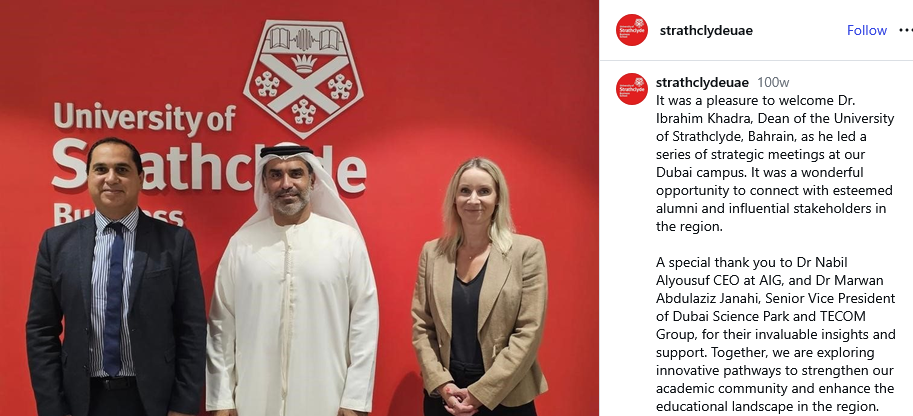
Khadra did his PhD and spent most of his academic career at Strathclyde, only last year he announced on Linkedin to be “honoured and delighted to share that I have been promoted to Professor at the University of Strathclyde.” Khadra also used to be the “Strathclyde University Advisor for Engagement with MENA Region”, the abbreviation standing for “Middle East and North Africa”. He was very busy securing Saudi and Emirates money for his university, which even has campuses in Dubai and in Bahrain, and yes, Khadra was the Dean and Vice-President of University of Strathclyde Bahrain. Just in January 2026, Bahrain Space Agency and University of Strathclyde Bahrain announced further cooperation:
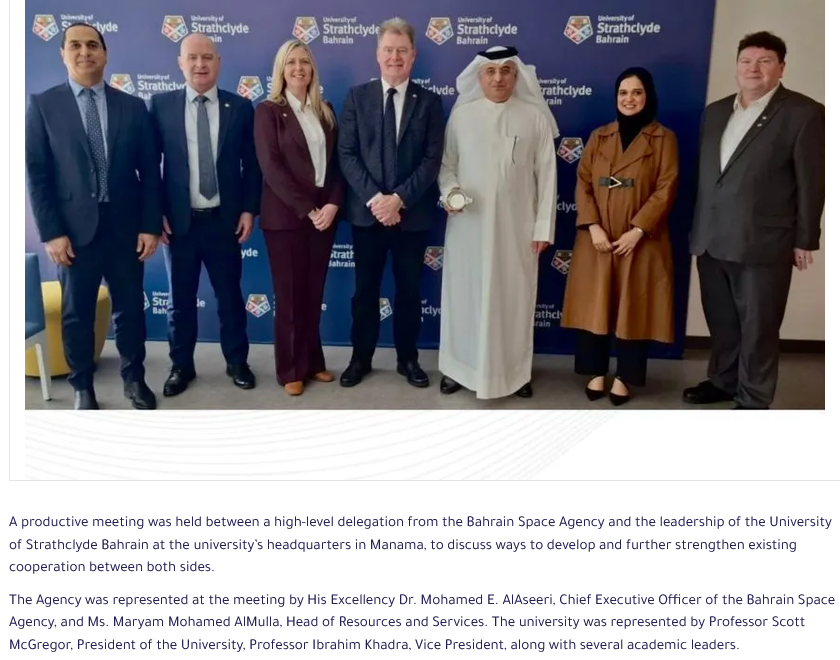

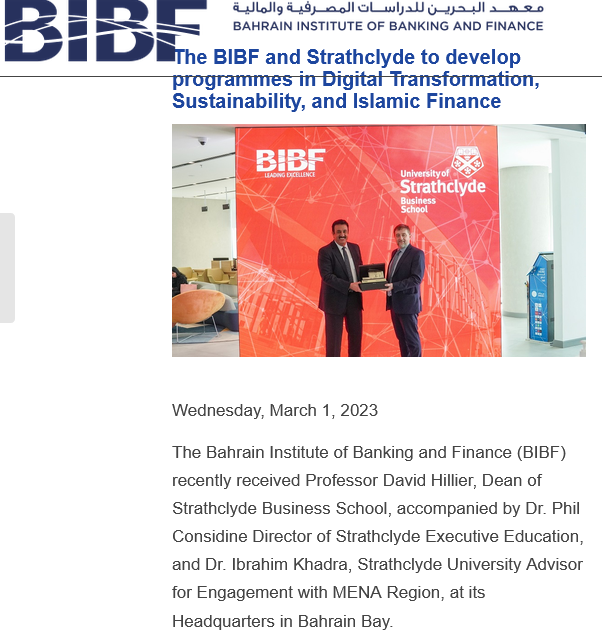

Maybe this explains why Strathclyde chose not to notice Khadra’s sexual harassment until now? Now these people are hurrying to erase all traces of Khadra at Strathclyde and especially at Strathclyde UAE. There’s a purge on social media going on!
Clarify yourself and who you represent
Meet the US cancer researcher Yehenew Agazie, originally from Ethiopia, trained in USA and since 2003 professor at the West Virginia University School of Medicine. Sholto David notified him about 11 bad papers of his which the sleuth posted on PubPeer. This was deemed as the worst example:
Hua Zhao , Elisha Martin , Fatimah Matalkah , Neal Shah , Alexey Ivanov, J. Michael Ruppert, Paul R. Lockman, Yehenew M. Agazi Conditional knockout of SHP2 in ErbB2 transgenic mice or inhibition in HER2-amplified breast cancer cell lines blocks oncogene expression and tumorigenesis Oncogene (2019) doi: 10.1038/s41388-018-0574-8


Zachary Hartman , Werner J Geldenhuys , Yehenew M Agazie A specific amino acid context in EGFR and HER2 phosphorylation sites enables selective binding to the active site of Src homology phosphatase 2 (SHP2) Journal of Biological Chemistry (2020) doi: 10.1074/jbc.ra119.011422


Zachary Hartman, Werner J Geldenhuys, Yehenew M Agazie Novel Small-Molecule Inhibitor for the Oncogenic Tyrosine Phosphatase SHP2 with Anti-Breast Cancer Cell Effects ACS Omega (2020) doi: 10.1021/acsomega.0c02746

Xiangdong Zhou , Yehenew M. Agazie Molecular Mechanism for SHP2 in Promoting HER2-induced Signaling and Transformation Journal of Biological Chemistry (2009) doi: 10.1074/jbc.m900020200
The above mentioned papers all have further instances of forged figures. Agazie is the only common name on those. On PubPeer, he announced some corrections, and in an email to Sholto, he wrote:
“I have seen many of the comments you raised. There is no manipulation. Yes, there are some errors and not all comments you sent are correct. The errors will be corrected using appropriate channels.
I highly appreciate if you clarify yourself and who you represent.“
The paper from 2016 was previously flagged on PubPeer by other users for other issues:
Fatimah Matalkah , Elisha Martin , Hua Zhao , Yehenew M. Agazie SHP2 acts both upstream and downstream of multiple receptor tyrosine kinases to promote basal-like and triple-negative breast cancer Breast Cancer Research (2016) doi: 10.1186/s13058-015-0659-z


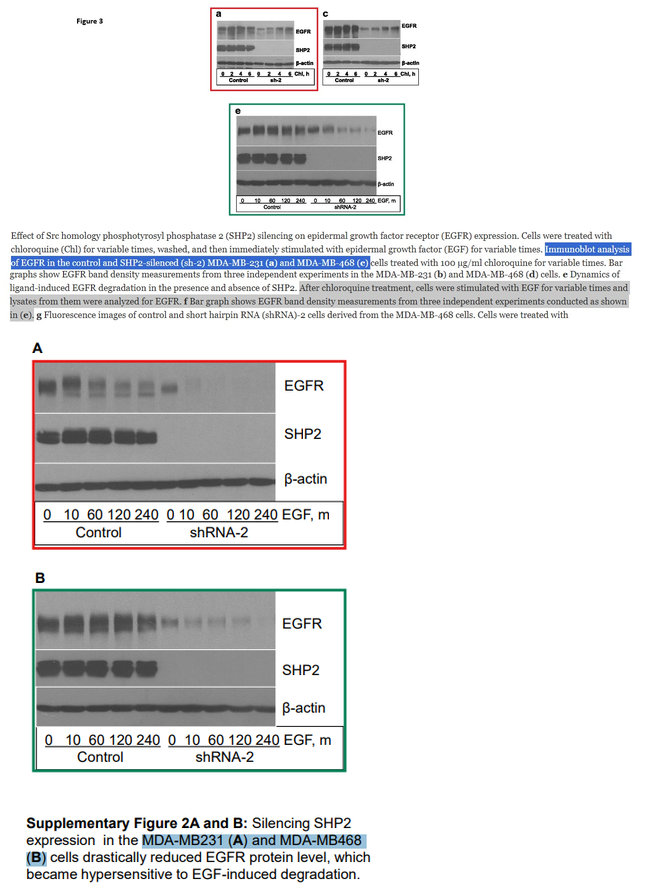
I wrote to Agazie and clarified myself and whom I represent. He still didn’t reply.
Hua Zhao , Yehenew M Agazie Inhibition of SHP2 in basal-like and triple-negative breast cells induces basal-to-luminal transition, hormone dependency, and sensitivity to anti-hormone treatment BMC Cancer (2015) doi: 10.1186/s12885-015-1131-2


Agazie announced on PubPeer: “there is an error of duplicate images that need to be corrected. We have the data.” What about this one then:
Rebecca Merritt , Michael J. Hayman , Yehenew M. Agazie Mutation of Thr466 in SHP2 abolishes its phosphatase activity, but provides a new substrate-trapping mutant Biochimica et Biophysica Acta (2006) doi: 10.1016/j.bbamcr.2005.11.013


Or this:
Xiangdong Zhou , Yehenew M. Agazie The signaling and transformation potency of the overexpressed HER2 protein is dependent on the normally-expressed EGFR Cellular Signalling (2012) doi: 10.1016/j.cellsig.2011.08.015


And so on, one is better advised to search for a paper by Agazie which does NOT contain falsified data. Then there was this bizarre case:
Yehenew M. Agazie, Michael J. Hayman Molecular Mechanism for a Role of SHP2 in Epidermal Growth Factor Receptor Signaling Molecular and Cellular Biology (2003) doi: 10.1128/mcb.23.21.7875-7886.2003


The paper is 23 years old, published by Agazie with his postdoctoral mentor from Stony Brook University, just when Agazie arrived as professor to West Virginia University. Yet that ten year old data returned in a new shape in the 2013 dissertation of Agazie’s student Zachary Hartman, now working for pharma industry. How did this happen? Whom will Agazie blame if questioned?
Pot de départ
A great scientist retires!
On 12 October 2026, the French plant scientist Martin Crespi will be celebrated by his peers in Paris, with a special retirement party called “Rooted in RNA”. There will be a “Pot de départ” , i.e. a retirement party in the institute’s cafeteria “for all IPS2 staff and Martin Crespi’s guests“.
Crespi is Research Director Exceptional class at the CNRS Institute of Plant Sciences Paris-Saclay. He previously featured on this website as the evaluator of the CNRS-IBMP institute in Strasbourg in the wake of the Olivier Voinnet‘s research fraud scandal. One of his retirement party speakers, Lionel Navarro, is a former Voinnet mentee (see PubPeer).
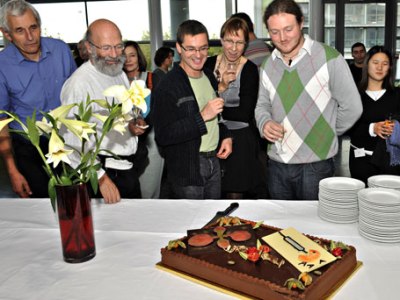
The travelling circus of research integrity in Strasbourg
On March 8, an international scientific review board will be evaluating the research at the French CNRS Institut de Biologie Moléculaire des Plantes (IBMP) in Strasbourg. This is the place where the former star (and now misconduct-tainted pariah) of plant sciences Olivier Voinnet shot to fame, where his main lab operated since 2002 until he was…
Five years later, in 2022, Crespi evaluated IBMP once again, and I discussed that and some of his own problematic papers in June 2023 Shorts. Since then, more was found and posted on PubPeer. Like this, with one of the organisers of the retirement party, Florian Frugier:
Pablo R. Gargantini , Silvina Gonzalez‐Rizzo, Delphine Chinchilla, Marcela Raices , Verónica Giammaria , Rita M. Ulloa, Florian Frugier, Martin D. Crespi A CDPK isoform participates in the regulation of nodule number inMedicago truncatula The Plant Journal (2006) doi: 10.1111/j.1365-313x.2006.02910.x

Graphidipus graphidiparia: “Concerns regarding Figure 3b: Upon adjusting the contrast of the image, distinctive square-shaped patterns become apparent around certain blot signals, particularly in the histone phosphorylation analysis under the Sm41-treated condition. Notably, two examples—one in the “Particulate” fraction and one in the “Soluble” fraction—stand out. These geometric artifacts suggest that the corresponding signals may not originate from the original background but could have been superimposed onto it.”
Yes, those bands do look like they were digitally pasted in. In November 2025, Crespi replied on PubPeer and admitted the manipulation:
“Almost 20 years have passed since the publication, and unfortunately we could not find the original digital files.
Looking at the figure now, it seems possible that the lanes for days 0 and 1 post-inoculation were run on a different gel from those for days 2, 3, and 4, and that the image was assembled afterward. This may explain the straight-edged or square-shaped areas visible after contrast adjustment. There was no intention to manipulate the data — the image was likely assembled to show all time points together in a single panel.
The result described in the paper […] is correct and remains valid.“
Here another paper where Crespi replied:
Christine Lelandais-Brière , Loreto Naya , Erika Sallet, Fanny Calenge, Florian Frugier, Caroline Hartmann , Jérome Gouzy , Martin Crespi Genome-WideMedicago truncatulaSmall RNA Analysis Revealed Novel MicroRNAs and Isoforms Differentially Regulated in Roots and Nodules The Plant Cell (2009) doi: 10.1105/tpc.109.068130

Homalomena rubescens: “Figure 5 issue: Several U6 loading control panels appear to have been reused multiple times (or shown as different exposures of the same panel) across distinct miRNA detection experiments”
Crespi declared the raw data as lost since his past Institut des Sciences du Végétal closed more than 10 years ago. He however explained the duplications as appropriate:
“Indeed, we performed several RNA blots and each membrane was hybridized with two to four different miRNA probes successively. Before hybridization with a new probe, we performed a dehybridation step (2 washings of 5 minutes, in boiling water) and waited for 2 weeks before doing a new hybridization with another miRNA probe (radiolabelled with fresh radioactivity). The absence of remanent radioactive signal after one week exposition was checked before each novel hybridization.”
Actually, even ChatGPT agreed with my theory that Crespi’s claimed approach of stripping and re-probing the same membrane for different miRNA is not really appropriate: one gets either into problems with a false signal from incomplete removal of the previous radioactive probe or with damage and loss of miRNA from the membrane. Especially boiling will cause loss or degradation of the RNA on the membrane, so there would be nothing to detect in the next round. It’s not like Crespi is working with extremely scarce RNA samples, there’s absolutely no valid rationale for his membrane reuse, quite the opposite. It rather sounds like a made-up excuse for dodgy image duplication.
This paper by Crespi was corrected, it features one of his close friends and member of the retirement party committee, Hervé Vaucheret of Institut Jean-Pierre Bourgin, as well as Alexis Maizel, professor at the University of Heidelberg, Germany:
Ana Beatriz Moreno , Angel Emilio Martínez De Alba , Florian Bardou , Martin D. Crespi , Hervé Vaucheret, Alexis Maizel, Allison C. Mallory Cytoplasmic and nuclear quality control and turnover of single-stranded RNA modulate post-transcriptional gene silencing in plants Nucleic Acids Research (2013) doi: 10.1093/nar/gkt152

Maizel explained on PubPeer that the error occurred “during the revision of the manuscript […] in response to a reviewer’s request“, when a panel “was inadvertently duplicated“. A Correction was published in August 2025.
On this occasion, allow me to introduce you to the work of Moussa Benhamed, professor at Université Paris Cité and the other organiser of Crespi’s retirement party. This was corrected:
Pierre Bourguet, Leticia López-González , Ángeles Gómez-Zambrano , Thierry Pélissier , Amy Hesketh , Magdalena E Potok , Marie-Noëlle Pouch-Pélissier , Magali Perez , Olivier Da Ines , David Latrasse, Charles I White , Steven E Jacobsen, Moussa Benhamed, Olivier Mathieu DNA polymerase epsilon is required for heterochromatin maintenance in Arabidopsis Genome Biology (2020) doi: 10.1186/s13059-020-02190-1

The Correction from 13 July 2026 fixed “a nomenclature error in the labelling of Fig. S6A” as well as for another image duplication: “Fig. S6A and Fig. S8D display images of the exact same wild-type (Col-0) and pol2a-12 plants“, but that image reuse was apparently “experimentally consistent“. Of course, “These corrections do not alter the scientific conclusions of the study“.
This is surely not some Chinese papermill:
Jia Yuan Ye, Wen Hao Tian , De Rui Zhang , Qian Yi Yu , Ji Ming Xu , Wo Na Ding , Gui Xin Li , Jing Ying Yan , Chong Wei Jin , Moussa Benhamed, Shao Jian Zheng, Zhong Jie Ding BRAHMA represses STOP1-NRT1.1 module to control plant rhizosphere alkalization and acid stress adaptation Nature Communications (2026) doi: 10.1038/s41467-026-69905-z

In June 2024, Zhong Jie Ding replied on PubPeer to explain that a “clerical error” happened where “a column containing pre-calculated mean values was mistakenly copied into the column for individual replicate data“, and in fact, all this PubPeer sleuthing was not really helpful because the authors themselves “identified this specific data-handling error approximately two weeks ago during our own comprehensive audit of the source data“, as one does. Ding also announced to have “already contacted the editorial team of Nature Communications to […] request a formal Author Correction.”
That was more than two years ago, and still no correction. There’s more for Benhamed on PubPeer, like this with Marianne Delarue, professro at Université Paris-Saclay:
David Latrasse, Moussa Benhamed, Yves Henry , Séverine Domenichini, Wanhui Kim , Dao-Xiu Zhou , Marianne Delarue The MYST histone acetyltransferases are essential for gametophyte development in Arabidopsis BMC Plant Biology (2008) doi: 10.1186/1471-2229-8-121

Carex kelloggii: “Figure 2B: two nearly-identical actin loading controls (1 and 2, outlined in dashed-red) have been used for different conditions (Col-0/ham1-2 and Ws/ham1-3 respectively)”
Or this:
Quentin Bruggeman , Florence Prunier , Christelle Mazubert, Linda De Bont , Marie Garmier, Raphaël Lugan, Moussa Benhamed, Catherine Bergounioux, Cécile Raynaud , Marianne Delarue Involvement of Arabidopsis Hexokinase1 in Cell Death Mediated byMyo-Inositol Accumulation The Plant Cell (2015) doi: 10.1105/tpc.15.00068
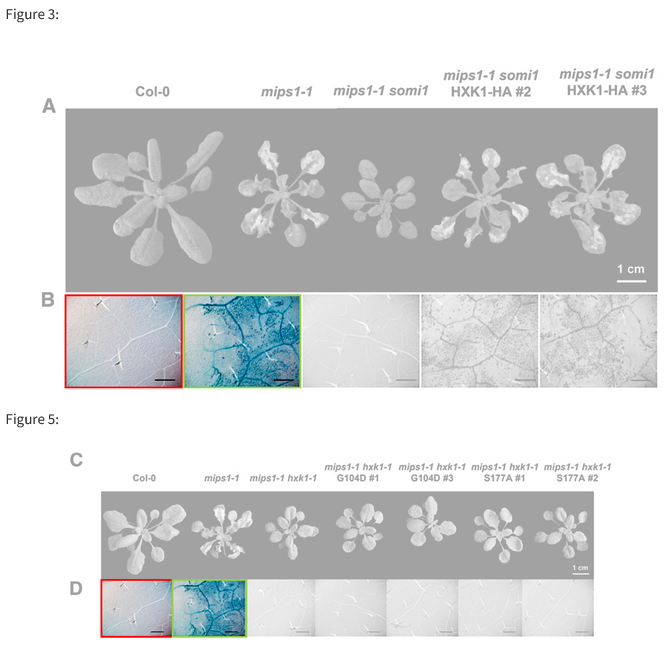

In March 2025, Delarue admitted on PubPeer “an error in annotating the photos“, but decided against publishing a correction.
By the way, in 2018 Crespi co-signed a nasty letter organised by French Academy members, which defended science fraud and, most unpleasantly – demanded punishment for a Le Monde journalist and especially for 10 anonymous authors of a counter-report which denounced the institutional whitewashing of former chief biologist of CNRS, Catherine Jessus. Read here:
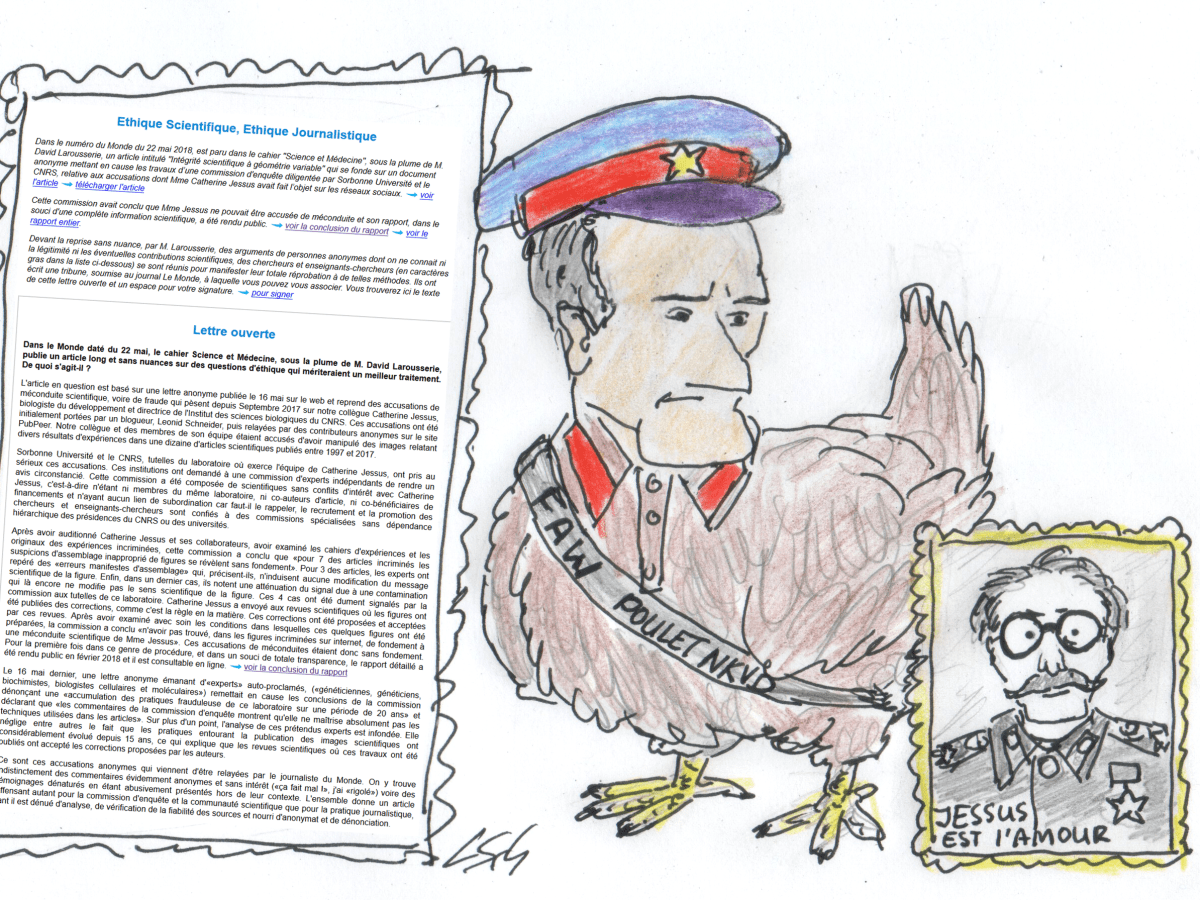
Jessus critics defiant, reactionary cock-up and Chicken of Dishonour Legion
As Le Monde brought into public light the Catherine Jessus affair with its whitewashed data manipulation and the growing academic protest, a counter-revolution put its foot in. A signature list in the worst Stalinist tradition was published, organised by the very elite of French academia (mostly members of Academie de Sciences), and signed by hundreds,…
Retraction Watchdogging
Additional concerns were identified
We remain in France, where a Strasbourg professor loses another paper. All because Portland Press has much less tolerance for bad science than other publishers.
Jean-Philippe Loeffler is professor at the University of Strasbourg, his INSERM unit was shut down in 2022, which suggests Loeffler must have retired (he is currently around 68 years old). In the past he was seen as occasional visitor of OMICS predatory conferences, and he featured in this article:

The Strasbourg Swamp
You know Voinnet, but now meet other great life scientists of Strasbourg: Drouard, Loeffler, Boutillier, Mr and Mrs Egly, and many others.
The paper is more than two decades old, it was flagged in June 2022:
Franck Di Scala , Luc Dupuis , Christian Gaiddon, Marc De Tapia , Natasa Jokic , Jose-Luis Gonzalez De Aguilar , Jean-Sébastien Raul , Bertrand Ludes , Jean-Philippe Loeffler Tissue specificity and regulation of the N-terminal diversity of reticulon 3 Biochemical Journal (2005) doi: 10.1042/bj20040458


With papers like this, Luc Dupuis became INSERM research director at the University of Strasbourg. Here is the unexpected retraction from 10 September 2026:
“This article is being retracted from the Biochemical Journal at the request of the Editor-in-Chief and the Editorial Board. This follows the receipt of a notification from a reader, alerting the Editorial Board to multiple concerns over high similarity within the article. Upon investigation, additional concerns were identified. The specific similarities identified are as follows:
- Between the Figure 5B NogoA and NogoC bands
- Between the Figure 5BRTN3A1 bands and the Figure 7A 18S bands (lanes 3-6).
- Between the Figure 7A NogoA (after a 180° rotation) and NogoB bands.
- Between the Figure 7A RTN2A1, RTN3A4, RTN3A4b and NogoC bands, at varying exposures.
The authors could not retrieve the original data, generated 20 years ago, to address the concerns raised and sincerely apologise for any inconvenience caused. Given the extent of the issues raised, the Editorial Board have decided to retract the article. The authors agree to the retraction.”
Three years ago, Loeffler suffered another retraction, also only because PLOS One cares where others don’t. The lead authors are Loeffler’s Strasbourg colleagues Jean-Christophe Cassel and Anne-Laurence Boutillier, Cassel’s former PhD student, then lab co-director (and likely partner). I wrote about it in December 2023 Shorts.
Prohibited from publishing
The papermill press masquerading a a learned society and known as IEEE (Institute of Electrical and Electronics Engineers) retracted a papermill product with a very appropriate title:
Minu Baek , Sangkeum Lee A Three-Stage Reinforcement Learning Pipeline for Autonomous Process Control in the Papermaking Industry IEEE Transactions on Industrial Informatics (2026) doi: 10.1109/tii.2026.3682018
“After careful and considered review of this article by senior publication officers at IEEE, this article was found not to meet IEEE’s publication standards. Concerns were raised after publication regarding IEEE’s authorship policy that resulted in a determination that, specifically, at the time of publication, co-author Sangkeum Lee was prohibited from publishing with IEEE. The co-author was unaware of this prohibition and did not consent to coauthor a paper with a prohibited individual. When asked for a response, the co-author did not dispute the decision.”
(Retraction 1 September 2026)
A retraction because one author, Sangkeum Lee, “was prohibited from publishing with IEEE“? Actually, COPE guidelines forbid blacklisting authors:

Not that I agree with COPE on this, but IEEE claims to be following COPE guidelines. Also, IEEE shoudl decide what their exact position on this Korean scholar from Hanbat National University is, I mean look at this correction:
Hanen Issaoui , Asma Eladel , Ahmed Zouinkhi , Mourad Zaied , Lazhar Khriji , Sarvar Hussain Nengroo Defending CNN Against FGSM Attacks Using Beta-Based Personalized Activation Functions and Adversarial Training IEEE Access (2024) doi: 10.1109/access.2024.3432773
“In the above article [1], after reorganizing the research team and double-checking the original data, we updated the author list to accurately reflect each contributor’s contributions. Prof. Sangkeum Lee was unintentionally excluded from the author list on the original submission.
Prof. Sangkeum Lee has been added to the author list as the second corresponding author, with his bibliography also included.
Corresponding authors: Lazhar Khriji (lazhar@squ.edu.om) and Sangkeum Lee (sangkeum@hanbat.ac.kr)”
Correction 25 November 2024
So which way is it? How did IEE move from adding Lee to papers post publication to retracting papers by him after publication?
Of course Lee is a papermilling fraudster, see this paper of his:
Ting Xu , Mohammad Hosein Sabzalian , Ahmad Hammoud , Hamed Tahami , Ali Gholami , Sangkeum Lee An innovative machine learning based on feed-forward artificial neural network and equilibrium optimization for predicting solar irradiance Scientific Reports (2024) doi: 10.1038/s41598-024-52462-0
It is a citation delivery vehicle, criticised by Smut Clyde for the “hollow, content-free nature of these opening sentences, providing the pretexts for citational lolly-scrambles“.

The Citation Payola
“The proposition that a niche of citation brokers exists, opens our eyes to other transaction options..” . Smut Clyde

A non-verifiable cell line
The retraction lottery is a strange thing. Here, the publisher Sage started to crack down on papers using wrong cell lines, and these were not flagged on PubPeer before:
Xian Min Li , Li Li Cao Identification of GOLM1 as a positively regulator of tumor metastasis by regulating MMP13 in gastric carcinoma Cancer biomarkers (2019) doi: 10.3233/cbm-190301
“The Journal and the publisher were alerted to concerns about the use of a non-verifiable cell line in this article as discussed in a recent publication1. The specific cell line concerns are outlined below:
- GSE-1 is a non-verifiable cell line believed to be a misspelling of GES-12 . GES-1 is described in the article as human gastric epithelium cell line.
- BGC823 is described in the article as human gastric cancer cell lines. Originally thought to be a gastric adenocarcinoma. The cell lines are considered contaminated and have been shown to be a HeLa derivative.2
- SGC7901 is described in the article as human gastric cancer cell lines. Originally thought to originate from the lymph node of a 56-year-old female patient with a gastric carcinoma; the cell lines are considered contaminated, and have been shown to be a HeLa derivative.2
Multiple attempts were made to contact the authors for an explanation, but no response was received by the publisher.
Due to concerns about the strength of the conclusions resulting from experiments that used a contaminated cell line, Cancer Biomarkers Editor-in-Chief retracts this article.”
( Retraction 3 September 2026)
Oh what Botangled web we weave
“Would it be irresponsible to speculate that all these multiple sets of images being handed around from paper to paper all belong to a papermill? An artisanal, bespoke fabrication studio, catering to a select group of clients? It would be irresponsible not to speculate!” – Smut Clyde
Reference 2 goes to Bairoch, The Cellosaurus, a cell line knowledge resource. J Biomol Tech 2018, Here a similar retraction, in the same journal, again referencing Cellosaurus:
You-Jun Wu , Zi-Long Hu , Shi-Dong Hu , Yu-Xuan Li , Xiao-Wei Xing , Yu Yang , Xiao-Hui Du Glutamate dehydrogenase inhibits tumor growth in gastric cancer through the Notch signaling pathway Cancer biomarkers (2019) doi: 10.3233/cbm-190022
“The Journal and the publisher were alerted to concerns about the use of a non-verifiable cell line in this article as discussed in a recent publication.1 The specific cell line concerns are outlined below:
- BSG823 is described in the article as human gastric cancer cell lines. BSG823 is a non-verifiable cell line misspelling of BGC-823 which was originally thought to be a gastric adenocarcinoma. The cell lines are considered contaminated and have been shown to be a HeLa derivative.2
- MGC-803 is described in the article as human gastric cancer cell lines. Originally thought to originate from a 53-year-old male patient suffering from a poorly differentiated gastric mucinous adenocarcinoma. The cell lines are considered contaminated and have been shown to be a HeLa derivative and probably of a gastric cancer cell from an Asian individual. The STR profile is highly similar to that of HeLa yet shows some specific differences that suggest it is a hybrid cell line.2
- SGC7901 is described in the article as human gastric cancer cell lines. Originally thought to originate from the lymph node of a 56-year-old female patient with a gastric carcinoma; the cell lines are considered contaminated, and have been shown to be a HeLa derivative.2
Multiple attempts were made to contact the authors for an explanation, but no response was received by the publisher.
Due to concerns about the strength of the conclusions resulting from experiments that used a contaminated cell line, Cancer Biomarkers Editor-in-Chief retracts this article.”
(Retraction 3 September 2026)
My theory is that the publisher found much bigger issues in these papers, which are likely fabricated by Chinese papermills (hence also the lack of reply on authors’ side). The misidentified cell line issue is an easy excuse to retract a paper, but don’t expect this to be applied to works of western academic elites.
Donate!
If you are interested to support my work, you can leave here a small tip of $5. Or several of small tips, just increase the amount as you like (2x=€10; 5x=€25). Your generous patronage of my journalism will be most appreciated!
€5.00


The first retracted Chinese paper you mentioned does have duplicate western blots with other contemporaneous papers in the same genre (not illustrated). The second similar retracted paper you mentioned also has overlapping images. In the end it is really only Chinese papers that consistently use well characterised HeLa subclones like this (especially BGC823, SGC7901, SMMC-7721, etc), I think it’s a sufficient and fair reason to retract papers, and of course it does map almost 1-to-1 with the non-coding RNA style paper mills and their variations. Obviously it’s not possible now, but this style of paper should be subject to retrospective desk rejection.
LikeLiked by 1 person
What is the connection between Martin Crespi, Hervé Vaucheret and Moussa Benhamed? Their membership in a group led by sectarian, elitist scientific figures with extremely demanding behavioral expectations, a group that has contributed over the years to the rise of increasing favoritism within French research institutions: GDR Epiplant (https://gdr-epiplant.cnrs.fr/).
This research group is now chaired by Aline Probst, whose scientific talents appear to be on a par with those of her colleagues, as recently brought to light on PubPeer:
https://pubpeer.com/publications/2FD03BFD7571DDD093928F193B6C99
The publication of this latest post very likely helped her former PhD student, now a member of the GDR’s scientific board, Matthias Benoit, secure a position at INRAE. The same goes for Céline Duc, the first author of that publication, now an Associate Professor at the University of Nantes, who was none other than the most recent organizer of this year’s conference as well as another scientific adviser to the GDR.
And what about the other members of this board? Things do not look much better, particularly in the case of Olivier Mathieu, a long-standing colleague of Aline Probst, whose talents in assembling artificial figures were recently brought to light on PubPeer, including in papers published in The Plant Cell:
https://pubpeer.com/publications/044945868FA033827D03BAF3572CAC
https://pubpeer.com/publications/8741EECE7096A3B85EAA385438B8AC#0
https://pubpeer.com/publications/F2CF46AE247E7ABD06AAC1F9581A3F#0
All these spots are taking part of a larger investigation aimed at debunking a broad cooperation of practices aimed at reusing control panels in different experimental contexts, which I think served to speed up the pace of publication at that time to give permanent positions to all these undeserving people…
Hervé Vaucheret will no doubt follow Martin Crespi into retirement very closely, together with his long-time teammate Taline Elmayan. They have also made sure to organize an INRAE “research scientist” recruitment competition that very much looks TAILOR-MADE to bring back his former PhD student, Nicolas Butel:
https://ijpb.versailles.inrae.fr/equipes-de-recherche/epigenetique-et-petits-arns/membres
Bonnes retraites !
LikeLiked by 2 people
“Hupp’s close associate Kathryn Ball“
A long time favourite. PubPeer – Docking-dependent regulation of the Rb tumor suppressor prot…
Am I seeing things?
LikeLike