
The Californian biotechnologist Ali Khademhosseini is a shameless regenerative medicine cheater and lab grown meat entrepreneur, who so far avoided retractions. During Trump’s first term, when a “Muslim ban” was announced in 2017, this Harvard professor (who is originally from Canada) was praised as a shining example of Iranian scholars in USA. In reality, Khademhosseini looks like the centre of a global network of tissue engineering fraud, which indeed involves other Persians in USA, especially Esmaiel Jabbari.
At Harvard, Khademhosseini rose to the rank of associate faculty member of the Wyss Institute. But in November 2017 he left and went to UCLA in California, where he became an endowed professor and centre director. Yet he again left it all after just two years, becoming after a brief stint at Amazon(!) the president of the Terasaki Institute in Los Angeles, a tax-exempt “non-profit” family business of the Terasaki family. There, Khademhosseini’s “lab-grown meat” company Omeat was founded.
Fake-O-Meat by Ali Khademhosseini
Ali Khademhosseini is the greatest American researcher in regenerative medicine. His mentees are all professors themselves now. In his own Californian institute, he grows not only all possible organs, but even hamburgers!

And then, massive fraud was found in his papers. In December 2025, Nature reported that Khademhosseini was first whitewashed by his Terasaki Institute, and then shown the door:
“In December 2024, Elisabeth Bik noticed irregularities in a few papers by a highly-cited bioengineer, Ali Khademhosseini. She started looking at more publications on which he was a co-author, and the issues soon piled up […]
He and his co-authors sprang into action. Responding to the concerns, some of which were reported in the blog For Better Science, became like a full-time job, says Khademhosseini, who until October was director and chief executive of the Terasaki Institute for Biomedical Innovation in Los Angeles, California. “I alerted journals, I alerted collaborators. We tried to do our best to make the literature correct.” […]
The Terasaki Institute says that an “internal review has not found that Dr. Khademhossei
ni engaged in research misconduct”. […]
In October, Khademhosseini left the Terasaki Institute. He says that he did so to work on a start-up “to accelerate scientific discovery using AI”, and that his departure was not related to the PubPeer comments. The institute also says that his departure “was unrelated to any research integrity inquiries”.”

According to his LinkedIn, Khademhosseini left the institute in August 2025 and set up yet another startup, this time a “stealth” one. Omeat was rebranded in February 2026 as Evergreen Select and raised $6 Million in new investments. The biotech now claims to be “already working with meat distributors in the US and Singapore“:
“The company is taking the blended meat approach – combining cultivated meat with conventional animal protein to offer the best of both worlds. This has been the philosophy behind most cultured meat products that have made it to the market, from Wildtype’s salmon and Mission Barns’s pork to Good Meat’s chicken.”
This basically means flesh from slaughtered cows is mixed with unspecified quantities of “lab-grown meat”, the latter can be present in literally homeopathic amount. The catch is that nobody will ever be able to test if there is actually any lab grown meat in the beef which Evergreen sells, especially since its CEO warns: “we don’t compromise through plant-based proteins“.
Omeat/Evergreen also sought to market “lab-grown” fetal bovine serum called “Plenty”, where the claim was that blood from cows can be somehow expanded in the lab. Again, you will never know if they simply sell you overpriced cow blood but relabelled.
There is also this old article from April 2024, about 80% of Omeat’s employees quitting and Khademhosseini being removed as CEO:
“It was around October that things began to heat up, with Omeat preparing to open its pilot plant but Khademhosseini still feeling progress was slow. He articulated that in a verbal attack on a business trip, which was filmed by employees.
“You guys have demonstrated nothing but incompetence,” he was reported as saying. “Do you want me to be saying: ‘Oh great job for failing for two years?’” The startup’s founder labelled assembled employees as “idiots”, saying he was “sick and tired of all you guys”.
“He just started unloading, he had a complete meltdown,” said one witness. Another added: “He would belittle the team and the PhD scientists. He put them under so much pressure that they would just tell him what he wanted to hear.””
From COVID-19 to Lab-Grown Meat
Enterprising Israeli Scientists show how these things are connected.
Bullying and science fraud always go hand-in-hand, and even if this crook didn’t forge all that data himself, he drove his subordinates to do that for him.
Khademhosseini has presently around 100 papers on PubPeer. As he triumphantly told Nature in 2025, there were no retractions, but now he has three – an ancient one from 2016, Hosseinkhani et al 2006, retracted for plagiarism, and two recent ones.
Otherwise, Khademhosseini gets by with corrections, where he either provides the “correct” replacement picture or announces the papers to be way to old to find raw data, but fresh enough to recover the old reagents and biological material to repeat the experiments. This was flagged by Bik and then fixed with a stealth correction:
Akhilesh K. Gaharwar, Shilpaa Mukundan , Elif Karaca , Alireza Dolatshahi-Pirouz , Alpesh Patel , Kaushik Rangarajan , Silvia M. Mihaila, Giorgio Iviglia , Hongbin Zhang , Ali Khademhosseini Nanoclay-enriched poly(ɛ-caprolactone) electrospun scaffolds for osteogenic differentiation of human mesenchymal stem cells Tissue Engineering Part A (2014) doi: 10.1089/ten.tea.2013.0281


Bik wrote in October 2025: “I can also not find any official correction for this paper, and the HTML version seems unchanged. Yet, if you download the paper now, three of the figures have been altered, with new panels replacing the old ones.“ Well done, Sage.
This paper is from Khademhosseini’s time at MIT, as PhD student of Robert Langer, a God-like figure in USA. In 2009, Langer was celebrated by Nature for “Running one of the biggest academic labs in America“, via his Blackberry no less. Back then, he employed “more than 80 people, has authored in excess of 1,000 papers and holds more than 300 patents with almost as many pending.“ The result was fraud like this:
Kahp Y. Suh , Hyunsik Yoon , Hong H. Lee , Ali Khademhosseini, Robert Langer Solventless ordering of colloidal particles through application of patterned elastomeric stamps under pressure Applied Physics Letters (2004) doi: 10.1063/1.1795362

Several panels appear to contain repetitive patterns, as shown with boxes of the same color”

The Corrigendum was issued on 13 March 2025:
“Figures 2(a)–2(d) contain optical microscope images of PS beads ordered along the PDMS stamps. Some areas in these images appeared repetitive. The original data from this experiment are no longer available. However, we have data from an independent experiment with 20 μm stamps that show the reproducibility of our results [Figs. 2(a) and 2(c)]. These changes do not affect the interpretation of data or the conclusion of the study.”
Nature spoke to the editor of Applied Physics Letters, Maria Antonietta Loi, who said: “These data were reproduced in completely different laboratories and confirm the core findings of the original article”.
This was also corrected:
Ali Khademhosseini, Judy Yeh , George Eng , Jeffrey Karp , Hirokazu Kaji , Jeffrey Borenstein, Omid C. Farokhzad, Robert Langer Cell docking inside microwells within reversibly sealed microfluidic channels for fabricating multiphenotype cell arrays Lab on a Chip (2005) doi: 10.1039/b508096g

Elisabeth Bik: “Concern about Figure 5B […] Boxes of the same color highlight areas in the microchannels that look remarkably similar.”
On PubPeer, Khademhosseini and Langer explained that the duplications are perfectly normal because the surface of the microchannels was “sometimes not fully smooth“, thus “the repetitiveness in the image may be due to these defects in the surface that we used”. They eventually agreed to publish a Correction, which appeared on 8 April 2026:
“An issue was identified with the original Fig. 5B, where certain elements of the image appeared repetitive. As the original data were unavailable, and the cause of the issue could not be determined, the experiment was independently repeated. The independently reperformed Fig. 5 corroborates the conclusions presented in the original study.”
A Bob Langer paper cannot be retracted, and also papers authored by his dearest mentees can’t be retracted either. Khademhosseini apparently profits greatly from Langer’s protection, but now two retractions did break through, despite the editors’ best efforts to save these papers.

Ali is board member on a predatory conference (USERN)
Extracting a retraction
Langer was making sure his mentee published well to earn a full professorship in Harvard, he coauthored many papers with Khademhosseini which are now rotting on PubPeer. Elksewhere, Langer helped Khademhosseini with peer review, this PNAS paper was “Edited by Robert Langer“:
Yaqian Li , Wei Liu , Fei Liu , Yang Zeng , Simin Zuo , Siyu Feng , Chunxiao Qi , Bingjie Wang , Xiaojun Yan , Ali Khademhosseini , Jing Bai , Yanan Du Primed 3D injectable microniches enabling low-dosage cell therapy for critical limb ischemia Proceedings of the National Academy of Sciences (2014) doi: 10.1073/pnas.1411295111

The right-hand bands in Scheme 1 / 2 days look like the right-hand bands in Scheme 2 / 500 cells/GM, albeit either rotated 180 degrees or in mirror image”
The last author Yanan Du, now professor at Tsinghua University in China, explained that the figure was supposed to be like this, but announced “A corrigendum addressing this mislabeling will be submitted to PNAS.“. Khademhosseini explained on PubPeer his relationship with Langer :
“This is now the 4th time in approximately 2 weeks that an issue has been raised by some anonymous organism (Desmococcus antarctica) including yourself above (Nisista serrata) about conflicts of interest with respect to Dr. Langer being an editor, which he does as a service for PNAS (See the 2 articles (https://pubpeer.com/publications/C7FC9DE69156701D3ADFFE5E8BC46B and https://pubpeer.com/publications/1B777B4E6EEDD562DCD9FD677F5003 by myself and the article by Dr. Daniel Anderson https://pubpeer.com/publications/EB8F1B4A40A82A50B8BB48DBC76063 ). In all 3 earlier cases, it was explained (by me twice on the same day that the concern was raised, and by Dr. Anderson) that there were no conflicts according to the National Academy of Sciences. We suggest if you or other anonymous organisms are so concerned about this issue it would be far more productive to contact PNAS directly to understand their policies and to let them know about your concerns.“
By the way, this MIT professor Daniel Anderson is a close friend of Langer’s, together they published a lot of bad stuff some of which was discussed in October 2026 Shorts. None of that will be ever retracted because of who Langer is.
In April 2025, PNAS issued a Correction regarding the Figure 2 and the hidden conflicts of interests:
“The authors note that Fig. 2 and its corresponding legend appeared incorrectly. In Fig. 2A, the label “100 cells/GM × 1,000 GMs” at 0 h in Scheme 1 should instead be “500 cells/GM × 200 GMs.”
The corrected figure and its legend appear below. Concerns were raised that in Fig. 2D the Western blot gels in Scheme 1, 2 d were duplicated and rotated 180 degrees or in mirror image in Scheme 2, 500 cells/GM. The following explanation has been added to the SI Appendix, page 7, second full paragraph: “To ensure experimental consistency and comparability, […] arrangement necessitates the rotation of the original images (SI Appendix, Fig. S9) (Group 1 vs. Group 2 vs. Group 3) to properly display the Scheme 2 (Group 3 vs. Group 2).”
The authors have also elected to add the original Western blot gel images pertinent to Fig. 2D to the SI Appendix as SI Appendix, Fig. S9.
The editors note the following competing interest statement is missing from the article: “Editor R.L. and author A.K. had collaborated on separate projects within 48 mo preceding the submission of this paper.” The staff did not query the editor about this issue at the time and note the collaboration does not invalidate the work.”
Then more fraud was found. A lot, this is the clearest example:

Data plots in several figures were proven to show something else than described, with some numbers making no sense. Cited references were wrong also. On 27 March 2026, PNAS gave up and retracted the paper:
“The authors note: We are retracting this article due to the following concerns identified after an initial correction:
In the article, all references to the Free hMSCs (106) group sample size should have been n = 3, not n = 4.
In the Discussion section of the article, “hMSC” should have been “rMSC” in ref. 25 to correctly reflect the rat-derived cells used in the cited study.
In Fig. 2C, for the Collagen I, we inadvertently presented fold change values (calculated as 2-ΔΔCt) relative to control groups (4-h group in Scheme 1 and 100 cells/GM group in Scheme 2) instead of GAPDH-normalized expression. This mixed presentation created inconsistency and confusion.
In Fig. 4B and SI Appendix, Fig. S4, the data plotted for the Sham group and GMs+hMSCs group at day 7 did not match the original dataset due to an error during figure preparation.
In Fig. 5B, the curves for “Sham Day 0” and “Sham Day 28” appear identical. The fluorescence intensity–time curve of the control mouse on day 28 was mistakenly used as that of the same mouse on day 0 in the Sham group during figure preparation.
We believe a retraction is necessary to correct the scientific record and intend to submit a revised manuscript in due course due to our belief in the validity of the study.”
Will the resubmitted manuscript also be edited by Langer?
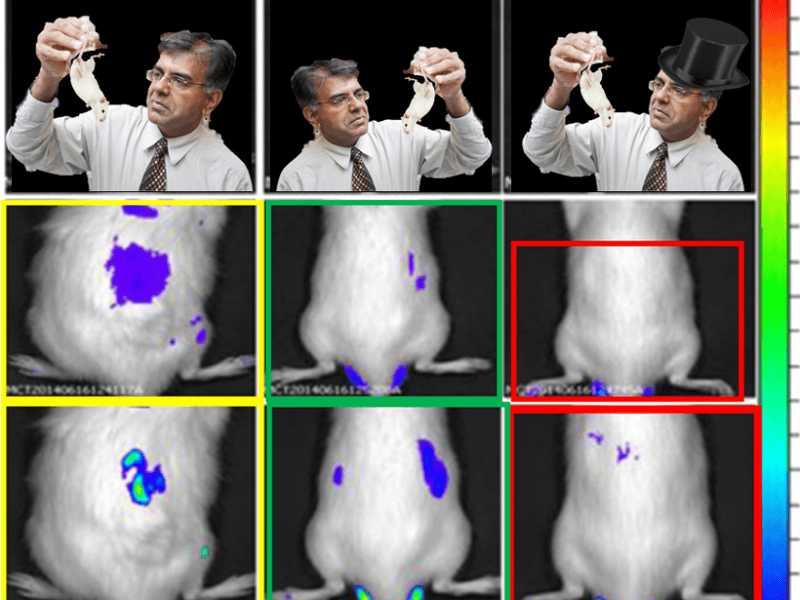
Mansoor Amiji: rare gem and modern-day polymath
“Again, none of the images are duplicated”, Mansoor Amiji, inventor

This paper was published in the Official Journal of the Controlled Release Society, which in 2013 honoured Khademhosseini with their Young Investigator Award:
Danial Barati , Seyed Ramin Pajoum Shariati , Seyedsina Moeinzadeh , Juan M. Melero-Martin, Ali Khademhosseini, Esmaiel Jabbari Spatiotemporal release of BMP-2 and VEGF enhances osteogenic and vasculogenic differentiation of human mesenchymal stem cells and endothelial colony-forming cells co-encapsulated in a patterned hydrogel Journal of Controlled Release (2016) doi: 10.1016/j.jconrel.2015.12.031

Red boxes: A band in the b-actin panel of Figure 3e looks very similar to a band in the b-actin panel of Figure 5c, representing a different sample
Bands have very eclectic shapes, as if little bumps have been added to the bands
Blue arrows: several features in the backgrounds of both CD31 and b-actin panels look remarkably similar. These include lighter areas and vertical stripes between some bands.”

Large yellow boxes: The day 4/BMP2/VEGF and day 4/NG-BMP2/NG-VEGF panels appear to contain an overlap, with a 90 degree rotation.
All panels contain repetitive areas as shown with boxes of the same color and shape.
I did only mark a fraction – there are many more repeats.”
In November 2025, an Expression of Concern, was published, informing us that “The Editor-in-Chief of the Journal of Controlled Release began an investigation in response to the reader Elisabeth Bik,” and:
“ While the original blots are no longer available, because of the university’s data retention policy, the authors stated that they are in the process of repeating some experiments to further validate their findings. After careful deliberation, the editorial team has concluded that while additional clarification is needed, the concerns pertaining to figs. 3, 4, and 5 which remain outstanding are unlikely to impact the wider conclusions of the article. […] The journal remains committed to maintaining the integrity of the scientific record and will update this notice should further information become available.”
On 20 June 2026, the Editor-in-Chief Stefaan De Smedt of Ghent University in Belgium, issued this Editor’ Note to announce his final decision:
“Based on the material available to the journal the Editor was not able to come to a conclusive decision about the article’s findings. Because original source images are unavailable and additional experimental verification was not provided, the journal is unable to fully resolve the outstanding image integrity questions for the specific figure panels that prompted the Expression of Concern. However, the Editor does not have sufficient evidence to retract the article.
Accordingly, the journal is concluding its investigation […] If further information becomes available that materially affects this assessment, the journal will consider whether additional action is required to correct the scholarly record, in line with COPE guidance.”

USERN-friendly Nobelists
Nobel Prize laureates and predatory conferences – why such mutual attraction?
But then, someone must have sufficiently shamed the editor De Smedt, and some time in October 2026, he issued this massive retraction:
“This article has been retracted at the request of the Editor-in-Chief.
An Expression of Concern (https://doi.org/10.1016/j.jconrel.2025.114458) and Editor’s Note (https://doi.org/10.1016/j.jconrel.2026.115041) were previously published for this article. This retraction supersedes these prior notices.
Post-publication, an investigation was conducted on behalf of the journal by Elsevier’s Research Integrity & Publishing Ethics team after concerns were raised on PubPeer regarding this article, described here: https://pubpeer.com/publications/981C24DC8085D84FAA610B07741F59
The concerns relate to the authenticity of the following figure panels, which appear to depict the same source image, but are described as representing different experimental samples:
- •Figure 3 Panel E (β-Actin, lane 4, NG(10)-BMP+NG(21)-VEGF/d4) and Figure 5 Panel C (β-Actin, lane 4, upper panel)
Furthermore, concerns relating to the authenticity of the following figure panels were identified, which appear to show visual indicators of possible image overlay within the same panel:
- •Figure 4 Panel G (None – Day 4)
- •Figure 4 Panel G (None – Day 21)
- •Figure 4 Panel G (NG-BMP2/NG-VEGF – Day 21)
And finally, concerns relating to the authenticity of the following figure panels were identified, which appear to share an overlapping region indicating that they depict the same source image, but are described as representing different experimental samples:
- •Figure 4 Panel G (None – Day 4) and Figure 4 Panel G (NG-BMP2/NG-VEGF – Day 4)
- •Figure 4 Panel G (None – Day 4) and Figure 4 Panel G (BMP2/VEGF – Day 4)
- •Figure 4 Panel G (NG-BMP2/NG-VEGF – Day 4) and Figure 4 Panel G (None – Day 21)
- •Figure 4 Panel G (BMP2/VEGF – Day 4) and Figure 4 Panel G (None – Day 21)
- •Figure 4 Panel G (BMP2/VEGF – Day 4) and Figure 4 Panel G (NG-BMP2/NG-VEGF – Day 4)
- •Figure 4 Panel G (BMP2/VEGF – Day 4) and Figure 4 Panel G (BMP2/VEGF – Day 21)
- •Figure 4 Panel G (BMP2/VEGF – Day 4) and Figure 4 Panel G (NG-BMP2/NG-VEGF – Day 21)
- •Figure 4 Panel G (BMP2/VEGF – Day 21) and Figure 4 Panel G (None – Day 21)
- •Figure 4 Panel G (BMP2/VEGF – Day 21) and Figure 4 Panel G (NG-BMP2/NG-VEGF – Day 4)
- •Figure 5 Panel G (BMP2/VEGF – Day 4) and Figure 5 Panel G (None – Day 4)
- •Figure 5 Panel G (BMP2/NG-VEGF – Day 4) and Figure 5 Panel G (BMP2/VEGF – Day 10)
- •Figure 5 Panel G (NG-BMP2/NG-VEGF – Day 4) and Figure 5 Panel G (NG-BMP2/NG-VEGF – Day 4)
The authors were requested to provide comment on these concerns, as well as the original unprocessed image files to aid investigation, but were unable to provide a satisfactory response. Therefore, the Editor-in-Chief has lost confidence in the reliability of results and conclusions of the article and has determined it should be retracted. Authors DB, SM, and EJ disagree with the retraction. Author AK agrees with the retraction.”
Clearly, like with PNAS above, new evidence for additional fraud had to be provided to convince the editor to retract the paper. Elisabeth Bik posted this on PubPeer:

Elisabeth Bik : “Close analysis of Figure 5g brings concerns to light, some of which were mentioned in the retraction notice – and more.
Several smaller and larger areas appear to be present multiple times within the same panel, or between panels. Contrast enhanced to bring out the dark blue staining. I did not mark them all.”
As mentioned, that was only a third retraction for Khademhosseini, despite almost 100 papers on PubPeer. Yet his Persian friends do not enjoy the same protection, no MIT God is phoning every editor and publisher to save them from retractions.
Call me Esmaiel!
Now we arrived to the last author on the above retraction: Esmaiel Jabbari, professor at University of South Carolina in USA. He has a very nasty PubPeer record which rivals that of his friend Khademhosseini. And there are more retractions, currently six in total in fact.
Let us start with a set of four papers, one of them in Journal of Controlled Release, all four sharing same image for different experiments:
- Angel E. Mercado , Esmaiel Jabbari Effect of encapsulation or grafting on release kinetics of recombinant human bone morphogenetic protein‐2 from self‐assembled poly(lactide‐co‐glycolide ethylene oxide fumarate) nanoparticles Microscopy Research and Technique (2010) doi: 10.1002/jemt.20846
- Angel E. Mercado , Junyu Ma , Xuezhong He , Esmaiel Jabbari Release characteristics and osteogenic activity of recombinant human bone morphogenetic protein-2 grafted to novel self-assembled poly(lactide-co-glycolide fumarate) nanoparticles Journal of Controlled Release (2009) doi: 10.1016/j.jconrel.2009.08.009
- Xuezhong He , Junyu Ma , Angel E. Mercado , Weijie Xu , Esmaiel Jabbari Cytotoxicity of Paclitaxel in Biodegradable Self-Assembled Core-Shell Poly(Lactide-Co-Glycolide Ethylene Oxide Fumarate) Nanoparticles Pharmaceutical Research (2008) doi: 10.1007/s11095-007-9513-z
- Angel E Mercado , Xuezhong He , Weijie Xu , Esmaiel Jabbari The release characteristics of a model protein from self-assembled succinimide-terminated poly(lactide-co-glycolide ethylene oxide fumarate) nanoparticles Nanotechnology (2008) doi: 10.1088/0957-4484/19/32/325609

The 2010 study in Wiley’s Microscopy Research and Technique was retracted on 23 April 2026:
“The retraction has been agreed upon following concerns raised by a third party. An investigation identified duplication of the inset image included in Figure 4 with another previously published article, as well as duplication of Figures 6A and 6B in three other earlier articles by overlapping authors, without disclosure of reuse. Furthermore, the images in Figures 6A and 6B are described differently in some of the earlier articles, raising concerns affecting the interpretation of the results. The editors consider the results and conclusions to be unreliable. The authors disagree with the retraction.”

MIT review closed and decision final
“MIT’s receipt and review of allegations of possible research misconduct by my office are treated as confidential under MIT and, to the extent applicable, federal policies. MIT does not intend to disclose its receipt and review of these allegations to others. By the same token, you therefore may not disclose to others that you brought…

However, the 2009 study in the Journal of Controlled Release, which suffered from the same problem, received on 17 June 2026 only an Expression of Concern:
“Concerns have been raised regarding the integrity of scanning electron microscopy (SEM) images presented in Figure 3 of the article. Specifically, certain images appear to be highly similar to images published in other articles with shared authors. The concerns are listed here: https://pubpeer.com/publications/5B868437C8D323274819F1598D3014?utm_source=Chrome&utm_medium=BrowserExtension&utm_campaign=Chrome The corresponding author has provided an explanation attributing the reuse of images to the use of representative morphological data derived from experiments conducted under similar conditions. Replacement images and supporting metadata have also been supplied. However, the Editor has decided that the explanation provided does not fully resolve the concerns, particularly given:
- the reuse of similar images across multiple publications;
- uncertainties regarding the provenance and verification of replacement images, given the age of the study; and
- the inability to contact all co-authors.
The Editor has found the explanation provided by the authors, and the supporting evidence, to be inconclusive and has determined that an Expression of Concern is the most appropriate course of action to alert readers to these issues.”
Again, the editor De Smedt didn’t see not enough fraud for a retraction, apparently at this journal at least four figures must be completely fraudulent before a retraction is even considered. By the way, De Smedt is a collaborator of Sabine Szunerits….

See no evil, speak no evil, hear no evil
Félix Sauvage tells how he blew the whistle on his collaborator: Sabine Szunerits

Now, another Jabbari retraction, featuring his former PhD student and first author on the retracted Khademhosseini paper above, Danial Barati:
Danial Barati , Ozan Karaman , Seyedsina Moeinzadeh , Safaa Kader , Esmaiel Jabbari Material and regenerative properties of an osteon-mimetic cortical bone-like scaffold Regenerative Biomaterials (2019) doi: 10.1093/rb/rbz008


The Retraction from 29 April 2026 went:
“In January 2026, a reader alerted the Editors to similarities between a number of the images presented in the article and those published by the same author group in Langmuir in 2015 and Biomacromolecules in 2019. These concerns were also raised via PubPeer […]
The Editors contacted the corresponding author who explained that the paper had been published seven years ago and they were unable to retrieve the raw images of Figure 2A and Figure 7D.
The Editors investigated the concerns raised and have decided to retract this paper because the image duplication described above, and the authors’ inability to supply the raw images, undermine their confidence in the results and conclusions reported in the paper. “
You really must see these other two papers, and those are neither retracted nor corrected, at least not yet. Here is one, in Elsevier, Barati is first author:
Danial Barati , Joshua D. Walters , Seyed Ramin Pajoum Shariati , Seyedsina Moeinzadeh , Esmaiel Jabbari Effect of Organic Acids on Calcium Phosphate Nucleation and Osteogenic Differentiation of Human Mesenchymal Stem Cells on Peptide Functionalized Nanofibers Langmuir (2015) doi: 10.1021/acs.langmuir.5b00615


And here the other one, in an ACS journal, Barati is among the authors, Safaa Kader is instructor at University of South Carolina, the hapless Thomas Makris is associate professor at North Carolina State University:
Safaa Kader , Mehri Monavarian , Danial Barati , Seyedsina Moeinzadeh , Thomas M. Makris , Esmaiel Jabbari Plasmin-Cleavable Nanoparticles for On-Demand Release of Morphogens in Vascularized Osteogenesis Biomacromolecules (2019) doi: 10.1021/acs.biomac.9b00532


And that paper shares data with another study by Jabbari and Kader in MDPI:
Safaa Kader , Esmaiel Jabbari Material Properties and Cell Compatibility of Photo-Crosslinked Sericin Urethane Methacryloyl Hydrogel Gels (2022) doi: 10.3390/gels8090543

Degenerative medicine is clearly attracts the best scholars. Also this was retracted, featuring the Harvard professor Juan Melero-Martin, who just has bad luck: he is also on the above discussed retracted paper with Khademhosseini. The first author Seyedsina Moeinzadeh is currently innovating at Stanford.
Seyedsina Moeinzadeh , Seyed Ramin Pajoum Shariati , Safaa Kader , Juan M Melero-Martin , Esmaiel Jabbari Devitalized Stem Cell Microsheets for Sustainable Release of Osteogenic and Vasculogenic Growth Factors and Regulation of Anti-Inflammatory Immune Response Advanced Biosystems (2017) doi: 10.1002/adbi.201600011


Seyedsina Moeinzadeh , Seyed Ramin Pajoum Shariati , Esmaiel Jabbari Comparative effect of physicomechanical and biomolecular cues on zone-specific chondrogenic differentiation of mesenchymal stem cells Biomaterials (2016) doi: 10.1016/j.biomaterials.2016.03.034
The retraction from 9 July 2026 went:
“The retraction has been agreed upon following concerns raised by a third party. A subsequent investigation identified abnormalities in the western blot presented in Figure 6e, such that the background in each panel is unusually similar and deviates from typical experimental results. Further concerns were noted regarding the flow cytometry data shown in Figure 8, where similar clusters were observed across the plots. The authors cooperated with the investigation but were unable to provide any acceptable raw data; they supplied some numerical data and TIFF images depicting the flow cytometry plots. They also acknowledged that the western blot images were constructed by cutting and pasting the bands onto the same background. The data and explanations provided were not sufficient to restore confidence in the results; therefore, the editors consider the results and conclusions to be unreliable. The authors disagree with the retraction.”

The Kingdom of Rui Reis
“I think this story shows the debacle and corruption of entire research fields that become just a very expensive show of bad science-fiction. ” – Carabus Maleki

The authors admitted to fraud with published and with raw data, but they still disagree with retraction. Of course.
This went pop also, the first author Ozan Karaman is now associate professor at Izmir Katip Celebi University in Turkey:
Ozan Karaman , Ankur Kumar , Seyedsina Moeinzadeh , Xuezhong He , Tong Cui , Esmaiel Jabbari Effect of surface modification of nanofibres with glutamic acid peptide on calcium phosphate nucleation and osteogenic differentiation of marrow stromal cells Journal of Tissue Engineering and Regenerative Medicine (2016) doi: 10.1002/term.1775


Here is the Retraction from 26 June 2026:
“The above article […] has been retracted by John Wiley & Sons, Ltd, following concerns raised by a third party. An investigation identified several instances of duplication of elements within Figures 5 and 8. The authors cooperated with the investigation; however, due to the time elapsed since publication, they were unable to provide the original raw data. While some supporting data were provided, this was not sufficient to restore confidence in the article’s results and conclusions. Therefore, the publisher considers this article unreliable. The authors disagree with the retraction.”
Here Jabbari, then 54 years old, appointed himself as first author, presumably so that Moeinzadeh could apply for a faculty position:
Esmaiel Jabbari, Samaneh K. Sarvestani , Leily Daneshian , Seyedsina Moeinzadeh Optimum 3D Matrix Stiffness for Maintenance of Cancer Stem Cells Is Dependent on Tissue Origin of Cancer Cells PLOS One (2015) doi: 10.1371/journal.pone.0132377


Xiaoming Yang , Samaneh K. Sarvestani , Seyedsina Moeinzadeh , Xuezhong He , Esmaiel Jabbari Three-dimensional-engineered matrix to study cancer stem cells and tumorsphere formation: effect of matrix modulus Tissue Engineering Part A (2013) doi: 10.1089/ten.tea.2012.0333
Here the retraction from 28 May 2026, citing some unhinged stuff by the corresponding author Jabbari:
“After this article [1] was published, concerns were raised regarding results presented in Fig 1, and Figs 3-5.
Specifically:
- There appear to be repetitive areas within the Fig 1A 0.6 M Day 9 panel.
- There appear to be similarities between parts of the following panels:
- ◦ Figs 3D and 3E.
- ◦ Figs 3G and 3H.
- ◦ Figs 3I and 3J of this article, and Fig 5 14d 4T1-2.5 kPa in [2].
- ◦ Fig 3K of this article, Fig 5 5d 4T1-2.5 kPa in [2], Fig 5 5d 4T1-5.3 kPa in [2], Fig 5 8d 4T1-5.3 kPa in [2], and Fig 5 11d 4T1-2.5 kPa in [2].
- The Figs 4A and 4C panels appear more similar than expected from independent results.
- In Fig 5A, multiple panels show regions that appear discontinuous with the rest of the image directly surrounding these regions.
Regarding the above concerns for Figs 1A, 3D-3E, and 3G-3K, the corresponding author stated that the observed similar fluorescent features reflect expected underlying morphological uniformity of the cells and tumorspheres formed in the PEGDA matrix under controlled culture conditions and imaged using standardized fluorescence microscopy settings. Regarding the FACS panels in Figs 4A and 4C, the corresponding author stated that these plots share similar distribution patterns consistent with CD44 and CD24 expression under comparable culture conditions. The corresponding author provided incomplete image data underlying Figs 1 and 3-5. Upon editorial review, the data and responses provided did not resolve the above concerns.
In light of the above concerns that question the reliability and integrity of the reported results, the PLOS One Editors retract this article.
All authors did not agree with the retraction and stand by the article’s findings.”
Yes, Jabbari is as fake as a 25 Dollar bill. This however was corrected by MDPI, Azadeh Sepahvandi is another instructor at University of South Carolina:
Esmaiel Jabbari, Azadeh Sepahvandi Decellularized Articular Cartilage Microgels as Microcarriers for Expansion of Mesenchymal Stem Cells Gels (2022) doi: 10.3390/gels8030148


The preprint version of the article features these duplications and more.”

One wonders: did MDPI notice the duplications we see in the preprint, and asked the authors to “fix” them, but then missed some smaller duplications? There was a huge Correction on 6 July 2026 to explain the nonsensical Figure 1, and the authors had to add back the preprint authors, the aforementioned Kader and Victor Madormo, then an undergraduate student at University of South Carolina:
“In the original publication [1], three contributors listed as authors in the BioRxiv preprint version were not included in the published article. As a result, Safaa Ibrahim Kader and Victor Anthony Madormo have been added to the list of authors. The third individual was contacted and given the opportunity to be included as an author but declined authorship.
Accordingly, the author list has been corrected as follows:
Esmaiel Jabbari 1,*, Azadeh Sepahvandi 1, Safaa Ibrahim Kader 1,2 and Victor Anthony Madormo 1“
Indeed, the bioRxiv preprint had five authors, but Mehri Monavarian chose a new life in Stanford without these freaks.

Jabbari and Khademhosseini, a book with a predatory publisher.
This won’t be retracted, because it is in ACS and they don’t believe in retractions or research fraud there. We meet the same gang, including Barati, the coauthor Roger Sawyer was until his retirement trustee professor and Executive Dean and Head of Faculty at University of South Carolina.
Danial Barati , Safaa Kader , Seyed Ramin Pajoum Shariati , Seyedsina Moeinzadeh , Roger H. Sawyer , Esmaiel Jabbari Synthesis and Characterization of Photo-Cross-Linkable Keratin Hydrogels for Stem Cell Encapsulation Biomacromolecules (2017) doi: 10.1021/acs.biomac.6b01493


In case you are still unsure whom to blame with so many dodgy Persians – here we have only one author to blame:
Esmaiel Jabbari Targeted Delivery with Peptidomimetic Conjugated Self-Assembled Nanoparticles Pharmaceutical Research (2009) doi: 10.1007/s11095-008-9802-1

Reese Richardson: “There are unexpected duplications within Figure 2B (see colored boxes”
Again, there’s more awful stuff for Jabbari on PubPeer, most recently Elisabeth Bik joined the treasure hunt:
Xiaoming Yang , Samaneh K. Sarvestani , Seyedsina Moeinzadeh , Xuezhong He , Esmaiel Jabbari Effect of CD44 binding peptide conjugated to an engineered inert matrix on maintenance of breast cancer stem cells and tumorsphere formation PLOS One (2013) doi: 10.1371/journal.pone.0059147

An interesting fact: after 2016, Jabbari received no public research grant money from NSF or NIH, and the grants prior to that were always rather modest. It looks like Jabbari had no money to do actual research, but this didn’t stop his creativity. Still, compare to Khademhosseini who was constantly showered with R01 grants until 2021, when he was already at Terasaki Institute.
A question arises: what did Khademhosseini do with all that American research grant money he was given? Obviously he also didn’t do any actual research either.
Safer Sex with Cowboy Yan
“Hongji Yan presented four different versions of Figure 9 in the article and during the investigation as the “correct” figure. One version was published in the original article, one version was sent to the journal and published as a correction, and two more versions were shared with the Board”
Stanford Shame
We will now return to Danial Barati, who after his PhD with Jabbari first went for postdoc to Stanford University and after some pharma industry jobs (including his own consulting business), ended up as senior scientist at Johnson & Johnson.
Barati’s postdoctoral research at Stanford in the lab of the associate professor Fan Yang also ended up in a retraction now:
Danial Barati, Kira Watkins, Zhibin Wang , Fan Yang Injectable and Crosslinkable PLGA‐Based Microribbons as 3D Macroporous Stem Cell Niche Small (2020) doi: 10.1002/smll.201905820


The retraction arrived on 3 November 2026:
“The retraction was agreed upon following concerns raised by a third party. An investigation identified several overlaps between the panels presented in Figures 5a and 5b. Additionally, multiple duplications were observed within the panels of Figure 6. Finally, in Figure S2, the panels labelled as 10 µm and 20 µm PLGA appear to show the same image, with the 20 µm panel presented at higher magnification, despite the caption indicating that the panels represented different samples. The authors were contacted multiple times for their comments and supporting data but did not respond. The editors consider the results and conclusions unreliable. The authors did not respond to the retraction notice.”
This sounds like Yang won’t be chasing the editors to retract this paper also:
Danial Barati , Courtney Gegg , Fan Yang Nanoparticle-Mediated TGF-β Release from Microribbon-Based Hydrogels Accelerates Stem Cell-Based Cartilage Formation In Vivo Annals of Biomedical Engineering (2020) doi: 10.1007/s10439-020-02522-z

Reese Richardson: “Some of the images in Figure 4C show the same sample despite representing different experiments”
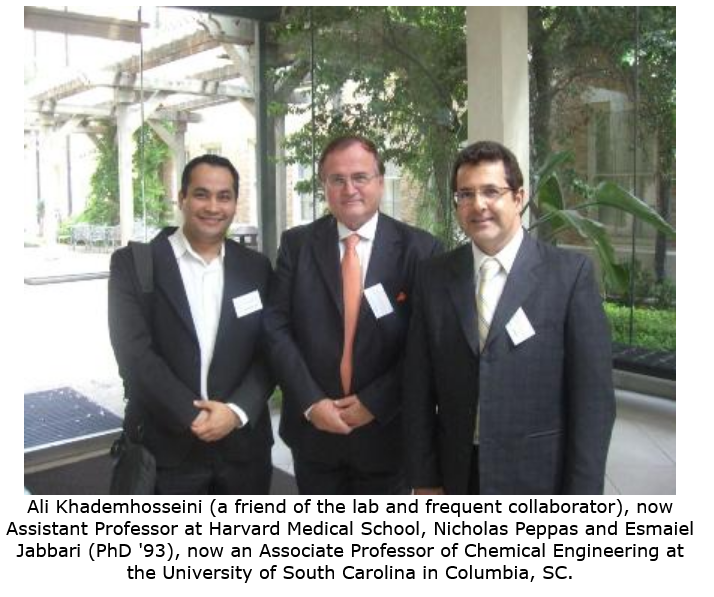
By the way, Khademhosseini and Jabbari are friends with yet another American bigwig: Nicholas Peppas is a professor at the University of Texas at Austin. Ali is Nick’s friend and Esmaiel is Nick’s former PhD student. Here they are at Peppas’s 60th birthday party in 2008, which featured “La Boheme Grec: An Opera Libretto” sung by Michael Sefton (professor at the University of Toronto) and “Dr. Peppas Through the Eyes of an Undergrad: Poem by Natalie Wisniewski“. Langer was also there.
On LinkedIn, Jabbari is currently reposting every self-indulging post by Peppas. Which looks pathetic, but I understand it: Peppas is Jabbari’s only hope now.
Barati will probably continue with his career in Big Pharma. Jabbari is 65, most likely the University of South Carolina will retire him soon, or maybe they already did. Khademhosseini is only 51, he will keep bullshitting investors about growing human organs and beef burgers, and stuff his pockets with their stupid money.
Donate!
If you are interested to support my work, you can leave here a small tip of $5. Or several of small tips, just increase the amount as you like (2x=€10; 5x=€25). Your generous patronage of my journalism will be most appreciated!
€5.00


0 comments on “Princes of Persia”