
The Swedish National Board for Assessment of Research Misconduct (NPOF) found Diana Spiegelberg, researcher and docent at the University of Uppsala, guilty of research misconduct. Her coauthors, including her PhD mentor and lab head Bo Stenerlöw, were however declared only to have acted negligently.
Spiegelberg works at the Department of Immunology, Genetics and Pathology; for the programme Cancer Precision Medicine. The group hosts one more full professor, two associate professors and some researchers, Spiegelberg is one of them. Possibly not for long.
The data forgery was uncovered by Sholto David, I notified NPOF following on 30 May 2025, before my reporting in June 2025 Shorts, and now the investigation ended. This is the NPOF report, dated 4 September 2026 and sent to me on 21 September:
As usual, I used online machine tools (Google and DeepL) to translate it. The summary:
“The Board for the Investigation of Research Misconduct (hereinafter ‘the Board’) has decided that Diana Spiegelberg is guilty of research misconduct.
The Board has decided that Hanna Berglund, Mehran Hariri, David P Lane, Sara Lundsten, Christer Malmberg, Patrick Micke, Tabassom Mohajershojal, Anja CL Mortensen, Marika Nestor, Elftherios Papalanis, Bo Stenerlöw and Julia Uffenorde have not been found guilty of research misconduct.”
Marika Nestor is Chair of the Cancer Precision Medicine program and former co-supervisor of Spiegelberg’s thesis. Christer Malmberg is research engineer in the same department in Uppsala and clearly Spiegelberg’s husband or life partner, because they are registered at the same household.
These were the investigated papers, I numbered them as NPOF did:
- Julia Uffenorde , Mehran Hariri , Eleftherios Papalanis , Annika Staffas , Josefine Berg , Bo Stenerlöw , Hanna Berglund, Christer Malmberg , Diana Spiegelberg Enhancing glioblastoma therapy: unveiling synergistic anticancer effects of Onalespib – radiotherapy combination therapy Frontiers in Oncology (2025) doi: 10.3389/fonc.2025.1451156

Sholto David: “Figure 2D: 10nm condition is very similar to the control after rotation and resizing.”
Spiegelberg commented on PubPeer in June 2025 that these “representative images in Figure 2D are included solely to illustrate typical colony morphology” and “are not intended to support any conclusions beyond those shown in the corresponding graph“. She explained that the duplication arose because she and her coauthors “relied on handheld mobile phone photography, which made it difficult to maintain consistent magnification and orientation“., and lamented that this “oversight was unfortunately missed by us, the reviewers, and the journal’s image screening tools“. Naturally, the mistake “does not affect the validity of the data or conclusions“, a correction was announced and published on 26 March 2026:
“There was a mistake in Figure 2D as published, where the representative images for U87 MG under the control and 10 nM Onalespib conditions were not accurately displayed. […]
There was a mistake in the caption of Figure 2 as published. The name of the cell line U343 MG was incorrectly spelled as “U434 MG and U34mg”.”

NPOF however decided “that Figure 2D in Article 1 is falsified, as two incorrect images are shown and the correct images are not shown, which means that results have been altered and omitted without justification“. Spiegelberg was named as the one who “created” the forged figures and thus chiefly responsible.
“They happened before I joined Uppsala University”
“There are therefore grounds for suspecting that there have been such serious deviations from good research practice that the matter should be referred to the National Board for Assessment of Research Misconduct for further investigation.”

Paper Nr 2, also here it was determined that Spiegelberg alone “created the falsified figure“:
- Anja Charlotte Lundgren Mortensen, Hanna Berglund , Mehran Hariri , Eleftherios Papalanis , Christer Malmberg , Diana Spiegelberg Combination therapy of tyrosine kinase inhibitor sorafenib with the HSP90 inhibitor onalespib as a novel treatment regimen for thyroid cancer Scientific Reports (2023) doi: 10.1038/s41598-023-43486-z

On PubPeer, Spiegelberg assured that “These images are only added as representative illustration“, and determined “the root cause to be the use of copy-paste during the figure layout work“, during which “the images were re-arranged and in one case flipped and in one case rotated for aesthetic reasons, as the rotation and direction of these images do not alter the interpretation“. Again, this “mistake was unfortunately missed by us and the reviewers, as well as the image duplication detection processes used by the journal.” A Correction was swiftly published on 29 July 2025, where four images were exchanged:
“The original version of this Article contained an error in Figure 3, where due to a mix-up in labelling the results, the 0 h untreated images for MDA-T32 were duplicated and rearranged from the BHT-101 images shown in Figure 3A, which led to incorrect results shown in Figure 3D. The original Figure 3 and accompanying legend appear below.”
NPOF however decided “that Figure 3D in Article 2 is falsified” and that “the incorrectly stated doses of sorafenib in Figure 3D of Article 2 constitute falsification, as eight incorrect doses are stated and the correct doses are not stated, which means that data has been altered and omitted without justification.” Spiegelberg was the one who “moved the images around and rotated and flipped them” and “drew dotted lines on top of the photographs“, she is therefore guilty of “gross negligence“.

Swedish rector Anders Hagfeldt pronounced innocent of papermilling
“The board’s conclusion is therefore that the deviations regarding figure 2b and 2c in article 1 constitute serious deviations from good research practice”
The third paper had similar issues as the first, and again NPOF found that the duplication “was the result of negligence on the part of Diana Spiegelberg“:
- Anja Charlotte Lundgren Mortensen, Tabassom Mohajershojai , Mehran Hariri , Marika Pettersson , Diana Spiegelberg Overcoming Limitations of Cisplatin Therapy by Additional Treatment With the HSP90 Inhibitor Onalespib Frontiers in Oncology (2020) doi: 10.3389/fonc.2020.532285

Sholto David: “Figure 3A: One of these images is a magnification of another. I’ve added the red shapes to show where I mean. These should show different treatment conditions.”
Back in June 2025, Spiegelberg posted a similar comment on PubPeer, and specifically blamed the Frontiers AI software: “This mistake was unfortunately missed by us, the reviewers, and the journal’s image duplication screening tools (AIRA).” Also here, a Correction was published on 12 May 2026, which merely briefly stated that “There was a mistake in Figure 3A as published, where the representative image for SKOV3 control was not accurately displayed.“

NPOF however decided “that Figure 3A in Article 3 has been falsified, as an incorrect image is shown and the correct image is not shown, which means that results have been altered and omitted without justification.”
In bed with Hari and Aruna
Hari Shanker & Aruna, a YouTube influencer couple in Sweden. With or without Rudolph the Red-Faced Liar. And with Anca and Dafin, two totally innocent and upright Romanians. Pushing pig brain juice an SS Nazi invented. You won’t find a better story for Christmas!
Paper Nr 4, the last author is Spiegelberg’s PhD thesis co-supervisor and co-boss, Nestor. NPOF decided that Spiegelberg has “created the two forged figures“:
- Diana Spiegelberg, Anja Charlotte Lundgren Mortensen, Kartika Dyah Palupi , Patrick Micke , Julin Wong , Borivoj Vojtesek , David Philip Lane , Marika Nestor The Novel Anti-cMet Antibody seeMet 12 Potentiates Sorafenib Therapy and Radiotherapy in a Colorectal Cancer Model Frontiers in Oncology (2020) doi: 10.3389/fonc.2020.01717


Again, Spiegelberg announced on PubPeer “the root cause to be the use of copy-paste during the figure layout work“, again this “mistake was unfortunately missed by us and the reviewers, as well as the image duplication detection processes used by the journal (AIRA)“, and of course, she and her coauthors “do not consider the conclusions of the paper to be invalidated by this error“. A correction was announced but wasn’t published yet. This is the submitted correction, as shown in the NPOF report:
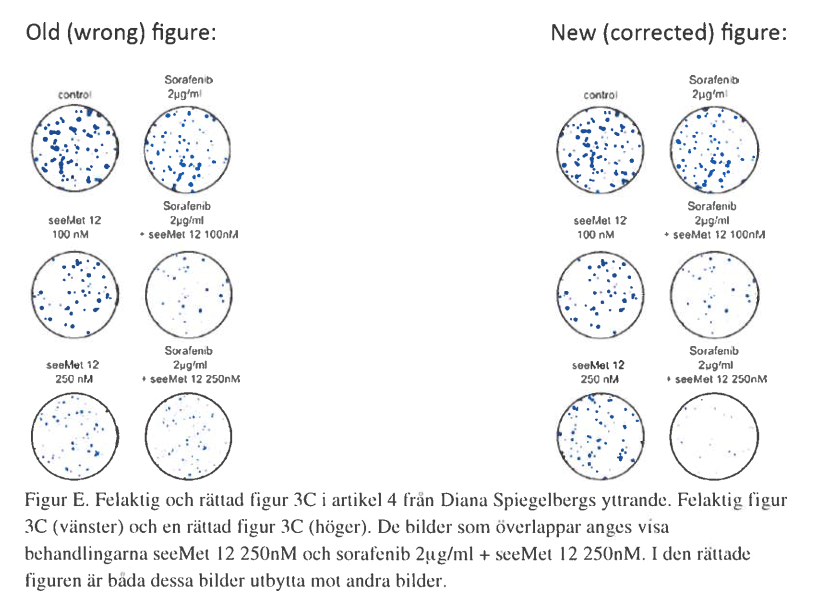
NPOF decided “that Figure 3C in Article 4 is falsified” and “that Figure 2E in Article 4 is falsified because an incorrect image is shown and the correct image is not shown, which means that results have been altered and omitted without justification.“

Leonard and Ada Girnita guilty of research misconduct
“The Board states in conclusion that the research leaders Ada Girnita and Leonard Girnita have a special responsibility for guaranteeing the quality of the research group’s publications and that they have failed to take this responsibility fully.”
This is the final paper and the oldest one, where Spiegelberg “created the two forged figures“:
- Diana Spiegelberg, Anja C. Mortensen, Sara Lundsten , Christopher J. Brown , David P. Lane , Marika Nestor The MDM2/MDMX-p53 Antagonist PM2 Radiosensitizes Wild-Type p53 Tumors Cancer Research (2018) doi: 10.1158/0008-5472.can-18-0440


Back in June 2025, Spiegelberg informed on PubPeer that these “representative images shown in panel C were not used as basis for the analysis; they serve only illustrative purposes to show the spheroid morphology.” The “root cause” was again “copy-paste during the figure layout work, where one image was multiplied to make a grid pattern, followed by using the “replace image” function of the layout software.” Again the blame for missing the duplication lies mostly with “reviewers, as well as the image duplication detection processes used by the journal.”
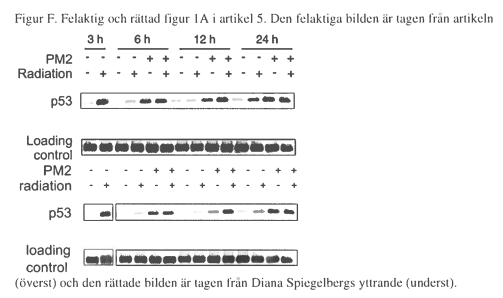
The spliced western blot “arose from a lack of communication within the study team“, where a “composite image, initially prepared for internal presentation due to uneven staining in some replicates, was inadvertently used in the publication, despite the availability of consistent, non-composite replicates showing the same trend.” And anyway: “at the time of publication, it was common to present Western blots as cropped membranes“. Not true, unless she meant “common” among cheaters. On 2 November 2025, an Editor’s Note was published:
“The editors are publishing this note to alert readers to concerns about this article (1). The authors informed the journal that in Fig. 1A, the p53 Western blot was spliced after lane 2 and the incorrect image was used to represent the 3 hours loading control bands. In Fig. 2C, the image used to represent day 14 for 10× PM2 + 3 × 2 Gy was duplicated from the image of day 7 for 3 × 2 Gy. The affected images served as representative visuals selected from larger datasets and the authors located the correct original images for these experiments, which are included in the Supplementary Data for this notice.”
The NPOF report contains Spiegelberg’s proposed corrections, which she also shared on PubPeer:
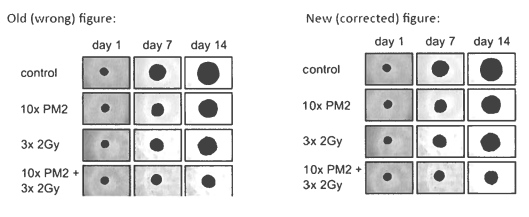
NPOF decided “that Figure 2C in Article 5 has been falsified“, and regarding the western blot:
“Figure 1A in Article 5 has been falsified, as it shows two incorrect bands and omits the correct band, which means that results have been altered and omitted without justification. The Board considers that the fact that the researchers have combined p53 bands from different experiments and presented them as if they came from the same experiment constitutes manipulation of the results, which amounts to falsification”
In this case, Spiegelberg was again found guilty of “gross negligence“.
Omer Nour and Magnus Willander guilty of research misconduct
“The Board assesses that there are no scientifically acceptable explanations for why the notified researchers have fabricated research results in the manner that has occurred in the notified articles. Raw data also does not support the reported results. [..] In summary, the Board finds therefore that the notified researchers have been guilty of misconduct in…
Spiegelberg’s coauthors (except Patrick Micke, who only contributed some immunohistochemistry data and was otherwise not involved) all denied that their own responsibility and that any research fraud happened, by anyone, they also all agreed with Spiegelberg’s explanations. This was Spiegelberg’s testimony to NPOF:
“She and her colleagues found no evidence that the data had been deliberately manipulated. All the correct images are in their archive, and the images at the centre of the allegations do not affect the results or conclusions.
The discrepancies are the result of inadequate image-handling procedures rather than deliberate actions. At the time, their review process was not rigorous enough to detect these errors. She and the other co-authors fully acknowledge these shortcomings in their processes.
In principle, the image errors require specialised software to be detected. At the time these publications were being prepared, validation software and AI-assisted tools were not widely available.
The discrepancies described in the allegations were all oversights and mistakes made without any intention to mislead; therefore, she does not consider them to constitute falsification.”
Basically, you cannot blame scientists for fake data in their papers if these scientists do not have the advanced “validation software and AI-assisted tools” to find the irregularities they themselves have introduced. If your brain hurts from this, be also aware that Sholto found these issues by eye, without any tools.
NPOF disagreed:
“The arguments put forward by the researchers involved in the Board’s review – that all errors have been corrected and that none of the errors has affected the results or conclusions of the articles – do not alter the Board’s assessment. It is the Board’s view that research misconduct can occur at any stage of the research process and that there is no requirement for the results or the findings of the research to have been affected. Furthermore, the incorrect images constitute precisely those research results which the authors themselves considered important enough to be presented in scientific articles.”
I love this argument, if only universities would follow it.
The Misunderstanding of Henrik Thorlacius
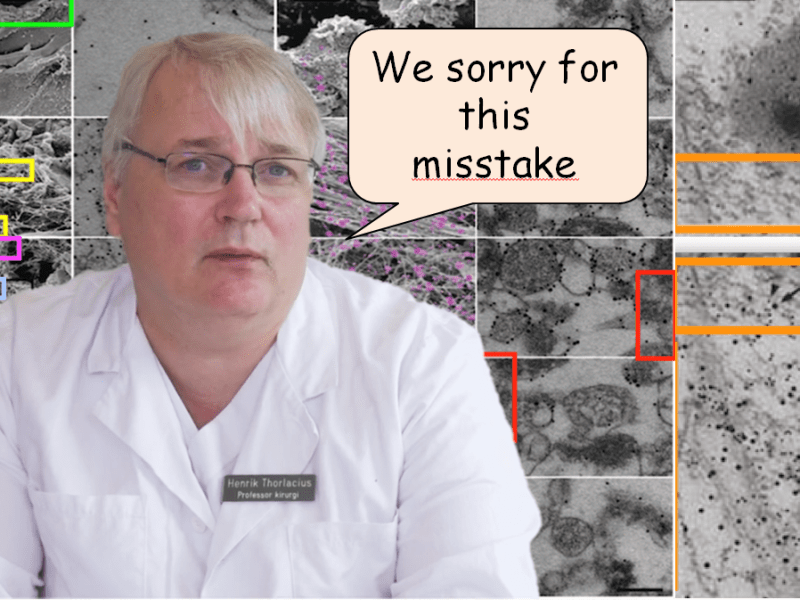
“Potential repetitive areas presumably arise from the residual bulk image (RBI) phenomenon of the CCD camera, in which structures may be digitally repeated due to charge residues in the camera wafer.”
For all these five publication it was determined:
“In summary, the Board finds that Diana Spiegelberg is guilty of research misconduct. […]
The Board considers that, in the research in question, there may have been other deviations from good research practice other than research misconduct. The allegations concern systematic shortcomings in data management in articles 1–5.”
Other authors were found to be merely negligent, which doesn’t constitute research misconduct.
Another paper was flagged by the pseudonymous sleuth Claire Francis while NPOF was investigating. Luckily for all involved, it is already 11 years old and thus outside NPOF’s statute of limitation (which is ten years):
Diana Spiegelberg, Adrian Dascalu , Anja C. Mortensen , Andris Abramenkovs , Gamze Kuku , Marika Nestor , Bo Stenerlöw The novel HSP90 inhibitor AT13387 potentiates radiation effects in squamous cell carcinoma and adenocarcinoma cells Oncotarget (2015) doi: 10.18632/oncotarget.5363

All this cancer research fraud helped Spiegelberg to get funded by the Swedish Cancer Foundation and the Childhood Cancer Foundation. She is seeking to find therapies for paediatric cancer, and said that she “found some good candidates, especially substances developed for other cancer types and that are close to being approved for clinical use“. And now these misconduct findings, who will save the children now…
Back in June 2025, Spiegelberg wrote to me:
“We appreciate that these issues have been identified, as we recognize how crucial it is, especially in today’s climate of misinformation and “fake news”, to uphold solid, transparent, and trustworthy science. Only through rigorous, evidence-based research can we maintain public trust and continue to advance knowledge effectively.“
In all of her PubPeer replies and her email to me, Spiegelberg also promised:
“A review group, comprising co-authors and advisors not directly involved in the project, will now examine all data and figures prior to submission. As part of this step, we will use AI-based tools such as Proofig/Figcheck to screen for potential image duplications before submitting manuscripts for publication.“
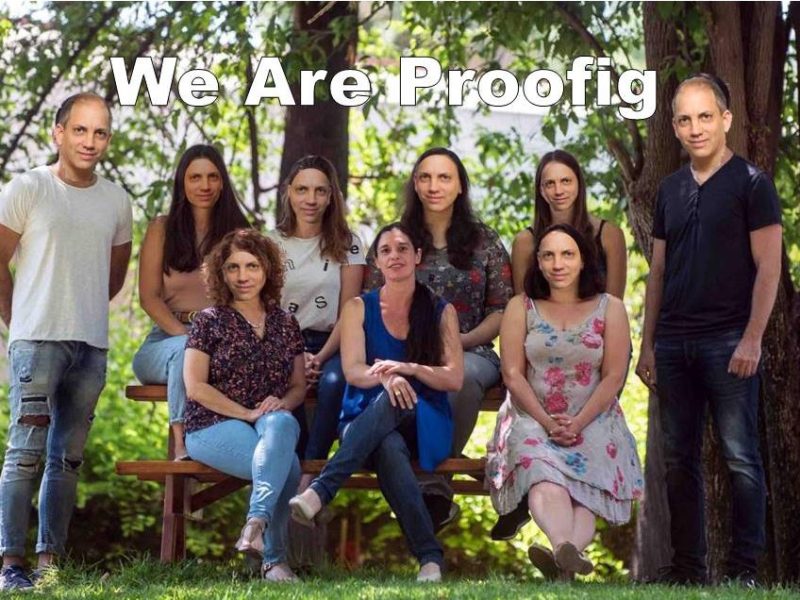
Proofig – the Kolodkin-Gal family business
“Don’t let online controversies and aggressive blogs easily ruin everything you’ve worked for to build your reputation […] Whether the image issue is innocent or intentional, the outcome is still the same. Bloggers will attack that publication with image issues, which will damage your reputation and may even lead to a costly investigation. We are…
As soon as I received the NPOF report, I wrote to Spiegelberg again. And got this out-of-office reply: “I am currently on sick leave and have limited access to email.“
We can imagine what this means.
Donate!
If you are interested to support my work, you can leave here a small tip of $5. Or several of small tips, just increase the amount as you like (2x=€10; 5x=€25). Your generous patronage of my journalism will be most appreciated!
€5.00


As bad as all scientific fraud is, I am especially appalled by fraud relating to therapy for ill people. The infamous Anil Potti directed his lies towards women with breast cancer, but here we are dealing with a broad array of cancers. Including glioblastoma no less, and children?!? Thank you to the detectives.
LikeLike
On one of this -errors- alone… one could really assume that it is just mislabelling or unintended… could happen to thr best. especially when working under pressure and with older data… or with different ppl. However, this was no one off… so it is evident that these duplications were done on purpose.
LikeLike
Spiegelberg’s bullshit answer to me made perfectly clear that a) it wasn’t a mistake of oversight and b) it wasn’t someone else who did it
LikeLike