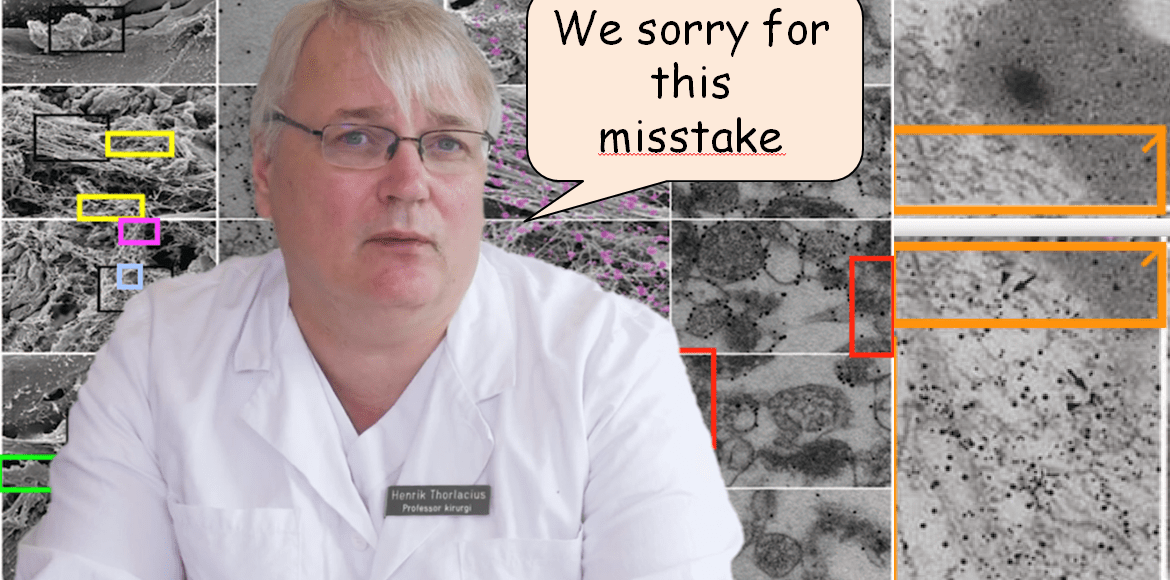

The Swedish cancer researcher Henrik Thorlacius is not only professor of surgery at Lund University and colorectal surgeon at Skåne University Hospital in Malmö, he is also a underappreciated graphic artist and an innocent victim of a misunderstanding.
The story is best told backward, starting with a bizarre retraction notice which was published a few days ago.
This was flagged on PubPeer in April 2023:
Johan Linders , Raed Madhi , Milladur Rahman, Matthias Mörgelin, Sara Regner, Max Brenner, Ping Wang, Henrik Thorlacius Extracellular cold-inducible RNA-binding protein regulates neutrophil extracellular trap formation and tissue damage in acute pancreatitis Laboratory Investigation (2020) doi: 10.1038/s41374-020-0469-5

Elisabeth Bik: “Concerns about Figure 2. Spotted by ImageTwin.
- Cyan boxes: In the top right TEM panel, the same area appears to be visible twice, albeit rotated 180 degrees
- Orange boxes: Two TEM panels representing different treatments appear to overlap, albeit with a 90 degree rotation and the addition or removal of small gold particles.”

The paper was retracted in February 2026, and please do appreciate the notice:
“This article has been retracted at the request of the authors.
It has come to the authors’ attention that Figure 2 in their paper contains overlapping regions in the electron microscopy image. They consulted the microscopist responsible for the images, who provided the following explanation:
“Taurocholate + Vehicle (C) originates from the same specimen as Taurocholate + C23 (C), although from two different experiments. In the Taurocholate + Vehicle condition, the thin sections were first labeled with antibodies and then imaged. In subsequent control experiments, all gold label was stripped from the thin sections by metaperiodate treatment, and, as a control, the same thin sections were relabeled with control antibodies. This accounts for the differing gold patterns in the repetitive areas between Taurocholate + Vehicle (C) and Taurocholate + C23 (C).
Potential repetitive areas within Sham + Vehicle (C) presumably arise from the residual bulk image (RBI) phenomenon of the CCD camera, in which structures may be digitally repeated due to charge residues in the camera wafer.”
Although this explanation appears reasonable, the authors acknowledge that none of them possesses the expertise required to fully assess the matter. Although the conclusions of the paper remain valid and the electron microscopy images served only to support other findings, the authors recognize that the quality of these images does not meet the standards necessary for publication. They therefore believe that retraction of the paper is warranted and express their sincere regret for the situation.
The statement is issued by Johan Linders, Raed Madhi, Milladur Rahman, Matthias Mörgelin, Max Brenner, Ping Wang, and Henrik Thorlacius.
Author Sara Regner could not be reached for comment.”
That deserves a prize for the most shameless piss-taking. In a moment, you will see how shameless Thorlacius’s blaming of a microscopist and “residual bulk image (RBI) phenomenon of the CCD camera” was.

Leonard and Ada Girnita guilty of research misconduct
“The Board states in conclusion that the research leaders Ada Girnita and Leonard Girnita have a special responsibility for guaranteeing the quality of the research group’s publications and that they have failed to take this responsibility fully.”

But now, an earlier retraction for Thorlacius:
Amr A. Al-haidari, Ingvar Syk, Karin Jirström, Henrik Thorlacius CCR4 mediates CCL17 (TARC)-induced migration of human colon cancer cells via RhoA/Rho-kinase signaling International Journal of Colorectal Disease (2013) doi: 10.1007/s00384-013-1712-y

Elisabeth Bik: “Concern about Figure 1.
- Sharp background transitions are visible between the left and right lanes of all panels, suggesting lanes were not run next to each other. This makes it more difficult to know differences in molecular weight or exposure.
- Red arrows: In the CCR6 panel, the left and right lanes look identical, although perhaps stretched a bit differently.”
In April 2023, the first author Amr A. Al-haidari replied on PubPeer with “the original data“, which was presumably fake, since the retraction arrived on 9 June 2023:
“The Editor-in-Chief has retracted this article at the request of the corresponding author. Concerns were raised regarding potential irregularities in Fig. 1. The corresponding author has stated that the original data are no longer available. Amr Al-Haidari, Karin Jirström, and Henrik Thorlacius agree to this retraction. Ingvar Syk has not responded to any correspondence from the editor or publisher about this retraction.”
Gothenburg tries and fails to sack Sumitran-Holgersson, requests 7 retractions
The travesty around the data faking regenerative medicine enthusiast Suchitra Sumitran-Holgersson is finally over. Her Swedish employer University of Gotheburg announced to sack her as university professor. Retractions of 7 papers were requested
This, by Al-Haidary and Thorlacius, was also retracted, the paper was flagged on PubPeer right after its publication:
Amr A. Al-Haidari , Nader Algethami , Mattias Lepsenyi , Milladur Rahman, Ingvar Syk, Henrik Thorlacius Neutrophil extracellular traps promote peritoneal metastasis of colon cancer cells Oncotarget (2019) doi: 10.18632/oncotarget.26664

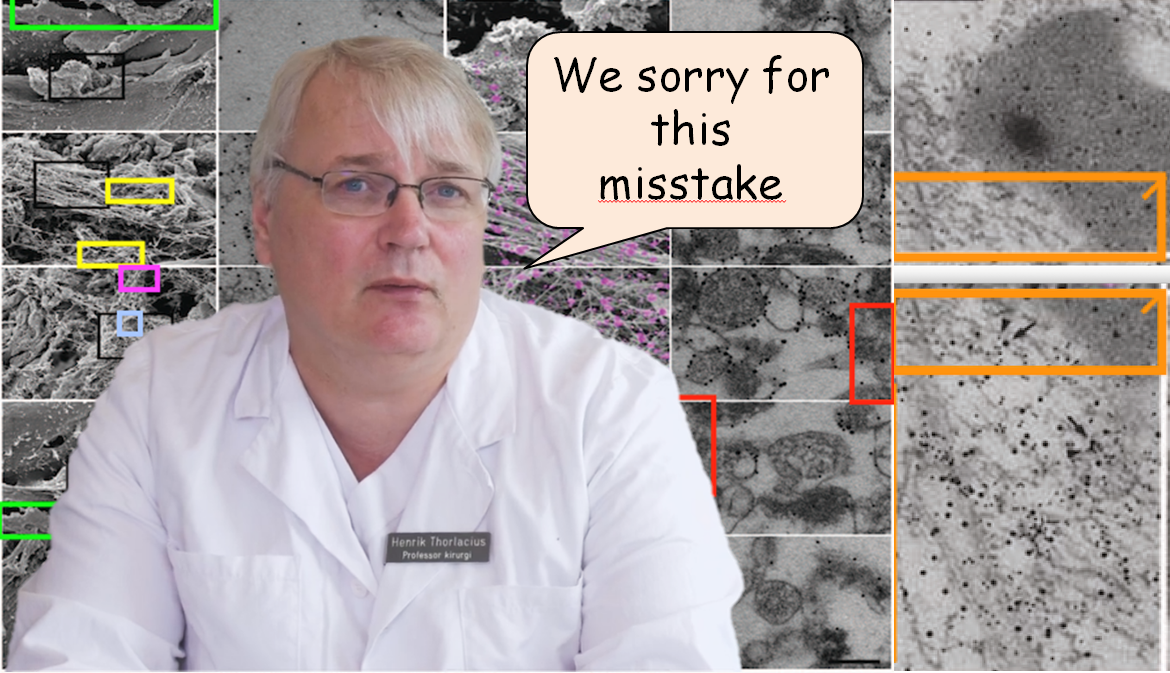
In August 2019, Thorlacius replied on PubPeer: “We will correct this by sending in an erratum to Oncotarget editorial office with this week. We sorry for this misstake.” Instead, in February 2020, this retraction arrived:
“This article has been retracted: This paper is retracted because as of this writing, the authors are not able to correct an erroneous negative control in Figure 6B with an original image. Nevertheless, the conclusions of the paper are correct as when the concern was raised after publication, the authors repeated the experiments and confirmed the original results. The authors are deeply sorry for the error.”
After the retraction, Elisabeth Bik found this:


Thorlacius has in total 11 such papers on PubPeer, courtesy of Bik. Like this:
Muhammad Asaduzzaman , Shahram Lavasani , Milladur Rahman, Su Zhang , Oscar Ö Braun , Bengt Jeppsson , Henrik Thorlacius Platelets support pulmonary recruitment of neutrophils in abdominal sepsis Critical Care Medicine (2009) doi: 10.1097/ccm.0b013e31819ceb71

Elisabeth Bik: “Concern about Figure 2.
- Red boxes: Panels b (phosphate-buffered saline-treated) and c (control antibody-treated) appear to overlap.
- Blue boxes: Panels d (anti-GP1b alpha) and e (anti Gr-1) appear to overlap, with a rotation and mirroring.”
Another one, again with his Lund colleagues:
Darbaz Awla , Anna V. Zetterqvist , Aree Abdulla , Cristina Camello , Lisa M. Berglund , Peter Spégel , Maria J. Pozo , Pedro J. Camello, Sara Regnér, Maria F. Gomez, Henrik Thorlacius NFATc3 Regulates Trypsinogen Activation, Neutrophil Recruitment, and Tissue Damage in Acute Pancreatitis in Mice Gastroenterology (2012) doi: 10.1053/j.gastro.2012.07.098

Elisabeth Bik: “Concern about Figure 3.
- Blue boxes: The +A-285222 (non-operated) panel appears to overlap with the Taurocholate+A-285222 panel, if one of the panels is rotated.”
How about a fake western blot?
Songen Zhang , Rundk Hwaiz, Lingtao Luo , Heiko Herwald, Henrik Thorlacius STAT3-dependent CXC chemokine formation and neutrophil migration in streptococcal M1 protein-induced acute lung inflammation American Journal of Physiology-Lung Cellular and Molecular Physiology (2015) doi: 10.1152/ajplung.00324.2014

Elisabeth Bik: “Concern about Figure 2.
- Red boxes: In the Total-STAT1 panel, the left-most and right-most bands look remarkably similar”
Clearly, already in 2019, Lund University knew that Thorlacius’s lab only produces research fraud. The university also ordered this retraction, the paper was not flagged on PubPeer before, but thanks to Elisabeth Bik, we can now see what was wrong with it:
Raed Madhi , Milladur Rahman , Dler Taha , Johan Linders , Mohammed Merza , Yongzhi Wang , Matthias Mörgelin, Henrik Thorlacius Platelet IP6K1 regulates neutrophil extracellular trap-microparticle complex formation in acute pancreatitis JCI Insight (2019) doi: 10.1172/jci.insight.129270


Elisabeth Bik: “Figures 1 and 2, showing duplicated and overlapping areas, as highlighted with boxes of the same color. Note that in the case of the TEM overlap shown with red and orange boxes, black dots appear to have been added or removed.”
In December 2019, an Expression of Concern was published, about “irregularities in the pseudocoloring of microparticles in scanning electron microscopy images in Figures 1–4 and 6 and Supplemental Figure 7“.
And finally we have a retraction notice from February 2021 which tells us what really happened, pay attention to the highlighted section:
“Following a review by the Swedish National Board for Assessment of Research Misconduct, it was determined that a serious breach of good scientific practice in the form of falsification occurred during the pseudocoloring of scanning electron micrographs in this article. The National Board determined that the serious deviation from good research practice was not intentionally committed and concluded that no research misconduct occurred. The paper is being retracted because JCI Insight editorial policy prohibits falsification and misrepresentation of data.”

The Wonderful Adventures of Nils Billestrup with Swedish gels
I obtained the full report on the case of Karin Dahlman-Wright, Vice-Rector of the Karolinska Institutet. The investigation by Danish researcher Nils Billestrup for CEPN found 6 out of 8 papers contained data manipulations, but only in 2 cases serious enough to affect the conclusions.
Indeed, the website of the Swedish National Board for Assessment of Research Misconduct (NPOF) shows no “guilty” verdicts for Lund University in the years 2020 and 2021, matching this case. There is indeed only this “innocent” verdict, from 18 December 2020, Number 3.1-20/0026. NPOF provided me with an unredacted copy:
It was about this exact paper Madhi et al 2019, retracted in February 2021. Thorlacius was reported in November 2019 for “deviations in the pseudo-colouring of microparticles in scanning electron microscope images (Figures 1C, 3A-B and 4B) in the article.” He replied, basically admitting that yes, he painted those nanoparticles in by hand, because they were otherwise invisible. NPOF quotes him with “no attempt was made to insert new objects that resembled real microparticles, but only to highlight existing particles” and that “pseudostaing was not used for quantitative measurements“.
Recall that in his recent retraction, Thorlacius blamed a microscopist and a “residual bulk image (RBI) phenomenon of the CCD camera“.
Omer Nour and Magnus Willander guilty of research misconduct
“The Board assesses that there are no scientifically acceptable explanations for why the notified researchers have fabricated research results in the manner that has occurred in the notified articles. Raw data also does not support the reported results. [..] In summary, the Board finds therefore that the notified researchers have been guilty of misconduct in…
Here the summary of the NPOF verdict, translated:
“The researchers who were the authors of a published article were cleared of misconduct in research. The board judged that it was a deviation from practice in the presentation of scanning electron microscopy images. The images had been manipulated without justification in the article.
The board found that the action was not intentional and that, although it seems to deviate clearly from acceptable order, it was also not grossly negligent, but rather seems to be due to “a misunderstanding”. The board’s conclusion was therefore that the serious deviation from good research practice was not committed with intent or gross negligence.”
It mentions that Thorlacius “has discussed and reviewed all collaborations with external parties to prevent future misunderstandings of the type in question” and that his “research group will have a seminar series on pseudostaining.”
The expert consulted by NPOF on this case was Julia Fernandez-Rodriguez, Head of the Centre for Cellular Imaging at Göteborg University. She is indeed an expert, being coauthor a fraudulent paper by Pontus Boström who was found guilty of research fraud and fired by Karolinska Institutet (read below). That paper Boström et al 2007 was never retracted.
Pontus Boström: cheater carousel in Sweden
Sweden is a tolerant country, which is a very good thing. Unfortunately, sometimes this Swedish tolerance seems ill-advised. Dishonest scientists caught faking data are happily given another chance and fat funding, like the case of the diabetes researcher Pontus Boström shows. This scientist was found to have fabricated data during his PhD studies with late…
Fernandez-Rodriguez’s opinion on Madhi et al 2019 was:
“The expert states that it is clear that the authors have ‘cloned’ or ‘copied and pasted’ circular objects into several of the images. She also writes that they have created de novo data, i.e. coloured microparticles that do not appear to exist in the original image for Figure 1C. […]
The Board agrees with the expert’s assessment that this is a deviation from standard practice in the presentation of scanning electron microscope images. The images have been manipulated without justification in the article. It is therefore clear that the reported practices constitute falsification within the meaning of the law.”
And yet all authors were found to be innocent, because nobody noticed the image duplications and because Thorlacius and his colleagues they assured that “it is now clear to them that it is not appropriate to paste objects to mark microparticles” and that “no attempt was made to overemphasise results or mislead the reader“.
In bed with Hari and Aruna
Hari Shanker & Aruna, a YouTube influencer couple in Sweden. With or without Rudolph the Red-Faced Liar. And with Anca and Dafin, two totally innocent and upright Romanians. Pushing pig brain juice an SS Nazi invented. You won’t find a better story for Christmas!
Well, here is another paper by Thorlacius and his aforementioned industry partner Matthias Mörgelin (co-founder and CSO of Colzyx), with same hand-drawn nanoparticles, and unlike with their other two papers with similar forgeries, no action at all was taken there:
Yongzhi Wang , Feifei Du , Avin Hawez , Matthias Mörgelin, Henrik Thorlacius Neutrophil extracellular trap-microparticle complexes trigger neutrophil recruitment via high-mobility group protein 1 (HMGB1)-toll-like receptors(TLR2)/TLR4 signalling British Journal of Pharmacology (2019) doi: 10.1111/bph.14765

NPOF was set up in January 2020 in the wake of Paolo Macchiarini affair which showed how catastrophically a Swedish university (in that case, Karolinska Institutet) can fail when tasked with investigating themselves. Usually NPOF does good work not only investigating research misconduct, but also sanctioning the culprits. Here, they utterly failed in the second part.
Swedish investigation spoils Macchiarini cover-up at Lancet
NPOF, again and again: “Philipp Jungebluth and Paolo Macchiarini guilty of research misconduct” Lancet: “Paolo Macchiarini is not guilty of scientific misconduct”
Anyway, let’s see what lessons Throlacius learned after he was reported for research misconduct in November 2019. This was submitted for publication in April 2020, coauthors are Lund University’s professor Ingvar Syk and associate professor Milladur Rahman, both of whom you already met a few times above:
Anwar Algaber , Amr Al-Haidari , Raed Madhi , Milladur Rahman, Ingvar Syk, Henrik Thorlacius MicroRNA-340-5p inhibits colon cancer cell migration via targeting of RhoA Scientific Reports (2020) doi: 10.1038/s41598-020-73792-9


Pink boxes: The Y-27632 and the Mimic-Ctrl panels appear to overlap.”
On 15 February 2024, Thorlacius issued this Author Correction:
“The Supplementary Figures file published with the original version of this Article contains errors.
As a result of an error during figure assembly, panel Y-27632 in Supplementary Figure 2 and panel Y-27632 in Supplementary Figure 3 are incorrect.
The correct Supplementary Figures file is now linked to this correction notice.”

The Indefatigable Ashutosh Tiwari
Four years after Ashutosh Tiwari’s scamferences and research fraud were exposed, his impressive-sounding yet fictional “International Association of Advanced Materials”, or IAAM, still opens doors, hearts and wallets.
And then some Swedish professor who has just been whitewashed by NPOF must have thought, hey, why not faking some flow cytometry for a change?
Mattias Lepsenyi , Nader Algethami , Amr A. Al-Haidari , Anwar Algaber , Ingvar Syk , Milladur Rahman , Henrik Thorlacius CXCL2-CXCR2 axis mediates αV integrin-dependent peritoneal metastasis of colon cancer cells Clinical & Experimental Metastasis (2021) doi: 10.1007/s10585-021-10103-0

Also here, Thorlacius had to issue a Correction, on 27 July 2024. It was very short:
“In Fig. 1 of this article. The CXCR3 representative image copied twice and mislabelled the x-axis and the correct Fig. 1 should have appeared as shown below.”
So, what is Thorlacius up to now, after NPOF naively declared him an innocent victim of a misunderstanding? Well, doing clinical studies on patients of course! While on the payroll from industry.
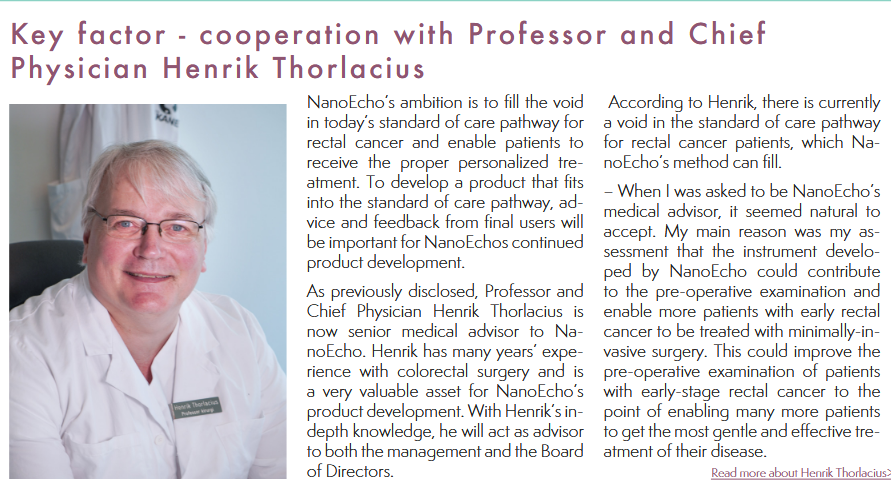
In May 2021, the Swedish biotech company NanoEcho announced this:
“NanoEcho will conduct a preclinical study led by Henrik Thorlacius, Professor of Surgery at Lund University and Chief Physician at Skåne University Hospital in Malmö, in which NanoEcho’s new instrument for detection of lymph nodes with cancer spread will be evaluated. The study will be carried out at Skåne University Hospital in Malmö and will include about 40 patients that will undergo he usual routine standard surgery. Once the cancer is removed from the patient, the surgical preparate will be examined with NanoEcho’s instrument. The result will then be compared with the pathologist’s final microscopic examination.
– My hope for the clinical trial is that we will be able to validate that NanoEcho’s instrument is able to provide high-precision identification of lymph nodes containing cancer cells. If so, we will proceed with further clinical trials, where NanoEcho’s instrument will be evaluated in patients prior to surgery, says Henrik Thorlacius.”
NanoEcho was founded by the Lund University professor Tomas Jansson, his and his company’s patented technology is such: iron nanoparticles are injected into patient’s intestine, then imaged under a magnetic field. The assumption is that these nanoparticles behave differently in cancer tissue versus healthy tissue.
Linköping whistleblower under attack from May Griffith’s lawyers
Former Linköping professor May Griffith set lawyers upon a former colleague who dared to protest about her research practices on my site. Jaywant Phopase is ordered to delete official documents I made available for download, retract his complaints to journals and pay Griffith a compensation. Or else.
Now you see why Thorlacius painted those particles onto his cancer slides. It wasn’t “a misunderstanding”, but greed. Thorlacius co-owns since 2006 the company CarpoNovum, which makes tools for colorectal surgery, but that wasn’t enough for him. He was obviously looking forward to personally making proper money from biotechs like NanoEcho (where he became senior medical advisor in early 2021), and his Lund University had a financial interest there as well. Hence the NPOF whitewash.
In 2022, the clinical testing at Skåne University Hospital progressed to “an investigator-led clinical development study“, that investigator was of course Thorlacius. In April 2024, he presented his amazing clinical results at a surgeon conference in Malmö:
“” This new technology that NanoEcho is developing is exciting. It would really make a difference to both patients and society if we can come up with a method that allows us to find out whether patients with rectal cancer have spread to nearby lymph nodes or not, before surgery” says Professor Henrik Thorlacius, who leads a study on NanoEcho’s technology at Skåne University Hospital.”
In January 2026, Thorlacius and NanoEcho signed a letter of intent about “a continued dialogue regarding NanoEcho’s diagnostic system and possible participation in the company’s upcoming clinical studies in rectal cancer.“
Sounds weird, just a dialogue? Must be all these retractions and other stuff on PubPeer, did they at NanoEcho maybe notice that things only work on Thorlacius’s side when Photoshop is deployed?
Lund University’s Policy Officer for Deviations from Good Research Practice Review Board, Jessica Salomonsson Enetoft, told me:
“the PubPeer record from 2023 haven´t been subject to investigation.”
Well, now is as good time as any, no? Let’s hope the new NPOF investigation will contain less misunderstandings.
Donate!
If you are interested to support my work, you can leave here a small tip of $5. Or several of small tips, just increase the amount as you like (2x=€10; 5x=€25). Your generous patronage of my journalism will be most appreciated!
€5.00


Gold label stripping from thin sections? I’ve never heard of that, although I’ve worked for many years with TEM. This is a giant BS.
LikeLike
Same as the RBI excuse.
RBI-affected images exhibit very distinct and well-documented characteristics. These typically include localized overexposure, beam-induced damage patterns, persistent contrast artifacts, or structural alterations consistent with prolonged beam interaction. None of these features are present in the images that were presented.
Properly trained microscope operators are fully aware of how RBI manifests and understand the operational parameters that can cause it. They are trained to prevent such artifacts through appropriate control of beam current, dwell time, accelerating voltage, scan strategy, and overall exposure management. Avoiding RBI is a fundamental aspect of competent microscope operation.
Given this, one must reasonably question the qualifications and oversight within the team responsible. What kind of personnel are being employed if such a basic misinterpretation is being put forward? If individuals involved cannot distinguish between genuine RBI artifacts and unrelated image features, it raises concerns not only about operator training but also about supervisory review and quality control processes.
LikeLike
Guys, Thorlacius admitted to NPOF to have painted those particles, in those same figures of this paper.
LikeLike
Yes, but in the end, claiming that RBI is responsible for his paintings is essentially the same as admitting that you can’t trust their raw data because they have no idea how to properly acquire it.”
LikeLiked by 1 person
Milladur Rahman. Why not.
https://pmc.ncbi.nlm.nih.gov/articles/PMC10351202/
LikeLike
With Mo Taheri, his Ombudsahmad in Jena, and Soudeh Ghafouri-Fard.
LikeLike
Another one for Henrik Thorlacius, happens to be in Scientific Reports (a colouring book)
PubPeer – Neutrophil extracellular trap-microparticle complexes enhanc…
LikeLike