

Schneider Shorts of 7 August 2026 – a tech bro cleans oceans, a climate expert suggests animal sacrifice, a creepy American crook still trying to cheat, Italian role models lose papers, Danish ecologist fails to cure cancer, and a Pole threatening punishment gets punished.
Table of Discontent
Industry Giants
- Killing everything swimming and living nearby – how tech bros clean oceans
Scholarly Publishing
- It has been 6 years and the original data has been lost – Springer Nature and bad apples from China
Retraction Watchdogging
- Artefacts arising during manual development of chemiluminescent films – Santo Marsigliante and Antonella Muscella lose a paper
- She made a difference – meet Abhijit Dey’s friend Elza Bontempi
- An incorrect Handling Editor name was published – Christian Sonne failed to cure cancer
- Expect severe punishment – Tomasz Sliwinski and friends lose five papers
- The motive remains a mystery – three more retractions for Eliezer Masliah
Science Breakthroughs
- Organic free-range production scored worst – scientists suggest animal sacrifice to placate climate gods
Industry Giants
Killing everything swimming and living nearby
The Revelator revealed on 16 July 2026 how a young tech bro and his non-profit company The Ocean Cleanup spectacularly failed to solve the plastic pollution of the seas:
“It all began in 2012, when Boyan Slat, an 18-year-old Dutch aerospace engineering student, gave a TED talk announcing a bold scheme to scoop plastic trash out of the ocean. Slat envisioned building what would be the largest human-made structure ever deployed in the ocean (by far), a device that would collect plastic from the Great Pacific Garbage Patch and remove it, saving countless marine organisms.
This idea has since attracted a loyal social media following and become a nonprofit that generates millions of dollars in donations a year, a fundraising and media juggernaut in the ocean conservation space. […]
After building and testing expensive prototypes that led to failed tests — which failed exactly the way ocean plastic pollution and ocean engineering experts said they would — the team pivoted in 2019 toward a new model that was first suggested by critics and skeptics as an alternative in 2015. Now they mostly intercept plastic when it first leaves rivers and enters the ocean instead of trying to scoop it out of the middle of the ocean, though the open ocean work is still mentioned on their website and generates praise-filled uncritical media coverage.”
Slat and his fellow tech bros falsely expected their big devices to survive in the open ocean and most importantly, they imagined the plastic pollution differently from the reality:
“But when most people think about the ocean plastic pollution problem and the famous “Great Pacific Garbage Patch,” they picture a huge and dense plastic island so thick that you can walk on it. That’s not the case — it’s more like a soup full of tiny bits of plastic, sometimes so small that they’re invisible to the naked eye. […]
if you incorrectly believe that there are giant mountains of dense plastic floating in the ocean, it’s easier to wrongly believe that we can engineer a way to easily just scoop that plastic out of the ocean. It’s much harder to remove lots of tiny crumb-sized pieces of plastic … at least if your goal is avoiding killing everything else that’s swimming and living nearby.”
As critics predicted, the Ocean Cleanup failed to remove any mentionable amount from plastic, its huge device broke down and became plastic pollution itself, but not before “killing enormous numbers of marine organisms.“
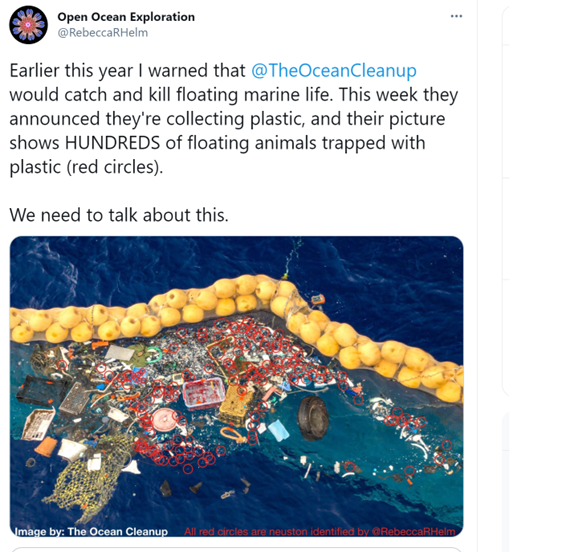
Rebecca Helm on Twitter: “This week they announced they’re collecting plastic, and their picture shows HUNDREDS of floating animals trapped with the plastic.”
But the company is unbothered, they have the peer review on their side:
“A representative for the Ocean Cleanup acknowledged via email that their efforts kill some marine life but asserted that their research, published in the journal Scientific Reports, suggests plastic pollution kills more marine life than their cleanup attempts. They further claimed that “a majority of species caught as bycatch are invasive species. […]
The supplementary materials of their Scientific Reports paper, meanwhile, catalogued thousands of marine animals killed during Ocean Cleanup operations, including threatened species of sharks, bony fish, and sea turtles — none of whom are invasive.”
This is that paper:
Matthias Egger , Andy M. Booth , Thijs Bosker , Gert Everaert , Samantha L. Garrard , Vilma Havas , Helga S. Huntley , Albert A. Koelmans , Karin Kvale , Laurent Lebreton , Helge Niemann , Qiaotong Pang , Maira Proietti , Peter Puskic , Camille Richon , Sarah-Jeanne Royer , Matthew S. Savoca , Arjen Tjallema , Marjolein Van Vulpen , Yanxu Zhang , Ziman Zhang, Denise M. Mitrano Evaluating the environmental impact of cleaning the North Pacific Garbage Patch Scientific Reports (2025) doi: 10.1038/s41598-025-00619-w
Having wasted many millions of dollars, killed countless marine animals, and polluted the oceans even more with their own trash, The Ocean Cleanup changed strategy. It simply copied the idea and design from its critics to intercept plastic trash at the rivers, but “at a much higher cost” than the original proposals. That’s because, as Ocean Cleanup claims, “their river interceptors are custom-designed for each river“.

Personally, I wonder where Ocean Cleanup gets all that enormous money from. can’t be all charity donations. But what if the plastic industry somehow indirectly pay someone who claims the pollution problem is elegantly solved with their fancy technology…
Scholarly Publishing
It has been 6 years and the original data has been lost
Springer Nature seems to be very concerned about its business in China. Otherwise, how to explain that this ridiculous fraud was merely corrected?
The study is from Shandong Agricultural University in Tai’an, two associate editors from the journal Plant Cell Reports are affiliated with it, it was first flagged on PubPeer in November 2020:
Da-Gang Hu, Cui-Hui Sun, Mei-Hong Sun, Yu-Jin Hao MdSOS2L1 phosphorylates MdVHA-B1 to modulate malate accumulation in response to salinity in apple Plant Cell Reports (2016) doi: 10.1007/s00299-015-1914-6


As you see, at least Fig 3c is completely fraudulent. In February 2021, the first author Da-Gang Hu posted this bizarre reply on PubPeer on behalf of the last author Yu-Jin Hao, using his boss’s email account:
“Dear editor, Thanks for this good concern and sorry for our delayed response. This is because Professor Yujin Hao, the corresponding author of this article, has been suffering from lung cancer in recent half a year and has been receiving drug treatment in the hospital. You know, he did not have more time to deal with this email. […]
we have analyzed it very carefully and tried to find the original data. But unfortunately, it has been 6 years and the original data related to this graph has been lost. We are very sorry about this.“
They then insisted that, for Fig 3c, “It is not logical for indicated splices” and “The differences between the bands are evident“, and as for the other issues: “the shape of the last four bands in Figure 3d and Figure 4b are significantly different“. They then asked to be given “more time if you want us repeat these two results.“.
Five and a half years passed, maybe Hao died in between (he last published a preprint in January 2024), and on 14 July 2026 this Correction was published:
“In the originally published Figs. 3c, 3d, and 4b, the ACTIN loading control panels (bottom panels) were inadvertently prepared using incorrect ACTIN reference images. Due to the high visual similarity among reference protein bands, these three panels were mistakenly assembled during figure compilation.
To address this, the ACTIN panels in Figs. 3c, 3d, and 4b have been replaced with corrected versions obtained from newly performed western blot analyses using the original, preserved biological materials. The corrected panels accurately represent the ACTIN loading controls for the corresponding experimental samples.
No other parts of the figures or the manuscript have been altered. This correction has no impact on the results, data interpretation, or conclusions of the original publication.
The authors sincerely apologize for any inconvenience caused.”
Here are more bad apples from Hao:
Chun‐Ling Zhang , Gui‐Luan Wang , Ya‐Li Zhang , Xing Hu , Li‐Jie Zhou , Chun‐Xiang You , Yuan‐Yuan Li , Yu‐Jin Hao Apple SUMO E3 ligase MdSIZ1 facilitates SUMOylation of MdARF8 to regulate lateral root formation New Phytologist (2021) doi: 10.1111/nph.16978


Retraction Watchdogging
Artefacts arising during manual development of chemiluminescent films
Italian scholar retracting a cancer research fraud is a popular classic. Here another episode, from the lab of Santo Marsigliante and Antonella Muscella, full and associate professor at Salento University of Lecce, respectably.
The paper was corrected in March 2015 soon after publication, because the authors reported to have used their inhibitor at a millimolar concentration (10 mM), instead of micromolar (10 μM). In January 2026, Claire Francis flagged this paper on PubPeer:
Antonella Muscella, Carla Vetrugno , Nadia Calabriso , Luca Giulio Cossa , Sandra Angelica De Pascali , Francesco Paolo Fanizzi , Santo Marsigliante [Pt(O,O’-acac)(γ-acac)(DMS)] Alters SH-SY5Y Cell Migration and Invasion by the Inhibition of Na+/H+ Exchanger Isoform 1 Occurring through a PKC-ε/ERK/mTOR Pathway PLOS One (2014) doi: 10.1371/journal.pone.0112186

On 20 July 2026, the paper was retracted, because much more fraud was found:
“After this article [1,2] was published, concerns were raised regarding Fig 1-6. Specifically,
- The following panels within Figs 1 and 4 appear to partially overlap with one another:
- The upper left and lower right panels of Fig 1B, when rotated 180o.
- The lower left and upper right panels of Fig 1B.
- Lane 2 in the MMP-9 and MMP-2 panels of Fig 4D.
- There appear to be similarities within the following panels of Figs 3 and 6:
- The backgrounds of lanes 1 and 3 of the p-ERK1/2 panel of Fig 3B.
- Lanes 1 and 4 of the β-actin panel of Fig 3B.
- Lanes 3 and 4 of the ɑ-Na+/K+ATPasi panel of Fig 6B.
- The following panels in Figs 3 and 5 appear to contain vertical discontinuities;
- The p-6S [Pt(acac)2(DMS)] (0.50μM) panel of Fig 3B, between lanes 3–4.
- The p-S6 [Pt(acac)2(DMS)] panel of Fig 5A, between lanes 3–4.
- The following panels in Figs 2 and 4 appear to overlap with later articles published by the same research group:
- Lanes 1–4 of the [Pt(acac)2(DMS)] (0.5μM) ERK 1/2 panel of Fig 2D and the upper ERK 1/2 panel of Fig 6A in [3].
- Lanes 1–4 of the β-actin panel of Fig 4C and the β-actin panel of Fig 4A in [4], when flipped horizontally.
- Lanes 1–4 of the p38MAPK panel of Fig 4C and the β-actin panel of Fig 6D in [4], when flipped horizontally.
The corresponding author stated that any perceived similarities between images are possibly the result of artefacts arising during manual development of chemiluminescent films.
In light of the above concerns that question the reliability and integrity of the reported results and conclusions, the PLOS One Editors retract this article.”
Some of the new fraud PLOS editors found took place in other papers by Marsigliante and Muscella, illustrated by yours truly:
Antonella Muscella , Leonardo Resta , Luca Cossa , Santo Marsigliante Immunolocalization of the AT-1R Ang II Receptor in Human Kidney Cancer Biomolecules (2023) doi: 10.3390/biom13081181

And another PLOS finding, illustrated by me:
Antonella Muscella , Erika Stefàno , Luigi De Bellis , Eliana Nutricati , Carmine Negro , Santo Marsigliante Antitumor and antimigration effects of Salvia clandestina L. extract on osteosarcoma cells Annals of the New York Academy of Sciences (2021) doi: 10.1111/nyas.14601

That paper has even more fraud:


Muscella and Marsigliante have more on PubPeer of course. Here, same data was published twice in two different journals parallel, so that the editors don’t notice:
- Antonella Muscella , Loredana Urso , Nadia Calabriso , Antonella Ciccarese , Danilo Migoni , Francesco Paolo Fanizzi , Bruno Di Jeso , Carlo Storelli , Santo Marsigliante Differential response of normal, dedifferentiated and transformed thyroid cell lines to cisplatin treatment Biochemical pharmacology (2005) doi: 10.1016/j.bcp.2005.10.022
- L. Urso , A. Muscella , N. Calabriso , A. Ciccarese , F.P. Fanizzi , D. Migoni , B. Di Jeso, C. Storelli , S. Marsigliante Differential functions of PKC-delta and PKC-zeta in cisplatin response of normal and transformed thyroid cells Biochemical and Biophysical Research Communications (2005) doi: 10.1016/j.bbrc.2005.09.046

These two clowns occasionally decide to leave the laboratory cancer research, and do public health clinical studies on other topics:
Santo Marsigliante , Vito Ciardo , Antonio Di Maglie , Giulia My , Antonella Muscella Efficacy of school-based intervention programs in reducing overweight: A randomized trial Frontiers in Nutrition (2022) doi: 10.3389/fnut.2022.1001934

Sholto David: “Table 1: The values I have highlighted in yellow are not consistent. How is it possible for the overall mean age to be 9.1 if the average age of the boys is 9.2, and the girls 9.3? Same problem with the highlighted BMI value, the overall BMI of the group cannot be equal to the girls.”
Did this clinical trial on children ever happen as described? Or at all?
She made a difference
More Italian retractions!
This paper by the Indian papermill operator Abhijit Dey was not previously flagged on PubPeer, but since the journal Environmental Research is extremely papermill-infested, Elsevier is performing a major spring cleaning now.
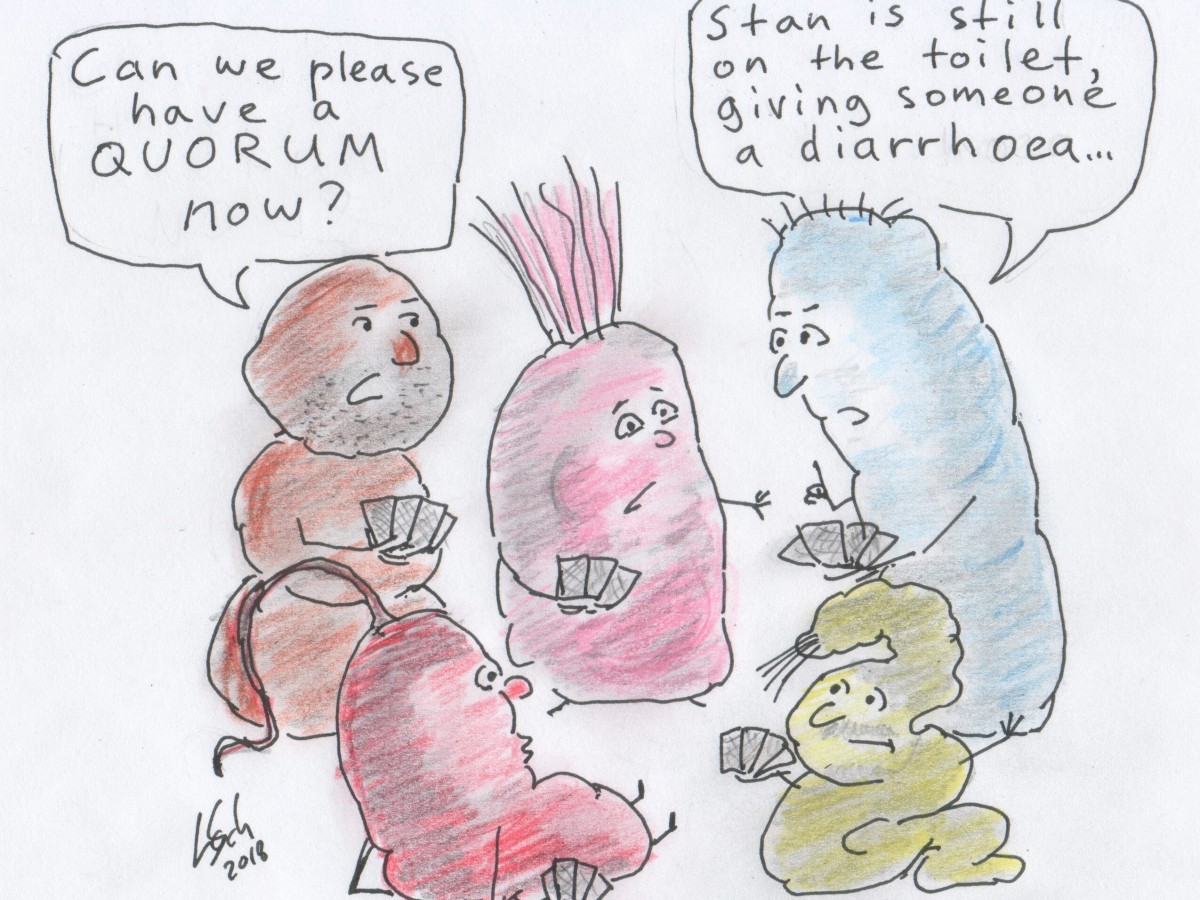
I have almost 100 manpower with me at any time
“WE DONT PAY FOR PAPERS. YOU MUST KNOW THAT THESE BEST IN THE PLANET JOURNALS GO THROUGH RIGOROUS PEER REVIEW” – Abhijit Dey, papermiller

Dey sold the authorships to not one, not two but three Italian professors here:
Pracheta Pal , Uttpal Anand , Suchismita Chatterjee Saha , Suresh Sundaramurthy , Emmanuel Sunday Okeke , Manoj Kumar , Radha , Elza Bontempi , Emidio Albertini, Abhijit Dey, Francesco Di Maria Novel CRISPR/Cas technology in the realm of algal bloom biomonitoring: Recent trends and future perspectives Environmental Research (2023) doi: 10.1016/j.envres.2023.115989
The retraction notice isn’t dated yet, highlights mine:
“An unauthorised authorship change was made when the revised version of this paper was submitted, following suggestions for relatively minor revisions, with 4 authors (Suresh Sundaramurthy, Emmanuel Sunday Okeke, Emidio Albertini, and Francesco Di Maria) being added to the paper to replace two authors who were deleted. Emidio Albertini and Francesco Di Maria were also designated as corresponding authors at this time. No satisfactory explanation was given for this change, nor was it approved by the editor. This authorship change breaches the policies of the journal and as a result the article is being retracted.
Pracheta Pal indicated that she was involved in literature survey/mining, writing the major first draft of the manuscript, preparing the tables and figures, and arranging the references, but was not involved in any decisions regarding the authorship list or in the subsequent stages of upgrading, finalising and revising the manuscript. Emidio Albertini, whose consent to being an author of the revised version is recorded, stated that he rewrote part of the revision after being asked to do so, and also stated that he was not involved in the submission process. Emmanuel Sunday Okeke, whose consent to being an author of the revised version is also recorded, remembers being contacted to revise and proof read the manuscript, but states that he was not aware that anyone was removed or replaced.
Pracheta Pal respects the editor’s decision, notwithstanding the fact that she had no role in the circumstances that led to this retraction. Emidio Albertini disagrees with the retraction and disputes the grounds for it. After receiving the draft retraction notice, none of the other authors expressed strong objection or agreement regarding the retraction of the paper.”

Top Italian Scientists
“You may think this is just a silly prank with zero impact on whatsoever, but no. […] this initiative is useful for something. It provides solid numbers for quantifying the extent of scientific misconduct in Italy and beyond” – Aneurus Inconstans

Emidio Albertini is full professor at University of Perugia and a mentor figure for young Italians: he is coordinator of the PhD Course in Agricultural, Food and Environmental Sciences and Biotechnology and since 2025 President of Perugia Officina per la Scienza e la Tecnologia, the interactive scientific museum of the Municipality and Province of Perugia where also you “can learn, explore and be fascinated by science“. Presumably science like his own above?
The last author Francesco Di Maria is professor in environmental sanitary engineering at the University of Perugia. In 2020, he was put in charge of pandemic response in Perugia, last month the commune put him in charge of “wider dissemination of scientific contents and research results for the benefit of the community and the territory.” He can disseminate his retraction now.
The worst Italian papermiller however is the one who was on the paper before Dey started to sell additional positions: Elza Bontempi, full professor in chemistry at the University of Brescia, specialising in “new technologies for critical raw materials recovery“. Her university celebrates Bontempi as “TOP WORLD RESEARCHER” and a “Top Italian Scientist” who “received numerous awards for her groundbreaking research” including “WE Award – Women Excellence 2024” and “”She made a difference” prize from European Women’s ManagementDevelopment Network” and “2018 Winner of the ITWIIN (Italian Women Innovators and Inventors Network) prize“, plus she is one “of the UNSTOPPABLE WOMEN (the 1000 women who are changing Italy) and one of the 100 esperte.“

Issues of global relevance
“I like ImageTwin, but seeing things with just eyes is like hand-to-hand combat….” – Mu Yang
All through hard work in papermilling, as recorded on PubPeer. There are more common papers with Dey (e.g, Anand et al 2022a, Anand et al 2022b, Anand et al 2022c, Dey et al 2023, Pérez De La Lastra et al 2022). Unfortunately, Bontempi wasn’t offered a discount authorship on the following paper by Dey, which was now also retracted. It was originally flagged for rigged peer review:
Prabhjot Kaur , Devendra Kumar Pandey , R. C. Gupta , Vijay Kumar , Padmanabh Dwivedi , Rupa Sanyal , Abhijit Dey Biotechnological interventions and genetic diversity assessment in Swertia sp.: a myriad source of valuable secondary metabolites Applied Microbiology and Biotechnology (2021) doi: 10.1007/s00253-021-11345-4
“The Editor-in-Chief has retracted this article because an investigation by the publisher has found evidence that peer review in this instance has been compromised. The Editor-in-Chief therefore no longer has confidence in the results and conclusions presented in this article.
The authors have not clearly stated whether they agree or disagree with this retraction.”
(Retraction 28 July 2026)
Quite possibly Bontempi’s main papermill contact is a fellow woman in science: Meththika Vithanage in Sri Lanka, a fellow “Top 2% of most cited scientists, Highly Cited Researcher” with around 70 papers on PubPeer, with the worst papermillers out there including Yong Sik Ok and Jörg Rinklebe. Returning to Bontempi’s PubPeer record: most papers are flagged for rigged peer review process, but also for other issues. Bontempi worked with other major papermill fraudsters (who in turn are also associates of Vithanage) – Pau Loke Show (Kayastha et al 2022), Damià Barceló, Sunita Varjani and Christian Sonne (Iyer et al 2023, Anand et al 2023), mostly on topics not really related to Bontempi’s official expertise, like COVID-19 epidemiology.
An incorrect Handling Editor name was published
Since mentioned Christian Sonne, professor of marine mammal ecology at University of Aarhus in Denmark: he received another retraction himself. His previous two retractions are in November 2025 Shorts, and do read here:
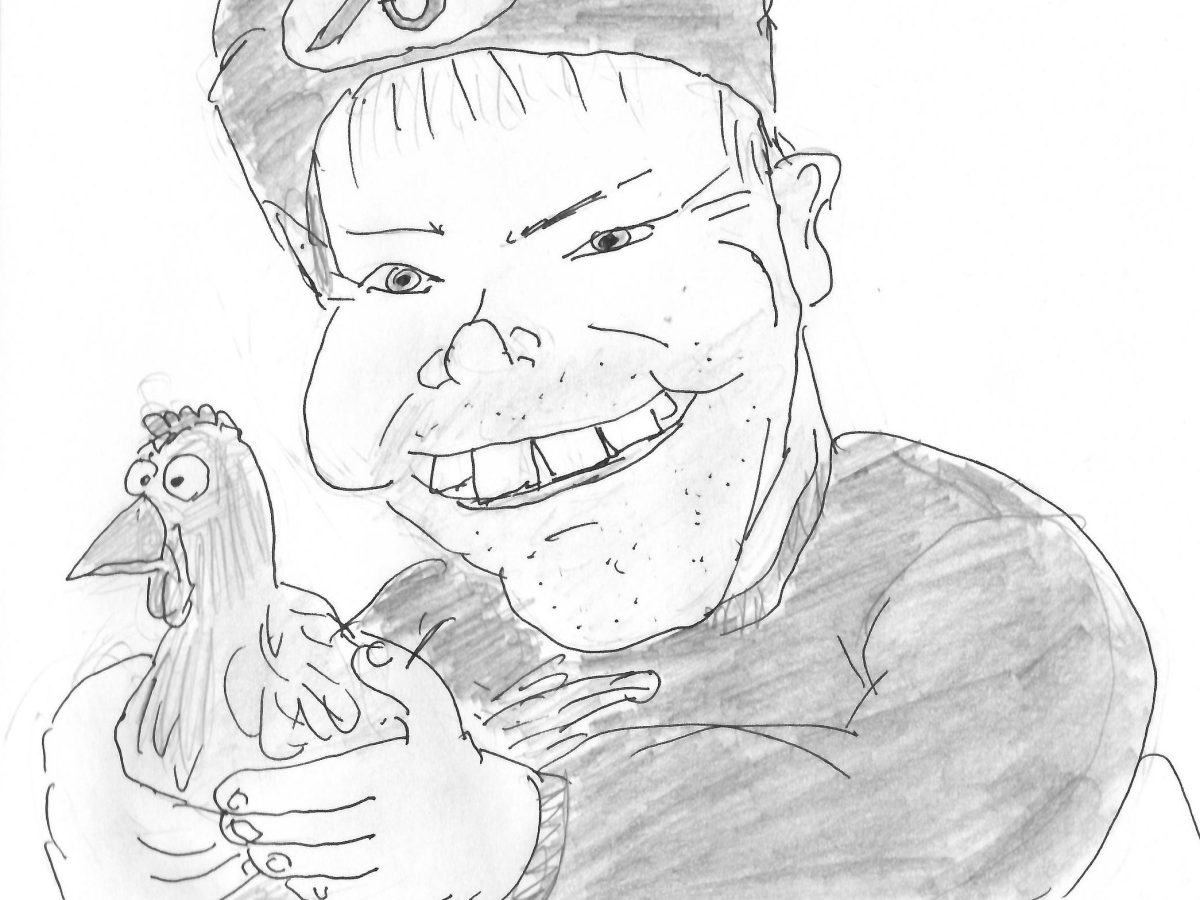

Sonne’s university famously tried to get my reporting about him deleting by threatening me with lawsuits of various kinds (read October 2025 Shorts). Now that he is losing papers to retractions, the battle-hardened university lawyers chickened out (pun intended) and stopped replying to me, no matter how much I try to provoke them.
Meh.
Anyway, can you ask Aarhus to explain how their expert in seals and cetaceans managed to cure breast cancer? On board are also fellow papermillers like Su Shiung Lam, plus Sonne’s Aarhus colleague Bjarne Styrishave (now professor at the University of Copenhagen) and Tomasz Maciej Ciesielski of the University Centre in Svalbard in Norway, all of them previously retracted another paper with Sonne (read July 2025 Shorts).
Yiyang Li , Nyuk Ling Ma , Huiling Chen , Jiateng Zhong , Dangquan Zhang , Wanxi Peng , Su Shiung Lam, Yafeng Yang , Xiaochen Yue , Lijun Yan , Ting Wang , Bjarne Styrishave, Tomasz Maciej Ciesielski , Christian Sonne High-throughput screening of ancient forest plant extracts shows cytotoxicity towards triple-negative breast cancer Environment International (2023) doi: 10.1016/j.envint.2023.108279


Other criticisms were raised by PubPeer user Diaporthe meridionalis:
- “The supplemental information provided by the authors does not give much extra info about which 100 plants they actually collected. Nor how they came up to 479 samples.”
- “In the M&M section the authors talk about 5 groups with 3 mice each. This seems to make sense given the 4 conditions tested (+ the control). However, in the supplementary file the authors mention 7 groups of 3 mice.”
- “I am also confused about the following statement: and the mice were randomly divided into the 4 treatment groups wood and root bark from Amur honeysuckle and Nigaki, respectively, according to tumour volume and body weight.[…] If they were divided based on the tumor weight and tumor volume, then how is this a random process?”
Another user criticised that the paper was editorially handled by Sonne’s collaborator Adrian Covaci (a fellow papermiller, his PubPeer record). In May 2024, Elsevier issued a Corrigendum which consisted of the sentence: “We have updated Figure 4A and 4C.” In July 2026, Elsevier decided to lie a bit more and issued An Erratum claiming:
“The publisher regrets that an incorrect Handling Editor name was published for the manuscript entitled “High-throughput screening of ancient forest plant extracts shows cytotoxicity towards triple-negative breast cancer” as Dr. Adrian Covaci.
The correct Handling Editor for this paper is Prof. Xing-Fang Li.”

Do papermillers dream of eclectic journals?
“I focus on the sprawling parody literature devoted to the three Es of Energy, Economy and the Environment. Together they […] freeload on the authentic literature on energy efficiency and pollution reduction (while diluting, distracting and discrediting them).” – Smut Clyde

But then other people in Elsevier took over the case, and the paper was retracted a few days ago:
“This article has been retracted at the request of the Editor-in-Chief.
Acceptance of this article was solely based upon the positive advice of reviewers who were closely linked to six of the authors: Yiyang Li, Wanxi Peng, Su Shiung Lam, Yafeng Yang, Xiaochen Yue, Christian Sonne. This compromised the editorial process and breached the journal’s policies.
The Editor has, therefore, lost confidence in the results and conclusions of the article and has determined it should be retracted.
Christian Sonne, on behalf of the author group, disagrees with the retraction and disputes the grounds for it.”
Go, send your university lawyer on them, Chrissy.
Expect severe punishment
The Polish cheater Tomasz Sliwinski, professor of molecular genetics at the University of Lodz, with a second affiliation at the Medical University of Lodz, has been served with four retractions in one go. Read about his fake science here:

Would you in Lodz?
“Forgeries of this calibre make me think anything ever published by Sliwinski, Skorski and their associates is made up. In an ideal world, hundreds of articles by these people showing just tables and graphs should get retracted ” – Aneurus Inconstans
Sliwinski previously send me this charming message:
“In consultation with my colleagues and university authorities, the matter has been reported to the police and prosecutor’s office. Expect severe punishment because Polish law has changed and it’s no longer possible to anonymously harass, harass, and slander others.
notification to the Prosecutor’s Office regarding suspected offenses under Article 190a § 1 of the Penal Code (persistent harassment) and Article 212 § 2 of the Penal Code (defamation with a motion to prosecute ex officio).
I have nothing to fear because I’ve provided evidence that I’m clean. On the advice of a lawyer, we won’t discuss this with anonymous individuals, but you will be identified and face appropriate punishment.
Now, I wish you a great day! “
Quite unexpectedly, it is not me, but Sliwinski who is facing appropriate punishment. He is being investigated by Polish academic authorities, and now his papers are being pulled. All four in the same journal by Wiley. Retraction Nr 1, with professors Przemyslaw Sitarek, Ewa Skala and Halina Wysokinska from the Medical University of Lodz:
Ewa Skała, Przemysław Sitarek, Marek Różalski , Urszula Krajewska , Janusz Szemraj, Halina Wysokińska , Tomasz Śliwiński Antioxidant and DNA Repair Stimulating Effect of Extracts from Transformed and Normal Roots of Rhaponticum carthamoides against Induced Oxidative Stress and DNA Damage in CHO Cells Oxidative Medicine and Cellular Longevity (2016) doi: 10.1155/2016/5753139


The retraction arrived on 30 July 2026, the PubPeer reference credited Aneurus Inconstans:
“The retraction has been agreed due to concerns that have been raised with the figures, also reported on PubPeer [1]. Specifically:
- In Figure 6a, the β-actin/H2O2 + TR and β-actin/H2O2 bands appear unexpectedly similar to the β-actin/NR and β-actin/TR bands
- In Figure 6a, SOD2/control band appears highly similar to the CAT/H2O2 band
- In Figure 6a, SOD2/H2O2 band appears highly similar to the CAT/H2O2 + NR band
- In Figure 7a, the SOD2/control band appears highly similar to the CAT/H2O2 + TR band
The authors responded to the concerns; however, due to the time elapsed since the study, they could not provide the original images for these figures.
After assessing the response to the concerns, we conclude that neither the results nor the conclusions can be considered reliable, and the article is therefore retracted.
The authors disagree with the retraction.”
Retraction Nr 2 also features Sliwinki’s friends mentioned above, plus professor Monika Toma from the University of Lodz and professor Janusz Szemraj from the Medical University of Lodz:
Przemysław Sitarek, Ewa Skała , Halina Wysokińska , Marzena Wielanek , Janusz Szemraj  , Monika Toma , Tomasz Śliwiński The Effect of Leonurus sibiricus Plant Extracts on Stimulating Repair and Protective Activity against Oxidative DNA Damage in CHO Cells and Content of Phenolic Compounds Oxidative Medicine and Cellular Longevity (2016) doi: 10.1155/2016/5738193

The retraction from 30 July 2026 corrected the sleuth that the figure was actually 4c and not 5c, confirmed “multiple instances of identical bands […] reported as representing both the same and different conditions” .
Retraction Nr 3, about the same siberian plant. There, Sliwinski invited foreign collaborators from the Lusophone University of Humanities and Technologies in Lisbon, Portugal: the known cheater Patrícia Rijo, plus Catarina Garcia. We also find a foreign Pole: Dariusz Pytel at the Medical University of South Carolina, USA:
Przemysław Sitarek, Patricia Rijo, Catarina Garcia, Ewa Skała, Danuta Kalemba, Adam J. Białas, Janusz Szemraj, Dariusz Pytel, Monika Toma, Halina Wysokińska, Tomasz Śliwiński Antibacterial, Anti‐Inflammatory, Antioxidant, and Antiproliferative Properties of Essential Oils from Hairy and Normal Roots of Leonurus sibiricus L. and Their Chemical Composition Oxidative Medicine and Cellular Longevity (2017) doi: 10.1155/2017/7384061

Aneurus inconstans: “Figure 3b: several bands look much more similar than expected (boxes of same color).
Moreover, the bands boxed in light yellow, the bands boxed in green, the band below the cyan triangle, and the band below the red triangle also appear in Figure 3b of Skała et al. 2016 Oxid Med Cell Longev assembled in random order in in completely different context.
Finally, the band below the green triangle also appers in Sitarek et al. 2017 Pathol Oncol Res assembled in random order in in completely different context..”
Also here the retraction from 30 July 2026 referenced Aneurus Inconstans on PubPeer and reported further fraud findings:
“Moreover, multiple bands in Figure 3b also appear highly similar to ones in Figure 3b of the author’s previous work [2], assembled in apparently random order in a different context. Lastly, the sixth IL-6 band also appears highly similar to ones in Figure 2a in another of the author’s previous publications [3], assembled in apparently random order in a different context. […]
The authors responded to the concerns; however, due to the time elapsed since the study, they could not provide the original images for this figure. […] The authors disagree with the retraction.”
The reference 3 is Sliwinski’s paper Sitarek et al 2017, its Figure 2A is also completely fraudulent, but Springer Nature doesn’t feel that would warrant a retraction just yet. But reference Nr 2 was in the same Wiley journal, and it is gone now:
Ewa Skała, Patrícia Rijo, Catarina Garcia, Przemysław Sitarek, Danuta Kalemba, Monika Toma, Janusz Szemraj, Dariusz Pytel, Halina Wysokińska, Tomasz Śliwiński The Essential Oils of Rhaponticum carthamoides Hairy Roots and Roots of Soil‐Grown Plants: Chemical Composition and Antimicrobial, Anti‐Inflammatory, and Antioxidant Activities Oxidative Medicine and Cellular Longevity (2016) doi: 10.1155/2016/8505384

Aneurus inconstans: “Figure 3b: several bands look much more similar than expected (boxes of same color).”
The retraction from 30 July 2026 mentioned:
“The retraction has been agreed due to concerns that have been raised with Figure 3b, also reported on PubPeer [1]. Specifically, there are multiple instances of highly similar bands shown in Figure 3a, between both the same and different conditions.
The authors responded to the concerns; however, due to the time elapsed since the study, they could not provide the original images for this figure.”
Again, the authors didn’t agree with the retraction. I asked both Lodz universities about any progress in Sliwinski’s case, but they chose to remain silent.
Update 8.08.2026: that section was edited twice because I erroneously listed the same retracted paper two times.
The motive remains a mystery
The sacked NIH fraudster Eliezer Masliah earn three more retractions, two of them just a few days ago. And he is still lying, denying, and submitting forged raw data trying to avoid them.

Cerebrolysin: Sharmas, Masliah, and EVER Pharma
“Poking around PubMed (Dysdera the spider is always on the hunt for new hornet’s nests) [..], I came across one image in two papers by Eliezer Masliah. […] By a conservative count, I contributed to about 160 out of 300 slides in the final dossier” – Mu Yang

Here the retraction from April, featuring Masliah’s usual collaborator Edward Rockenstein (deceased):
Jerel A. Fields, Jeff Metcalf , Cassia Overk , Anthony Adame , Brian Spencer, Wolfgang Wrasidlo , Jazmin Florio , Edward Rockenstein, Johnny J. He, Eliezer Masliah The anticancer drug sunitinib promotes autophagyand protects from neurotoxicity in an HIV-1 Tat model of neurodegeneration Journal of NeuroVirology (2017) doi: 10.1007/s13365-016-0502-z


Boxes of the same color highlight lanes that look more similar to each other than expected.”
The retraction from 23 April 2026 went:
“The Editor-in-Chief has retracted this article. After publication, concerns were raised regarding some of the data presented in the figures, specifically:
- Figure 2a LC lanes 1–2 and 3–4 appear highly similar;
- Figure 2a p35/p25 lanes 1 and 2 as well as lanes 11 and 12 appear highly similar;
- Figure 3a Tat Tat tg + DOX Vehicle and Sunitinib images appear to overlap;
- Figure 6a MAP2 Non-tg Vehicle and Sunitinib images appear to overlap;
- Figure 6a Sy38 Non-tg Vehicle and Sunitinib as well as Tat tg + DOX Vehicle and Sunitinib images appear to overlap;
- Figure 7a t-tau Non-tg Vehicle and Sunitinib images appear to overlap.
The authors provided partial original data to address these concerns. However, further checks by the publisher found additional similarities between original images representing different groups or samples.
The Editor-in-Chief therefore no longer has confidence in the presented data. […] Elezier Masliah does not agree with this retraction. Edward Rockenstein is deceased.”
Also this retraction with Rockenstein and Malsiah’s other friend, Robert Rissman (endowed chair at University of Southern California) was caused by Mu Yang aka Dysdera arabisenen, and again Masliah swas caught submitting fake raw data:
Changyoun Kim, Somin Kwon , Michiyo Iba , Brian Spencer , Edward Rockenstein , Michael Mante , Anthony Adame , Soo Jean Shin , Jerel A. Fields , Robert A. Rissman, Seung-Jae Lee , Eliezer Masliah Effects of innate immune receptor stimulation on extracellular α-synuclein uptake and degradation by brain resident cells Experimental & Molecular Medicine (2021) doi: 10.1038/s12276-021-00562-6

Dysdera arabisenen: “Fig 3b: There is a pair of regions in this image that is more similar than expected and may be a clone.”
The retraction from 29 June 2026 revealed that Masliah tried sumbitting forged raw data again:
“The Editor-in-Chief has retracted this article. After publication, concerns were raised regarding areas of high similarity in the Fig. 3b Neocortex (High) α-syn-tg LV-con image.
The authors have provided the full-size image files used in Fig. 3b for validation. However, further checks by the publisher found additional cases of high similarity areas in these images. The Editor-in-Chief therefore no longer has confidence in the presented data.
Soo Jean Shin and Seung-Jae Lee agree with this retraction. Eliezer Masliah does not agree with this retraction. Edward Rockenstein is deceased. The other authors have not responded to any correspondence from the editor or publisher about this retraction.”
The second recent retraction, Masliah’s Austrian coauthors Markus Mandler and Frank Mattner both now own biotech companies: the former owns Tridem Bioscience and the latter owns ADvantage Therapeutics:
Markus Mandler, Edward Rockenstein, Kiren Ubhi , Lawrence Hansen , Anthony Adame , Sarah Michael , Douglas Galasko , Radmila Santic , Frank Mattner , Eliezer Masliah Detection of peri-synaptic amyloid-β pyroglutamate aggregates in early stages of Alzheimer’s disease and in AβPP transgenic mice using a novel monoclonal antibody Journal of Alzheimer’s disease : JAD (2012) doi: 10.3233/jad-2011-111208


The retraction from 31 July 2026 went:
“The Journal Editors and Sage were alerted to a discussion surrounding the article on PubPeer.
Concerns were raised about the following figures in the article:
- A) Figure 5(c) contains elements highly similar to Figure 5(e)
- B) Figure 5(g) contains elements highly similar to Figure 5(i)
- C) Figure 6(a) contains elements highly similar to Figure 6(d)
- D) Figure 7(b) contains elements highly similar to Figure 7(f)
Sage contacted the authors for comments and requested the raw images underlying the figures. The corresponding author responded to concerns A-D to note that they had erroneously used the incorrect images when assembling the figures, resulting in inadvertent reuse of panels. The authors provided the uncropped raw images, but were unable to resolve the original concerns raised about image reuse.”
Masliah of course disagreed with the retraction.
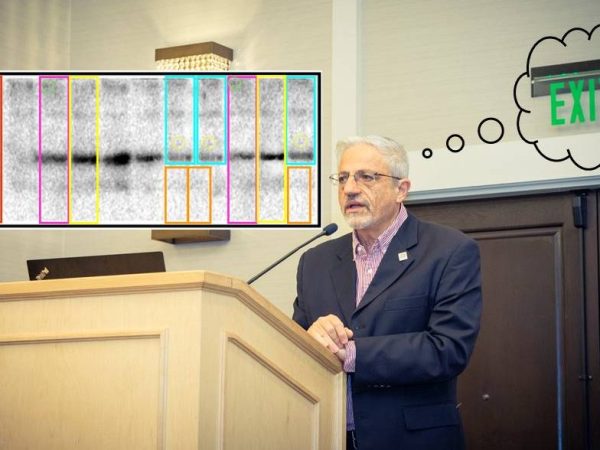
The potential problems of Eliezer Masliah
“the confusion occurred while utilizing prior panels as example ” – emeritus professor Eliezer Masliah
The guy is an utter crook, and there are things which make the whole story even creepier. You see, all former friends of Masliah now have fraudulent papers on PubPeer, but there is only one regular coauthor, in whose papers with Masliah Mu Yang couldn’t find anything problematic: Tsunao Saitoh, a former researcher at UC San Diego, where Masliah worked before moving to NIH.
Saitoh was murdered in 1996, and the killer still roams free. Here is the San Diego police’s “cold case“:
“Dr. Tsunao Saitoh was an accomplished and well-respected research neuroscientist at UCSD. On May 8, 1996 at about 11:00 p.m., Dr. Saitoh and his 13-year-old daughter, Loullie, returned home from the research lab on campus. As their car pulled up to the front of their home, an unknown suspect or suspects ambushed Dr. Saitoh and his daughter in the driveway, shooting and killing them both. Neighbors heard the gunshots and passers-by found the bodies a short time afterward. Dr. Saitoh was slumped over in the car and Loullie had run a short distance before being gunned down. […]
An exhaustive investigation was conducted in this case, and the motive for the double murder remains a mystery. Dr. Saitoh had no known enemies, and neither he nor his daughter was involved in any high-risk activities.”
Maybe Saitoh knew something, and was planning to tell?
Science Breakthroughs
Organic free-range production scored worst
British science has a solution to climate change catastrophe. It is a bit unconventional, and involves animal sacrifice. Basically, the idea is that if UK would torture millions of chickens to death every week, the gods of climate will have mercy and stop the global warming.
On 29 July 2026, The Guardian brought this headline: “Organic eggs have worse impact on climate than eggs from caged chickens”:
“Organic eggs are twice as bad for the climate as eggs from chickens living in cages, research suggests.
According to the study, switching the UK’s entire egg production to an organic free-range model would lead to greenhouse gas emissions equivalent to 2,316,000 tonnes of CO2 (tCO2e), while production through a fully caged system would emit 1,184,000 tCO2e.
This is because organic free-range models need more chickens for the same number of eggs produced, as birds living in cages tend to be more efficient.
Organic free-range production also scored worst in its potential for water eutrophication, acidification and land use.”
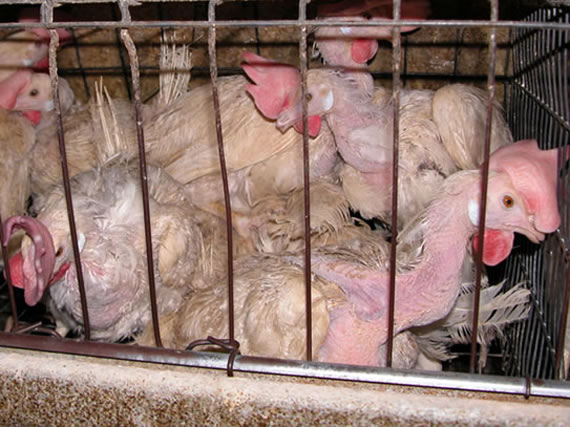
This is the paper:
Oliver Martinic , Luisa Magrin , Valentina Caldart , Rhea Harrison , Margaret Hegwood , Flaviana Gottardo , Harriet Bartlett The environmental cost of welfare-driven policy changes in UK egg production Royal Society Open Science (2026) doi: 10.1098/rsos.251830
The Guardian then quoted the lead scientist Harriet Bartlett, research associate at the University of Oxford:
“We found an important trade-off,” Bartlett added. “It’s that, the types of farms that are generally regarded as being better for animal welfare, like organic and free-range, can actually require more birds to produce the same amount of eggs because they’re less less efficient and they can have higher environmental impacts.”
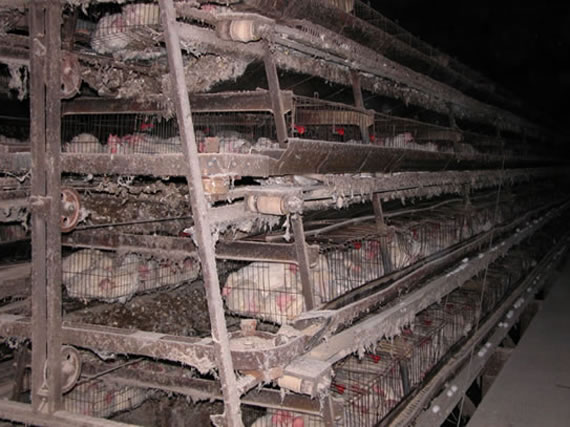
Allow me to make a point of criticism which no expert peer reviewer did. And it is not animal ethics and the increased antibiotics use which even the authors acknowledge. If Britain, finally free from the oppressive chains and bureaucratic dictatorship by the evil European Union, returns to cage-torture of egg-laying hens, it still won’t achieve a reduction of CO2 emissions, quite the opposite. Battery cage eggs are much, much cheaper than free-range or especially organic eggs, which drives consumers to eat more of them, and the industry to use more of those cheap eggs for processed food and even non-food related applications. Thus, many more chickens will be bred than they are already now. And of course, more cheap chickens mean more cheap chicken meat.
But Bartlett seems to have an issue with animal welfare in general. In her earlier paper, with her mentor Andrew Balmford – Cambridge professor, Fellow of the Royal Society and winner of its Environment Prize – she proved that also organic and free range farming of pigs is bad for the climate:
Harriet Bartlett , Márcia Zanella , Beatriz Kaori , Leandro Sabei , Michelle S. Araujo , Tauana Maria De Paula , Adroaldo J. Zanella , Mark A. Holmes , James L. N. Wood , Andrew Balmford Trade-offs in the externalities of pig production are not inevitable Nature Food (2024) doi: 10.1038/s43016-024-00921-2
The University of Camdringe celebrated that study with a press release titled: “Pork labelling schemes ‘not helpful’ in making informed buying choices“:
“Organic farming systems, which consumers might see as climate and environmentally friendly, have on average three times the CO2 output per kg of meat of more intensive Red Tractor or RSPCA assured systems and four times the land use. […]
“Our findings show that mitigating the environmental impacts of livestock farming isn’t a case of saying which farm type is the best,” said Bartlett.”

In our economy, it is perfectly normal, in fact desired that meat must be cheaper than vegetables, so that you can afford to eat your five meat portions a day, and now scientists proved that this is even good for the climate! Yes, I am ideologically biased, being a vegan and a member of the German Green Party. But these Cambridge scientists declare everywhere to have no conflicts of interests whatsoever. Do you believe them?
Donate!
If you are interested to support my work, you can leave here a small tip of $5. Or several of small tips, just increase the amount as you like (2x=€10; 5x=€25). Your generous patronage of my journalism will be most appreciated!
€5.00

 For Better Science
Ah, Scientific Reports – the journal equivalent of the Great Ocean Garbage Patch. How apropos.
LikeLiked by 1 person
Meanwhile at Cambridge…Cambridge professor Jason Arday resigns amid accusations of plagiarismhttps://www.theguardian.com/education/2026/aug/05/cambridge-professor-jason-arday-resigns-amid-accusations-of-plagiarismThey found the black Matthew Stephenson. If only there had been warning signs…’The new investigations may have been triggered by Arday’s claims that he held a string of prestigious visiting fellowships and professorships at other universities, including statements in published biographies dating back to 2018 that he was a visiting fellow or visiting professor at Ohio State University in the US. Ohio State has denied that Arday was ever employed in any role.
Biographies linked to Arday have also claimed he had visiting professorships at Durham, Glasgow, Coventry and London Metropolitan universities as well as Nelson Mandela University in South Africa.
Arday’s appointment as professor of sociology at Cambridge, at the comparatively young age of 37, received wide publicity through Arday’s life story, which includes a diagnosis of autism at the age of three, being unable to speak until he was 11, or read or write until he was 18.
Despite those factors, Arday went on to university and swiftly climbed the academic ladder. After receiving his PhD in 2015 he held academic posts at Leeds Beckett, Roehampton and Durham universities, including a brief stint at Warwick University, before being appointed professor of sociology of education at Glasgow University in 2021. By early 2023 he had sought and won appointment to a professorship at Cambridge.
Arday also claimed to have completed 30 marathons in 35 days as well as running 600 miles in six days, and raising £5m for charity over several years. After facing questions he revised some of those claims, and instead said he was part of a funding raising group that he cannot name for legal reasons.’
LikeLike
Jason Arday is dead.
https://www.telegraph.co.uk/gift/afdfd248c2b6fc15
LikeLike
BMJ et al. and all at BMJ Public Health are unwilling to consider findings in a institutional investigation when the complainer = me sends them this institutional investigation. See https://bmjpublichealth.bmj.com/content/4/3/e000282ret
BMJ et al. and all at BMJ Public Health are also unwilling to accept that I have sent them as well the institutional investigation about the role of first author Saskia Mostert. This investigation was finished in the end of April 2025. It since the end of April 2025 in the possession of BMJ et al. and several members of the editorial / advisory board of BMJ Public Health.
Jasper Tromp, a member of the advisory board, is aknowledged for sending me a legal threat.
I am the complainer. I am thus in the possession of all unedited reports of the institutional investigation by the Princess Máxima Center.
LikeLiked by 1 person
Tomasz Śliwiński and Co. suffered retraction #5 – this time in MDPI’s Genes.
10.3390/genes11091093
LikeLiked by 2 people