

Schneider Shorts of 2 October 2026 – Greek papermiller and industry shill also worked for cocaine mafia, another papermill acquitted by Norwegian authorities, US biotech finds fraud, French entrepreneur on a losing streak, plus other retractions for trachea tranplanters, a trio of European professors, and a Commander of the British Empire.
Table of Discontent
Science Elites
- The Mafia of Chania – Aristides Tsatsakis on trial for bribes from cocaine mob
- Objectionable and undesirable in academia – shameless papermiller Jerry Chun-Wei Lin acquitted in Norway
Retraction Watchdogging
- The first author was solely and fully responsible – US biotech discovers fraud by lead scientist
- Conclusions from the retracted clinical report – Paolo Macchiarini and Martin Birchall lose perspective
- An honest error during the construction – Caroline Dive’s paper took a plunge
- Present on the ATCC.org catalogue – Palma Rocchi has no shame
- It is not possible to predict which publications may be retracted in the future – surprise for Nikos Karamanos and Martin Götte
Science Elites
The Mafia of Chania
Those who have heard of the Greek toxology professor Aristides Tsatsakis know that he is a papermiller, an antivaxxer, a shill for tobacco and pesticide industry, and a russian asset (he has an active professorship in russia).

An expert criticism by fraudsters and antivaxxers: the case of PubPeer
“A concerning trend is the rise of “hyper-skepticism”” – ChatGPT

What we didn’t know yet was that Tsatsakis is apparently a literal mobster, connected to the Greek organised crime syndicate The Mafia of Chania. In summer 2026, Tsatsakis was all over the Green news because he was arrested and put on trial.
Athens News reported in English on 27 July 2026, that “charged with repeatedly accepting bribes in a particularly serious form.” As professor at University of Crete and head of the Laboratory of Toxicology and Criminological Chemistry (PAGNI) at the University Hospital of Heraklion, Tsatsakis was involved in some prominent national crime case, where he apparently delivered rigged expert reports “to mitigate punishment, change the results of legal disputes and obtain compensation” in criminal cases related to the local Greek mafia.
Zougla.gr had more details:
“At the center of the revelations is “Patopoukalos”, a person who is accused of flooding Chania with cocaine and allegedly a “client” of the PAGNI Toxicology professor, who was arrested together with the Chania medical examiner for falsifying laboratory tests and forging certificates for judicial use.
Among the cases included in the case file, the fatal traffic accident that occurred in October 2023 stands out, where the motorcycle driven by “Patomopoukalos” ran over and fatally injured an 81-year-old pedestrian, while cocaine was initially found in his possession by the police.
While the first blood sample showed that the driver was under the influence of drugs, after a request for a retest, the substance… “disappeared” from the results.
For this specific incident, the Chania medical examiner and the toxicologist are charged with drawing up a false toxicological report for unfair financial consideration. “
The aforementioned forensic pathologist and Tsatsakis’s associate is Stamatis Belivanis. Thanks to Tsatsakis’s rigged expert reports, “Patopoukalos” repeatedly saw his criminal charges reduced for mitigating circumstances of drug addiction. He is currently in prison for organised drug trafficking, and also suspected of being “behind the placement and detonation of an explosive device in January 2024 at the house of a police officer“.
Elsevier’s Pandemic Profiteering
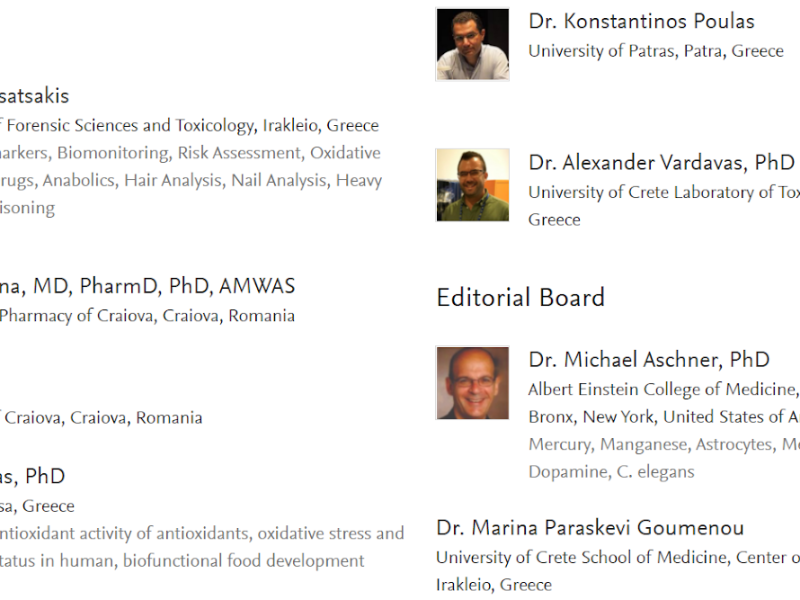
Aristidis Tsatsakis, Konstantinos Poulas, Ronald Kostoff, Michael Aschner, Demetrios Spandidos, Konstantinos Farsalinos: you will need a disinfecting shower once you read their papers.

The eight major cases where Tsatsakis and Belivanis are accused to have forged evidence in return for bribes from mafia, are presented on HuffPost and on zarpanews.gr:
- “Fatal car accident, attributed to writing a false toxicology report for unfair financial consideration.
- Sudden death case where, according to the case file, false forensic and toxicology reports were allegedly prepared.
- Fatal traffic accident, with the charge of making a false forensic report.
- Armed conflict with police officers, in which a false forensic report is attributed.
- Complaint for demanding monetary compensation from a family, in exchange for the preparation of a forensic report.
- Rape complaint case, in which the case file attributes the preparation of a false forensic report.
- A drug case where a false toxicology report was allegedly prepared in order to favor the defendant.
- Second narcotics case, with corresponding charge of making a false toxicology report”
On 27 July 2026, Greek media reported that Tsatsakis was out on bail of €30k, and banned from leaving the country. Maybe he planned to flee to his beloved russia?
The really dangerous thing is that this is not a local Greek disaster. Tsatsakis is well connected not just to the organised crime in Crete, but also to the highest levels of academic networks of European and international toxicology. His friends advice governments and authorities on what is safe for you to eat, drink or inhale.
I am not exaggerating. The entire Federation of European Toxicologists and European Societies of Toxicology (EUROTOX) is behind Tsatsakis – he used to be Eurotox’s President (2014-2016), and more recently, he was the President of the Eurotox 2025 congress last December, which took place in December 2025 in Athens.
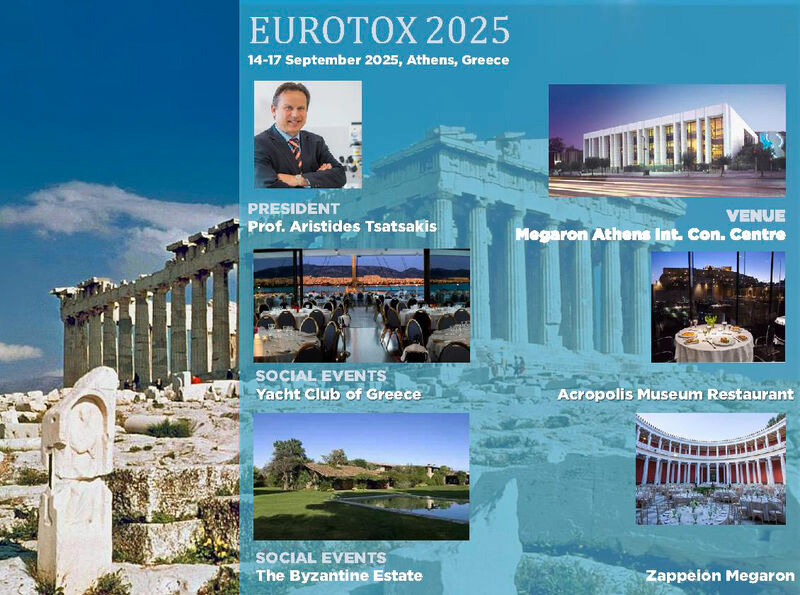

It was bad enough that Tsatsakis and his friends funnelled tobacco and pesticide money into European toxicology. Now it turns out there was also cocaine money from the organised crime, the literal mafia.
Objectionable and undesirable in academia
In Norway, a shameless papermiller was first found guilty of research misconduct by his institution, then acquitted by a national authority.
The perpetrator is Jerry Chun-Wei Lin, until March 2025 professor at the Western Norway University of Applied Sciences (HVL), now very unsurprisingly at the Silesian University of Technology in Gliwice, Poland, because there one knows to cherish and nurture papermill fraudsters.

The papermilling den of Gliwice
“As you will see, there is a lot of papermilling happening in Gliwice, as if this place has suddenly become attractive to many “researchers” from different corners of the papermilling spectrum. ” – Alexander Magazinov

Lin has a massive PubPeer record of ridiculous papermill stuff he published himself and of purchased citations to these papers. His coauthors include the professional fraudster duo Thippa Reddy Gadekallu and Gautam Srivastava, read about them on Retraction Watch and below. Worth noting that this gang includes another member: Youcef Djenouri, associate professor at University of South-Eastern Norway (PubPeer record), who so far seems to have escaped any consequences.
The Extortionists, by M. Angeles Oviedo-Garcia
“The preference of Thippa Reddy Gadekallu et al. (Abdul Rehman Javed, Celestine O. Iwendi, Sharnil Nitin Pandya and Gaurav Jay Dhiman) for coercive citation and copy-pasting their review comments” – Maria de los Ángeles Oviedo García
The Norwegian magazine Khrono reported on 24 September 2026 (translated):
“Lin, who is an expert in artificial intelligence and data analysis, has been among Norway’s most published researchers. In Khrono’s overview for 2019-2022, he ended up in 2nd place. In 2022 alone, he was co-author of 115 scientific articles , more than two a week.
In 2021 and 2022, he alone accounted for more than 10 percent of the overall scientific production at the college.
In connection with the probity case against him, an expert committee, set up by his faculty, went through 42 of his publications. It was on the basis of this report that HVL’s own research ethics committee condemned him for misconduct. [….]
the expert committee believed that Lin deliberately mass-produced articles of low quality, including inadequate method descriptions and text that did not make sense. […] The committee also recommended that several articles should be withdrawn.”
But then Lin appealed to the National Committee for the Investigation of Research Misconduct, and got acquitted. They found merely “significant shortcomings both in terms of content and language“, and Lin’s methods to be “objectionable and undesirable in academia“, but no fraud. Basically, the argument was that the scholarly publishing is so screwed up and corrupt that one can’t blame trash scientists for abusing it. The committee also ordered the retraction decisions to be revoked. Too late for some, according to Argos, Lin has already six retractions, most recently this one:
Pravin R. Kshirsagar , Hariprasath Manoharan , Shitharth Selvarajan , Sara A. Althubiti, Fayadh Alenezi, Gautam Srivastava, Jerry Chun-Wei Lin A Radical Safety Measure for Identifying Environmental Changes Using Machine Learning Algorithms Electronics (2022) doi: 10.3390/electronics11131950
The retraction from 7 May 2026 mentioned “inappropriate citations, incoherent text, an incorrect formula, and content lacking meaningful scientific value, including instances of incorrect terminology“.
Also on 24 September 2026, Lin got Khrono to publish his rebuttal, where he refers to himself in royal plural and basically claims that his investigators are the corrupt ones and too stupid to understand his high-flying science.
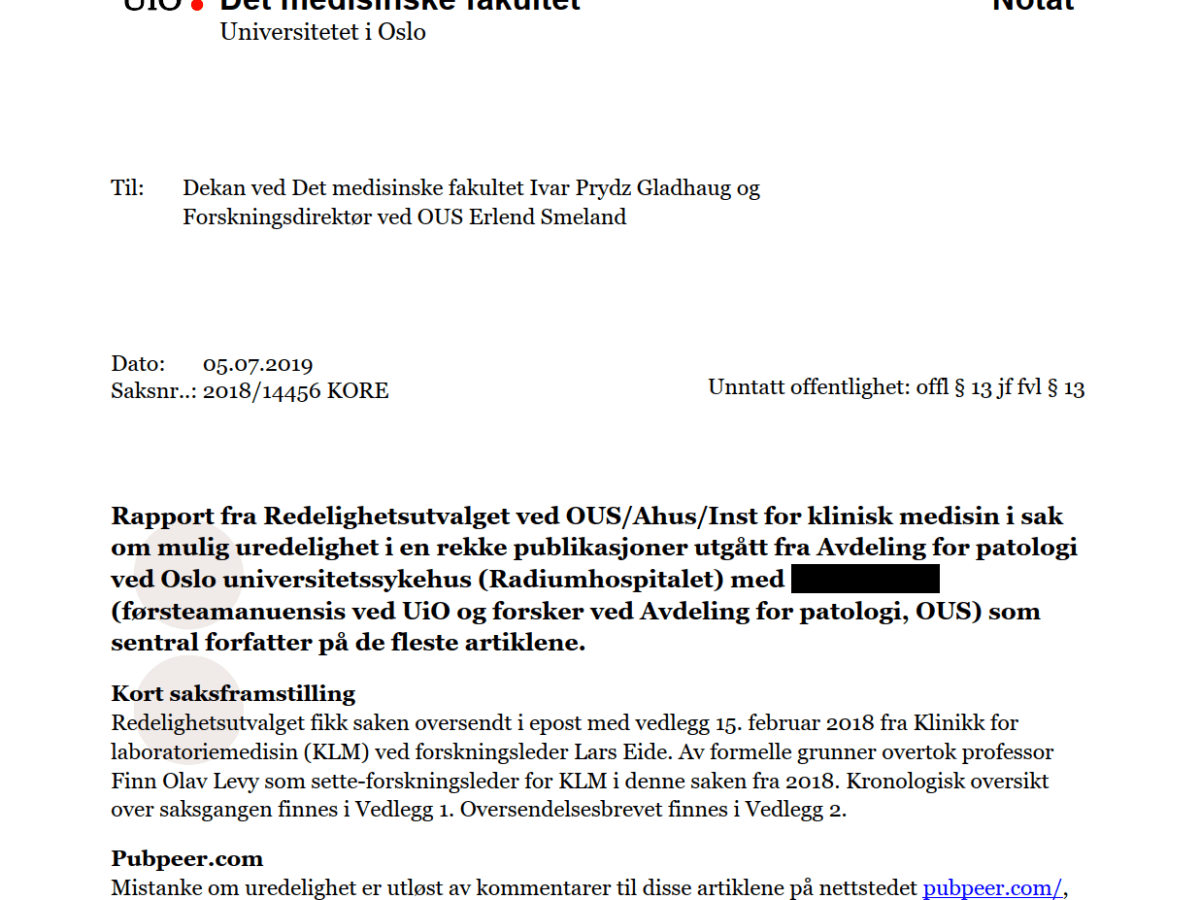
The communal misconduct by Zhenhe Suo in Oslo
“the Committee believes that when carelessness or scientific dishonesty can be found in so many articles with so many different authors in question, there must be a lack of training and / or lack of control over data handling. The committee therefore believes that it is qualified probability that there has been an institutional system…
As Khrono previously wrote, the affair started in 2020, and then again in 2022, when a whistleblower, the HVL librarian Kjetil Sletteland, reported this paper to HVL, because it contains nonsense references:
Hassan A. Alterazi , Pravin R. Kshirsagar , Hariprasath Manoharan , Shitharth Selvarajan , Nawaf Alhebaishi , Gautam Srivastava , Jerry Chun-Wei Lin Prevention of Cyber Security with the Internet of Things Using Particle Swarm Optimization Sensors (2022) doi: 10.3390/s22166117
Sletteland also reported other papers by Lin, but was initially ignored by HVL. Only in 2024 did they start their investigation.
Lin was second ranking, but Norway most published researcher was Filippo Berto at NTNU. Who in 2022 decided to return to Italy, specifically to Sapienza University of Rome, where papermilling and other kinds of fraud are valued and appreciated. Still, NTNU caught up, opene an investigation in early 2024, and Berto was soon found guilty of research misconduct. Read March 2026 Shorts and here:

Karimipour Saga III: All roads lead to Rome
“The academic career of D’Orazio is tightly coupled to that of Karimipour since she hosted him at Sapienza. Of the 57 papers she declared authorship for, 25 (44%) are published together with Karimipour.” – Maarten van Kmapen

Back in May 2025, Berto also forced Khrono to publish his rebuttal, where he described himself to be a victim of, among other things, “the darkest Mediaeval inquisition“. Berto also announced to sue everyone in Norway:
“The rest will be done by my lawyers taking specific actions on individuals and players who have violated laws during the entire process.”
HVL has another case to solve, that of their professor Dhayalan Velauthapillai. I wrote about his papermilling and his retractions in August 2025 Shorts. He has over 30 papermill fabrications on PubPeer and just earned yet another retraction, with Fuad Ameen:
M. Isacfranklin , Fuad Ameen , G. Ravi , R. Yuvakkumar, S.I. Hong , Dhayalan Velauthapillai , M. Thambidurai , Cuong Dang Single-phase Cr2O3 nanoparticles for biomedical applications Ceramics International (2020) doi: 10.1016/j.ceramint.2020.05.050


Jian Peng Chan: “shares similarity with another 2 sets of papers: (left)”
R. Uma Maheswari , B. Jansi Rani , G. Ravi , R. Yuvakkumar , Fuad Ameen , A. Al-Sabri Structural, morphological, optical and antibacterial properties of pentagon CuO nanoplatelets Journal of Sol-Gel Science and Technology (2018) doi: 10.1007/s10971-018-4773-0
and
R. Yuvakkumar , S. I. Hong Nd2O3: novel synthesis and characterization Journal of Sol-Gel Science and Technology (2015) doi: 10.1007/s10971-015-3629-0
The retraction from 26 September 2026 announced “This article is being retracted at the request of an impartial field expert acting in the role of an independent Publishing Ethics advisor“, mentioned the above data reuse and referenced PubPeer.
In March 2026, the HVL professor lost this paper:
S. Swathi , R. Yuvakkumar , G. Ravi, S.I. Hong , E. Sunil Babu, Dhayalan Velauthapillai , Tahani Saad Algarni , Amal M. Al-Mohaimeed Iron doped vanadium sulfide anemone like nanorod structure for electrochemical water oxidation Current Applied Physics (2021) doi: 10.1016/j.cap.2020.11.002

Dysdera arabisenen: “Fig 2A: 10% Fe-VS and VS traces appear to share similar fingerprint noise patterns that are scaled differently”
The retraction from 12 March 2026 addressed “duplication and misrepresentation of results” in Fig 2A.
And before that, there were other retractions, making it at least six in total. In 2025, since HVL found themselves unable to sanction Velauthapillai, I notified the National Commission for the Investigation of Research Misconduct. Their director Ragnhild Aursnes Dammen told me in December 2025 (typos hers):
“The response from the Commision is that it is the research institution to be contacted and who must deal with such issues. […] The reporting should be done after a case handling has been concluded at the institution. Therefore, you can always ask the institution wether it has reported the handling of the case to the The National Commission for the Investigation of Research Misconduct. ”
Dammen then told me that “From 2026 there will be a new Commission and this new Commission will be informed about your inquiry.” In March 2026, she informed me that “The conclusion of the new Commission was that it maintains the same conclusion and answer as the old Commission.”
Basically, if HVL doesn’t investigate Velauthapillai, the National Commission won’t do anything either. But now we know that should HVL ever investigate Velauthapillai and find him guilty, the National Commission will jump in to acquit him, as they did with Lin.
Retraction Watchdogging
The first author was solely and fully responsible
In USA, a stock market traded biotech retracts a preclinical study and accuses their lead scientist of fraud. Denali Therapeutics is founded and run by Ryan Watts, a former Genentech executive.
Madhuja Samaddar , Gabriel A. Fitzgerald , Ann Hong Nguyen , Sonnet S. Davis , Shourya Jain , Jian Guo , Nicholas E. Propson , Bettina Van Lengerich , Yajuan Shi , Srijana Balasundar , Lionel Rougé , Jamal Alkabsh , Anil Rana , Julie Yi , Marcus Y. Chin , Isabel A. Becerra , Annie Arguello , Brian M. Fox , Todd Logan , Jung H. Suh , Anastasia G. Henry, Gilbert Di Paolo Lysosomal polyamine storage upon ATP13A2 loss impairs β-glucocerebrosidase via altered lysosomal pH and electrostatic hydrolase-lipid interactions Cell Reports (2025) doi: 10.1016/j.celrep.2025.116179
Here is the retraction from 28 September 2026 (highlights mine).
“This article has been retracted at the request of the authors and with the approval of the editor-in-chief. Several months after publication, re-examination undertaken by one of the co-authors of primary and final data included in this manuscript revealed that the first author had altered some of the data to reduce variability and improve statistical significance, thus impairing its accuracy. Denali Therapeutics undertook an investigation of all figures and data represented in the paper. The investigation concluded that the paper contained inaccurate data in Figures 1B, 3B–3G, and 4F and that the first author was solely and fully responsible. It also concluded that the altered and inaccurate data impact the conclusions about lysosomal pH and glucocerebrosidase activity in ATP13A2 KO cells in vitro but do not affect the major conclusions of the in vivo data in Figures 1 and 2 or the mechanistic data in Figure 4. The first author is no longer employed by Denali Therapeutics, and the issues described for this paper were unknown to the corresponding author and all other authors at the time of publication. Given that this issue affects the scientific validity of the key results and conclusions, the authors collectively requested retraction of the article. The authors apologize for any inconvenience caused. All authors agree with the retraction.”
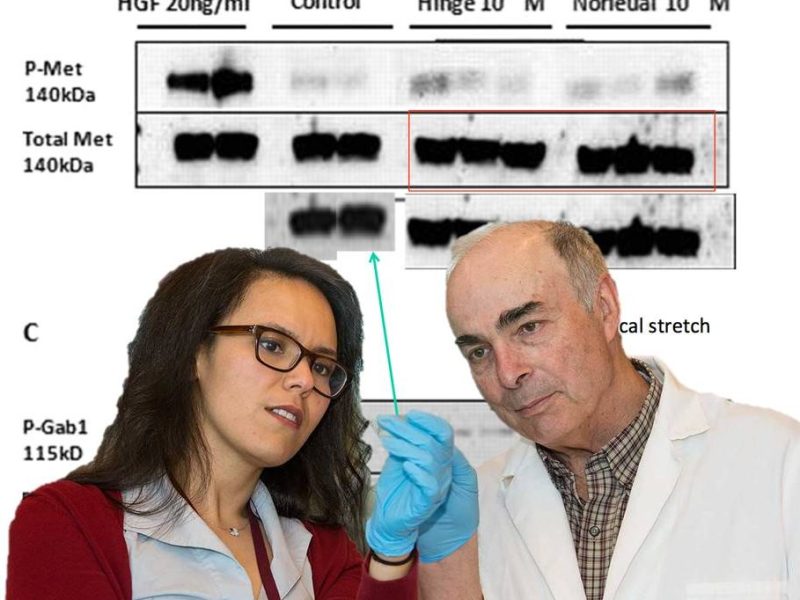
How to cure all diseases
“I have a passion to solve a problem that is facing millions. I could have a job that makes more money, has normal hours, but this is where I should be right now.” Dr Leen Kawas, CEO of Althira Pharma
Fingers are clearly pointed at Madhuja Samaddar, until her sacking Senior Scientist for Discovery Biology at Denali. She worked there since March 2021 and was recruited from Calico Life Sciences, a biotech by Cynthia Kenyon. Already in 2019, Samaddar had this paper on PubPeer, from her past work at Indian Institute of Science in Bangalore:
Kondalarao Bankapalli , SreeDivya Saladi , Sahezeel S. Awadia , Arvind Vittal Goswami , Madhuja Samaddar , Patrick D’Silva Robust glyoxalase activity of Hsp31, a ThiJ/DJ-1/PfpI family member protein, is critical for oxidative stress resistance in Saccharomyces cerevisiae Journal of Biological Chemistry (2015) doi: 10.1074/jbc.m115.673624
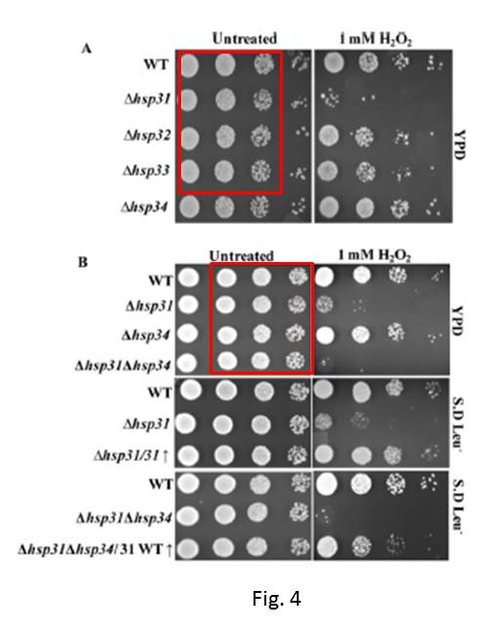
Potamanaxas unifasciata: “Image duplication.” (Fig 4)
Conclusions from the retracted clinical report
The killer surgeon Paolo Macchiarini and his former best friend and closes partner Martin Birchall lose yet another paper about their fraudulent and deadly trachea tranplants.
The perspective review paper was flagged for image reuse eight years ago, it reused an image from the now retracted seminal study by Macchiarini and Birchall about their first ever published trachea transplant:
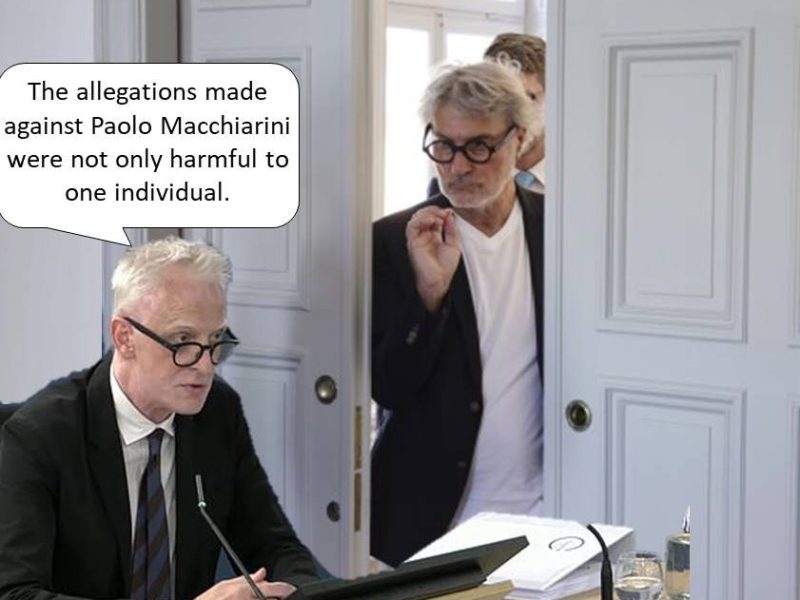
Swedish investigation spoils Macchiarini cover-up at Lancet
NPOF, again and again: “Philipp Jungebluth and Paolo Macchiarini guilty of research misconduct” Lancet: “Paolo Macchiarini is not guilty of scientific misconduct”
Better late than never for the publisher Wolters Kluwer:
Silvia Baiguera , Martin A. Birchall, Paolo Macchiarini Tissue-engineered tracheal transplantation Transplantation (2010) doi: 10.1097/tp.0b013e3181cd4ad3

Condylocarpon Amazonicum: “A pair of cell microscopy images from Fig. 4 are very similar to two images in Fig. 1 of a paper published two years later, though they are not identical. Judging by the highlighted texts of the figure legends, the images are also not being presented for the same purposes.”
Paolo Macchiarini, Philipp Jungebluth , Tetsuhiko Go , M Adelaide Asnaghi , Louisa E Rees , Tristan A Cogan , Amanda Dodson , Jaume Martorell , Silvia Bellini , Pier Paolo Parnigotto , Sally C Dickinson , Anthony P Hollander , Sara Mantero , Maria Teresa Conconi , Martin A Birchall Clinical transplantation of a tissue-engineered airway The Lancet (2008) doi: 10.1016/s0140-6736(08)61598-6 [RETRACTED]
The publisher however decided not to confuse the readers with a retraction notice, this is what the article’s main page looks like today:
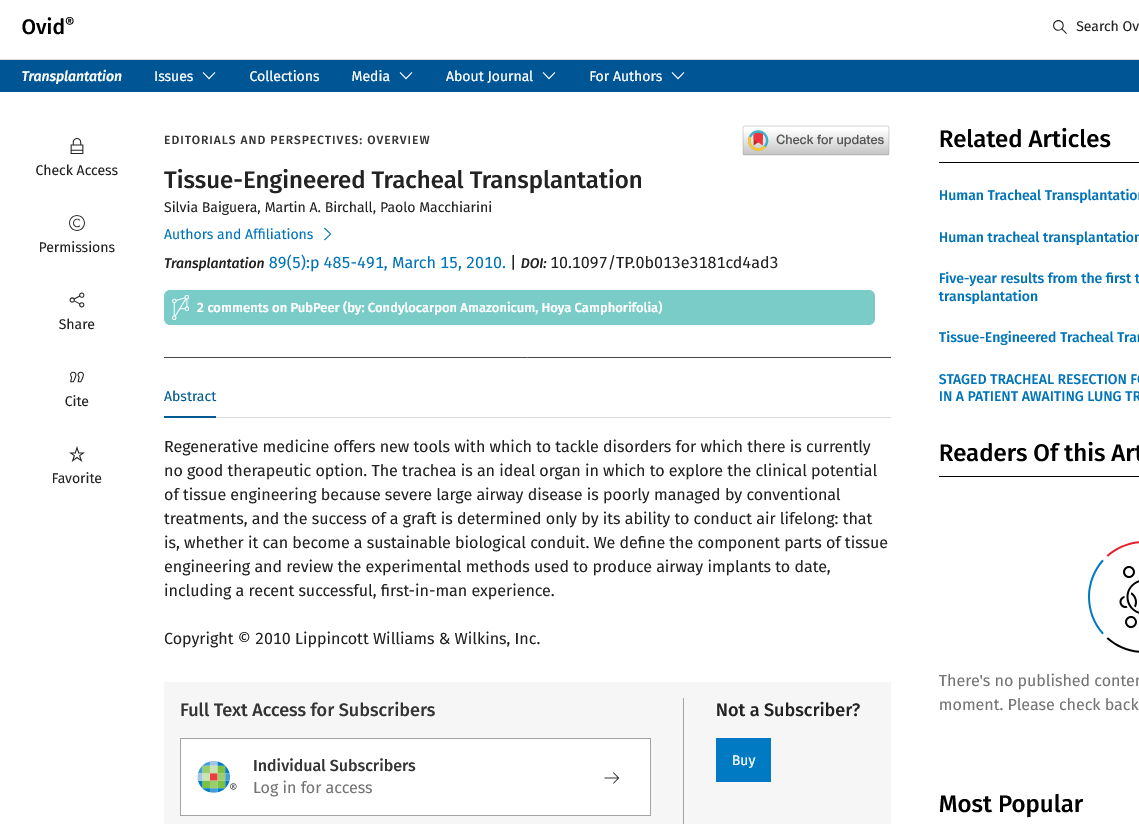
The hidden retraction notice leads its totally seperate existence, it was future-dated to October 2026:
“At the request of the authors, the Editors of Transplantation have retracted this article.1
This article is retracted because it relies substantially on data and clinical outcomes reported in a 2008 Lancet publication that was retracted in 2023. Key sections of the review discuss and draw conclusions from the retracted clinical report, including statements regarding the patient, procedure, and clinical outcome. As the validity of the underlying publication can no longer be relied upon, the integrity of the review has been compromised. The Editors have therefore decided to retract this article.
Retracted Article: DOI: 10.1097/TP.0b013e3181cd4ad3
Retraction Notice Published: 110(10) October
Retraction Notice DOI: 10.1097/TP.0000000000005878
Reason for Retraction: Data in the Transplantation publication overlap with data of the retracted the lancet publication? publication in The Lancet?
Author Agreement: All Authors”
There are still some papers by Macchiarini and Birchall about their trachea transplants, which still escaped retraction. Peter Wilmshurst and Patricia Murray are doing an incredible work (see also Wilmshurst’s blog), but the resistance from the publishing business and the medical and academic community is still huge.

American Association of Thoracic Surgery: Macchiarini method works!
“The reviewers and editors agree there is not clear evidence to support Dr Murray’s claim.”
An honest error during the construction
One of Britain’s top biomedical scientists loses a paper. Caroline Dive is professor at University of Manchester, interim director of the Cancer Research UK Manchester Institute (CRUK-MI), President of the European Association for Cancer Research, and Commander of the Order of the British Empire (CBE) “for her services to cancer research”.
And this paper from Dive’s lab was now retracted for fraud, the first author Isabel Pires is now lecturer at the Manchester Cancer Research Centre (formally known as Paterson Institute). The corresponding author is Tim Ward, a retired scientist from that institute and a cancer sufferer himself.
I M Pires , T H Ward , C Dive Oxaliplatin responses in colorectal cancer cells are modulated by CHK2 kinase inhibitors British Journal of Pharmacology (2010) doi: 10.1111/j.1476-5381.2009.00607.x


One year after the PubPeer posts, the paper was retracted on 22 September 2026:
“Concerns were raised by a third party on PubPeer [1] that the p53 -phosphoS20 53kD band in Figure 3A contained an identical section between the UT and CHK2II lanes and that there was evidence of splicing in Figure 5A.
Not all original data for the article, including data from Figure 5, were still available. The editors recognize that, at the time of publication, the presentation of spliced blots may have been more common and that authors may not have had clear journal instructions that they must clearly indicate where splicing had been used for figures with western blots.
The editors reviewed data supplied by the authors relating to Figure 3A and determined that the published p53-phosphoS20 bands appeared to have been created from different regions of the original blot, aligning with blot lanes representing different experimental conditions than those reported, and so did not accurately represent the experiment as published. The authors report that this was due to an honest error during the construction of the figure for publication.”
How one honestly fakes a western blot, is not explained.

Manchester: “research misconduct concerned only one member of the research group”
The University of Manchester found out that someone has secretly manipulated data in the papers of their star cancer researcher, Richard Marais. Who might that be?
Dive has more on PubPeer, mostly flagged by the pseudonymous sleuth Claire Francis. This duplication was a bit too lazy:
K L Simpson , C Cawthorne , C Zhou , C L Hodgkinson , M J Walker , F Trapani , M Kadirvel , G Brown , M J Dawson , M MacFarlane , K J Williams , A D Whetton , C Dive A caspase-3 ‘death-switch’ in colorectal cancer cells for induced and synchronous tumor apoptosis in vitro and in vivo facilitates the development of minimally invasive cell death biomarkers Cell Death & Disease (2013) doi: 10.1038/cddis.2013.137

“Lower actin panel has 7 lanes, PARP panel above it has 8 lanes.” (Fig1aii)
It was shameless to just copy-paste control gels, but doing so partially makes it even more insidious:
Jennifer Adamski , Andrew Price , Caroline Dive , Guy Makin Hypoxia–Induced Cytotoxic Drug Resistance in Osteosarcoma Is Independent of HIF-1Alpha PLOS One (2013) doi: 10.1371/journal.pone.0065304

Here a paper with Constantinos Demonacos, senior lecturer at University of Manchester, and his wife Marija Krstic-Demonacos, professor at the nearby located University of Salford.
G Xenaki , T Ontikatze , R Rajendran , I J Stratford , C Dive , M Krstic-Demonacos , C Demonacos PCAF is an HIF-1alpha cofactor that regulates p53 transcriptional activity in hypoxia Oncogene (2008) doi: 10.1038/onc.2008.192


Dive is also the former mentor of Janine Erler, who despite retractions made it very big at home in Denmark.
Janine Erler dossiers which ERC does not want
Janine Erler is a star of Danish cancer research, funded by ERC. Her earlier research led to the discovery of the key role of the enzyme lysyl oxidase in cancer metastasis and brought the scientist and businesswoman very close to curing cancer. Until some sad envious bad-wishers found duplicated gel bands in Erler papers.
Here is a joint paper by Dive and Erler, Demoncos is on board:
Janine T. Erler , Christopher J. Cawthorne , Kaye J. Williams , Marianne Koritzinsky , Bradley G. Wouters , Clare Wilson , Crispin Miller , Costas Demonacos , Ian J. Stratford , Caroline Dive Hypoxia-mediated down-regulation of Bid and Bax in tumors occurs via hypoxia-inducible factor 1-dependent and -independent mechanisms and contributes to drug resistance Molecular and cellular biology (2004) doi: 10.1128/mcb.24.7.2875-2889.2004


Present on the ATCC.org catalogue
Things are collapsing for Palma Rocchi, research director at INSERM in Marseille, France, and former colleague of the Canadian cheater Martin Gleave. They set up separate companies to market the same siRNA-based drug against prostate cancer. Rocchi was mentioned here:

Trials and Errors of Martin Gleave
“The magnitude was much greater than we had expected or hoped for,” – Martin Gleave
Now she earned yet another retraction, and this is probably just the beginning:
F. Fina , X. Muracciole, P. Rocchi, I. Nanni-Métellus , C. Delfino , L. Daniel , C. Dussert , L.’H. Ouafik , P.M. Martin Molecular profile of androgen-independent prostate cancer xenograft LuCaP 23.1 The Journal of Steroid Biochemistry and Molecular Biology (2005) doi: 10.1016/j.jsbmb.2005.04.041

Palma Rocchi, Xavier Muracciole, Frederic Fina , Dave J Mulholland , Gilles Karsenty, Jacqueline Palmari , L’Haucine Ouafik , Franck Bladou , Pierre-Marie Martin Molecular analysis integrating different pathways associated with androgen-independent progression in LuCaP 23.1 xenograft Oncogene (2004) doi: 10.1038/sj.onc.1208154


The 2005 paper reuses data from Oncogene 2004, which was criticised for animal abuse. There, mice had tumours of ~5750mm3 , twice the size of what animal ethics allow. Now it also turned out there was no ethics approval at all. The retraction for the 2005 paper from 3 September 2026 revealed:
“Post-publication, a reader raised concerns regarding the ethical approval of the study and the republication of Figures 1, 2, and 3 presented in this article from a previous publication by some of the listed authors, published in Oncogene (23 (2004), 9111–9119; https://doi.org/10.1038/sj.onc.1208154), without appropriate citation or acknowledgement.
The journal promptly initiated an investigation with the support of Elsevier’s Research Integrity & Publishing Ethics team and attempted to contact the authors to seek clarification.
The authors Palma Rocchi, Xavier Muracciole, Laurent Daniel, L’Houcine Ouafik, and Frédéric Fina did not provide a response addressing these concerns. The corresponding author, Pierre-Marie Martin, sadly passed away in 2017. Isabelle Nanni-Metellus, Christine Delfino, and Christophe Dussert could not be contacted.
The Editor has reviewed the case and could not confirm whether ethical approval was given for the research presented in this publication in line with the journal’s policy. As it cannot be established whether the article complies with the journal’s policies on ethical approval, the editor has lost confidence in the integrity of the article and has determined it should be retracted.”There are also corrections which were upgraded to Expressions of Cocnern and much get upgraded to retractions soon.
There are Rocchi’s Corrections which got upgraded to Expression of Concern, and might soon get upgraded to retractions, see Rocchi et al 2006 (with Gleave) or Andrieu et al 2010.
It started with hidden conflicts of interests for Rocchi (see June 2025 Shorts), then progressed to data manipulation, mouse torture and self-plagiarism. Now we also have outright data theft.
This mouse research paper was originally flagged for suspected lack of ethics approval. Its author include Philippe Barthélémy, former Vice-President of Bordeaux Segalen University, now professor at University of Bordeaux and Director of ARNA lab, and David Taïeb, Rocchi’s business partner at their Marseille-based company Silon Therapeutics.
Dang Tan Nguyen, Thi Khanh Le, Clément Paris, Chaïma Cherif, Stéphane Audebert, Sandra Oluchi Udu-Ituma, Sébastien Benizri, Philippe Barthélémy, François Bertucci, David Taïeb, Palma Rocchi Antisense Oligonucleotide-Based Therapeutic against Menin for Triple-Negative Breast Cancer Treatment Biomedicines (2021) doi: 10.3390/biomedicines9070795

This figure shows Western blots derived from breast cancer cells treated with different antisense oligonucleotides (ASOs).
Pink and cyan boxes highlight GAPDH blots that look unexpectedly similar to those in Figure 2 of”
Chaïma Cherif, Dang Tan Nguyen, Clément Paris, Thi Khanh Le, Thibaud Sefiane , Nadine Carbuccia, Pascal Finetti, Max Chaffanet, Abdessamad El Kaoutari , Julien Vernerey , Ladan Fazli , Martin Gleave, Mohamed Manai, Philippe Barthélémy, Daniel Birnbaum , François Bertucci, David Taïeb, Palma Rocchi Menin inhibition suppresses castration-resistant prostate cancer and enhances chemosensitivity Oncogene (2022) doi: 10.1038/s41388-021-02039-2

The authors describe how Hs578T cells were treated with control-ASO or menin-ASO, and Figure 3b shows photos of the two experiments.
Unexpectedly, the two photos shown in Figure 3b match photos of Hs 578T cells as found in the ATCC catalog, with the ATCC logo cropped off and a vertical stretch.”
Yes, the images were stolen from the website of the cell line provider. Also here:
Guillaume Sicard, Clément Paris, Sarah Giacometti, Anne Rodallec, Joseph Ciccolini, Palma Rocchi, Raphaëlle Fanciullino Enhanced Antisense Oligonucleotide Delivery Using Cationic Liposomes Grafted with Trastuzumab: A Proof-of-Concept Study in Prostate Cancer Pharmaceutics (2020) doi: 10.3390/pharmaceutics12121166

The description of the figure suggests that experiments were done on four types of cells.
The photos shown here match those present on the ATCC.org catalogue, suggesting they were not taken by the authors. The text does not mention the source of the photos.”

The other newly found fraud in Rocchi’s papers (see PubPeer) looks almost benign in face of this now. Like this:
Quang Hieu Duong , Elmira Khusnutdinova , Thi Khanh Le , Yinghua Hu , Thi Thom Tran , Vincent Nail , Laure Balasse , Thuy Duong Dinh , Thi Tu Uyen Phan , Marc Borie-Guichot , Michael Baboudjian , Frederic Garzino, Benjamin Guillet, David Taïeb, Michel Camplo, Palma Rocchi A novel 5-FU derivative chemotherapy: a promising pan-cancer treatment to improve antitumor efficacy and overcome therapy resistance Journal of Experimental & Clinical Cancer Research (2026) doi: 10.1186/s13046-026-03826-z

It is not possible to predict which publications may be retracted in the future
We started with Greek fraud, we shall end with Greek fraud.
This retraction was earned by Nikos Karamanos, former Vice-Rector of Academic & International Affairs, now governing board member at University of Patras in Greece. He was until 2025 President and is now board member of the International Society for Matrix Biology, in whose journal this was published, and now retracted:
Zoi Piperigkou, Marco Franchi, Christoph Riethmüller , Martin Götte, Nikos K. Karamanos miR-200b restrains EMT and aggressiveness and regulates matrix composition depending on ER status and signaling in mammary cancer Matrix Biology Plus (2020) doi: 10.1016/j.mbplus.2020.100024


Zoi Piperigkou , Anastasios Koutsandreas , Marco Franchi , Vasiliki Zolota , Dimitrios Kletsas , Alberto Passi , Nikos K. Karamanos ESR2 Drives Mesenchymal-to-Epithelial Transition in Triple-Negative Breast Cancer and Tumorigenesis In Vivo Frontiers in Oncology (2022) doi: 10.3389/fonc.2022.917633
The retraction arrived on 25 September 2026 and it detailed the authors attempts to publish a fraudulent correction by submitting unrelated blots and duplicate images (highlights mine):
“Post-publication, the authors brought to the attention of the Editor in Chief some issues with multiple figures in this publication and provided replacement figures. These issues had been reported in https://pubpeer.com/publications/0C513F9EBFA057EC1A07D8D99CEF84.
The Editorial team of the journal investigated these concerns and the authors’ response. The Editors conducted a detailed analysis of these concerns, which they provided to the authors, requesting further clarification and original data. The authors’ subsequent response provided additional data but failed to provide clarity or alleviate the most serious concerns as detailed here.
- A review of the article identified the presence of shifted, duplicated sections in control miR MCF-7 micrographs appearing in Figure 2 panel A. The authors were requested to provide comments on these concerns, as well as the original unprocessed image files to aid the investigation; however, their response did not satisfactorily address the above concerns. The first author correction provided in December 2025 also used another duplicate. The authors were requested to provide original panels for control and pre-miR conditions for each of the 6 biological replicates. Unfortunately, the MCF-7 control miR data shown in panels 2, 3, 4 and 6 each have overlapping fields of view provided in the most recent response and in the accompanying original images. This raises the issue of overlapping cell counts as well.
- Figure 5E: The authors provided six unlabeled panels and original images to explain the cropped blots for phospho-ERK and alpha-tubulin. There are 4 experimental conditions that were analyzed in Table 2, but 6 lanes on these blots. The analyses do not correspond to the images for p-ERK1/2 (2) for MDA-MB-231 cells or p-ERK1/2 (2) (rightmost lane, which is also labeled as sample 2 but which might be replicate 3) for both cell types. For the alpha-tubulin blot, the quantification of the MCF-7 blots for samples (2) and rightmost (2) do not correspond to the corresponding images. Similarly, the quantification of MDA-MB-231 images do not correspond to the blot images for rightmost (2).
- Data from an irrelevant study for the panel in Figure 5E that was later published in another journal (Fronters in Oncology 2022; https://doi.org/10.3389/fonc.2022.917633) was acknowledged by the authors in our prior correspondence, but the authors did not provide any confirmation that the editor of Frontiers in Oncology had been notified regarding prior publication of this duplicate panel in the Matrix Biology Plus article in 2020.
- Figure 5B: The authors provided original images and quantification from two separate zymogram studies shown in Figure 5B. The authors stated that the data from the third replicate was not available. The authors’ explanation for the splice site is indeed reasonable and there is no objection to this splicing, although this action should have been specified as such in the figure legend in the original publication. Most importantly, the two zymograms do not show consistent results for MMP-9. Zymogram #1 shows an increase in MMP-9 in pre-miR-200b treated cells and an obvious decrease in pre-miR-200b treated cells in zymogram #2. Furthermore, the calculated areas for zymogram #1 lanes 1 and 2 do not correspond to the original images provided in the authors’ response.
The Editors believe that the multiple errors and the absence of accurate and unambiguous original data seriously undermine the integrity of this publication, leading to a loss of confidence in the reported results and have determined it should be retracted.
The authors disagree with retraction and dispute the grounds for it.”
Karamanos has more bad stuff on PubPeer. Like this, with the same first author, Zoi Piperigkou, who submitted a fraudulent correction above and is assistant professor in Karamanos’s department:
Zoi Piperigkou , Dimitra Bainantzou , Nadia Makri , Eleni Papachristou , Aglaia Mantsou , Theodora Choli-Papadopoulou , Achilleas D. Theocharis , Nikos K. Karamanos Enhancement of mesenchymal stem cells’ chondrogenic potential by type II collagen-based bioscaffolds Molecular Biology Reports (2023) doi: 10.1007/s11033-023-08461-x

Actinopolyspora biskrensis: “The two signals in the GAPDH panel seem unexpectedly similar.”
Another one:
Chrisavgi Gourdoupi, Spyros Kremmydas, Sylvia Mangani , Paraskevi Ioannou, Nikolaos A. Afratis, Zoi Piperigkou, Nikos K. Karamanos From Structure to Function: The Impact of EGFR and IGF-IR in 3D Breast Cancer Spheroids Cancers (2025) doi: 10.3390/cancers17162606

That paper reused data from another work by Nikos and his Zoi, submitted in parallel:
Sylvia Mangani, Christos Koutsakis , Nikolaos E. Koletsis , Zoi Piperigkou, Marco Franchi , Martin Götte, Nikos K. Karamanos Spheroid-Based 3D Models to Decode Cell Function and Matrix Effectors in Breast Cancer Cancers (2025) doi: 10.3390/cancers17213512

As you may have noticed, we met again Marco Franchi, associate professor at University of Bologna in Italy, and Martin Götte, professor at University of Münster in Germany. These three men also worked with the massive cheater Renato Iozzo, where they authored this authoritative review:
Nikos K. Karamanos, Zoi Piperigkou , Achilleas D. Theocharis , Hideto Watanabe , Marco Franchi , Stéphanie Baud , Stéphane Brézillon , Martin Götte , Alberto Passi , Davide Vigetti , Sylvie Ricard-Blum , Ralph D. Sanderson , Thomas Neill , Renato V. Iozzo Proteoglycan Chemical Diversity Drives Multifunctional Cell Regulation and Therapeutics Chemical Reviews (2018) doi: 10.1021/acs.chemrev.8b00354
The review was flagged for citing retracted papers by Iozzo, plus by María Giselle Peters and some Chinese papermill stuff. Götte accused the critics on PubPeer:
“As an author of a review it is not possible to predict which cited publications may be retracted in the future. At eht ime of publication you have to trust the integrity of the scientists that have published the cited work, and the quality of the peer review.
Pointing out that the 5 cited references have been retracted is important. Questioning the validity of the review, as it cites papers that were not retracted at the time of publication, however, is not appropriate.“
I guess Götte could not predict that his own publication will be retracted! The German professor of gynecology has his own PubPeer record, including with Franfurt’s Liliana Schaefer, and stuff like this:
Eyyad Nassar , Nourhan Hassan , Eslam A. El-Ghonaimy , Hebatallah Hassan , Mahmoud Salah Abdullah , Theresa V. Rottke , Ludwig Kiesel, Burkhard Greve , Sherif Abdelaziz Ibrahim , Martin Götte Syndecan-1 Promotes Angiogenesis in Triple-Negative Breast Cancer through the Prognostically Relevant Tissue Factor Pathway and Additional Angiogenic Routes Cancers (2021) doi: 10.3390/cancers13102318

Fig 3F, “Much more similar than expected for different cell lines.”
Totally not papermilled.
Donate!
If you are interested to support my work, you can leave here a small tip of $5. Or several of small tips, just increase the amount as you like (2x=€10; 5x=€25). Your generous patronage of my journalism will be most appreciated!
€5.00


Minor correction : Philippe Barthélémy is no longer professor at University of Bordeaux and Director of ARNA – He moved to Aix Marseille University (last year if I am not mistaken).
LikeLike
AMU, the perfect place for people like these.
LikeLike
Jerry Chun-Wei Lin was hired at Silesian Tech in the same competition for hiring outstanding experienced scientists as Balal Yousaf in 2023 (IDUB funds).
https://www.gov.pl/attachment/0f96d2e3-b8d2-49d6-a797-8e0935cdcddb?utm
Last week Balal Yousaf suffered his third retraction – this time with the affiliation of Silesian Tech, which overtook Gdansk Tech and is now #2 in Poland with 26 retractions.
https://doi.org/10.1016/j.omx.2019.100024
His Maestro grant for 3 354 633 PLN (770 000 EUR) just half way through.
Projects funded by the NCN | National Science Centre
LikeLiked by 2 people
Oh damn… Gdansk Tech needs to work harder. Maybe Hamed Niroumands picoparticle b.s. will help
LikeLike
I try to help them as much as I can, but the journals mostly don’t want to cooperate.
LikeLike
Oh my, Gdansk Tech really has to work hard, particularly now, when all achievements of MR Saeb go to GUMed. Gliwice has just earned 2 more making it 28.
Nasir Shakeel
RETRACTED ARTICLE: Exposure to polycyclic aromatic hydrocarbons and liver function: a systematic review of observational studies | Air Quality, Atmosphere & Health | Springer Nature Link
and Muhammad Raheel Khan
10.1016/j.ijhydene.2024.09.305
And yes, I know that the names do not really sound Polish.
LikeLiked by 1 person
@Hubert Wojtasek – wrong link to the paper, this one is from Opole and Czestochowa
LikeLike
Thanks, right. Too many windows open. Correct one.
10.1016/j.envres.2025.121257
LikeLike
But this last retraction from Opole and Czestochowa was quite interesting because it revealed another papermill group there which I had not detected before.
LikeLike
Not the first time for Tsatsakis: https://ohifront.wordpress.com/2012/11/20/%CF%86%CE%AC%CE%BC%CF%80%CF%81%CE%B9%CE%BA%CE%B1-%CF%80%CE%B9%CF%83%CF%84%CE%BF%CF%80%CE%BF%CE%B9%CE%B7%CF%84%CE%B9%CE%BA%CF%8E%CE%BD-%CE%B2%CE%AC%CF%86%CF%84%CE%B9%CE%B6%CE%B5-%CF%84%CE%BF%CF%85/
LikeLike
That’s the same stuff Tsatsakis was arrested for now. Only it was all known already 14 years ago. To everybody.
Again, for at least 14 years the European Societies for Toxicology were working with and for cocaine mafia.
LikeLike
Interestung
LikeLike