
Valentin Rodionov caused the retraction of two more papers in his own research field. Not everybody approves of his behaviour, including his reviewers. After all, serious and respectable scientists are not supposed to debunk fraud and bullshit in their fields, but publish fraud and bullshit of their own, and whoever gets to publish fraud and bullshit in the highest journal with the highest impact factor, wins the scientific argument.
One of these two retractions involves a dead papermiller, so I added an obituary in a Coda.
But now, Valentin will give you another chemistry lesson. Especially if you an editor for a chemical journal, you should listen, this stuff might be very new and surprising for you.
Graphyne Chronicles, Episode 2: A Tale of Two Retractions
by Valentin Rodionov
In the previous installment, I wrote about Xiaoli Cui and the “mechanochemical graphyne” literature: a self-sustaining citation ecosystem built on concepts and work that is not even wrong. Few if any duplications, and no hand-drawn squiggles. Just impossible chemistry, spectra that do not mean what the authors think they mean, and scale bars that efficiently rescale themselves when someone points at them.
Graphyne Chronicles
“Black crap formed in all cases. None of it was graphyne. None of it contained any detectable sp¹ carbons” – Valentin Rodionov

In my previous article, I promised to write about holey graphyne. I also promised that the holey stuff would be very fake.
This new post slightly over-delivers. It is a story of two papers, and really about a small (n=2) comparative study of how journals handle obvious nonsense. The two cases could hardly be better matched.
Case one: Matter, part of Elsevier portfolio, launched in 2019. It is marketed as a “sister journal to Cell“, and run by a professional full-time editor. Article processing charges start around $9,350. The kind of place that sends you emails about “impact.”
Case two: ACS Catalysis, the most prestigious general catalysis journal in the world, published by the American Chemical Society, run by a working academic who has her own lab and her own students. If society publishing and academic editorship are supposed to be the antidote to commercial science publishing, this is what the antidote looks like.
Both journals published a paper that any competent chemist, and even some incompetent chemists, could see at a glance was garbage. Both editors were told so. Both papers were eventually retracted. Neither journal covered itself in glory, and the close resemblance between the two processes is the actual finding here.
Rings, sticks, and things that go bang
To understand the first paper we’ll be talking about, you need one concept: strain.
Anyone who has handled a plastic molecular model kit knows that the balls have holes drilled at specific angles. Those angles are not a decoration. In the 1850s, Kekulé, Couper, and Butlerov worked out that carbon forms exactly four bonds, largely by counting how many distinct isomers of certain compounds could actually be isolated. Twenty years later, van’t Hoff and Le Bel realized those four bonds point toward the corners of a tetrahedron, and that atoms occupy real positions in three-dimensional space. The model kit is not just a teaching aid. It is a physical analogy that happens to be (mostly) true.

Carbon with four neighbors, as in diamond, or in bacon you ate this morning, sits at the center of a tetrahedron with bond angles around 109°. Carbon in a flat aromatic ring, as in benzene or graphene, has three neighbors at 120°. Carbon in a triple bond has two neighbors at exactly 180°. It is strictly linear, like a bead threaded on a wire.
Now force a bond into an angle it does not want. In the model kit the plastic sticks bend, and if you push hard enough they snap. Real molecules do the same thing. Bonds held at wrong angles store energy, and they give it back when something lets them. Cyclopropane, a three-membered ring where the angles get squeezed down to 60°, burns hotter than its unstrained equivalent for exactly this reason.

That energy can be useful: syntin, a Soviet rocket fuel that flew on Soyuz launches from 1982 to 1995, gets a significant fraction of its punch from three strained cyclopropane rings packed into one small molecule.

Possibly the worst strain of all comes from putting triple bonds into rings. A triple bond insists on 180°. Bending it is like forcing a straight rod into a curve, except the rod is made of electrons and is looking for an excuse to let go. Eight-membered rings with a single triple bond, called cyclooctynes, are so reactive that they will find and grab an azide group at nanomolar concentrations, even inside a living animal. Carolyn Bertozzi won a thoroughly deserved Nobel Prize in 2022 for turning that reactivity into a tool for biologists.
Now put two triple bonds into the same eight-membered ring. The strain roughly doubles. You have just crossed from the “very reactive” into the “energetic material” zone. Compounds like this do exist. They are made in specialized labs, through long syntheses, in small quantities and poor yields, by people who dream about blast shields at night. I like to have all ten of my fingers, and would not work with the stuff.
“Holey graphyne” is a proposed all-carbon material made almost entirely of these two-triple-bond rings.

Fig. 4. “Holey graphyne”. Unicorn is not rendered to scale. This is the actual graphical abstract on our published debunking paper, Desyatkin, Bolding &. Rodionov 2024
The molecules go bonk, randomly
In mid-2022, Professors Do Hyun Ryu and Hyoyoung Lee from Sungkyunkwan University in Korea, aided by colleagues from other illustrious Korean institutions, as well as the University of Puerto Rico in San Juan, published a synthesis of “holey graphyne” in Matter. This groundbreaking study was funded by the Institute for Basic Science, National Research Foundation of Korea, and on the US/Puerto Rico side, by both NASA and NSF.
Xinghui Liu , Soo Min Cho , Shiru Lin , Zhongfang Chen , Wooseon Choi , Young-Min Kim , Eunbhin Yun , Eun Hee Baek , Do Hyun Ryu , Hyoyoung Lee Constructing two-dimensional holey graphyne with unusual annulative π-extension Matter (2022) doi: 10.1016/j.matt.2022.04.033
The claim of this paper is simple. Dissolve a monomer in dichloromethane, sprinkle some dilute aqueous copper acetate and pyridine on top, wait at room temperature, and obtain a new, amazing carbon allotrope, which happens to be a p-type semiconductor. Complete with the super-strained rings, and even “holey pores” [sic].
The chemistry alone would be remarkable. The reaction Ryu and Lee claim is a cross-coupling between a terminal alkyne and an aryl bromide. This is the kind of chemistry that won Heck, Negishi, and Suzuki the 2010 Nobel Prize. That Nobel-prize chemistry requires expensive, toxic, and hard-to-remove palladium. Copper can occasionally substitute, but only with special additives (ligands), at high temperature, with a limited substrate scope. Dilute aqueous pyridine at room temperature will not do it. If it could, nobody would be buying palladium, and the three Nobelists of 2010 would owe the world an apology. In other words: a copper-catalyzed cross-coupling that works just as well as the palladium chemistry will be an automatic, instant Nobel.
But my favorite part of the “holey graphyne” paper is not the optimistic choice of copper catalyst. It is a passage that requires not much chemistry at all.

When describing their experimental setup, the authors explain that one weird trick that enabled their synthesis. They introduce a “buffer layer” of water on top of their reaction in order to “circumvent the random encounter” between the copper catalyst and the monomer.
Read that again.
Molecules are small. Molecules move. In solution they move constantly and in every direction, bumping into each other billions of times a second. Every encounter between two dissolved molecules is a “random encounter”. That is what a solution is. This is not graduate-level chemistry; it is middle school science material. You can verify it by watching a drop of food coloring spread through a glass of water. There is no arrangement of liquid layers that makes molecular collisions non-random, and in any case you cannot stack two separate stable layers of water in a flask with water and dichloromethane. Water does not know which water it is supposed to be.
The idea appears to be borrowed, badly, from an earlier paper by the Nishihara group, where a layer of pure water is added on top of an organic layer for an entirely mundane reason: to keep the interface from getting physically disturbed when you pipette in the catalyst. Ryu and Lee add their water after the catalyst, which defeats even that purpose. They also fail to cite the Nishihara paper where they describe the synthesis, though it somehow turns up later in a section about Raman spectra.
So, we have a material made of one of the most strained ring systems in organic chemistry, produced by a reaction that would make palladium obsolete, using a water-layering procedure that prevents molecules from bumping into each other at random. The paper also reports that this material, which by the authors’ own energy numbers is roughly 56% more energetic than TNT, is stable up to 700 °C.
Not a single molecule
“Nothing helps more to happily resolve such “scientific controversies” than replacement data, and this is exactly what Prof. Guo and his group provided in their response. ” – Maarten van Kampen

The renaissance man
A quick word about the authors is in order. Because it is readily apparent that at least some members of that collective must understand that “holey graphyne” cannot be a thing. The editors should have known better, too. But before going there, let’s discuss why this magna opus should never have been written in the first place.
One of the corresponding authors, Do Hyun Ryu, trained with Elias J. Corey, one of perhaps two chemists ever awarded a Nobel Prize just for being extraordinarily good at making molecules. This shows. My group has made the same monomer, and I can tell you the synthesis and especially purification are neither easy, nor pleasant. Ryu’s team executed an even more difficult sequence than what we did, and got a clean compound. Their spectroscopy is absolutely solid and immaculate. I would give their route about a 2 out of 10 for planning, but an 11 out of 10 for execution. Somebody in that lab can do bench chemistry.
Which is precisely the problem. Ryu is a specialist, and his specialty is precisely the one that applies here. A Corey-trained synthetic chemist knows what ring strain is. He knows what a cyclooctyne is. This is not obscure. It is second-year organic chemistry, and it is unavoidable for anyone who has spent a career trying to think like a molecule. Ryu had to take one look at the proposed structure, with exactly half of its carbons crammed into super-strained alkynes, to just say no. He put his name on it anyway. It appears that publishing in Matter matters more.
The other corresponding author, Hyoyoung Lee, operates on a different scale entirely. He is not just a synthetic chemist. His Google Scholar profile currently shows 24,174 citations and an h-index of 76, with 244 papers in the i10 index. Since 2021 alone: 174.


He kills E. coli dead with indoor light. He unravels the phosphorus-nitrogen bridges in quantum dots, for the utter demolition of organic contaminants. He intercalates lithium in just a few layers of graphene, for better superconductivity. He demonstrates that curcumin-containing graphene composites have high anticancer activity. He splits water into bountiful hydrogen and oxygen via cluster size adjustment in ruthenium-incorporated carbon nitride. He controls the helicity direction of nanoribbons with circularly polarized light. Which brushes up against the origins of biological homochirality and therefore, arguably, of life itself.
The venues are not shabby. They include Nature Communications, Science Advances, Angewandte Chemie, ACS Nano, Advanced Functional Materials, and Chemical Science. Roughly one significant claim every fortnight, spread across electrocatalysis, photocatalysis, carbon allotropes, nanomedicine, memory devices, gas sensors, and chiral self-assembly.
He is a true giant of science, and very creative.
There are faster operators out there. Rafael Luque was managing a paper every 37 hours before University of Córdoba suspended him, though that was for his paid affiliations rather than for papermilling (which continues). But Luque’s model is volume more or less regardless of venue. The configuration here is different: fewer papers, fancier journals, bigger claims.
Elsevier chooses Papermills and Patriarchy, Chief Editor resigns
“Among these candidates that you “vetted” were people with no expertise in the field (either 0 or 1 publication), people with longer PubPeer profiles and more retractions than most people have articles on their CVs, and people whose names appear as authors on sold paper sites. ” – Jillian Goldfarb

Lee has published in so many areas that almost nobody will have expertise across all of them. I
know nothing about windshield-glass nano-heaters. But I do know graphyne.
[Section added on 27.08.2026] The holey stuff is bonkers. But it turns out holey graphyne was not where Lee started with exotic carbon. He got there via ordinary γ-graphyne, on which his group published nothing before the Matter paper. What they did instead was file a patent: US 2023/0088084 A1, “Method of preparing graphyne.” And what a patent it is!
Let’s take a look at its Figure 9A. Two powder X-ray diffraction patterns, monomer on top and
claimed γ-graphyne below, both covered edge to edge in a dense regular squiggle presumably
meant to represent instrument noise. It does not look anything like instrument noise.
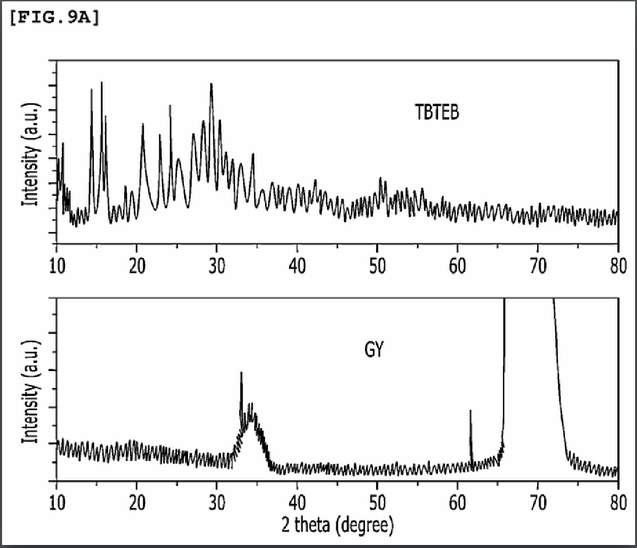
Diffraction is a counting experiment, so shot noise grows as the square root of the signal while
the signal grows faster. Strong peaks come out relatively clean, and the visible fuzz lives in the
baseline. In real data, a prominent peak would not be buried under a uniform squiggle.
The second problem is better. Look closely at the hump near 33 degrees. The squiggle is drawn
at a fixed amplitude and period regardless of the slope beneath it, so on the steep flanks the
individual spikes lean over, overhang, and double back on themselves. The trace crosses the
same x-value several times. A diffractometer records one intensity per angle. Whatever produced this shape, it was not a diffractometer. It was a hand, and the result is a hedgehog that swallowed a hair comb.
Note where this appears. A patent application is a legal document, filed with a duty of candor to
the examining office. Whatever one thinks of peer review as a filter, this is a different category
of thing entirely.
Lee is a true giant of science, and very creative. He bends even instrument noise to his will.

Anatomy of a Retraction 2 – Superconductive Fraud
Maarten van Kampen dispels the superconductive illusions of Ranga Dias and Ashkan Salamat. Will we also receive a cease-and-desist letter now?
What replication actually costs
My group replicated the holey graphyne experiment. I want to be specific about why we did it, and why we could. The reasons are not “we expected bountiful holey graphyne”, “we needed something with a colossal figure of merit”, or “we are that diligent”.
We did it because that was our only path to try and get the inane paper retracted. Steve Cranford, the Editor-in-Chief of Matter, indicated that he will only entertain a challenge to the “holey” paper if this challenge is an experimental replication.

Fig. 6. “Holey graphyne” being replicated, unsuccessfully. Copper(II) is green, sometimes it’s blue, it Glasers your alkynes, and that’s all it’ll do. (Desyatkin, Bolding &. Rodionov 2024)
We could do it because we already had the monomer. It is not an easy compound to make, and we had it on the shelf for unrelated reasons. We could do it because we had access to the electron microscopy, elemental analysis, and NMR needed to characterize whatever came out. And most importantly, we could do it because Steve Cranford agreed in advance to send a replication study through peer review at his journal.
That last condition is the one people tend to underestimate. Ask yourself, dear reader, how many replication studies you have seen published in a glossy journal. Not corrections. Not commentary. Actual “we did the experiment and it did not work” papers. The number for most people is close to zero, and the reason is that journals usually do not want them. Without advance agreement from Editor-in-Chief, our experiment would have been a folder of data on a hard drive. Which is why I want to take this opportunity to commend Steve Cranford for agreeing to review the replication.
The result of our experiments was entirely predictable. Black crap came out of the vial. Same as with the Cui replication in Episode 1, and for the same underlying reason: when organic chemistry does not work, char is the result.
Elemental analysis showed the material contained over 20 atomic percent each of copper and bromine. That is copper acetylide, which is what you get when copper reacts with the terminal alkyne and then nothing else happens. Almost none of the bromine had been lost, which it would have been if any coupling actually happened. We then ran the reaction with the simplest possible model compounds, phenylacetylene and bromobenzene, and watched it by NMR. The alkyne coupled to itself, as expected. The aryl bromide sat there untouched. In the biphasic version of the model reaction, which mimicked the original conditions, nothing happened at all.
The reported characterization in the Ryu and Lee paper does not survive an encounter with reality either. The solid-state NMR spectrum offered as evidence for the product matches the starting material. Some of the strongest peaks in the Raman spectrum match hydrated copper acetates, which is to say, the catalyst. The XPS analysis uses peak shapes that are wrong for carbon materials, with components too broad to distinguish the carbon types being claimed. The electron microscopy shows fringes consistent with ordinary disordered char. And Ryu and Lee report essentially no bromine and no copper in their product, which is impossible for a real microcrystalline polymer with edges, and which our own analysis flatly contradicts.
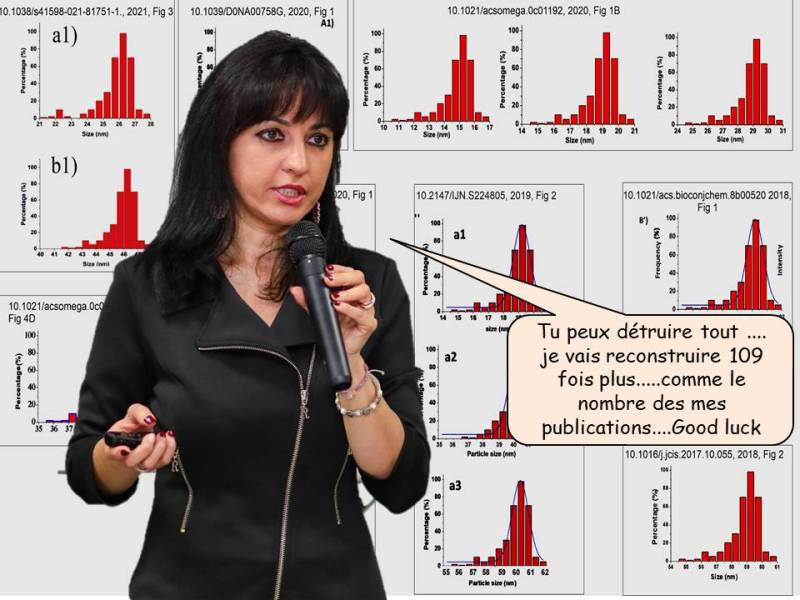
Good luck, Jolanda Spadavecchia!
CNRS research director Jolanda Spadavecchia was sanctioned with two years suspension for “serious and repeated breaches of her duty of scientific integrity”, 19 retractions were requested.
Matter
Handling and process are what matter for the between-journal comparison, and Cranford’s handling was better than what came later. But it also tells you something uncomfortable about what an editor at a journal like this actually does all day.
Steve Cranford is not a naive party. Before becoming an editor, he was a computational materials scientist, and among his most-cited papers are “Mechanical properties of graphyne” (Carbon, 2011, over 500 citations) and “Extended graphynes: simple scaling laws for stiffness, strength and fracture” (Nanoscale, 2012). He has modeled these exact materials. He knows what strain is. He knows what graphyne is.
Which is why I do not think he ever looked at the structure before publication.
That sounds like an accusation. It is not meant as one. Consider the alternative. If the Editor-in-Chief of Matter had spent thirty seconds on the graphical abstract of this manuscript, he would have seen a lattice built from eight-membered rings with two triple bonds each, and asked a question. The question was not asked. The most economical explanation is not that he looked at it and shrugged. It is that the paper moved through the system without ever crossing the desk of the one person at that journal capable of recognizing what was wrong.
So what does an Editor-in-Chief at a flagship Cell Press title actually do? Commissioning, strategy, special issues, conference circuits, the metrics that justify a $9,350 APC. Manuscripts get assigned, reviewers get selected, decisions get made, and much of that happens through editorial staff and workflow software (which is now likely an LLM). The person whose name is on the masthead, and whose own publication record is part of the reason you are supposed to trust the masthead, is not necessarily in the loop on any individual paper. That is the structure. It is not Cranford’s personal failing.
It is, however, a bad structure, and this paper is a decent demonstration of why. The single most valuable thing Matter had available in 2022 was an editor who understood graphyne. The system did not use him.
To his credit, once I contacted Cranford in January 2023, he engaged seriously and did not stonewall or delay. Matter policy requires giving the original authors a chance to respond before publishing a critique, which is reasonable. Cranford wrote to Ryu and Lee in May 2023. Nothing. He wrote again. Nothing. Escalated internally. Deadline passed in silence. By September he had authorized our replication to go through peer review, while still waiting for Ryu and and Lee. The authors eventually produced a rebuttal defending the indefensible. Our critique and our replication were published in 2024 alongside it. The original paper stayed up. Its landing page did not include any links to our debunking.
Then in April 2026 Cranford emailed me one line: “Just kept on going with this one… figured you’d want to know.” With a link to the retraction.
Here is that retraction note in full:
“This article has been retracted at the request of the editor-in-chief.
Post-publication, concerns were raised about the validity of some of the results presented in the article. Following consultation with subject matter experts, the editor-in-chief found that the synthesis of the claimed HGY system is problematic and the assertion by the authors that HGY is a p-type semiconductor material is not supported by evidence.
The authors were requested to provide comment on these concerns. It was felt that the explanation provided regarding synthesis was unsatisfactory in resolving the concerns. In addition, the authors have acknowledged that the claim of p-type semiconductivity in HGY is unsubstantiated.
The editor has determined that the findings of the article cannot be relied upon and has decided to retract the article. The authors disagree with retraction.”
So, the synthesis is “problematic” and that the claim of p-type semiconductivity “is not supported by evidence.” The authors concede the semiconductivity point. Nevertheless, the authors “disagree” with the retraction.
Now, let’s enumerate what is not in there. Not that the proposed material would be more energetic than TNT. Not that the “holey” NMR spectrum matches the starting material. Not that the claimed reaction is chemically impossible. Not that an independent group could not reproduce it. The paper came down over an electronic property claim, which is apparently an objection that came from someone with sufficient standing. Right outcome, wrong reason.
And so it goes. The paper is retracted. Lee’s rebuttal, which exists solely to defend the retracted paper, is still up. It stands proudly, unmarked, arguing for a position that the journal itself has now formally rejected.

Superconductive Fraud: The Sequel
“After the huge box-office success of “Nature 2020: Room-temperature superconductivity in CSH” this March our Nature studios released a sequel with the same star-studded cast: “Nature 2023: Near-ambient superconductivity in N-doped LuHx”. – Maarten van Kampen
Now to the society journal
In September 2023, a group at South China Normal University led by one Mingzhi Huang, in collaboration with the prolific papermiller Dionysios Dionysiou at the University of Cincinnati (who died soon after in November 2023, read the obituary in the CODA by LS), published a paper in ACS Catalysis claiming single-atom ruthenium catalysts with metal loadings up to 27.6 wt%. This remarkable achievement was credited to “N-doped graphdiyne/γ-graphyne quantum dots” as support.
Chao Zhang , Yingqiang Li , Yue Xie , Zhanjiang Yu , Xin Wan , Xinzhi Wang , Jiaan He , Junlang Li , Zhenguo Chen , Xiaoyong Li , Xiaohui Yi , Zhaoli Wang , Guang-Guo Ying , Dionysios D. Dionysiou , Mingzhi Huang High-Loading Single-Atom Ru Catalysts Anchored on N-Doped Graphdiyne/γ-Graphyne Quantum Dots for Selective Hydrodehalogenation and Hydrodearomatization ACS Catalysis (2023) doi: 10.1021/acscatal.3c01390
The purported γ-graphyne was made by Xiaoli Cui’s ball-milling method (keep this in mind, it will become very relevant later). Readers of Episode 1 will recognize the problem: that method only makes char, not graphyne, as our 2024 replication established. It cannot make anything but contaminated char.
The rest of the claimed procedures fail on physical grounds that require no specialist knowledge, only an understanding of what a boiling point is.
To “reflux” a reaction means to boil the solvent and let the vapor condense back into the flask. The temperature is therefore fixed by physics. It is the boiling point of the liquid. You cannot reflux something below its boiling point, because nothing is boiling. You should not attempt to reflux it above the boiling point, because the solvent will just leave. Or, if the apparatus is sealed and it cannot leave, there may be an explosion.
This paper proposes to reflux acetone at 120 °C. Acetone boils at 56 °C. It refluxes ethylene glycol at 160 °C, which boils at 197 °C. It refluxes concentrated nitric acid at 80 °C, which boils at 121 °C. Every single boiling point is wrong. Getting all of your boiling points wrong is quite difficult if you have actually stood next to the fume hood. And the acetone number is not an isolated typo, because the authors claim to cool the flask down to 80 °C (24 degrees above the boiling point) after the reaction is over.
That great acetone boil deserves another special mention. Most chemists know acetone is low-boiling, and will not try to heat it to 120 °C in a sealed flask. Notice that I said “most”, not “all”. I’ve known a postdoc who demolished their fume hood by pouring a mixture of acetone and dry ice in a bottle, and closing the cap. I’ve known a staff scientist at a national lab, who caused an explosion by pouring acetone in a liquid waste drum with nitric acid in it. And the whole point of a published procedure is that people follow it. If you publish it, they will do it. There are no safety warnings anywhere in the Huang and Dionysiou paper.
One such missing warning is for their claimed graphdiyne precursor. Hexaethynylbenzene is spontaneously explosive, and should be handled with roughly the level of caution one reserves for diazomethane. The reference Huang and Dionysiou cite for the preparation of this delightful compound describes a milligram-scale synthesis, and does not report isolating the pure stuff. Very smart. Most people want to minimize property damage, and to keep their ten fingers and two eyes. Huang and Dionysiou imply that at least ten grams of the stuff were used. If that were true, it would be genuinely dangerous. It is most certainly not true, which is the only reassuring thing about the whole affair.
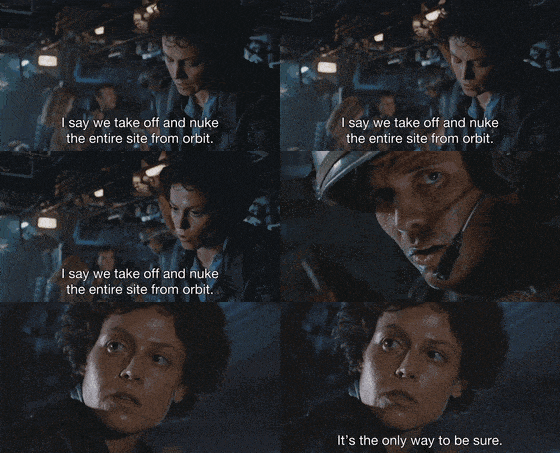
Once made, the purported graphyne powders are quantum-dotted by blasting them with 500 watts of ultrasound in concentrated nitric acid for 24 hours. This is the chemistry equivalent of nuking the entire site from orbit, because it’s the only way to be sure. Graphite itself oxidizes in hot concentrated nitric acid. Triple bonds are considerably more delicate than graphite. Nothing resembling graphyne comes through that (not that any graphyne was ever involved).
And then the authors get truly creative. Whatever survived nitric acid is reacted with ammonia at 200 °C. This, supposedly, swaps carbon atoms out of the triple bonds, and replaces them with nitrogen, generating chains of two, three and four nitrogen atoms in a row. Without affecting the rest of the structure. The four-nitrogen version has a name, tetraazadiene, R-N=N-N=N-R.
Let us take take a close look at this monstrosity, because it is worth understanding just how energetic and unstable such a structure would be. N₂ is the most thermodynamically satisfied molecule in the universe. Its triple bond is so stable that almost every nitrogen-rich compound is fundamentally a device for making N₂ and releasing an enormous amount of energy in the process. This is the operating principle behind most explosives and propellants. Sodium azide in an airbag inflator has just three nitrogens in a row, and it converts to gas fast enough to save your life in a collision. Four uncharged nitrogens in a row, combined with a few carbons, would be a great deal more enthusiastic about an unscheduled energetic rearrangement than even “holey graphyne” would be.
The authors claim that four-nitrogen material is stable at 500 °C. They also specify that each of these four nitrogens is linear and sp hybridized. Linear tetraazadienes are not a known class of compound. They are drawings.
The paper has additional drawings. A ruthenium complex in Fig. 3b has a metal center bound by a combination of two linear tetraazadienes. The one in 3f appears to have a combination of azides and aromatic nitrenes holding on to the metal, with a distorted tetraazadiene sitting nearby. If something like this were actually made, it would violently react with anything nearby within picoseconds, releasing nitrogen.

Huang and Dionysiou match their highly imaginative chemistry with some quality characterization techniques. The Raman spectra show two purported triple-bond peaks where γ-graphyne should show one, and those features do not change at all after the reactions that supposedly replaced most of the triple-bond carbons with nitrogen. Diazo groups, nitriles and azides are strong Raman scatterers; if any of the claimed chemistry had happened, the spectra would be transformed. They are identical. The peaks also rise vertically off the baseline without the profile of a real molecular vibration. Speaking charitably, this is what artifacts from fluorescent light look like. The electron microscopy gives identical lattice spacings for the supposed graphyne and graphdiyne samples, both matching ordinary graphite. The EDS data contain large unexplained peaks from elements that should not be present, and the reported compositions sum to exactly 100%, which is only achievable by ignoring those peaks and renormalizing.

Fig. 8. Some Ramen spectra. They are not direct duplications, but they are functionally the same, for every material in the paper. The peaks past 2000 are not indicative of triple bonds.
Last but not least, the paper is chock full of inappropriate, irrelevant, and nonsensical references. Many of these appear to be inserted out of sheer respect to and admiration of certain eminent scholars. So I guess I should not complain too much about this simple act of politely acknowledging some important colleagues, in fields as diverse and unrelated to graphyne quantum dots as biocatalysis and electrochemistry.
Crudden, step by step
On March 4, 2025, I wrote to Cathleen Crudden, Editor-in-Chief of ACS Catalysis, laying all of this out. Crudden is a Canada Research Chair at Queen’s University, a Fellow of the Royal Society of Canada and of the American Academy of Arts and Sciences, and a leading expert on both homogeneous and heterogeneous catalysis. She has done some original work on palladium-catalyzed cross couplings, and certainly knows what a Sonogashira reaction requires. She can look at a linear tetraazadiene and see that it is not a molecule. Handling the Huang and Dionysiou paper did not need a specialist. The fabrication is that clumsy. That paper needed a single, brief look from a chemist, and Cathleen Crudden is a very accomplished chemist.

What followed was not the appropriate handling one would expect, that is, an immediate retraction on the spot. It was a procedure. Old man Franz would have called it Der Prozess. Someone must have been telling the truth about Mingzhi H., for without having done anything right, he was one fine morning sent out for peer review.
The editorial office asked me to contact the authors first. I did, on March 19, 2025. Huang had already received eleven PubPeer notifications about his paper over the preceding month, and had reacted to none of them. Naturally, he failed to answer my direct email, sent from an institutional address. I reported the non-response.
The editorial office then suggested I submit a formal Correspondence, to be peer reviewed and published alongside a Rebuttal from the authors. I objected at the time that this converts a question of fact into an academic debate, hands an inane and fake paper two more citations, and gives the authors a fresh publication for their trouble. I submitted the Correspondence anyway, on April 29, 2025, with Reese Richardson as co-author. There was no other possible route.
Huang finally responded on June 10, 2025, 82 days after my email. Perhaps he had to reach his late coauthor by seance. He sent the requested Raman data as plain text files. The instrument named in the paper saves data in a proprietary binary format containing full instrument state metadata. Plain text strips all of it and makes it impossible to tell whether the data were processed. Huang described this as the “raw” output of the spectrometer. It is not.

All the provided files were created inside a two and a half hour window, meaning the entire Raman characterization of a multistep synthesis with several distinct intermediates happened in one sitting. The baselines show the signature of software correction. And the published figures are cropped just short of a large peak near 2750 cm⁻¹. The position and shape of this band strongly suggest it is none other than the so-called 2D band, highly characteristic of multilayer graphene or char. This band is neither predicted nor observed in the Raman spectra of graphyne or graphdiyne. Given the full spectra, no reviewer familiar with carbon would have let them through. Then again, the reviewers were not fazed by the rest of it, tetraazadienes included. So I take that back.

In August 2025, Crudden told me the ACS data integrity team had reviewed the Raman question and found no evidence of fraud, that she was not a Raman expert herself, but that the matter was at the Top of Her List.
Then silence. I asked for a status update in April 2026. And again a week later. And again in May. The reviews came back on May 26, 2026, thirteen months after submission.
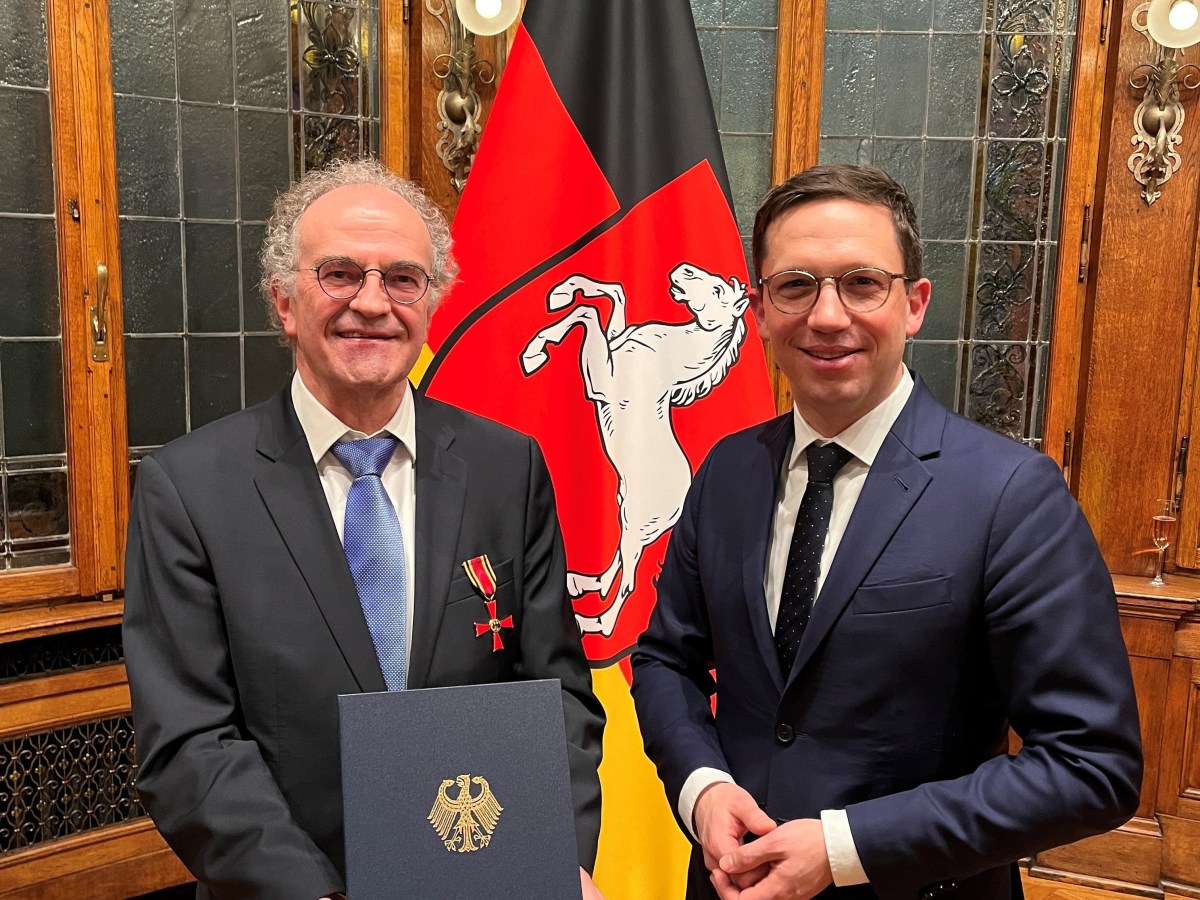
Bundesverdienst-Kümmerer am Bande
“Benign-by-design, circular economy in the plastics industry, biodegradable antibiotics – the sustainable design of chemistry is the central theme of Prof. Klaus Kümmerer’s work. “
The four reviewers
The reviews are likely the most interesting document in this whole affair, so let us take them in ascending order of interest.
Reviewers 1 and 4 are the boring ones, in the best sense. Reviewer 1 found every point in our Correspondence chemically valid, and recommended publication without revision. Reviewer 4 wrote that the substrate materials in the Huang paper were misidentified, that the central claims were invalid, that the reported conditions “reflect real experimental impossibilities rather than minor procedural ambiguities,” and recommended publication of our Correspondence urgently, plus retraction of the original. Two competent chemists read the material and said that obvious thing is obvious. This is what peer review looks like when it works, and it is not very dramatic.
Reviewer 3 recommended against publication of our Correspondence.
Reviewer 3 defended Cui’s 2018 Carbon paper as a perfectly valid basis for the synthesis. Reviewer 3 listed other groups who have used Cui’s method, as though the number of people doing a thing has any relationship to whether the thing works. Reviewer 3 noted approvingly the “mechanochemical” production of “naphtyne”, “S-doped” graphyne, and “nitrogen-rich” graphyne, an entire product line of materials that do not exist. Reviewer 3 questioned whether our replication was really a replication, “since the experimental conditions are different from the original case.” Our conditions were, in fact, identical to those claimed by Cui.
Reviewer 3 is either Xiaoli Cui or someone very close to her. I obviously cannot prove this and will not pretend otherwise, but consider the alternative: that there exists an independent scientist, unconnected to Cui, who has read the replication data and the thermodynamics and nonetheless believes ball-milling calcium carbide with hexabromobenzene produces a crystalline carbon allotrope. That person would be defending Lysenko’s “vernalization” in 1948.
And this is where I stop being generous with Crudden.
Journal policies and COPE guidelines required her to ask the authors to respond. Fine. They required her to let the authors submit a rebuttal. Fine. Nothing in COPE compelled her to let them submit two separate rebuttals, one of which I have seen and one of which was never shared with me. And nothing whatsoever in any publishing ethics framework in existence required her to send a debunking of Cui-derived work to Cui or her circle for review.
That was a conscious choice. Someone selected that reviewer. Having given the authors every opportunity to double down on the nonsense, the journal then went and found a member of the school being criticized, and asked them whether the criticism was warranted. The predictable answer came back and went into the file.
Because this all is just a normal academic dispute, of a controversial topic. Also, what if it works?

MIT review closed and decision final
“MIT’s receipt and review of allegations of possible research misconduct by my office are treated as confidential under MIT and, to the extent applicable, federal policies. MIT does not intend to disclose its receipt and review of these allegations to others. By the same token, you therefore may not disclose to others that you brought…
And now we come to Reviewer 2. Just like with Reviewer 3, their identity is an enigma, wrapped in mystery. But I shall call him “Michael,” because that person is truly special. The review is worth reading twice for full appreciation.
Michael agrees with our every scientific argument. He has, he tells us, followed the graphyne and graphdiyne story for many years. Michael explains that this is a “problematic area of research” because of “fanciful interpretations of molecular structure by people that seemingly do not understand basic chemistry”. Could not have said that better myself! Michael notes that four sp nitrogens in a row is “chemically impossible” and “chemical nonsense.” He explains that the Cui synthesis route was “very likely” debunked by our Carbon replication. He notes that the high-temperature treatments would have graphitized any acetylenic material, even if it were there. He notes that the claimed ruthenium complexes “have no basis in chemical reality.” He concludes that “the myriad mistakes in the 2023 ACS Catalysis paper warrant a retraction of the original article.” He also, in passing, observes that the referees and the associate editor who handled the original paper “failed to notice these glaring chemical impossibilities, as such preposterous structures should have never been published.”
Yes! He is right about all of it!
But in his second paragraph, before any of that insightful analysis, he writes:
“Rodionov published a cross-coupling synthesis of gamma-graphyne in JACS in 2022, about the same time that Zhang published a different synthesis via alkyne metathesis in Nature Synth. Since that time, Rodionov has apparently been on a mission to prove that all other reports on the synthesis of gamma-graphyne are not correct. To date, I know that has resulted in…”
Then he enumerates the results of said “mission”: a retraction of that Zhang paper in Nature Synthesis, two debunkings of “holey graphyne” in Matter, a failed Cui replication in Carbon, and now this. A list of retractions and debunkings which Rodionov caused to others, presented as a rap sheet.
Actually, Michael is significantly understating my contributions to the field. When the review has been written, “holey graphyne” was not retracted yet – now it has. Two years before that retraction hit, the “holey” case was made fairly public with my Chemistry World opinion piece. When the Zhang Nature Synthesis paper was retracted for data fabrication, an accompanying News & Views encomium was also retracted. Journal of Materials Chemistry A had to publish two “corrections” to fix Cui’s scale bars. And then there are PubPeer threads. It is all clear evidence of unpleasantness and troublemaking.
Now let’s think about the structure of Michael’s review. The chemistry is impossible. The original paper must be retracted. Our analysis is correct on every single point he addresses. And before saying any of this, Michael felt it was important to establish that the person raising the concerns has a habit of raising concerns and trouble, and that the habit is worth noting.
The implication is never stated, because it cannot survive being stated. It is that I do this to protect my own work. That because my group published a graphyne synthesis, my interest in whether other graphyne syntheses are real is self-serving rather than scientific. That I must be green with envy that Huang and Dionysiou published a graphyne paper in ACS Catalysis, and I did not. That the correct findings are somehow tainted by having been sought.
This does not survive five seconds of thought. If the papers I examined had turned out to be sound, I would have stopped examining papers. They keep turning out to be unsound, and this keeps being confirmed by (non) replication, by editorial action, and by retractions. The word for someone who repeatedly identifies bad papers that are subsequently retracted is not “on a mission”. It is “correct”. Being repeatedly correct is not a personality defect.
But it is inconvenient, and that is the real point of the remark.
Consider what a senior figure, such as Michael here, actually does. He reviews papers and grants, mostly anonymously. He steers the field. He sits on editorial boards at fancy journals. Occasionally, when a paper is important enough, he may be invited to write a Perspective celebrating it, and he signs that with his name.
Now investigate one of those “hot” papers and discover that it is fabricated, or violates the laws of Nature. The reviewers who accepted it look incompetent, because they were. The editors who handled it look incompetent, because they were. And the encomium, written in good faith by a benevolent senior figure whose only fault is not reading carefully enough, gets pulled along with the paper it praised. He did nothing dishonest. He is merely wrong in public, permanently, in a way that is now indexed.
Which explains why “being on a mission” is so frowned upon.
Every investigation is a threat to somebody’s record, and eventually to everybody’s. Far better to agree that the whole area is “complex and problematic”, that there is “mudslinging” on all sides, that nobody is quite innocent, and therefore nobody need be held to account. The water is muddy, so let us all stop looking into it.
This posture is extremely pleasant for whoever is already in the room.
It is fatal to science.
The Bielefeld Conspiracy
“During your studies, it should be taught that, for example, you critically question your data, handle it transparently and immediately disclose weak points.” – Prof Katharina Kohse-Höinghaus
The retraction
On May 26, 2026, Crudden delivered her final decision. She had “no confidence“, she wrote, that the Huang and Dionysiou paper “contains realistic representations of compounds that, even if they were initially present, would survive the treatments they were exposed to“. Even if such compounds had been present, high-temperature treatment would have produced amorphous carbon, and any catalytic activity would belong to ruthenium on amorphous carbon. Since the activity could not be attributed to the structures drawn. That was a fair and balanced summary of what I sent her on March 4, 2025. Fifteen months earlier, in more straightforward language.
Crudden also informed me that our Correspondence “will not be published“, it had served its purpose as an internal assessment tool:
“a Correction in which the chemically unlikely structures are corrected would not be appropriate and the best course of action in this case is to have the paper retracted rather than publish the Correspondence and Rebuttal. “
Close to two years of work, a formal submission, thirteen months in review, four reviewers, three of whom called for publication, and the visible output is a decision memo that no one outside the process will ever read.
You can read Crudden’s decision and the four review reports here:
The retraction notice appeared on August 17, 2026, another three months later. In full:
“The authors retract this article because of concerns that the γ-graphyne described is not a true product of the synthesis conditions and that the conditions employed during the quantum dot preparation process compromised the structural integrity of any initially present frameworks. As such, the article is being retracted”.
“The authors retract this article”, including the dead Dyonisiou. Those same authors who ignored eleven PubPeer notifications, ignored my direct email for 82 days, played games with “raw” Raman data, and wrote two rebuttals defending the indefensible. The same ones who padded the bibliography with irrelevant references. They are credited with the retraction they resisted at every step.
Nobody else is mentioned. Not me, not Reese, not the replication study, not the months of correspondence, not the three reviewers who called for this, even Michael. The permanent record shows that the authors, upon thoughtful reflection, retracted their own paper, out of abundance of integrity.
Speaking of which, “structural integrity” is not a chemistry term. It is from Star Trek. It is what Geordi says is failing before the hull breach. It is deployed here to avoid writing “the triple bonds are destroyed by boiling nitric acid,” which would require acknowledging that someone worked that out and told them so.
There is one positive. This is the very first on-the-record admission in any respectable academic venue, other than our own debunking in Carbon, that maybe, just maybe, Cui’s carbide chemistry is unworkable. And so it goes.
Kostya Ostrikov’s russo-iranian false friends
“Let me assure you that I totally condemn the war in Ukraine, and at the very least because my old mother is in Kharkiv and she suffers a lot… I am trying to help my colleagues and friends from Ukraine whichever way I can…” – Professor Kostya “Ken” Ostrikov
The comparison
So: a commercial Cell Press journal with a professional editor, and a society journal with a distinguished academic editor. Two flavors of scientific publishing that are supposed to differ in kind.
Matter published a material more energetic than TNT, assembled by a reaction that would obsolete Nobel-winning palladium chemistry, justified by the claim that molecular collisions can be made non-random by layering water on water. Its Editor-in-Chief has previously published on the theory of graphyne mechanics. Time from my first email to retraction: three years and three months. The retraction cites the wrong reason. The rebuttal defending the retracted paper is still up.
ACS Catalysis published a paper whose every reported boiling point is wrong, whose central structures are drawings of impossible structures, and whose support material was made by a method expected (and later shown experimentally) to produce black crap. Its Editor-in-Chief is one of the world’s experts on exactly the chemistry being fabricated. Time from my first email to retraction: seventeen months, plus the PubPeer work before it. The retraction credits the authors and names nobody else. Along the way, the journal sent the critique to a defender of the very literature under criticism.
Different business models, different editorial cultures, similar outcome. Which suggests the problem is not the business model.
Neither paper required a full-blown investigation. Neither required specialist equipment, or a data sleuth, or forensic image analysis. Both required somebody to read them and say the obvious thing, out loud, repeatedly, for years, in writing, to people who would rather have been doing something else.
That last part is the bottleneck, and it is worth being honest about what it costs. There is no reward for it. It consumes time that would otherwise go to new research, or career building. It requires resources most people do not have, in our case a fancy molecule already on the shelf, instrument access, and an editor agreeing in advance to review a replication. Then even the reviewers who agree with you will note, for the record, that you appear to have an agenda. The editors will thank you for your patience while the calendar turns. And if the retraction finally comes, it will hand the credit to the people who fought against it.
For every paper like these two, there are hundreds or thousands that stay. Not because they are more defensible. Because nobody had two years to spare.

Whitewashed by ACS and Elsevier, Zboril sues Olomouc Dean for “bullying”
“I should remind you that the editorial offices that investigated your allegations did not found any evidence of scientific misconduct or data fabrication. In my opinion, your allegation may bear the elements of defamation and false accusation” – Prof Radek Zboril
CODA by LS
Obituary to a giant reservoir of energy for knowledge and curiosity
As in the June 2024 Shorts before, I gather you all here to mourn and lament the untimely death of the great Greek-American scholar Dionysios Dionysiou, professor of engineering at the University of Cincinnati. Dion, as everyone called him, died on November 20, 2023, at the age of 57. His university issued this obituary:
“Dionysiou was a true leader in his field. In 2022, he was named a Highly Cited Researcher by Clarivate for the fifth consecutive year. Dionysiou had more than 600 publications, which have been cited 68,000 times in other papers. His research has been supported by more than $8 million in grant funding. “

A faculty colleague was quoted with “Dion possessed a giant reservoir of energy for knowledge and curiosity that could never be filled”. A PhD mentee said: “At every conference, when people learned Dr. Dion was my adviser, they would launch into a story about how they knew him – which would usually end in laughter”. Same mentee shared this about Dion:
“He was known for his affable personality as much as he was for his impressive body of research. Weitzel recalls how he would stop by her office to chat and share funny stories about his pet chinchilla or his crazy travel adventures.”
The obituary doesn’t say what Dionysiou died from, but not only his pet chinchilla, but also the Chinese papermilling industry must sorely miss him. Dion used to publish more papers than some other scientists read: 72 in 2019, 83 in 2020, 63 in 2021… Most of his coauthors are in China. Like here:
Fang Deng , Fei Zhong , Decai Lin , Lina Zhao , Yuejing Liu , Jinhong Huang , Xubiao Luo , Shenglian Luo , Dionysios D. Dionysiou One-step hydrothermal fabrication of visible-light-responsive AgInS2/SnIn4S8 heterojunction for highly-efficient photocatalytic treatment of organic pollutants and real pharmaceutical industry wastewater Applied Catalysis B: Environment and Energy (2017) doi: 10.1016/j.apcatb.2017.07.051
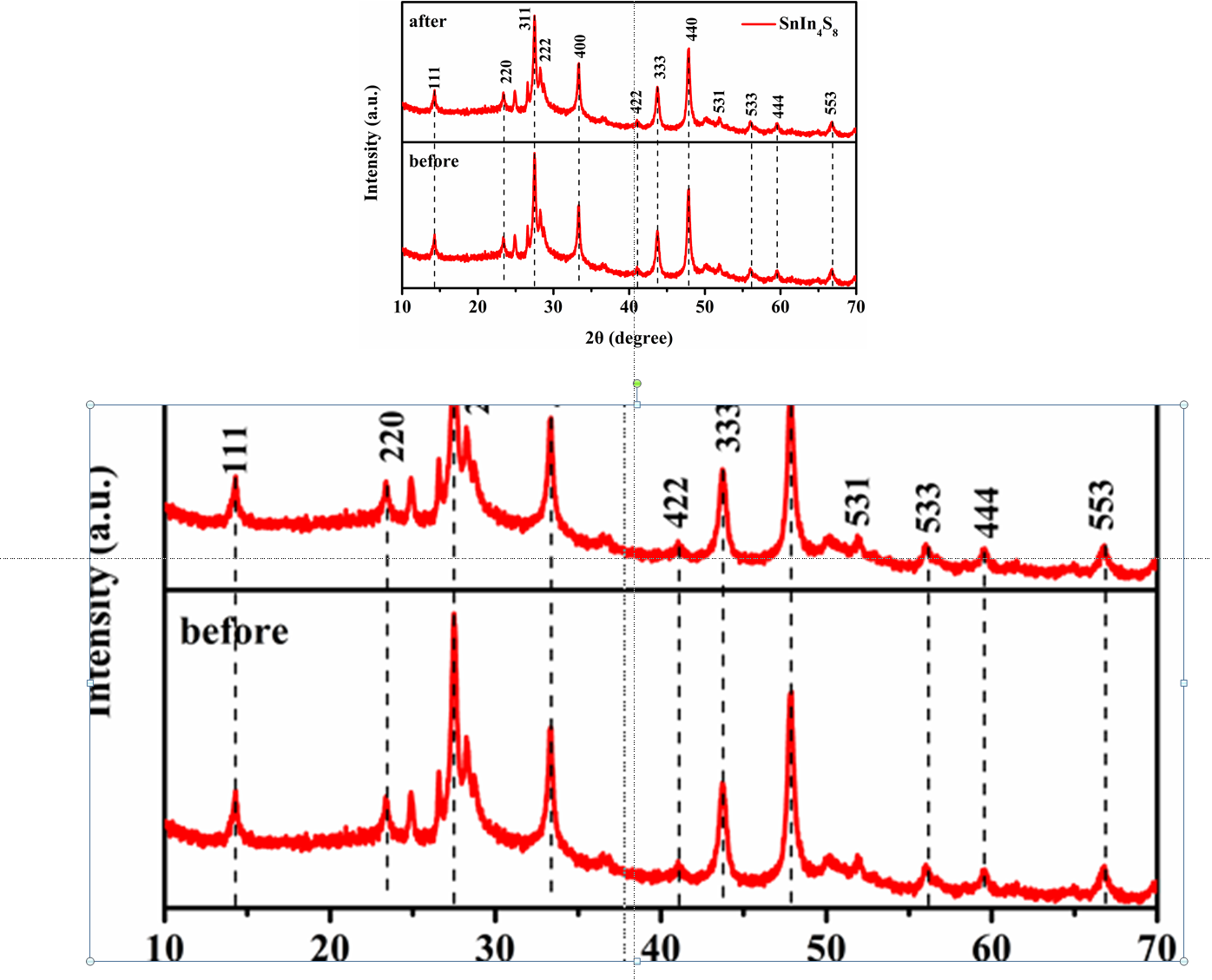
Azolla filiculoides: “The XRD patterns for the catalyst before and after use exhibit patches of similar noises.”
Another one, same first author Fang Deng:
Fang Deng , Xiaoying Lu , Yingbo Luo , Jie Wang , Wenjie Che , Ruijie Yang , Xubiao Luo , Shenglian Luo , Dionysios D. Dionysiou Novel visible-light-driven direct Z-scheme CdS/CuInS2 nanoplates for excellent photocatalytic degradation performance and highly-efficient Cr(VI) reduction Chemical Engineering Journal (2019) doi: 10.1016/j.cej.2018.10.176
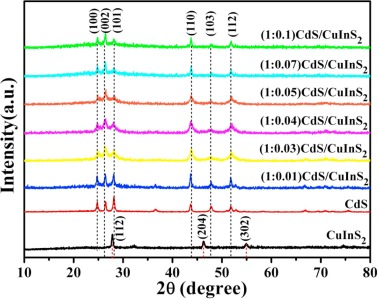
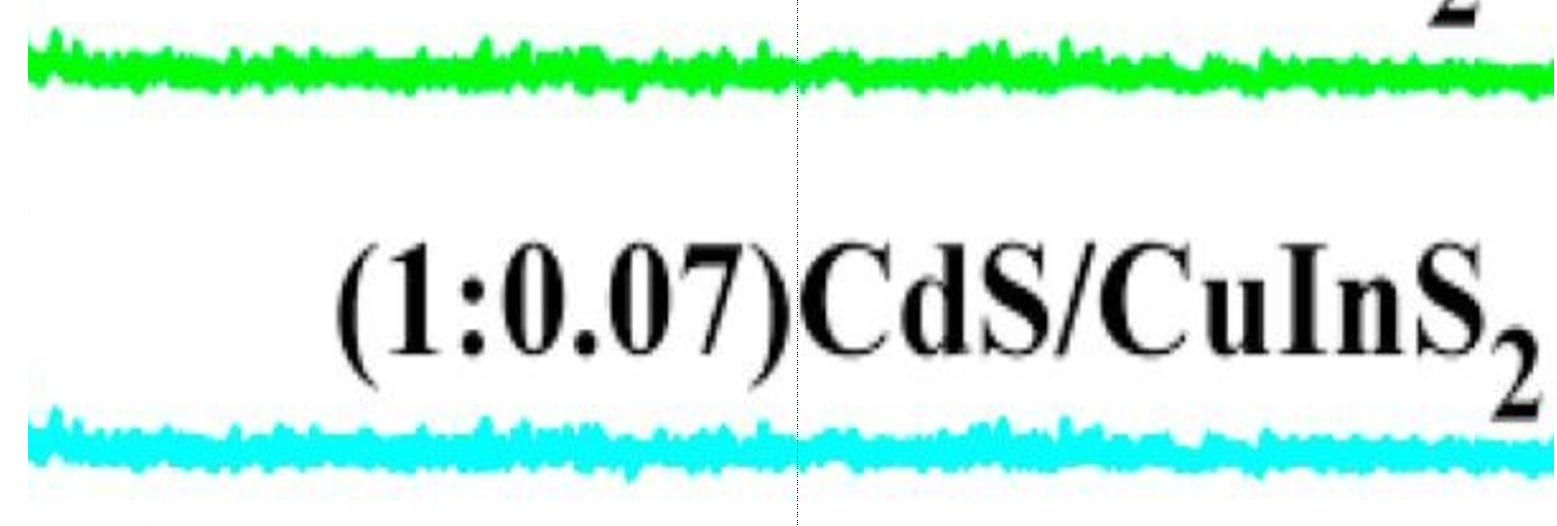
There is a similar fabrication by Fang Deng, Dionysiou and others in the same journal Dion used to Executive Editor of:
Fang Deng , Lina Zhao , Xubiao Luo , Shenglian Luo , Dionysios D. Dionysiou Highly efficient visible-light photocatalytic performance of Ag/AgIn5S8 for degradation of tetracycline hydrochloride and treatment of real pharmaceutical industry wastewater Chemical Engineering Journal (2018) doi: 10.1016/j.cej.2017.09.022


One wonders if Dion edited his own papers there? Here he is in another Elsevier journal, with other Chinese friends and the aforementioned fallen King of Papermillers, Rafael Luque:
Wei Wang , Binhai Cheng , Ming Zhao , Edward Anthony , Rafael Luque, Dionysios D. Dionysiou Boosting H2 yield from photoreforming of lignocellulose by thermo-alkaline hydrolysis with selective generation of a key intermediate product: Tartaric acid Energy Conversion and Management (2022) doi: 10.1016/j.enconman.2022.115444
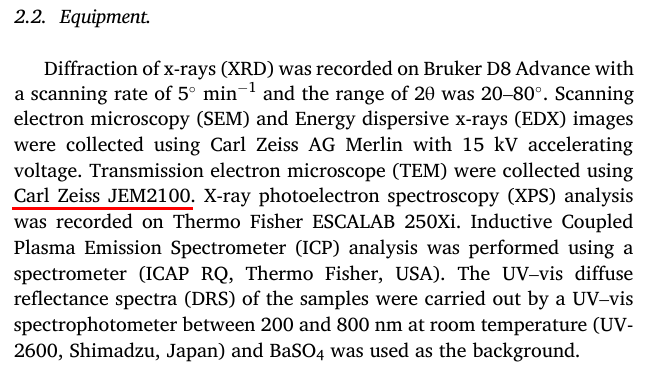
Dion also worked with the Texas papermiller Virender Sharma (read October 2023 Shorts), see for example Sharma et al 2017 with Luque. Bereft and unconsolable with grief, Sharma and others organised in December 2024 a “Dion Dionysiou Memorial Issue: Celebrating Legacy of Innovation in Advanced Oxidation Processes for Water Treatment” in Chemical Engineering Journal (where Dion used to Executive Editor). Various papermillers and cheaters, including Radek Zboril, eagerly contributed to that issue.
But here is another misreported electron microscope by Dion and his friends, including his Fulbright-sponsored postdoc Murtaza Sayed (PubPeer record):
Murtaza Sayed , Bangxing Ren , Atif Mossad Ali , Abdulaziz Al-Anazi , Mallikarjuna N. Nadagouda , Adel A. Ismail , Dionysios D. Dionysiou Solar light induced photocatalytic activation of peroxymonosulfate by ultra-thin Ti3+ self-doped Fe2O3/TiO2 nanoflakes for the degradation of naphthalene Applied Catalysis B Environment and Energy (2022) doi: 10.1016/j.apcatb.2022.121532


Dionysiou’s papers were referenced by the worst of papermillers. Ali Fakhri for example, in Wang et al 2021, Yang et al 2021, Chen et al 2021 and Bahodorari et al 2022. Papermillers never cite other papermillers for no reason – such citations are usually paid for or extorted.

Synthetic Communications with Ali Fakhri and his real or imaginary friends
“the entire dramatis personae seem to have crawled out of our man’s sock drawer, and the page-count of Synthetic Communications would be grievously impoverished without his contributions, whether direct or uncredited.”- Smut Clyde

Here a lovely cartoon Dion or his mentee like the aforementioned Sayed drew, it is meant to show some Ramen:
Javed Ali Khan , Murtaza Sayed , Noor S. Shah , Sanaullah Khan , Yuxin Zhang , Grzegorz Boczkaj , Hasan M. Khan , Dionysios D. Dionysiou Synthesis of eosin modified TiO2 film with co-exposed {001} and {101} facets for photocatalytic degradation of para-aminobenzoic acid and solar H2 production Applied Catalysis B Environment and Energy (2020) doi: 10.1016/j.apcatb.2019.118557

Scaptomyza hsui: “In fig. 2, at the low Raman shift, the blue trace features an unusually regular, periodic noise pattern”
Note that a Polish papermiller from Gdansk Polytechnic, Grzegorz Boczkaj, is on board. He collaborates a lot with Sayed, and you can read about Boczkaj’s compulsive papermilling here:
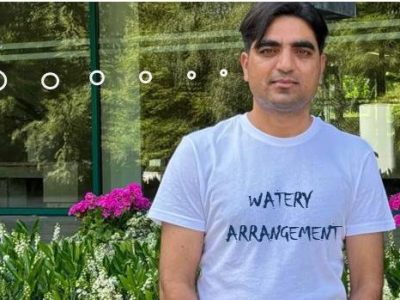
Nobelium Bilalski, a Gdansk papermiller
“To date, he has authored over 700 peer-reviewed articles, 150 book chapters, 25 edited books, and 10 editorial-type scientific articles in various areas of Science and Engineering. Dr. Bilal has a h-index of 94 with 34 000 citations (Google Scholar).”
Another cartoon by Dion, again his Ramen is clearly hand-drawn:
Narges Mohammadian, Seyyed M Ghoreishi, Samira Hafeziyeh, Samrand Saeidi, Dionysios D Dionysiou Optimization of Synthesis Conditions of Carbon Nanotubes via Ultrasonic-Assisted Floating Catalyst Deposition Using Response Surface Methodology Nanomaterials (2018) doi: 10.3390/nano8050316

Dion was accompanied above by his mentee Samrand Saeidi, who added meaningless citations to himself. That one is a failed Iranian papermiller now based in Poland, who previously threatened me with arrests and violence for questioning his academic performance. Read June 2024 Shorts and here:

The papermilling den of Gliwice
“As you will see, there is a lot of papermilling happening in Gliwice, as if this place has suddenly become attractive to many “researchers” from different corners of the papermilling spectrum. ” – Alexander Magazinov

It is very fitting that one obituary to Dion at the website of Prince Sultan Bin Abdulaziz International Prize for Water (which Dion won in 2022) was written by the Spanish papermiller, antivaxxer and sacked Elsevier editor Damia Barcelo:
“Dion’s legacy extends beyond his professional accomplishments, and his absence will be deeply felt by those who knew him. We express gratitude for the rich and meaningful life he shared with us. In addition to his noteworthy career, Dion was always open and generous with his time, willingly providing invaluable advice to students and researchers alike. His willingness to share his wisdom and experience leaves an indelible mark on the academic community, and his legacy will undoubtedly continue to inspire future generations.”

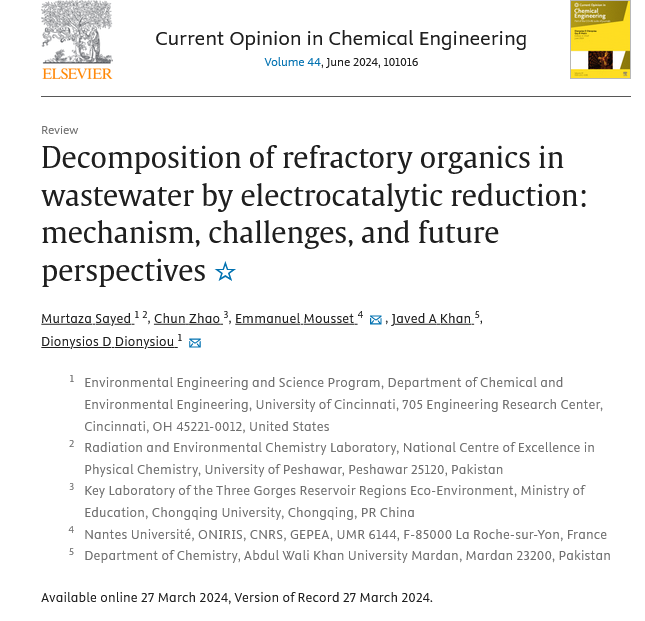
With Dion, it ends in laughter indeed: he continues publishing from beyond the grave. Starting with Gong et al 2024, which was submitted in February 2024, of course the paper carries no notice of the death. Since his untimely demise from our space-time continuum, Dionysiou authored more than three dozens of papers, with colleagues from all over the world. Thirty in 2024, followed by nine papers in 2025, how many conventionally dead scientists achieve this, I ask you? Most recently Dion the Undead authored Chae et al 2026, published last June. Our dead man is even corresponding author on Sayed et al 2024, a China-Pakistan-France-USA collaboration, online since 24 March 2024. Who was corresponding with Elsevier there? Dion’s ghost? Or maybe he uploaded his mind into a papermill computer?
Coda to the Coda
Totally unsurprisingly, the last author of the above discussed ACS Catalysis paper, Mingzhi Huang, professor at South China Normal University in Guangzhou, is also connected to Damia Barcelo. Huang published with a certain Muthusamy Govarthanan (e.g., Elumalai et al 2021), who, as his PubPeer record shows, is an associate of Barcelo’s, but also of Mika Sillanpää, Jörg Rinklebe, Damia Barcelo, Pau Loke Show, and other known papermillers.
Indeed, also Huang engaged in papermilling, as one can see on PubPeer. Here another paper with Punniyakotti Elumalai:
Punniyakotti Elumalai , Punniyakotti Parthipan, Mohamad S. AlSalhi , Mingzhi Huang , Sandhanasamy Devanesan , Obulisami Parthiba Karthikeyan , Woong Kim , Aruliah Rajasekar Characterization of crude oil degrading bacterial communities and their impact on biofilm formation Environmental Pollution (2021) doi: 10.1016/j.envpol.2021.117556


The last author Aruliah Rajasekar has much more fake stuff on PubPeer, including the recently retracted Satheeshkumar et al 2024 in ACS Omega.

Donate!
If you are interested to support my work, you can leave here a small tip of $5. Or several of small tips, just increase the amount as you like (2x=€10; 5x=€25). Your generous patronage of my journalism will be most appreciated!
€5.00


https://pubpeer.com/storage/image-1787349987186.jpg
Dionysiou was so great that XRD peaks bowed down before him.
https://pubpeer.com/publications/2BFFA69EC94D023279D010E4061FB7
LikeLike
“After all, serious and respectable scientists are not supposed to debunk fraud and bullshit in their fields, but publish fraud and bullshit of their own”
Very accurate assessment, Leonid. Let me cite a fragment of a review of my application for the title of the professor. The only one that was negative, other 4 were positive:
“In his summary of achievements, the candidate focuses on finding flaws in the methodology and interpretation of other scientists’ results, instead of being a creator of new research directions.”
At that time I was fighting what I thought were errors not fraud. Obviously such activity is not highly valued in science. But there is an optimistic point to it. This review so pissed me off that I decided to unravel the mechanisms behind promotion in Polish science beginning with reporting the Bilal case.
LikeLiked by 3 people
Putting a dead person as a corresponding author is a papermill lifehack – if someone wants to publish a critique, the EiC will not be able to recieve the response (unless some unholy editorial-necromantic skills are involved) and thus it will be eternally stuck in a limbo.
LikeLike
Actually, if the corresponding author cannot be reached for response, the paper should be retracted.
LikeLike
Only if this is the sole author, otherwise the journals store whatever information they can get for each author. Moreover, they demand author contributions, making the reach of the responsible for that author even easier. But of course, if the editors are willing to do it. Which editor wants a retraction, let alone a recent highly cited paper to turn into a retracted one?! 😉
LikeLike
Valentin, I understand your disappointment by Crudden’s decision that “your Correspondence “will not be published“, it had served its purpose as an internal assessment tool” and by the retraction notice. But I think you should take pride in your achievement.
In December I submitted a Correspondence to Journal of Hazardous Materials, which included these comments and more (moderated by PubPeer)
PubPeer – Green products from herbal medicine wastes by subcritical wa…
It only took 2 weeks of work though not 2 years. Then after receiving the authors’ rebuttal I showed to the editor how much AI-generated crap it contained. The EiC then wrote to me – “We will have some internal discussion”. Then 2 months later the paper was retracted. My Correspondence was not published, my participation in the retraction process was not mentioned in the retraction notice. But the effect was achieved. And the paper contained some really big fish – S. Mohammad Sajadi, Navid Rabiee, Eder C. Lima, Mohammad Reza Saeb. So, I’m really proud of it.
LikeLiked by 1 person
“It does not look anything like instrument noise.”
Diffractograms crying out for a Fourier transform.
LikeLike
“Compounds like this do exist. They are made in specialized labs, through long syntheses, in small quantities and poor yields, by people who dream about blast shields at night.”
The tone here reminds me of Derek Lowe’s “Things I Won’t Work With” tag (and I mean that as a high compliment).
LikeLiked by 1 person
Exactly what I thought of! This is good writing.
LikeLike