

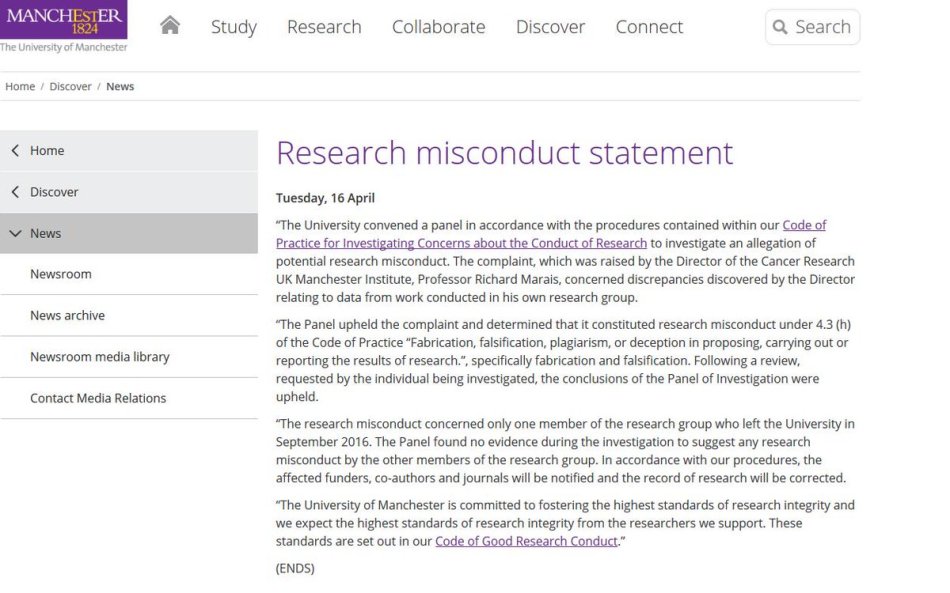
On 16 April 2019, the University of Manchester in UK issued this public announcement:
Research misconduct statement
The University convened a panel in accordance with the procedures contained within our Code of Practice for Investigating Concerns about the Conduct of Research to investigate an allegation of potential research misconduct. The complaint, which was raised by the Director of the Cancer Research UK Manchester Institute, Professor Richard Marais, concerned discrepancies discovered by the Director relating to data from work conducted in his own research group.
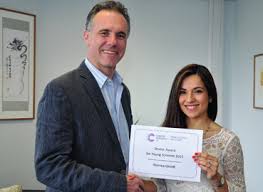
[Photo source: CRUK]
“The Panel upheld the complaint and determined that it constituted research misconduct under 4.3 (h) of the Code of Practice “Fabrication, falsification, plagiarism, or deception in proposing, carrying out or reporting the results of research.”, specifically fabrication and falsification. Following a review, requested by the individual being investigated, the conclusions of the Panel of Investigation were upheld.“The research misconduct concerned only one member of the research group who left the University in September 2016. The Panel found no evidence during the investigation to suggest any research misconduct by the other members of the research group. In accordance with our procedures, the affected funders, co-authors and journals will be notified and the record of research will be corrected.“The University of Manchester is committed to fostering the highest standards of research integrity and we expect the highest standards of research integrity from the researchers we support. These standards are set out in our Code of Good Research Conduct.
Update 28.06.2019: the press release was deleted this week, here a backup from Google cache and a screenshot.
A source informed me that the accused scientist might be the Argentinian melanoma cancer researcher Maria Romina Girotti, who used to work in Richard Marais‘s lab between 2011 and 2016, first at the huge cancer research institute ICR London, and then in Manchester. During that time the young shooting star of melanoma research coauthored 20 papers with Marais, including two in Cancer Cell which according to my source might be now up for retraction. Or maybe not, knowing how Cell Press works. Also, a melanoma clinical trial started in Manchester in 2015 based on Girotti’s possibly flawed research, which was celebrated with a Young Investigator award from European Cancer Organisation in 2015. That phase 1 clinical trial is now completed according to update from 12 June 2019, according to ClinicalTrials website, but no results have been posted yet. Maybe Girotti’s discoveries never led anywhere, since since the update in 2016 its “recruiting” status was dropped.
As aside, the University of Manchester is a special place where research integrity seems to be applied on a case-by-case basis. Almost exactly 10 years ago, a huge fraud affair shook Germany, when the pseudonymous image integrity sleuth Clare Francis blew the whistle on the immunologist Silvia Bulfone-Paus. At the end of the affair, two Russian postdocs got the blame, while Bulfone-Paus resigned from her tenured position as director of Research Centre Borstel and retracted 12 papers. Also her husband Ralf Paus was investigated, which proved tricky because the guilty Russians were not among coauthors of manipulated papers. You know where this is going, right? Bulfone Paus (just like her husband) is professor at University of Manchester, she is even funded by Cancer Research UK (if you recall, Marais is director of the local CRUK institute).
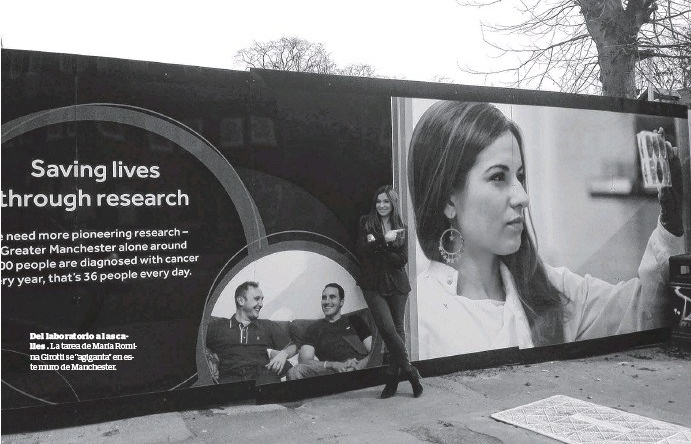
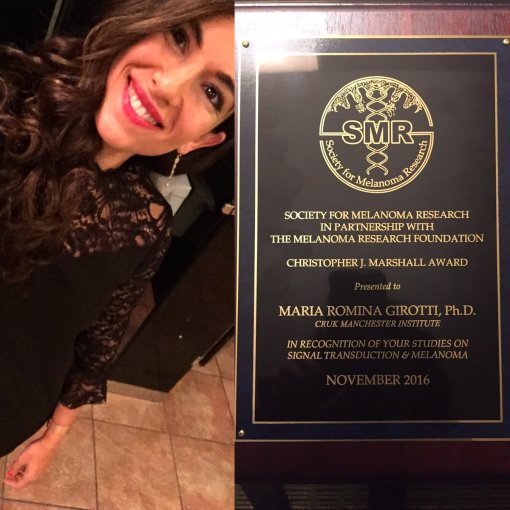
But now back to the Manchester’s most photogenic former researcher Girotti, who never replied to my email. There was also a British Association of Cancer Research Translational Award for her in 2015, and an award from Society for Melanoma Research, and another Early Career Research Award from the Biochemical Society, which followed in 2016. Girotti was quoted:
“I am absolutely thrilled to receive this award. I would like to thank my supervisor Prof Richard Marais for nominating me and for being such an amazing mentor. To work in his team is a privilege one and certainly one of the most important steps in my scientific career”.
Girotti is presently named as professor at the Argentinean Enterprise University (UADE) and is employed at a CONICET research institute in Buenos Aires in her home country Argentina, where she is listed as member of the team of the immunologist and cancer researcher Gabriel Rabinovich. Less than 3 weeks ago Rabinovich posed with Girotti for a photo-op on the occasion of their recent common paper in Cancer Cell, Segovia et al 2019. Interestingly, as soon as I wrote to Rabinovich, the lab’s website went completely offline and came back after I tweeted at Rabinovich with an archived copy. Girotti’s personal Twitter profile (which had no new tweets for some time) was deleted permanently. Her company G4h (Genes for Health), which she runs together with her husband, another UADE professor, is still online.
My source informed me that two big papers are set for retraction due to fabricated mouse data. Which suggests it might be these papers:
Girotti MR, Lopes F, Preece N, Niculescu-Duvaz D, Zambon A, Davies L, Whittaker S, Saturno G, Viros A, Pedersen M, Suijkerbuijk BMJM, Menard D, McLeary R, Johnson L, Fish L, Ejiama S, Sanchez-Laorden B, Hohloch J, Carragher N, Macleod K, Ashton G, Marusiak AA, Fusi A, Brognard J, Frame M, Lorigan P, Marais R, Springer C.
Paradox-Breaking RAF Inhibitors that Also Target SRC Are Effective in Drug-Resistant BRAF Mutant Melanoma.
Cancer Cell. 2017 Mar 13;31(3):466. doi: 10.1016/j.ccell.2017.02.007.
Girotti MR, Lopes F, Preece N, Niculescu-Duvaz D, Zambon A, Davies L, Whittaker S, Saturno G, Viros A, Pedersen M, Suijkerbuijk BM, Menard D, McLeary R, Johnson L, Fish L, Ejiama S, Sanchez-Laorden B, Hohloch J, Carragher N, Macleod K, Ashton G, Marusiak AA, Fusi A, Brognard J, Frame M, Lorigan P, Marais R, Springer C.
Paradox-breaking RAF inhibitors that also target SRC are effective in drug-resistant BRAF mutant melanoma.
Cancer Cell. 2015 Jan 12;27(1):85-96. doi: 10.1016/j.ccell.2014.11.006.
The last author Caroline Springer, who also moved to Manchester from ICR London, did not reply to my emails (admittedly those were short notices). Her latter paper with Girotti was already corrected in 2016 for image duplication:
“The authors have noted an error in Figure 6A of the originally published version of this article. The image for pERK (top right panel) was incorrectly duplicated from Figure 4E (top right panel). The corrected Figure 6 is shown here. This error does not alter the original conclusions of the study, but the authors wish to apologize for this oversight and any confusion that may have resulted.”
Maybe the conclusions are affected after all, in view of the recent misconduct findings? A paper in Nature from Marais lab, Viros et al 2014, coauthored by Girotti, was corrected in 2015 for an error in the transcribed sequence of a mutated allele.
Marais himself was exonerated from all suspicion according to the press release of his university. Which is just as well, since the director of the Cancer Research UK (CRUK) Manchester Institute was recently put forward as President of American Association for cancer Research (AACR), an enormous status achievement which cannot be tainted by any misconduct association. Marais was not elected in any case. The only communication I received from him was this, 3 weeks after I originally wrote to him asking about Girotti’s role:
“As the complainant in this case I have handed the matter to the University of Manchester Research Governance, Ethics and Integrity Team and it would therefore be inappropriate for me to comment”.
Marais never replied since. Incidentally, many of Marais’ common papers with Girotti appeared in AACR journals, most often in Cancer Discovery. Shall we assume these are perfectly reliable then, like this paper:
Maria R. Girotti, Malin Pedersen, Berta Sanchez-Laorden, Amaya Viros, Samra Turajlic, Dan Niculescu-Duvaz, Alfonso Zambon, John Sinclair, Andrew Hayes, Martin Gore, Paul Lorigan, Caroline Springer, James Larkin, Claus Jorgensen, Richard Marais
Inhibiting EGF Receptor or SRC Family Kinase Signaling Overcomes BRAF Inhibitor Resistance in Melanoma
Cancer Discovery (2013) doi: 10.1158/2159-8290.cd-12-0386
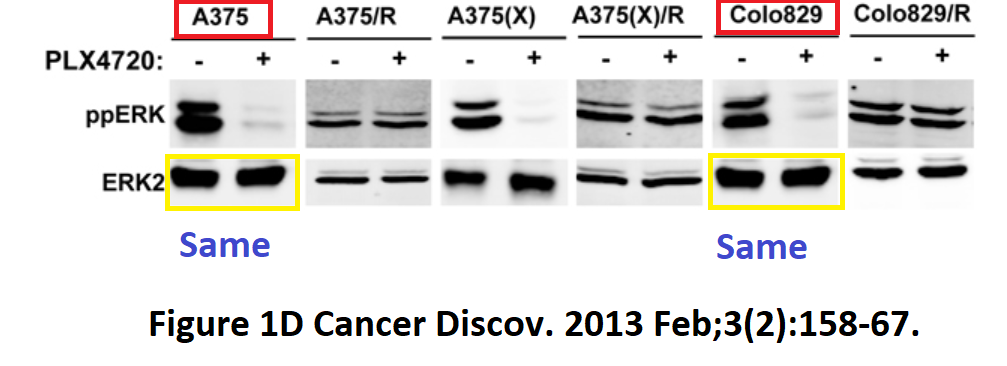
But what about Marais’ other papers where Girotti was not a coauthor, in fact even from the times before she joined his lab? There is an interesting PubPeer record, it is a pity University of Manchester decided not to look that way. Two collaborative papers are very problematic (here and here), but also those straight from Marais lab are not always paradigms of exemplary figure assembly practice. Mostly there is a lot of gel splicing, not always acceptable even by the standards of the time. But this paper (discussed on PubPeer), published in an AACR journal by AACR’s presidential candidate, needs particular attention:
Victoria Emuss , Mathew Garnett , Clive Mason , Richard Marais
Mutations of C-RAF are rare in human cancer because C-RAF has a low basal kinase activity compared with B-RAF
Cancer Research (2005) doi: 10.1158/0008-5472.can-05-1683
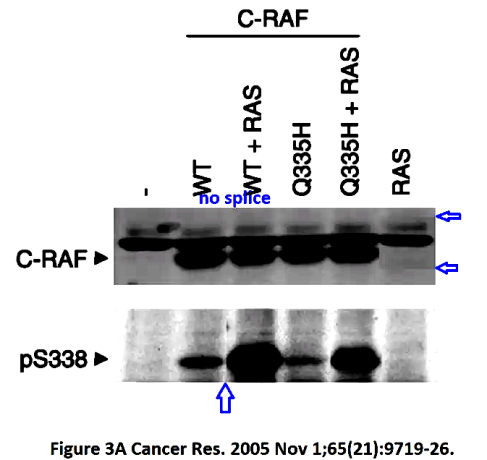
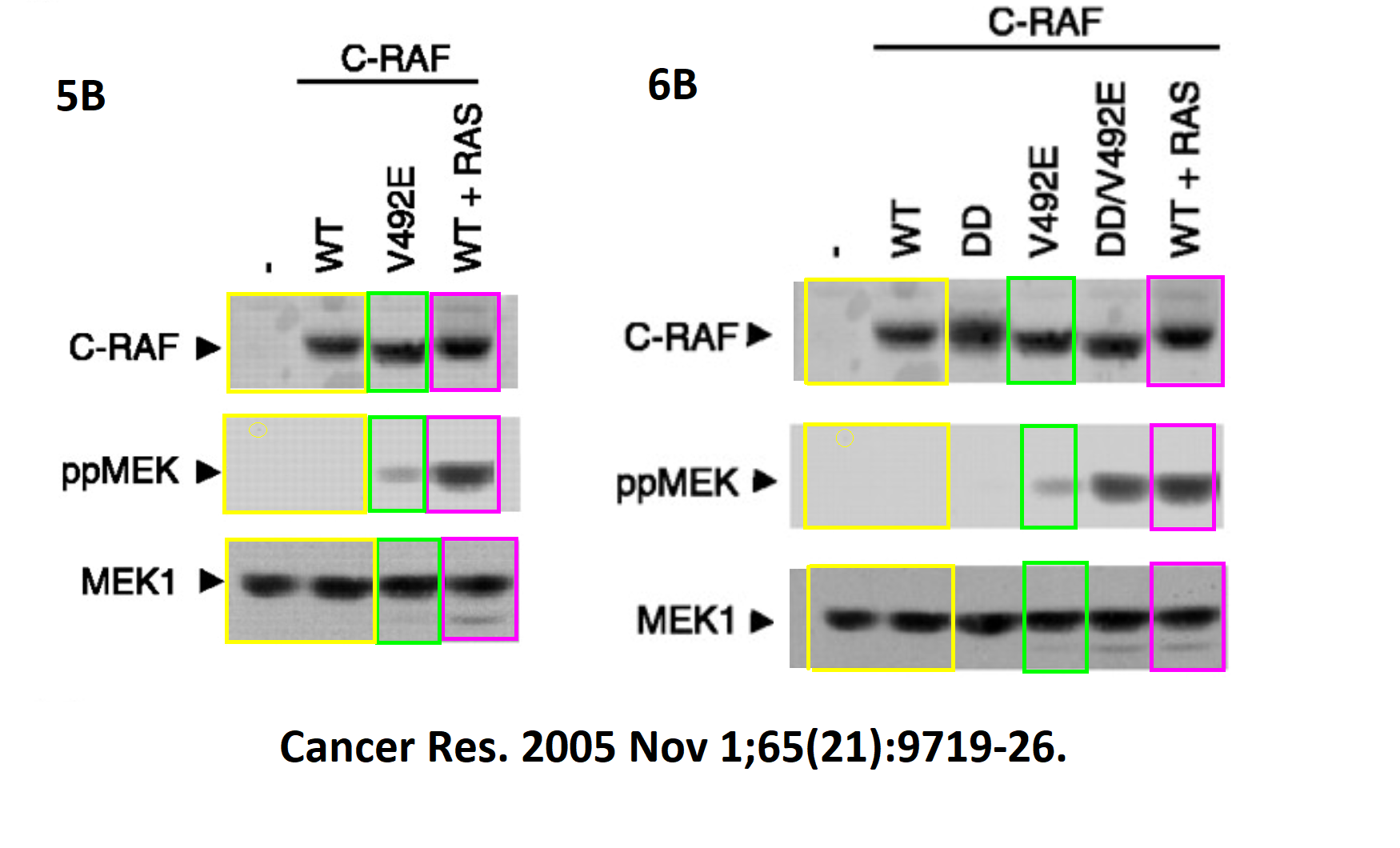
What we are expected to believe is that we see the same western blot, probed for total C-RAF protein (top, also serves as its own loading control) and for phosphorylated C-RAF (bottom). That is obviously not true, because the bottom image is spliced, meaning it shows a different gel (or maybe even two gels) spliced. Worse, someone chose to remove or “adjust” the signal in the last lane (RAS) of the total C-RAF blot using a rectangular patch in Photoshop. This is blatant data manipulation. But then again, in that paper the authors apparently committed it willy-nilly, for no other reason than to pretend that an experiment was done more than once:
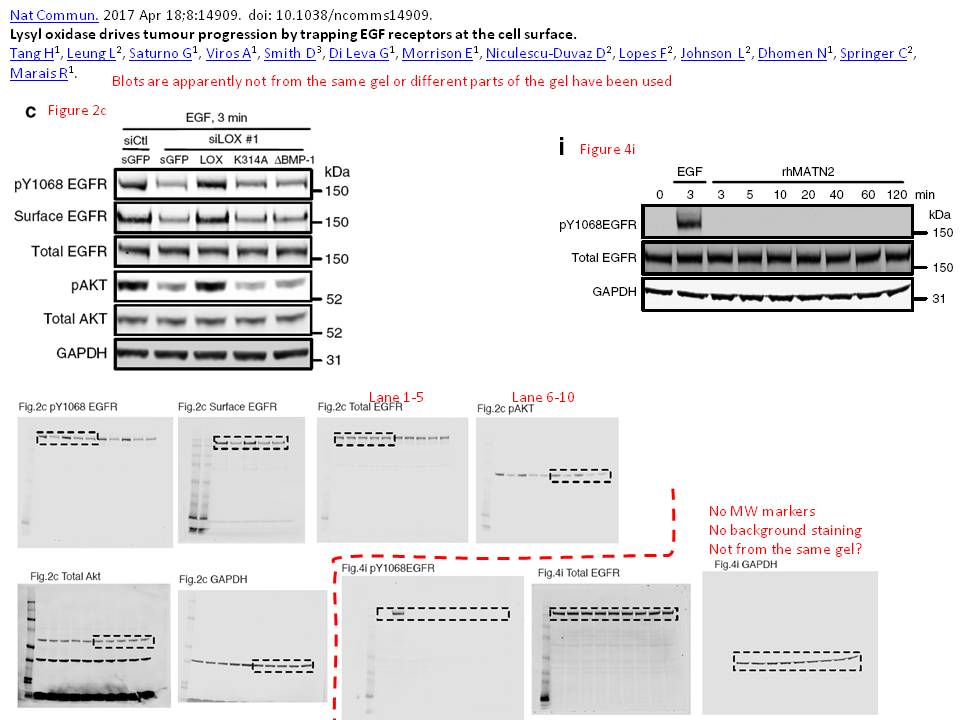
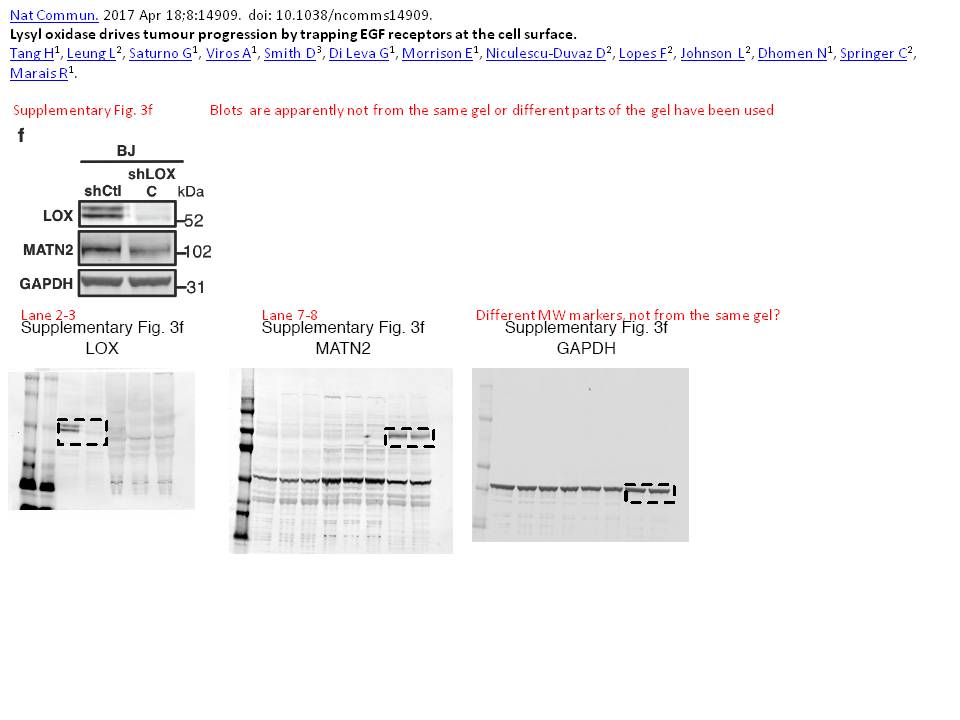
Another non-Girotti paper from Marais lab, Tang et al Nature Communications 2017, was criticised on PubPeer because the published figures did not match the raw data (the Nature family journal require deposition of full-size original gel images, a very useful feature):
“Figure 4j: the pY1068EGFR blot does not correspond with the other blots.
Figure 1c: the LOX blots seem to be retrieved from a different gel when comparing with the corresponding blots, please see the raw data supplied.
Supplementary figure 1c: raw data indicates that different parts of the blots have been used. E.g. lanes 2-4 are used for the py1068EGFR blot, but lanes 4-6 are used for the other corresponding blots.
Supplementary figure 3f: similar issue as suppl figure 1c. Raw data shows that different parts of the blots have been used, and the blots have different number of lanes. Therefore LOX, MATN2 and GAPDH cannot have been run on the same gel.”
Basically, total and phospho-proteins were analysed on different gels and the loading control was run on yet another gel, instead of probing each gel for equal loading as in fact Nature journals expect from their authors. A questionable research practice which not only does not account for technicalities of western blot, but also demands enormous trust in the authors’ personal scientific integrity.
It is rather obvious that this unorthodox approach to western blot analysis did not happen behind Morais back. One can reasonably expect him to read at least those papers from his lab submitted to elite journals like Cancer Cell and Nature Communications. Maybe this relaxed attitude to controls is what makes for such breakthrough discoveries and such a stellar career in cancer research?
Marais arrived to the University of Manchester from ICR London, where he once coauthored a manipulated paper Sharp et al 2007, in AACR journal Cancer Research. Last author was ICR London President Paul Workman, while one co-investigator on the aforementioned melanoma clinical trial in London is Udai Banerji, another ICR professor and close collaborator of Workman. After my reporting nudged ICR to at least correct some of Workman’s papers, Banerji and Workman acted as unofficial internal investigators of their own papers and quickly flushed out the real perpetrators, namely their female colleagues.
Banerji even went so far as boldly to explain on PubPeer how cancer research is done properly:
“parallel gels were run and blotted with the […] antibodies. This is a common, reliable and widely accepted approach when the proteins being analysed are close in molecular weight”
Common and widely accepted at ICR London maybe. Now you know why these scientists are swamped in grant and charity money, while you pathetic loser toil with your ridiculous loading controls.
Correction: in the earlier article version, Marais was named as AACR president-elect. He was only put forward as candidate.
Update 22.06.2019
Because I received no further emails and no requests to keep the communications confidential, I am quoting those first hand sources messages from 18.06.2019, which replace the earlier update.
Romina Girotti wrote to me this:
“I am innocent of the findings the University has reported and I am a victim of the procedure started by the Director of the Institute. I would be grateful if you refrain to keep this post online, which is an attack on my reputation, until my further contact as I want to be able to tell my side of the story. I am not able to share with you at this stage the grounds for my appeal but the investigation process has been biased, unfair and based on a factual error. The University says I have to wait for the outcome of this appeal and, either result, I would be happy to talk to you at a later stage. I would like to mention that Professor Gabriel Rabinovich is not involved in any way in this case.”
Gabriel Rabinovich wrote this:
“I was certainly shocked with the news. As you mentioned in your article, this affair took place when Dr. Girotti was performing her postdoctoral training in Manchenster. When she contacted us after her postdoc, we got excellent recommendations and based on her outstanding CV she applied to the Scientific Carreer and was promoted directly as Adjunct Researcher. Unfortunately, I can´t give you an opinion on this affair at this time as I am not aware of the details that led to this situation when Romina was doing her postdoc in the UK. We will of course keep an eye on this.”
There have been no other communications from the persons mentioned in this article (Girotti later retrospectively declared her email confidential though).
Update 12.07.2019.
I informed CRUK leadership about the accusations of bullying and data manipulations in the many comments below. I eventually received this reply from Iain Foulkes, Executive Director Research & Innovation, CRUK:
“Thank you for your email and for making us aware of the anonymous posts on your blog relating to the CRUK Manchester Institute. CRUK expects all people involved in our research to treat each other with dignity and respect, and we consider bullying and harassment of any kind, in any context, unacceptable. We have a clear policy on bullying within the research environment (Dignity at Work in Research) and expect Host Institutions to investigate any allegations that are made to them. Anyone working under a CRUK grant who has a complaint should report it to their employer, who, under the terms of our policy are obliged to investigate. Given the nature of the allegations raised in your email, we intend to pass your email to the University of Manchester.”
Don’t hold your breath though. Marais and his colleagues just received £25m in Government funding to build a new cancer research centre:
“The new research facility, currently known as the Paterson Redevelopment Project (PRP), will be built at The Christie on the site of the old Paterson building, which suffered fire damage in April 2017″
Now we know why University of Manchester deleted ‘that’ press release, because they have a better one now. It also turns out, Marais (who is busy censoring his Wikipedia entry) is very well capable of doing public statements, he is quoted with:
“I am absolutely thrilled. This significant funding announcement is an exciting step towards creating a world class facility and a vibrant environment for researchers, clinicians and external partners to work together.
“I am extremely proud of the work we are doing in Manchester, which is creating a strong legacy in cancer research. The new facility will attract scientists from around the world and make a huge difference in the way cancer is diagnosed and treated.”
Update 1.08.2019.
Now we know why University of Manchester deleted the press release: Girotti’s lawyers succeeded. This message was circulated by CRUK MI chief operating officer, Caroline Wilkinson, highlight mine:
“The University has received a challenge to the research misconduct process from solicitors instructed by the former member of staff who was the subject of that [misconduct] case. Whilst the University disputes the grounds of the challenge advanced by the solicitors, it recognises the impact of the issues to all concerned. The University has therefore taken the decision to quash (i.e. cancel) the findings of the research misconduct reached in the recent process to enable the University to consider afresh the allegations of research misconduct under the University’s Code of Practice for Investigating Concerns about the Conduct of Research. In accordance with the Code of Practice, the process will be conducted under the presumption of innocence. In the meantime, the University has requested that the relevant journals take no action in relation to the published papers until the resolution of the University’s processes.”
Donate!
If you are interested to support my work, you can leave here a small tip of $5. Or several of small tips, just increase the amount as you like (2x=€10; 5x=€25). Your generous patronage of my journalism will be most appreciated!
€5.00

 For Better Science
Can I suggest the best way to uncover all this is for members of his team to use their phones or other small devices to video or just put it under the desk on record during lab meetings etc. I think you’ll find that videos with direct evidence are extremely powerful. Wish I was there to do it myself, but that is of course easy for me to say as it is no longer my career to care about. I understand completely these nasty pieces of work. I know several of them first hand and cannot agree more with what people have written. I have seen people leave science (something they dreamt of doing as a kid) because of these people. Heartbreaking to see, but they are now much happier funnily enough. Get everyone on board in the lab recording everything. Start a youtube channel and get it on there. Yeh ok you will probably get lawsuits etc threatened, but if you stand together it will be hard for them to prove who actually did the recording. But I do fully understand the problems and that it risks damaging your careers. It is so easy for me to write that now I am out of it. However, if the likes of Richard are reading this then you can rest assured all those patients made to suffer a clinical trial because of falsified data will be made aware and I will help to raise a lawsuit against you and the CRUK. The benefits of me switching to a job in law. There are very senior lawyers here rubbing there hands for something like this.
LikeLike
I have been passed information in relation to Richard’s inhibitors that they are believed to be.. what is the scientific word? Yes ,’bollocks’. This is well known internally and his ex wife has been put in place to close the doors.
You think you are untouchable richard? Think again. You will be held accountable.
LikeLike
@YouTuber is there something that could be done as a group. RM should be prosecuted but so should CRUK and Wellcome for protecting him.
LikeLike
I never thought bullying would happen to me. I thought I was almost immune, having made it through school and college unscathed. But I had the misfortune to work with Richard Marais who has literally made my life hell. He was insecure in the extreme, to the point that anyone who managed to do their job well, who had friends in work or generally just got on with people, became the subject of his vitriol. I worked in Richard Marais lab for three years. I held a postdoctoral position in a very competitive project. I was really good at it and I had great ideas. I was much better than my boss and that made him really angry. I was denigrated and humiliated constantly, when eventually, I made a bullying/harassment case to HR.
My story was swept under the carpet because he was the director of the Institute. HR are useless in this regard. Their only apparent function is to ensure the smooth running of the status quo for this in Senior Management. Complaints magically disappear and there is a continual of denial of facts and evidence.
If you are getting bullied by Richard speak up quickly, don’t let it fester into ruining your life. Go to the University or to CRUK. Go to the media. Film him, record him. This bully / power-abuser must pay the years of misery he infringed to us.
LikeLiked by 1 person
Enter Caroline Wilkinson into the CRUK MI cluster f. Her sole purpose is to lie, falsify, cover up, basically do everything possible to protect her senior management cronies at CRUK MI. Chief Obfuscation Officer. It seems her nose couldn’t bend any further with all the lies spewed.
I tell you what from my interactions with Marais, Dive, Springer, Wilkinson..they are like children who never had a proper job. No understanding of how to be a leader; Just lied their way up the Academia pyramid. Now they’re at the top(ish), got to keep their place somehow. They are afraid. If they lose their job, what else will they do, where will they go? They don’t know how to work and behave professionally with peers let alone produce an honest piece of work which hasn’t been plucked from the tree of bllsht. They can only survive in this toxic bullying swamps of academia. Its a systemic issue which works for them. They should consider to dissolve CRUK MI for a start, it’s not a charity, its a playground for said bullies and thieving b**tards. If only we could let the public peer behind the curtain. Anyone fancy making a FOI request or tipping off the Guardian?
LikeLike
Completely agree, they should all be fired and prosecuted for their fraud and abuse – and here is more rotten science from Dive:
https://pubpeer.com/publications/B48D7E0BE55D41581E33E20CC84BEC
LikeLike
Pingback: The Crooks of CRUK – For Better Science
I had the displeasure of experiencing the arrogance of Marais and his minion Girotti during my staying at the CRUKMI and it is a true shame to discover that their efforts to cover up this scandal have been successful.
A big thank you to Leonid Schneider for the content of this blog and for trying to improve the state of biomedical research!
LikeLike
Pingback: Amato Giaccia: too big to fall – For Better Science
Pingback: Never-ageing Anti-aging to cure COVID-19 – For Better Science
Pingback: AACR conjures undead Count Fakula Michael Karin – For Better Science
Pingback: The English science supremacy – For Better Science
https://www.bbc.co.uk/news/uk-england-manchester-65562080.amp
The latest report followed a CQC review in February 2022 which found the trust had been “defensive and dismissive” when staff raised concerns about a £20m research project and bullying.
‘Raising concerns’
The report said: “Very senior executives were heavily invested in the promotion and protection of the trust’s reputation.
LikeLike