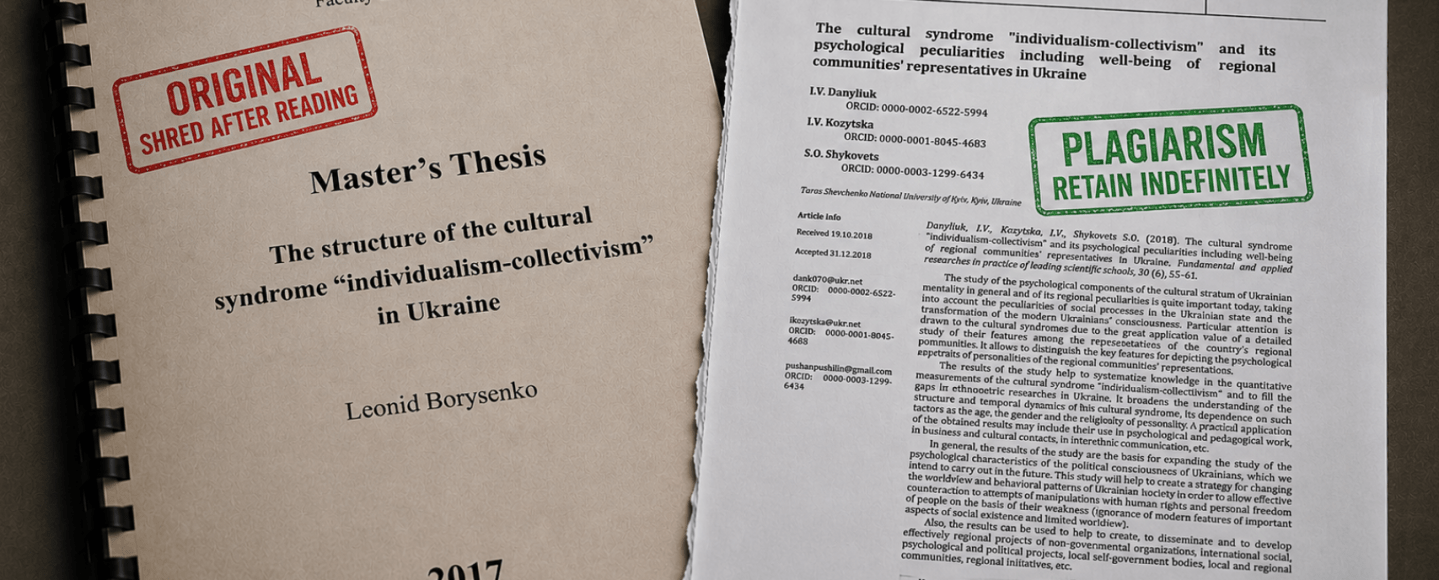

Some time ago, a reader from Ukraine contacted me with a problem he couldn’t solve. Leonid Borysenko saw his Master thesis plagiarised, the perpetrators were his superiors. You’d probably think that the university simply refused investigation, but no – the story took a very unusual detour to arrive to the unfortunate outcome.
Maybe you have an idea what one can do in such a situation. Read Leonid Borysenko’s story, in his guest post:
The perfect crime of plagiarism
by Leonid Borysenko
When research plagiarism is formally confirmed, the expected outcome is straightforward. The scientific record should be corrected. Depending on the severity of the misconduct, this may involve a correction, an expression of concern, or a retraction. Although these processes are often slow and imperfect, they are generally regarded as the mechanisms by which science eventually corrects itself.
But what happens when those mechanisms no longer exist?
This is not a hypothetical question. It is the situation I have found myself in.
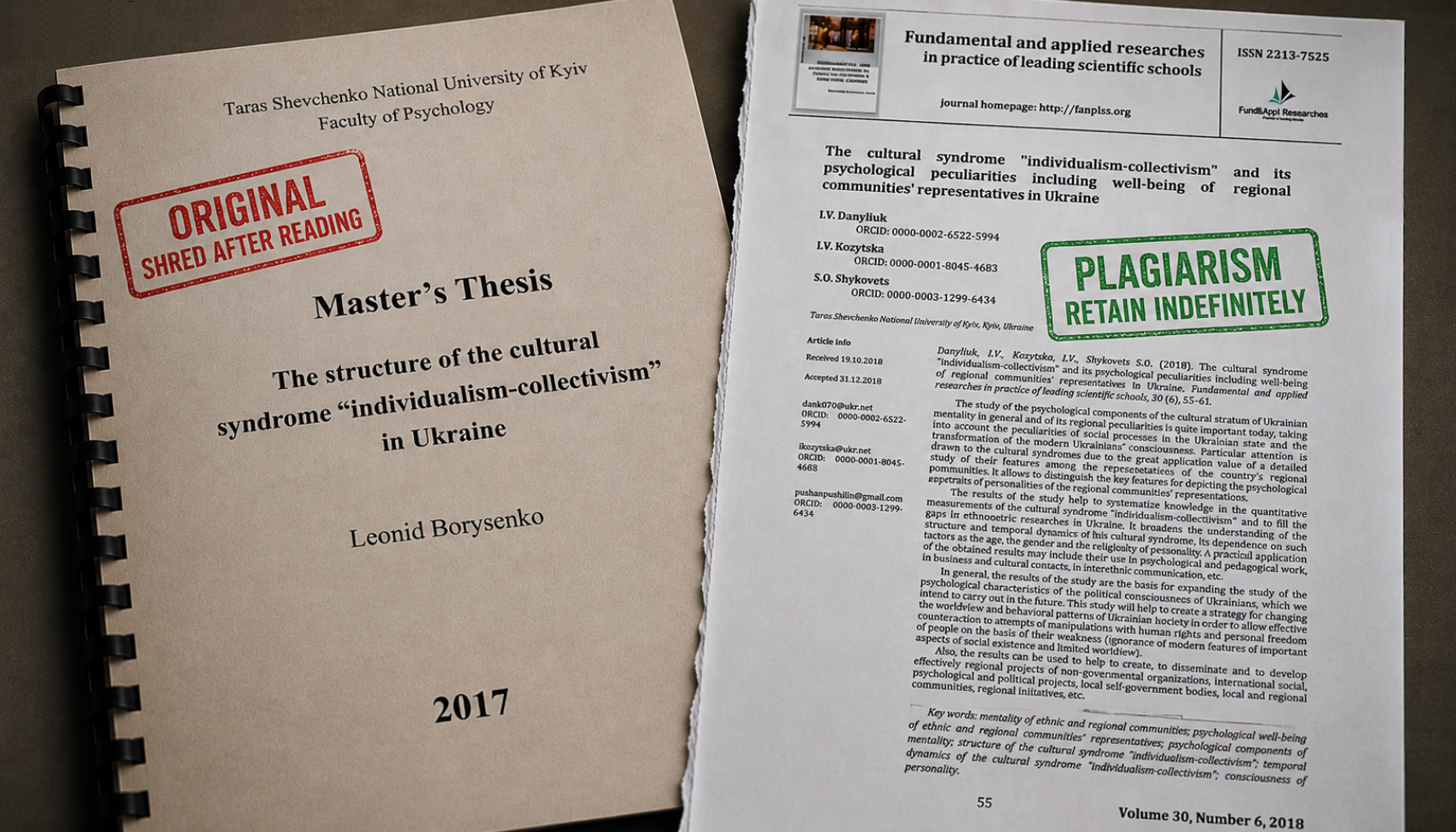
My case began as what appeared to be a fairly typical plagiarism dispute. A paper published in 2018 reproduced the complete dataset from my Master’s thesis, together with the corresponding analyses and substantial portions of the text. After a formal institutional investigation, the university acknowledged that plagiarism had occurred.
Normally, this should have been the beginning of the correction process.
Instead, it became the beginning of a far more unusual story.
No retraction was ever issued. The article quietly disappeared from the journal’s website without any retraction notice, while continuing to circulate elsewhere as a legitimate peer-reviewed publication. The journal itself subsequently ceased to exist. The official archived copy of my original Master’s thesis was destroyed by the university despite my written request that it be preserved and despite the mandatory archival period not having expired.
Today, years after plagiarism was officially confirmed, the scientific record remains unchanged. The plagiarizing paper continues to exist, and its authors still include it in their publication lists. The journal that could have issued a retraction no longer exists.
This article is therefore not primarily about plagiarism itself. It is about a different question that I have not seen discussed in the research integrity literature:
What happens when plagiarism is officially confirmed, but correcting the scholarly record becomes structurally impossible?

Taras Persidskyy and Arik of Negev, Shahed Hunters
“He has embarked on a path of unacceptable slander, not only against me, but also against my colleagues (Prof. Oleg Smutok, Prof. Arnold Kiv, Prof. Vladimir Solovyov). We have all the necessary evidence to bring Leonid Schneider to justice for slander and moral turpitude.” – Taras Kavetskyy.

Original research and plagiarism
The events described in this article originated from research that I conducted during my Master’s studies at Taras Shevchenko National University of Kyiv, Ukraine’s leading university in the QS World University Rankings.
My Master’s thesis, defended in 2017, investigated the cultural syndrome of individualism–collectivism. The project represented several years of work, including study design, data collection, statistical analysis, and interpretation. I planned to expand these results into a PhD dissertation.
In 2018, this paper was published:
I.V. Danyliuk , I.V. Kozytska , S.O. Shykovets The cultural syndrome “individualism-collectivism” and its psychological peculiarities including well-being of regional communities’ representatives in Ukraine Fundamental and applied researches in practice of leading scientific schools (2018) doi: 10.33531/farplss.2018.6.08
When I compared the publication with my thesis, I discovered that the overlap extended far beyond textual similarity.
The published paper reproduced the complete underlying dataset from my Master’s thesis—163 numerical data points—together with the corresponding statistical analyses and the scientific conclusions derived from those data. Substantial portions of the text were also reproduced.
This was not a case of isolated copying, paraphrasing, or the reuse of several figures. The publication presented my original research as if it were the work of another research team.
The first two authors of the paper were senior academics at the same university where I had defended my thesis: Ivan Danyliuk, Dean of the Faculty of Psychology, and Inna Kozytska, Head of the Department of Experimental and Applied Psychology. The third author Serhii Shykovets was Danyliuk’s PhD student. Ivan Danyliuk had chaired my thesis defence committee. Inna Kozytska taught me experimental psychology during my studies, and at one of the seminars, I discussed my ongoing research in detail, with her present.
The comparison tables below illustrate the extent of the overlap between my Master’s thesis and the published paper.
- In the left column is the article: Danyliuk I. V., Kozytska I. V., Shykovets S. O. The cultural syndrome “individualism-collectivism” and its psychological peculiarities including well-being of regional communities’ representatives in Ukraine. // Fundamental and Applied Researches in Practice of Leading Scientific Schools. – 2018. – 30, 6. – P. 55–61 (it can be viewed here; downloaded here; viewed on the journal’s web-archived site here).
- In the right column is my thesis: Borysenko L. H. The structure of the cultural syndrome “individualism-collectivism” in Ukraine / Master’s Thesis, Taras Shevchenko National University of Kyiv, Kyiv, 2017. – 105 p. (Ukrainian University-certified copy – can be viewed here, downloaded here, on Researchgate here; English translation – view here, download here, on ResearchGate here).

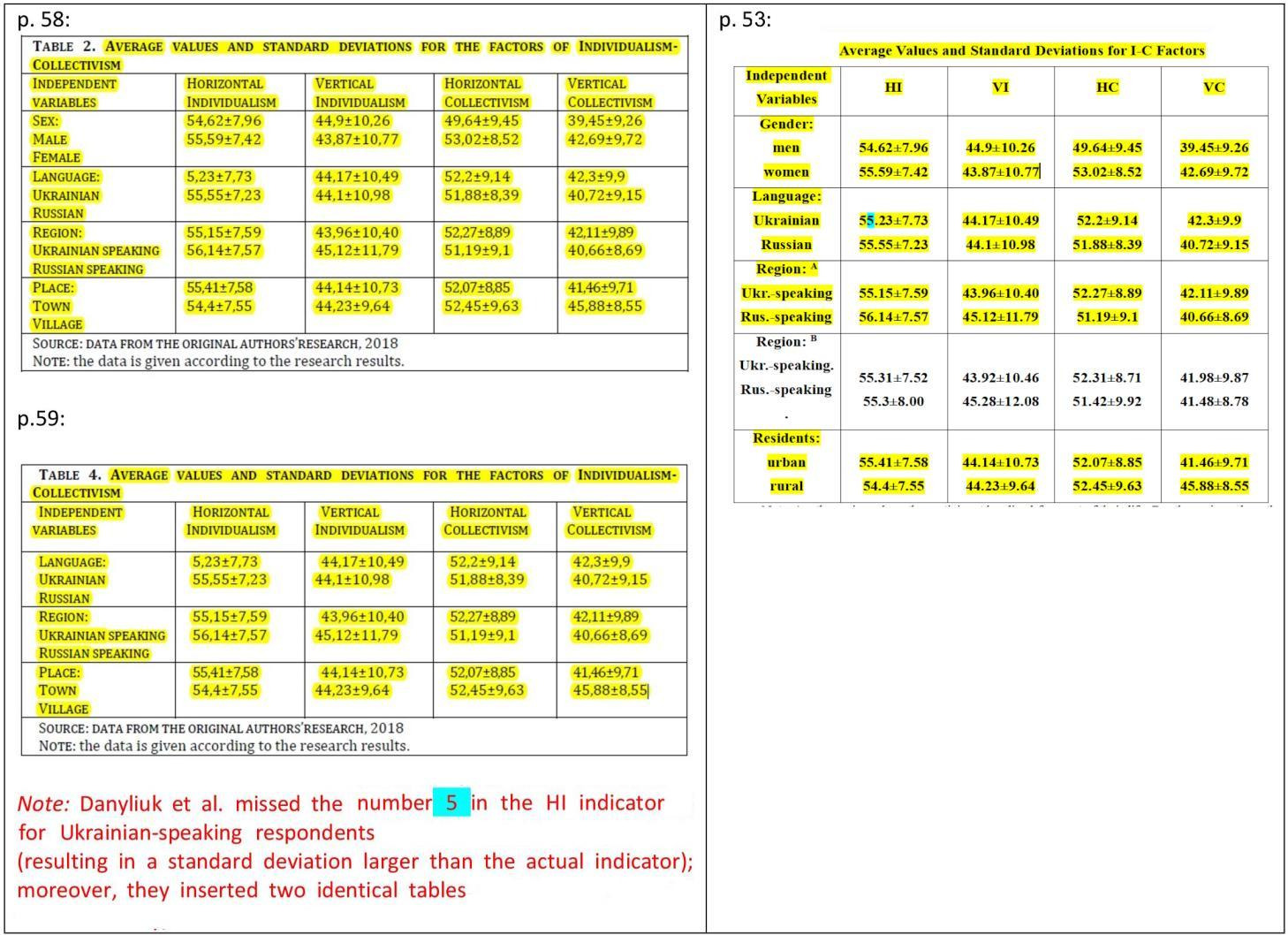
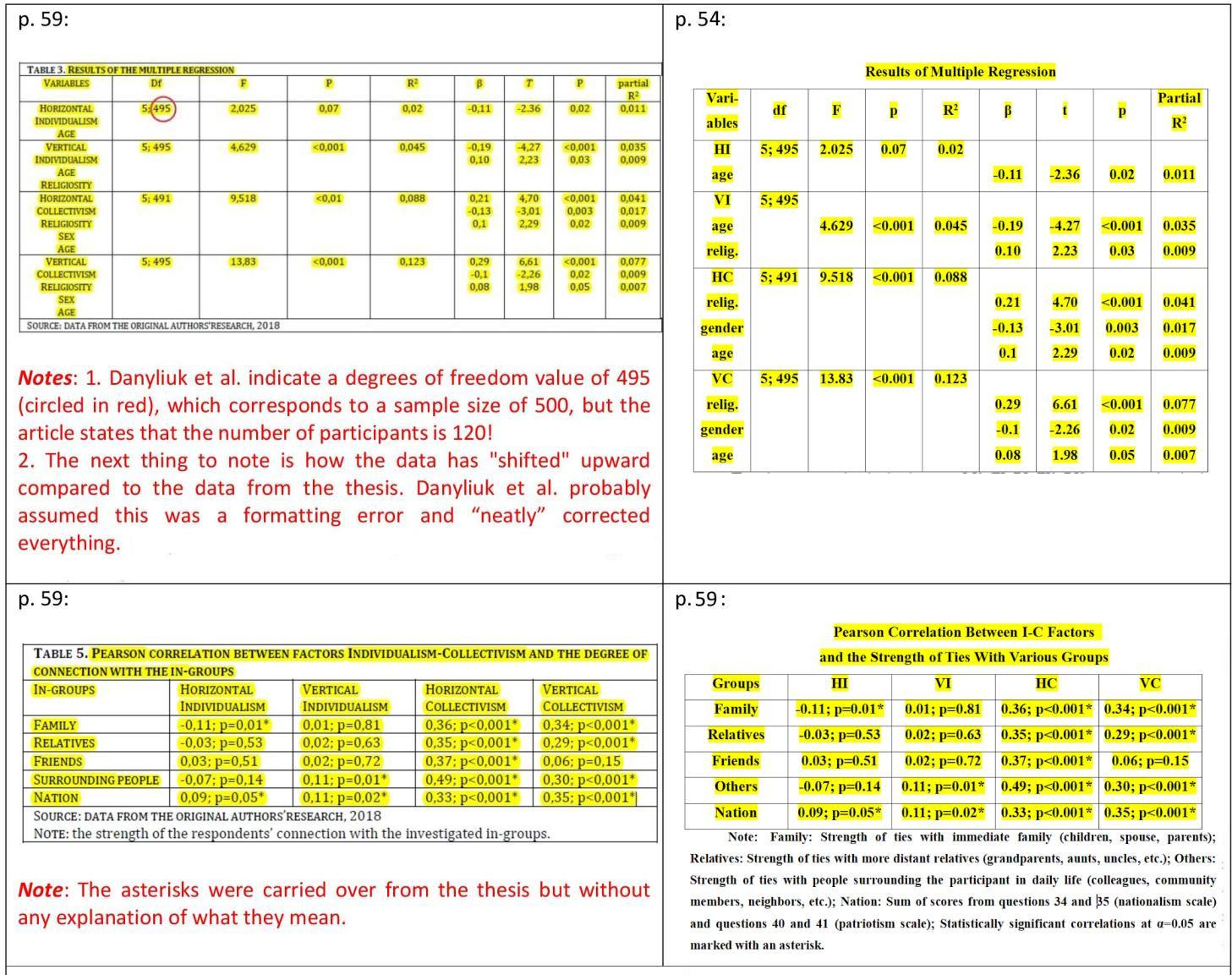
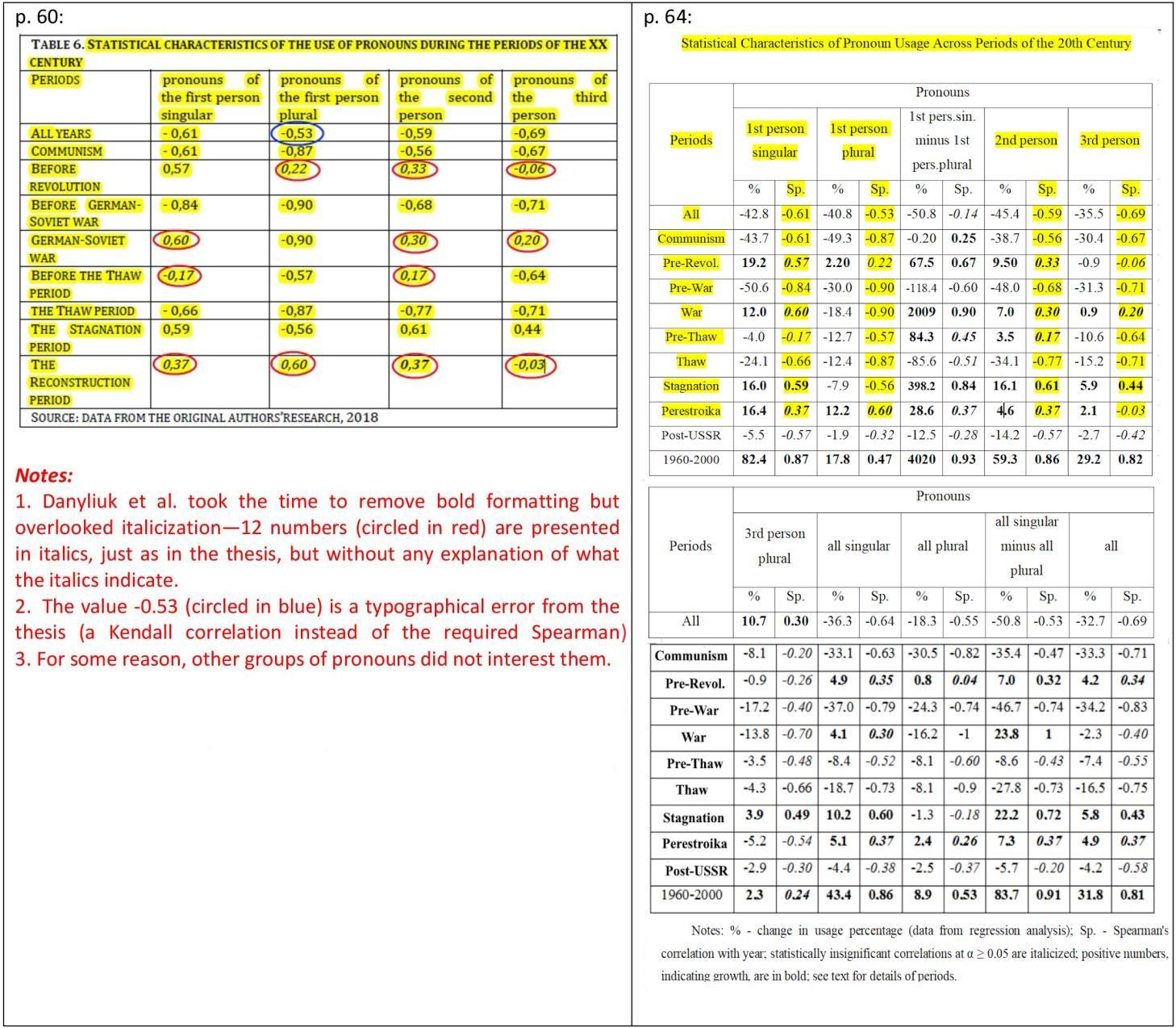
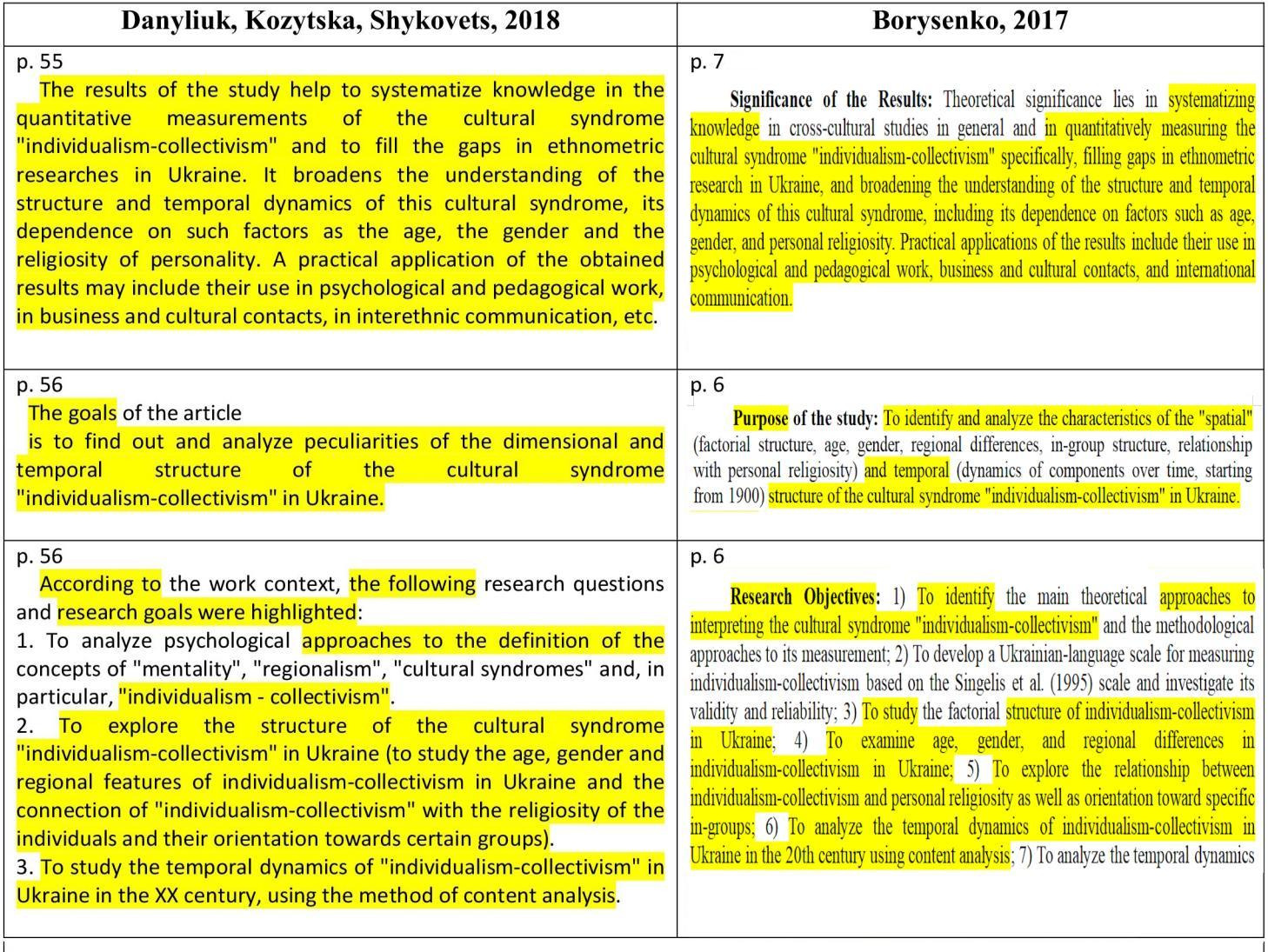
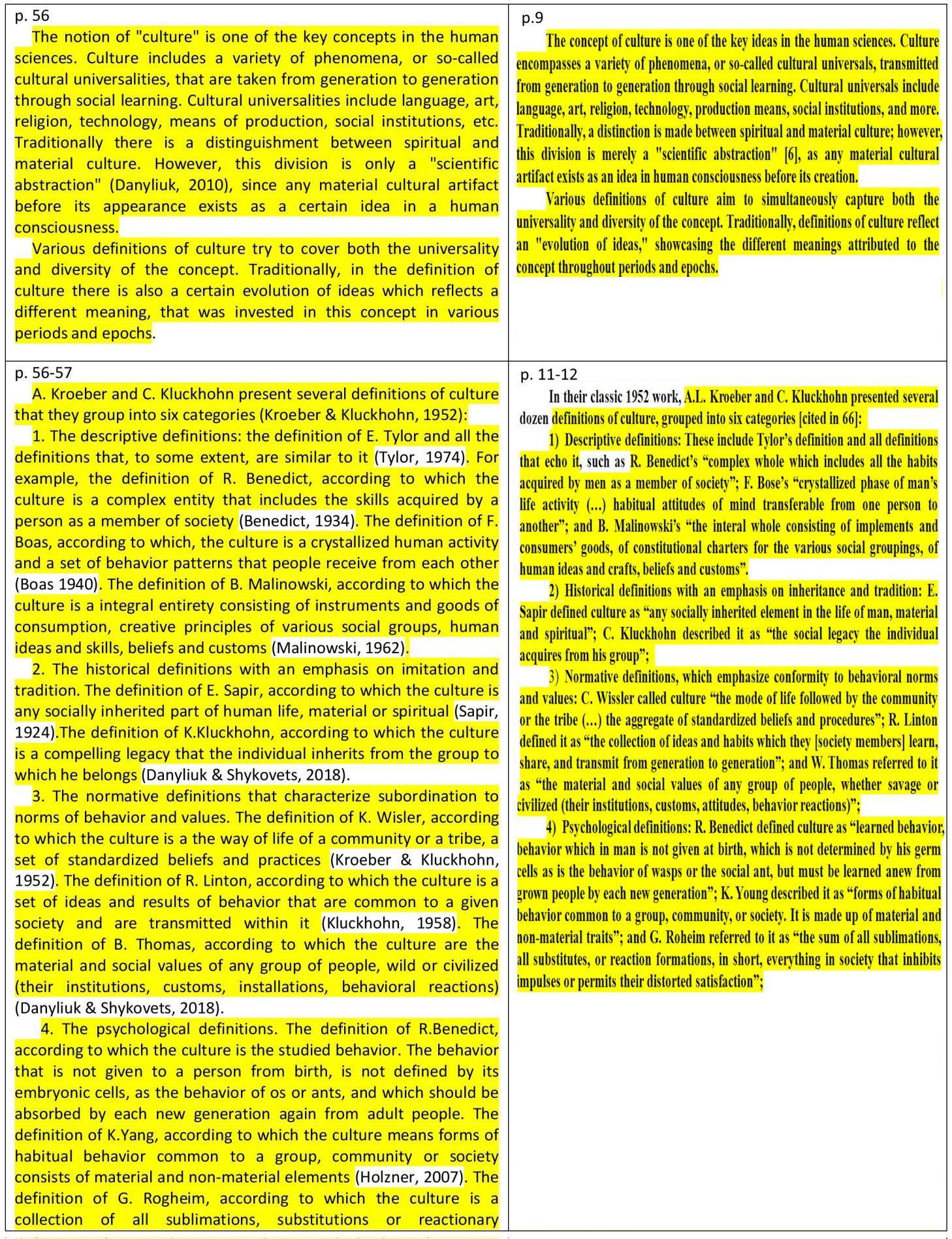
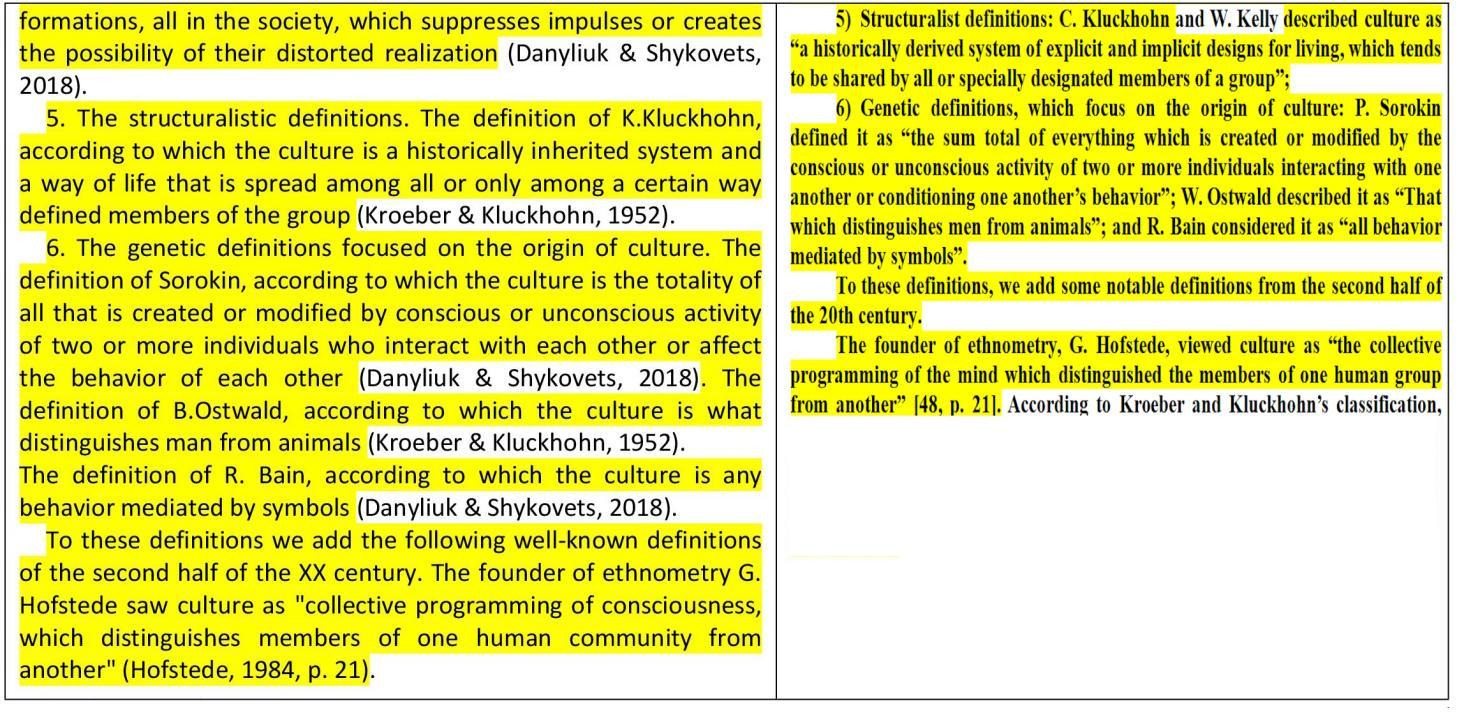
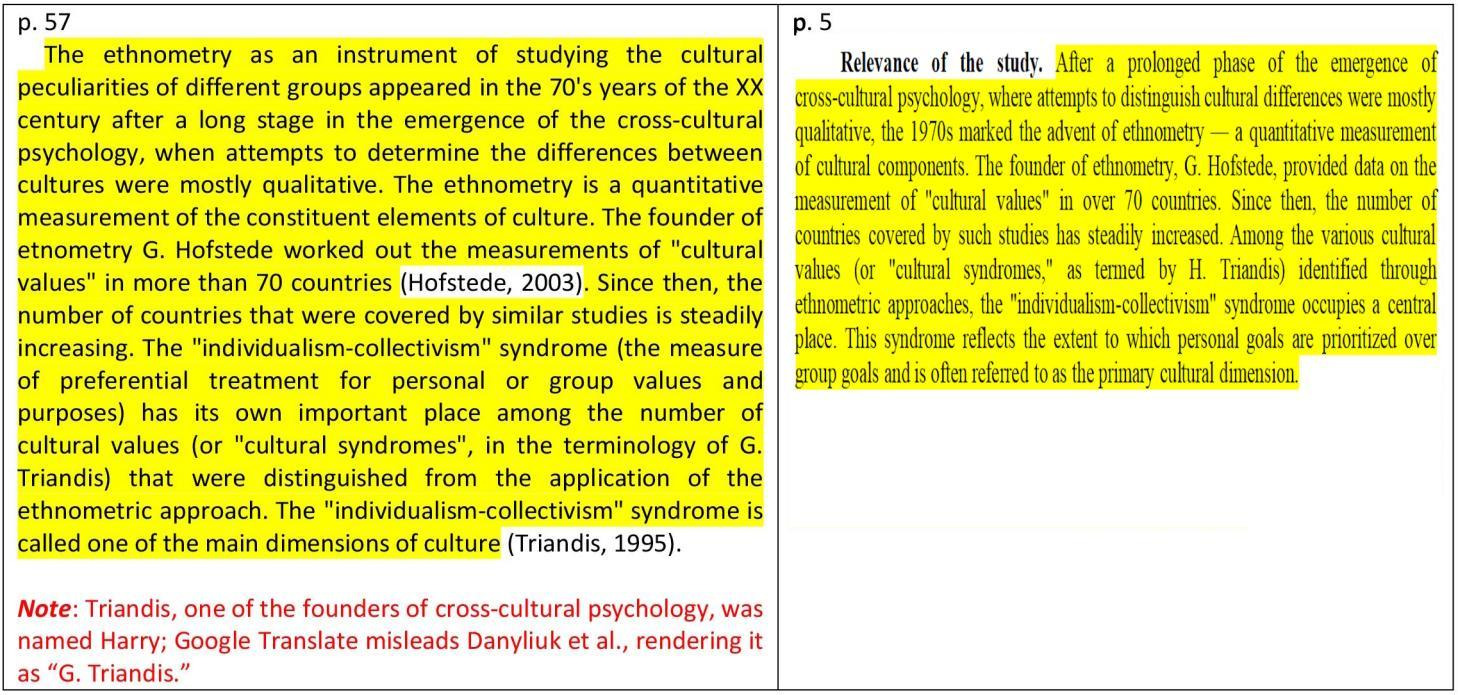
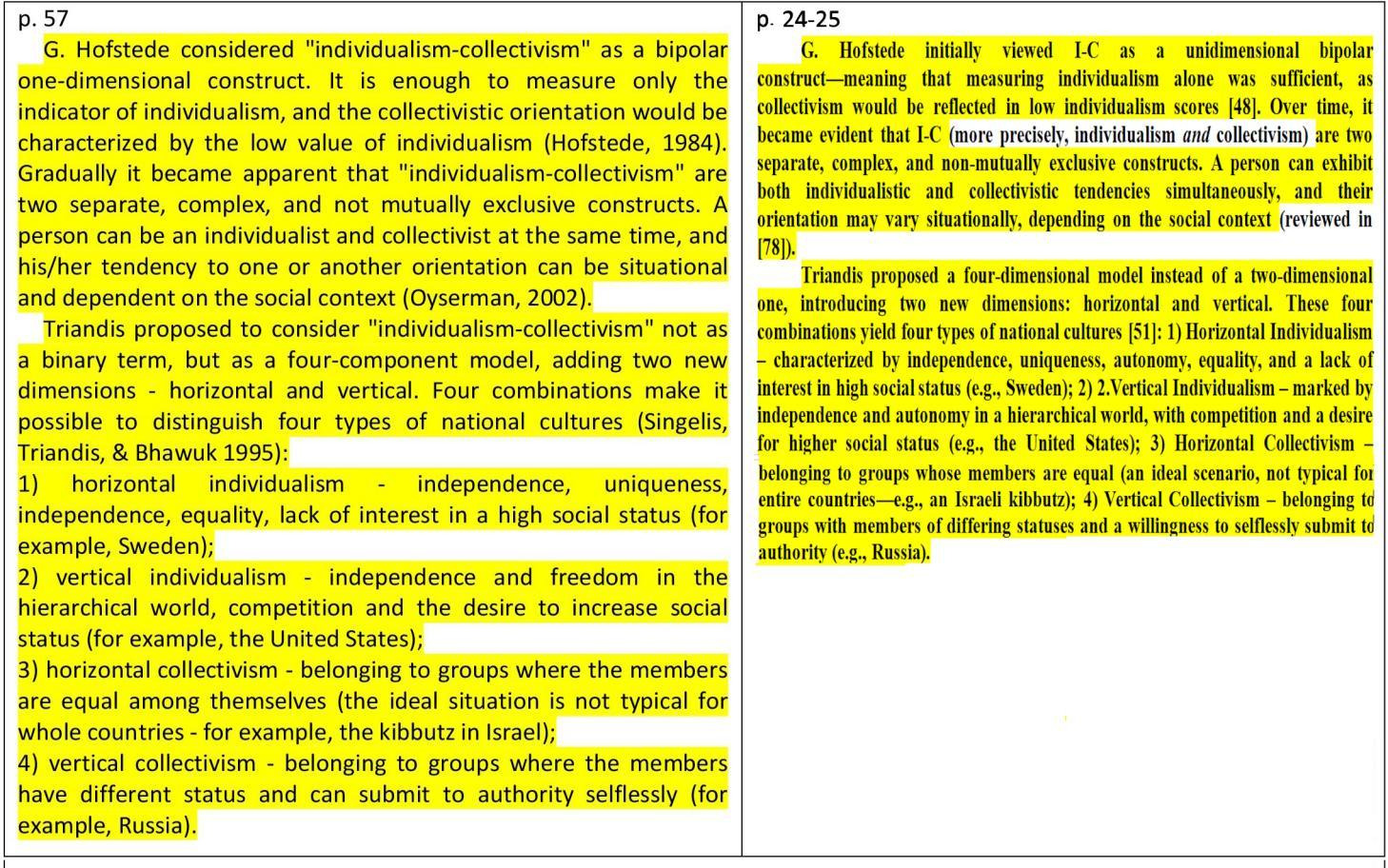
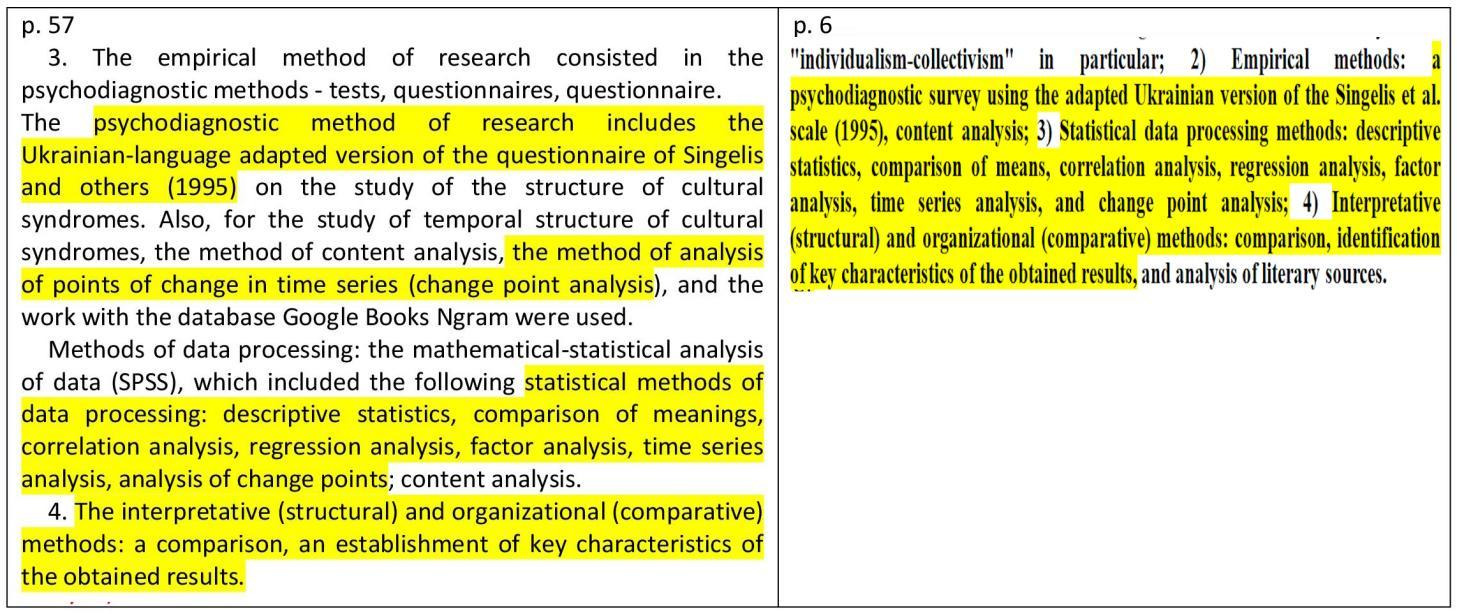
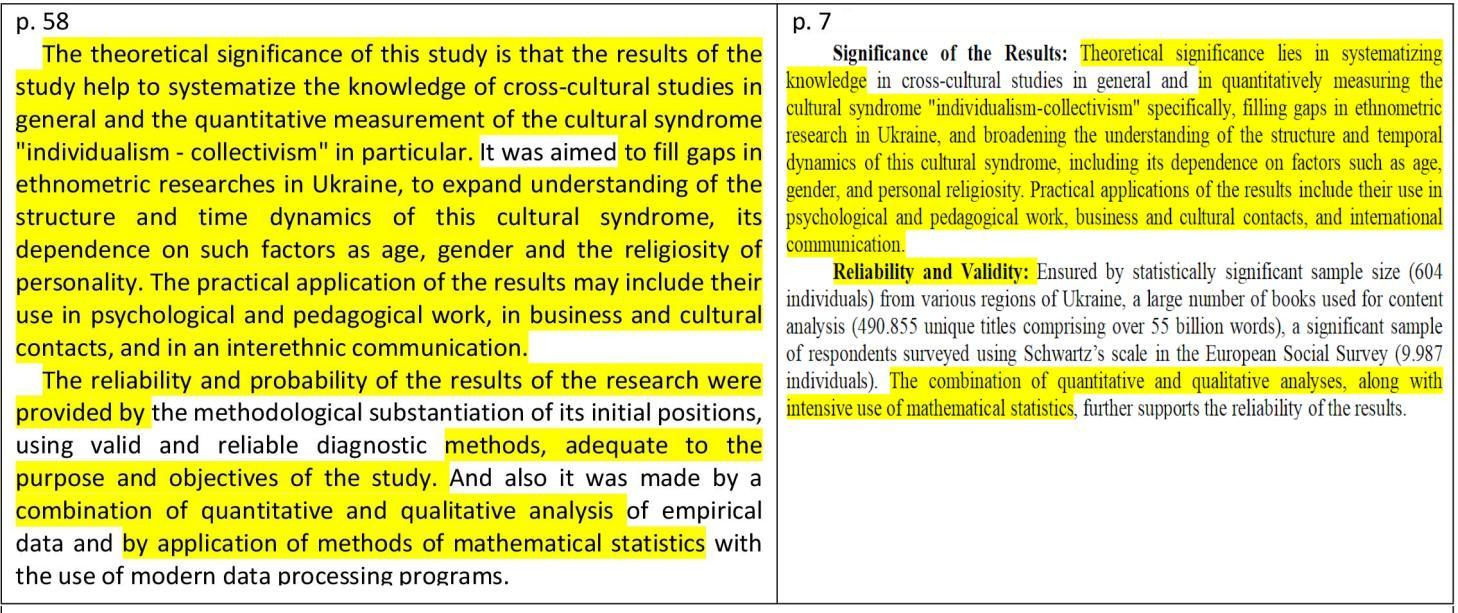
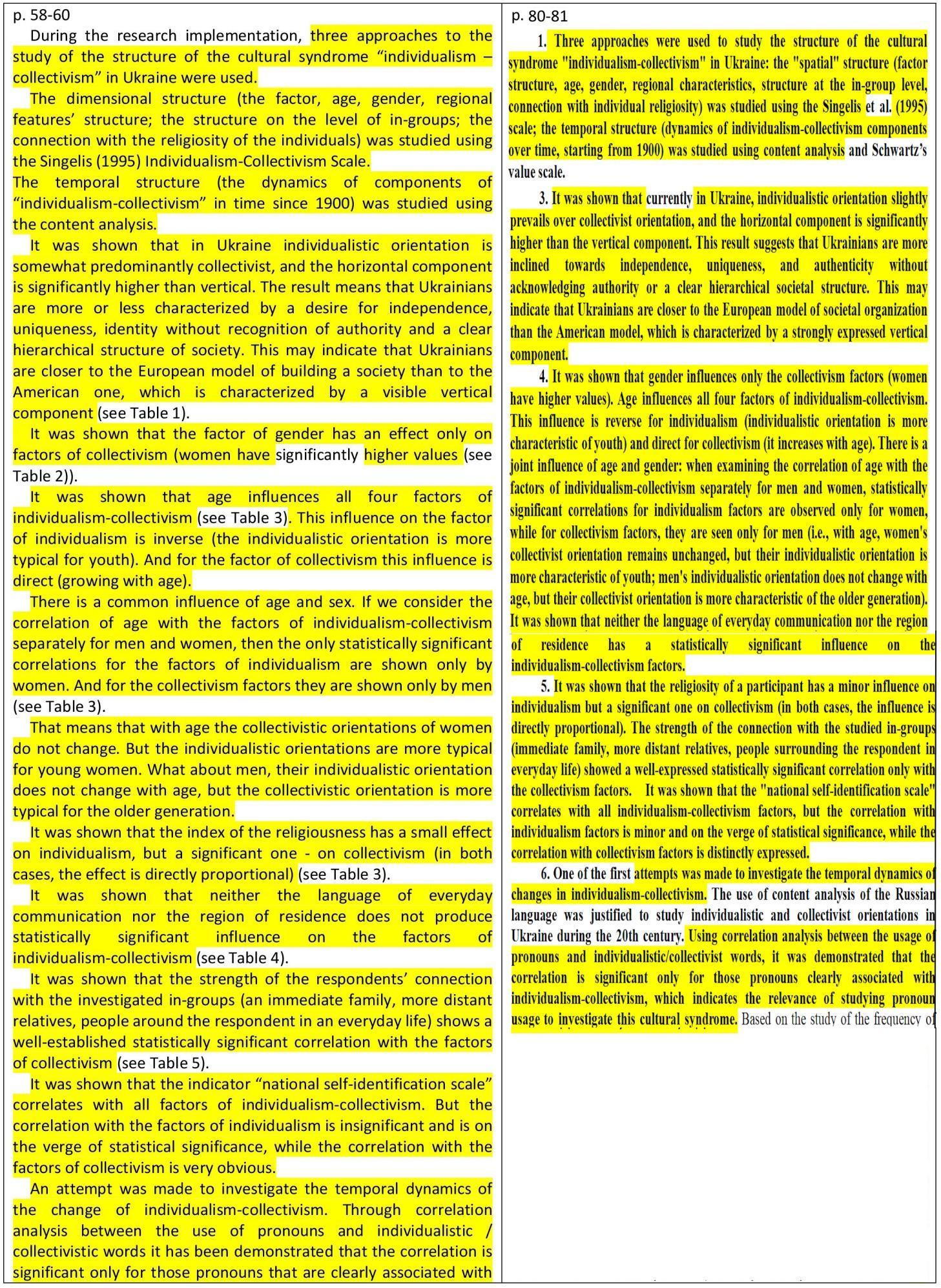
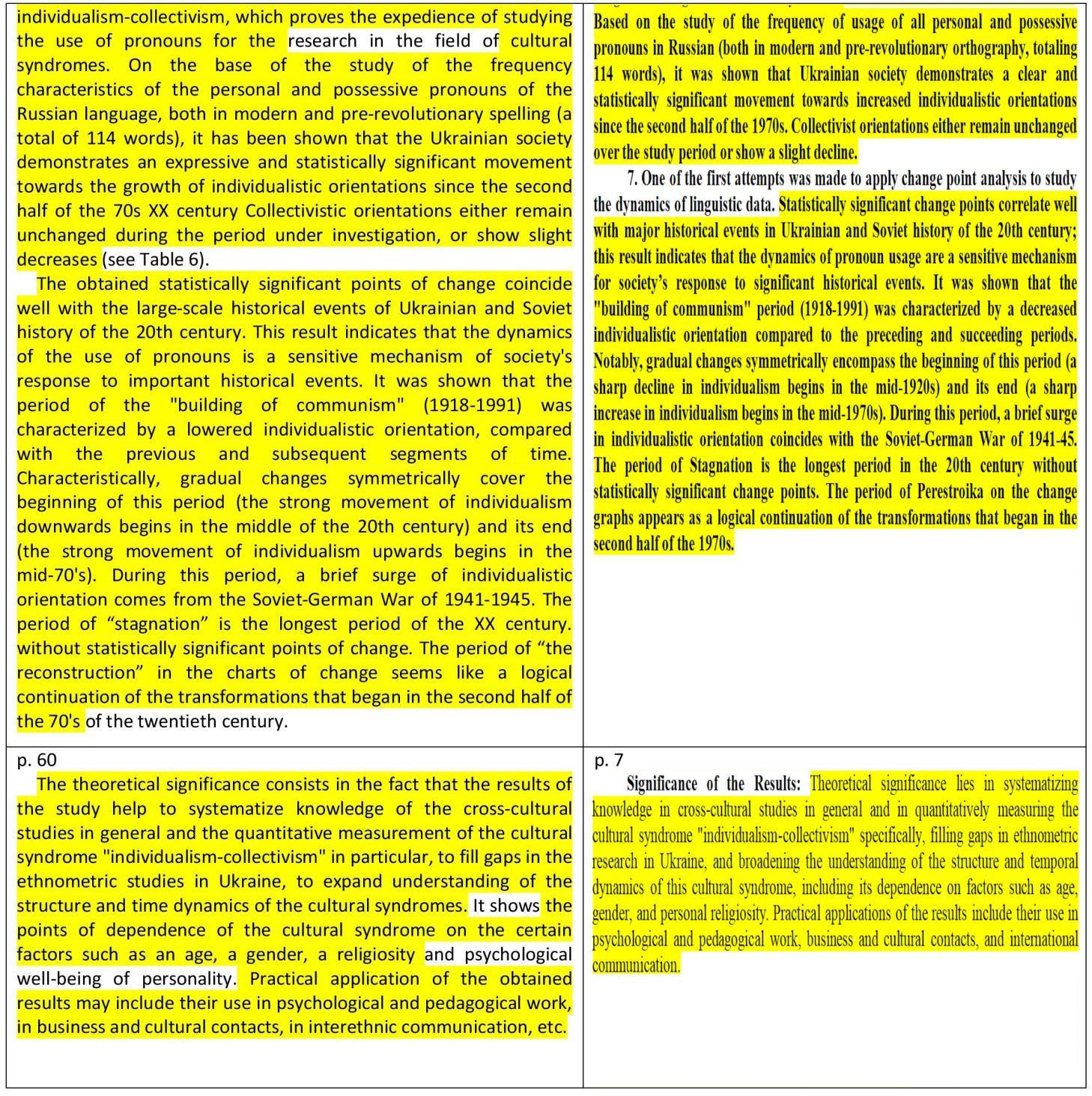
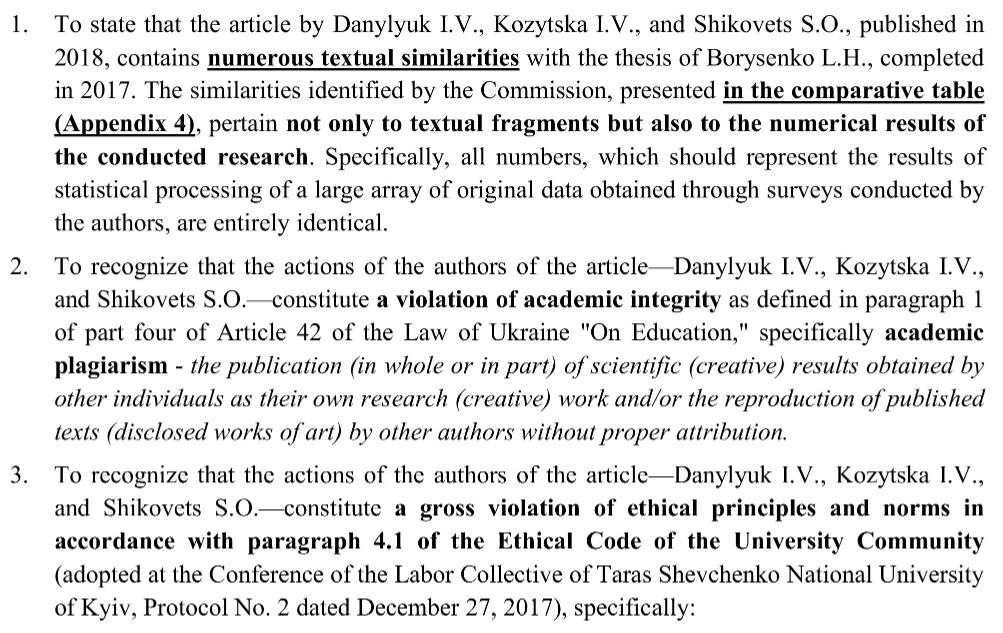
Thus, all 163 numerical values from the article match those from the thesis, including all decimal points, italicization, bold formatting and even one incorrect value.
Regarding textual similarities, the English translation of my MSc thesis is somewhat loose (non-literal), yet even that version reveals numerous overlaps. Comparing the original Ukrainian text of my MSc thesis directly with the English text of the paper makes it obvious that the authors performed a literal, word-for-word translation into English—evidently relying on machine translation. As a result of this verbatim translation, the English text of the paper became virtually unreadable and features several hilarious ‘lost in translation’ blunders that only a bilingual reader can fully appreciate. A side-by-side comparison of the Ukrainian text of the MSc thesis and the paper can be found here.
Particularly striking is the section on definitions of culture. The authors of the paper didn’t even bother to consult the primary sources; instead, they simply performed a literal translation of the definitions directly from my Ukrainian text. In other words, I originally translated the text from English-language sources into Ukrainian, and then the authors translated my translation back into English. Once again, this resulted in unreadable nonsense (for instance, ‘behavior of wasps’ turned into ‘behavior of os’—where ‘os’ is Ukrainian for ‘wasps’) alongside errors even in proper names (e.g., Bose became Boas, Young became Yong, Roheim became Rogheim, C. Wissler became K. Wissler, W. Thomas became B. Thomas, C. Kluckhohn became K. Kluckhohn, and W. Ostwald became B. Ostwald). To top it all off, the authors randomly scattered citations—mostly to their own publications—with the absurd result that early 20th-century classics of cultural studies supposedly gave their definitions of culture in the authors’ 2018 paper.
Ukrainian papermills – symptom, not a cause
“Prof. Dr. Svetlana Drobyazko, The European Academy of Sciences Ltd and Scientific Publication Service are a symptom, not a cause, of the current problems in academic publishing. ” – Nick Wise

Institutional confirmation
After I submitted a formal complaint, the Taras Shevchenko National University of Kyiv established a special Commission to review my allegations.
During the Commission’s investigation, the paper’s authors insisted that these were their original results and that “similarities are coincidental”. When the commission requested raw data, I provided it (which I still retain to this day). Danyliuk and Kozytska were forced to admit that they had never actually seen the raw data and had exercised only “general supervision”. Shykovets simply ignored the question regarding raw data.
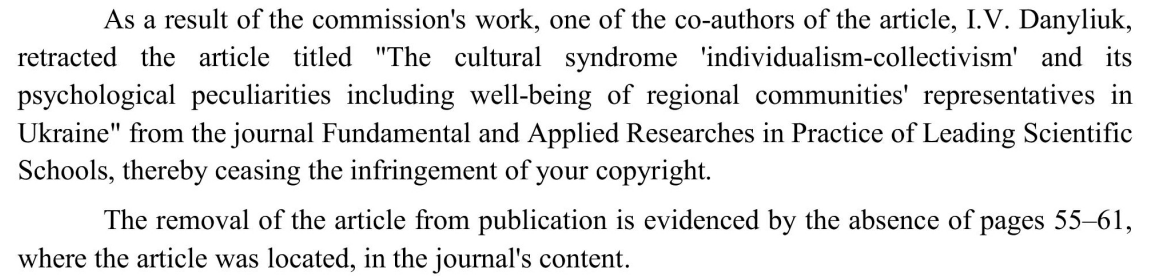
Although the Commission concluded its work in May 2022, it took another six months and two appeals to the Ombudsman for me to finally obtain the official findings. At first, the university merely confined itself to a brief letter informing me that the article was “removed from publication,” which was “evidenced by the absence of pages 55-61 in the journal’s content.”
When I finally received and read the report, the outcome was unambiguous: the Commission unanimously concluded that the publication contained plagiarism of my Master’s thesis.
Once plagiarism had been formally acknowledged by the institution where both the original research and the later publication originated, I believed that correcting the scholarly record would be a straightforward process. I expected that the documented findings would lead to appropriate editorial action, most importantly a formal retraction or another visible correction linked to the publication.
Instead, no correction followed.
Neither the journal nor the authors issued a retraction, correction, or expression of concern. The paper simply quietly vanished from the journal’s website as though it had never existed, leaving a gap in the volume’s pagination—which is precisely what the university termed a “retraction.” At the same time, the publication remained part of the scientific literature despite the university’s official finding.
The documents reproduced below are excerpts from the official correspondence and the findings of the institutional investigation.
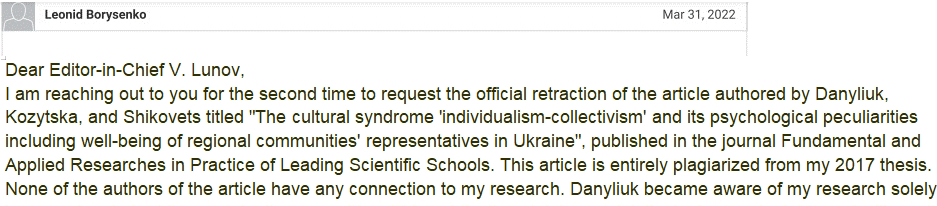
My retraction request to Editor-in-Chief V. Lunov and his sole response (full English text here; full Ukrainian original here):

The university’s response regarding “removal from publication” (full English text here; full Ukrainian original here):
The Commission’s official findings of “gross violation of ethical principles and norms” (full English text here – 1, 2, 3, 4; full Ukrainian original here – 1, 2, 3, 4):
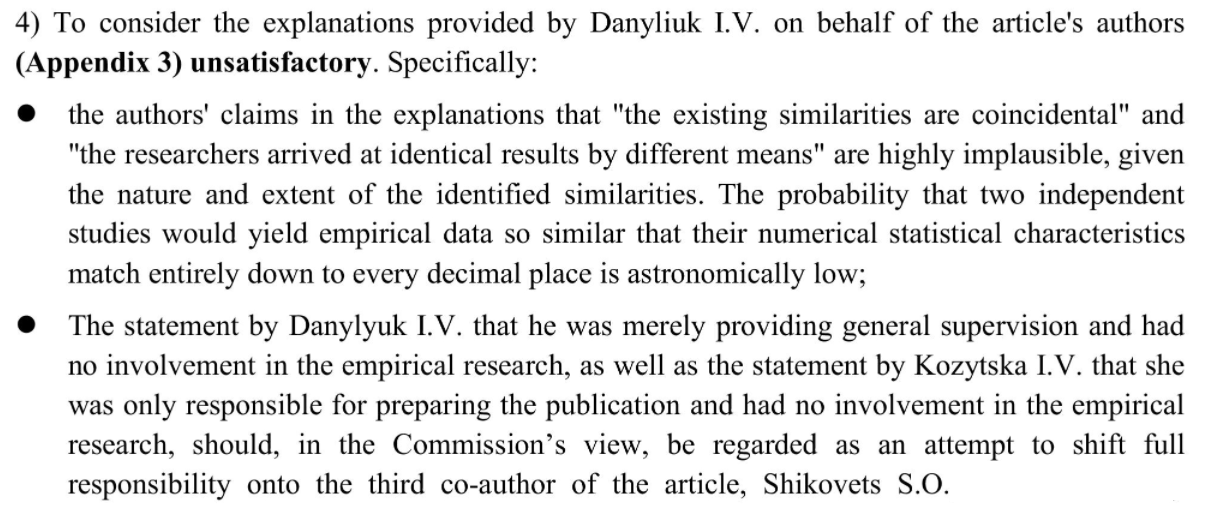
no involvement in the empirical research, as well as the statement by Kozytska L.V. that she
was only responsible for preparing the publication and had no involvement in the empirical
research, should, in the Commission’s view, be regarded as an attempt to shift full
responsibility onto the third co-author of the article, Shikovets S.O.”
The university’s explanation of why the paper’s authors cannot face disciplinary action (full Ukrainian original here):
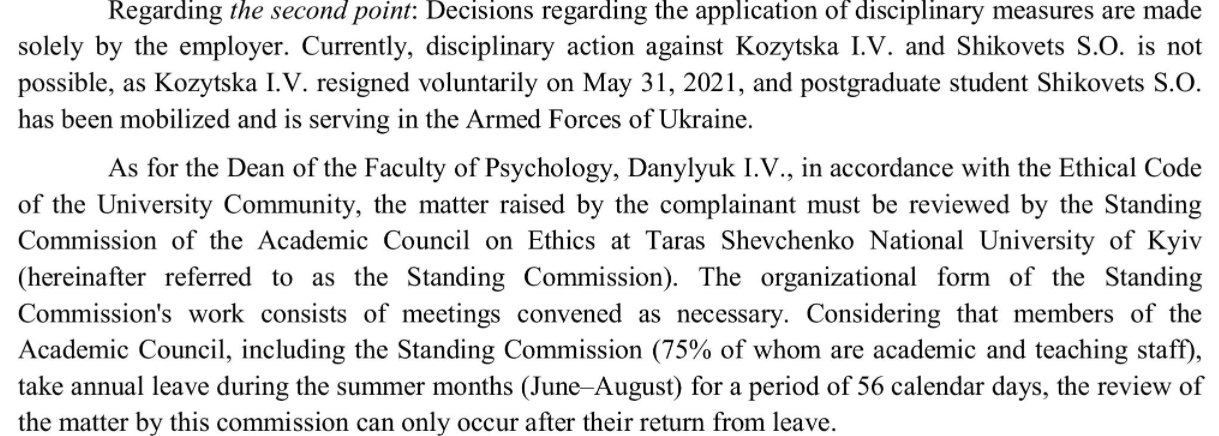
As for the Dean of the Faculty of Psychology, Danylyuk I.V. […] the matter raised by the complainant must be reviewed by the Standing Commission of the Academic Council on Ethics at Taras Shevchenko National University of Kyiv”
Therefore, the central question is no longer whether plagiarism occurred. The university has already answered that question. The unresolved question is why, despite that official conclusion, the scholarly record remained unchanged.

Bad science sanctioned in Ukraine
“…the Commission emphasized that some of the members of the author’s team paid lip service to integrity in science, while at the same time consciously or unconsciously allowing deviations from the principles they promoted in their own activities. “
Why correction failed
Having exhausted the available institutional procedures, I decided to seek judicial review. I filed a civil lawsuit against the journal, the university, and the authors requesting that the article be formally retracted through the publication of a retraction notice stating that the paper contained plagiarism.
After initiating the proceedings, I submitted a written request to the university asking that the archived copy of my original Master’s thesis be preserved. I explained that the thesis constituted essential evidence for the ongoing court case and asked that it not be destroyed.
Upon receiving my request, the university immediately destroyed the archived copy of the thesis (link1, link2), before the mandatory 5-year retention period (link1, link2) had expired. Although I possess a university-certified copy obtained before the story broke, the destruction of the original severely compromised the prospects of legal action.
Furthermore, the university effectively boycotted me and refused to process any of my appeals, citing my lawsuit demanding a retraction: “the University has suspended the consideration of your appeals until a court decision in the case is received” (link).
Another development virtually destroyed all legal prospects: the journal’s Editor-in-Chief, Vitalii Lunov, who was affiliated with the same university as the paper’s authors, shut down the journal entirely.
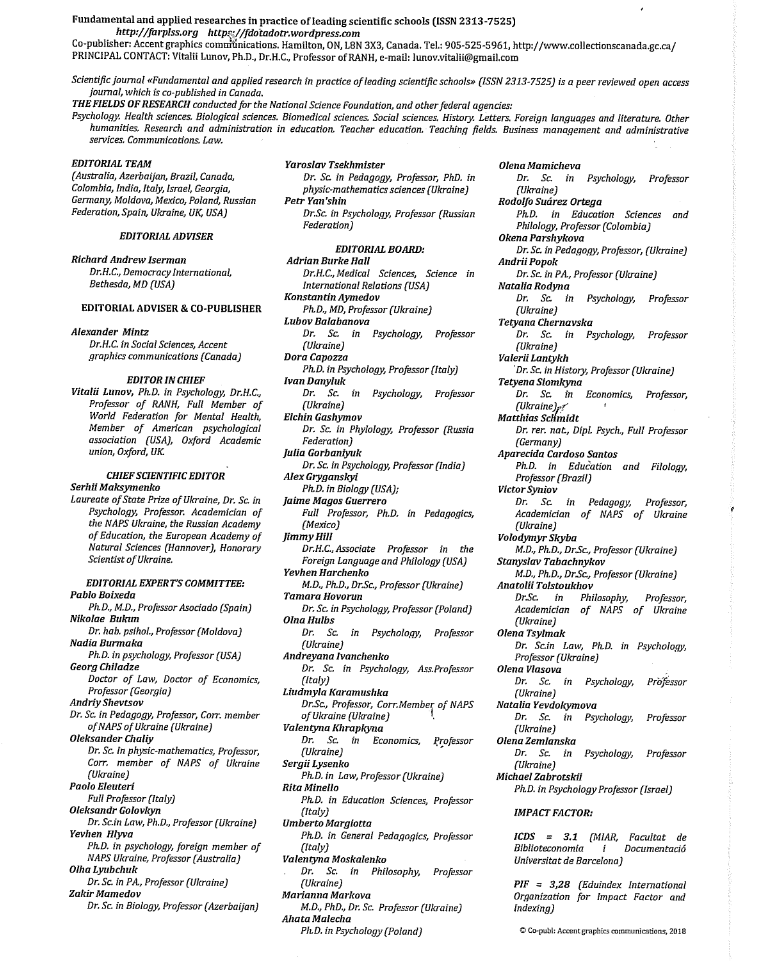
The years 2022 and 2023 proved to be challenging for V. Lunov. First, he received a lawsuit from me demanding a retraction. Presumably, shutting down the journal was easier for him than publishing a brief notice regarding plagiarism committed by the Dean of Ukraine’s highest-ranked university. Later, he became the subject of a rare Ukrainian investigative journalism piece on academic integrity, which raised serious questions regarding suspicious journals he founded and managed—in addition to the aforementioned Fundamental and Applied Researches in Practice of Leading Scientific Schools, this included the American Journal of Fundamental, Applied & Experimental Research)—as well as bogus regalia, the chaperoning of individuals accused of academic misconduct, and the graduation of PhD students who lacked even a basic higher education. Lunov’s journals were described as part of a network of shell organizations and paper mills used for the rapid, artificial inflation of academic credentials and dissertation assembly lines devoid of real scientific merit. Lunov provided no answers to any of these questions. Instead, he did precisely what he had done in my case: quietly shut down his second journal.
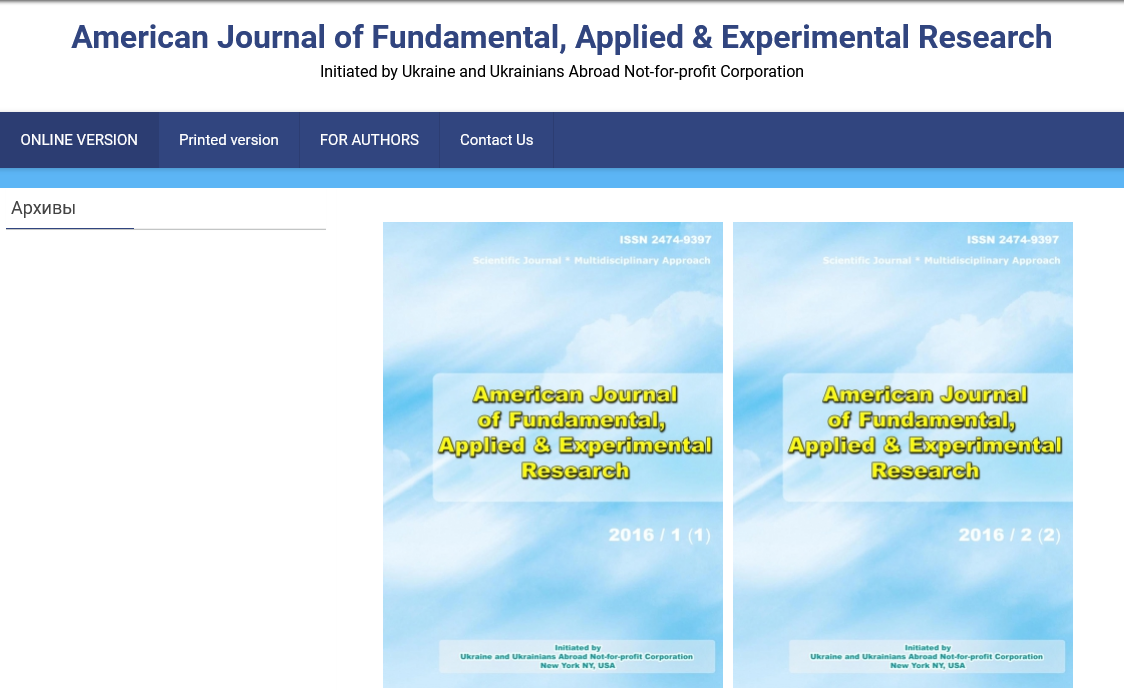
Once the journal that published the plagiarized paper had closed, the practical possibility of issuing a formal retraction through the publisher disappeared as well. These events fundamentally changed the nature of the case.
The original dispute had concerned plagiarism and the correction of the scholarly record. It had now become a situation in which the usual mechanisms for correcting that record were themselves disappearing. Despite an official institutional finding of plagiarism and my extraordinary efforts to defend my research—which took a heavy toll on my health—there was no longer an effective mechanism through which the publication could be formally corrected.
Bremen Rector Bernd Scholz-Reiter, a hero of Open Access?
Research by German journalists revealed whole lists of German academics engaging in predatory publishing and scamferences. Named on over 60 predatory conference papers is Bernd Scholz-Reiter, Rector of the University of Bremen and former Vice-President of DFG. Several such papers are even self-plagiarised, and were used in DFG project reports and Scholz-Reiter’s rectorship application from…
Why I cannot simply publish my original research
One question has been asked repeatedly by journalists and colleagues who learned about this case:
Why not simply publish the original research in another journal?
At first glance, this seems like a reasonable solution. However, in practice it is neither straightforward nor ethically acceptable.
The principal obstacle is that the plagiarizing article has never been retracted. Although it disappeared from the original journal’s website (and the journal itself has vanished), it continues to circulate elsewhere as a published, peer-reviewed paper. From the perspective of the scientific literature, it therefore still exists as the first formal publication of my findings.
Submitting my original work to another journal would place editors in an impossible position.
Editors are responsible for evaluating the scientific quality and originality of manuscripts. They are not investigators, nor can they realistically be expected to reconstruct years of institutional correspondence, analyse documents in another language, compare complete datasets, or determine which of two publications represents the original research.
Even if I provided the university’s official finding, editors would still be asked to resolve a dispute that properly belongs to institutions and journals responsible for maintaining the integrity of the scholarly record.
There is also an ethical issue.
Publishing the same dataset and conclusions for a second time while the earlier publication remains formally valid would amount to duplicate publication, regardless of the fact that the earlier paper reproduced my own research without attribution. Scientific publishing depends on a clear and trustworthy publication record. The records of fly-by-night predatory journals are just as much a part of the scholarly record as those of reputable journals. The former may possess less scientific merit, but they are no less ‘scientific’ in formal terms. Until that record is corrected, knowingly creating a second publication based on the same unretracted results would itself raise ethical concerns.
For these reasons, republishing the research is not a genuine solution. It shifts responsibility from the institutions that failed to correct the record onto journal editors who are neither equipped nor expected to resolve such cases.
This is precisely why correcting the original publication remains essential. Without a functioning mechanism to correct the scholarly record, the original research remains effectively trapped between an unretracted plagiarizing paper and the ethical impossibility of publishing the same work again.
The decadence of German medical doctorate
Germany is a country where a doctorate still invites respect and even deference, in certain circles at least. Here, the prefix “Dr.” even becomes official part of your name, while your professorial thesis advisor is reverentially called “Doktorvater”- doctoral father (there is no appropriate term for female supervisors, which makes the concept even more embarrassing these days).…
The bottom line almost eight years after the publication of the plagiarized paper
Myself (the author of the original research): My Master’s thesis—the product of several years of original research designed to serve as the foundation for a PhD dissertation—could no longer be developed within the academic system. For demanding a formal retraction through legal channels, the university boycotted me. The personal and professional consequences have been devastating, and my research career has effectively been destroyed.
Ivan Danyliuk: Continues to serve as Dean of the Faculty of Psychology, facing no consequences—not even disciplinary ones.
Inna Kozytska: Faced no consequences, not even disciplinary ones. Despite the university’s claim that she resigned voluntarily in 2021 (making it impossible to hold her accountable), her affiliation in recent publications continues to be listed as Taras Shevchenko University (e.g., see Block et al 2026); she is also still listed as an employee on the university’s website.
Serhii Shykovets: Faced no consequences, not even disciplinary ones. Despite the university’s claim that he was serving in the military (making it impossible to hold him accountable), as early as the following year, in 2023, he defended his PhD thesis at the university titled “The impact of ethnolinguistic identity on the level of psychological well-being of the individual”. The text of his PhD dissertation contains no mention of either the 2018 article or my data—rather strange, given his claims before the Commission that the data were his own, isn’t it? The university refused to conduct an investigation into whether his 2018 Master’s thesis overlapped with my 2017 Master’s thesis, and did not provide his Master’s thesis for comparison.
Vitalii Lunov: Faced no consequences, not even disciplinary ones, neither for publishing plagiarized material in 2018 nor for the 2023 journal scandal. His institutional profile states that he remains an editor of the journal Fundamental and Applied Researches in Practice of Leading Scientific Schools, serves as an Associate Professor in the Department of Developmental Psychology at Taras Shevchenko University, and is involved in establishing new journals.
Please Don’t Steal My Work, by Maria Toft
“…my suspicion is that academia is much more haunted by power abuse and structures of fear than most other systems. […] these conditions put a pressure on otherwise morally functioning human beings and suddenly “research theft” and power abuse become part of the invisible academic culture.” – Maria Toft
What remains?
This case is no longer only about plagiarism.
The plagiarism itself has already been investigated. The university formally acknowledged it. The evidence has been documented. The comparison of the datasets is publicly available.
The real question is what happens after that.
The chain of knowledge production in science relies critically on the integrity of all its participants. An honest researcher, honest peer reviewers, an honest journal. Current research integrity frameworks largely assume that, once misconduct has been established, journals and institutions retain the ability to correct the scholarly record. My case demonstrates that this assumption is not always true. If misconduct occurs at every stage of knowledge production, the system suffers a fatal failure.
This leaves the original researcher in a position where years of genuine scientific work cannot be ethically published, while the plagiarizing publication remains part of the permanent scholarly record.
If a journal ceases to exist before issuing a retraction, and if the original publication continues to circulate without correction, what mechanism remains? More importantly, what should happen to the original researcher? Simply advising the researcher to submit the work to another journal is not a real solution. Journal editors are not investigators, and knowingly republishing findings that already exist in the literature—even when that publication resulted from plagiarism—is itself ethically problematic.
My case therefore raises a broader question for the research integrity community.
- Are there any mechanisms for helping researchers in situations like this?
- Should responsibility end once plagiarism has been formally established, even if no practical means of correcting the scholarly record remain?
- Or does the scientific community need new mechanisms for cases where the existing system has failed completely?
I do not present this case because I expect a simple answer. I present it because I have been unable to find one.
If science is committed not only to discovering new knowledge but also to preserving the integrity of the scholarly record, then cases such as this deserve discussion. Otherwise, researchers whose work has been formally plagiarized may discover that recognition of misconduct is only the beginning—and that, once every formal mechanism has failed, they are left entirely on their own.
- Full archive of the case
- PubPeer record (by Elisabeth Bik)
- ResearchGate discussion
Donate!
If you are interested to support my work, you can leave here a small tip of $5. Or several of small tips, just increase the amount as you like (2x=€10; 5x=€25). Your generous patronage of my journalism will be most appreciated!
€5.00


Well, so you don’t feel lonely, I post a comment. My own thesis advisor was more of a manager, and neither understood biology well themself, nor was able to generate any original ideas. They effectively destroyed any opportunities I had for postdocs at various, very promising labs, so that I would be forced to stay at their lab, as they had often insisted I do. I was forced to obtain postdoctoral funding to remain at their lab, writing my thesis into a project that was ultimately funded. The PI then took my project and submitted it as their own as a full R01-type project, which was also funded. Of course, it goes without saying that the university administrators did nothing in their investigation and all the evidence and testimony I submitted was used actually to build a case against me. Nothing about this is a surprise to anyone, I’m sure. Everyone who reads these pages knows that research is a feudal enterprise that is sustained on mythology and fables.
LikeLiked by 2 people
Thank you, Michael — I don’t feel lonely anymore. And I am sorry for what happened to you as well. Your story is different from mine, but the underlying pattern sounds painfully familiar: a person with more institutional power takes what they want, while the institution ultimately protects itself rather than seriously investigating what happened… But I feel that if science is about the truth, we need to try to make things a little better, don’t we?
LikeLiked by 2 people
Yes, I agree that in principle science is about truth. But I think that, in the same way that society is due for a re-think concerning many things–for example “should the economy serve the citizenry? or the economy?” and “should the government serve the citizenry? or the financial sector?” Science does not currently serve the truth because the truth is not what sustains it. All things, from science to the conduct of government, have been co-opted into the service of money, and thus their relation to truth or commonwealth are possible only to the degree that it serves a larger, financially viable purpose. For example, the search for truth is not what engenders paper-mills and academic fraud; securing financial gains, continued research funding, and career stability all do. Well, what do we do about this? The re-think happens when the system reaches such levels of dysfunction that we are forced to reform the system. But just like addiction to drugs or alcohol, we will have exhausted every other option prior to abandoning the centrality of money, before reaching the pain-point where science (slop) and government (K-curve) have utterly lost their utility. It sounds a little like a parliament of thieves who are compelled to honesty and cooperation only while under duress.
LikeLike
This is likely the least commented article in the history of this site. I thank Leonid Schneider for the opportunity to share this story and apologize for my article being so unpopular. Many thanks to Michael for his two philosophical comments. Sometimes silence says more than words. So, the answer to the question is: there’s nothing that can be done here, and the researcher is left entirely on his own.
LikeLike