

Schneider Shorts of 19 April 2024 – Nobelist defended by fellow German man, two progeny sons of successful fathers, retractions for various Italian bigwigs, papermill fraud professionally corrected, with a neuroscience breakthrough only few people can master, censorship at a Dutch university, and finally, how to have more sex with Frontiers.
Table of Discontent
Science Elites
- Endemic diffusion of fraudulent research – Robert Nisticò, the new head of Italian Medicines Agency
- Work hard my son – Meet Christophe Len’s prodigy child
- I cannot detect any intentional manipulation or deception – Ulrich Dirnagl defends Thomas Südhof from anonymous trolling
- Labour law measures will be taken – Delft University censors newspaper
Scholarly Publishing
- Very unprofessional to change the brightness – Society journal corrects papermill fraud
Retraction Watchdogging
- Experts in the field were consulted – Royal Society of Chemistry becomes proactive
- Engineering Failure Analysis – another retraction for Filippo Berto and Nima Sina
- The institutional investigation concluded – second retraction for Francisco Baralle
- None of the authors have responded – one more for Salvatore Cuzzocrea
Science Breakthroughs
- Very curious why other groups fail – Dr Park and his neuroscience breakthrough
- A girl just is not a girl without her hair – More sex with Frontiers
Science Elites
Endemic diffusion of fraudulent research
The Italian journalist Andrea Capocci and his newspaper Il Manifesto reveal yet another high-profile research fraud case. That follows their previously reported cases of Italian Minister of Health Orazio Schillaci (read here) and of the former president of Italian Medicines Agency (AIFA), Giorgio Palù (read here).
The new case is about Palu’s successor as AIFA president, Robert Nisticò, pharmacology professor at the University of Rome Tor Vergata, published on 5 April 2024. Google-translated:
“After the stormy resignation of the virologist Giorgio Palù, Schillaci had promised a “European” profile and Nisticò responds to the identikit. He has 181 publications to his credit and before Tor Vergata he worked in Bristol and Nottingham (UK), was laboratory director at the European Brain Research Institute (EBRI) and is part of the commission on orphan drugs of the European Medicines Agency (EMA).”
Like with so many Italian professors, Nistico’ father Giuseppe (also called Pino) used to be professor of pharmacology at Tor Vergata, general director at EBRI and commission member at EMA. Pino Nistico also was, as Capocci writes, a senator of Berlusconi’s party Forza Italia, undersecretary of Health in the first Berlusconi government, president of Calabria in 1995 and then a EU parliamentarian. Thus, totally no nepotism anywhere, Pino’s son Bob honestly deserved everything he achieved.
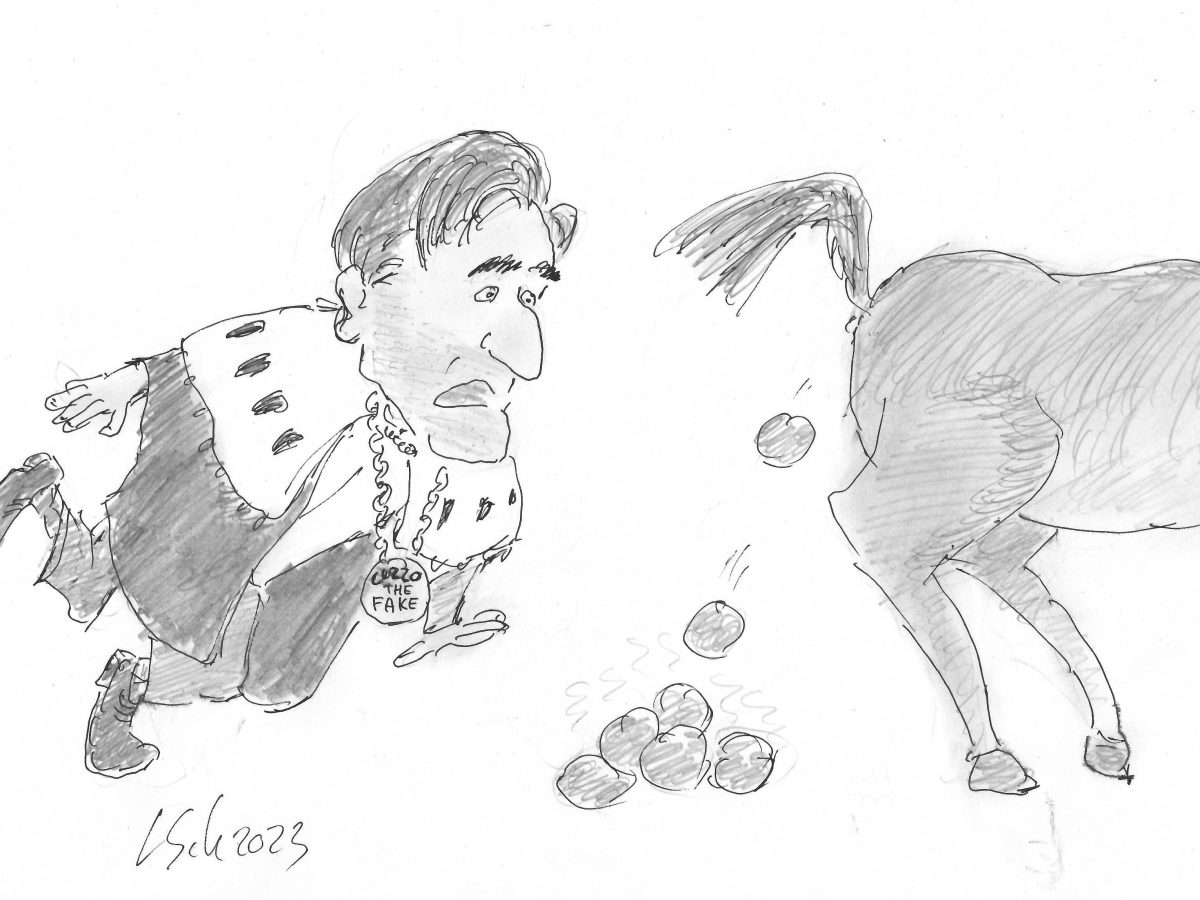
Cuzzocrea’s Magnificent Fall
“These unscrupulous charlatans in Messina should be fired on the spot tomorrow morning, forced to return twenty years of undeserved wages and sent to work the land” – Aneurus Inconstans

“The manifesto has in fact discovered at least five scientific publications signed by the Tor Vergata pharmacologist and containing “duplicated” images , in which the same photograph taken under the electron microscope is used several times in reference to different experiments. Three other studies by him had already been reported on the site pubpeer.com, the database where scientists report suspicious research. The studies with recycled figures signed by the new Aifa president therefore rise to eight, and are spread between 2000 and 2019.
THE ANOMALIES are also confirmed by the expert eye of Elisabeth Bik, probably the world’s greatest expert on scientific fraud. «This is a considerable number of articles» she comments on her poster.”
In fact, Nistico has around a dozen of papers on PubPeer right now, courtesy of Elisabeth Bik and the pseudonymous Aneurus Incostans. He can thank his rotten friends for that.
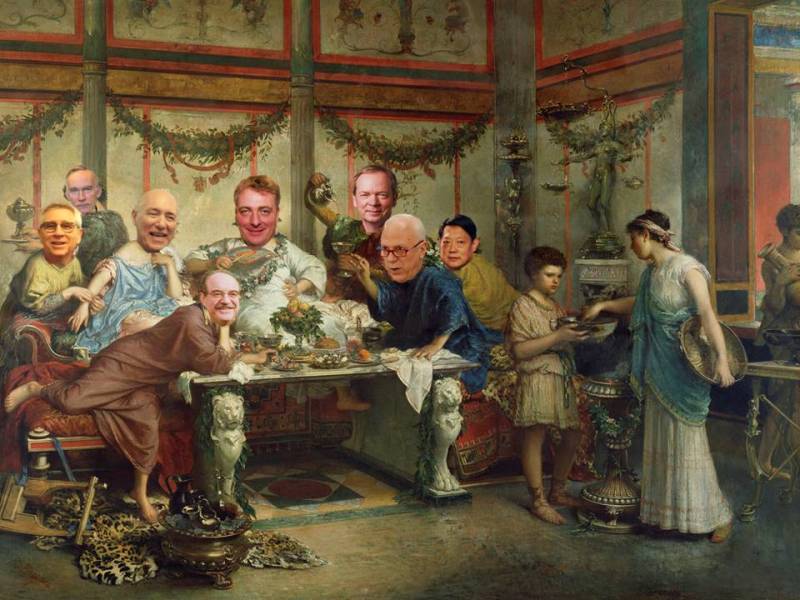
Cell Death and Depravity
Is the journal Cell Death and Disease a disease itself, parasitised by Chinese paper mills? Can it be cured? Not with this team of doctors on editorial board.

Here, with Pierluigi Nicotera, director of the Helmholtz Institute in Bonn, Germany about whom I wrote in the article above. Worth mentioning that the Helmholtz Society refuses to investigate Nicotera’s papers.
Carlo Nucci , Silvia Piccirilli , Paola Rodinò , Robert Nisticò, Marina Grandinetti , Luciano Cerulli , Marcel Leist , Pierluigi Nicotera, Giacinto Bagetta Apoptosis in the Dorsal Lateral Geniculate Nucleus after Monocular Deprivation Involves Glutamate Signaling, NO Production, and PARP Activation Biochemical and Biophysical Research Communications (2000) doi: 10.1006/bbrc.2000.3811

Next, with Milanese neuroscience bigwig Angelo Vescovi of University Milano-Bicocca, about whom I never managed to write, but feel free to go through his embarrassing PubPeer record, especially this fraudulent horror Binda et al Cancer Cell 2012, where Vescovi resorted to lying about a “technical problem with the scanned picture database“. In 2015, he claimed to have submitted an erratum because “conclusions of the manuscript are unaffected and, in some cases, reinforced by the inclusion of the correct plates“, but then Vescovi and Cell Press decided to do nothing at all. The paper was so fake that even Retraction Watch reported about it in 2016.
Now, Nistico with Vescovi:
Luigia Cristino , Livio Luongo , Marta Squillace , Giovanna Paolone , Dalila Mango , Sonia Piccinin , Elisa Zianni , Roberta Imperatore , Monica Iannotta , Francesco Longo , Francesco Errico , Angelo Luigi Vescovi , Michele Morari , Sabatino Maione , Fabrizio Gardoni, Robert Nisticò, Alessandro Usiello d-Aspartate oxidase influences glutamatergic system homeostasis in mammalian brain Neurobiology of Aging (2015) doi: 10.1016/j.neurobiolaging.2015.02.003

Here is Nistico with Salvatore Cuzzocrea‘s special friend in USA, Daniela Salvemini (read about her here):
Carolina Muscoli, Iolanda Sacco , Wanessa Alecce , Ernesto Palma , Robert Nisticò , Nicola Costa , Fabrizio Clementi , Domenicantonio Rotiroti , Francesco Romeo , Daniela Salvemini, Jawahar L. Mehta , Vincenzo Mollace The Protective Effect of Superoxide Dismutase Mimetic M40401 on Balloon Injury-Related Neointima Formation: Role of the Lectin-Like Oxidized Low-Density Lipoprotein Receptor-1 Journal of Pharmacology and Experimental Therapeutics (2004) doi: 10.1124/jpet.104.068205


Nistico with the mightiest cancer researcher in Milan, IEO President Pier Giuseppe Pelicci, read about him here:

Pier Paolo and Pier Giuseppe, the titans of IFOM-IEO
Meet two grand cancer researchers from Milan: Pier Paolo Di Fiore and Pier Giuseppe Pelicci. Then decide if you want to give them your tax and charity money.
Viviana Triaca, Valentina Sposato , Giulia Bolasco , Maria Teresa Ciotti , Piergiuseppe Pelicci, Amalia C. Bruni , Chiara Cupidi , Raffaele Maletta , Marco Feligioni, Robert Nisticò, Nadia Canu , Pietro Calissano NGF controls APP cleavage by downregulating APP phosphorylation at Thr668: relevance for Alzheimer’s disease Aging Cell (2016) doi: 10.1111/acel.12473

Another questionable collaboration, with a Cinzia Severini of Sapienza University of Rome:
Silvia Caioli , Cinzia Severini, Teresa Ciotti , Fulvio Florenzano , Domenico Pimpinella , Pamela Petrocchi Passeri , Gianfranco Balboni, Patrizio Polisca , Roberta Lattanzi , Robert Nisticò , Lucia Negri, Cristina Zona Prokineticin system modulation as a new target to counteract the amyloid beta toxicity induced by glutamatergic alterations in an in vitro model of Alzheimer’s disease Neuropharmacology (2017) doi: 10.1016/j.neuropharm.2016.12.012
Cinzia Severini , Roberta Lattanzi , Daniela Maftei , Veronica Marconi , Maria Teresa Ciotti , Pamela Petrocchi Passeri , Fulvio Florenzano , Ester Del Duca , Silvia Caioli , Cristina Zona , Gianfranco Balboni, Severo Salvadori , Robert Nisticò, Lucia Negri Bv8/prokineticin 2 is involved in Aβ-induced neurotoxicity Scientific Reports (2015) doi: 10.1038/srep15301
- “Amber, orange, pink purple, cyan, teal boxes: Several panels in Figure 2 (12h) and 3 (24h) appear to be the same as those shown in Additional Figure 1 in Severini et al., Scientific Reports (2015), DOI: 10.1038/srep15301. The panels appear to show the same experiments, but they are presented as novel results, and there is no citation of the 2015 paper.
- Red boxes: The ABeta 12h Hoescht/NeuN panel in Figure 2 appears to be the same as the ABeta 24h Hoescht/NeuN panel in Figure 3; however, the PK2 and MERGE images are different.”


Another 2015 paper in Scientific Reports (Nistico et al 2015), with EBRI researcher Marco Feligioni, served as template for this fabrication:
Serena Marcelli , Elena Ficulle , Filomena Iannuzzi , Enikö Kövari, Robert Nisticò, Marco Feligioni Targeting SUMO-1ylation Contrasts Synaptic Dysfunction in a Mouse Model of Alzheimer’s Disease Molecular Neurobiology (2017) doi: 10.1007/s12035-016-0176-9


Pink boxes: The Control panels in Figure 2A look identical to the Tg2576 panels in Figure 5A.
Green boxes: The Tg2576 panels in Figure 2A look identical to the Control panels in Figure 5A.”
The two alpha men Nistico and Feligioni have other common fraudulent papers on PubPeer. This, for example:
Marco Pignatelli , Barbara Vollmayr , Sophie Helene Richter , Silvia Middei , Francesco Matrisciano , Gemma Molinaro , Carla Nasca , Giuseppe Battaglia , Martine Ammassari-Teule , Marco Feligioni , Robert Nisticò, Ferdinando Nicoletti , Peter Gass Enhanced mGlu5-receptor dependent long-term depression at the Schaffer collateral-CA1 synapse of congenitally learned helpless rats Neuropharmacology (2013) doi: 10.1016/j.neuropharm.2012.05.046

Everything is falsifiable:
Dalila Mango , Robert Nisticò , Roberto Furlan , Annamaria Finardi , Diego Centonze, Francesco Mori PDGF Modulates Synaptic Excitability and Short-Latency Afferent Inhibition in Multiple Sclerosis Neurochemical Research (2019) doi: 10.1007/s11064-018-2484-0 Figure 2:
- Green boxes: the CFA+PDGF trace in A overlaps with the EAE+PDGF trace in B
- Cyan boxes: the EAE+PDGF+PZ0012 trace in B overlaps with the CFA trace in C
- Blue boxes: the CFA trace in A appears to be the same as the CFA trace in C

Capocci is careful to make clear that Nistico was not the lead researcher in this affair. His authorships are likely complimentary, so he can now decide whether to be guilty of research misconduct for gift authorships or guilty of research misconduct for data manipulation. Yet Nistico is first author here:
Robert Nisticò, Caterina Ferraina , Veronica Marconi , Fabio Blandini , Lucia Negri , Jan Egebjerg , Marco Feligioni Age-related changes of protein SUMOylation balance in the AβPP Tg2576 mouse model of Alzheimer’s disease Frontiers in Pharmacology (2014) doi: 10.3389/fphar.2014.00063


The Il Manifesto article ends with:
“GIVEN HIS ROLE as new president of AIFA, however, the matter is even more worrying. In fact, it dramatically highlights the endemic diffusion of incorrect or fraudulent research. The case demonstrates the poor ability of scientists to control even the studies they sign personally. From today Nisticò must monitor the data that demonstrate the safety and effectiveness of the drugs we take. If not even the research on which he signed is above suspicion, we all have something to worry about.”
Work hard my son
We remain on the topic of fathers and sons in academia.
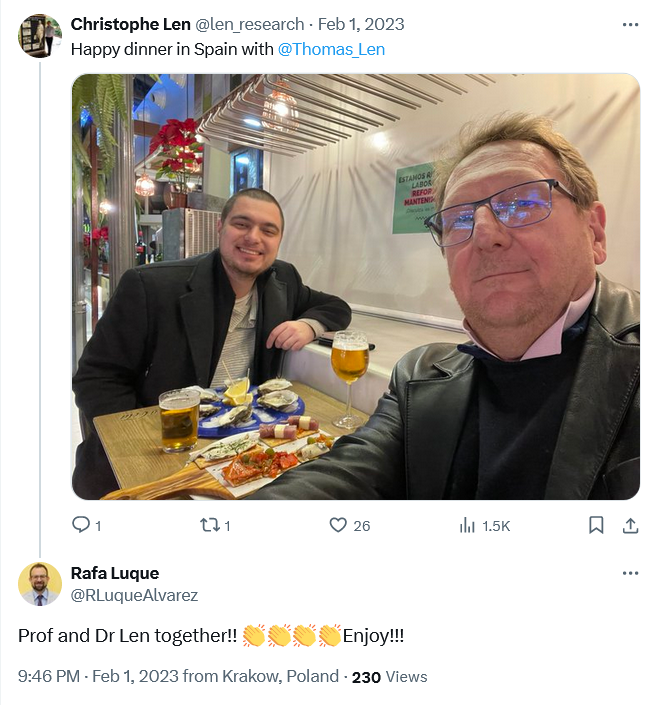
You may recall Christophe Len, professor at Institute of Chemistry for Life and Health Sciences in Chimie ParisTech in France. He is a close friend and a fellow papermill enthusiast of the famous Rafael Luque, who was a year ago kicked out by his University of Cordoba in Spain. I briefly wrote about Len and Luque in June 2023 Friday Shorts.
Well, Len has a son, Thomas Len, who is about to become a professor himself. Presently, he is employed as postdoc Department of Organic Chemistry at the University of Cordoba, where his supervisor was (or maybe still is, from a distance?) Rafi Luque. Surely a pure coincidence. Of course also Len Sr and Len Jr published together.
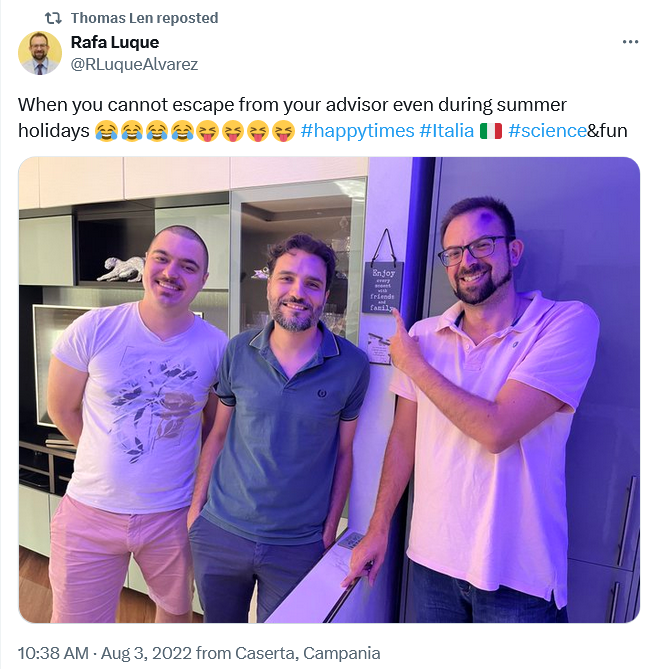
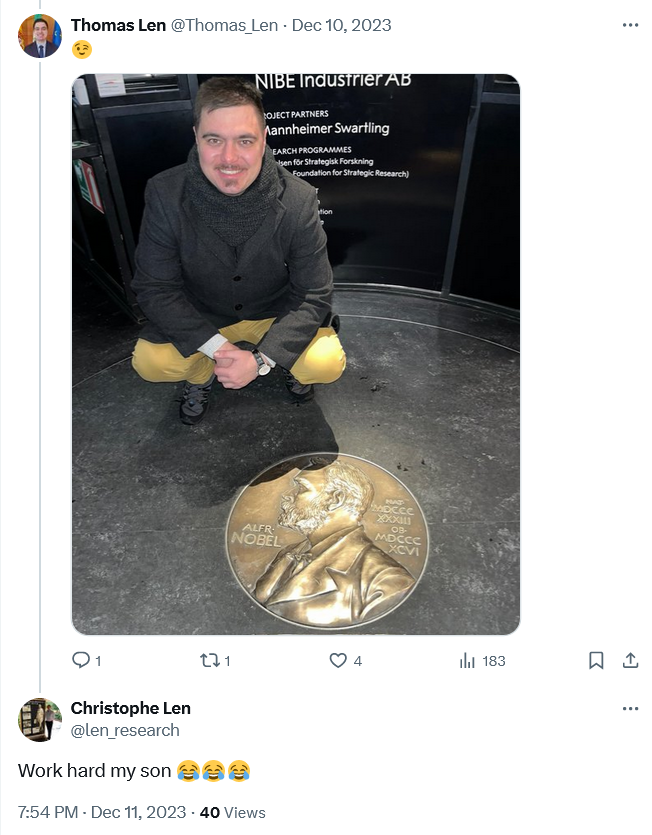
And this is what Len Jr and his Dad’s friend Rafi published together, in the papermill-infested Elsevier journal Ceramics International:
Nosheen Farooq , Rafael Luque, Thomas Len, Sameh M. Osman , Ashfaq Mahmood Qureshi , Muhammad Altaf Nazir , Aziz Ur Rehman Design of SrZr0.1Mn0.4Mo0.4Y0.1O3-δ heterostructured with ZnO as electrolyte material: Structural, optical and electrochemical behavior at low temperatures Ceramics International (2023) doi: 10.1016/j.ceramint.2022.09.184

If the scale bar is 500 nm, then one notch is 50 nm, and the dimensions displayed are incorrect.” “M&M section states a TESCAN VEGAN was used, however, as also can be seen in #1 a TESCAN MIRA3 was used.”

Yet, none of the authors has an affiliation in Germany.”

Obviously another papermill fabrication as we often see with Luque and Len Sr, but this time Len Jr is on board, working on his impressive CV. Here is another one:
Misbah Malik , Thomas Len, Rafael Luque, Sameh M. Osman , Emilia Paone, Muhammad Imran Khan , Muhammad Ahmad Wattoo , Muhammad Jamshaid , Aqsa Anum , Aziz Ur Rehman Investigation on synthesis of ternary g-C3N4/ZnO–W/M nanocomposites integrated heterojunction II as efficient photocatalyst for environmental applications Environmental Research (2023) doi: 10.1016/j.envres.2022.114621

Upon criticism, an author shared “original EDS spectra”, which PubPeer user Simnia avena proved as having “absolutely no relationship between the screenshots posted (which are not raw data files) and the original graphs” and having “clear traces of editing“. S. avena also mentioned “they provided the editor by email another version of the data“. Len Jr replied on PubPeer accusing his critic of “a lack of scientific ethic” because they publicly shared the fake image he sent to the editor, and which the editor forwarded to the critic. Len Jr also raised other accusations. Alexander Magazinov then found more evidence of data fabrication, and PubPeer user Desmococcus antarctica found that also in Figures 7 to 10 “some pictures seem to have been manipulated“.
And here is another one, with Luque’s russian friend Leonid Voskressensky (next to Saudi Arabia, Luque has a faculty position in the RUDN university in russia):
Rick A. D. Arancon , Zeid A. Al Othman , Thomas Len, Kaimin Shih , Leonid Voskressensky , Rafael Luque Naturally Nano: Magnetically Separable Nanocomposites from Natural Resources for Advanced Catalytic Applications Catalysts (2022) doi: 10.3390/catal12111337

There is much more on PubPeer, both for Len Jr and for Len Sr. Rest assured that Thomas Len’s CV is already now better than that of many professors. Because of certain Asian business his dad and Luque operate.
Len Sr and Luque were seen everywhere where no decent scientist should ever go. Even here:

Synthetic Communications with Ali Fakhri and his real or imaginary friends
“the entire dramatis personae seem to have crawled out of our man’s sock drawer, and the page-count of Synthetic Communications would be grievously impoverished without his contributions, whether direct or uncredited.”- Smut Clyde

But Len Sr is not only papermilling, he is also running a peer review ring! It became known because Frontiers names its peer reviewers:
Christophe Len, Vaishaly Duhan , Weiyi Ouyang , Remi Nguyen , Bimlesh Lochab Mechanochemistry and oleochemistry: a green combination for the production of high-value small chemicals Frontiers in Chemistry (2023) doi: 10.3389/fchem.2023.1306182

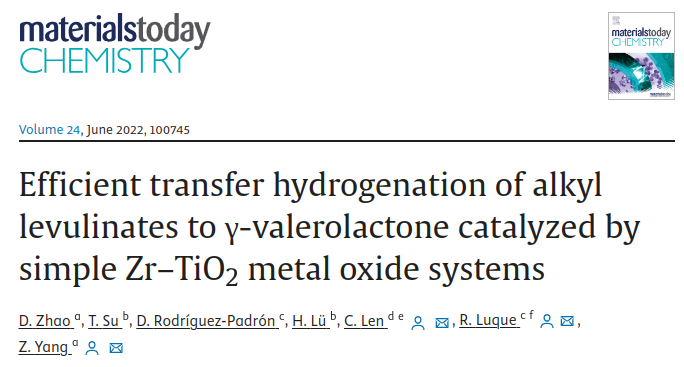
Len Sr protested on PubPeer:
“It is incomprehensible and scandalous to have remarks of this nature that affect the integrity of an editor, reviewers and authors. When you’re a Special Edition Editor, or an editor in general, it is because you are an expert in the field. If you’re an expert in a field, chances are you have published collaborative works with other experts in the field.“
PubPeer user Desmococcus antarctica replied (I embedded the hyperlinks for brevity):
“It is already the third (!) case at Frontiers were C. Len is linked to a reviewer, editor or the other way around, when he is an author and a frequent co-author reviews his paper:
- Case 1: A. M. Ball reviews C. Len his paper
- Case 2: C. Len reviews for R. Luque and A. M. Bal; the roles are reversed here compared to case 1
- Case 3: this case, D. Rodriguez-Pardon is an editor for C. Len while they are frequent co-authors.”
I cannot detect any intentional manipulation or deception
You all have heard of the affair of Thomas Südhof, the Nobel Prize laureate and Stanford professor of neuroscience. He was first hounded by Maarten van Kampen (which led to a retraction, read here), then by Elisabeth Bik (read here), which might lead to more retractions.

Thomas Südhof and the standards of scientific rigor
Maarten van Kampen’s second attempt at hounding of Nobel papers.

Bik’s findings of image duplications were picked up by the US online magazine The Transmitter on 5 April 2024:
“In total, 23 papers co-authored by Südhof have threads on PubPeer. A page on his lab’s website acknowledges 17 mistakes in 11 papers that have been brought to his team’s attention through PubPeer comments. “Most errors that have been found look like sloppy mistakes, not intentional misconduct,” Bik wrote in an email to The Transmitter, adding that the 23 papers discussed on PubPeer represent “only a small percentage” of Südhof’s more than 600 publications.
In February, Südhof’s team corrected figures in a 2019 Neuron paper and a 2016 PLOS ONE paper after anonymous PubPeer commenters raised concerns of image duplication and other issues in the studies.
In March, Südhof retracted a 2023 study published in the Proceedings of the National Academy of Sciences after he and his colleagues reanalyzed the data following inconsistencies raised by PubPeer commenters, as The Transmitter reported last month.”

Science moves forward with productive and meaningful activities
“Yup we are being hounded.” – Thomas Südhof
On 8 April 2024, two of the biggest German media outlets, Frankfurter Allgemeine Zeitung (FAZ) and Der Spiegel picked up from their US colleagues, becasue Südhof is German native and used to lead the Max Planck Institute in Göttingen and act as visiting professor at Charité Berlin. Spiegel mostly quotes from The Transmitter, FAZ spoke to Südhof and suspects a conspiracy:
“Is there a witch hunt on the team of the German-American Nobel Prize winner Südhof? “
FAZ quotes the persecuted Nobelist , translated:
“Südhoff responded in detail to our request for a statement. He admits “a serious mistake”, which plagiarism detectives was not discovered The careless errors were mainly caused by the way in which images from a large panel of images were transferred into the paper. His statements and the transparency offensive failed, “the critics obviously have no interest in science.”
Overall, says Südhof, he sees a new “accusation movement” that makes use of AI tools and, above all, has a few prominent scientists in its sights. There is an actual problem in science, that of “reproducibility and veracity”. Südhof is referring to a completely different problem in experimental research, namely the increasing urge of specialist magazines to want to publish sensational results that may be based on “bad science”. The crux of the matter, says Südhof, is that “the data and illustrations are correct, but the experiments and conclusions are wrong.” Südhof: “We are dependent on journals that obviously no longer fit the mechanisms of this time.”
You see, the real research integrity champion is not Bik or van Kampen, but Professor Südhof.
And then, Südhof’s Charité colleague, the neurology professor Ulrich Dirnagl weighted in. Dirnagl is not someone: he is Germany’s highest authority on all things connected to academic ethics. I personally don’t know why, but his authority is peer-reviewed.
Dirnagl published his op-ed piece about the Südhof affair in Tagesspiegel on 12 April 2024. He discusses the case together with those of Simone Fulda, Marc Tessier-Lavigne and Francesca Gino, all of which he says were originally reported on PubPeer. Even if it is totally not true in Gino’s case, she was exposed by the Data Colada blog of Uri Simonsohn, Leif Nelson and Joe Simmons.
Simone Fulda: Open4Work!
“I am taking this step with a heavy heart and a sense of responsibility for the university since a sufficient foundation of mutual trust no longer remained with some parts of the university to ensure successful cooperation”, – Simone Fulda
Germany’s greatest expert Dirnagl believes that there are only honest mistakes in Südhof’s papers which can be easily corrected:
“[Südhof] was able to clarify or dispel a significant part of the criticism – and he admitted and corrected actual errors. He also expressly thanks those who commented constructively and praises the principle of PubPeer. None of the errors proven to him influenced the statements of the works.
Prof U. Dirnagl
I cannot detect any intentional manipulation or deception.”

But, Dirnagl laments (translated):
“And this is exactly where the dark side of PubPeer lies: paradoxically, the opportunity to openly deal with errors there increases scientists’ fear of being exposed in front of their colleagues. The mere fact of finding your own work on PubPeer with a possible error pointed out can lead to a loss of reputation and gloating among competitors. Such an anonymous platform is also suitable for private vendettas that have nothing to do with science and everything to do with envy or personal animosity.”
Thing is, all cases Dirnagl refers to were raised not by anonymous trolls with vendettas. Elisabeth Bik and Maarten van Kampen are not anonymous, they most definitely do not suffer from “envy or personal animosity” towards Südhof or anyone else. And the three Data Colada sleuths are presently being sued by Gino for millions in reputational damage. Also, as all German media wrote (except Dirnagl in Tagesspiegel!), Fulda resigned explicitly because of my reporting (of anonymous PubPeer postings). Dirnagl knows very well that we don’t hide our identities, but still he chose to tell scary tales of pusillanimous vengeful trolls who hide behind anonymity.
Maybe it makes a better story? After all, isn’t it how science works, twist facts to fit a sexy narrative to get the story published?
I wrote to Professor Dirnagl, he never replied.
Labour law measures will be taken
The Delft University of Technology in the Netherlands elegantly solved its problem with institutional mismanagement. By gagging and threatening everyone.
The newspaper De Volkskrant reported on 16 April 2024 (translated):
“‘Under protest’, writes editor-in-chief Saskia Bonger, the editors removed the article from the Delta website, which advertises itself as an ‘independent journalistic platform’ of the technical university. The article can still be read via the Internet Archive, which continuously makes copies of web pages on websites that are accessible to everyone.
The article describes the developments at the Innovation & Impact Center after a new director was appointed there last April. Criticism soon arose about the performance of this Kemo Agović. The I&IC organizes collaboration between the university, the business community and government on research projects.
Delta, which spoke to twelve people involved, writes that since Agović took office, no one has had insight into what he does. ‘He is regularly absent and since November 2023 he no longer shows up at the office at all and cancels appointments at the very last minute.’ When complaining to the rector magnificus and the director of human resources Annemieke Zonneveld has no effect, fifteen employees eventually report to an external confidential counselor at TU Delft. […]
Director Agović has now left the I&IC, according to the university of his own accord. His departure as of June 1 was announced last month.”
In December 2023, the whistleblowers received an email from the Rector Magnificus Tim van der Hagen, warning them to keep shtumm or be fired: “In the event of a breach of confidentiality, labour law measures will be taken“. Bonger received threatening mail first from a law firm, then from her university’s legal department, announcing a lawsuit “for libel or slander”, because she quoted from a confidential report. The extra irony:
“Last month, the education inspectorate published a report on inappropriate behavior at the university. At TU Delft there is ‘serious neglect’ of social safety and ‘mismanagement’ in this area, according to the report […]
The report identifies inappropriate behavior such as intimidation, shouting, sexually suggestive comments, racism, fear of reporting abuses and managers who side with those responsible for the unsafe situation. According to the inspectorate, PhD students and female employees experience social insecurity ‘disproportionately more often’.”
Scholarly Publishing
Very unprofessional to change the brightness
A journal issued by a learned society and published by Springer Nature corrected a papermilled fabrication.
The authors are from South Africa, Pakistan, Malaysia and from a biotech in UK, their fraud was flagged in August 2022:
Stalielson Tatenda Ndlovu , Naseem Ullah , Shahzeb Khan, Pritika Ramharack , Mahmoud Soliman, Marcel De Matas , Muhammad Shahid , Muhammad Sohail , Muhammad Imran , Syed Wadood Ali Shah , Zahid Hussain Domperidone nanocrystals with boosted oral bioavailability: fabrication, evaluation and molecular insight into the polymer-domperidone nanocrystal interaction Drug Delivery and Translational Research (2019) doi: 10.1007/s13346-018-00596-w

https://doi.org/10.2147/IJN.S151597“

The “author” Shahzeb Khan protested on PubPeer right away:
“First of all, this is very unprofessional to change the resolution and brightness of the images by different softwarers. You have disturbed the originality of the image by changing its background. These are totally different images, you have just copied some similar particles and circled.”
He also claimed that such duplications are the gold standard of quality science: “There are unlimited SEM and TEM images, where you will see same repeated shapes of the particles.” But very soon Khan changed his tune and admitted that the figure was forged, and blamed someone else: “human errors can always be unintentionally occurred. We shall rectify and anlayse all the original SEM original files and will ask the person who did this analysis for us in another University as well.”
There was August 2022. Now the journal’s editors, led by María José Alonso of University of Santiago de Compostela in Spain and the Controlled Released Society concluded their professional investigation with this Correction from 28 February 2024:
“The authors have corrected Fig. 4 A, B after images from a previous study were mistakenly included in the original article. The changes do not affect the conclusions of this study.”
What? You thought only certain Swiss open access publishers are run by crooks and idiots?
“The journal is committed to maintaining the highest level of integrity in the content published”
Ethics & disclosures
In this regard, on the Editorial Board I recognise the Associate Editor Raghu Raj Singh Thakur of Queen’s University of Belfast. Sholto David caught him papermilling, but that British university lashed out against Sholto, accusing him of sabotage, harassment, and attempting to “undermine people’s reputations“. Errata were announced, but then decided against. Read about this is December 2023 Friday Shorts.
Retraction Watchdogging
Experts in the field were consulted
The Royal Society of Chemistry (RSC) started to retract fraudulent papers which were not reported by sleuths before. A pleasant surprise!
Mojtaba Mahyari , Ahmad Shaabani Nickel nanoparticles immobilized on three-dimensional nitrogen-doped graphene as a superb catalyst for the generation of hydrogen from the hydrolysis of ammonia borane Journal of Materials Chemistry A (2014) doi: 10.1039/c4ta03940h
The Retraction was published on 28 March 2024 and signed by the Executive Editor Michaela Mühlberg:
“There are repeating fragments in the XRD data in Fig. S2 and S3, and the Raman data in Fig S6, indicating that the data has been manipulated.
The authors are not able to provide their original data.
Given the significance of these concerns, the findings presented in this paper are no longer reliable.
The authors were informed about the retraction of the article but have not responded.”


Or this, signed by the Executive Editor Sally Howells-Wyllie:
Sekar Gayathri , Ramajayam Kalaipriya , Periasamy Viswanathamurthi , Saravanan Raju , Peter Hrobarik Ruthenium(II) CNN Pincer Complexes as Efficient Catalysts in Oxidative Annulation of Aromatic Acids with Alkynes to Isocoumarins New Journal of Chemistry (2023) doi: 10.1039/d3nj03745b
The Retraction from 23 February 2024 stated:
“After initial publication of the Accepted Manuscript, concerns were raised regarding the reliability of the NMR characterisation of the catalytic products presented in the electronic supplementary information (ESI). Experts in the field were consulted and agreed that the NMR provided did not correspond to the products claimed. The authors were contacted in an attempt to resolve these issues and provided alternative NMR spectra, however were unable to provide the associated raw NMR data at this time. Given the significance of these concerns, the findings presented in this paper are no longer reliable.”
Now, what is confusing is that the next paper, in the same journal, was not retracted. Its authors is a German in China, Florian Stadler, and his trusty data forger Amit Kumar, read here:
Epileptic spasms of tics and glitches in Krautrock diffractograms
Smut Clyde chases free radicals in a German-run lab in China
The same editor was satisfied with an Expression of Concern.
Amit Kumar, Ajay Kumar , Gaurav Sharma , Mu. Naushad , Renato Cataluna Veses , Ayman A. Ghfar , Florian J. Stadler, Mohammad Rizwan Khan Solar-driven photodegradation of 17-β-estradiol and ciprofloxacin from waste water and CO2 conversion using sustainable coal-char/polymeric-g-C3N4/RGO metal-free nano-hybrids New Journal of Chemistry (2017) doi: 10.1039/c7nj01580a

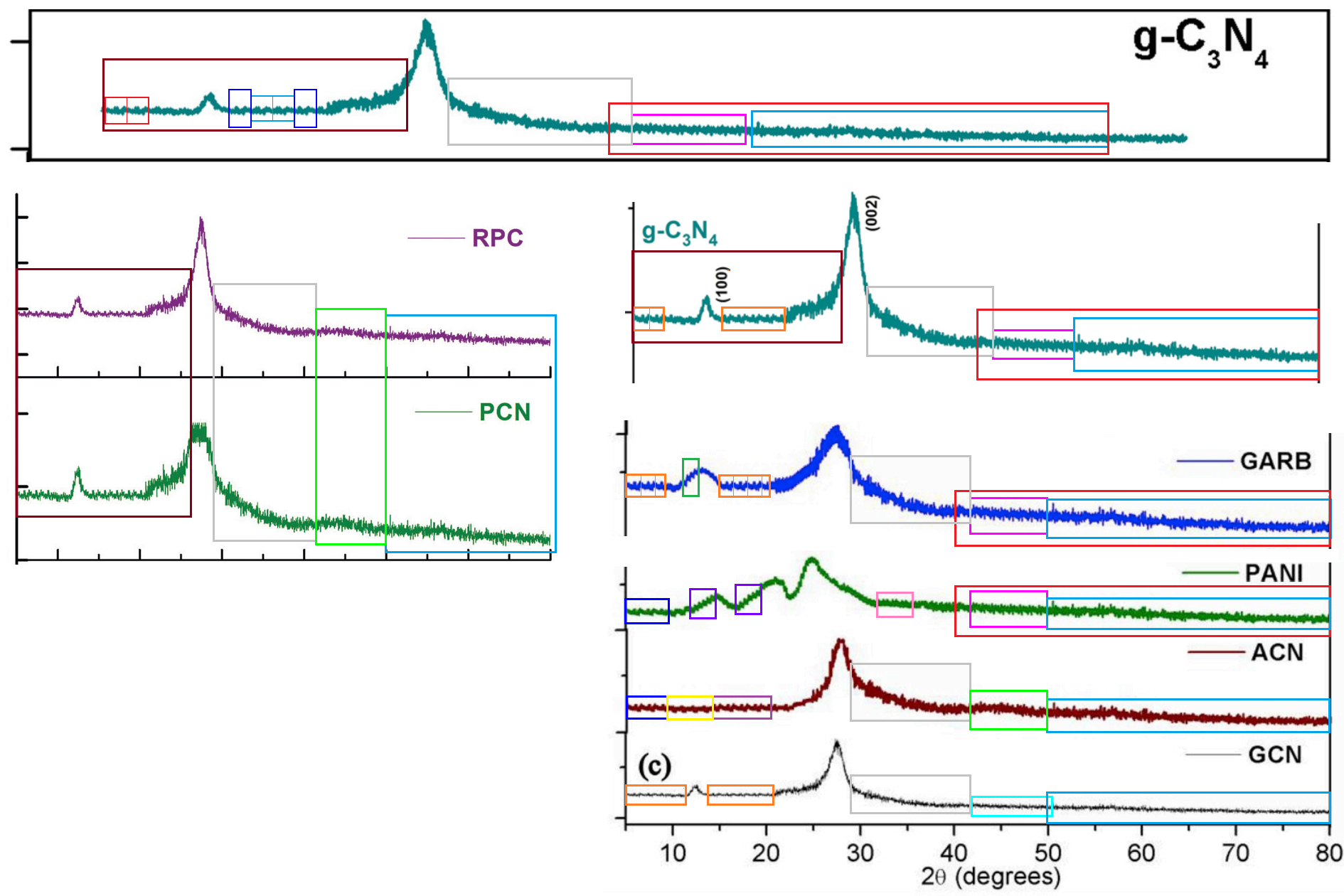
RPC and PCN xrds from Fig 2. g-C3N4 again, from Fig 2a of “Environmental Pollution Remediation via Photocatalytic Degradation of Sulfamethoxazole from Waste Water Using Sustainable Ag2S/Bi2S3/g-C3N4 Nano-Hybrids” (Kumar et al 2022).
GARB, PANI, ACN and GCN from Fig 2c of “Visible photodegradation of ibuprofen and 2,4-D in simulated waste water using sustainable metal free-hybrids based on carbon nitride and biochar” (Kumar et al 2019).”
There was even more on fake stuff. On 13 September 2023, the journal published this Expression of Concern, signed by Howells-Wyllie:
“New Journal of Chemistry is publishing this expression of concern in order to alert our readers that we are presently unsure of the reliability of the XRD data reported in Fig. 2 and Fig. S6 and the UV-Vis data in Fig. 7c, Fig. 12c and Fig. 12d of this article.
Concerns were first raised with the reliability of the XRD data in Fig. 2 and the UV-Vis data in Fig. 12c and Fig. 12d. The authors provided a response to address these concerns, however, they have not been able to provide the original raw XRD data and UV-Vis data for this article.
The Royal Society of Chemistry has asked the affiliated institution (Shoolini University) to investigate this matter and confirm the integrity and reliability of the XRD data reported in Fig. 2 and Fig. S6 and the UV-Vis data in Fig. 7c, Fig. 12c and Fig. 12d of this article.
An expression of concern will continue to be associated with this manuscript until we receive information from the institution on this matter.”
We all know what this Chinese university will find. Will RSC accept it?
Engineering Failure Analysis
Yet another retraction for the papermilling gnome of the Sapienza University of Rome. You can read about Filippo Berto and his papermilling Italian university here:

Karimipour Saga III: All roads lead to Rome
“The academic career of D’Orazio is tightly coupled to that of Karimipour since she hosted him at Sapienza. Of the 57 papers she declared authorship for, 25 (44%) are published together with Karimipour.” – Maarten van Kmapen
Berto “co-authored” with an Iranian fraudster friend named Nima Sina, a PhD student at the Iowa State University in USA. In March 2024, Alexander Magazinov notified Sina’s university about his two earlier retractions in the infamous all-papermill special issue of the Journal of Energy Storage (here and here), and pointed out that it is a bit unusual that “a man in his 40-ies or nearing that age, with about 40 publications and 2000+ citations is enrolled as a PhD student“. The university promised to investigate.
Now, here is Nima’s and Berto’s new retraction, not for papermilling but for plagiarism because someone got too greedy:
Reza Masoudi Nejad, Filippo Berto, Mohammadreza Tohidi, Ahmad Jalayerian Darbandi, Nima Sina An investigation on fatigue behavior of AA2024 aluminum alloy sheets in fuselage lap joints Engineering Failure Analysis (2021) doi: 10.1016/j.engfailanal.2021.105457
“This is one of three papers published by similar sets of authors that overlap to a huge extent. The papers were all submitted within a week of each other have three authors in common, but two more authors on one, and two other co-authors on the third.”
Angus J. Wilkinson
The two other Nejad et al 2021 papers (here and here), all in Elsevier, have Berto as coauthor, one of them appeared even in the same Engineering Failure Analysis journal and nobody minded. They are not retracted YET.
Maybe stop accepting submissions, Herr Prof Dr Sauer?
Who needs science if you can have a 75 paper strong special edition by Afrand and Karimi? A guest post by Alexander Magazinov.

The Nejad, Berto and Nima paper received an Expression of Concern on 24 January 2024, because “Readers have raised concerns about possible plagiarism“. The Retraction was published soon after:
“This article has been retracted at the request of the Editor-in-Chief, for duplication of text and methodology, as well as salami slicing of research results, related to the following paper published in the same special issue, without citing this paper and without comparing and discussing their results:
Fatigue performance prediction of Al-alloy 2024 plates in riveted joint structure, Engineering Failure Analysis, Volume 126, August 2021, 105439. https://doi.org/10.1016/j.engfailanal.2021.105439
One of the conditions of submission of a paper for publication is that authors declare explicitly that their work is original and has not appeared in a publication elsewhere. Re-use of any data and methodology should be appropriately cited. The scientific community takes a very strong view on this matter and apologies are offered to readers of the journal that this was not detected during the submission process.”
So what about the other two copies?
The institutional investigation concluded
Francisco Baralle, Argentina-born director of the International Centre for Genetic Engineering and Biotechnology (ICGEB) in Trieste, Italy, loses another paper in the same journal (read about his previous retraction here):
Roberto Marcucci , Maurizio Romano, Fabian Feiguin, Mary A O’Connell, Francisco E Baralle Dissecting the splicing mechanism of the Drosophila editing enzyme; dADAR Nucleic Acids Research (2009) doi: 10.1093/nar/gkn1080

The Retraction was published on 11 April 2024:
“Following allegations of image manipulation in Figure 3C in 2023, the journal conducted a brief investigation and detected potential issues in other figures.
- Figure 3C: lanes 1 and 2 (Testis and Ovaries) appear to be duplicates.
- Figure 3C, RP49, lanes 5–6, 7–8 and Figure 4B, Egl control, lanes 1–2 appear identical after size adjustments.
- Column charts in Figures 1, 3, 4: the error bars appear to have been added by hand.
The matter was referred to the authors’ institution and an Expression of Concern was published.
The authors have since been unable to produce the original data. The institutional investigation substantiated the issues raised about Figures 3C, lanes 1 and 2, and concluded that the lanes are duplicates.
The institutional investigation concluded the following about the other images:
- Figure 3C, RP49, lanes 5–6, 7–8 and Figure 4B, Egl control, lanes 1–2: close examination of the images indicate that these lanes are not direct copies of each other. Bands are only similar after digital manipulation such as cropping and resizing.
- Column charts in Figures 1, 3, 4: the error bars have likely been added by hand.
Further examination by the Editors reveals that, in addition to the error bars, some columns also appear to have been added by hand to the column graphs.
Based on their assessment of the institutional investigation and the figures, the Editors have determined that the image manipulations described above undermine the credibility of the study and have decided to retract the article. The authors have been informed of this decision.”
As I wrote in Friday Shorts before, ICGEB probably simply agreed to an editorial retraction request because this institution cannot be trusted with anything. Its Secretary-General Lawrence Banks already featured as a Coda in this article about Trieste researchers:
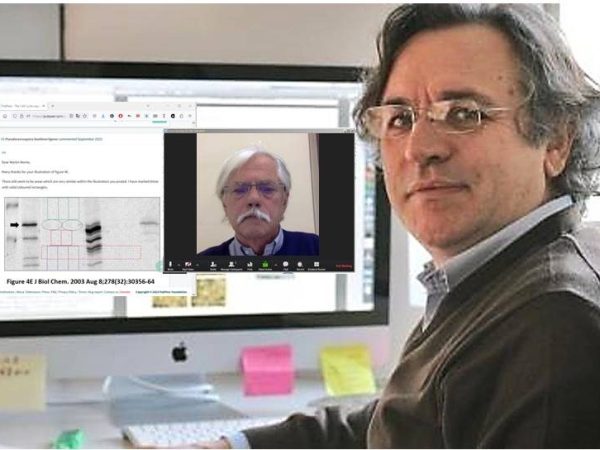
Claudio and Giannino evaluate and analyze
“together with my colleagues we are actively analyzing the points raised on pubpeer.” – Claudio Schneider “we will evaluate Pubpeer comments” – Giannino Del Sal
None of the authors have responded
It seems that for the foreseeable future every Friday Shorts issue will contain retractions for the fallen ex-rector of the University of Messina Salvatore Cuzzocrea.
Uni Messina, money for nothing & brothers in arms
“The University of Messina was, in short, a good business that appealed to many, including organized crime on both sides of the Strait of Messina.” – Aneurus Inconstans
Because here is yet another one.
I. Paterniti, M. Campolo, M. Cordaro, D. Impellizzeri, R. Siracusa, R. Crupi, E. Esposito, S. Cuzzocrea PPAR-α Modulates the Anti-Inflammatory Effect of Melatonin in the Secondary Events of Spinal Cord Injury Molecular Neurobiology (2017) doi: 10.1007/s12035-016-0131-9


The Retraction was published on 10 April 2024:
“The Editor-in-Chief has retracted this article. After publications, concerns were raised regarding the data presented in the figures. Specifically:
- In Figs. 2a and 4c and b-actin lanes 2–3 appear highly similar to lanes 13–14;
- In Fig. 2a, IkBa lanes 1–7 and 8–14 appear to be duplicated (flipped and adjusted for brightness);
- In Fig. 2b, lamin A/C lanes 2–4, 5–7 and 12–14 appear highly similar;
- In Fig. 4c, AKT labes 1–5 appear highly similar to lanes 10–14;
- Fig. 5 PPAR-α-KO SCI images appear highly similar to Fig. 7 CD1 WT SCI + Melatonin images;
- Fig. 6 PPAR-α-KO SCI images appear to overlap with Fig. 7 PPAR-α-KO SCI images.
The Editor-in-Chief therefore no longer has confidence in the presented data.
None of the authors have responded to any correspondence from the publisher about this retraction.”
Science Breakthroughs
Very curious why other groups fail
Nature News brought an article on 11 April 2024, titled: “This fMRI technique promised to transform brain research — why can no one replicate it?“
“It was hailed as a potentially transformative technique for measuring brain activity in animals: direct imaging of neuronal activity (DIANA) held the promise of mapping neuronal activity so fast that neurons could be tracked as they fired. But nearly two years on from the 2022 Science paper1, no one outside the original research group and their collaborators has been able to reproduce the results.
Now, two teams have published a record of their replication attempts — and failures. The studies, published on 27 March in Science Advances2,3, suggest that the original results were due to experimental error or data cherry-picking, not neuronal activity after all.
But the lead researcher behind the original technique stands by the results. “I’m also very curious as to why other groups fail in reproducing DIANA,” says Jang-Yeon Park, a magnetic resonance imaging (MRI) physicist at Sungkyunkwan University in Suwon, South Korea.”
This is the National Research Foundation of Korea study in Science, of which “Park says that, as far as he knows, researchers outside his collaborative spheres have not been able to reproduce the results“:
Phan Tan Toi , Hyun Jae Jang , Kyeongseon Min , Sung-Phil Kim , Seung-Kyun Lee , Jongho Lee , Jeehyun Kwag , Jang-Yeon Park In vivo direct imaging of neuronal activity at high temporospatial resolution Science (2022) doi: 10.1126/science.abh4340
The paper received an Expression of Concern in September 2023:
“The editors have been made aware that the methods described in the paper are inadequate to allow reproduction of the results and that the results may have been biased by subjective data selection. We are alerting readers to these concerns while the authors provide additional methods and data to address the issues.”
Sylvain Lesné is a failed scientist
From Lesné’s public shame to successful role models of neuroscience like Aguzzi and Tessier-Lavigne.
Nature mentions that “Park says he will submit the additional information by August“. The Transmitter covered this affair already on 27 March 2024, and quoted Park:
““I firmly believe, despite the controversy, the DIANA signal exists,” he says. “Further studies from other groups—including me and my collaborators—will clearly reveal the truth. I think it’s just a matter of time.” He understands that sometimes replications fail, he says, “but to me, it looks like they reached a hasty conclusion. […]
Park denies cherry-picking data but has adopted a new data analysis method to make that clearer, he says. In his first study, he collected data from 48 to 98 trials for each mouse and selected 40 to average. Now he acquires only 40 trials from each mouse and averages them all, he says.
“I have clear criteria now. We clearly see what people really want. So we tried our best to satisfy the audience,” he says.”
The current explanation for irreproducibility of Park’s DIANA discovery are “a combination of both ‘cherry picking’ and an unintended biased acquisition may have led to the wrong conclusions,” as a peer was quoted.
It is of course not entirely impossible that Park’s DIANA results are simply fake. Which might theoretically impede their faithful replication, at least by those outside of the fraudster’s circles. As it actually happened with Ranga Dias‘ room-temperature superconductors (read earlier Friday Shorts). It is up to Science‘s research integrity champion Holden Thorp to decide whether to retract Park’s paper. So far, Thorp saw no reason to retract Dias’ fraud.
A girl just is not a girl without her hair
We haven’t seen stuff like this for some time. Not even in Frontiers!
As it happens, also from Korea. The title says it all:
Jeong Eun Cheon , Jeongwoo John Kim , Young-Hoon Kim Wives with long and high-quality hair have more frequent sex Frontiers in Psychology (2024) doi: 10.3389/fpsyg.2023.1294660
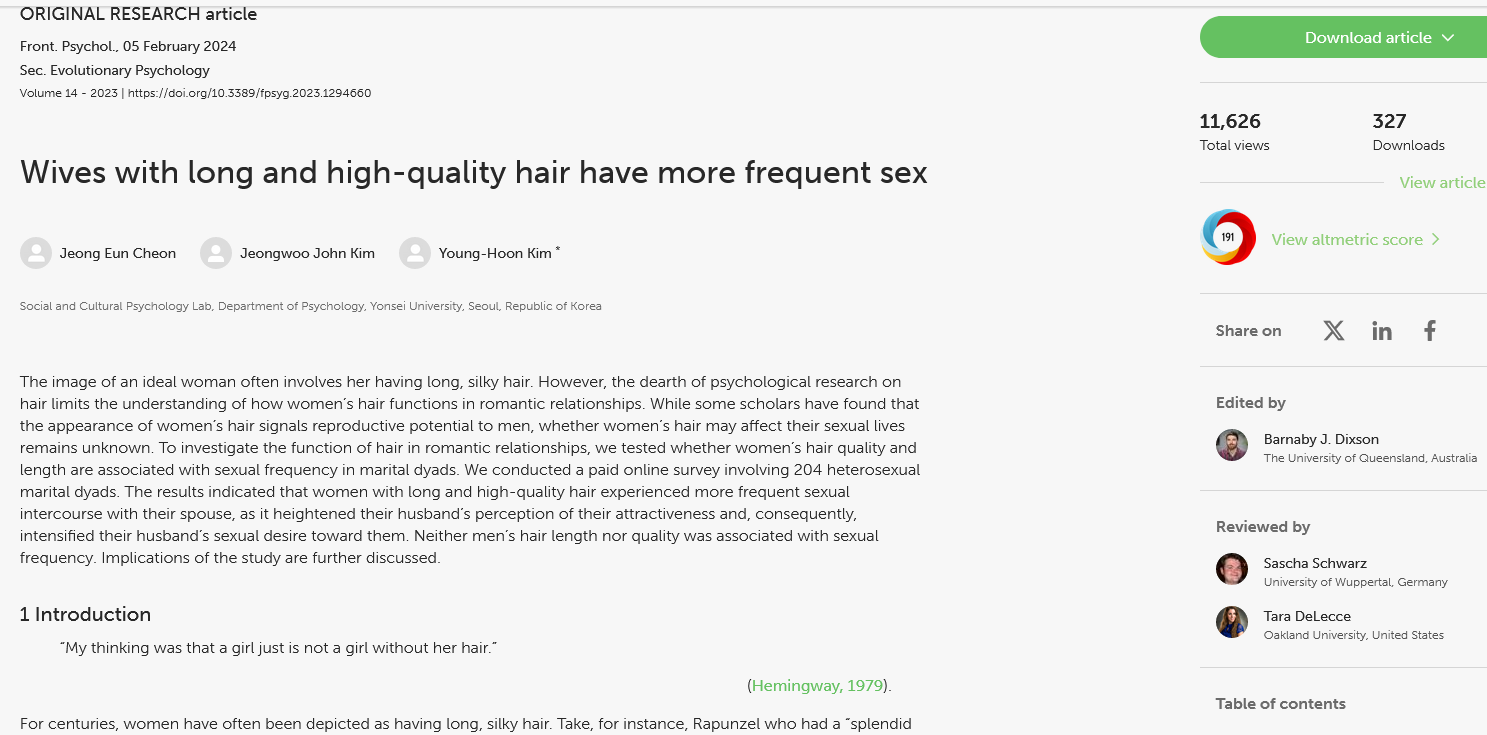
The paper starts with a quote by Hemingway, and the abstract explains that the three authors (who probably suffer from a priapic condition due to excessive pornography consume), orgasmised “a paid online survey involving 204 heterosexual marital dyads” about their sex and hair practices. The participants were asked to
- “rate the quality of your hair”
- “rate their spouse’s physical attractiveness using a seven-point Likert-type scale”
- rate “sexual desire for their spouse”
- “provide a numeric estimate of their monthly sexual frequency”
The reward was 5 USD, paid upon completion.
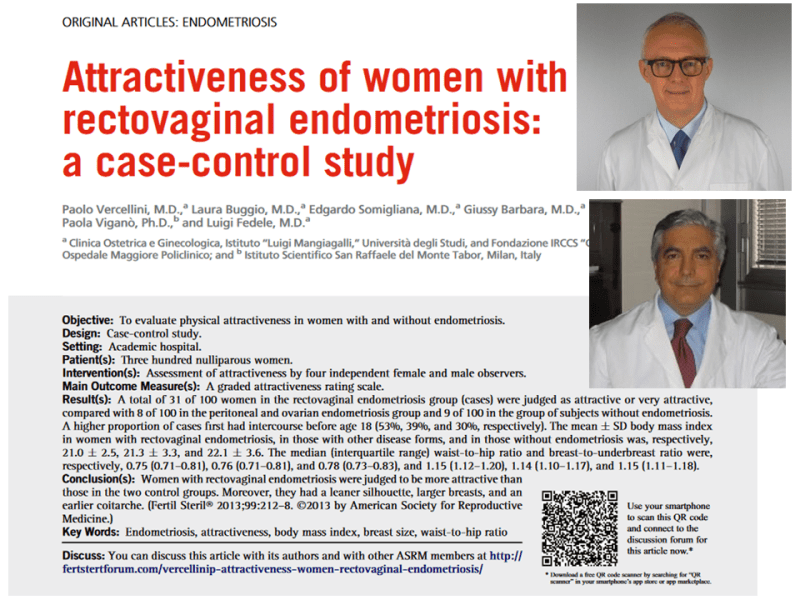
Undress, the doctors will see you now
Two old gynaecology professors in Milan decided to racially profile, then rate their misinformed young patients for sexual attractiveness. Their even published this as an evo-psych study in a respected society journal.
This, in discussion, probably counts as small print:
“However, it is essential to contextualize that the influence of hair on the romantic dynamics of marital dyads was relatively modest. A correlation of women’s hair with sexual frequency indicated a small effect size. After accounting for factors like age, perceived attractiveness, satisfaction, commitment, and others, its direct association with sexual frequency remained small. The indirect influence of hair length and quality on sexual frequency was very small.”
The authors masturbated their data until they were satisfied.
I thank all my donors for supporting my journalism. You can be one of them!
Make a one-time donation:
I thank all my donors for supporting my journalism. You can be one of them!
Make a monthly donation:
Choose an amount
Or enter a custom amount
Your contribution is appreciated.
Your contribution is appreciated.
DonateDonate monthly
 For Better Science
https://forbetterscience.com/2024/04/19/schneider-shorts-19-04-2024-endemic-diffusion-of-fraudulent-research/#respond:~:text=Scholarly%20Publishing-,Very%20unprofessional%20to%20change%20the%20brightness,-A%20journal%20issued
I admit that I’m at the risk of getting bored with this type of response by journals. In the last few days I saw a similar case where a journal accepted an almost incomprehensible explanation that an “error” created the anomaly that required a correction. If the journals don’t care that they are publishing twaddle, who am I (someone completely outside the research/publishing field) to tell them otherwise?
LikeLike
It’s not just journals. You saw how QU Belfast attacked Sholto for catching Singh Thakur on papermilling.
LikeLike
This is a particularly frustrating episode, especially since the unedited version of the image is even available, that’s fairly uncommon.
LikeLike
Are the British slipping?
Usually they are quite good at hiding things, but then again, Gerry Melino did edit it.
PubPeer – Crosstalk with lung fibroblasts shapes the growth and therap…
LikeLike
PubPeer – Crosstalk with lung fibroblasts shapes the growth and therap…
The person who edited this paper (you can see this at the bottom of the first page), Gerry Melino, may be conflicted as he worked for 19 years at the same institute, where one of the authors, Anne E Willis, is director.
https://www.nature.com/cddis/editors/editorial-board
“Gerry Melino, MD, PhD, DSc, University of Rome, Italy and DZNE, Germany.
For 19 years he was programme leader at the Toxicology Unit of the Medical Research Council, Cambridge University, UK.”
https://www.mrc-tox.cam.ac.uk/staff/anne-willis-obe
According to his own CV Gerry Melino was, at one time, editor-in-chief of Cell Death and Disease.
https://dottoratobiochimica.uniroma2.it/wp-content/uploads/2022/04/gerry-melino-CV.pdf
“He is Editor-in-Chief, of the journal Cell Death & Differentiation (www.nature.com/cdd), Cell Death &
Disease (www.nature.com/cddis)”
LikeLike
Anne Willis OBE | MRC Toxicology Unit (cam.ac.uk)
At what stage might you say there is a problem with the data?
PubPeer – Translational reprogramming following UVB irradiation is med…
PubPeer – Identification of internal ribosome entry segment (IRES)-tra…
PubPeer – Canonical initiation factor requirements of the Myc family o…
PubPeer – Sustained translational repression by eIF2α-P mediates prion…
PubPeer – The human insulin receptor mRNA contains a functional intern…
PubPeer – Crosstalk with lung fibroblasts shapes the growth and therap…
PubPeer – Long-Fiber Carbon Nanotubes Replicate Asbestos-Induced Mesot…
PubPeer – The chaperonin CCT interacts with and mediates the correct f…
PubPeer – Regulation of BAG-1 IRES-mediated translation following chem…
PubPeer – Upregulated c-myc expression in multiple myeloma by internal…
LikeLike
Another one for Anne E Willis. What to make of it?
https://pubpeer.com/publications/EC7D0061D1A40249205D8200BD183F#1
LikeLike
Anne E Willis, O B.E., https://pubpeer.com/publications/D14F3CA09459D087B28766CAA1E840
LikeLike
Anne E Willis, O.B.E, with the epitome of attention to detail, Owen J Sansom,
https://pubpeer.com/publications/1F0B4ED1C90BFBA293463A77580902
https://pubpeer.com/search?q=Owen+Sansom+
LikeLike
Anne E Willis, O.B.E., joins the party in Liège.
https://pubpeer.com/publications/294AF1A5C70DD08F15F692E992B71D
In the U.K., O.B.E, order of the British Empire, is commonly known as “other buggers’ efforts”.
LikeLike
If anybody were to criticise the likes of Amato Giaccia, or Anne E Willis, both directors of MRC units in the U.K.. nothing will happen. The MRC will not investigate, the other directors of MRC units will feel that it is their bounden duty to rush to the defence of Amato Giaccia and Anne E Willis. Leonid has already written a detailed piece about Amato Giaccia, but to no avail.
Anne E Willis’ “thing”, and claim to fame, are “mammalian IRES sequences”, and any function they are supposed to have. It appeals to those who collect hens’ teeth. Her problematic data often involves mammalian IRES sequences, and the more astute, thinking individuals in that field, or rather those who criticise that field, believe that claims of “mammalian IRES” sequences are artefacts, false positive results of the assays used, and that there are more conventional explanations, which fit the results, such as conventional splicing and the usual start of translation.
LikeLike
Anne E Willis, O.B.E., is on very firm ground with this fake Genes & Development paper,
https://pubpeer.com/publications/DC4763FA02B946FB7E468CBACAA0D9
(I mean that it is a real Genes & Development paper, but that the data are thoroughly fake), because Genes & Development refuses to see any problematic data in this other British fake Genes & Development paper.
https://pubpeer.com/publications/F2D636777C93F3A7B20984459C3BC1
LikeLike
Another one for the “rotten borough” of the MRC toxicology unit presided over by Anne E Willis, O.B.E.. Real British quality on display for all to see!
PubPeer – Cap-translation inhibitor, 4EGI-1, restores sensitivity to A…
Scroll up!
LikeLike
Senior author as first author. Is it mean to mention this? Does it make me worse than a Nazi?
JBC cancer paper felled by duplication is one author’s second retraction this month – Retraction Watch
LikeLike
I wonder if Imperial College will not only ignore the problematic data, “be within its rights to ignore” even, to quote its scientific integrity deflection officer, but get its lawyers out to suppress the truth. Much affronted by people pointing out problematic data.
LikeLike
PubPeer – Crosstalk with lung fibroblasts shapes the growth and therap…
The editor of the paper, you can see Gerry Melino at the bottom of the first page, and one of the authors, Anne E Willis, O.B.E., have 7 publications together. Cosy world.
Many would think that is a conflict of interest.
willis ae melino g – Search Results – PubMed (nih.gov)
LikeLike
Just so there is no confusion about which paper.
PubPeer – Crosstalk with lung fibroblasts shapes the growth and therap…
Is isit possible for Imperial College to retract this very recent paper soon, or otherwise the paper is money in the bank for the authors for too long?
LikeLike
Is it possible for Imperial College to retract this paper soon? On the strength of this paper, and an Imperial College PhD, the first author has written a book about the importance of Yoga to women suffering from breast cancer.
PubPeer – FOXM1 confers acquired cisplatin resistance in breast cancer…
More problematic data has recently come to light as if there were not enough problematic data before. Scroll up!
PhD is clearly marked on the front of the book.
Yoga for Breast Cancer Survivors and Patients: Kwok, Jimmy: 9781911079453: Amazon.com: Books
LikeLike
I was surprised that an associate professor, rather than a full professor, was chosen for being the president of AIFA. When I’ve learnt who Robert Nistico’s father was, all became crystal clear.
LikeLike
Molecular Neurobiology (2017) p. 6614, Fig. A, “Before KCl”, image seems to my (unassisted) eye to be very similar to Scientific Reports (2015), KCl+L-JNKi1, Fig D.
LikeLiked by 1 person
Post it on PubPeer!
LikeLike
We are witnessing an incredible inversion of moral norms in Academia and society at large. Cheating is not only increasingly tolerated but also expected and rewarded, while honesty is viewed as an unacceptable practice deserving swift punishment.
LikeLike
Honesty is viewed by many as stupid and naive. If you are not gaming it you are not doing it properly.
Better to know what people say in the gossip circles about how your scientific field/topic is supposed to work, then mime some experiments, no need to do any experiments if your field is “mature”, go straight to the computer.
Favourite fake fields include:- p53, which has been done to death, but everybody knows that if you put p53 in the title, even p53-independent (nothing to do with p53) it is more likely to be published, p73 is also good hook for fakers, as is 17-AAG, a heat shock protein peptide which often causes data problems in papers.
A search of your favourite country, city with p53 helps narrow the field down, avoids the social sciences. Half hour screens of “France+p53” netted Oliver Bischof at the Pasteur Institute, Paris (there are other Pasteur institutes in other cities) and Massimo Tommasino at the IARC in Lyons. Oliver Bischof was fired. The IARC is one of those WHO organisations so nothing happened. Funny to hear that a Harvard professor recently was found to have plagiarized an IARC report by a federal judge in the USA, and his “evidence” thrown out of court.
A 30 minute screen of “p53+Stockholm” netted Leonard and Ada Girnita, husband and wife, at the Karolinska Institute, both found guilty by NPOF, an administrative court that deals with allegations, of scientific misconduct in Sweden. NPOF has its limitations (the papers have to be within the last 19 years), but the people who reply to emails seem quite reasonable and polite. I am always mindful to be polite to the people at NPOF as it is their paying job, and I don’t want them to feel upset on opening my emails, but rather I want to convince them that some published data are illogical.
LikeLike
the papers have to be within the last 10 years), but the people are reasonable and polite
LikeLike
Works probably even better with mTOR!
LikeLike
I hypothesize this is the most selective net for fraud: miRXXX (X = whole number) AND mTOR AND p53 AND china[ad] OR italy[ad]
LikeLike
https://www.cell.com/molecular-cell/fulltext/S1097-2765(24)00224-7?_returnURL=https%3A%2F%2Flinkinghub.elsevier.com%2Fretrieve%2Fpii%2FS1097276524002247%3Fshowall%3Dtrue
The Editor-in-Chief of Mol Cell should also do the right thing and retraction more papers from his fake-riddled journal rather than virtue-signalling about other people retracting papers.
I do wonder if the Cell stable of journals receives backhanders from fraudsters to keep schtumm, or is simply staffed by lazy and stupid people.
LikeLike
Cell Press, like Lancet, is traditionally staffed by people who think they are extremely clever, heroes of science and experts of ethics (that’s why they organise WCRI). They also think everyone connected to For Better Science is worse than Nazis.
LikeLike
As someone who has worked in American academia most of their life, what I see, both in research and in teaching, is a very strong status quo in academic research departments, with occasional narratives (like DEI, for example) overlayed on it. Previously the status quo was acceptable when there was little fraud in research and half way decent teaching, but even though now that a lot more irreproducible crap is published and teaching is, at best, no better that what it was 50 years ago, the status quo of academia has NOT CHANGED AT ALL. I think it never will. Academia is becoming less of a venerable institution of science research and education and more of a scam to bilk taxpayers and students out of their money. Why?
Human ego. I-deserve-the-best-in-life-ism.
LikeLike
Len Sr. featured on a certain T&F editorial board (“Global Security: Health, Science and Policy“) with a non-trivial affiliation.
LikeLike
C. Len uses multiple affiliations. But what his expertise is in this field, global security: health, science and policy, is a mystery to me. His employer, Chimie ParisTech, did confirm that they are investigating him, but whether something will come from it, is another question. Now his son is continuing the family business, I guess C. Len will retire in a few years with a full pension etc.
LikeLike
Len Sr’s expertise is endless.
Did you know he is also an oncologist?
Monoclonal antibodies in breast cancer: A critical appraisal (https://pubmed.ncbi.nlm.nih.gov/36702424/)
Emerging Roles of Calreticulin in Cancer: Implications for Therapy (https://doi.org/10.2174/1389203718666170111123253)
LikeLike
I am sure Len Jr will soon publish there!
LikeLike
Ah yes! That might be the idea. I really do not understand how Cordoba is not really taking action. They kicked Luque out, but he is still working with his ‘old lab’ and now with the son of his best friend/fraud C. Len in his old lab, the legacy of his lab can continue.
LikeLike
A fellow sleuth pointed out that it might be actually Christopher Len (not Christophe) who is sitting on the editorial board. But(t) who knows.
LikeLike
https://www.bizjournals.com/sanfrancisco/news/2024/04/23/ai-marc-tessier-lavigne-xaira-therapeutics.html
LikeLike
The fraud Nobelist, Tom Sudhof, seems to be going after his own papers and find the so called “copy-paste” errors and post them on Pubpeer. The idiot does not realize the problem is not who finds the mistakes. Sudhof would rather die than Bik finds and posts the errors first. A Kamikaze move …it’s hilarious 😆
LikeLike
What did I miss????
LikeLike
Sudhof’s current and former lab members are posting new errors found in their papers. It seems like he wants to post the errors before Bik /anyone else finds them to give the impression how minor and irrelevant these errors are.
LikeLike
Oh wow.

https://pubpeer.com/publications/F7C42C356B2E7049FDB68A434EF4F8#1
LikeLike
Hm… How do they find the errors?
I have it on good authority that ‘neither I (TS) nor the postdocs/students who made the mistakes nor other co-authors could possibly detect these mistakes before sophisticated AI software identified them.’
Do they use sophisticated AI software all of a sudden, or do they have to rely on memory?
LikeLike
Both. Tom bought Proofig now and then they claim they found everything by eye.
LikeLike
The censorship at TU Delft is weird because it was an open secret that the university newspaper did the Executive Board’s dirty work by smearing critics and downplaying anything which adversely affected the university’s reputation. I can personally confirm this based on my own experience with reporting wrongdoings to TU Delfta (the newspaper) and them trying to butcher the story and downplay the wrongdoings.
LikeLike