
Alexander Magazinov and yours truly wish to reassure everyone in the audience that the papermill problem is entirely under control, located exclusively to Asia, never affects serious publishers like Elsevier, and most importantly: no white people of European origin are involved.
We even have Danish, Finnish, German and Brazilian experts to prove it: Prof Dr Christian Sonne, Prof Dr Mika Sillanpää, Prof Dr Eder Lima and especially Univ.-Prof. Prof. mult. Dr.-Ing. agr. Jörg Rinklebe. Noteworthy, these great men of science are currently inventing eco-friendly biofuels and building materials, while saving the planet from environmental pollution, species extinction, climate change and COVID-19.
Hier kommt Herr Sonne
By Alexander Magazinov (with LS)
In the University of Aarhus, in the Jutland part of Denmark, there works a self-ascribed “wildlife research veterinarian” Christian Sonne. His university CV describes this professor as “Member of the Arctic Research Centre” and “Responsible for Veterinary Ecotoxicology and Wildlife Medicine.” But in reality, Sonne is expert in everything.

A while ago, he suddenly joined a team with a focus on green chemistry, sustainable biofuels, pollutant removal, and the rest of the very familiar papermilling playbook. We will get a glimpse at this team, their production, and the reasons why their research is perfectly reliable, despite all the red flags – or rather slander by envious nobodies.
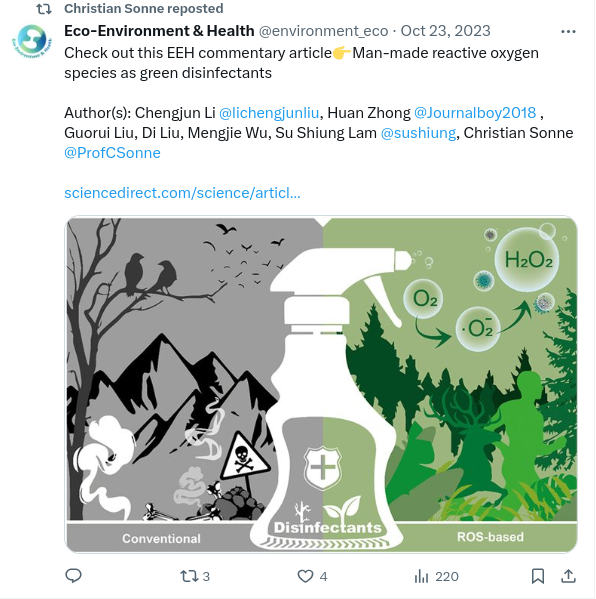
These reviews by Sonne in The Science of the Total Environment, are representative of his earlier career, which was indeed about the wildlife in the Arctic and how it is affected by various pollutants.
- Heli Routti, Todd C. Atwood, Thea Bechshoft, Andrei Boltunov, Tomasz M. Ciesielski, Jean-Pierre Desforges, Rune Dietz, Geir W. Gabrielsen, Bjørn M. Jenssen, Robert J. Letcher, Melissa A. McKinney, Adam D. Morris, Frank F. Rigét, Christian Sonne, Bjarne Styrishave, Sabrina Tartu, State of knowledge on current exposure, fate and potential health effects of contaminants in polar bears from the circumpolar Arctic, The Science of The Total Environment (2019), doi: 10.1016/j.scitotenv.2019.02.030.
- Rune Dietz , Robert J. Letcher , Jean-Pierre Desforges , Igor Eulaers , Christian Sonne , Simon Wilson , Emilie Andersen-Ranberg , Niladri Basu , Benjamin D. Barst , Jan Ove Bustnes , Jenny Bytingsvik , Tomasz M. Ciesielski , Paul E. Drevnick , Geir W. Gabrielsen , Ane Haarr , Ketil Hylland , Bjørn Munro Jenssen , Milton Levin , Melissa A. McKinney , Rasmus Dyrmose Nørregaard , Kathrine E. Pedersen, Jennifer Provencher, Bjarne Styrishave, Sabrina Tartu, Jon Aars, Joshua T. Ackerman, Aqqalu Rosing-Asvid, Rob Barrett, Anders Bignert, Erik W. Born, Marsha Branigan, Birgit Braune, Colleen E. Bryan, Maria Dam, Collin A. Eagles-Smith, Marlene Evans, Thomas J. Evans, Aaron T. Fisk, Mary Gamberg, Kim Gustavson, C. Alex Hartman, Björn Helander, Mark P. Herzog, Paul F. Hoekstra, Magali Houde, Katrin Hoydal, Allyson K. Jackson, John Kucklick, Elisabeth Lie, Lisa Loseto, Mark L. Mallory, Cecilie Miljeteig, Anders Mosbech, Derek C.G. Muir, Sanna Túni Nielsen, Elizabeth Peacock, Sara Pedro, Sarah H. Peterson, Anuschka Polder, Frank F. Rigét, Pat Roach, Halvor Saunes, Mikkel-Holger S. Sinding, Janneche U. Skaare, Jens Søndergaard, Garry Stenson, Gary Stern, Gabriele Treu, Stacy S. Schuur, Gísli Víkingsson, Current state of knowledge on biological effects from contaminants on arctic wildlife and fish, The Science of The Total Environment (2019), doi: 10.1016/j.scitotenv.2019.133792.

These papers may over-cite Sonne a little bit. Or maybe not – what if Sonne himself is the state-of-the-art of all Arctic pollution research? For this reason, I won’t dare flagging them on PubPeer. There is enough already.
In an earlier For Better Science post below, you can read about The Science of the Total Environment, an Elsevier journal whose editor-in-chief is a Spanish-Saudi paper-spammer Damià Barceló. Or on Retraction Watch, about an insane paper about jade amulets against COVID, ultimately retracted. Or see this edition of Friday Shorts, featuring yet another editorial achievement of Barcelo, but in a different Elsevier journal, a crazy unfurl-thwack tortured review.
Elsevier’s research integrity
A Chinese paper gets rejected at Elsevier after reviewer spotted fraud. Same paper re-appears unchanged in another Elsevier journal, the editors refuse any action.

This one, however, is already on PubPeer, and has been there since a while ago.
Christian Sonne, Markus Dyck, Frank F. Rigét, Jens-Erik Beck Jensen, Lars Hyldstrup, Robert J. Letcher, Kim Gustavson, M. Thomas P. Gilbert, Rune Dietz, Penile density and globally used chemicals in Canadian and Greenland polar bears, Environmental Research (2015), doi: 10.1016/j.envres.2014.12.026.
An unnamed reader raises the possibility that the methodological foundations of the work may be shaky:
“Therefore, the analysis in this study may not be dissimilar to suggesting that – among humans – eating rice might cause black hair (which superficially appears true because Asian nations tend to have black hair). Although risk quotients for “effects on normal reproduction and development” are calculated, it is not clear that these risks are directly related to penile bone mineral density. What is needed is a per-individual analysis showing that individuals with the highest PCB levels have the lowest penile bone mineral density.
Peer 1
[…]
And I really don’t think the evidence is there to support the suggestion that PCBs are going to cause increased fractures of the penile bone and thereby contribute to polar bear extinction. (Hunting and climate change being the more obvious culprits here.)”
Fast forward through the COVID pandemic… Boom! – there came a sudden U-turn in Sonne’s research interests. Valorization! Thermocatalytic conversion! It is hard to spot a non-papermilled study with these words these days – thanks Rafael Luque for raising this trash from the depths of obscurity.
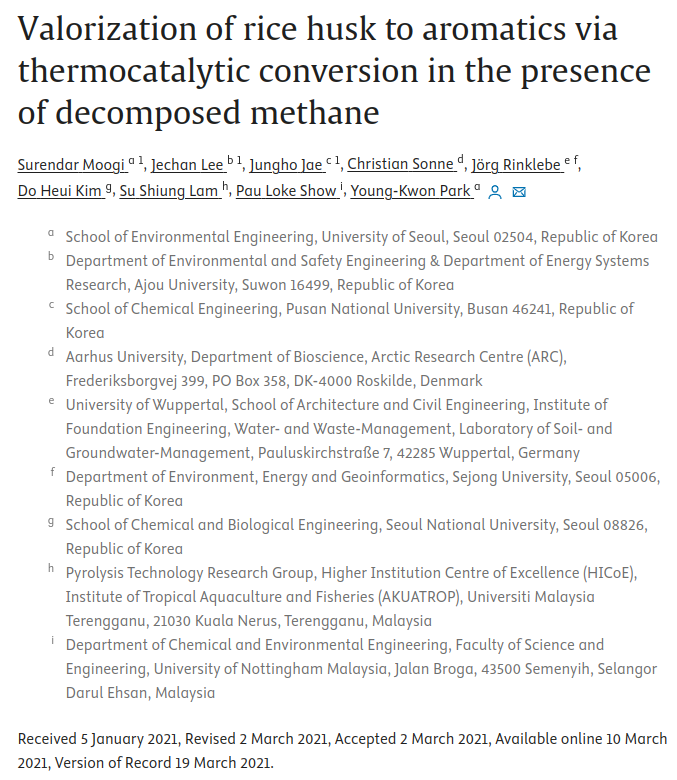
Surendar Moogi, Jechan Lee, Jungho Jae, Christian Sonne, Jörg Rinklebe, Do Heui Kim, Su Shiung Lam, Pau Loke Show, Young-Kwon Park, Valorization of rice husk to aromatics via thermocatalytic conversion in the presence of decomposed methane, Chemical Engineering Journal (2021), doi: 10.1016/j.cej.2021.129264.
As our readers can see, there is the usual geographic diversity in the author list: only a single pair of authors – Moogi and Park – have the same affiliation.
But this is not the only problem. Of course, the content is fake.
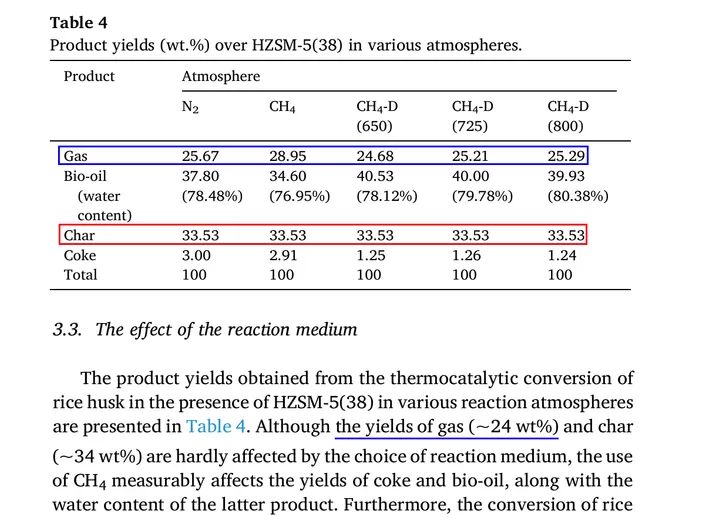
b) The reporting of gas yield as “~24%” is not quite accurate; all reported values are visibly larger than that.
Then, on 15 December 2023, arrived a Corrigendum:
“Explanation for the error
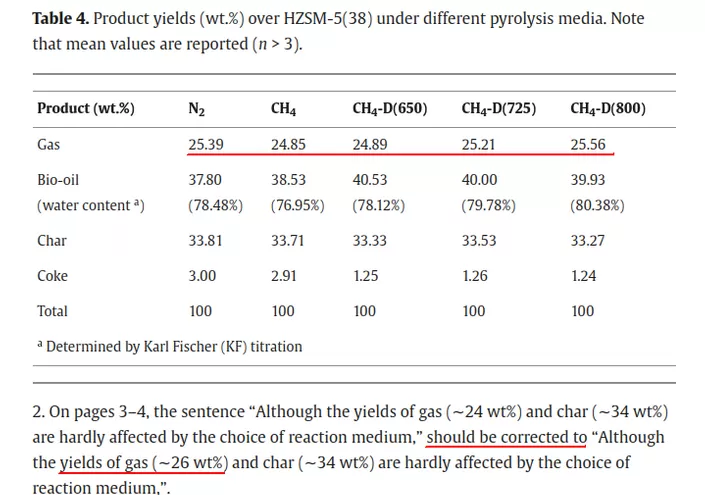
Because the reaction was performed using ex-situ type pyrolyzer, the char yield should be almost identical. Thus, in original Table 4, the average value of char yield was reported. However, for a clearer presentation of our experimental data, the authors have decided to revise Table 4. Accordingly, the re-computed gas and oil yields are provided in the revised Table 4, and relevant changes are made on the statements in Section 3.3. Furthermore, more pieces of information are added to the revised Table 4 for a clearer understanding.
The authors would like to apologize for any inconvenience the authors might have caused to the readers of the journal. The correction does not alter the primary results, discussion, and conclusions of the article.”
Basically, “We have squeezed all the data out of our bums, got caught, so we will try again the same. Because we are dumb, we cannot even make sure that the text matches the table. But then again, we need to convince an editor, not you.” Here is the corrected Table 4.
Eventually, another PubPeer user reported more inconsistencies:
“According to Table 4 for instance, the CH4-D650 scenario, over a HZSM-5 catalyst with Si/Al = 38 yielded 40.53 % bio-oil which had a water concentration of 78.12 %. This means that the yield in organics in the bio-oil can only be equal to 40.53*(1-0.7812) = 8.9 wt%
Yet, according to Figure 4, that same scenario (CH4-D650 atmosphere, Si/Al=38 HZSM-5 zeolite) already yields 14% BTX which is significantly higher than the maximum 8.9 % that you could have in all organics in the bio-oil. Sure we’re not talking about concentrations, rather than yields here?”
Proving once again that the data is made up. If you try to “valorize” unspecified rice husk yourself, you will get whatever, no guarantee if useful or not, and most certainly not what is promised by Sonne and friends. C’est la vie.
There are other usual suspects – Jörg Rinklebe, Su Shiung Lam and Pau Loke Show.

The Highly Cited Researchers of Clarivate
“here is my advice to Clarivate: better get lost. ” – Alexander Magazinov

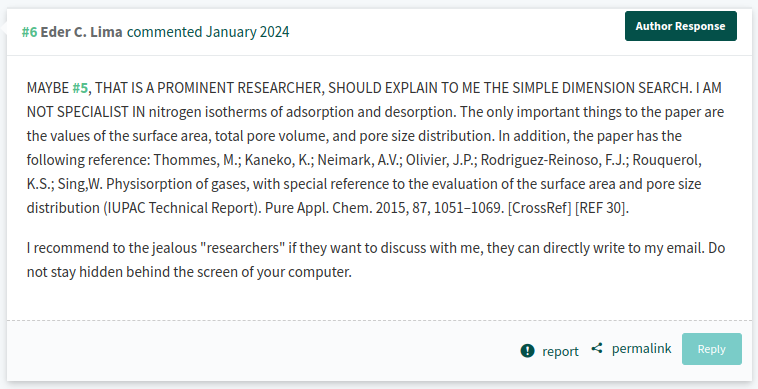
Speaking of the German biogeochemist Rinklebe, or “Univ.-Prof. Prof. mult. Dr.-Ing. agr. Jörg Rinklebe” as his University of Wuppertal wants you to refer to their “Highly Cited Researcher” and “Lion of the World“. How about this masterpiece? With characters as toxic as Navid Rabiee (see his paper-shaped excretions with Luque, Rajender Varma, and Thomas Webster). Or a Brazilian, Eder C. Lima, chemistry professor at Federal University of Rio Grande do Sul, and former editor of Elsevier’s Journal of Hazardous Materials.
Uendel Dos Santos Feitoza, Pascal S. Thue, Eder C. Lima, Glaydson S. Dos Reis, Navid Rabiee, Wagner S. De Alencar, Beatris L. Mello, Younes Dehmani, Jörg Rinklebe, Silvio L. P. Dias, Use of Biochar Prepared from the Açaí Seed as Adsorbent for the Uptake of Catechol from Synthetic Effluents, Molecules (2022), doi: 10.3390/molecules27217570.
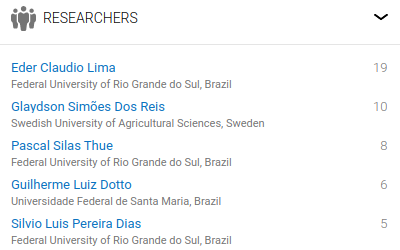
Since Lima is sitting on the 2023 Highly Cited Researchers list, this is all totally justified, and the sole reason for critics is jealousy.
What about Sonne’s other regular associate and another Highly Cited Researcher, Pau Loke Show, currently professor at Khalifa University in Abu Dhabi, Emirates? A PubPeer user commented about their paper with Sonne:
“Rinklebe Jörg is an editor on several papers from Pau Loke Show for the journal of Hazardous Materials. This is odd and potentially unethical as they are both frequent co-authors around the same time. Furthermore, it is quite remarkable that R. Jörg is almost always the editor for the P. L. Show papers.”
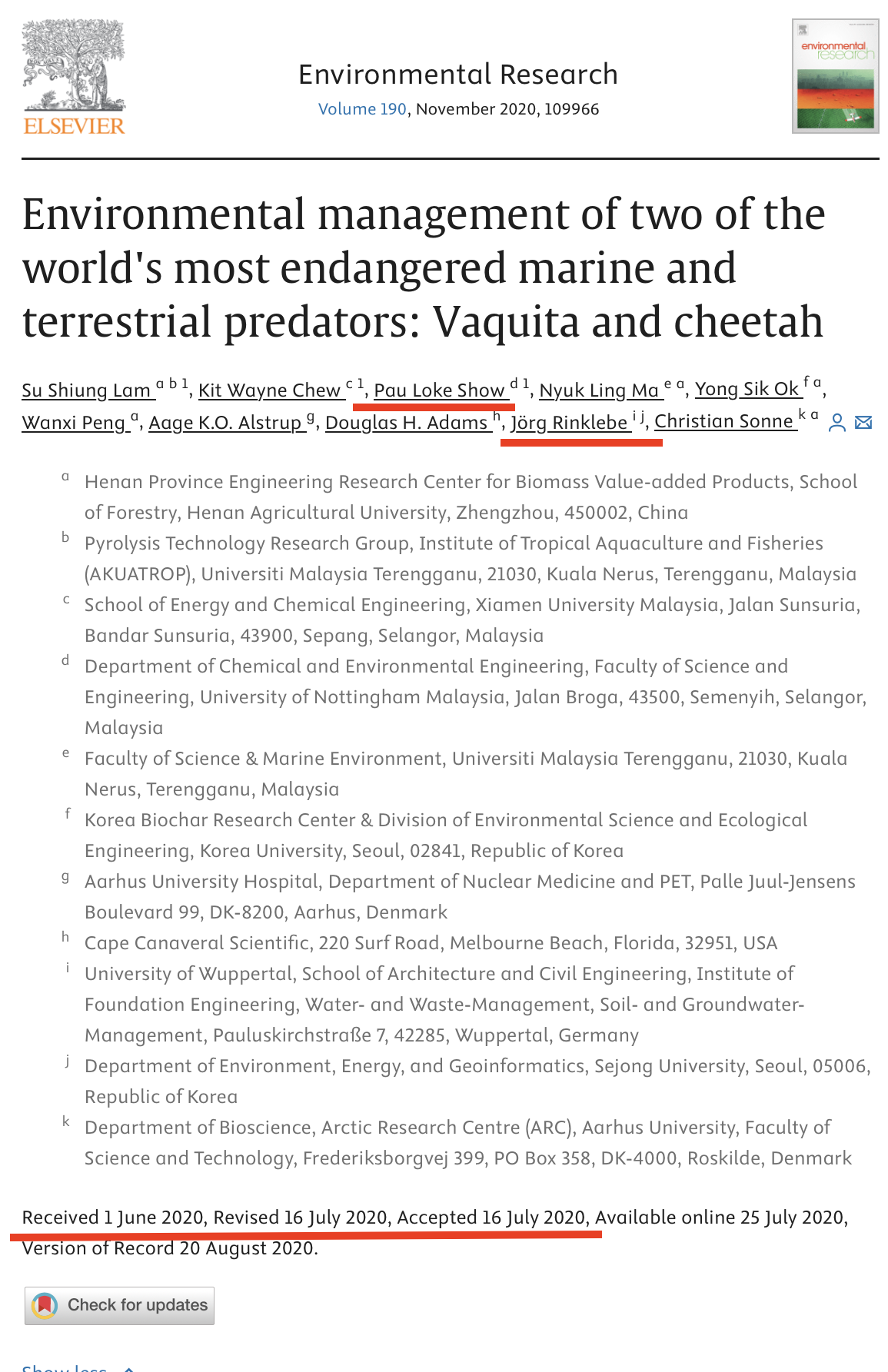


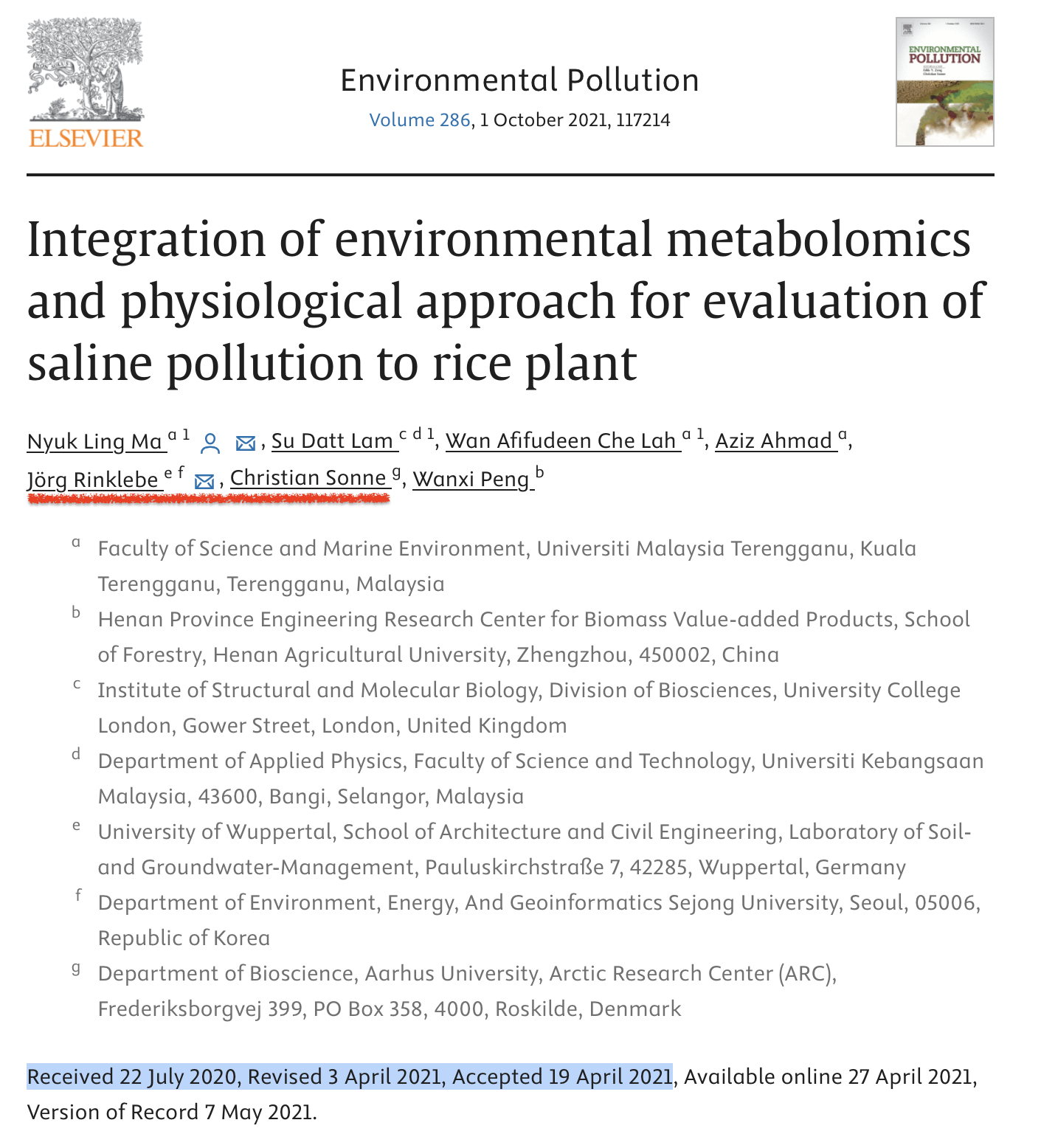
The University of Wuppertal is enormously proud that their “Prof mult” Rinklebe acts as guest editor for special issues at Elsevier’s Journals of Hazardous Materials. He also shares the chief editor position with Sonne at the Elsevier journal Environmental Pollution. Together, they pollute research with papermilled trash.

It is not immediately clear what Rinkelebe’s officially stated (yet not verified) expertise of soil and ground water management has to do with asbestos disposal (Bolan et al 2023), lithium-ion-battery recycling (Wang et al 2022). Or with cheetahs (Lam et al 2020, with Sonne). Or with SARS-CoV2, but then again, it is his journal, his rules:
Hai Nguyen Tran, Giang Truong Le , Dong Thanh Nguyen , Ruey-Shin Juang , Jörg Rinklebe , Amit Bhatnagar , Eder C. Lima, Hafiz M.N. Iqbal , Ajit K. Sarmah , Huan-Ping Chao SARS-CoV-2 coronavirus in water and wastewater: A critical review about presence and concern Environmental Research (2021) doi: 10.1016/j.envres.2020.110265

Men like Sonne and Rinklebe have such big brains they can be experts on anything which is currently hot. Heavy metals in hair of Chinese mine workers (Dai et al 2023), deforestation in the Amazon (Mahari et al 2020), or, as the pandemic raged – COVID-19.
- Manish Kumar , Keisuke Kuroda , Kiran Dhangar , Payal Mazumder , Christian Sonne , Jörg Rinklebe , Masaaki Kitajima Potential Emergence of Antiviral-Resistant Pandemic Viruses via Environmental Drug Exposure of Animal Reservoirs Environmental Science & Technology (2020) doi: 10.1021/acs.est.0c03105
- Manish Kumar, Payal Mazumder , Sanjeeb Mohapatra , Alok Kumar Thakur , Kiran Dhangar , Kaling Taki , Santanu Mukherjee , Arbind Kumar Patel , Prosun Bhattacharya , Pranab Mohapatra , Jörg Rinklebe , Masaaki Kitajima , Faisal I. Hai , Anwar Khursheed , Hiroaki Furumai , Christian Sonne , Keisuke Kuroda A chronicle of SARS-CoV-2: Seasonality, environmental fate, transport, inactivation, and antiviral drug resistance Journal of Hazardous Materials (2021) doi: 10.1016/j.jhazmat.2020.124043
They are even experts on research ethics!
Christian Sonne, Yong Sik Ok, Su Shiung Lam, Jörg Rinklebe, Aage K.O. Alstrup , Ki-Hyun Kim First predatory journals, now conferences: The need to establish lists of fake conferences The Science of The Total Environment (2020) doi: 10.1016/j.scitotenv.2020.136990
In fact, their co-author Yong Sik Ok of Korea University knows everything about fake conferences because he frequents them as plenary speaker. Your can read about the PAGES Scamferences here.
One of the invited speakers at that scma even Yong Sik Ok spoke at, was a certain Farooq Sher. You are invited to visit his PubPeer record and read about this freak clown of the Nottingham Trent University in UK here, at the end:

Nuttingham Trash University
“I will not by myself, or be instructing or encouraging any other person or howsoever othewise, publish or cause to be published words or otherwise howsoever make statements to others which wrongfully refer to Nottingham Trent University and/or their employees and for any person or any body associated with Nottingham Trent University”

Here is Sher with Rinklebe’s Brazilian associate Lima and some hand-drawn spectra (among other issues):
Bilal Fareed , Farooq Sher, Saba Sehar , Tahir Rasheed , Fatima Zafar , Mariam Ameen , Eder C. Lima Tailor made Functional Zeolite as Sustainable Potential Candidates for Catalytic Cracking of Heavy Hydrocarbons Catalysis Letters (2022) doi: 10.1007/s10562-021-03657-x

Another one, you ask?
Usama A. Al-Rawi , Farooq Sher , Abu Hazafa , Tahir Rasheed , Nawar K. Al-Shara , Eder C. Lima, Jabir Shanshool Catalytic Activity of Pt Loaded Zeolites for Hydroisomerization of n-Hexane Using Supercritical CO2 Industrial & Engineering Chemistry Research (2020) doi: 10.1021/acs.iecr.0c05184


Last one, just so you know with what kind of utter fraud that German Prof mult Rinklebe “collaborates”:
Saba Sehar , Farooq Sher, Shengfu Zhang, Ushna Khalid , Jasmina Sulejmanović, Eder C. Lima Thermodynamic and kinetic study of synthesised graphene oxide-CuO nanocomposites: A way forward to fuel additive and photocatalytic potentials Journal of Molecular Liquids (2020) doi: 10.1016/j.molliq.2020.113494

Like Rinklebe, Show is also featured on the latest Highly Cited Researchers list, and with some fellow papermillers they built a network where they not only co-author papermilled studies, but also edit each other’s manuscript submissions, as special issue editors. This is the network, according to a PubPeer user:
- Pau Loke Show
- Jörg Rinklebe
- Muhammad Mubashir
- Awais Bokhari
- Hassan Karimi-Maleh
- Kuan Shiong (or Kuan Shiong Khoo)
Sonne missed out on publishing with the Czech Renaissance man of sustainability, Jiří Jaromír Klemeš. Because the latter died in January 2023, leaving behind a scientific legacy of papermill garbage, often co-authored with Show and Bokhari. Below, Klemes and Bokhari joined their efforts in the team led by Mohammad Arjmand to synthesize a magic adsorbent.
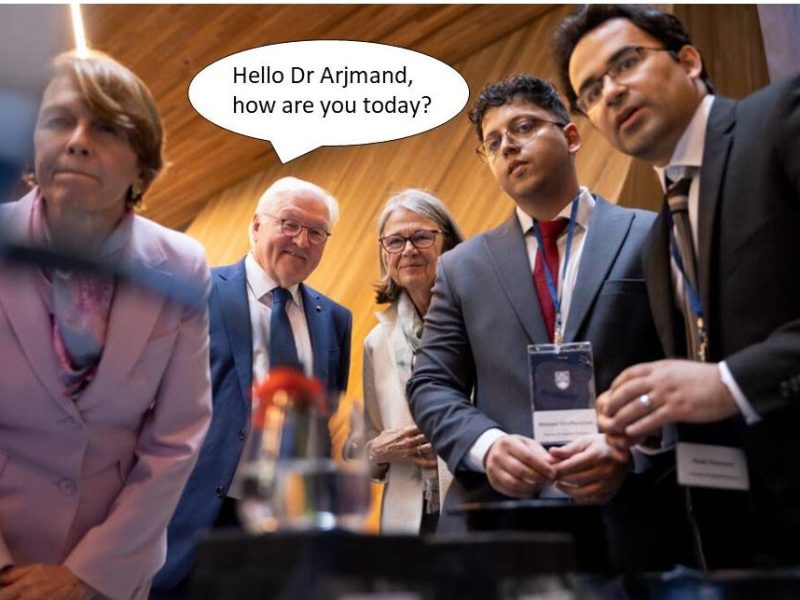
Dr. Mohammad Arjmand showcases his work to German President Steinmeier
“The German President and delegation members also spoke with researchers working on challenges relating to clean energy,…”
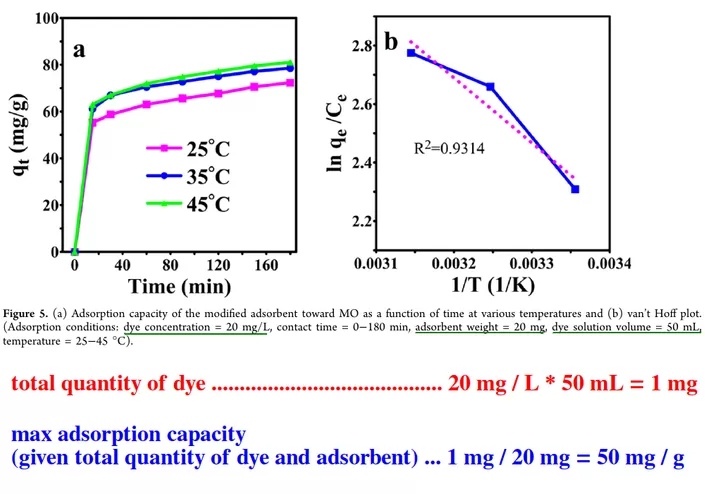
With their discovery, you can remove even more pollutant dye than the solution contains – a true miracle!
Farhad Ahmadijokani, Salman Ahmadipouya, Mahdi Heidarian Haris, Mashallah Rezakazemi, Awais Bokhari, Hossein Molavi, Mohsen Ahmadipour, Swee-Yong Pung, Jiří Jaromír Klemeš, Tejraj M. Aminabhavi, Mohammad Arjmand, Magnetic Nitrogen-Rich UiO-66 Metal–Organic Framework: An Efficient Adsorbent for Water Treatment, ACS Applied Materials & Interfaces (2023), doi: 10.1021/acsami.3c02171.
Now meet Su Shiung Lam, professor in environmental technology at the Universiti Malaysia Terengganu, and Sonne’s and Show’s fellow COVID-19 expert.
Su Shiung Lam , Pau Loke Show, Angela Paul Peter , Kit Wayne Chew, Pei En Tham , Nyuk Ling Ma , Shing Ching Khoo , Shin Ying Foong , Dangquan Zhang , Yafeng Yang , Wanxi Peng , Christian Sonne Detection methods of Covid-19 to build resilience for environmental changes in the community Urban Governance (2023) doi: 10.1016/j.ugj.2023.10.001
Thanks probably to the same papermill, Sonne and Lam also put their heads together and, with a help of colleagues from China, Malaysia, India and Scandinavia found a cure for cancer.
Yiyang Li , Nyuk Ling Ma , Huiling Chen , Jiateng Zhong , Dangquan Zhang , Wanxi Peng , Su Shiung Lam , Yafeng Yang , Xiaochen Yue , Lijun Yan , Ting Wang , Bjarne Styrishave, Tomasz Maciej Ciesielski , Christian Sonne High-throughput screening of ancient forest plant extracts shows cytotoxicity towards triple-negative breast cancer Environment International (2023)
doi: 10.1016/j.envint.2023.108279

They claim to have experimented on mice, but without ethics approval. And we thought out wildlife vet Dr Sonne loves animals…. This one, again coauthored by Sonne and Lam with Kopenhagen University professor Bjarne Styrishave in Denmark and NTNU professor Tomasz Ciesielski in Norway, was allegedly done in China and received its unspecified ethics approval there:
Xiaochen Yue , Nyuk Ling Ma , Jiateng Zhong , Han Yang , Huiling Chen , Yafeng Yang , Su Shiung Lam, Lijun Yan , Bjarne Styrishave, Tomasz Maciej Ciesielski, Wan-Xi Peng , Christian Sonne Ancient forest plants possess cytotoxic properties causing liver cancer HepG2 cell apoptosis Environmental Research (2024) doi: 10.1016/j.envres.2023.117474
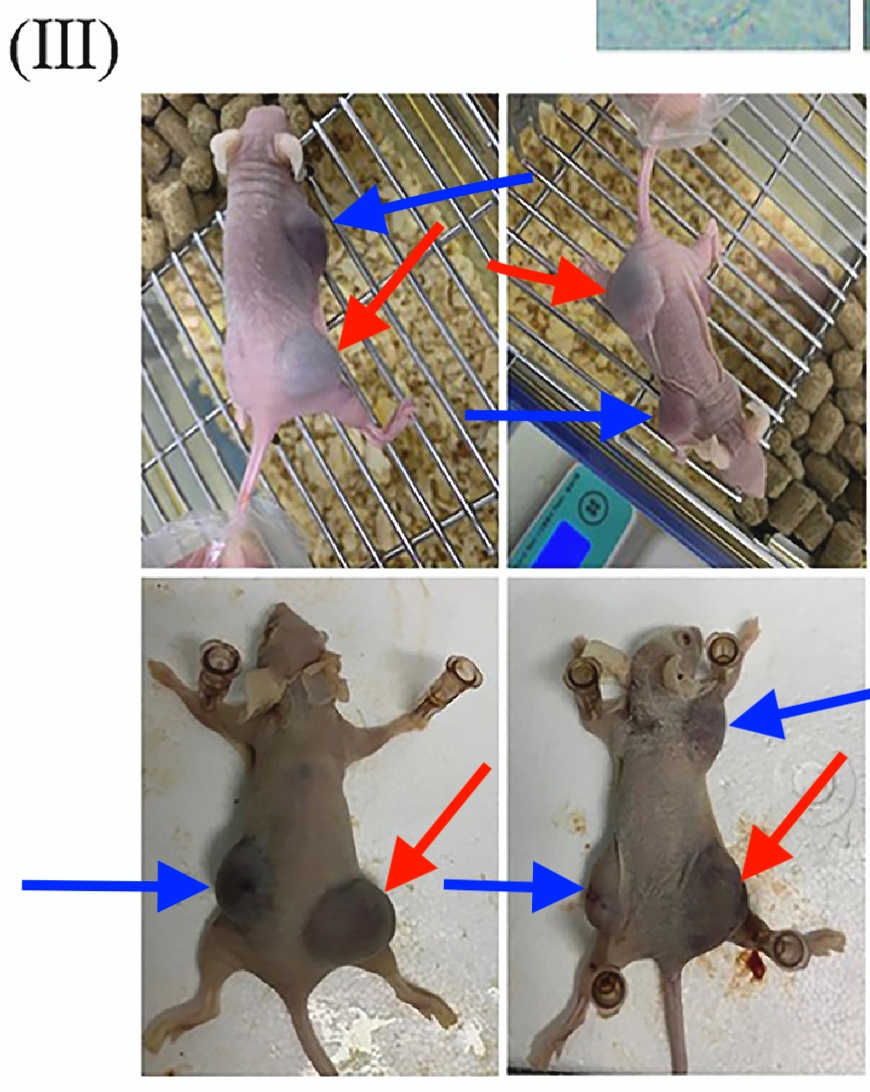
“If one looks at figure 4 III , one can question the statement in the M&M section regarding the injection of the tumor cells in the right hind leg of the mice. How can there be such large tumor development in the left hind leg and even upper legs of the mice of the injection was in the right hind leg?”
Our friend of animals in Aarhus, who happens to be the corresponding author of this paper, commented on PubPeer with:
“Feel free to send the corresponding author(s) an email. My best, Christian“
Here is Lam with the Iranian papermiller Mohammadreza Shokouhimehr, plus a few characters we are about to see later on.
Van-Huy Nguyen, Ba Duc Nguyen, Hien Thu Pham, Su Shiung Lam, Dai-Viet N. Vo, Mohammadreza Shokouhimehr, Thi Hong Hanh Vu, Thanh-Binh Nguyen, Soo Young Kim, Quyet Van Le, Anti-icing performance on aluminum surfaces and proposed model for freezing time calculation, Scientific Reports (2021), doi: 10.1038/s41598-020-80886-x.

Since this is Scientific Reports, changing aspect ratio can absolutely be an honest mistake. So there you have a Correction.
Back to Sonne and Elsevier’s Chemical Engineering Journal. There, we also find:
Rui Yang, Qinghua Cao, Yunyi Liang, Shu Hong, Changlei Xia, Yingji Wu, Jianzhang Li, Liping Cai, Christian Sonne, Quyet Van Le, Su Shiung Lam, High capacity oil absorbent wood prepared through eco-friendly deep eutectic solvent delignification, Chemical Engineering Journal (2020), doi: 10.1016/j.cej.2020.126150.
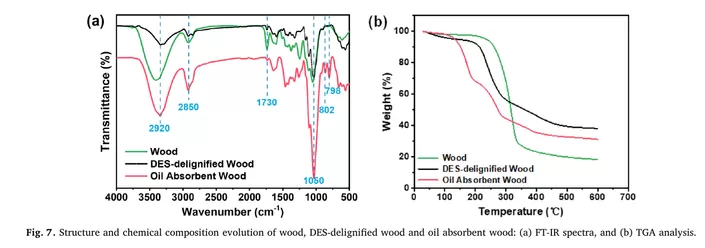
b) There is too much space between the alleged “802” cm−1 and “798” cm−1 absorption peaks. At this scale they should not be distinguishable.
If the editors and the reviewers are all for it, why not paste in some hand-drawn spectra? And again, there is a constellation of familiar names. We have already met Su Shiung Lam, now meet also Changlei Xia and Quyet Van Le. Here are Sonne, Xia and Lam together, being again experts on stuff they actually have absolutely no clue about. Luckily, the Elsevier journal Chemosphere specialises on papermills.
Yingji Wu , Yunyi Liang , Changtong Mei, Liping Cai , Ashok Nadda , Quyet Van Le , Yucheng Peng , Su Shiung Lam , Christian Sonne, Changlei Xia Advanced nanocellulose-based gas barrier materials: Present status and prospects Chemosphere (2022) doi: 10.1016/j.chemosphere.2021.131891

And here Sonne and his friends may have watched too many Bob the Builder cartoons.
Yang Wang , Haoran Ye , Changlei Xia , Yang Shi , Zhongfeng Zhang , Su Shiung Lam , Rock Keey Liew , Christian Sonne, Shengbo Ge High-performance poplar-polyethylene laminates based on microwave-assisted acetic acid pretreatment process with potential application in construction Journal of Building Engineering (2023) doi: 10.1016/j.jobe.2023.106731
“By comparing the tensile strength of the wood-plastic laminates, it is obvious that the pretreated wood-plastic laminates has a slightly higher tensile strength. This could be due to the influence of microwave-assisted acetic acid treatment on the wood cell wall structure [28].”
[28] L. Wang, C.X. He, X.X. Yang, Effects of pretreatment on the soil aging behavior of rice husk fibers/polyvinyl chloride composites, Bioresources 14 (1) (2019) 59–69.
Changlei Xia is indeed yet another citation farmer (they are everywhere, sigh). See him, for example, receiving a few donated citations from… Fatih Sen!

Don’t mess with Fatih Sen
Fake nanotechnology is always fun, but it does get extreme here. Word of advice: if you are in Turkey, better don’t point fingers at Professor Fatih Sen’s research. Things get broken easily.
Kaijie Ni, Yingji Wu, Fatemeh Karimi, Fulya Gulbagca, Abdullah Seyrankaya, Elif Esra Altuner, Yilmaz Kocak, Fatih Sen, Palladium based bimetallic nanocatalysts: Synthesis, characterization and hydrogen fuel production, Fuel (2023), doi: 10.1016/j.fuel.2023.127577.
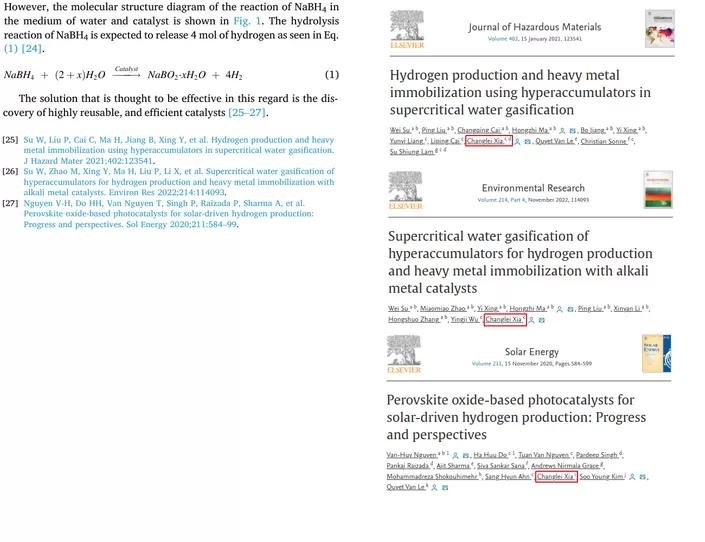
In turn, Quyet Van Le is not a stranger to this blog. We met him briefly in earlier Friday Shorts. To be more precise, when RSC appointed one Venkata Krishnan to an editorial role, fellow sleuths stumbled upon series of papers, where data were reused to represent different compounds or conditions. By that time, some were retracted, some were not. Anyway, here is one with Le onboard, first corrected, then retracted.
Van-Huy Nguyen, Mitra Mousavi, Jahan B. Ghasemi, Seyed Ali Delbari, Quyet Van Le, Abbas Sabahi Namini, Mehdi Shahedi Asl, Mohammadreza Shokouhimehr, Yashar Azizian-Kalandaragh, Mohsen Mohammadi, Z-scheme g-C3N4 nanosheet/MgBi2O6 systems with the visible light response for impressive photocatalytic organic contaminants degradation, Journal of Photochemistry and Photobiology A Chemistry (2021), doi: 10.1016/j.jphotochem.2020.113023.
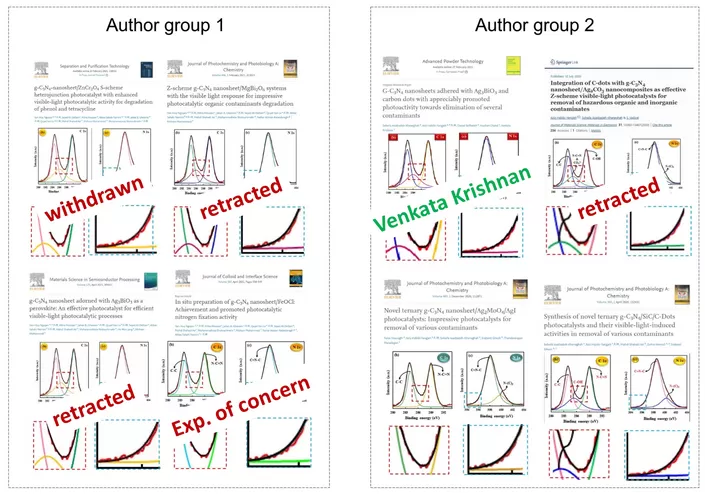
But Quyet Van Le is also a valuable editor. At least for Elsevier’s Solar Energy, sitting on the editorial board (archived).

Together with, for example, Luisa F. Cabeza, an Editor-in-Chief for Journal of Energy Storage, an outlet just as papermill-infested as it was under the previous German editor Dirk-Uwe Sauer. There are also Sandro Nižetić and Zhenjun Ma, the duo spotted in a collaboration with Masoud Afrand. All totally by chance, of course.
Maybe stop accepting submissions, Herr Prof Dr Sauer?
Who needs science if you can have a 75 paper strong special edition by Afrand and Karimi? A guest post by Alexander Magazinov.
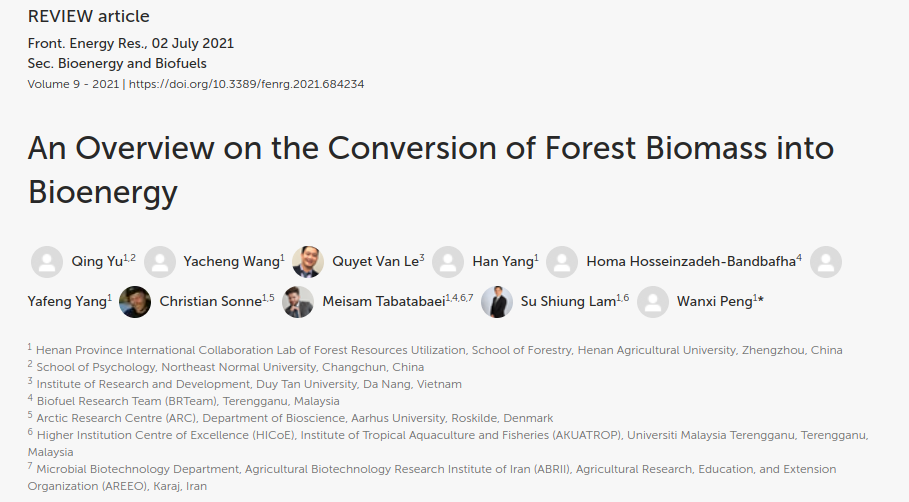
Moving further. And here is Lam with Sonne again, now on why deforestation is good for climate:
Qing Yu, Yacheng Wang, Quyet Van Le, Han Yang, Homa Hosseinzadeh-Bandbafha, Yafeng Yang, Christian Sonne, Meisam Tabatabaei, Su Shiung Lam, Wanxi Peng, An Overview on the Conversion of Forest Biomass into Bioenergy, Frontiers in Energy Research (2021), doi: 10.3389/fenrg.2021.684234.
The list of affiliations is enough to draw away any doubt: we are looking at a papermill product. Other than that, it is a citation plantation.

Papermilled trash like this is obviously what qualified Sonne to publish in Nature. Yes, Nature.
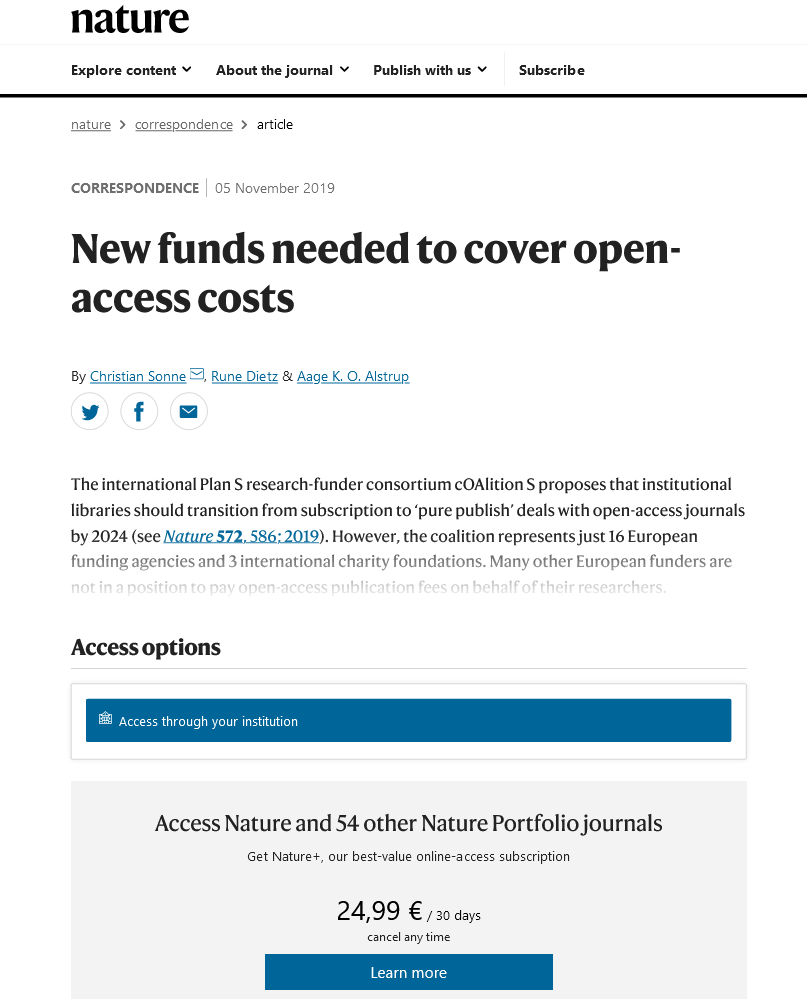
Here, Sonne meets Quyet Van Le and Su Shiung Lam, but also Meisam Tabatabaei. Speaking of Tabatabaei and his friend and fellow citation farmer Mortaza Aghbashlo:
Hamed Kazemi Shariat Panahi, Mona Dehhaghi, Gilles J. Guillemin, Wanxi Peng, Mortaza Aghbashlo, Meisam Tabatabaei, Targeting microRNAs as a promising anti-cancer therapeutic strategy against traffic-related air pollution-mediated lung cancer, Cancer and Metastasis Reviews (2023), doi: 10.1007/s10555-023-10142-x.
Now, if biofuel “experts” Tabatabaei and Aghbashlo join forces with a sacked neuroscience fraudster Gilles Guillemin to review the fraud-infested field of miRNAs in cancer (read earlier Friday Shorts), sure the result will be absolutely trustworthy? At least the editors of the Springer Nature journal seem to think so. The reality is, however, harsher than the expectations:
| Questioned References Cited | Details |
|---|---|
| 10.3233/cbm-190555 retraction | [2020] Cancer Biomarkers: MiR-155 targeting FoxO3a regulates oral cancer cell proliferation, apoptosis, and DDP resistance through targeting FoxO3a.. Xiaoting Li • Kun Liu • Wei Zhou • Zhe Jiang |
| 10.1186/s13045-019-0708-7 retraction | [2019] Journal of Hematology & Oncology: RETRACTED ARTICLE: miR-195-5p/NOTCH2-mediated EMT modulates IL-4 secretion in colorectal cancer to affect M2-like TAM polarization. Xiaobin Lin • Shuyi Wang • Min Sun • Chunxiao Zhang • Chen Wei • Chaogang Yang • Rongzhang Dou • Qing Liu • Bin Xiong |
| 10.1038/ncb1577 retraction | [2007] Nature Cell Biology: DEAD-box RNA helicase subunits of the Drosha complex are required for processing of rRNA and a subset of microRNAs. Toru Fukuda • Kaoru Yamagata • Sally Fujiyama • Takahiro Matsumoto • Iori Koshida • Kimihiro Yoshimura • Masatomo Mihara • Masanori Naitou • Hideki Endoh • Takashi Nakamura • Chihiro Akimoto • Yoko Yamamoto • Takenobu Katagiri • Charles Foulds • Shinichiro Takezawa • Hirochika Kitagawa • Ken-ichi Takeyama • Bert W. O’Malley • Shigeaki Kato |
Which is just a tip of the trash iceberg, that the list of references is. Why? Well, because the miRNA / circRNA / lncRNA / whatever-else-RNA retractions are still sparse. Even Adam Day‘s Clear Skies detector flags many tens of thousands of suspicious papers each year, and lots of those are RNA-related. At the same the number of retractions in this field still seems to be at best in low thousands.

Environmental Pseudoscience and Polluted Research
“We are living in a faked world and there is a lot of un-verified avatars. “, Philippe Garrigues, EiC
And why this reference would be relevant in a lung cancer-related paper?
[7] Hosseinzadeh-Bandbafha, H., Panahi, H. K. S., Dehhaghi, M., Orooji, Y., Shahbeik, H., Mahian, O., Karimi-Maleh, H., Kalam, M. A., Jouzani, G. S., & Mei, C. (2023). Applications of nanotechnology in biodiesel combustion and post-combustion stages. Renewable and Sustainable Energy Reviews, 182, 113414.
Forget it: per the template, one can unleash a flurry of hollow statements in the introduction, citing anything and everything. And this template is the real science; respectively, any deviation is a heresy.
By the way, what a colorful set of authors this reference has! Yasin Orooji, Omid Mahian, Hassan Karimi-Maleh! Published in a journal edited by Aoife Foley! But this is already too much of a deviation from the main story line.
And now, behold! Here comes Herr Sonne again:
Hossein Shahbeik, Hamed Kazemi Shariat Panahi, Mona Dehhaghi, Gilles J. Guillemin, Alireza Fallahi, Homa Hosseinzadeh-Bandbafha, Hamid Amiri, Mohammad Rehan, Deepak Raikwar, Hannes Latine, Bruno Pandalone, Benyamin Khoshnevisan, Christian Sonne, Luigi Vaccaro, Abdul-Sattar Nizami, Vijai Kumar Gupta, Su Shiung Lam, Junting Pan, Rafael Luque, Bert Sels, Wanxi Peng, Meisam Tabatabaei, Mortaza Aghbashlo, Biomass to biofuels using hydrothermal liquefaction: A comprehensive review, Renewable and Sustainable Energy Reviews (2024), doi: 10.1016/j.rser.2023.113976.
Apparently, Hamed Kazemi Shariat Panahi, Mona Dehhaghi, Wanxi Peng, along with Tabatabaei, Aghbashlo and Guillemin, make no difference between lung cancer and liquefaction of biomass. Whatever increases the paper count. There is (again!) Su Shiung Lam. And there is the King of Papermillers Rafael Luque! And all the gang receives a warm welcome from Dr Foley in her journal, because Foley’s job is to fill the pages and ensure citations, in which papermills are much better partners than honest scientists.
Elsevier chooses Papermills and Patriarchy, Chief Editor resigns
“Among these candidates that you “vetted” were people with no expertise in the field (either 0 or 1 publication), people with longer PubPeer profiles and more retractions than most people have articles on their CVs, and people whose names appear as authors on sold paper sites. ” – Jillian Goldfarb
But here is a word of warning from Dr Foley herself, about both of us, sent to fellow editors:
- “I suggest that you do not respond to Leonid Schneider. He is well known in academic harasser on the web.“
- “When it started first, and they realised I was a female I was hounded!”
- “I work very hard to manage out paper mills. You’ve no idea how much work goes into this. I adhere COPE guidelines, and I work closely with Elsevier.”
“COPE guidelines” and “close work with Elsevier” are actually the exact opposite to “managing out paper mills,” dear Dr Foley.
Anyway, thanks to Moenkhausia copei, we can appreciate the quality of this review:
The sentence afterward the above statement has a similar issue. The authors of this review state: ‘The ranges of temperature in these four groups are >374 °C, 247–374 °C, 180–247 °C, and <180 °C, respectively [23].’
Moenkhausia copei
[…]
However, reference 23 does not seem to support this division. Tran mentions slightly different temperatures.
This type of error is painfully familiar to those with a certain IT background: it is exactly what you expect from time to time from a GPT-like summarization model. It is more likely than not, that you are reading a ChatGPT text, signed by a crowd of crooks, and sold to your university by Elsevier. Especially given that Luque himself admitted to using ChatGPT to writing his papers.
That being said, an easter egg-style reference is also totally expected under the circumstances.
LCA starts with a goal and scope definition and continues with a life cycle inventory analysis, impact assessment, and result interpretation [321].
[321] Sarlaki E, Kermani AM, Kianmehr MH, Asefpour Vakilian K, Hosseinzadeh-Bandbafha H, Ma NL, et al. Improving sustainability and mitigating environmental impacts of agro-biowaste compost fertilizer by pelletizing-drying. Environ Pollut 2021;285:117412.
No, [321] does not invent the pipeline of a lifecycle assessment. It is at best a rather boring case study co-authored by Tabatabaei and Aghbashlo, and at worst yet another papermilled fake.
So how does Sonne respond to the criticism? Either this way:

Now, I naturally have my own notion when there is room for a private communication with corresponding authors, and papermilled fakes do not fall in this category. If Herr Sonne thinks that it is inappropriate to discuss his papers (or even read them at all), the best path would be not to publish.
Or even this way:
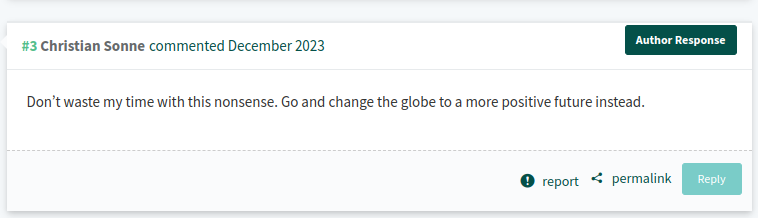
Which kinda leaves open a possibility that Sonne really believes in papermilling as a path to “a more positive future.” Who said that the academia consists only of smart people?
On 15 December 2023, I reported the case of Christian Sonne to his Aarhus University. And on 18 December 2023, I received this reply:
“On behalf of rector, Brian Bech Nielsen, I thank you for your inquiry. I have been informed that your inquiry is being processed in The Research Practice Committee at Aarhus University.“
Bjarke Flytkjær Vestergaard, Special Advisor & PA to rector
He also announced that the notification “will be handled according to the “Procedure for handling cases of suspected research misconduct or questionable research practices”. Very promising!
Yet on 2 January 2024, i received this message from Hanne Rye Johansen, Legal advisor of the Aarhus University:
“In order to be able to handle your complaints you must send us a copy of all relevant articles and documentation (preferably in PDF if possible). Links are not sufficient.
The articles must include clear markings and highlighting of relevant models, tables, passages or phrases in the articles and precise references to the allegations being made concerning research misconduct or questionable research practices (QRP), in addition to evidence for these allegation.
If different articles/ documentation are compared precise cross references in the documents are necessary.
The easiest way to do this is by inserting comments in the margins in PDF-versions of the articles using PDF tools.
You can find further information on the procedures for handling cases of suspected research misconduct or QRP’s at Aarhus University here.
Finally I shall ask you to provide me your full contact data including the number of your mobile phone. I need this to be able to contact you by secure mails if relevant.
Please send the information about the three respective cases in separate mails and indicate the subject of each mail clearly.
Please send me the mentioned information at the latest by Wednesday 23th of January 2024.”
I replied, announcing that I am not going to waste my time reformatting the evidence or reveal my personal data, including my mobile phone number, for the sake of my own safety. I am being phished by Luque and other close collaborators of Sonne and another papermilling professor in Aarhus, Mika Sillanpää.
You will be paid US $500-800 for each paper
“Or The author can also put your name to the article to increase your academic popularity, such as adding your name to the second or third author.”
On 15 January 2015, the Aarhus lawyer Johansen sent me this triumphant email, titled “Cases rejected”:
“The Danish parliament has passed a law on research misconduct (the link leads to a translation, but only the Danish document has legal validity) . The law came into force on 1st July 2017. The law sets the procedures that must be followed when dealing with research misconduct and questionable research practice.
According to the law the notification must include the allegations on research misconduct put forward and the grounds for making such allegations on research misconduct. The notifier is responsible for providing the required information including contact information.
If the notification does not contain the information mentioned, the research institution shall refuse to remit the case to the Committee.
Aarhus University is in dialogue with the Danish Committee on Research Misconduct about the requirements of the law.
Your cases dated 15th, 16 th and 20 th of December 2023 are rejected because the required information have not been delivered. “
German Authorities on Papermills and Whistleblowing
“I am not familiar with Iranian papermills!” – Prof Dr med Henning Madry, Saarland University.
Coda: Mika Sillanpää
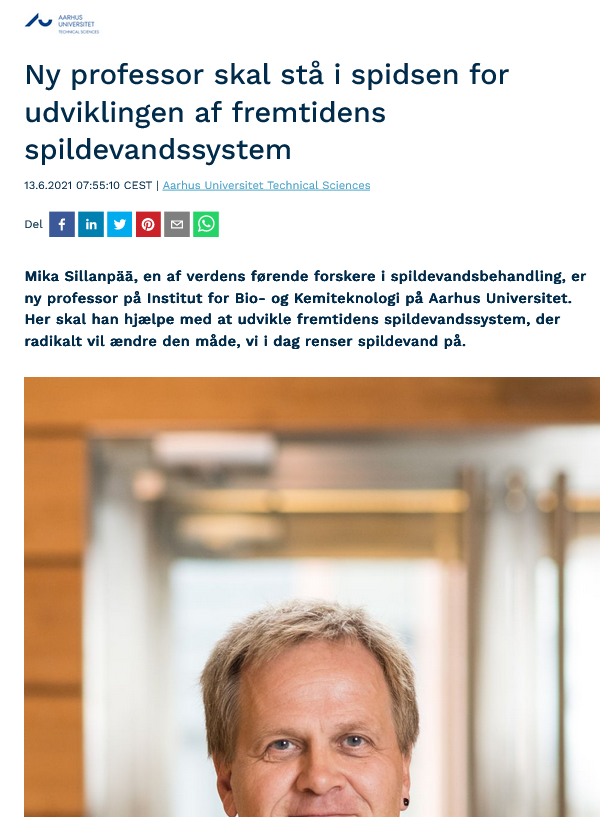
Let’s end with some papermilled trash by the Finnish genius and Highly Cited Researcher Mika Sillanpää, who became professor at Aarhus University in 2021, to “help develop the wastewater system of the future, which will radically change the way we clean wastewater today.” His institutional profile page in Aarhus is now deleted. But according to this YLE article from 23 December 2024, Sillanpää indeed presently works in Aarhus.
Here is Sillanpää with trash papermillers Abduladheem Turki Jalil and Dmitry Bokov, blocks of nonsense citations and hand-drawn spectra recycled across papers:
- Abduladheem Turki Jalil , Shameen Ashfaq , Dmitry Olegovich Bokov , Amer M. Alanazi , Kadda Hachem , Wanich Suksatan , Mika Sillanpää High-Sensitivity Biosensor Based on Glass Resonance PhC Cavities for Detection of Blood Component and Glucose Concentration in Human Urine Coatings (2021) doi: 10.3390/coatings11121555
- Supat Chupradit, Shameen Ashfaq , Dmitry Bokov, Wanich Suksatan, Abduladheem Turki Jalil , Amer M. Alanazi, Mika Sillanpaa Ultra-Sensitive Biosensor with Simultaneous Detection (of Cancer and Diabetes) and Analysis of Deformation Effects on Dielectric Rods in Optical Microstructure Coatings (2021) doi: 10.3390/coatings11121564

One more, also at MDPI Coatings. With Luque and another bunch of papermill customers from Iran, Malaysia and russia:
Fatemeh Rajabi, Chin Hua Chia , Mika Sillanpää , Leonid G. Voskressensky , Rafael Luque Cytosine Palladium Complex Supported on Ordered Mesoporous Silica as Highly Efficient and Reusable Nanocatalyst for One-Pot Oxidative Esterification of Aldehydes Catalysts (2021) doi: 10.3390/catal11121482
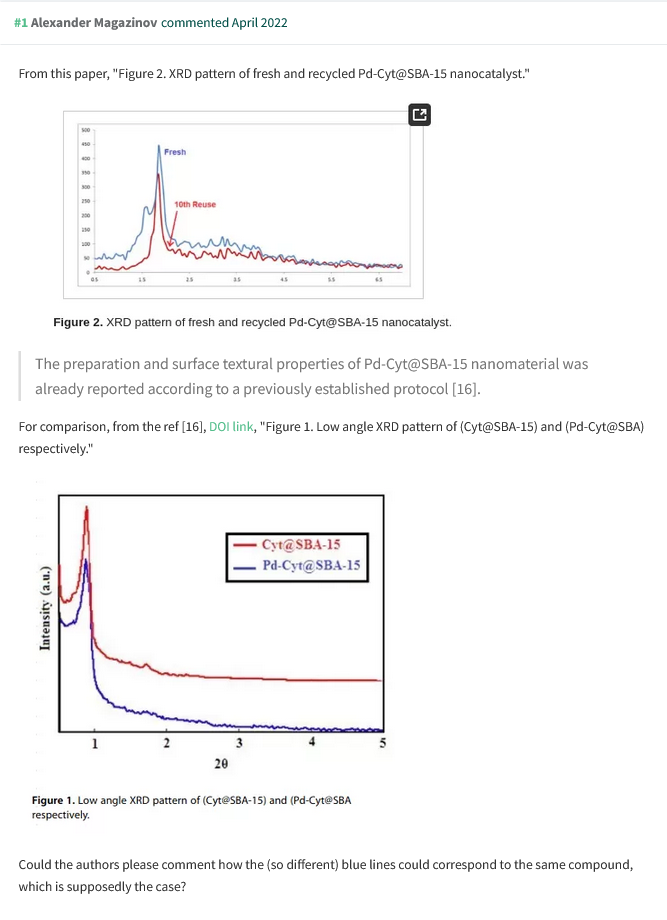
Again with Luque, and the French papermiller Christophe Len:
Fatemeh Rajabi , Mika Sillanpää, Christophe Len , Rafael Luque Efficient Synthesis of Dihydropyrimidines Using a Highly Ordered Mesoporous Functionalized Pyridinium Organosilica Catalysts (2022) doi: 10.3390/catal12030350

The two XRD patterns are exactly identical in the high-theta region, including all noise.”
Here is something with another Frenchman, Rabah Boukherroub (the husband of Sabine Szunerits):
Anasheh Mardiroosi , Ali Reza Mahjoub , Amir Hossein Cheshme Khavar , Rabah Boukherroub, Mika Sillanpää , Parminder Kaur Effects of functionalized magnetic graphene oxide on the visible-light-induced photocatalytic activity of perovskite-type MTiO3 (M= Zn and Mn) for the degradation of Rhodamine B Journal of Molecular Structure (2023) doi: 10.1016/j.molstruc.2023.135298
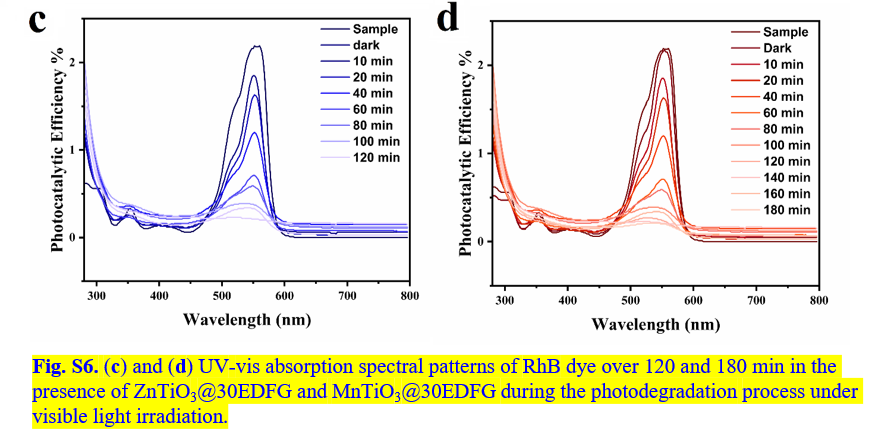


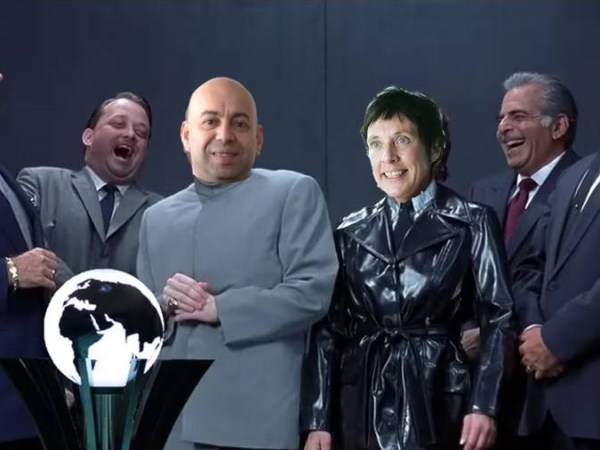
Lille Papermille
French nanotechnologists Sabine Szunerits and Rabah Boukherroub put EU Commission’s money to good use. The EU cannot afford a papermill gap to Iran and China!
Look at this utter insanity, a papermilled self-citation vehicle with Bokhari and the late Klemes you met above:
Sasan Zahmatkesh , Jiří Jaromír Klemeš , Awais Bokhari, Chongqing Wang , Mika Sillanpaa , Mudassir Hasan , Kassian T.T. Amesho Critical role of Hyssop plant in the possible transmission of SARS-CoV-2 in contaminated human Feces and its implications for the prevention of the virus spread in sewage Chemosphere (2022) doi: 10.1016/j.chemosphere.2022.135247
“There seems to be no ethic approval for collecting feces and consuming the hyssop drink daily ‘By drinking Hyssop three times a day,'”
The Finnish Aarhus professor plagiarising and torturing phrases with another infamous fellow papermiller, Rajender Varma:
Ehsan Nazarzadeh Zare , Zari Fallah , Van Thuan Le , Van-Dat Doan , Ackmez Mudhoo , Sang-Woo Joo , Yasser Vasseghian , Mahmood Tajbakhsh , Omid Moradi , Mika Sillanpää , Rajender S. Varma Remediation of pharmaceuticals from contaminated water by molecularly imprinted polymers: a review Environmental Chemistry Letters (2022) doi: 10.1007/s10311-022-01439-4

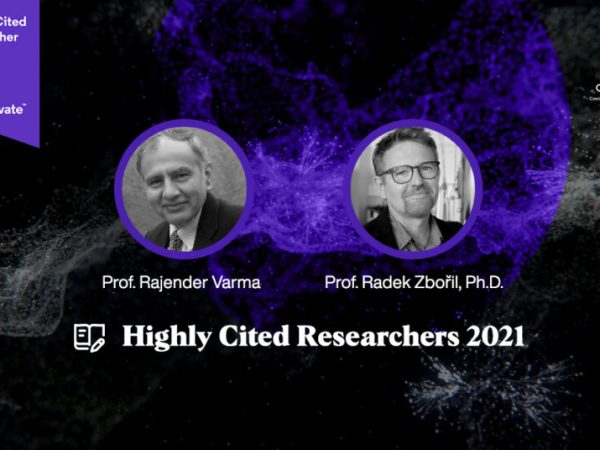
I, Rajender Varma, Highly Cited Researcher
“I could not comprehend the situation where a university picks up on individuals with an extraordinary and sterling performance and basically destroy one of the top European institutions. ” – Raj Varma
And with the German in China, Florian Stadler, and his trusty forger Amit Kumar:
Amit Kumar, Anamika Rana , Changsheng Guo , Gaurav Sharma , Khadijah Mohammedsaleh M Katubi , Fatimah Mohammed Alzahrani , Mu. Naushad , Mika Sillanpää , Pooja Dhiman , Florian J. Stadler Acceleration of photo-reduction and oxidation capabilities of Bi4O5I2/SPION@calcium alginate by metallic Ag: Wide spectral removal of nitrate and azithromycin Chemical Engineering Journal (2021) doi: 10.1016/j.cej.2021.130173



Epileptic spasms of tics and glitches in Krautrock diffractograms
Smut Clyde chases free radicals in a German-run lab in China
Sillanpää has 50 papermilled papers on PubPeer, two were already retracted (Moradi et al 2019 and Lou et al 2015, the latter for plagiarism). Maybe it was too much even for Aarhus, so he had to go? Because he was scheduled to receive a full time professorship (translated):
“Professor Sillanpää is an excellent researcher, and he has proposed a research strategy that aligns incredibly well with the institute’s plans to develop future wastewater treatment. At the same time, it is a strategy that goes hand in hand with the ambitions of both the university, regional water supplies and the entire nation for Aarhus to be an internationally recognized research center for waste water treatment,” says head of department at the Department of Bio- and Chemical Technology, Professor Lars DM Ottosen.
Mika Sillanpää is employed at Aarhus University until January 2022 10 per cent of his time. He will then move with his family from Finland to Aarhus and work full-time at the Department of Bio- and Chemical Technology.”
It was such a smart headhunting move of Aarhus University, because Sillanpää was sacked in 2019 by his Lappeenranta and Lahti University of Technology (LUT) in Finland for fraud, theft, bullying and sexual harassment. A criminal comlaint against Sillanpää was filed already in spring 2020. As Finnish newspaper YLE reported in May 2023 (Google translated):
“According to Yle’s information, Sillanpää had ordered goods for his own use on the laboratory’s invoice, which cost thousands of euros. In addition, he had wrongly invoiced representation expenses, such as tickets to the Savonlinna opera festival. […]
The university dismissed Sillanpää at the end of 2019 “due to a particularly pressing reason arising from the employee”. The justification was a lack of trust that arose from abuse of a superior position, financial abuse and violation of disability regulations.
In the years 2020–2022, the police investigated Sillanpää for sexual harassment, bullying-like employment discrimination and illegal threats. The prosecutor closed the investigation last summer because there was insufficient evidence. […]
After his dismissal, Sillanpää made 17 complaints about violations of good scientific practice. They targeted, among other things, principal Juha-Matti Saksa and graduate students who worked under Sillanpää.”
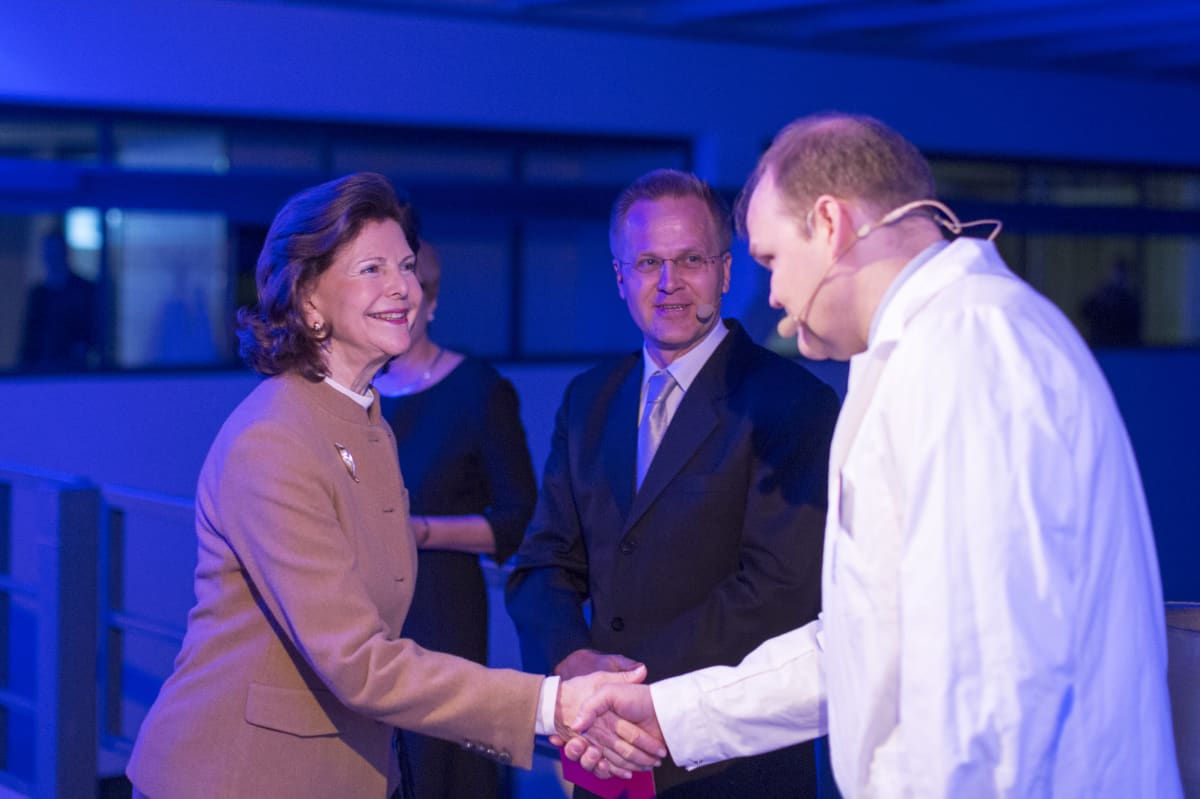
Another YLE article from April 2023 states in this regard:
“In the final report of the investigation team set up by the university, Sillanpää’s complaints are deemed to have been malicious and baseless. According to the report, the purpose has not been to defend scientific integrity. Sillanpää’s actions are described as deliberate, seriously reprehensible and disregarding good scientific practice.
In the university’s reports on the matter, it is stated that Sillanpää’s actions have been particularly reprehensible as they target younger researchers, some of whom have worked under Sillanpää or as his dissertation supervisors.
According to the decisions, Sillanpää’s inappropriate actions have also delayed the graduation of another researcher and made his work more difficult.”
In December 2023, YLE brought a detailed account of Sillanpää’s tyrannical rule at LUT: “the professor demanded loyalty and a hard work ethic, and did not tolerate criticism.” Finnish lab members were physically separated from non-Finns, while he directed his sexually harassment and abuse on visa-dependent non-white female students.
But Aarhus University is OK with that. And they can’t have enough papermill fraud – it brings great money.
The section about Sillanpää was updated on 9.02 and 20.02.2024. A misunderstanding was fixed: Sillanpää is still professor in Aarhus, but they hide him. Also, this fraudster was never professor at Aalto University, but his namesake works there.
Update 3.10.2025
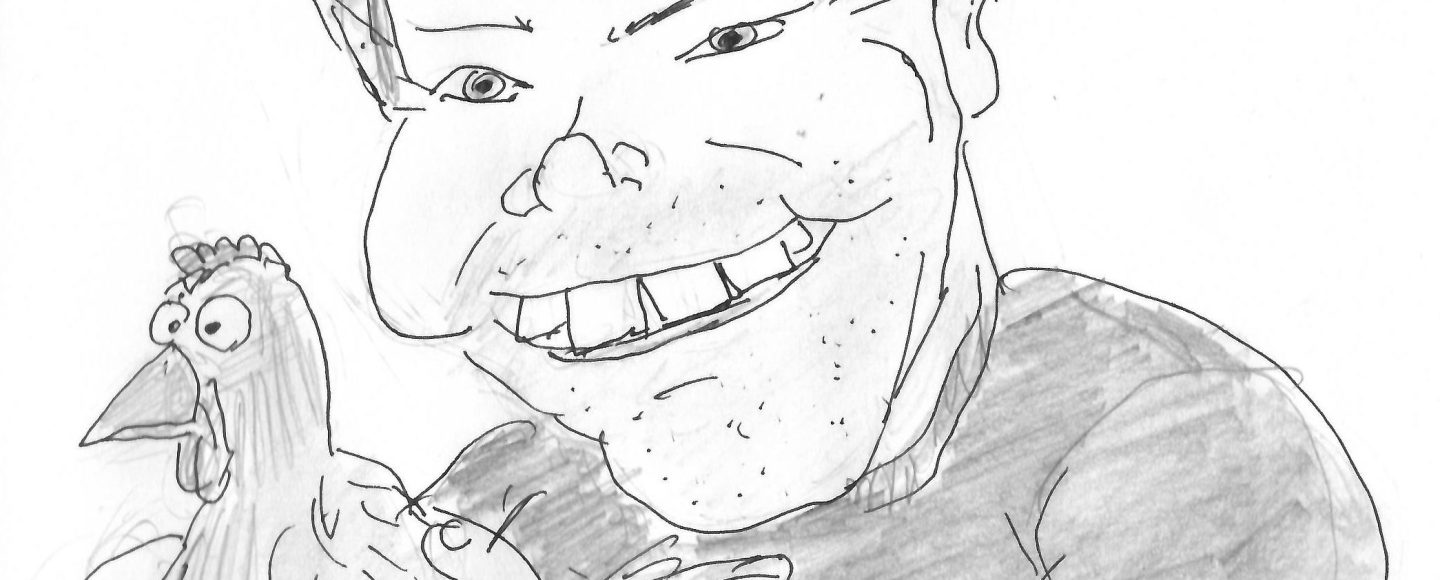
Regular readers might wonder why the previous cover image (a screenshot of the Danish film “Men & Chicken“) was replaced with my cartoon of some Danish man with a chicken. Well, that’s because the Aarhus University tries everything to get this article deleted!
As I wrote in September 2025 Shorts, I was contacted by Aarhus University’s Chief Legal Advisor Gry Bagger seeking to defend the honour of Christian Sonne:
“Please be advised that:
- The use of Professor Sonnes’s image constitutes a violation of his personal rights and data protection laws (including GDPR).
- Such use is not covered by any “fair use” or citation exception, as a portrait photograph does not fall within the scope of scholarly citation.
- Continued publication of the image without authorization exposes you to liability, including but not limited to:
- Formal complaints to data protection authorities,
- Civil claims for damages and injunctive relief,
- Possible reputational consequences within the academic publishing community.
We therefore demand that you immediately remove Professor Sonnes’s photograph from all online platforms and any printed versions.
In addition, please note that we are currently reviewing our position with regard to the manner in which Professor Sonne has otherwise been cited and subjected to what we consider to be intimidatory treatment on your site. We reserve all rights in this respect.”
Since I failed to comply, Aarhus University went to the Danish film production company which made “Men & Chicken” (a horror comedy so unhinged and sick it befitted to illustarate that university). Thus a representative of M&M Productions wrote to me on 2 October 2025:
“I´m contacting you because we have discovered that photos from our film is used in a article on your website. You have no permission to use the photos and could you please remove them asap.”
Well, I hope Aarhus University and Sonne enjoy the replacement. In July 2025 Shorts, I wrote about Sonne’s first retraction, maybe more are expected?
Donate!
If you are interested to support my work, you can leave here a small tip of $5. Or several of small tips, just increase the amount as you like (2x=€10; 5x=€25). Your generous patronage of my journalism will be most appreciated!
€5.00

 For Better Science
Great investigation and efforts. Kindly note that reviewers were possibly independent. A conflict of interest with editorial cannot be taken as a reason of an unethical article. Editors even publish in their own journals with independent reviewers.
LikeLike
“independent reviewers” just like the independent election observers in russia and occupied Ukraine, dear visitor from st petersburg?
LikeLike
This fella will definitely open a door at night to a stranger with a knife. Because why not get some help in cooking a late dinner?
LikeLike
Dear colleagues, please dont get me wrong. As I said it is a great report following your great operation on Pubpeer. I am just saying the flagged articles might not be necessarily unethical according to the publishing ethics. All the articles seams to be ok from integrity point of view. Also Mr. Magazinov published in a few local low quality journals that he has conflict of interest with. Before he leaves the academia I challenge him to publish in a decent journal.
LikeLike
I challenge you to stop wasting my time, russian troll. Слава Україні. Смерть ворогам.
LikeLike
Actually it is, it is against the rules from Elsevier itself: https://www.elsevier.com/editor/perk/undisclosed-conflicts-of-interest , you have to disclose this conflict of interest.
LikeLike
What an incredible journey is reading this piece. Hopefully noone will ever say again papermills and trash science mainly come from Asia or other “bullshit countries”. Recent cases at top US, Canadian, British and German institutions prove it unequivocally. And now the Scandinavians even!
LikeLike
“Even the Scandinavians”? I’m really sorry for this analogy, but I must point out that they are currently the rectum of European science, famous for opening their doors and promoting papermill scientists without question. Note: I did not use the expression rectum as an insult. It has a very important place for the human body. This much dirt has to come out of a small hole so we can survive, right?
LikeLiked by 1 person
Wait a minute what? You reported the situation to the university, and then a very special consultant responded to you by saying ‘we are processing this job’. They then asked you to share everything as a PDF document along with your contact information. As you did choose not to share your contact information, they dismissed the case but continued to be white arrogant “You know what? As a country we have laws against research misconduct because we have ethics. We have a law that seems to be very good, but useless at all unless you sacrifice yourself with your contact information. By the way, please sacrifice yourself with this case because we have many papermill scientists. You caught only one or few of them. If you don’t sacrifice yourself, this means you can catch others too. So please share your contact information and sacrifice yourself. We promise we will solve this case. We are Danes. We are proud of our contribution to the research. We are good, we are damn good. Please don’t blame us for being irresponsible.”
Denmark… With a large number of papermill researchers in a small number of universities, it is perhaps the country with the highest ratio of Papermill researchers per student in Europe. Oh, sorry, it is also one of the happiest countries in Europe, isn’t it? With no doubt they are happy. They pollute not only their own academies but also European academies, European funds and international scientific journals and do not take any responsibility. Anyone would be very happy. My humble advice to FBS is, please stay away from Denmark. There are more Papermill researchers you will find, but in the end nothing will happen. While they continue to be happy, you’ll just say “hey, that’s not fair.”
Btw, good catch of corrupted journals under Elsevier brand. Chemosphere is a nice catch.
LikeLiked by 2 people
I can’t believe it ! Aarhus just does not seem to care at all! I wonder if anything will change after this article. Perhaps some of us should contact the entire board of the Danish Board on Research Misconduct (https://ufm.dk/en/research-and-innovation/councils-and-commissions/The-Danish-Board-on-Research-Misconduct/members/members)
I hope some (Danish) journalists picks up this story and publishes something about it.
LikeLike
O.B., have you contacted that board before? In one of the network of relations that I have identified, there is Denmark, Canada, Sweden, and Iran. I mentioned it in the comments on the first post of the Karimipour Saga series:
If this Danish board is made up of people who do their job well, I would like to report to them about the Iranian citation and paper cartel in Denmark. I still don’t know who to contact for the ones in Canada and Sweden, but if the Danish board is working, at least I will have a chance to report.
LikeLike
Hmm. In the past, I’ve published in both Science of the Total Environment and Environmental Pollution. I’d been thinking of sending a current Ms. in prep to one or the other of those journals … are they really that bad in terms of fraudulent papers, or are these unusual problems? and if they really are that bad, where is better – are there any journals/publishers which don’t suffer this kind of infiltration by bogus articles?
LikeLike
Yes, they are as bad as it gets. Just check the content there – you don’t need me or anyone else as a guide.
At this stage I’d hard avoid any journal in this field published by Elsevier, Springer, Wiley, even RSC and ACS. Hindawi / MDPI / Frontiers are still worse. Maybe Oxford / Cambridge Uni Press? At least I have nothing from them on my radar, but perhaps they don’t have compatible journals whatsoever?
Otherwise, you might be pretty much in the situation: either you publish in the top journals (Nature / Science for you), or the rest of your choices are quasi-predatory. Once I realized that is the case for me, I simply left the academia.
LikeLike
many thanks for your quick response –
“Yes, they are as bad as it gets”
genuinely disappointed to hear this, and more so that you also implicate ACS and RSC – e.g. I’ve always thought of Environ Sci Technol (an ACS journal) as publishing really solid work with high standards. Will have to consider carefully. Thanks again for your response.
LikeLike
FYI: Hassan Karimi-Maleh has been removed from the editorial board of the journal Ecotoxicology and Environmental Safety from Elsevier because of his fraud. His papers are now under investigation.
LikeLike
FYI: Su Shiung Lam has been removed from the editorial board from Elsevier Journals because of his fraud.
LikeLike
Hebrick, do you have more information which journals kicked him out? Good to hear that Elsevier started to kick these fraudulent editors out!
LikeLike
He has an impressive publication track record: https://scholar.google.com/citations?hl=en&user=7J3mIw4AAAAJ&view_op=list_works&sortby=pubdate ; it is very obvious he is a paper miller! However, his pubpeer record is still limited: https://pubpeer.com/search?q=Meisam+Tabatabaei. I guess someone needs to check more of his papers!
LikeLike
Not just Tabatabaei. Many Iranian researchers are doing similar work in many Western countries. The interesting thing is that the academic abuses of these people are very obvious. But no one makes a sound. When someone speaks out, this is called xenophobia or Iran phobia. But how will all this papermill and citation fraud be stopped?
It is as if there is a secret Iranian diaspora that protects these researchers both in the West and in the East. Because an Iranian papermill in the West and an Iranian papermill in the East can establish a very comfortable network. Please look at Omid Mahian whose name is mentioned in the article! An excessive number of articles are being published with Iranian researchers from many different countries. Even funnier, Omid Mahian also teaches us how to quote: https://pubpeer.com/publications/8494BA2705EBC7B1F35BA5DDDE4576
LikeLike
There was a comment about Meisam Tabatabaei (who is indeed a fraud, one of the many) from someone.
The initial commentator’s IP belonged to a familiar range. There is little doubt that their goal was to achieve a whitelisted status, then to unleash the usual crap. We therefore removed the chain of comments.
Tabatabaei’s Google Scholar: https://scholar.google.com/citations?user=7J3mIw4AAAAJ.
LikeLike
Not entirely sure you are referring to my comment ? I seem to remember that I wrote that he still has a rather ’empty’ pubpeer record. But this was more to my surprise as indeed it is very clear he is a fraud too (I think I even mentioned this). So I was not trying to ‘whitelist’ him at all. I actually added about 5 or more papers yesterday from him to pubpeer in order to increase his ‘status’ there as it is very obvious he is a fraud.
If you are referring to other comments (chain of comments) than I have no clue about what it was as I never saw them.
Anyway, I’ll be having some fun with checking more of his nonsense papers. It is truly amazing how this paper mill keeps spreading and spreading.
LikeLike
No, not yours. Something called “Max Amini.”
LikeLike
There is yet another YLE article on Sillanpää, from December 2023.
Finnish original.
Google-translated.
Via Zahra Safaei @ LinkedIn.
LikeLike
He even has a Wikipedia page! Too bad only in Finish, but it does talk about his bad behavior.
https://fi.m.wikipedia.org/wiki/Mika_Sillanp%C3%A4%C3%A4
LikeLiked by 1 person
People might be interested in these 2 papers from Jörg Rinklebe where they used human tissue samples (hair) without any ethic statement! To make things worse, they even took samples from 2 year old ones!!
https://doi.org/10.1016/j.envint.2023.108177
and
https://doi.org/10.1016/j.scitotenv.2022.158635
LikeLike
Thanks, I will add this to my notification to University of Wuppertal
LikeLike
You might want to check out the Humboldt Foundation as well. They supported this fraud. They are in the acknowledgments of both papers and I doubt they are aware their money is being used to support this type of BS.
LikeLike
You might want to check the Humboldt Foundation as well (and contact them). They are mentioned in both papers in the acknowledgment. I doubt they are aware of their funding being used for this type of nonsense. (could be double post, something went wrong trying to post this message)
LikeLike
Already contacted
LikeLike
there are many more “issues” within jorg rinklebe
LikeLike
It seems that Jörg Rinklebe deserves his own article. Some people compiled a list of potentially problematic papers where authors and editors are linked. Check it out here: https://www.researchgate.net/publication/378830384_Citation_Rings_Inflating_Impact_Undermining_Integrity
LikeLike
When you submit this to a journal, do suggest Pau Loke Show and Christian Sonne as reviewers!
LikeLike
Not sure Show still has time for an extra review given his very busy shedule!
https://imgur.com/RT4VSXt
https://imgur.com/QlkHv4V
https://imgur.com/68juSMH
LikeLike
Christian Sonne published his first corrigendum: https://www.sciencedirect.com/science/article/pii/S0959652624013118
LikeLike
Not the first corrigendum for Sonne (there is an earlier one, look no further than this very post). But yeah, it’s spectacular.
LikeLike
Someone is going to submit a (more in depth and non-anonymous) report to his university about his fraud. Perhaps this will help. I really do not understand how these papermill authors keep getting away with corrections. I have seen corrections that pretty much change the entire paper.
LikeLike
A paper from Rinklebe without an ethic statement got a correction: all of a sudden they have an ethic statement: Corrigendum to “Potentially toxic elements exposure biomonitoring in the elderly around the largest polymetallic rare earth ore mining and smelting area in China” [Sci. Total Environ. 853 (2022) 158635] – ScienceDirect
LikeLike
In which we are not entitled to know a reference number, of course.
LikeLike
Or the date when Rinklebe’s ethics approval was issued.
LikeLike
Christian Sonne might start to feel the heat a bit…. One of his paper mill garbage papers just got an expression of concern: https://www.frontiersin.org/articles/10.3389/fenrg.2021.684234/full
LikeLike
The Belgian university Ghent still loves Rinklebe! And Tsang & Alessi, also part of the same paper mill network. A shame they didn’t invite Sonne! https://event.ugent.be/registration/event/3f1ac280-12fa-4614-842c-5ee755ea2ed3
LikeLike
Oh dear. A Papermill Workshop by Rinklebe and friends,
“Funded by the European Union through the IMETE master programme with support from the Flemish government”
LikeLike
Pau Loke Show got 3 retractions (so far) today: https://doi.org/10.1016/j.chemosphere.2023.138152 ; https://doi.org/10.1016/j.chemosphere.2022.133596 and https://doi.org/10.1016/j.chemosphere.2022.135625. All in Chemosphere. More to be expected. He has 11 retractions so far. There was also a retraction where he was an editor for his former PhD student Kit Wayne Chew: https://doi.org/10.1016/j.chemosphere.2021.130092. When will Rinklebe and Sonne start to get retractions?
LikeLike
Never. They are WHITE.
LikeLike
I refrained from adding this to my message… I considered writing: or would they be protected by their European univeristy, being European getting less chances or retractions….. I guess you somewhat confirmed that indeed this is an option. I do suspect they will suffer some retractions, but it is indeed odd it is taking a lot longer.
LikeLike
Christian Sonne just got his first retraction: https://doi.org/10.1016/j.envres.2023.117474
LikeLiked by 3 people
Good to know what Sillanpää is up to. Great post, as always. Just one little detail that isn’t really relevant to the subject, but still worth noting: Silvia is queen of Sweden, while Finland is a republic 😅
LikeLike
Another retraction of a paper authored by Christian Sonne, details at https://pubpeer.com/publications/39A7F1D8CEAFBD93C22DD7D46AE00E
LikeLiked by 1 person