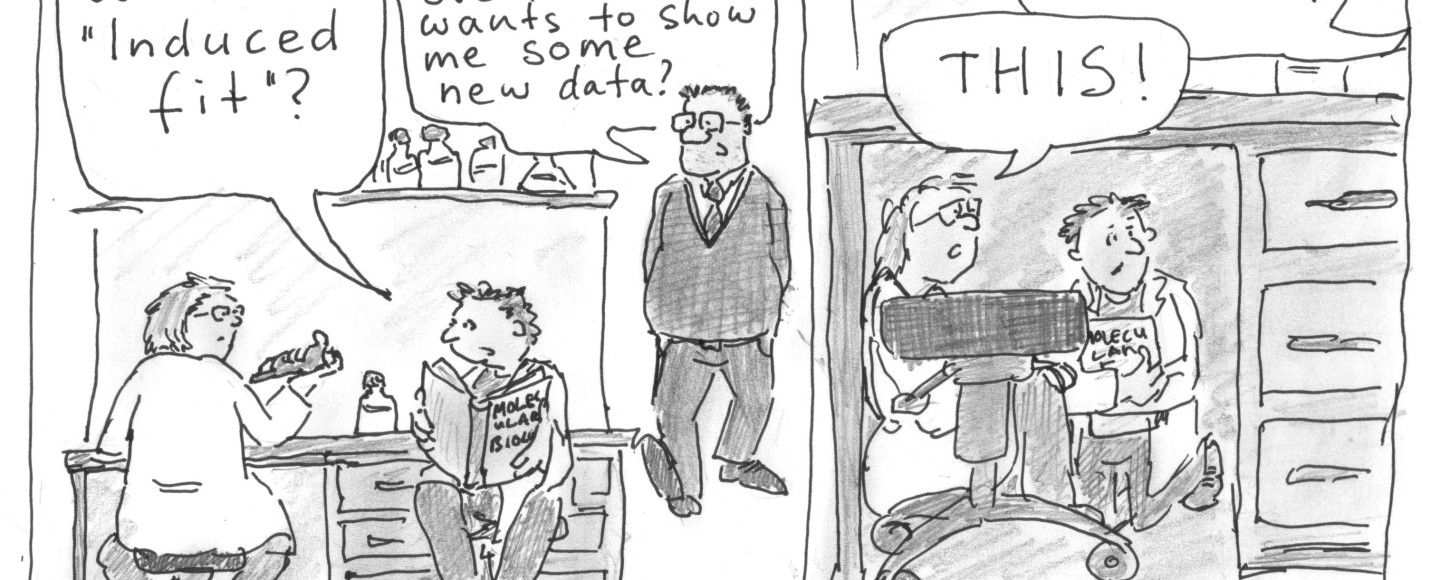

A horrible, horrible conspiracy befell Spain. Worse than anything you can imagine: Carlos Lopez-Otin, a star of cancer and ageing research from the University of Oviedo, was forced to retract EIGHT papers in the Journal of Biological Chemistry (JBC), right after he retracted a very important paper in Nature Cell Biology. Spanish elites cry foul, and point accusing fingers at the evil deed by JBC, and of course also at yours truly, without naming me, for my “virulent and libellous attacks” on poor Carlos. A letter signed by 50 Spanish researchers was sent to JBC trying to dissuade the journal from retracting the 8 papers. The ringleader here appears to be a certain Juan Valcarcel of CRG in Barcelona, and I shall use this occasion to release the 3 incompetent investigative reports Valcarcel commissioned in 2015 to whitewash his CRG colleague, the Italian zombie scientist Maria Pia Cosma.
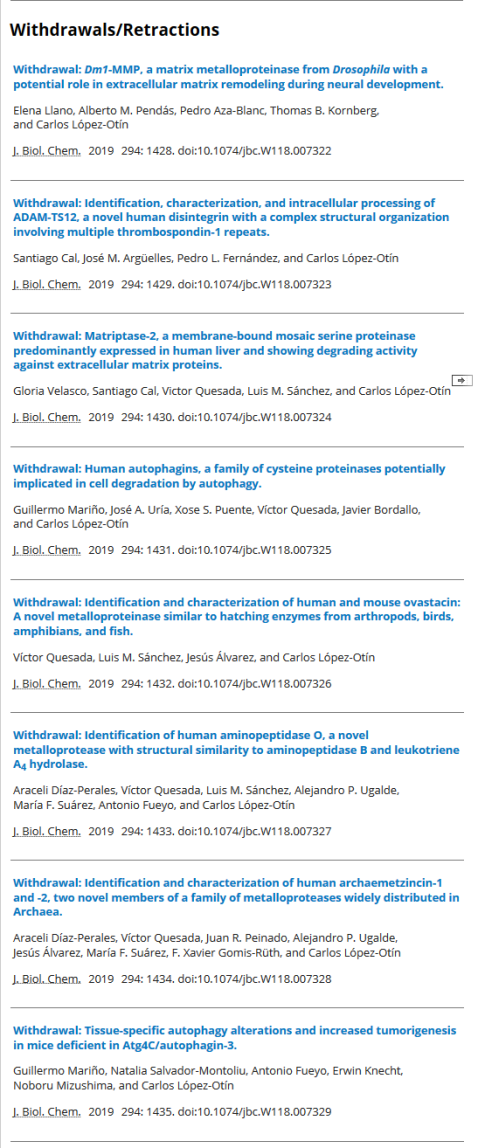
All 8 Lopez-Otin retractions in the JBC issue from January 25th 2019 are similarly worded: some image data was found inappropriately manipulated or duplicated, after the journal used the occasion to scrutinise all the papers the Oviedo lab published there. Original data was not available, so the authors were asked to withdraw their papers. After which Lopez-Otin and his friends took to Spanish media to decry the injustice perpetrated by JBC.
Whitewashing Inc
The whole circus is somewhat similar to what happened in France, in the Catherine Jessus case, where another top-rank biologist became victim of my reporting and of PubPeer data analysis campaign instigated by my readers. Also in France, there was a whitewashing investigation, and a signature campaign in support (read here). The differences are: French newspaper Le Monde played a key part in uncovering the affair (and got huge flak for it), while Spanish media chose to leave the podium to Lopez-Otin and his supporters, largely unchallenged. Main difference however is: Jessus never hat to retract anything, the journals blinked and issued passive-aggressively worded corrections only.
JBC however has a different stance on data manipulation, and is unafraid to do mass-retraction if they see either excessive fraud or a pattern of recurrent data manipulation from the same lab. This happened to several other researchers, Rony Seger, Yehiel Zick or Samson T Jacob. When only one paper is found manipulated, it may be bad luck, a rogue student, the journal will issue a correction. Otherwise, it gets progressively more and more suspicious, especially if the only common name on these 8 papers is that of principal investigator, here Lopez-Otin.
Apparently in Spain (similarly to France), the elites of science are either too crooked or too incompetent to understand this. So here comes a statement from the University of Oviedo, via its president, Santiago García Granda, from 28.01.2019, as announced in the local newspaper Asturias Mondial:
“Given the press reports about the recent withdrawal of several articles by the group of Professor at the University of Oviedo, Carlos López Otín, we as the institution express our full support for this research, his team and his work. The group of Professor López Otín has collaborated with publishers by providing all required information and kept the academic authorities informed at all times. Our support is based on the findings from an investigation conducted by the Ethics Committee of the University of Oviedo, and the analysis of the articles retracted from the Journal of Biological Chemistry by an expert group of Spanish scientists which sent its conclusions to the University.
These findings support the scientific validity of the published results despite the deficiencies found in some of these studies. The evidence analysed confirms the reliability of this research, as multiple studies by independent laboratories later corroborated it, based on the cited work. As mentioned in the statement of the Institute of Oncology, “reagents generated in these works, including plasmids, recombinant proteins, antibodies, etc., as well as the valuable animal models developed in this laboratory, have always been shared with dozens groups worldwide, allowing validation of the results described in numerous publications by international laboratories. In fact, many of the work done by this group has opened up new lines of research, up to now.”
In any case, the University of Oviedo reserves the right to take legal action to preserve the good name and reputation of our institution as well as to defend the honour and the reputation of the members of our university community, and to allow them to practice their scientific investigations, teaching and management”.
I am not sure whom the University of Oviedo meant to threaten here with legal action? Myself? I had this before, from another fake clown of a rector in Italy, Giorgio Zauli, and again from France, and that time it was the Government itself, on behalf of minister Frederique Vidal and her Ministry of Research and Innovation.
If only Spanish biomedical elites could be interested in doing something about real injustice. Like, to call for an investigation of patient abuse and deaths caused by Paolo Macchiarini in Barcelona. This was where I actually was sentenced in court for, so maybe Lopez-Otin’s university and his Instituto Universitario de Oncología in Oviedo did speak of Macchiarini as another victim of mine, when their present and two past directors wrote in this press release (which was already quoted above):
“There have been very virulent and libellous attacks in some social networks, whose goals are completely away from constructive criticism and scientific debate. “We are facing a very complex media situation where attacks which compromise the activity of several research groups are carried out with impunity and whose main victims are leaders of groups with high research activity”.
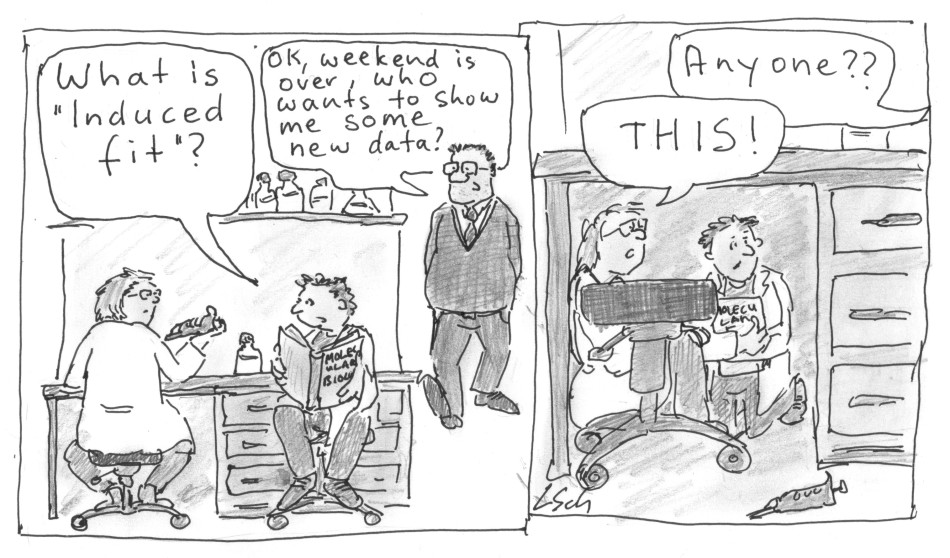
Save-Our-Carlos Letter
Now even the regional Government of Asturia expressed support for Lopez-Otin, because in Spain they do not separate between scientific and state issues. If this gets out of control, Spain might even send war ships to bomb the offices of JBC and the American Society for Biochemistry and Molecular Biology:
“Also, the Minister Fernando Lastra, who spoke at the press conference as spokesman of the Governing Council, pointed personal relationship of the Asturian President, Javier Fernández, with the researcher so their support is even a “little beyond “the expression of recognition of their work by the Governing Council.”
Before that, we had the Ethics Committee at University of Oviedo whitewash Carlos-Otin, assisted by some unnamed external investigation, and finally, there was a letter to JBC signed by 50 scientists, as reported by El Mundo.:
“Fifty Spanish scientists also asked the journal not retract the papers completely, but to allow the correction of errors. But they found a ‘no’ for an answer.
“Mistakes must be corrected, but the retraction of the articles does a disservice to science,” says geneticist Juan Valcarcel, one of the scientists who has defended the work of Otín and coordinated the appeal to the journal.
“The detected errors do not affect in any way the research findings, which have been validated independently on multiple occasions and have served as a basis for further work as the development of animal models for understanding cancer progression. Nobody doubts its validity, ” says the researcher.
Beside him, the letter was signed by first class personalities in the field of science such as Margarita Salas, professor Ad Honorem Center Severo Ochoa Molecular Biology; Manuel Serrano, researcher at IRB Barcelona; Elias Campo, scientist at the Institute of Biomedical Research Pi i Sunyer Augus Barcelona; Cristina Garmendia, former Minister of Science; López-Barneo José, Institute of Biomedicine of Seville and Juan Bueren, Center for Energy, Environment and Technology in Madrid, among others.”
It is actually an exorcise in nepotism. Margarita Salas, the grand dame of Spanish biology, trained by the revered Nobelist Severo Ochoa, is herself the doctorate mentor of Lopez-Otin. Manuel Serrano is another star of Spanish life science, who also did PhD with Salas. His ex-wife is Maria Blasco, who is a regular coauthor of Lopez-Otin and another graduate of Salas. So is the signatory politician Cristina Garmendia, who is also a personal friend of Lopez-Otin since their common time in university. Elias Campo is Lopez-Otin’s co-author and has his own PubPeer record. Elsewhere Juan Bueren is mentioned, another newspaper names Jesús Ávila as a signatory, guess under whom he did his PhD? Exactly, Salas.
Salas is appalled by my and my readers’ behaviour: “I do not know who or how many are behind this, but have done unnecessary damage“, she also explained how to think properly of her Carlos and his data manipulations:
“For me he is, if not the best, one of the best researchers we have in Spain. Without a doubt, one of the most brilliant scientists. He has all my confidence, my support and my respect. His career is absolutely flawless”
The Maria Pia Cosma affair
But I would like to go back to Juan Valcarcel of CRG in Barcelona, the instigator of that letter to JBC. It is not the first time Valcarcel engages in whitewashing activities to help a colleague caught with manipulated data. I interacted with Valcarcel in 2015, on the affair of the CRG group leader Maria Pia Cosma, who story I later presented in this article. The issue was an “investigation” Valcarcel commissioned to declare that all those obviously duplicated bands in Cosma’s papers from her previous stints as PhD student at the infamous Università di Napoli “Federico II” in Italy and as postdoc at the Institute for Molecular Pathology (IMP) in Vienna, Austria, were actually never ever duplicated.
These were the three papers:
Cosma MP, Cardone M, Charlemagne F, and Colantuoni V. (1998). Mutations in the extracellular domain cause RET loss of function by a dominant negative mechanism. Mol Cell Biol , Vol. 18 (6) :3321-9
Cosma MP, Panizza S and Nasmyth K (2001) Cdk1 triggers association of RNA
polymerase to cell cycle promoters only after recruitment of the mediator by
SBF. Molecular Cell, Vol. 7 (6): 1213-1220
Cosma MP, Tanaka T and Nasmyth K (1999) Ordered recruitment of transcription and chromatin remodeling factors to a cell cycle and developmentally regulated promoter. Cell ,Vol. 97 (3) : 299-311
These are the three investigative reports, here, here and here. Back then, I presented the excerpts on PubPeer for debate, see thread here.
The expert was in all three cases Josep Manel Rodríguez Sánchez, Senior Engineer in Computer Science from the Universitat Politècnica de Catalunya. In the nutshell: whenever the expert found one single pixel difference between two bands, he used it as evidence to declare them as utterly unrelated. In detail, this was his methodology:
“Steps I followed:
1. Obtaining the original images published in the different articles with the highest possible quality. To do this, I downloaded the published article PDFs.
2. Visual Analysis: the first step was to determine visually if there was cause for a more
detailed examination. For this I used the best possible images that can be obtained. Specifically, I obtained the digital images contained in the cell.com website where the article was published.
3. Forensic Analysis: If necessary, the second step involved the forensic analysis of the
images to determine if the reasons of the comments were valid or not, or whether there
were additional evidences that might be detected.
This forensic analysis was performed with computer tools for the treatment of images,
basically the Adobe Photoshop version 2014 of which I have the corresponding
authorization for use. “
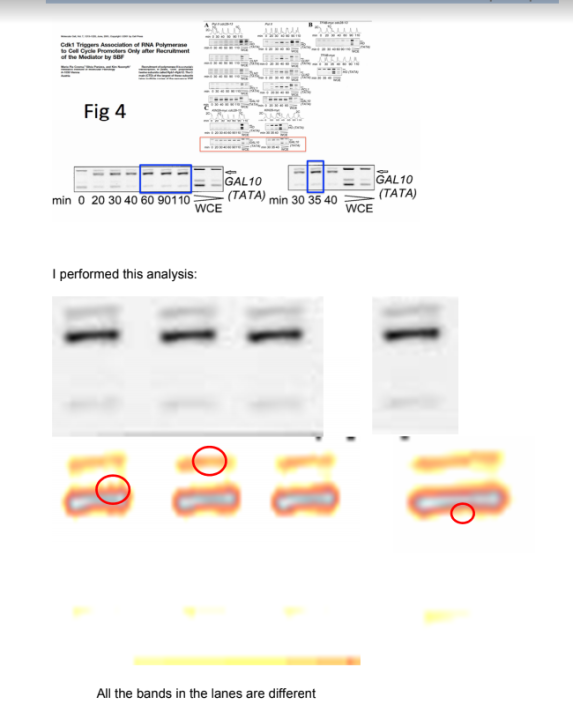
This is an embarrassing approach from an IT expert, who should know how compression works. If a gel band is digitally duplicated in an image, and the image is then compressed into a pdf, tiny pixel differences are bound to be discovered if you only search long enough. But these papers were done actually in pre-Photoshop days, and the bands are not likely to have been digitally duplicated. Back then, thermoprinter images from the gel camera were printed out, re-photographed and sent to the journal as figures. Another scientist, Heike Lange, recently had together with her former PhD advisor Roland Lill to correct a paper from around same time, after she admitted to having inadvertently printed out too many copies of the same band and collaged them together into one continuous western blot image. With such “analogue” duplication with print-outs, scissors and glue, there are bound to be even more pixel dissimilarities, even if otherwise bands look identical and neatly superimpose.
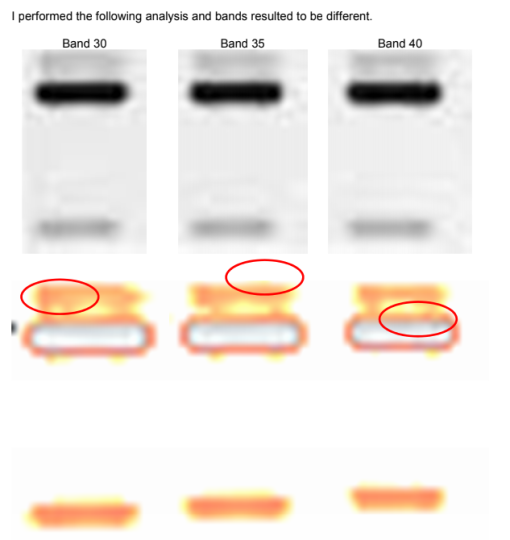
Valcarcel explained to me in May 2015:
“While we are not ourselves experts in forensic analysis, the expert, who as you know was designated by the Official College of Computer Engineers of Catalonia, and whose reports are legally recognized (e.g. in a court of law), has stated that he took into account possible compression artifacts and used the best images available. Unfortunately records of original data are not available for the majority of the claims.”
I approached Sanchez with some of the criticisms his methodology met on PubPeer. This was how he replied back then:
” in deference to you and to CGR I have no objection to clarify that the images they use for the issuance of the report, as indicated in the are of the highest possible quality, in the following order:
* Original picture extracted from the documentation hanging on the web ( powerpoints and images )
* Extracted image of the PDF.The majority of the images were of the original powerpoint and in very few cases use images extracted from the pdf.
All it is known that the extracted image of the PDF may suffer some variation in the conversion process. I followed the recommendations of Dr. John Krueger from ORI ( The Office of Research Integrity ) in this aspect and perform the appropriate actions at the time of the analysis. I recommend the reading of a report published by Dr. Krueger (https://www.aclu.org/sites/default/files/assets/krueger_affidavit.pdf) for more details on the subject as well as tools and techniques that I have gleaned from the website of the ORI (http://ori.hhs.gov/advanced-forensic-actions ). In any case, try at all times avoid the effects of compression and compare images among themselves to the extent possible. “
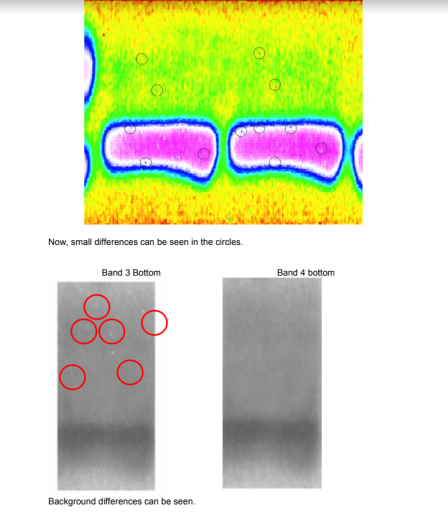
In July 2015, Valcarcel wrote to me:
“The forensic analysis of the expert assigned by the Official College of Computer Engineers of Catalonia is considered professionally and legally valid. Given this report, the absence of primary data and the corrections issued or in process in various Journals, we have decided to close the case.”
Just days after this email, Cell issued this editorial note (which I covered in my article at that time):
“Concerns about duplicated images in Cosma et al. (Cell, 1999) and Cosma et al. (2001, Mol. Cell 7, 1213–1220) were brought to our attention by a reader. We, the editors of Cell and Molecular Cell, have investigated the matter, communicating with the corresponding author, Dr. Kim Nasmyth; the first author, Dr. Pia Cosma; The Research Institute of Molecular Pathology (IMP), where the research in question was conducted; and the Center for Genomic Regulation, Dr. Cosma’s current institute, which conducted its own investigation. The IMP located Dr. Cosma’s notebooks and provided her with high-resolution copies. As part of our investigation, Dr. Cosma brought those copies to the Cell Press office, where we went through them with her, identifying data for the figures in the paper. The notebooks contained original images, alternate exposures, and/or replicate data for most of the figures in the papers, providing support for the reported findings. In a few instances, original data could not be located, making it difficult to assess the concerns raised about those specific data panels.
While we understand the reasons that the figures in the paper were flagged by the community, in our judgment the burden of proof for determining inappropriate data handling or image duplication has not been met. Furthermore, the available original data support the findings of the papers. With these things in mind, based on the information available to us at this time, we have decided not to take any further action. This statement is to notify the community of our investigation and findings”.
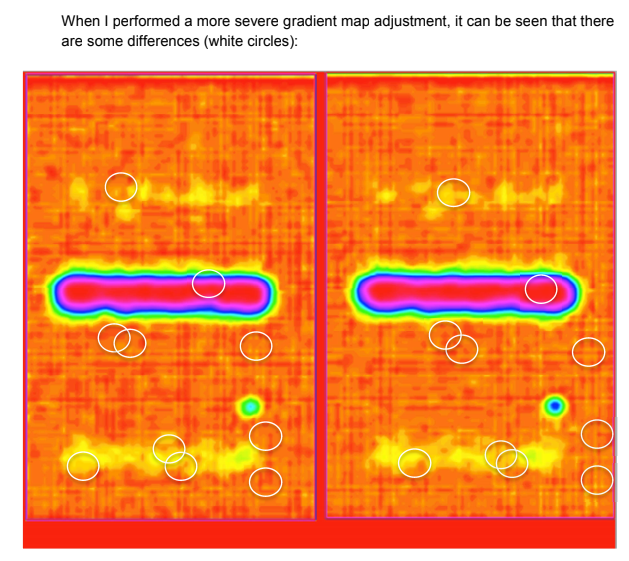
Valcarcel’s bullshittery, combined with the impressive fraud tolerance of Cell editor at that time, Emilie Marcus, as well as IMP’s obvious reluctance to damage their former director Kim Nasmyth, proved successful. The gel bands which most obviously look duplicated where proven to be not duplicated exactly because original data was available, though not specifically for these questioned figures.
Again, these are the three investigative reports, here, here and here.
Such a success story apparently prompted Valcarcel to try it once again (he even compares Lopez-Otin to Christopher Columbus here). Only that JBC is exactly the opposite of Cell in research ethics, and apparently unafraid of bullshitting bullies like Valcarcel. He now looks very silly now. Serves him right.
And his friend Carlos? Hiding in Paris, with another dishonest elite scientist Guido Kroemer; one wonders if the “sabbatical” is paid from Lopez-Otin’s ERC grant. Maybe his wife Gloria Velasco (professor at the same department) continues supervising his research in the Oviedo lab. Soon the convalescing Spanish victim of persecution will be visiting the Galapagos islands, as his son tweeted. Not sure if Kroemer and/or his charming co-author, Laurence Zitvogel, will be joining Carlos there.
Update 4.02.2019. Events happen quite fast, if you want to keep track, follow my comment section and tweets. In particular:
- Some months ago, almost 6000 of Lopez-Otin’s transgenic mice had to be culled due to a mysterious infection.
- Right-wing newspaper El Comercio and the rector of Oviedo fingered certain Oviedo scientists as masterminds behind my reporting, these claims are made up, I never had any sources in Spain
Donate!
If you are interested to support my work, you can leave here a small tip of $5. Or several of small tips, just increase the amount as you like (2x=€10; 5x=€25). Your generous patronage of my journalism will be most appreciated!
€5.00

 For Better Science
I wonder if Prof. López-Otín’s defenders have really read the JBC retraction notices. It’s not a question of the unacknowledged reuse of an Actin control band, or anything trivial and easily corrected. I was looking at the relevant PubPeer threads, and it is undeniable that results were fabricated. Lanes were duplicated. Parts of lanes were copied and pasted elsewhere. Splice lines were smeared out with rather clumsy Photoshop. These were not the work of an envious outsider or conspirator working to blacken López-Otín’s reputation.
So I can sympathise with the JBC editors. If they had noticed these fabrications at the time, they would not have accepted the manuscripts. It seems reasonable to unpublish them now that they have become aware of the issues. If the authors have repeated the experiments, and have better data, then fine, they can submit a new manuscript.
Anyway, someone in López-Otín’s lab was forging results, 15 years ago. The ideal response at this point would be to find out who was responsible (one person or several), and determine whether they stopped – because otherwise there could be other fake results polluting the scientific record, not yet exposed. Then everyone can get on with their work.
The ideal response is not to hunt for whistleblowers, or blame everything on an outside scapegoat.
LikeLike
Anyone know Spanish for “hoist by his own petard”?
LikeLike
Pingback: Inspector Voinnet, Wollman in fraud-overdrive, and Farewell to Jessus – For Better Science
I am slightly disappointed by the response of some of the Spanish scientific establishment.
Although Spain exhibits about the same level of fakery as Italy
I used to think that Spain was attempting to clean up its act, whereas Italy makes no efforts.
Evidence for this were:-
retractions of work by Susana Gonzalez,
with the caveat that Manuel Serrano still has problematic data he needs to correct, or retract.
https://pubpeer.com/search?q=manuel+serrano
Retractions from Dunach, Barcelona (Catalonia is not a cut above the rest of Spain),
That a Catalan kingpin was coming into view at Pubpeer.
https://pubpeer.com/search?q=cordon-cardo
Retraction: https://mcb.asm.org/content/37/18/e00365-17
A naive belief that Spain was not mafia-ridden, and that Spain has a Royal Family, which might give national example of ethical behaviour (I am not an avid reader of Hello magazine).
I was wrong.
LikeLike
Present Queen of Spain is from Oviedo. Sooner or later this episode will reach her ears.
https://en.wikipedia.org/wiki/Queen_Letizia_of_Spain
LikeLike
https://www.europapress.es/asturias/noticia-asociacion-transparencia-pide-explicaciones-claras-rigurosas-universidad-oviedo-otin-20190205165412.html
“Asociación para la Transparencia pide explicaciones claras y rigurosas a la Universidad de Oviedo y a Otín”.
“Association for Transparency calls on University of Oviedo for clear and rigorous explanations Otín”
“Consideran que el ‘cierre de filas’ que se está produciendo puede generar más dudas”
“They consider that the ‘closing of ranks’ that is taking place can generate more doubts”
LikeLike
These problems should be liftet to a higher level. The Ministry of Science, innovation and universities should be more responsible in order to improve the culture in spanish research institutes and to increase the trust and reproducibility.
Research misconduct is very costly for the society, it slows down the scientific progression, which will affect the development of new drugs and patient safety in a negative way.
For that reason, politicians should take action for the best of science and society.
However, due to the high corruption level among spanish politicians, my expectations are not high…
LikeLike
Every conservative Spanish Government has Opus Dei members in its ranks, sometimes the entire government is run by Opus Dei (cf José María Aznar). Every single Spanish university has Opus Dei people in high administrative positions. Many prominent scientists also have Opus Dei connections, direct or indirect.
In this regard, I wonder if any of my Spanish readers can find records to the Antonio Brugarolas-Mario Gosálvez-Norgamen scandal which took place in Asturias in 1980, since all information that used to be on Internet about it has been eliminated? It took place in Hospital General de Asturias, involved massive research fraud with fake cancer cures, bans form publishing in certain journals… and exorcism. Yes, Exorcism of the Devil, done by hospital head clinician, Jiménez-Lacave and Opus Dei on Gosalves.
LikeLike
Pingback: Boycott Elsevier, passim - Ocasapiens - Blog - Repubblica.it
“We need to talk about systematic fraud”
https://www.nature.com/articles/d41586-019-00439-9
LikeLike
Nature with an editorial on fraud. Good one.
LikeLike
To Mr.Schneider and Mr.Owlbert: I apologize for my ignorance in some issues. You can noticed that I am not a scientist myself.
I don´t understand that if you get the (good) data first (so you can post them in a panel in a conference) you cannot publish first .So is the problem here fake data from other (good)sources?. If that is the case, which are these sources?.Why they don´t speak up?. Your response is inconsistent with Mr.Olbert suggestions (or the other way around) about the death of the mice (a strange event) . If the results are true but “stolen” from a panel in a conference,for example, and my data are fakes created only for a quick publication, my unique and rare mice are my best alibi.They can show (afterwards) that my results are true.
To Mr.Smut Clyde: Mr.Otín affirms that what he call “mistakes in the graphs” are minor ,well, “mistakes” and don´t affect the results and that he offered the journal submit corrections but JBC refused just by the power of internet sites like this one.
Thank you very much for your answers.
LikeLike
“JBC refused”. JBC has its own policies and makes its own decisions.
It is one of the pioneers in publication ethics.
https://retractionwatch.com/2012/11/19/jbc-publisher-asbmb-hiring-manager-of-publication-ethics-and-why-retraction-watch-is-cheering/
” Mr.Otín affirms that what he call “mistakes in the graphs” are minor ,well, “mistakes” and don´t affect the results” That’s what he says.
The most significant problematic data are image duplications used to represent different things.
That does affect the results as they are the results.
Directly below, as previously mentioned by Smut Clyde February 4, 2019,
February 4, 2019, shows image duplication for different treatments (scroll down to see the fibrinogen panel).
https://pubpeer.com/publications/357783222F3529B2B43C2184EE4B6B#11
Directly below is duplication and flipping:
https://pubpeer.com/publications/6FB396DF025A286AD45D16C5A0D9C9#11
Directly below is the same image used to represent different things.
https://pubpeer.com/publications/10FB7126BF313F0A591E72548FE73D#3
LikeLike
“Mistakes”? Lanes of gel do not just stumble and duplicate themselves by mistake. Someone very carefully created the images that JBC were no longer willing to host.
LikeLike
Credit to you Pedro Villarías López for hanging on in this thread if you are not a scientist. In truth, there is a large divide between the highly-focused and quantitative nature of scientific results and the much broader political arguments that have been made in this case.
The word “mistake” without adjective, defaults to “unintentional”. However what we are talking about here is intentional mistakes. I.e. manipulations. The political commentary has not dwelt on that aspect. The political commentary also treats the issues in a black and white fashion. I.e. the results are valid, or they are not. In scientific terms, a degree of confidence would be attached to the results. And this confidence suffers from the manipulations. It does not invalidate them outright, except in the eyes of the JBC unfortunately.
The JBC is a prestigious journal, authors who get published there attract funding more easily than lower-ranking journals, so there is frustration that JLO has benefited from prestige and funding success which perhaps was not so well deserved. Although, having 8 articles retracted in one go is certainly a varapalo that no one will be envious of.
LikeLike
“except in the eyes of the JBC unfortunately”
That’s not true. Nat Cell Biol retracted a 2105 Lopez-Otin paper in December 2018.
Nat Cell Biol. 2015 Aug;17(8):1004-13. doi: 10.1038/ncb3207
NF-κB activation impairs somatic cell reprogramming in ageing.
Soria-Valles C1, Osorio FG1, Gutiérrez-Fernández A1, De Los Angeles A2, Bueno C3, Menéndez P4, Martín-Subero JI5, Daley GQ6, Freije JM1, López-Otín C1.
Author information
1
Departamento de Bioquímica y Biología Molecular, Facultad de Medicina, Instituto Universitario de Oncología, Universidad de Oviedo, 33006-Oviedo, Spain.
2
Department of Pediatric Oncology, Dana-Farber Cancer Institute and Division of Hematology/Oncology, Boston Children’s Hospital, Harvard Stem Cell Institute, Harvard Medical School, Boston, Massachusetts 02115, USA.
3
Josep Carreras Leukemia Research Institute, Cell Therapy Program of the University of Barcelona, Faculty of Medicine, 08036 Barcelona, Spain.
4
1] Josep Carreras Leukemia Research Institute, Cell Therapy Program of the University of Barcelona, Faculty of Medicine, 08036 Barcelona, Spain [2] Institucio Catalana de Recerca i Estudis Avançats (ICREA), 08035 Barcelona, Spain.
5
Departamento de Anatomía Patológica, Farmacología y Microbiología, Universitat de Barcelona, IDIBAPS, 08036 Barcelona, Spain.
6
1] Department of Pediatric Oncology, Dana-Farber Cancer Institute and Division of Hematology/Oncology, Boston Children’s Hospital, Harvard Stem Cell Institute, Harvard Medical School, Boston, Massachusetts 02115, USA [2] Howard Hughes Medical Institute, Boston, Massachusetts 02115, USA [3] Department of Stem Cell and Regenerative Biology, Harvard University and Harvard Medical School, Cambridge, Massachusetts 02138, USA.
2018 retraction notice.
https://www.nature.com/articles/s41556-018-0259-0
Retraction Note: NF-κB activation impairs somatic cell reprogramming in ageing
Clara Soria-Valles, Fernando G. Osorio, Ana Gutiérrez-Fernández, Alejandro De Los Angeles, Clara Bueno, Pablo Menéndez, José I. Martín-Subero, George Q. Daley, José M. P. Freije & Carlos López-Otín
Nature Cell Biology (2018)
Published 17 December 2018
“We, the authors, are retracting this Article due to issues that have come to our attention regarding data availability, data description and figure assembly. Specifically, original numerical data are not available for the majority of the graphs presented in the paper. Although original data were available for most EMSA and immunoblot experiments, those corresponding to the published EMSA data of Supplementary Fig. 8a, the independent replicate immunoblots of Fig. 8b and Supplementary Fig. 1e, and the independent replicate EMSA data of Supplementary Figs 6e, 8b, 8c and 8d, are unavailable. Mistakes were detected in the presentation of Figs 3c, 4i and Supplementary Figs 6a, 8a, 8d, 9, and in some cases the β-actin immunoblots were erroneously described in the figure legends as loading controls, rather than as sample processing controls that were run on separate gels. Although we, the authors, believe that the key findings of the paper are still valid, given the issues with data availability we have concluded that the most appropriate course of action is to retract the Article. We deeply regret these errors and apologize to the scientific community for any confusion this publication may have caused. All authors agree with the retraction.”
LikeLike
You take a carton of milk out of the fridge in the morning and sniff it. If it smells bad, I dump it down the sink. There may be some milk in there that is in fact still OK, but I have neither the time nor inclination nor skill to recover it. I move on to another carton. Carlos the clown does not pass my scientific sniff test, so for me everything he has done is worthless in supporting the narrative that he is a competent researcher. I hypothesize that he never had an original idea in his life, and he is an arrogant sod who rode the political gravy train to local fame and glory, and burned anyone and anymouse who got in his way. He has no way to disprove this, and no way to prove his false narrative of self importance. This may be acceptable within his culture, but it marks him as a pariah in the international scientific culture. Big h-index, but no scientific huevos.
LikeLike
That’s quite a condemnation, you seem to be ready to group him in with Macchiarini Schoen, etc. However, a few of those faults (arrogance, self-importance) are very common in high status scientists like CLO. Also what you describe is the “ruthless careerist” mould, which is not a small club. But your comment about burning perhaps that’s a bit more specific, that information hasn’t come out in the latest revelations, although it can be conjectured and I think his defense has used it as one of the possible reasons for the ocaso/onslaught.
I also think “un gran par de huevos” is actually necessary for presenting those images to JBC, Surely science is just plain hard work, some inspiration (Thomas Edison style) and risk reduction which seems the opposite really.
LikeLike
https://www.20minutos.es/noticia/3556533/0/ridea-reitera-su-peticion-para-que-lopez-otin-sea-galardonado-con-premio-princesa-asturias-investigacion/
“El Real Instituto de Estudios Asturianos (Ridea) ha reiterado su solicitud para que el Premio Princesa de Asturias de Investigación Científica y Técnica sea concedido al catedrático en el área de Bioquímica y Biología Molecular en el departamento de Bioquímica de la Universidad de Oviedo, Carlos López Otín (Sabiñánigo, Huesca, 1958).”
“The Royal Institute of Asturian Studies (Ridea) has reiterated its request that the Princess of Asturias Award for Scientific and Technical Research be awarded to the professor in the area of Biochemistry and Molecular Biology in the Department of Biochemistry of the University of Oviedo, Carlos López Otín (Sabiñánigo, Huesca, 1958).”
“Desde el Ridea han emitido un comunicado de apoyo a López Otín después de que el investigador haya tenido que retirar un artículo en Nature Cell Biology y otros ocho en Journal of Biological Chemistry por errores en las imágenes que contenían los ‘papers’. Según el comunicado del Ridea, López Otín está siendo víctima de “injustificados ataques” y los artículos han tenido que ser retirados “sin oportunidad de corrección de los fallos detectados a pesar de los reiterados ofrecimientos realizados por los autores”. Los fallos, añaden desde el Ridea, no invaliden la “sobresaliente” trayectoria científica de López Otín. “Su calidad humana, sumada a su capacidad docente, revela una persona con elevados rigor científico y ética profesional”, han señalado. Consideran que es merecedor del Premio Princesa de Asturias de Investigación Científica y Técnica, que otorga la Fundación Princesa de Asturias, en reconocimiento “a su ingente y pionera labor sobre las claves genéticas del cáncer y el envejecimiento”.”
“From the Ridea have issued a statement of support to López Otín after the researcher had to withdraw an article in Nature Cell Biology and eight in the Journal of Biological Chemistry for errors in the images that contained the ‘papers’. According to the statement of the Ridea, López Otín is being victim of “unjustified attacks” and the articles have had to be withdrawn “without opportunity of correction of the detected faults despite the repeated offers made by the authors”. The failures, added from the Ridea, do not invalidate the “outstanding” scientific career of López Otín. “His human quality, coupled with his teaching ability, reveals a person with high scientific rigor and professional ethics,” they said. They consider that she is worthy of the Princess of Asturias Award for Scientific and Technical Research, awarded by the Princess of Asturias Foundation, in recognition of “her enormous and pioneering work on the genetic keys of cancer and aging.””
LikeLike
She may indeed be the best candidate. Tallest dwarf.
LikeLike
Pingback: El Teatro de la Ciencia y la Academia. El Otín-Gate – Investigadores En Paro
Thank you, Adamselwith, I understand that duplicated and flipped lanes for different treatments are forgeries but this raise some important questions: How is possible that a so “prestigious journal” as JBC with so high ethical concerns had been foxed , not one or two, but ¡EIGHT! times? and how its readers didn´t see the forgeries?.
The second question is this: if the reviewers of JBC were foxed is not possible that Mr.Otin were unaware of the data manipulation also?.
To Mr.Owlbert. I don´t know Mr.Otin ,I never meet him,but the description of his character by his acquaintances don´t match yours, on the contrary.
I thought that words like “sod” or “clown” were of no use for scientists (I am clearly an outsider) and I find your hypothesis hard to believe. I thing that it is very difficult to build a very long career in experimental sciences based in systematic forgeries: the possibility of confirm or reject the discoveries is very high (not so in social sciences).
The cases of Obokata or Schon are good examples: their supposed findings didn´t match the test of independent experiments and their careers finished very soon. Their mentors had very much to lose than they had. And you know how true is this.
Thank you very much.
LikeLike
“duplicated and flipped lanes for different treatments are forgeries”.
Why not leave it at that? Any reasons they were not spotted earlier does not take away from that.
LikeLike
“if the reviewers of JBC were foxed is not possible that Mr.Otin were unaware of the data manipulation also?.”
That’s the Silvia Bulfone-Paus defence. The DFG did not buy it.
https://retractionwatch.com/category/by-author/silvia-bulfone-paus-retractions/
LikeLike
“I thing that it is very difficult to build a very long career in experimental sciences based in systematic forgeries: the possibility of confirm or reject the discoveries is very high (not so in social sciences).”
I don’t know if the exact sciences are any better than the social sciences, both are performed by humans.
The things in high school physics books are likely correct, tested over decades, but the latest articles off the scientific presses I am not sure.
To think that it is not possible “build a very long career in experimental sciences based in systematic forgeries” is at present not known.
As Nefaria
February 6, 2019
posted “We need to talk about systematic fraud”
https://www.nature.com/articles/d41586-019-00439-9
LikeLike
“To think that it is not possible “build a very long career in experimental sciences based in systematic forgeries” is at present not known.”
I take that back.
Many on this list had long careers, although I think you will argue about the meaning of “very”.
LikeLike
“How is possible that a so “prestigious journal” as JBC with so high ethical concerns had been foxed , not one or two, but ¡EIGHT! times? and how its readers didn´t see the forgeries?.”
Readers did see the forgeries, and reported them to the journal directly or indirectly (e.g. via PubPeer). Crap papers got into the journal because peer review is an honor system, and the peers involved were clearly not honorable. It’s called an “in club”. Every graduate student learns about this. To consistently get into the good journals (and even a lot of crap ones) it is often necessary to join a gang where the members give each other’s papers the old matador wave through the review process (an apt metaphor here), especially if care is taken to cite the work of fellow old boys. Many times I have seen stuff that would not past muster as a high school science fair project get a glowing one-paragraph wave through by one of the author’s pals. There is usually a gentleperson’s agreement that this does not go as far as allowing outright fraud get past, but hey, cultures differ. Since no editor can known everything, many journals are happy to have editors that know nothing. But the great and unique thing about JBC, JCI and other rare birds in the journal jungle is that if you’re caught down the line they throw out the trash. If all journals did that, then maybe the gangs would start doing what they are supposed to do. As for using nasty words to describe the fraudster, well if 50 people jump up to reflexively to defend another for purely tribal reasons, surely it’s fair to point out that they are all buffoons.
LikeLike
To address owlbert’s point about the “fifty”; I wonder if some of these supporters will regret putting their names to this letter……maybe some are already.
LikeLike
https://www.redaccionmedica.com/secciones/sanidad-hoy/la-universidad-de-oviedo-ya-nego-irregularidades-de-lopez-otin-en-2017-4580
“La Universidad de Oviedo ya negó irregularidades de López-Otín en 2017 Lo hizo por medio de carta a un ciudadano que había planteado dudas sobre sus trabajos”
“The University of Oviedo has already denied irregularities of López-Otín in 2017 It did so by means of a letter to a citizen who had raised doubts about his work”.
“La Universidad de Oviedo negó el 30 de octubre de 2017 la existencia de irregularidades en diferentes artículos científicos en los que había participado como autor Carlos López Otín como catedrático en el área de Bioquímica y Biología Molecular en el departamento de Bioquímica de la Universidad de Oviedo.
Así consta en una carta con el sello de la Universidad firmada por el vicerrector de Investigación de la Universidad de Oviedo, José Ramón Obeso, dirigida a un ciudadano que había planteado dudas acerca de los artículos.
En la misiva, Obeso explica que el Comité de Ética de Investigación de la Universidad de Oviedo estudió el asunto y, tras escuchar a “expertos en la materia”, concluyó que no existen “irregularidades relevantes en los artículos que menciona y la investigación se ha desarrollado siguiendo los estandares establecidos por las diferentes publicaciones”.
Además, Obeso añadió en la carta el “apoyo expreso” de la Universidad de Oviedo a Carlos Otín y a su grupo de investigación, añadiendo que en la institución estaban muy preocupados “por las consecuencias potenciales de publicar ese tipo de dudas en Internet”.
“The University of Oviedo denied on October 30, 2017 the existence of irregularities in different scientific articles in which Carlos López Otín had participated as a professor in the area of Biochemistry and Molecular Biology in the Department of Biochemistry of the University of Oviedo.
This is stated in a letter with the seal of the University signed by the Vice Chancellor for Research of the University of Oviedo, José Ramón Obeso, addressed to a citizen who had raised doubts about the articles.
In the letter, Obeso explains that the Research Ethics Committee of the University of Oviedo studied the matter and, after listening to “experts in the field”, concluded that there are no “relevant irregularities in the articles mentioned and the investigation has been developed following the standards established by the different publications “.
In addition, Obeso added in the letter the “express support” of the University of Oviedo to Carlos Otín and his research group, adding that in the institution they were very concerned “about the potential consequences of publishing such doubts on the Internet.””
“La carta no se publicó hasta ahora
La carta no se hizo pública entonces. Fue la semana pasada, casi año y medio después, cuando ha trascendido la retirada de nueve artículos entre cuyos autores figura López Otín. En concreto, fue retirado en octubre un ‘paper’ publicado en 2015 de la revista ‘Nature Cell Biology’ tras detectarse irregularidades en algunas imágenes. Más recientemente otros ocho artículos en los que ha participado el investigador, publicados entre 2007 y 2009, también fueron retirados en su totalidad por los mismos motivos por sus autores, a requerimiento de la revista Journal of Biological Chemistry.
Desde la Universidad de Oviedo se emitió un comunicado de tres párrafos en apoyo de López Otín, quien se encuentra realizando una estancia sabática de seis meses en París. Posteriormente añadieron que Otín se reincorporará próximamente a la Universidad de Oviedo y declinaron dar más detalles ni responder a preguntas, alegando que habían facilitado ya “amplia información”.
Por su parte, López Otín dijo que la retirada de ocho de sus artículos de la revista ‘Journal of Biological Chemistry’ resulta “dañino tanto para la ciencia como para los científicos”, ya que se trata de publicaciones “muy antiguas” y sus resultados están “ampliamente validados” y “no tenían ningún impacto sobre el mensaje principal del artículo”.
“The letter was not published until now
The letter was not made public then. It was last week, almost a year and a half later, when it has transpired the withdrawal of nine articles whose authors include López Otín. Specifically, in October a ‘paper’ published in the magazine ‘Nature Cell Biology’ was removed in October after detecting irregularities in some images. More recently, eight other articles in which the researcher has participated, published between 2007 and 2009, were also withdrawn in their entirety for the same reasons by their authors, at the request of the Journal of Biological Chemistry.
From the University of Oviedo, a three-paragraph statement was issued in support of López Otín, who is on a six-month sabbatical in Paris. They later added that Otín will soon rejoin the University of Oviedo and declined to give more details or answer questions, claiming that they had already provided “extensive information”.
For his part, Lopez Otín said that the withdrawal of eight of his articles in the journal ‘Journal of Biological Chemistry’ is “harmful to both science and scientists,” since they are “very old” publications and their results they are “widely validated” and “had no impact on the main message of the article”.”
“5.000 ratones sacrificados
En una entrevista concedida al diario asturiano La Nueva España la pasada semana, López Otín, reveló que más de 5.000 ratones con los que investigaba habían tenido que ser sacrificados hace unos meses por culpa de una infección “sin precedentes”. Explicaba además que era objeto desde hace tiempo de una campaña de acoso.
Tras esa revelación, la Universidad de Oviedo confirmó mediante una escueta nota que hace unos meses se detectó en el Bioterio de la institución un brote infeccioso con un virus murino. “Con objeto de erradicar la infección, se procedió al desalojo de las instalaciones, a su limpieza en profundidad y a su esterilización”, se han limitado a declarar sobre lo sucedido, sin querer aclarar más detalles sobre lo ocurrido.
Para distintos miembros de la comunicad científica e investigadora las explicaciones no están siendo suficientes. La Asociación Transparencia Universitaria (ATU) advertía esta semana que el ‘cierre de filas’ que se estaba produciendo podía ser contraproducente y generar aún más dudas.
En un comunicado han solicitado que se ponga fin al “oscurantismo” y han anunciado que solicitarán formalmente la información sobre el caso y los procesos de experimentación animal, tanto al propio investigador López Otín y a la Universidad de Oviedo, concretamente al Vicerrectorado de Investigación, a la Comisión de Bioética y al Comité de Ética de la Investigación de la propia Universidad.”
“5,000 sacrificed mice
In an interview with the Asturian newspaper La Nueva España last week, López Otín revealed that more than 5,000 mice with which he was investigating had to be slaughtered a few months ago because of an “unprecedented” infection. He also explained that he had been the target of a harassment campaign for some time.
After that revelation, the University of Oviedo confirmed by means of a brief note that a few months ago an infectious outbreak with a murine virus was detected in the Bioterio of the institution. “In order to eradicate the infection, we proceeded to evict the facilities, to clean them thoroughly and to sterilize them”, they have limited themselves to declaring what happened, without wanting to clarify more details about what happened.
For different members of the scientific and research community the explanations are not enough. The University Transparency Association (ATU) warned this week that the ‘closing of ranks’ that was taking place could be counterproductive and generate even more doubts.
In a statement they have requested that the “obscurantism” be stopped and they have announced that they will formally request information on the case and the processes of animal experimentation, both to the researcher López Otín and the University of Oviedo, specifically to the Vice-Rector for Research, the Bioethics Commission and the Research Ethics Committee of the University itself.”
LikeLike
All universities do the same: I obtained the same answer from Cornell. University and Champalimaud Foundation regarding Dr David Lyden
LikeLike
Pedro Villarias, I take that you honestly try to understand what the problem in Lopez-Otin case is. In my view, the problem does not have to do on whether Lopez-Otin is a good or bad person. You are correct that many of his friends say that he is a good person and they probably are right. However, many other people who try to do research in Spain, but did not get a grant, are also good persons. Many of these out of job scientists did not get funding because Lopez-Otin and his likes, who are in the granting committees, said that they did not deserve to be granted because they did not have enough papers. So the problem is huge, honest scientists that publish few papers because they do a very careful job are not granted, while those that publish a lot forging data, trick the system to get all the money and fame. Is what I a call the “elegant violence” of charming but fame hungry “look alike scientists” who think they are better than the honest guys. The scientific community is global, and people who publish forged results and do not have the shame to admit it, and even say that they did not know the results were manipulated, have to be forced out of science, even if they are good persons. If the scientific community of Spain supports Lopez-Otin and other people who have been forced to retract articles and does not manifest publically against Lopez-Oting and it will be an accomplice to forgery and the spanish scientific community will be irreversibly discredited making very difficult to do honest and credible science in Spain.
LikeLiked by 1 person
“However, many other people who try to do research in Spain, but did not get a grant, are also good persons. Many of these out of job scientists did not get funding because Lopez-Otin and his likes, who are in the granting committees, said that they did not deserve to be granted because they did not have enough papers. So the problem is huge, honest scientists that publish few papers because they do a very careful job are not granted, while those that publish a lot forging data, trick the system to get all the money and fame.”
If your analysis is true the system is self-seeking, not self-correcting (inside Spain).
One partial solution:
only let non-Spanish people review grant applications submitted by Spanish people.
Bar Spanish people in the country, and Spanish people outside the country (same networks),
from reviewing grants submitted by Spanish people.
Foreigners will less likely be competing for the same pool of resources, whereas natives will more likely be competing for the same resources and will tend to deny their competitors resources.
This could be applied to any country. Only foreigners to review grants submitted by natives.
LikeLike
As you already indicate, this could be a partial solution, but I do not think it is even partial. Some private funding institutions in Spain use the “foreign” strategy review process, and it does not work because the results are the same, only the “Stars” get funded. The problem of scientific review, either for grants or papers, is very complex and there may not be a single solution. For example, “foreign” is difficult to define in terms of a global scientific activity/community. If we focus in the issue of the scientific “stars” like Lopez-Otin, one clear example is ERC review and funding. Many of the “stars” that appear in pubpeer have been awarded ERC grants even after having been forced to retract papers. In this case, the problem is not due to reviewers from their own country; it is rather due to reviews from “natives” of the same research area and network. Perhaps one alternative could be to defend that granting agencies or journal take into account only the quality of the projects or the papers, and not on the number or impact of previous publications to get a grant or a paper published.
LikeLike
That’s sounds nationalistic. I strongly disagree that rogue science is a Spanish feature, ERC example here is already given.
It’s not a big deal to bring the other set of examples, not necessarily related to funding.
Spaniards are more prone to nepotism, that’s true, and sometimes this type of connections (families or other… em…mates) not so easy to spot. They are also too open in their corruption which often does have a look for them like: «oh, dear, how come you say these awful things about Pedro, he’s so nice guy, we’ve watched many matches together, everything is fine with him!» etc — here above you could notice that too.
LikeLike
Pedro Villarias, bis. Regarding your surprise on why did journals like JBC and NCB and reviewers not notice the forgeries, here is my view. Journals send articles for review to peers and it may happen that the peers are friends or most often do not spend the time to check carefully the figures and data they review. They cannot. In addition, until very recently, scientific journals did not ask for the actual data or the whole images used to make the figures. It has been only until very recently, after the extremely valuable effort of people like Leonid or anonymous peers in pubpeer who devote time to improve scientific reporting and have discovered so many forged articles, that Journals have started asking for the real data. By the way, the peer review in the majority of scientific journals is anonymous because up to know is the only way to better scientific articles outside the menace of powerful “scientists look alike”. When someone, in the cover of anonymity, does not provide sound arguments or does not act correctly, it is obvious.
LikeLike
Some more small details being reported by the Spanish press, but mainly the same as the report in
https://www.redaccionmedica.com/secciones/sanidad-hoy/la-universidad-de-oviedo-ya-nego-irregularidades-de-lopez-otin-en-2017-4580
https://www.lavanguardia.com/local/asturias/20190207/46284718015/la-universidad-de-oviedo-nego-ya-en-octubre-de-2017-la-existencia-de-irregularidades-en-articulos-de-lopez-otin.html
“La Universidad de Oviedo negó ya en octubre de 2017 la existencia de irregularidades en artículos de López-Otín
0 La Universidad de Oviedo negó el 30 de octubre de 2017 la existencia de irregularidades en diferentes artículos científicos en los que había participado como autor el catedrático en el área de Bioquímica y Biología Molecular en el departamento de Bioquímica de la Universidad de Oviedo, Carlos López Otín (Sabiñánigo, Huesca, 1958).”
“The University of Oviedo already denied in October 2017 the existence of irregularities in articles by López-Otín
0 The University of Oviedo denied on October 30, 2017 the existence of irregularities in different scientific articles in which the professor in the area of Biochemistry and Molecular Biology in the Department of Biochemistry of the University of Oviedo, Carlos López, had participated as author. Otín (Sabiñánigo, Huesca, 1958).”
“OVIEDO, 7 (EUROPA PRESS)
“La Universidad de Oviedo negó el 30 de octubre de 2017 la existencia de irregularidades en diferentes artículos científicos en los que había participado como autor el catedrático en el área de Bioquímica y Biología Molecular en el departamento de Bioquímica de la Universidad de Oviedo, Carlos López Otín (Sabiñánigo, Huesca, 1958).
Así consta en una carta con el sello de la Universidad firmada por el vicerrector de Investigación de la Universidad de Oviedo, José Ramón Obeso, dirigida a un ciudadano que había planteado dudas acerca de los artículos.
En la misiva, Obeso explica que el Comité de Eética de Investigación de la Universidad de Oviedo estudió el asunto y, tras escuchar a “expertos en la materia”, concluyó que no existen “irregularidades relevantes en los artículos que menciona y la investigación se ha desarrollado siguiendo los estandares establecidos por las diferentes publicaciones”.”
“OVIEDO, 7 (EUROPA PRESS)
The University of Oviedo denied on October 30, 2017 the existence of irregularities in different scientific articles in which the professor in the area of Biochemistry and Molecular Biology in the Department of Biochemistry of the University of Oviedo, Carlos López Otín, had participated as author. (Sabiñánigo, Huesca, 1958).
This is stated in a letter with the seal of the University signed by the Vice Chancellor for Research of the University of Oviedo, José Ramón Obeso, addressed to a citizen who had raised doubts about the articles.
In the letter, Obeso explains that the Research Ethics Committee of the University of Oviedo studied the matter and, after listening to “experts in the field”, concluded that there are no “relevant irregularities in the articles mentioned and the investigation has been developed following the standards established by the different publications “.”
“Además, Obeso añadió en la carta el “apoyo expreso” de la Universidad de Oviedo a Carlos Otín y a su grupo de investigación, añadiendo que en la institución estaban muy preocupados “por las consecuencias potenciales de publicar ese tipo de dudas en Internet”.
La carta no se hizo pública entonces. Fue la semana pasada, casi año y medio después, cuando ha trascendido la retirada de nueve artículos entre cuyos autores figura López Otín. En concreto, fue retirado en octubre un ‘paper’ publicado en 2015 de la revista Nature Cell Biology tras detectarse irregularidades en algunas imágenes. Más recientemente otros ocho artículos en los que ha participado el investigador, publicados entre 2007 y 2009, también fueron retirados en su totalidad por los mismos motivos por sus autores, a requerimiento de la revista Journal of Biological Chemistry.
Desde la Universidad de Oviedo se emitió un comunicado de tres párrafos en apoyo de López Otín, quien se encuentra realizando una estancia sabática de seis meses en París. Posteriormente añadieron que Otín se reincorporará próximamente a la Universidad de Oviedo y declinaron dar más detalles ni responder a preguntas, alegando que habían facilitado ya “amplia información”.
Por su parte, López Otín dijo que la retirada de ocho de sus artículos de la revista ‘Journal of Biological Chemistry’ resulta “dañino tanto para la ciencia como para los científicos”, ya que se trata de publicaciones “muy antiguas” y sus resultados están “ampliamente validados” y “no tenían ningún impacto sobre el mensaje principal del artículo”.”
“In addition, Obeso added in the letter the “express support” of the University of Oviedo to Carlos Otín and his research group, adding that in the institution they were very concerned “about the potential consequences of publishing such doubts on the Internet.”
The letter was not made public then. It was last week, almost a year and a half later, when it has transpired the withdrawal of nine articles whose authors include López Otín. Specifically, a ‘paper’ published in the Nature Cell Biology journal in 2015 was removed after detecting irregularities in some images. More recently, eight other articles in which the researcher has participated, published between 2007 and 2009, were also withdrawn in their entirety for the same reasons by their authors, at the request of the Journal of Biological Chemistry.
From the University of Oviedo, a three-paragraph statement was issued in support of López Otín, who is on a six-month sabbatical in Paris. They later added that Otín will soon rejoin the University of Oviedo and declined to give more details or answer questions, claiming that they had already provided “extensive information”.
For his part, Lopez Otín said that the withdrawal of eight of his articles in the journal ‘Journal of Biological Chemistry’ is “harmful to both science and scientists,” since they are “very old” publications and their results they are “widely validated” and “had no impact on the main message of the article”.”
“En una entrevista concedida al diario asturiano La Nueva España la pasada semana, López Otín, reveló que más de 5.000 ratones con los que investigaba habían tenido que ser sacrificados hace unos meses por culpa de una infección “sin precedentes”. Explicaba además que era objeto desde hace tiempo de una campaña de acoso.
Tras esa revelación, la Universidad de Oviedo confirmó mediante una escueta nota que hace unos meses se detectó en el Bioterio de la institución un brote infeccioso con un virus murino. “Con objeto de erradicar la infección, se procedió al desalojo de las instalaciones, a su limpieza en profundidad y a su esterilización”, se han limitado a declarar sobre lo sucedido, sin querer aclarar más detalles sobre lo ocurrido.
Para distintos miembros de la comunicad científica e investigadora las explicaciones no están siendo suficientes. La Asociación Transparencia Universitaria (ATU) advertía esta semana que el ‘cierre de filas’ que se estaba produciendo podía ser contraproducente y generar aún más dudas.
En un comunicado han solicitado que se ponga fin al “oscurantismo” y han anunciado que solicitarán formalmente la información sobre el caso y los procesos de experimentación animal, tanto al propio investigador López Otín y a la Universidad de Oviedo, concretamente al Vicerrectorado de Investigación, a la Comisión de Bioética y al Comité de Ética de la Investigación de la propia Universidad.”
“In an interview with the Asturian newspaper La Nueva España last week, López Otín revealed that more than 5,000 mice with which he was investigating had to be slaughtered a few months ago because of an “unprecedented” infection. He also explained that he had been the target of a harassment campaign for some time.
After that revelation, the University of Oviedo confirmed by means of a brief note that a few months ago an infectious outbreak with a murine virus was detected in the Bioterio of the institution. “In order to eradicate the infection, we proceeded to evict the facilities, to clean them thoroughly and to sterilize them”, they have limited themselves to declaring what happened, without wanting to clarify more details about what happened.
For different members of the scientific and research community the explanations are not enough. The University Transparency Association (ATU) warned this week that the ‘closing of ranks’ that was taking place could be counterproductive and generate even more doubts.
In a statement they have requested that the “obscurantism” be stopped and they have announced that they will formally request information on the case and the processes of animal experimentation, both to the researcher López Otín and the University of Oviedo, specifically to the Vice-Rector for Research, the Bioethics Commission and the Research Ethics Committee of the University itself.”
LikeLike
Ay Leonidas, si vives de las donaciones debes de estar forrándote con los cebollinos que no sacaron la plaza de catedrático en Oviedo. Aunque en realidad son tan “listos” que te hacen ellos todo el trabajo.
Si escribiesen la mitad de artículos en revistas científicas que las entradas que escriben aquí, tendrían más premios que Otín…
La verdad que esto engancha es como el Sálvame cutre de la investigación.
LikeLike
pero si sólo son cuatro gatos aquí! ah y un hombre murciélago. Vamos, que te pasas un pelín.
LikeLike
We should have a list of current fundings of Lopez-Otin, his related people and 50-signed scientists. And ask each agency what happens to their funds and if the proposals were based on the retracted/concerned studies.
The retracted Nature Cell Biology paper resulted in
-2.5 million euros for ERC grant to Lopez-Otin’s ageing research;
-60K euros for Juan de la Cierva Incorporacion to Clara Soria-Valles back to University of Oviedo.
JBC papers are decades old, but surely produced lots of past fundings which will never be back.
LikeLike
Thank you very much for your answers to my questions . To Zebedee (1) the time table for the detection is important because here I heard that the reason for all of this is a personal feud in the Otin´s department not an unselfish search of scientific truth.The articles are old but only very recently (October 2017) appears a letter point to them and the JBC´s retractions.(2). He says that he was unaware, you can believe him or not. (3).I confess that I don´t know that a scientist can be “retracted” so many times as it shows the retraction watch page that you post so it seems that there is a huge problem in biological sciences but I hold my believe (my words were “very difficult” not “impossible” and it is an opinion not a fact) because the conclusions of the experiments must be validated as it seems is the case in Mr.Otín career .Surely you know the nearly perfect agreement of Mendel peas experiments with the theory (6022 yellow seeds/2001 green seeds=3.009, something very rare in a experiment with organisms (probably Mendel discarded some anomalous peas) but, obviously Mendelian genetics are true inside the limits of its application. But if Mendel had trying to sell another (false) proportion we never had heard about him (never he had been “rediscovered”).Perhaps I must used the expression “long and successful career” (400 papers) because it is obvious that the retractions in Otín´s case are important because are rare. It was a big surprise, at least, for me.
To Mr.Owlbert: You draw a very bleak picture of science and I believe you but if JBC is the rare bird in the jungle of scientific publications who can “throw out your trash” ¿why submit to this journal , one of the rare that would give you a severe reprimand, not one but eight manipulated papers?. Surely Mr. Otin had had others safer options. “Clown” and “sod” are directed to Mr.Otin not the peers that supports him and here enters my response to “concerned” and Zebedee about personal traits. Thank you for your answers. In Spanish “good person” and “honest person” are synonymous. You cannot be a good person (“buena persona”) and a trickster (“estafador” ) at the same time so here there are two pictures of the same person that don´t match one with the other, in fact, they are the opposite. Thank you, I am learning a lot about science (surely much more that in a reality show of TV I believe , despite I never had seen one)
LikeLike
“To Zebedee (1) the time table for the detection is important because here I heard that the reason for all of this is a personal feud in the Otin´s department not an unselfish search of scientific truth.The articles are old but only very recently (October 2017) appears a letter point to them and the JBC´s retractions.”
Personal feuds happen all the time. If it were just a personal feud why would 2 journals, one based in Washington D.C., and the other based in London, retract 9 articles? The articles retracted are not “very” old, 8 retractions 2000-2007, and a 2018 retraction of a 2015 paper. Even if they were very old that is not a reason not to retract them.
(2). He says that he was unaware, you can believe him or not.
That is a typical defence used by higher-ups when things go awry. Once, or twice, but 9 times?
In civil courts it is on the “balance of probabilities”, not “beyond reasonable doubt”, which is for criminal courts.
(3).I confess that I don´t know that a scientist can be “retracted” so many times as it shows the retraction watch page that you post so it seems that there is a huge problem in biological sciences but I hold my believe (my words were “very difficult” not “impossible” and it is an opinion not a fact) because the conclusions of the experiments must be validated as it seems is the case in Mr.Otín career”
What is the evidence for “conclusions of the experiments must be validated as it seems is the case in Mr.Otín career”? He is saying that. The mice are all dead.
LikeLike
I heard that the reason for all of this is a personal feud in the Otin´s department
That is certainly a possibility, but it is not an enormously helpful theory, unless there is outside evidence to support it. It does not explain the retraction of the Nature Cell Biology paper, which started when a well-established Pubpeer contributor raised a question in PubPeer, starting a thread that wandered all over the place and grew steadily worse.
The theory is not flattering for the other people in the department. The important point is that the criticisms were all valid: JBC retracted 8 papers because figures were fabricated (we don’t know by whom). If one person knew about these fabrications from a decade ago, but was only motivated to announce them in late-2017 because of a “personal feud”, we wonder how widespread that knowledge might be – how many other people also knew?
LikeLike
At Spanish universities, “personal feuds” are typical, everybody knows what is going on but everybody remains silent afraid of reprisals including seeing their careers going through the sink
LikeLike
Another thing you will learn from following Retraction Watch, PubPeer and this esteemed blog is that for this case we only have the “first wave” of retractions so far. As the sleuths turn the cold light of inspection on the outputs of the great Mousekiller of Oviedo there is little doubt that much more will turn up. Our boy will be rocketing up the RW List of Shame week by week, and when it is revealed that fake crap was used to get grants and award graduate degrees even the Spanish Inquisition will have to do something other than rattle the nationalist tambourines. Of course if this follows the established Euro pattern ol’ Carlos will be allowed to rattle off into comfortable retirement – who knows, maybe even become Minister of Science or head of his University – while the real shitstorm will come down on his trainees and collaborators. Then again, at least one of them must have started all this by ratting him out, no?
LikeLike
Yes!! You are rigth! CRG and Valcarcel seem to be at the hot spot of the ring. Following their trace may lead to very interesting findings. BTW the CRG scientific director recently appeared in an interview in El Pais saying that they cant even spend the huge amount of money they have, and he was pictured in his lavish building right in front of the beach.. 5 star science tourism
LikeLike
«pictured in his lavish building right in front of the beach.. 5 star science tourism» — this does not come only from Spain/Catalonia: some people blissed to work there, being not Spanish at all, consider that CRG does not make enough advertising of their location to get more money of those, who «want to learn biology on the beach» (they sell courses for that) their guests on twitter repeatedly report with the same view, also referring to good food… — «we are in science to have fun», aren’t we?
LikeLike
«an interview in El Pais saying that they cant even spend the huge amount of money they have» — I found this — https://elpais.com/elpais/2019/01/31/ciencia/1548956263_585614.html
see the context: he complains that they have 3 years financial plans from the govs and then they can have cut out for the next 3 years so he asserts that previous 3 years money had been spent in wain as 3 years aren’t enough, so they have to fire people (olala, in my case that were officially discipline and disobedience, I still wonder where are my 5 year contract’s money…)
but the most captivating part is the bottom of the article in El Pais 😉
where they complain that the Minister is avoiding their clown SOMMa alliance
but
they had still unconfirmed appointment on 11 of February (today)
fingers crossed 😀
LikeLike
Oh, BTW, Juan Valcarcel is a member of the PRBB Good Scientific Practice Working Group http://portal.prbb.org/information/for-researchers/good-scientific-practice/10 along with some well connected CRG’s officer, who has nothing to do with research but organizes courses right «near the beach with so fascinating view on the sea in sunny Barcelona» (true sci-touristic business)
LikeLike
Yes!, you may be right about having fun. That may explain everything, of course while you our out lunching in michelin star restaurants and go to the beach afterwards, there is no time to do experiments, and it is really necessary to become a photoshop expert (like some of the CRG residents that profusely appear in pubpeer).
LikeLike