
The history department of the Humboldt University (HU) Berlin has a problem with sexual harassment. The former vice-dean for teaching Andreas Kohring, has been already sacked, while another, a full professor, is currently under investigation. And that despite massive support from his academic peers who demand that HU cracks down on the victims and their supporters.
But that dear colleague, whose scholarly output they value so much, is also under investigation for plagiarism.
Right after January 2026 Shorts appeared, Andreas Eckert sent a lawyer to prevent my reporting. Well, here is even more reporting.
Bullies and Harassers of Cologne
“the professor insults her doctoral students, calling them “stupid”, “useless” or “retarded”, for example. She is said to sometimes require her employees to work more than 80 hours a week. The report speaks of a “quasi-feudal relationship of dependence” and a “climate of fear” at the institute in question.”

Two decades of Kohring
It began with the German newspaper Tagesspiegel reporting in July 2023 about an unnamed history lecturer at Humboldt University (translated):
“Anna Hájková had started her studies in 1998 and had only been at the HU for a year or two when she visited the lecturer in his office hours. At that time he was the dean of studies in his department, i.e. the main contact for students regarding exam questions and university bureaucracy. “When I was in his office, he complimented me on my behind.” […]
Another former student reported to the Tagesspiegel about a visit to the lecturer’s office hours in 2006. […] “When I presented him with my course certificates, he said: ‘Then let’s sort things out quickly with the certificates so we can go into the bathtub together.'” […]
Claudia Roesch […] was helping out behind the counter at a summer party at the institute when the [lecturer] approached her. “He asked me if I would undress for him during the evening.”
The lecturer also reportedly forced a female student to go out for dinner with him. For safety, this student took a female friend with her. During that dinner, the lecturer then exposed them to a combination of threats and extortion with sexual harassment, for example by comparing the breasts of his two victims.
The university was well aware of the problem for already 20 years of complaints. In 2007, the harasser was reprimanded by the then-president of HU, and quietly removed from his office as Vice-Dean for Teaching.
Then, an anonymous post from July 2023 revealed the name of the sexual harasser: Andreas Kohring, lecturer in ancient history, and also accused him of racism and transphobia. Now it’s clear why HU never allowed this known harasser to become full professor. It would have been easy to sack him, but HU chose not to. He was needed, Kohring was seen as indispensable for teaching, he even gave lectures to children, at Kinder-Uni.
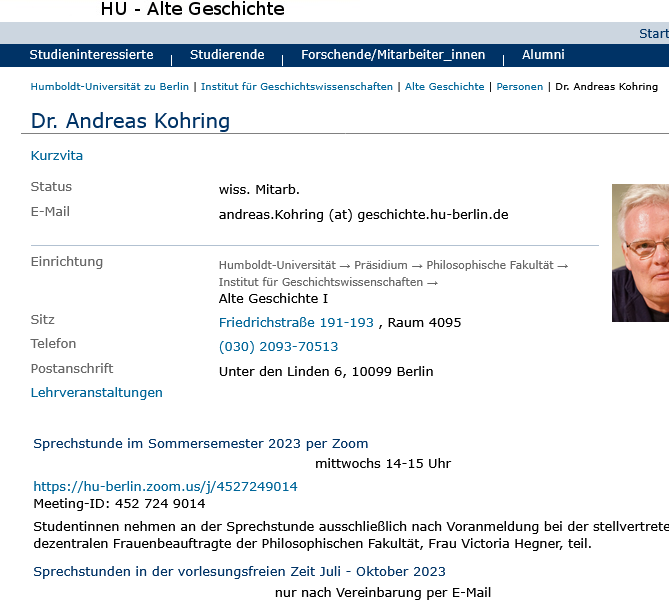
HU tried to solve the problem of sexual harassment by making Kohring post this statement on his faculty profile page: “Female students only take part in the consultation hours after prior registration with the decentralized women’s representative of the Faculty of Humanities“. Yes, insane, but this is how academia fixes such things.
But with the name being public, things quickly exploded and HU had to sack Kohring, who of course then sued. An undated statement by the student representatives at the HU Institute of History informed (translated):
“As part of the legal proceedings between Andreas Kohring and the Humboldt University of Berlin regarding his termination, the university announced on 9 January 2024 that it had reached an out-of-court settlement with him. He is therefore terminated with effect from June 30, 2024 and is suspended until then. With this settlement, Andreas Kohring will no longer be able to teach at our institute.
For us, this means that many students who were harassed by Andreas Kohring for years or who had to be afraid of him now have the final security of no longer being exposed to his attacks.”
“Rape of the Sabine women”
At around the same time, another scandal erupted, at the same history department. A professor was accused of sexual assault, in a book chapter , published in 2023 and authored by his victim Aslı Vatansever, now at Bard College in Berlin. This, she wrote, happened to her at a summer party in Berlin:
“At one point, I find him sitting in a chair next to me. Suddenly, I feel his fingers moving on my thigh where I sit. […] I move uncomfortably in my chair; I feel like I should cover this up on his behalf. There are people around. […] After all, everybody knows that he is a notorious sexual predator with past records of molesting female students […] I get up softly to avoid suspicion and go mingle with the other people. […] He is following me wherever I go. Sometimes with his eyes, sometimes physically. […]
“Aslı, could you come to my office for a sec? I want to show you
something”[…]I was in that office for probably four to five minutes, biting his tongue when he forcefully stuck it into my mouth, pushing him away, struggling to rid myself off his bearish grasp, biting the arm with which he was squeezing my breast. […]
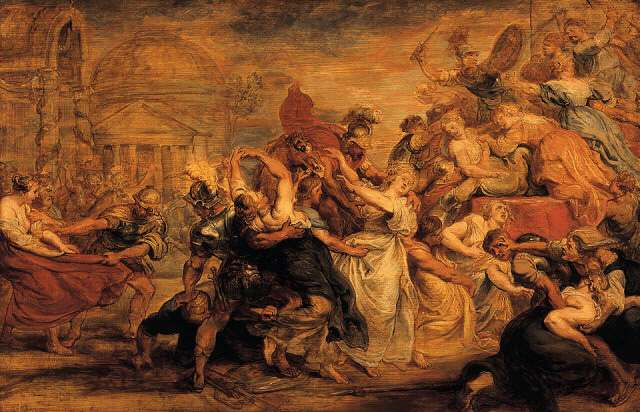
He literally uses brutal, physical force. A surreal scenery, an absurdly non-epic battle, a close-up from Rubens’ ‘Rape of the Sabine women’ reincarnated for the 21st-century German academia: a foreign female guest researcher in exile struggling to fight off a senior German professor in his office, biting and kicking around, trying to release herself from his violent grasp”
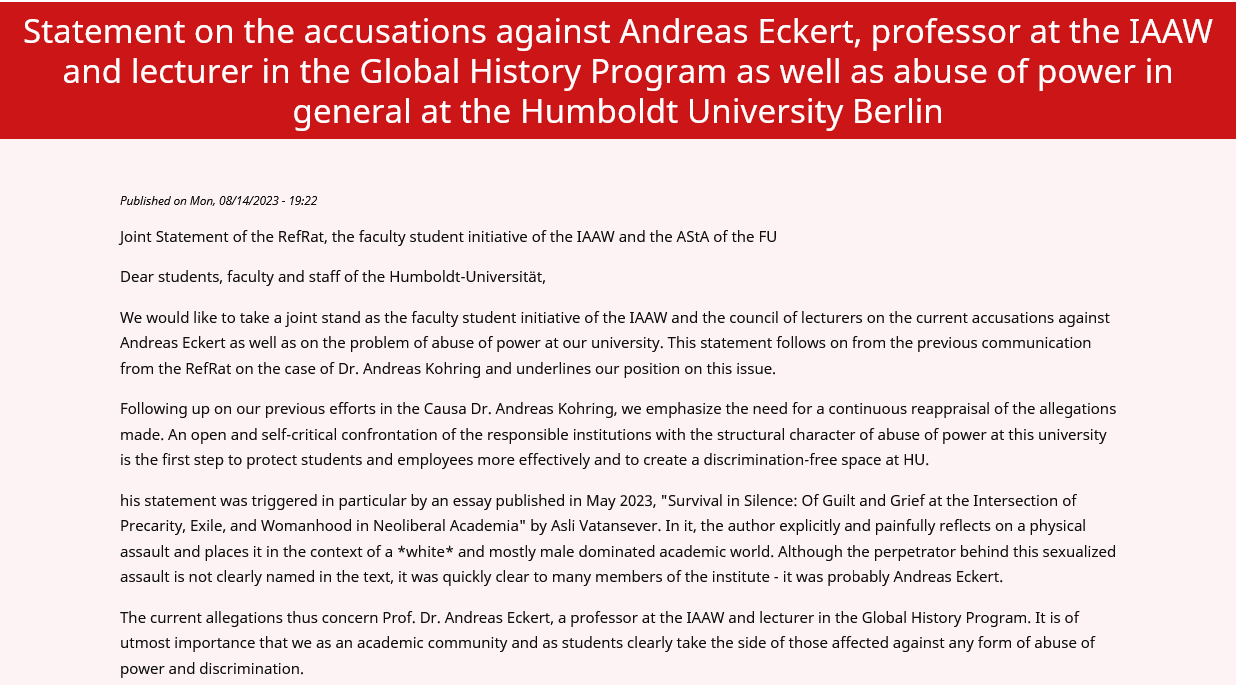
An August 2023 statement by the Student Committee at FU Berlin names the alleged harasser: Andreas Eckert, professor for history of Africa and colonialism at IAAW institute at Humboldt University (HU) Berlin. The statement is both in English and in German, and it mentions the Kohring case.
Quote:
“We would like to take a joint stand as the faculty student initiative of the IAAW and the council of lecturers on the current accusations against Andreas Eckert as well as on the problem of abuse of power at our university. […] [T]his statement was triggered in particular by an essay published in May 2023, “Survival in Silence: Of Guilt and Grief at the Intersection of Precarity, Exile, and Womanhood in Neoliberal Academia” by Asli Vatansever. […]
Although the perpetrator behind this sexualized assault is not clearly named in the text, it was quickly clear to many members of the institute – it was probably Andreas Eckert.
The current allegations thus concern Prof. Dr. Andreas Eckert, a professor at the IAAW and lecturer in the Global History Program. “
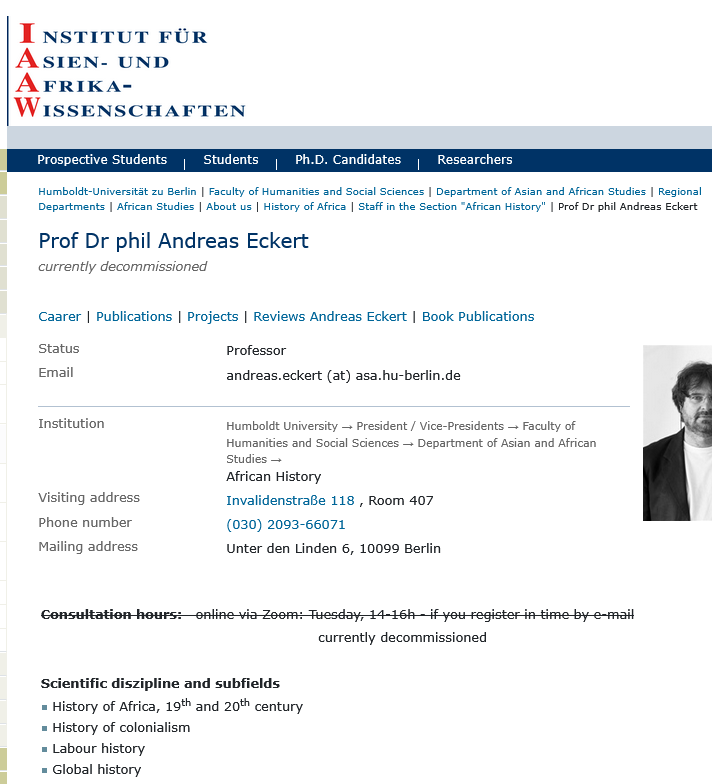
Presently, the HU lists Eckert as “currently decommissioned“:
The Tagesspiegel covered also this affair, again without naming the professor because of German media laws. In November 2023, Tagesspiegel brought the main story, referencing Vatansever’s reported experience from 2019. The professor likes to get drunk with his students, we read. Another alleged victim was named – Lisa Hellman said she was invited to professor’s hotel room and offered wine. At a party in a rented Berlin pub, the professor got drunk, and then attacked another unnamed victim. Translated:
“That evening, he became “very pushy,” says a woman who was doing her doctorate with him at the time. He told her he wanted to dance. The doctoral student tried to brush him off. But he kept coming back to her. “At some point, he grabbed me by the arm, pulled me onto the dance floor and pressed me against him,” she recalls.”
The problem was known: “For example, a group of women objected to the professor being accommodated in the same hotel at a summer school in St. Petersburg in 2018“. After Vatansever’s book chapter, the university opened an investigation – according to professor’s lawyer, upon his own request, in order to clear his name.
In July 2024, Tagesspiegel reported that the professor was suspended. HU Berlin stated that “The civil servant is temporarily off duty for an indefinite period“, due to “ongoing disciplinary procedure“. In December 2024, Tagesspiegel informed that the professor accused of sexual harassment returned to university because a Berlin court decided that his personal rights were infringed. He started teaching in April 2025, as the investigation continued. In October 2025, Tagesspiegel informed that criminal charges were raised against this professor, a court hearing was due to start in January 2026:
“”Specifically, this concerns an incident that allegedly took place on 5 July 2019 in the office of the defendant,” said the court spokeswoman. […] Humboldt University informed the Tagesspiegel newspaper that “the civil servant has been prohibited from carrying out his official duties for compelling professional reasons”.”

UCLA hunts whistleblowers as student accuses dentistry dean of sexual harassment
A UCLA dentistry student writes in a leaked letter: ” I was having disagreements with my research mentor, and thought that Dr. Tetradis could help. Instead, he distorted the issues to attack my mentor, and sexually harassed me. When I filed the Title IX complaint, his powerful colleagues discouraged me from filing.”
Soon after the January 2026 Shorts appeared, the lawyer of Engel.Law wrote to me, representing Eckert, and demanded that his client’s name is to be removed from this article. The lawyer also wrote (translated):
“Although the allegations have been investigated for years, no criminal, illegal, or otherwise inappropriate behavior on the part of my client has been established. My client is also convinced that this will remain the case, especially since the Berlin Administrative Court highlighted the contradictions in the incriminating statements and clearly stated that the measures taken by Humboldt University against my client were not in order.“
It should be said, this Engel lawyer specialises in media law, not criminal law. I haven’t heard from the lawyer representing Eckert in court yet.
Several other informal emails from Engel.law followed, where the lawyer always warned me that I am not allowed to quote or reproduce his messages. He told me that even if his client was named 2.5 years ago, I am still not allowed to name him. Noteworthy, I never received any proper cease and desist letter with a hefty bill attached to it, as a media lawyer would have done if they felt they have even a minimal chance to achieve an injunction in court. Because of course the entire academic community already knows about Eckert’s predicament, not just from the AStA statement.

Dirty Old Men
Does being a science genius entitle you to sexual harassment, as academic authorities in Yale and elsewhere insist? Let’s look at papers by Michael Simons, Joseph Schlessinger and Arnold Levine.
“Not an open letter”
Due to the Kohring affair just before, the allegations against Eckert hit big waves. Activists of “HU Täterfrei” (“HU free of perpetrators”) started this public petition in June 2025, titled “Another case at the HU: Andreas Eckert – consequences for sexual violence“. By now over 3500 signatories demand immediate resignation of Eckert and an independent investigation of the allegations of sexual harassment at HU, in this and other cases.
But of course the academic peer community sees the whole situation very differently. No less than 37 professors in Germany and abroad signed a letter to the leadership of Humboldt University, which can only be understood as a letter of solidarity with their dear colleague, Eckert. Here is its version from 4 October 2025 which I obtained:
Translated:
“The signatories of this letter, which is not an open letter, have been observing for more than two years the circumstances of the disciplinary proceedings at your university, which Prof. Dr. Andreas Eckert himself requested in June 2023 in order to clarify the allegations of abuse that have been made against him. We regret that the investigation has still not been completed.
The strain on all those involved is considerable. The danger of prejudgement seems to us to grow with the duration of the proceedings. This is manifested, among other things, in the fact that Prof. Eckert is also being marginalised and isolated in his academic publishing activities.
We are following with great concern the actions that have been taken since the end of the summer semester, including an online petition, demonstrations and calls for a boycott, in an attempt to have Prof. Eckert’s teaching licence revoked.
This contradicts the principle that, just like any other accused person in a constitutional state, the presumption of innocence applies, unless and until a contrary judgement has been passed.
As far as we are aware, Humboldt University has not responded to this escalation. The online petition, which has now been signed by more than 2,000 people, accuses the university of negligent omissions and cover-ups. Above all, however, these actions are directed against the university lecturer named in the allegations, who is unable to defend himself against them. In our opinion, it is part of the university’s duty of care to protect its members against such attacks.
In view of the risk that similar actions could be repeated in the upcoming winter semester, we urge you to take active steps to ensure that Prof. Eckert is able to freely perform his duties, particularly in teaching.
Beyond this individual case, we believe it is also in the best interests of Humboldt University and its national and international reputation to defend the freedom of teaching and research, as well as the principles of appropriateness and the rule of law, and to fulfil its duty of care towards its employees.”
Yes, they demand that the university cracks down on those who support Eckert’s alleged victims. Not on Eckert, who is the real victim apparently.
The signatories include leading German historians, some of whom I contacted for comment: Martin Schulze-Wessel (LMU Munich), Jürgen Kocka (FU Berlin), Hans van Ess (LMU Munich), Lutz Raphael (University of Trier), Andreas Gestrich (U. Trier), Stefan Berger (U. Bochum), Thomas Maissen (U. Heidelberg), Sven Reichardt (U. Konstanz), Andreas Mehler (U. Freiburg), Dmitri van den Bersselaar (U. Leipzig), Iris Schroeder (U. Erfurt), Christof Dipper (TU Darmstadt), Ute Daniel (TU Braunschweig). These and others are people in highest academic and administrative positions, in Germany and abroad, they decide about careers of countless students and early career researchers. None of them replied to comment on their letter.
Well, why don’t we look into those academic publishing activities of Eckert’s, which these scholars appreciate so much that literally nothing else matters to them.

Peer review ghost-writing, or do professors understand plagiarism?
Every academic will probably agree that plagiarism is wrong. It is absolutely not OK to pass someone’s else’s intellectual work as one’s own. Plagiarised research papers get retracted regularly, on several occasions plagiarism in dissertation led to withdrawal of doctorate, most notably among several German politicians. There is however one aspect of academic life where…
Plagiarism investigations
A reader contacted me with dossiers, where three book chapters authored by Eckert were marked for apparent textual overlap with earlier publications by other authors. Even though these publications are cited in the reference section of Eckert’s works, the text passages are most definitely not labelled as quotes. In many cases, they don’t even have a citation reference attached to them. Thus, they clearly seem to represent Eckert’s own thoughts and his own words. While the overlapping colour labels suggest that those are actually other historians’ thoughts and words, seemingly passed off as Eckert’s own.
Is this a bad thing? Asking for any historians in the audience.
Let’s start with this book chapter from 2019:
Andreas Eckert “From Poverty to Informality? The Social Question in Africa in a Historical Perspective” in “The Social Question in the Twenty-First Century”, Chapter 9, University of California Press (2019) doi: 10.1515/9780520972483-012
Here some examples from the dossier:
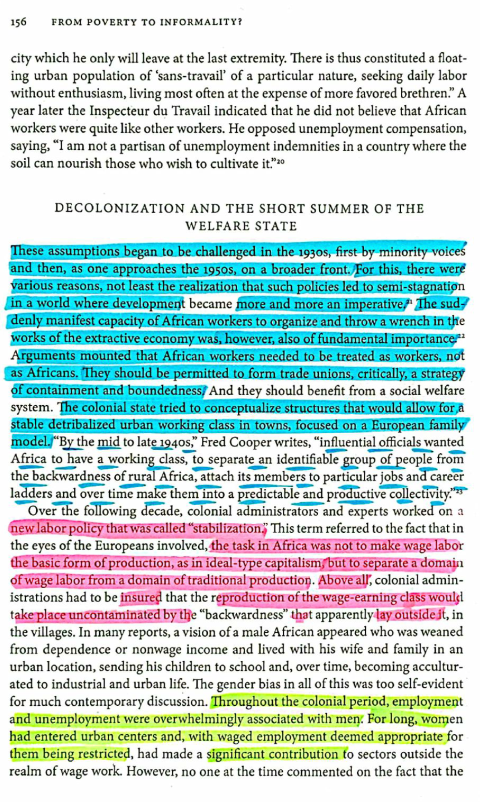
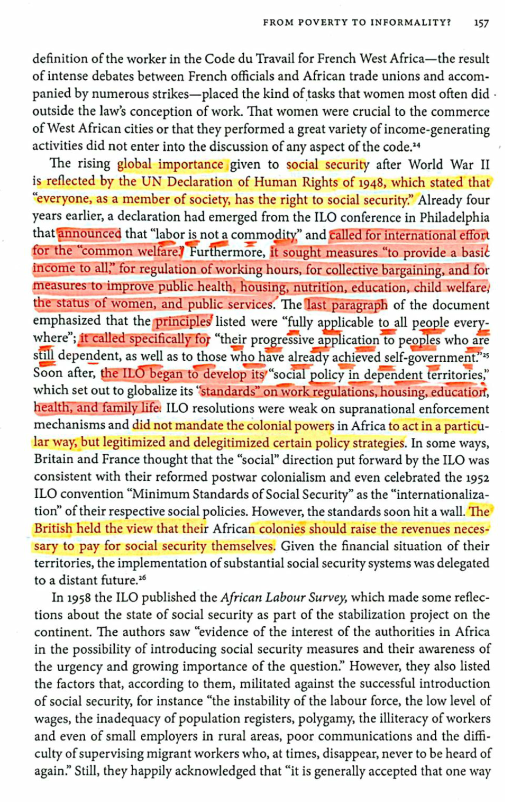
Colour codes:
- Blue (incl. dashes): Frederick Cooper “Decolonization and African Society The Labor Question in French and British Africa” Cambridge University Press, (1996), DOI: 10.1017/CBO9780511584091 (Reference 12)
- Red (incl. dashes): Frederick Cooper, “Afterword Social Rights and Human Rights in the Time of Decolonization,” Humanity (2012): 473–92. (Reference 25)
- Pink: Cooper, Frederick, “African Workers and Imperial Designs”, in “Black Experience and the Empire, Oxford History of the British Empire Companion Series” (2006/2011), doi: 10.1093/acprof:oso/9780199290673.003.0011 (not referenced)
- Yellow: Seekings, Jeremy. “Not a single white person should be allowed to go under’: Swartgevaar and the origins of South Africa’s welfare state, 1924-1929.” The Journal of African History (2007). doi: 10.1017/S0021853707002836 (Reference 9)
- Orange: Carina Schmitt “Social Security Development and the Colonial Legacy”, World Development (2015), doi: 10.1016/j.worlddev.2015.02.006 (Reference 3)
- Green: Andrew Burton, “Raw Youth, School-Leavers and the Emergence of Structural Unemployment in Late-Colonial Urban Tanganyika,” Journal of African History (2006) doi: 10.1017/S0021853706002052 (Reference 28)
Very ironically, the same New York University professor Frederick Cooper, whose works were seemingly “reused” in Eckert’s writings, signed the above letter in support of Eckert. Cooper’s works were also “used” in this other book chapter by Eckert, from 2017, also about post-colonial Africa:
Andreas Eckert, “Social Movements in Africa“, in “The History of Social Movements in Global Perspective”, Chapter 8, Palgrave Macmillan, (2017) doi: 10.1057/978-1-137-30427-8_8
Also here, some examples:
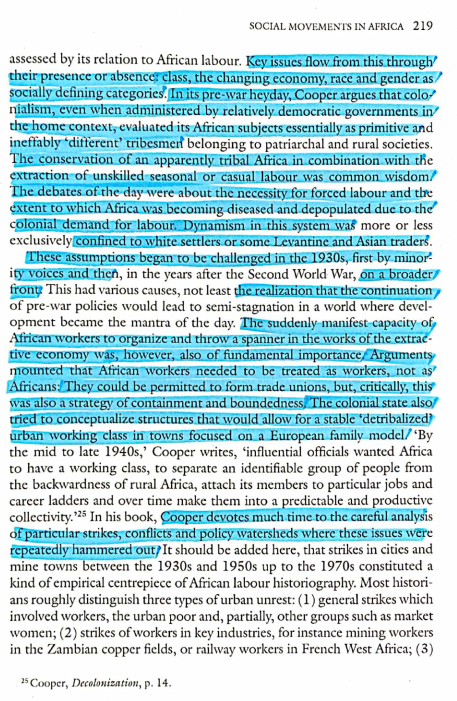
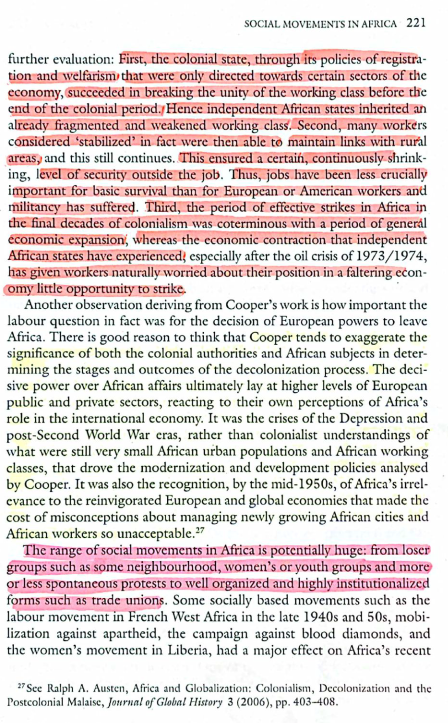
And again the colour coding, showing how much Cooper was “mis-cited”:
- Blue: Bill Freund “AFRICAN LABOUR HISTORY Decolonization and African Society: The Labor Question in French and British Africa. By Frederick Cooper. Cambridge: Cambridge University Press, 1996. Pp. xvii+677; £55 (ISBN 0-521-52651-1); £19.95, paperback (ISBN 0-521-56600-2).” The Journal of African History (1997), DOI: https://doi.org/10.1017/S0021853797357077
- Red: Leroy Vail “On the African Waterfront: Urban Disorder and the Transformation of Work in Colonial Mombasa. By Frederick Cooper. New Haven and London: Yale University Press, 1987. Pp. xvi + 290. £25; $36.” The Journal of African History. (1990) doi: 10.1017/S0021853700025160
- Pink: Nikolai Brandes & Bettina Engels “Social movements in Africa”, Wiener Zeitschrift für kritische Afrikastudien (2011) , 11. Jg., 1‐15.
- Green: Frederick Cooper “’Our Strike’: Equality, Anticolonial Politics and the 1947–48 Railway Strike in French West Africa” in “European Decolonization” (2007) doi: 10.4324/9781315255989
- Orange: Stephen Ellis & Ineke van Kessel “African social movements or social movements in Africa?” in “Movers and shakers: social movements in Africa”, Chapter 1 (2009). https://hdl.handle.net/1887/18530
- Yellow: Ralph A. Austen, “Frederick Cooper. Decolonization and African Society: The Labor Question in French and British Africa. (African Studies Series, number 89.) New York: Cambridge University Press. 1996. Pp. xvii, 677. Cloth $69.95, paper $27.95″, The American Historical Review, (1998) doi: 10.1086/ahr/103.1.248
The last book chapter, from 2019:
Andreas Eckert, “Anti-Western Doctrines of Nationalism“, in “The Oxford Handbook of the History of Nationalism”, Chapter 4, Oxford University Press (2019) ISBN: 9780198768203
Some examples, I will let readers decide if this is plagiarism or not:
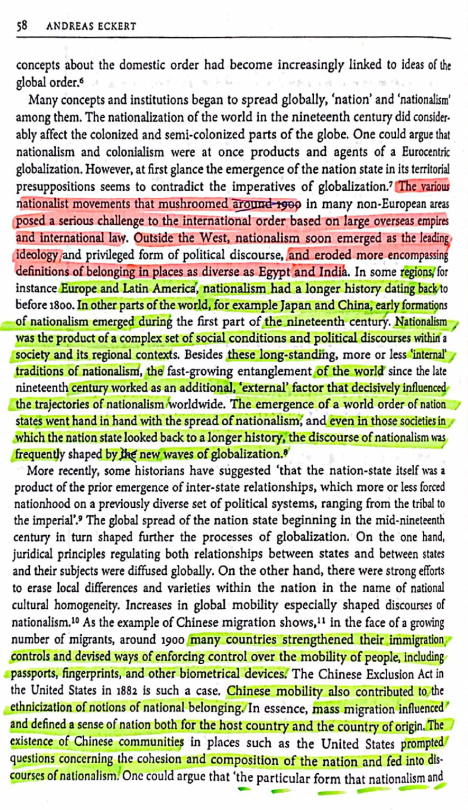
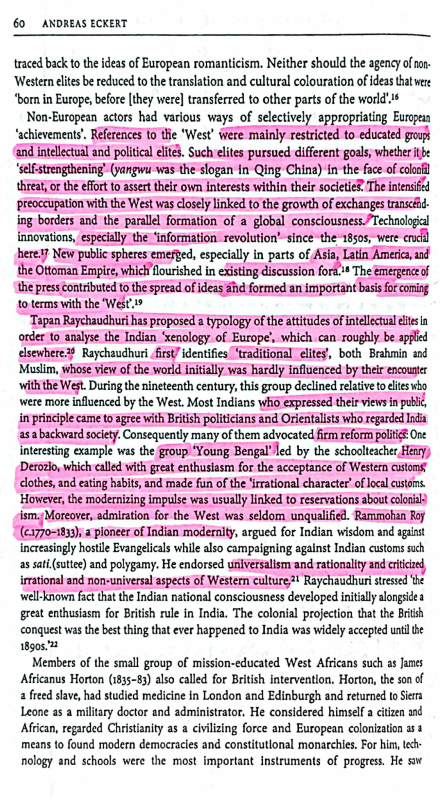
Colour coding:
- Red: Sebastian Conrad & Dominic Sachsenmaier “Introduction: Competing Visions of World Order: Global Moments and Movements, 1880s–1930s.” in “Competing Visions of World Order” (2007) doi: 10.1057/9780230604285_1 (Reference 6)
- Green: Sebastian Conrad & Klaus Mühlhahn “Global Mobility and Nationalism: Chinese Migration and the Reterritorialization of Belonging, 1880–1910” in “Competing Visions of World Order” (2007) doi: 10.1057/9780230604285_7
- Pink: Sebastian Conrad “Vorwort: «Europa» aus der Sicht nichtwestlicher Eliten, 1900–1930” in “Beyond Hegemony? – Europe and the Politics of Non-Western Elites, 1900-1930” (2006) doi: 10.17104/1611-8944_2006_2_158 (reference 6, original in German)
- Blue: Cemil Aydin “A Global Anti-Western Moment? The Russo-Japanese War, Decolonization, and Asian Modernity” in “Competing Visions of World Order” (2007). doi: 10.1057/9780230604285_8 (Reference 29)
- Orange: Gary Wilder, “The French Imperial Nation-State – Negritude and Colonial Humanism between the Two World Wars”, (2005) ISBN: 9780226897684 (reference 40)
- Yellow: David Arnold, “Gandhi” (2001) ISBN 9780582319783
Also ironically, the badly mis-cited FU Berlin historian Sebastian Conrad is his close collaborator/coauthor Christoph Conrad, the historian at University of Geneva, who trained with Kocka and co-signed the Eckert support letter above. (Note an earlier text version erroneously stated the two Conrads were brothers, they are not).
I asked Eckert to comment on these allegations of plagiarism. Eckert’s lawyer had only this message for me (translated):
“Some time ago, Mr. Eckert commented in detail on the accusation of plagiarism to both the HU and the DFG. He trusts that the investigative authorities will proceed carefully and objectively.”
But both Eckert and his lawyer refused to share with me (and thus with you, dear readers) those detailed comments. Instead, the lawyer told me (translated):
“The relevant procedures of the university and the DFG are subject to confidentiality for good reason: this preserves the integrity and objectivity of the examining bodies and institutions. The proceedings are not yet complete. Mr Eckert will comment on the matter once the proceedings have been concluded, if necessary.”
Obviously, the German Research Council (DFG) and Humboldt University both are still investigating the affair. Hey, maybe HU could appoint Kohring as investigator? He used to be a no-mercy fighter against plagiarism, demanding immediate expulsion for every student caught.
Donate!
If you are interested to support my work, you can leave here a small tip of $5. Or several of small tips, just increase the amount as you like (2x=€10; 5x=€25). Your generous patronage of my journalism will be most appreciated!
€5.00


0 comments on “Marginalised and isolated in academic publishing activities”