

Schneider Shorts of 31 July 2026 – trans children abused in Norway, a racist supported in Belgium, a mega-cheater rules English universities, a questionable female role model awarded in USA, with an ill-informed version of how Sage retractions happened, cures for cancer and autism, and finally, you’ll never believe the real reason why fruit and veg are good for you!
Table of Discontent
Science Elites
- Misconduct in research on transgender people – paediatrician Anne Wæhre found guilty in Oslo
- Stackable micro-credentials – David Latchman now rules over all universities of London
- Preservation of racial distinctions – Racist Nathan Cofnas enjoys full support
- Groundwork for the development of venetoclax – Marina Konopleva is a role model for WomenInSTEM
Scholarly Publishing
- Exclusive: Sage’s thorough investigation – how Yannick Griep’s papers got retracted, alternative version
Science Breakthroughs
- The importance of treating the whole patient – Israeli ScientistsTM cure cancer with Viagra
- Drug reverses autism within hours – US scientists cure autism with rapamycin
- Findings fundamentally alter our understanding of mitochondrial biology – US scientists reveal why fruit and veg are healthy
Science Elites
Misconduct in research on transgender people
On 23 July 2026, the Norwegian newspaper Aftenposten gained access to a 164-page investigative report from the University of Oslo, Oslo University Hospital and Akershus University Hospital, and brought this news under the headline “Three researchers convicted of scientific misconduct in research on transgender people“:
“The notification concerns the use of patient records and register information in four published studies.
The Integrity Committee finds that the researchers have acted scientifically fraudulently […]
In the other two articles, according to the committee, the researchers have breached research ethics norms to an extent that is reprehensible, but which does not constitute scientific misconduct as the case currently stands.
All the researchers are associated with the National Treatment Service for Gender Incongruence for Children and Young People (NBTK).”
The three scientists are Oslo University Hospital researcher Anne Wæhre (consultant), Trond Haaken Diseth (professor) and Cecilie Bjertness Nyquist (PhD student), other reports also list Linda David, (another PhD student) and Kjersti Gulbrandsen (clinical unit head), reports whether they were suspended or faced any disciplinary sanctions vary.
The committee ordered retractions for the two fraudulent papers, while the other two are to be further investigated by Oslo University Hospital. It also concluded that the accused scientists acted “grossly negligently” and committed “serious breaches of recognized research ethics norms“.
I do not have access to the report, but the two papers up for retraction are the following, they also received letters to editors and replies from the authors. They are on topic of gender dysphoria/gender incongruence (GD/GI), its medication and especially “detransition” in children and adolescents:
- Cecilie Bjertness Nyquist, Leila Torgersen , Linda W. David , Trond Haaken Diseth , Per Magnus , Guido Philipp Emmanuel Biele , Anne Waehre Population-adjusted numbers, demographics and mental health among children and adolescents referred to the Norwegian National Center for Gender Incongruence over two decades European Child & Adolescent Psychiatry (2024) doi: 10.1007/s00787-024-02508-5 (criticised by Banos et al 2025, reply by Nyquist et al 2025)
- Cecilie Bjertness Nyquist , Leila Torgersen , Linda W. David , Trond Haaken Diseth , Kjersti Gulbrandsen , Anne Waehre Treatment trajectories among children and adolescents referred to the Norwegian National Center for Gender Incongruence Acta Paediatrica (2024) doi: 10.1111/apa.17530 /criticised by Banos et al 2025, reply by Nyquist et al 2025)

The second paper was retracted by Wiley on 30 July 2026:
“The Commission on Research Integrity at Oslo University Hospital, Akershus University Hospital and Department of Clinical Medicine at the Medical Faculty University of Oslo determined through an official investigation that the research reported in this article did not receive appropriate approvals from a Regional Committee for Medical and Health Research Ethics (REK) and that proper informed consent procedures were not followed. The Commission on Research Integrity therefore recommended that this article should be retracted.
Based on this determination, all parties agree that the article should be retracted.”
The whistleblowers were the Patient Organization for Gender Incongruence (PKI) and a statistical expert, later revealed by the French website as University of Oslo professor David Banos, the author of the letters to the editor. Trans Youth Trajectories also revealed the two papers still under review:
- Henriette Pisani Sundhagen , Ane Bøyum Opheim , Anne Wæhre , Nina Kristine Oliver , Kim Alexander Tønseth Chest Wall Contouring in Transgender Men: A 20-Year Experience from a National Center Plastic and Reconstructive Surgery – Global Open (2023) doi: 10.1097/gox.0000000000004952
- Henriette Pisani Sundhagen , Anne Wæhre , Kim Alexander Tønseth Metoidioplasty in Norway: A 13-year Experience from a National Center Plastic and Reconstructive Surgery – Global Open (2024) doi: 10.1097/gox.0000000000006307
As Aftenposten reported:
“According to the whistleblowers, the information was used without approval from REK approval from REKREK, which stands for Regional Committees for Medical and Healthcare Research Ethics. […] Questions were also raised as to whether the presentation of data could make it possible to identify individual patients. For their part, the researchers stated that they assessed the projects as quality assurance, not research. The committee concludes that all four publications must be considered research. Thus, they must be assessed according to recognized research ethical norms.”
It turned out, NBTK has been operating without a valid ethics approval since 2021. The details of this ethics breach were revealed by the website Forskning.no in November 2025 (there’s also English-language reporting by Universitas from May 2026). Basically, Wæhre applied in 2016 to conduct research on the NBTK paediatric patients seeking treatment for gender incongruence. her application was approved, under the condition that Waehre “must obtain consent from all the patients, around 750 people. For children under 16, the parents will have to give consent“. A year later, Wæhre applied to change the project: instead of asking for consent, she waned to just “send them one information letter.” Her request was rejected because this patient group is particularly vulnerable. Also Waehre’s appeal to the rejection was rejected. National Research Ethics Committee committee for medicine and health sciences (NEM) says a proper consent must be obtained.
The communal misconduct by Zhenhe Suo in Oslo
“the Committee believes that when carelessness or scientific dishonesty can be found in so many articles with so many different authors in question, there must be a lack of training and / or lack of control over data handling. The committee therefore believes that it is qualified probability that there has been an institutional system…

Waehre and her colleagues at NBTK then set up in May 2020 a “quality assurance registry” called “Gender Incongruence Registry for Children and Adolescents (GIRCA) in 2020 at Oslo University Hospital. Its purpose was to extract information from the medical records of 1700 children and adolescent patients, and then to design a new research project to study this register. (that despite the fact that some patients explicitly objected to being used in research). That didn’t matter, because instead of doing research on children, Waehre and her colleagues were now doing merely research on hospital healthcare records! No need for consent or ethics approval for such a “quality assurance initiative”. The descriptions in the published papers also allowed for patients to be indirectly identified, but who cares, their lack of consent didn’t matter anymore.
After the PKI blew the whistle and reported the patient abuse to the hospital’s Joint Integrity Committee in 2025, Wahre applied to REK for a retrospective ethics approval, which was denied. An investigation by Oslo University Hospital determined that the scientists did commit ethics breach, but unintentionally: “negligent, but not fraudulent“. No need for any retractions also, but the case was forwarded to the National Research Ethics Committee (NEM), with the result we see now.
Now, Waehre’s research was also fraudulent, as the interview with Banos revealed: Waehre and her colleagues presented in Nyquist et al. 2024 a “graph projecting further increases in referrals. It extended an observed trend into the future without identifying a convincing mechanism that would make that trend continue“:
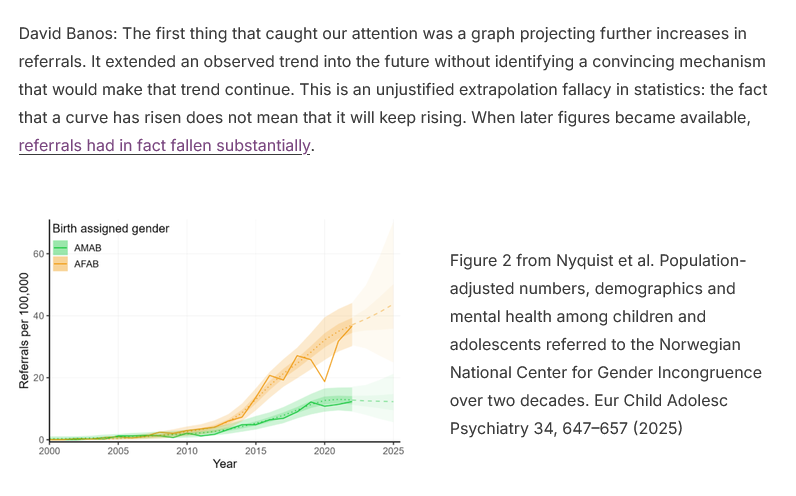
Meaning, Waehre seemingly insinuated that kids started to declare themselves transgender for no medical reason, but as a kind of fashion. In this vein, Waehre’s diagnoses apparently defined gender incongruence as a psychiatric disorder, which Banos criticised:
“Mental-health difficulties among trans young people must be studied, but they should not be used to imply that being trans is a symptom of psychiatric illness.”
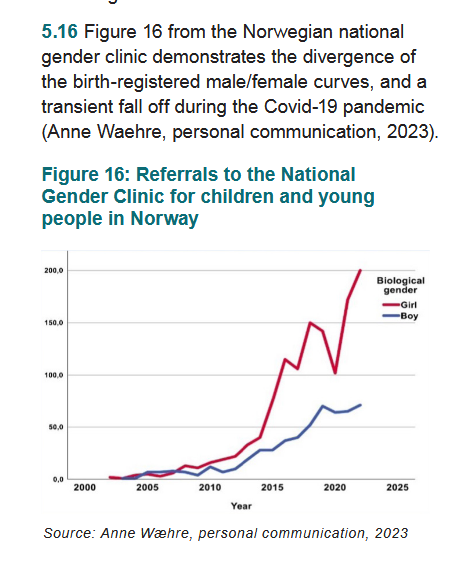
Waehre’s fraudulent research on transgender children didn’t just affect Norway – it also influenced the so-called Cass Report in the UK, which are the final report and recommendations to NHS England by the Chair of the Independent Review of gender identity services for children and young people, Hilary Cass.
As you see on the right, Cass referenced her data as “personal communication” with Waehre. The Cass Report determined an “increase in the numbers of predominantly young people and young adults who have a trans or gender-diverse identity” and recommended that “For the majority of young people, a medical pathway may not be the best way to manage their gender-related distress.” Cass seems to strongly oppose transgender medication in general.
Waehre is also associated with the US-based Society for Evidence-Based Gender Medicine (SEGM), she authored the Conference Report of the SEGM 2025 conference on Youth Gender Distress, held in Berlin in September 2025 (opened by the President of the German Medical Association, Klaus Reinhardt). Waehre also took active role in the 2024 SEGM conference in Athens, Greece, which was dedicated to the Cass Report and titled “Questioning Gender: Psychotherapeutic Approaches to Youth Gender Dysphoria“. And in 2023 SEGM Conference in New York in USA.
Not only LGBTQ groups firmly oppose SEGM – also the US civil rights organisation, the Southern Poverty Law Center designated SEGM as one of “Anti-LGBTQ+ Hate Groups”, as reported by the Californian LGBTQ website Blade:
“The analysis further determined that in the case of SEGM, the organization’s funding stream included Koch Foundation money funneled through the Edward Charles Foundation. Notably, SEGM shared funding streams with right-wing Christian groups like the Alliance Defending Freedom and the Family Research Council.
In recent years, the Society for Evidence in Gender Medicine has played a huge role in advancing anti-transgender policy globally. In the United States, far-right politicians such as Texas Attorney General Ken Paxton and Governor Greg Abbott have relied on SEGM materials to justify treating gender affirming care for transgender youth as child abuse.
In Florida, SEGM members aided in a DeSantis initiative to ban transgender care through a review for the Florida Board of Medicine”
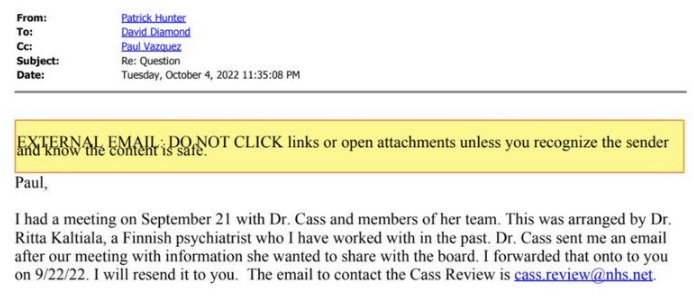
SEGM in turn influenced Cass, via their Finnish researcher Riittakerttu Kaltiala, who arranged “a meeting between Dr. Cass and Dr. Patrick Hunter, a DeSantis medical board pick“.
Update: David Banos now provided me with the full original report (in Norwegian, 146 pages with attachments), available here, and as a copy here:
Stackable micro-credentials
Britain’s flirtation with biomedical fraud as a mean to achieve global dominance has reached its logical conclusion.
The new Vice-Chancellor of one of world’s biggest universities, The University of London, which comprises UCL, King’s College, Queen Mary University and London School of Economics and other universities, is…
Who was years ago found guilty of research misconduct, which he suppressed by literal bribes to his university and by recruiting the most expensive lawyers his enormous personal wealth allows to buy.

David Latchman, uncensored
I publish exclusively two uncensored UCL screening panel reports into the David Latchman and Anastasis Stephanou affair. Now we know which papers were investigated and which requested retractions didn’t happen.
Times Higher Education reported on 23 July 2026:
“Latchman, a geneticist who has held the position on an interim basis since May, was approved on the recommendation of a joint appointments committee after a consultation with the heads of the university’s 17 federation members.
A former vice-chancellor at Birkbeck, Latchman has also served as the University of London’s deputy vice-chancellor, and is now set to lead the institution until July 2028. […]
It follows a tumultuous period for the university. Its previous vice-chancellor, Wendy Thomson, resigned from the post in April following an 11-month suspension pending an independent investigation, reportedly relating to allegations of bullying and poor leadership. […]
The suspension came at a time of significant leadership upheaval at the university, […] The new chair of the board of trustees, Kavita Reddi, praised Latchman’s leadership.
“Over the last year David has led key developments at the university, including the launch of new, online, stackable micro-credentials, with academic direction provided by our federation members,” she said in a statement.”
That’s professional journalism – not even a hint to past fraud investigations and misconduct findings. Nothing.

Latchman and Wohl Foundation: gifts that keep on giving
David Latchman, Master of Birkbeck and professor of genetics at UCL was once again cleared of all suspicions of research misconduct, while his two subordinates took all the blame, for just 7 papers. Over 40 flagged for suspected data manipulations were ignored. Latchman is namely also Chair of the over £100 Million-heavy Maurice Wohl Charitable…
Latchman has at least four retractions and SEVENTY papers on PubPeer, half of these bad papers of these were NOT coauthored with the official culprits and Latchman’s former mentees, Anastasis Stephanou and Tiziano Scarabelli. For example this paper from UCL:
S. Gandhi , M M K Muqit , L Stanyer , D G Healy , P M Abou-Sleiman , I Hargreaves , S Heales , M Ganguly , L Parsons , A J Lees , D S Latchman , J L Holton , N W Wood , T Revesz PINK1 protein in normal human brain and Parkinson’s disease Brain (2006) doi: 10.1093/brain/awl114


Two of Latchman’s papers with UCL professor Vishwanie Budhram-Mahadeo were previously corrected. There was Irshad et al 2004, and this:
Chantelle D. Hudson , Peter J. Morris , David S. Latchman , Vishwanie S. Budhram-Mahadeo Brn-3a transcription factor blocks p53-mediated activation of proapoptotic target genes Noxa and Bax in vitro and in vivo to determine cell fate Journal of Biological Chemistry (2005) doi: 10.1074/jbc.m408679200


The October 2020 Correction simply denied the duplications:
“There were some suggested ambiguities with regards to the actin immunoblots shown in Fig. 4, A and C, because they were closely cropped and compressed in the original figures. To correct this, higher resolution images were provided for all time points.”
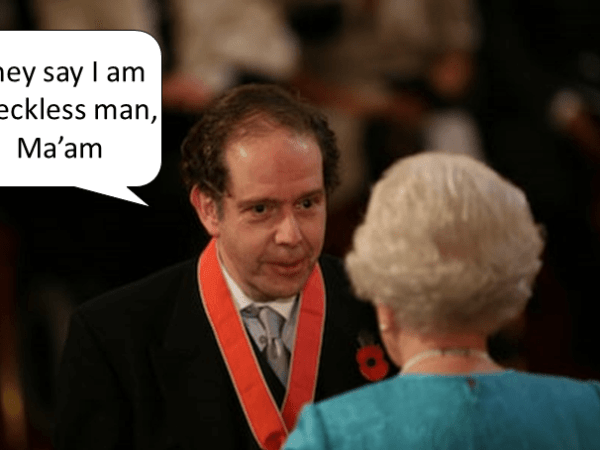
Investigator: “Dr Latchman, as senior author, should bear the weight of responsibility as there was no other author in common”
In David Latchman affair, UCL finally gave censored investigative reports to journalists. These show the Master of Birkbeck was found guilty of misconduct by recklessness, trice. Former investigator John Hardy now speaks out exclusively on my site.
Here, Latchman is last author:
Yogesh J.K. Patel , Martin D. Payne Smith , Jacqueline De Belleroche , David S. Latchman Hsp27 and Hsp70 administered in combination have a potent protective effect against FALS-associated SOD1-mutant-induced cell death in mammalian neuronal cells Molecular Brain Research (2005) doi: 10.1016/j.molbrainres.2004.10.028

And so on. 70 fake papers, four retractions. Latchman is in charge of all research in all of London. Whoo-hoo.
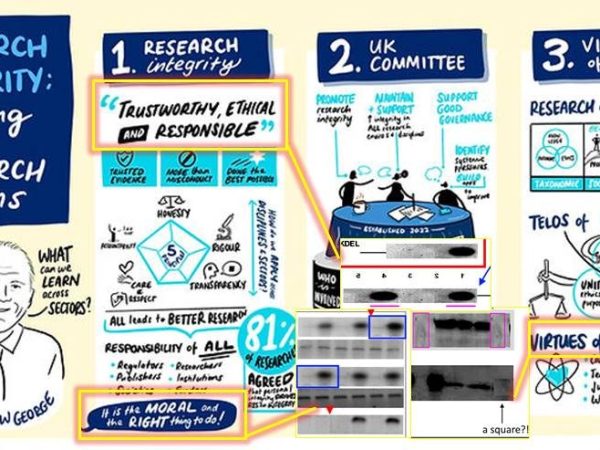
Andrew George and the Virtues of Research Integrity
“One of the UK research system’s strengths is having established processes that allow for this review so that we maintain an accurate and robust research record. Promoting and improving this system, and encouraging more openness and transparency, is why I became involved in the UK Committee on Research Integrity.” – Andrew J T George
Preservation of racial distinctions
Also in Belgium, a very controversial recruitment decision, since last March.
How can a country, which got obscenely rich from its genocide in Congo, better celebrate its past mass murder of Black people, than by recruiting an outspoken academic racist to one of its universities?
It is about the American Nathan Cofnas, who describes himself as “race realist”, so you don’t mistakenly confuse him for a Nazi or a Klan member. In March 2026, The Brussels Times wrote:
“Ghent University rector Petra De Sutter is yet again in the hot seat after the university appointed controversial philosopher Nathan Cofnas to work on a research project, prompting protests from academics and students.
The appointment, first reported by investigative news site Apache, concerns a project led by professor Bouke De Vries. The move has triggered strong criticism within the university.
In an open letter, 45 philosophers from Ghent University called for Cofnas’ resignation, accusing him of promoting racist pseudoscience. […]
“As a university, we have a responsibility to create space for debate, but also to ensure an environment where people feel heard and respected,” [De Sutter] said”
It seems, in a Belgian university only white people can feel heard and respected. Black people must clean toilets.
The philosophy magazine Daily Nous wrote in March 2026 about Cofnas:
“In 2024, Emmanuel College at Cambridge University cut its affiliation with Cofnas, who was a fellow at Cambridge at the time, a decision for which the self-described “race realist” is suing them.
Cofnas was recently hired into a temporary position at Ghent to work on a project run by philosophy professor Bouke de Vries (reportedly no stranger to the race science crowd, either).”
Bouke de Vries used to work in Germany, at the Max Planck Institute for the Study of Religious and Ethnic Diversity, gosh how ironic.
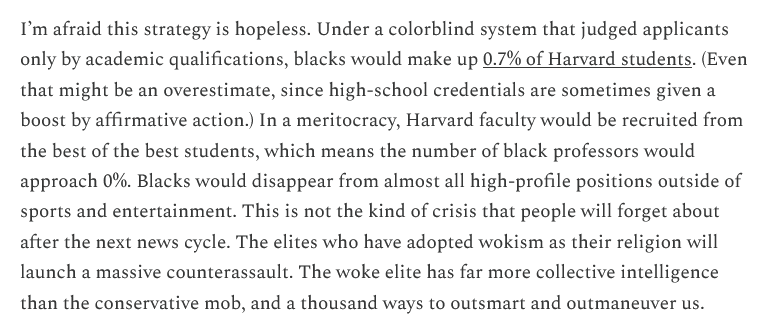
Here is why Ghent University just had to recruit Cofnas after he was kicked out in Cambridge after student protests – he uses what looks like straightforward Nazi pseudoscience to describe Black people. Cofnas infamously wrote on his blog:
“Under a colorblind system that judged applicants only by academic qualifications, blacks would make up 0.7% of Harvard students. (Even that might be an overestimate, since high-school credentials are sometimes given a boost by affirmative action.) In a meritocracy, Harvard faculty would be recruited from the best of the best students, which means the number of black professors would approach 0%. Blacks would disappear from almost all high-profile positions outside of sports and entertainment.”
And, as quoted by Varsity:
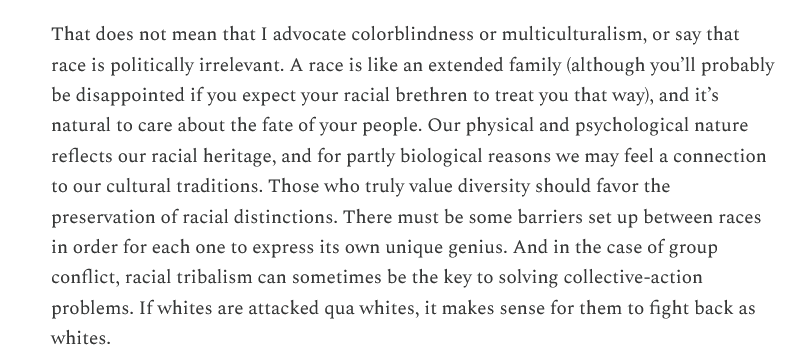
“Those who truly value diversity should favor the preservation of racial distinctions. There must be some barriers set up between races in order for each one to express its own unique genius.”
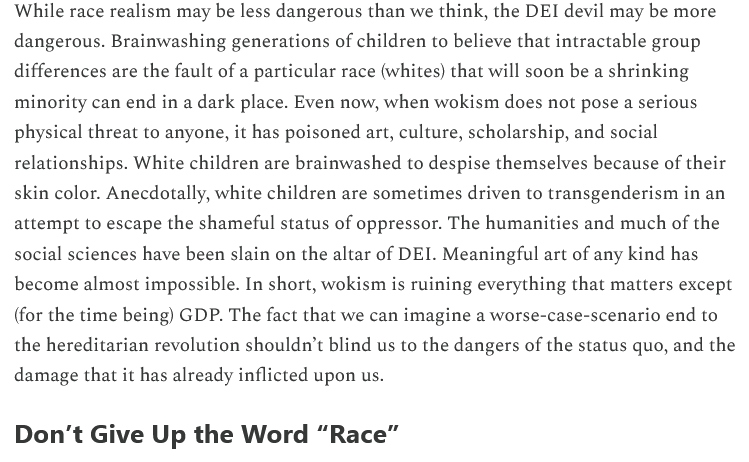
For Cofnas, the danger is clearly in the White Genocide and the Great Replacement, plus of course in transgender people:
“While race realism may be less dangerous than we think, the DEI devil may be more dangerous. Brainwashing generations of children to believe that intractable group differences are the fault of a particular race (whites) that will soon be a shrinking minority can end in a dark place. […] White children are brainwashed to despise themselves because of their skin color. Anecdotally, white children are sometimes driven to transgenderism in an attempt to escape the shameful status of oppressor.”
No wait, Cofnas has more to show to make the Ghent rector proud.
Daily Nous reported in 2022 that the philosophy journal Philosophia (which calls itself “Philosophical Quarterly of Israel“) hosted a debate on “Jewish Influence”, to which Cofnas contributed, with topics like “Did Jews create liberal multiculturalism to advance their ethnic interests?”, also writing that “intelligent, ethnocentric Jews created liberal intellectual and political movements to promote Jewish interests at the expense of gentiles”. They might think it somehow elevates Jews above other “races”, but actually Cofnas’s talk of Jewish “high mean IQs” neatly confirms to Hitler’s view of Jews being a super-intelligent, evil and unnatural race which conspires to control humanity.
The extra irony is that Cofnas is now a celebrated hero of research ethics: in his blog post, he exposed PhD thesis plagiarism by a Black man from the work of a white woman, as reported by Retraction Watch on 27 July 2026:
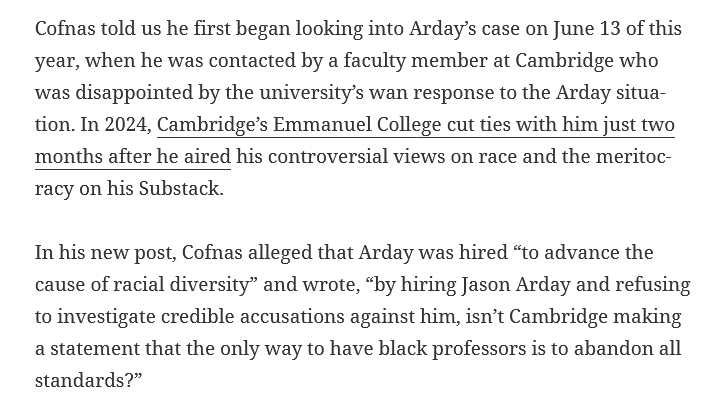
The accused plagiarist is the sociologist Jason Arday of Cambridge University, the youngest Black professor in England’s history. It is likely Arday is a fraud and pathological liar, but so are others, including in Cambridge, who happen not to be Black and who suffer no consequences whatsoever. Half-joking: Maybe it is a sign of progress when British universities defend also Black fraudsters? Most important: why was Cofnas of all people roped in as expert on “Black problem of academia”??? I understand why the far-right media does this, but Retraction Watch?
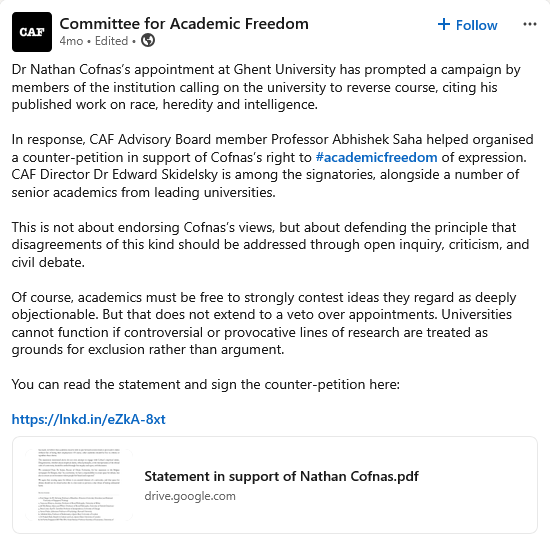
Cofnas openly admits that his attack on Arday is his personal revenge on Cambridge for his own sacking. Which brings us back to the Ghent affair, where academics, who are of course never racists and antisemites, but merely champions of freedom of (hate) speech for fellow white peers, are fighting to defend Cofnas. Daily Nous wrote in March 2026:
“A number of scholars, led by the editors of The Journal of Controversial Ideas, Peter Singer (Princeton), Francesca Minerva (Milan), and Jeff McMahan (Oxford), have signed onto an open letter objecting to calls for the university to back out of its hiring of Cofnas.”
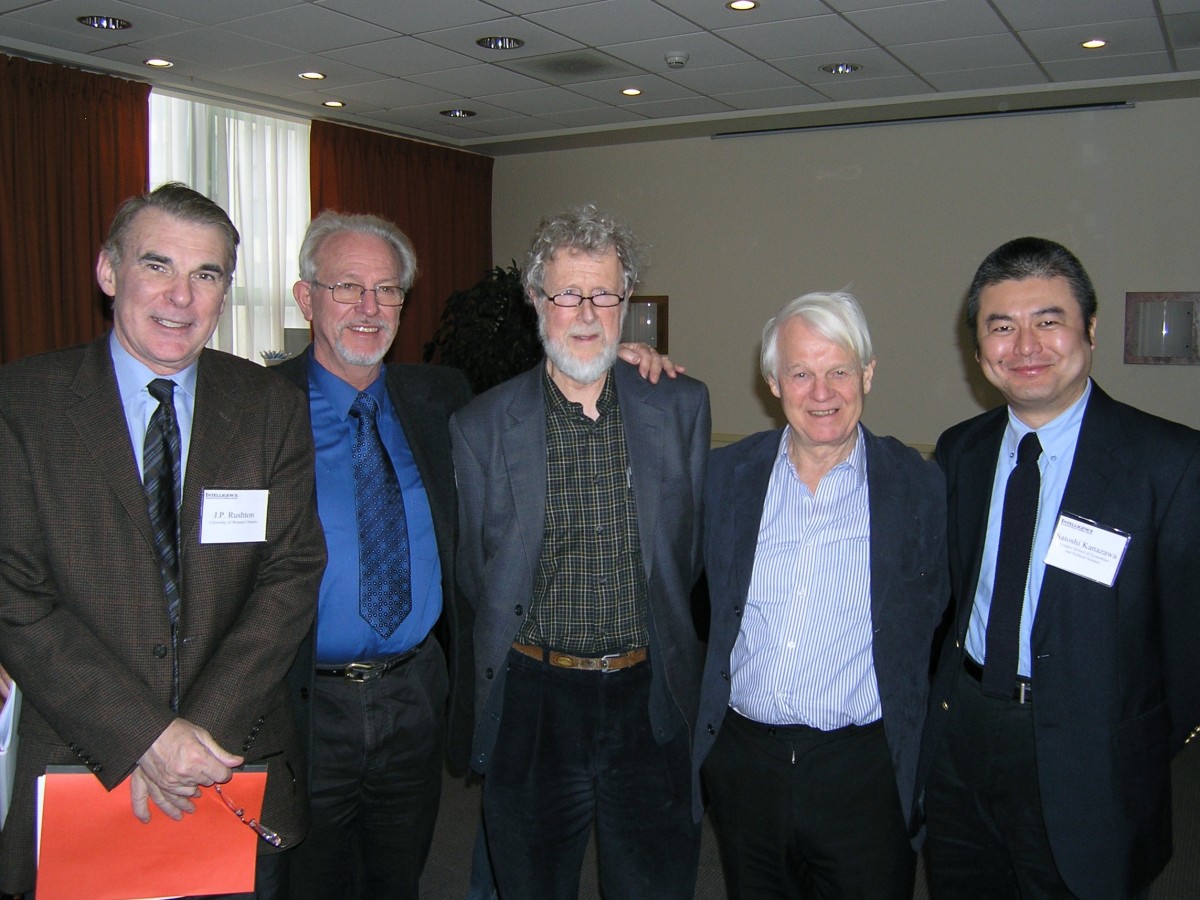
Satoshi Kanazawa and other racist “Galileos”
Outright racism and misogyny became rare in academia, eugenics and bigotry lurk these days not in Mankind Quarterly but in respected journals, wrapped in fancy genetics and neuroscience. Meet one of the last of the old school racist IQ psychologists, Satoshi Kanazawa.
Especially Singer is a known racist. The petition was also co-organised by Abhishek Saha, professor of mathematics at Queen Mary University of London, and yet another racist, and Epstein-buddy on top – Steven Pinker of Harvard. It has now has 180 signatories, mostly British, American and European professors. Those include the infamous British racist Satoshi Kanazawa of London School of Economics (read above), the US racist Amy Wax of University of Pennsylvania (who sued her university for antisemitism because it sanctioned her racism against Blacks and other people of color), and a German professor accused of racism: Heiner Rindermann of Chemnitz University, who received full support from his university and learned society, his toxic views on low intelligence in non-white “races” were determined to be “scientifically sound and serious“. Next to outright racists, there are also eugenicists like Robert Plomin of King’s College London, Richard Haier of University of California Irvine and Geoffrey Miller of University of New Mexico.
Not all signatories are probably racist – academics just love signing support letters of the most horrible people who did horrible things.

Marginalised and isolated in academic publishing activities
A history professor remains a valuable peer even if credibly accused of sexual harassment. And even of plagiarism? Will they still defend him with their letters?
I saved a copy here, hopefully it will all come back to bite them:
Groundwork for the development of venetoclax
Women in science should definitely be recognised much more. But that being academia, the women they chose to recognise are usually darlings of someone important, or outright frauds.
Marina Konopleva is of course an exception! She is now professor at Albert Einstein College of Medicine in New York, previously for many years at MD Anderson in Houston, USA. I wrote about Konopleva’s retraction and other bad papers on PubPeer with her postdoctoral mentor in MD Anderson, Michael Andreeff, in July 2024 Shorts. I am not absolutely not implying anything, their close collaboration is purely academic and professional in nature. Most likely Konopleva was now recognised simply for being a “Good Russian”(TM).
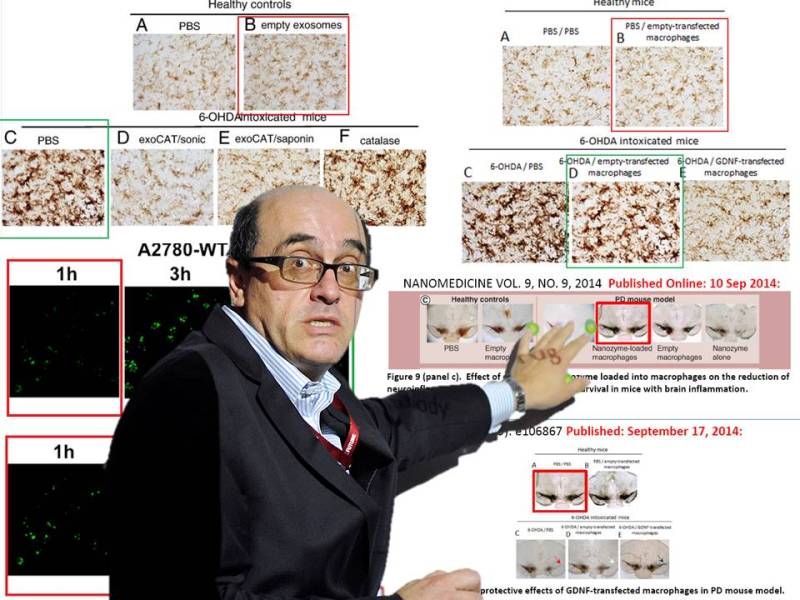
Nanotheranostics with a decisive action
“We will look in each instance thoroughly and take a decisive action in consultation with journals and university in each instance as appropriate”, Sasha Kabanov, winner of the Lenin Komsomol Prize 1988
Here the announcement of the American Society of Hematology (ASH) from 23 June 2026 about the Ernest Beutler Prize to Konopleva and another scientist, Suzanne Cory:
“Dr. Konopleva, recipient of the Ernest Beutler Lecture and Prize in clinical science, is being recognized for her pioneering research targeting the genes BCL2 and BCLXL with small molecule inhibitors and degraders. She has characterized mechanisms of resistance to BCL2 inhibitors and identified novel combinations with immune therapies and signaling inhibitors. A physician-scientist, Dr. Konopleva has led multiple translational projects that have brought targeted agents from the laboratory to clinical trials.
Together, the research contributions of Drs. Cory and Konopleva helped lay groundwork for the subsequent development of venetoclax, the first BCL2 inhibitor to be approved by the U.S. Food and Drug Administration. “
This is how Konopleva’s and Andreeff’s BCL2 and venetoclax research works:
Rongqing Pan , Vivian Ruvolo , Hong Mu , Joel D. Leverson , Gwen Nichols , John C. Reed , Marina Konopleva , Michael Andreeff Synthetic Lethality of Combined Bcl-2 Inhibition and p53 Activation in AML: Mechanisms and Superior Antileukemic Efficacy Cancer Cell (2017) doi: 10.1016/j.ccell.2017.11.003

This is worse:
Bing Z. Carter , Po Yee Mak , Duncan H. Mak , Vivian R. Ruvolo , Wendy Schober , Teresa McQueen , Jorge Cortes , Hagop M. Kantarjian , Richard E. Champlin , Marina Konopleva , Michael Andreeff Synergistic effects of p53 activation via MDM2 inhibition in combination with inhibition of Bcl-2 or Bcr-Abl in CD34+ proliferating and quiescent chronic myeloid leukemia blast crisis cells Oncotarget (2015) doi: 10.18632/oncotarget.5890

This venetoclax paper was corrected before the award ceremony:
Yuki Nishida , Jo Ishizawa , Edward Ayoub , Rafael Heinz Montoya , Lauren B. Ostermann , Muharrem Muftuoglu , Vivian R Ruvolo , Tallie Patsilevas , Darah A. Scruggs , Shayaun Khazaei , Po Yee Mak , Wenjing Tao , Bing Z. Carter , Steffen Boettcher , Benjamin L. Ebert , Naval G. Daver , Marina Konopleva , Takahiko Seki , Kensuke Kojima , Michael Andreeff Enhanced reactivation disrupts transcriptional program and overcomes venetoclax resistance in acute myeloid leukemias Science Advances (2023) doi: 10.1126/sciadv.adh1436

Erratum 3 April 2026: “In the originally published version of Fig. 4E, the mice images in the “Mil” column of the “Day 34” and “Day 41” rows were inadvertently duplicates. The image in the “Day 41” row has been corrected.”
More venetoclax research by Konopleva:
Tarang Gaur , Ramulu Poddutoori , Leena Khare , Bhausaheb Bagal , Sonal Rashmi , Nikhil Patkar , Prashant Tembhare , Subramanian PG , Dhanlaxmi Shetty , Amit Dutt , Qi Zhang , Marina Konopleva , Uwe Platzbeckar , Sudeep Gupta , Susanta Samajdar , Murali Ramchandra , Navin Khattry , Syed K. Hasan Novel covalent CDK7 inhibitor potently induces apoptosis in acute myeloid leukemia and synergizes with Venetoclax Journal of Experimental & Clinical Cancer Research (2023) doi: 10.1186/s13046-023-02750-w

Here another BCL-2 inhibitor, ABT-737, and how to get it to perform in mice:
Ismael Samudio , Romain Harmancey , Michael Fiegl , Hagop Kantarjian , Marina Konopleva , Borys Korchin , Kumar Kaluarachchi , William Bornmann , Seshagiri Duvvuri , Heinrich Taegtmeyer, Michael Andreeff Pharmacologic inhibition of fatty acid oxidation sensitizes human leukemia cells to apoptosis induction Journal of Clinical Investigation (2010) doi: 10.1172/jci38942


Same BCL-2 inhibitor, and there’s a star coauthor, and I don’t mean that obscure cheater James McCubrey, an associate of the Ferrarese crooks Giorgio Zauli and Luca M. Neri (read June 2023 Shorts):
Marina Konopleva , Rooha Contractor , Twee Tsao , Ismael Samudio , Peter P. Ruvolo , Shinichi Kitada , Xingming Deng , Dayong Zhai , Yue-Xi Shi , Thomas Sneed , Monique Verhaegen , Maria Soengas , Vivian R. Ruvolo , Teresa McQueen , Wendy D. Schober , Julie C. Watt , Tilahun Jiffar , Xiaoyang Ling , Frank C. Marini , David Harris , Martin Dietrich, Zeev Estrov, James McCubrey, W. Stratford May, John C. Reed, Michael Andreeff Mechanisms of apoptosis sensitivity and resistance to the BH3 mimetic ABT-737 in acute myeloid leukemia Cancer Cell (2006) doi: 10.1016/j.ccr.2006.10.006

Yes, John C. Reed, executive vice president at Johnson & Johnson, before that executive vice president at Sanofi, and before that global head at Roche.

Sanofi R&D Head John Reed knows how to science
In 2018, the pharma giant Sanofi appointed with John Reed a new R&D head. Apparently Sanofi does not believe in PubPeer.
The following was published in an ASH journal, obviously the editors can’t correct papers by an ASH prize winner. We also meet Konopleva’s husband Sergej Konoplev, whom she brought from russia first to Texas and then to New York, he now works at Memorial Sloan Kettering Cancer Center as pathologist.

Fig 5Aiii

Fig 3C
Of course Konopleva cured other cancers. Those corner clones often indicate that the original figure was stolen somewhere, the new owners had to erase the labelling to accommodate the journal’s standards:
Xiaoyang Ling , Marina Konopleva, Zhihong Zeng , Vivian Ruvolo , L. Clifton Stephens , Wendy Schober , Teresa McQueen , Martin Dietrich , Timothy L. Madden , Michael Andreeff The novel triterpenoid C-28 methyl ester of 2-cyano-3, 12-dioxoolen-1, 9-dien-28-oic acid inhibits metastatic murine breast tumor growth through inactivation of STAT3 signaling Cancer Research (2007) doi: 10.1158/0008-5472.can-06-3629


Back to leukaemia being cured, meet Marina’s husband Sergej again:
Olga Frolova , Ismael Samudio , Juliana Maria Benito , Rodrigo Jacamo , Steven M. Kornblau , Ana Markovic , Wendy Schober , Hongbo Lu , Yi Hua Qiu , Daniela Buglio , Teresa McQueen , Sherry Pierce , Elizabeth J. Shpall , Sergej Konoplev , Deborah Thomas , Hagop Kantarjian , Richard Lock , Michael Andreeff , Marina Konopleva Regulation of HIF-1α signaling and chemoresistance in acute lymphocytic leukemia under hypoxic conditions of the bone marrow microenvironment Cancer Biology & Therapy (2012) doi: 10.4161/cbt.20838


Forty papers on PubPeer and a retraction earns you a prestigious society award and lecture.
Scholarly Publishing
Exclusive: Sage’s thorough investigation
You may remember that psychology professor Yannick Griep, who was fired by the Radboud University in Nijmegen, Netherlands, for financial fraud, and then was found guilty of research fraud also. The affair was exposed by the Dutch magazine Vox, as I reported in April 2026 Shorts. Later on, Vox found out that Griep’s past colleagues in his native Belgium and in Canada knew all along that he was faking research data, but they didn’t really mind being his coauthors and got rid of him in the academic way: by helping him get a better job abroad (see June 2026 Shorts).

Stuck with Hommel, or Bad Choices in Leiden
“Scientific articles often have more than one author, with different contributions and responsibilities. It cannot be the case that in all events of demonstrated malpractice in publications, where one or more authors have been shown to have breached the scientific integrity, all other authors are therefore suspect without any further indication.” Leiden University defends Bernhard…
One Griep paper was retracted following Radboud University’s orders and media pressure, and now eight more are gone. The story how it happened is however not as straightforward as professional watchdogs say.
On 8 July 2026, Retraction Watch brought a headline: “Exclusive: Sage to retract multiple articles by dismissed rising star for “compromised” peer-review process“. The article informed its humble readers that the publisher Sage decided to retract several papers which Griep published in the journal Group & Organization Management (GOM) he used to be Editor-in-Chief of:
“In an email we obtained, Sage’s Isabella Austin told editorial board members of Group & Organization Management that following “a thorough investigation into the concerns about peer-review on this journal,” the publisher found the “objectivity of the peer-review process administered by the former Editor in Chief on a subset of articles where they are co-author was compromised.” Those articles, wrote Austin, would be retracted.”
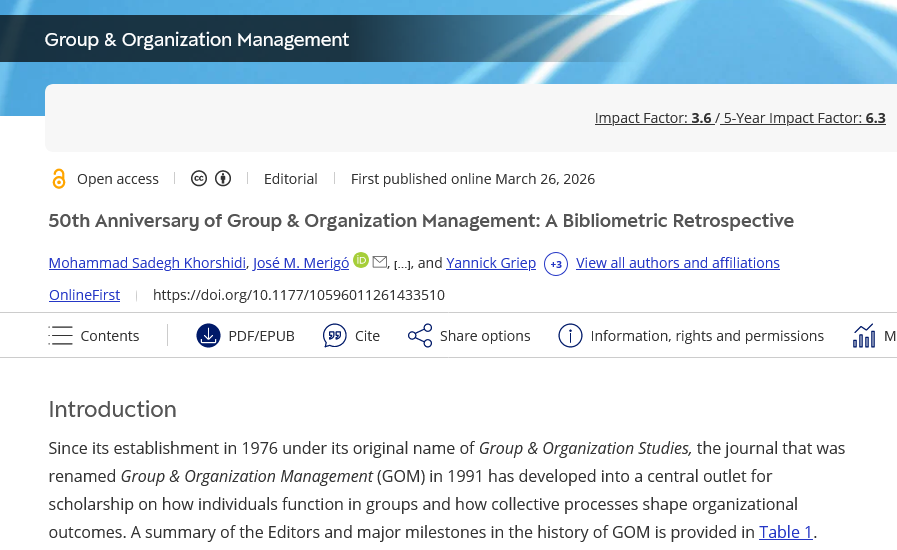
On 14 July 2026, Retraction Watch brought a follow-up, that Sage retracted eight out of 25 papers by the recently sacked editor Griep in his former journal:
““As the peer-review process was administered by the former Editor in Chief, who is also the co-author of the articles, the objectivity of the peer-review process has been compromised,” reads a publisher’s note published alongside the retractions. The move “relates to the underlying review process and no determination has been made regarding the scientific content of the articles.”
Six of the articles were retracted at the publisher’s request, and two of the papers were retracted at the request of coauthors, according to the notice. […]
When we asked about the remaining 17 papers in the journal, Laura West, a public affairs manager for Sage, told us the publisher was “continuing to investigate the journal and don’t have anything else to share at this time.””
This bit about “request of coauthors” will be relevant in a moment. Here are the retracted papers. the first six “have been retracted at the request of the Publisher“, the last two “at the request of the Publisher and the authors“:
- Griep, Y., Vander Elst, T., Kraak, J. M., Hansen, S., & Beekman, E. M. Temporal Proximity Matters: The Impact of Justice Information Timing on Psychological Contract Breach Resolution. Group & Organization Management, (2025) doi: 10.1177/10596011241238796
- Vanbelle, E., Griep, Y., Van den Broeck, A., & De Witte, H. Development and Validation of a Short Broad Job Crafting Scale. Group & Organization Management, (2026) doi: 10.1177/10596011231208924
- Sonneveld, G., Griep, Y., & Kraak, J. M. A Commentary on Asmuß & Thomsen (2024): Workplace Inclusion Through Social Partnerships – A Critical Exploration of Relational Practices. Group & Organization Management,(2025) doi:10.1177/10596011251327906
- Moradi, M., Rurenga, M., Boonman-de Winter, L., Krouwel, W., & Griep, Y. Solving What Can’t Be Solved Alone: Unleashing the Power of Action Research to Tackle Wicked Problems in Practice. Group & Organization Management, (2025) doi: 10.1177/10596011251377506
- Griep, Y., Cruz, K. S., Haggard, D. L., & Haggard, K. S. The Inclusive Leadership Paradox: When Inclusion Efforts Lead to the Exclusion of Neurodivergent People. Group & Organization Management, (2025). doi: 10.1177/10596011251330687
- Kraak, J. M., Hansen, S. D., Griep, Y., Bhattacharya, S., Bojovic, N., Diehl, M.-R., Evans, K., Fenneman, J., Ishaque Memon, I., Fortin, M., Lau, A., Lee, H., Lee, J., Lub, X., Meyer, I., Ohana, M., Peters, P., Rousseau, D. M., Schalk, R., … Tekleab, A. . In Pursuit of Impact: How Psychological Contract Research Can Make the Work-World a Better Place. Group & Organization Management, (2024) doi: 10.1177/10596011241233019
- Griep, Y., Knol, W. M., & Obenauer, W. G. A Commentary on Bazzoli (2024): Toward a Nuanced and Rigorous Model Evaluation. Group & Organization Management, (2025). doi: 10.1177/10596011241287574
- Knol, W. M., Griep, Y., Schleu, J. E., & Lemoine, G. J. Use of Political Skills by Leaders to Establish Successful Organizational Change. Group & Organization Management, (2024). doi: 10.1177/10596011241278028
Before we continue, everyone please rise and applaud the heroic effort of Sage for investigating and retracting Griep’s fraud unprompted and on their own accord, and please applaud even more our heroic watchdogs of Retraction Watch for their exclusive and exhaustive reporting.
Continue clapping please. Louder!

A bit more applause for Retraction Watch and Sage, you can also hoot, cheer hooray and throw your hat in the air.
You may now sit down.
Because it turned out, that Sage was forced to retract Griep’s papers by a coauthor on the paper Nr 8, the US psychologist James Lemoine, who originally exposed his editorial fraud. This aspect was erased for Retraction Watch‘s “Exclusive” story about the “thorough investigation” by Sage, but it now revealed by Vox on 23 July 2026, based on Lemoine’s LinkedIn post from 21 July 2026:
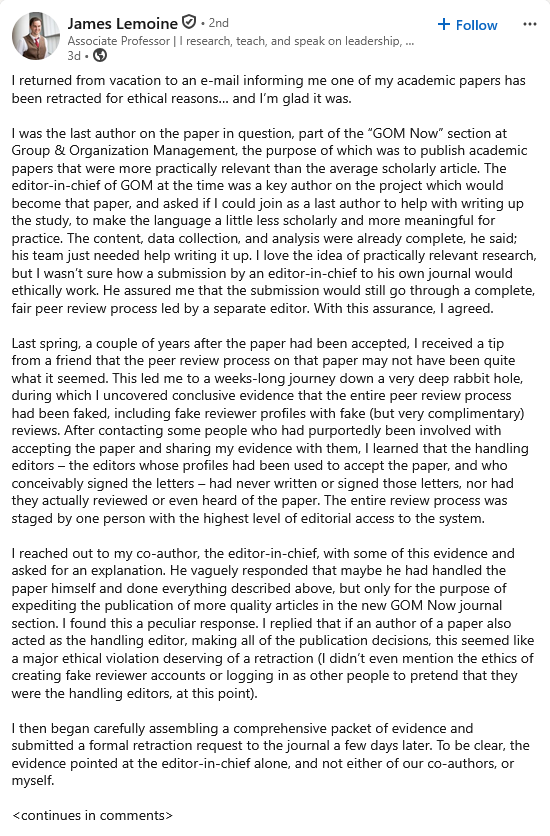
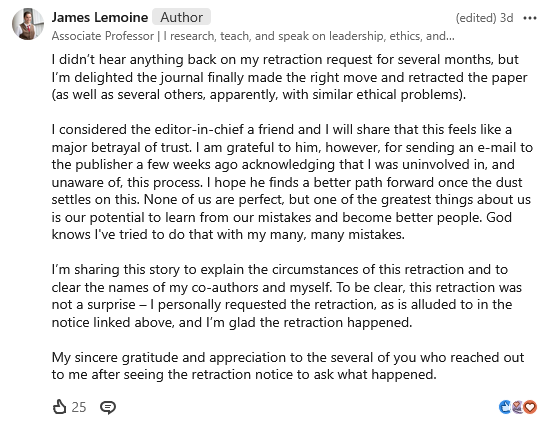
“Last spring, a couple of years after the paper had been accepted, I received a tip from a friend that the peer review process on that paper may not have been quite what it seemed. This led me to a weeks-long journey down a very deep rabbit hole, during which I uncovered conclusive evidence that the entire peer review process had been faked, including fake reviewer profiles with fake (but very complimentary) reviews. After contacting some people who had purportedly been involved with accepting the paper and sharing my evidence with them, I learned that the handling editors – the editors whose profiles had been used to accept the paper, and who conceivably signed the letters – had never written or signed those letters, nor had they actually reviewed or even heard of the paper. The entire review process was staged by one person with the highest level of editorial access to the system.
I reached out to my co-author, the editor-in-chief, with some of this evidence and asked for an explanation. He vaguely responded that maybe he had handled the paper himself and done everything described above, but only for the purpose of expediting the publication of more quality articles in the new GOM Now journal section. […]
I then began carefully assembling a comprehensive packet of evidence and submitted a formal retraction request to the journal a few days later. […]
I didn’t hear anything back on my retraction request for several months”
(James Lemoine on LinkedIn)
So this is the truth. A coauthor exposed Griep’s fraud and asked for retraction, got ignored, eventually the publisher did change their attitude (probably due to previous Vox reporting) and agreed to retract some, but not all of Griep’s fraudulent papers.
Lemoine confirmed to me that Retraction Watch hasn’t reached out to him after he published his story. There is also no follow-up reporting by Retraction Watch, neither “exclusive” or inclusive of Lemoine’s role.
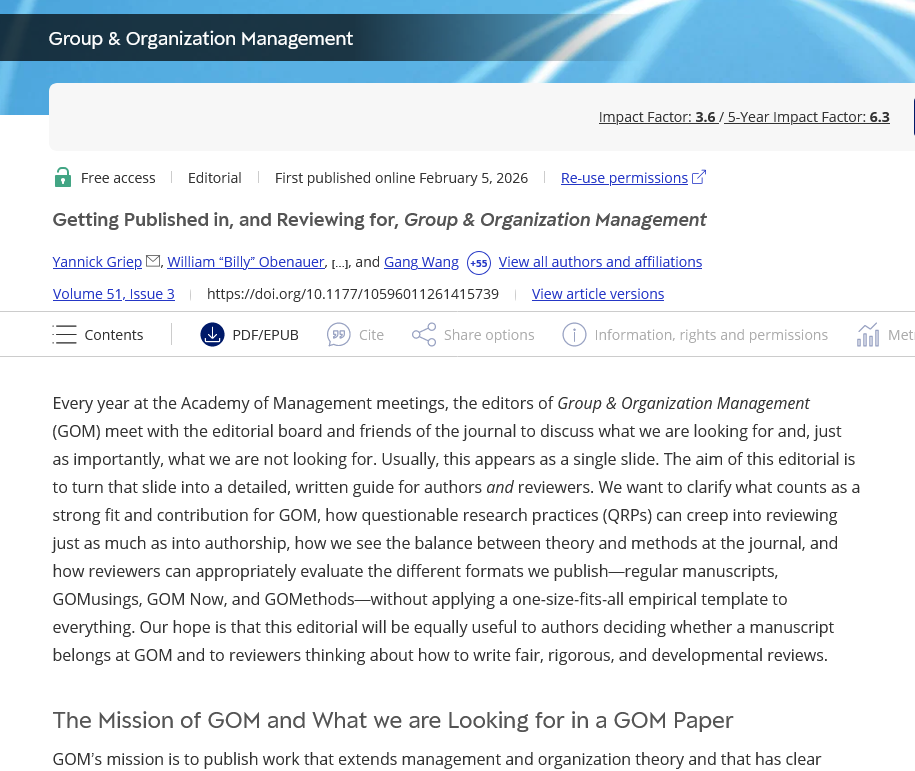
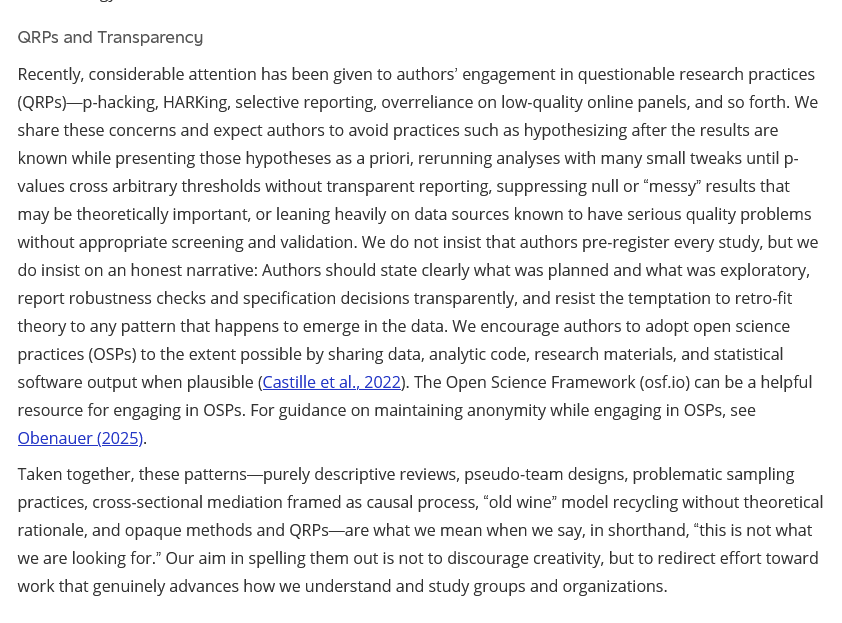
And no, there are no plans to retract Griep’s fraudulent “Getting Published in, and Reviewing for, Group & Organization Management“ editorial, published just before he was fired.
Now please rise again and applaud Sage and Retraction Watch until your hands hurt.
Science Breakthroughs
The importance of treating the whole patient
You won’t believe what crazy stuff Israeli ScientistsTM have discovered now.
Viagra as cancer cure!
Here a press release by Weizmann Institute of Science from 23 July 2026:
“In a study published recently in Cancer Research, scientists in the lab of professor Ayelet Erez at the Weizmann Institute of Science found that sildenafil, Viagra’s active ingredient, may restrict cancer metastasis through a newly discovered biological mechanism.
The researchers, led by Dr. Yarden Ariav in Erez’s lab, showed that sildenafil limits cancer cells’ ability to use cholesterol, an essential component of cellular membranes. […]
“We have uncovered a new biological pathway that links a well-known signaling molecule to cholesterol regulation within cells, and shown how this pathway can be harnessed to interfere with the ability of cancer cells to form metastases,” says Erez, who is also a practicing physician in addition to serving as a senior researcher and dean of Weizmann’s Miriam and Aaron Gutwirth Medical School. […] “Our study underscores the importance of treating the whole patient—not just the cancer—when tailoring the most effective therapy.””
This is the paper:
Yarden Ariav , Samah Hayek , Thomas Cantore , Neel Sanghvi , Lital N. Adler , Naama Darzi , Lipika R. Pal , David Robert. Crawford , Tomer Malleron , Josh Silverbeck , Eliane Yardeni , Emma Hajaj , Efrat Ben-Zeev , Sanju Sinha , Shahar Ziman , Amir Shlomai , Sergey Malitsky , Maxim Itkin , Smadar Levin-Zaidman , Inna Goliand , Omer Goldman, Hila Tishler, Alexander Brandis, Tevie Mehlman, Yuri Kuznetsov, Noga Kozer, Karen Shamash, Ella Itzhaki, Neta Ben-Chaim Moskovits, Dean Ranmar, Salomon M. Stemmer, Shay Ben-Shachar, Eytan Ruppin, Ayelet Erez PDE5a Inhibition Restricts Cancer Metastasis by Disrupting NPC1-Mediated Cholesterol Trafficking Through a Non-canonical cGMP-Dependent Pathway Cancer Research (2026) doi: 10.1158/0008-5472.can-26-1818
The PubPeer Stars of Weizmann Institute
Rony Seger, Jacob Hanna, Ilana Kolodkin-Gal, Atan Gross, Sima Lev, Tsvee Lapidot, Moshe Oren, Varda Rotter and others. Let’s celebrate the Weizmann Science!
Indeed, Ayelet Erez knows how to get things to work against cancer. In fact, in the same AACR journal, when she was a junior researcher almost two decades ago:
Ayelet Erez , Asher Castiel , Luba Trakhtenbrot , Marina Perelman , Esther Rosenthal , Itamar Goldstein , Noa Stettner , Alon Harmelin , Hagit Eldar-Finkelman, Stefano Campaner , Ilan Kirsch , Shai Izraeli The SIL gene is essential for mitotic entry and survival of cancer cells Cancer Research (2007) doi: 10.1158/0008-5472.can-07-0064

That study received a very well hidden Correction in June 2007, because there was “an error in the bottom left panel of Fig. 3B“, presumably a duplicated FACS plot. Erez’s penultimate coauthor Eytan Ruppin, deputy director of the Translational Research Institute at Cedars-Sinai Cancer in USA, also has a problmatic paper on PubPeer:
Gaurav Pathria , Joo Sang Lee , Erez Hasnis , Kristofferson Tandoc , David A. Scott , Sachin Verma , Yongmei Feng , Lionel Larue , Avinash D. Sahu , Ivan Topisirovic , Eytan Ruppin , Ze’ev A. Ronai Translational reprogramming marks adaptation to asparagine restriction in cancer Nature Cell Biology (2019) doi: 10.1038/s41556-019-0415-1


There are two more bad papers by Ruppin and his fellow countryman at Cedars-Sinai, Ze’ev Ronai: Khateb et al 2021 and Verma et al 2022.
But if they say, viagra can cure cancer, then who are we to laugh.
Drug reverses autism within hours
In USA, scientists have found a cure for autism! And it’s rapamycin, because it cures everythign else, so why shouldn#t it also cure autism?
Here is the announcement by the Broad Center of Regenerative Medicine and Stem Cell Research at University of California Los Angeles (UCLA) from 23 July 2026, headlined “Drug reverses autism-like brain changes in adult mice within hours“:
“”A new mouse study led by UCLA Health suggests that inflammation during pregnancy can trigger autism-like changes in offspring, but also that those brain and behavior effects may be rapidly but temporarily reversible in adulthood with a short-term dose of the immunosuppressive drug rapamycin. […]
The level of functional normalization achieved over this short time suggests new mechanisms by which possible treatments may act,” said the study’s senior author Dr. Harley Kornblum, director of the UCLA Intellectual and Developmental Disabilities Research Center in the Semel Institute for Neuroscience and Human Behavior. […]
In this study, researchers exposed pregnant mice to a mild inflammatory trigger early in gestation at a dose that was too low to make the mothers significantly ill. The resulting offspring went on to develop chronic brain and body-wide inflammation, mild brain overgrowth, overactive cell-signaling in the mTOR pathway, disorganized brain functional network connectivity and behaviors associated with autism.
When researchers gave adult offspring a single dose of rapamycin, they found rapid improvement across nearly every measure […] within roughly two hours”
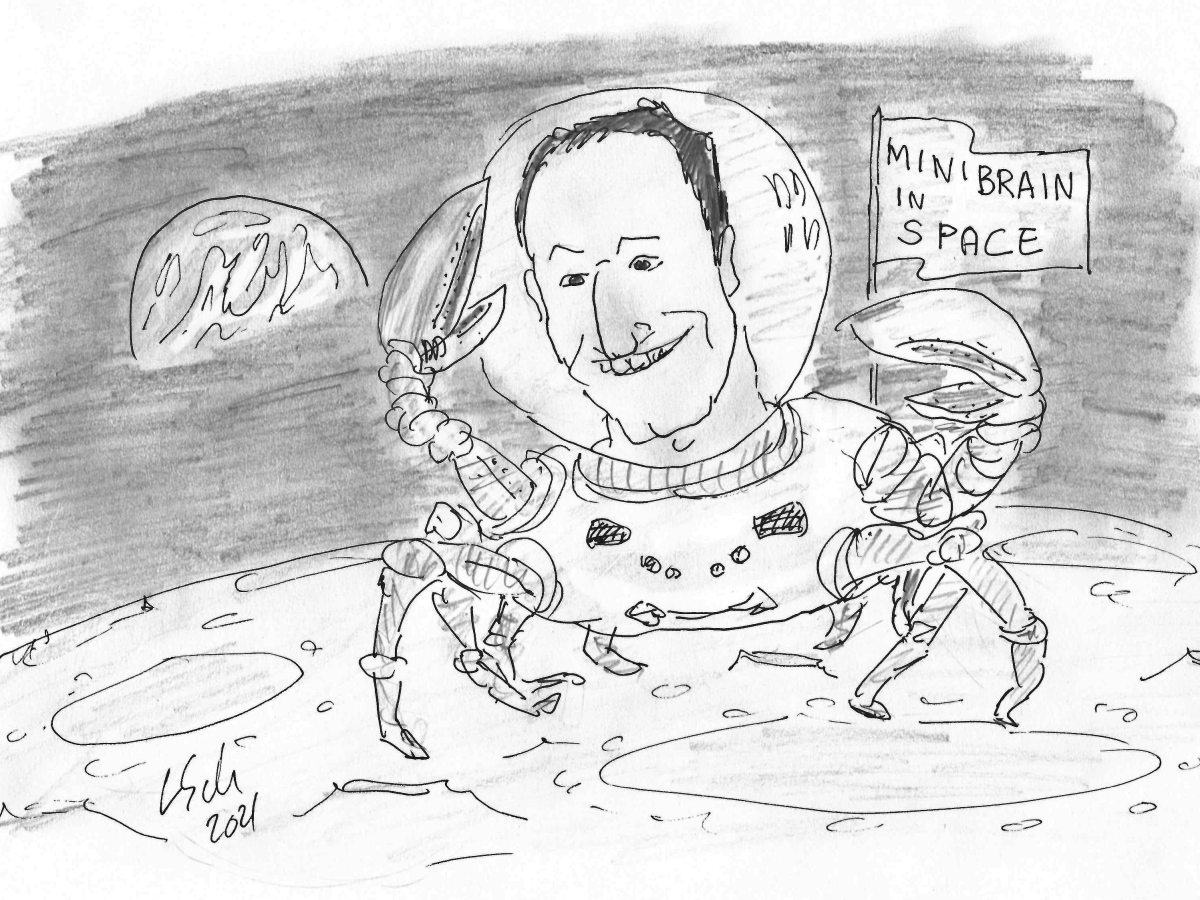
Alysson Muotri, a minibrain
Autistic Neanderthal minibrains operating crab robots via brain waves of newborn babies are to be launched into outer space for the purpose of interstellar colonization. No, I am not insane. Science Has Spoken.
This is the paper:
J E Le Belle , M. C. Condro , C. Cepeda , K D Oikonomou , K. Tessema , L. Dudley , J. Schoenfield , R. Kawaguchi , D. Geschwind , A J Silva , Z. Zhang , K. Shokat , N G Harris, H I Kornblum Acute rapamycin treatment reveals distinct mechanisms of dysfunction in a maternal inflammation mouse model Nature Communications (2026) doi: 10.1038/s41467-026-74958-1
In fairness, the press release does admit that the study “did not identify rapamycin as a viable treatment for these symptoms in humans given its temporary effects and potential for toxicity from repeated doses“. The study’s authors also admitted “the treatment effects to be temporary“, and suggest to seek for less toxic drugs with similar function as rapamycin to cure autism.
Before science runs off on a search, let’s discuss previous neuroscience research by UCLA professor Harley Kornblum, of which some is on PubPeer. Here he is with his UCLA colleague and coauthor from above, Daniel Geschwind, and a very dodgy gel:
Lorelei D Shoemaker , Nicholas M Orozco , Daniel H Geschwind, Julian P Whitelegge , Kym F Faull , Harley I Kornblum Identification of differentially expressed proteins in murine embryonic and postnatal cortical neural progenitors PLOS One (2010) doi: 10.1371/journal.pone.0009121

Actinopolyspora biskrensis: “Supplemental Figure S4 seems to show some differential splicing.
- Rack1 panel: 1 splice
- TrkC & HSP90 panels: 2 splices
- Actin panel: no splicing”
Here an even worse gel by Kornblum and Geschwind:
Ichiro Nakano, Andres A. Paucar , Ruchi Bajpai , Joseph D. Dougherty, Amani Zewail , Theresa K. Kelly , Kevin J. Kim , Jing Ou , Matthias Groszer , Tetsuya Imura , William A. Freije , Stanley F. Nelson , Michael V. Sofroniew , Hong Wu , Xin Liu , Alexey V. Terskikh , Daniel H. Geschwind , Harley I. Kornblum Maternal embryonic leucine zipper kinase (MELK) regulates multipotent neural progenitor proliferation Journal of Cell Biology (2005) doi: 10.1083/jcb.200412115


In April 2024, Kornblum replied on PubPeer and announced to investigate. In June 2024, he posted what seemed to be a self-flagellating letter to the editor of Journal of Cell Biology (Published by Rockefeller University Press), but not Kornblum’s letter, but his student’s:
“Dear Editor:
Based on an observation posted on PubPeer, I reviewed the JCB paper (J Cell Biol. 2005 Aug 1;170(3):413-27. doi: 10.1083/jcb.200412115) and discovered that I made errors in assembling and pasting in gel bands in Figures 1A and 1B. These included: duplicated presentation of the samples for MELK and GAPDH (pointed out as red and cyan) and the GFAP data that were claimed as identical (pointed out as light green). First, the data for MELK and GAPDH are in fact identical as the control is the same for both, but I should not have portrayed them as being different. We can remove one of these two images. The GFAP data look quite similar but they are different. I have confidence in all the other data in the paper and each experiment was replicated 3 or more times. Our other findings strongly support our conclusions. However, based on the errors in Figures 1B, I would like to seek your guidance in how to proceed with the publication. I can write an erratum to withdraw the identical parts of Figure 1B in question, as many years have passed and I do not have the original data, or, if you conclude that is insufficient, I will accept whatever decision your office decides. No other authors were aware of these errors and they are mine alone.
Ichiro Nakano (first author that generated all the data in question)“
The editor decided that no action whatsoever needed to be taken. Funnily, data from that rotten paper was later reused in another study by Kornblum, Geschwind and Kornblum’s guilty mentee Ichiro Nakano, who is since 2015 professor at University of Alabama at Birmingham, USA:
Ichiro Nakano, Joseph D. Dougherty, Kevin Kim , Ivan Klement , Daniel H. Geschwind , Harley I. Kornblum Phosphoserine Phosphatase Is Expressed in the Neural Stem Cell Niche and Regulates Neural Stem and Progenitor Cell Proliferation Stem Cells (2007) doi: 10.1634/stemcells.2007-0046

Another problematic paper by Nakano and his mentor Kornblum in the same Oxford University Press journal also reused data from that 2005 paper in Journal of Cell Biology:
Kaushal Joshi , Yeshavanth Banasavadi-Siddegowda , Xiaokui Mo , Sung-Hak Kim , Ping Mao , Cenk Kig , Diana Nardini , Robert W. Sobol, Lionel M.L. Chow , Harley I. Kornblum, Ronald Waclaw , Monique Beullens , Ichiro Nakano MELK-Dependent FOXM1 Phosphorylation is Essential for Proliferation of Glioma Stem Cells Stem Cells (2013) doi: 10.1002/stem.1358

In May 2024, Kornblum announced on PubPeer: “We are investigating and will submit our proposals for corrections/edits or withdrawals soon“. Nothing happened since.
Another paper by Nakano and Kornblum was however retracted, because even its raw data was fraudulent:
Jia Wang , Peng Cheng , Marat S. Pavlyukov , Hai Yu , Zhuo Zhang , Sung-Hak Kim , Mutsuko Minata , Ahmed Mohyeldin , Wanfu Xie , Dongquan Chen , Violaine Goidts , Brendan Frett , Wenhao Hu , Hongyu Li , Yong Jae Shin , Yeri Lee , Do-Hyun Nam , Harley I. Kornblum , Maode Wang, Ichiro Nakano Targeting NEK2 attenuates glioblastoma growth and radioresistance by destabilizing histone methyltransferase EZH2 Journal of Clinical Investigation (2017) doi: 10.1172/jci89092


In September 2020, the journal issued an Expression of Concern, where it “requested an institutional investigation into this matter.” Just weeks later, in October 2020, a retraction was published:
“At the request of the corresponding author, the JCI is retracting this article. Several concerns were raised regarding the Western blot data in Figures 1J, 2A, 3A, and 4D and Supplemental Figures 3A, 4C, and 6A. After an extensive internal review, it became apparent that errors were introduced during the preparation of the revised figures. Due to loss of confidence in the published figures, the corresponding author requested retraction. No issues have been raised with regard to any of the other data in the paper.”
Obviously the corresponding author Nakano blamed his students and is officially innocent. Nakano has much more on PubPeer, in fact, due to his other affiliation with Ohio State University, he teamed up even with Carlo Croce, see for example their fraudulent study Jeon et al 2018. Here are two papers by Nakano:
- Chunyu Gu , Yeshavanth K. Banasavadi-Siddegowda , Kaushal Joshi , Yuko Nakamura , Habibe Kurt , Snehalata Gupta , Ichiro Nakano Tumor-Specific Activation of the C-JUN/MELK Pathway Regulates Glioma Stem Cell Growth in a p53-Dependent Manner Stem Cells (2013) doi: 10.1002/stem.1322
- Sung-Hak Kim , Kaushal Joshi , Ravesanker Ezhilarasan , Toshia R. Myers , Jason Siu , Chunyu Gu , Mariko Nakano-Okuno , David Taylor , Mutsuko Minata , Erik P. Sulman , Jeongwu Lee , Krishna P.L. Bhat, Anna Elisabetta Salcini , Ichiro Nakano EZH2 protects glioma stem cells from radiation-induced cell death in a MELK/FOXM1-dependent manner Stem Cell Reports (2015) doi: 10.1016/j.stemcr.2014.12.006

The 2015 paper received an Editorial expression of concern in October 2024, which “will remain appended to the article until the investigation has been completed and the editors have reached a conclusion and taken any further action deemed necessary“. The note also mentioned: “In addition, histology data shown in Figure 1D have been reused from Figure 6C in Gu et al., 2013“. I illustrate this finding here:

Nakano’s bad preclinical research trnaslates directly into clinical trials:
Ping Mao , Kaushal Joshi , Jianfeng Li , Sung-Hak Kim , Peipei Li , Lucas Santana-Santos , Soumya Luthra , Uma R Chandran , Panayiotis V Benos , Luke Smith , Maode Wang , Bo Hu , Shi-Yuan Cheng, Robert W Sobol, Ichiro Nakano Mesenchymal glioma stem cells are maintained by activated glycolytic metabolism involving aldehyde dehydrogenase 1A3 Proceedings of the National Academy of Sciences of the United States of America (2013) doi: 10.1073/pnas.1221478110

Actinopolyspora biskrensis: “Two images in Figure S7D seem to overlap, but appear to be described differently.”
Now, important is also that Kornblum isn’t bothered at all: he and Nakano still happily publish together, one paper in 2024 and another in 2025. Now you decide if Kornblum’s rapamycin for autism finding is any reliable.
Findings fundamentally alter our understanding of mitochondrial biology
Now something much crazier comes. Ever heard of the importance of eating your five a day? Now science explains why exactly it’s important!
You see, the mitochondria from spices and vegetables you eat reach your brain and then rejuvenate it.
No, really, this is exactly what this study from the University of Louisville in Kentucky, USA, claimed to have proven:
Yun Teng, Chao Luo , Qingbo Xu , Jingyao Mu , Lucy Teng , Hongjia Qian , Yinan Huang , Minmin Liu , Lifeng Zhang , Juw Won Park , Jae Yeon Hwang , Maiying Kong , Jun Yan , Michael L. Merchant , Huang-Ge Zhang Plant-derived mitochondria mitigate aging-related neurodegeneration by reprogramming microglial mitochondrial energy metabolism Translational Neurodegeneration (2026) doi: 10.1186/s40035-026-00565-1
Now, logic dictates that the biggest health benefits can be obtained from foodstuffs relevant to Traditional Chinese Medicine. And indeed, the authors used curcuminturmeric roots, ginger roots”, garlic and aloe, the extracts were used for experiments on mice and brains from diseased patients. Naturally, /turmeric mitochondria T-Mit) outperformed all, the tremendous anti-aging and neuroprotective effect via miRNAs (what else!) was verified with gold nanoparticles and electron microscopy and energy dispersive spectroscopy, as well as with next-generation small RNA sequencing. This is the abstract:
“Mitochondria were isolated from several commonly consumed edible plants (P-Mit) using differential centrifugation followed by sucrose gradient ultracentrifugation. […]
Orally administered T-Mit travelled from the gut to the brain in aged male mice, where they fused with microglial mitochondria (M-Mit), reprogramming M-Mit energy metabolism and reversing aging-related cognitive dysfunction. Specifically, T-Mit was taken up by microglia via the phagocytic receptor TREM2. Subsequently, T-Mit fused with M-Mit in a mitofusin 1-dependent manner. The T-Mit microRNAs Tae-miR319 and Osa-miR166a-3p then integrated into M-Mit, inhibiting the expression of complex I subunits ND4 and ND5. This inhibition alleviated reverse electron transport (RET) at complex I, reducing reactive oxygen species (ROS) production and facilitating ATP production, ultimately rescuing aging-related cognitive decline. Data from elderly human subjects also showed overactivation of the RET process and overproduction of ROS, accompanied by low ATP levels in microglia.
Our findings fundamentally alter our understanding of the regulation of mammalian mitochondrial biology by P-Mit and may lead to P-Mit-based transfer therapy for preventing or treating human mitochondrial disorder-related diseases.”
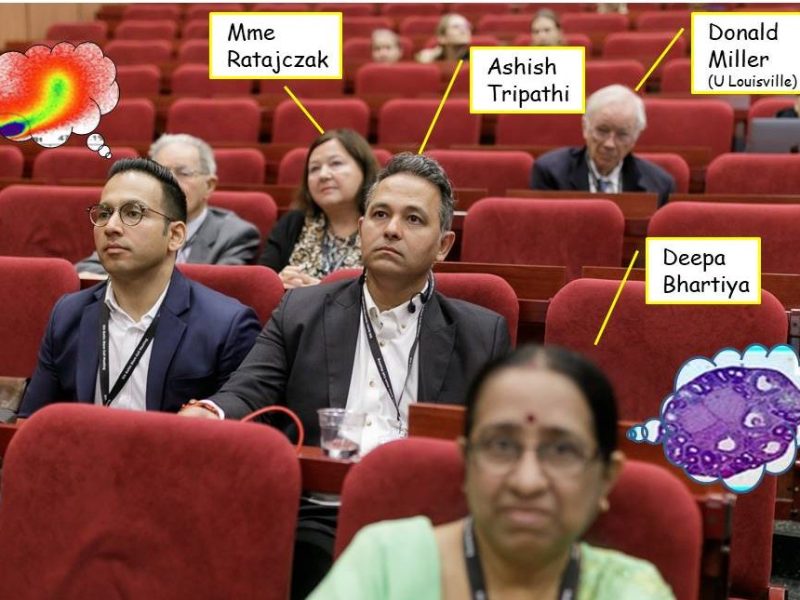
Stop trying to make VSEL happen!
“…the best evidence for the existence of VSELs is the dismal failure of all the other much-vaunted stem-cell therapies to deliver on their promises. Since it is axiomatic that some stem-cell therapy must work, the successful cell-types must be the ones that haven’t been tried yet, which leaves VSELs.”- Smut Clyde

This is completely insane brainrot, every single word of it, notice that despite this being US research, no serious media dared to report about this, for obvious reasons.
Ad of course it is completely fake. I don’t think they ever did any actual experiments, because the amount of work to bully people into falsifying them would be dangerously too much, even in Kentucky. In fact, the figures prove that the fakes were very basic:


The lead clown is Huang-Ge Zhang, Endowed Chair in Cancer Research at Brown Cancer Center of University of Louisville, and, as his university celebrated earlier this year a Highly Cited Researcher “among top 1% most-cited in the world“.
Of course this clown has more on PubPeer, in the following paper Zhang and his Louisville colleague and only white coauthor above, Michael Merchant, used ginger nanoparticles to cure obesity and diabetes:
Anil Kumar , Kumaran Sundaram , Yun Teng , Jingyao Mu , Mukesh K Sriwastva , Lifeng Zhang , Joshua L. Hood , Jun Yan , Xiang Zhang , Juw Won Park , Michael L Merchant , Huang-Ge Zhang Ginger nanoparticles mediated induction of Foxa2 prevents high-fat diet-induced insulin resistance Theranostics (2022) doi: 10.7150/thno.62514

That paper also reuses data from another study by Zhang and Merchant in the same journal, about miRNA in diabetes:
Anil Kumar , Yi Ren , Kumaran Sundaram , Jingyao Mu , Mukesh K Sriwastva , Gerald W Dryden , Chao Lei , Lifeng Zhang , Jun Yan , Xiang Zhang , Juw Won Park , Michael L Merchant , Yun Teng , Huang-Ge Zhang miR-375 prevents high-fat diet-induced insulin resistance and obesity by targeting the aryl hydrocarbon receptor and bacterial tryptophanase (tnaA) gene Theranostics (2021) doi: 10.7150/thno.52558

Here Zhang cured tooth decay with ginger nanoparticles:
Kumaran Sundaram , Daniel P. Miller , Anil Kumar , Yun Teng , Mohammed Sayed , Jingyao Mu , Chao Lei , Mukesh K. Sriwastva , Lifeng Zhang , Jun Yan , Michael L. Merchant , Liqing He , Yuan Fang , Shuangqin Zhang , Xiang Zhang , Juw W. Park , Richard J. Lamont, Huang-Ge Zhang Plant-Derived Exosomal Nanoparticles Inhibit Pathogenicity of Porphyromonas gingivalis iScience (2019) doi: 10.1016/j.isci.2019.10.032

And here, Zhang recruited next to Merchant another whitey, namely his own boss – the Brown Cancer Center director Donald Miller:
Yun Teng , Yi Ren , Xin Hu , Jingyao Mu , Abhilash Samykutty , Xiaoying Zhuang , Zhongbin Deng , Anil Kumar , Lifeng Zhang , Michael L. Merchant, Jun Yan , Donald M. Miller, Huang-Ge Zhang MVP-mediated exosomal sorting of miR-193a promotes colon cancer progression Nature Communications (2017) doi: 10.1038/ncomms14448

Here, Zhang and Miller cured cancer with grapefruit nanoparticles.
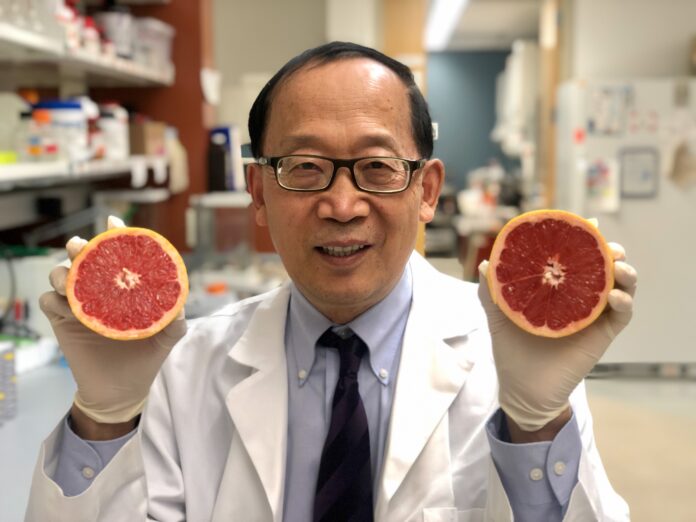
While no fraud was found in that paper (yet!), some of its figures were stolen by a Chinese papermill:
Yun Teng , Jingyao Mu , Xin Hu , Abhilash Samykutty , Xiaoying Zhuang , Zhongbin Deng , Lifeng Zhang , Pengxiao Cao , Jun Yan , Donald Miller , Huang-Ge Zhang Grapefruit-derived nanovectors deliver miR-18a for treatment of liver metastasis of colon cancer by induction of M1 macrophages Oncotarget (2016) doi: 10.18632/oncotarget.8361

Yuting Liu , Jie Tang , Xiaolan Qiu , Lucy A Teng , Mukesh K Sriwastva , Xuedong Han , Zhi Li , Minmin Liu , Shuangyue Liu , Dongzhu Da , Zhi Li , Linlin Zhen , Yi Ren Rab1A-Mediated Exosomal Sorting of miR-200c Enhances Breast Cancer Lung Metastasis Breast Cancer: Targets and Therapy (2023) doi: 10.2147/bctt.s400974 RETRACTED June 2026
Strange, why is the Univeristy of Louisville not celebrating the T-Mit discovery by their Highly Cited Zhang? Come on guys, no need to be shy, tell this discovery to RFK Jr and his Make America Healthy Again!
Donate!
If you are interested to support my work, you can leave here a small tip of $5. Or several of small tips, just increase the amount as you like (2x=€10; 5x=€25). Your generous patronage of my journalism will be most appreciated!
€5.00


Re: VC Latchman
Satire is now obsolete, utter cynicism has prevailed once again. He just won’t go away until he gets his knighthood.
LikeLike
Replacing someone suspended for bullying by someone with loads of fraudulent papers! Something is rotten at UCL…
LikeLike
https://www.theguardian.com/education/ng-interactive/2026/aug/01/playbooks-plagiarism-pigs-head-new-claims-surrounding-cambridge-professor-jason-arday
“Another critic of Arday was Dr David Harris, professor emeritus at Plymouth Marjon University, in Devon, who had previously written to Cambridge with claims about Arday’s work.
Harris had been stripped of his professor emeritus title after he wrote a post about critical race theory that was deemed “controversial” by colleagues, but it was reinstated in 2026.”
LikeLiked by 1 person
Just received an interesting email regarding that Cofnas Support Letter organised by Abhishek Saha.
“Hello,
I see my name (n 177) among the signatories of a letter in support of Nathan Cofnas hosted on your website. I have no idea how my name ended up there. I see no traces of this in my email inboxes, for example. Please remove it immediately.
Thank you in advance,
Enzo Rossi
University of Amsterdam”
Well, I obviously only made a copy of Saha’s document.
LikeLike