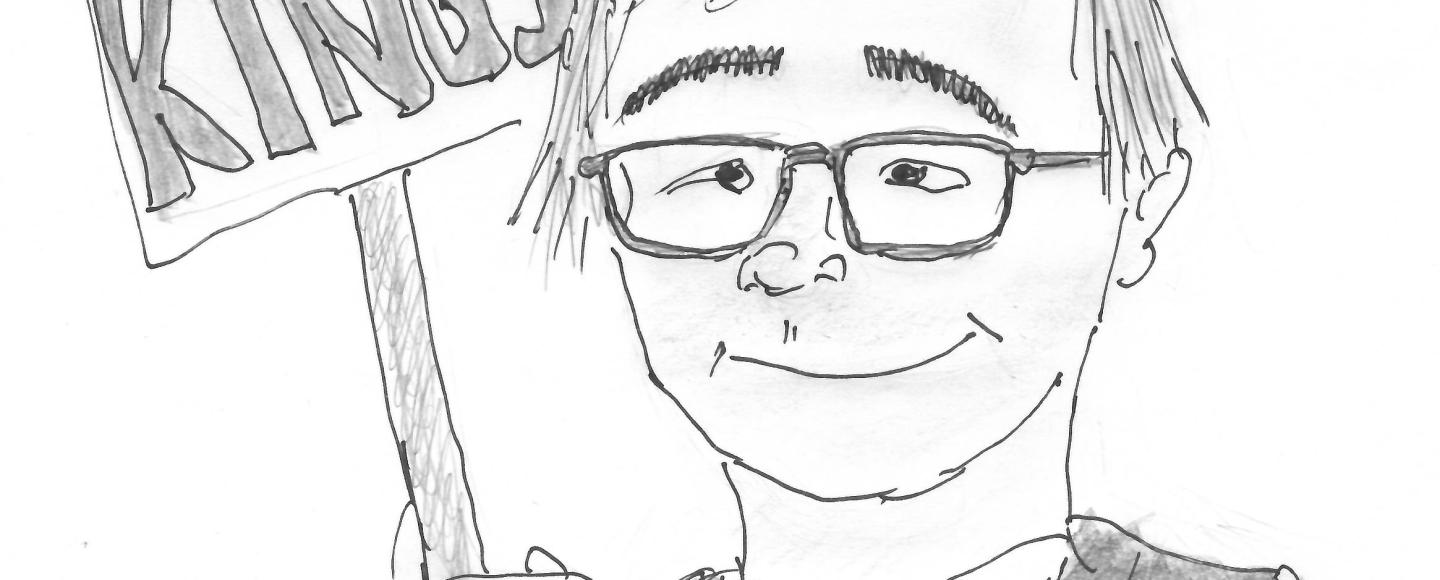

This is a tour de force by the PubPeer sleuth Carabus maleki, about Rui Reis, born 1967, still looking like a nerdy boy, but in reality the king of Portuguese regenerative medicine who cured all diseases with biomaterials and stem cells. At least his publication metrics say so.
Or maybe it is all a huge scam. Over 90 papers on PubPeer, even Iranian and Chinese papermills seem to be involved.
It is possible that Reis used his enormous institutional power to impose himself as coauthor on every paper coming from his institute. We don’t know if he read all of them, but we can safely assume he personally profited from them all, financially and otherwise. We also can’t know what the punishment for not adding Rui as author was (sacking? whip-lashing?), but all these papers should by no means cease being his own now that we see how ridiculously fraudulent they are.
The big powerful man never replied to my email. And neither did his coauthors, including the university’s Vice-Rector for Research.
Now, over to the amazing sleuth, Carabus maleki, whose writings you may have read on this website before, under a different pseudonym.
The Kingdom of Rui Reis
by Carabus maleki
We are about to meet the top scientist of the top scientists in Portugal, Rui Luís Reis (he has his own Wikipedia page, informing us that he is “a strong supporter of FC Porto”). A native of Porto, he is the pride and joy of the charming city of Guimarães, where he founded and still presides over i3Bs, the Research Institute on Biomaterials, Biodegradables and Biomimetics. He is a Full Professor of Tissue Engineering, Regenerative Medicine and Stem Cells in the Department of Polymer Engineering at the School of Engineering, University of Minho; and Director of the PhD Program in Tissue Engineering, Regenerative Medicine and Stem Cells. He is the CEO the European Institute of Excellence on Tissue Engineering and Regenerative Medicine formally known as EXPERTISSUES EEIG, headquartered at the 3B´s Research Group facilities. He is the President, Chairman and Chief Scientific Officer of Stemmatters, a Portuguese biotechnology Contract Development and Manufacturing Organization (CDMO) specialized in regenerative medicine, advanced cell therapies, and blood-derived biologicals.

Zombie scientist Sonia Melo awarded by AstraZeneca
Sonia Melo is back, and not to be messed with. The Portuguese zombie scientist is responsible for a number of papers with manipulated data (only one was retracted, Melo et al, Nature Genetics, 2009), saw her EMBO Young Investigator funding withdrawn in 2016, but was whitewashed and reinstalled by her employing institute Instituto de Investigação e…

In the past 30 years, Rui Reis’s work promised to engineer all types of damaged biological tissues, build biomaterials from natural polymers, harness stem cells, develop artificial organs, and cure cancer with all sorts of nano-stuff, pretty much the full sci-fi starter pack, documented in the numerous videos on the i3Bs YouTube channel. For this, he has been generously funded, not only by drawing on the multimillion-euro budgets and human resources of the institutions and consortia he controls, but also through numerous national and European grants. For example, a €2.35 million ERC Advanced Grant awarded in 2012 to develop methods to evaluate the complex interactions between stem cells and materials, and about €1 million in 2024 from “Fundação laCaixa” to develop a synthetic retina, aimed at restoring vision in cases of blindness caused by retinitis pigmentosa, together with the legendary Maria Pia Cosma, an Italian superstar in Barcelona.
The list of Rui Reis prizes and honours is too long to enumerate here, but it includes a hat-trick of major European biomaterials awards: the young scientist prize (Jean Leray Award, Barcelona, 2002), the career achievement award (George Winter Award, Dublin, 2011), and, more recently, the mentoring and support of young researchers prize, the Klaas de Groot Award from the European Society for Biomaterials (ESB). As expected, Professor Reis has an impressive publication record, with nearly 2 000 papers indexed in Scopus, over 95,000 citations, and an h-index of 168, quite unparalleled for any researcher in Portugal, something that is regularly celebrated in the Portuguese press. Rui Reis is, without a doubt, the crowned king of Portuguese science, which conveniently fits his name, since “Reis” literally means “kings” in Portuguese.
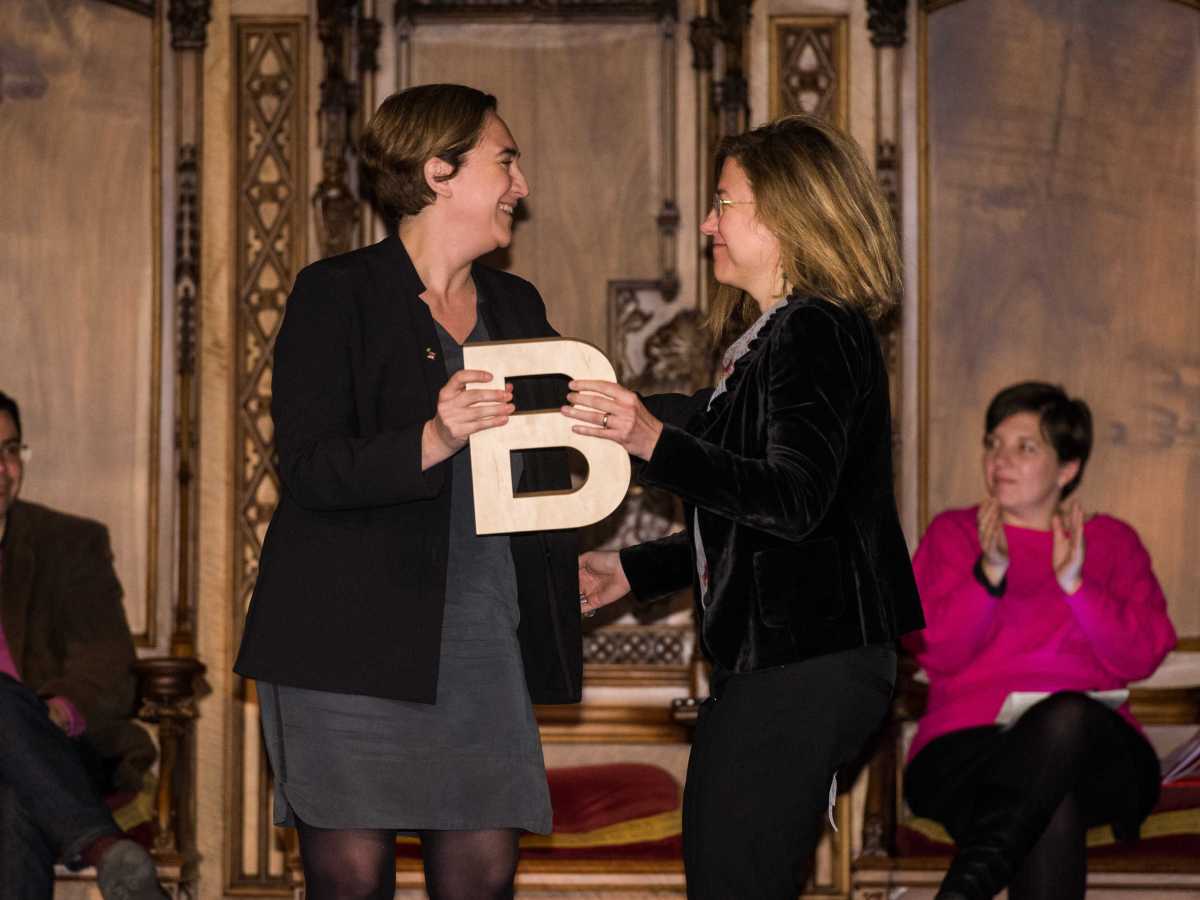
However, not everything appears to be quite right in the kingdom of Reis. Buried among the innumerable news pieces celebrating Professor Reis’s achievements, a rather intriguing newspaper report dated from 3 years ago, mentions a police raid on his office over the alleged misuse of university funds to pay for luxury travel around the world for him, his family, and his friends. However, the newspaper that published this, Correio da Manhã, is often dismissed as somewhat populist and tabloid-leaning. More respectable, intellectually polished newspapers do not dare publish such unflattering news about top academics, which are generally treated as deities in Portugal. Professor Reis also has an astonishing number of papers commented on PubPeer, for all the wrong reasons, over 90 (and counting), which must surely be another record for any Portuguese scientist!
His travels around the world, which seem to have put him at odds with the Portuguese justice system, certainly contributed to some of his productivity and PubPeer record, including, for example, authorships from South Korea with Gilson Khang, one of the founders of the Asian Tissue Engineering Society (ATES).
Jeong Eun Song , Eun Young Kim , Woo Young Ahn , Yu Jeong Lee , Dongwon Lee , Rui Reis , Gilson Khang The potential of DBP gels containing intervertebral disc cells for annulus fibrosus supplementation:in vivo Journal of Tissue Engineering and Regenerative Medicine (2015) doi: 10.1002/term.1699
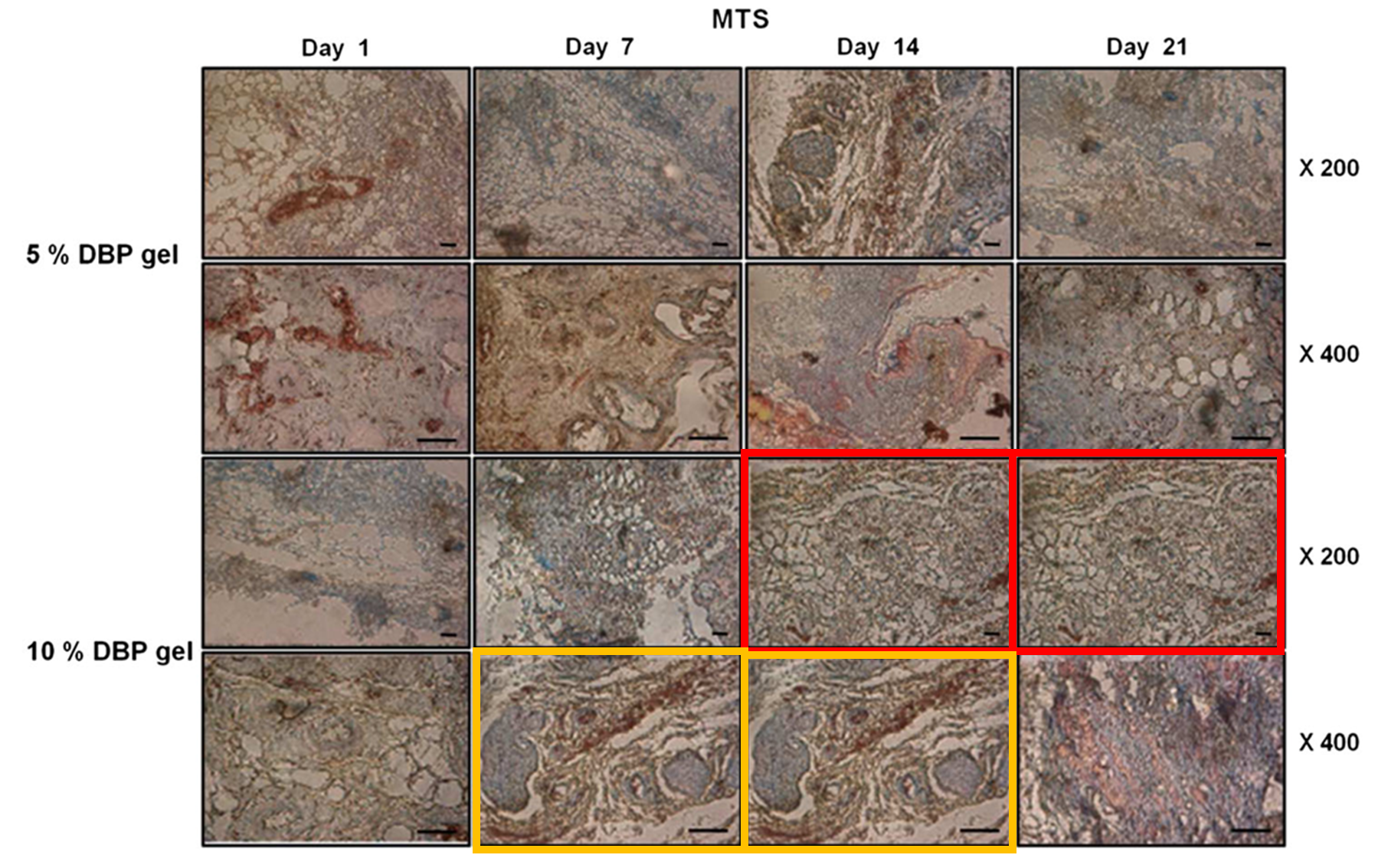
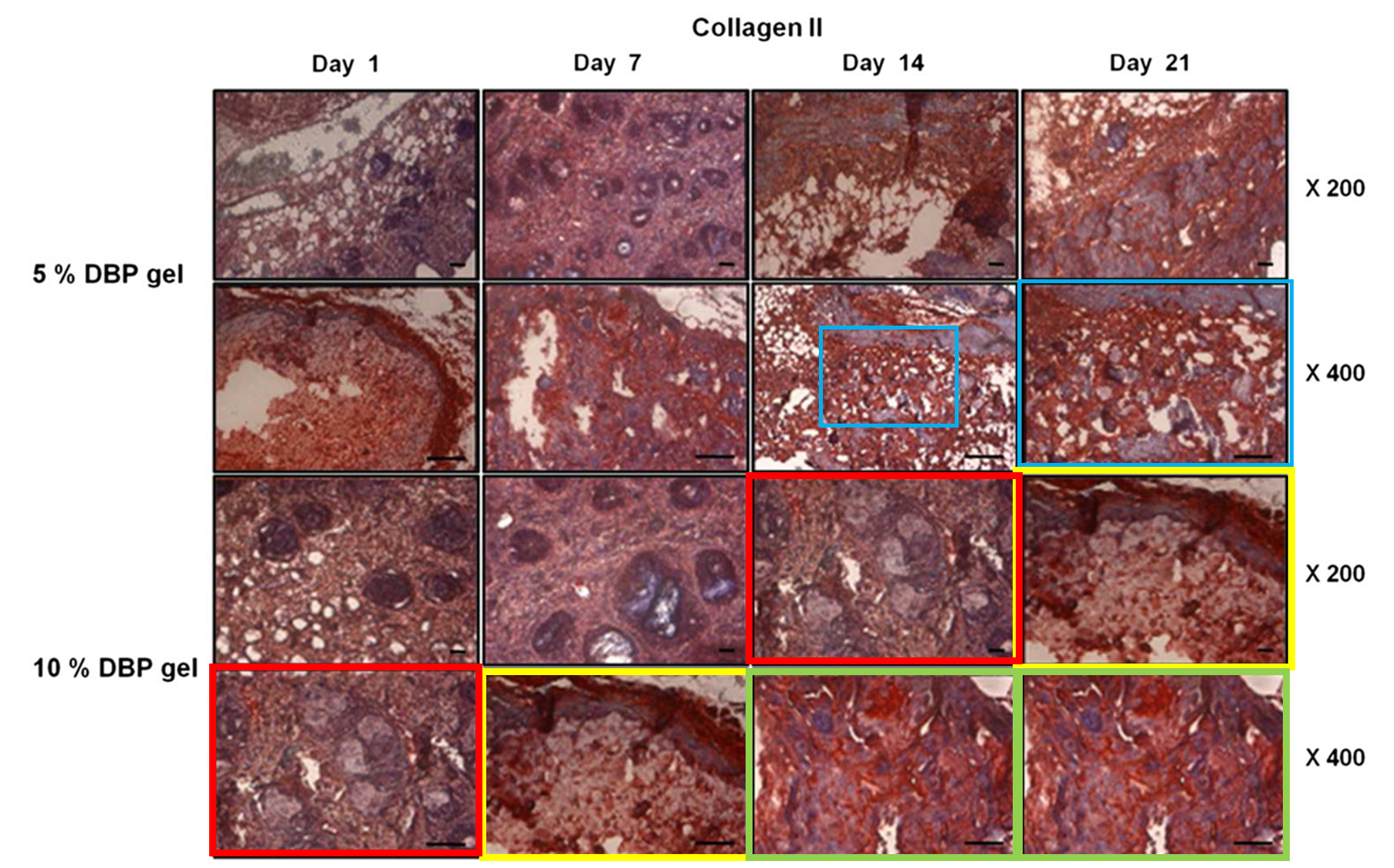
Another attempt at regenerative medicine by Kang and Reis:
Joo Hee Choi, Ok Kyun Choi , Jeonghun Lee , Joungyoun Noh , Sumi Lee , Ain Park , Min A. Rim , Rui L. Reis , Gilson Khang Evaluation of double network hydrogel of poloxamer-heparin/gellan gum for bone marrow stem cells delivery carrier Colloids and Surfaces B Biointerfaces (2019) doi: 10.1016/j.colsurfb.2019.06.041
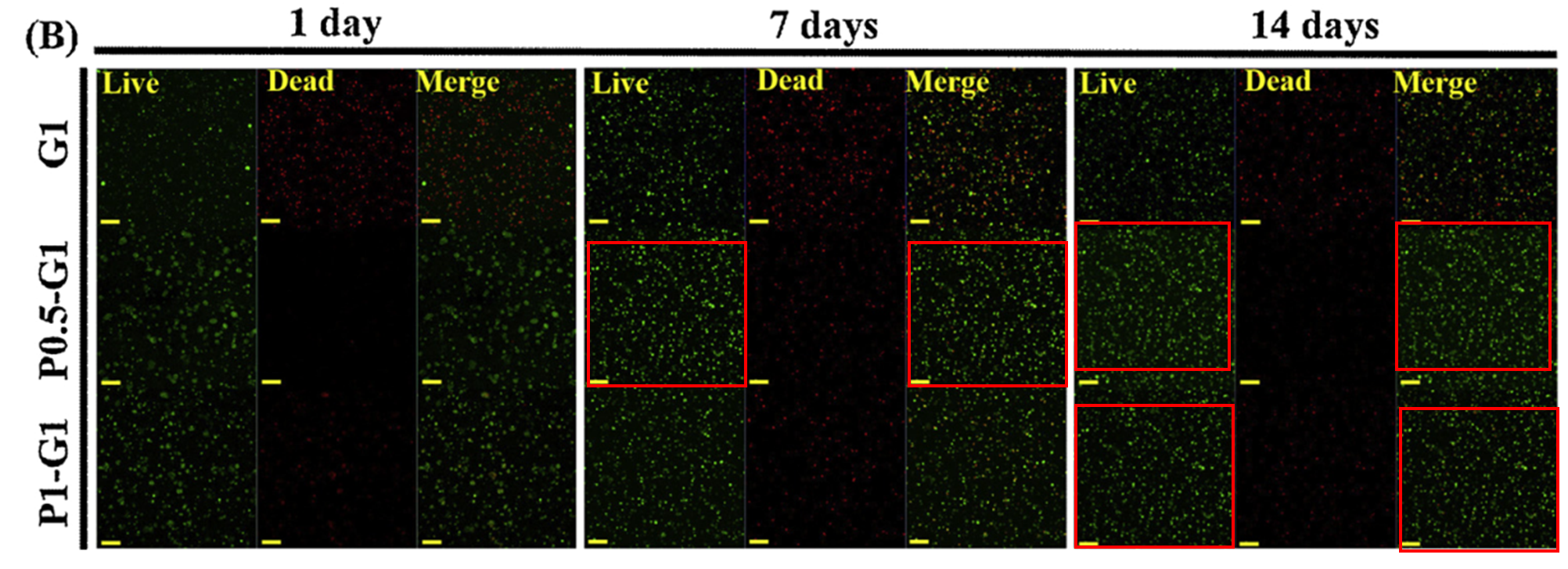
More stuff from South Korea:
Jae Seo Lee , Sang Jin Lee , Seok Bin Yang , Donghyun Lee , Haram Nah , Dong Nyoung Heo , Ho-Jin Moon , Yu-Shik Hwang , Rui L. Reis , Ji-Hoi Moon , Il Keun Kwon Facile preparation of mussel-inspired antibiotic-decorated titanium surfaces with enhanced antibacterial activity for implant applications Applied Surface Science (2019) doi: 10.1016/j.apsusc.2019.143675
And from China, hopefully a papermill product, and hopefully no real mouse had to suffer through such humongous tumours:
Xuerui Chen , Xuelian Yin , Lin Zhan , Junfeng Zhang , Yuxi Zhang , Yinghua Wu , Jiale Ju , Yajie Li , Qianghua Xue , Xu Wang , Chenchen Li , Rui L. Reis , Yanli Wang Organelle‐Specific Anchored Delivery System Stretching a Reversal of Tumor Hypoxia Microenvironment to a Combinational Chemo‐Photothermal Therapy Advanced Functional Materials (2022) doi: 10.1002/adfm.202108603
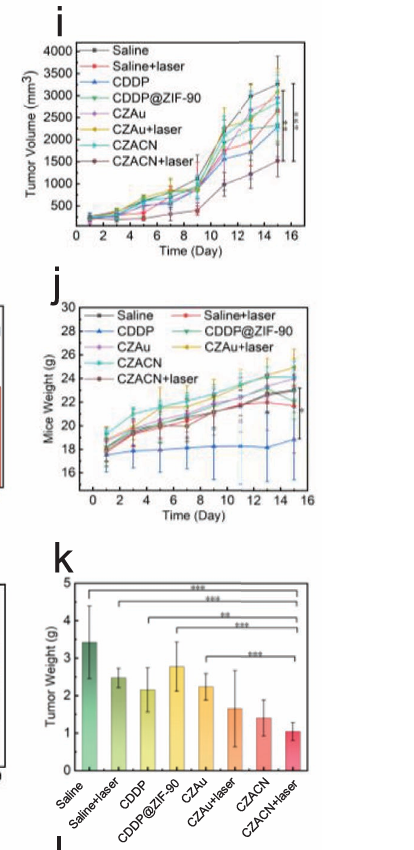
On Fig. 2, panels i and k appear to show tumor burdens that may exceed commonly accepted IACUC humane endpoints. For rodent tumor studies, maximum tumor size is typically limited to about 20 mm (2 cm) in diameter in mice (~2000–2500 mm³) to minimize pain and distress. In panel i, tumor volumes reach ~3000–3500 mm³ by day 14–16. Panel k further suggests tumor weights exceeding ~4 g in some groups, which would represent a substantial fraction of total body weight for a typical mouse.
However, most of Professor Reis’s astonishing productivity is home-made, driven by the obligatory practice of his name adorning virtually every paper from the research teams at i3Bs. Thus, we cannot dissect the achievements and alleged misdeeds of Professor Reis without telling the story of a broader network of researchers, mostly in Portugal, who are part of this mess. A king’s power depends on his court and subjects, and Reis’s court includes quite a collection of high achievers: recipients of multi-million-euro European grants, highly cited researchers who went on to top positions at several institutions, and even a Forbes Portugal “30 Under 30.” King Reis, it seems, is also something of a king-maker. So, let’s begin.

Moravian Rhapsody
“Please, can you tell me more about the web page and mechanism behind? Is there any “scheme” of scanning published papers?” asks Professor Vojtech Adam. Yes, it’s Elisabeth Bik.
Multitalented student
Joaquim Miguel Oliveira is a Principal Investigator with habilitation at 3B’s, Vice-President of i3Bs, and Editor-in-Chief of the In Vitro Models journal. Having worked with Rui Reis since at least his PhD thesis (concluded in 2009), Oliviera’s research seems to focus virtually on all fields developed at i3Bs: biomaterials for tissue engineering, nanomedicine, stem cells, and cell/drug delivery. In practice, he seems to have placed his name on as many papers as possible: more than 400 publications indexed in Scopus and an h-index of 69, co-authoring 17 of the Rui Reis papers commented on PubPeer.
Such as this one with some Brazilian co-authors:
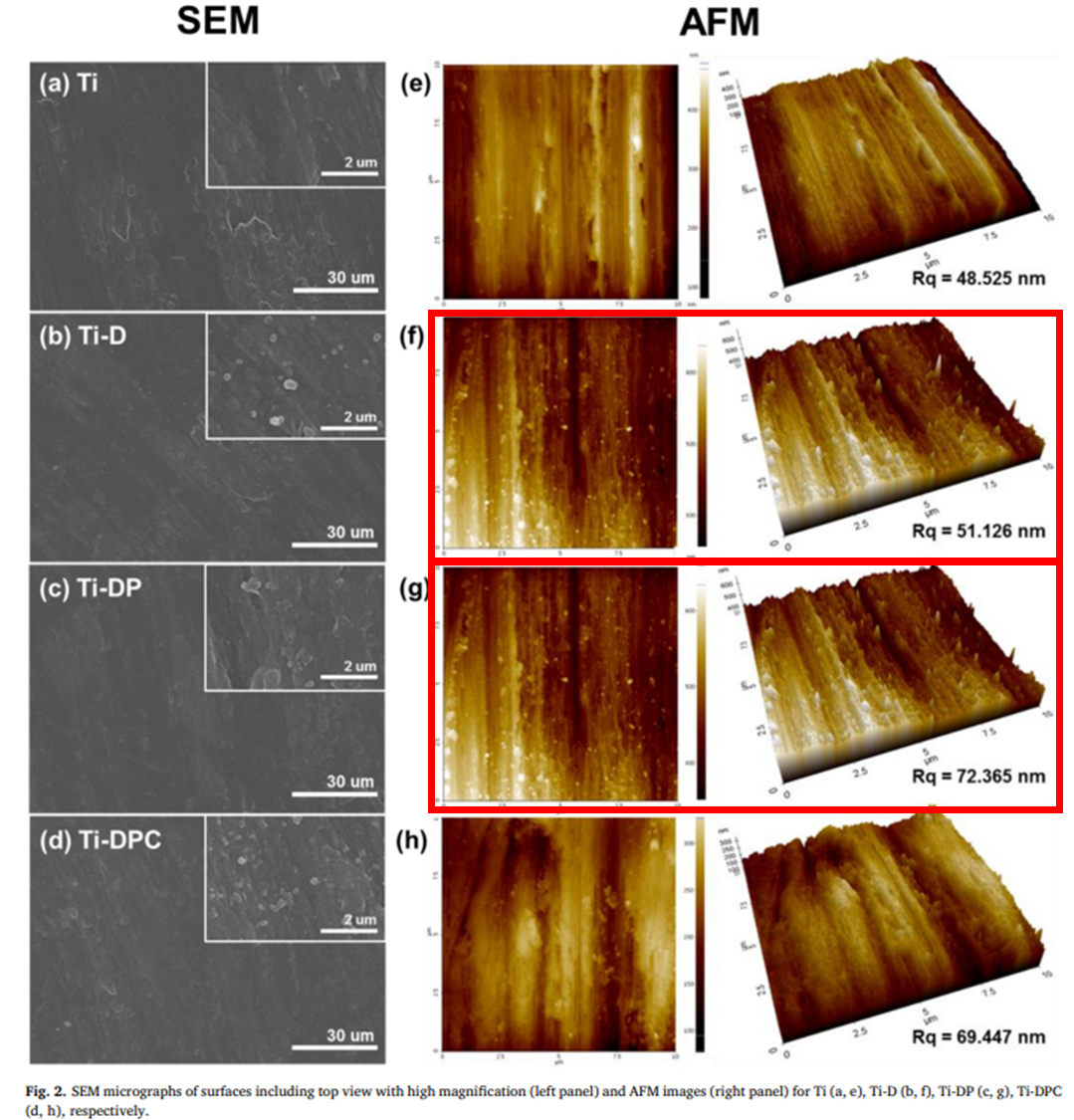
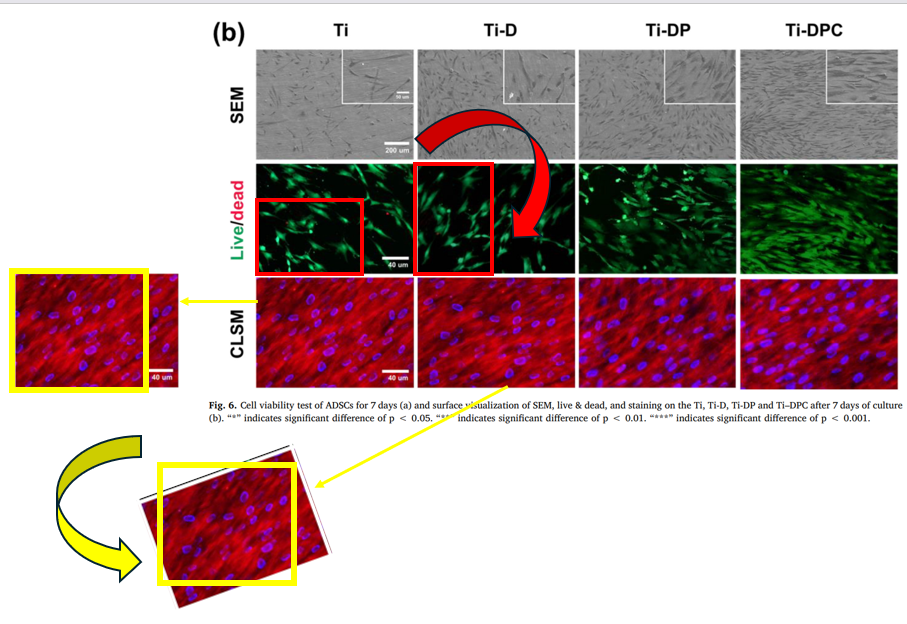
Talita Kathleen Correia De Sousa, Fátima Raquel Maia , Sandra Pina , Rui L. Reis, Joaquim Miguel Oliveira , João Pedro Aquiles Carobolante , Ana Lúcia Do Amaral Escada , Guilherme Arthur Longhitano , Ana Paula Rosifini Alves Anodic Oxidation of 3D Printed Ti6Al4V Scaffold Surfaces: In Vitro Studies Applied Sciences (2024) doi: 10.3390/app14041656
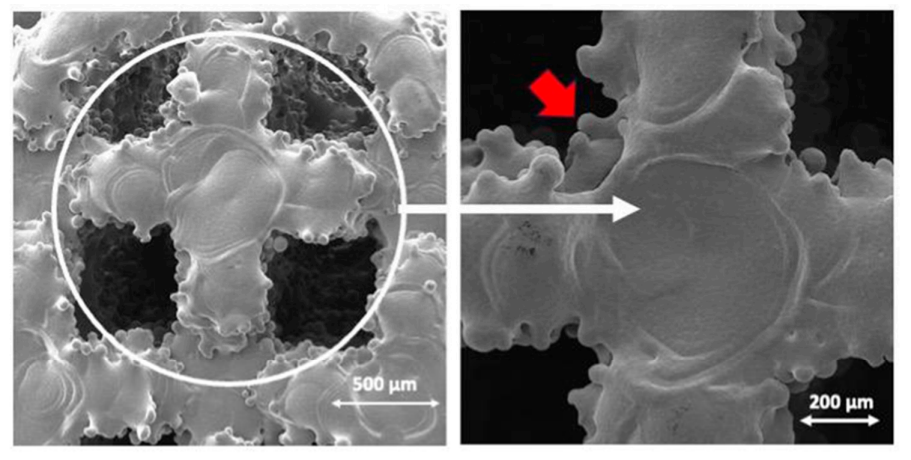
However Djordje Bozic, MDPI’s Journal Relations Specialist from the Applied Sciences editorial office does not think this deserves any correction. Here is his replay to the post on PubPeer:
“The Editorial office, in consultation with our Editorial Board and Ethic Committee, have thoroughly investigated the concerns that you raised and determined that the authors’ explanation and data provided (original SEM micrographs at 50x, 100x, and 200x acquired during the experiments) adequately resolved the issue. The differences observed between the images at different magnifications are consistent with the expected local morphological heterogeneity of PBF-EB Ti6Alav scaffold surfaces, where partially melted and unmelted particles are inherently non-uniformly distributed.
The raw SEM images show clear structural consistency across magnifications and do not indicate any concerns regarding data integrity or image manipulation.
Overall, the provided data fully support the reliability of the published figure, and no further action is required.
This investigation is now closed and we are not planning any further action.“
MDPI indeed has the best experts, and now we learned that fraud is when the magnifications look similar to the full picture.
There is also this paper by Oliviera as last author, with some co-authors from Singapore, proving that one can repair peripheral nerves with chitosan/keratin and some creative image reuse:
Cristiana R. Carvalho , João B. Costa , Lígia Costa , Joana Silva-Correia , Zi Kuang Moay , Kee Woei Ng , Rui L. Reis , Joaquim M. Oliveira Enhanced performance of chitosan/keratin membranes with potential application in peripheral nerve repair Biomaterials Science (2019) doi: 10.1039/c9bm01098j
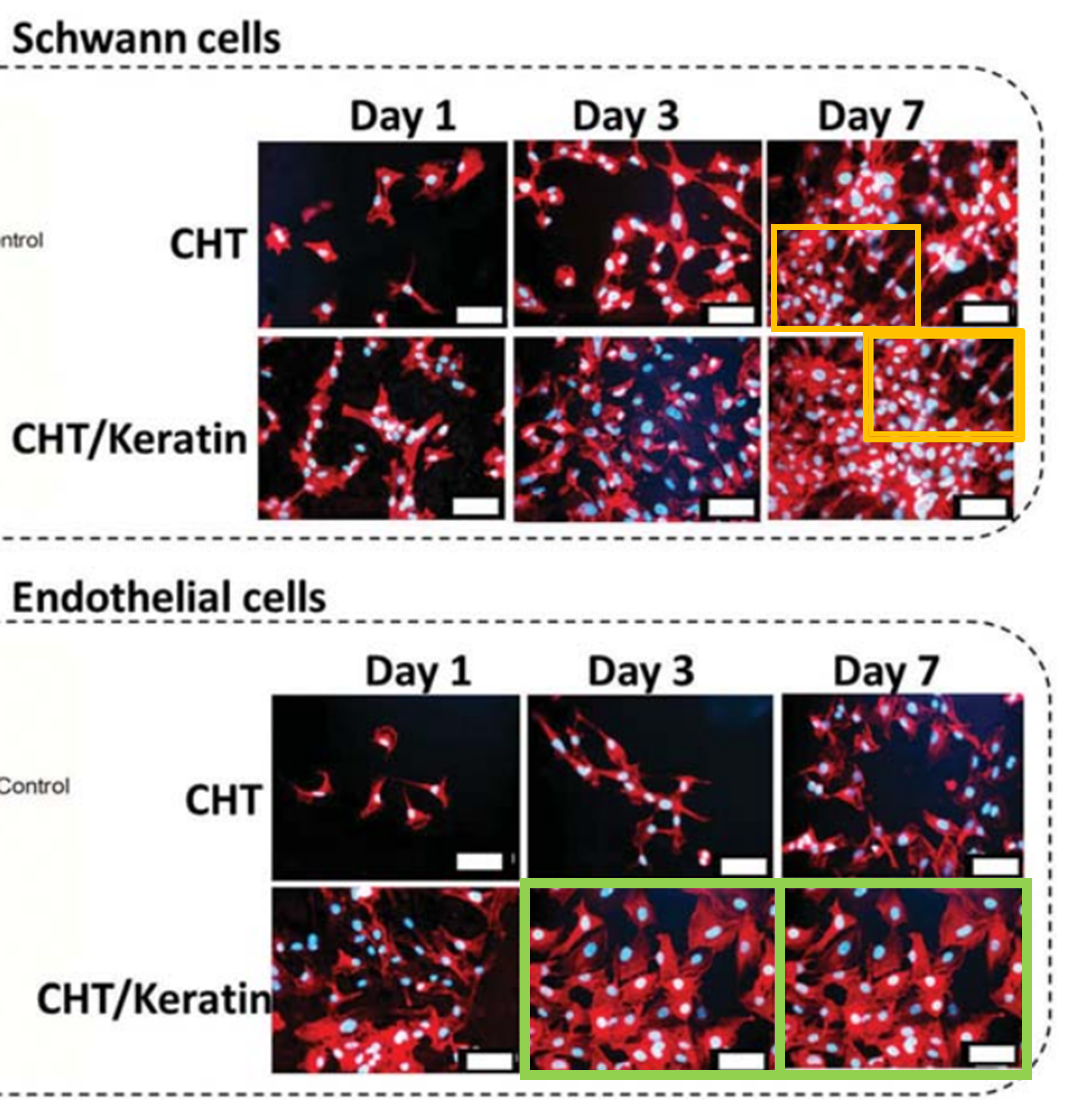
n Fig. 4 (right panels), there appear to be unexpected overlaps between some panels (highlighted by boxes of the same color).
Or this one, with co-author Utkan Demirci, professor at Stanford University School of Medicine, and some Chinese friends:
Raphaël F. Canadas, João B. Costa , Zhengwei Mao , Changyou Gao , Utkan Demirci , Rui L. Reis , Alexandra P. Marques , Joaquim M. Oliveira 3DICE coding matrix multidirectional macro-architecture modulates cell organization, shape, and co-cultures endothelization network Biomaterials (2021) doi: 10.1016/j.biomaterials.2021.121112
Another one with their Stanford colleague:
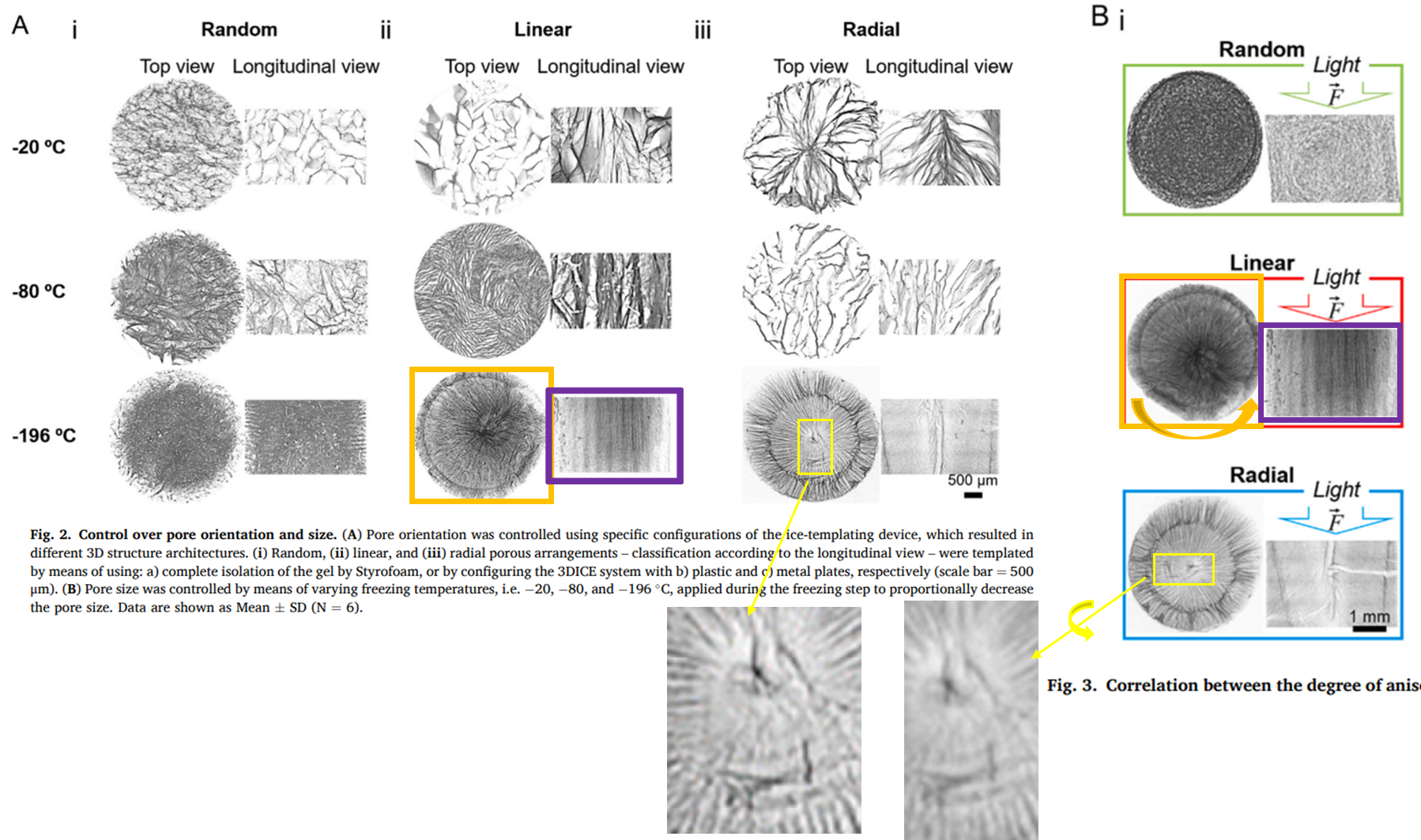
Raphaël F. Canadas , Tanchen Ren , Alessandro Tocchio , Alexandra P. Marques , Joaquim M. Oliveira , Rui L. Reis, Utkan Demirci Tunable anisotropic networks for 3-D oriented neural tissue models Biomaterials (2018) doi: 10.1016/j.biomaterials.2018.07.055
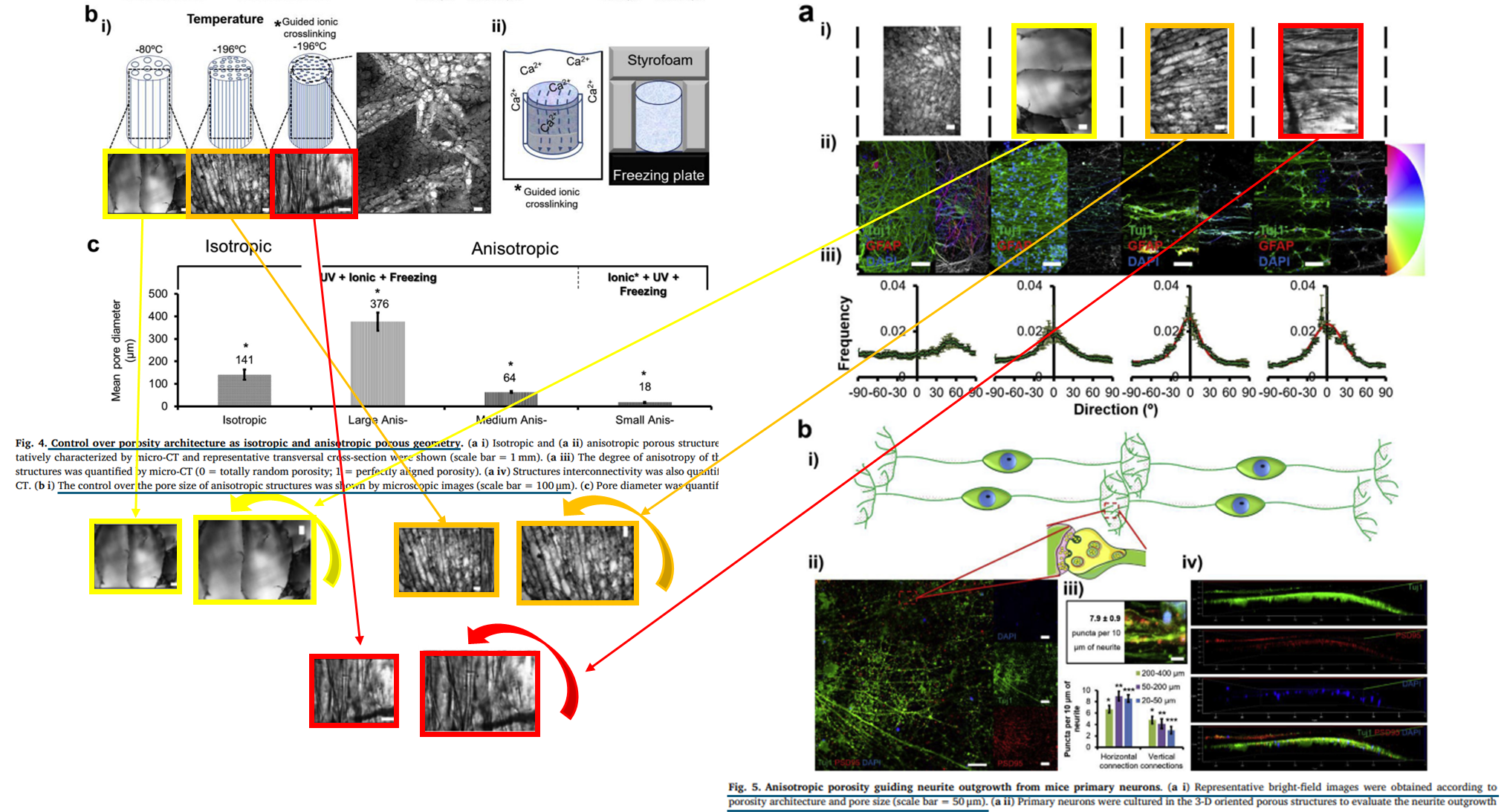
More recently, Oliviera launched a new research line within ICVS/3B’s on 3D in vitro models for cancer research. How that effort is progressing is unclear, but his name has recently begun appearing as co-author on a series of papers on cancer research that look suspiciously like paper-mill products.
Sylvain Lesné is a failed scientist
From Lesné’s public shame to successful role models of neuroscience like Aguzzi and Tessier-Lavigne.
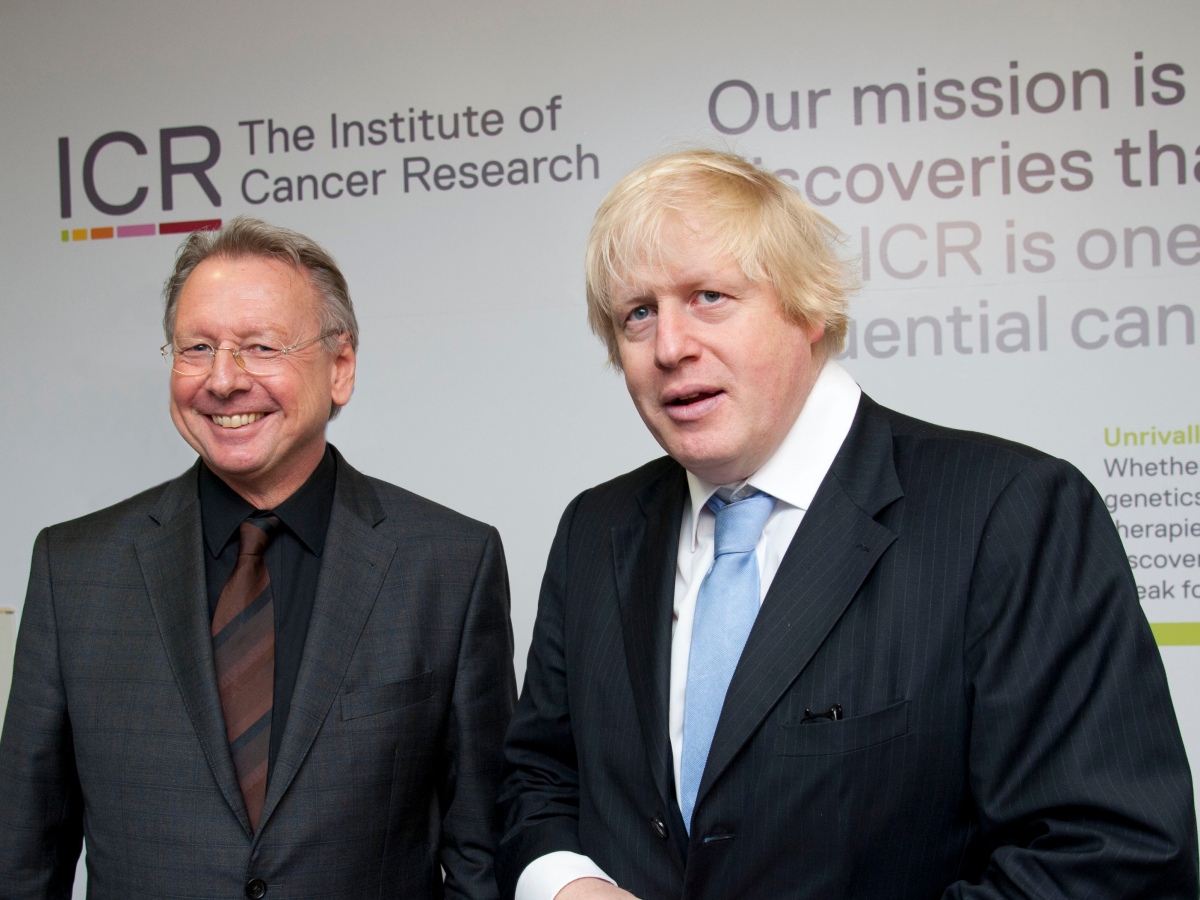
Such as these two examples, also co-authored by Axel Behrens, a former postdoc of Adriano Aguzzi and currently Scientific Director of the Cancer Research UK Convergence Science Centre at ICR London:
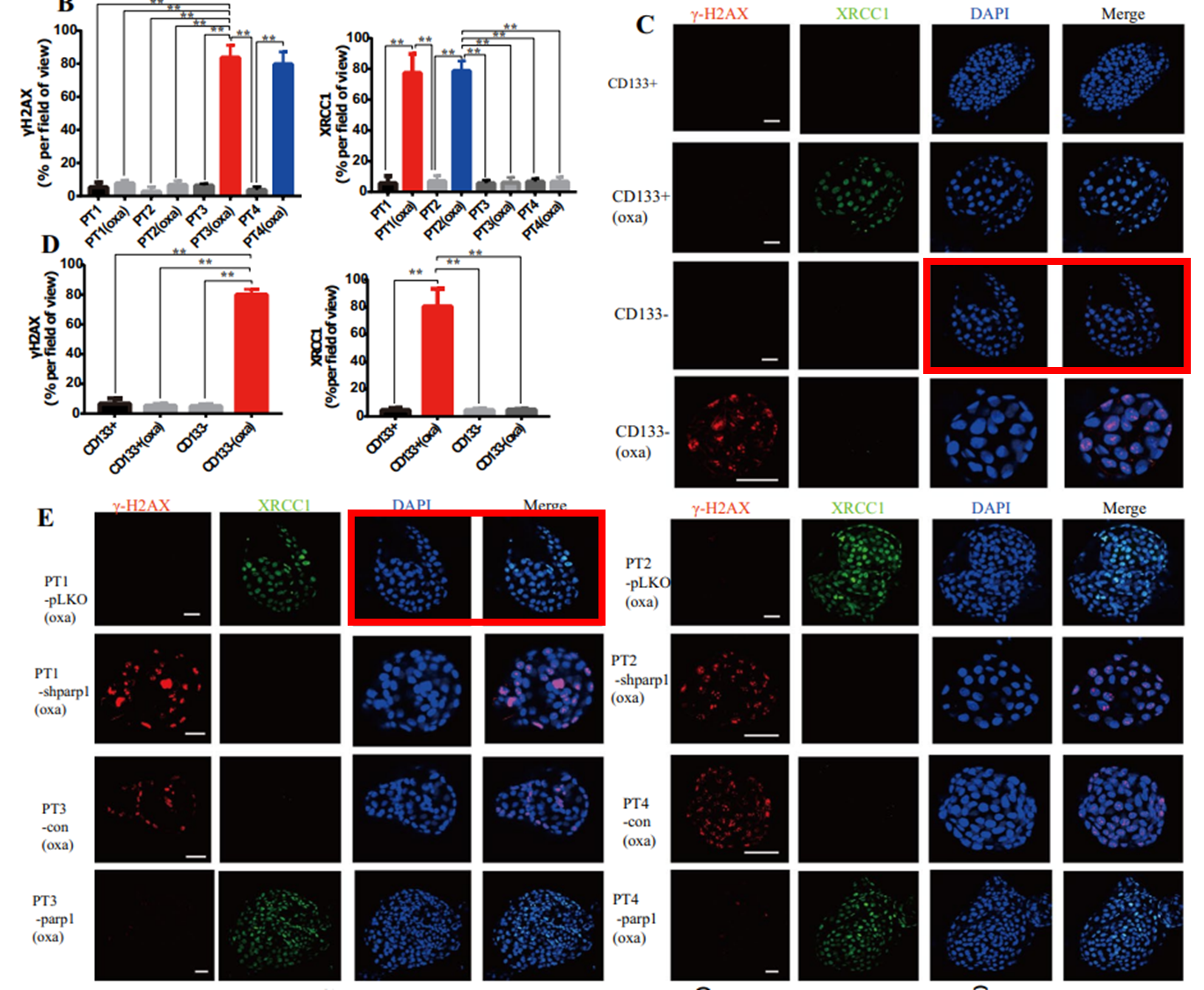
Huafu Li , Chunming Wang , Linxiang Lan , Leping Yan , Wuguo Li , Ian Evans , E. Josue Ruiz , Qiao Su , Guangying Zhao , Wenhui Wu , Haiyong Zhang , Zhijun Zhou , Zhenran Hu , Wei Chen , Joaquim M. Oliveira , Axel Behrens, Rui L. Reis, Changhua Zhang METTL3 promotes oxaliplatin resistance of gastric cancer CD133+ stem cells by promoting PARP1 mRNA stability Cellular and Molecular Life Sciences (2022) doi: 10.1007/s00018-022-04129-0
To be fair, the ICR London is the perfect place for scientists like Behrens who learned their tricks from scientists like Aguzzi.
Fake data, untouchable men and guilty women at ICR London
With nobody above him, ICR director Paul Workman was seemingly investigating himself, and found two female colleagues guilty of placing fake data into his papers, primarily the ICR emeritus Ann Jackman. One paper was retracted, another received an outrageous correction. The previous ICR CEO, Alan Ashworth, together with his right-hand man Chris Lord, have their…
Thus, here another totally not-papermilled study by Reis, Oliviera and Behrens with their Chinese providers:
Huafu Li , Chunming Wang , Linxiang Lan , Wenhui Wu , Ian Evans , E. Josue Ruiz , Leping Yan , Zhijun Zhou , Joaquim M. Oliveira , Rui L. Reis , Zhenran Hu , Wei Chen , Axel Behrens , Yulong He, Changhua Zhang PARP1 Inhibitor Combined With Oxaliplatin Efficiently Suppresses Oxaliplatin Resistance in Gastric Cancer-Derived Organoids via Homologous Recombination and the Base Excision Repair Pathway Frontiers in Cell and Developmental Biology (2021) doi: 10.3389/fcell.2021.719192
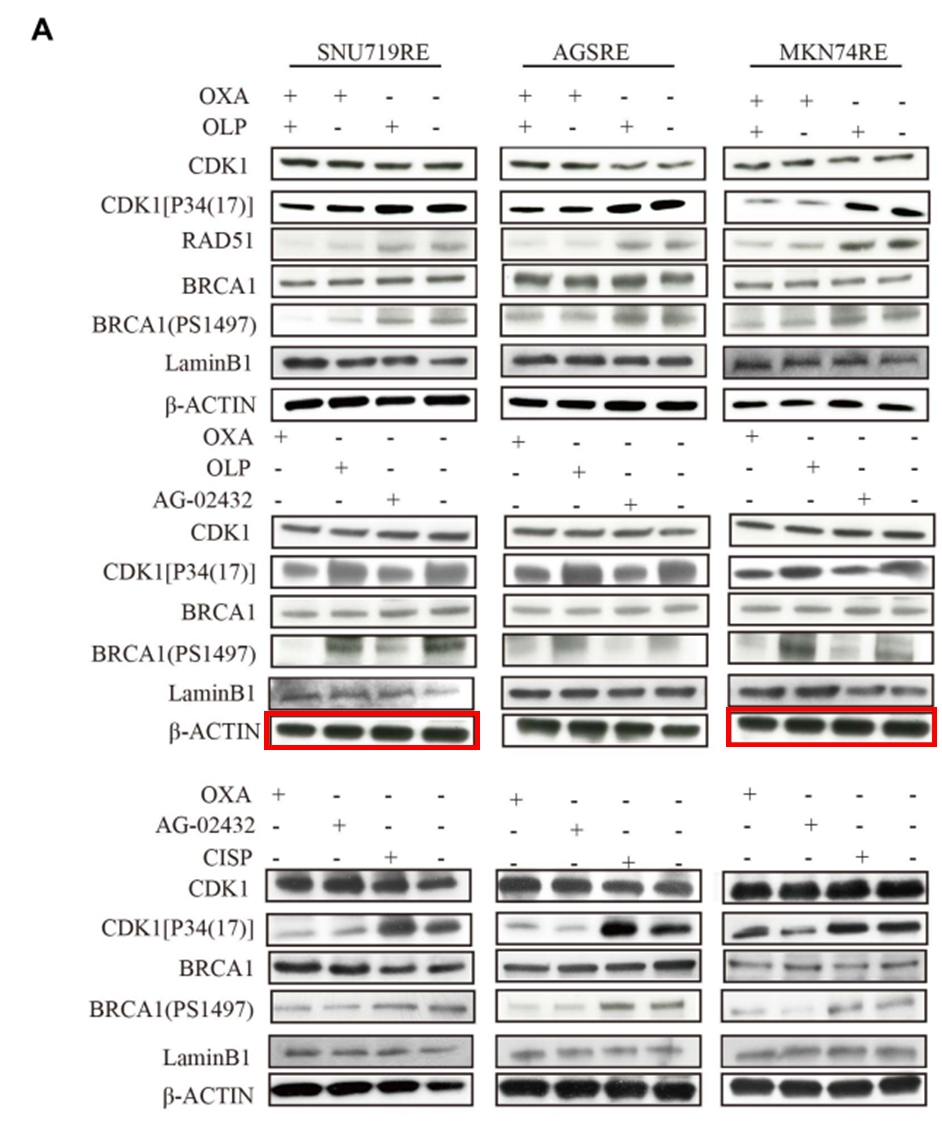
More similar than expected (highlighted by the red boxes) in Fig. 6A;
Bioink and jellyfish
Another loyal student of Reis’s is Alexandra Pinto Marques, a coordinator researcher at i3Bs, (PubPeer record). In 2017 she was awarded an ERC Consolidator Grant of around €2 million (“ECM-INK -Cells-self Extracellular Matrices-based Bioinks to create accurate 3D diseased skin tissue models”, ERC-2016-COG-726061), which resulted in several papers including this one:
Daniel P. Reis , Beatriz Domingues , Cátia Fidalgo , Rui L. Reis , Luca Gasperini , Alexandra P. Marques Bioinks Enriched with ECM Components Obtained by Supercritical Extraction Biomolecules (2022) doi: 10.3390/biom12030394
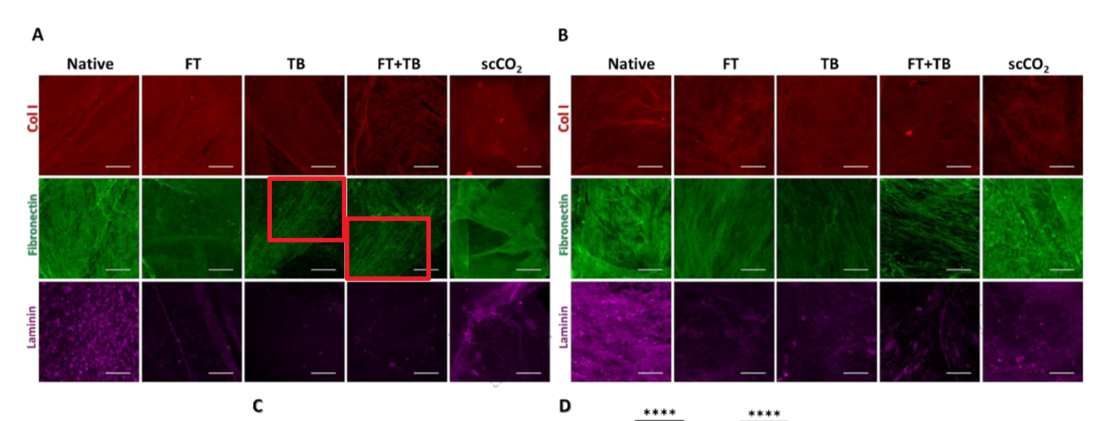
Then we have Rogério P. Pirraco, another long-term researcher at i3Bs (PubPeer record), and an ERC Starting Grant awardee (€1.5 million, 2018) with the project “CapBed – Engineered Capillary Beds for Successful Prevascularization of Tissue Engineering Constructs”, aimed at developing bioengineered capillary networks to improve the vascularization of lab-grown tissues for transplantation. I wonder if these papers helped him and Marques to get those big ERC grants:
M.T. Cerqueira , R.P. Pirraco , A.R. Martins , T.C. Santos , R.L. Reis , A.P. Marques Cell sheet technology-driven re-epithelialization and neovascularization of skin wounds Acta Biomaterialia (2014) doi: 10.1016/j.actbio.2014.03.006
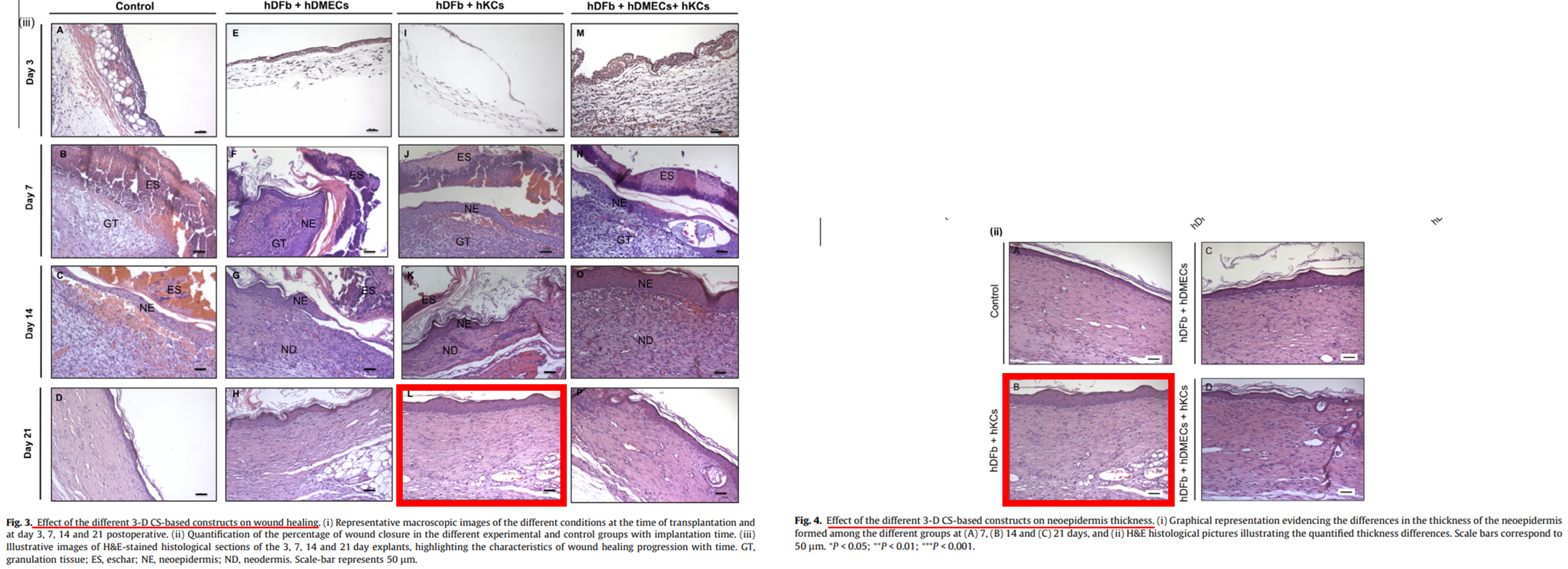
In March 2026, Marques announced on PubPeer that the figure reuse was perfectly fine (“panel 4(ii) is not labeled with the corresponding time point, which is 21 days” and announced “corrections to the figure labeling and legends“. No comment was made here:
Lucília P Da Silva , Sílvia Oliveira , Rogério P Pirraco , Tírcia C Santos , Rui L Reis , Alexandra P Marques , Vitor M Correlo Eumelanin-releasing spongy-like hydrogels for skin re-epithelialization purposes Biomedical Materials (2017) doi: 10.1088/1748-605x/aa5f79
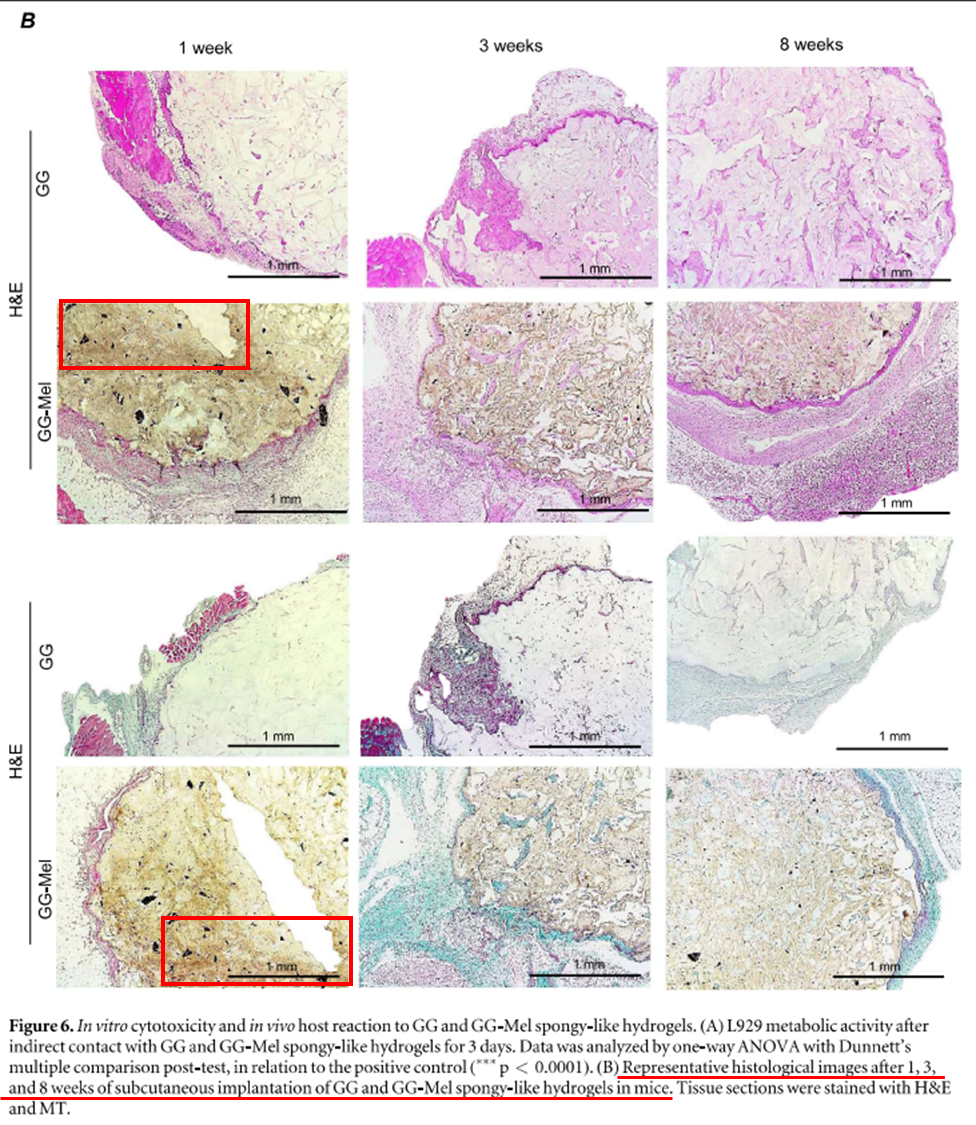
There is an apparent overlap between two panels in Fig. 6B (red boxes), which is unexpected if the panels correspond to different representative histological images.
The Principal Researcher Tiago Henriques Silva works on developing marine-inspired biomaterials for tissue engineering and other advanced applications. We can see some results on PubPeer, including this paper, describing how jellyfish collagen supposedly regenerates cartilage, done in collaboration with the British manufacturer Jellagen Ltd (author Andrew Mearns-Spragg is founder and CSO):
Duarte Nuno Carvalho, Michael Gelinsky , David S. Williams, Andrew Mearns-Spragg, Rui L. Reis, Tiago H. Silva Marine collagen-chitosan-fucoidan/chondroitin sulfate cryo-biomaterials loaded with primary human cells envisaging cartilage tissue engineering International journal of biological macromolecules (2023) doi: 10.1016/j.ijbiomac.2023.124510
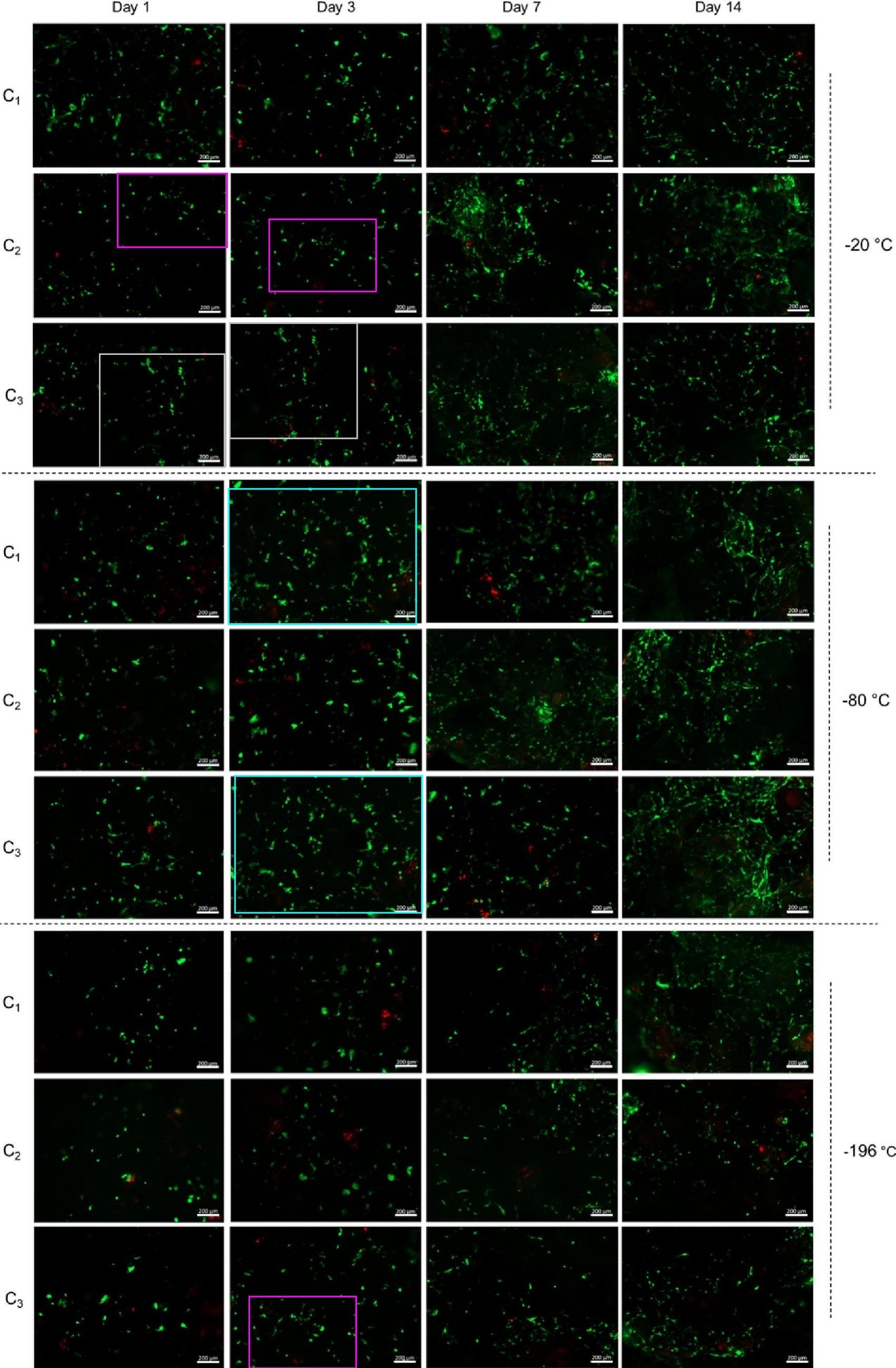
Alexander Magazinov: “In Fig. 9, a number of overlaps across panels are present. Some pairs are described as coming from different samples.
In April 2023, Silva apologised on PubPeer “for the unfortunate mistake in Figure 9, which was already detected during the final proofing process“, blamed the publisher for failing to use the correct proofs, and added that “this mistake does not affect the discussion of the results.” In November 2024, he published this Corrigendum:
“The authors regret an unfortunate mistake in Fig. 9 of the original version of the article, caused by a mislabeling of original fluorescence microscopy images, which resulted in the use of incorrect images for the conditions “C1 −80 °C day 3” and “C1 −80 °C day 14” when assembling the fluorescence images on the panel to produce the said Fig. 9.
After a thorough revision of the acquired fluorescence microscopy images taking into consideration the equivalent records, the labeling has been revised. The correct images corresponding to the two referred conditions were identified and have now been placed in the due positions in the panel corresponding to Fig. 9, as follows.
We would like to emphasize that this error does not affect the interpretation or discussion of the obtained results, neither the drawn conclusions indicated in the article.
The authors would like to apologise for any inconvenience caused.”
Good luck, Jolanda Spadavecchia!
CNRS research director Jolanda Spadavecchia was sanctioned with two years suspension for “serious and repeated breaches of her duty of scientific integrity”, 19 retractions were requested.
Another Jellagen Ltd collaboration (coauthor David S Williams later left Jellagen to work for another company):
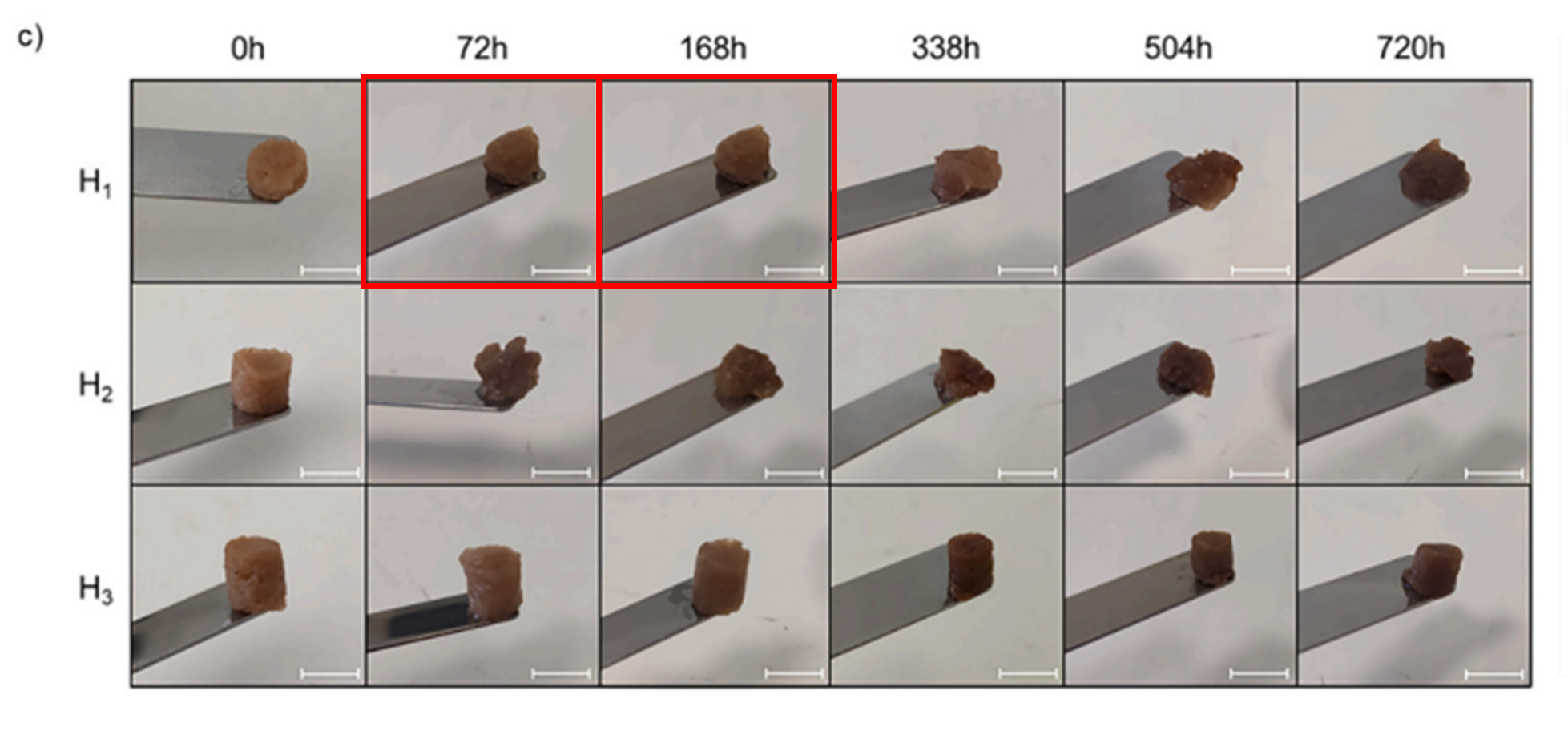
Duarte Nuno Carvalho , David S. Williams , Carmen G. Sotelo , Ricardo I. Pérez-Martín , Andrew Mearns-Spragg , Rui L. Reis , Tiago H. Silva Marine origin biomaterials using a compressive and absorption methodology as cell-laden hydrogel envisaging cartilage tissue engineering Biomaterials Advances (2022) doi: 10.1016/j.bioadv.2022.212843
More marine gelatines, this time Made in Portugal, to regenerate corneas:
Ana L. Alves , Ana C. Carvalho , Inês Machado , Gabriela S. Diogo , Emanuel M. Fernandes , Vânia I. B. Castro , Ricardo A. Pires , José A. Vázquez , Ricardo I. Pérez-Martín , Miguel Alaminos , Rui L. Reis , Tiago H. Silva Cell-Laden Marine Gelatin Methacryloyl Hydrogels Enriched with Ascorbic Acid for Corneal Stroma Regeneration Bioengineering (2023) doi: 10.3390/bioengineering10010062
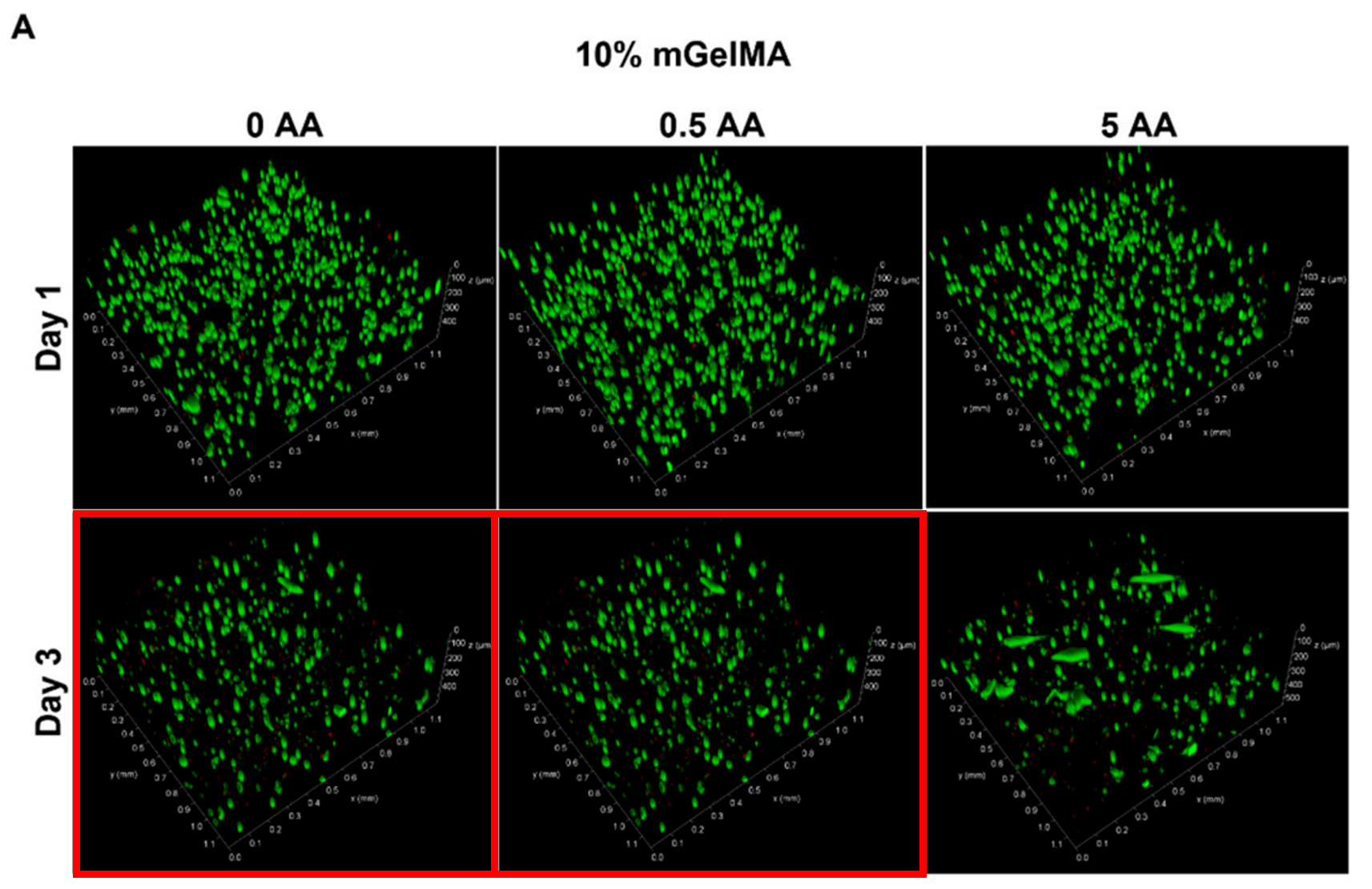
Two panels in Fig. 10A appear more similar than expected (as highlighted by the red boxes), considering that they correspond to different treatments.
We must mention the latest generation of i3Bs genius, particularly Carlos F. Guimarães, a very promising young researcher. He invented “Living Optical Fibers” which can digitalize 3D biological processes, and in 2024 was included in the prestigious list of 30-under-30 from Forbes (Portugal). He only has one paper on PubPeer, but hey! He is still under 30.
Bingcheng Yi , Lei Yu , Yating Yang , Carlos F. Guimarães , Ruijie Xu , Thavasyappan Thambi , Boya Zhou , Qihui Zhou , Rui L. Reis Light-stimulated smart thermo-responsive constructs for enhanced wound healing: A streamlined command approach Asian Journal of Pharmaceutical Sciences (2025) doi: 10.1016/j.ajps.2025.101057
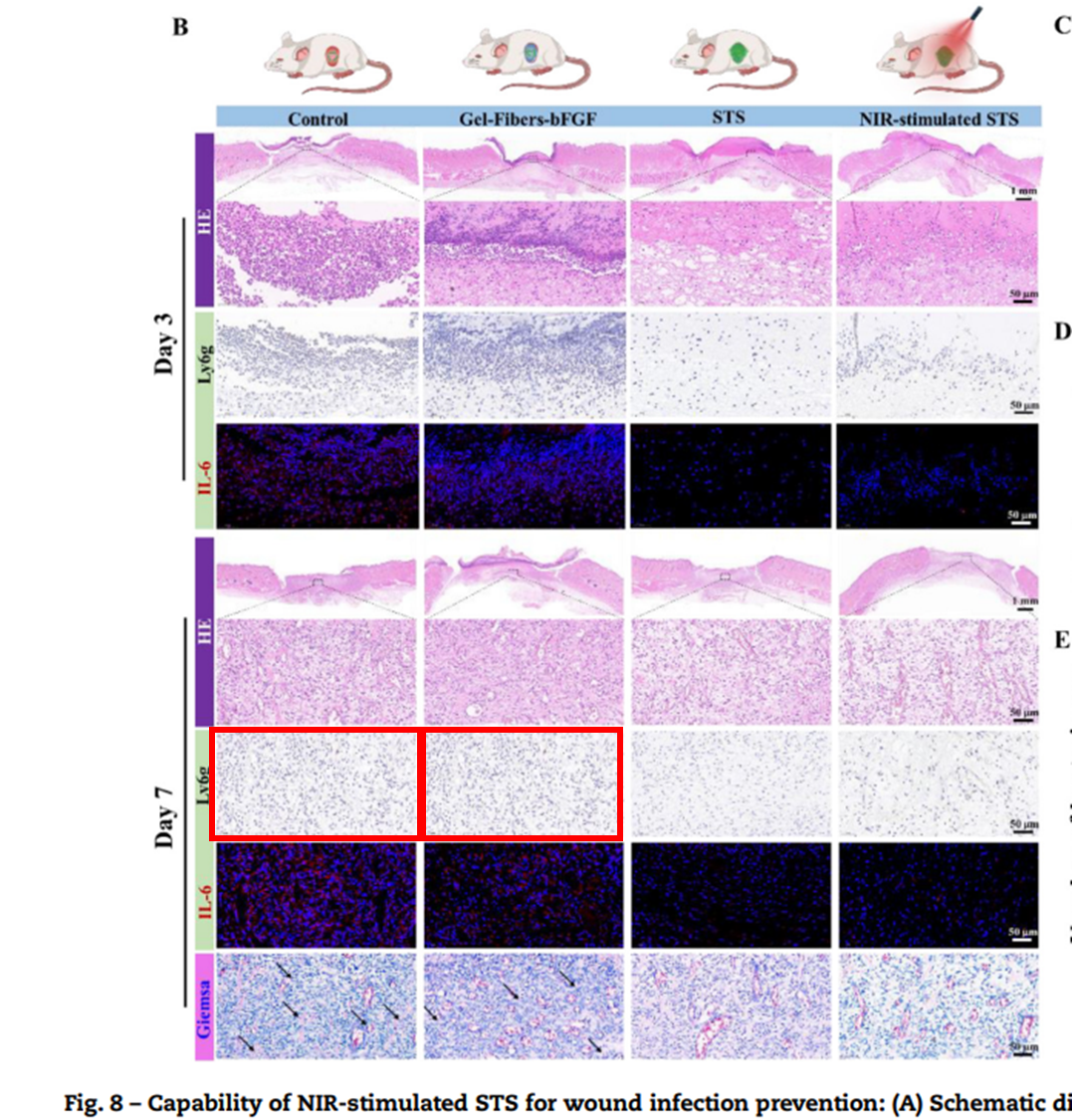
Two panels in Fig. 8B appear more similar than expected (highlighted by the red boxes), considering that they represent different treatments.
The papermiller
Finally, we have the expat Subhas Chandra Kundu. He was the Founder Head and Full Professor in the Department of Biotechnology at the Indian Institute of Technology (Kharagpur), before moving from West Bengal to the greener pastures of north-west Portugal. In 2016, he joined 3B’s as an ERA-Chair (European Research Area Chair), becoming Research Coordinator in 2020. The justification for his appointment as an ERA-Chair was his expertise in biomaterials and tissue engineering, particularly in the development of 3D tumour microenvironments in vitro.

Tiwari’s IAAM honours Magdeburg
Ashutosh Tiwari’s scamference activities continue. Now the University of Magdeburg in Germany is very excited about a medal from the International Association of Advanced Materials.
Here some relevant cancer research from i3B, which Kundu announced to correct in January 2026:
Virginia Brancato, Banani Kundu , Joaquim Miguel Oliveira , Vitor Manuel Correlo , Rui Luis Reis , Subhas C. Kundu Tumor-Stroma Interactions Alter the Sensitivity of Drug in Breast Cancer Frontiers in Materials (2020) doi: 10.3389/fmats.2020.00116
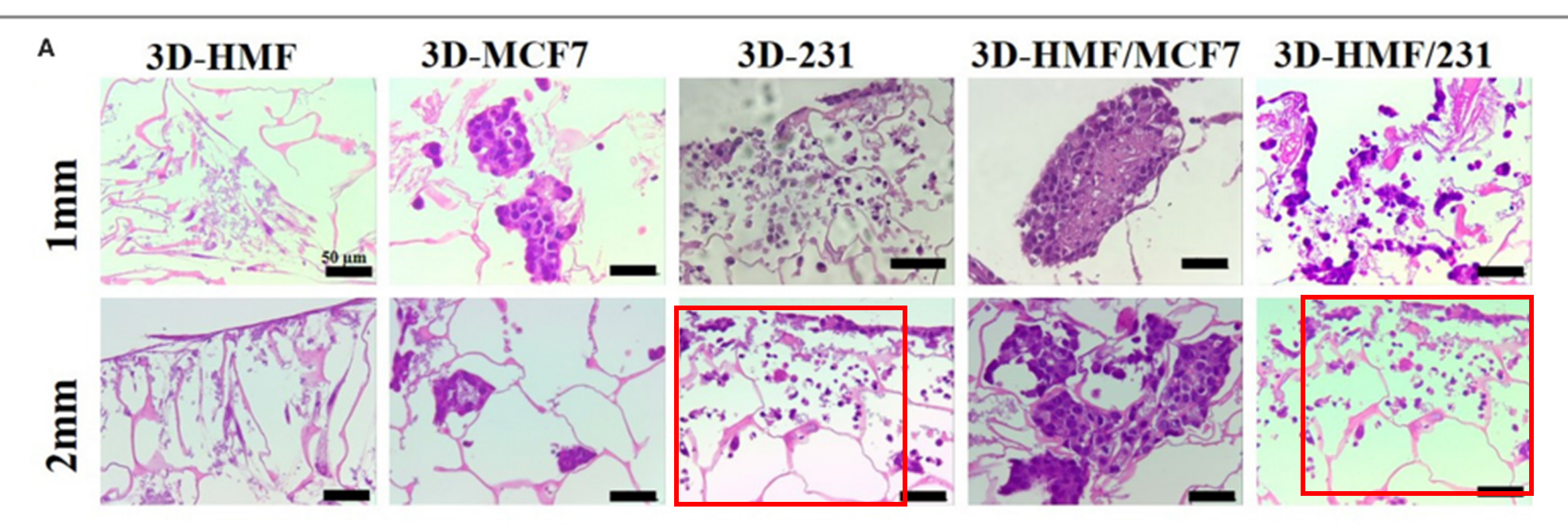
In my view, and this is strictly an opinion, which may well be proven wrong, he is just a shameless papermiller, and his papermilling skills and networks came in handy to keep the productivity within the i3Bs increasingly outlandish biomaterial-regeneration-nano-cancer-curing-fantastic projects. Professor Kundu has a PubPeer record of about 30 papers, a third of them co-authored with Ruis Reis. The oldest of Kundu’s papers on PubPeer date from 2008-2009, well before his move to Portugal, such as this image reuse:
- Biman B. Mandal, Subhas C. Kundu Non‐Bioengineered Silk Fibroin Protein 3D Scaffolds for Potential Biotechnological and Tissue Engineering Applications Macromolecular Bioscience (2008) doi: 10.1002/mabi.200800113
- Biman B. Mandal , Anjana S. Priya , S.C. Kundu Novel silk sericin/gelatin 3-D scaffolds and 2-D films: Fabrication and characterization for potential tissue engineering applications Acta Biomaterialia (2009) doi: 10.1016/j.actbio.2009.03.026
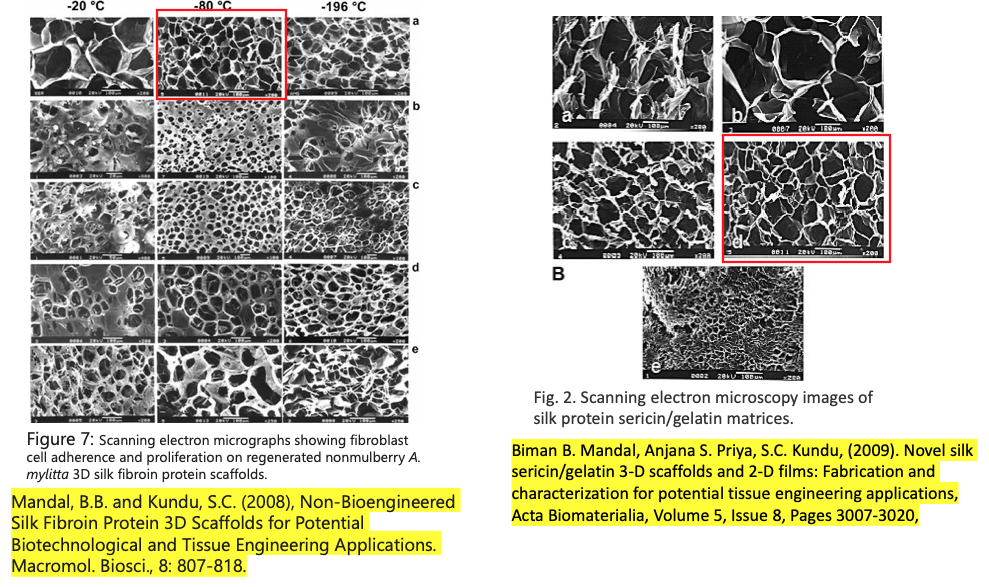
Since Professor Kundu’s move to Portugal, Reis’s name started to adorn the author list of some masterpieces, like this one with Rassoul Dinarvand and other Iranian friends:
Fatemeh Mottaghitalab , Melika Kiani , Mehdi Farokhi , Subhas C. Kundu , Rui L. Reis , Mahdi Gholami , Hassan Bardania , Rassoul Dinarvand , Parham Geramifar , Davood Beiki , Fatemeh Atyabi Targeted Delivery System Based on Gemcitabine-Loaded Silk Fibroin Nanoparticles for Lung Cancer Therapy ACS Applied Materials & Interfaces (2017) doi: 10.1021/acsami.7b10408
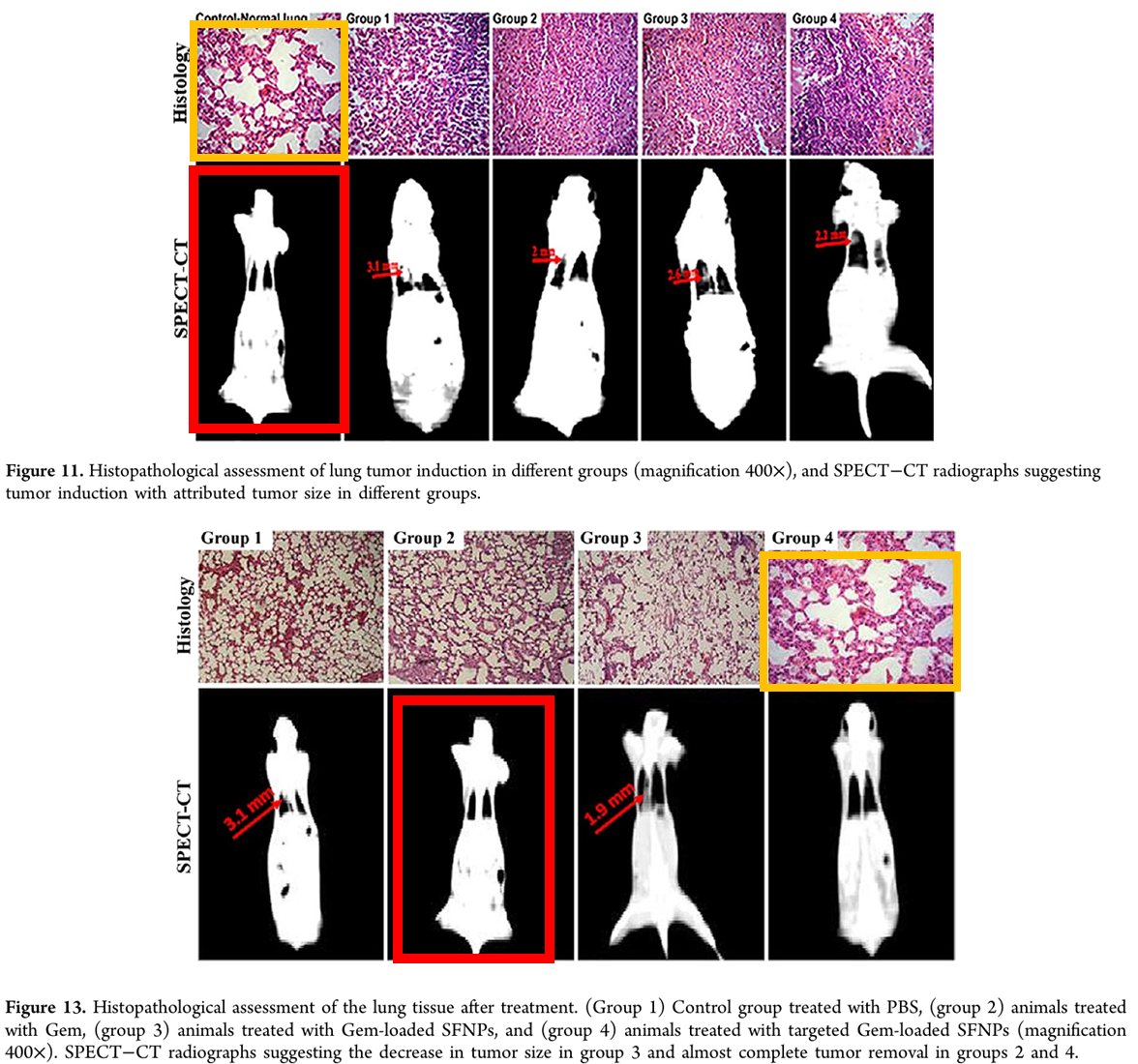
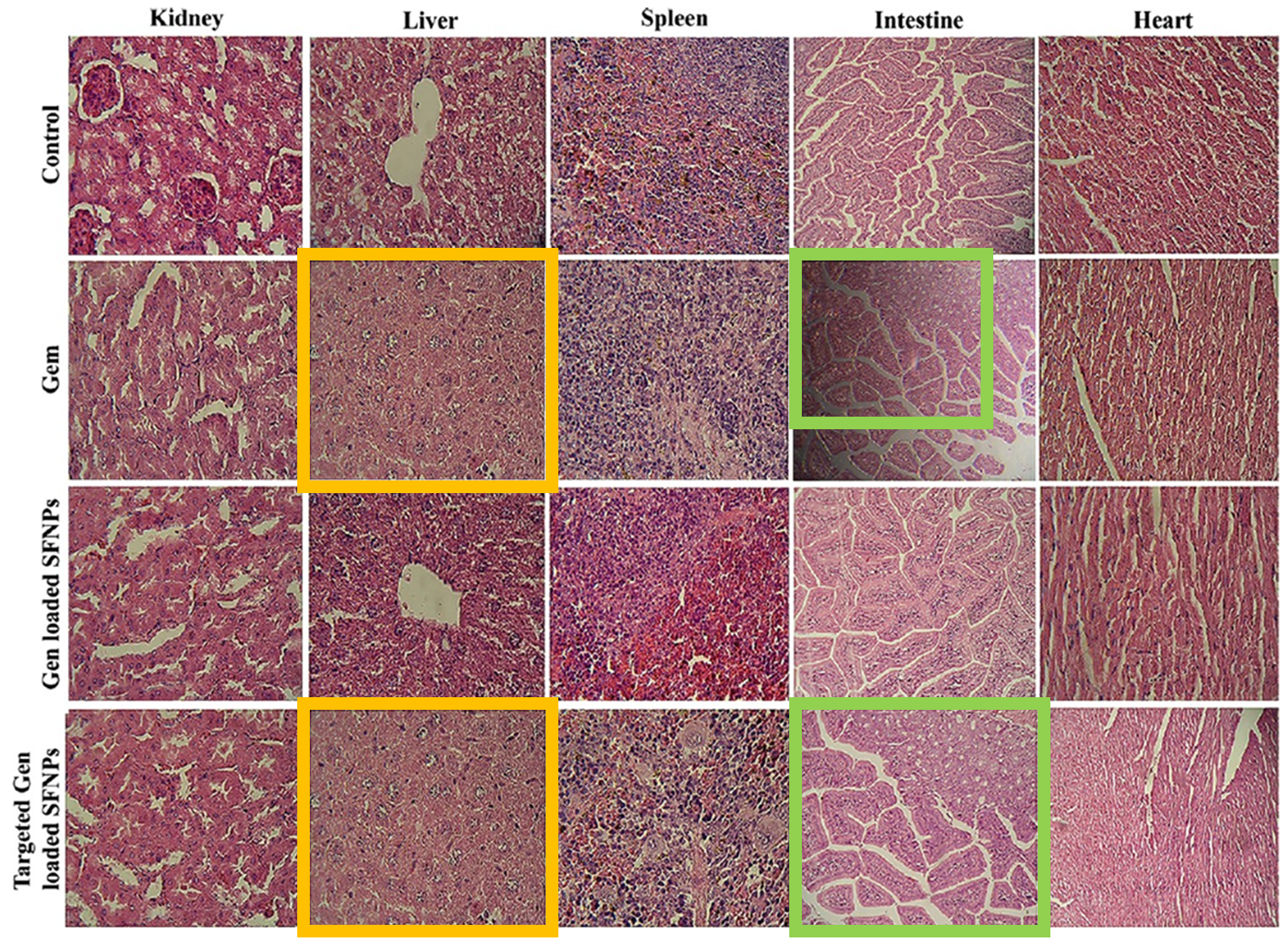
The last author Fatemeh Atyabi assured in May 2026 that this was merely “an unintentional layout error during final figure preparation“, and that “the scientific validity and interpretation of the results remain unchanged“. This Iranian scholar has over 40 papers on PubPeer and some retractions, see Talaie et al 2011 or Izadi et al 2020, and January 2026 Shorts. Her regular coauthors are fellow Iranian papermillers like Farhad Jadidi-Niaragh.
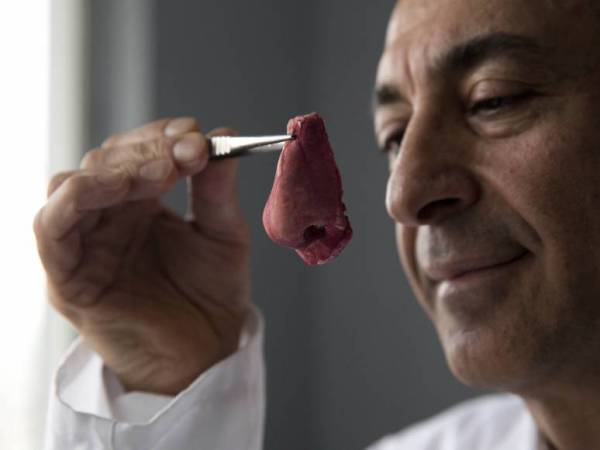
Kundu may even have dragged Reis into his first retraction with this paper, co-authored with a very international team of cheaters, including Alexander Seifalian, former professor at UCL in London, collaborator of Martin Birchall and Paolo Macchiarini. After Seifalian was found guilty of research misconduct and sacked in 2017, he continued pushing degenerative medicine (artificial vagina and pelvic implants, anyone?) and turned to papermilling with fellow Persians, read here and below:
UCL trachea transplant inquiry: scapegoating, obfuscation and a lost nose
In 2017, UCL invited an external expert commission to investigate the deadly trachea transplants performed by the former UCL honorary professor Paolo Macchiarini. An already sacked UCL nanotechnology professor, Alexander Seifalian, whose lab made the two UCL plastic POSS-PCU tracheas in 2011, was announced as the main culprit on UCL side. All this despite Seifalian’s…
Here, the Iranian papermillers invited next to Reis, Kundu and Seifalian also the Lancaster University professor John Hardy and a Polish postdoc in USA, Aleksandra Urbanska:
Mazaher Gholipourmalekabadi, Alexander M. Seifalian, Aleksandra M. Urbanska , Mir Davood Omrani , John G. Hardy, Zahra Madjd , Seyed Mahmoud Hashemi , Hossein Ghanbarian, Peiman Brouki Milan , Masoud Mozafari , Rui L. Reis , Subhas C. Kundu , Ali Samadikuchaksaraei 3D Protein-Based Bilayer Artificial Skin for the Guided Scarless Healing of Third-Degree Burn Wounds in Vivo Biomacromolecules (2018) doi: 10.1021/acs.biomac.7b01807


The paper received a huge correction on 5 March 2025, where the authors replaced the offending figures and assured:
“These corrections do not affect the interpretation and conclusion of the article. The authors confirm that the new data presented are obtained from the system studied in the work.
The authors would like to apologize for any inconvenience caused.
The authors are committed to maintaining the highest standards of scientific integrity and appreciate the opportunity to correct these errors.”
Despite all those assurances, the correction proved to be shamelessly fraudulent:

Sholto David: “The correction has unexpected overlapping images”
Even ACS felt that a red line has been crossed, a Retraction was published on 10 January 2026:
“The authors retract this article […] due to partial image duplication in Figures 5a,b, 7a, and 8a. On March 5, 2025, a Correction was issued due to overlap in the aforementioned figures (DOI: 10.1021/acs.biomac.5c00225). However, due to additional partial image duplication in the same figures, the authors have agreed that this impacts the accuracy of the work, though it does not alter the conclusions. As such, to avoid confusion, the article and the associated Correction are being retracted.
The original article was published on March 12, 2018 and corrected on March 5, 2025, and both of these were retracted on February 10, 2026.”
Hopefully this paper about fantasy artificial skin made from decellularized human amniotic membrane and silk fibroin was totally fabricated , and no real mice were burned alive for its testing, and no real human burn victims were ever tortured with this nonsense. Natural silk, in fact, seems to be a passion of Prof. Kundu, and he is actively inventing all sorts of high-tech healing applications and made-up papers with several Chinese friends, some with Reis as co-author. Like this:
Shixiong Yi , Ying Zhou , Jiamei Zhang , Min Wang , Shaohui Zheng , Xiao Yang , Lian Duan , Rui L. Reis , Fangyin Dai , Subhas C. Kundu, Bo Xiao Flat Silk Cocoon‐Based Dressing: Daylight‐Driven Rechargeable Antibacterial Membranes Accelerate Infected Wound Healing Advanced Healthcare Materials (2022) doi: 10.1002/adhm.202201397
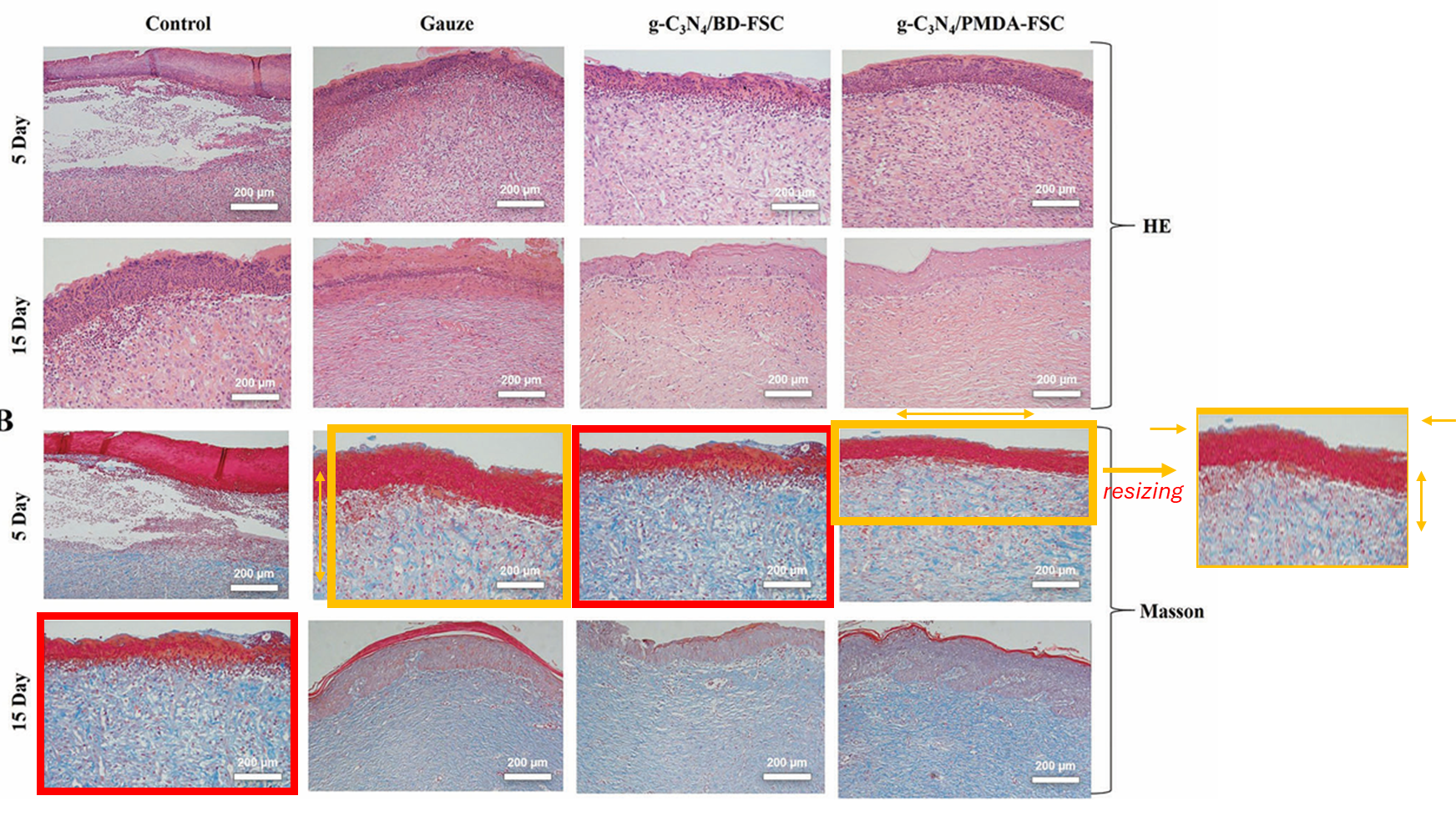
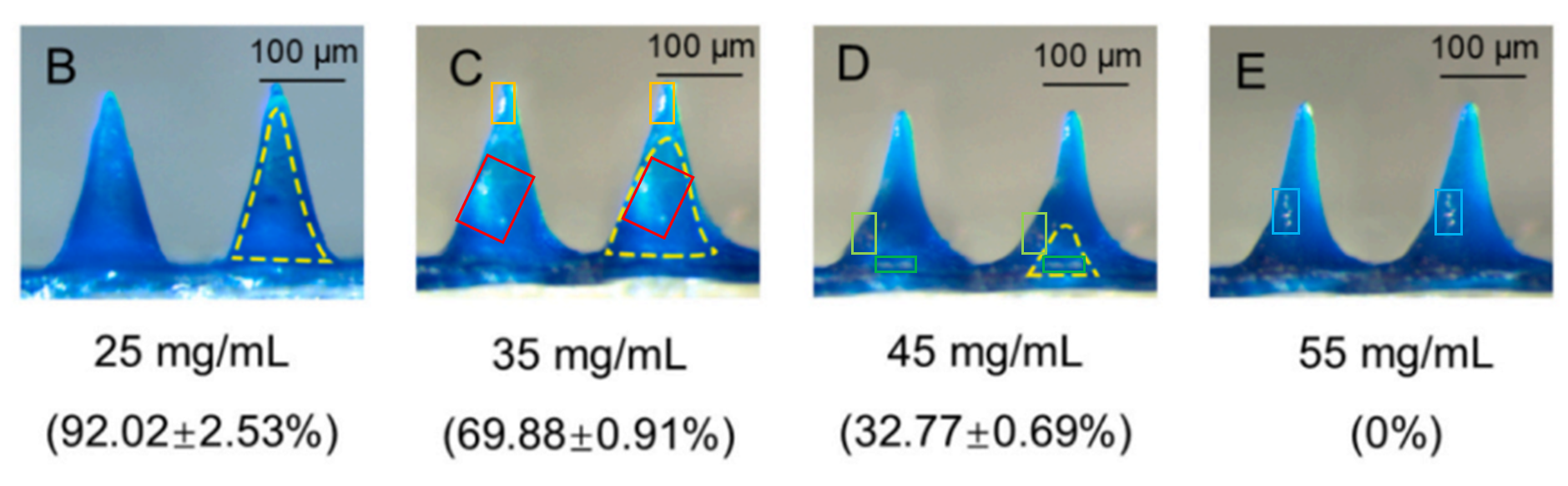
Here, Reis was somehow left out, but with the affiliations of i3B’s and UMinho in place, I guess this puts Portugal firmly on the silk papermilling road:
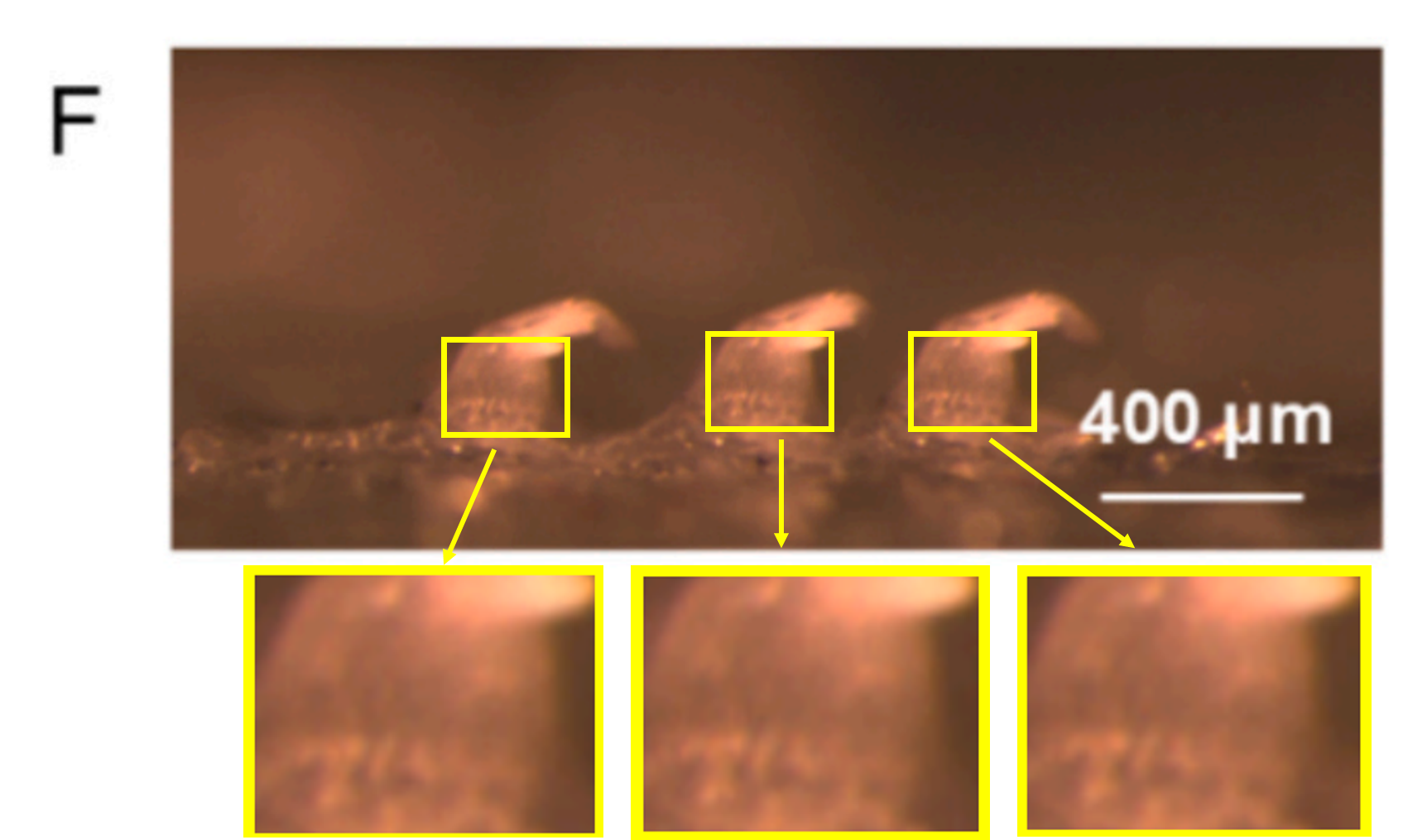
Tianshuo Jia , Yiyu Geng , Huiyan Shao , Guohongfang Tan , Xiaofeng Zhang , Subhas C. Kundu , Shenzhou Lu Silk fibroin hollow microneedle system for sustained transdermal administration of liraglutide: development and characterization International Journal of Biological Macromolecules (2025) doi: 10.1016/j.ijbiomac.2025.146884
All previously mentioned researcher appear to hold contracts through the i3Bs centre which is not a fully permanent and insulated entity. Thus, although titles such as tenure-track researcher, principal/coordinator investigator, or group leader suggest stability, in practice salaries and roles are dependent on external funding sources such as FCT (recently dissolved by the government, with its replacement still uncertain), Associate Laboratory block funding, EU funding, and competitive research grants. These positions are therefore dependent on evaluation cycles and periodic funding renewals.
As a result, these researchers are largely under Professor Reis’s thumb, while he himself holds a comfortable and secure university position, all within a system that exerts considerable pressure to publish and secure funding.
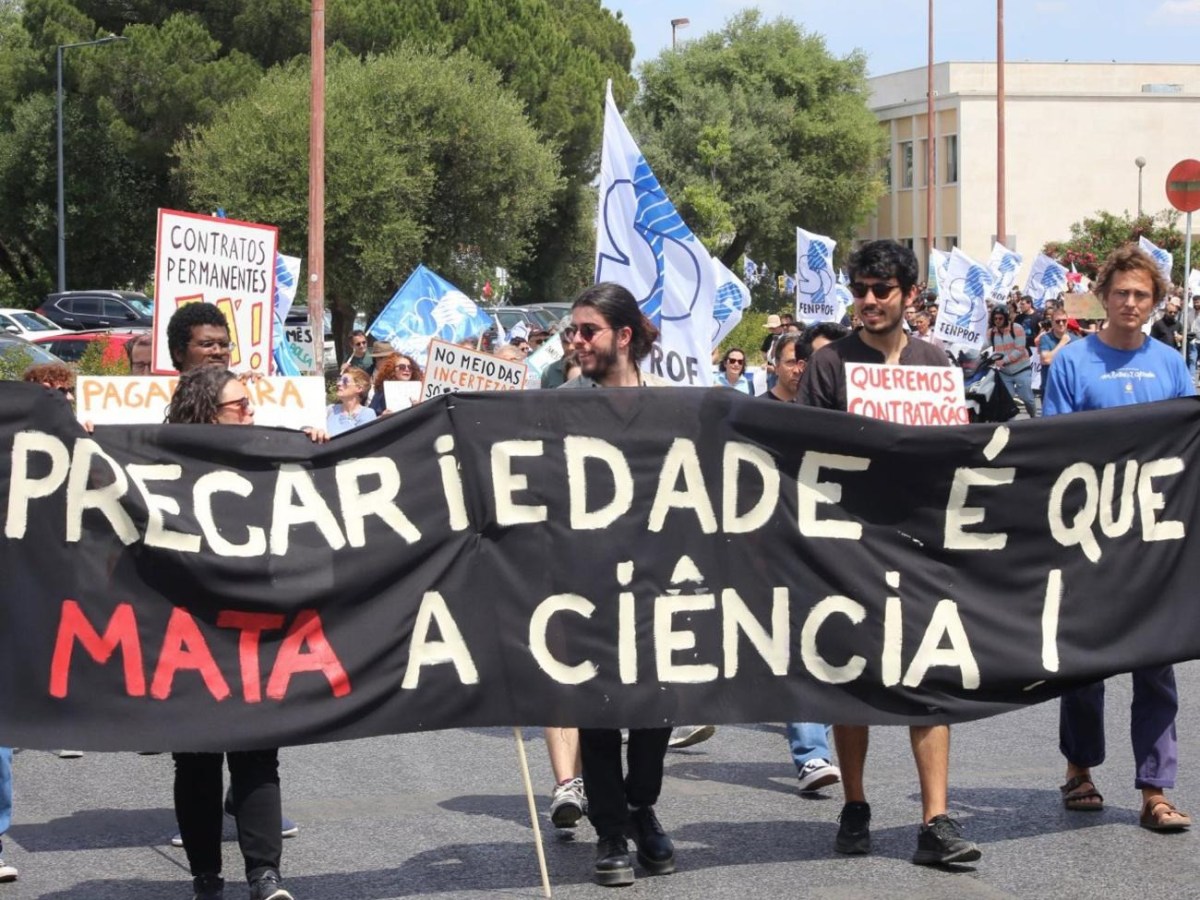
Academic precarity in Portugal
“In Portugal more than 95% of all research activities are carried out under precarious labour conditions, by undergraduate and PhD researchers employed under a variety of temporary contracts, often with limited or no benefits, and no access to a career.” –
Vice-Rector for Research and Science Policy
But we should also talk about Professor Nuno Meleiro Neves, who made it into the safe position of associate professor at the University of Minho. His PubPeer record is modest by i3Bs standards, perhaps because he is not under the same level of pressure to publish at any cost. Still, this paper published in 2010 with an international team of co-authors, from the UK and USA, deserves mentioning:
M.L. Alves Da Silva, A. Crawford , J.M. Mundy , V.M. Correlo , P. Sol , M. Bhattacharya , P.V. Hatton , R.L. Reis , N.M. Neves Chitosan/polyester-based scaffolds for cartilage tissue engineering: Assessment of extracellular matrix formation Acta Biomaterialia (2010) doi: 10.1016/j.actbio.2009.09.006
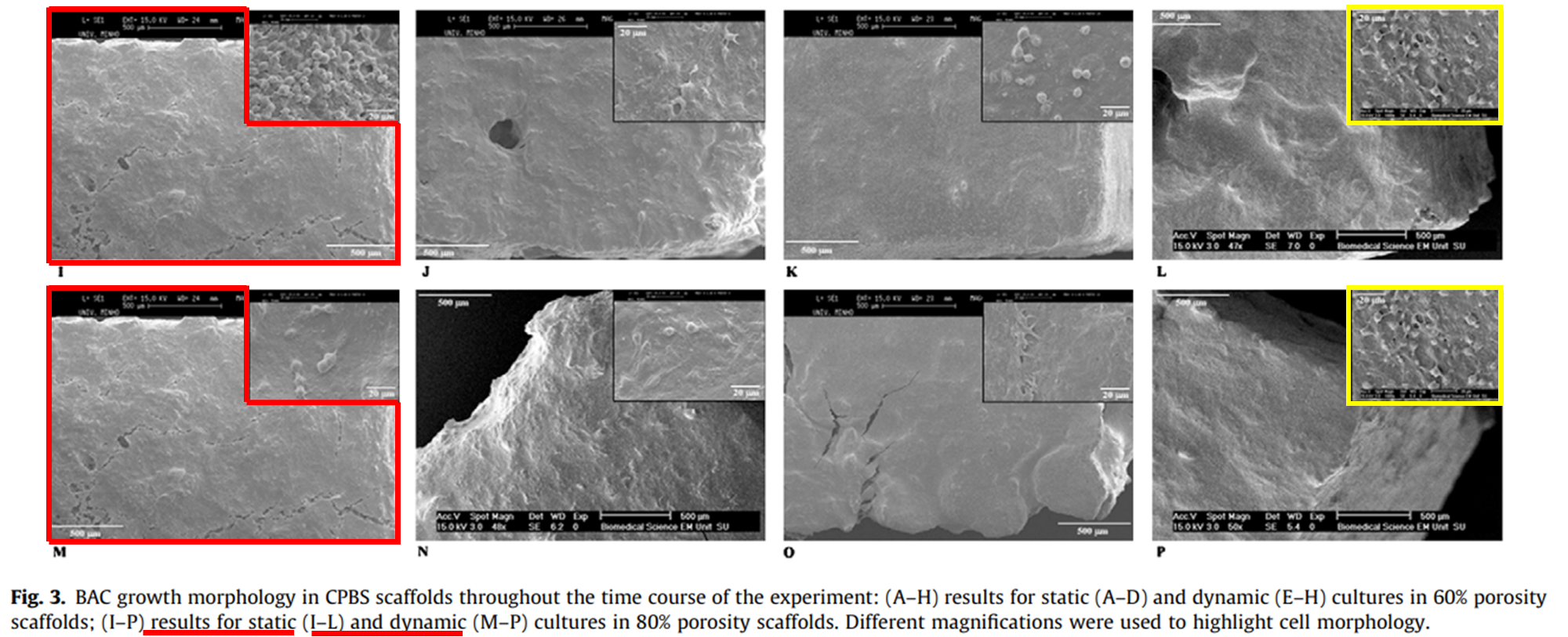
Hopefully, these chitosan/polyester cartilage scaffolds did not find their way into anyone’s joints.
And to whom within the University of Minho, which hosts i3Bs, should we report this PubPeer extravaganza? Who should we complain to if we think that i3Bs research practices should be reviewed, and perhaps gently chaperoned a little more closely? Since Portuguese universities are nothing more than feudal fiefdoms under the absolute control of the rectors and their offices, the most logical step would be to warn the Vice-Rector for Research and Science Policy. And this is who presently holds that office: Professor António J. Salgado, a former mentee of Rui Reis and associate of i3Bs, and reportedly co-author of a couple of Rui Reis PubPeer entries.
Silvina Ribeiro‐Samy , Nuno A. Silva , Vitor M. Correlo , Joana S. Fraga , Luísa Pinto , Andreia Teixeira‐Castro , Hugo Leite‐Almeida , Armando Almeida , Jeffrey M. Gimble , Nuno Sousa , António J. Salgado, Rui L. Reis Development and Characterization of a PHB‐HV‐based 3D Scaffold for a Tissue Engineering and Cell‐therapy Combinatorial Approach for Spinal Cord Injury Regeneration Macromolecular Bioscience (2013) doi: 10.1002/mabi.201300178
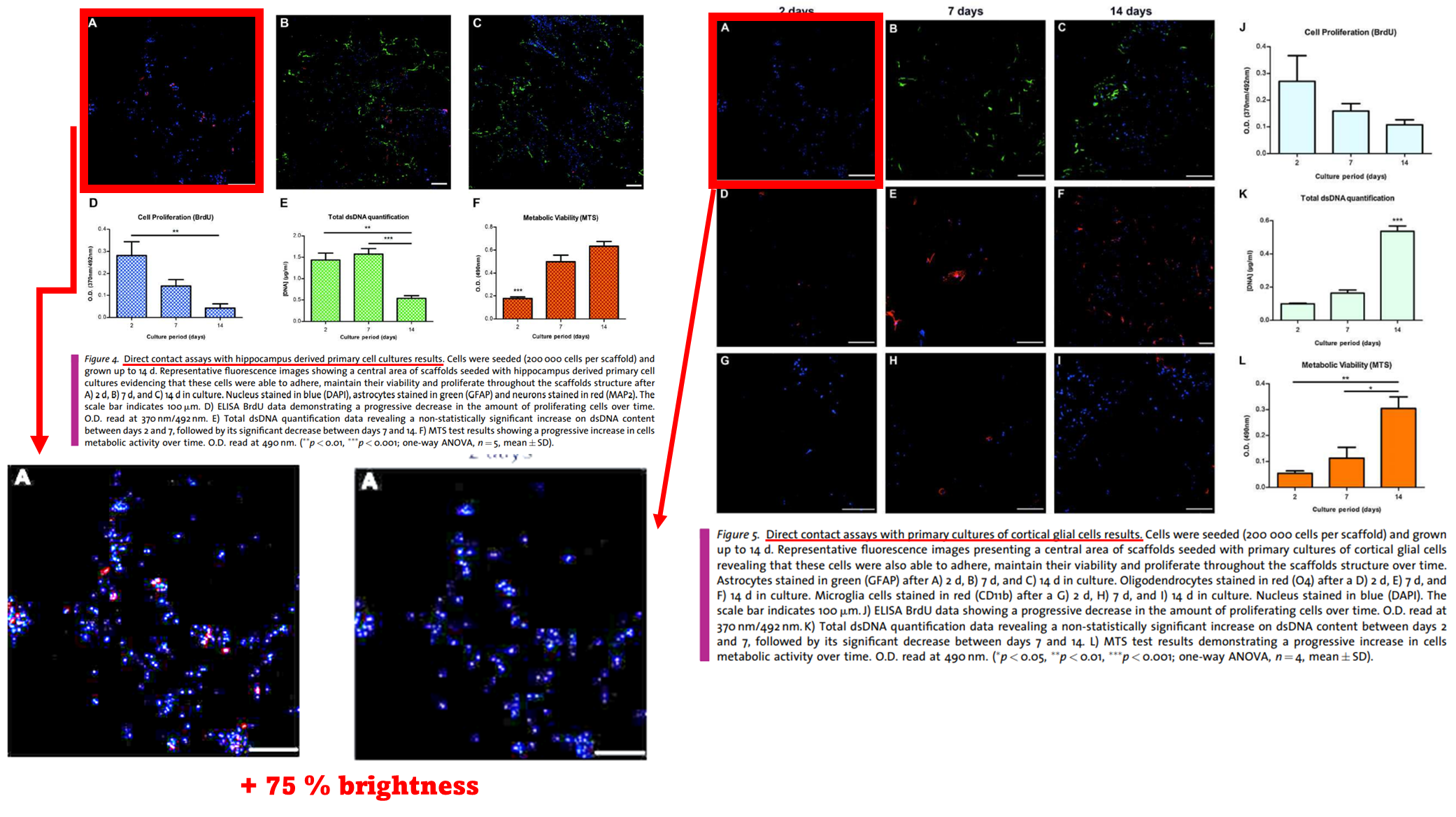
There are two Reises on this paper, Rui Manuel Reis is also a researcher at Minho University, we don’t know if they are related:
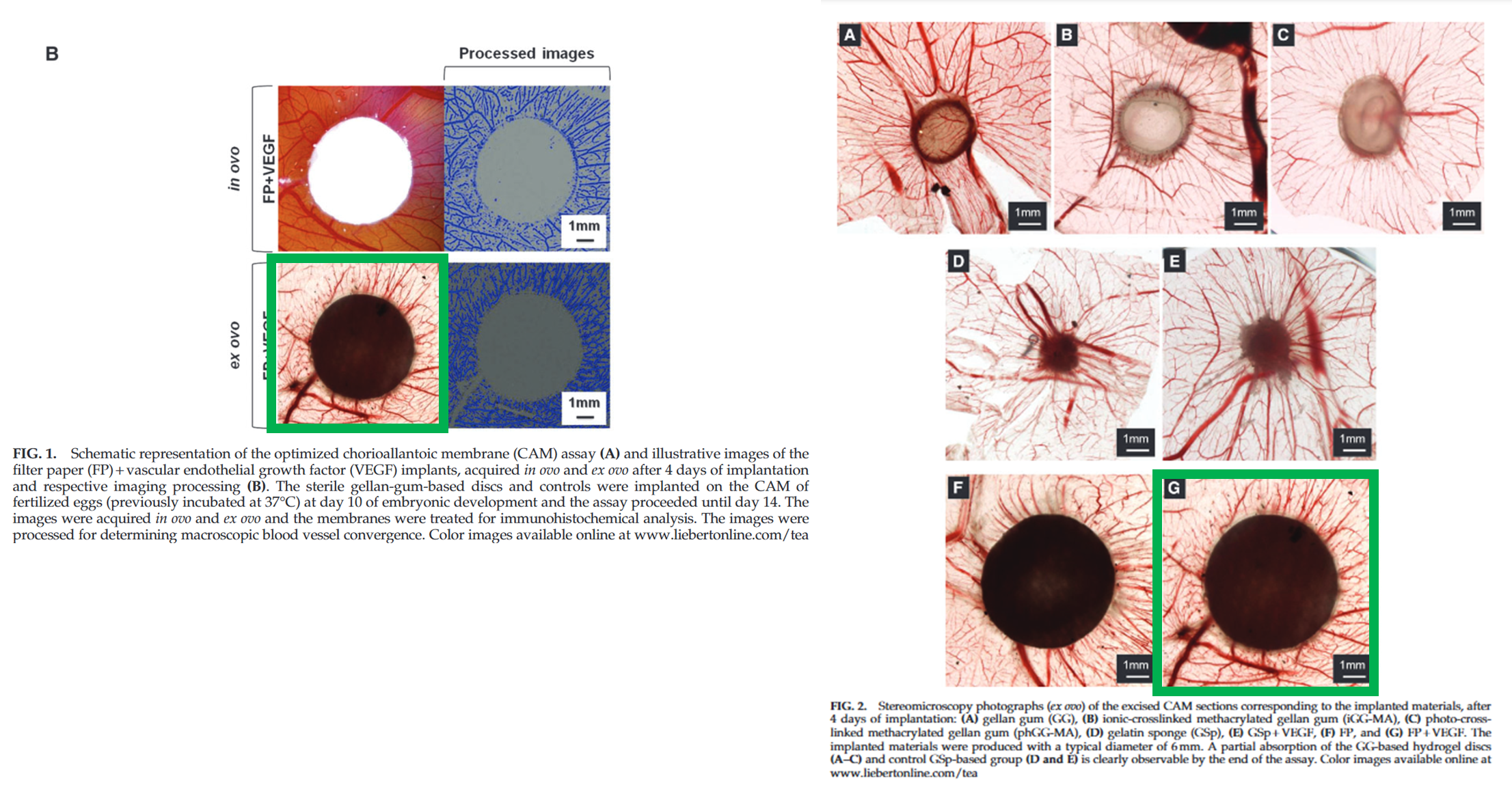
Joana Silva-Correia, Vera Miranda-Gonçalves , António J. Salgado, Nuno Sousa , Joaquim M. Oliveira, Rui M. Reis, Rui L. Reis Angiogenic Potential of Gellan-Gum-Based Hydrogels for Application in Nucleus Pulposus Regeneration: In Vivo Study Tissue Engineering Part A (2012) doi: 10.1089/ten.tea.2011.0632
The Alumini
We should also mention former members of i3Bs who, after contributing to Professor Reis’s remarkable publication and PubPeer record, while cushioning their own CVs, went on to secure top positions at other academic institutions. Many others probably fell through the cracks and are not worthy of mention here.
The first of these alumni is Professor João F. Mano. With nearly 1,000 papers indexed in Scopus and an h-index of 110, he is second only to Professor Reis, including in his PubPeer record. While at i3Bs, he coordinated works like this one:
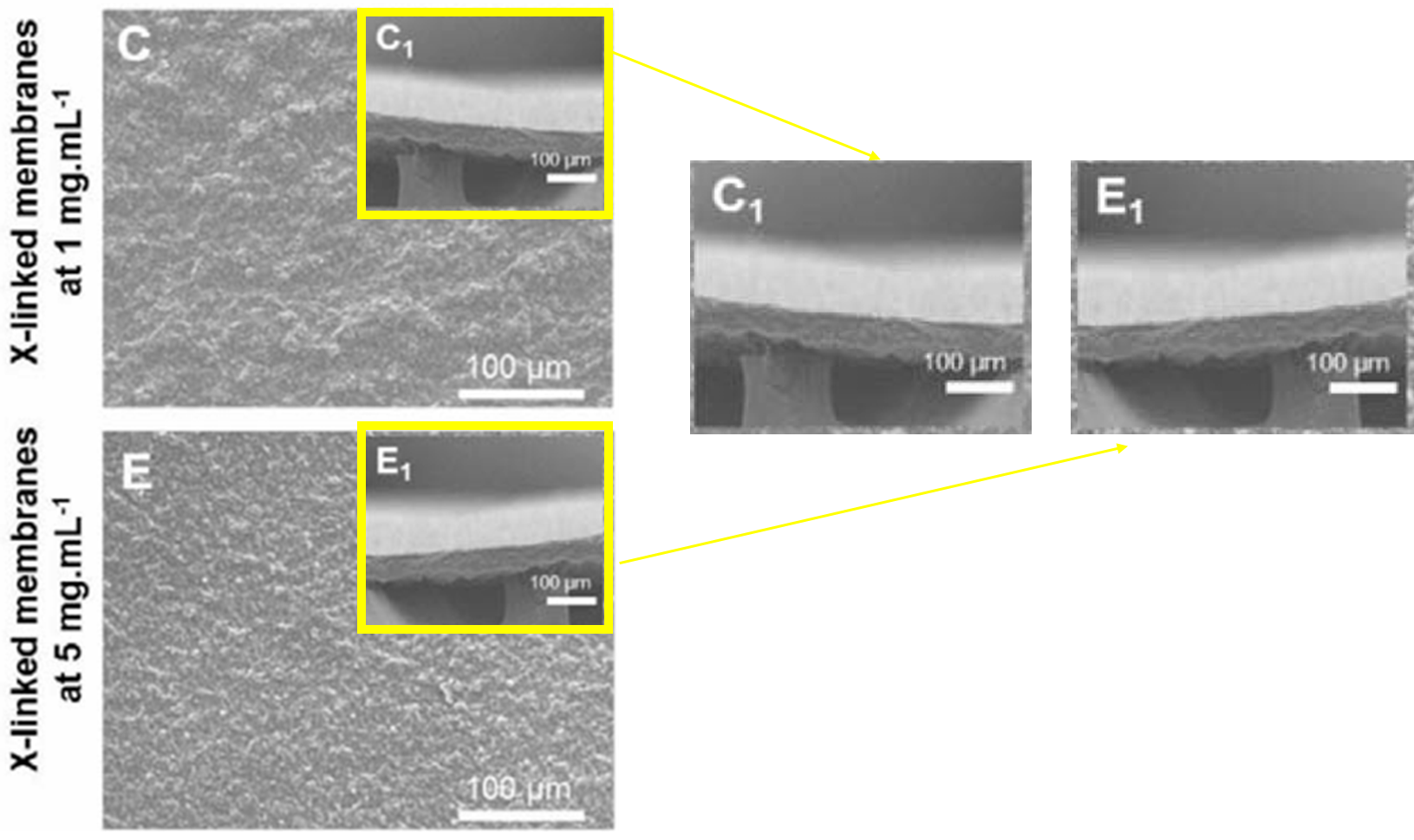
Joana M. Silva , Ana Rita C. Duarte , Sofia G. Caridade , Catherine Picart , Rui L. Reis , João F. Mano Tailored freestanding multilayered membranes based on chitosan and alginate Biomacromolecules (2014) doi: 10.1021/bm501156v
After about 20 years at i3Bs, he stepped out of the shadow of King Reis, and in 2016, became Full Professor of Biotechnology at the University of Aveiro. There, he founded and now directs the COMPASS Research Group, where his research focuses on the use of biomaterials and cells to develop transdisciplinary concepts for regenerative and personalized medicine. In 2022, Professor Mano was awarded a European Research Council (ERC) Proof of Concept grant entitled “HumanINK – validation and commercialization of a new family of bioinks based on human-derived proteins obtained from blood fractions or placental tissues.” Not a multimillion-euro ERC grant, the Proof of Concept scheme provides just €150,000 in funding, but still very prestigious. In Aveiro, Professor Mano continued the tradition of fitting the data into whatever suits better to prove his fantastic science, with more recent papers commented on PubPeer that were not co-authored with Rui Reis, such as these ones already flagged six years ago:
Pedro Lavrador , Vítor M. Gaspar , João F. Mano Bioinstructive Naringin-Loaded Micelles for Guiding Stem Cell Osteodifferentiation Advanced Healthcare Materials (2018) doi: 10.1002/adhm.201800890
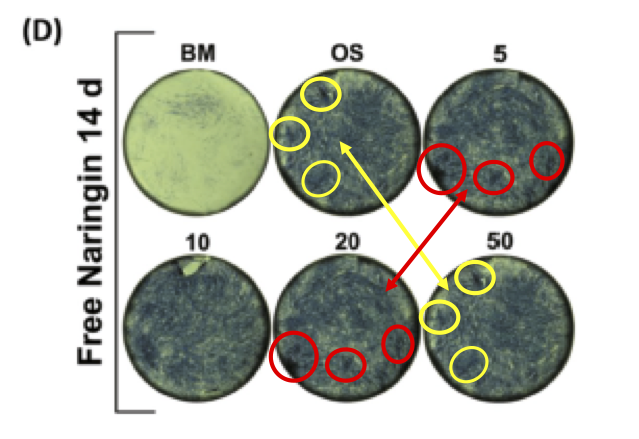
Dicranocarpus parviflorus: “same images to represent effects from different conditions, as presented in Fig. 4D”
This was addressed with a Correction in October 2019: “This mistake was due to errors in the assembly of the original figure, and do not affect the conclusions published in this work.”

The Apprentice of the One-Man Papermill
“‘More than 80 articles and H-index over 25 (Scopus) have been achieved’.” – M.K. Ahmed


Manuela E. Gomes spent essentially her entire career at i3Bs, likely moving from contract to contract and grant to grant. In May 2024, she finally became Full Professor of Bioengineering at the nearby University of Porto. As with several other top i3Bs researchers, she was the recipient of a multimillion-euro ERC Consolidator Grant for the project “MagTendon – Magnetically Assisted Tissue Engineering Technologies for Tendon Regeneration” (awarded in 2018, around €2 million). Later, in 2022, she received a more modest ERC Proof of Concept grant for “BioCHIPS – Biofabricated microfluidics chips based on the self-assembly of CNCs to recreate the hierarchical fibrillar structure of the extracellular matrix in human tissues.” She has also been involved in the COST Action TENETand, since June 2024, has served as Chair of the European chapter of the Tissue Engineering and Regenerative Medicine International Society (TERMIS-EU).
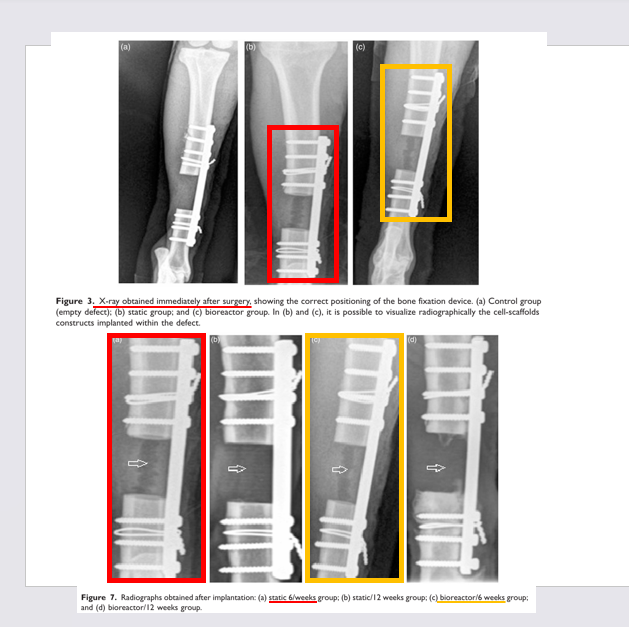
As we can see Professora Manuela work is all about engineering and regenerating Musculo-skeletal tissues. However, according to her PubPeer record, at least some these bone tissue-engineered constructs do not appear to have worked very well, as it is the case here (I am afraid real goats were tortured to produce this trash):
LS Gardel, M Afonso , C Frias , ME Gomes , RL Reis Assessing the repair of critical size bone defects performed in a goat tibia model using tissue-engineered constructs cultured in a bidirectional flow perfusion bioreactor Journal of Biomaterials Applications (2014) doi: 10.1177/0885328213519351
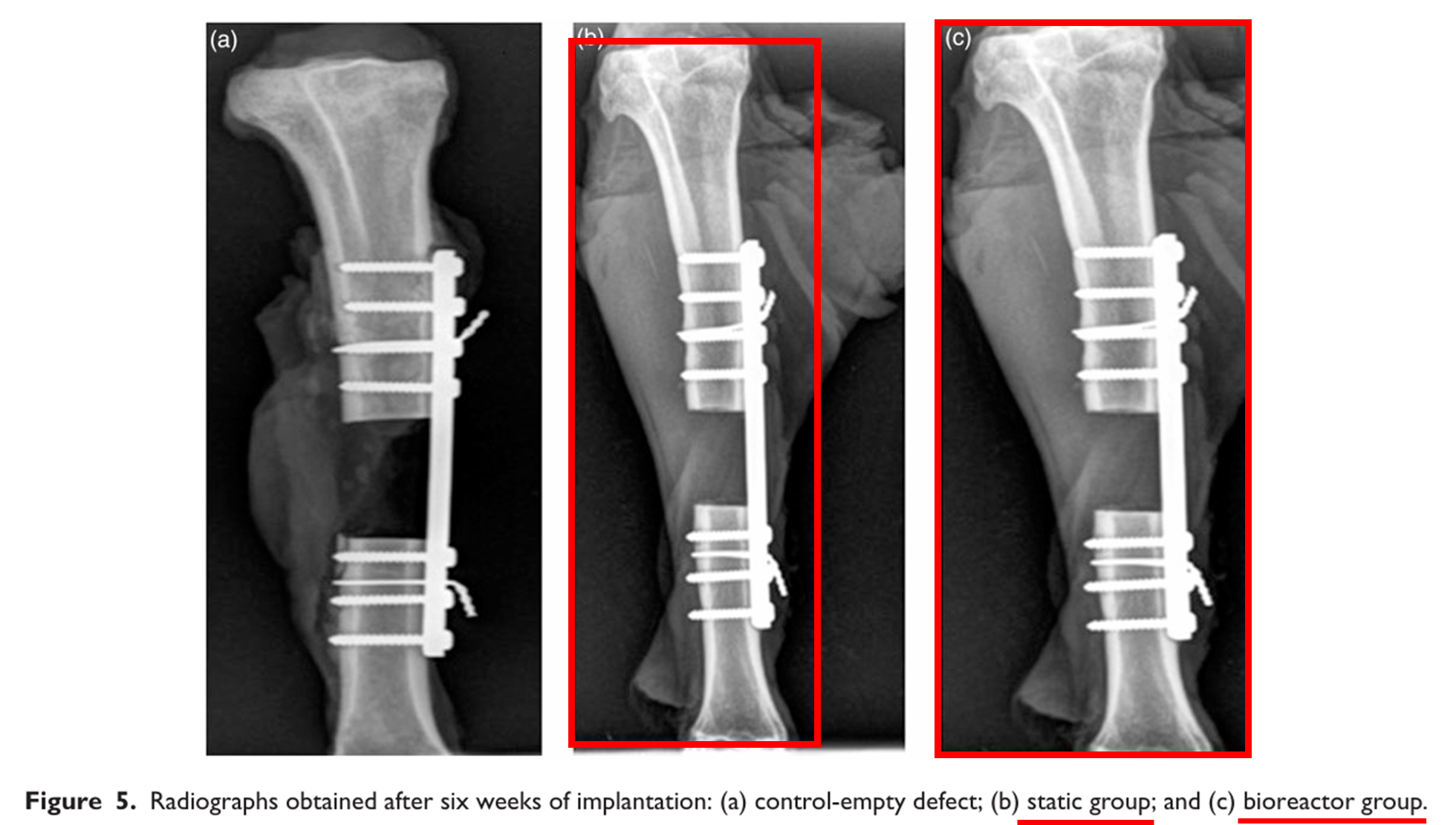
But we should also mention this stem cell study:
Raquel Costa-Almeida , Isabel Calejo , Rui L. Reis , Manuela E. Gomes Crosstalk between adipose stem cells and tendon cells reveals a temporal regulation of tenogenesis by matrix deposition and remodeling Journal of Cellular Physiology (2018) doi: 10.1002/jcp.26363
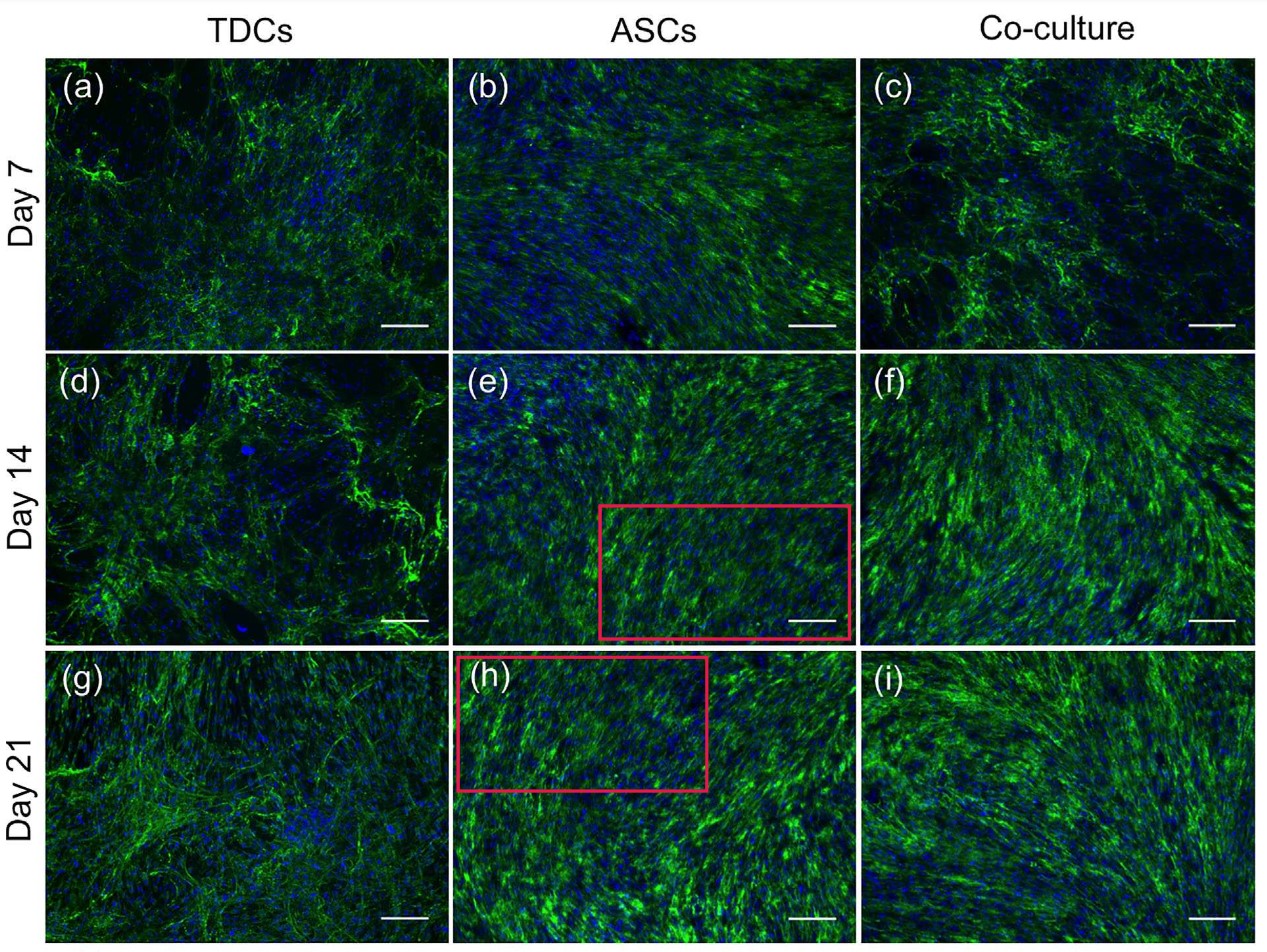
Actinopolyspora biskrensis: “Figures 4e and 4h appear to overlap.”
And this tendon study, where in January 2026 Professor Gomes was quick to reply on PubPeer, but she so far did not bother to publish a correction, because “this was a purely clerical mistake in the preparation of the figure and does not affect the underlying data, the experimental results, or the conclusions of the study“:
Adriana Vinhas , Márcia T Rodrigues , Ana I Gonçalves , Rui L Reis , Manuela E Gomes Pulsed Electromagnetic Field Modulates Tendon Cells Response in IL-1β-Conditioned Environment Journal of Orthopaedic Research (2020) doi: 10.1002/jor.24538
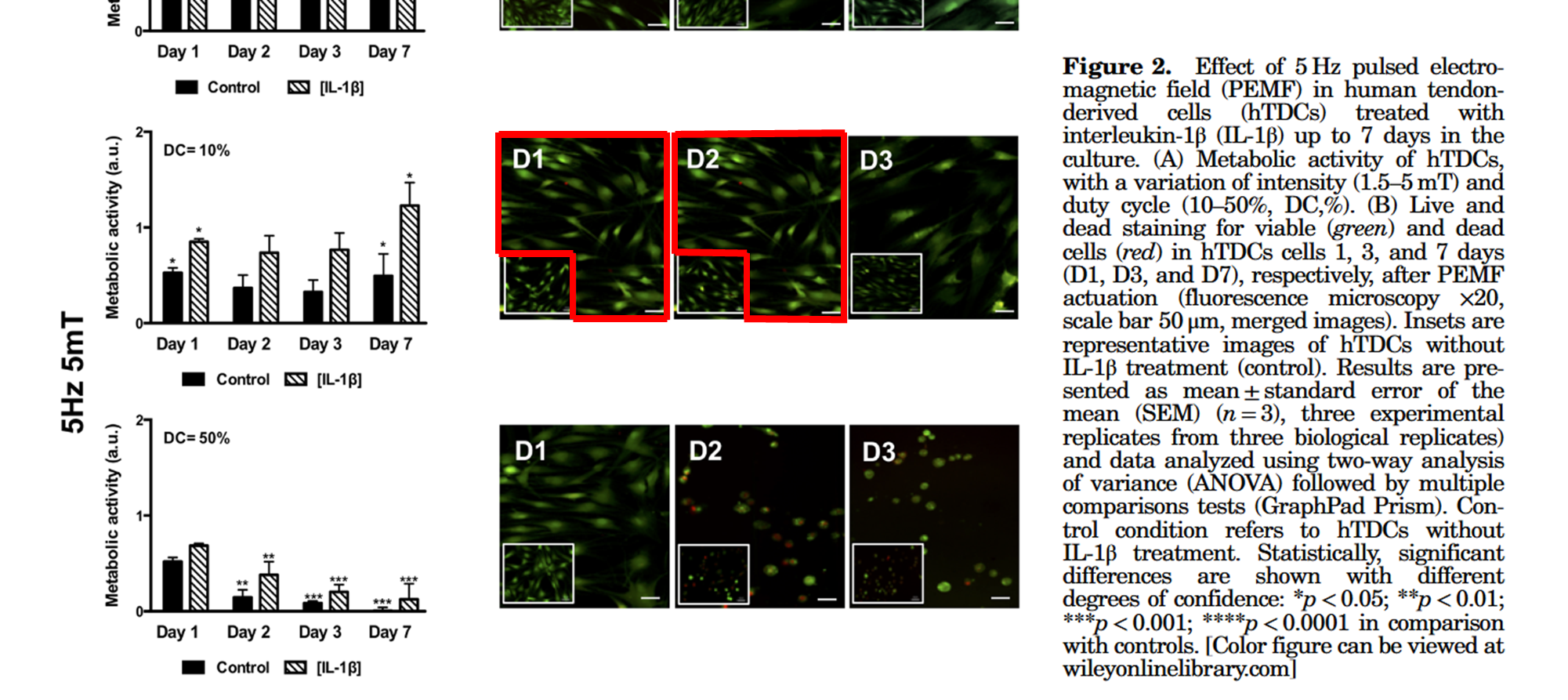
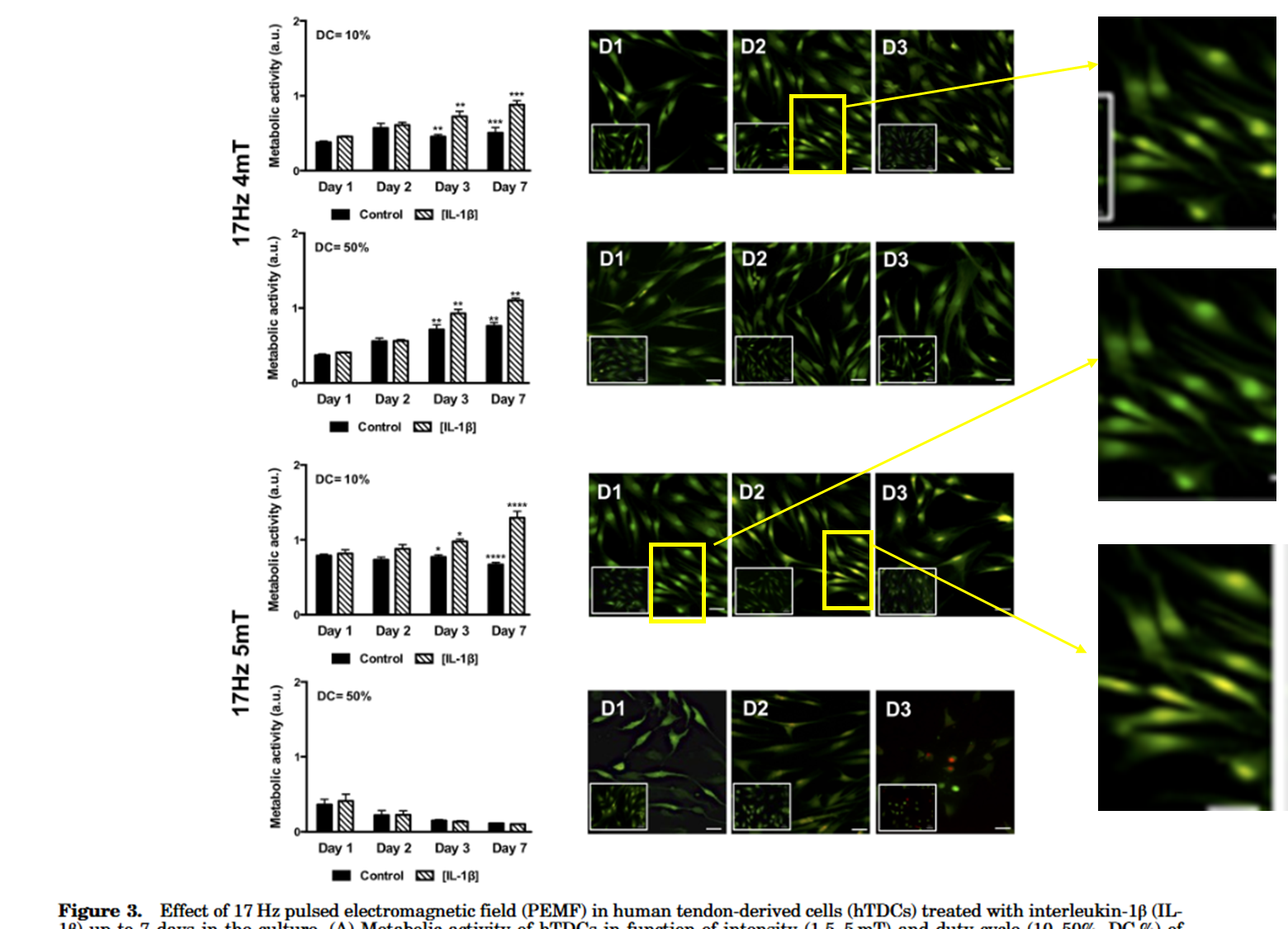
And we mustn’t miss this study with a celebrity of regenerative medicine, the lagendary transplanter of artificial bladders Anthony Atala of Wake Forest Medicine, a friend of Paolo Macchiarini:
Ana I. Gonçalves , Márcia T. Rodrigues , Sang-Jin Lee , Anthony Atala , James J. Yoo , Rui L. Reis , Manuela E. Gomes Understanding the role of growth factors in modulating stem cell tenogenesis PLOS One (2013) doi: 10.1371/journal.pone.0083734

Actinopolyspora biskrensis: “Figure 2 appears to include at least three sets of repeated images. Two sets in the upper panel, one set in the lower panel”.
It was corrected in May 2024, where the journal also noted “a potential conflict of interest between the authors and the original Academic Editor who handled the peer review of this article“, a newly appointed editor “verified the article and its findings“.
Several of Manuela E. Gomes’s problematic papers involve one of her former PhD students, Sílvia Maria Mihaila, whom she co-supervised together with the aforementioned Alexandra P. Marques. A Romanian native, Mihaila enrolled in a PhD at the University of Minho, working on “advanced vascularized bone tissue-engineering constructs.” During her PhD program she participate on the MIT-Portugal program, which gave her the opportunity to work in the lab of Ali Khademhosseini, the results of which are on PubPeer. One of Mihaila’s and Khademhosseini’s papers , coauthored by Marques and Reis (Gaharwar et al 2013) and its ridiculous correction were discussed here:
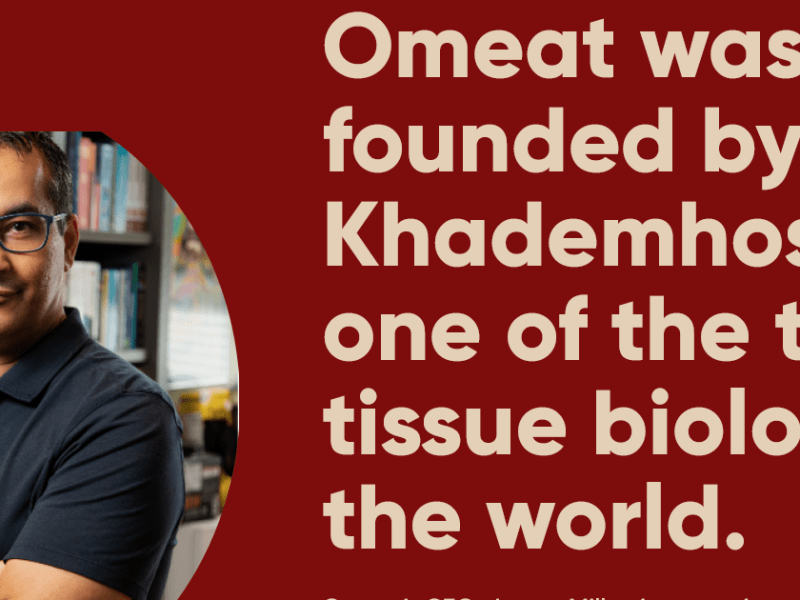
Fake-O-Meat by Ali Khademhosseini
Ali Khademhosseini is the greatest American researcher in regenerative medicine. His mentees are all professors themselves now. In his own Californian institute, he grows not only all possible organs, but even hamburgers!
This paper with Mihaila as first author and her supervisors as last authors, is a real work of art:
Silvia M. Mihaila, Akhilesh K. Gaharwar, Rui L. Reis, Ali Khademhosseini, Alexandra P. Marques, Manuela E. Gomes The osteogenic differentiation of SSEA-4 sub-population of human adipose derived stem cells using silicate nanoplatelets Biomaterials (2014) doi: 10.1016/j.biomaterials.2014.07.052
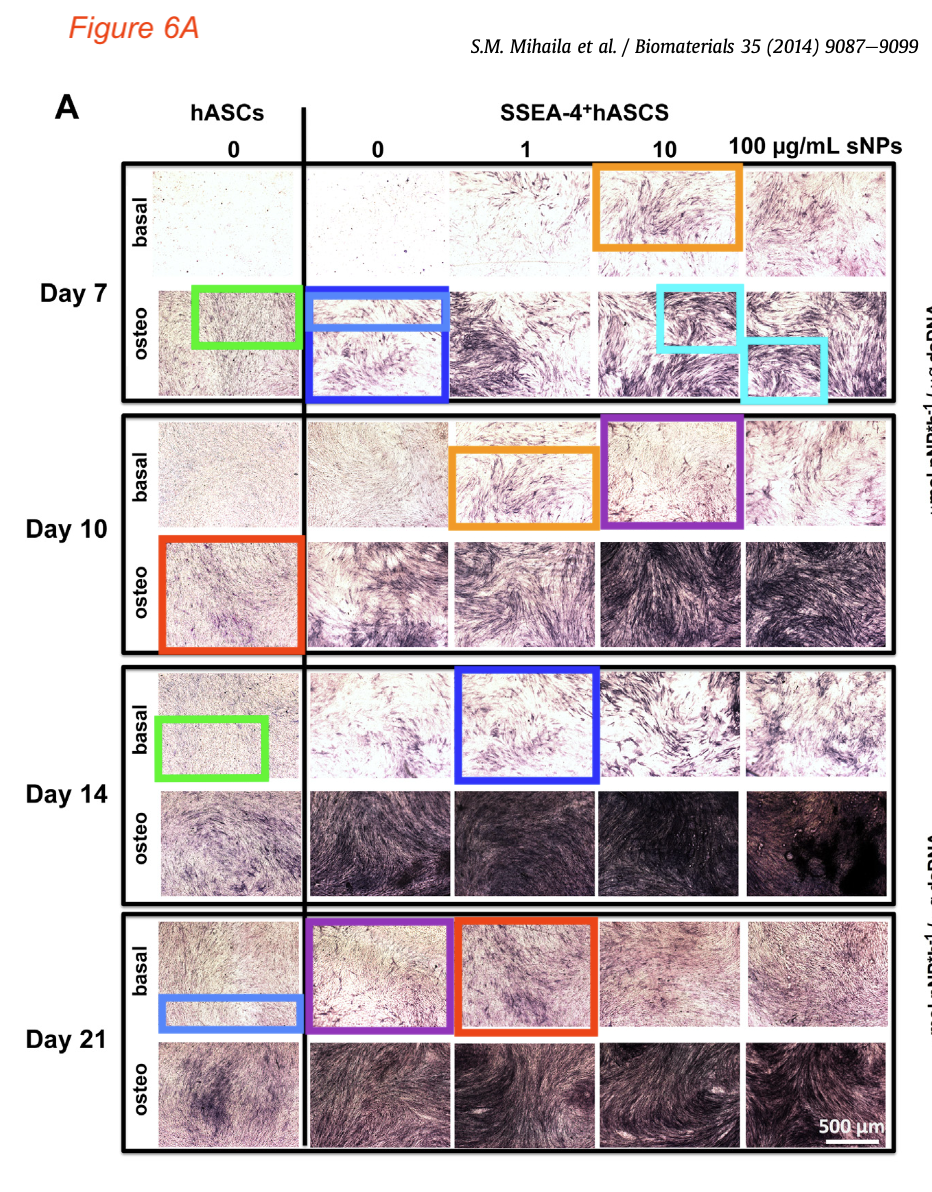
Boxes of the same color illustrate overlapping panels.”
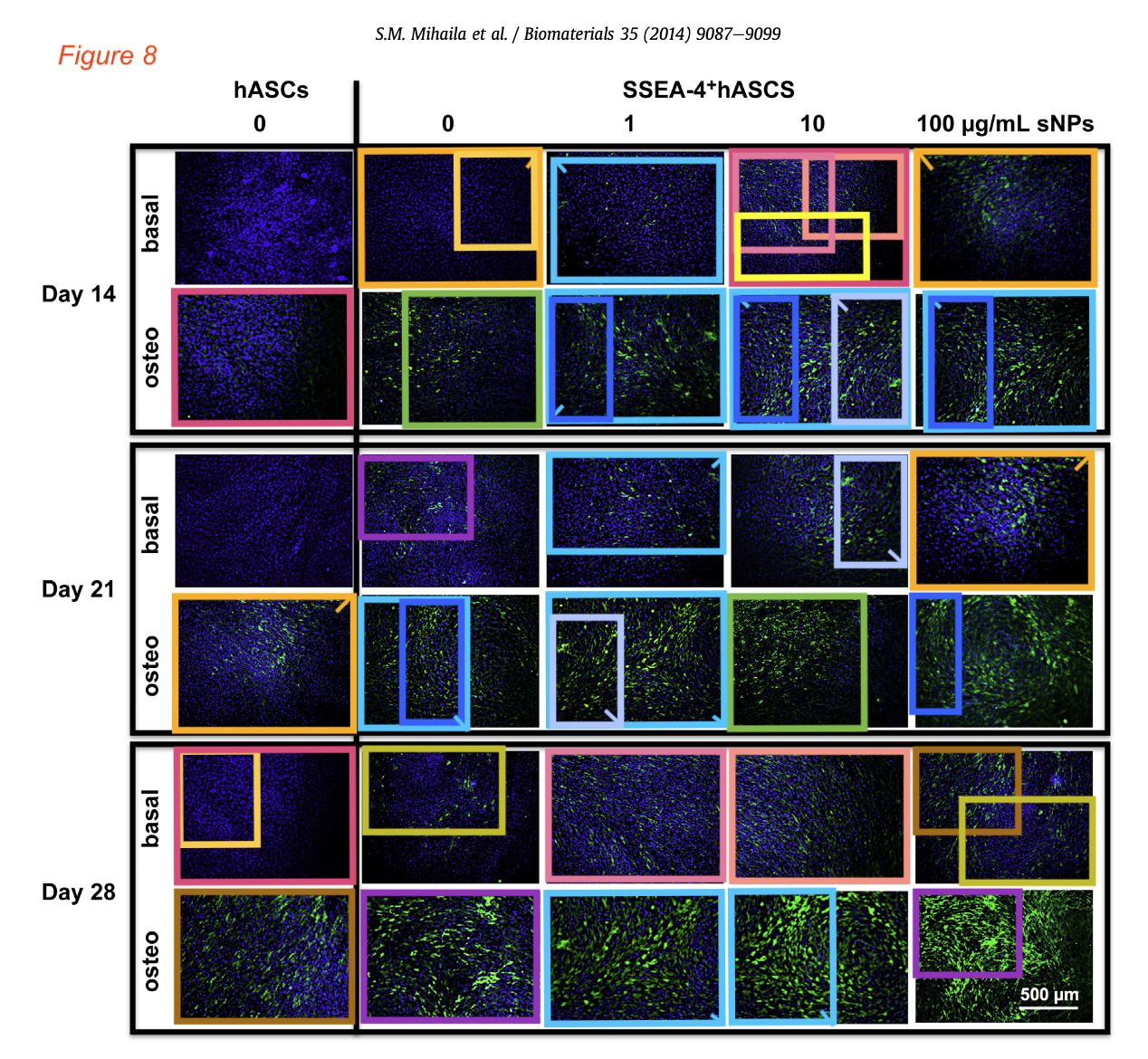
Boxes of the same color highlight panels that appear to overlap. Several images appear to all have been derived from the same sample, with several rotations, mirrorings, changes in magnification, and changes in blue/green ratios. There were so many that I did not mark all very precisely.”
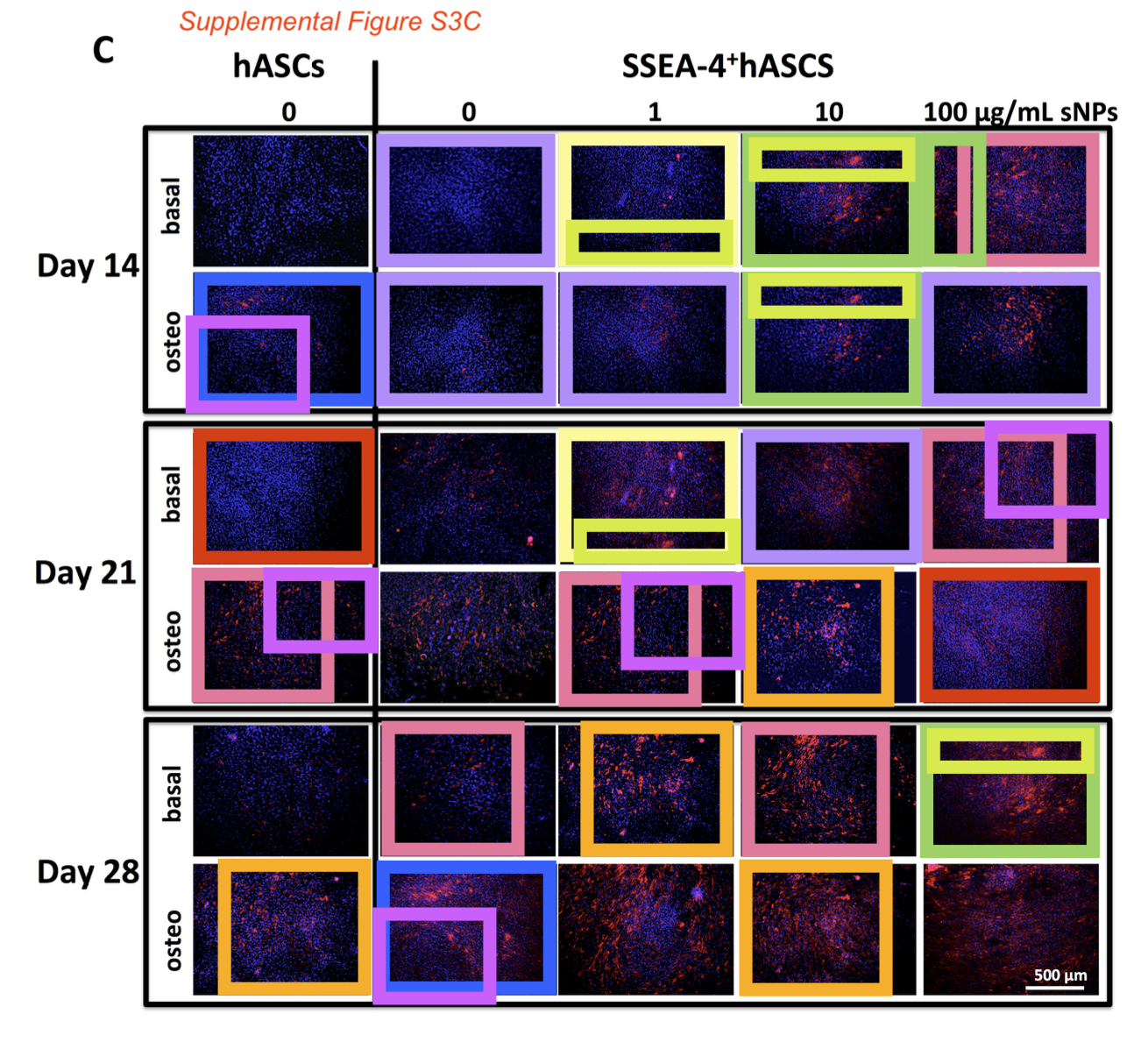
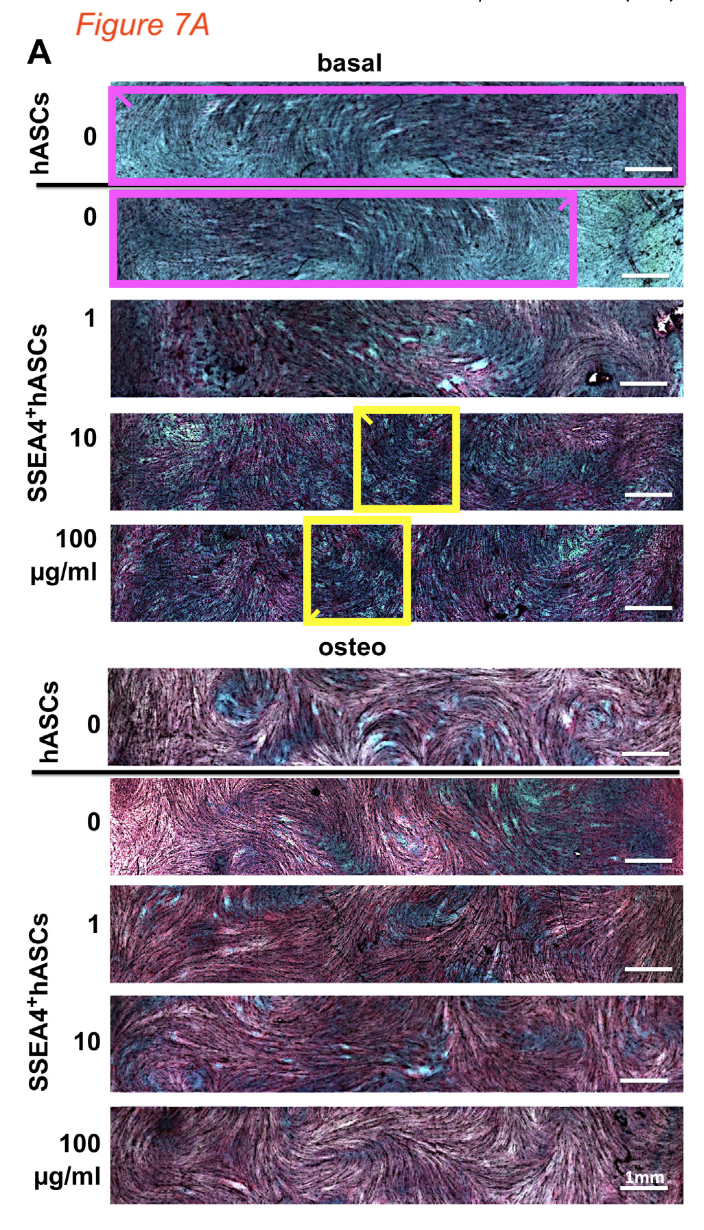
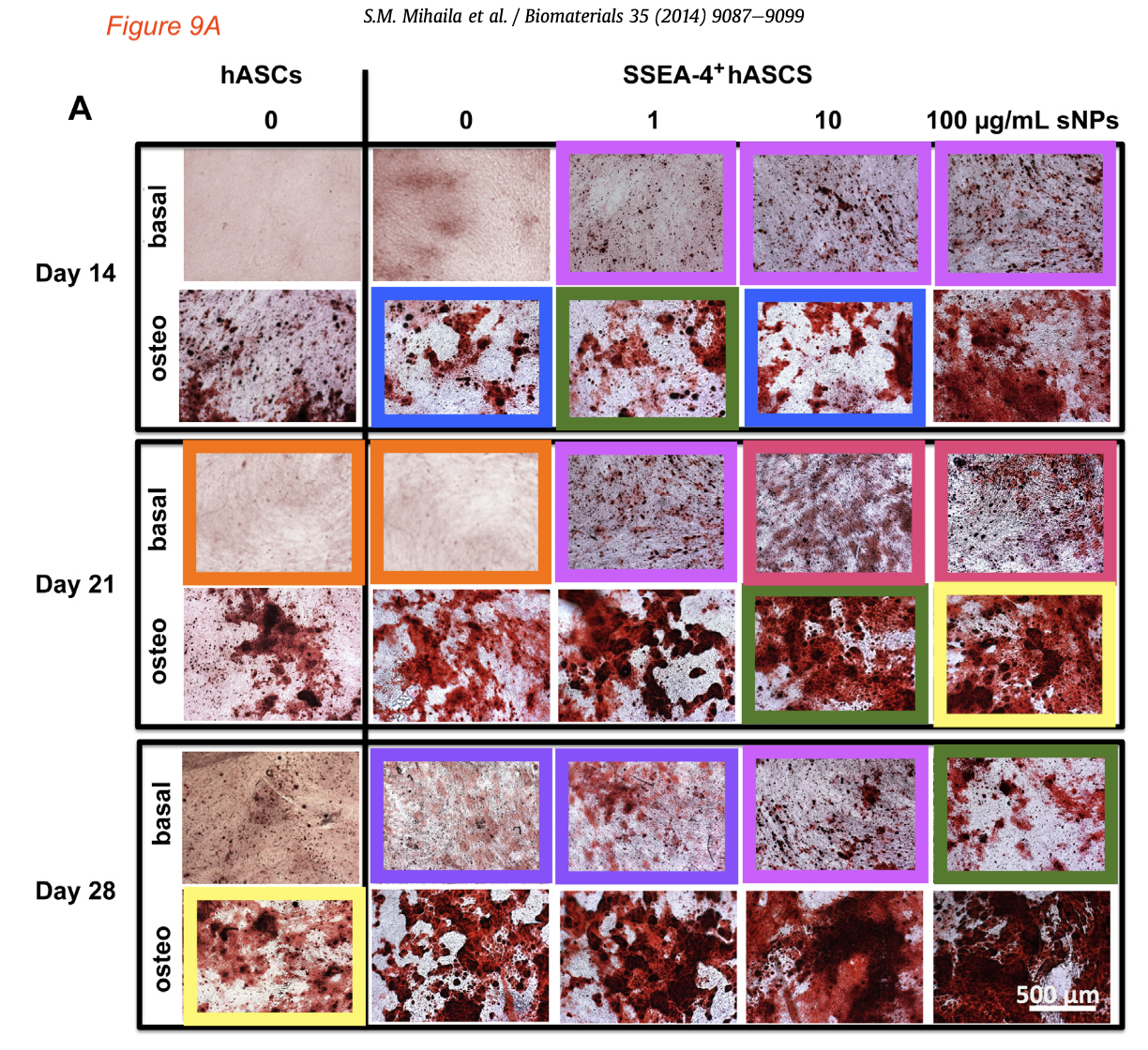
Here, boxes of the same color highlight panels that overlap with each other, without noting the precise areas of overlap or orientations”
In April 2025, Khademhosseini announced on PubPeer: “The authors regret the error and are working with publishers using COPE policies.” A year passed, and Elsevier is still unsure what to do with that paper. Akhilesh Gaharwar is now professor at Texas A&M University.
But we also have this one without Khademhosseini with the same type of problems:
Silvia M. Mihaila , Margarida F. Resende , Rui L. Reis , Manuela E. Gomes , Alexandra P. Marques Interactive endothelial phenotype maintenance and osteogenic differentiation of adipose tissue stromal vascular fraction SSEA-4+-derived cells Journal of Tissue Engineering and Regenerative Medicine (2017) doi: 10.1002/term.2096
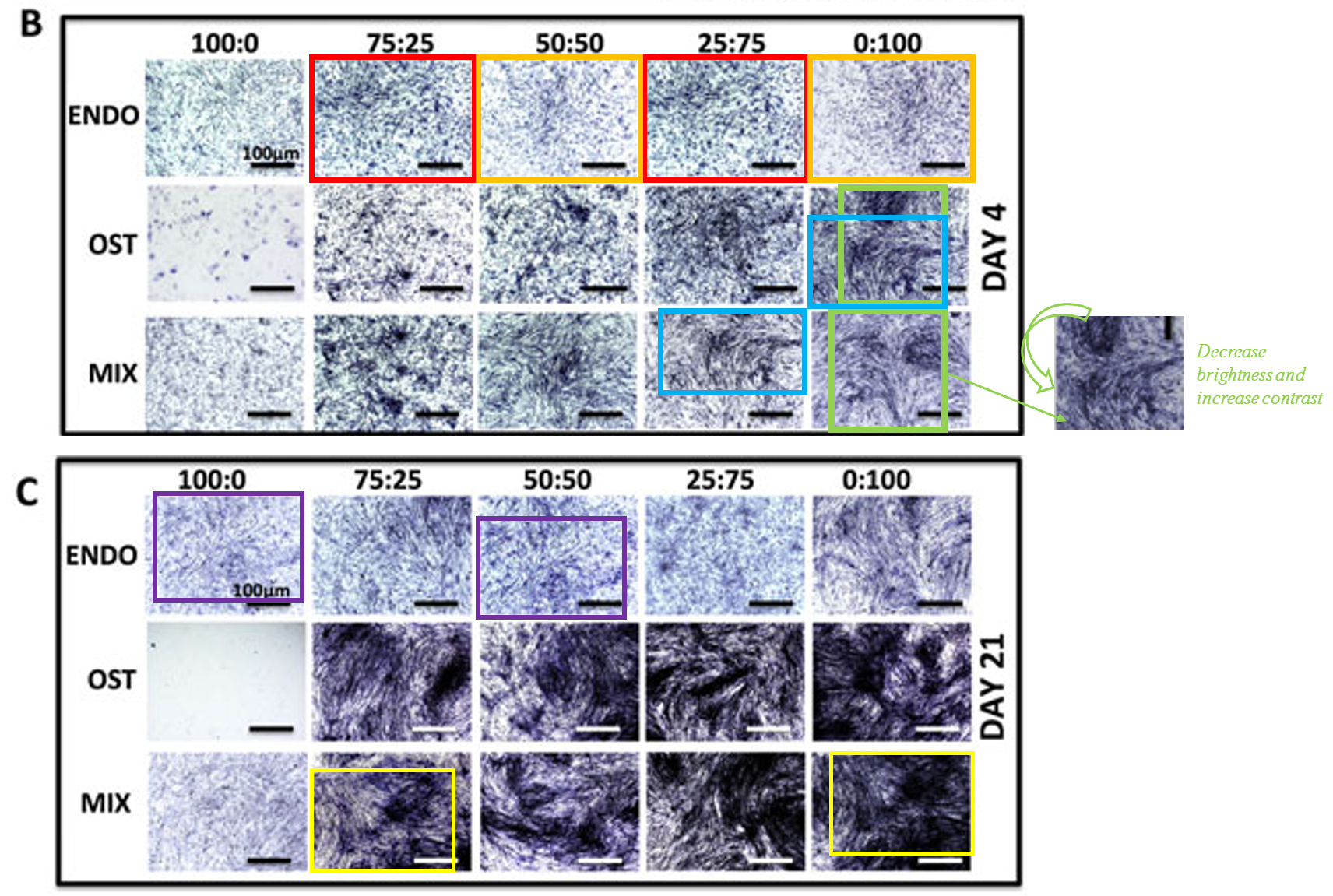
After completing her PhD in 2015, Mihaila continued her remarkable academic trajectory as a Marie Curie postdoctoral fellow at the Department of Urology of Radboud UMC (Nijmegen, Netherlands). She later became Assistant Professor at Utrecht University, where she is developing artificial kidneys.
There is also Ana Leite Oliveira (PubPeer record), who became an Assistant Professor at the School of Biotechnology of the Catholic University in Porto. She completed her PhD under Rui Reis supervision in 2008, followed by a postdoctoral position in collaboration with Tufts University, where she worked with David L. Kaplan, who has his own PubPeer record. Here is a paper with Reis and Kaplan:
A.L. Oliveira, L. Sun , H.J. Kim , X. Hu , W. Rice , J. Kluge , R.L. Reis , D.L. Kaplan Aligned silk-based 3-D architectures for contact guidance in tissue engineering Acta Biomaterialia (2012) doi: 10.1016/j.actbio.2011.12.015
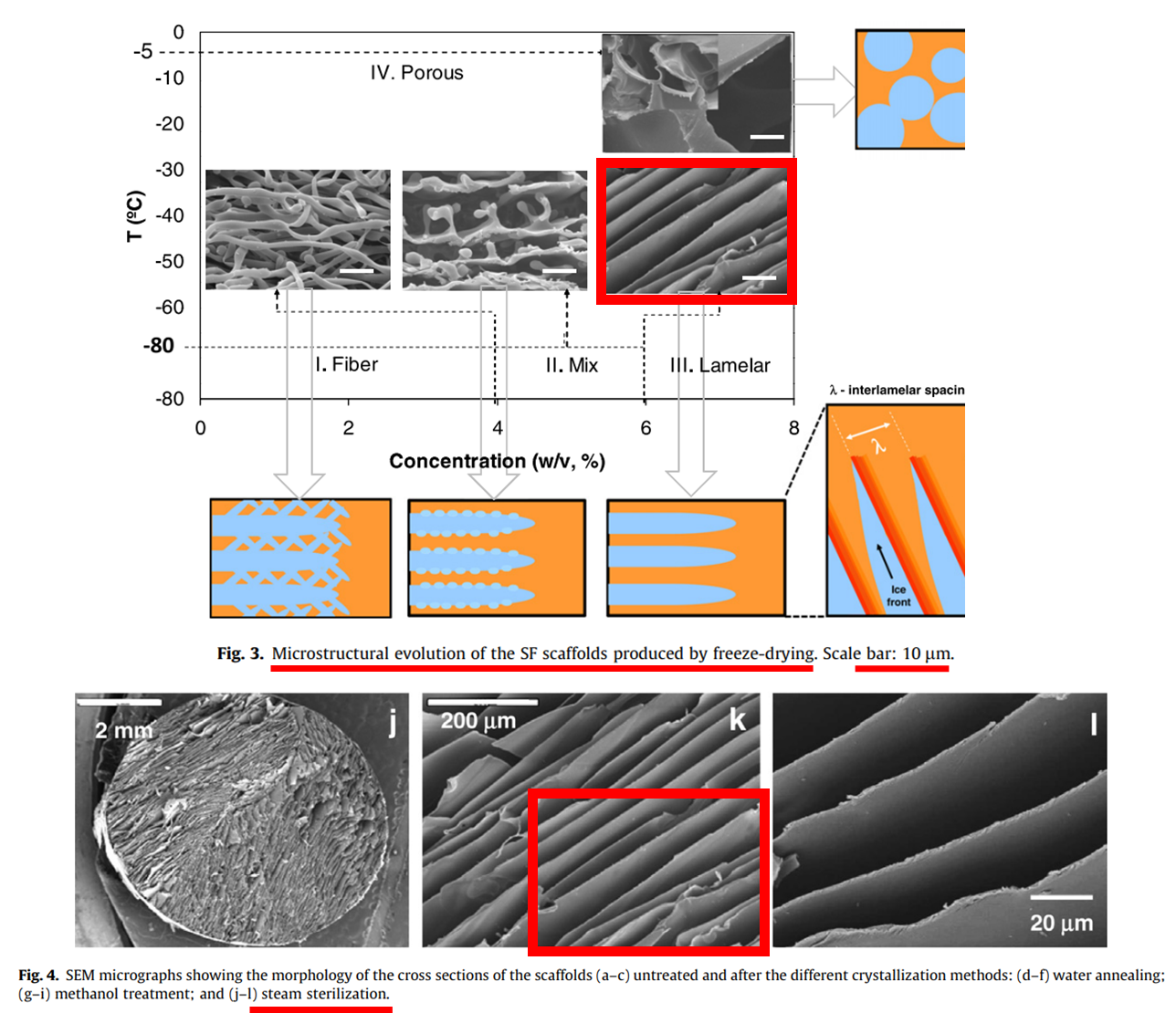
There is an apparent partial overlap between a panel in Fig. 3 and Fig. 4K (highlighted by the red boxes), which is unexpected since Fig. 3 represents the microstructure of the SF scaffolds produced by freeze-drying, while Fig. 4K shows cross-sections of the scaffolds after steam sterilization.
Problematic papers followed Professor Oliveira into her new position, suggesting she learned well during her time at the i3Bs center:
Anabela Veiga , Rui Magalhães , Marta M. Duarte , Juliana R. Dias , Nuno M. Alves , Ana Rita Costa-Pinto , Filipa Castro , Fernando Rocha , Ana L. Oliveira Continuous Production of Highly Tuned Silk/Calcium-Based Composites: Exploring New Pathways for Skin Regeneration Molecules (2022) doi: 10.3390/molecules27072249
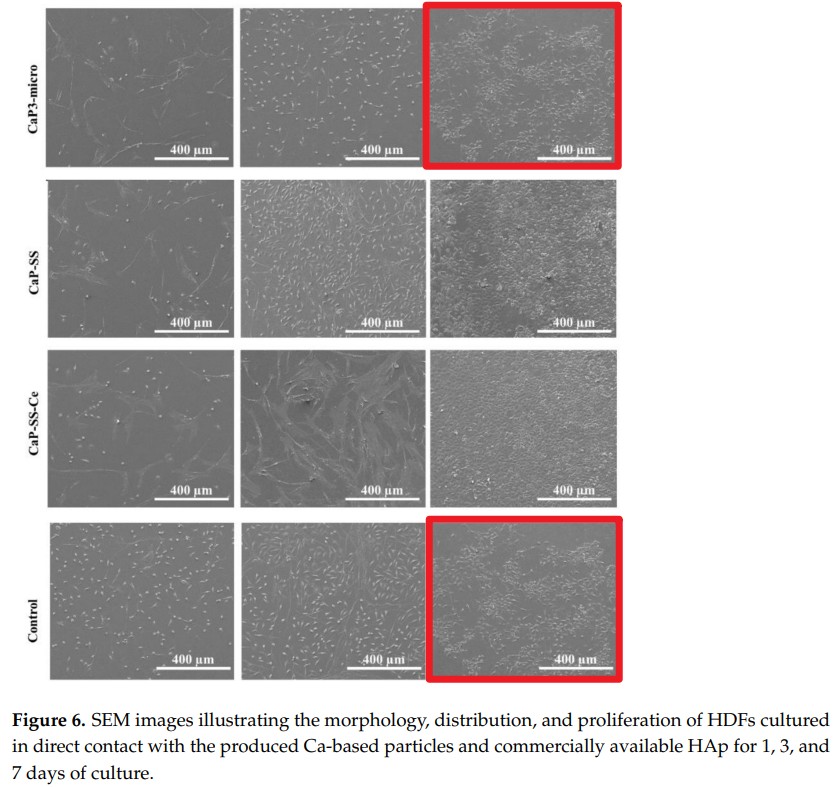
Stachys persepolitana: “In Figure 6, figcheck software indicated that two images that collected from different experiment (DAY 7: CaP3-micro vs Control) are identical.”
Finally, we should mention Ana Rita C. Duarte, who spent 10 years as a research assistant at i3Bs after completing her PhD in 2006 at NOVA University Lisbon, building quite an interesting PubPeer record with papers published during this time, most of them with her as first or last author. Such as this one:
Joana M Silva, Luísa C Rodrigues, Simone S Silva, Rui L Reis, Ana Rita C Duarte Engineered tubular structures based on chitosan for tissue engineering applications Journal of Biomaterials Applications (2018) doi: 10.1177/0885328217744698
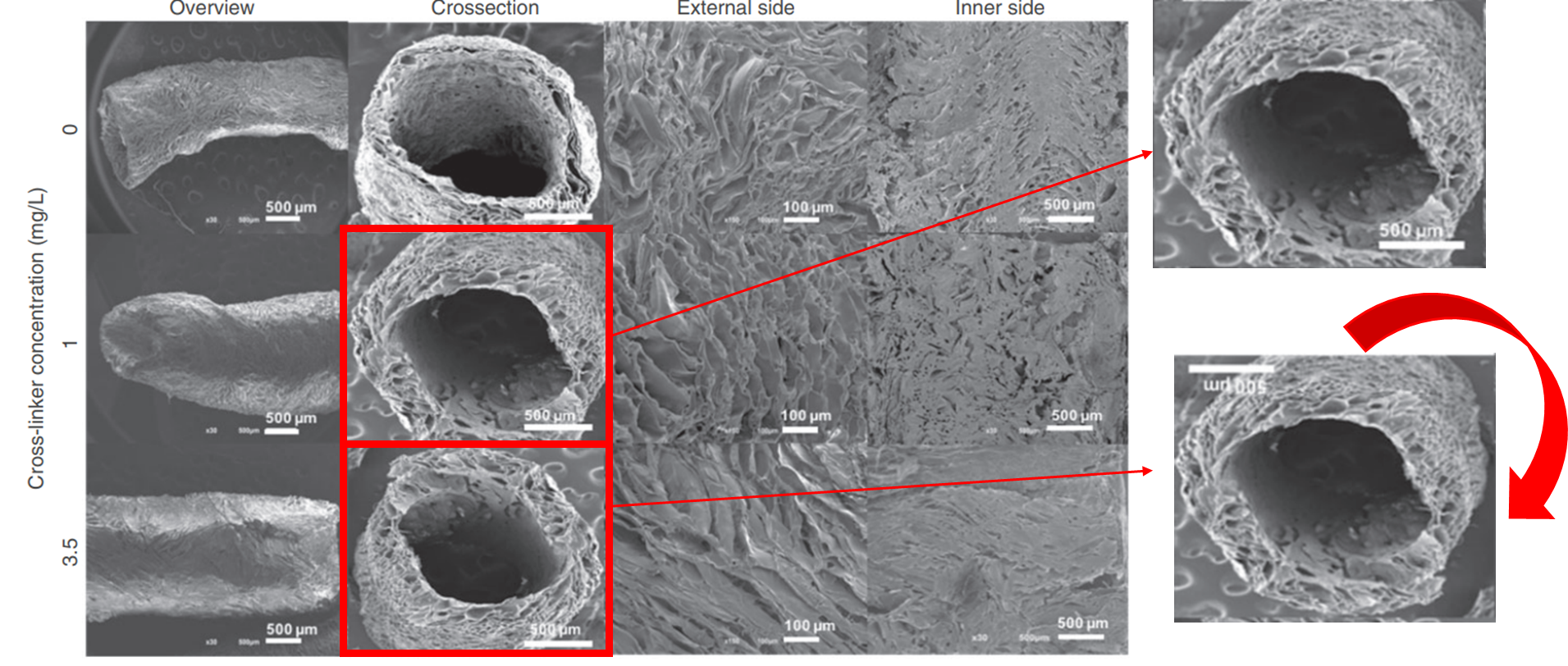
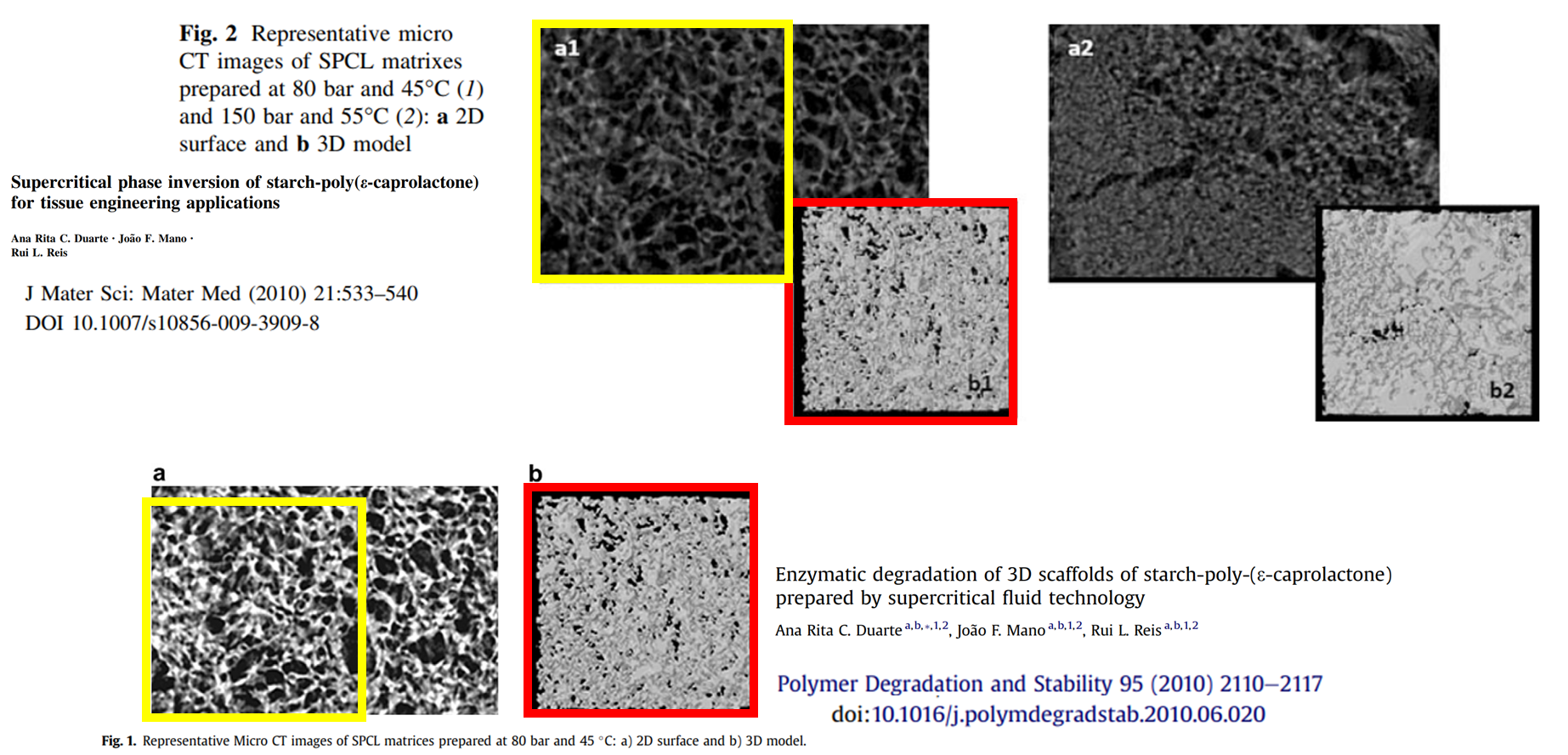
Or this panel reuse in different papers, with the aforementioned Joao Mano:
- Ana Rita C. Duarte, João F. Mano , Rui L. Reis Supercritical phase inversion of starch-poly(epsilon-caprolactone) for tissue engineering applications Journal of Materials Science Materials in Medicine (2010) doi: 10.1007/s10856-009-3909-8
- Ana Rita C. Duarte, João F. Mano , Rui L. Reis Enzymatic degradation of 3D scaffolds of starch-poly-(ɛ-caprolactone) prepared by supercritical fluid technology Polymer Degradation and Stability (2010) doi: 10.1016/j.polymdegradstab.2010.06.020
Duarte’s stay at i3Bs most certainly helped her secure a nearly €2 million ERC Consolidator Grant after she returned to Lisbon in 2016: “DES.solve – When solids become liquids: natural deep eutectic solvents for chemical process engineering”. She later received another ERC grant, this time a Proof of Concept award of €150,000 for 18 months, to develop the project “CryoDES – Nature-inspired Cryopreservation Systems using Natural Deep Eutectic Systems.” She has already become an Associate Professor at NOVA University Lisbon and will no doubt soon progress to Full Professor.
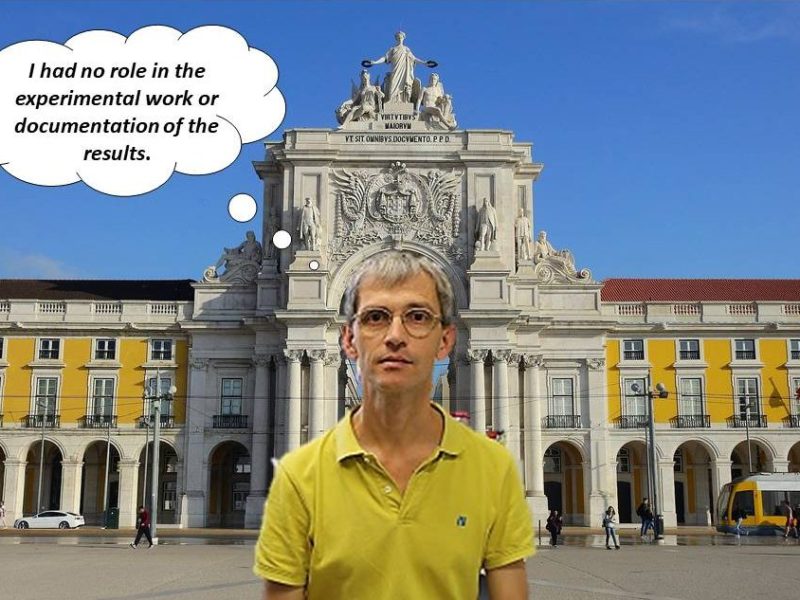
At the end of all this, I must confess that I stopped believing in any science related to tissue engineering, biomaterials, or whatever… I think this story shows the debacle and corruption of entire research fields that become just a very expensive show of bad science-fiction. And, of course it is the best (or the worst, depending on one’s perspective) example of what an absolutely dysfunctional Portuguese academia can produce. What should we expect from academic research system that imposes a relentless push to publish, where most researchers are always one paper away from losing their jobs, judged almost entirely by h-index and citations, under the rule of a small elite accustomed to unchecked power? Add to this virtually no oversight and no enforcement of scientific misconduct, and a press that simply parrots what comes out of research centers’ communication offices, serving merely as propaganda vehicles to aggrandize powerful figures within the system, and we have a perfect storm like Rui Reis. And judging by the absurd amount of EU funding that has been funneled to Reis and his circle, this dysfunction appears to extend to European research funding schemes as well.
Donate!
If you are interested to support my work, you can leave here a small tip of $5. Or several of small tips, just increase the amount as you like (2x=€10; 5x=€25). Your generous patronage of my journalism will be most appreciated!
€5.00


“the silk papermilling road:”
I just wanted to read that again.
LikeLiked by 4 people
You mean, Silk Fibroin, Minho has produced many
https://pubpeer.com/publications/9E65F9110C900D7B11D670BD0EB6FB
LikeLiked by 1 person
I think there is some silk mafia pushing all these papers. As far as I know, the only current biomedical application for silk is sutures, but if we look at what has been published, it seems like a wonder material that will cure and fix everything. The wonders of international paper mills. This guy has also been pushing this very hard: David L. Kaplan from Tufts University. Maybe someone should take a look at him.
LikeLike
Great work. It is worth reassuring the author (although they may well know it already) that the so-called “dysfunctional Portuguese academy” is merely one example of the global condition in which research worldwide currently finds itself. In some countries, fraud is more blatant; in others, it is better concealed. But the percentage of fraudsters, I fear, is very similar everywhere. Data tells us that 85% of what is published is irreproducible; however, this figure stems from surveys conducted on top-tier journals, making it an underestimate. If we were to also consider second-, third-, and fourth-tier scientific journals, the figure would rise well above 90%, perhaps even reaching 99%. This shameful house of cards must be razed to the ground.
LikeLiked by 1 person
Gasperini L, Mano JF, Reis RL. Natural polymers for the microencapsulation of cells. J R Soc Interface. 2014;11(100):20140817. doi:10.1098/rsif.2014.0817.
vs
Bacelar AH, Silva-Correia J, Oliveira JM, Reis RL. Recent progress on gellan gum hydrogels provided by functionalization strategies. J Mater Chem B. 2016;4:6164-6184. doi:10.1039/C6TB01488G.
Figure 2 and 3
LikeLike
Schematic panels in Fig. 2 of Gasperini et al. (J R Soc Interface 2014, doi:10.1098/rsif.2014.0817) are repeated in panels in Figs. 2 and 3 of Bacelar et al. (J Mater Chem B 2016, doi:10.1039/C6TB01488G) (highlighted by boxes with corresponding colors). This should not be expected sinse no attribution such as “adapted from” or indication that the artwork was reproduced with permission could be identified. In addition, only one author is shared between the two papers, suggesting that this may not represent simple figure reuse within the same author group. This could be considered plagiarism or self-plagiarism.
Unfortunatly PubPeer regected this comment. https://pubpeer.com/storage/image-1779356211997.png
https://pubpeer.com/storage/image-1779356211997.png
LikeLike
PubPeer moderation, for reasons that I do not understand, also rejected my comments on two other papers co-authored by Joaquim Oliveira, produced by a very international team of co-authors. The control panels are repeated in corresponding figures across both publications, althought the two papers test different hypotheses and are presented as separate experimental studies.
https://pubpeer.com/storage/image-1778754110143.png
https://pubpeer.com/storage/image-1778755044106.png
https://pubpeer.com/storage/image-1778755960353.png
LikeLike
Interesting post. Always new things to discover. The amount of money spent on regenerative tinkering is outlandishly out of touch with the actual benefits delivered to patients. This kind of research seems to have evolved to become a strange sort of conceptual art. So many strange gels and particles.
LikeLiked by 2 people
It is a very well-prepared piece of work indeed. I had noticed Reis’s name whilst reviewing the Khademhosseini paper on PubPeer after reading about him on FBS, but I had no idea Reis was a part of such a scandal. It has turned out to be a very fine piece of work.
After reading this article, my doubts are growing by the day regarding a subject that one would never even consider touching. We are seeing exactly what sort of people the ERC grants, said to be Europe’s most prestigious, are actually being awarded to. It looks like ERC grants are now becoming as corrupt as the HORIZON and Marie Curie programmes.
When asking certain individuals about why the Iranian papermilling cartel is able to commit such blatant fraud yet continues to be cleared by university boards in the West and why publishers stubbornly refuse to retract these authors’ papers, the topic of ERC grants also came up during the conversation. I had heard that even in ERC grants, gang activity was real, and that the system had become corrupt even at the ERC level. My suspicions regarding this matter had grown due to a few specific names, but this post has made them grow even further.
LikeLiked by 1 person
This scandal is about much more than scientific integrity it is, first and foremost, about how PhD students are treated at 3B’s.
Just look at the numbers. There was a time when the institute hosted more than 100 doctoral students. Today, that number has collapsed to a fraction of what it once was. The reason is no mystery: it is the model of governance imposed by Rui L. Reis, sheltered by the convenience of the University of Minho, which for years has chosen to look the other way.
What happens inside this institute is serious. Many families have been affected, and continue to be affected, by the narcissism of a man who was once presented as a leading figure of Portuguese science. More than 50 PhD students have been unable to complete their theses — not because of academic shortcomings, but simply because they refused to submit to the personal, dictatorial rules of a single individual, rules that have nothing to do with academic values.
Numerous formal complaints have been submitted to the University of Minho, to the Foundation for Science and Technology (FCT), and to other competent bodies. To this day, no action has been taken. This inaction is, in itself, complicity.
3B’s has facilities that any research centre in Europe would envy, built on the work of hundreds of researchers over decades. And yet they degrade by the day, through lack of strategic vision and a chronic closure to society. A multi-million-euro centre, run as personal property, governed by the logic of “either you are with me or you are against me” — through intimidating emails, through career evaluations within the University of Minho that claim to be “independent” but which systematically favour those closest to the director’s inner circle over everyone else.
The culture of fear and repression has become so entrenched that most people prefer to leave in silence. But that silence is precisely what has allowed this to continue. Those who stay silent collaborate.
I issue a public challenge to all former and current students and collaborators of 3B’s: speak up. Share what you experienced, the retaliation you faced, the way this culture took root and normalised itself. Speak in the comments, speak to the journalists investigating this, speak to the competent authorities — and this time, demand a response.
This deeply discredits the University of Minho and its leadership, who chose complicity out of convenience. The end of the institute as we knew it is near — and the responsibility does not lie with the researchers who endured against the odds. It lies with those who allowed this, and continue to allow it.
We will not stay silent until measures are taken. It is time to act.
LikeLiked by 3 people
I would just like to add that Rui L. Reis is an alcoholic. Most days, after lunch, it is completely impossible to talk to him or to his bestie, Nuno Neves because they are both drunk.
All of the people who work there knows and suffer with that in one way or another.
Alcohol elevates his prepotent personality
LikeLike
Critical discussion in science is important, and questioning research should absolutely be part of academia. But honestly, this article goes well beyond scientific criticism and turns into a very personal attack against researchers, students, and institutions mentioned by name.
The tone throughout constant sarcasm, ridicule, and a lot of speculative accusations, feels less like an effort to encourage constructive discussion and more like public shaming.
It’s also worth remembering that science is highly collaborative and complex. Large publication records, international collaborations, and successful funding do not automatically imply misconduct. More often than not, they reflect years of sustained effort, coordination, scientific leadership, and the work of many people contributing at different levels.
What feels particularly unfair is how easily pieces like this end up discrediting entire research communities, including postdocs, PhD students, technicians, and collaborators who work diligently and ethically every day. Public trust in science isn’t built through sensationalism or hostility, but through rigorous, fair, and respectful discussion.
In the end, this article reads far more like a witch hunt than a genuine attempt to address scientific issues. It is somewhat ironic that such a strongly moralizing tone about “ethics” is paired with language that feels itself ethically questionable. The focus seems less on clarifying potential problems and more on targeting individuals.
To all the worked-up keyboard warriors joining the outrage: be careful. When speculation and personal attacks replace balanced discussion, the line between critique and targeting becomes dangerously thin and anyone can end up being next
LikeLike
Hello reader from Portugal (I can see your IP address).
I presume you are Rui or one of his coauthors who were afraid to reply to my email and now are afraid to sign your passive-aggressive comments with your name.
How does it feel, being so afraid and helpless, Rui?
LikeLiked by 3 people
I just received this message from Ariana C. Silva, Business Development Analyst of Stemmatters (the company located inside i3B building):
I think Ariana must first write to i3B and demand their retraction, where Reis presents himself as “President/Chairman and Chief Scientific officer of Stemmatters (www.stemmatters.com) ”
https://3bs.uminho.pt/people/18

Also here, also by University of Minho:
https://forecast.3bs.pt/rgreis

Even Cruchbase says he is currently Stemmatters president.
https://www.crunchbase.com/organization/stemmatters#people

__
LikeLiked by 1 person
Leonid miss this: “Under the pretext of attending scientific congresses and meetings, the president of the University of Minho’s 3B’s Institute, Rui Reis, has been traveling the world on luxury trips paid for by the University of Minho. On many of these trips, the scientist allegedly travels with family and friends, regardless of cost. The case was recently reported and led the Braga Judicial Police to search the university professor’s office.” https://www.cmjornal.pt/sociedade/detalhe/universidade-do-minho-paga-viagens-de-luxo-a-cientista
LikeLiked by 2 people
Let me begin by saying I know nothing about this scandal and the research community behind it. I am just chiming in to say that this is nothing new and extends way beyond researchers – it is a systemic cancer in Portuguese academia all around. You can pick almost any institution and any course – corruption, abuse of power, using students for profit and personal agendas is prevalent. Just taking a random look at what’s going on in Universidade do Minho’s Departamento de Música (ELACH), practically a Game of Thrones novel, you’d be absolutely speechless. And that’s one of many, many cases.
LikeLike
Karma is a bitch
Rui L. Reis criou o seu reino e manteve-o até agora com a conivência de muitos. Os que sempre souberam e nada fizeram. Os que sabiam e queixaram-se a quem de direito e que nada fez. E os que souberam e tinham poder para fazer alguma coisa e nada fizeram.
E, infelizmente, para os portugueses e contribuintes europeus, muitos dos fundos europeus nunca serviram para produzir algo de relevante e de valor nem para melhorar a vida de algumpaciente. Após quase 30 anos, o 3Bs com as instalações e equipamentos de fazer inveja a qualquer centro de investigação em qualquer parte do mundo, produziu uma montanha cheia de nada. Esta falta de visão, o isolamento do ambiente académico e da sociedade, numa vila no meio do nada, a promoção dos protegidos, a aposta no número e não na qualidade, a ditadura pesrpetuada levam o 3bs à irrelevânvia científica.
Grande parte dos alunos de doutoramento e postdocs que por lá passaram abandonaram a academia. Os que nela continuam, ocultam seraficamente esse período negro das suas vidas. É surpreendente consultar a webpage do 3bs e reparar na omissão dos Alumni. Este Narciso que é viciado em números ignora e esconde os alumni, secção de particular importância em todos os websites dos grandes labs e cientistas em todo o mundo. Porque será? Ningém saiu bem do 3Bs. Deve contar-se pelos dedos de duas mãos os Alumni que lhe dirigem a palavra.
A ponta do véu que se levanta com o questionamento da “verdade” científica é o menor dos problemas. Manipular resultados, como se mostra no artigo, acredito ser verdade. Se analisarmos as centenas de pessoas que por lá passaram, acredito que os exemplos mostrados são uma minoria.
O que eu quero mesmo falar é da perpetuação dos maus-tratos ao longo dos anos. A pressão, a coação, desrespeito, o medo, a obediência. Um misto de seita religiosa e claque de futebol anti-Lisboa. A ditadura à imagem do Duce que apesar de muito viajado é um parolo que não se cansa de dizer que a melhor cidade do mundo é o Porto e que gosta de tripas e vinho verde. A sua queda pelo último já está além do prazer. Há muito que se sabe que o Rui é um temido alcoolico. As cenas alcoólicas são épicas ao ponto de ningúem com ele poder falar após o almoço. Quem não se lembra de tão célebres cenas na Coreia do Sul onde foi encontrado no chão de uma casa de banho, das fotos no Porto numa TERMIS em que não controlou a urina, ter ficado sem carta? Quem não se lembra da figura ridícula que faziamos quando assinavamos contratos no GAP e recusavamos, para espanto das funcionárias, os descontos para a segurança social? As câmaras em todo o edifício e o controlo biométrico só para alguns?
Este professor catedrático é pago por dinheiros públicos do orçamento de estado. É perguntar há quantos anos não dá uma única aula. Quem dava as aulas por ele fazia-o de graça e não tinha sequer o direito de incluir isso no CV ou como o provar numa qualquer entrevistra. Afinal pagamos a este senhor para fazer o quê?
Há muito que o Rui se queixa, injustamente, da falta de atenção e reconhecimento do poder político e científico português. Se houvesse alguma justiça neste país, este senhor não estaria à frente de um unidade de investigação de uma universidade pública onde não dá aulas (mas ganha por elas), onde pela sua megalomania construiu dois edifícios que estão hoje às moscas, onde ouve o próprio eco e onde as vagas para os programas doutorais ficam por preencher.
Não podemos nunca esquecer que deixou cair o projecto Discoveries um Teaming, de …MEUR porque teimou em ser CEO do consórcio mas as regras não o permitiam. Cego peloenorme ego, qual Narciso, achou estupidamente que a Comissão Europeia cederia e largou a corda deixando universidades, institutos e investigadores na mão.
E a regra estúpida dos 5+1? O Rui que nunca fez mais nada na vida do que usar os subalternos como degraus na sua escada, viajar e ficar em hotéis 5 estrelas. Nunca soube o que é um laboratório nem uma bata a não ser para mostrar aos jornalistas e aos políticos que o visitam. Não revê um artigo no qual é autor, seguramente, há mais de 15 anos. E todos os alunos de doutoramento que abandonaram no meio do caminho ou por não terem o número de papers idealizado pelo Senhor Professor (apoiados pelo seu fidelíssimo séquito), porque ousaram procurar alternativas e quem os ajudasse e sempre encontraram uma parede de silêncio nos altos dirigentes da Universidade do Minho? E os emails enviados para o grupo sempre apoiados pela sua musa, maquavélica e menos inteligente Executive Secretary que atira a pedra e esconde a mão e que nunca poderá pagar pelo mal que tem feito a tantos porque é uma simples secretária?
O Rui perdeu uma grande oportunidade, com a sorte que teve, de ser lembrado como um Mestre. Infelizmente, será lembrado como uma péssima pessoa, que criou um séquito de bullies à sua imagem e semelhança, cuja carreira de … anos e após milhões gastos em várias world tour não produziu nada e ajudou 0 doentes.
Nenhum de nós, que sempre soubemos o que ali se passava, está isento de culpa. O silêncio é cúmplice. Mas a verdade é que a maioria de nós gastou milhares de euros nos psiquiatras e psicólogos de Porto, Braga, Guimarães e arredores a tentar esquecer este período negro das suas vidas. Mas como nos ensina a história da humanidade, nunca é demasiado tarde para falarmos.
Quanto ao resto do que se ouve falar, dinheiros de projectos gastos principescamente em restaurantes, viagens, hoteis 5 estrelas, e também, a patrocinar as viagens de férias da família do Rui, qual monarquia, deixo o mote ao Ministério Público e PJ.
Aos lesados do 3Bs deixo o meu apelo que se manifestem: escrevam, falem, espalhem. Para que nunca mais isto se repita.
Agora que temos um Ministro da Educação e Ciência, Professor da Universidade do Minho, talvez haja alguma esperança para que algo possa ser feito. Tenho a certeza que não poderá negar algum dia ter ouvido falar disto. Talvez consiga fazer algo mais do que apenas ignorarcomo a também Professora da Universidade do Minho e última Presidente da FCT.
LikeLike
Carabus Maleki provides me with a translation for the above comment, which I here quote in part:
“What I really want to talk about is the perpetuation of mistreatment over the years. The pressure, the coercion, disrespect, the fear, the obedience. A mixture of religious sect and anti-Lisbon football fan club. A Duce-like dictature, someone widely travelled, yet provincial in attitude, repeatedly insisting that Porto is the best city in the world, loving tripas [a traditional dish from Porto made of cow stomach, – CM] and green wine. His love for the latter goes beyond pleasure. It is long known that Rui is a feared alcoholic. The alcohol-fuelled episodes are epic, to the point that no one can speak with him after lunch. Who does not remember such famous scenes in South Korea, where he was found on the floor of a bathroom, of the photos in Porto at a TERMIS where he did not control his urine, having had his driving license suspended?” Who does not remember the ridiculous figure we made when signing contracts at GAP and, to the astonishment of the staff, refusing social security contributions? The cameras throughout the building and biometric access control only for some?”
“This full professor is paid with public funds from the state budget. It is worth asking how many years he has not taught a single class. Those who gave lectures on his behalf did so for free and did not even have the right to include it on their CV or prove it in any interview.”
“We should not forget that the Discoveries project, a Teaming worth several million euros, was lost after he insisted on becoming CEO of the consortium, even though the rules did not allow it. Blinded by its huge ego, like Narciso, he was stupidly convinced that the European Commission would eventually concede, the initiative was abandoned, leaving universities, institutes, and
researchers without the expected support.”
“What about the stupid “5+1” rule? Rui never did nothing else in his life than use subordinates as stepping stones, travel, and stay on 5-star hotels. He never knew what a laboratory or a lab coat is, except to show to journalists and the politicians who visit him. He has not reviewed a paper on which he is an author for more than 15 years, for sure. And what about all the PhD students who abandoned their projects halfway through, either because they did not achieve the number of papers deemed ideal by the Professor (supported by his very
loyal entourage),”
“As for the rest of the rumours regarding project funds spent generously on restaurants, travel, and 5-star hotels, as well as on supporting family holiday trips, just like in a monarchy, I will leave it to the Public Prosecutor’s Office and the judicial police to examine the matter.”
LikeLiked by 1 person
É exactamente pelo facto do Ministro ser Professor na Universidade do Minho que nada irá acontecer ao Rui Reis. Nem sequer a imprensa Portuguesa se atreve a pegar neste caso.
LikeLike
For those saying that this is just “another” case of scientific misconduct, I’m afraid this one is far worse than any case I know.
I met Rui Reis about 19 years ago, and already at the time his narcissism and “God complex” were very evident. We are not just talking about scientific misconduct, we are talking about a dictator that systematically harassed students and other young researchers, created inhumane work conditions, forced them into scientific misconduct, systematically committed financial fraud with research money, and threatened and intimidated anyone that did not play by his rules.
I did not work at his department, but every time I encouraged his students to speak up, they were terrified of him. He is very powerful, influential, and vindictive. This article mentions the careers he helped to build for those that followed his rules, but does not mention the careers he destroyed out of vengeance.
In other countries a case like this would at least deserve some investigation. His hundreds of publications per year would arouse suspicion in any serious university. However, even after being investigated by the police for financial crimes nothing happened.
The veneration he receives by Portuguese politicians who are proud of his achievements is so absurd that he received the title of “comendador”, which is the portuguese equivalent of being knighted.
I only hope more whistleblowers who worked directly with him will come forward.
LikeLiked by 1 person
Unfortunately, I was a victim of this SCAM! Let me briefly share my story.
About 15 years ago, I was in my final year of Biomedical Engineering at the University of Minho. That year, we had to write our Master’s thesis and had the opportunity to do an Erasmus-like internship. Guided by Prof. João Mano, I chose to go to Italy and did my internship there from September to February. The research went well—honestly, nothing groundbreaking, but it yielded some results.
When I returned to Portugal, I thought it was time to focus on writing my thesis ahead of the defense at the end of the academic year in June. I couldn’t have been more wrong.
I had a meeting at the 3B’s Research Group with Prof. João Mano, who told me it was crucial for me to conduct further research in the 3B’s lab. The goal? To publish the results so they could get their names on the paper. I was left with basically no choice if I wanted to defend my thesis; getting publishable material for them was mandatory.
Feeling trapped, I started commuting 150 km a day to the lab, trying to get results on a new assignment related to my work in Italy, so they could merge everything into a single article.
As months passed, this new assignment wasn’t yielding the desired results—which is completely normal in science, right? That’s when the situation became incredibly stressful. The pressure to deliver “publishable” results was horrendous; I was essentially their hostage. Until I got those results, I wasn’t allowed to defend my Master’s thesis.
That is when I became part of the SCAM. I saw other students in the exact same position, completing their theses by repeating tests over and over just to get one “nice” result or image for publication, pretending it was consistent data. I felt forced to do the same, meticulously selecting data to make everything look cohesive. I just wanted to get out of there and never look back.
By October, I finally had enough data for them to try to publish something. We were all fully aware that the data was fabricated to, let’s say, ‘look good.’ After several months there, I realized this was their standard modus operandi. To my surprise, they still wanted me to try another angle and get even more results! At that point, I just wanted to escape and start a career in a completely different field—my time there made me certain I never wanted to touch academia again.
I spoke to the PhD student supervising me and said I wanted to leave and finish my degree. I was paying tuition just to work for free, and I had already done way more than my fair share. That was when she set up a meeting with the “mighty” Prof. Rui Reis.
The arrogance displayed by Rui Reis in that meeting left me completely baffled. I still remember his exact words to me: “At the beginning of your career, would you prefer to play for free for Real Madrid, or get paid to play for a third-division team?”
Long story short, I was finally able to defend my Master’s thesis in December—a year and a half after this journey began. In a way, I am thankful to 3B’s: they made me absolutely sure that I didn’t want a career in research, and I am incredibly happy with the path I chose instead.
LikeLiked by 2 people
Unfortunately, I can assure you that 15 years later, the same still happens; even situations eerily similar to yours. I can attest to that as I’ve seen it happen. If anyone is still unsure, you can check an instagram page @jesuismemesum. It has not been updated in years, but you can see in the posts and highlight sections testimonies that were shared (as the page was very famous in UMinho’s community at the time and since going to the Rectory would amount to nothing and could even backfire). Master’s students, former PhDs, all attesting to their horrible time at i3Bs.
LikeLiked by 1 person
Well, Prof. João Mano was a good learner and now, do the same at University of Aveiro.
LikeLike
someone should do a post or share testimonials about the culture at University of Aveiro. Joao Mamo has installed the exact policies done at 3Bs, following the Bible of Rui Reis.
5+1 article policy for letting you finish the PhD. All articles need to be submitted before accepting the thesis submission. All articles on high impact journals should be a combine of >20 points of IF, 1 review that doesn’t count towards that count.
Non-stop overwhelming pressure, psychological abuse by him and his top lieutenants (look into the small kingdom of V Gaspar – he burned through students in , now does the same and even worse at UA!)
95% or all phd students don’t finish in 4 years, most are obligated to stay for AT LEAST 1 extra year without any pay!! People’s families have to pour in their savings to help pay rent, food and transportation… absolutely VILE.
<
p class=”wp-block-paragraph”>
A problem of a “sunken-cost” adventure like a PhD, where the students feel that if they give up now, they will have lost time and potential career, so most keep pushing through to finish the degree. THE ACCEPTANCE OF A PHD THESIS SUBMISSION SHOULD NEVER HAVE TO COME FROM THE SUPERVISORS. It needs to come from a “non-conflict of interest” third-party counselling team.
<
p class=”wp-block-paragraph”>
LikeLike
This stuff is appalling and as it was already mentioned, this tragic philosophy has metastasized to the University of Aveiro in the form of the COMPASS Research Group. Professor Mano and Vítor Gaspar exploit their PhD students. I corroborate the testimony given here by Bruno and I will add to it.
I know at least one PhD Student who despite their immense work is still stuck in the group for almost 2 years, because Mano won’t let them defend. I know many more colleagues that are many months beyond 4 years, several of them were forced to find a job to support themselves while trying to submit enough work for Mano to let them defend.
And it is not only in direct academic work that the students are exploited, but also to save work to these alleged kings. The PhD students, and sometimes even master students are coerced into doing extra work, like give classes, orient younger students and review articles, all stuff that Professors and Doctors like Mano or Vítor are supposed to do, not PhD students.
This is how Mano is currently the supervisor of some 80 PhD students and however many Master students, by passing along work and hopping across the world in first class flights. from conference to award.
This all leads to immense stress and shoddy science. Something must be done, and I am all ears.
LikeLike
It’s Oliveira, actually, please spell check, thanks
LikeLike
Mate, that’s your only issue with our reporting? Your name misspelled?
Are you proud of all this fake crap and Chinese papermill fraud you authored?
https://pubpeer.com/search?q=%22Joaquim+M.+Oliveira%22OR%22Joaquim+Miguel+Oliveira%22OR%22J.+M.+Oliveira%22OR%22J+Miguel+Oliveira%22OR%22J.M.+Oliveira%22
LikeLiked by 1 person
Please consider that there’s many J. Oliveira in Portugal (and Brazil!) and that I’m not the guy your article is about.
With that being said yes, your misspelling of the name me and one of the subjects of your reporting share is my main issue with your article.
LikeLike
Are you personally mentioned anywhere in this article or the comments, or are you protesting about someone else’s misspelling?
LikeLike
I’m volunteering a correction, I’m not mentioned in the article or the comments
LikeLike
Great we clarified this now. Let’s hope no “R. Reis” arrives to correct any typos and create even more confusion.
LikeLike
Unfortunately this is not a surprising behaviour. I did my PhD in another Portuguese university, well over a decade ago, and have seen how things go.
My own experience was not good. My research as an undergraduate ended up in a publication, but I was told I would not be first author. The supervisor, who had not performed the work or written the manuscript, was. I was told that was the way things were and I accepted it. I am a first generation academic and had no idea this was unfair. Now I know the supervisor needed first author publications and saw an opportunity. In hindsight, I’m glad I was not first author, because at the time the supervisor said the PCR backgrounds were too dirty and I should clean them up digitally. Also told me to join multiple PCRs in one figure without it being clear they were different panels. Having my first experience with research and unaware of rules (which was their obligation to teach), and no contact with any other mentors, I did as I was told. The only reason I don’t ask for the paper to be retracted is because it did not change the results, but I’m ashamed of it and don’t usually list it in publication lists. I refused to do any digital clean-up again for subsequent publications, as I was begining to learn my myself by then, but had to repeat blots and gels ad nauseum to fulfil arbitrary aesthetic criteria.
I ended up doing my PhD in the same institution, thankful I wouldn’t have to leave my country to fulfil my dream of being a researcher (sweet summer child). It was with the same supervisor and an additional one, who became the main supervisor during the PhD. I had a terrible time and was severely depressed throughout my PhD. After my FCT scholarship ended I worked full-time without pay for almost a year, including teaching and supervising younger students. I was forced to do so to fulfil publication criteria in order to submit my thesis and escape that situation. All the while using up savings and receiving food from my family when they visited me and having to listen while my supervisor complained about the lack of raises on their salaries (IMF intervention) and how difficult it was to maintain their lifestyle in such rough conditions. I couldn’t wait to leave. I found a job in a different country and left immediately after my viva. That day my supervisor expressed surprise that I was leaving and told me and my mother, who was with me saying goodbye, that I didn’t have to leave, I could just stay! Also lectured us about how terrible life abroad was, how cold and heartless foreign people could be. I did not realise the supervisor was holding a mirror to their face. I only realised when I was working for my new boss that things worked differently in some places (I’m well aware this is not general) and how good for my mental and physical health it was having an emotionally caring (though scientifically strict) mentor.
I continue abroad, and although I maintained connection with my PhD supervisor for several years, mostly when it was useful for them to have an external collaborator on grants (I believe I’m the only alumnus who has a scientific career without having stayed as an underling), things have since gone sour and we have cut ties. I finally recognised how toxic, petty, and narcissistic this person was after a dispute over a manuscript. I am now sure I might have no future in academia in Portugal, as this person is often in hiring committees and is now very high up in the hierarchy.
Lastly, I have to say I don’t hate academia. I am a very respected researcher in my field, internationally recognised and one might say successful. I don’t publish much, and rarely in fancier journals, but my conscience is clear. I try to do different and better because I’m still traumatised by my experience during PhD and beyond and try to avoid working with toxic people, even when it could bring me benefits. Yes, I love my job, except when I hate it.
LikeLiked by 2 people
Talking about such despotic, arrogant persons in power in academia. The rector of university in Siedlce has just been suspended by our minister of science and higher education for sexual harassment and abuse of subordinates. With expectation of dismissal by the board of electors (in case of lack of criminal charges only they are competent to do it).
Rektor Uniwersytetu w Siedlcach zawieszony!
LikeLiked by 1 person
Maybe here in Portugal, we could learn something with Poland. However the the current Portuguese Minister of Education, Science and Innovation is Fernando Alexandre, which is a top academic of the University of Minho. Higher education is overseen by the Secretary of State for Higher Education, Cláudia Sarrico; and gess what she is a full professor at the University of Minho. I think the foxes are guarding the chicken coop.
LikeLike
Don’t be naive. Action was taken against him, because his case was widley publicized in Polish media and he became inconvenient for the government. I can give a list of at least a dozen of rectors with lesser offenses (mostly papermillers or covering papermilling), who are completely safe.
LikeLiked by 1 person
Dear Leonid!
if you’re waiting for an answer from El Reis, it’s better to be in the morning! Cause after lunch, or he’s completely drunk or “out of the office”.
Our dear El Reis is a well known narcissist failed researcher that never worked in his pathetic life. He spent his time living on tax payer money, traveling with family and friends around the world.
The funniest part is that all the top management of Uminho knows about it, a criminal investigation is ongoing, and El Reis still the king of the failed and pathetic research group.
From a friend well connected and with inside information!
Heil herr Ariana 😉
LikeLike
Thank you!
In fact, Ariana stopped talking to me. From “retract your lies or else” to total silence.
Meh.
LikeLike
As a person that spent too my years in that institution, i can say all of this is true. I suffered retaliation when I took two weeks of sick leave; they barred me from traveling as planned, claiming that I was “mentally unstable.” What is this? Someone who submitted a lot of papers to comply with the 5+1 channanigan, all with the king or my supervisor as the last author. On top of that, a few years earlier I went nine months without pay, and without knowing better i asked my supervisor for help, and just told me “go to the bank ask for a loan, thats what banks are for”. Oh my god. If i knew what i know now, i would have expose it all in public newspapers and give up my PhD. Worst kind of people i’ve ever met, from Ariana to all the PIs to the clown on top.
LikeLike
3Bs (Rui Reis and its minions) are the reason I hate science!
Although this article was originally to expose the lack of scientific integrity of 3Bs, sadly that is the least concerning issue about that place.
It is also not that bold to say that the only significative contribution this institute and its leaders have done to science and health might be in the field of psychiatry, since that’s where many of us ended up going for years due to burnouts, depression, severe anxiety/stress, and PTSD caused from being a sleve (correction master student) there.
As a master student there, we were not paid or had any grant/scholarship and we were obliged to be there at least 10+ hours a day, even when we didn’t have any lab/practical experiments ongoing. Plus our masters was supposed to be 1 year, thanks to 3Bs and their stupid “you need to publish in a high impact factor journal” mine was 2.5 years (p.s.in the end neither my research was that groundbreaking, or the scientific journal was that special). Not only we were completely physically tired, but we were mentally exhausted and questioning our worth because it was not normal even a very bad student to take that long to present their thesis. This situation was even worse for PhD students, that once their scholarships ended, they were forced to work full-time (and overtime of course) without any kind of payment for more than one year, relying on their savings and help of their families.
The only sad part is that a person like Rui Reus, an institute like 3Bs, and situations like this also lead to the association and discredit by default of the work of many amazing, and most of all, kind researchers of the University of Minho. However, I believe that for former students, technicians, and collaborators, this is the only opportunity we have to speak up and share our experiences since the formal complaints submitted to the university or to the Foundation for Science and Technology (FCT) were in vain.
LikeLiked by 1 person
It seems the students at i3Bs have been complaining in every way possible, to no avail. They have been trying every possible way to make themselves heard. This is clear from an instagram page that was already metioned in this comment section
https://www.instagram.com/jesuismemesum
I had no idea on what the situation at i3Bs was; just went after a mega-cheter, and, as is already well known, and as this case once more proves, scientific cheating and abuse are always interconnected. I think the comments previously left on Instagram by the survivors of i3BS should be translated and posted here so that the whole world can see what is being allowed to happen in Portuguese academia. Maybe our government will be ashamed enough to do something.
So, here we go.
1st testimony ”They force us to publish papers, even though we’re master’s students lol; free labor ffs! And a few more papers in the supervisor’s pocket. Until we do it, our master’s degree remains suspended, waiting for approval.”
2nd testimony “In the PhD, the number of papers goes up to 4 or 5, but they are more demanding. However, they only published a document in 2020 warning about this fact. In other words, if you want PhD approval you have to follow these rules. In the master’s, you have nothing written down! It’s just verbal. The research world within UM is a bit strange. But these issues are really difficult to control because they are research centers that, although associated with UM, I believe have quite a lot of independence.
3rd testimony “Yes! Everyone, there are too many rules there. They only allow us to submit the thesis with X published papers; we have to have 6 papers by the end of the PhD, one of them being a review paper. Nowhere else is it like this. There are people who finish their scholarship and have no money and have to keep staying there for free without being able to find a job elsewhere until they submit their thesis. On top of that, the papers have to have a cumulative impact factor above 20. The rules are usually given ‘verbally’ and everyone just finds out about them. They keep adding more restrictions. But I’ll try to see if I can find any written document or something like that about it. The rules were changed, or in this case made more restrictive, in 2020, and many people had already started their PhDs before that and still have to follow those same ‘new’ rules. As for master’s students, it’s even worse. Of course, in PhDs people are even more afraid to say anything because if they want to, they don’t renew our contract annually. It’s a joke.
4th testimony “Whoever enters the 3Bs to do a PhD does not know that they will have to have 5 first-author papers and at least one review in order to be able to submit their thesis. In fact, nothing is signed, there is no official regulation stating this, and yet these are the rules. When the scholarships end and these conditions have not been met, people end up working for free until they manage to fulfill them. We are not talking about one or two weeks, but months (not one or two), sometimes a year. There is immense pressure in this regard. And sometimes people are not even allowed to take holidays when they want.”
5th testimony “Master’s students are required to publish a paper in order to be able to defend their thesis. This is ridiculous since they are students, not researchers, and they do not receive a salary as such. They are scientific slaves with the purpose of producing papers to raise the institute’s name. This also happens in its twin institute, the famous ICVS. Within PhDs, they were already required to publish a ridiculous number of papers (5 results papers + 1 review) and they cannot defend their thesis (they go months and months without receiving pay) until they submit these papers. Now the rules have become even worse, where those papers must have a high average impact factor in order to submit/defend the thesis. The problem is that this is being imposed on all students, even those who are about to finish their PhD. In PhDs it makes sense to publish, although that huge number of publications only brings negative things: bad science and people pulling their hair out. For the master’s, there are no words. It’s just ridiculous. I was lucky to publish during my master’s but it was because I had the opportunity, not because I was forced. If I were in their position, I don’t know what I would do. The University of Minho lets the 3Bs do whatever they want.”
6th testimony “I am finishing my thesis there. In addition to all the requirements they impose (writing multiple papers), they demand that we are able to do everything, literally everything, without anyone’s support. Basically, the supervisors don’t care about the students. They avoid correcting the thesis, make excuses not to do it, and trap the students there. During the time when there was supposed to be remote work, we were forced to go in EVERY day, even for computer-based work. It was one of the worst decisions of my life. They treat master’s and PhD students below dogs, but especially master’s students. I am already in the final stretch and even so they still make demands of us. They expect me to do something new every day, without taking into account that I have been trying to finish my thesis for 2 years and that I am not being paid…And when we ask for permission to stay at home on a given day because we have no lab work, the response is: “I find it unacceptable that you don’t have lab work.” And again, I am in the final stretch. And then they say: “I understand that you are here without being paid, but you have to come in every day like everyone else.” There were many COVID outbreaks in that place and nobody, absolutely nobody from management warned the secretarial staff… people were simply disappearing. There are so many things to say about this place. We are treated below everything… in addition to being exploited. We work in shifts, and in the place where I sit the maximum limit was 6 people due to COVID, and we were 12… 12!!! Everyone is very tired of being there. I do not recommend anyone (master’s or PhD student) to go there…The environment is so bad that postdocs are resigning.”
7th testimony “Me and 10 other colleagues have been trying for two years to finish our master’s thesis at the 3Bs, and we are not allowed to submit our theses without a submitted scientific paper. We were aware of this when we accepted, but what we did not know is that there was an (never mentioned) requirement for minimum impact factors for those journals. As is obvious, two years to complete a thesis are no way due to negligence or any similar factor. We spend more than 12 hours a day in the laboratories working to produce results and meet deadlines, including weekends. Travel to Taipas is, of course, paid by us. When we have results, we are completely ignored by our supervisors for months. This is the sad life of a student who made the “mistake” of wanting to become a researcher. Ah yes, you can ask “maybe it helps”. (In reality, even the requirement for any kind of paper is not written in any clause, nor did we sign anything about it. We are also capable of producing results for those journals, but two years in that “asylum” is no longer financially possible. Many of us have had everything ready since May (2020), and we were forced to keep producing more and more results until their excellencies were satisfied. We spent days in a row there, from 6 in the morning until 6 the next day, doing ridiculous experiments that they proposed, only to be treated like shit afterwards. But yes, we appreciate the ombudsman’s data, please, because we are already fed up with this situation and want to warn so that more students do not fall into this mistake. And even more absurd…We have had the articles ready for their lovely high-impact journals for more than a month and their excellencies still have not submitted them, which in turn prevents us from submitting our thesis on the portal.
“Therefore, it is perfectly clear that we are facing situations of moral and professional harassment. Many of our colleagues, as they told me by message, do not speak about this because they fear the repercussions it may have on their future and professional life. The key point here may perhaps be the money and visibility that the 3B’s institute brings to the University of Minho, which is probably why the university turns a blind eye to this.”
LikeLiked by 1 person
This article, as already seen by more than 30 comments in this page, only shows the tip of the iceberg of everything that has been going on at this so-called “Institute of Excellence.”
For years, people have been reporting labor abuses, and often personal abuses as well, to the student ombudsman at the University of Minho and to other relevant entities, yet NOTHING, absolutely NOTHING, has been done to serve the interests of those who keep the universities running: the students!
As a former PhD student from the 3B’s, I know very well what many of my colleagues went through, and are still going through, at the hands of this place. The first time we set foot there, we are promised a world of opportunities and conditions that simply do not exist. Then, the conversation about finishing the PhD changes to: “Don’t forget you need to have 3 published papers, one in a journal with an impact factor above 15 and two more submitted, plus a review article; OR 5 papers, with 3 published and the other 2 submitted, plus the review, before you are allowed to submit any doctoral thesis!”
I ask the academic community: during a 4-year scholarship period in this scientific field, who can realistically achieve this? Countless people I crossed paths with spent 8 to 10 years and plus in that hole before they could submit a doctoral thesis, only after obtaining the approval so desperately desired by the PIs. Others, many of them far from home, simply gave up because they no longer had the financial means to continue working for free and even pay more tuition fees or realized their work would never be published where they needed, simply because not all branches of science operate in the same way.
This place has destroyed many people’s dreams, affected the mental and physical health of many, and it simply continues operating quietly in its corner without any justice ever being done.
What is most unbelievable is that the main Portuguese funding agency for science, the Fundação para a Ciência e a Tecnologia (FCT), continues year after year to award this institute an “Excellent” rating. The 3B’s Institute even handpicks the people interviewed by evaluators, knowing full well they have these individuals under their control, since they are on the verge of submitting their thesis and if they do not do what the “dictator” says, they already know they will suffer the consequences.
But nothing lasts forever! Neither good nor the bad and this will eventually come to an end! There is still so much more to say about this place. One could write a bestseller book about it!
To everyone who went through what I went through: PLEASE, SPEAK UP! If nobody speaks, nothing will be done, and these people will continue putting on the same performance they always have. A window has been opened, let’s open the door completely! This is OUR opportunity. Don’t complain later that nothing was done if you remain silent, because these people may be responsible for the harm they cause in the scientific world and to those who work for them, but it is WE, the students and honest researchers who refuse to cooperate with this oppressive and fake system who are responsible for breaking it!
LikeLiked by 2 people
I invite everyone to share with me those complaints submitted to U Minho, and the replies they received.
Otherwise, now we know why all papers from i3B are fraudulent, how else can people be allowed to graduate.
LikeLiked by 2 people
Just wow. I have gone down the rabbit hole of looking through PubPeer of Reis and his “alumni”, there are some really evident “outliers”, so to speak. Mano’s recent works could use a fresh pair of eyes, there are even some that are not mentioned here but are present on PubPeer:
Supervised by Mano, first authors Joana Silva and Ana Duarte have 3-4+ mentions there. And it appears that his younger generation of students are following suit: one paper was already mentioned in this post (although it appears to have been corrected), but there is also another recent one who hasn’t received any attention after the report on PubPeer: Monteiro et al. https://pubpeer.com/publications/722894C6EB9631FB926FAB7717DEC6
The fact that the experimental labeling for Condition Matrigel was in the figure legend but not in the final figure, indicates to me that the authors are cherrypicking which conditions to best highlight their results. Let’s show the missing Matrigel data, shall we?
LikeLike
Looks like U o Min, is a place to be for paper abusers and coercive people. Successful apprenticeship is also being provided here. The more you dig, the more skleton will come out. Another abuser of paper miller with nearly 150 papers/year, and same pattern with Master & Ph.D. students exploitation, many has left in the middle, Marie curie type funding manipulation, reimbrushment of travel bills in two different countries and channelzing money to start ups. This bioengineering and biomaterials field has attracted many to follow the patterns. When the lazy university will be shaken that lolled around to letting people do their way, without any check & balance. The menace has plagued other places also. We have to stop idolizing such character and name and shame them. Another example from Physics department of a great duo, who are so naive.
https://pubpeer.com/search?q=Lanceros+Mendez
LikeLike
Lanceros-Mendez is at U Minho now??
Wow.
Read about him and his Ahmed Shalan here:
https://forbetterscience.com/tag/ahmed-shalan/
LikeLike
I’m actually glad this discussion is finally moving in this direction. Leonid Schneider, if I remember correctly, concerns and allegations surrounding this type of academic culture have existed for years.
When I first met Senentxu Lanceros-Méndez 3 decades ago, I genuinely believed he had the potential to build something truly innovative and scientifically disruptive. Back then, the group was smaller, more focused, intellectually sharper, and genuinely competitive. There was critical thinking, rigor, and actual scientific ambition, with people who, frankly, possessed something increasingly rare in certain academic ecosystems: functioning neurons.
Over time, however, my perception changed profoundly. As happened with Rui Reis, there seems to emerge that dangerous academic delusion where certain figures begin seeing themselves as untouchable, almost god-like, convinced that institutional power somehow places them above scrutiny, criticism, or consequence.
The focus gradually shifted away from science itself and toward influence, metrics, networking, institutional power, publication factories, and the industrialization of academic output. What we see today is a culture of hyper-publication bordering on parody.
One of the Big researchers, perhaps the Biggest, and here BIG is definitely the key word, works in the battery field
Paper after paper claims extraordinary breakthroughs, miracle performances, “record-breaking” batteries, revolutionary devices, and unprecedented energy densities. And the truly fascinating part is that these miracles apparently emerge from absolutely anything that enters the laboratory.
One week it is paper waste. The next week textile waste. Then plastic waste. Coffee grounds. Fish scales. Agricultural residues. Banana peels. Pineapple fibers. Recycled socks. Himalayan dirt. Dubai sand. At this point I am personally waiting for the next Santa Claus underwear-derived supercapacitor delivering infinite cycle stability and intergalactic energy density.
In most serious materials science labs around the world, researchers spend decades optimizing a single material system. Here, however, every random object on Earth appears capable of instantly becoming the best battery material in human history, only to be surpassed two weeks later by another miracle extracted from yesterday’s recycling bin.
And everyone notices it. Colleagues joke about it privately all the time because the pattern becomes impossible to ignore. Yet very few openly question it because these ecosystems accumulate funding power, editorial influence, institutional protection, and enormous publication metrics.
The strategy also seems remarkably dependent on building highly hierarchical structures populated by intellectually limited “ big tentacles/researchers” whose main role is not to think critically but simply to produce, obey, publish, and never question the machinery around them. Independent thinkers eventually leave, while mediocrity is rewarded because obedient people are easier to control. Over time, this destroys the scientific atmosphere and replaces curiosity with assembly-line science.
There is also, allegedly, a broader ecosystem of influence surrounding luxury “business trips,” editorial friendships, reciprocal favors, and institutional networking disguised as scientific excellence. Some people privately speculate about ongoing journalistic or legal scrutiny related to financial practices, reimbursements, and institutional overlaps, although naturally time will tell what is true and what is rumor.
Meanwhile, the cult of personality grows stronger. Endless self-promotion, endless luxury conferences, endless five-star hotel networking, endless photographs, endless “visionary leadership.” Science itself increasingly feels secondary to maintaining the mythology.
To be clear, this is not to say that every paper produced within these systems is invalid. That would be simplistic and dishonest. Serious collaborations and legitimate results certainly exist. But it is equally dishonest to pretend there are no structural problems in the current publication and funding culture especially surrounding the batteriues-related research.
At some point universities and funding agencies will have to decide whether science is supposed to reward rigor, reproducibility, originality, and critical thought, or merely endless publication counts, marketing ability, institutional politics, and the capacity to transform literally any household object into the next “world-leading” battery.
LikeLiked by 1 person
This the place where he started and Master the art of quackery, and marketed himself as next Einstein to stupid manager who hired him. Travelling the world to look for next prey and telling story of scientific excellence and breakthrough and how he made invention in so many fields. Making Costa his deputy and confidential. No one knows, how he sign with so many affliation, while being employed 100% outside. Joke is around, when was the last time he spoke a single word of truth.
The story of Santa Clause with supercaps is actually true, he use to send e-Christmas card to the world, showing battery & supercaps and other invention, with picture of 50 people (Master, Bachleor) to market himelf. MBA skills worked here.
LikeLike
I think we all would like to know a bit more about Lanceros-Mendez career. I am sure it would be really interesting to investogate such a brilliant and vast “work”. Please make it happen Leonid
LikeLiked by 1 person
Dr. Pedro Arezes, the Rectorate of the University of Minho, and the relevant UMinho executive leadership have now been formally made aware of the serious public allegations, testimonies, and comments surrounding i3Bs/3B’s and Prof. Rui Reis.
The recent public comments describe alleged student exploitation, pressure to publish before thesis submission, unpaid work after scholarships ended, fear of retaliation, ignored complaints, and concerns about research integrity. These are allegations and testimonies, but they are now public and cannot be ignored.
To protect the credibility of UMinho, the good researchers, students, and future generations, the University should not treat this as a reputational problem to hide. It should treat it as a governance, ethics, labour, and research-integrity matter requiring an independent investigation.
All evidence should be preserved and shared with competent bodies: formal complaints, replies from UMinho/FCT, emails, internal rules, thesis/publication requirements, alleged threatening or repressive communications, PubPeer records, and testimonies from former and current students and researchers.
If nothing is done, the damage will not only affect the people directly involved; it will affect the credibility of good UMinho institutes, honest researchers, and future generations of Portuguese science.
LikeLike
As a former 3B’s PhD student: Not all papers published there were fraudulent.
I published a few papers many years ago, and while reading this article, I felt confident that my name would not be mentioned. During my PhD at 3B’s, I had the privilege of meeting wonderful colleagues who were deeply committed to scientific integrity. Many of us paid a high personal price for that commitment: our time, our wellbeing, and our mental health. We worked 12-hour days, 7 days a week. I even worked through Christmas Eves.
We suffered through those years, but we still maintained our scientific integrity. We fought the system with the only tools we had: integrity, resilience, and a genuine commitment to science.
I do not blame those who did what they needed to do in order to leave that place. But for those of us who still love science, and who did not allow that darkness to compromise our work, do not make this even harder by attaching an unfair reputation to all of us.
What is being discussed now represents only a small sample of a much larger community, including many people who were committed to producing quality science in a well-equipped laboratory, even under very difficult supervision conditions.
We have suffered enough! Please, bring the truth to light, but do so while honouring those who kept their hands clean.
LikeLike
Wait. “One week it is paper waste. The next week textile waste. Then plastic waste. Coffee grounds. Fish scales. Agricultural residues. Banana peels. Pineapple fibers. Recycled socks.”
These materials were used for making batteries? I have seen them as sources of anticancer drug carriers and catalyts for degradation of persistent (sorry – “recalcitrant”) environmental pollutants – mostly drugs and dyes. Did all these applications have “SUSTAINABLE” in their names?
LikeLike
Statement of Concern — 3Bs Research Group and the A4TEC Association Beyond the misconduct already reported involving Prof. Rui Reis within the 3Bs research group, I wish to bring to light an additional set of facts that demonstrate direct financial benefits being obtained at the expense of others’ work. The A4TEC Association A4TEC — the Association for the Advancement of Tissue Engineering and Cell Based Technologies & Therapies (https://a4tec-association.com/) — is a non-profit scientific association founded in 2007, headquartered on the premises of the 3Bs Research Group at the University of Minho. According to its own website, A4TEC operates under a cooperation protocol with the University of Minho for the shared use of facilities, human resources, and scientific equipment. The association was established by researchers and postgraduate students from the 3Bs group, without any formal participation from the University of Minho — an institution that has nonetheless been aware of this situation for many years, and which in fact supports A4TEC’s ongoing application for recognition as a public utility institution. Since its founding, Prof. Rui Reis has held the position of President of the association, managing it as though it were his own private asset. Funding and Resource Execution A4TEC is funded through two main channels: European and national projects (public funds) and services rendered to companies (private capital). In theory, nothing irregular so far. However, the execution of European projects does not rely on the association’s own resources, but rather on those of the 3Bs institute, an organic unit of the University of Minho. Even in cases where projects are developed in consortium with the University of Minho/3Bs, the execution of resources allocated to A4TEC raises serious questions as to their regularity. Over the years, the association has acquired some equipment which is made available to the 3Bs for research purposes — something A4TEC’s own website acknowledges as part of the cooperation protocol. However, the services provided by the 3Bs to companies — explicitly advertised on the 3Bs website and managed by a dedicated unit with its own director — are frequently carried out by doctoral students who receive no additional remuneration and must divert hours from their doctoral research to complete them. The Most Serious Issue: Remuneration of the President The most critical aspect of this situation is the payment of a monthly salary to Prof. Rui Reis in his role as President of A4TEC, amounting to approximately €3,300 per month — additional to the full salary he already receives as a full Professor (cathedratic) at the University of Minho. This amount is funded directly by European grants whose execution is carried out by researchers and infrastructure belonging to the 3Bs/University of Minho, and by revenue generated from services rendered to companies — services from which the University of Minho receives no financial benefit whatsoever. In summary: the University of Minho contributes facilities, human resources, and infrastructure to the execution of projects and services, while the resulting financial benefits flow to Prof. Rui Reis and to A4TEC’s administrative structure. A Direct Appeal to Rector Pedro Arezes and Prof. Raul Fangueiro We address ourselves directly to Rector Prof. Pedro Arezes, and to Prof. Raul Fangueiro, and the broader scientific community of the University of Minho, with a clear and urgent appeal: The facts described here — combined with what has already been reported regarding misconduct within the 3Bs Group — constitute a situation of serious conflict of interest, misuse of public resources, and exploitation of researchers in training. This situation has been known to the institution for several years, yet no consequential action has been taken. It is time to act. We call for a formal, transparent, and independent investigation into the relationship between the University of Minho, the 3Bs Group and the A4TEC association; into the management of European funds executed using UMinho resources on behalf of A4TEC; and into the working conditions of doctoral students involved in the provision of services to companies. The reputation of the University of Minho, the wellbeing of its researchers, and the integrity of public fund management are all at stake. Inaction is no longer an option.
LikeLike
The battery group mentioned in responses to this comment was not always like this either. Very innovative publications emerged from it, cited countless times by international experts and leading to international awards. There used to be a group of three to five highly competent, honest, and intelligent people. Recently, things have deteriorated, with pressure for original publications, manipulation of results, poor scientific practices, and the belief that they can always be the best at everything. There have also been hires for projects of people who had never even seen a battery in their lives, as well as paid trips to exotic destinations for people outside the group. The articles stopped being written and reviewed by the people in the group with the greatest expertise in the field. I think the blame for all of this does not lie with the “big name” that was mentioned, who is actually a hardworking person, but rather with the fact that this “big name” does not know how to say no to the group leader, Senentxu. It is a shame, because it used to be one of the most recognized European groups in the field of energy, and now it has become a joke.
LikeLike
It is sad to see how many people have been deeply affected by this situation. Such situations demand accountability of those complicit with. Following the call to action, all that have been affected by this rubbish should share their stories publicly. It is important that their voices are heard to demand consequences from those responsible for institutional oversight.
However, the ongoing situation is unfair to the many that were never complicit with the lack of ethics or never adopted similar behaviors. In full confidence, I can assure that I met nice, competent, committed and hard-working people there. Still, the few horrible but disastrous individuals at the top have made what 3B’s is currently known for. Unfortunately, most of the good ones have left.
There has never been an interest in science by Rui Reis. The purpose was to achieve status. Science was the means to an end. He pretended to be a scientist to access public funding and a social relevance very above his worth as an individual. Unfortunately, parts of the funds have been used for personal traveling, seven star hotels, first class flights, expensive dinners, and expensive gifts for the family. Remember Rui Reis as the person that refused to pay social security to students or staff in grant related contracts. Could he actually do that? No, that is why he forced and pressured people to do that for themselves (refusing to claim social security contribution).
The 3B’s problem lies precisely in how pseudoscience has been used for power grabbing by an individual and his pupils while depending exclusively on public money (better said taxpayers’ money). Millions have been spent to generate irrelevant scientific publications, that have been promised to all of us as the future of healthcare. These publications only served a purpose: to amass a substantial number of publications, citations, and attract funding. There was a never a noble intent to solve/address/treat whatever. The copy paste approach to exploit pseudo-inspired biomaterials narratives that treat all sorts of conditions and diseases is pathetic. No technology has evolved, no product has been developed, no patient has been treated. After so much public spending during the last 30 years by 3B’s, the results speak for themselves.
The pyramidal system at 3B’s has been thought of as a ponzi scheme. Informal co-supervision has been implemented mandating senior members to co-supervise students. In most cases, Rui L Reis remains as top supervisor, The objective is to have as many students as possible, while remaining virtually free of any practical contribution. His involvement in supervision is usually zero, while the burden is transferred to others. The only contribution limits to the PhD examination. But his questions or remarks are intellectually poor. Based on his peculiar entrepreneurial experience, he is known for asking candidates about what they would do if they were given a pile of money…
In the daily dynamics of 3B’s, authors are not necessarily included or sequenced because of their merit or responsibility. Many times, they are simply included because they have enough power to demand so. Others silently join because of their marital situation. Concerning lecturing, Rui L. Reis does not give lecture since many years ago although he continues to receive a salary as professor These are assured by researchers and postdocs and organized by Natália Alves. It is important to highlight that most of the days Rui l. Reis is out of office. For the ones he is actually there, half of the day is lost anyway.
The way funding has been managed demonstrates the full lack of integrity. Some of the things that have been done may justify prosecution. A good example is the obscure A4TEC association that has been used to pay Rui L. Reis a second salary. This non for-profit association is involved in public funded projects at the university and joins the many patent applications from the research group in a parallel to the university rules concerning intellectual property rights management. Although the associates are the researchers, the association is out of any formal control, allowing Rui l. Reis to force the decisions on his own, including the ones that paid him commissions or awarded him a second salary. The minutes approving the decisions are normally distributed for signature of the researchers without any previous involvement of them and without any meeting taking place. How can such type of entity be used to execute public funding at a public university? Another sad story, concerns the way a Teaming project has been cancelled by the European Commission. Rui L. Reis forced University of Minho to lose millions in funding and cause the university to repay the funds already transferred simply because he insisted in becoming the director of the new institute. Is hard to understand how this situation occurred and the university remained completely silent.
LikeLiked by 1 person
Do the right thing, speak up!
Finally someone is exposing what has been completely nonsense for decades.
Many people know, some tried to speak, others asked for help, no justice was made, never.
Let’s start by the beginning of the story,
Who is Rui L. Reis? If you search for his PhD you will find out that he did absolutely nothing special and the reason why he left the U. Porto to the U.Minho was because he faced “problems”, “incompatibilities” and had the help in that smart move from Prof. António Cunha, from the Polymer Engineer Department (who was later the Rector for two terms from 2009 to 2017 from the UMinho). Some of his most loyal disciples have been with him since that time.
At the time, he had a small lab, let’s say too small, with students, completely crammed, not only into a room lacking basic humane conditions, but also into the department hallway. That was a very interesting lab, the students were handling toxic chemicals in a fake fume hood that had absolutely no extraction for toxic fumes, putting their health at risk. When they got the big funding and it was time to move to the brand new building at the end of the world Caldas das Taipas, the students were intimidated and forced to help with the move, carrying boxes and washing samples without knowing what was inside them; liters of chemicals were poured down the sink, causing environmental damage, but who cares? At least three pregnant students were working without safe conditions, very unfortunately at least two of them faced terrible and very serious and sad consequences forever.
So, how does it work? He is a Professor and the way he recruits the students is by overpromising things that will never happen, like career opportunities and partnership with reputable institutions. He never teaches lectures, usually he says that he will give the lecture time to do an assignment, why UMinho accepts to still pay him for nothing, absolutely no teaching effort? After the student is committed and has already invested a good amount of funded time, he starts an intimidation process with a very hostile behaviour. He holds the student hostage, squeezing every last drop out of them at any cost. The PhD student is obligated to publish five first author original articles plus a review article to be able to graduate. How is this possible with 4 years of FCT funding? His input is zero, not even a final review. He knows absolutely nothing about biology, he is a material engineer, never did cell culture, a PCR, microscopy, he can not even understand a “Cell” paper, I am so sorry.
However, his concern when there was a visit or some opportunity to appear in the media was so big, that a total fake scenario was prepared and trained in advance to look like a very reputable futuristic place, he even dresses in a lab coat, that’s funny. Big brother is watching you! He installed cameras everywhere at the labs and has the biometric control. Students do not have a work contract but are obligated to record their working hours, even the time they take to have lunch. Also, students need to use software from the black market because he will not pay for software licences. The student also needs to pay all costs of traveling including VISAs and ESTA. Some students had to spend money driving guests and making administrative work for visiting students. He takes advantage of all international collaborations from the students, obligating them to add not only his name, but also selected names of the loyal disciples in the authors list, even knowing they contributed with nothing, but they are creating a network of corruption. But, are students stupid? Of course not, but if the 3Bs is funded by public money, has amazing labs and equipment, is part of a network of excellence and you are a young, naive student who doesn’t have many opportunities in a poor south european country, you want to give a try and believe that you could do different things and succeed there. If he finds out that the student is trying to change the institution, or complaining, that student is dead for him, and he will ignore the student and ultimately the student will never graduate, after 5, 6, 7, 8 or more years of research and commitment. The reality later is depression, anxiety and post traumatic syndrome. Many students faced mental health consequences, with the need of a psychiatric and prescribed medicines
The narcissist profile of Rui L. Reis is evident, making ridiculous comparisons to soccer, calling himself “the special one”. One student faced the death of her father during her PhD and Prof. Reis obligated her to keep working, saying that Cristiano Ronaldo was playing when his father died. Prof Reis made himself unavailable to give the impression he was busy, he put a traffic light at his office door that was always red so that no one could reach him, probably because he was sleeping after some good wine at lunch time. About this, almost all students saw him drunk at conferences or asking for alcohol quota at the plane when traveling. He strongly believes that everyone envies him and wants to destroy him, that is why he just trusts the loyal ones. He has no empathy, a student could be far away from his country, struggling, without money and he just doesn’t care.
Another interesting thing at 3Bs are the affairs. A super student could defend her PhD before everyone else, maybe because of her special relationship with her supervisor. Everyone also knows the elevator story. There is also a very interesting person who came to 3Bs with a crappy PhD of zero publications because “the plants were dying” to a top position at 3Bs, just because she got married to the loyal disciple. There were also the car sharing trips with students and advisors all mixed together, completely inappropriate in a professional relationship. And that’s how it works there, you grow in your career if you are loyal like in the soviet union. If you question, if you don’t accept or even if you make a face, you are dead.
Many students screamed for help at UMinho. Fundação para a Ciência e Tecnologia knows, everyone knows. But everyone benefits from the paper factory machine, even UMinho gets a better position at the international rankings. No one cares and even the students that tried to change the advisor to another institution, because they opened their eyes, usually are not accepted because no one wants to get in trouble with Prof. Reis. And why don’t many people speak? Although many people admit that what happened there was not normal, they had no better opportunities, many got their degrees based on bad science and built a life with that, paying now their bills. Who will help the ones who refused to be part of the system and then were seen as failures because they could never defend their PhDs and get the deserved degree after years of hard work? No one. This all just shows that unfortunately doing the right thing does not pay off. Prof. Reis has a very comfortable life paid with inappropriate use of public money that could have been used in hospitals and education instead of the shitty scaffolds of corn and other unbelievable ideas. So if you are reading this, speak up, I know you are a good person!!
LikeLiked by 1 person
Someone definitely needs to look into João Mano’s work practices. The red flags range from criticizing researchers for signing department-wide petitions for better working conditions, to making inappropriate comments about the number of women getting pregnant in the group. Monitor the locations of group members during work hours, and not allowing PhD student to focus on thesis writing before their scholarship finishes.
Combine this with a total lack of scientific independence for long-term group members. Even researchers who are more than 10 years out from their PhDs lack autonomy, as their work and projects still require the “big boss’s” seal of approval. I suppose acting as a puppet master is the most effective way to secure 2 ERC Advanced, 3 ERC Proof of Concept, and 1 ERC Synergy grants, managing a massive group alone, publishing dozens of papers a year, teaching simultaneously and having a seat at several spin offs.
LikeLike
great piece of work! A lot to be investigated in Porto about Miguel Mascarenhas and his mother Teresa Mascarenhas too. Let the era of transparency begin.
LikeLike
I was there many years ago, and I can honestly say that what I read here is true. Luckily, I recognized on time what that environment was doing to people and that I did not want to continue in a place like that. To this day, I still remember an email titled “The F Word” that was sent to all laboratory. There was this conference, and as a reminder to submit abstracts, were told to submit an abstract within 15 minutes or be added to a list that Ariana was compiling of those who had not complied. That email finished with “No regards”! It may seem like a small incident but for me it perfectly reflected the pressure and culture that existed there, as there will be consequences for not complying immediately.
<
p class=”wp-block-paragraph”>
LikeLike
To clarify, the Ariana you refer to is not Ariana C Silva who works for Reis’s company Stemmatters.
She just wrote to me:
“Dear Leonid,
It appears you have mistaken me for another individual with the same name.
I am not the Ariana referenced in the article or the comment you linked, and I have no connection to the individuals, discussions, or group you are referring to. I work at Stemmatters, where I have been employed only since 2025, and I have no association with the 3B’s research group or any of the matters discussed.
(…) I will not engage with further accusations or speculative interpretations.
Do not contact me again regarding this this matter.
Sincerely,
Ariana”
LikeLiked by 1 person
There’s Rui’s secretary named Ariana Santos
https://www.linkedin.com/in/ariana-santos-b6904712
LikeLike
New PubPeer comments for Antonio J. Salgado, this time without Rui Reis. The Vice-Rector for Research and Science Policy of the University of Minho should definitively investigate himself.
https://pubpeer.com/publications/8AABD753D124D29C26C901E1EC3F71
https://pubpeer.com/publications/A86FD3BD58E0C4F25B68C52B2F2A9C
And there is this paper for which PubPeer moderators rejected my comment, for reasons unknown to me.
Rocha LA, Gomes ED, Afonso JL, Granja S, Baltazar F, Silva NA, Shoichet MS, Sousa RA, Learmonth DA and Salgado AJ (2020) In vitro Evaluation of ASCs and HUVECs Co-cultures in 3D Biodegradable Hydrogels on Neurite Outgrowth and Vascular Organization. Front. Cell Dev. Biol. 8:489. doi: 10.3389/fcell.2020.00489
https://pubpeer.com/publications/044020E6C9B72D475A11629F24FE04
There is a partial overlap in two panels in Figs. 2A and 3A with some differences in brightness and sharpness (highlighted by the red boxes), unexpected considering that both figures reportedly represent different experiments with independent measurements and statistical analyses.
https://pubpeer.com/storage/image-1779366306878.png
LikeLike
What could I say about the “The kingdom of Rui Reis”
I know this arrogant, narcissistic and prolific purveyor of pseudoscience rather well. His institute has long struck me as bearing more than a passing resemblance to a Scientology-style enterprise in academic dress, i.e., a place where researchers are expected not merely to conduct inquiry, but to absorb, reproduce, and celebrate the wisdom of an arrogant and parochial supreme leader and his devoted inner circle. Several of these loyal disciples have since dispersed to other institutions, apparently carrying the same managerial creed with them, rather like missionaries spreading the gospel to the unenlightened Portuguese masses.
Why do I claim to know him so well? Unlike many of his admirers, who appear content to evaluate him through the carefully curated lens of press releases and hagiographic media profiles, my assessment rests upon the rather unfashionable foundation of direct personal experience.
I graduated in engineering from the University of Minho, where he taught one or two modules during my final year. At the time, he was only beginning his academic career within the Department of Polymer Engineering, reportedly assisted by a number of well-placed acquaintances known to his father from Africa who happened to occupy positions at the university. This should surprise no one. Portuguese academia has long treated nepotism not as an unfortunate pathology but as a cherished cultural institution. While favouritism exists everywhere, Portugal has elevated it to something approaching a fine art, where family connections, personal loyalties, and social networks often appear to carry considerably greater weight than merit, competence, or demonstrable achievement.
More broadly, Portuguese universities continue to wrestle with deeply entrenched traditions of patronage, academic tribalism, personal networks, and institutional politics. These maladies are hardly unique to Portugal, yet they remain sufficiently pervasive to raise an intriguing question: is meritocracy intended to function as a genuine principle or merely as decorative marketing material? Scientific innovation flourishes when ideas compete on their intrinsic merits; it languishes when careers are determined by whom one knows and whose boots one polishes most assiduously. Unsurprisingly, the latter model often appears to be thriving.
But enough scene-setting.
After completing my engineering degree, I moved abroad to pursue a PhD. From enrolment to thesis submission, I completed the entire process in just two years and seven months. Upon returning to Portugal, I encountered him again at the same university. By that stage, he was still working towards his own doctorate while simultaneously maintaining what appeared to be an energetic commitment to the care and maintenance of his superiors’ footwear (a subject to which I shall return shortly). I have occasionally wondered whether the fact that I completed my doctorate before he completed his played any role in our subsequent interactions. Perhaps it was mildly inconvenient that a former student had already crossed a finish line he was still approaching.
One episode, in particular, exemplified what I perceived as an almost theatrical deference toward senior academics. At a conference in Portugal, he travelled to the airport to receive a distinguished professor (one of his PhD co-supervisors). He insisted on pushing the professor’s wheelchair throughout the airport and continued to accompany him in this manner for much of the conference. To my mind, the incident illustrated a broader pattern of behaviour that appeared motivated less by practical necessity than by a conspicuous desire to display loyalty and deference toward influential senior figures. It was an exhibition of academic fealty so elaborate that one almost expected a herald to announce it.
On one occasion, I was invited to present my research to colleagues within the department. He attended the seminar and subsequently informed me, in front of others, that I appeared nervous while using a laser pointer. Because the beam moved slightly across the projection screen, he concluded that I lacked confidence in my own work. It was a truly breathtaking display of scientific deduction. One could almost hear the gears of genius turning. The actual explanation was somewhat less dramatic: I have suffered from essential tremor since the age of twenty-four. Rather than interrupt his triumph of observational science with tedious facts concerning neurological conditions, I elected not to respond. On another occasion, he informed me that he disliked people who excelled in mathematics and mathematical modelling. Certain remarks reveal so much about the individual making them that rebuttal becomes superfluous.
As for his vast publication record, frequently presented through Scopus metrics as evidence of extraordinary scientific accomplishment, notwithstanding the fact that much of the reported data appears highly questionable, I remain deeply sceptical regarding the practical significance and enduring value of a substantial portion of that work, particularly in regenerative medicine and related fields.
It is scarcely a secret that a considerable proportion of academic research in Portugal is driven less by the pursuit of meaningful scientific advancement than by the relentless accumulation of publication counts, citation metrics, media attention, grant income, and institutional prestige. Papers emerge at extraordinary speed; real-world impact often appears to travel by considerably slower means.
Despite decades of grand announcements and revolutionary promises, I am unaware of any genuinely transformative medical device or technology presently improving patients’ lives that emerged from this supposedly world-changing body of research. When one considers the countries that consistently produce technologies with tangible clinical impact, such as the United States, the United Kingdom, Germany, France, Japan, and a select handful of others, Portugal is seldom the first nation that comes to mind. What Portugal does produce in remarkable abundance, however, are press releases confidently announcing that the next revolution in medicine is just around the corner. It has remained just around the corner for a very long time indeed.
So yes, I know this individual rather well. Among his many talents was an apparently remarkable ability to ensure that no bottle ever remained unattended for too long. One can only admire such unwavering dedication to public service. Some people devote their lives to advancing science; others dedicate themselves to supporting the beverage industry. Every contribution, one supposes, has its place.
Reis is not nearly as extraordinary as his admirers claim. Albert Einstein, despite publishing far fewer papers, all of them groundbreaking, possessed immeasurably greater intellectual depth and considerably greater humility. His contributions to science exceeded anything Reis is likely to accomplish by several orders of magnitude. The comparison serves as a reminder that quality and humility ultimately matter far more than quantity and arrogance.
LikeLike