

Schneider Shorts of 27 June 2025 – the innocent man of Santa Cruz, the guilty man of Arkansas, a woman and her dogs harassed, a Marquis knighted by King of Spain, with one of Australia’s top researchers, money shortage in Marseille, retractions in Heidelberg, and a lawsuit at Duke.
Table of Discontent
Science Elites
- This is a confidential matter – UCSC declares Pallab Sarker an innocent victim
- One of Australia’s top researchers – why Rabiul Awual is so highly cited
- Highly unacceptable deviation from professional standards – Sharma collaborator Z Ryan Tian in trouble
- Marquis of Castillo de Lerés – Carlos Lopez-Otin knighted by King of Spain
Industry Giants
- Dig deeper into the credentials of those doing the critiquing – Colossal CSO Beth Shapiro harassed by envious little men
- Fraudulent ability to experimentally treat patients – autism quackery at Duke University culminates in lawsuit
- No competing interests – Martin Gleave’s French collaborators don’t earn enough yet
Retraction Watchdogging
- Oncotarget has completed its investigation – Ingrid Herr retracts second paper, others get corrected
- We appreciate your vigilance and commitment – another retraction for Margot Zöller
- Authenticity of the citations – don’t rely on references from ChatGPT
Science Elites
This is a confidential matter
Meet the fishy fish researcher Pallab Kumer Sarker, who is assistant professor at University of California Santa Cruz (UCSC) and (according to his LinkedIn profile) “Project Director of USDA-NIFA projects”. Before that, the Bangladesh-born Sarker was Research Assistant Professor at Dartmouth College, in the lab of Anne R. Kapuscinski, and he followed her to UCSC. The lab is still called “Kapuscinski – Sarker lab group”. In 2023, Sarker received a unsolicted grant from the Mitchell Foundation, in addition to his big grant from US Department of Agriculture.
Sarker has currently 14 papers on PubPeer, his regular coauthor being the papermill fraudster Shafaqat Ali. Ali in turn has 90 papers on PubPeer, coauthored with papermill professionals like Jörg Rinklebe, Rafael Luque, Dmitry Bokov, Afshin Davarpanah or Muhammad Rizwan).

Shake the Stupid Tree and see what falls out
“Does this mean it’s time for an update on the bogus-citation economy? Leonid thought it is, and now you all must suffer for his misdirected priorities. ” – Smut Clyde

Basically, anyone seen together with Ali is suspicious. Especially when their common papers contain falsified data. On 1 March 2025, Fabian Wittmers aka Archasia Belfragei reported 8 such papers by Sarker and Ali to UCSC.
- Eram Rashid , Syed Makhdoom Hussain, Shafaqat Ali, Pallab K. Sarker , Shabab Nasir , Khalid Mashay Al-Anazi , Nadia Nazish New Insights into the Effects of Polystyrene Microplastics on Freshwater Fish, Labeo rohita: Assessment on Histopathology, Mineral Composition, Bioaccumulation and Antioxidant Activity Water Air & Soil Pollution (2025) doi: 10.1007/s11270-024-07643-y

Archasia belfragei: “Rashid et al. 2025 (this article) seems to reproduce/reuse images from [Rashid et al. 2024, without Sarker] Figure 5 representing different experimental conditions and overlapping with multiple panels”
- Arzoo Fatima , Syed Makhdoom Hussain, Shafaqat Ali, Pallab K. Sarker , Khalid A. Al-Ghanim , Eman Naeem Mitigating potentials of natural herbal supplements against heavy metal toxicity in freshwater fish, Cyprinus carpio Aquaculture International (2024) doi: 10.1007/s10499-024-01622-0

Another recurrent author is Syed Makhdoom Hussain from Pakistan, he however doesn’t seem to be such a papermill professionals as Ali is.
- Eram Rashid , Syed Makhdoom Hussain, Pallab K. Sarker, Shafaqat Ali, Adan Naeem , Khalid A. Al-Ghanim Evaluating the influence of aquatic environmental hazard, polylactic acid microplastics, on Labeo rohita Environmental Pollutants and Bioavailability (2025) doi: 10.1080/26395940.2025.2467745

Archasia belfragei: Figure 4 contains an image that was previously published in [Rashid et al. 2024, with Sarker and a forged table] to describe a different experimental condition.”
- Syed Muhammad Farhan Ali Shah , Syed Makhdoom Hussain, Shafaqat Ali , Pallab K. Sarker , Khalid A. Al-Ghanim , Sunakbaeva Dilara Ameliorating Nickel-Induced Stress in Hypophthalmichthys molitrix (Silver Carp) Through Piper nigrum Extract Supplementation Biological trace element research (2025) doi: 10.1007/s12011-025-04560-x

- Muhammad Mahmood , Syed Makhdoom Hussain, Pallab K. Sarker , Shafaqat Ali , Muhammad Saleem Arif , Nadia Nazish , Danish Riaz , Nisar Ahmad , Bilal Ahamad Paray , Adan Naeem Toxicological assessment of dietary exposure of polyethylene microplastics on growth, nutrient digestibility, carcass and gut histology of Nile Tilapia (Oreochromis niloticus) fingerlings Ecotoxicology (2024) doi: 10.1007/s10646-024-02749-9

- Eram Rashid , Syed Makhdoom Hussain, Pallab K. Sarker, Shafaqat Ali, Bilal Ahamad Paray Assessment of polystyrene microplastics as dietary additives in aquaculture species, Catla catla: Alters growth, feed utilization, nutritional composition, hematology and gut histopathology Aquaculture Reports (2024) doi: 10.1016/j.aqrep.2024.102100
- Eram Rashid , Syed Makhdoom Hussain , Shafaqat Ali, Khalid A. Al-Ghanim , Pallab K. Sarker Toxicological consequences of polystyrene microplastics on Cirrhinus mrigala: effects on growth, body composition, nutrient digestibility, haematology and histopathology Marine and Freshwater Research (2024) doi: 10.1071/mf24055

Archasia belfragei: “There is an overlap between two articles by the same author that were in review at two different journals at the same time”
And finally, this one:
- Sawera Maqaddas , Syed Makhdoom Hussain, Shafaqat Ali, Ameer Fawad Zahoor , Ebru Yilmaz , Pallab K. Sarker , Mohammad Abul Farah , Eman Naeem Recuperative effects of herbal feed supplement on Hypohthalmichthys molitrix: Improvement in physiology and histopathology against waterborne-induced heavy metals toxicity Aquaculture Reports (2025) doi: 10.1016/j.aqrep.2025.102705

Archasia belfragei: “Figure 3 contains multiple overlapping or identical panels (the orange panels have been flipped/mirrored)”
On 12 May 2025, Fabian received a reply from the very top, namely from UCSC’s Vice Chancellor for Research, John MacMillan, who himself is a biochemist. MacMillan informed the sleuth that a research misconduct inquiry was performed with Sarker as Respondent, and attached its final report. He stressed: “This is a confidential matter and the results of this inquiry should remain confidential.“
Maybe you can imagine where this is going. Here is the Summary:
“Vice Chancellor MacMillan reviewed the e-mail correspondence provided by Complainant and carried out an initial assessment of the eight published manuscripts that were specifically mentioned in the allegation. […]
The Respondent provided an explanation that he was unaware of these publications and had not given his approval to be included as a co-author. […] There are three publications (not those included in this allegation) that the Respondent acknowledged he did collaboratively participate.
V. Conclusion
After reviewing all of the information received during this Inquiry phase, the Office of Research believes that the Allegation stems from the inappropriate inclusion of the Respondent as an author on the manuscripts of concern. While
the inquiry did determine there is potential evidence of data plagiarism and manipulation, the Respondent was unaware of these activities.As an action, the Respondent has reached out to the editorial staff for the journals that are included in the allegations, informing them of his inclusion without permission (documentation provided to the Office of Research) and has
communicated to the corresponding authors that the manuscripts should be retracted.The Office of Research is investigating the process to file a research misconduct claim against the corresponding authors at their home institution.”
Yes, Sarker is officially an innocent and clueless victim of some foreign criminals. Here the full report, please treat it confidentially:
Wait, this is not the end of story. Fabian wanted to know which 3 papers with Ali and Hussain it were which Sarker admitted to have wilfully coauthored. Silence. Then Fabian wrote to MacMillan and UCSC again, sending them 5 more papers authored by Sarker with Ali and Hussain, like this:
Nisar Ahmad , Syed Makhdoom Hussain, Shafaqat Ali, Muhammad Farrukh Tahir , Pallab K. Sarker , Mudassar Shahid Nano-selenium supplementation: improving growth, digestibility and mineral absorption in freshwater fish, Catla catla BMC Veterinary Research (2024) doi: 10.1186/s12917-024-04291-6

Rashid et al Ecotoxicology 2024 had a falsified table (“the sd values in table 5 seem extremely repetitive“), and so did Rashid et al Aquaculture Reports 2024 (“Multiple values in Table 7 are identical for III and IV, including sd“. Also Ahmad et al Scientific Reports 2024 and Amjad et al Aquaculture Reports 2024 have very dodgy tables, and most remarkably: on both of these Sarker was recorded as corresponding author, even with his UCSC email address. Will UCSC now do as promised and “file a research misconduct claim against the corresponding authors at their home institution“?
And this is why MacMillan and UCSC did not dignify the sleuth with any replies again.
One of Australia’s top researchers
We remain on the topic of Bangladeshi scientists. Meet “One of Australia’s top researchers“, “One of Australia’s research field leaders“, and of course a “Highly Cited Researcher“, Md Rabiul Awual, adjunct professor for chemical engineering at Curtin University.

If you happen to work in the field, you probably never heard of the great Dr Awual, and for a good reason. The dude is a scam, all his highly cited achievements are the result of fraud, extortion and papermilling.
The current PubPeer record is less about Awual’s own papers (although he did manage to use the same image in SEVEN publications, see Awual et al 2024), but rather about papers by other people whom he somehow forced to cite huge blocks of his fake trash. As happened to some Polish scholars, see February 2025 Shorts.
As Fabian Wittmers aka Archasia Belfragei shared on social media:
Here is Awual’s own paper, with his much-cited friend from back home at University of Dhaka in Bangladesh – Md Munjur Hasan. There, at least 123 citations went to Awual:
Md Nazmul Hasan, M A Shenashen, Md Munjur Hasan, Hussein Znad , Md Rabiul Awual Assessing of cesium removal from wastewater using functionalized wood cellulosic adsorbent Chemosphere (2021) doi: 10.1016/j.chemosphere.2020.128668

Elsevier journal Chemosphere was delisted by Clarivate for papermilling, exactly because of practices like this. Here another papermill-infested Elsevier journal, you don’t see Awual who is cited 128 times, because Mohammad Mahbub Kabir and Aminul Islam are authors:
Mohammad Mahbub Kabir, Snigdha Setu Paul Mouna , Samia Akter , Shahjalal Khandaker , Md. Didar-ul-Alam , Newaz Mohammed Bahadur , Mohammad Mohinuzzaman , Md. Aminul Islam , M.A. Shenashen Tea waste based natural adsorbent for toxic pollutant removal from waste samples Journal of Molecular Liquids (2021) doi: 10.1016/j.molliq.2020.115012

Fabian commented on Bluesky:
“I reported dozens of articles with ~75% self-citation rate, especially around 2019/2020. I believe some journals/reviewers started to give them trouble for it, so they started being more careful. They didn’t stop excessively citing themself. Instead, they started manipulating reference sections. […] They systematically deleted Awual’s name from most of the citations text, leaving all other authors listed correctly. Awual was only listed if it was a single-author study. Still 70% of all refs go to Awual…”

An unethical guide to 100.000 citations
“”A number of leading researchers have published their research contributions at this Journal among them Zhanhu Guo, Zhanhu Guo, Zhanhu Guo,….”

Here an example, by Awual and his Bangladeshi buddies Md. Nazmul Hasan, Aminul Islam, Md. Munjur Hasan et al. While more than a hundred papers by Awual are cited, his name is listed on only 14, where he is first author. But not on others:
Khadiza Tul Kubra , Md. Shad Salman , Md. Nazmul Hasan , Aminul Islam , Md. Munjur Hasan , Md. Rabiul Awual Utilizing an alternative composite material for effective copper(II) ion capturing from wastewater Journal of Molecular Liquids (2021) doi: 10.1016/j.molliq.2021.116325


Not all journals are run by utter crooks and idiots, thus Awual’s opportunities to excessively cite himself are limited. The simple way is to have his friends cite him, here 125 Awual citations by the four boys you just met above:
Md. Shad Salman , Md. Nazmul Hasan , Khadiza Tul Kubra , Md. Munjur Hasan Optical detection and recovery of Yb(III) from waste sample using novel sensor ensemble nanomaterials Microchemical Journal (2021) doi: 10.1016/j.microc.2020.105868

Archasia belfragei: “Almost 80% of all references (163) to articles by Awual”
Another option is to enlist yourself as peer reviewer and then extort citations while from the cover of anonymity. This paper, in an ACS journal, has 152 citations to Awual, and 34 to Munjur Hasan:
Khalid Althumayri , Ahlem Guesmi , Wesam Abd El-Fattah , Ammar Houas , Naoufel Ben Hamadi , Ahmed Shahat Enhanced Adsorption and Evaluation of Tetracycline Removal in an Aquatic System by Modified Silica Nanotubes ACS Omega (2023) doi: 10.1021/acsomega.2c07377

Archasia belfragei: “Almost 80% of all references to to articles by Awual […] They often appear in a stacked manner […] & they seem generally out of place in many situations.
This study, again in that papermill-infested Elsevier journal, contains ONE HUNDRED SIXTY TWO references to Awual, plus 50 to Munjur Hasan:
Ahmed Alharbi Cellulose nanofiber-based nano-collector for highly sensitive preconcentration, spectrophotometric detection, and efficient recovery of Co(II) ions in lithium-ion battery waste Journal of Molecular Liquids (2024) doi: 10.1016/j.molliq.2024.124219

Archasia belfragei: “based on OpenAlex.org data, 162 references go to works by just one individual, Md. Rabiul Awual“
Journal of Molecular Liquids vs One-Man Papermills
Mu Yang catches two crooks, Ayman Atta and S Muthu, who flooded one Elsevier journal (and several others) with ridiculous hand-drawn fraud. Whom to believe, the peer review, or your own eyes?

Those studies above at least had water pollution as research topics. But these, in the Elsevier journal Food Chemistry, had nothing to do, even remotely, with anything Awual himself ever published about. And yet they cite Awual’s wastewater sewage several times:
- Jinying Guo , Feng Liu , Chuanfa Gan , Yingying Wang , Ping Wang , Xiaolan Li , Jiaxing Hao Effects of Konjac glucomannan with different viscosities on the rheological and microstructural properties of dough and the performance of steamed bread Food Chemistry (2022) doi: 10.1016/j.foodchem.2021.130853
- Jinhui Zhang , Zeping Shao , Yaozhong Hu , Bing Liu , Yan Zhang, Shuo Wang Formation of a creatinine thermal degradation product and its role and participation in the radical pathway of forming the pyridine ring of 2-amino-1-methyl-6-phenylimidazo[4,5-b]pyridine (PhIP) Food Chemistry (2020) doi: 10.1016/j.foodchem.2019.126083
- Yudie Sun , Kehong Quan , Ruilai Zhang , Aobo Feng , Mingfu Ye , Kui Zhang An enzyme-free multi-stage hybridization chain reaction for the electrochemiluminescence detection of MRSA using MoS2 NF@AuNPs catalyst Food Chemistry (2025) doi: 10.1016/j.foodchem.2025.144043
Fabian summed up:
“A couple things jump out: It’s a lot of papers showing this type of pattern. Dozens, possibly 100ths over the past 5 years. Always citing ~5-10 of Awual’s papers. Always stacked in unnecessary paragraphs or just inserted as references for completely unrelated statements. A lot of these articles appear in the same journals: Food Chemistry / Food Chemistry: X & Environmental Research (all three Elsevier outlets).”
Environmental Pseudoscience and Polluted Research
“We are living in a faked world and there is a lot of un-verified avatars. “, Philippe Garrigues, EiC

Like this one, four meaningless references to Awual:
Ling Liu , Haiyang Yin , Yanan Xu , Bin Liu , Yuqing Ma , Jianxue Feng , Zhihan Cao , Jinho Jung , Ping Li , Zhi-Hua Li Environmental behavior and toxic effects of micro(nano)plastics and engineered nanoparticles on marine organisms under ocean acidification: A review Environmental Research (2024) doi: 10.1016/j.envres.2024.120267
This one is very revealing, the authors admitted a reviewer forced them to cite at least 8 papers by Awual on the topic of wastewater treatment, completely outside of any context or logical connection:
Qingzhen Tian , Jinjin Liu , Yuxuan Long , Hao Liang , Kechen Wu , Xi Chen , Qinqin Bai , Xiangheng Niu Catalytic preference-enabled exclusive bimodal detection of methyl-paraoxon in complex food matrices using double site-synergized organophosphorus hydrolase-mimetic fluorescent nanozymes Food Chemistry (2025) doi: 10.1016/j.foodchem.2025.144023
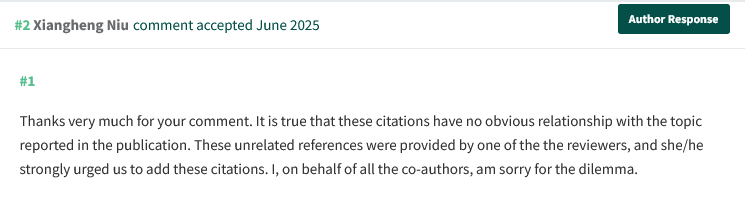
It is safe to assume that Awual and his Bangladeshi friends somehow manage to get invited as editors and reviewers of papers outside of their nominal expertise (nominal, because I don’t think any of these clown has any scientific expertise whatsoever), and then the extortion party begins. And if you wonder why they extort only 5-10 references to Awual, and not say 25 or 50? Maybe anything up to 10 references is roughly the amount which journals see as a perfectly reasonable request from a reviewer.
The Extortionists, by M. Angeles Oviedo-Garcia
“The preference of Thippa Reddy Gadekallu et al. (Abdul Rehman Javed, Celestine O. Iwendi, Sharnil Nitin Pandya and Gaurav Jay Dhiman) for coercive citation and copy-pasting their review comments” – Maria de los Ángeles Oviedo García
Highly unacceptable deviation from professional standards
You surely remember the hilarious fraudster duo Hari and Aruna Sharma, who were found guilty of research misconduct in Sweden (see January 2025 Shorts). No, I am not going to expose you to further home videos of them in bed or bathtub. It is about one of their coauthors.
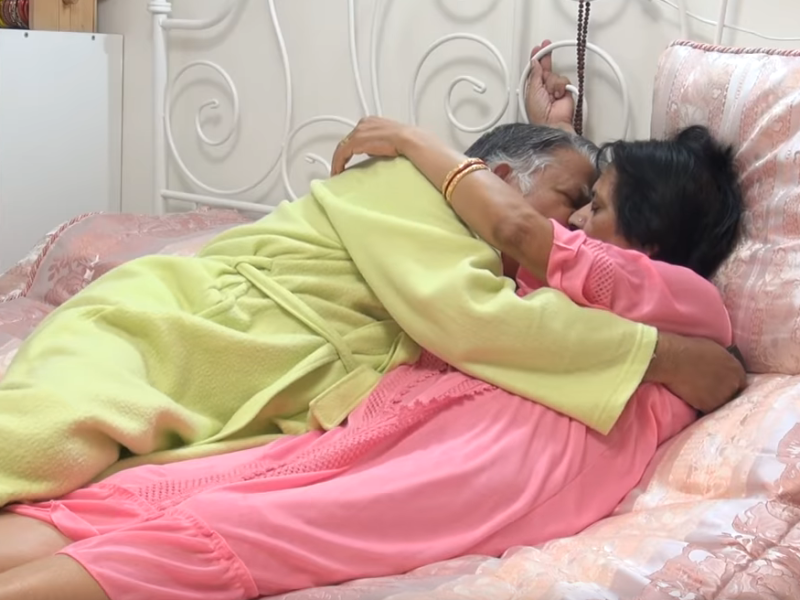
In bed with Hari and Aruna
Hari Shanker & Aruna, a YouTube influencer couple in Sweden. With or without Rudolph the Red-Faced Liar. And with Anca and Dafin, two totally innocent and upright Romanians. Pushing pig brain juice an SS Nazi invented. You won’t find a better story for Christmas!
Here a representative study, one of those many now retracted book chapters. Like all others, it was flagged by Mu Yang.
Hari Shanker Sharma , José Vicente Lafuente , Lianyuan Feng , Dafin F Muresanu , Preeti K Menon , Rudy J Castellani, Ala Nozari , Seaab Sahib , Z Ryan Tian , Anca D Buzoianu , Per-Ove Sjöquist , Ranjana Patnaik , Lars Wiklund , Aruna Sharma Methamphetamine exacerbates pathophysiology of traumatic brain injury at high altitude. Neuroprotective effects of nanodelivery of a potent antioxidant compound H-290/51 Progress in Brain Research (2021) doi: 10.1016/bs.pbr.2021.06.008


This was the removal notice:
“”REMOVED. This chapter has been removed due to substantiated image manipulation. Following a complaint by a reader, an internal investigation discovered several examples of reused images from different publications by some of the co-authors that were presented in this work as unique.”
The Sharmas had many international collaborators, I reported most of them for suspected research misconduct in their home universities. There were 3 Americans. Rudy J Castellani, professor of pathology at Northwestern University, managed to convince everyone that he was added as author without his knowledge. Elsevier then removed his name from all studies with Sharma.
In December 2023, the Research Compliance Officer at Boston Medical Center of the Boston University, announced to open an investigation against their anaesthesiology professor Ala Nozari. I now asked for an update to the investigation, and was promised one. But I decided not to wait, there are clues: Nozari remains in his position of Vice Chair for Research at Boston Medical Center, where he is, among other things, in charge of all such misconduct investigations. It is safe to assume Nozari officially determined himself to be both innocent and beautiful.
Cerebrolysin: Sharmas, Masliah, and EVER Pharma
“Poking around PubMed (Dysdera the spider is always on the hunt for new hornet’s nests) [..], I came across one image in two papers by Eliezer Masliah. […] By a conservative count, I contributed to about 160 out of 300 slides in the final dossier” – Mu Yang

Z. Ryan Tian, associate professor for nanotechnology at University of Arkansas in USA, was however properly investigated.
Back in December 2024, Tian blamed his lab members Asya Ozkizilcik and Seaab Sahib in an email to me:
“All the figures that you have questioned about are from Sharma’s lab.
My lab only provided the TiO2 nanowires, so the papers and book chapters with Sharma are not in my field, thus I am not a corresponding author in these publications.
Sharma directly emailed my lab’s Asya and Seaab and called their cellphones, for editing/submitting these papers and book chapters.
I will talk to Sharma asap, as I plan to delete such publications with him from my CV and to even stop working with him in the team that he and I started in 2006.
Nonetheless, thank you for kindly recognizing that my lab is innocent in this misconduct.”
In the next email, Tian decided to try the Castellani-Nosari exit:
“Between you and me — quite a few papers and book chapters (Sharma put my name in and omitted my students Asya or Seaab) didn’t get my okay beforehand (as he might think I must appreciate the co-authorships) although I urged him to co-publish papers in top journals (like mine in Nat Mat, Science, PNAS) as he got no paper in a high-impact-factor journal.”
The investigation at University of Arkansas was chaired by Douglas Behrend, head of department of sociology and criminology. I was video-interviewed twice, where I had to explain to the university officials again and again that Tian included all these fake papers in his official CV and can therefore not claim to not have known about them or to have not contributed anything to them, because gift authorships are actually research misconduct.
On 19 June 2025, Behrend finally informed me of the outcome of the investigation:
“As provided for in the University of Arkansas Research and Scholarly Misconduct Policy, I am informing you of the results of the University’s investigation of your allegation of research misconduct against one of our faculty members, Dr. Ryan Tian.
The University’s deciding official, the Provost, concluded that Dr. Tian’s conduct did not meet the definition of research misconduct under the University’s policy. However, Dr. Tian’s failure to personally review publications at issue in this matter, on which Dr. Tian is credited as a co-author, was a highly unacceptable deviation from professional standards. This is now being addressed as a confidential personnel matter.”
Will Tian leave the University of Arkansas now? He had at least three profile websites there, this one is gone now, but this faculty page and this one remain:

Marquis of Castillo de Lerés
In case you are interested in all things related to royalty and nobility, I have just the story for you. From Spain!
ABC Espana reported on 19 June 2025 (DeepL-translated):
“To round off this year of celebrations for his 10th anniversary of reign – which ends today, eleven years after his proclamation as King-, Felipe VI has decided to award his first noble titles to former head of the King’s Household, Jaime Alfonsín; the sportsman Rafa Nadal; the swimmer Teresa Perales; the singer Luz Casal; the biochemist Carlos López Otín and the photographer Cristina García Rodero. […]
The biochemist and molecular biologist Carlos López Otín will be Marquis of Castillo de Lerés. A distinction for life, which will return to the Crown upon his death.”
Yes, Carlos Lopez-Otin is a Marquis now, it seems the title of “Marqués de Castillo de Lerés” was invented just for him, he is the first to wear this title. Lopez-Otin is still touted as Spain’s greatest cancer and aging researcher, despite his having published massive fraud, which led to 9 retractions, 8 in JBC and 1 in Nature Cell Biology. He also lost his Nature Mentoring Award. All because of the investigation by my sleuthing colleagues, and my reporting.
Carlos Lopez-Otin and the revoked Nature Mentoring Award
St Carlos of Oviedo almost was canonised as Spain’s first living martyr, but now Nature revoked his mentoring award. Spanish media and science elites are desperate, even the Queen is not amused. The Royal Academy of Sciences insists Lopez-Otin is a victim of journal’s failure.
When his fake science was exposed, Lopez-Otin killed all of his 5000 transgenic mice (to hide evidence?) and hid in France with Guido Kroemer for a year or so. Before their martyr’s return to University of Oviedo (supported by Opus Dei!), Spanish academic elites threatened JBC with war, led a massive campaign in media and elsewhere, and the Royal Academy of Exact, Physical and Natural Sciences of Spain (RAC) issued statements of public support to St Carlos. At the same time, both Lopez-Otin and the president of RAC, Jesus Maria Sanz Serna, terrorized Lopez-Otin’s critics with lawsuits and threats thereof. Two Spanish journalists were forced to publicly recant and apologise for writing about St Carlos’ retractions, and two Oviedo professors who uttered criticism were found guilty of blasphemy misconduct.

The Royal Academy of Exact, Physical, and Natural Bullying
“If, within the aforementioned 15 days, you have not proceeded to make the retraction I am requesting, this corporation will consider itself free to take any legal actions necessary under the law.” – Jesus Maria Sanz Serna, President
Since his research fraud scandal, Lopez-Otin evolved from an atheist liberal scientist into a guru of a quasi-religious sect, preaching all kind of bollocks. The Church of Otin is quite successful, the newspaper El Cierre reminded in this regard:
“One of the strongest sources of support during difficult times came from the Royal Family, especially from Queen Letizia, who keeps a deep intellectual relationship with Otín. She considers him her “mentor,” and he refers to her as a “student,” reflecting an academic and human bond built over years of mutual interest in science and health.
The relationship between Carlos López Otín and Queen Letizia began in 2019, when the Queen attended the presentation of his book Life in Four Letters. Letizia has attended several of his lectures, such as the Cancer Tour in Lleida in 2022, and has personally purchased his books.”
In any case, a message to everyone in Spain who might think of blowing the whistle on research fraud. Off with their heads.

The Perennial Northern Blot of Lopez-Otin
Cancer researcher Carlos López-Otín published the same Northern blot no less than 23 times in 23 publications, between 1994 and 2006. Eventually Lopez-Otin et al even stopped caring what order of samples that original loading control had.
Industry Giants
Dig deeper into the credentials of those doing the critiquing
Enough of male dominance, time to defend some role model Women in Science.
As you all sure know, the US company Colossal Biosciences, founded by the MIT professor George Church and a tech bro called Ben Lamm, was recently celebrated in Times and everywhere else for having allegedly de-extincted the dire wolf. Collosal’s Chief Science Officer behind that “de-extiction” is Beth Shapiro, currently on leave as professor of evolutionary biology at University of California Santa Cruz. Read here:
Colossal Liar Wolves
“What is most concerning is that Colossal’s ‘dire wolves’ have now attracted the attention of the Trump administration.” – Ronan Taylor

To stake their claims, Colossal had first to redefine what the original dire wolf was and what it must have looked like (even by enlisting support of world’s top authority, the Game of Thrones creator George R.R. Martin), then to redefine what the terms “species” and “de-extinction” mean. Still, almost everyone in the relevant scientific community was either angrily shakign their fists or rolling on the floor laughing, because of course those white doggies Collosal paraded in the media were no dire wolves. At best (if the official claims are true, that is), those are grey wolves with 20 gene edits.
Soon after the big party, Collossal started to distance itself from their own bullshit claims. On 24 May 2025, New Scientist brought the headline: “Colossal scientist now admits they haven’t really made dire wolves“, Shapiro was quoted:
““It’s not possible to bring something back that is identical to a species that used to be alive. Our animals are grey wolves with 20 edits that are cloned,” she tells New Scientist. “And we’ve said that from the very beginning. Colloquially, they’re calling them dire wolves and that makes people angry.” […]
“We didn’t ever hide that that’s what it was. People were mad because we were calling them dire wolves,” she says. “Then they say to us, but they’re just grey wolves with 20 edits. But the point is we said that from the beginning. They’re grey wolves with 20 edits.”
Shapiro also sought to distance Colossal from suggestions that if de-extinction is possible, less needs to be done to save endangered species – a view espoused by some in the Trump administration. “Now it’s suddenly tied to this idea that we don’t have to care. It’s terrible,” she says.”
As reminder, Colossal previously celebrated the US Secretary of Interior Doug Burgham, who celebrated the successfuly de-extinction only to announce to abolish the Endangered Species Act because, as Trump’s shitgoblin insinuated, who needs to protect any living species if one can easily de-extinct them centuries later should anyone ever miss them.
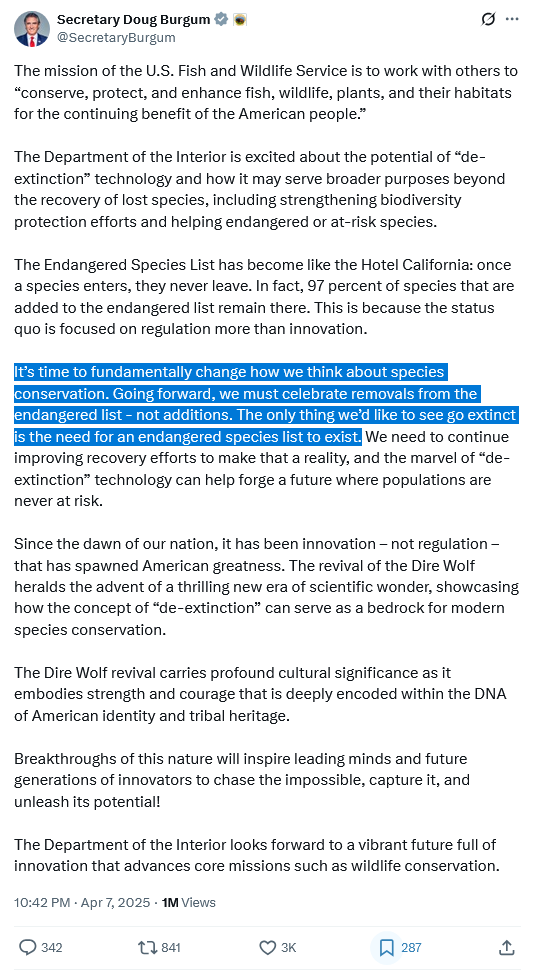
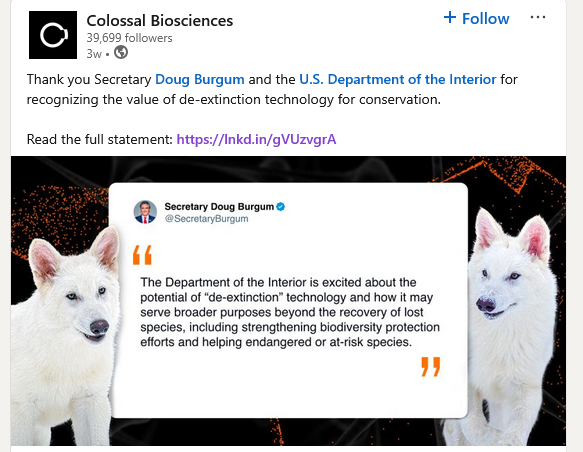
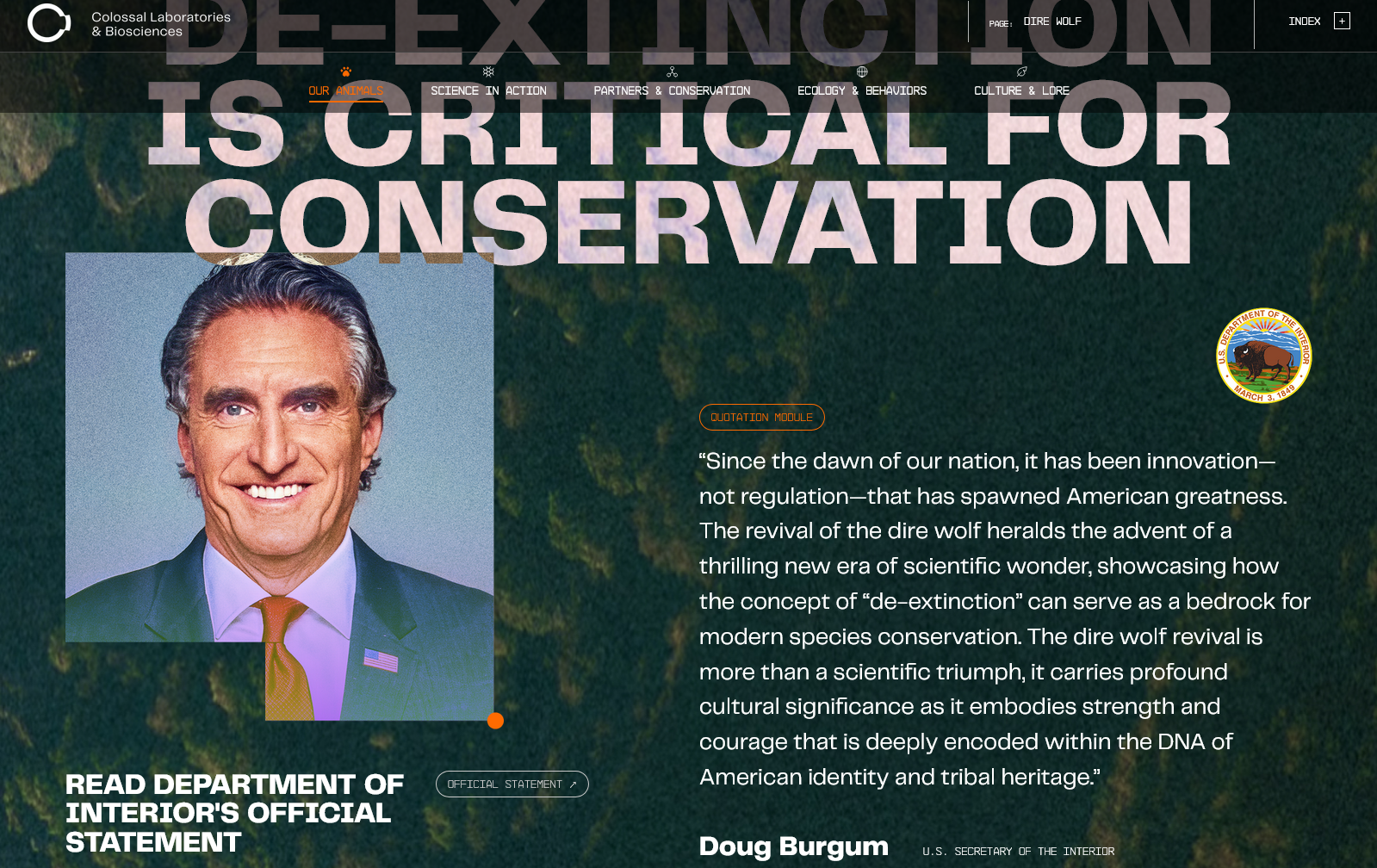

Elsewhere, it was mentioned that Colossal sent lawyers against above report, accusing New Scientist of having “misquoted Beth Shapiro” who allegedly “ never said they weren’t dire wolves”. It seems, Shapiro was quoted correctly, the New Scientist article remains unchanged as of today. Instead, a Daily Galaxy article from 2 June 2025 was deleted, it re-celebrated Colossal’s silly orange wooly (trumpian?) mice as “a striking step toward reviving one of the Earth’s most iconic lost creatures: the woolly mammoth“.
Indeed, Shapiro personally calls those animals “dire wolves” as she poses with them for pictures. See for example this article in Lookout Santa Cruz from 17 April 2025. But now, Colossal (a company owned by two white men) is rolling out its biggest guns to discredit their critics. The accusations of sexism and misogyny!
Forbes frought this bizarre piece on 21 June 2025:
“Dr. Beth Shapiro, Chief Science Officer of Colossal Biosciences is a champion of animal bioscience, but she’s been met with scrutiny from others in the industry. Namely, less qualified males. […]
While leaving academia wasn’t an easy decision for Shapiro, she has gone on to work on some of the most exciting projects in her career. Last year, she made history when she brought the dire wolf back from extinction. On October 1, 2024, the first two dire wolf pups, Romulus and Remus, were born; on January 31, 2025, a third dire wolf named Khaleesi was welcomed into the world. […]
She has faced some level of criticism for the project, and the harshest are often less qualified males in the STEM field. […]
This isn’t just about Shapiro; it’s about the culture of tearing down women in fields where they’re already underrepresented. The stakes are high—not just for the scientists, but for the future of innovation itself.”
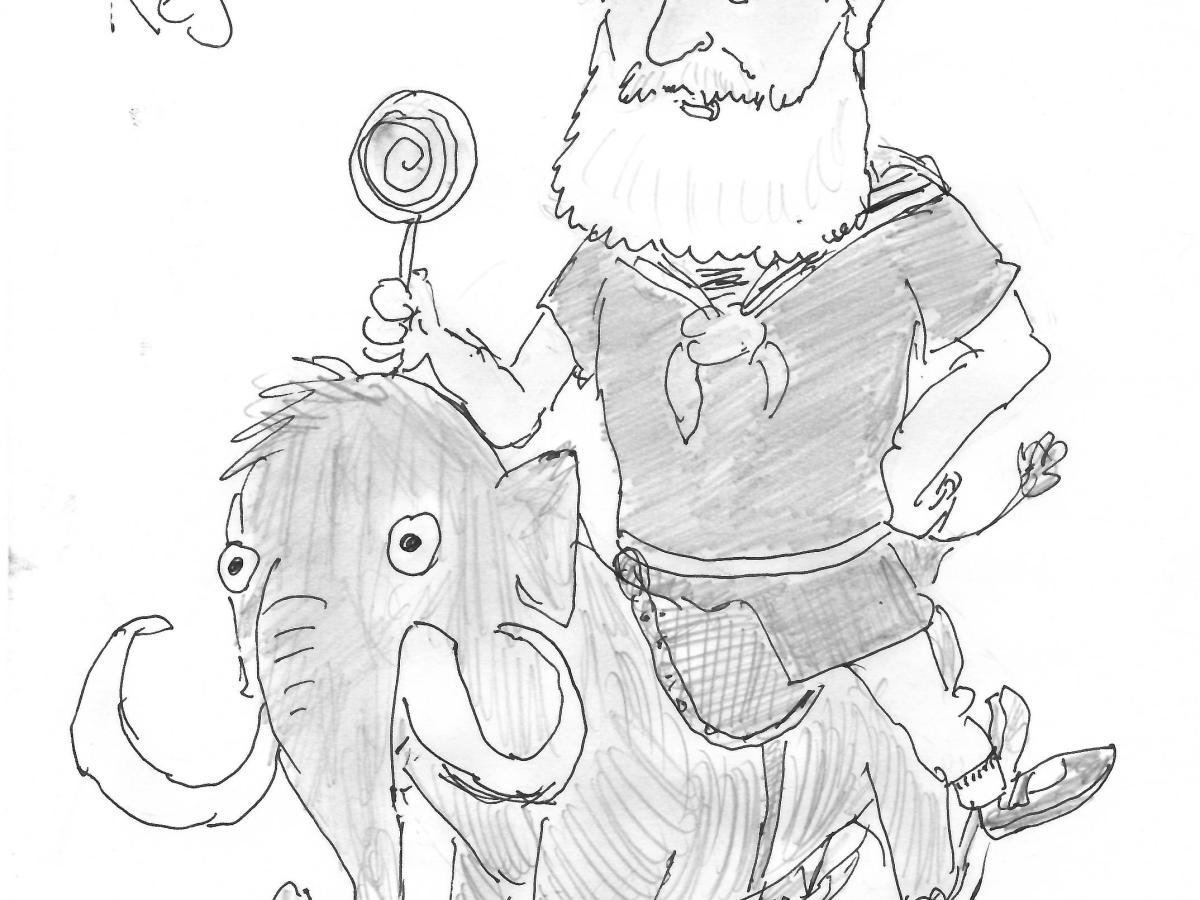
George Church, Colossal W*nker
From mammoths to eugenics to anti-aging scams: god-impersonator George Church knows how to make money with bullshit.
The article is followed by professional advice:
“Not all scientists are created equal. Before buying into criticism, dig deeper into the credentials of those doing the critiquing. Are their accomplishments anywhere near the level of those they’re disparaging? […]
Question why women face disproportionate scrutiny. Is it jealousy, insecurity, or outdated biases? Sometimes, the problem isn’t the science. It’s the ego of the critic.”
Now those dogs are officially dire wolves again, and if you still doubt it, you are a sexist swine. Racist also, probably.
Anyway, here is our heroic women champion Shapiro on the far-right podcast of Joe Rogan, who is an idol of the so-called Manosphere and has been “critiqued for fostering and amplifying harmful ideologies, including misogyny“:
Fraudulent ability to experimentally treat patients
Maybe you remmeber that the prestigious Duke University in USA has a side business of running a stem cell quackery clinic where desperate parents pay $15k for umbilical cord blood from the company Cryo-Cell to have their autistic children abused with this bullshit therapy. The case was briefly described here:

Gesundheit! Israeli Scientists treat autism with stem cells
A mysterious clinical trial in Israel is recruiting autistic children for blood draws. As the company’s founder admitted, the actual therapy on offer is extraction of bone marrow “stem cells” and their injection into patient’s spine. Smut Clyde investigates.
At some point, even the Duke Autism Center professors Geraldine Dawson and Joanne Kurtzberg had to admit their scam doesn’t work (read Paul Knoepfler’s blog from May 2020), but since when are facts and decency allowed to stand in the way of some greedy sods getting rich.
Thus, Duke and Cryo-Cell are at each other’s throats in court, as The Chronicle reported on 24 June 2025:
“In mid-May, Duke terminated its controversial Patent and Technology License Agreement with the umbilical cord blood and cord tissue stem cell bank Cryo-Cell International, Inc., after almost five years of exclusive partnership. Leading up to the termination, both parties claimed the other breached the agreement.
Cryo-Cell filed a demand for arbitration with the American Arbitration Association against Duke in October 2024, claiming $100 million in damages and five counts of the institution breaching the Duke License Agreement. The counts were based on claims that Duke fraudulently induced the company into entering the agreement and restricted its ability to experimentally treat patients.
In the termination notice sent on May 17, Duke claims that Cryo-Cell also breached the Duke License but does not specify how the agreement was breached. “
In this regard, we are helpfully reminded that Duke’s distinguished professor of pediatrics Kurtzburg is not only the holder of the relevant patents, but also the medical director of Cryo-Cell. Dawson is not employed by this company directly, but she declares in her publications to hold patents licenced to Cryo-Cell and to have “benefited financially” from that relationship.
We are also reminded by The Chronicle that in 2021, long after their autism “stem cell” therapy was proved as ineffectual, “Cryo-Cell entered an executive license agreement with Duke for the rights to cord blood technologies and data, intending to eventually open its first for-profit stem cell infusion clinic in 2025, in Durham.” And:
“Through the Duke agreement, some patients would receive the treatments on clinical trials or as part of expanded access protocols (EAPs) before they were approved by the FDA as standard treatments. […]
In 2023, Duke discontinued its EAP for cord stem cell treatment for autism, which allowed patients who did not qualify for clinical trials to access treatments. […]
The autism treatments, however, continued at Cryo-Cell without the use of Duke’s EAP, as the licensing agreement allowed Cryo-Cell to develop its own cell therapy program.”
Even before that, Cryo-Cell francised into other countries, for example to Israel. Jerusalem Post touted in April 2021:
“Dr. Omer Bar Yosef, a clinical and research neurobiologist at Sheba Medical Center, Tel Hashomer, has thus far treated 25 children with autism as part of a Phase II trial using a protocol developed at Duke University Medical Center.”
I hope Kurtzburg and Dawson will soon learn the golden rule of academia: never sue your university or they’ll sack you.
No competing interests
On the topic of greedy academics and their businesses, I have a very illustative case. It showcases how professors understand the concept of the Conflict of Interests. The paper featured before in this article about Canada’s top urologist, Martin Gleave, who is professor at University of British Columbia and founding director of the Vancouver Prostate Centre:
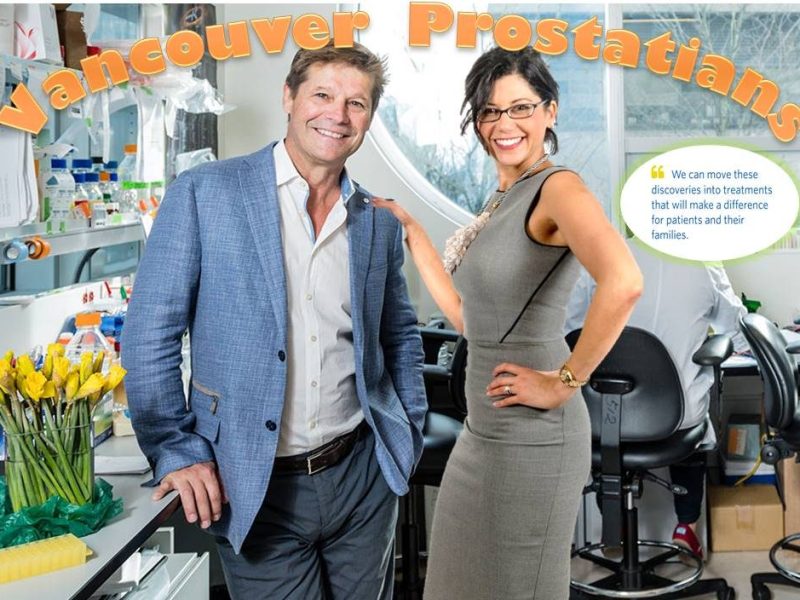
Trials and Errors of Martin Gleave
“The magnitude was much greater than we had expected or hoped for,” – Martin Gleave
Gleave is also the owner of the biotech startup OncoGenex Pharmaceuticals, which markets the Heat Shock Protein 27 (HSP27) antisense RNA called OGX-427 (Apatorsen), deployed in this study. The study was done in France, one coauthor is the notorious cheater Carmen Garrido, who caused Gleave his only retraction, on a HSP27 related topic, (see October 2024 Shorts):
C Andrieu , D Taieb , V Baylot , S Ettinger , P Soubeyran , A De-Thonel , C Nelson , C Garrido , A So , L Fazli , F Bladou , M Gleave , J L Iovanna , P Rocchi Heat shock protein 27 confers resistance to androgen ablation and chemotherapy in prostate cancer cells through eIF4E Oncogene (2010) doi: 10.1038/onc.2009.479

Editorial Expression of Concern 10 April 2025: “The Editors-in-Chief would like to alert the readers that concerns have been raised about some of the blots presented in this article. Specifically,
- Fig. 2b anti-4E-BP1 lanes 5 and 6 appear highly similar to Fig. 6b anti-4E-BP1 lanes 4 and 3 (blot flipped horizontally and stretched differently).
- Fig. 6a anti-eIF4E IB lanes 3 and 4 appear highly similar.
Readers are therefore advised to interpret these results with caution.”
On top of flasified data, there was this:
“The authors declare no conflict of interest.”
Obviously in Gleave’s case this is a shameless lie. But in April 2025, the last author and Gleave’s former colleague Palma Rocchi, now research director at INSERM in Marseille, chimed in on PubPeer with this strange comment:
“M. Gleave, consultant, OncoGenex Technologies, Sanofi-Aventis, Astra-Zeneca; commercial research support, OncoGenex Technologies, Sanofi-Aventis, Astra-Zeneca, Pfizer; ownership interest, OncoGenex Technologies“
Well yes, sure, but none of that is mentioned anywhere in the original paper or the Expression of Concern as of now.

In June 2025, the PubPeer user Dendrodoris tuberculosa chimed in to inform us that another paper by this team says something different:
Virginie Baylot , Maria Katsogiannou , Claudia Andrieu , David Taieb , Julie Acunzo , Sophie Giusiano , Ladan Fazli , Martin Gleave , Carmen Garrido , Palma Rocchi Targeting TCTP as a new therapeutic strategy in castration-resistant prostate cancer Molecular therapy (2012) doi: 10.1038/mt.2012.155
“The University of British Columbia has submitted patent applications, listing Dr Gleave and Dr Rocchi as inventors, on the Hsp27 antisense sequence (OGX-427) described in this paper. This patent has been licensed to OncoGenex Technologies, a Vancouver-based biotechnology company that Dr Gleave has founding shares in. The authors declared no conflict of interest.”
This joint patent to Gleave and Rocchi dates to 2003. The PubPeer user also points to the French biotech Silon Therpauetics, where Rocchi is the CSO, while her coauthor, the Aix Marseille University professor David Taieb is CMO. Both are listed as founders of this biotech which “aims to develop and test smart, versatile and adaptable therapeutic Hsp27-ASO Apatorsen nanoparticles“, i.e. Gleave’s and OncoGenex’s patented siRNA technology, but with nano-bollocks. The Silon website (original and archived) presents the technology using, uhm, a digitally manipulated western blot:

Silon was founded in 2024, and the above papers with Gleave and Garrido are old, but even now the authors refuse to declare this conflict of interests when writing about their company’s products:
Virginie Baylot, Thi Khanh Le , David Taïeb, Palma Rocchi , Laurence Colleaux Between hope and reality: treatment of genetic diseases through nucleic acid-based drugs Communications Biology (2024) doi: 10.1038/s42003-024-06121-9
“The authors declare no competing interests.”
This 2024 paper was published after Silon was incorporated, the last author, INSERM researcher Laurence Colleaux, is Silon’s co-founder and CEO. The PubPeer user also pointed out:
“As a physician and CMO, Dr. David Taieb has not disclosed this conflict of interest on the public French database “Transparency – Health”
Indeed, Taieb never mention Silons there:
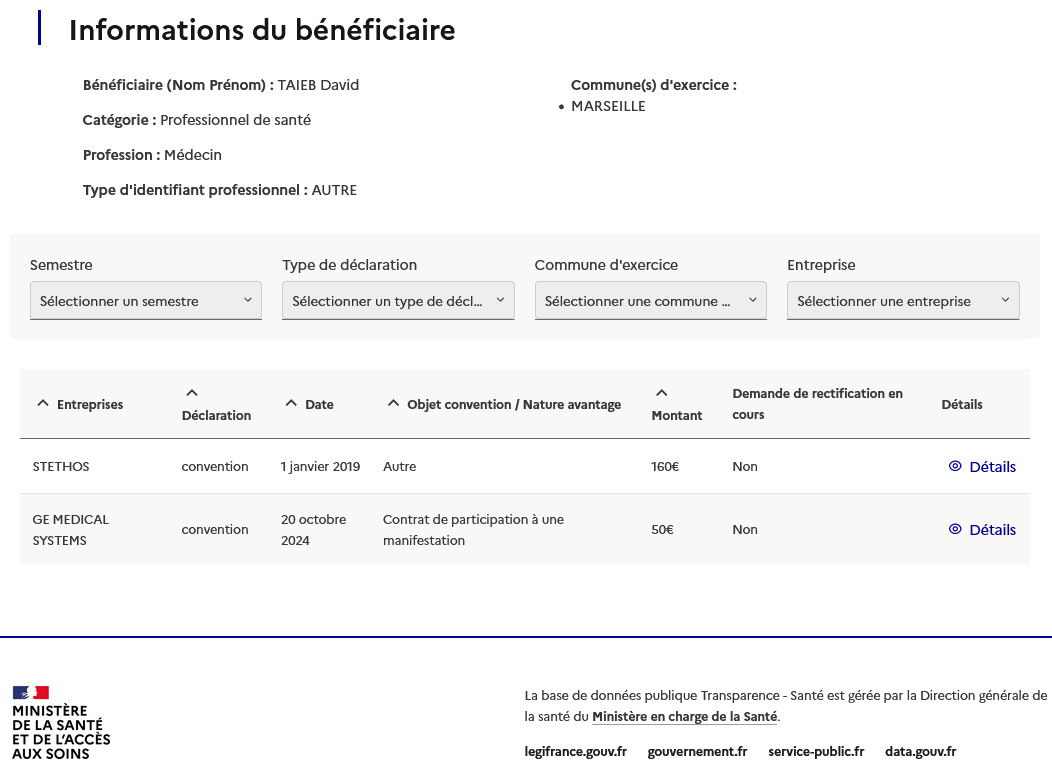
Taieb retorted on PubPeer:
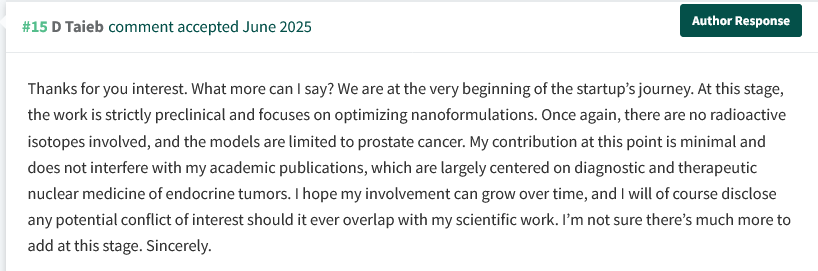
“To the best of my knowledge, the declaration applies to activities where the value of each benefit is equal to or exceeds €10 including VAT. However, in the context of my involvement with SILON Tx, I do not receive any remuneration.”
The PubPeer user reminded Taieb that he is Silon’s cofounder, stakeholder and CMO and that never mind how much he earned in cash, “under French regulations (Article D1453-1 related to Law n°2011-2012, codified in article L.1453-1 of the French Code de la Santé Publique), advantages must also be publicly disclosed.” And that despite his more than 250 research papers, around 30 publications in 2024 alone, he never disclosed his conflict of interest as Silon co-founder and CMO.
Taieb kept blathering back that his “role as CMO at this stage is quite limited and does not involve any financial compensation or qualitative benefits“, and this:
This is exactly what I saw elsewhere, when the German surgeon Axel Haverich insisted to have no conflicts of Interests whatsoever in his clinical studies which used artificial heart valve manufactured by his own company, Corlife, a spin-off from Haverich’s university, the Hannover Medical School (MHH). The official explanation from Corlife, which was accepted by MHH, was:
“it was not predictable if the relevant approval application will be successful. […] Therefore, there was no potential conflict of interest with this publication”
Read here:
Regenerating in Hannover, Part 2: Axel Haverich’s “growing” heart valves
The science of the fallen star of regenerative medicine Paulo Macchiarini was simple: take a dead organ, strip it of its cells and seed the carcass with stem cells (usually the magic cells from bone marrow). After some days in a “bioreactor”, you take out a living trachea, esophagus, even heart, and implant it into a…
You see, professors who start a company think they will have no conflicts of interests as long as their company doesn’t earn them a certain amount in cash. Until then, they publish research papers advertising for their products pretendign to be totally unbiased and unconflicted, exactly to stimulate financial investments and regulatory approvals so that the money starts to roll.
What more can I say? Which part of this academic logic don’t you understand?
Retraction Watchdogging
Oncotarget has completed its investigation
Almost 2 years after the German cancer researcher Ingrid Herr, professor at the Universiyt Clinic Heidelberg, announced to retract an Oncotarget paper, it was finally retracted. Read the relevant guest post by Herr from August 2023:

My little PubPeer saga – A wake-up call, by Ingrid Herr
“Dear colleagues, scientists, check your lab members’ raw data, publications, and dissertations even more thoroughly than before to protect scientific ethics and data integrity and maintain trust in science!” – Ingrid Herr
Here is that paper:
Clifford C. Nwaeburu, Natalie Bauer, Zhefu Zhao, Alia Abukiwan, Jury Gladkich, Axel Benner, Ingrid Herr Up-regulation of microRNA let-7c by quercetin inhibits pancreatic cancer progression by activation of Numbl Oncotarget (2016) doi: 10.18632/ oncotarget.11122


In August 2023, Herr announced an immediate retraction on PubPeer:
“Unfortunately, neither I, nor our internal review, nor the external reviewers saw these duplicate images before submitting the manuscript. There is extensive raw data and I don’t understand why the former PhD student is showing duplicates here at all. Now, however, there is no more pardon. I will withdraw this manuscript immediately.“
The first author Clifford Nwaeburu however posted something different, about “representative images” that “have no impact on the overall results“, and co-signed with Herr’s name, against which she immediatedly protested.
Almost 2 years passed and the “immediate” retraction finally arrived, on 25 June 2025. The journal editors plagiarised all PubPeer findings and claimed credit to themselves:
“This article has been retracted: Oncotarget has completed its investigation of this article, which determined that many instances of image overlap and duplication compromise the integrity of the presented data and findings. Wound healing assay Images from different treatment groups of different cell lines were the result of manipulations with a few initial images. Specifically, in Figure 3D, the 0-hour timepoint images one and two appear to be duplicates of images two and four, respectively. Furthermore, three images of AsPC-1 cells in Figure 3D at the 24-hour and 48-hour timepoints seem to be duplicates of three images of AsanPaCa cells found in Supplementary Figure 1E. Upon further review of Supplementary Figure 1E, we identified internal duplications at the 0-hour timepoint for both AsanPaCa cells (images 1 and 3 are duplicates of images 2 and 4) and PANC 1 cells (the top three images are duplicates). In addition, we have found duplications within the colony formation assay images presented in Figures 3 A-C. In Figure 3A, the last two images, representing different treatments, are duplicates. Moreover, the third image of Asan PaCa cells in Figure 3B appears to be a duplicate of the fourth image of PANC 1 cells in Figure 3C. First author Clifford Nwaeburu provided corrected files for a new Figure S1 and Figure 3, but these did not resolve all the issues noted. Corresponding author Ingrid Herr contacted Onoctarget regarding the remaining image duplications and requested retraction of the article. Based on these circumstances, the Editorial decision was made to retract this paper. All authors except the first author, Clifford C. Nwaeburu, agreed with the decision.”
It was the second retraction for Nwaeburu, after Nwaeburu et al 2017 was retracted by Herr in August 2023. I wonder how that awful journal Oncotarget, run by Mikhail Blagosklonny‘s widow Zoya Demidenko and Blagosklonny’s chosen successor (hopefully only as Editor-in-Chief!), the disastrous Wafik El-Deiry, finally agreed to retract that other paper.
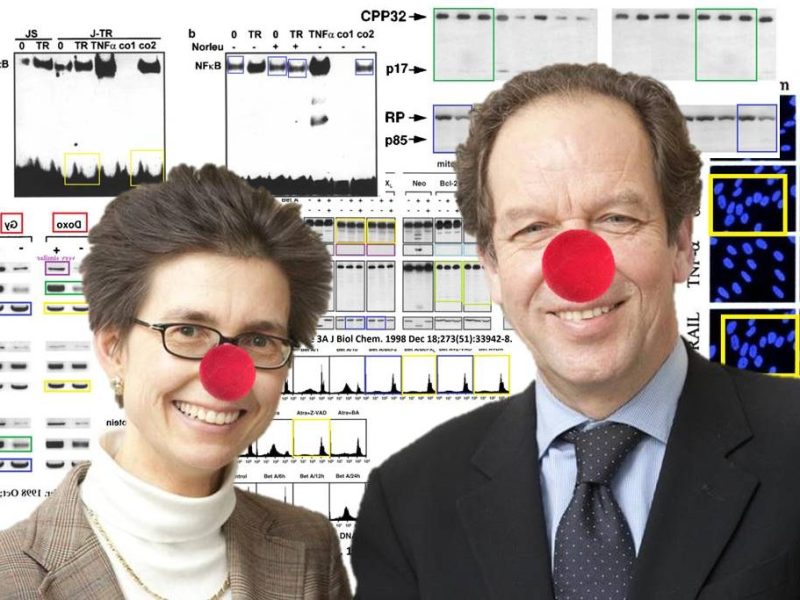
Fulda & Debatin: Reproducibility of Results in Medical and Biomedical Research
“Basic and advanced training for researchers should focus much more on self-reflection, openness and a culture of error acceptance.”
Anyway, Ingrid Herr, who is a mentee of Klaus-Michael Debatin, has further papers on PubPeer, almost 20 of them, see for example February 2024 Shorts. To be fair, Herr did issue at least corrections, maybe not always suitable ones. Like this one in Oncotarget:
Yiyao Zhang , Li Liu , Pei Fan , Nathalie Bauer , Jury Gladkich , Eduard Ryschich , Alexandr V. Bazhin , Nathalia A. Giese , Oliver Strobel , Thilo Hackert , Ulf Hinz , Wolfgang Gross , Franco Fortunato , Ingrid Herr Aspirin counteracts cancer stem cell features, desmoplasia and gemcitabine resistance in pancreatic cancer Oncotarget (2015) doi: 10.18632/oncotarget.3171


The coauthors include Herr’s former Heidelberg colleagues Thilo Hackert and Alexandr Bazhin, her past experience with the latter actually promted Herr to write that guest post for me. The July 2024 Correction spoke of “accidental duplicates” which of course “do not change the results or conclusions of this paper.”
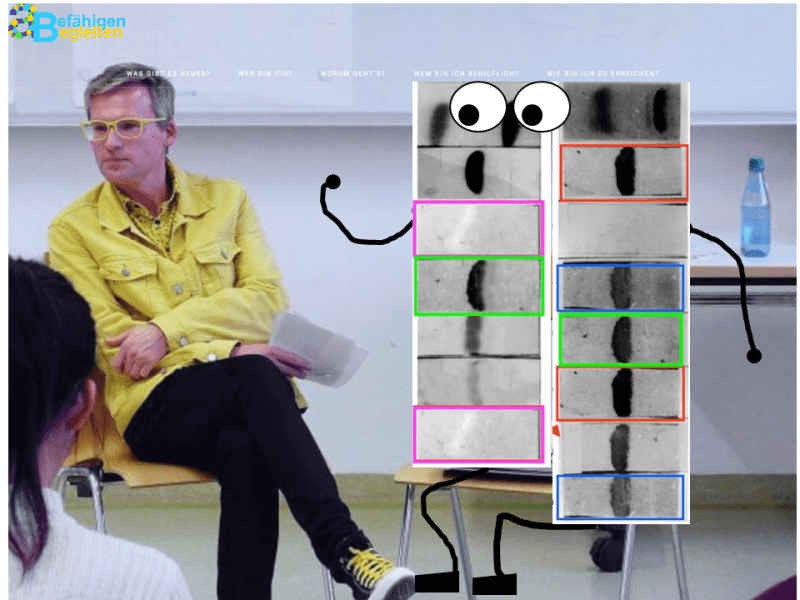
From Russia, with Photoshop
Germany recruits the very best of the best in international science to its elite institutions. Professor Alexandr Bazhin is one of them.
Also this was corrected:
Nikolaus Gassler, Ingrid Herr, Martina Keith , Frank Autschbach , Hubertus Schmitz-Winnenthal , Alexis Ulrich , Herwart Otto , Jürgen Kartenbeck , Kaspar Z’graggen Wnt-signaling and apoptosis after neoadjuvant short-term radiotherapy for rectal cancer International Journal of Oncology (2004) doi: 10.3892/ijo.25.6.1543

Aneurus inconstans: “Figure 1 illustrates two different immunostaining, either beta-Catenin or c-Myc, in different groups. […] the possibility that these two micrographs were consecutive sections of the same tissue (which could have been then immunostained with different antibodies) is unlikely,”
Herr however insisted on PubPeer that “the tissue sections were unusually ultra-thin: 2 µm” and “a significant structural similarity of consecutive sections stained with different antibodies can be anticipated.” Soon after, she admitted that “indeed an incorrect figure was accidently published” and that “An erratum will be promptly published.” Indeed, a Corrigendum appeared 2 months later in October 2023.
Here, coauthored by Nwaeburu and Hackert, a corrigendum was announced in August 2023, but failed to materilise so far:
Yefeng Yin , Li Liu , Zhefu Zhao , Libo Yin , Nathalie Bauer, Clifford C. Nwaeburu , Jury Gladkich , Wolfgang Gross, Thilo Hackert , Carsten Sticht, Norbert Gretz, Oliver Strobel, Ingrid Herr Simvastatin inhibits sonic hedgehog signaling and stemness features of pancreatic cancer Cancer Letters (2018) doi: 10.1016/j.canlet.2018.04.001

Also this still awaits a possible correction:
Yiqiao Luo, Bin Yan, Li Liu , Libo Yin, Huihui Ji , Xuefeng An, Jury Gladkich, Zhimin Qi , Carolina De La Torre, Ingrid Herr Sulforaphane Inhibits the Expression of Long Noncoding RNA H19 and Its Target APOBEC3G and Thereby Pancreatic Cancer Progression Cancers (2021) doi: 10.3390/cancers13040827

Aneurus inconstans: “Figure 2C and Figure 5D: the NC MIAPaCa2 micrographs do overlap (red boxes), therefore they come from the same sample. This wouldn’t be an issue per se, as the conditions are identical. What seems to be troubling are the quantifications below (yellow circles). While in Figure 2C the count of cells is about 175±25, in Figure 5D is about 280±50.”
Returning to that russian cheater Bazhin and Oncotarget, what about this one:
Orkhan Isayev , Vanessa Rausch , Nathalie Bauer , Li Liu , Pei Fan , Yiyao Zhang , Jury Gladkich , Clifford C. Nwaeburu , Jürgen Mattern , Martin Mollenhauer , Felix Rückert , Sebastian Zach , Uwe Haberkorn , Wolfgang Gross , Frank Schönsiegel , Alexandr V. Bazhin , Ingrid Herr Inhibition of glucose turnover by 3-bromopyruvate counteracts pancreatic cancer stem cell features and sensitizes cells to gemcitabine Oncotarget (2014) doi: 10.18632/oncotarget.2120

Pedicularis thamnophila: “Figure 4 C seems to show signs of a differential splice, and insertion, getting obvious in the ALDH11 and OCT-4 bands, with adjusted brightness and contrast. But only one unspliced β-Actin panel is present as loading control.”
No editorial action, and no PubPeer replies by any of the authors.
We appreciate your vigilance and commitment
Another retraction in Heidelberg, for another cancer researcher and, as it happens, a collaborator of the aforementioned Thilo Hackert, the long-retired professor of German Cancer Research Centre (DKFZ) and the University Clinic Heidelberg, Margot Zöller.
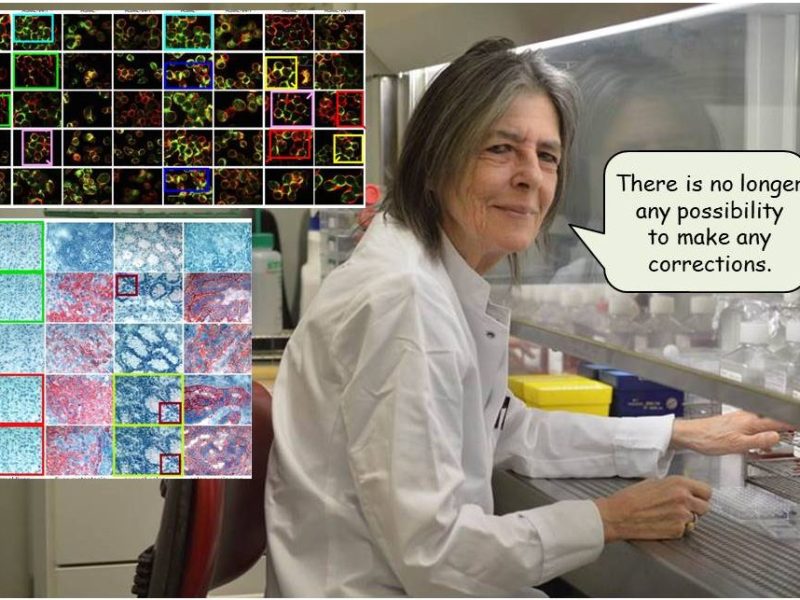
The elusive Margot Zöller
Celebrating the German cancer research maverick Margot Zöller of Heidelberg.
Previously, Zöller had to retract a paper she has just succeeded in correcting (read March 2025 Shorts). I reported her gigantic PubPeer record to publishers, and on 26 June 2025 Elsevier’s Research Integrity & Publishing Ethics team sent me an email, informing me about the retraction and thanking me “for bringing to our attention”. the email ended with:
“We appreciate your vigilance and commitment to maintaining the integrity of the scientific record.”
What luck you can’t see me blushing. Anyway, this is the paper:
Sanyukta Rana , Shijing Yue, Daniela Stadel , Margot Zöller Toward tailored exosomes: the exosomal tetraspanin web contributes to target cell selection The International Journal of Biochemistry & Cell Biology (2012) doi: 10.1016/j.biocel.2012.06.018

This is the retraction notice from 26 June 2025:
“Post-publication, an investigation conducted on behalf of the journal by Elsevier’s Research Integrity & Publishing Ethics team identified a concern around the authenticity of the following figures/image panels:
Analysis verified with high confidence, the blot duplication posted on PubPeer; with additional instances of blot splicing.
- • Figure 1A – the CD151 and neuropilin blots are identical
- • Figure 1B – in the ‘antiCD49c’ IP blots, the tspan8 row has a clear line where the control lane has been spliced into the blot
- • Figure 1C – in the ‘GDF15’ IP blots, the CD9 row has a clear line where both the control lane and the AS-tspan8 lane have been spliced into the blot
The authors were requested to provide comment on these concerns, as well as the original unprocessed image files to aid investigation.
The explanation provided was unsatisfactory in resolving these concerns. The Editor-in-Chief has determined that the findings of the article cannot be relied upon, and has decided to retract the article.”
In March 2025, a reader commented under my relevant article about Zöller, identifying themselves as her former PhD student from “around 2000” period who “could not take it anymore 2 years later“:
“The technique was the usual one (seen in so many labs): refuse any results that were not fitting to the “gut feeling of her majesty”. You were asked to repeat until you got the result she expected and blaming you for everything that did not work her way. But she could change her mind and ask you why you were wasting your time on stupid experiments and refused to admit she asked you to. Most of the time you were left without any clear direction. At some point the threats were coming. She could shift you to a contract were you were less played or just cut the money.
Many students left science after this experience but needed their diploma so they gave her the results she wanted… “
Bullies and Harassers of Cologne
“the professor insults her doctoral students, calling them “stupid”, “useless” or “retarded”, for example. She is said to sometimes require her employees to work more than 80 hours a week. The report speaks of a “quasi-feudal relationship of dependence” and a “climate of fear” at the institute in question.”
Bullying and bad science always go hand in hand. Quite often the academic bully never needs to personally fake any data to get the result they want. The reader also had this anecdote:
“Margot came to the lab at 7h and left at 23h. Indeed, she was a real nerd. She was feeding on 1 apple and 3 packs of cigarettes a day. She was smoking all the time everywhere in the lab (in the DKFZ!!!) and no one was saying a thing. She was even smoking while working at the laminar flow bench!”
Zöller is now in her 80ies…
Authenticity of the citations
A paper from Ghana about limitations of ChatGPT was written by ChatGPT and is now retracted.
George Clifford Yamson Immediacy as a better service: Analysis of limitations of the use of ChatGPT in library services Information Development (2023) doi: 10.1177/02666669231206762
The publisher issued this retraction on 19 June 2025:
“At the request of Sage and the Journal Editors, the following article has been retracted:
Yamson GC (2023) Immediacy as a better service: Analysis of limitations of the use of ChatGPT in library services. Information Development 0(0): https://doi.org/10.1177/02666669231206762.
Concerns regarding the authenticity of the citations in this article were raised to the Journal Editor.
The author was unable to explain the inclusion of the concerning references but wished to review and verify the references cited.
As the references supporting this research can no longer be relied upon, this article has been retracted.
G.C.Y disagrees with the decision.”
Smut Clyde, who found this retraction, assumes that ChatGPT fabricated some non-existent references.
Happens to the best and brightest of people [-sarcasm trigger warning-], see US Secretary of Health, the murderous psychopath Robert F Kennedy Jr, and his “Make America Healthy Again”.
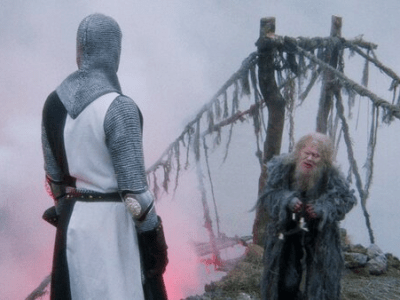
The Dead Geier Sketch, RFK Jr version
“David Geier is the ideal fit to the purposes of RFK Jr. For the only reliably loyal underlings are incompetent ones who know they have no future anywhere else. ” – Smut Clyde
As Notus reported on 29 May 2025:
“Health Secretary Robert F. Kennedy Jr. says his “Make America Healthy Again” Commission report harnesses “gold-standard” science, citing more than 500 studies and other sources to back up its claims. Those citations, though, are rife with errors, from broken links to misstated conclusions.
Seven of the cited sources don’t appear to exist at all. […]
A section describing the “corporate capture of media” highlights two studies that it says are “broadly illustrative” of how a rise in direct-to-consumer drug advertisements has led to more prescriptions being written for ADHD medications and antidepressants for kids.
The catch? Neither of those studies is anywhere to be found. Here are the two citations:
Shah, M. B., et al. (2008). Direct-to-consumer advertising and the rise in ADHD medication use among children. Pediatrics, 122(5), e1055- e1060.
Findling, R. L., et al. (2009). Direct-to-consumer advertising of psychotropic medications for youth: A growing concern. Journal of Child and Adolescent Psychopharmacology, 19(5), 487-492.
Those articles don’t appear in the table of contents for the journals listed in their citations. […]
The administration updated the MAHA report to remove the seven references to reports that do not exist.”
And will you be surprised that RFK Jr and his imps continued in this vein?
The new Trumpian CDC either invented or asked a LLM like ChatGPT to invent a paper about the neurotoxicity of vaccine preservative thimerosal, Berman et al 2008, which shows the exact opposite that its real-life original.
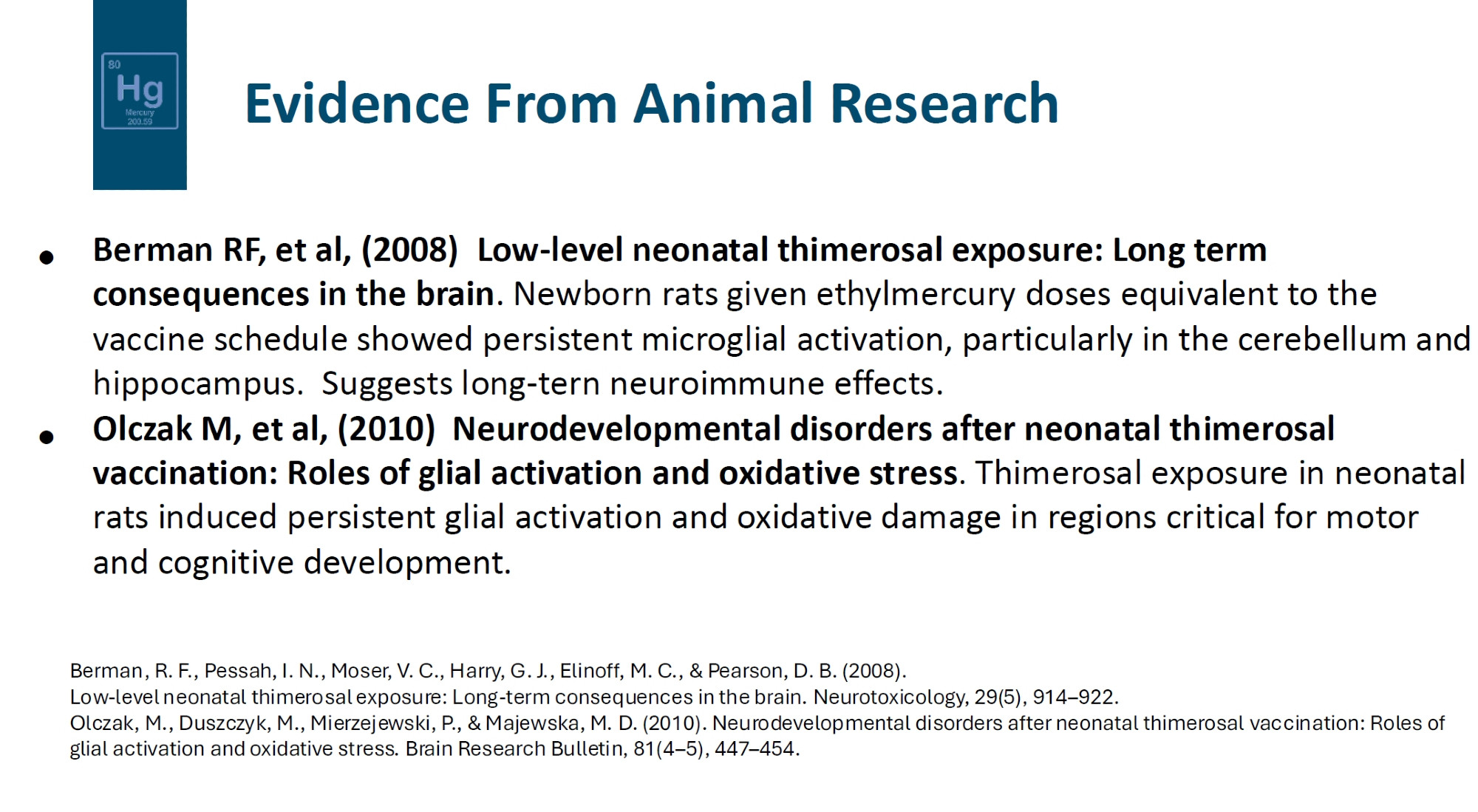
Fake Citation that is made up. No such manuscript exists.
Look at [Neurotoxicity 2008]”
Donate!
If you are interested to support my work, you can leave here a small tip of $5. Or several of small tips, just increase the amount as you like (2x=€10; 5x=€25). Your generous patronage of my journalism will be most appreciated!
€5.00

 For Better Science
Ah, so your papers might be written with the specific purpose of increasing the value of your patents, investments and companies, but there is no guarantee they’ll succeed in that, so no COI.
LikeLiked by 1 person
Exactly my thoughts!
LikeLike
An article that is published as part of the requirements for completing a PhD, masters degree or promotion is also COI that needs declaration. Structuring experiments with potential bias to produce desired outcomes, to increase company valuations vs to get it accepted by a journal to increase self valuations (title -> higher income) – What is the difference ? In both cases research done has potential bias. Maybe I’m missing something.
LikeLike
Are you trying to prove COI doesn’t exist because everything has a COI?
That’s so clever you should be on russian TV.
LikeLike
The argument is not to deny the existence of financial COIs, but to broaden the scope of what qualifies as COI. Academia operates under deeply embedded COIs, that are inherent to the system (publishing to fulfill degree requirements, another form of incentive driven bias in research) and these are so normalized that they are not even recognized, let alone disclosed as COI – unlike financial COIs, whose omission is immediately noticed, as in this case. I guess with this clarification, my TV star career ended before it even began. If the clever label is gone too, it’s a truly heartbreaking fall from grace !
LikeLike
Sorry, I can’t really make sense of your and the other comment.
There are two types of COi.
1. Financial COI, which has to do with patents, business activities, grants, payment in money or in kind etc. These conflicts must be declared, no matter how “little” money you make, and even if you are not conflcited directly (e.g., when your wife works for the company whose product you advertise for).
2. Personal COI, which is about your current or recent scientific collaborators or business partners. These conflicts must lead to your exclusion as their handling editor or reviewer.
Your demand that people disclose it as COI that their paper might earn them a promotion is frankly a load of bollocks, and very unhelpful. Do you really wish to tell me that you avoid such “COI” by never adding your publications to your CV?
LikeLike
using La-source-fournit-de-l’eau his/her logic every paper has a COI. Makes no sense whatsoever.
LikeLiked by 1 person
If you wonder why Rabiul Awual acted as a reviewer at Food Chemistry/Environmental Research/Journal of Molecular Liquids, not to mention Chemosphere, check their editorial boards. You can also add International Journal of Biological Macromolecules. Some time ago I received a review of my manuscript, in which the reviewer requested inclusion of 18 unrelated references. All of them were co-authored by Rabiul Awual. Of course, I refused and notified the editor. But many authors comply to get their papers published, including famous names from Poland. I mentioned it in one of my PubPeer comments, which is included in the list linked in this article.
PubPeer – Adsorption of Cu(II) and Zn(II) onto ZrO2–SiO2 composite: Ch…
LikeLiked by 1 person
What small world, Hubert! How did the editor react to Awual’s extortion?
LikeLike
Well, my paper was accepted. It was published in International Journal of Biological Macromolecules. I only submitted it to this journal to correct serious errors in several junk papers published there. At that time I was not aware about its unethical editorial practices. Here is part of my response:
“If Dr Rabiul Awual or one his associates wrote the review, then I believe it constitutes a case for the journal’s ethics committee, as such a practice violates one of the basic principles of the peer-review process, described, e.g., in the CSE’s White Paper on Promoting Integrity in Scientific Journal Publications, chapter 2.3 Reviewer Roles and Responsibilities.”
I think that this reviewer should have been removed from the lists of reviewers not only in IJBM but all Elsevier journals. At that time I still believed in scientific ethics of “reputable” journals. Now I think it didn’t happen nor ever will. The handling editor was Rizwan Hasan Khan. Can you say anything about him?
LikeLiked by 1 person
I can only say you must be honoured to have had such a genius as Prof Rizwan Hasan Khan as editor.


https://pubpeer.com/search?q=%22Rizwan+Hasan+Khan%22
With Ayman Atta:
https://pubpeer.com/publications/DFACC64250F215F589CEDA5F451EC8
https://pubpeer.com/publications/8854E4349B06AF6E73999A207912FB
LikeLiked by 1 person
Thank you for this newsletter. I’d like to point out that Ryan Tian appears to be on the faculty of the University of Arkansas at Fayetteville. The University of Arkansas at Little Rock is a separate campus with its own faculty. Tian may use the nanoscience research center at the Little Rock campus. As a Little Rock resident I don’t want to see the city get any bad press that it doesn’t deserve.
Sent from Yahoo Mail for iPhone
LikeLike
Thanks, somewhat confusing. The website I screenshot is at Little Rock, but yes, the chair of investigative committee, Doug Behrend as at Fayetteville.
In any case, I replaced “Little Rock” for “Arkansas” in the summary above
LikeLike
https://www.quora.com/How-can-Alexandru-Biris-be-so-successful-at-University-of-Arkansas-at-Little-Rock-In-just-5-years-Mr-Biris-published-in-more-than-240-journals-presented-at-numerous-international-conferences-and-been-granted-more
https://pubpeer.com/search?q=biris
UALR has its own home grown source of bad press
LikeLike
Ha. https://forbetterscience.com/2023/02/24/schneider-shorts-24-02-2023-peer-reviewed-ruscism/#biris
LikeLike
I’m a little surprised by this. My earlier comment was regarding a factual error. Ryan Tian is on the faculty of the University of Arkansas at Fayetteville. He would be expected to have affiliation with the nanoscience center at the U of A at Little Rock. But his employer is the U of A at Fayetteville, which is a different campus with separate faculty appointments. If this prompted you to go searching for other bad actors at UA LR, it’s worth noting that you are citing a lengthy Quora post by a “John Anderson”with zero followers relaying what a “friend” told them about a professor Alexandru Biri. Yes, unlike Tian, Biri actually is on the faculty of UALR. This Quora post is 6 years old. It drags Biri. It drags the University. It could be true, it also could be a lot of mud slinging by someone with an axe to grind. I have no idea. Apparently Biri had a couple of retractions according to a 2012 Retraction Watch article. That’s bad, but honestly, if the only dirt you can find on Little Rock is this professor with 2 retractions 13 years ago, I’d say it’s better than a lot of other places.
Sent from Yahoo Mail for iPhone
LikeLike
I don’t have any axe to grind here but if I was the research integrity officer at UALR I would be more concerned about Biris’s pubpeer record and retraction than about the Quora post. These are mostly older papers but I wonder if anyone has thought about taking a look at his more recent output? I am sure this site is essential reading for The Sleuths. Ever heard of the Streisand effect?
LikeLike
Yes, I know what the Streisand Effect is, thanks. You seem to think that since I wanted to correct the simple factual error about Tian’s affiliation being Fayetteville and not Little Rock, that I am attempting to hide negative information about Little Rock. In response to my correction re Tian you have identified a problematic (or worse) unrelated professor Biri that IS actually at UA Little Rock. I have great respect for PubPeer whistleblowers who produce evidence that can be proven or disproven. Sunlight is a great disinfectant. The Quora quote you included in your reply to me, and previously published in your newsletter, is, by comparison, absolute junk. An unknown person (calling himself John Anderson while clearly not being a native English speaker) makes allegations based on what an unnamed “friend” told him about Biri. Nothing that can be substantiated. No names, dates, specifics or details of “poor quality” “problematic” “clueless” “corrupt” behavior. Written the way Trump talks – nothing provable, lots of insults. And we’re supposed to believe UALR is “very corrupt” based on its university ranking? Dear Lord, since when is a high ranking evidence of an absence of corruption? The Quora post is the science equivalent of something published in a third rate celebrity gossip rag. It’s obviously your choice whether to investigate Biri and UALR to look for misconduct or corruption since the time that the retractions/PubPeer came out lo those many years ago, even if you are doing it in response to my earlier correction about Tian, to which you seemed to take offense. If you do, by all means publish your findings! In my original post I said “As a Little Rock resident I don’t want to see the city get any bad press rhat it doesn’t deserve.” I don’t see how I could be any clearer than that. I started reading this blog because I want to see dishonesty in science called out. And if it is in Little Rock, more power to you. Sent from Yahoo Mail for iPhone
LikeLike
Goodness me what a long post! Its “Biris” with an “S”
If you are interested in research misconduct in Little Rock then the big fish are at UAMS.
https://pubpeer.com/search?q=Fenghuang+Zhan
There are quite a few other examples.
LikeLike
And that’s “it’s” not “its”. Short enough for you?
Sent from Yahoo Mail for iPhone
LikeLike
I thought you were interested in research misconduct in Little Rock. How about this one?
https://www.arkansasonline.com/news/2019/may/19/professor-s-research-flagged-at-uams-20/
LikeLike
You’re embarrassing yourself. You can do that without me I’m sure. Have a nice day.
Sent from Yahoo Mail for iPhone
LikeLike
Paywalled, unfortunately
LikeLike
https://web.archive.org/web/20191212124344/https://www.arkansasonline.com/news/2019/may/19/professor-s-research-flagged-at-uams-20/
A journal’s published retraction of a scholarly article in February cited an “internal review” by the University of Arkansas for Medical Sciences. A university spokesman said UAMS conducted an internal investigation involving a review of laboratory data that resulted in a finding of research misconduct.
No one has been disciplined, but a professor resigned in November, said Leslie Taylor, the university’s vice chancellor for communications and marketing. The university has notified the federal Office of Research Integrity about the case, Taylor said, but the office neither confirms nor denies whether any investigation is ongoing.
Since the retraction by the journal PLOS One, another academic publication, the Journal of Biological Chemistry, in March attached an “expression of concern” to three articles co-written by former UAMS professor Fusun Kilic, a researcher whose work involves studying the biochemical serotonin.
LikeLike
Ah yes.
https://pubpeer.com/search?q=%22fusun+kilic%22
To University of Arkansas’s credit, the retraction notices refer to their investigation and the requests for retraction.
LikeLike
Absolutely. There are honest ethical people doing research at UAMS/UofA and I assume also UALR but my point is that there is research misconduct in Little Rock if you know where to look. Although the volume and significance of the research output in Arkansas are both low, I would argue that the lack of resources, inability to hire and retain the best people and to some extent lack of self-policing and oversight might mean that on a pound for pound basis what goes on in Arkansas is not much different from anywhere else in the country.
LikeLike
With literally, millions of fake/duplicated/manipulated images out there, the real story may not even be the sadly, highly predictable one of individual fraudsters, but the “response” of the institutions who cover them, hide them, release them from responsibility or, in rare cases issue symbolic, nominal penalties. Who are these people staffing (I am not going to write ‘working’) these academic research integrity offices? What is their background? What directions are they getting from their superiors? What is wrong with their mental capacity if they call image fraud, which is clear as day as POTENTIAL evidence of misconduct? How can they conclude that a last/corresponding author on a fraudulent paper is not responsible for the content of a paper? Somebody (some official body) should be set up and start to investigate the investigators. But I am not hopeful. Considering the situation at the NIH and the (planned, or already ongoing, not sure which, I think it is held up in court proceedings?) cut of the overhead rate to 15%, I think these already ridiculously dysfunctional integrity offices will be the first to be gutted. And so the fraud and data massaging will continue.
LikeLike
You wouldn’t primarily blame Hungarian judges for banning everything LGBT or democratic or Ukrainian. You would blame Orban and his gang who installed those judges. Same for research integrity officers.
LikeLiked by 2 people
In the case of Hungary, I would blame both of them; yes, mainly the installers but also the installees. In the current political system if somebody accepts a political position, they know what this means, they have to ‘play ball’. So the people who accept those positions know very well what they are signed up to. Also if they had any guys they could dissent or just resign in protest. I do not see many of them doing the last option.
Something similar is happening in research integrity. The people who are appointed –- even if they don’t know initially what’s going on –– will soon or later realize, and then it is up to them to play ball, or blow the whistle, or resign in protest. I don’t think very many take the last option.
LikeLike
Exactly.
Sometimes university leaders intentionally recruit utter crooks and sociopaths as their RIO. See for example Audrey Zeitoun-Calvo at Aix Marseille University, who suddenly started threatening and insulting me when I tried to report a case.
Incidentally, her very supportive boss, the rector Eric Berton, now mass-recruits scientists from USA.
LikeLike
Both cases from Europe are baffling,
Of course, there is no COI in the eye of the man trying to push further a BioTech and getting federal fundings or CIR (crédit impôt recherche)…Aix Marseille is now even more interested to drag US researchers, might be interesting to see who will be picked….if they come with no COI (cause you know no money was made…)
One has to say that for Santo Carlos, Spain is always here to manipulate the simple facts and protect the old guard (recently the Case of Maria Blasco : barely mentioned in the press…her defense was : it is not me, but the ones before me).
LikeLike
What about Maria Blasco, tell us more
LikeLike
The “Blasco” case seems to have started from a political stunt from the far right in Spain trying to justify massive cuts in spending towards research and people being paid by the gouvernement. As Blasco is one of the Highest payee..things were dug..and found.
First on the money side, then on management and finally (few) scientist started to talk about the general aspect of her science.
since then, as I understood she stepped down of her responsibility (she was super classy about it with a wonderful godwin point) and the whole things got quiet.
https://edatv.news/en/news/imputan-directora-del-cnio-por-estafa-y-malversacion-dia-su-destitucion
https://www.eldiarioalerta.com/articulo/espanha/ocaso-maria-blasco-escandalos-que-llevaron-destitucion-cnio/20250130175633550357.html (point 5 and 6 are the one where….well nothing is and will be done).
https://www.elmundo.es/loc/famosos/2025/01/31/679cf2a521efa0a17d8b458b.html
https://www.ondacero.es/noticias/sociedad/quien-maria-blasco-directora-cnio-punto-miras-ser-denunciada-acoso-laboral_20250117678a2ca56b777a0001768693.html
https://elpais.com/ciencia/2025-01-29/maria-blasco-una-margarita-con-espinas.html
https://www.esdiario.com/comunidad-valenciana/241217/149012/diana-morant-escandalo-presidenta-cnio-maria-blasco.html
LikeLike
well, Blasco had some great male friends. Carlos and Guido.
https://www.cell.com/cell/fulltext/S0092-8674(22)01377-0?
But can you explain, was it a far-right political campaign or was Blasco really guilty of embezzlement and other things?
LikeLike
I have frankly no idea “how bad” it was. It sure started from Vox, at the same time when they exposed the PM’s wife, other members of parlement and so on. A tradition on that side of Europe: try to frame people linked to the other party (here Blasco was the highest payee if I am correct, and linked to the PSOE through one association), hope it catches on and see where it goes.
Blasco looks guilty of embezzlement (looking toward the Art fondation side), to what extend is the question.
Was she playing the Ball like the others? or did she play the ball harder. No idea. she did resign. So there is that, but who know she might, at some point, become a Marquesa (should be a piece of cake _ pun intended_ thanks to her friends).
On the science side, all is unsurprisingly quiet.
LikeLike
Outside of the highly questionable (at best) Joe Rogan appearance. Ben Lamm’s mentor and Colossal investor Tony Robbins was the subject of an extensive Buzzfeed investigtion surrounding his sexual misconduct.
https://www.buzzfeednews.com/article/janebradley/tony-robbins-self-help-secrets
“Interviews and records reveal how Robbins has created a highly sexualized environment in which both men and women have been told to touch themselves intimately and simulate orgasms — but he has repeatedly singled women out of the crowd for more personal attention. One secret recording from 2018 captured him laughing as he told a woman in the audience that he wanted her to “come up onstage and make love to me.” And two former bodyguards told BuzzFeed News they were sent out to trawl audiences for attractive women on Robbins’ behalf. Two women told BuzzFeed News they had witnessed it or experienced it themselves.”
LikeLike
Michael Snyder – a big data/tech evangelist at Stanford – has also joined with Tony Robbins: https://www.sfchronicle.com/bayarea/article/stanford-tony-robbins-science-19742532.php
Also, you can’t claim to advocate for minorities in science and align yourself with George Church of all people.
LikeLike
side note: edatv is – let’s be frank – a very bad source of info; I put it there to make the link with what seemed to be a stunt form Vox not against Blasco per se, but what was gouvernemental/ PSOE related.
LikeLike
The spliced blots presented on the Silon website are taken without citation from the Figure 4 of an academic paper (10.1016/j.jconrel.2017.04.042), authored last by Dr. Rocchi, which contains no disclosure of conflicts of interest involving any private company
LikeLike
There’s also this:

https://pubpeer.com/publications/D16404B72787854F130AF7D9DC0852#1
also relevant:
https://pubpeer.com/publications/A4DCD2A8FDE4B6A198CCE129507A63#2
LikeLike
On this same paper, and despite no significant difference in tumour volume between treated and control groups at the humane endpoint, the authors continued the experiment well beyond accepted welfare limits (up to twice the recommended tumour size) to observe a questionable effect: https://pubpeer.com/publications/D16404B72787854F130AF7D9DC0852#4
LikeLike
Oh dear.
You ask the authors to ” provide details of the ethical approval obtained for this study, including the name of the institutional animal care committee and the approval reference number”.
But since Raoult affair we know they don’t do ethics approvals at Aix Marseille University. Not even for humans.
And if you try to report misconduct, their ethics officer Audrey Calvo threatens to sue you.
LikeLike