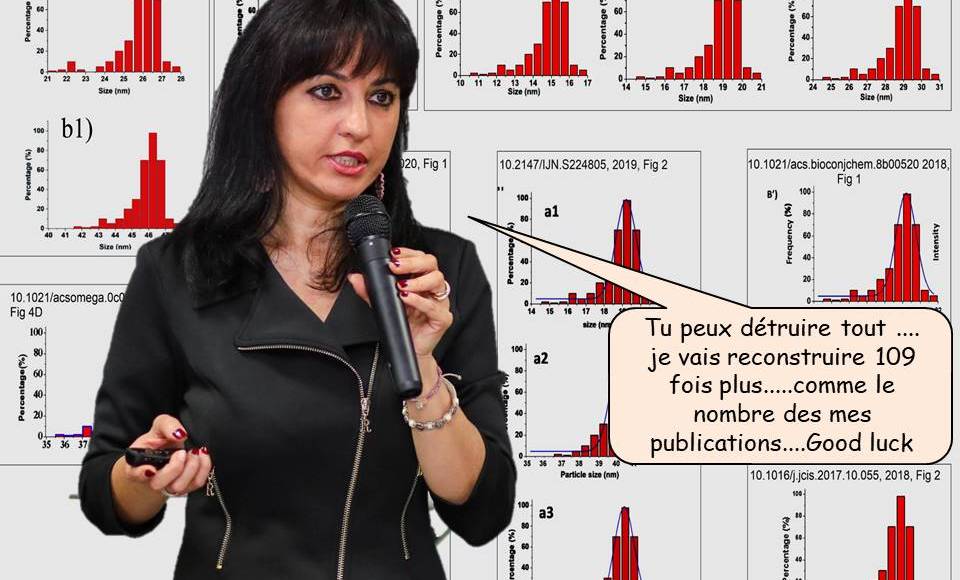

End of the road for the Sorbonne University of Paris researcher Jolanda Spadavecchia, the old sword of fake nanotechnology. The second investigation didn’t lead to her sacking directly, but at least to a two years suspension which normally ends academic careers in France.
Spadavecchia is an Italian native. She studied pharmaceutical chemistry at the University of Bari and did her PhD in material engineering at the University of Lecce, both in Italy. In 2006, she started a 3 year postdoc at Laboratoire Charles Fabry in Orsay, France, and in 2010 she became a tenured CNRS researcher at Pierre and Marie Curie University Paris VI, which later became part of Sorbonne University.

In 2018, Spadavecchia was “as hired as a visiting professor at Shenzhen University“, as a Chinese website informed. The same website also mentioned that Spadavecchia served as chief scientist of Torskal Biotechnology (a French company which sells “gold nanoparticles for cancer therapy“) since 2015, indeed some of Spadavecchia’s studies were done in collaboration with Torskal. However, neither current nor 2021 archived versions of the company’s website list Spadavacchia. But like the Chinese announcment said, she is indeed still listed as research director at the start-up BioEven which aims to sell plant extracts in nanocapsules:

The failed whitewash
I first wrote about Spadavecchia in December 2022 Shorts. That was because her research featured in Le Monde!
The Le Monde journalist David Larousserie reported (translated):
“It all started in February 2021 with the report, initially anonymous, of suspicions of breaches of scientific integrity addressed to the CNRS referent. He will investigate the case with his university counterpart. The case is about more than twenty recent scientific articles from the Chemistry, Structures, Properties of Biomaterials and Therapeutic Agents (CSPBAT) laboratory in Bobigny. The incriminated work concerns nanomedicine […]
A year later, in May 2022, after consultation with independent experts, the two referents submit their report. The president of the university sends a message to the staff of the CSPBAT, confirming that “several breaches of scientific integrity have actually been observed” and that “the number of corrections requested is significant, but no incriminated article is the subject of ‘a request for retraction’. The identity of the suspect, Jolanda Spadavecchia, director of research at the CNRS since 2010, is communicated.
Then the case bounces back. In the summer of 2022, the first decisions of the publishers who published the offending articles fall. Nine corrections to date and, surprise, a retraction decided by a journal, against the advice of the main author.”
The CNRS report was kept secret, but then 9 scheduled corrections happened and one unscheduled retraction:
Fatima Aouidat , Sarah Boumati , Memona Khan , Frederik Tielens , Bich-Thuy Doan , Jolanda Spadavecchia Design and Synthesis of Gold-Gadolinium-Core-Shell Nanoparticles as Contrast Agent: a Smart Way to Future Nanomaterials for Nanomedicine Applications Farib (2019) doi: 10.2147/ijn.s224805

Retraction August 2022: “The authors raised concerns regarding errors that had been made during the calculation of the size of the nanostructures shown in Figure 2. The sizes reported in the histograms of Figure 2; a1, a2 and a3 were incorrect due to miscalculations that occurred during analysis of the gold core and polymer shells of the spherical nanostructures represented in TEM images of Figure 2A. The authors provided the editor with data from the original study and requested to remove the incorrect histograms and replace them.
However, the Editor determined that this part of the article was integral to the study and the admission of these errors, because of the miscalculation, meant the data was unreliable and would not accept the correction proposed by the authors. The Editor requested for the article to be retracted and the authors were notified but do not agree with this decision.“
Spadavecchia’s bad luck was that this Dove Press journal was found to be infested by Chinese papermills, havign been edited by the former Northeastern University professor Thomas Webster, who is a research fraudster and a papermiller himself. The publisher Taylor & Francis did a clean up, mass-retracted the papermill fraud and sacked Webster as editor.
Thomas Webster to save the world with COVID-19 nanoparticles
The world is in the grip of COVID-19 pandemic. Thousands dead, infection rates explode, nations in lockdown. Perfect timing for troll scientists to offer their bullshit cures. Like Thomas Webster of Northeastern University.

The craziest thing with that retraction is: Spadavecchia immediately republished the retracted paper with some sleazy predatory publisher. Her coauthors Fatima Aouidat, Memona Khan and even Frederik Tielens (head of chemistry department at Vrije Universiteit Brussel in Belgium and Maître de Conferences “hors classe” at Sorbonne) participated in this dirty game, two coauthors did not. A certain liver surgery professor from China, Xiaowu Li, became their replacement:

As it happens, Xiaowu Li was the one who in 2018 installed Spadavecchia as visiting professor at his Shenzhen University. He appeared here also:
Celia Arib , Hui Liu , Qiqian Liu , Anne-Marie Cieutat , Didier Paleni , Xiaowu Li , Jolanda Spadavecchia Flavin Adenine Dinucleotide (FAD) Pegylated (PEG)-Complexes: Proof of Concept (PoC) of theranostic tool on a Murine Breast Cancer Model Nanotheranostics (2022) doi: 10.7150/ntno.63496

As in a previous paper from the same group, doi: 10.7150/ntno.59290, the spleens appear to have been arranged in a collage, perhaps from individual photos. They do not have any shadow, and appear to float above a green, homogenous background. Do the authors still have the individual photos to share, please?
Pink boxes: One of the PEG spleens looks remarkably similar to one of the NP1-IG spleens.“
For some of the corrected papers, Spadavecchia attacked her PubPeer critics:
“I will not answer to such anonymous comment, from someone who seems ignorant in nanomedicine, nanoscience and law.”

Whistleblower on trial
Indeed, law is something Spadevecchia did try to play to her advantage. She went after her critic, the whistleblower Raphaël Lévy, a fellow professor at University of Sorbonne University and a “scientific terrorist”, as the nanotechnology bigwig Chad Mirkin called him.
Do nanoparticles deliver? Merck’s Smart Flares and other controversies
Two somewhat controversial approaches to nanoparticle delivery: the striped nanoparticles by Francesco Stellacci, and the spherical nucleic acids by Chad Mirkin.
Le Monde wrote in December 2022:
“During this time, the atmosphere deteriorates at the CSPBAT. Some criticize the whistleblower for not having discussed his report with the responsible director before sending it to the referents, triggering open animosity against him, pushing the university to change his assignment. Some of his former colleagues even think he wants to settle scores. According to our information, this is one of the lines of defence followed by Jolanda Spadavecchia, who even speaks of harassment. […]
Sign of this tension, in November, a new article by Jolanda Spadavecchia was corrected. It contained, at the very end, an unpublished and inappropriate statement: “We have a conflict of interest with Raphaël Lévy. At the request of the latter, this mention was withdrawn one month after its publication.”

UCL trachea transplants: Videregen sets lawyers on Liverpool academics Murray and Levy
Videregen, the Liverpool-based company which bought the trachea regeneration patent from UCL, deployed lawyers against the academics Patricia Murray and Raphael Levy, precisely via their employer University of Liverpool. Main issue is the parliamentary submission by Levy and Murray, subject to absolute privilege. Yet Videregen also cites from the confidential notice of suspected research misconduct…
In December 2022 Shorts, I reported about new fraud findings by Levy, which with the help of other sleuths eventually rose Spadavecchia’s PubPeer record to almost 40 papers.
In April 2023 Shorts, I wrote about a bizarre twist of events: Spadevecchia was whitewashed and Levy was charged with research misconduct.
David Larousserie reported in Le Monde on 25 April 2023 (Google-translated):
“At the same time, Raphaël Lévy battles. On April 17, 2022, he was cleared by the university of a charge of plagiarism. In two master’s reports of his students, identical curves had been identified. The university took months, using an outside expert, to discover that the students were in the same group and had done the same experiments… And the administrative investigation is not making progress on the rumours of moral harassment that have been circulating for more than a year against the professor, who had already rejected them in December in Le Monde.
The researcher is also facing charges for ethical and deontological breaches, currently being examined by the Ethics College of the Ministry of Research…”
On social media, Spadavecchia used to paint herself a victim of academic harassment and bullying. And is anyone surprised that she hates sleuths like Elisabeth Bik and is a fan of Didier Raoult and the fascists of France Soir?



Dirty Old Man harasses Elisabeth Bik
Mad chloroquine guru Didier Raoult is becoming an embarrassment for France, who would’ve known.
The Open Letter
It looked good for Spadavecchia, and bad for the whistleblower. But then Dorothy Bishop, emeritus professor of psychology at the University of Oxford, contacted CNRS President Antoine Petit and the Scientific Integrity Officer of CNRS, Rémy Mosseri. Worth noting that Petit describes PubPeer sleuths as “assholes” and firmly believes that research fraud doesn’t really exist in France, see October 2022 Shorts and below:
Jessus investigator identity leaked, CNRS President to expose whistleblowers
An update to the ongoing cartoon Stalinism propaganda and purge activities at the EU largest research institution, the French CNRS, in the wake of the affair around manipulated data of CNRS chief biologist Catherine Jessus, according to their press release an innocent “victim” of my “slanderous” and “unscientific” blogging. First of all, a reliable source…
Bishop published her communication as an Open Letter in February 2023, which was signed by several academics:
“This Open Letter is prompted by an article in Le Monde describing an investigation into alleged malpractice at a chemistry lab in CNRS-Université Sorbonne Paris Nord and the subsequent report into the case by CNRS.[…]
We need also to be aware of the possibility of accusations made in bad faith by those with an axe to grind. However, there comes a point when there is a repeated pattern of errors for a prolonged period for which there is no innocent explanation. This point is surely reached here: the problematic data are well-documented in a number of PubPeer comments on the articles (see links in Appendix 1 of this document).
The response by CNRS to this case, as explained in their report (see Appendix 2 of this document), was to request correction rather than retraction of what were described as “shortcomings and errors”, to accept the scientist’s account that there was no intentionality, despite clear evidence of a remarkable amount of manipulation and reuse of figures; a disciplinary sanction of exclusion from duties was imposed for just one month.
So what should happen when fraud is suspected? We propose that there should be a prompt investigation, with all results transparently reported. Where there are serious errors in the scientific record, then the research articles should immediately be retracted, any research funding used for fraudulent research should be returned to the funder, and the person responsible for the fraud should not be allowed to run a research lab or supervise students. The whistleblower should be protected from repercussions.”
The letter ends with a request to CNRS to “review their disciplinary processes and consider adopting a more robust, timely and transparent process that treats data manipulation with the seriousness it deserves“.

Pravda of Jessus report, CNRS Politburo scared of own people
Following my recent article about attempts to fix data irregularities in the papers by CNRS’ chief biologist and director of l’Institut des sciences biologiques (INSB) Catherine Jessus, this state-owned French research institution, the biggest in Europe, now went full Pravda. Just as the notorious propaganda newspaper of the Communist Party of the Soviet Union (Pravda means…
On 30 March 2023, Bishop also published the replies she received. On 28 February 2023, CNRS President Petit educated Bishop:
“You are obviously not familiar, or at least very unfamiliar, with CNRS policy and procedures regarding scientific integrity.
The CNRS deals with these essential issues without any complacency, but tries to be fair and to ensure that the sanctions are proportional to the misconduct committed, while respecting the rules of the French civil service.
Your letter mixes generalities about the so-called actions of scientific institutions with paragraphs that apply, perhaps, to the CNRS.“

The Strasbourg Swamp
You know Voinnet, but now meet other great life scientists of Strasbourg: Drouard, Loeffler, Boutillier, Mr and Mrs Egly, and many others.
Petit then directed Bishop to talk to Mosseri, which she did, and received Mosseri’s reply on 15 March 2023. He reiterated Petit’s criticism of her criticism and offered a confidential Zoom call under the condition that nothing will be published online. Bishop refused secrecy, and on 18 March 2023 Mosseri replied:
“You may know that (i) I must apply a strict confidentiality about the cases we treat, (ii) I cannot start (decide alone) an investigation without having a documented allegation that I can then send to the targetted persons asking for a reply. You mention in your letters 4 pubpeer new posts concerning the case discussed in a french newspaper last december. It is not clear for me whether you considered that mentioning these posts was a formal allegation or just an information. In the first case, I must tell you that just sending to a pubpeer post is not considered by us as a formal allegation. If you ask for an investigation to be opened on new elements, you are invited write and send us a detailed allegation.“
Mosseri also berated Bishop at length for refusing confidentiality. In a follow up email, he reiterated that PubPeer links won’t be admitted as evidence and scolded the Oxford professor for having low “personal ethics” and infringing his privacy:
“Dear Mrs Bishop, I understand that you do not agree with our imperative rules of confidentiality, and with the form under which an allegation should be sent to us in order to possibly open an investigation. It seems that, as a general principle, emails have the same status as private correspondance, and should therefore not be tranferred to third parties without the consent of the author of the email.”
Frederique Vidal, Minister for Research and gel band duplication
Frédérique Vidal has been professor for molecular genetics and rector of the University of Nice before she became the currently serving cabinet Minister of Higher Education, Research and Innovation in France. The French government keeps responding with threats of legal action to earlier evidence of data irregularities in her published research, this is why I…
Jolanda and Sabine
Meanwhile, Spadavecchia became progressively toxic, which even caused a retraction to other French scientists currently under research misconduct investigation: the Knight of the Honour Legion Sabine Szunerits and her husband and fellow professor at the University of Lille, Rabah Boukherroub. Read about them here:
Lille Papermille
French nanotechnologists Sabine Szunerits and Rabah Boukherroub put EU Commission’s money to good use. The EU cannot afford a papermill gap to Iran and China!
As of today, Szunerits has almost 140 very problematic papers on PubPeer. Her University of Lille is working hard to save her, while Danube Private University in Szunerits’s home country Austria has dissolved her lab there (see December 2024 Shorts).
The following became Spadavecchia’s fourth retraction, but the first and so far the only one for Szunerits and Boukherroub:
Oleksandr Zagorodko , Jolanda Spadavecchia, Aritz Yanguas Serrano , Iban Larroulet , Amaia Pesquera , Amaia Zurutuza , Rabah Boukherroub, Sabine Szunerits Highly Sensitive Detection of DNA Hybridization on Commercialized Graphene-Coated Surface Plasmon Resonance Interfaces Analytical Chemistry (2014) doi: 10.1021/ac502705n
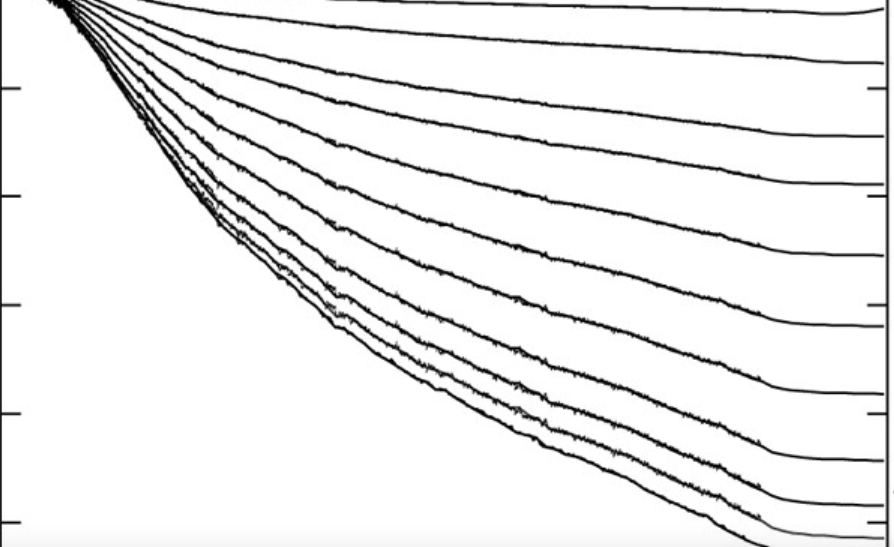
Gonodonta sinaldus: “Figure 4B shows a series of curves showing changes in SPR signal over time at different DNA concentrations. […] Most of the plots, however, appear to show the same data, simply multiplied by a different constant, with the pattern of noise repeated at all concentrations.”
The paper was flagged since 19 December 2023 with an Expression of Concern, which mentioned that “authors are in the process of redoing the experiments to verify their original findings“. The retraction from 17 September 2024 had a similar wording, but apparently the newly generated replacement data was not really convincing:
“The authors retract this article (DOI: 10.1021/ac502705n) due to concerns raised regarding the calibrations shown in Figure 4 that could not be explained or validated, and the original data is not available to confirm the conclusions of the paper. While the authors were able to reproduce the SPR data in a general sense, the missing original data prevented a full validation of the work. As such, the article is being retracted.”
Think about it: the only retracted paper of Szunerits and Boukherroub is the one co-authored by Spadavecchia.
Another study by Spadavecchia and Szunerits (Turcheniuk et al 2015) received in December 2024 an Expression of Concern, because it had cloned spectra, hand-drawn diagrams and shared data with other papers from Szunerits’ lab:
“The Royal Society of Chemistry has asked the University of Lille to investigate this matter. An expression of concern will continue to be associated with the article until we receive conclusive evidence regarding the reliability of the reported data.”

CEA declares Anne Peyroche’s data fakery scientifically correct
Former CNRS president Anne Peyroche has been symbolically sanctioned for research misconduct. Despite previous fraud findings, conclusions are not affected, and so is her employment by the Atomic Energy Commission. I present two more falsified figures.
Suspension and retractions
And now, the news broke. On 19 May 2025, the journalist David Larousserie reported in Le Monde (translated):
“A CNRS research director was sanctioned with two years of exclusion from her duties for “serious and repeated breaches of her duty of scientific integrity” ,reveals the organization’s Official Bulletin on Thursday, May 15. This is the highest penalty on the scale of administrative sanctions, just before revocation. Since 2015, two scientists have been convicted for this type of reason, according to a tally by Le Monde .”
One of these other two scientists sanctioned by CNRS was Olivier Voinnet. Unlike Spadavecchia, Voinnet already had a cushy job as professor at ETH Zürich in Switzerland, which made sure he was whitewashed enough to keep that job.
Olivier Voinnet case: correcting the uncorrectable
The case of the former star plant scientist Olivier Voinnet is being quietly concluded. After now seven paper retractions, more than twice as many controversial corrections and after his misconduct was made official by the investigative commission of the ETH Zürich, the institutions, journals and a number of scientific peers are showing all the intention for this scandal…
Le Monde continues:
“The decision is the latest chapter in a story that began more than four years ago in a biochemistry laboratory at Sorbonne Paris-Nord University. In February 2021, the CNRS and university scientific integrity officers received a report about a university professor of suspected irregularities in twenty-seven articles. […] A year later, after two expert reports were commissioned, the irregularities were confirmed, and corrections were requested for twenty articles from the chemist. A disciplinary commission resulted in the CNRS CEO issuing a one-month suspension in December 2022.
But, in February 2023, the “integrity” referents received, this time from two people outside the laboratory, new reports – again for twenty-seven articles, about ten of which had been corrected following the first investigation. The investigation method was modified compared to the first: it will consist of a single report informed by the opinions of three experts and the integrity referents.”
The new report requests the retractions of 17 papers, and approved two of the retractions which already happened.
Here is the report, published by CNRS in May 2025. I saved a copy because such things tend to disappear:
I used Google Translate to put it in English. The report opens with a “Preliminary remark”:
“The research work of Jolanda Spadavecchia (J.S.) and her team was the subject of an initial report in 2021 to the RIS of CNRS and Sorbonne Paris Nord University for alleged fraud involving 25 publications. Following the expert appraisal of this work, 11 corrections were published, 3 publications were retracted by the editors, and 4 publications remained as is.
A new report was received by the RIS in February 2023 concerning certain corrections to the publications assessed during the first report and new allegations.
At the initiative of CNRS and Sorbonne Paris Nord University, an inquiry commission was set up, comprising three scientists, experts in the relevant fields (nanoparticles, biophysics, electron microscopy, etc.). 27 publications were subject to an exhaustive examination, with the conclusion that a significant portion of the reported elements were validated. The commission issued the following recommendations, concerning 17 publications, and confirmed the validity of two retractions already made by the editors.”
The recommendation was to retract all 19 papers due to fraud.
Call to research integrity, or at least a minor revolution at CNRS
When I first started digging into the affair of data manipulations around the former star of plant sciences Olivier Voinnet in early 2015, I was sure to be dealing with a singular case of fraud in French science, which went totally unnoticed for decades. When 2 years later I wrote “a fish stinks from the head down” in my…
The 19 papers
Here are the papers, numbered as they were in the report. Nr 1, the first author Céline Falentin-Daudré is now deputy director of the CNRS and Sorbonne-affiliated CB3S Laboratory in Paris.
- Céline Falentin-Daudré , Mounia Aitouakli , Jean Sébastien Baumann , Nadia Bouchemal , Vincent Humblot , Véronique Migonney , Jolanda Spadavecchia Thiol-Poly(Sodium Styrenesulfonate) (PolyNaSS-SH) Gold Complexes: From a Chemical Design to a One-Step Synthesis of Hybrid Gold Nanoparticles and Their Interaction with Human Proteins” ACS Omega (2022) doi: 10.1021/acsomega.0c00376
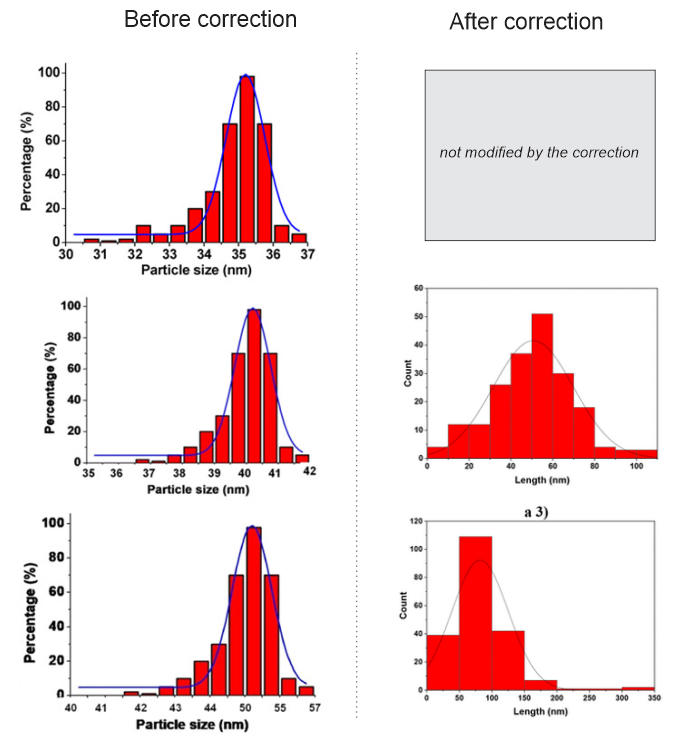
CNRS investigators disagreed with ACS editorial assessment that this paper was perfectly fine after the correction:
“Experts recommend the retraction of the publication which had already been the subject of a request for correction, because
- ∙The particle size histograms in the published patch (Figures 1a2 and 1a3) do not match the particle sizes shown. Moreover, these new histograms are strikingly different from those in the original publication, but the legend has not been changed, which shows the lack of care taken in the patch by the authors and the editor.
- The absorbance axes of several nanoparticle absorption spectra and the corresponding labels (Figures S14 A and B, Figure S15B) appear “manipulated”.∙ The UV-visible spectra of the PolyNaSS-SH@AuNPs nanoparticle at different pHs are identical to those published by members of the same team in the journal Particle in 2018 (doi : 10.1002/ppsc201700299) while they correspond to different nanoobjects. The legends of the figures have also been “manipulated”.
- Two NMR spectra of nanoparticles were recognized by their author as falsified by erasure of part of the spectrum.”
Also the second paper was corrected by ACS in 2022, its coauthor Nadia Djaker-Oudjhara is group leader at CB3S Laboratory.
- Ferdaous Sahli , Manon. Courcelle , Tony Palama, Nadia Djaker, Philippe Savarin , Jolanda Spadavecchia Temozolomide, Gemcitabine, and Decitabine Hybrid Nanoconjugates: From Design to Proof-of-Concept (PoC) of Synergies toward the Understanding of Drug Impact on Human Glioblastoma Cells Journal of Medicinal Chemistry (2020) doi: 10.1021/acs.jmedchem.0c00694
“The original version of this article unfortunately contained some mistakes. We realized, after publication, that we used a bad drug release profile (concerning TMZ) in Figure 4, without the error bars on the kinetic profile. A corrected drug release profile with error bars is presented below.
Correction June 2022
We would also like to correct Figure 1B (panel 2) and Figure 2B (panel 1-1′) because the nanoflowers are similar to those shown in another paper, but not the same, and we confused the TEM images.”
And yet, also this one is need of retraction, as the report states:
“Experts recommend the retraction of the publication which had already been the subject of a request for correction because several inconsistencies were noted […]
The correction published following the first report is not credible because the nanoparticle release curves (figure S4) correspond to pH values different from the originals.”
That’s because Levy found more:


On to Nr 3, already fixed by Elsevier in November 2022 with a Corrigendum, where “values of distribution histogram of nanoparticles size” in Fig 2a was changed from 60 nm to 83.29 nm. Marc Lamy de la Chapelle is also a recurrent coauthor and is professor at Le Mans Université in France.
- Maelle Monteil , Hanane Moustaoui , Gennaro Picardi , Fatima Aouidat , Nadia Djaker , Marc Lamy De La Chapelle , Marc Lecouvey , Jolanda Spadavecchia Polyphosphonate ligands: From synthesis to design of hybrid PEGylated nanoparticles toward phototherapy studies Journal of Colloid and Interface Science (2018) doi: 10.1016/j.jcis.2017.10.055

Zygomolgus dentatus: “Before the Corrigendum, particles were between 54.5 and 61 nm. After the corrigendum, the distribution is between 20 and 160 nm. The difference is striking “
Also here says the CNRS report:
“Experts recommend the retraction of the publication which had already been the subject of a request for a correction for duplication of a nanoparticle size histogram (figure 2A). However, the new histogram is improbable because:
- The distribution and size of particles cannot be inferred from the particle collections presented.
- The step size chosen for the histograms is incompatible with the dimensions of the images.”
Next one is already retracted It was coauthored with Italian colleagues at University of Florence, Annarosa Arcangeli and Olivia Crociani, about whom I wrote in March 2025 Shorts.
- Angelica Sette , Jolanda Spadavecchia , Jessem Landoulsi , Sandra Casale, Bernard Haye, Olivia Crociani , Annarosa Arcangeli Development of novel anti-Kv 11.1 antibody-conjugated PEG-TiO nanoparticles for targeting pancreatic ductal adenocarcinoma cells Journal of Nanoparticle Research (2013) doi: 10.1007/s11051-013-2111-6

Ferrisia virgata: “The molecules drawn here are not polyethylene glycol”
In July 2022, a Correction was issued for a histogram in Figure 2C:
“The original version of this article unfortunately contained an error: the value of distribution histogram of nanoparticles size incorrectly was given as 7 nm (Fig. 2C). After analysis of several TEM images with a novel software J Image, we have found a new value. The correct one is 9.45 nm.”
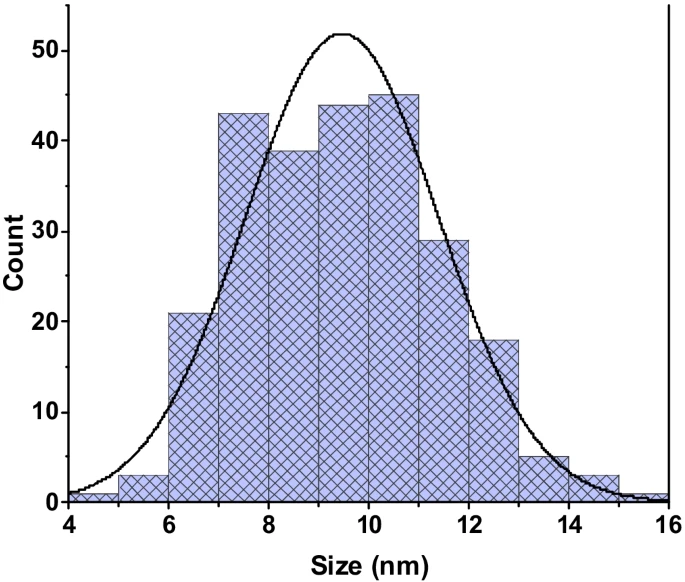
The retraction from 27 February 2025 referred to the CNRS investigation:
“The Editor-in-Chief has retracted this article after an investigation by Sorbonne Paris Nord University and CNRS revealed that the histogram published in the Correction [1] is not compatible with the size of the nanoparticles shown in the ME images and the characteristics of the XRD spectrum do not reflect the size of the nanoparticles. The Editors have therefore lost confidence in the findings of this article. J. Spadevecchia does not agree to this retraction. ”
The CNRS investigation recommended that retraction because more issues were found, namely a “duplication of an XRD spectrum published in 2011“:
“The characteristics of the XRD spectrum (Figure 2D) do not reflect the size of the nanoparticles, which clearly suggests that there has been “recycling” of the XRD figure from one article into another.”
Next one, also already corrected in 2022, this time by Royal Society of Chemistry, because “the TEM image and the values from the distribution histogram of nanoparticles were incorrectly shown in Fig. 1A and A1“. You might recognise Djaker, De La Chapelle and Xiaowu Li, and we will meet them again:
- Qiqian Liu , Hui Liu , Pasquale Sacco , Nadia Djaker , Marc Lamy De La Chapelle , Eleonora Marsich , Xiaowu Li, Jolanda Spadavecchia CTL-doxorubicin (DOX)-gold complex nanoparticles (DOX-AuGCs): from synthesis to enhancement of therapeutic effect on liver cancer model Nanoscale advances (2020) doi: 10.1039/d0na00758g


This Paper Nr 5 also shared the drug release curves with Paper Nr 2. The CNRS verdict:
“Experts recommend the retraction of the publication that had already been the subject of a request for a correction concerning the duplication of a nanoparticle size histogram. The correction had been published by the publisher. However, the validity of this new data is questioned by the experts because the corrected histogram (Figure 1A1) cannot be representative of the particles represented on the new electron microscopy photo (Figure 1A).
The authors proposed a correction to the nanoparticle release curves versus time, which had been duplicated from at least three previous publications on different nanoparticles (Figure S2).”
Remember Charles-Henri Lecellier?
Charles-Henri Lecellier is about to get promoted to CNRS research director 2nd class. Time to dig up old stories and let the ghosts rise to wash their dirty laundry.
Paper Nr 6 was also already corrected in July 2022 (for “errors in Figure 3 where the histograms were incorrect in panels (a1) and (b1).”), because it shared same histograms you saw in paper Nr 5:
- Célia Arib , Jolanda Spadavecchia, Marc Lamy De La Chapelle Enzyme mediated synthesis of hybrid polyedric gold nanoparticles Scientific Reports (2021) doi: 10.1038/s41598-021-81751-1
The CNRS report recommends that Springer Nature upgrades that correction to a retraction:
“Experts recommend the retraction of the publication (already corrected once). Indeed, the new nanoparticle size histograms (figure 3) present inconsistencies:
- Particle sizes on histograms are inconsistent with particle size determined by transmission electron microscopy
- The scale of the histograms is expressed in %, with a maximum value of 100% which assumes that the total number of particles is greater than 100%.
- The digital data of the histograms could not have been obtained with such a resolution, for objects of this size.
- The hydrodynamic data of the nanoparticles (table S1) are incompatible with the values given on the new histograms.”
Paper Nr 7 shares the same red histogram as well as other duplications, but it wasn’t even corrected by ACS.
- Rawdha Dekhili , Khaoula Cherni , Hui Liu , Xiaowu Li , Nadia Djaker, Jolanda Spadavecchia Aptamer–Gold(III) Complex Nanoparticles: A New Way to Detect Cu, Zn SOD Glycoprotein ACS Omega (2020) doi: 10.1021/acsomega.0c01192

The CNRS report assumes the paper was corrected already, but it wasn’t:
“Experts recommend the retraction of the publication (already corrected once). In fact:∙
- Three of the four absorption spectra (Figure S1) of the “On” and “In” aptamers were obtained not experimentally but by duplication of the same spectrum.
- The absorption spectra (Figure S2) of the SOD4 Aptamer particle and the corresponding calibration line (Figure S2) are duplicates of those published previously but for other nanoparticles.
- Furthermore, in response to the first report, JS submitted to the experts three new histograms of nanoparticles to replace those published which were identical while corresponding to different particles (Figure 1). These new histograms, which contain questionable data (unrealistically accurate particle sizes) have not been published.”

Opera Buffa di Guido Kroemer a La Scala
Guido Kroemer receives on 8 November 2019 the €1mn Lombardy Award for Healthy Ageing, at La Scala in Milan. And why not, one panel member was Carlo Croce.
Allow me a very quick detour on why ACS Omega is unlikely to be in a hurry to comply with this CNRS decision. As I wrote in May 2024 Shorts, in August 2022, the sleuth Actinopolyspora biskrensis notified this journal about another problematic paper by Spadavecchia:
Fatima Aouidat, Zakaria Halime , Rosalba Moretta , Ilaria Rea , Stefania Filosa , Stella Donato , Rosarita Tatè , Luca De Stefano, Raphaël Tripier , Jolanda Spadavecchia Design and Synthesis of Hybrid PEGylated Metal Monopicolinate Cyclam Ligands for Biomedical Applications ACS Omega (2019) doi: 10.1021/acsomega.8b03266
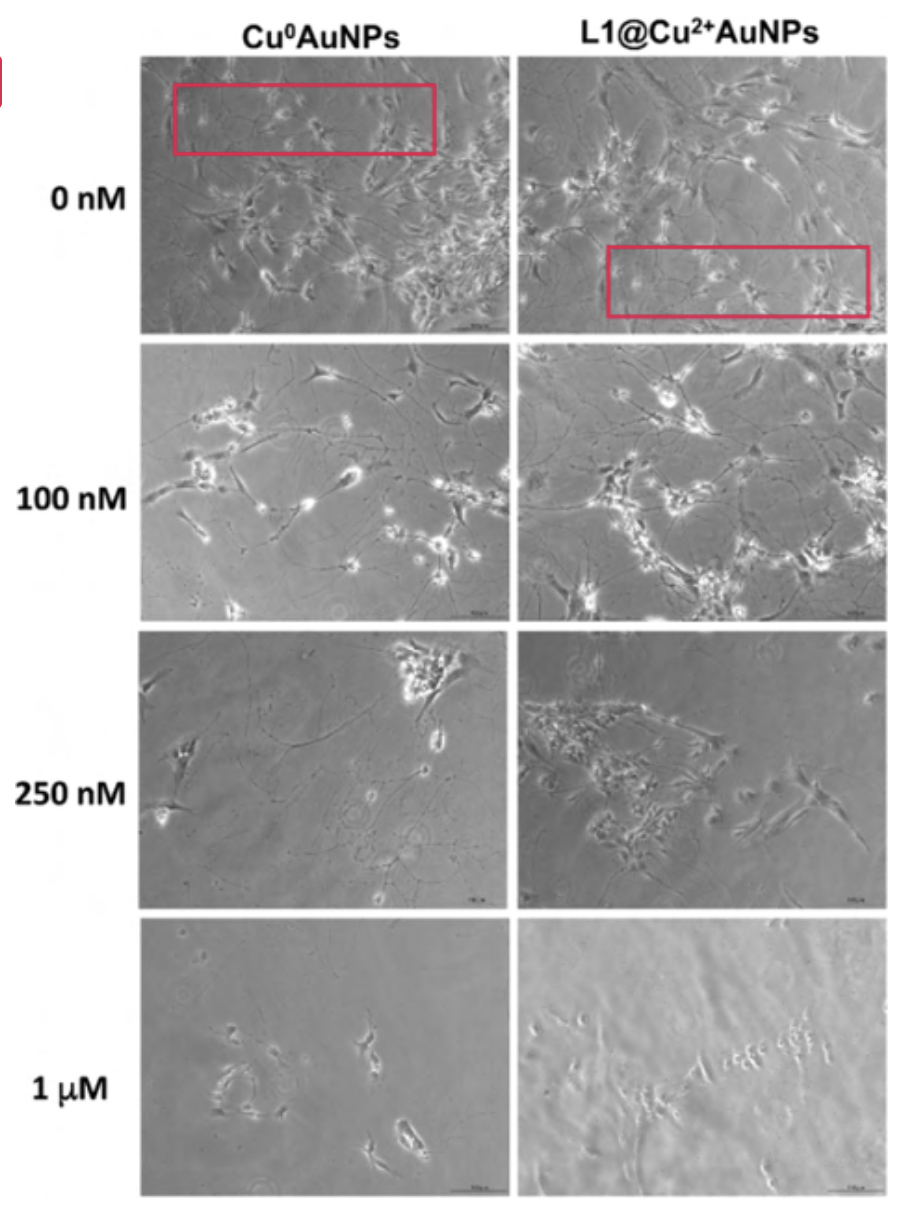
Actinopolyspora biskrensis: “Figure 4 appears to have two images which overlap.”
A month later, in September 2022, the Development Editor at ACS Omega Aditi Jain, requested that the sleuth sends “specific scientific concerns […] so that we can move forward with the investigation“. Almost two years passed and on 19 May 2024, the sleuth contacted Jain again. Right away, he received this unsigned email from ACS Omega Managing Team:
“We note that the authors have provided an explanation in the post.
If you would still like to request an inquiry, please confirm that we have your consent to share the details of this complaint verbatim with the authors.”
The duplicated images speak for themselves, yet ACS reiterated their demands to know the sleuth’s identity:
“This is done to ensure the author isn’t held accountable out of nowhere and there is a justified process or scientific reasoning to validate the investigation.”
Worth mentioning that the same first author Fatima Aouidat retracted and republished fabrication discussed at the beginning). The coauthor Stefania Filosa retracted her last-author paper (Manganelli et al 2012), and in 2021 she and Stella Donato retracted another paper (Stellavato et al 2018), in both cases for excessive fraud.
In this regard, Spadavecchia’s collaborator Luca De Stefano of Institute for Microelectronics and Microsystems at CNR in Naples wrote on PubPeer in April 2021:
“Usually, I don’t reply to posts or emails from anonymous people or people hiding behind a nickname, especially when these concern observations that cast suspicion rather than create clarity, but in this case for the serenity of my co-authors and readers of the article in question, I will be happy to answer. A part of the two images seems to actually overlap, which means that they belong to two fields of view of the microscope of the same sample which is not by chance the control sample.[…] Actually, the image of the control sample could have been the same…”
PubPeer users swiftly debunked De Stefano’s pompous drivel, which even contradicted his own Materials and Methods section. But as you see, ACS and its journal ACS Omega decided that it was the anonymous sleuths who acted unethically.

Whitewashed by ACS and Elsevier, Zboril sues Olomouc Dean for “bullying”
“I should remind you that the editorial offices that investigated your allegations did not found any evidence of scientific misconduct or data fabrication. In my opinion, your allegation may bear the elements of defamation and false accusation” – Prof Radek Zboril
Going back to the CNRS report: IOP Publishing seems to have a very different understanding of research ethics. And IOP didn’t fall for Spadavecchia’s and De Stefano’s bullshit. Paper Nr 8 and 9 were already retracted, and they both came from De Stefano’s Neapolitan lab:
- Jane Politi , Luca De Stefano , Ilaria Rea , Alfredo Maria Gravagnuolo , Paola Giardina , Christophe Methivier , Sandra Casale , Jolanda Spadavecchia One-pot synthesis of a gold nanoparticle–Vmh2 hydrophobin nanobiocomplex for glucose monitoring Nanotechnology (2016) doi: 10.1088/0957-4484/27/19/195701
- Jane Politi, Jolanda Spadavecchia, Gabriella Fiorentino , Immacolata Antonucci , Sandra Casale , Luca De Stefano Interaction of Thermus thermophilus ArsC enzyme and gold nanoparticles naked-eye assays speciation between As(III) and As(V) Nanotechnology (2015) doi: 10.1088/0957-4484/26/43/435703

The retraction notices from 30 March 2023 were were similar (here and here):
“This article has been retracted by IOP Publishing following an allegation that this article may contain image integrity issues [1]. IOP Publishing has investigated in line with the COPE guidelines and have found figure 2A is duplicated from another source [1] without disclosure. The authors have provided explanations and offered to make a correction; however, these do not adequately explain the re-use of the image and raise more concerns about the integrity of the work. As such IOP Publishing and the Editor in Chief agree this article should be retracted. IOP Publishing express thanks to the anonymous whistleblower and subject experts who were consulted during the investigation.”
I wrote about these two retractions in May 2025 Shorts. The CNRS report now mentions that Spadavecchia “contested” both editorial decisions, but “the experts confirmed the validity of the retraction“.
Paper Nr 10, again in ACS. It shares the drug release curve shown in Paper 2 above, and has other issues:
- Celia Arib , Jolanda Spadavecchia Lenalidomide (LENA) Hybrid Gold Complex Nanoparticles: Synthesis, Physicochemical Evaluation, and Perspectives in Nanomedicine ACS Omega (2020) doi: 10.1021/acsomega.0c02644

CNRS once again erroneously believes ACS bothered to correct that paper:
“Experts recommend the retraction of the publication (already corrected once). The report concerned the duplication of TEM images of nanoparticles corresponding to two different experiments carried out at pH 4 and pH 7 (Figure 5) for which the corresponding author provided an acceptable explanation.
However, the analysis of the publication by experts revealed several improbabilities:
- The UV-visible spectra of the nanoparticle studied (LENA) (Figure S2A) are in all respects identical to those published by the authors in 2018 (two: 10.1002/ppsc.201700299), but for the docetaxel particle.
- The calibration line (Figure S2B) relating absorbance to nanoparticle concentration is aberrant because neither the number of points nor the position of these points correspond to the absorbance values presented on the spectra (Figure S2A). Furthermore, the calibration line has been duplicated in several publications dealing with distinct nanoparticles and presenting totally different spectra.
- The release curves of the LENA nanoparticle (figure S3) are perfectly superimposable with those published in other articles by the authors published in 2018, 2019, 2020 and corresponding to other nanoparticles (two: 10.4172/2157‐7439.1000 ; doi: 10.1002/ppsc.201800395, doi: 10.1002/ppsc.201800082; two: 10.1039/d0na00758g) “
Paper Nr 11 was already corrected by Elsevier:
- Jolanda Spadavecchia , Ramesh Perumal , Sandra Casale , Jean-Marc Krafft , Christophe Methivier , Claire-Marie Pradier Polyethylene glycol gold-nanoparticles: Facile nanostructuration of doxorubicin and its complex with DNA molecules for SERS detection Chemical Physics Letters (2016) doi: 10.1016/j.cplett.2015.08.038

The Corrigendum from September 2023 informed that the “authors regret a bad histogram of size distribution (Figure 3)“, which was replaced. However, a PubPeer critic noted that “the SEM image shown in Figure 4 has particles of a completely different size even though they are supposed to be the same sample” as those in Figure 3.
No wonder CNRS decided:
“Experts recommend the retraction of the publication (already corrected once). The first report concerned the nanoparticle histogram (figure 3B) which was duplicated from two articles published by the authors in 2013 (doi. 10.1007/s11051‐013‐2111‐6) and 2015 (doi: 10.1088/0957‐4484/26/43/435703) Experts noted inconsistencies in the newly published particle histogram between the data and the figure legend that cast doubt on the validity of the correction.”
Academic throne succession: from Anne Dejean to Oliver Bischof
Anne Dejean is a very important cancer researcher in France. To whom shall she bequeath her high-achieving Institut Pasteur lab when she retires? The German shooting star Oliver Bischof is the right man to continue Dejean’s craft.
Paper Nr 12 appeared in the disastrous Dove Press journal run by the fraudster and papermiller Thomas Webster, until his sacking as professor and editor. It again contains the drug release curve from Paper Nr 2:
- Memona Khan , Sarah Boumati , Celia Arib , Amadou Thierno Diallo , Nadia Djaker , Bich-thuy Doan , Jolanda Spadavecchia Doxorubicin (DOX) Gadolinium-Gold-Complex: A New Way to Tune Hybrid Nanorods as Theranostic Agent International journal of nanomedicine (2021) doi: 10.2147/ijn.s295809

Raphaël Lévy: “In figure 1 ; histograms of fig 1c top and middle have 24 bins each. Out of these 24 bins, 19 are identical.”
Again, it wasn’t yet corrected unlike the investigators believed:
“The experts recommend the retraction of the publication (already corrected once). The report concerns nanoparticle histograms for which the size of the nanoparticles is not consistent with the TEM photos (Figure 1B). The experts actually consider that several problems arise relating to (i) the size of the nanoparticles; (ii) the resolution of the histograms; (iii) the unrealistic resemblance of several bars of two histograms (Figure 1C). Furthermore, the experts noted that:
- The nanoparticle release curves (Figure 2A) are in all respects identical to those published for other nanoparticles (see report 10)∙ The UV-visible spectra of the nanoparticles (Figure S3) are identical to those published by the authors in 2016 (doi.org/10.2147/IJN.S97476) while they are different nanoparticles. “
Paper Nr 13 uses the same drug release curve.
Hui Liu , Peng Jiang , Zhonghu Li , Xiaowu Li , Nadia Djaker , Jolanda Spadavecchia HIV‐1 Tat Peptide‐Gemcitabine Gold (III)‐PEGylated Complex—Nanoflowers: A Sleek Thermosensitive Hybrid Nanocarrier as Prospective Anticancer Particle & Particle Systems Characterization (2018) doi: 10.1002/ppsc.201800082

Raphaël Lévy: “The figure 1A of this article is more similar than expected to the fig 2A of 10.1039/c3an01794j”
Wiley will have to retract it now:
“This article accumulates improbabilities, the experts consider the retraction of this article as the only possible outcome.
A first report concerned (i) self-plagiarism of MET images (figure 1A of this article and figure 2A of the article doi.org/10.1039/C3AN01794J and (ii) on the duplication of nanoparticle release curves (Figure 2). A correction was proposed by the author but it was not published. In addition, the experts noted several other dubious data: (i) implausibility of the absorbance scales of the UV spectra of the nanoparticles (Figure S1); (ii) calibration line not corresponding to the data on the spectra (Figure S2) and identical to those published elsewhere on several other nanoparticles.”

Charbel Massaad et la lutte contre la fraude
Charbel Massaad is head of biomedical sciences at University of Paris Descartes. He even put forward his candidacy as rector, advocating for science ethics. Unironically.
Paper Nr 14, again that same drug release curve. It wasn’t on PubPeer yet. The paper insisted that “The authors declare no conflict of interest” even though Maroua Ben Haddada was since 2018 Torskal employee (and so was apparently also Spadavecchia):
- Gwendolyn Marguerit , Hanane Moustaoui , Maroua Ben Haddada , Nadia Djaker , Marc Lamy De La Chapelle , Jolanda Spadavecchia Taxanes Hybrid Nanovectors: From Design to Physico-Chemical Evaluation of Docetaxel and Paclitaxel Gold (III)-PEGylated Complex Nanocarriers Particle & Particle Systems Characterization (2018) doi: 10.1002/ppsc.201700299
Again, it wasn’t actually corrected:
“Experts recommend the retraction of the publication (already corrected once).
The first report concerned the duplication of nanoparticle release kinetics but did not result in a correction. The new report 2 concerns the similarities of the absorption spectra of the two particles studied (figure S3a and b). The experts have indeed noted that several spectra present the same noise and were clearly obtained by stretching and adjusting the scales. In addition, the calibration lines (figure S3c) associated with the absorption spectra are aberrant.”

The secret COVID-19 cure of Pasteur Lille
There is a miracle drug for COVID-19, but it is secret. Enterprising researchers at Institute Pasteur in Lille ask for €5 million.
Also Paper 15 wasn’t on PubPeer yet, but it was corrected in August 2022 to add another reference to Spadavecchia:
- Jolanda Spadavecchia , Dania Movia , Caroline Moore , Ciaran Manus Maguire , Hanane Moustaoui , Sandra Casale , Yuri Volkov , Adriele Prina-Mello Targeted polyethylene glycol gold nanoparticles for the treatment of pancreatic cancer: from synthesis to proof-of-concept in vitro studies International journal of nanomedicine (2016) doi: 10.2147/ijn.s97476
“Experts recommend the retraction of the publication (already corrected once).
The report concerns inconsistencies in the size of nanoparticles depending on whether they are obtained by SEM or TEM (Figures 6A and S6). The experts consider that this report is justified. There can be no inconsistency in the size of nanoparticles depending on whether they are obtained by SEM or TEM.”
Paper Nr 16 used that same red histogram you saw in Paper Nr 5.
- Qiqian Liu , Pasquale Sacco , Eleonora Marsich , Franco Furlani , Celia Arib , Nadia Djaker , Marc Lamy De La Chapelle , Ivan Donati , Jolanda Spadavecchia Lactose-Modified Chitosan Gold(III)-PEGylated Complex-Bioconjugates: From Synthesis to Interaction with Targeted Galectin-1 Protein Bioconjugate Chemistry (2018) doi: 10.1021/acs.bioconjchem.8b00520
The CNRS report criticises the ACS Correction from June 2022 (“The value of distribution histogram of nanoparticles size is 20 ± 0.5 nm (Figure 1B′). The correct one is 31.45 nm.”):
“Experts recommend the retraction of the publication (already corrected once).
The report concerns scale inconsistencies between the different TEM images (Figures 3A and 3B). The experts consider this report to be justified, and the response of the author concerned does not resolve the ambiguity. This article has already been corrected, which was found to be incomplete and inaccurate.”
Jessus critics defiant, reactionary cock-up and Chicken of Dishonour Legion
As Le Monde brought into public light the Catherine Jessus affair with its whitewashed data manipulation and the growing academic protest, a counter-revolution put its foot in. A signature list in the worst Stalinist tradition was published, organised by the very elite of French academia (mostly members of Academie de Sciences), and signed by hundreds,…
Paper Nr 17 was also already corrected by ACS:
- Carole Barbey , Nadia Bouchemal , Pascal Retailleau , Nathalie Dupont , Jolanda Spadavecchia Idarubicin-Gold Complex: From Crystal Growth to Gold Nanoparticles ACS Omega (2021) doi: 10.1021/acsomega.0c04501
An Erratum from June 2022 quoted Spadavecchia:
“The original version of this article unfortunately contained a mistake: I realized, after publication, that I used a bad histogram (Figure 4). This histogram corresponds to another experiment and consequently the above change is absolutely imperative. The difference is minimal but not negligible.”

But CNRS experts disagree with ACS experts:
“Experts recommend the retraction of the publication (already corrected once).
The article concerns the duplication of a size histogram of idarubicin nanoparticles (Figure 4). The experts examined this correction as well as the absorption spectra and calibration line of the nanoparticles. The multiple anomalies observed (duplication of spectra and calibration lines, aberrant figure legend) (Figure S1) are indicative of falsification.”

The Passion of Don Carlos
I obtained a partial script of a stage play which recently premiered in Paris: “La Passion de Don Carlos”. Any similarities with Spanish or French cancer researchers are entirely coincidental.
Paper Nr 18 again used those drug release curves you see in Paper Nr 2. Again, “The authors declare no conflict of interest“, never mind Torskal:
- Maroua Ben Haddada , Katy Jeannot , Jolanda Spadavecchia Novel Synthesis and Characterization of Doxycycline‐Loaded Gold Nanoparticles: The Golden Doxycycline for Antibacterial Applications Particle & Particle Systems Characterization (2019) doi: 10.1002/ppsc.201800395
It will have to go also:
“Experts recommend the retraction of this article due to the multiple duplications and the highly improbable nature of the results.
The first report concerned the duplication of release curves. A correction was requested but was not published. Beyond this duplication, the experts noted various anomalies: falsification of the absorption spectra of the nanoparticles (Figure S2A) and the calibration line (Figure S2B).”
Finally, the last in the list, also corrected already:
- Thomas Degabriel, Elodie Colaço , Rute F. Domingos , Karim El Kirat , Dalil Brouri , Sandra Casale , Jessem Landoulsi, Jolanda Spadavecchia Factors impacting the aggregation/agglomeration and photocatalytic activity of highly crystalline spheroid- and rod-shaped TiO nanoparticles in aqueous solutions Physical chemistry chemical physics (2018) doi: 10.1039/c7cp08054a
The Correction from June 2022 informed that an earlier Spadavecchia paper in Frontiers needed to be cited because “Parts of Fig. 1 and 3 in this article were first published” there. There were other problems:

Goodbye then:
“Experts recommend the retraction of the publication (already corrected once). This article had been the subject of an initial report for duplication of several figures. The authors had submitted a correction referring to the original article (see doi.org/10.1016/j.flm.2017.12.003) In the context of this report, the experts compared the data from the two papers and uncovered a case of proven fraud, involving not only the duplication of figures and text but also the omission of author signatures”
By the way, that other paper by Falentin-Daudré and Spadavecchia had problems of its own:
Céline Falentin-Daudré, Jean-Sebastien Baumann, Véronique Migonney, Jolanda Spadavecchia Highly crystalline sphere and rod-shaped TiO 2 nanoparticles: A facile route to bio-polymer grafting Frontiers in Laboratory Medicine (2017) doi: 10.1016/j.flm.2017.12.003

It is not clear what next is for Spadavecchia. Even if she should return to CNRS after the 2 year suspension, she is now a zombie and unlikely to ever receive any grant money. But she is still publishing papers! The most recent one, done with colleagues at Sapienza University of Rome in Italy, appeared in April 2025. And the one before seems to have reached the level of Asian papermills:

We now must wait for the French academic authorities to finish investigating Szunertis. Who is a much, much bigger fish than Spadavecchia.
Donate!
If you are interested to support my work, you can leave here a small tip of $5. Or several of small tips, just increase the amount as you like (2x=€10; 5x=€25). Your generous patronage of my journalism will be most appreciated!
€5.00

 For Better Science
Below is a list of unresolved issues that remain unaddressed by their authors, despite the fact that the corresponding papers contributed to securing high-level positions (e.g., Marion Clavel, MPI Golm, former PhD student of Jean-Marc Deragon, postdoc of Pascal Genschik, and co-author with Patrice Dunoyer and Olivier Voinnet), or led to permanent positions and competitive funding (e.g., Moussa Benhamed, Catherine Bergounioux, Marianne Delarue, Cécile Raynaud). Please forward this to the editors and relevant CNRS authorities.
https://pubpeer.org/publications/66E7F9A5F017BE52F53A2CE7FAADB6
https://pubpeer.org/publications/89096FB56EFA4D7511376DED0583F3
https://pubpeer.org/publications/0784547D0E94B32F0DB19B33F75244
https://pubpeer.org/publications/8B1781415F0BB271415E67D69DF892#0
https://pubpeer.org/publications/F286EA1073C26CC5BDBD9E069C3F69
https://pubpeer.org/publications/AB9C00A24DB1DD74BEC2BB100DB33B#0
https://pubpeer.org/publications/9DF0AD8F52B9D503AC9891292AD5BA#0
https://pubpeer.org/publications/55492D62595D926BDF0388F85E4BD2#0
https://pubpeer.org/publications/9A9F71CE8F4C285674C7D47000EB64#0
https://pubpeer.org/publications/4B8AB40750DF03B9FE8A550390A8E4#0
https://pubpeer.org/publications/F1CD48D9B34142380E5B05D712D416
LikeLike
It is not clear what next is for Spadavecchia.
She should give Silvia a call in Manchester.
Silvia Bulfone-Paus – Research Explorer The University of Manchester
Silvia Bulfone-Paus – Wikipedia
Silvia is still publishing papers.
PubPeer – Search publications and join the conversation.
LikeLike
Apologies, I forgot somebody in France, whom Jolanda Spadavecchia should call, Carmen Garrido.
https://www.ube.fr/en/carmen-garrido-wins-a-ruban-rosa-scholarship-to-fund-her-cancer-research/
https://pubpeer.com/search?q=Carmen+Garrido
All is not lost in the game of science, a game of only ladders, no real snakes to speak of.
You can win prizes with on the back of highly problematic data.
LikeLike
I came up with a fun new game: pick a nationality, then write down the names of science fraudsters from that country off the top of your head. Whoever lists the most wins. Bonus points for speed and scandal!
For example, Italy: “Jolanda Spadavecchia, Francesca Gino, Carlo Crocce, Paolo Macchiarini, Giorgio Zauli, Piero Anversa, Alfredo Fusco, Salvatore Cuzzocrea, Carlo Spirli.”
LikeLike
With Italy, you might have to include entire universities. Messina, Catania, Rome (Sapienza), Neaples (Federico II and Catania), Ferrara, etc etc
LikeLike
This is a very unfair and unsubstantiated comment about the work of entire universities. Lack of integrity cannot be considered a national problem, it is a personal fault and it has to be considered that way. Retraction Watch has a leaderboard about the authors who have the most retractions and five out of the first ten are Japanese. Would you conclude that Japan research system is flawed? No of course.
LikeLike
How would you explain the Cuzzocrea and Zauli phenomena?
A personal fault of two university rectors?
Really?
LikeLike
Having written about both cases, I am aware of your in-depth knowledge of them, and I have no doubt that the behaviour of both rectors was despicable. What I question about your post is that the behaviour of one person reflects badly on the whole university.
Nevertheless, Jolanda Spadavecchia and Francesca Gino built their careers outside Italy, so I would say that the Italian system did well to let them go. The same applies to Paolo Macchiarini, Carlo Croce, Pietro Anversa and Carlo Spirili.
Furthermore, both Francesca Gino and Piero Anversa were from Harvard. Would you blame Harvard for poor vetting? After all, Gino and Anversa were questioned several years after moving to Harvard.
Alternatively, since the majority of scientific fraud occurs in the life sciences, perhaps the problem lies in this field, which seems extremely prone to accepting results without proper checking. In my own field of quantum and high-energy physics, Sapienza University is home to Nobel Prize winner Giorgio Parisi, and large-scale fraud cases are absent. However, small cases, often confined to a single paper, are often exposed by the same people who participated in the research. See, for example, the ‘faster-than-light neutrino’ saga.
Of course, being part of the Italian university system, I am fully aware of its flaws, which I believe are too numerous and require deep reform. Cuzzocrea and Zauli should never have happened, but universities are made up of people and researchers who are in no way similar to those two fraudsters.
In conclusion, I am not defending any of them; I despise them all for tarnishing the work of all the honest researchers. I have greatly appreciated your reports on this website, but I still think that your last post was out of tone and excessive.
LikeLike
Sapienza? Really?
They don’t even have an ethics commission.
LikeLike
Let me state that I am not from Sapienza.
But just for the records, Sapienza has an ethics commission. It is on their website as well as there is the last version of the Code of Conduct (Codice Etico di Ateneo). The commission has 3 professors, 2 representatives from the administrative body, 2 from students and an external member acting as secretary.
But again, it seems that I am unable to communicate my point of view.
LikeLike
Vincenzo, there are things I and my colleague know about Sapienza which you don’t.
Yes they do have an ethics commission, on paper.
Not in practice. If you don’t believe me, ask them yourself when they last met to address the cases of D’Orazio, Berto and Hoseinzadeh.
Italy has a very serious problem with institutionalised research fraud. It is no coincidence that so many Italian fraudsters in Italy and abroad rose to the very top of academic hierarchies.
Harvard of course has many other fraud cases, but the shamelessness and impunity we see at Italian universities is in my view unique.
If you think this is racist, I can’t help you.
And what the fuck is this please:
https://www.gazzettadisiena.it/universita-di-siena-il-professore-antonio-giordano-e-stato-nominato-nella-commissione-mur/
Did Giordano appont himself? A failure of one single individual?
LikeLiked by 1 person
Italian society has a huge problem of accountability, I am very aware of that. Such a problem affects all the aspects of the society, university system included. I simply defended the point of view of many researchers who are honest and trust me, we are a lot.
No, I sincerely do not think you are racist.
About the last link you sent. I do not know Prof. Giordano, again from life sciences, but he did not appoint himself. He was appointed by the ministry of education to a panel, which is not a panel of university of siena, but a panel which depends solely from the ministry of education (MUR= Ministero Università e Ricerca). The task of such panel is to overview the procedures by which all universities in italy ask to appoint a person without passing through a public examination, what we call “concorso pubblico”. People in such panels are appointed only on a political base and needless to say I am way on the opposite side with respect to the current Italian government.
Of course you know Giordano, I have read your report before writing this reply.
Wish you a good life.
LikeLike
Italy in general, as a country, has a huge problem with corruption. So it make sense that also in academia the same issue is prevalent. Anyone denying this is either a fool, naive or just lying.
LikeLiked by 1 person
I moderated two comments from a “bernardo” which sought to ridicule Raphael Levy as someone who didn’t publish as much as the scientists he criticizes.
As it happens, the IP address for both comments leads to Sorbonne University Paris Nord.
Gosh, who might that be. “Bernardo” Spadavecchia, maybe?
Update: just moderated a third such comment.
LikeLike
Update: four such comments plus this one:

Any hope for Jolanda to go away and start a new life in China?
LikeLike
A whole rapid series of many moderated comments by “bernardo” arrived, including two copies of


“How’s your visio going, Raphael?”
also this:
“it’s petty not to leave my messages there is nothing insulting”
And this:
“i know you’re totally obsessed with jolanda spadavecchia but no it’s not her”
Twice:
“This obsession with women, discuss it with your psychiatrist ?”
LikeLike
A certain reader from France returned to this comment section, with more accusations.
In particular, of “corruption and scientific terrorism”.
All will be deleted.
LikeLike
Looks like Spadavecchia’s style from what we already read…
Regarding women, the former editor-in-chief of Innovations et Thérapeutiques en Oncologie, where I report some of the most obvious frauds performed by French researchers, criticized me for finding (almost) only women (Jessus, Peyroche, Roques, Spadavecchia, Szunerits, Garrido). Fortunately, I escaped accusations of sexism thanks to Voinnet and Kroemer! The dishonor is safe.
LikeLiked by 1 person
“someone who didn’t publish as much as the scientists he criticizes” – what a nice argument. How is an honest scientist supposed to catch up with these fraudsters? From my experience, a good and hard-working postdoc or PhD student can generate data for a solid paper in about two years – if the results are positive and confirm the initial idea. So how is it that these Knights of Honour and similar figures manage to publish 20–30 papers a year? Any explanation – besides the obvious one, which happens to be the central topic of all these discussions?
LikeLiked by 2 people
“From my experience, a good and hard-working postdoc or PhD student can generate data for a solid paper in about two years – if the results are positive and confirm the initial idea.”
So true! and this assuming the idea works– producing a compelling narrative with positive results. That happens about 10% of the time, I figure.
LikeLiked by 2 people
NMH, the failed scientist and incel: “That happens about 10% of the time, I figure.” It depends, and it is really hard to give an exact number. But to me, the core problem lies in the flawed approach – generating data without ideas, rather than starting with solid ideas and then generating data to explore or support them.
LikeLike
I mean, I know firsthand that at least some of these Knights of Honour do not come to their student or postdoc with “Hey, I came up with a couple of ideas over the weekend – can you check them?” but rather with “You need to provide me with this graph/figure by the end of the week. I do not care how you do it, but if you do not – I will send you back to your India/China/Ukraine/you name it”. What kind of outcome can we expect from that?
LikeLiked by 1 person
What kind of outcome?.An ERC grant!
LikeLiked by 1 person
Looks like Spadavecchia’s style from what we already read…
Regarding women, the former editor-in-chief of Innovations et Thérapeutiques en Oncologie, where I report some of the most obvious frauds performed by French researchers, criticized me for finding (almost) only women (Jessus, Peyroche, Roques, Spadavecchia, Szunerits, Garrido). Fortunately, I escaped accusations of sexism thanks to Voinnet and Kroemer! Raoult is out of the competition. The sex ratio is not statistically significant… I don’t need to discuss with my psychiatrist!
LikeLike
I wonder if italian-run labs are more hierarchal (example: Piero Anversa), where if you dare question and displease the boss, your out. All the americans I worked for were reasonably tolerant of questioning data. immigrant-run labs I’ve been in not so much; italians may be the extreme.
LikeLike
https://www.aeaweb.org/articles?id=10.1257/app.20170778
Highly nepotistic society. Italians come across as nice, but thick, as a coddled life will make you happy, but stupid, but then again being clever never gets you far. I have heard that in Italy playing the fool helps you as nobody will see you as a threat.
LikeLike
Regarding the Knight of Horror – oh, sorry, Honour – DPU resolved her lab only on the website, while the Knight still continues to apply for EU grants from there, trying to get some money to cover Photoshop licenses for future publications.
LikeLiked by 1 person
Knowing how ERC operates (they never sanctioned a fraudster), they will soon cough up €2 million for this great genius, and why not another €2 million for her husband. Because it’s nobody’s money anyway!
LikeLiked by 1 person
Exactly, +/- €2-3 million from the EU taxpayers – is that a big deal? Anyway one can explain the reduced social standards by sending money to “deeply corrupted Ukraine”.
LikeLiked by 1 person