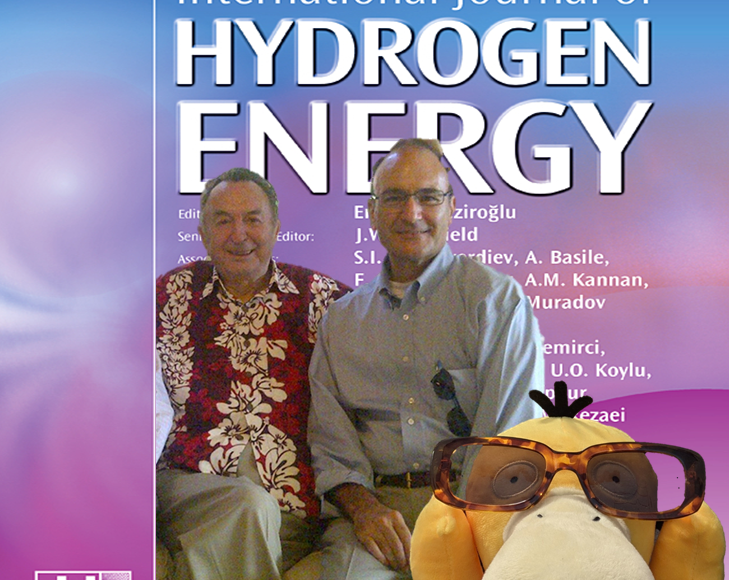

The International Journal of Hydrogen Energy (IJHE) is despite its utterly fraudulent content not some bottom-feeding predatory spigot, but a highly desirable publication venue with impact factor of bynow 8.1. It is an extremely lucrative business of the Turkish family Veziroglu, all thanks to the publisher Elsevier. Retractions may be ordered for other Elsevier journals, but IJHE remains off limits.
It is yet another journal Mu Yang scrutinised. Will the Turkish mafia be after her now? Maybe there’s a good reason why Elsevier is afraid to interfere with the business at IJHE?
Issues of global relevance
“I like ImageTwin, but seeing things with just eyes is like hand-to-hand combat….” – Mu Yang

Family business
IJHE is not Elsevier’s property. The journal was founded in the 1970ies by the Turkey-born professor of University of Miami in USA, Turhan Nejat Veziroglu, and owned via his private company “Hydrogen Energy Publications LLC” and the so-called “International Association for Hydrogen Energy” (IAHE), which Veziroglu owned as well via his named trust, until his recent death at the Methuselahan age of 100 in September 2024. Noteworthy, he only retired as professor in Miami in 2009, after 47 years in service there.
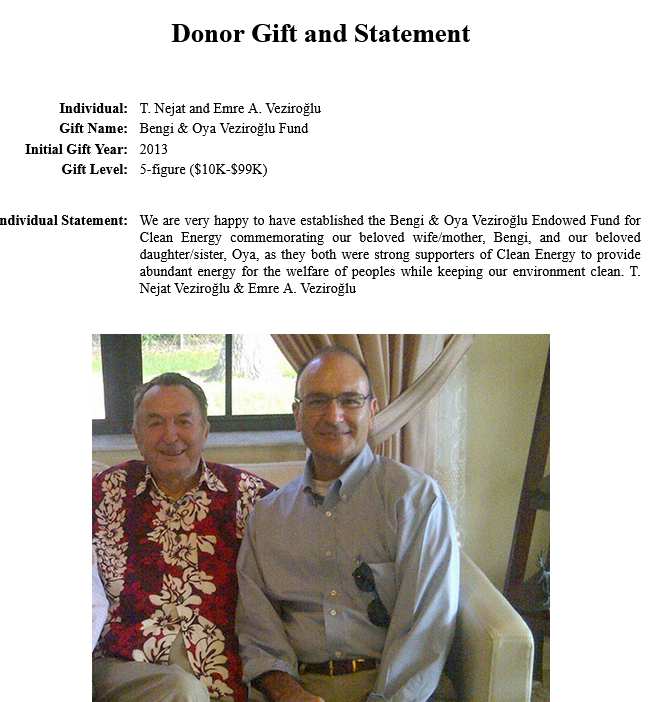
What with the owner’s old age, the actual Editor-in-Chief has been for years his son, Emre A. Veziroglu, a quality assurance manager working in businesses unrelated to hydrogen technology. Veziroglu Jr has no detectable scientific training, his highest academic degree is MSc in Mechanical Engineering. But it doesn’t matter, because his business is not to peer review scientific papers, but to make sure as many of them as possible get published, so that money for the Veziroglu family and for Elsevier keeps flowing.
Another key figure is Veziroglu Sr’s second and 44 years younger wife Ayfer Veziroglu, a fellow Turkish national who used to be his former student in Miami. In 2022, she then started work at IJHE and IAHE, and married her boss in 2006 at his ripe age of 82, eight years after the death of his first wife. One year later, the great man sired a child with his new wife, which was publicly celebrated.
Ayfer Veziroglu took over various senior executive roles in the Veziroglu hydrogen energy businesses, including as IJHE‘s financial manager. Despite her busy schedule, she managed to publish around 20 research papers, in IJHE of course. Since her husband’s death she became president of IAHE, on top of being president of Hydrogen Energy Publications LLC.
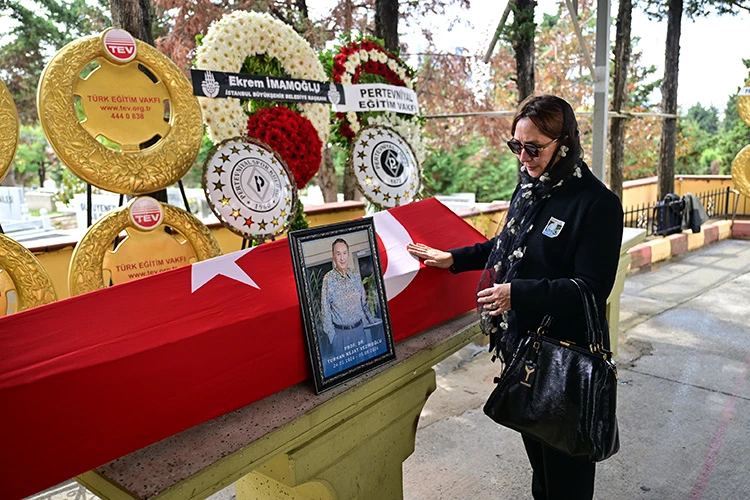
IJHE‘s editorial board is as good as exclusively male. Obviously old Veziroglu valued women for some qualities, but certainly never as scientists.
Santilli-Galilei Gold Medal for Lifetime Commitment to True Scientific Democracy
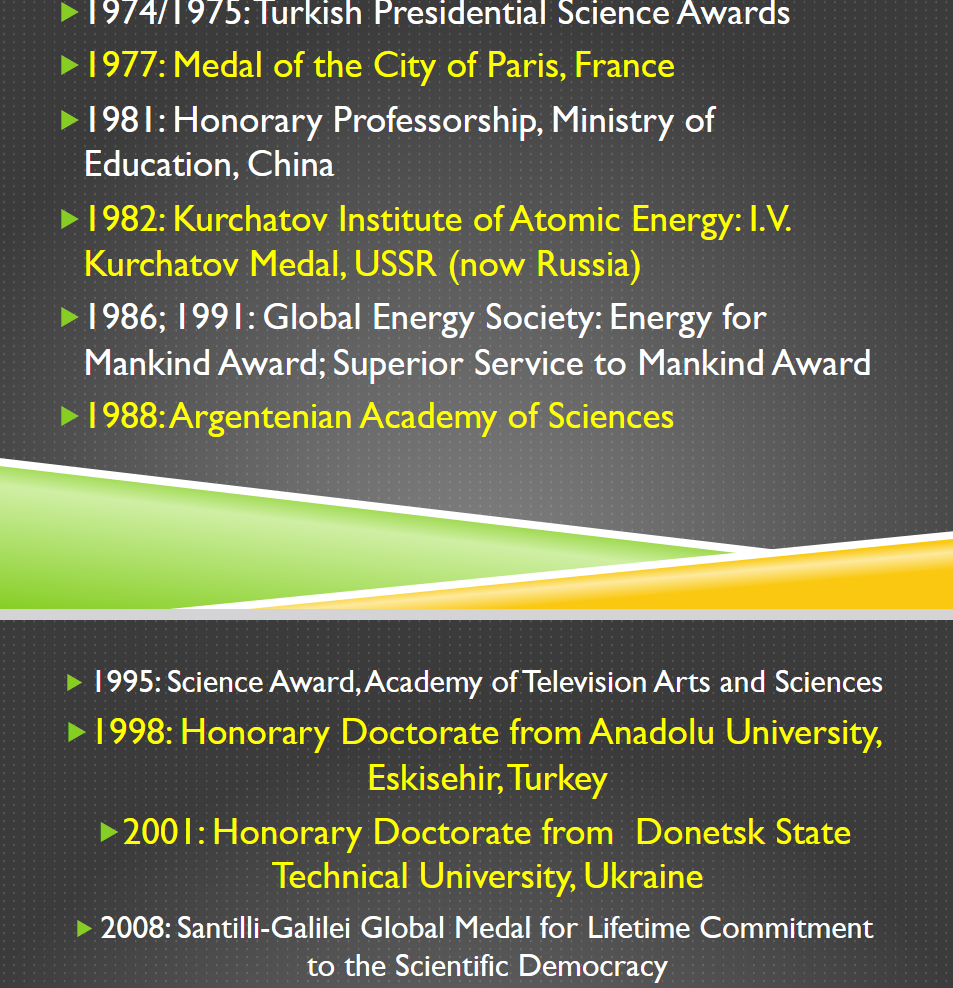
A peculiar detail about Veziroglu Sr is that on the height of the cold war in 1982, this American professor was allegedly awarded the Kurchatov Medal by the Kurchatov Institute of Atomic Energy in USSR. Or so he claimed, since his name is not on the official list, and the Kurchatov Medal was issued every 3 years (i.e., not in 1982), and to Soviet citizens.
Another award Veziroglu Sr boasted is connected to a friend in Florida: the loony inventor, business scammer and antisemite Ruggiero Santilli. Read about this toxic Italian here:

Another Jewish conspiracy against Ruggiero Santilli!
EU Commission gives €6 million to an obscure German start-up, promising to convert sewage to synthetic fuels. Internet sources suggest behind all this is “Professor” Ruggiero Santilli, the litigious “Florida Genius”, eternally self-appointed Nobel Prize candidate and sock- puppeteering businessman. Exactly the kind of “fringe scientist” Smut Clyde likes to write about!
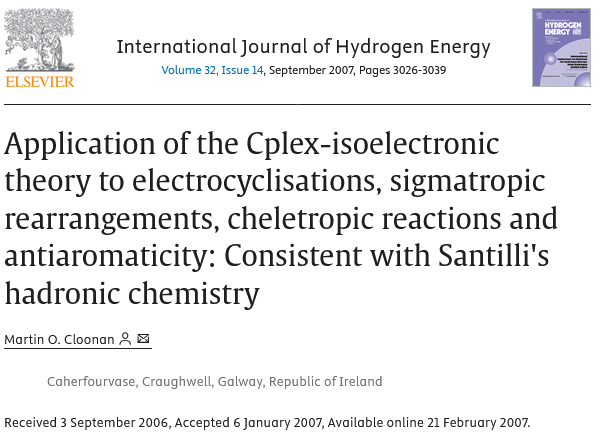
Santilli published in Veziroglu’s “peer reviewed” journal unhinged self-promoting editorials and nonsense “research” papers, sometimes under an assumed name of a fictional sockpuppet named “J.V. Kadeisvilli” (whom Santilli then “killed” in 2014). “Martin O. Cloonan” was obviously yet another fictional sockpuppet of Santilli’s who contributed papers to IJHE to attack the critics of Santilli’s idiocies.

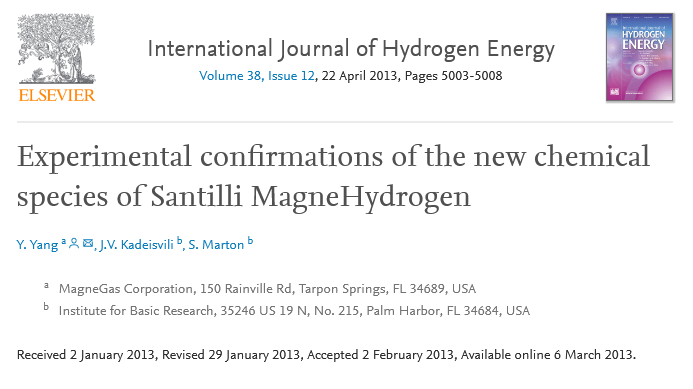
Experimental Confirmations of the New Chemical Species of Santilli
MagneHydrogen (2013) doi: 10.1016/j.ijhydene.2013.02.015
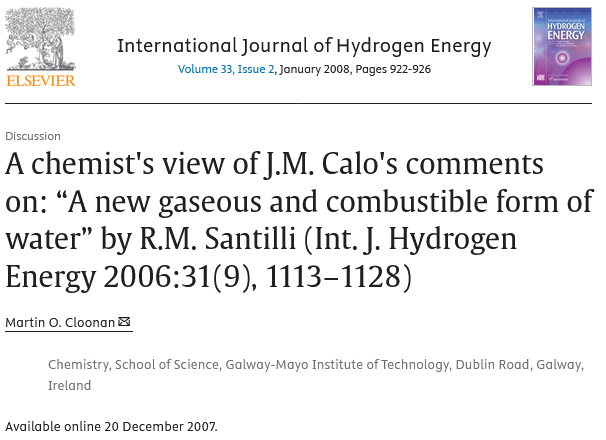
The publishing relationship worked so well that the Italian antisemite honoured Veziroglu Sr in 2008 with a ridiculously fake award “Santilli-Galilei Gold Medal for Lifetime Commitment to True Scientific Democracy”, which Veziroglu received in person and included in his official CV ever since. This was reported by Sylvie Coyaud, to which Santilli retorted with worst misogyny and antisemitic slurs using yet another sockpuppet of “Luca Petronio”.
Citations yes, retractions no
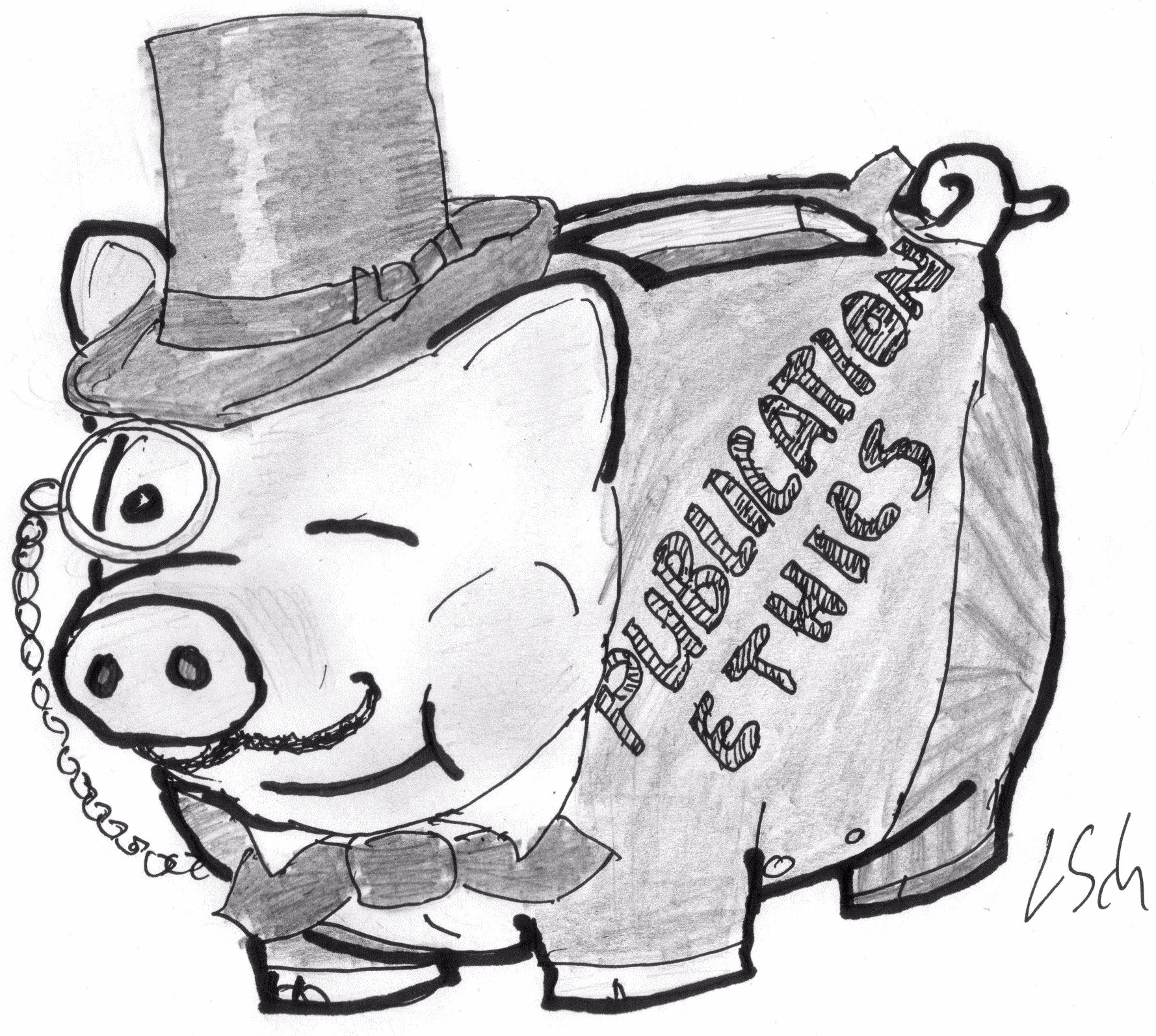
Publication ethics was always something Veziroglu liked to wipe his bottom with. IJHE owners used to routinely extort authors for citations to their journal, as Elisabeth Bik once tweeted:
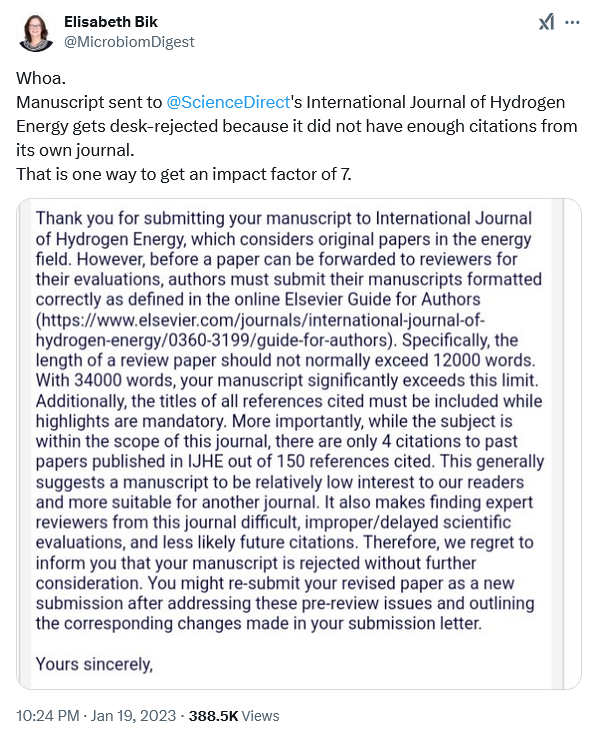
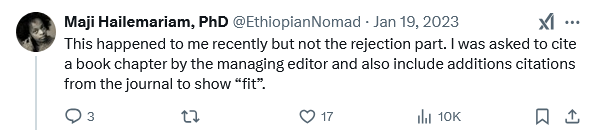

No wonder that IJHE impact factor continues to grow every year. Also the editors and reviewers extort citations. That’s what recently happened when honest authors accidentally submitted a manuscript to IJHE:
“As strongly requested by the reviewers, here we cite some references [[35], [36], [37], [38], [39], [40], [41], [42], [43], [44], [45], [46], [47]] although they are completely irrelevant to the present work.”
That was a paragraph in the Introduction, for all the world to see in this paper:
Fan-Xi Yang , Yi-Fei Zhu , Shuo Cao, Chao-Ming Wang , Ying-Jie Ma , Rui Yang , Qing-Miao Hu Origin of the distinct site occupations of H atom in hcp Ti and Zr/Hf International Journal of Hydrogen Energy (2024) doi: 10.1016/j.ijhydene.2024.10.197


All these papers the IJHE authors had to reference are “authored” by two russian papermill fraudsters, the brothers Alex and Sergey Trukhanov. You can probably imagine who the reviewers were.
I previously wrote about various contributors to IJHE. For example, Fatih Sen, the Turkish fraudster and papermill published a lot there, those papers exposed as fraudulent were successfully corrected by the wise Editor-in-Chief.

Don’t mess with Fatih Sen
Fake nanotechnology is always fun, but it does get extreme here. Word of advice: if you are in Turkey, better don’t point fingers at Professor Fatih Sen’s research. Things get broken easily.
The Iranian papermill fraudster Yasser Vasseghian ran his own special issue there in 2023, dedicated to fellow papermillers. The clown Ali Fakhri is a Trusted Peer-Reviewer at IJHE. The list could continue endlessly.

Synthetic Communications with Ali Fakhri and his real or imaginary friends
“the entire dramatis personae seem to have crawled out of our man’s sock drawer, and the page-count of Synthetic Communications would be grievously impoverished without his contributions, whether direct or uncredited.”- Smut Clyde

Unlike fraud and papermilling, retractions are something IJHE does not condone. Here a rare recent case:
Abdul Qayoom Mugheri , Muhammad Soomar Samtio , Ali Asghar Sangah , Jawad Hussain Awan , Shahzad Ahmed Memon Promoting highly dispersed Co3O4 nanoparticles onto polyethyne unraveling the catalytic mechanism with stable catalytic activity for oxygen evolution reaction: From fundamentals to applications International Journal of Hydrogen Energy (2021) doi: 10.1016/j.ijhydene.2021.08.074
“The complaint takes issue with 5 manuscripts published in the last few years which contain figures and graphs that were not properly cited and for which Dr. Mugheri did not have permission to publish. https://doi.org/10.1016/j.ijhydene.2021.11.007 https://doi.org/10.1016/j.ijhydene.2021.10.173 https://doi.org/10.1016/j.ijhydene.2021.04.122 https://doi.org/10.1016/j.ijhydene.2021.08.074 https://doi.org/10.1016/j.ijhydene.2020.06.005.”
Retraction from 19 November 2024, signed by Abdul Qayoom Mugheri
The DOI links above were all broken, I fixed them. They list 5 papers by Abdul Qayoom Mugheri in IJHE (including the above) which all received the same retraction notice. In June 2024, Mugheri retracted a paper in a Springer journal, the notice also mentioned “An investigation by the University of Sindh has also ruled that the authors did not have permission to publish the data presented in this article.”
Here is another recent retraction in IJHE, the paper was flagged by Smut Clyde in January 2022:
Xuhao Li, Minghao Zuo, Jiahao Wu, Li Feng, Zizeng Wang, Bingzhi Liu Wet chemistry synthesis of CuFe2O4/CdSe heterojunction for enhanced efficient photocatalytic H2 evolution under visible irradiation International Journal of Hydrogen Energy (2021) doi: 10.1016/j.ijhydene.2021.01.168
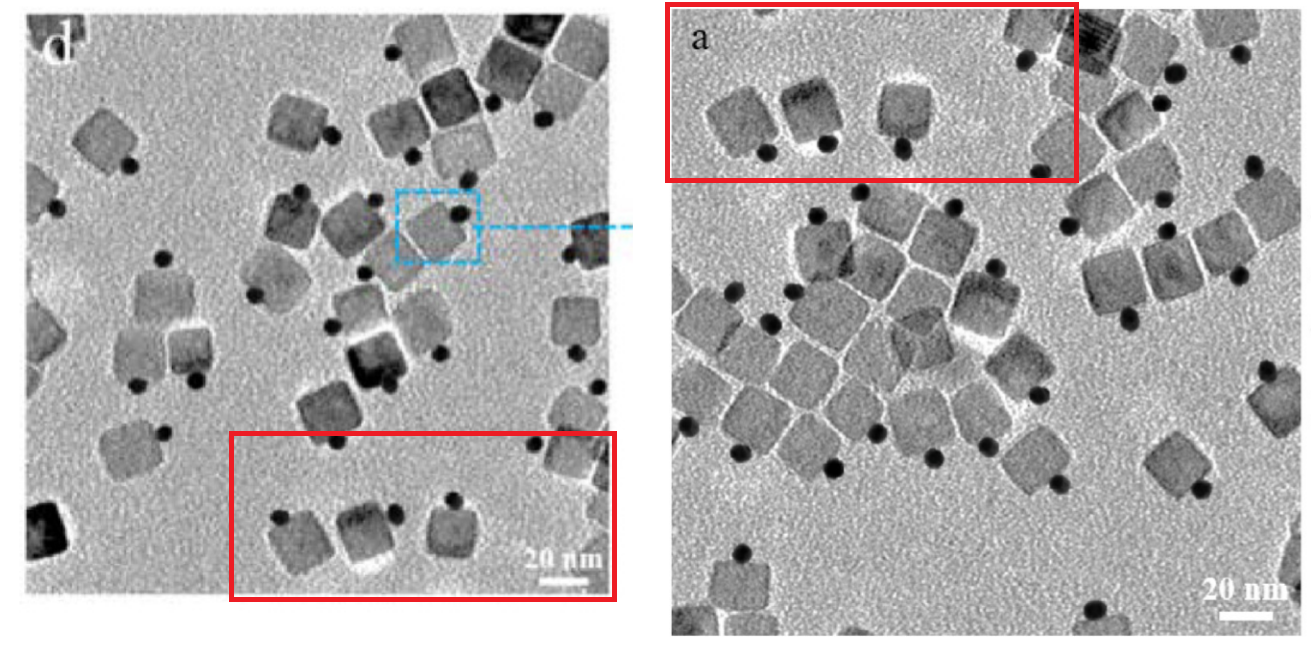
Also, as Smut Clyde noted:
“The References are nonsensical. The most charitable explanation is that the authors obtained a pre-existing list of generic references and slotted entries from it into the [citation here] gaps in the manuscript, more or less at random. The same list is used in numerous Ceramics International papers, producing the same incongruous absurdities – e.g. Li et al (2021), Zhou et al (2021).“
The brief and totally not unhinged retraction notice from 19 November 2024 was attributed to Li Feng:
“I found that my team and our collaborators have used the wrong images and pictures in their experiments, or they were using them in a reckless way.”
Those were the only these 6 retractions which IJHE allowed in 2024, before that, the last retractions in that journal appeared in 2018. All ten of them affected some A. Salar Elahi and had the same text celebrating Veziroglu’s borderless wisdom and integrity:
“This article has been retracted at the request of the Editor-in-Chief.
After a thorough investigation, the Editor has concluded that the acceptance of this article was based upon the positive advice of at least two illegitimate reviewer reports. The reports were submitted from email accounts which were provided to the journal as suggested reviewers during the submission of the article. Although purportedly real reviewer accounts, the Editor has concluded that these were not of appropriate, independent reviewers.
This manipulation of the peer-review process represents a clear violation of the fundamentals of peer review, our publishing policies, and publishing ethics standards. Apologies are offered to the reviewers whose identities were assumed and to the readers of the journal that this deception was not detected during the submission process.”
According to his PubPeer record and Retraction Watch, the Iranian scholar Salar Elahi by now managed to achieve over 60 retractions. It is quite possible that those Salar Elahi retractions in 2018 and the new ones in 2024 only happened because someone failed to pay.
Smut Clyde discussed some ridiculously fake IJHE papers from India in this article:
Do papermillers dream of eclectic journals?
“I focus on the sprawling parody literature devoted to the three Es of Energy, Economy and the Environment. Together they […] freeload on the authentic literature on energy efficiency and pollution reduction (while diluting, distracting and discrediting them).” – Smut Clyde
So let’s finally have a look at what this journal publishes. Unless stated otherwise, the evidence was posted on PubPeer by Mu Yang.
Gate keepers, gate keeping
A good start is with its own editors.
Meet the assistant editor of IJHE, Mehran Rezaei of Iran University of Science and Technology in Tehran, and his hand-made contribution:
Meysam Nezhadhassan Ghazimahaleh , Mehran Rezaei , Seyed Mehdi Alavi , Ehsan Akbari , Mohammad Varbar Synthesis of Ni–FeCeO2 by mechanochemical method for high-temperature water-gas shift reaction International Journal of Hydrogen Energy (2024) doi: 10.1016/j.ijhydene.2024.10.438


And another cartoon by the editor Rezaei:
Javad Hafezi-Bakhtiari , Amin Bazyari , Mehran Rezaei , Ehsan Akbari , Amirhosein Rajabzadeh Nobakht Elevating catalyst performance: How hierarchical Alumina’s phases enhance Cu/Al2O3 in reverse water-gas shift (RWGS) reaction International Journal of Hydrogen Energy (2024) doi: 10.1016/j.ijhydene.2024.08.061

“Fig 7a: The green and brown traces each has a spot where the trace doubled up onto itself. There is also a slight backtracking on the brown trace.”
These XRD spectra are at least not hand-drawn, just stolen somewhere and copy pasted:
Faezeh Mirshafiee , Mehran Rezaei Co/Fe3O4@GO catalyst for one-step hydrogen generation from hydrolysis of NaBH4: Optimization and kinetic study International Journal of Hydrogen Energy (2023) doi: 10.1016/j.ijhydene.2023.04.337

Naturally, there is more fake stuff by Rezaie on PubPeer. much of it in his own IJHE.
Now meet the IJHE Associate Editor and regular contributor, the russian academician Suleyman Allakhverdiev. According to his CV, he is lab head at two institutes of Russian Academy of Sciences in Moscow, professor at Lomonosov Moscow State University and Moscow State University of Physics and Technology, plus lab head at an institute of Azerbaijan National Academy of Sciences in Baku, professor at Al-Farabi Kazakh National University in Almaty, at King Saud University in Riyadh, Saudi Arabia, at Foshan University, China, and at Daegu Gyeongbuk Institute in Korea.
In 2016, Allakhverdiev organised a conference in russia on ““Photosynthesis Research for Sustainability”, where Veziroglu Sr spoke about “global solutions to
global problems” and was celebrated, see this Powerpoint presentation, with family photos.
You know me, I am the first to applaud russian science. Especially when it’s artisan hand-made.
Nouf H. Alotaibi , Jafar Hussain Shah , Mehar Un Nisa , Saikh Mohammad , Hüseyin Günhan Özcan , Abdul Ghafoor Abid , Suleyman I. Allakhverdiev Catalytic enhancement of graphene oxide by trace molybdenum oxide nanoparticles doping: Optimized electrocatalyst for green hydrogen production International Journal of Hydrogen Energy (2024) doi: 10.1016/j.ijhydene.2024.03.032


More from this rascist academy clown with crayons:
Nouf H. Alotaibi , Sumaira Manzoor , Shahroz Saleem , Saikh Mohammad , Muhammad Khalil , Şenay Yalçin , Abdul Ghafoor Abid , Suleyman I. Allakhverdiev Rational development of PPy/CuWO4 nanostructure as competent electrocatalyst for oxygen evolution, and hydrogen evolution reactions International Journal of Hydrogen Energy (2024) doi: 10.1016/j.ijhydene.2024.02.125

You may notice the absence of other russian authors. That’s probably because Allakhverdiev is a stingy git who only pays the papermills for his own authorship. Despite that being a very cheap papermill, look at those hand-drawn fakes:
Munirah D. Albaqami , Mehar Un Nisa , Sumaira Manzoor , Jafar Hussain Shah , Saikh Mohammad , Senay Yalcin , Abdul Ghafoor Abid , Suleyman I. Allakhverdiev Controlled fabrication of various nanostructures iron-based tellurides as highly performed oxygen evolution reaction International Journal of Hydrogen Energy (2024) doi: 10.1016/j.ijhydene.2024.02.051


Aptly called Fabrication:
Asma A. Alothman , Jafar Hussain Shah , Khuolwod A. Aljadoa , Gürkan Soykan , Şenay Yalçin , Abdul Ghafoor Abid , Suleyman I. Allakhverdiev Fabrication of heterojunction electrode based on Fe2O3@CuO-400 nanocomposite constructed for hydrogen production International Journal of Hydrogen Energy (2024) doi: 10.1016/j.ijhydene.2024.02.354


There is more by Allakhverdiev on PubPeer.
Nobel friends from russia

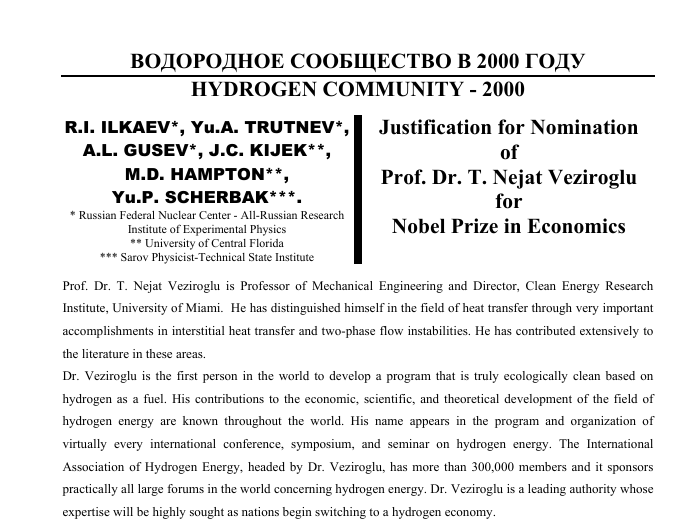
On this occasion, meet another russian contributor to IJHE, Alexander Gusev, who among other russian and occasional Serbian honours is also veteran of russian armed forces. In 2000, Gusev and his russian friends nominated Veziroglu for the Nobel Peace Prize in Economics, which the IJHE owner boasted on his CV ever since.
On the right, is Gusev’s citation index. Here is the explanation why it looks like this:
Alexander L. Gusev , Aydin M. Gafarov , Panah H. Suleymanov , Ibrahim A. Habibov , Rauf Kh. Malikov , Yashar H. Hasanov , A.I. Levina , Pavel Mikheev , Ruslan A. Ufa Some aspects of reliability prediction of chemical industry and hydrogen energy facilities (vessels, machinery and equipment) operated in emergency situations and extreme conditions International Journal of Hydrogen Energy (2024) doi: 10.1016/j.ijhydene.2024.07.462


However, at least some peaks appear to lean/back-track, so that there is 1X –> 2Y correspondence.”
There are other weird things with that paper, for example silly AI illustrations or this:

Pityokteines curvidens: “A.L. Gusev is the first and corresponding author of the current paper. […] Could the authors also please clarify how does the scope of the current paper relate to the Large Hadron Collider?”
Now lets welcome another russian scholar, Rustem Zairov of Kazan Federal University:
Muhammad Sohail , Muhammad Ayyob , Anjie Wang , Zhichao Sun , Asad Syed , Abdallah M. Elgorban , Ali H. Bahkali , Rustem Zairov , Iqbal Ahmad Cobalt-based CoSe/CoO heterostructure: A catalyst for efficient oxygen evolution reaction International Journal of Hydrogen Energy (2024) doi: 10.1016/j.ijhydene.2023.12.278


Same group of friends from russia, China, Pakistan and Saudi Arabia (more on PubPeer):
Muhammad Sohail , Muhammad Ayyob , Anjie Wang , Zhichao Sun , Lamia Abu El Maati , Reem Altuijri , Rustem Zairov , Iqbal Ahmad An efficient Fe2Se3/Fe2O3 heterostructure electrocatalyst for oxygen evolution reaction International Journal of Hydrogen Energy (2023) doi: 10.1016/j.ijhydene.2023.11.054
By Harpalus amputatus

Draw like a scientist contest
Fake EDX spectra are rather popular at IJHE. Here, those were hand-drawn. The gang leader is Haifa Alyousef (PubPeer record), an associate of the Egyptian fraudster Kh S Shabaan (read January 2025 Shorts):
Mehru Nisa , Haifa A. Alyousef, Albandari. W. Alrowaily , B.M. Alotaibi , Mohammed F. Alotiby , Gul Khan , Abdullah G. Al-Sehemi , A.M.A. Henaish Development of BaMnO3 nanoparticles embedded on rGO nanosheets via facile hydrothermal route to improve water oxidation International Journal of Hydrogen Energy (2024) doi: 10.1016/j.ijhydene.2024.04.320

Reese Richardson: “Beyond the background being unusual, the peak shapes are unusually broad (there should be much more separation between the peaks in this spectrum) and the Mn K family peaks should start at ~5.9 keV. Here, they appear to start at ~6.5 keV.”
These people around Alyousef are very unconvincing fakers who probably never saw a real analysis in their life:
Mukhtiar Hussain , Albandari.W. Alrowaily , Haifa A. Alyousef , B.M. Alotaibi , Mohammed F. Alotiby , Muhammad Jahangir Khan , Abdullah G. Al-Sehemi , Muhammad Imran Saleem Improving the electrocatalytic efficiency of hydrothermally developed ZnMnO3 with rGO for oxygen evolution reaction activity International Journal of Hydrogen Energy (2024) doi: 10.1016/j.ijhydene.2024.07.372

Tetraphleps parallelus: “Abnormal noises and peaks”
Here we have a celebrity author, Pau Loke Show. Unfortunately the cheap papermill he worked with failed to write his name properly:
Kumar Premnath , Jagannathan Madhavan , Saradh Prasad , Mamduh J. Aljaafreh , Mohamad S. AlSalhi , Show Pou Loke Ultra-efficient, low-cost and carbon-supported transition metal sulphide as a platinum free electrocatalyst towards hydrogen evolution reaction at alkaline medium International Journal of Hydrogen Energy (2022) doi: 10.1016/j.ijhydene.2021.09.120

Again, hand-drawn EDX spectra in IJHE:
Zahoor Awan , Zafar Khan Ghouri , Saud Hashmi Influence of Ag nanoparticles on state of the art MnO2 nanorods performance as an electrocatalyst for lithium air batteries International Journal of Hydrogen Energy (2018) doi: 10.1016/j.ijhydene.2017.12.083


The authors of this paper obviously stole the data somewhere and then edited it:
Praveena Gurusamy , Sundara Venkatesh Perumalsamy, Paulraj Gnanasekar , Jeganathan Kulandaivel , Thangadurai Paramasivam , Thamilmaran Pandian Synthesis of Ni-doped 1T/2H MoS2 nanoparticles as an efficient and stable bifunctional electrocatalyst for overall water-splitting International Journal of Hydrogen Energy (2024) doi: 10.1016/j.ijhydene.2024.06.214


A certain Hafiz Muhammad Tahir Farid, who has almost 80 papers on PubPeer and who featured in the article below, offers nice hand-painted cartoons also.
The Incorrigible Elsevier
“I woke up seeing Elsevier’s giant middle finger in front of my face.” – Mu Yang

Here, Reese Richardson criticised the EDX spectra in Figure 2D with “The shapes of the peaks are strangely round, almost parabolic.”
Hossam Donya, Salma Aman, Naseeb Ahmad, Hafiz Muhammad Tahir Farid, Taha Abdel Mohaymen Taha Development of SnCo2O4 spinel supported on the rGO nanosheet with the improved electrochemical performance of OER activity International Journal of Hydrogen Energy (2024) doi: 10.1016/j.ijhydene.2023.06.238


Fig 5c: XPS cartoon, drawn by an alcoholic.
In October 2024, the last author Taha Abdel Mohaymen Taha informed the PubPeer community of a published Erratum from 19 August 2024, which was worded as such:
“Dear Editor,
I hope this email finds you well. I am writing to address an issue regarding Fig. 2 d (EDX) in my recently published paper […] In my recent review of our work, I noticed that the EDX image presented in Fig. 2 d (EDX) were not the correct images. Further investigation revealed that a mix-up of old and new files (unintentional) in a similar folder led to this error and wrong labelling in the EDX spectrum. This unintended mix-up of the files led us to this error in the current paper. We sincerely apologize for this oversight and any confusion it may have caused.
We have informed all the authors of this paper about this mix-up and have made a detailed investigation into the validity of the results, which confirms that the conclusion and scientific merit of the work remain unaffected.
We believe in maintaining high research integrity standards and honest representation of our work for the advancement of science. As such, we are contacting you as soon as we become aware of this issue.
To ensure the accuracy and integrity of the publication, we request the issuance of a correction of this unintentionally error in Fig. 2 d (EDX), which is provided in the attached file.
I appreciate your assistance in urgently resolving this matter, and as a corresponding author, my team and I are available for any further information or clarification needed.
Sincerely,
Hafiz Muhammad Tahir Farid”
A faithful customer
Now let’s turn to a very regular contributor of IJHE, Masoud Salavati-Niasari, professor at University of Kashan in Iran. He also likes to paint, and he even admits it.
Meghdad Pirsaheb , Tahereh Gholami , Elmuez A. Dawi , Hasan Sh Majdi , Furqan S. Hashim , Hooman Seifi , Masoud Salavati-Niasari Green synthesis and characterization of SnO2, CuO, Fe2O3/activated carbon nanocomposites and their application in electrochemical hydrogen storage International Journal of Hydrogen Energy (2023) doi: 10.1016/j.ijhydene.2023.03.186


This is also pretty, maybe Salavati-Niasari’s mum will hang it on her fridge:
Foroozan Samimi , Maryam Ghiyasiyan-Arani , Masoud Salavati-Niasari Morphology engineering of Ni6MnO8/NiMn2O4 nanostructures through in-situ solvothermal synthesis controlling for electrochemical hydrogen storage inquiries International Journal of Hydrogen Energy (2022) doi: 10.1016/j.ijhydene.2022.07.275


Here some more hand-drawn EDX spectra histograms:
Samira Alinavaz , Masoud Salavati-Niasari , Maryam Ghiyasiyan-Arani Sonochemical synthesized Gd4Al2O9 nanostructures modified with carbonous compounds for electrochemical hydrogen storage application International Journal of Hydrogen Energy (2024) doi: 10.1016/j.ijhydene.2024.07.065


As in previous case, Salavati-Niasari replied on PubPeer with better-quality forgeries and this comment:
“EDS analysis is a qualitative analysis and the obtained results just reported as a figure and table by operators. Our research team just modified the quality and color of the figures.“
He replied with the same comments here:
Samira Alinavaz , Maryam Ghiyasiyan-Arani , Elmuez A. Dawi , Masoud Salavati-Niasari Gd3Fe5O12/MgAl-LDH nanocomposites: Sonochemical synthesis, optimization and electrochemical hydrogen storage studies International Journal of Hydrogen Energy (2023) doi: 10.1016/j.ijhydene.2023.04.030


And here Salvavati-Niasari openly admitted to photoshopping:
Masoud Hosseini , Mojgan Ghanbari , Elmuez A. Dawi , Makarim A. Mahdi , Safaa H. Ganduh , Layth S. Jasim , Angum M.M. Ibrahim , Masoud Salavati-Niasari Investigations of nickel silicate for degradation of water-soluble organic pollutants International Journal of Hydrogen Energy (2024) doi: 10.1016/j.ijhydene.2024.02.275


Salavati-Niasari’s honest reply:
“Thank you for your attention. We just painted by Photoshop.“
He admitted the same in this paper:
Kamran Mahdavi , Mojgan Ghanbari , Elmuez A. Dawi , Masoud Salavati-Niasari Holmium silicate nanostructures: Simple auto-combustion preparation, characterization, and scrutiny of photocatalytic performance International Journal of Hydrogen Energy (2024) doi: 10.1016/j.ijhydene.2023.07.275


This is truly enlightening:
Sahar Zinatloo-Ajabshir , Zahra Salehi , Omid Amiri , Masoud Salavati-Niasari Green synthesis, characterization and investigation of the electrochemical hydrogen storage properties of Dy2Ce2O7 nanostructures with fig extract International Journal of Hydrogen Energy (2019) doi: 10.1016/j.ijhydene.2019.05.137

Again, Salavati-Niasari replied:
“EDS analysis is a qualitative analysis and the obtained results just reported by operator. Our research team just modified the quality and color of the figure. The original EDS pattern is attached below for your confident.”
Mu Yang analysed what he supplied. It was of course fake:

Mu then found more:


This guy now has almost 170 fake papers on PubPeer, thanks to Mu Yang and her colleagues, many in IJHE.
Microscopic talents
In this ALCHEMY paper of his, Salavati-Niasari sh*tposted about electron microscopy:
Maryam Masjedi-Arani , Masoud Salavati-Niasari Novel synthesis of Zn2GeO4/graphene nanocomposite for enhanced electrochemical hydrogen storage performance International Journal of Hydrogen Energy (2017) doi: 10.1016/j.ijhydene.2017.05.118

Scanning electron microscopy (SEM) image was applied on LEO-1455VP equipped with an energy dispersive X-ray spectroscopy.
However, Figures 3 and S1 show images from a TESCAN MIRA3.”

“Yes, you are right. Unfortunately, we made a mistake in writing the physical instrument of SEM microscopy. SEM images were obtained on TESCAN MIRA3, equipped with energy-dispersive X-ray spectroscopy. […] EDS analysis is a qualitative analysis and the obtained results just reported as a figure and table by operators. Our research team just modified the quality and color of the figures.“
Here, the explanation became more creative:
Hamed Safajou , Mojgan Ghanbari , Omid Amiri , Hossein Khojasteh , Farzad Namvar , Sahar Zinatloo-Ajabshir , Masoud Salavati-Niasari Green synthesis and characterization of RGO/Cu nanocomposites as photocatalytic degradation of organic pollutants in waste-water International Journal of Hydrogen Energy (2021) doi: 10.1016/j.ijhydene.2021.03.175


This is how our Iranian friend assured his critics:
“It seems that the term “alchemical reactions” was used in place of “chemical reactions” in the text. While this might have been an unintentional error, it’s worth noting that “alchemical” carries historical and mystical connotations, […] Since our university does not have an electron microscope, samples are sent to various centers to perform the test, which charges a fee. Therefore, the name of Mashhad University of Medical Sciences is not mentioned in the acknowledgment section.”
Actually, for all we know, the Iranian regime might indeed operate a papermill at the Mashad University, where Iranian scholars can buy authorships for a fee.
Journal of Molecular Liquids vs One-Man Papermills
Mu Yang catches two crooks, Ayman Atta and S Muthu, who flooded one Elsevier journal (and several others) with ridiculous hand-drawn fraud. Whom to believe, the peer review, or your own eyes?
Here is another Highly Cited Researcher from Iran, Alireza Nezamzadeh-Ejhieh, sh*tposting about electron microscopes:
Neda Raeisi-Kheirabadi, Alireza Nezamzadeh-Ejhieh A Z-scheme g-C3N4/Ag3PO4 nanocomposite: Its photocatalytic activity and capability for water splitting International Journal of Hydrogen Energy (2020) doi: 10.1016/j.ijhydene.2020.09.028

SEM images were obtained by a Seron technology AIS-2100 Scanning electron microscope 2008 instrument.
However, Figure 2 shows images from a TESCAN MIRA3.”
His Highly Citedness Nezamzadeh-Ejhieh explained on PubPeer:
“While the initial characterization was indeed performed using a Seron technology AIS-2100 Scanning Electron Microscope, the specific images presented in Figure 2 were acquired using a TESCAN MIRA3 at a later stage of the study. We apologize for any confusion this may have caused.”
You laugh, but most professional journal editors will fall for that nonsense, not just at IJHE.
This is the most recently published paper on the list the sleuths prepared.
Rabia Nawaz , Muhammad Saad , Ali Bahadur, Shahid Iqbal, Sajid Mahmood, Ammar Zidan , Muhammad Shuaib Khan , Rabia Liaquat , Manzar Sohail , Mohammed T. Alotaibi Designing an innovative 2D/2D step scheme α-Fe2O3/BiOBr/MoS2 ternary integrated heterojunction with unparalleled visible-light-induced remarkable photocatalytic H2 evolution International Journal of Hydrogen Energy (2025) doi: 10.1016/j.ijhydene.2024.12.201


Fig. 1. Identical XRD spectra.
As you can see, the fraud continues unabated.
Mu Yang sent to the EiC Enre Veziroglu and Senior Associate Editor John W. Sheffield (Purdue University, USA) an excel file with almost 200 PubPeer threads of fake papers in IJHE. Nobody ever replied.
Donate!
If you are interested to support my work, you can leave here a small tip of $5. Or several of small tips, just increase the amount as you like (2x=€10; 5x=€25). Your generous patronage of my journalism will be most appreciated!
€5.00

 For Better Science
“Actually, for all we know, the Iranian regime might indeed operate a papermill at the Mashad University, where Iranian scholars can buy authorships for a fee.“
There is a papermill in Mashad, that’s certain. But I am not sure whether they do it only for a fee. It could be a paper mill organization that is used by Iranians in different parts of the world to strengthen their publishing records to get rid of people who are doing their job properly, or it could be a paper mill organization used to jump from Iran to different parts of the world.
When I think of Mashad recently, the first thing that pops into my mind is Omid Mahian, who can travel through time to exist in more than one place at the same time, and Ahmad Arabkoohsar, who is often favored by Mahian in co-authored papers. Mahian also has an affiliation with a university in Mashad. I came across it in different articles.
LikeLike
International Journal of Hydrogen Energy Senior Associate Editor John W. Sheffield now has his very own PubPeer entries – for an article published in International Journal of Hydrogen Energy. Perhaps there are more, the first two articles I looked at co-authored by him resulted in today’s finding.
https://pubpeer.com/publications/C33374801A8D34D27FB11F5ABAB7DA#1
https://pubpeer.com/publications/461BA2630B319D09C0D691633B5444#1
LikeLiked by 1 person
There’s three more by Sheffield, bringing the total to five. Back in the summer of 2013 he and his colleagues decided it would be a good idea to submit essentially the same paper to five different Elsevier titles:
LikeLiked by 1 person
I am not here to defencd anyone. However, let me make something clear for you. As an Iranina researcher, I can testimony this on behalf many iranian scholars working correctyl and honestly.
In Iran, due to many reasons, the number of high tech facilites such as SEM, TEM, NMR and others are so rare. Fo instance, as my best knowlodege, we have to SEM mahcines, on at University of Tehran, physics department and one at Mashhad Medical Unveristy. They run by operators becasue the maintance of them difficult, so they do not allow stundets to use them. We have to submit our smaples to one of the above mentioned universities, then they do the job and charge the authors for that job. I belive that you are submitting you jobs sometimes to third companies in other countries. Also, the University of Tehran has a long line, so Mashhad medical university is easiet to do it faster.
I am not sure about the data of those papers, but please consider this although we have some paper mills in Iran, but we have many great schoolars working honestly and truly. So, Please do not discredit a nation just due to the lack of a facility in an univeristy.
LikeLike
But, according to the stream of Iranian chemical bullshit:
Quite a bit more than you tried to describe, eh?
But then again, there is a 76-year-old Masoud Salavati-Niasari, who has zero (or even less than zero?) equipment in the lab, but apparently every single synthesis procedure he invents (without any try-and-fail loop!) is a great success for sustainability. What a genius!
Oh wait, this junk is supposed to be applied, right? Could you point out any specific application adopted by any industry? Or is it a heap of on-paper-only bullshit, useful only for counting publications and trading citations?
At this point, it is safe to assume any piece of chemistry coming from Iran as fake, unless there is decisive evidence to the contrary.
Quite in line with the operational mode of the previous minister of “science and education”, who was caught not just on fakery, but on dumb fakery. Then again, the current one is an “islamic scholar”, which isn’t a sign of improvement.
LikeLiked by 1 person
By the way, this is how sir John Sheffield responds to the notification about this funny paper, featuring a “Hamid Farajian, Solar Energy and Power Electronic Co., Ltd, Tokyo, Japan”. (One can bet on whether this Japanese company with offices in Ankara, Istanbul and Munich exists, despite no online presence.)
LikeLiked by 1 person
what does his message say? Also, that paper does not seem to be on pubpeer? I assume they won’t allow such comment?
LikeLike