Schneider Shorts 2.02.2024 - Three stories about Dana Farber (including a Nobelist!), two stories about the Lille papermille (including a game!), with an "honest" plant scientist, doctors being rewarded, amazing corrections and informative retractions, and how another Nobelist's cell therapy business ended up unsold.
Schneider Shorts of 2 February 2024 – Three stories about Dana Farber (including a Nobelist!), two stories about the Lille papermille (including a game!), with an “honest” plant scientist, doctors being rewarded, amazing corrections and informative retractions, and how another Nobelist’s cell therapy business ended up unsold.
New fun with Dana Farber Cancer Institute researchers. Your read about this affair everywhere, right? Courtesy of Sholto David and all US national and international news:
This time, it affects someone even bigger than the CEO Laurie Glimcher or the bigwigs Bill Hahn or Ken Anderson. A paper by the Dana Farber professor and Nobel Prize 2019 laureate, William Kaelin.
Mycosphaerella arachidis: “Figure 1f: I guess there was a copy and paste error here because from my reading these are supposed to be different cell lines?”
“Figure 2k: Glut-1 blots; these are not pixel perfect duplications, but I think they are similar enough”
Now, there are several ironic aspects to this, not just Dana Farber being in all news with its announced retractions and corrections, and poor Sholto being beset by journalists who fall over each other writing mostly the same story while possibly mistaking Ivan Oransky for Sholto’s father.
The main ironic aspect is of course Kaelin’s co-recipient of the 2019 Nobel Prize in Physiology of Medicine, Gregg Semenza, the Johns Hopkins University professor who had to retract TEN papers by now for data forgery.
“Even after people have been telling you for, you know, 20 years or more that it’s going to happen, no one expects it.” -Gregg Semenza, Nobel Prize winner 2019
On the occasion of Semenza’s retractions, Kaelin said in summer 2023:
“These papers that are being retracted now are from a different era and different area of biology,” Professor Kaelin told Times Higher Education. “It’s an unhappy situation, but at least none of the work that led to the Nobel prize is affected.”
But Kaelin’s own dodgy paper on HIF, what about it?
The additional irony is that Kaelin’s and Semenza’s third co-recipient of the 2019 Nobel, Peter Ratcliffe, also published dodgy data whcih he had to correct (read here).
And the extra irony is that Kaelin is considered as the highest authority of research ethics. Like here, an advice to scientists doing experiments, from his 2018 lecture:
“The first questions should be: Is this true and robust? Is someone likely going to be able to build on this?”
But I must be fair. The irresponsible party is likely another Dana Farber researcher and Harvard professor, and senior co-author of this paper – Sabina Signoretti. She already has a worrisome PubPeer record. Mostly thanks to her former postdoctoral mentor Massimo Loda (then at Harvard, now at Weill Cornell) Read about him here:
“At the request of the corresponding author, the JCI is retracting this article. The authors were recently apprised that portions of the p27 blot and cyclin D1 blot of Figure 5A in this publication were duplicated and used to represent different samples. The corresponding author has indicated that previous and subsequent experiments from his and other laboratories support the conclusions reported in Figure 5A; however, the original data are no longer available. No issues have been raised with regard to any of the other data in the paper.”
Here are our two Italian superstars with a fake gel and various Harvard and Dana Farber bigwigs, including Todd Golub who also happens to be merely the Director of MIT’s Broad Institute:
“When rotated 180 degrees, the right two LT bands in Fig. 4A look very similar to the right two LT bands in Fig. 1A.”
Look at this beauty in Nature, with even more US biomedical bigwigs, including Signoretti, Loda, Golub, and MD Anderson’s former President Ronald DePinho and Ron’s former student/current wife and MD Anderson’s current scientific director Lynda Chin!
Zhihu Ding , Chang-Jiun Wu , Gerald C. Chu , Yonghong Xiao , Dennis Ho , Jingfang Zhang , Samuel R. Perry , Emma S. Labrot , Xiaoqiu Wu , Rosina Lis , Yujin Hoshida , David Hiller , Baoli Hu , Shan Jiang , Hongwu Zheng , Alexander H. Stegh , Kenneth L. Scott , Sabina Signoretti, Nabeel Bardeesy , Y. Alan Wang , David E. Hill, Todd R. Golub, Meir J. Stampfer, Wing H. Wong, Massimo Loda, Lorelei Mucci, Lynda Chin, Ronald A. DePinhoSMAD4-dependent barrier constrains prostate cancer growth and metastatic progressionNature (2011) doi: 10.1038/nature09677
“Supplementary Figure 5: Red triangles show an overlap between two histology images. These should show ventral and dorsal prostate.”
I wrote to Signoretti and Kaelin. And even to Dana Farber’s research integrity officer Barrett Rollins. No reply.
Hope this adds clarity
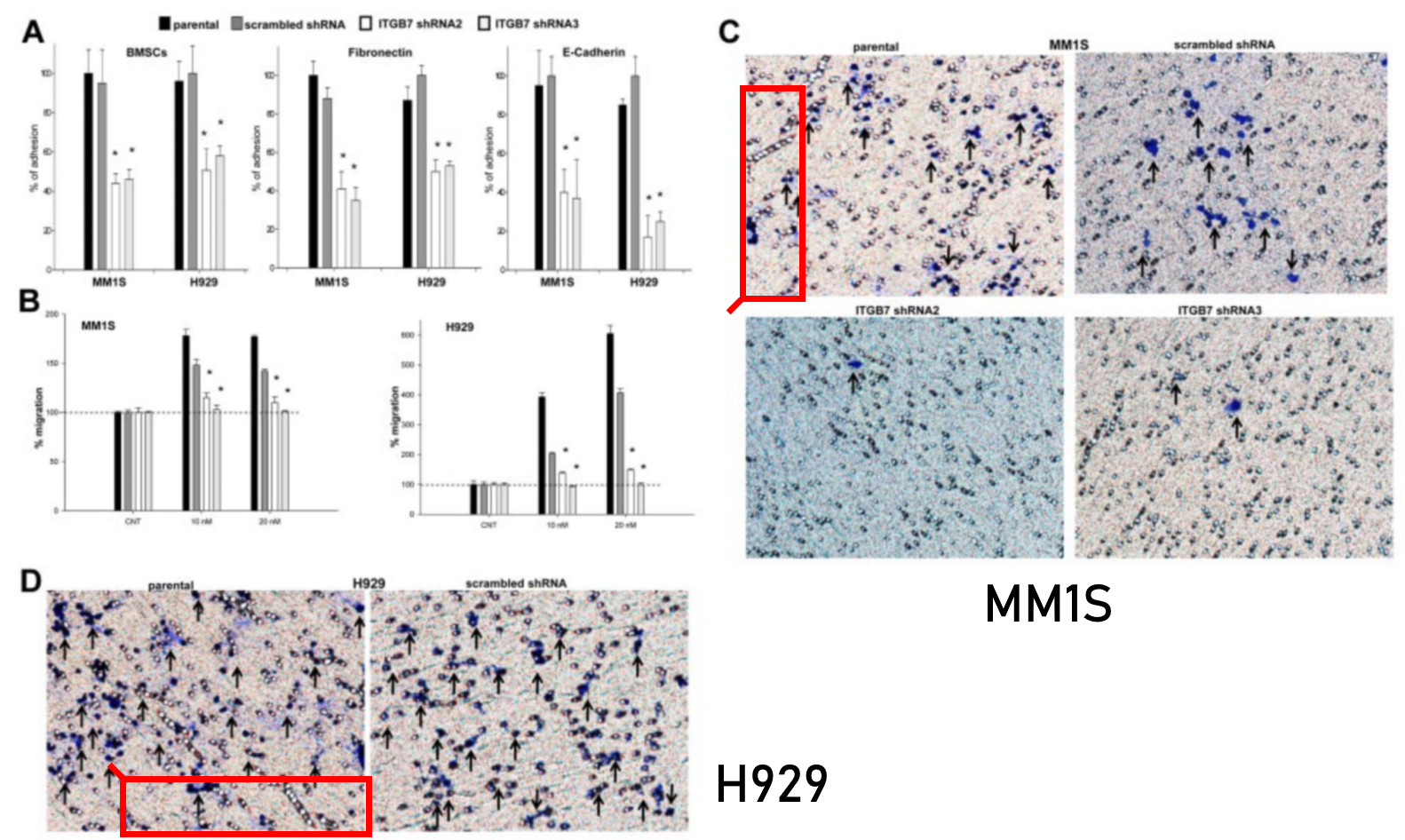
Another Dana Farber-related case. A collaborator of Irene Ghobrial has been acting silly on PubPeer. The issue was also originally flagged by Sholto David.
“Figure 2C and D: Images which should show different cell lines overlap”
The last author Nizar Bahlis, associate professor at the University of Calgary in Canada, and former postdoc mentee of the coauthor Lawrence Boise, posted raw data images on PubPeer and reassured:
“There was indeed an error un uploading the control for MM1S in that figure however this unintentional error does not change the data integrity nor the results or conclusions of this research work.”
Problem is, the raw data Bahlis provided was for OTHER images, which were not criticised as duplicated. Elisabeth Bik visualised it:
Bahlis congratulated BIk:
“”yes indeed you are correct! these images march the original panels but we provided wider field images. […] Obviously we don’t have the original matrigels 11 years after the paper was published to take new images. I hope this adds clarity.”
See, he has SOME images! After some criticism, Bahlis simply put up a replacement image “for the Matrigels for parental MM1S (correct image for mistakenly inserted one in the original publication)” which presumably closes the matter, in his circles.
Coming from our US collaborators
Grégory Vert (or Greg Vert) is a French plant scientist and senior group leader at a CNRS institute in Toulouse. In December 2023, he corrected a Nature paper. Remarkable: the paper was not flagged on PubPeer before.
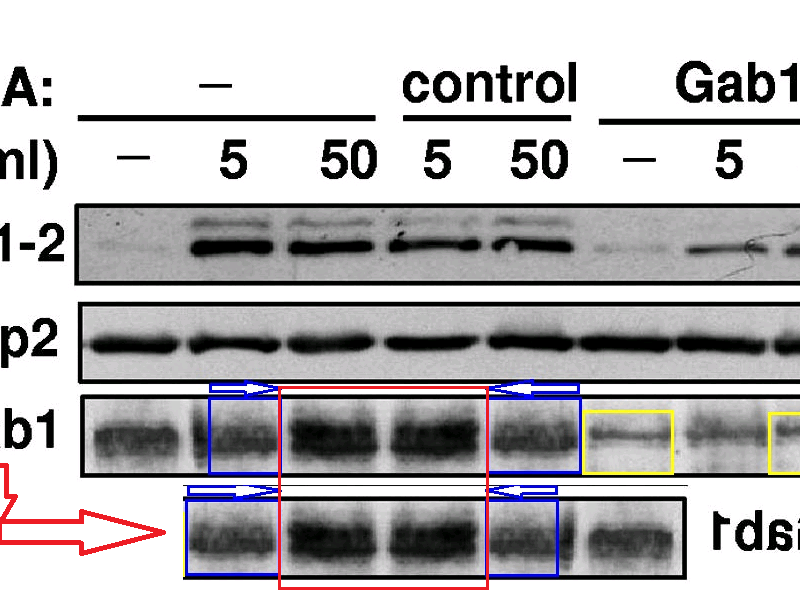
The Author Correction from 18 December 2023 stated (I illustrated the illustrations):
“Figure 3a contains undisclosed cropping to organize samples differently from the original experiment and to show a single untreated control, as no change in BES1 phosphorylation or levels was observed with time in mock-treated plants. In addition, an inversion of lanes between the 2 h and 4 h +BL signals occurred during figure preparation. We have retrieved the original blot (shown in the Supplementary Information) and have produced a corrected panel for Fig. 3a in which cropped regions are shown with dotted lines (Corrected Fig. 3a). The correction does not alter the original conclusions that BL treatment leads to dephosphorylation of the BES1 transcription factor, with little or no change in total BES1 levels in our conditions.
The published Fig. 3b [..] original blot was modified to remove background shadows above P-BES1 signals without mention in the corresponding legend. We have recovered the original blot (shown in the Supplementary Information), and have produced a new panel supporting the prominent role of BL in controlling BES1 phosphorylation status, with no obvious change in the accumulation of BES1 protein in our conditions (Corrected Fig. 3b below). Additionally, the signal corresponding to WT plants grown on BRZ results from the duplication of the BL-deficient det2-1 background lane. […] The western blot shown on the corrected Fig. 3b therefore lacks the WT+BRZ lane and, consistently, the phenotype of a BRZ-grown plant was removed. We apologize for such alteration of the blot. The conclusions of this experiment remain unchanged.
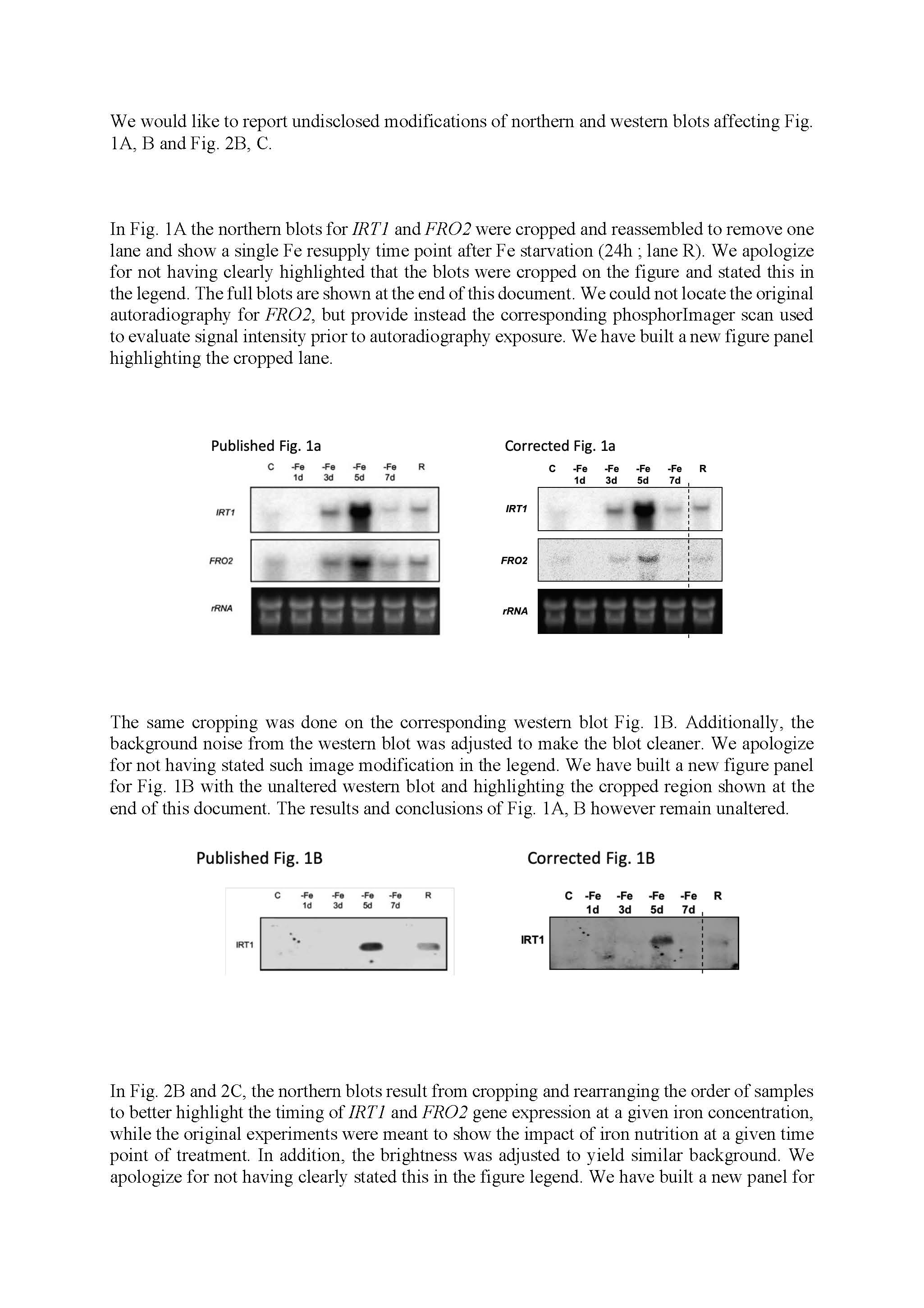
What a good, honest scientist. A role model. Dr Vert corrects old gel issues like shuffled and duplicated gel lanes in his papers, unprompted! Also in December 2023, Vert announced to correct a two-decade-old paper for gel splicing, and the correction was published in January 2024.
“The authors would like to report undisclosed modifications of northern and western blots affecting Fig.1A, B and Fig. 2B, C. […] The results and conclusions of Fig. 1A, B however remain unaltered. […] The results and conclusions of Fig. 2B, C are unchanged.”
Susana Rivas, a CNRS research group leader from the French National Institute for Agricultural Research (INRA) in Toulouse is now at the epicenter of a new research integrity scandal in plant sciences. In the last two years, France was shaken by the Olivier Voinnet scandal, when their former star researcher was found guilty of data…
Actually, 2 more Vert papers were previously criticised on PubPeer. This one, again with Vert’s former PhD mentor in Montpelier, Catherine Curie, was flagged on PubPeer in July 2019 and corrected 3 years ago already:
“In Figure 2a, the same samples with slightly different exposure, are used for different conditions.”
Right away, Vert replied, admitting “a mix up between clones that we unfortunately did not pick up at that time“, and proving replacement for the entire figure from “additional complementation experiments“, see below:
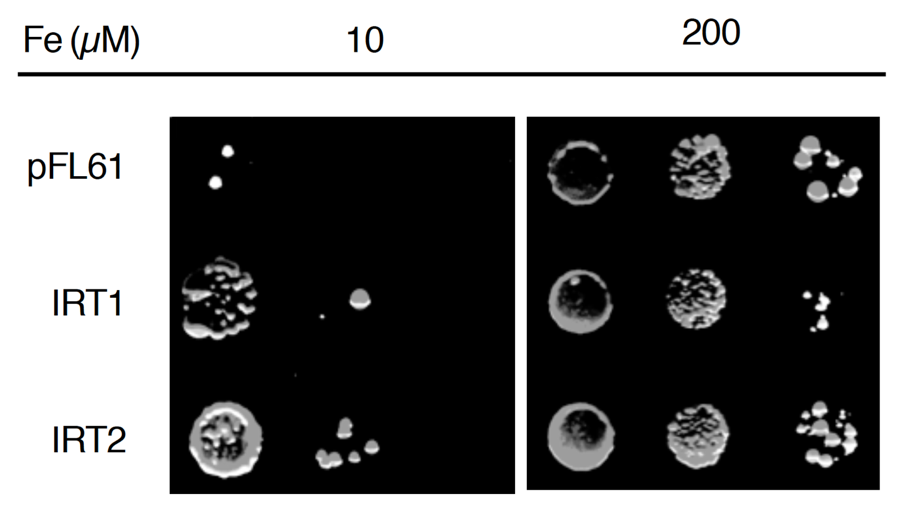
“the authors would like to correct figure 2 panel a) for which an error was introduced during preparation. The original figure 2 a) is composite and was made of a representative clone out of three independent clones that were tested for each construct. This has inadvertently led to a duplication of some of the drops. The original scans from two decades ago could not be recovered but we provide an image from a different experiment that yields the same conclusions. The results and figure legend are unaltered by this correction.”
Another honest mistake, presumably? This paper by Vert and Curie was also corrected in 2020.
“Right hand side of Figure 1C is forged using a duplicated empty background region.”
Back in 2019, I wrote to Vert, and he replied:
“This figure is coming from our US collaborators and co-authors.”
He referred to Mary Lou Guerinot at Dartmouth College. Who has no other papers on PubPeer. There was more in that Vert et al Plant Cell paper, some gels were inappropriately spliced:
Fig 10A
Fig 10E
Just when the PubPeer comments appeared in June 2019, that paper was praised in an editorial (Salome 2019):
“The article itself is a text-book example on how to harness the power of reverse-genetics to determine the role of a gene […] First author Grégory Vert, then a graduate student with Briat in Montpellier and now a group leader in Toulouse, France, remembers this experiment very well.”
I reported the problems to the journal in June 2019. The Correction was published more than one and a half years later, in January 2021:
“The original western blot shown in Figure 1C monitoring IRT1 protein accumulation in wild-type or irt1-1 knock-out mutant, in both roots and shoots, and in response to iron nutrition was cropped and reassembled to present the data in a more logical way. This unfortunately led to a mistake during figure mounting, with the duplication of part of the blot and mis-annotation of the lanes. The original and corrected Figure 1 are shown below. The results and figure legend are unaltered by this correction. […]
The corrected figures and accompanying text were reviewed by members of The Plant Cell editorial board.”
As for the spliced gels in Figure 10: the corrections drew some dividing lines, not just on the spliced gels, but also on the unspliced loading controls. Evil tongues might say the authors and editors jointly forged data to fit their lies.
Not really honest mistakes then. It seems, after the PubPeer posts in 2019, someone had been scrutinising Vert’s papers and asked him to issued corrections. Who knows what else was found. Important is: none of the manipulations affected any of the conclusions.
These 3 molecular biologists from Toulouse should really consider to stop. In fact, one of them already switched to psychiatry, probably to forget the Photoshopped science he published.
Peter Wilmshurst, British cardiologist and the nation’s most-sued whistleblower, blogged again, this time about how rapists and sexual harassers among doctors get rewarded with money in UK, via the Clinical Excellence Award Scheme.
“I was naturally most interested in the doctor with the fifth highest score, because he had a lower score than me but had been put forward for a gold award instead of me. When I did an internet search for him, the first links that came up were not to his hospital website. They were links to national newspaper reports about him being placed on the Register of Sex Offenders for accessing child pornography. (Being placed on the Register of Sex Offenders indicates that an individual has a criminal conviction for a sexual offence.) Next items in the search were reports in a local newspaper about a press statement by his hospital saying that he had been taken off some of his duties as a gynaecologist. Specifically he is not allowed to treat young women. It was difficult to see how he could be contributing “over and above” the expectation for an NHS clinician.
The documents showed that he got his silver award 18 months after being placed on the Register of Sex Offenders. […] He got a silver award the same year as me. Four years later he applied for a gold award.”
A UCLA dentistry student writes in a leaked letter: ” I was having disagreements with my research mentor, and thought that Dr. Tetradis could help. Instead, he distorted the issues to attack my mentor, and sexually harassed me. When I filed the Title IX complaint, his powerful colleagues discouraged me from filing.”
Just to put this into money perspective: “In 2010 a bronze award added approximately £35,000 to a consultant’s annual salary, silver about £46,000, gold about £58,000 and platinum £76,000.” And even if they don’t get an extra 50k salary raise, sex offenders can still continue practising medicine, because the responsible authorities let them:
“I asked an employee of the General Medical Council how many practising doctors were on the register of sex offenders. I was told that there were about 100. […]
The failure of the GMC to deal with sexual misconduct by doctors is illustrated by the case of Alan Tutin. I was interested in him because he worked in the Merrow Park Surgery in Guildford, Surrey. Dr Andrew Dowson had his private practice in the same surgery. Dowson appeared before the GMC on two occasions (2006 and 2014-2015) and was found guilty of misconduct in research on both occasions. Dr Dowson’s second GMC hearing followed my complaint to the GMC and he was suspended from the medical register. Details are available in one of my earlier blogs https://drpeterwilmshurst.wordpress.com/2022/12/29/correspondence-with-circulation-about-retraction-of-the-mist-trial-publications/
I was interested that in one small general practice surgery, there were two doctors whose conduct was judged to be unacceptable in different ways.
We now know that Tutin started sexually assaulting female patients, girls and women, in 1981. Concerns about his conduct first became known in about 2000. In 2005 a GMC panel acquitted him of eight counts of sexually assaulting patients. At a second hearing in 2009, the GMC struck Tutin off the medical register for multiple counts of sexual misconduct dating back to 1984. The GMC found he had sexually abused patients as well as a trainee doctor and a community midwife. However it was not until 2019 that a criminal court sentenced him to ten years and six months in prison for 15 counts of sexual assault dating back to 1981.”
Two old gynaecology professors in Milan decided to racially profile, then rate their misinformed young patients for sexual attractiveness. Their even published this as an evo-psych study in a respected society journal.
“It is difficult to escape the conclusion that the white male employees of teaching hospitals that sit on regional advisory committees believe that the people who most deserve an award are doctors that are most similar to themselves. […] I must disclose a conflict of interest, because I had a national CEA and still benefit enormously from the money I receive. Like the majority of those with a CEA, I am a white man.”
Where’s Wally?
France’s superstar nanofabricator Sabine Szuneritsis being betrayed by her former collaborators. You can read about this Knight of the Legion of Honour and CNRS Silver Medal laureate, her husband and fellow University of Lille professor Rabah Boukherroub, and their trashy nano-science here:
French nanotechnologists Sabine Szunerits and Rabah Boukherroub put EU Commission’s money to good use. The EU cannot afford a papermill gap to Iran and China!
Coracina lineata: “The middle and right panels of Figure 3(B) are the same spectra with the same noise. However, they are for different chemical compositions of CQD-S.”
On 30 January 2024, Felix Sauvage, pharmacology professor at the University of Gent in Belgium, posted a lenghty comment:
“Dear colleagues,
Thank you very much for pointing out this issue. In fact, we were aware of this issue before the publication of this Pubpeer thread (for at least two months). In the moment we have found first data discrepancies, we have contacted the other senior researcher in charge with the questioned experiments.
Though this is outside my expertise, I totally acknowledge that these two XPS spectra are the same: (same curves, same noise and same colour). I am therefore afraid not being able to give a satisfying answer. This experiment has been made by our collaborators in Lille, I will therefore let them reply to shed light on this situation. […]
Unfortunately, as it seems similar issues became more ‘global’ recently, my colleagues and myself further checked all the figures in this paper (before this pubpeer thread), and sadly found out other issues. The TEM images in the ESI Figure S1 are the same images. The issue that we found is very similar to mutliple examples previously presented on Pubpeer regarding issues that our collaborators are facing. In fact, one of the images was rotated, cropped, and then stretched. This was very difficult to detect before the submission of the paper as, despite being obvious when pointed out, it was very hard to spot during the writing process.
[…]
Because we are not indifferent to this matter, we have already taken some action on our side, including contacting the integrity commission of our University. We will contact the editor of the journal to undertake appropriate actions.”
In another PubPeer comment on the same thread, Sauvage said:
“I have contacted my colleagues from Lille some months ago, before the publication of this pubpeer thread. I could have access to the raw data […] Apparently, two similar materials measured with the same equipment, the same day can give identical noise in their XPS spectra, which, though I am not being an expert in the stochastic aspect of noise, rather surprised me, to be honest. […] the repeated pattern in the decimal values (10−1−1) of the intensities of the CQDs 180: they are either 7, 3 or 0 (while they vary more for CQDs 170). Is this coincidental?”
He was sarcastic of course. The spectra are duplicated and forged.
“the two graphs look very similar but appear to be slightly shifted on the X-axis. This can be explained by the constant value obtained when we substract the X values of both graphs. X180 – X170 = 0.07″
Sauvage ended with:
“Could we expect apologies from the top senior chemists on board? Or, is this only the junior scientists (PhD students, postdocs) and the early-career scientists who have to do the dirty job and keep quiet? Am I the only captain on board? SOS, allô? Appropriate action with the journal will be taken in compliance with our integrity services.”
That was also because he found out that the TEM images “were already reported in another pubpeer thread“. Here it is, from ophthalmology to diabetes:
“A pity we had to play “where’s Wally?” after the papers were submitted, right? Not sure the scientific community and the young students like this game though, especially the ones who want to stay in academia.”
Not just the TEM images got recycled in that diabetes paper:
Félix Sauvage: “Now that my pubpeer record is not virgin anymore (I would like to acknowledge (some of) my collaborator(s) for this), and because, after all, this is an online journal club, here is another “mix up”: Figure 5 of this article presents two identical panels as in Figure 2 of https://doi.org/10.1039/D1NH00157D (in which I am author)”
Sauvage also found out that the other paper recycling the panels also recycled the same TEM image:
Félix Sauvage: “We have noticed that the TEM images in Figure S2 of this article are actually the same after image manipulations including a rotation, a crop and a stretch. As these images come from the laboratory of our colleagues from Lille, we let them reply and clarify this situation.”
In his email to me, Sauvage announced to contact the journals for retractions:
“ I don’t care to retract papers that I have with people facing such allegations. There is no blabla like ‘this does not change the conclusions, etc…” with me. I just have to do it with respect to the co-authors etc…”
Also, that TEM image was found by Sauvage in yet another Szunerits paper, making it a quadruple re-use. In fact, that paper Loczechin et al 2019, also in the ACS journal Applied Materials & Interfaces has been just corrected. Proceed to the next Short!
Scholarly Publishing
A purple alert
We remain on the case of Sabine Szuneritsand Rabah Boukherroub. This paper received a huge Correction from ACS on 27 December 2023:
You saw the TEM image which Felix Sauvage found in 3 more Szunerits papers, some of them he himself coauthored. But there was much more, one of the many other issues are the hand-drawn error bars:
Now, I best let Maarten van Kampen discuss this correction, with illustrations.
“Correction notices can sometimes be as opaque as retraction notices. So let’s go through this one in some detail:
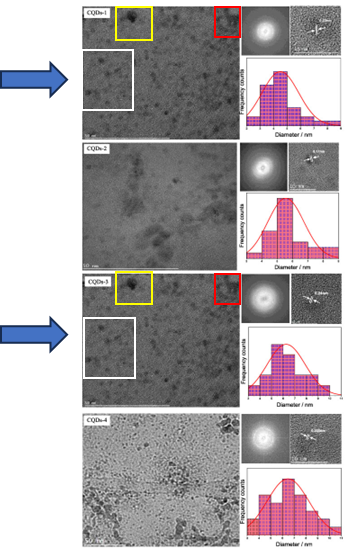
“In the original version of this article, Figure 2B contains a mistake of partially identical TEM images, Figure 5B of identical size distribution, and Figure 2C and F of misfitted lines. These errors are rectified in the corrected versions included herewith. Reference 12 was added to the XPS spectrum of CQDs-6 (Figure 5D) as the particles have been described earlier. Raman images without line smoothing were implemented (Figure 2G). A reference was added to the Raman images of CQDs-5 and CQDs-6 in the Supporting Information (SI). The fluorescence images of the different CQDs in the SI (Figures S1D and S3D) were replotted.”
The part “Figure 2B contains a mistake of partially identical TEM images” means that the SEM images of CQDs-1 and CQDs-3 were identical in Fig. 2(b), see #1. And with “… Figure 5B of identical size distribution” the authors say that the size distribution for CQDs-1 in Fig. 2(b) has been re-used in Fig. 5(b), but there representing CQDs-6 (#6):
The last part of the first sentences is more interesting. It is about the mistake in “Figure 2C and F of misfitted lines”. One could expect that the correction only changes the fits. The authors, however, also took the opportunity to change the primary C XPS data for CQDs-1 displayed in Fig. 2(c), see animation below:
Hence in the correction/retraction lingo the correction of “misfitted lines” can also mean a wholesale replacement of the the data. It is nice to see that the corresponding CQDs-1 N XPS spectrum shown in Fig. 2(d) was correct.
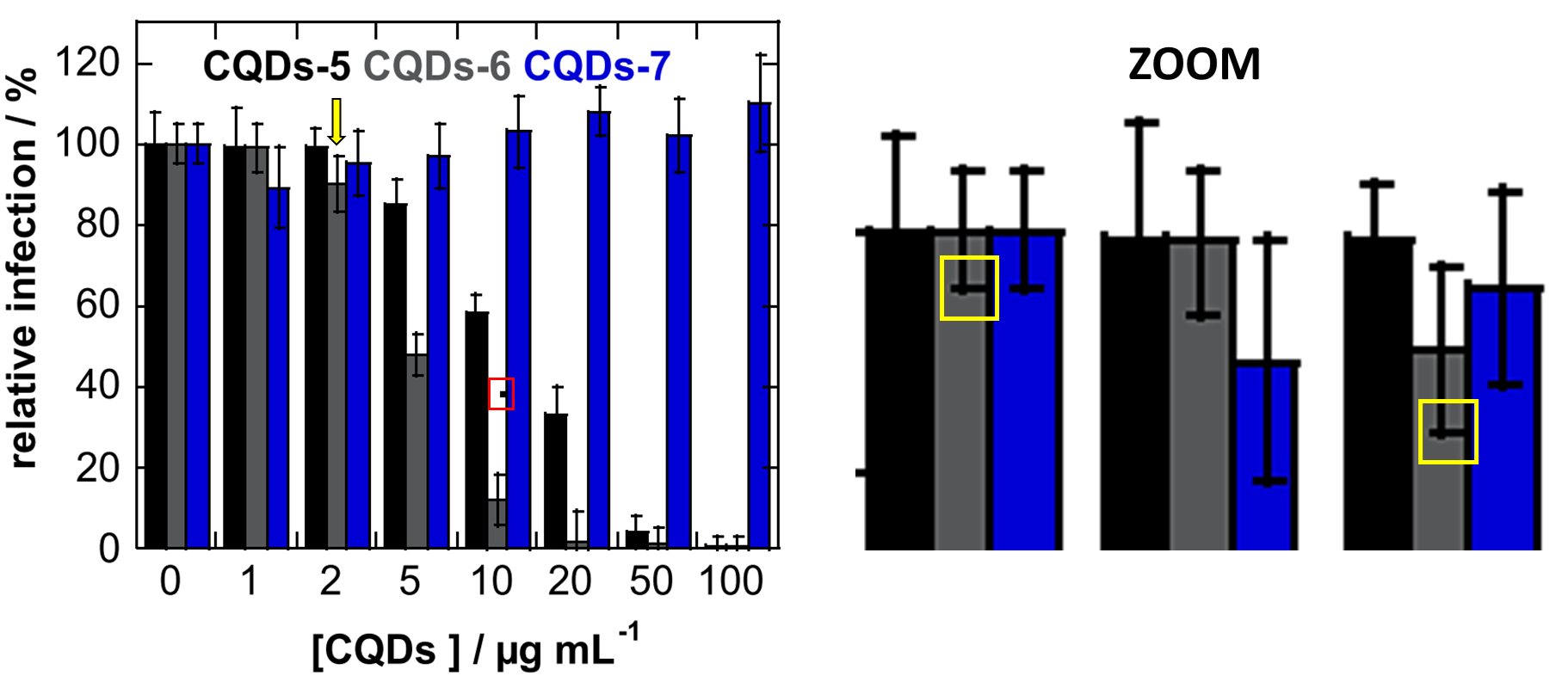
Then to “Reference 12 was added to the XPS spectrum of CQDs-6 (Figure 5D) as the particles have been described earlier“. As was noted in #10, the XPS spectrum of CQDs-6 featured in a paper that was submitted 3.5 years earlier. In that paper the particles were christened 4-AB/C dots. But one cannot blame authors for very good bookkeeping and discovering a promising type of nanoparticles that are not cytotoxic and showing broad-spectrum anti-viral properties by preventing both the uptake of herpes simplex and corona viruses:
Things get a bit odd when we get to the Raman data: “Raman images without line smoothing were implemented (Figure 2G)“. In #10 it was convincingly shown that the Raman curves for CQDs-2 to -4 displayed in Fig. 2(g) are exactly identical. And it is actually worse: also the CQDs-1 curve displayed in Fig. 2(e) was identical to all three curves in Fig. 2(g).
Below a before-and-after correction comparison of Fig. 2(g). The original figure was provided in vector format and I have already taken the opportunity to change the line colors. Note that none of the corrected/’unsmoothed’ curves match their single original:
As to the curves CQDs-1 to -4 being perfectly identical in the original publication: below-left Fig. 2(g) with the (re-colored) curves shifted on top of each other. And below-right the same figure with the CQDs-1 curve from Fig. 2(e) added. The original publication contained 4x the exact same Raman spectrum for four types of particles:
This then gives us another entry for the correction/retraction thesaurus: “Raman images without line smoothing were implemented” means “We quadruplicated a single curve and now corrected that by providing new data”.

This then only leaves “The fluorescence images of the different CQDs in the SI (Figures S1D and S3D) were replotted.“. In #7 it was noted that each and every panel in Fig. S1(d) shows the exact same curve, apart from a single yellow curve that hops around:
[original Fig. S1(d)]

The correction now also mentions that Fig. S3(d) is “replotted”. And I think you already guessed it: the “CQDs-5 260->420 nm” curves shown in Fig. S3(d) are exactly identical to the “CQDs-1 260->460 nm” curves of Fig. S1(d):
The authors made the effort to show a wider x-axis range and the curves have different colors.
This then gives a final entry for the thesaurus: “replotted” means “We published 11 curves in five-fold to stand in for QCDs 1-4 and -6. For QCDs 1-4 we moved a 12th curve a bit around, for QCDs-6 we changed the colors and the axis limits. After correction everything is better.”.
Let’s ends with some re-assuring words (typo theirs):
“These corrections do not alert the conclusion of this work.“
To me the whole correction feels like a purple alert.”
If you wonder which clown of an ACS editor accepted this correction: probably the journal’s Executive Editor, a certain Rabah Boukkerroub. He will sure soon correct the paper which Felix Sauvage exposed above.
This ACS journal has a bad history. Its founding Editor-in-Chief from 2008 until end of 2023 was is Kirk Schanze, professor at the at the University of Texas San Antonio. He ran a tough zero-retraction policy where even the most despicable low-life of an Asian fraudster can issue corrections about unaffected conclusions, with full and total approval from ACS. See here:
Smut Clyde is back with more fraudulent nanotechnology. This time, he presents the works of Dhanaraj Gopi, who designs fabricated surfaces for surgical implants. In Photoshop, or with a pencil.
Even the worst of papermillers are Schanze’s dearest peers (I have a great example here). Ashutosh Tiwari was also most welcome at Schanze’s ACS journal. For these people, Schanze used to bend over backwards and correct anything. His successor, Xing Yi Ling of Nanyang Technological University in Singapore, already proved his loyalty.
A subject matter expert
Another society publisher, this time Institute of Physics (IOP), decreed that science is supposed to be fraudulent.
This is the paper, like everything else from russia, it is totally trustworthy:
Fig 4: “Identical background noise in X-ray diffraction patterns.”
The two spectra are identical save for the main peak, here is an overlay:
But IOP Publishing stated in January 2024 on PubPeer:
“After carefully reviewing all information and material to hand, with the support of a subject matter expert, we have found that the XRD spectra baseline do not involve an intentional alteration of the images. We are therefore taking no further action at this time.
We can confirm this matter has been investigated in line with the principles outlined by the Committee on Publication Ethics (COPE, https://publicationethics.org/).
IOP Publishing wishes to thank the PubPeer commenter for their diligence on this matter.”
I wonder if IOP’s “subject matter expert” was some russian papermiller?
Alexander Magazinov presents you two russian professors whom Elsevier and MDPI consider respectable: a Lt Colonel of putin’s mass-murdering army, and a machine-gun totting rascist. Both buy from papermills.
Never mind that this paper has even more fake spectra:
“XRD patterns in Fig. 4 with Fig. 3 published elsewhere“
That other paper, by same russian fraudsters, pardon, antifascist defenders of Christianity and traditional family values, was published in a Springer journal:
In the Correction from 18 January 2024, long list of equations was changed, with this note:
“There were some typo mistakes in the manuscript, which are modified as follows. It is confirmed that the results were utterly right. The authors apologize for the typo mistakes.”
Nick Wise commented:
“It is hard to see how the results could previously been ‘utterly right’ if the governing equations and parameter were incorrect. As the authors say, as a result of correcting the equations ‘the changes have correctly shown their influences on the contours and diagrams’, i.e. the results are different to before the correction.”
But then again, the Editor-in-Chief of that journal is Imre Miklós Szilágyi of Budapest University of Technology and Economics in Hungary. He apparently likes to issue weird corrections. Even on his own papers in his own journal – the literature review Ba et al 2020 received a Correction consisting of 50 corrections to the text.
I heard of Szilagyi first from someone claiming to be a different Hungarian, Lorant Denes David, who accused Szilagyi of receiving “major citations from his own journal“, only to accuse me of conspiracy, bullying and worse in the same comment. David publishes on tourism, for example to Mars (sic!, Ghorbani et al 2023), but also research ethics, and sometimes on both, to insert random self-citations:
He also published on chemistry (Shomanova et al 2018), and the papermill stench is quite strong. After those PubPeer posts, someone under the name Lóránt Dénes Dávid started to send me messages with announcements to have dispatched his university lawyers, Interpol, and a team of 12 professors (sic!) to abduct me and Alexander Magazinov to a Hungarian prison. There were worse threats I won’t quote. I contacted Lorant Denes under his verifiable work email and shared those nasty messages and the PubPeer links of his papers. His reply:
“I do not deal with this letter, I do not know you or your website. Please don’t write to me, I’m not interested in this website, I don’t know it.
Prominent Prof. Dr. habil. habil. habil. Dávid Lóránt Dénes“
Credible denial?
Inadvertently
And back to Dana Farber. You may recall that their research integrity officer Barrett Rollins educated all journalists that regardless of what Sholto David found, no research misconduct findings are to be expected despite the announced 6 retractions and over 30 corrections. So indeed, there is none, as the first correction since the scandal exploded, proves.
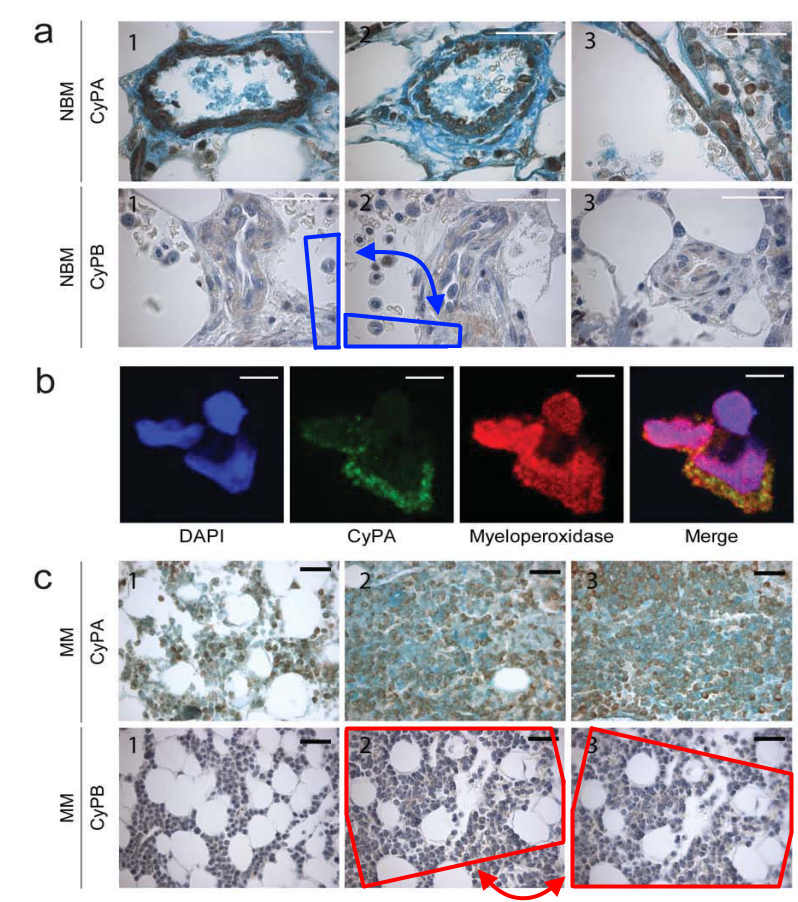
Di Zhu , Zhongqiu Wang , Jian-Jun Zhao , Teresa Calimeri , Jiang Meng , Teru Hideshima , Mariateresa Fulciniti , Yue Kang , Scott B Ficarro , Yu-Tzu Tai , Zachary Hunter , Douglas McMilin , Haoxuan Tong , Constantine S Mitsiades , Catherine J Wu , Steven P Treon , David M Dorfman , Geraldine Pinkus , Nikhil C Munshi, Pierfrancesco Tassone, Jarrod A Marto, Kenneth C Anderson, Ruben D Carrasco The Cyclophilin A-CD147 complex promotes the proliferation and homing of multiple myeloma cellsNature Medicine (2015) doi: 10.1038/nm.3867
Mycosphaerella arachidis: “Figure 5i: There’s an overlapping area between images, which should show different experimental conditions”
“Supplementary Figure 3: […] the numbers are supposed to refer to different patients”
The Author Correction was published by Nature Medicine on 25 January 2024:
“In the version of the article initially published, three pairs of micrographs (in Fig. 5i and Supplementary Figs. 3a and c) inadvertently contained overlapping areas. These figures have been amended with new micrographs and are available as Supplementary Information with this notice.”
Inadvertently.
There seems to be a need for a second correction though.
“Supplementary Figure 07 and 08: Some of the bioluminescent images seem very similar after adjusting the alignment and stretch very slightly.”
“Figure S05E: These are different experiments, but some of the features around the edges of the bands are surprisingly similar.”
“Supplementary Figure 1f: There is an overlap between images. I’ve added a diagram to show where I mean. The figure legend describes these as “independent” experiments.”
Be aware that Ruben Carrasco is Ron DePinho‘s man at Dana Farber. And Ron DePinho is the Almighty God of US cancer research, as you know.
Here a random pick, same Dana Farber gang of Carrasco, Anderson, Munshi, Tai:
“It looks like the same data analysed with different settings.”
Retraction Watchdogging
Avoid misleading conclusions and maintain scientific integrity
Ahmed Shalan loses yet another paper which he previously corrected. At ACS, but not in Kirk Schanze‘s Advanced Materials and Interfaces, where Shalan’s correction remains valid. Also corrected were figures 6 and 7, and the text of results and discussion was changed. Shalan has around 30 papers on PubPeer, everything he publishes is fake and papermilled. Read here:
“Fig. 1b: S2 and S3 are identical. So are S4 and S5.” Also: these spectra are hand-drawn.“Fig. S1 supporting information: curves S1, S2, and S3 are exactly identical. So are S4 and S5.“
“Fig. 1a: XRD spectra S4 and S5 are identical down to the noise level. So are S2 and S3.““Fig. 6c. The figure shows fluorescence spectra as a function of excitation wavelength. However, the materials seem to be able to fluoresce at a lower wavelength than the excitation wavelength. This is very unusual.”
A year ago, in January 2023, ACS and their journal’s Editor-in-Chief, Penn State professor Phillip E. Savage, issued a Correction:
“Here, we report editing errors in Figure 1a,b and Figure S1 and provide corrected results. These corrections do not affect any conclusions of the work. We sincerely apologize for any inconvenience caused because of these editing errors.”
Also corrected were figures 6 and 7, and the text of results and discussion was changed. I wrote about that in earlier Friday Shorts.
“The authors retract this Article (DOI: 10.1021/acs.iecr.1c02124) due to concerns about the misinterpretation and clarity of the imaging data presented. There was a mistake in presenting the scanning and transmission electron microscopy (SEM and TEM) images in the article. Similar SEM and TEM images were used for different materials in the images shown in Figures 6 and 7.
The author contributions were as shown below:
Mehdei Davoodi: Synthesis of CdSe quantum dot: Acquisition of data from Figures 1–5 and writing the manuscript part related to the results obtained from Figures 1–5.
Dr. Fatemeh Davar: Supervision of the part done by Mehdi Davoodi.
Sudabe Mandani: Analysis and interpretation of data from Figures 6–11 and writing the manuscript part related to the results obtained from Figures 6–11.
Dr. Behzad Rezaei: Supervision of the part done by Sudabe Mandani.
Dr. Ahmed Esmail Shalan: Edited and improved the English presentation of the manuscript and helped in submitting the manuscript.
An Addition/Correction was posted on January 27, 2023, to correct Figures 1 and S1 (DOI: 10.1021/acs.iecr.2c01776); however, this Correction did not fully address the concerns related to this Article. As a result, the authors agreed with the Editor-in-Chief to retract the Article to avoid misleading conclusions and to maintain scientific integrity.”
How nice of the authors, so concerned about the misinterpretation and clarity of the imaging data that they voluntarily retract their paper. And so nice of the editors to allow them to write this bullshit. Ah, and up until the retraction, Shalan declared as author contribution:
“A.E.S. helped in designing the research, supervising the work, discussing the results, and editing the manuscript. All of the authors participated in writing, editing, and revising the manuscript.”
Now Shalan says he merely helped with English and ended up as co-author by mistake!
Saudi service lab
A very informative retraction notice, for a paper by Usama Fahmy and Nabil Alhakamy, two papermillers at the King AbdulAziz University in Saudi Arabia (read about them in earlier Friday Shorts). It should be said, the journal was completely overrun by papermills, but then started to mass-retract fake trash (read other Friday Shorts).
“Dear Authors, Could you explain why a few red dots (representing cells) of the Facs graph are located outside the graph area”
“Figure 3 is reused in another publication”
The Retraction was published on 30 January 2024, enjoy:
“This article has been retracted at the request of the Editor-in-Chief.
The journal was contacted by a concerned reader to report unusual flow cytometry features within Figure 7, and a TEM image within Figure 3 that appears to have been published in another article, as detailed here: https://pubpeer.com/publications/769546985121E3931ECB3C3AF85452.
The journal performed independent image analysis and identified two additional suspected image duplications within Figure 8D that appear to feature in another article (Journal of Enzyme Inhibition and Medicinal Chemistry, 36:1 (2021) 922–939, DOI: https://doi.org/10.1080/14756366.2021.1901089).
As per journal policy, authors were contacted and asked to provide an explanation to these concerns and associated raw data. The corresponding author, Usama A. Fahmy, informed the journal that they had referred this case to the Dean of the Faculty of Pharmacy at King Abdulaziz University who formed a committee to investigate. The internal investigation concluded that:
(a) the flow cytometry experiments were outsourced to another laboratory whose data retention policy do not allow raw data to be stored beyond six months. The committee stated that flow cytometry dots that fall outside of the axes are “…normal and do not affect the results and findings of these experiments.”;
(b) the suspected duplicated TEM image in Figure 3 was the result of an unintentional error from a co-author due to “…the inaccurate labelling and the incorrect decoding of the images into the assigned articles”;
(c) the committee members considered the two suspected image duplications within Figure 8D to be “…a grave concern as it involves duplicating a manuscript not related to the lab group.”.
The report stated that “The authors confirmed in the investigation that they received the raw data file from the service lab that performed this experiment. After contacting the lab, the lab admitted it made a mistake by sending images of other work in the service lab.”.
The editorial team assessed the case and decided that these issues had not been satisfactorily resolved, and that the results in the paper were not reliable. Therefore, the Editor-in-Chief decided to retract the article.”
Now, one of the biggest, wealthiest Saudi univeristies openly admitted that the paper was bought from a papermill, and declared that it is “normal” that the data is fake. Consider this when congratulating another western professor for taking a Saudi affiliation for a bribe.
Enough to lose trust
Petra Pötschke, group leader at the Leibniz Institute for Polymer Research in Drseden, Germany, finally retracted a paper. Noteworthy: Pötschke used to be the mentor of the Iranian papermiller Mohammad Arjmand, now big professor in Canada. Read about them here:
“Figure 2f exhibits irregularities, as if both XRD patterns are derived from the same parent pattern. The peaks in the cellulose/GO/Fe3O4 pattern may have a digital nature.”
The now retracted paper has as last author the current South China University of Technology professor Haisong Qi, who spent 8 years in Germany under the National Thousand Youth Talents Plan, of those 5 years at the Leibniz Institute in Dresden, mentored by the former institute director Brigitte Voit (a co-author of the retracted study). In August 2023, Qi wrote on PubPeer:
“After checked the data and discussed with our co-authors, we decided to retract this paper at first.”
Qi’s mentor and Pötschke’s boss Voit in turn was found guilty of research misconduct in 2022 for her covering up the research fraud by her other Chinese student, also after my notification (read here and below).
The Retraction from 31 January 2024 was very brief:
“The authors retract this article because a part of Figure 2 (X-ray diffraction patterns in Figure 2f) was inappropriately manipulated. These concerns are significant enough to lose trust in the reliability of the study.”
Thing is, ACS is again lying: it was not the authors who decided about the retractions. Pötschke wrote to me in August 2023 (translated):
“We have initiated the retraction of both publications as a result of an internal preliminary investigation.“
Yes, there was a second fraudulent paper, published in another ACS journal and were cited by now over 120 times. Note that the red-circled blue spectrum in Figure 2c is obviously hand-drawn.
But that one was not retracted, despite Qi’s public announcement on PubPeer in August 2023. Can you guess why? Yes, it is the Kirk Schanze journal.
Brits in Italy
And a retraction for two British folks in Italy. I previously wrote about one of them, the toxic virologist and Director-General of ICGEB Trieste,Lawrence Banks, at the end of this article:
“together with my colleagues we are actively analyzing the points raised on pubpeer.” – Claudio Schneider “we will evaluate Pubpeer comments” – Giannino Del Sal
The other Brit is Georgine Faulkner, at the University of Padova since 1984. In between, she worked for over two decades years (1987-2008) at ICGEB Trieste, she and Banks published a lot together. (Correction 28.04.2025: I previously wrongly speculated about Faulkner being married to Banks, in reality she is married to Giorgio Valle).
The paper was originally flagged by Elisabeth Bik:
“After this article [1] was published, concerns were raised about results reported in Figs 2, 5, and 6.
Specifically:
Lanes 2 and 3 of the IP anti-Flag Wb: anti-Ankrd2 panel in Fig 2C appear similar to lanes 5 and 6 of the IP anti-Flag Wb: anti-p53 in Fig 5B.
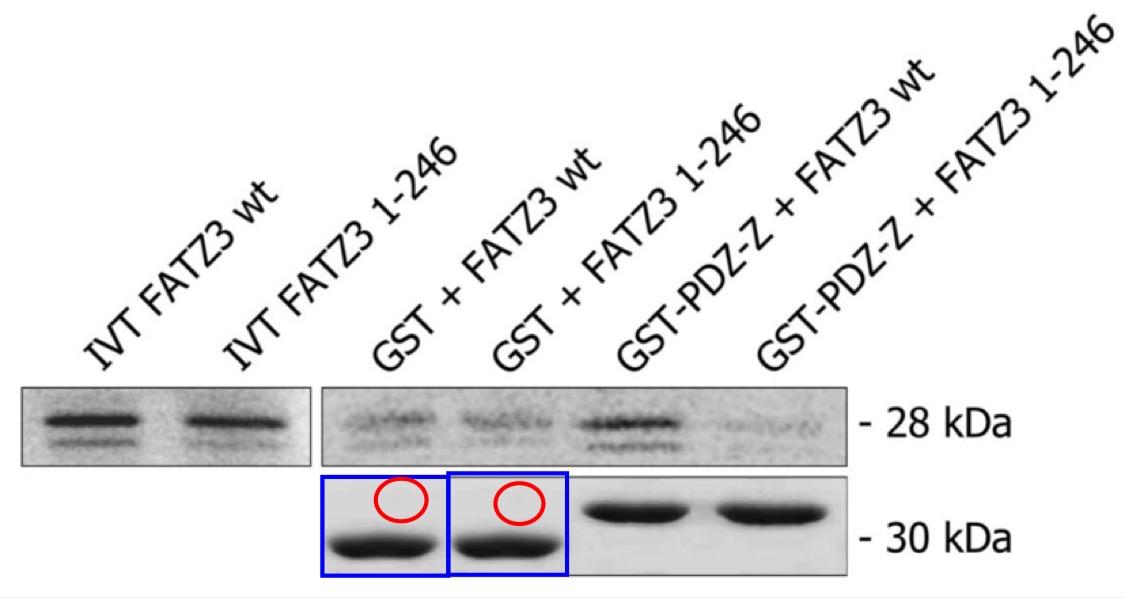
In Fig 2D, when levels are adjusted to visualize background, the 4th and 5th (“GST” and “-”) Wb: anti-GST panels appear similar.
In the left Wb: anti-FLAG Panel in Fig 5B, when levels are adjusted to visualize background there are several areas that appear to contain repeating or similar patterns.
In Fig 5C the 4th and 5th (“GST” and “-”) Wb: anti-GST panels appear similar when the latter is horizontally stretched. The bands in these lanes also appear similar to those in the third WB: anti-His panel in Fig 6D.
In Fig 5C, all five Wb: anti-His panels appear similar.
The corresponding author stated that the original data underlying results in this article are no longer available.
In light of the unresolved concerns discussed above, the PLOS ONE Editors retract this article.
GF did not agree with the retraction. VCM, WBK, SK, NV, ZL, AB, PM, LB, MV, and GV either could not be reached or did not respond directly.”
Maybe Faulkner”s raw data never existed as such? Another case:
What a nightmare couple, Banks and Faulkner. Although, Italian biomedicine relies on exactly this kind of people.
Industry Giants
No longer in the best interests of shareholders
As reported in Friday Shorts from half a year ago (here and here), the enterprising Nobelist Sir Martin Evans and his protege Ajan Reginald sold their trash stem cell company Celixir/Cell Therapy Ltd to a company called Ashington Innovation for whooping £135 million.
Celixir sells a cell therapy cure for heart attack, which are used to be blood cells from Welsh heart attack patients, subjected to Reginald’s voodoo and relabelled as magic “iMP cells”. Those were previously applied in Greece in some rigged and unethical clinical trials by Britian’s most famous cardiologist Stephen Westaby, a former board member of Cell Therapy Ltd/Celixir and his Greek collaborators.
Westaby also owns a company called Calon Cardio, together with a certain Marc Clement, who was sacked for gross misconduct from Swansea University, and investigated by the police (read here). Calon Cardio’s product is an implantable heart pump, and Ashington Innovation previously announced to buy 100% of this company as well, for £39 million.
Patricia Murray uncovers the business secrets of the Nobelist Martin Evans and his partner Ajan Reginald. It seems the magic iMP cells used to treat patients in Greece were drawn from the blood of patients in Swansea, for the purpose of a secret PhD thesis. There is no serious science behind it, only serious investor…
An announcement from the London Stock Exchange from 24 january 2024 (highlights mine):
“Termination of Proposed Reverse Takeover
On 17 August 2023, Ashington Innovation plc announced the signing of a non-binding term sheet with Cell Therapy Limited (“Cell Therapy”) to acquire 100% of Cell Therapy’s total issued equity in an all-share transaction (the “Transaction”). The Company announces today that it has terminated negotiations in relation to the Transaction and the Transaction will no longer proceed.
Both the Company and Cell Therapy have spent considerable time and effort on the due diligence process, negotiating definitive terms and preparing the required transactional and listing documentation, but given current market conditions it was not certain that the required funding for the Transaction would be available. The Board has therefore concluded that it was no longer in the best interests of shareholders to proceed. As the Company’s additional proposed acquisition of Calon Cardio-Technology Limited, announced on 24 August 2023, was conditional on the takeover of Cell Therapy, this acquisition will also no longer proceed.
Ashington’s ordinary shares were suspended from trading on 17 August 2023 while the details of the Transaction were finalised and the required information is published, or the Transaction was terminated. As the Transaction has been terminated, the Company will make an application to the FCA to request that the suspension of the trading of ordinary shares be lifted.”
Congratulations to Sir Martin, Ajan and Steve. Remember that all this fraudulent circus was busted by one female stem cell professor in Liverpool: Patricia Murray. It is the second British stem cell quack business she brought to its knees, intentionally ignored by the British media. The other one was the UCL-supported trachea transplanting company Videregen, which uses Paolo Macchiarini‘s technology.
The European Commission admitted that their €6.8 mn phase 2 clinical trial TETRA with cadaveric tracheas, led by the UCL laryngologist Martin Birchall is unlikely to ever recruit any patients. In January 2019, the status was changed to “grant agreement terminated”
Dear Leonid,
Thanks for the article, pleasant to read. I just have few comments:
1) the term “betrayed” is a bit hard, in the current situation ask around who feels betrayed? Especially to young students that have been dragged in this story. Such wording can prevent some other people facing similar situations to speak up in the future and contribute to a better science. But this is just my point of view and this is maybe sarcasm (?).
2) I am not a prof of pharmacology but pharmaceutical sciences
3) Félix takes an accent otherwise it’s pronunced FEElix and it sounds really weird in French ;). Some typo: hsi instead of his, somewhere in the text.
4) Just a clarification point: I pointed out discrepancies in my articles, they were obvious. Regarding the responsability of persons, I am not inclined and I can’t accuse people without proof and this is not actually my job that’s why I will always use the term “collaborators or colleagues”, plural form. If it’s clear that the issues come from a laboratory, it is still hard to know the exact origin of the data in there and I am not working there.
5) I am pro retraction, especially in this cas but this has to be discussed with all co-authors in a democratic way. This is the reality of the ground… That’s why I added “with respect” to the co-authors at the end. Whatever happens this will be done in accordance to the remaining sailors on the boat.
6) My answers are Savage, that’s true but hey, my name indicate my ancestors lived in a wood and sometimes they were obliged to get out of it.
Thanks Félix! (had to copy-paste your name because my German keyboard doesn’t have all this extra lettering)
You are lucky you are not in France or the CNRS revenge machine would be after you after your first PubPeer post.
It’s time seriously to think about publication of the “A Guide to the Most Honest Scientific Excuses” booklet. These shorts contain at least 3 of them:
This was very difficult to detect before the submission of the paper as, despite being obvious when pointed out, it was very hard to spot during the writing process.
This experiment has been made by our collaborators in Lille, I will therefore let them reply to shed light on this situation.
merely helped with English and ended up as co-author by mistake!
Thanks for your reply, Leonid. I also appreciate the comment of Albert and understand his point.
In fact there are, to me, two possibilities in this situation: remaining quiet and ignore or be active. It also depends on charatcter traits and human nature.
I am not finding excuses, if you look at the whole situation I even indicate “massive and enormous” issues in one of our article. I highlighted them in bold and named them. It is normal for me to ask for clarification from the colleagues, this is part of the notion of scientific collaborations.
The contributions are also indicated in one pubpeer post, it goes a bit beyond English 😉 (but I understand what you mean by saying this, Albert, to me this is another situation/debate regarding the validity of some authorships).
If we don’t speak up in those situations we do not help scientific integrity. In our situation, we also faced problems during the submission. We could avoid some but, as you can see not all of them. The Where’s Wally during the submission was harder than we thought, there were three Wally’s not one.
Anyway, this is an interesting debate about responsabilities: are all authors responsible or only some of them? There are various understandings on this matter.
@Leonid: I am not sure CNRS is involved, the situation looks more complex. It would be unfair to point fingers at them. An investigation is apparently on going.
If you have issues in a structure, it does not mean the whole structure is guilty, again another debate :)! The institutional aspect is not really my cup of tea, it was more a matter of noise and petits points: point, point, point final ! Finalement tout ça est assez musical !
Arthur P. Young , Susanne Schlisio, Yoji Andrew Minamishima , Qing Zhang , Lianjie Li , Chiara Grisanzio , Sabina Signoretti, William G. Kaelin VHL loss actuates a HIF-independent senescence programme mediated by Rb and p400 Nature Cell Biology (2008) doi: 10.1038/ncb1699
What they say about people who cheated in sport (taking steroids, well timed bleeding before events…) is not just that they dishonesty got the medals and careers, but that other people didn’t get the medals and careers. Same for “science”.
Come to think of it, the comparison of fake science with doping in sports is wrong.
Doped athletes deliver what they were paid for. Medals, spectacular results, big show for the media.
What do cheating scientists deliver? Lies, broken hopes, death and misery.
Or do we really pay scientists for nothing else but to publish in Nature?
Mohammad Arjmand continued to be a big professor, even after your reporting Wiley grace him with many covers, and Springer Nature does not want to be behind in the race.Common authors in the list with out of the field expertise, to create impression and dodge the radar, what work was done where.
“There’s only one solution – intifada revolution!” – is now the official policy of most (if not all) universities in Canada. Who are the best match? – of course, the Israel-hating / Jew-hating Iranians.
A great read. I am surprised to see a familiar name: Xing Yi Ling from this paragraph in the article:
“Even the worst of papermillers are Schanze’s dearest peers (I have a great example here). Ashutosh Tiwari was also most welcome at Schanze’s ACS journal. For these people, Schanze used to bend over backwards and correct anything. His successor, Xing Yi Ling of Nanyang Technological University in Singapore, already proved his loyalty.”
First of all, Ling is a female professor from Singapore so it should be “her loyalty” if it’s true.
I used to be a course mate of her some 20 years ago but didn’t kept in touch with her since. Based on the internet, she has only started her job as EIC this year, I just wonder if it’s too soon to claim that she has “already proved his (her) loyalty” (to Schanze or to the zero-retraction policy?). Or you have already had some source of proof you didn’t disclose here. Hope you can clarify.
Thanks for your comment. I probably assumed that correction for Szunerits was approved by XY Ling, but indeed, it must be one of Schanze’s last acts. Thanks for your clarification!





























Brava Professor Murray!
LikeLiked by 3 people
Dear Leonid,
Thanks for the article, pleasant to read. I just have few comments:
1) the term “betrayed” is a bit hard, in the current situation ask around who feels betrayed? Especially to young students that have been dragged in this story. Such wording can prevent some other people facing similar situations to speak up in the future and contribute to a better science. But this is just my point of view and this is maybe sarcasm (?).
2) I am not a prof of pharmacology but pharmaceutical sciences
3) Félix takes an accent otherwise it’s pronunced FEElix and it sounds really weird in French ;). Some typo: hsi instead of his, somewhere in the text.
4) Just a clarification point: I pointed out discrepancies in my articles, they were obvious. Regarding the responsability of persons, I am not inclined and I can’t accuse people without proof and this is not actually my job that’s why I will always use the term “collaborators or colleagues”, plural form. If it’s clear that the issues come from a laboratory, it is still hard to know the exact origin of the data in there and I am not working there.
5) I am pro retraction, especially in this cas but this has to be discussed with all co-authors in a democratic way. This is the reality of the ground… That’s why I added “with respect” to the co-authors at the end. Whatever happens this will be done in accordance to the remaining sailors on the boat.
6) My answers are Savage, that’s true but hey, my name indicate my ancestors lived in a wood and sometimes they were obliged to get out of it.
Have a nice day,
Félix
LikeLike
Thanks Félix! (had to copy-paste your name because my German keyboard doesn’t have all this extra lettering)
You are lucky you are not in France or the CNRS revenge machine would be after you after your first PubPeer post.
LikeLike
It’s time seriously to think about publication of the “A Guide to the Most Honest Scientific Excuses” booklet. These shorts contain at least 3 of them:
This was very difficult to detect before the submission of the paper as, despite being obvious when pointed out, it was very hard to spot during the writing process.
This experiment has been made by our collaborators in Lille, I will therefore let them reply to shed light on this situation.
merely helped with English and ended up as co-author by mistake!
LikeLike
Thanks for your reply, Leonid. I also appreciate the comment of Albert and understand his point.
In fact there are, to me, two possibilities in this situation: remaining quiet and ignore or be active. It also depends on charatcter traits and human nature.
I am not finding excuses, if you look at the whole situation I even indicate “massive and enormous” issues in one of our article. I highlighted them in bold and named them. It is normal for me to ask for clarification from the colleagues, this is part of the notion of scientific collaborations.
The contributions are also indicated in one pubpeer post, it goes a bit beyond English 😉 (but I understand what you mean by saying this, Albert, to me this is another situation/debate regarding the validity of some authorships).
If we don’t speak up in those situations we do not help scientific integrity. In our situation, we also faced problems during the submission. We could avoid some but, as you can see not all of them. The Where’s Wally during the submission was harder than we thought, there were three Wally’s not one.
Anyway, this is an interesting debate about responsabilities: are all authors responsible or only some of them? There are various understandings on this matter.
@Leonid: I am not sure CNRS is involved, the situation looks more complex. It would be unfair to point fingers at them. An investigation is apparently on going.
If you have issues in a structure, it does not mean the whole structure is guilty, again another debate :)! The institutional aspect is not really my cup of tea, it was more a matter of noise and petits points: point, point, point final ! Finalement tout ça est assez musical !
Have a nice day,
F
LikeLike
Petit points indeed, haha.
LikeLike
“Clinical Excellence Award – Peter Wilmshurst on sexual harassers in British medicine”
https://www.bbc.co.uk/news/articles/c9w4mzjmgk9o
LikeLike
Impressive from Félix. Difficult situation to be in, as always feel sorry for the students 😔
LikeLike
I’ll be interested to see what’s next for the Nature Medicine paper… I haven’t even finished looking at it yet 😂
LikeLike
The paper served as basis for DFCI patent:
Compositions and methods for treating multiple myeloma
Inventors: CARRASCO RUBEN ZHU DI
https://app.dimensions.ai/details/patent/US-11391739-B2
LikeLiked by 1 person
Here’s another example of a crap paper leading to a patent: https://pubpeer.com/publications/942409EDB301244E64CBCE4D442556
But, I suppose when you are an intelligent designer with a 173 h-index you can get away with all kinds of shit. https://www.youtube.com/results?search_query=james+tour
LikeLiked by 1 person
“Note that the red-circled blue spectrum in Figure 2c is obviously hand-drawn.”
The “hand” part is not obvious at all. Might be a butt or whatever.
LikeLiked by 2 people
Arthur P. Young , Susanne Schlisio, Yoji Andrew Minamishima , Qing Zhang , Lianjie Li , Chiara Grisanzio , Sabina Signoretti, William G. Kaelin VHL loss actuates a HIF-independent senescence programme mediated by Rb and p400 Nature Cell Biology (2008) doi: 10.1038/ncb1699
Third author retraction.
https://pubpeer.com/publications/AB503FE52E95FA64E33D8101F419FB
LikeLike
What they say about people who cheated in sport (taking steroids, well timed bleeding before events…) is not just that they dishonesty got the medals and careers, but that other people didn’t get the medals and careers. Same for “science”.
LikeLike
Let’s just agree to call those who don’t dope “Failed athletes”.
LikeLike
Come to think of it, the comparison of fake science with doping in sports is wrong.
Doped athletes deliver what they were paid for. Medals, spectacular results, big show for the media.
What do cheating scientists deliver? Lies, broken hopes, death and misery.
Or do we really pay scientists for nothing else but to publish in Nature?
LikeLike
It is not that wrong, both are also used for political and national pride, dividends and goals.
Also, there are broken hopes and misery in sports, mainly for the undoped/failed sportsmen of course.
LikeLike
Those are “failed athletes”!
Should explore alternative careers.
LikeLike
Mohammad Arjmand continued to be a big professor, even after your reporting Wiley grace him with many covers, and Springer Nature does not want to be behind in the race.Common authors in the list with out of the field expertise, to create impression and dodge the radar, what work was done where.
https://onlinelibrary.wiley.com/doi/10.1002/adfm.202370294
https://onlinelibrary.wiley.com/doi/10.1002/adma.202370299
https://pubs.acs.org/doi/10.1021/acsami.3c10596
https://www.nature.com/articles/s41467-023-43319-7
LikeLike
“There’s only one solution – intifada revolution!” – is now the official policy of most (if not all) universities in Canada. Who are the best match? – of course, the Israel-hating / Jew-hating Iranians.
Expect more of them to be welcomed.
LikeLike
And not to forget many many opportunists like Pavel Trojovský who support these papermills.
LikeLike
Hi Ivana, how about we talk over a cup of coffee? I guess you know where to find me. I would really like to meet you. Ivana Budinská
LikeLike
Wiley star journal loves Arjmand stuff https://doi.org/10.1002/adma.202310683
LikeLike
Hi Leonid
A great read. I am surprised to see a familiar name: Xing Yi Ling from this paragraph in the article:
“Even the worst of papermillers are Schanze’s dearest peers (I have a great example here). Ashutosh Tiwari was also most welcome at Schanze’s ACS journal. For these people, Schanze used to bend over backwards and correct anything. His successor, Xing Yi Ling of Nanyang Technological University in Singapore, already proved his loyalty.”
First of all, Ling is a female professor from Singapore so it should be “her loyalty” if it’s true.
I used to be a course mate of her some 20 years ago but didn’t kept in touch with her since. Based on the internet, she has only started her job as EIC this year, I just wonder if it’s too soon to claim that she has “already proved his (her) loyalty” (to Schanze or to the zero-retraction policy?). Or you have already had some source of proof you didn’t disclose here. Hope you can clarify.
LikeLike
Thanks for your comment. I probably assumed that correction for Szunerits was approved by XY Ling, but indeed, it must be one of Schanze’s last acts. Thanks for your clarification!
LikeLike