Schneider Shorts 9.06.2023 – With daily dedication sacrifying my private life
Schneider Shorts 9.06.2023 - Italy's greatest scholar dedicates his life to training Asian papermillers, concern for Texas fraudster, stem cell embarrassment, retraction a decade delayed, with more retractions, papermill promo, and finally, Germany's pesticide shill with whitewashed PubPeer record.
Schneider Shorts of 9 June 2023 – Italy’s greatest scholar dedicates his life to training Asian papermillers, concern for Texas fraudster, stem cell embarrassment, retraction a decade delayed, with more retractions, papermill promo, and finally, Germany’s pesticide shill with whitewashed PubPeer record.
Meet Filippo Berto, “Renowned Chair of Mechanics of Materials” at La Sapienza University of Rome, Italy. His institutional profile educates us:
“He has been international chair in fracture mechanics, fatigue, and structural integrity at the Norwegian University of Science and Technology of Trondheim, Norway, since beginning of 2015. He was professor of machine design at the University of Padua, Italy, between 2006 and 2014. He is chairman of the technical committee ESIS TC15 on Structural Integrity of additive manufactured components of European Structural Integrity Society. […] He is editor-in-chief or Editor of several scientific journals, […] Filippo Berto has a major role in the Italian Group of Fracture being president since 2021 and co-editor in chief of the associated journal. He is also vice-president of the European Society of Structural Integrity since June 2022.”
You will soon see why he is renowned. The man is merely 45 years old, and he already now published more than 1000 papers. Most scientists would not be able to read papers as fast as Berto publishes them. Basically, he must be the greatest scientific mind Italy ever produced, without any false modesty. Some of these papers are now discussed on PubPeer.
And this is his secret. Secret Number 1: double-publishing!
According to Sameer et al. [114] research, alternative fuel resources, power-train enhancements, vehicle aerodynamic adaptations, and weight reduction can reduce CO 2 emissions.
[114] D.S. Kumar, K. Suman, Selection of magnesium alloy by MADM methods for automobile wheels. Int. J. of Eng. Manuf. 2, 31–41 (2014)
According to Sameer et al, the grass is green, the sky is blue, and magnesium alloys in car wheels are the only solution to reduce CO2 emissions.
Sometimes Berto’s own papers with Iranians get cited by infamous papermill fraudsters like Ali Fakhri (examples here and here). But here is another paper by Berto with the Iranians:
“each of the first two lines adds up to a number significantly over 100%, which cannot be explained by rounding.”
Magazinov also noted that “A number of references that boost the citation statistics of a certain HM Ali are out-of-context and therefore unwarranted”, and he contacted Berton with this criticism. In March 2023, Berto replied:
“In the revision they asked those references. See below“
It was this Reviewer Report, which basically consisted only of this request:
“The literature study must be enriched. In this respect, authors must read and refer to the following papers“
Secret Number 3: The Chinese! Here is Berto with co-authors from Iran and China. His own affiliation is listed exclusively with “Department of Mechanical and Industrial Engineering, NTNU – Norwegian University of Science and Technology, Trondheim, Norway“, no mention of La Sapienza. Like in similar papers.
“References 11, 12, 15, 17 and 18 are to the benefit of A. Yan and are about electrical components, not fracture mechanics.“
Nick Wise: “On the 27th of July 2022 an advert was placed on a Telegram offering citations in an academic paper. This article is the only one that matches the keywords in the advert according to Web of Science.The advert was placed after the paper had been submitted and presumably after it had been accepted subject to minor revision.“
Indigofera tanganyikensis: “Figure 10: duplication of data. ImageTwin was used for analysis.”
Berto explain that is was a review article and the cited figure was from reference 135 (Shi et al 2019) and not his. In any case, he wasn’t even bothered that the copyright on this image lies with Elsevier and he never obtained a permission.
Secret Number 4: russians! Here is Berto with a whole bunch of them:
“This article contains data from an earlier publication (Dontsov VY et al., 2020).”
The first author “Sergey Panin on behalf of all the authors” claimed on PubPeer the recycled photo is merely “similar”, and anyway, their earlier paper was cited somewhere.
Here is Berto, unperturbed by the genocidal war in Ukraine, with his dear friedn Panin and even more russians, publishing questionable spectra:
Much of Berto’s publication output is co-authored with “colleagues” in russia, Iran and China. In an email, Berto informed me (typos his):
“I have dedicated all my life to research with daily dedication sacrifying my private life. I have many international collaborations and I am mentoring several young talented researchers. I have always contributed to the papers that have been published making my real best.“
He also told me:
“If some mistakes arwe present in our works we are more than happy to reply but not to anonimous alluding something not existing. In addition I have already reported this to legal authority and web police.”
Uh-Uh. Berto remained silent when I asked if his legal threat was directed at me.
Scholarly Publishing
Errors did not affect the scientific conclusions
Expression of Concern for Anil Sood, massive cheater at MD Anderson in Houston Texas. Sood has around 70 papers on PubPeer, but because his employer made research fraud its business model and the US medical elites are either fellow fraudsters or chickenshits, only one of them has been retracted so far, and only because an outside collaborator received full blame.
“The graduate school at University of Texas MD Anderson does not care and keep sending students to his lab, Sood is a member of faculty there. RIO at MDACC doesn’t care because witnesses either left the country or are too afraid to speak.”
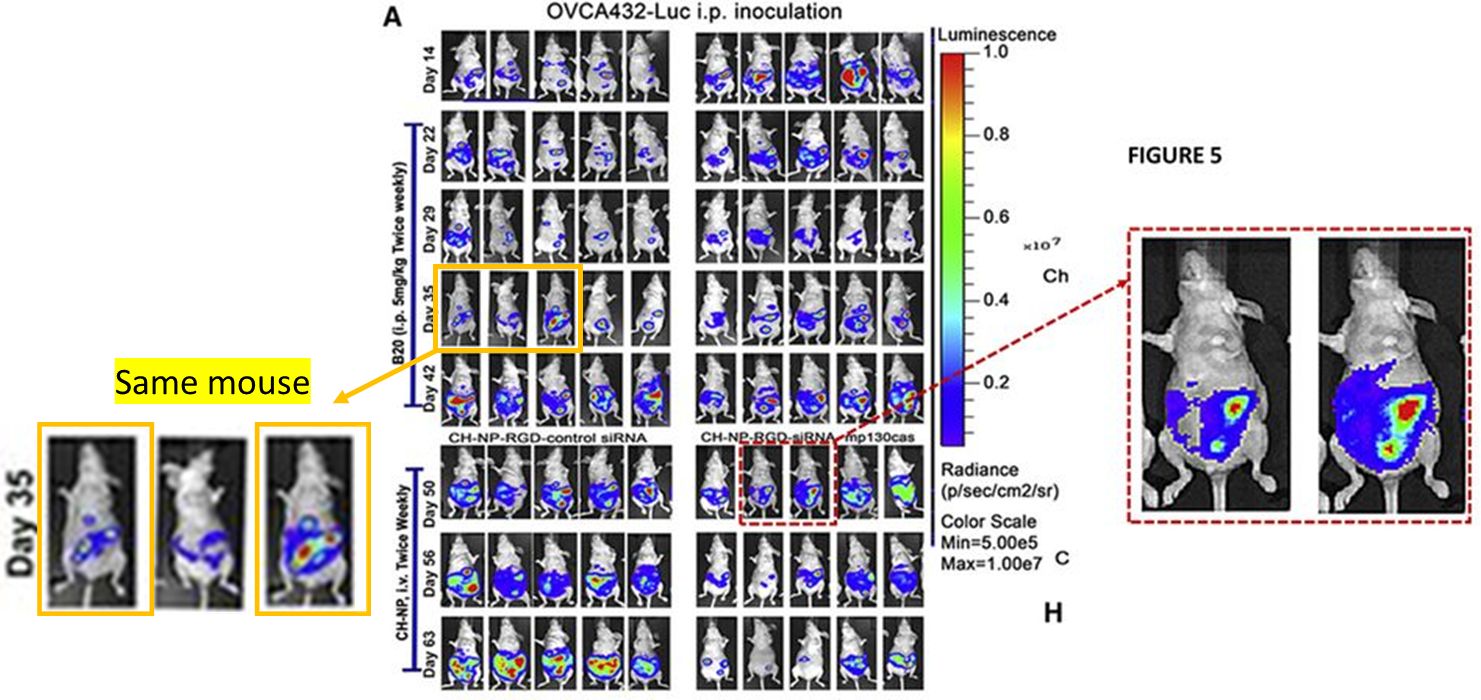
“In the original version of the article that was published with the January 25, 2022 issue, there were inadvertent errors introduced during figure assembly in Figures 2, 4, and 5. The original Figure 2H contained an inversion of the first two images in the upper panel, the original Figure 4D contained duplicated Hoechst and VEGFR2 images in row 1 and row 2 as well as a duplicated cell cluster in row 3, and the original Figure 5A contained duplicated animal images in day 35 (first group, positions 1 and 3) and day 50 (second group, positions 2 and 3). The correct images for each case have been located, and the correct versions of the figures now appear online with the article; these errors did not affect the scientific conclusions drawn from the figures. The authors sincerely regret the errors and any confusion they may have caused.”
Elisabeth Bik then found even more of those unaffected conclusions, for example:
There is more on PubPeer. Basically, Sood and his gang even submitted forged raw data. How shall a journal react to this insolent fraud?
Passive-aggressively of course, because MD Anderson banned all publishers from retracting Sood’s papers.
“We were made aware of readers’ concerns about potential image duplication in some of the figures from this article, which was originally published with the January 25, 2022 issue. For example, Figures 2C and 2D are described as depicting different proteins on different blots, but there are several seemingly identical regions in the two images, suggesting possible duplication. In Figure S2E, a portion of the image appears as though it may have been duplicated within the image itself. The research integrity office at the authors’ institution was alerted and is investigating these potential issues. The outcome of their investigation will inform any further action that we might take. The purpose of this statement is to inform readers of these concerns and the ongoing investigative process.”
Meanwhile, Sood is running for women’s issues:
Although I could only run half-marathon this year, proud to support OVARCOMERS! Great to also see @aaronshafer99, Travis Sims, Amma Asare, Mark Kim, Donyika Joseph, Andrea Milbourne and others out there! https://t.co/JMUZfLiOMj
These corrections do not change any of the conclusions
Another journal decided to go for correction where retraction was the only serious option. But then again, the journal planned to do nothing at all about this paper until I raised a fuss in earlier Friday Shorts and some emails.
The main author, the German-born Konrad Hochedlinger, is now a Harvard professor and serious bigwig of stem cell research. He can’t retract papers from fraud, even from his sinful youth. Not even this:
On 31 May 2023, Oncogene issued an unexpected Correction:
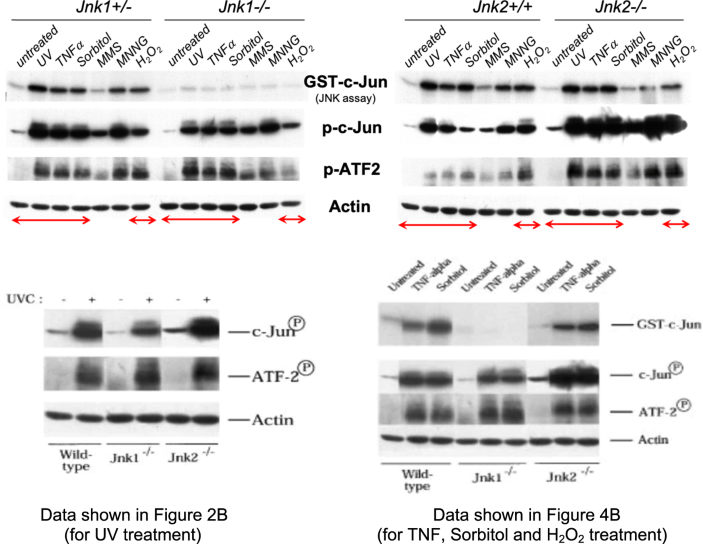
“This correction serves to address concerns raised by readers regarding the Western blot bands in Figs. 2B and 4B of this article [1], which were purported to be highly similar and contain vertical splice marks between samples.
We would like to clarify that the samples shown in Figs. 2B and 4B were run together on the same gel, and the treatment groups were split up into two images, using the same untreated controls. The splicing of gel bands to generate the composite figures and the use of common control bands were not described in the original publication as this was not a common policy at the time of publication. For reference, we show below the unprocessed data from which 4 of the 6 treatment groups were separated and presented in the manuscript (underlined with red arrows).
JNK1+/− and JNK2+/+ cells were interchangeably used as “Wild-type” controls in Figs. 2B and 4B. It is more appropriate to refer to these samples as “Controls” to reflect the difference in genotype.
During the re-analysis of our original and published data, we noticed that the Actin Western blot of JNK2 cells was inadvertently used as a loading control for both JNK1 and JNK2 cells in Figs. 2B and 4B. The two unprocessed Actin Western blots corresponding to JNK1 and JNK2 cells are shown below, along with the erroneously duplicated Actin Western blot of Figs. 2B and 4B.
These corrections do not change any of the conclusions of our manuscript.”
Indeed, if the conclusions are that this paper is a work of fiction, then the conclusions are unchanged. Even if no retraction, Hochedlinger stands embarrassed now.
According to Harvard, their stem cell genius is now busy fighting cancer. And as for Oncogene, well, its Editor-in-Chief Justin Stebbing is literally a crook who not only published fake science himself, but also a quack who defrauded wealthy patients suffering from terminal cancer. All valid arguments to remain an editor of Springer Nature journal.
On 2 June 2023, the paper was retracted with this notice:
“The Editors-in-Chief have retracted this article. After publication, concerns were raised regarding similarities of western blot bands in the presented images. Specifically:
In Fig. 2b, a number of ERK bands appear highly similar;
In Fig. 3c, the left and right NRP/B bands appear highly similar (with different exposure).
Also in Fig. 3c, the two left Actin bands appear highly similar (with different brightness).
In Fig. 4b, two pairs of Pro-caspase-3 bands appear highly similar.
Further checks by the Publisher identified a number of vertical straight line breaks in the western blot image backgrounds, indicating areas of potential splicing.
The authors have stated that the raw data are no longer available due to the age of the study, but noted that these concerns do not affect the conclusions of the article. However, due to the high number of issues with the images, the Editors-in-Chief no longer have confidence in the presented data.
None of the authors have responded to any further correspondence from the editor or publisher about this retraction note.”
Thank you Dr Stebbing! Thank you Oncogene! Look how swiftly they discovered fraud and cleaned science!
Not so fast.
Shalom Avraham used to be a professor at Harvard and the Beth Israel Deaconess Medical Center, and so was his wife Hava Karsenty Avraham. They have several papers on PubPeer. 12 years ago, they retracted 2 papers, Jiang et al Blood 2011 and Jiang et al JBC 2010. The reason was “multiple instances of duplicate (redundant) publication of data, text, and images” between the two papers, as one retraction notice stated.
In 2011, Retraction Watchmentioned in this regard:
“Last week, Harvard told us that it had “initiated a review process in accordance with both our institutional policy and federal regulations,” but wouldn’t say any more.”
We can’t know what Harvard discovered, but fact is, neither Avraham works in Harvard anymore. It seems, they both were shown the door in 2014, as Ms Avraham’s CV suggests. She is currently employed as “Research Associate Professor” at Northeastern University, and since 2019 as “Scientific Review Officer” at the cancer charity Metavivor. Mr Abraham doesn’t seem to be employed anywhere.
Here is another Avraham paper which Oncogene might have to act upon in the next 12 years:
Unsurprisingly, the co-author Richard Pestell, President of the Pennsylvania Cancer and Regenerative Medicine Research Center, has a massive PubPeer record of fudged science himself. Like this, again in Oncogene:
Yong Xian Ma , Saijun Fan , Jingbo Xiong , Ren-qi Yuan , Qinghui Meng , Min Gao , Itzhak D Goldberg , Suzanne A Fuqua , Richard G Pestell, Eliot M Rosen Role of BRCA1 in heat shock responseOncogene (2003) doi: 10.1038/sj.onc.1206061
However, while nobody gives a flying toss about the Avrahams, certainly a decade after Harvard sent them off, it is VERBOTEN to retract Pestell’s papers.
Look at references
Papermills started to offer a post-publication new service: press releases and news coverage!
“Altering the porosity of coiling in the treatment of cerebral aneurysms has been found to have a greater impact on maximum oscillatory shear index (OSI) among male patients, as compared to their female counterparts. This is the key concluding message of a computational study published in Nature: Scientific Reports.
“Our results indicate that blood HCT [haematocrit] has limited impact on the growth and rupture of aneurysms, while coiling porosity could decrease OSI and WSS [wall shear stress] about 50% on the aneurysm wall,” lead author Mostafa Barzegar Gerdroodbary (Babol Noshirvani University of Technology, Babol, Iran) and colleagues write.”
It is obviously a commercial press release, not attributed to any university of scholarly publisher, but instead disguised as independent news piece. I.e., the Iranian authors must have paid for it. Or, more likely, their friendly Iranian papermill!
“…look at references [27 – 49] and try to figure out if they make sense in this article (which they do not).
Next, if you try to figure out where the “male” and “female” patients in the study are coming from, the answer will be: from the authors’ imagination. This is merely a simulation study with parameters taken from the air; one can even go further and ask if the simulation has taken place at all as described (there is a distinct possibility that it hasn’t).
Back to citations. There exist several social media communities (such as Facebook groups, Telegram channels, etc.) run mostly by Iranians (fewer have Indian or Pakistani origin) which offer scientific authorship and citations for sale. For more details, please refer to the Twitter page https://twitter.com/author_for_sale maintained by Nick Wise (in cc). Of course, such services are at best unethical, at worst illegal.
In conclusion, as I said, your article is a great advertisement for such services.”
The real problem here is however Scientific Reports, which is unable (or uninterested) to stem the flood of papermilled trash from Iran. Obviously nobody even remotely qualified is peer-reveiwing these papers either. Like this one:
“Twelve consecutive references, namely [6-17], have no relevance to the topic of this paper and no relevance to the citation context. Can the authors explain how they ended up citing them?“
The next one references the author of the above, Gerdroodbary:
“The global chemical giant Syngenta has sought to secretly influence scientific research regarding links between its top-selling weedkiller and Parkinson’s, internal corporate documents show. While numerous independent researchers have determined that the weedkiller, paraquat, can cause neurological changes that are hallmarks of Parkinson’s, Syngenta has always maintained that the evidence linking paraquat to Parkinson’s disease is “fragmentary” and “inconclusive”. But the scientific record they point to as proof of paraquat’s safety is the same one that Syngenta officials, scientists and lawyers in the US and the UK have worked over decades to create and at times, covertly manipulate, according to the trove of internal Syngenta files….”
“The newly uncovered records show that among the scientists with which Syngenta had a consulting arrangement was the prominent British pathologist Sir Colin Berry, who in 2003 became president of the British Academy of Forensic Sciences. […]
Berry co-authored a paper published in 2010 titled “Paraquat and Parkinson’s Disease” in Cell Death & Differentiation, a journal owned by the Nature Portfolio, It concluded that the link between paraquat and Parkinson’s was weak and evidence linking the chemical to the disease was “limited” and based on “insufficient” data. Along with Berry, two other external scientists were listed as authors.
The paper’s ethics declaration did not disclose that any of the three had a relationship with Syngenta specifically.”
Is the journal Cell Death and Disease a disease itself, parasitised by Chinese paper mills? Can it be cured? Not with this team of doctors on editorial board.
And Berry’s coauthor is none other but Pierluigi Nicotera, one of that journal’s founding editors, director of the Helmholtz institute DZNE in Bonn, Germany, and author of several forged papers on PubPeer, some of them discussed in the article above. The DZNE institute and the Helmholtz Society whitewashed Nicotera in full and terminated all communication with me. German research ethics sometimes are no different from Italian.
Here is by the way a representative Nicotera trash paper, in his own trash journal:
As reminder, this kind of science the Helmholtz Society fully approves of. Just as they obviously approve of poisoning farmers with paraquat. Maybe Syngenta pays Helmholtz Society not to investigate Nicotera?
Nicotera told Guardian that “his consultant arrangement with Syngenta ended in 2008 and he was not paid to write the 2010 article“, and that he is even today “strongly skeptical about the link between use of paraquat and Parkinson“.
At Syngenta, this happened:
“The Syngenta scientist Louise Marks did a series of mouse studies between 2003 and 2007 that confirmed the same type of brain impacts from paraquat exposure that outside researchers had found. She concluded that paraquat injections in the laboratory mice resulted in a “statistically significant” loss of dopamine levels in the substantia nigra pars compacta. Syngenta did not publish the Marks research, nor share the results with the EPA. […] Instead, Syngenta told the EPA that internal studies showed high doses of paraquat did not reduce the dopamine-producing neurons, directly contrary to Marks’s conclusions.”
And then lawyers were deployed to put science right.
Držitel Nobelovy ceny na UP! Gregg L. Semenza během pobytu v ČR navštíví i Olomouc a naši univerzitu. Na lékařské fakultě pronese v pátek 9. června přednášku o objevu, za který obdržel v roce 2019 Nobelovu cenu za fyziologii a lékařství. Více v článku 👇 https://t.co/NaapKWGIXZ
“Even after people have been telling you for, you know, 20 years or more that it’s going to happen, no one expects it.” -Gregg Semenza, Nobel Prize winner 2019
Small setback for Didier Raoult. His new preprint Million et al 2023 is to be retracted for lack of ethics approval. Translated: “Following discussions with the General Management and the President of the CME, Pr Jean-Christophe Lagier, co-author and head of service in the infectious diseases division, announced today the withdrawal of the pre-print of the study on the cohort of 30,423 COVID patients treated at the IHU Méditerranée Infection in 2020-2021.”
Pré-print étude COVID19 #HCQ : le Pr Jean-Christophe LAGIER annonce son retrait
A la suite des échanges avec la Direction Générale et le Président de la CME, le Pr Jean-Christophe Lagier, co-auteur et chef de service dans le pôle des…
— AP-HM – Hôpitaux Universitaires de Marseille (@aphm_actu) June 2, 2023
In this regard, Barraud et al 2023, titled “Why the article that led to the widespread use of hydroxychloroquine in COVID-19 should be retracted?”
Our new paper:
As the biggest scandal in French clinical research looms, it's time to understand how a publication of very low scientific relevance was used to push people to believe in the effectiveness of a "miracle" treatment – and why it should be retracted. https://t.co/LlPDo9tSV5
BioMedCentral celebrates Nour & ALTINTAŞ 2023, titled “Effect of the COVID-19 pandemic on obesity and it is risk factors: a systematic review”. From the highly influential paper: “Another study reported that poor eating, inactivity, and binge eating raise BMI [65,66,67,68].” Guess what the reference 65 is. Yeah. The Vickers Curse!
During the COVID-19 pandemic, physical inactivity, sedentary lifestyle, and poor eating patterns were the most common risk factors for obesity, finds a study published in #BMCPublicHealthhttps://t.co/24bmDEoqqW
Seriously @BioMedCentral the inclusion of these two references should always be a red flag. Editors need to review the citations in this paper for relevancy, as they obviously didn't the first time. #GIGO. pic.twitter.com/FioLXXiF87
What do moth pheromones on one side have to do with cancer research, petrochemistry, materials science, e-commerce, psychology, forestry and gynaecology on the other? They are separated by just one citation!
Facebook job posting used same phone number as a “corresponding” author of a paper: “We are running a manuscript service company in China. In the past three years our company has recruited more than 10 experienced researchers or ghost writers from India. As our company expands, we need more and more experienced PhD or post-docs from biology, medicine, pharmacy fields to join in us.” Smut Clyde: “This broker handles at least two separate papermills, and enlivens the academic literature with the silliest corresponding-author email identities EVER.”
Pro-Tip: If you're a papermill broker – a middle-man between the millers and the customers in need of papers – it's worth the extra expense of paying for *two* phone numbers… one for recruiting staff, different from the # you use to submit the ms.https://t.co/nURkRREbWlpic.twitter.com/E873CLtDFc
— Smut Clyde, X-Ray Haruspex (@SmutClyde) June 5, 2023
One more retraction for the former dean of Weill Cornell, Augustine MK Choi, after a massive joint institutional investigation. The retraction notice from 6 June 2023 for Moon et al 2015 states: “This article has been retracted at the request of the editors of Cell Reports following the recommendation of the research integrity officers for Cornell University, Harvard Medical School, and Brigham and Women’s Hospital, who conducted an investigation and concluded that in several instances, image panels were duplicated, images were spliced, and previously published images reused.”
Yet another retraction for the Bhosale brothers! This time, Bhosale et al2010 sunk on 12 May 2023 with the retraction notice: “After due consideration of issues raised with respect to this paper by the co-author Cecilia Lalander, the Editors-in-Chief and the authors agree to retract the paper from Australian Journal of Chemistry. Reason: The image in Fig. 3 is not consistent with the raw data and appears to have been altered to obtain the image that appears in the paper.“
“These papers breached the Australian Code and RMIT Research Policy by not ensuring that conclusions are justified by the results and not responsibly disseminating research findings.” RMIT investigative report
Retraction for papermillers Siavash Iravani & Abbas Rahdar, Darvish et al 2022: “After publication, concerns were raised the validity of the XRD spectra presented in Figure 1, and the authorship and author contributions. The Editors requested the authors to provide raw original data and explanations regarding the contributions, but found the response provided by the Authors insufficient. The Authors were also not able to provide all of the original data with meta-data that would allow for the verification of its veracity. Additionally, references 18–68 appear to be unrelated to the research described in this Article.“
Retraction for Blaxill et al 2021: “After publication concerns were raised with respect to the methodology used in this article. […] In addition, the Conflict of Interest statement does not accurately reflect the non-financial interests of the authors.“
Retracted after two years. How in the name of Azathoth did these numpties ever get their jibber-jabber published in a serious journal in the first place?!https://t.co/c5Js9o2v05pic.twitter.com/vawylZz18Z
— Smut Clyde, X-Ray Haruspex (@SmutClyde) June 5, 2023
Another great Special Issue (“By Invitation Only“!), this time at Springer Nature. “Edited by Dr. Mohammad Reza Safaei, Dr. Mahyar Silakhori, Dr. Mohammad Hossein Doranehgard, Dr. Marjan Goodarzi.” Here is Safaei’s and Goodarzi’s PubPeer record. Moreover, a paper in Scientific Reports was retracted in July 2022 for “use of nonsensical language and excessive citation of work that is not directly relevant to the subject of this article.” The cited papers were by Safaei and Goodarzi.
So much for blood tests for cancer, as reported by Ars Technica: “More than 400 patients who signed up to take a pioneering oncology detection test developed by US biotech company Grail received erroneous letters last month suggesting they may have developed cancer. […] Grail said the letters were sent “in error” by its telemedicine provider PWNHealth and that its staff had moved swiftly to contact affected customers to reassure them their test results were wrong. The incident has generated concern among some insurers who are trialing Galleri, a multi-cancer early detection test that claims to be able to spot more than 50 cancers from a single draw of blood.” Of course it is just as possible that the real problem is: Grail’s test detects cancer where there is none.
Letter: you are going to die. Phone call: ha ha, a funny thing happened….
"more than half of individuals who received the letters had not yet had their blood drawn for the Galleri test"https://t.co/hdthiW2aAh
Another great Special Issue (“By Invitation Only“!), this time at Springer Nature. “Edited by Dr. Mohammad Reza Safaei, Dr. Mahyar Silakhori, Dr. Mohammad Hossein Doranehgard, Dr. Marjan Goodarzi.”
Meaning items 1, 2, 6, 7, 8 of Hafiz are identical to items 1, 2, 5, 6, 7 of MDPI. Item 3 (Hafiz) and item 3 (MDPI) differ only in the references suggested for citing.
Harvard acts like a massive detector for neutrinos, except Harvard detects fake science (a kind of anti-matter, or at least something with a negative value to science).
Particles detected:-
John Darsee,
Sam(e) W Lee,
Edward E Whang,
Mark Duxbury,
Judy Lieberman,
C Ronald Kahn,
Barbara B Kahn (who is not C Ronald Kahn’s wife or sister),
Bruce Spiegelman.
I don’t know what’s worse, the threat of web police, the typos everywhere, the retarded research with knwon fraudsters, or the fact people at the university didn’t notice anything was wrong here. I seriously wonder if he even has a degree.
Of course this lying credit-thieving tosser Dalmeet S Chawla credited Retraction Watch for the Semenza reporting. I guess that’s why ACS and Science love Chawla: he fakes facts the way they like it.








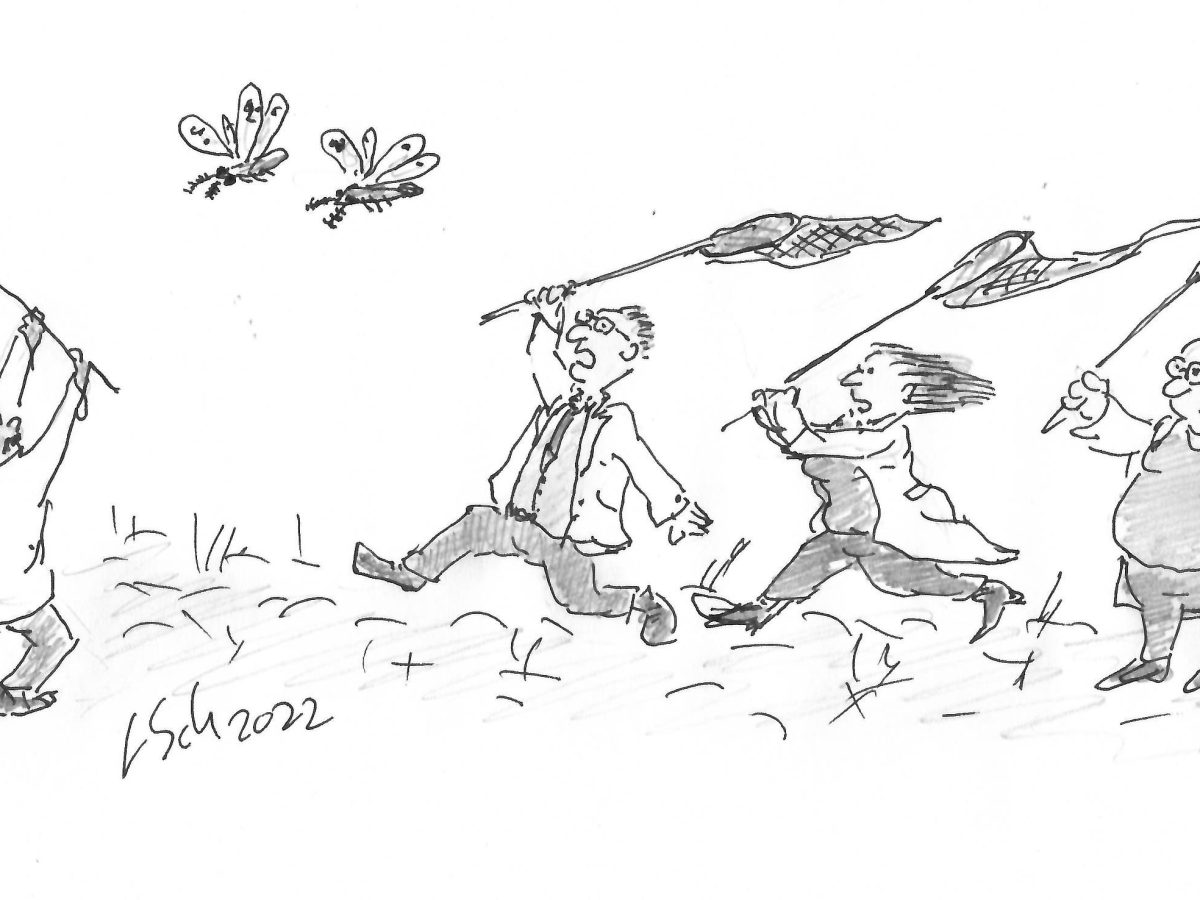



Another great Special Issue (“By Invitation Only“!), this time at Springer Nature. “Edited by Dr. Mohammad Reza Safaei, Dr. Mahyar Silakhori, Dr. Mohammad Hossein Doranehgard, Dr. Marjan Goodarzi.”
Gone into 404, it seems.
LikeLike
Nobody reads For Better Science, authorities say.
LikeLike
The report by Hafiz is surprisingly similar to one of the reports here https://www.mdpi.com/2504-477X/5/7/176/review_report
Meaning items 1, 2, 6, 7, 8 of Hafiz are identical to items 1, 2, 5, 6, 7 of MDPI. Item 3 (Hafiz) and item 3 (MDPI) differ only in the references suggested for citing.
LikeLike
Ditto: https://www.mdpi.com/2076-3417/12/11/5690/review_report
LikeLike
Ditto: https://www.mdpi.com/1996-1944/14/6/1401/review_report
LikeLike
Ditto: https://www.mdpi.com/2504-477X/7/1/27/review_report
LikeLike
Ditto:
https://www.mdpi.com/2079-6412/13/4/774/review_report
https://www.mdpi.com/2077-0383/11/4/1062/review_report
https://www.mdpi.com/2076-3417/11/24/12059/review_report
https://www.mdpi.com/2079-6412/12/5/643/review_report
https://www.mdpi.com/2076-3417/11/11/4743/review_report
https://www.mdpi.com/2076-3417/11/6/2859/review_report
LikeLike
Ditto:
https://www.mdpi.com/2076-3417/12/1/297/review_report
https://www.mdpi.com/2073-4360/15/1/69/review_report
https://www.mdpi.com/2079-6412/12/12/1933/review_report
https://www.mdpi.com/2079-6412/13/1/174/review_report
https://www.mdpi.com/2076-3417/11/15/7141/review_report
https://www.mdpi.com/2071-1050/13/16/9016/review_report
https://www.mdpi.com/2076-3417/11/17/7931/review_report
https://www.mdpi.com/2073-4360/14/2/265/review_report
https://www.mdpi.com/2076-3417/12/21/10875/review_report
https://www.mdpi.com/1996-1944/16/11/4045/review_report
LikeLike
(Better posted in the relevant thread…)
And ditto:
https://www.mdpi.com/1996-1944/14/6/1350/review_report
https://www.mdpi.com/1996-1944/15/19/6735/review_report
(This is what Google offered through the search. The list is most definitely incomplete.)
LikeLike
And also PLoS:
https://journals.plos.org/plosone/peerReview?id=10.1371/journal.pone.0256541.r001
LikeLike
And ditto:
https://www.mdpi.com/1996-1944/14/6/1350/review_report
https://www.mdpi.com/1996-1944/15/19/6735/review_report
(This is what Google offered through the search. The list is most definitely incomplete.)
LikeLike
Nice find! I liked https://www.mdpi.com/1996-1944/15/19/6735/review_report, with the Turkish reviewer Urtekin ‘suggesting’ the indian, maleysian, and polish authors to include a Turkish-language only paper.
LikeLiked by 1 person
“Editors-in-Chief no longer have confidence
We remain on the topic of Oncogene.”
Is there something about Harvard, or is it just big, and by chance problematic data are more likely to occur there?
An early, prominent case of faking was at Harvard, that of John Darsee. His supervisor, Eugene Braunwald does not come out of it that well either.
https://en.m.wikipedia.org/wiki/John_Darsee
https://pubmed.ncbi.nlm.nih.gov/6828878/
LikeLike
Harvard acts like a massive detector for neutrinos, except Harvard detects fake science (a kind of anti-matter, or at least something with a negative value to science).
Particles detected:-
John Darsee,
Sam(e) W Lee,
Edward E Whang,
Mark Duxbury,
Judy Lieberman,
C Ronald Kahn,
Barbara B Kahn (who is not C Ronald Kahn’s wife or sister),
Bruce Spiegelman.
https://scitechdaily.com/massive-underground-ghost-particle-detector-finds-final-secret-of-our-suns-fusion-cycle/?utm_content=cmp-true
LikeLike
“In addition I have already reported this to legal authority and web police.” Ooh, you in trouble now, boy.
LikeLike
Couldn’t sleep because of web police!
LikeLike
I don’t know what’s worse, the threat of web police, the typos everywhere, the retarded research with knwon fraudsters, or the fact people at the university didn’t notice anything was wrong here. I seriously wonder if he even has a degree.
LikeLike
This is Italy where professorships are inherited
LikeLike
Recent articles re. Semenza:
https://www.timeshighereducation.com/news/nobelist-gregg-semenza-hit-rising-tide-retractions
https://cen.acs.org/people/nobel-prize/Nobel-Prize-winner-Gregg-Semenza/101/web/2023/06
LikeLike
Of course this lying credit-thieving tosser Dalmeet S Chawla credited Retraction Watch for the Semenza reporting. I guess that’s why ACS and Science love Chawla: he fakes facts the way they like it.
LikeLike