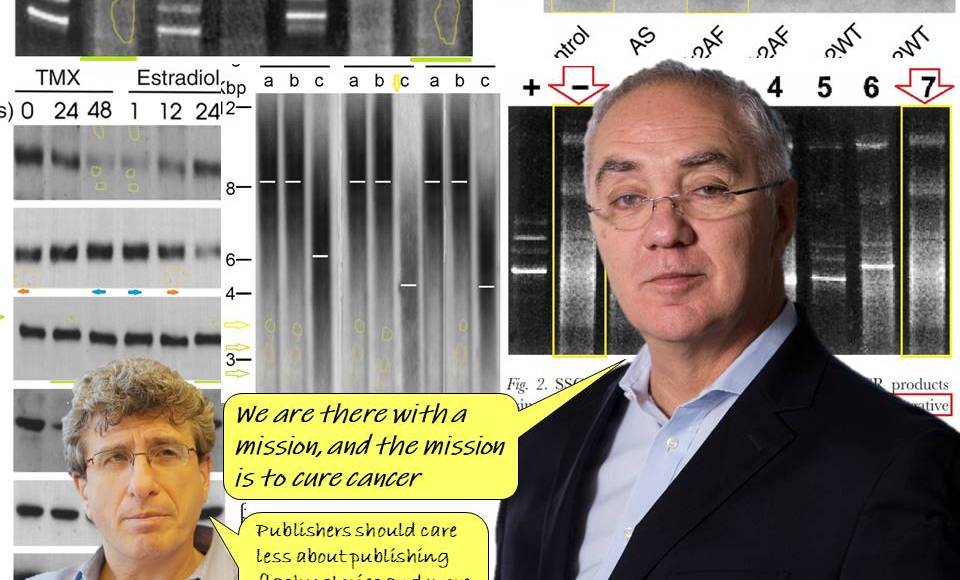

Yet another utterly inappropriate editorial appointment. Once again, it’s a learned society confused about how research integrity works. Congratulations to Professor Massimo Loda of Weill Cornell on his new job as Editor-in-Chief of Molecular Cancer Research, published by the American Association for Cancer Research (AACR).
AACR is torn between doing something about the massive research fraud they published in the last decades, and doing as their elite scientific members demand, which, in the nutshell, means fostering research fraud, because this is apparently the only way to cure cancer.
This is why last year AACR gave a fancy award to the undead Count Fakula of fraudulent science, Michael Karin. Any scientist with a minimal residue on ethics won’t touch Karin with a bargepole, but he got an AACR award anyway, to make a point.
The point again being: Photoshop fraud is the way to make careers pretending to cure cancer. This is basically the real purpose of AACR, even if some people there really mean well. The cheaters and bullshitters of US cancer research are just too powerful, and if won’t even help to wait for these old buggers to physically die out, they are constantly procreating by placing their depraved and dishonest academic progeny in professorial chairs in USA and all over the world, building entire dynasties of bad science.
And in 2018, AACR gave a huge award to Tony Hunter, a Salk Institute Gandalf who must never be criticised no matter how fake some of his papers are. If such deity like Hunter had to retract a paper, nobody would be safe.
So hence the new appointment, of the Italian-born Massimo Loda, Chairman of Pathology and Laboratory Medicine at Weill Cornell Medical College in New York. An AACR press release from 28 September 2021:
“The AACR is delighted to welcome Dr. Loda as Editor-in-Chief of Molecular Cancer Research,” said Margaret Foti, PhD, MD (hc), Chief Executive Officer of the AACR. “Given Dr. Loda’s extensive experience in molecular pathology, coupled with his significant accomplishments in the past as a deputy editor of the journal, he is particularly well suited for this position. Under his extraordinary leadership, Molecular Cancer Research will continue to attract high-quality manuscripts that contribute to our understanding of and progress against cancer.”
So let’s have a look at Loda’s achievements, posted on PubPeer by Clare Francis and others (currently around 15 papers). Here something in another AACR journal, criticised in 2015:
Carmen Priolo , Dan Tang , Mohan Brahamandan , Barbara Benassi , Ewa Sicinska , Shuji Ogino , Antonella Farsetti , Alessandro Porrello , Stephen Finn , Johann Zimmermann , Phillip Febbo , Massimo Loda The isopeptidase USP2a protects human prostate cancer from apoptosis Cancer Research (2006) doi: 10.1158/0008-5472.can-06-1374

Those was not an unintentional copy-paste, images don’t stretch themselves. Maybe this is why the paper was never even corrected? Incidentally, Cancer Research‘s “Deputy Editor for Controversy and Consensus”, thus presumably in charge of research ethics issues, is the infamous Raghu Kalluri of MD Anderson in Texas. This appointment can’t be a coincidence, but a statement from AACR.
Prior to moving to Weill Cornell in 2018, Loda used to be professor at Dana Farber Cancer Institute and Harvard Medical School, where he eventually retired, describing himself as “Emeritus”. Born 1955, Loda spent most of his life in Boston, having moved there from Milan, Italy in 1985. Loda became full professor in Harvard in 2006, in 2012 a Paul M. Dowd Chair of Molecular Oncologic Pathology at Dana Farber was sponsored for him by a charity, where Loda announced:
“I dedicate this chair to the patients because we are there with a mission, and the mission is to cure cancer and get rid of this disease and to help patients who do have cancer with their suffering.“
And then, in 2018, he just picked up and left Boston, after 33 years. I wonder if the PubPeer records can explain why Loda decided to stop being a Harvard professor and find a new job 300km away in New York. These records can also explain what kind of mission Loda was onto really. Maybe this paper, criticised already in 2016, can help:
Michael Murphy , Sabina Signoretti , Marshall E. Kadin , Massimo Loda Detection of TCR-gamma gene rearrangements in early mycosis fungoides by non-radioactive PCR-SSCP Journal of Cutaneous Pathology (2000) doi: 10.1034/j.1600-0560.2000.027005228.x

Or this one, flagged in 2014:
Sabina Signoretti , Michael Murphy , Maria Giulia Cangi , Pietro Puddu , Marshall E. Kadin , Massimo Loda Detection of clonal T-cell receptor gamma gene rearrangements in paraffin-embedded tissue by polymerase chain reaction and nonradioactive single-strand conformational polymorphism analysis American Journal Of Pathology (1999) doi: 10.1016/s0002-9440(10)65252-2

Given the evidence, both papers are likely to be utterly fake, and of course neither was retracted or corrected.
Loda never replied to my email, so I shall instead use fragments from his recent AACR interview on the occasion of his editorial appointment to explain the irregularities in his papers.
So, Professor Loda, why using Photoshop for cancer therapy?
Loda: “I reasoned that the increasing availability of novel and powerful methodological and technical approaches in the laboratory would lead to rapid and significant advances in understanding the biological underpinning of cancer pathogenesis and progression and, as a result, to better targeted therapies.“
Indeed, Photoshop is an advanced technology even WHO’s IARC occasionally deploys to fight cancer.
Loda published in Nature also. This paper had to be corrected:
Shidong Jia , Zhenning Liu , Sen Zhang , Pixu Liu , Lei Zhang , Sang Hyun Lee , Jing Zhang , Sabina Signoretti , Massimo Loda, Thomas M. Roberts , Jean J. Zhao Essential roles of PI(3)K-p110beta in cell growth, metabolism and tumorigenesis Nature (2008) doi: 10.1038/nature07091

Elisabeth Bik: “This article was corrected in 2016. The text of the Corrigendum reads: “In Fig. 3b of this Letter we inadvertently used the wrong images (partial duplicates of images representing p110α−/− mice) in the panels representing p110β−/− mice. The corrected Fig. 3b is shown in Fig. 1 of this Corrigendum. The conclusions of the paper are not affected; knocking out either p110α or p110β does not affect the growth of the normal prostate.”
Here is the original Figure 3b, in which two sets of overlapping images were present.“
No, of course the data fudgery, which cannot have happened by accident, never affected any conclusions.
Another paper of Loda’s, criticised on PubPeer already in 2014 and slapped with Expression of Concern in 2019:
Venkata Sabbisetti , Arianna Di Napoli , Apryle Seeley , Angela M. Amato , Esther O’Regan , Musie Ghebremichael , Massimo Loda, Sabina Signoretti p63 promotes cell survival through fatty acid synthase PLoS ONE (2009) doi: 10.1371/journal.pone.0005877

The PLOS One Expression of Concern informs readers that, in addition, “the same β-actin panels are presented in Fig 2D and in S1 Fig for SCC9 cells, although the p63 data and experimental conditions are different“, that “p63 and β-actin data were reported multiple times in the article” in Fig 1A, Fig 3B, and Fig 4. It concludes:
“The PLOS ONE Editors post this Expression of Concern to notify readers of the unresolved issues pertaining to the control data reported in this article and the unavailability of primary data to support most of the western blot results.”
I guess the paper could not be retracted for political reasons. Here another beautiful paper of Loda’s, also flagged already in 2014. The study was merely 8 years old back then, the raw data must have been available. If it ever existed, that is. But nobody asked.
Barbara Benassi, Maurizio Fanciulli, Francesco Fiorentino , Alessandro Porrello , Giovanna Chiorino, Massimo Loda, Gabriella Zupi, Annamaria Biroccio c-Myc phosphorylation is required for cellular response to oxidative stress Molecular Cell (2006) doi: 10.1016/j.molcel.2006.01.009


That collage of vintage Photoshop fraud was never decorated with any notices of concern because this is Molecular Cell, a kind of offshore heaven for biomedical customers where fraud is safe and protected.
Now, it may very well be that it was some Italian co-authors of Loda’s who are responsible for the fraud in those papers. But at some point, it matters less who faked the figure in Photoshop and rather who covers it up and refuses to correct the literature, while crying conclusions not affected. And this someone is now Editor-in-Chief of an AACR journal.
Maybe I should drop an email to Loda’s boss at Weill Cornell, the dean Augustine MK Choi? What do you think? Bad idea, probably.
Anyway, here another paper with Loda as last and corresponding author, flagged already in 2014.
M. Giulia Cangi , Barry Cukor , Peggy Soung , Sabina Signoretti , Gilberto Moreira , Moksha Ranashinge , Blake Cady , Michele Pagano , Massimo Loda Role of the Cdc25A phosphatase in human breast cancer Journal of Clinical Investigation (2000) doi: 10.1172/jci9174

Other figures in that paper were described to have problems as well. That was not in AACR, but in another society’s journal, whose chief editor is world’s champion of research integrity, Arturo Casadevall. The rotten Loda paper was never retracted or corrected or flagged with expression of concern. Nothing.
Michele Pagano publishing on steroids
Strangely, this other paper by Loda and his collaborator Michele Pagano at New York University, in the same journal, has been retracted already in 2016.
Sabina Signoretti , Lucia Di Marcotullio , Andrea Richardson , Sridhar Ramaswamy , Beth Isaac , Montserrat Rue , Franco Monti , Massimo Loda , Michele Pagano Oncogenic role of the ubiquitin ligase subunit Skp2 in human breast cancer Journal of Clinical Investigation (2002) doi: 10.1172/jci15795

The retraction notice went:
“At the request of the corresponding author, the JCI is retracting this article. The authors were recently apprised that portions of the p27 blot and cyclin D1 blot of Figure 5A in this publication were duplicated and used to represent different samples. The corresponding author has indicated that previous and subsequent experiments from his and other laboratories support the conclusions reported in Figure 5A; however, the original data are no longer available. No issues have been raised with regard to any of the other data in the paper.”
It is the only paper Pagano retracted, and it is co-authored with Loda who chose to quit being a Harvard professor 2 years later. Maybe a coincidence, maybe there was an investigation at some point? In any case, let me ask Loda why he keeps collaborating with cheaters:
Loda: “I am fond of building on knowledge that my discipline, pathology, has accumulated over the years in the field of cancer and complementing it with new mechanistic insights that validate prior observations.“
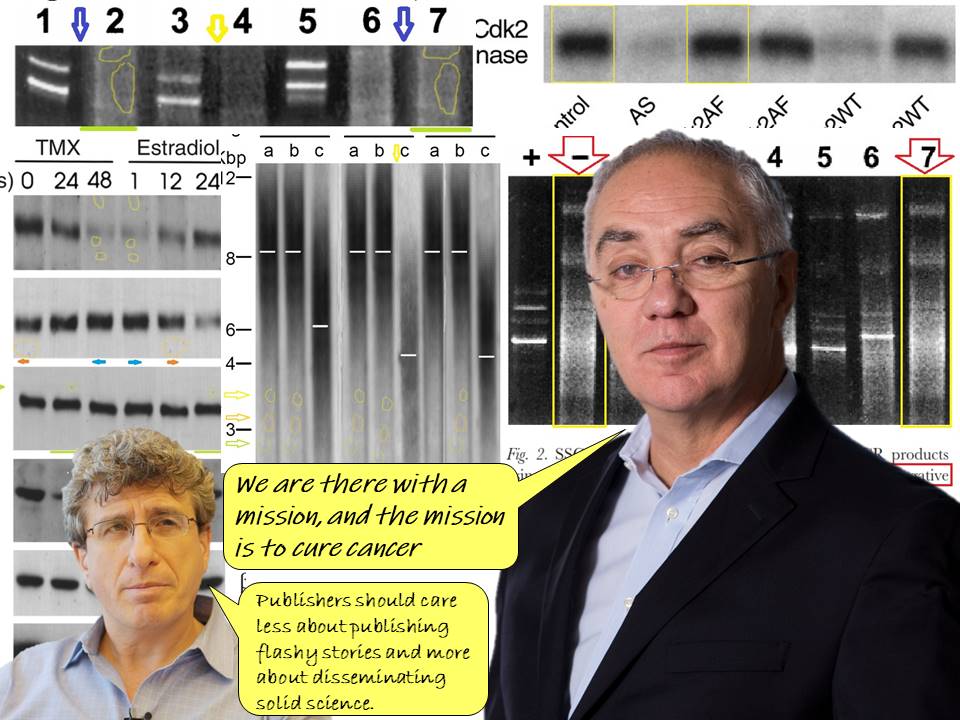
As for Pagano, there are many of his masterpeices on PubPeer, around 30 papers. Here some examples, all without Loda as co-author, mind you:

(Hersko won the Nobel Prize in Chemistry in 2004, maybe this is the reason the paper was never bothered with corrections.)

“Competing interests: M.P. is co-editor-in-chief of Cell Division but was not involved in the review process of this manuscript.“


(Several other figures in that paper are just as fake)

You may wonder why, except for one retraction, Pagano’s fake papers are above the basic rules of research ethics. Well, that is because he is seen as America’s hero of these ethics. No, honestly, I am not joking. Nature, who chose to ignore the data manipulation, published Pagano’s opinion piece in 2017, “Don’t run biomedical science as a business“:
“Science should abandon its assembly-line mentality and rebuild for quality, not quantity, argues Michele Pagano.”
Pagano just retracted a paper for fraud, the PubPeer evidence for other shenanigans in his papers, including in Nature, was publicly available for years when Pagano proclaimed in Nature:
“We are left with a form of publishing on steroids — it is more important to win than to be correct. When science becomes a business, what counts is not whether the product is of high quality, but whether it sells. […] Funds should be distributed on the basis of merit alone, not geopolitical considerations and interests. Institutions need to realign their mentality with their original academic mission, and reduce soft-money positions. Publishers should care less about publishing flashy stories and more about disseminating solid science. Individual scientists should emphasize excellence and rigour over stockpiling more and more papers and grants.”
What a despicable and sleazy hypocrite. A cat preaching veganism to the canary it’s about to eat is more credible. And yet everyone was celebrating Pagano for bravely standing up for science.
This, dear reader, is the corruption, hypocrisy and narcissism of academia and scholarly publishing in the nutshell. This is why Pagano’s associate Loda is now Editor-in-Chief at an AACR journal. This is also why Journal of Biological Chemistry (JBC), published by the American Society for Biochemistry and Molecular Biology (ASBMB), recently appointed as its new Editor-in-Chief Alex Toker, who incidentally did postdoc at Weill Cornell, with Lewis Cantley.
The difference being that Toker’s PubPeer record is largely very recent, posted just when he was appointed by ASBMB, while Loda’s goes back to 2014, and still he was recruited by AACR. Probably not despite the history of fake science, but because of it. In any case, both men, Loda and Tokar will keep their editorial appointments, because this is cancer research and not plant sciences, where the newly appointed Editor-in-Chief of The Plant Cell, Sally Assmann, was swiftly replaced when evidence of fraud was published.
Science being a village, Loda used to collaborate and share grants with Cantley, so maybe this is thanks to Cantley that Loda ended up in Weill Cornell, where he now works with him on mTOR? You really do find the very best scientists in that particular research field.
Let me conclude by asking Loda: What excites you most about the next decade in fraudulent cancer research?
Loda: “Many things excite me: the availability of major technical advances…[…] The combination of exponential growth in the understanding of cancer biology and the tool kit to manipulate it will result in new discoveries and better therapies.“
Yes, the tool kit to manipulate cancer research is growing exponentially indeed.
Oh never mind. Let’s have a song.

Get For Better Science delivered to your inbox.
Make a one-time donation
Make a monthly donation
Choose an amount
Or enter a custom amount
Your contribution is appreciated.
Your contribution is appreciated.
DonateDonate monthly

 For Better Science
https://bloodcancerdiscov.aacrjournals.org/editors
Blood Cancer Discovery (AACR).
Anas Younes, MD
Memorial Sloan Kettering
https://lymphomahub.com/about-us/prof-anas-younes
In 1992, following his fellowship, Prof. Younes worked at The University of Texas MD Anderson Cancer Center, Houston, US, where he acted as a clinical researcher and treating physician for the next two decades. In 2013, Prof. Younes made the move back east to become the Chief of Lymphoma Service at the Memorial Sloan Kettering Cancer Center.
Problematic data Anas Younes:-
https://pubpeer.com/publications/AFE0D5B5F57023951A45B0B3292BC0
https://pubpeer.com/publications/64403819DAD1CCB5F7EF9AB05892E9
https://pubpeer.com/publications/5CB81BC889A857F507CD7588FA633C#4
https://pubpeer.com/publications/5CB81BC889A857F507CD7588FA633C#7
https://pubpeer.com/publications/37224D1C70AC0518067A17C8C8CA39
https://pubpeer.com/publications/C70318767465E76B4F0A093AE33504#2
https://pubpeer.com/publications/1AAA8FC9FADEBD1D995538D146F5CF
LikeLike
https://cancerres.aacrjournals.org/site/misc/edboard.xhtml
Advisory Editors
Joan S. Brugge
Problematic data Joan S. Brugge:-
https://pubpeer.com/publications/F122A32DD65EC80C0308D541AB2382
https://pubpeer.com/publications/9BFC4E1E11D8585224260B5E68A731
https://pubpeer.com/publications/DBFE7B98B7768975FAD80C5E683D1E#2
https://pubpeer.com/publications/F86C8354CA74DC6F3D3F0A74CB4C94
https://pubpeer.com/publications/FD783B782147B4C1818FCB5413D335
https://pubpeer.com/publications/09D13D76B9CAE8EDA0AA88F0213759
https://pubpeer.com/publications/BAF18135586E647112068B9F4A0E76
https://pubpeer.com/publications/6CE8F1E7F5A7E25CD432BAAA1FBA79#1
https://pubpeer.com/publications/4C49546A4C0ABA201295238C1B4F55#1
LikeLike
Another Italian genius.
Thomas Rando. https://profiles.stanford.edu/thomas-rando
Problematic data:-
https://pubpeer.com/publications/E006ECA3F03CA48839B631F5682C7A
https://pubpeer.com/publications/ED7A7B635A2E70CC29A3CCD4F105B6
https://pubpeer.com/publications/4496C6C4AF075D8065D6DD295FDC2E#1
https://pubpeer.com/publications/0DF1C16E2210595C40C83AF07A78F1#1
https://pubpeer.com/publications/67DC885563C5A31221C286B05D94E1
https://pubpeer.com/publications/84C2A19220455DA8670BFA1D81FB28
https://pubpeer.com/publications/6B7568749BC69870B1755C411E3431
https://pubpeer.com/publications/003FC86082F546B2864C9F55EA09DE
https://pubpeer.com/publications/6552F1A9286E73130632553028FC4A#2
https://pubpeer.com/publications/054B93A215D19A89B85D8A34BBEC24
LikeLike
Rando was born in New York. If anything, his (great)-grandparents were Italian immigrants.
He is an American genius, not Italian.
LikeLike
Antonio Iavarone.
https://www.pathology.columbia.edu/profile/antonio-iavarone-md
https://ciaoitalianamerica.wordpress.com/tag/antonio-iavarone/
https://www.ansa.it/english/news/general_news/2018/01/04/tumour-drug-discovered_b4ea900e-ad95-4199-a9b2-ac372f931632.html
Italian genius, or Photoshop (scissors and glue)?
https://pubpeer.com/publications/279AF4D4E590238CA08B82613C8B07
https://pubpeer.com/publications/E81EF46BAE14A6C9A87C70A0488A9F
https://pubpeer.com/publications/CFC0B51D0F9728BB0D82B0C62C009E
https://pubpeer.com/publications/DC514376EB28E0B960AC646E622E48
https://pubpeer.com/publications/D8D81E23AD60BDEE7DFBFE5EB9FD54
https://pubpeer.com/publications/01823B7C2D658F859D5653DF78E87F#
https://pubpeer.com/publications/307C5BE07E66AD4DB75FB70E755C65
https://pubpeer.com/publications/60FF4ADF600EF8CCCD8AE9578957E3
LikeLike
Pingback: Prof Elizalde’s Magic Cancer Research at CONICET – For Better Science
Massimo Loda, fellow traveller, as you do.
https://pubpeer.com/publications/A9F90F78410B2B899AE6BEFBDDF97A#1
LikeLike
Cancer Res. 2004 Dec 15;64(24):8867-75. doi: 10.1158/0008-5472.CAN-04-2938.
Androgen-induced differentiation and tumorigenicity of human prostate epithelial cells
Raanan Berger 1, Phillip G Febbo, Pradip K Majumder, Jean J Zhao, Shayan Mukherjee, Sabina Signoretti, K Thirza Campbell, William R Sellers, Thomas M Roberts, Massimo Loda, Todd R Golub, William C Hahn
Affiliations collapse
Affiliation
1Department of Medical Oncology, Dana-Farber Cancer Institute, Boston, Massachusetts, USA.
PMID: 15604246 DOI: 10.1158/0008-5472.CAN-04-2938
https://pubpeer.com/publications/45E15919CF33A5223BF20DEB46EEDD
Problematic rotation, then other blots not following suit (they probably don’t know that they have to follow suit).
Problem for science is that Massimo Loda is editor-in-chief Mol Cancer Res and the fake above is in a sister journal, a journal out of the same AACR stable, Cancer Res.
The Editors-in-Chief of Mol Cancer Res and Cancer Res will know each other professionally.
They are employed by affiliated organisations.
https://aacrjournals.org/mcr/pages/editors
https://weillcornell.org/massimo-loda-md
Weill Cornell
https://aacrjournals.org/cancerres/pages/editors
https://www.mskcc.org/research-areas/labs/christine-iacobuzio-donahue
Memorial Sloan Kettering Cancer Center
https://weillcornell.org/about_us/our-affiliations
“Weill Cornell Medicine also maintains major affiliations with Memorial Sloan-Kettering Cancer Center and Rockefeller University.”
LikeLike
Massimo Loda/Michele Pagano co-production committed at Harvard.
PubPeer – Down-regulation of p27 is associated with development of col…
Scroll up!
LikeLike
Problematic ubiquination data.
PubPeer – Activation of Protein Kinase C Triggers Its Ubiquitination a…
LikeLike
The old-fashioned methods work in Science.
https://pubpeer.com/publications/6BDBADB660C598D1706DD868BE8695#1
LikeLike
Wonders will never cease, Massimo Loda a gymnast!
PubPeer – USP2a alters chemotherapeutic response by modulating redox
LikeLike
When in Rome.
https://pubpeer.com/publications/F07E41075883B3A11A52D03575FAE3#16
LikeLike
Extensive 23 May 2024 correction 2007 Science paper for Michele Pagano.
https://pubpeer.com/publications/E42BA2EAC9D708A1DFADA7A3CC608B#24
LikeLike
One more for Massimo Loda.
https://pubpeer.com/publications/A28115733CA7AC30DEFD702557CF8C
LikeLike
Nature lets Massimo Loda off the hook!
Editorial Expression of Concern: Essential roles of PI(3)K–p110β in cell growth, metabolism and tumorigenesis | Nature
LikeLike
Loda and the Dana Farber gang.
LikeLike
Nature lets Keith T Flaherty, ex-editor-in-chief of Clinical Cancer Research, off the hook!
Editorial Expression of Concern: A melanocyte lineage program confers resistance to MAP kinase pathway inhibition | Nature
LikeLike
Does this count as “corner cloning”? PubPeer – Down-regulation of p27 is associated with development of col…
LikeLike
Editorial Expression of Concern for Massimo Loda amongst others from a Roma-based journal. Whatever next?
Editorial Expression of Concern: USP2a alters chemotherapeutic response by modulating redox | Cell Death & Disease https://share.google/QoRNuo6UivyChcdTt
LikeLike
In the retractíon notice it states that the original data are no longer available. What is the point of an Expression of Concern? Why not retract the article? Sounds like typical protection.
LikeLike