

Schneider Shorts of 11 July 2025 – an insulted, slandered and harassed Italian man in Zurich, a Saudi-sponsored Belgian man in Lausanne, with more Swiss (and British) correctness, more Nobel retractions, and finally, with a moa and mammoth safari on Mars.
Table of Discontent
Industry Giants
- Path toward extraterrestrial existence – Colossal terraforms Mars, de-extincts moa, dinosaurs to follow
- Semi-science which gives a bad impression – Johan Auwerx to rejuvenate himself with Saudi money
Scholarly Publishing
- A central figure in medical research and education – Wen G Jiang has nothing to fear
- Due to the passage of time – Swiss professors correct a paper
Retraction Watchdogging
- There are jackals out there, clearly with mental issues – Adriano Aguzzi announces another retraction
- An attempt was made to contact the authors – Nobelist Gregg Semenza retracts two more papers
Industry Giants
Path toward extraterrestrial existence
George Church, the founder of the mammoth-revival company Colossal and of various anti-aging and eugenics businesses, is now ready to terraform Mars. Presumably so that he, Elon Musk and other rich white (and thanks to Church’s anti-aging tech, immortal) men can leave the polluted, overheated and dying Earth behind, and go hunt mammoths on Mars.

George Church, Colossal W*nker
From mammoths to eugenics to anti-aging scams: god-impersonator George Church knows how to make money with bullshit.

Harvard University’s School of Engineering announced on 2 July 2025:
“An international team of researchers led by Robin Wordsworth, the Gordon McKay Professor of Environmental Science and Engineering and Professor of Earth and Planetary Sciences, have demonstrated that they can grow green algae inside shelters made out of bioplastics in Mars-like conditions. The experiments are a first step toward designing sustainable habitats in space that won’t require bringing materials from Earth.
“If you have a habitat that is composed of bioplastic, and it grows algae within it, that algae could produce more bioplastic,” explained Wordsworth. “So you start to have a closed-loop system that can sustain itself and even grow through time.”
This is the paper, Church is last author:
Robin Wordsworth , Rafid Quayum , Elida Kocharian , Ann Pearson , Xavier Portillo , Madeleine Yang , Charles S. Cockell , Shannon Nangle , George Church Biomaterials for organically generated habitats beyond Earth Science Advances (2025) doi: 10.1126/sciadv.adp4985
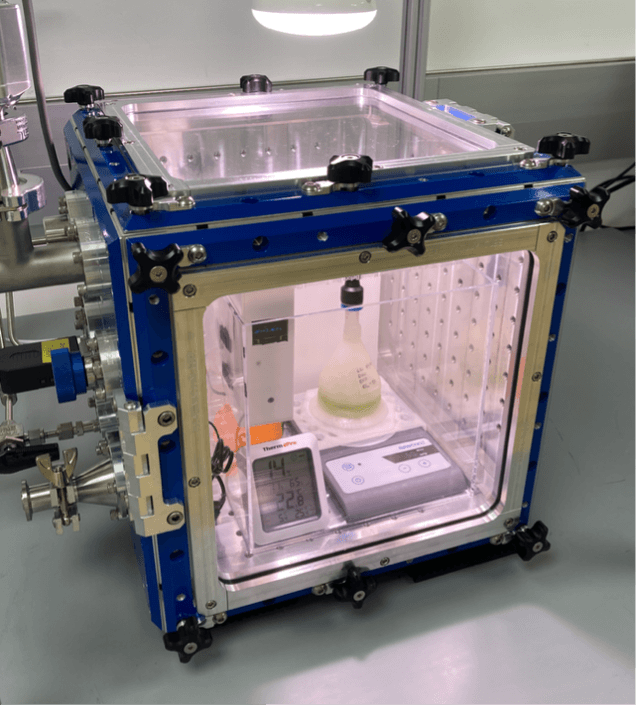
We are informed that some green algae called Dunaliella tertiolecta were grown in a bottle made from polylactic acid and “under a Mars-like 600 Pascals of atmospheric pressure – over 100 times lower than Earth’s — and in a carbon dioxide-rich environment, as opposed to mostly nitrogen and oxygen like on Earth“. Anyone with access to Wikipedia however will learn that this algae species actually thrives in “very harsh growth conditions consisting of high light intensities, high salt concentrations, and limited oxygen and nitrogen levels“.
So yeah, well done. We are also told:
“Wordsworth’s team previously demonstrated a type of local Martian terraforming using sheets of silica aerogels that mimic the Earth’s greenhouse warming effect to allow for biological growth. A combination of the algae experiments with the aerogels would solve both temperature and pressure issues for supporting plant and algae growth, Wordsworth said, and could open a clearer path toward extraterrestrial existence.
Next, Wordsworth said the researchers want to demonstrate that their habitats also work in vacuum conditions, which would be relevant for lunar or deep-space applications.”
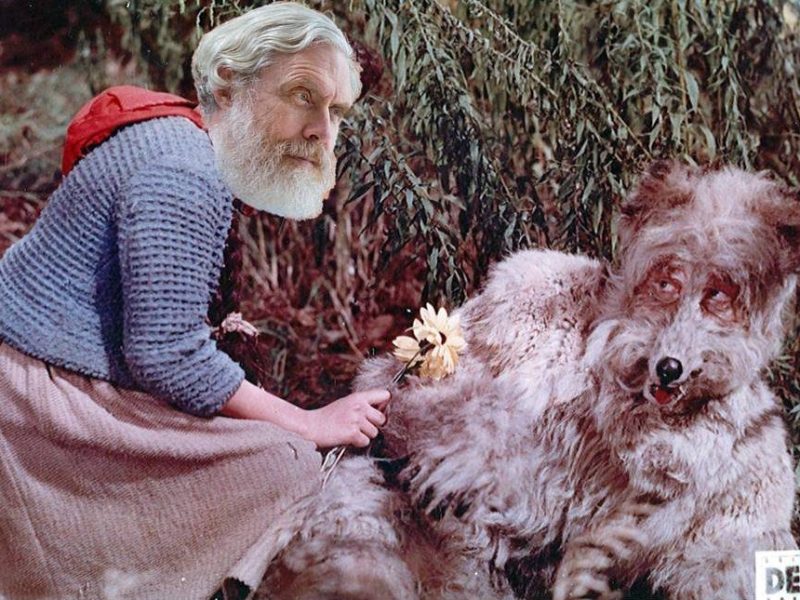
Colossal Liar Wolves
“What is most concerning is that Colossal’s ‘dire wolves’ have now attracted the attention of the Trump administration.” – Ronan Taylor

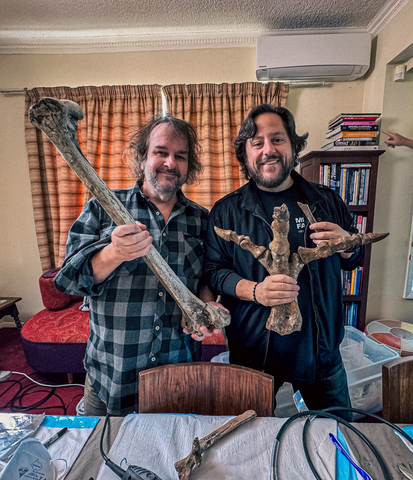
In addition to mammoths, there will be moas on Mars. On 8 July 2025, Colossal announced to the world that they are about to de-extinct New Zealand’s iconic flightless bird, the moa. That was covered by company press releases and various international news sources, also TIME brought a feature story. Spoiler: there is no moa, and there never will be, not even a fake one like with the dire wolf.
The actual story, in all its factual entirety, is that Lord of The Rings director Peter Jackson invested money into Colossal, and investors can order their animals. Games of Thrones author and Colossal investor George RR Martin ordered the dire wolf, and Jackson, who with his partner Fran Walsh invested $10 million, ordered the moa. Jackson was quoted by The Hollywood Reporter:
““When we had our first Zoom call with Colossal a couple of years ago, the moa wasn’t on their list on their website. We said to them, ‘Are you interested in the moa? And [Colossal co-founder] Ben [Lamm] said, ‘Yeah, we sure are. So we made a condition of our investment that all of our dollars go into the moa project.” As part of the agreement, Jackson and Walsh are giving Colossal the use of their collection of moa bones for research. “So we were able to not just invest in Colossal, but also bring our bones to the table, as it were,” continues Jackson”
Also, Colossal invited the director of the new Jurassic World film, Gareth Edwards, and announced to him to de-extict the dinosaurs. Well, in a hundred years, but it is never too early to invest!
Maybe Steven Spielberg himself will invest in Colossal next?
Semi-science which gives a bad impression
As the Betteridge’s Law of Headlines goes, Swissinfo could easily answer their own question in the headline of an article from 3 July 2025, “Can Saudi Arabia’s billions unlock the secrets to a longer, healthier life?“
“For nearly a decade, molecular biologist Johan Auwerx fought to get investors to back his theory that Urolithin A – a natural compound produced by our gut bacteria from food such as pomegranates and walnuts – holds the key to healthy ageing. […]
Although Auwerx secured grants and minor rounds of financing to pay for a few small-scale human tests, he struggled to secure the millions needed for large clinical trials that could give Urolithin A the scientific credibility to become a mainstay in medicine cabinets.
“The problem with the ageing field is that no one does a rigorous clinical trial because no one is willing to invest in natural products,” Auwerx told Swissinfo. “This has led to a lot of semi-science, which gives a bad impression of the ageing field and has made it even more difficult to get funding.””

mTOR: conclusions not affected?
David Sabatini, remember that story? Well, it seems the conclusions were not affected. I take an ill-informed look at the mTOR signalling research field, to understand how photoshopped data gets to be independently verified by other labs.
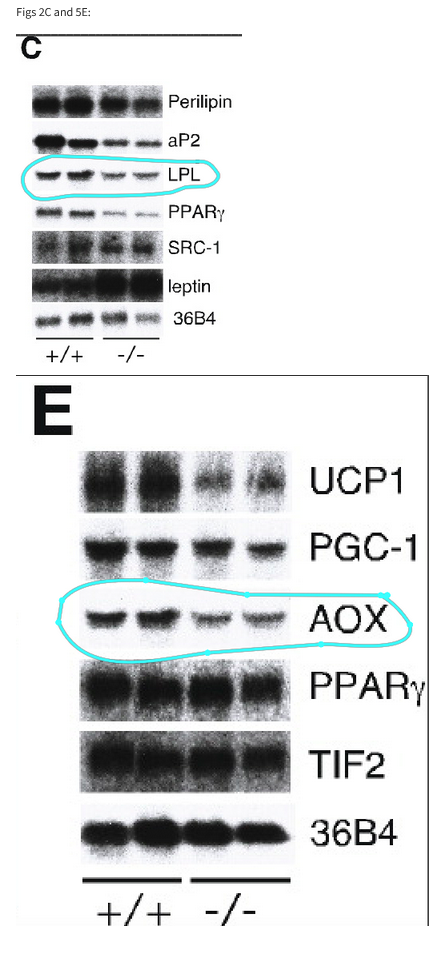
There are several reasons why the EPFL professor Johan Auwerx failed to raise those millions in civilised countries. One is the questionable nature of his research, as evidenced by both his PubPeer record and his refusal to even reply to emails when faced with those issues. I wrote about Auwerx’s bad science in November 2022 Shorts, on the occasion of a hibiscus-based Alzheimer’s cure marketed by a Korean company which Auwerx works for. This data fudgery, found in the works of many other anti-aging researchers, certainly gives a bad impression of the ageing field. Like this:
Frédéric Picard , Martine Géhin, Jean- Sébastien Annicotte , Stéphane Rocchi , Marie-France Champy, Bert W. O’Malley, Pierre Chambon , Johan Auwerx SRC-1 and TIF2 control energy balance between white and brown adipose tissues Cell (2002) doi: 10.1016/s0092-8674(02)01169-8


The other reason for Auwerx’s failure to raise millions for his clinical trials is that Urolithin A, a metabolite of gut bacteria which precursors are found in pomegranates and strawberries, is not an anti-aging miracle drug. In the best case, it does nothing. It certainly did not rejuvenate Auwerx.
But on the other side, the of fossil fuel oligarchs of the Saudi royal family will grab for all anti-aging straws to delay the unavoidable, i.e. their own demise and the irreversible separation from their money and material wealth. In the light of that, the unification with God and His Prophet in the Paradise is absolutely no consolation for these deeply religious and money-loving men. Hence:
“In 2018 Crown Prince Mohammed bin Salman announced plans to create the first global foundation dedicated to developing therapies that extend healthy lifespan. Three years later, the Hevolution Foundation was born with a budget of up to $1 billion (CHF800 million) a year, making it the world’s second-largest funder of geroscience […]
Swiss researchers and companies are among the beneficiaries. The foundation’s first four investments in start-ups included Lausanne-based Vandria, which is developing treatments for age-related diseases based on Auwerx’s discoveries on mitophagy. […]
Timeline, another company Auwerx is involved with that sells Urolithin A as a supplement, is one of 40 semi-finalists in XPRIZE Healthspan – a seven-year, global competition to develop new therapies that restore muscle, cognitive and immune function by at least ten years in people aged 50 to 80. Hevolution is the single-largest backer of the initiative, bankrolling $40 million of the $101 million prize money. “
Yes, Swissinfo worships a ruthless brutal Saudi dictator who executes people, at home and abroad, including most famously the Saudi journalist Jamal Kashoggi, whom the Crown Prince had killed and sawn into pieces in the in Istanbul. All because money does not stink. The article even has the gall to greenwash Saudi Arabia’s anti-aging scams as “a larger push to diversify its economy away from a dependence on fossil fuels“.
Timeline sells Urolythin A skincare products, trademarked as “Mitopure”. On the company’s website, Timeline’s Scientific Advisor Auwerx celebrates Mitopure as “a real game-changer for human health.”
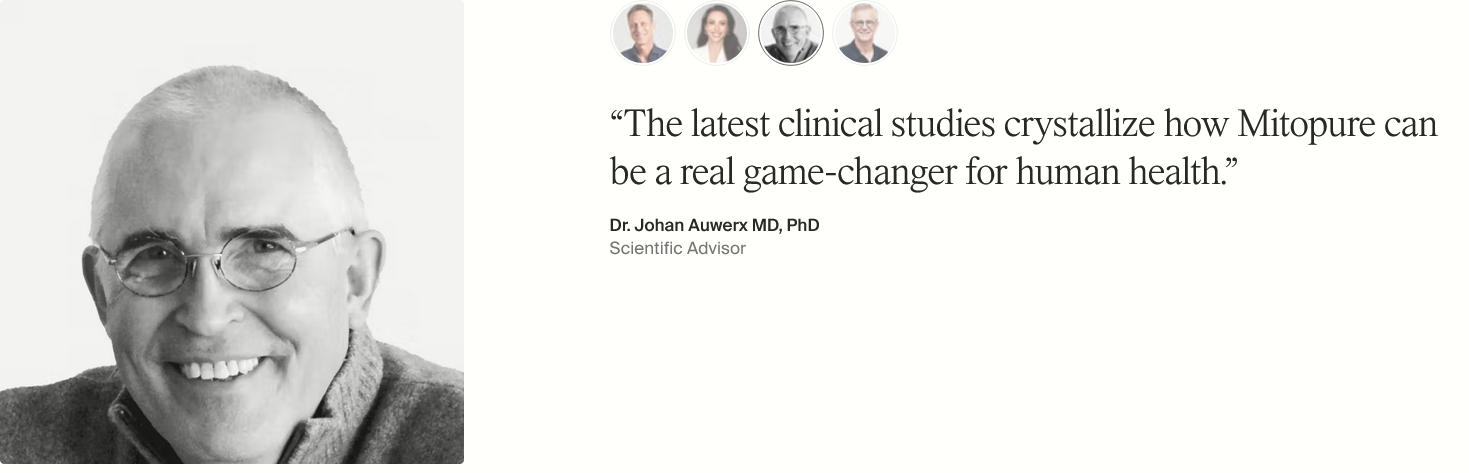
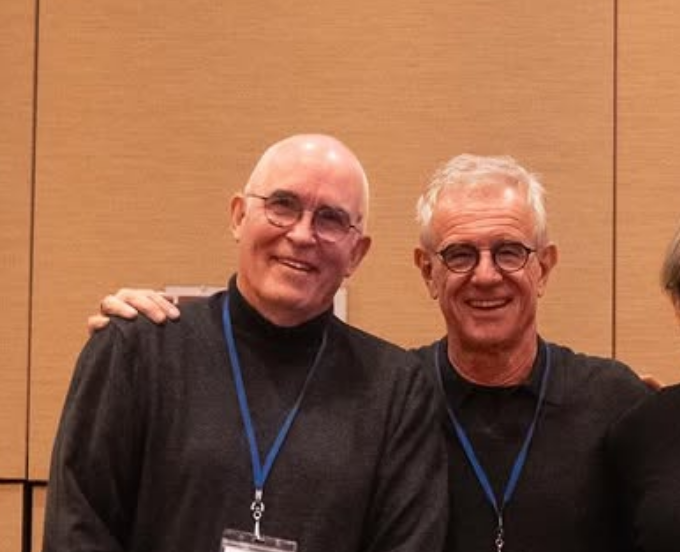
Auwerx is a native Belgian, also his compatriot friend Eric Verdin fawns: “Mitopure is one of the most promising compounds in our field“. The anti-aging researcher Verdin (PubPeer record) is director of the Buck Institute for Research on Aging in USA, which is now also funded by Saudi Hevolution.
As for Vandria– Auwerx is their scientific advisor, the Hevolution-funded company pushes anti-aging drugs for mitophagy, and is presided by the former EPFL president, Patrick Aebischer. On this occasion, a fake paper co-authored by Aebischer with, ta-da, Eliezer Masliah:
Katerina E Paleologou , Abid Oueslati , Gideon Shakked , Carla C Rospigliosi , Hai-Young Kim , Gonzalo R Lamberto , Claudio O Fernandez , Adrian Schmid , Fariba Chegini , Wei Ping Gai , Diego Chiappe , Marc Moniatte , Bernard L Schneider , Patrick Aebischer , David Eliezer , Markus Zweckstetter , Eliezer Masliah, Hilal A Lashuel Phosphorylation at S87 is enhanced in synucleinopathies, inhibits alpha-synuclein oligomerization, and influences synuclein-membrane interactions The Journal of neuroscience (2010) doi: 10.1523/jneurosci.5922-09.2010


Scholarly Publishing
A central figure in medical research and education
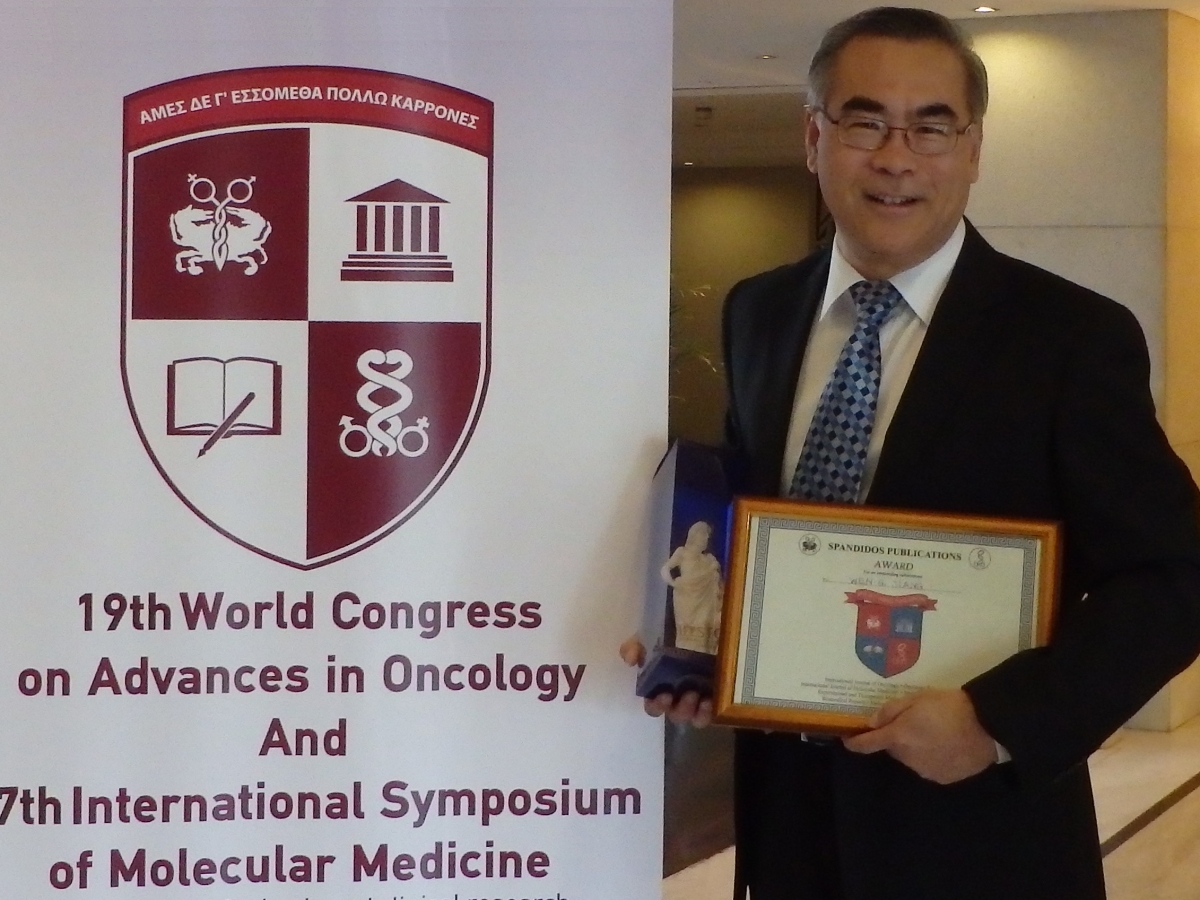
Spandidos issued a turbo-correction just days after the PubPeer concerns were posted. The beneficiary is a certain Wen G Jiang, oncology professor at the Cardiff University in UK. Which is sponsored by a Chinese TCM company which also sponsors Jiang directly, this is why in 2018 the British university declared Jiang totally innocent:
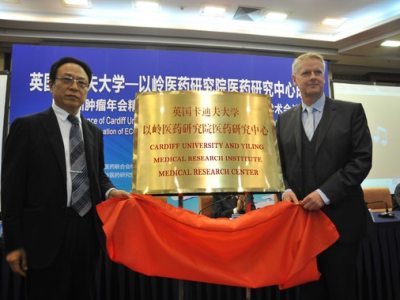
Cardiff: no misconduct by TCM professor Wen Jiang, report secret
Cardiff university declared their oncology professor and TCM peddler Wen Jiang innocent of any data manipulation. It then issued then a press release accusing me personally of having slandered Jiang with false allegations of misconduct.
Cardiff University also made sure that very few of Jiang’s fake papers got retracted (for the last retraction, see October 2023 Shorts)As I wrote in April 2023 Shorts, after his successful whitewashing, Jiang understood that he was free to continue with fake science, with full approval from his Cardiff superiors.
Eventually, Claire Francis and other sleuths returned to screening Jiang’s papers, this time using the software Image Twin. This was flagged in early June 2025:
Rong Liu , TRACEY A. Martin , NICOLA J. Jordan , Fiona Ruge , Lin Ye , WEN G. Jiang Metastasis suppressor 1 expression in human ovarian cancer: The impact on cellular migration and metastasis International Journal of Oncology (2015) doi: 10.3892/ijo.2015.3121

A Corrigendum was issued just days later, on 2 July 2025:
“Subsequently to the publication of the above article, an interested reader drew to the authors’ attention that, concerning the cell invasion assays shown in Fig. 5A on p. 1436, the ‘WT’ and ‘pEF6’ data panels contained apparently overlapping sections of data, such that these experiments were apparently derived from the same original source where the results of differently performed experiments were intended to have been portrayed.
After re‑examining their original data, the authors have realized that the data panel in Fig. 5A for the ‘pEF6’ experiment was inadvertently selected incorrectly. The revised version of Fig. 5, showing all the correct data for Fig. 5A, is shown on the next page. The authors are grateful to the Editor of International Journal of Oncology for allowing them this opportunity to publish a Corrigendum, and all the authors agree with its publication. Furthermore, the authors apologize to the readership for any inconvenience caused.”
Jiang currently has over 60 papers on PubPeer. Here one recently posted example:
Aihua Jiang , Huishan Zhao , Xiaofei Liu , Mingwei Yu , Jian Chen , Wen G Jiang Comparison of Different Muscle-Relaxant Anesthetics on Growth, Migration and Invasion of Gastric Cancer Cells Anticancer Research (2017) doi: 10.21873/anticanres.11831


The author Huishan Zhao promptly replied, accepted full responsibility as “the primary contributor“, and announced to publish a correction. Zhao put up a very different attitude here, concerning a paper in the same International Journal of Oncology:
- Gang Chen , Hefen Yu , Lucy Satherley , Catherine Zabkiewicz , Jeyna Resaul , Huishan Zhao , Hu Mu , Xiuyi Zhi , Junqi He , Lin Ye , Wen G. Jiang The downstream of tyrosine kinase 7 is reduced in lung cancer and is associated with poor survival of patients with lung cancer Oncology Reports (2017) doi: 10.3892/or.2017.5538
- Huishan Zhao, Gang Chen , Lin Ye , Hefen Yu , Shenglan Li , Wen G Jiang DOK7V1 influences the malignant phenotype of lung cancer cells through PI3K/AKT/mTOR and FAK/paxillin signaling pathways International Journal of Oncology (2018) doi: 10.3892/ijo.2018.4624

Zhao declared on PubPeer, in bold even:
“I hereby declare that there is no issue with the figure, and both articles are without any problem.“
Note that the second paper was published after Jiang had to stand a research misconduct investigation.
Fried Divine Comedy, featuring anti-cancer cockroach and phallic fungus
This is a follow-up to the previous article, about a misconduct investigation at the Cardiff University in UK into the published works of cancer researcher Wen Jiang, professor of Surgery and Tumour Biology, Fellow of Royal Society of Medicine and chair of Cardiff China Medical Research Collaborative. The following guest post by my regular contributor Smut…
Cunning as he is, Jiang involved some important colleagues as coauthors, to make sure he is protected. Here he is, in another Spandidos journal, with Keith G. Harding CBE FRCGP FRCP FRCS FLSW, Director of TIME Institute (Translation, Innovation, Methodology and Engagement) and Head of the Wound Healing Research Unit at Cardiff University:
SHEILA C. WANG , LIN YE , ANDREW J. SANDERS , FIONA RUGE , KEITH G. HARDING , WEN G. JIANG Tumour endothelial marker-8 in wound healing and its impact on the proliferation and migration of keratinocytes International Journal of Molecular Medicine (2016) doi: 10.3892/ijmm.2015.2434

Here, again in International Journal of Oncology, is Jiang with the Cardiff professor Malcolm Mason OBE MD FRCR FRCP FRSB FLSW:
- Ping-Hui Sun , Lin Ye , Malcolm D. Mason , Wen G. Jiang Protein Tyrosine Phosphatase µ (PTP µ or PTPRM), a Negative Regulator of Proliferation and Invasion of Breast Cancer Cells, Is Associated with Disease Prognosis PLOS One (2012) doi: 10.1371/journal.pone.0050183
- Ping-Hui Sun , Gang Chen , Malcolm Mason , Wen G. Jiang , Lin Ye Dual roles of protein tyrosine phosphatase kappa in coordinating angiogenesis induced by pro-angiogenic factors International Journal of Oncology (2017) doi: 10.3892/ijo.2017.3884

The 2017 Spandidos paper was corrected just days after the PubPeer posting, on 9 July 2025:
“Subsequently to the publication of the above paper, an interested reader drew to the authors’ attention that the data for the PTPRK blots shown in Fig. 1B on p. 1129 were strikingly similar to data that had already appeared in a previous publication by the same authors in the journal PLoS One. The authors have re‑examined their original data, and realize how this error occurred. The revised (and corrected) version of Fig. 1, now showing the correct data for the PTPRK blots in Fig. 1B, is shown below. The authors sincerely apologize for the error made in assembling this figure, although they confirm that this did not grossly affect either the results or the conclusions reported in this study. They also thank the Editor of International Journal of Oncology for granting them the opportunity to publish a Corrigendum, and apologize to the readership for any inconvenience caused.”
Again Spandidos journal, Jiang with the now retired Cardiff professor Robert Mansel, with whom Jiang even published a book about breast cancer:
Lijian Zhang , Jinfeng Chen , Yang Ke , Robert E Mansel , Wen G Jiang Expression of pigment epithelial derived factor is reduced in non-small cell lung cancer and is linked to clinical outcome International Journal of Molecular Medicine (2006) doi: 10.3892/ijmm.17.5.937

Here is Jiang again with Mason, Mansel and another Cardiff colleague, Michael Boulton (now in USA, at University of Alabama at Birmingham). Some PubPeer evidence is from 2017, some is fresh, from June 2025:
- Christian Parr, Andrew J. Sanders , Gaynor Davies , Tracey Martin , Jane Lane , Malcolm D. Mason , Robert E. Mansel , Wen G. Jiang Matriptase-2 inhibits breast tumor growth and invasion and correlates with favorable prognosis for breast cancer patients Clinical cancer research (2007) doi: 10.1158/1078-0432.ccr-06-2357
- Christian Parr, Gareth Watkins , Mike Boulton, Jun Cai, Wen G. Jiang Placenta growth factor is over-expressed and has prognostic value in human breast cancer European journal of cancer (2005) doi: 10.1016/j.ejca.2005.07.022
- Jun Cai , Christian Parr , Gareth Watkins , Wen G. Jiang , Mike Boulton Decreased pigment epithelium-derived factor expression in human breast cancer progression Clinical cancer research (2006) doi: 10.1158/1078-0432.ccr-06-0094


After his whitewashing, Jiang was promoted. He is remains University Dean of International, Director of Cardiff China Medical Research Collaborative, and Academic Director for International Relations at his Cardiff University. Plus he is Fellow of the Royal Society of Biology and of the Royal Society of Medicine, among other fellowships.
Basically, Jiang is Cardiff’s cash cow, tightly connecting this British university to the money teat and foreign control by the Chinese Communist Party and its TCM industry. On his website, Jiang describes himself accordingly as “a central figure in medical research and education“.
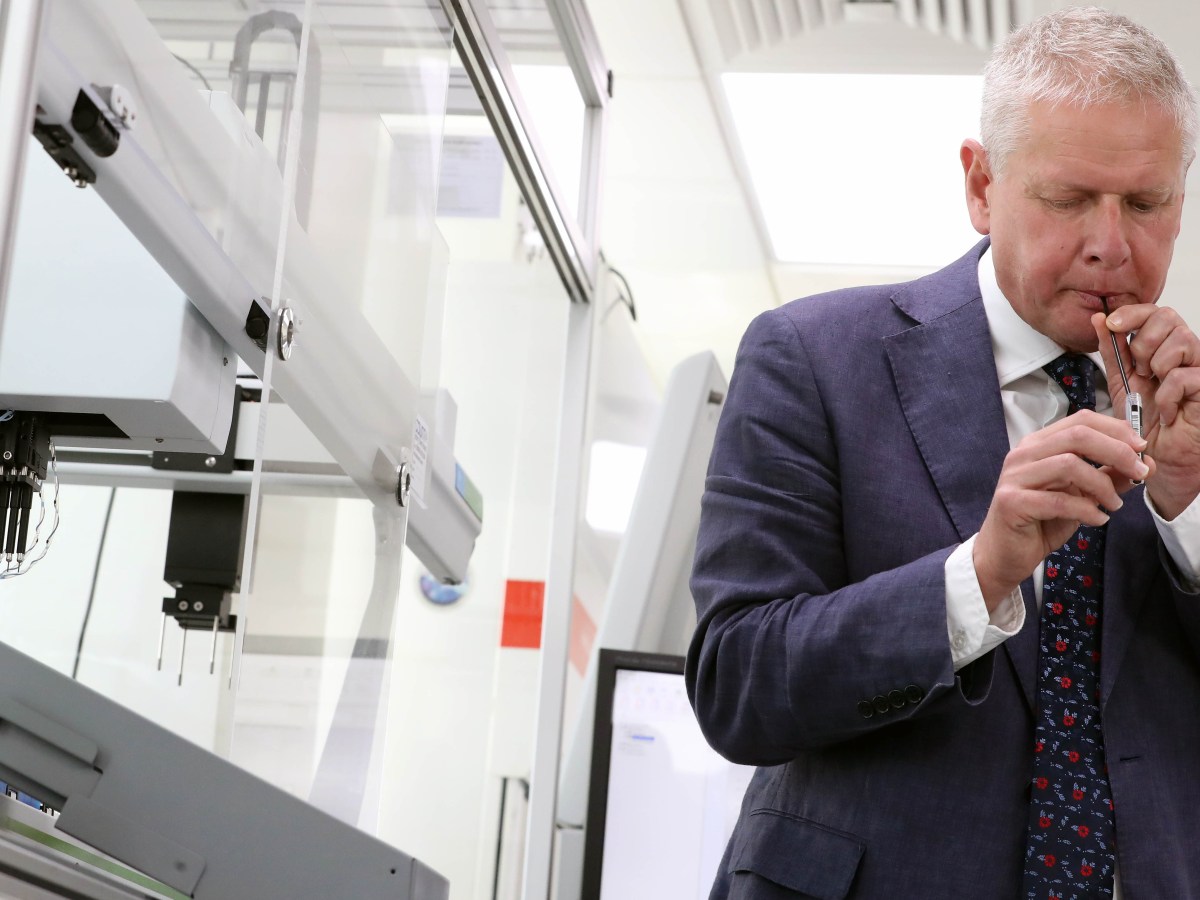
The Cardiff Coronatest
“A consumable component, magnetic beads, used by the laboratory was supplied by Magnacell Ltd, a company that has Dr T Jurkowski as a director. Cardiff University did not tender for these consumables at the time”.
Due to the passage of time
As you all know, Springer Nature’s journal Scientific Reports has the most cometenent and most technologically advanced team to screen for image data manipulations (read May 2025 Shorts).
That is why they will need to correct their correction now.
One coauthor here is the Swiss bigwig Michael Grotzer, Medical Director of the University Children’s Hospital Zurich, who was mentioned in this article:
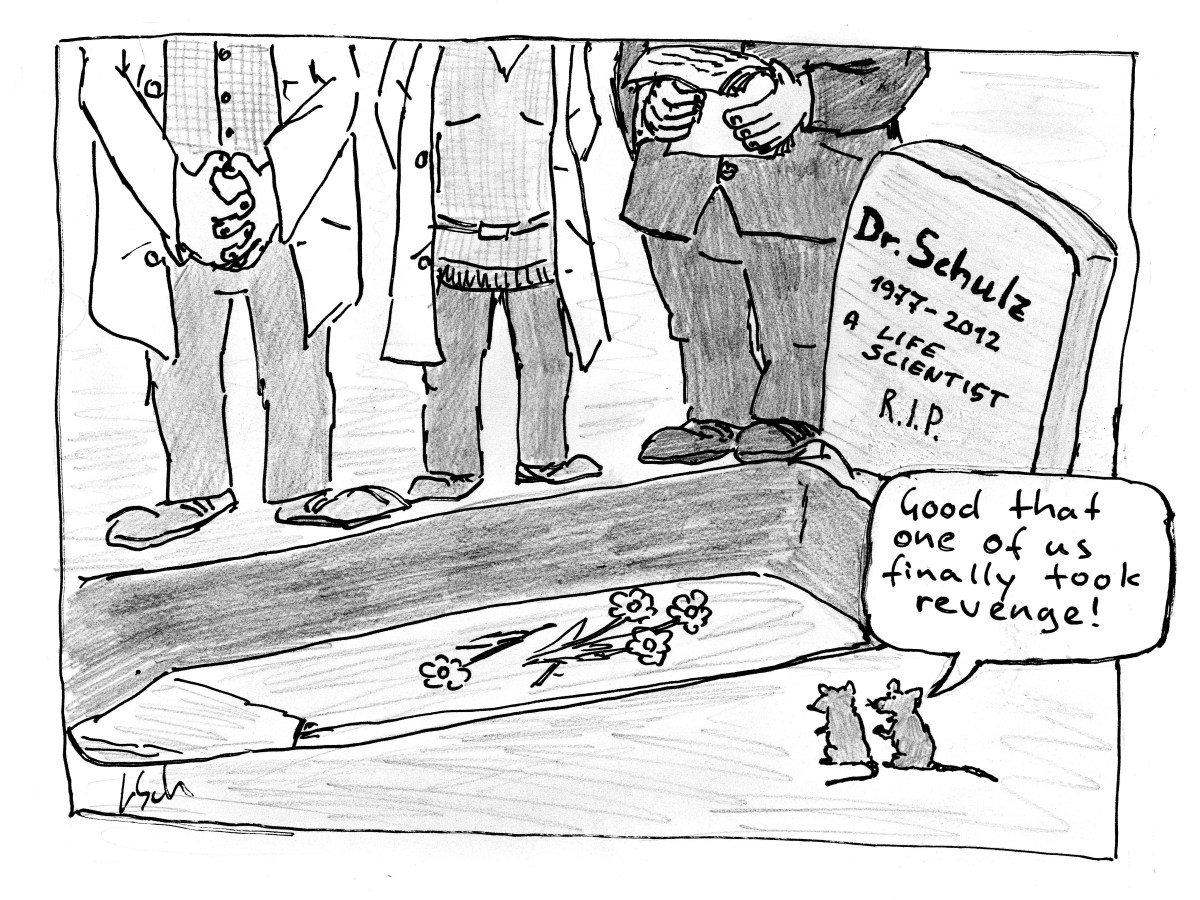
Obituaries for explosive developments in cancer research
“Michael Waterfield,a key figure in the explosive developments in cancer research in the late twentieth century [….] leaves an enormous legacy, not just in the landscape of cancer therapies which he did so much to transform, but also in the training and promotion of the careers of so many leading scientists”
Gorter’s coauthors are also Zurich based: Martin Baumgartner is professor at the same University Children’s Hospital Zurich, and Gisbert Schneider is professor at ETH Zurich, and Director of the Singapore-ETH Center in Singapore. The first author Karthiga Santhana Kumar is since 2020 CEO of the Zurich-based company Invasight, which 2 years ago raised CHF 4.5 million.
It is a set of two papers, only one was corrected.
- Karthiga Santhana Kumar , Max Pillong , Jens Kunze , Isabel Burghardt , Michael Weller , Michael A. Grotzer , Gisbert Schneider , Martin Baumgartner Computer-assisted quantification of motile and invasive capabilities of cancer cells Scientific Reports (2015) doi: 10.1038/srep15338
- Karthiga Santhana Kumar , Dimitra Tripolitsioti , Min Ma , Jasmin Grählert , Katja B Egli , Giulio Fiaschetti , Tarek Shalaby , Michael A Grotzer , Martin Baumgartner The Ser/Thr kinase MAP4K4 drives c-Met-induced motility and invasiveness in a cell-based model of SHH medulloblastoma SpringerPlus (2015) doi: 10.1186/s40064-015-0784-2

In the Scientific Reports paper, the authors insisted to have “no competing financial interests“, while Schneider boasts on his institutional website to be the “co-founder of Endogena Therapeutics Inc., Xanydys LLC, and AlloCyte Pharmaceuticals AG, and inSili.com LLC“. An Author Correction, issued on 2 July 2025, only addressed the re-used image:
“This Article contains errors. At the time of the preparation of this manuscript, the Authors were working on another paper originating from the same body of work. As a result of an error, an image representing HGF shMAP4K4_1 sample from Figure 6B in the other paper [1] was used in Figure 3F and data values for the UW228+ PHA-665752 condition in Figure 3D in [1] were used for the UW228+ PHA66572 condition in Figure 3G of this Article. Due to the passage of time, the Authors no longer have the raw image data but were able to provide data for the original quantification of distance from the microbead surface to show that reported quantifications in Figure 3G remain unaffected. The Readers should note that Figures 3F and 3G are incorrect. The corrected Figure 3 and accompanying legend appear below.”
This is the part of the corrected Figure 3, and the authors forgot to fix another duplication:

Baumgartner went to PubPeer to explain:
“In a response to Scientific Reports, the publishing journal, we explained the context and provided the original data […] demonstrating that the measurements reported in Figure 3G—linked to the representative image in Figure 3F—remain unaffected. […] The raw images for this experiment were recorded 10 to 12 years ago and are unfortunately no longer available. While we acknowledge that minor errors in the selection of the representative images may have occurred, they were inadvertent and have no impact on the scientific validity or conclusions of the study.“
Yes, all raw data was there just days ago when the correction was negotiated, but now it is all lost forever, but no worries – that data was always meaningless anyway.
Baumgartner however refuses to comment on this thread, with Kumar and Grotzer:
Karthiga Santhana Kumar , Anuja Neve , Ana S. Guerreiro Stucklin , Claudia M. Kuzan-Fischer , Elisabeth J. Rushing , Michael D. Taylor , Dimitra Tripolitsioti , Lena Behrmann , Daniel Kirschenbaum , Michael A. Grotzer , Martin Baumgartner TGF-β Determines the Pro-migratory Potential of bFGF Signaling in Medulloblastoma Cell Reports (2018) doi: 10.1016/j.celrep.2018.05.083


Do you think they should correct at least some of these duplicated western blots? At least one?
Retraction Watchdogging
There are jackals out there, clearly with mental issues
We remain in Zurich, Switzerland. The narcissist diva, science clown with a made-up PhD degree and pathetic bully Adriano Aguzzi is throwing another former mentee under a bus, because he has to retract yet another falsified paper.

Aguzzi and the Lowlifes
The prion researcher Adriano Aguzzi used to describe his Pubpeer critics as “lowlifes”, and himself as a victim of a lynch mob. But after Elisabeth Bik helped him find even more mistakes in his papers, Aguzzi changed his stance.
The Italian-born and Germany-trained Aguzzi remains professor at University Hospital of Zurich despite his retractions, bullying and accusations of academic degree fraud. Aguzzi’s past retractions, always coupled with his public accusations towards past mentees and collaborators, are in July 2024 Shorts and March 2025 Shorts .
And on 6 July 2025, Aguzzi posted this on social media:
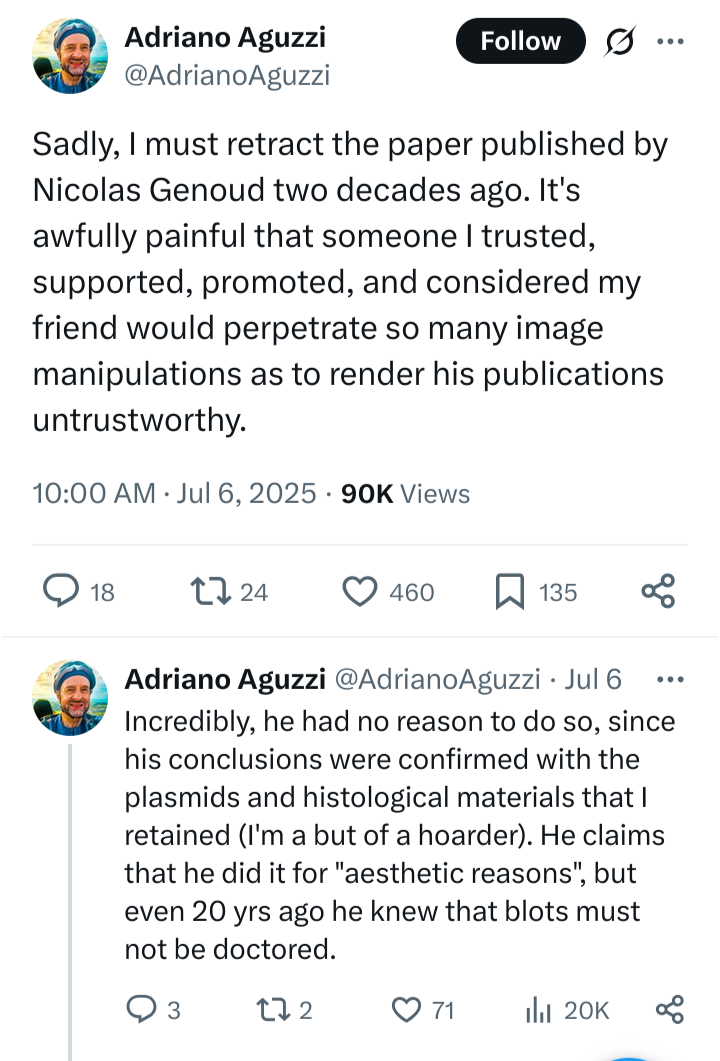
“Sadly, I must retract the paper published by Nicolas Genoud two decades ago. It’s awfully painful that someone I trusted, supported, promoted, and considered my friend would perpetrate so many image manipulations as to render his publications untrustworthy.
Incredibly, he had no reason to do so, since his conclusions were confirmed with the plasmids and histological materials that I retained (I’m a but of a hoarder). He claims that he did it for “aesthetic reasons”, but even 20 yrs ago he knew that blots must not be doctored.
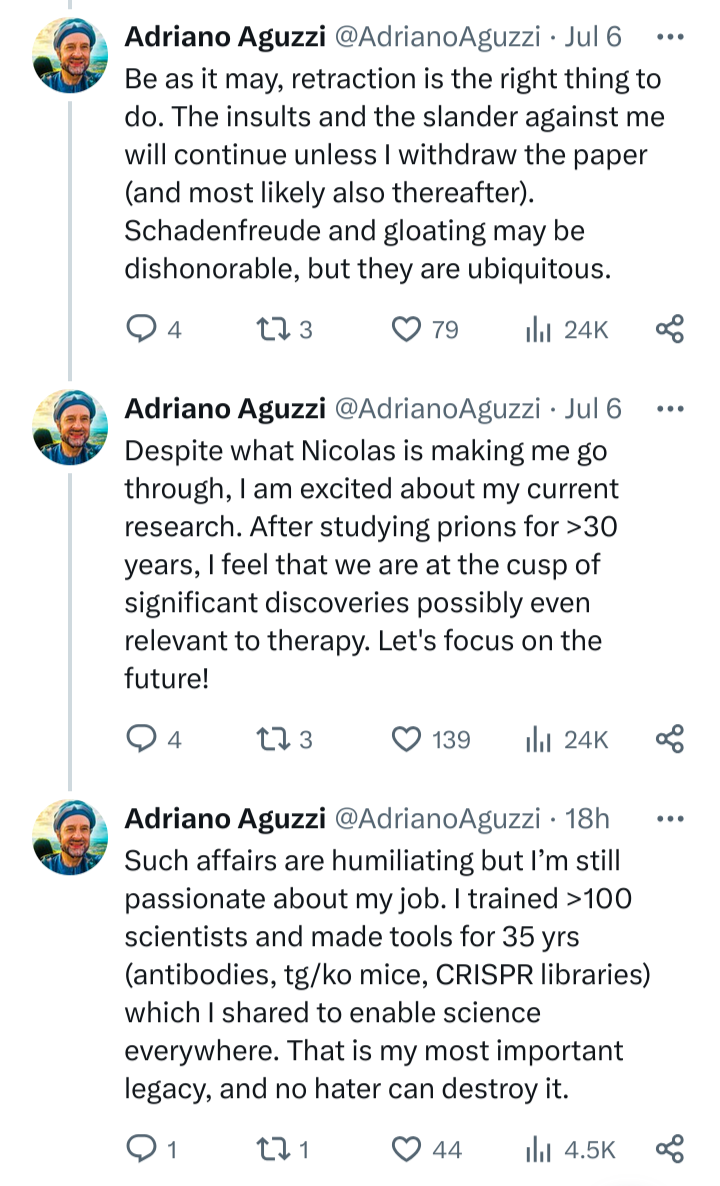
Be as it may, retraction is the right thing to do. The insults and the slander against me will continue unless I withdraw the paper (and most likely also thereafter). Schadenfreude and gloating may be dishonorable, but they are ubiquitous.
Despite what Nicolas is making me go through, I am excited about my current research. After studying prions for >30 years, I feel that we are at the cusp of significant discoveries possibly even relevant to therapy. Let’s focus on the future!
Such affairs are humiliating but I’m still passionate about my job. I trained >100 scientists and made tools for 35 yrs (antibodies, tg/ko mice, CRISPR libraries) which I shared to enable science everywhere. That is my most important legacy, and no hater can destroy it.”
This, part of the same thread, refers to yours truly:

Which one of us has mental issues here, judge for yourself. At least my PhD degree is real. I do think this unhinged thread by a pathological liar, narcissist and slanderer, should be alone a reason to sack Aguzzi. But I won’t write to that clown university again, because they will defend a fellow old white German-speaking male no matter what.
Now, which paper might that be? Nicolas Genoud, whom Aguzzi publicly charges with research fraud, used to be his PhD student, who graduated in 2004 and then left academia. On PubPeer, there are two papers by Genoud and Aguzzi, both published roughly 20 years ago. Neither is retracted yet, Here is the closest match, 21 years old, it was “communicated” to PNAS outside of independnet peer review by Aguzzi’s mentor Charles Weissmann.
Nicolas Genoud , Axel Behrens , Gino Miele , Dimitri Robay , Frank L. Heppner , Stefan Freigang , Adriano Aguzzi Disruption of Doppel prevents neurodegeneration in mice with extensive Prnp deletions Proceedings of the National Academy of Sciences of the United States of America (2004) doi: 10.1073/pnas.0400131101
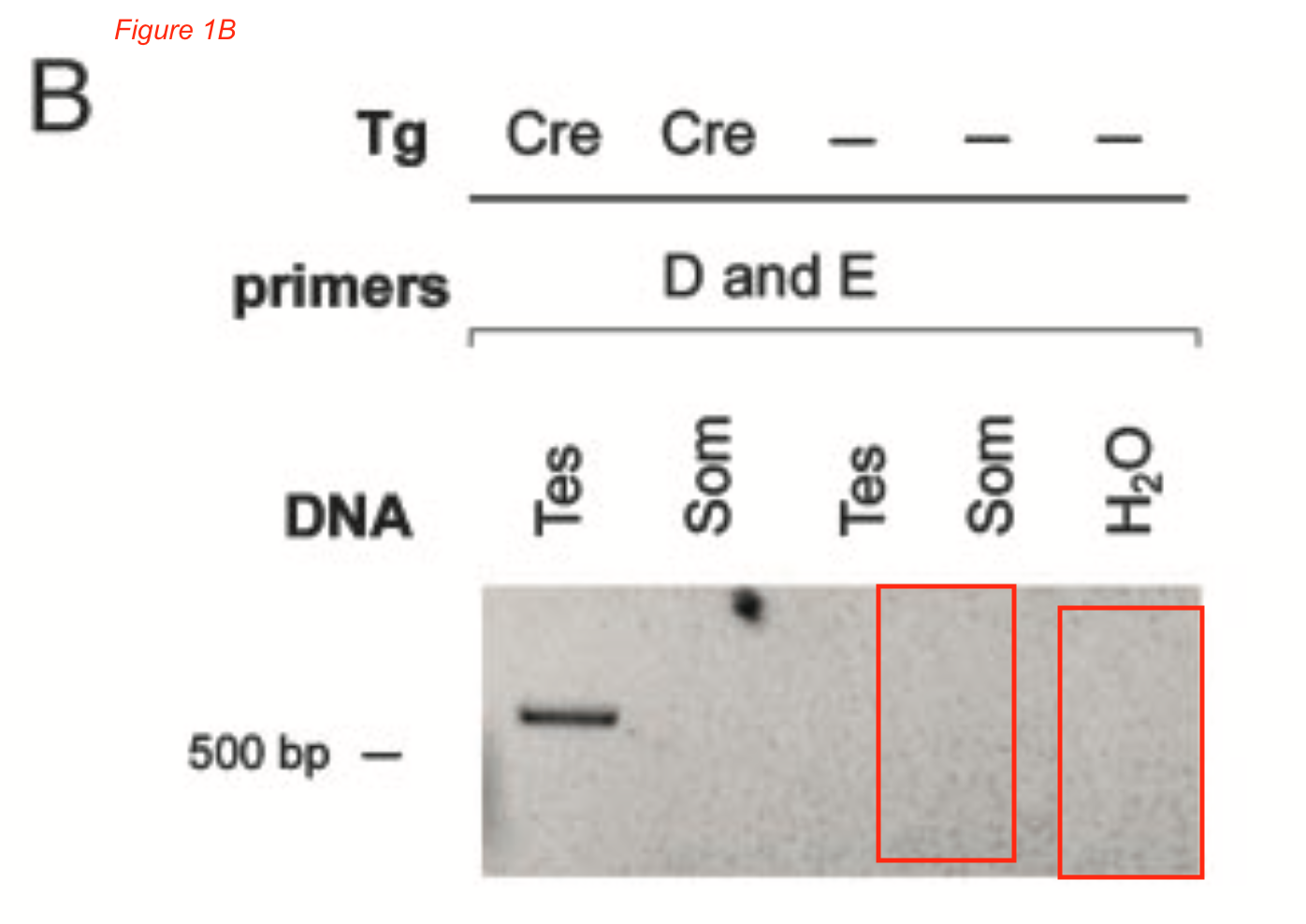
Elisabeth Bik: “Concern about Figure 1B. Red boxes: The Som and H2O lanes look remarkably similar. A sharp background transition appears to be visible between the two lanes.”
This is the other paper, it is 17 years old and announced a cure for prion-diseases, It has other problems but fake blots:
Nicolas Genoud , David Ott , Nathalie Braun , Marco Prinz , Petra Schwarz , Ueli Suter , Didier Trono , Adriano Aguzzi Antiprion prophylaxis by gene transfer of a soluble prion antagonist The American Journal of Pathology (2008) doi: 10.2353/ajpath.2008.070836

In the PrPFc panel, the bands in lanes 3 and 4 are a very deep homogenous black, and strangely positioned with respect to the background in the lane.
Blue boxes: In the Actin panel, lanes 1 and 2 look very similar to lanes 6 and 7. Note the presence of a dot and a slanted strip above the bands in lanes 1 and 6, and dots above the bands in lanes 2 and 7.
Not really depicting an experiment, but worth noting is that the far-right part of both panels appears to look similar.”

Red boxes: The tg550Nestin 185 dpi panel appears to show a (slightly rotated) overlap with the tg550PLO 224 dpi panel. “
Now, if Aguzzi was not an utterly dishonest marcissistic manipulator, he would have retracted both of these two fake papers, not just the one the journal told him he will have to retract. Instead, Aguzzi blamed Genoud on PubPeer already in December 2019 regarding the 2008 paper:
“There is little doubt that Fig. 5h is wrong and will need to be corrected. As for the Western blot,[…] I do not have any good explanation, and frankly I am very worried. I wonder whether image compression may create such an artifact“
The “hoarder” of western blots also stated in 2019: “I am not sure whether I can retrieve all the evidence“, soon after he informed “In Jan 2020 I have alerted the Editor-in-Chief of Am J Pathol of the issues raised above.” But then Aguzzi and the journal ediotr decided to do nothing, not even issue a correction.
In April 2025 another sleuth, Matthew Schrag, joined:


Schrag probably got interested in Aguzzi over the Zurich diva’s past collaboration with Sylvain Lesne, read here:
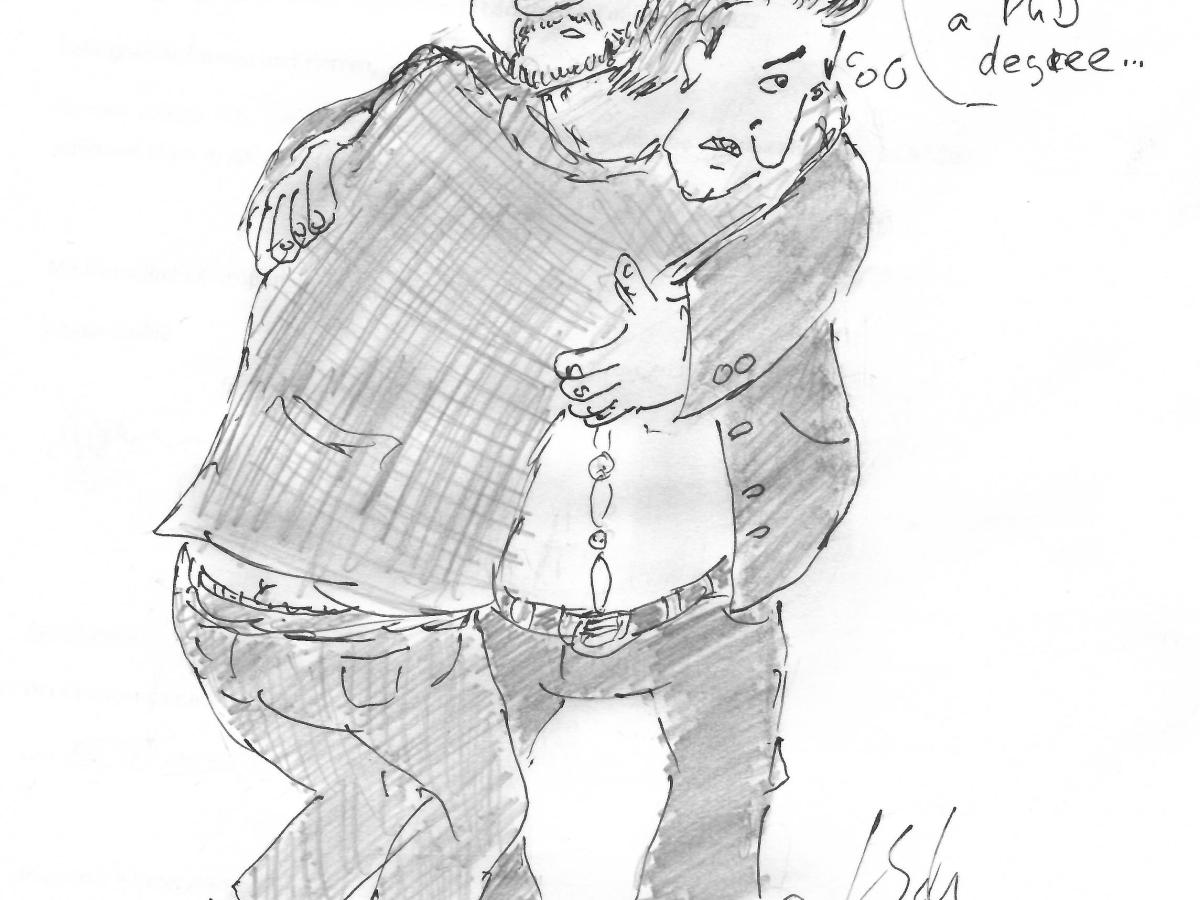
Sylvain Lesné is a failed scientist
From Lesné’s public shame to successful role models of neuroscience like Aguzzi and Tessier-Lavigne.
Thus, more was found, and this time no Genoud or Johannes Haybaeck for Aguzzi to blame. Posted on PubPeer in February 2025:
Tracy O’Connor , Nathalie Frei , Jana Sponarova , Petra Schwarz , Mathias Heikenwalder , Adriano Aguzzi Lymphotoxin, but not TNF, is required for prion invasion of lymph nodes PLoS Pathogens (2012) doi: 10.1371/journal.ppat.1002867

Mathias Heikenwalder, Aguzzi’s former mentee and now professor at the German Cancer Research Centre (DKFZ) in Heidelberg, assured on PubPeer that he already knew about those duplications long ago, and that he and his coauthors “requested an opportunity to publish corrected versions of the figures with PLoS Pathogens about a year ago, but the journal has not yet processed that request.” Feel free to believe, if you are that naive.
More recent findings, for Heikenwalder and Aguzzi:
Tracy O’Connor , Xiaolan Zhou , Jan Kosla , Arlind Adili , Maria Garcia Beccaria , Elena Kotsiliti , Dominik Pfister , Anna-Lena Johlke , Ankit Sinha , Roman Sankowski , Markus Schick , Richard Lewis , Nikolaos Dokalis , Bastian Seubert , Bastian Höchst , Donato Inverso , Danijela Heide , Wenlong Zhang , Petra Weihrich , Katrin Manske , Dirk Wohlleber, Martina Anton, Alexander Hoellein, Gitta Seleznik, Juliane Bremer, Sabine Bleul, Hellmut G. Augustin, Florian Scherer, Uwe Koedel, Achim Weber, Ulrike Protzer, Reinhold Förster, Thomas Wirth, Adriano Aguzzi, Felix Meissner, Marco Prinz, Bernd Baumann, Uta E. Höpken, Percy A. Knolle, Louisa Von Baumgarten, Ulrich Keller, Mathias Heikenwalder Age-Related Gliosis Promotes Central Nervous System Lymphoma through CCL19-Mediated Tumor Cell Retention Cancer Cell (2019) doi: 10.1016/j.ccell.2019.08.001

Panels marked with cyan boxes appear to show the same specimen as in Kierdorf, PLOS ONE (2013), DOI: 10.1371/journal.pone.0058544, although at different intensities. Both show brains of whole-body irradiated mice with albumin (red) leaking , but the green signal is representing something different, i.e. CD31 vs GFAP.
Marco Prinz is an author on both papers.”
Aguzzi, Heikenwalder, Haybaeck, and a celebrity cheater, Michael Karin!
Johannes Haybaeck , Nicolas Zeller , Monika Julia Wolf , Achim Weber , Ulrich Wagner , Michael Odo Kurrer , Juliane Bremer , Giandomenica Iezzi , Rolf Graf , Pierre-Alain Clavien , Robert Thimme , Hubert Blum , Sergei A. Nedospasov , Kurt Zatloukal , Muhammad Ramzan , Sandra Ciesek , Thomas Pietschmann , Patrice N. Marche , Michael Karin , Manfred Kopf , Jeffrey L. Browning, Adriano Aguzzi, Mathias Heikenwalder A lymphotoxin-driven pathway to hepatocellular carcinoma Cancer Cell (2009)doi: 10.1016/j.ccr.2009.08.021


Heikenwalder has much more on Pubpeer, over 20 threads, but I will spare DKFZ the need for an investigation because surely their professor never contriibuted anything to any of his problematic papers, which are anyway too old, yet highly cited and with all conclusions unaffected.

AACR conjures undead Count Fakula Michael Karin
What better distraction than the COVID-19 pandemic to revive one of the spookiest parasites in cancer research? AACR uses the COVID-19 cover to award Michael Karin, for his over 50-paper-strong record of data fakery.
And here is Aguzzi with his academic godfather, Weissman, plus with the NIH researcher Bruce Chesebro:
A J Raeber , R E Race , S Brandner , S A Priola , A Sailer , R A Bessen , L Mucke , J Manson , A Aguzzi , M B Oldstone , C Weissmann, B Chesebro Astrocyte-specific expression of hamster prion protein (PrP) renders PrP knockout mice susceptible to hamster scrapie The EMBO Journal (1997) doi: 10.1093/emboj/16.20.6057

Elisabeth Bik: “Concern about Figure 1B: Red arrows: The Tg4/Tg5 lanes look similar to the mirror image of the Tg6 and Tg7 lanes, at a slightly darker exposure.”
Aguzzi with Heikenwalder, Weissmann and Chesbro, in Science no less:
Mathias Heikenwalder , Nicolas Zeller , Harald Seeger, Marco Prinz , Peter-Christian Klöhn , Petra Schwarz, Nancy H. Ruddle, Charles Weissmann , Adriano Aguzzi Chronic Lymphocytic Inflammation Specifies the Organ Tropism of Prions Science (2005) doi: 10.1126/science.1106460

And much more for Aguzzi on PubPeer, around 65 papers, both older stuff and newly posted.
An attempt was made to contact the authors
Readers may have been waiting for new retractions for the 2019 Nobel Prize in Medicine laureate and Johns Hopkins University professor, Gregg Semenza. Well, he used to have 13 retractions, and now it’s 15!

Gregg Semenza: real Nobel Prize and unreal research data
“Even after people have been telling you for, you know, 20 years or more that it’s going to happen, no one expects it.” -Gregg Semenza, Nobel Prize winner 2019
Both new Semenza retractions happened in the same society journal:
Kiichi Hirota , Ryo Fukuda , Satoshi Takabuchi , Shinae Kizaka-Kondoh , Takehiko Adachi , Kazuhiko Fukuda , Gregg L. Semenza Induction of Hypoxia-inducible Factor 1 Activity by Muscarinic Acetylcholine Receptor Signaling Journal of Biological Chemistry (2004) doi: 10.1074/jbc.m405164200

The Retraction was published on 5 July 2025:
“This article has been retracted by the publisher. The Journal concluded that lanes 1 through 4 of Figure 1E had been reused as lanes 1 through 4 of the M1/CCH panel of Figure 5B. The journal also concluded that lane 5 of Figure 1E had been reused as lane 1 of the M1/IGF-1 panel of Figure 5B and that lane 3 of Figure 6 had been reused as lane 7 in that same figure. An attempt was made to contact the authors to finalize the process, but they could not be reached.”
Here is the second retraction in Journal of Biological Chemistry, or 15th retraction in total. Again with Kiichi Hirota, now professor at Kansai Medical University in Japan:
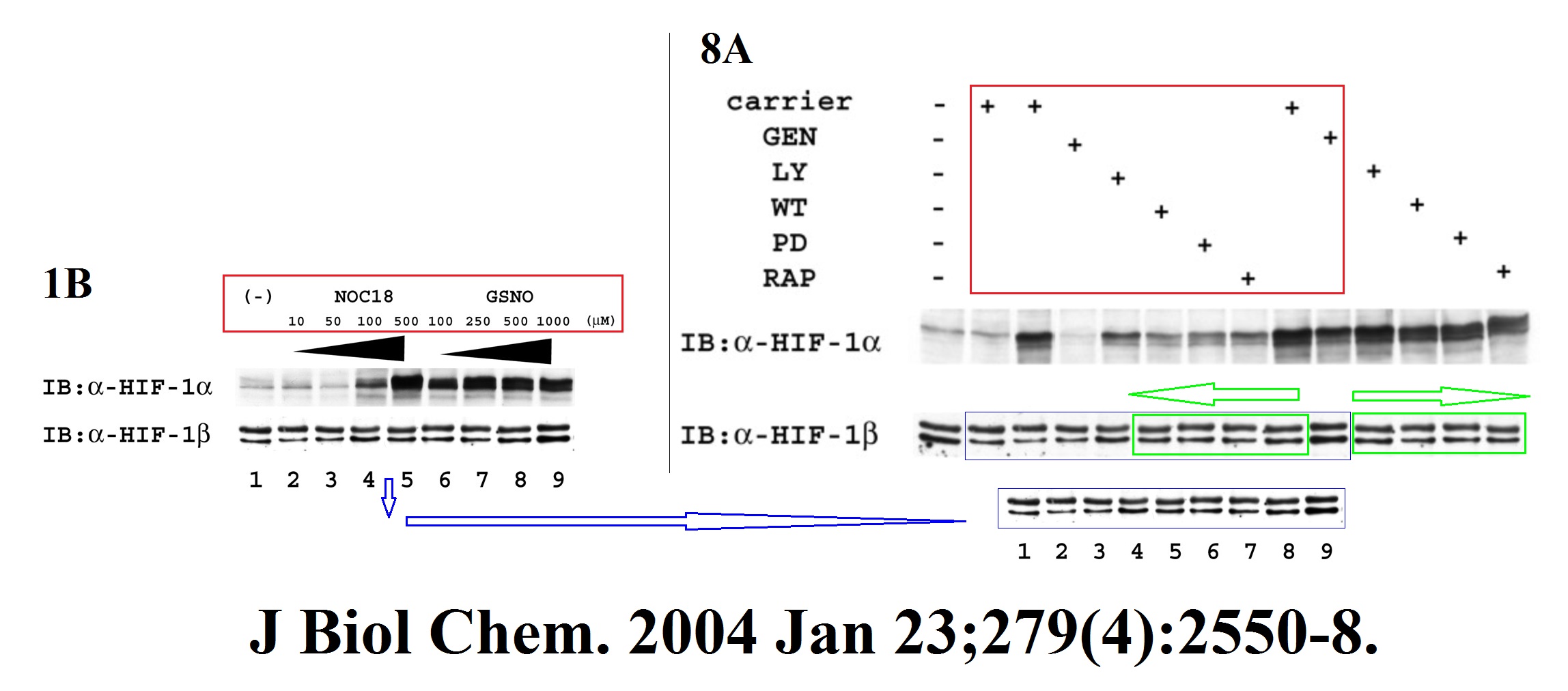
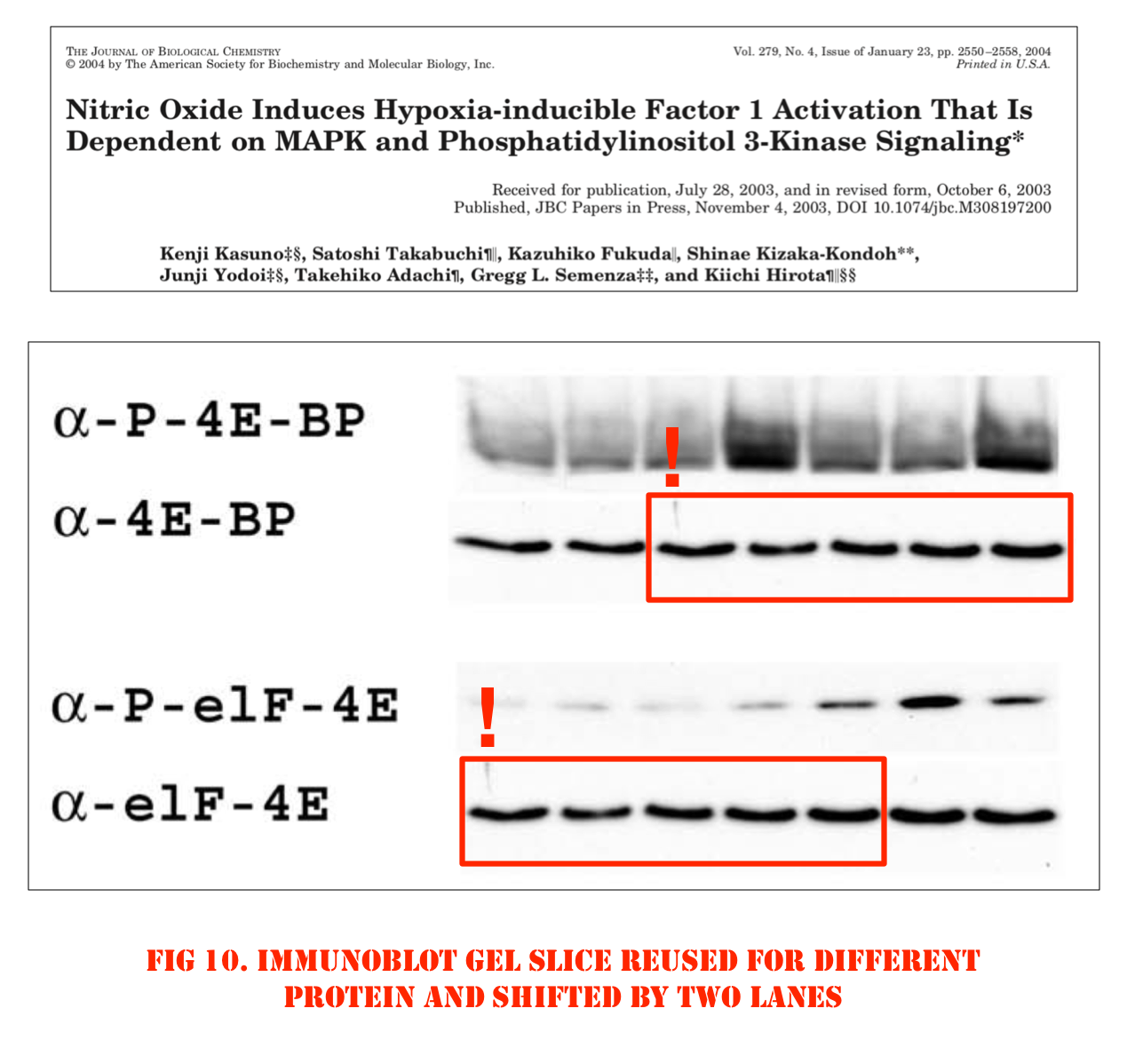
Kenji Kasuno , Satoshi Takabuchi , Kazuhiko Fukuda , Shinae Kizaka-Kondoh , Junji Yodoi , Takehiko Adachi , Gregg L. Semenza, Kiichi Hirota Nitric oxide induces hypoxia-inducible factor 1 activation that is dependent on MAPK and phosphatidylinositol 3-kinase signaling Journal of Biological Chemistry (2004) doi: 10.1074/jbc.m308197200
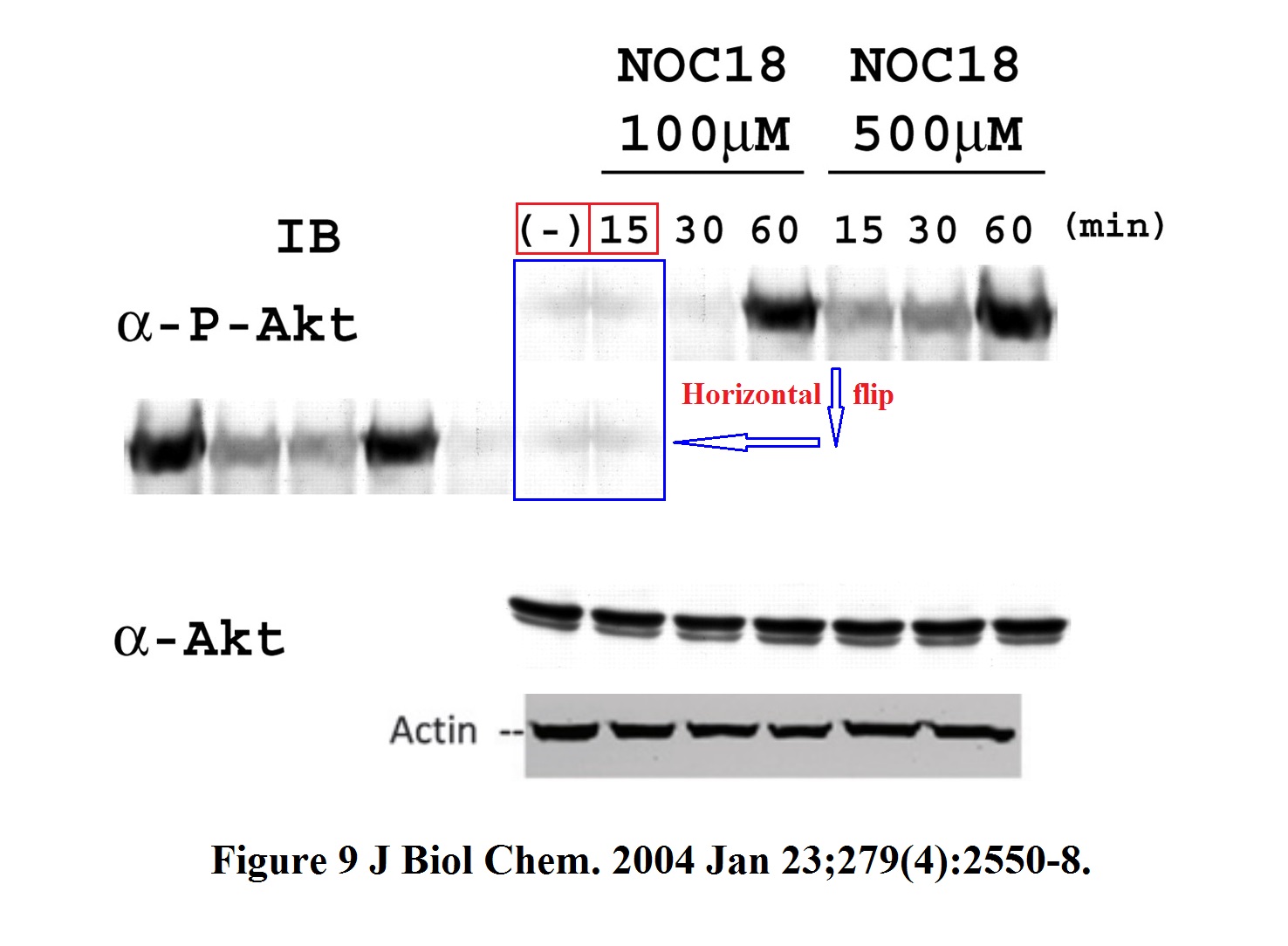

The Retraction also appeared on 5 July 5, 2025:
“This article has been retracted by the publisher. The Journal concluded that lanes 1 through 9 of the IB: α-HIF-1β panel of Figure 1B were reused as lanes 2 through 10 in the α-HIF-1β panel of Figure 8A and that lanes 6 through 9 of this panel were reused internally as lanes 11 through 14. The Journal also concluded that the α-S6K and α-S6R panels of Figure 10 had been derived from the same source image, as had the α-4E-BP and α-elF-4E panels of Figure 10. An attempt was made to contact the authors to finalize the process, but they could not be reached.”
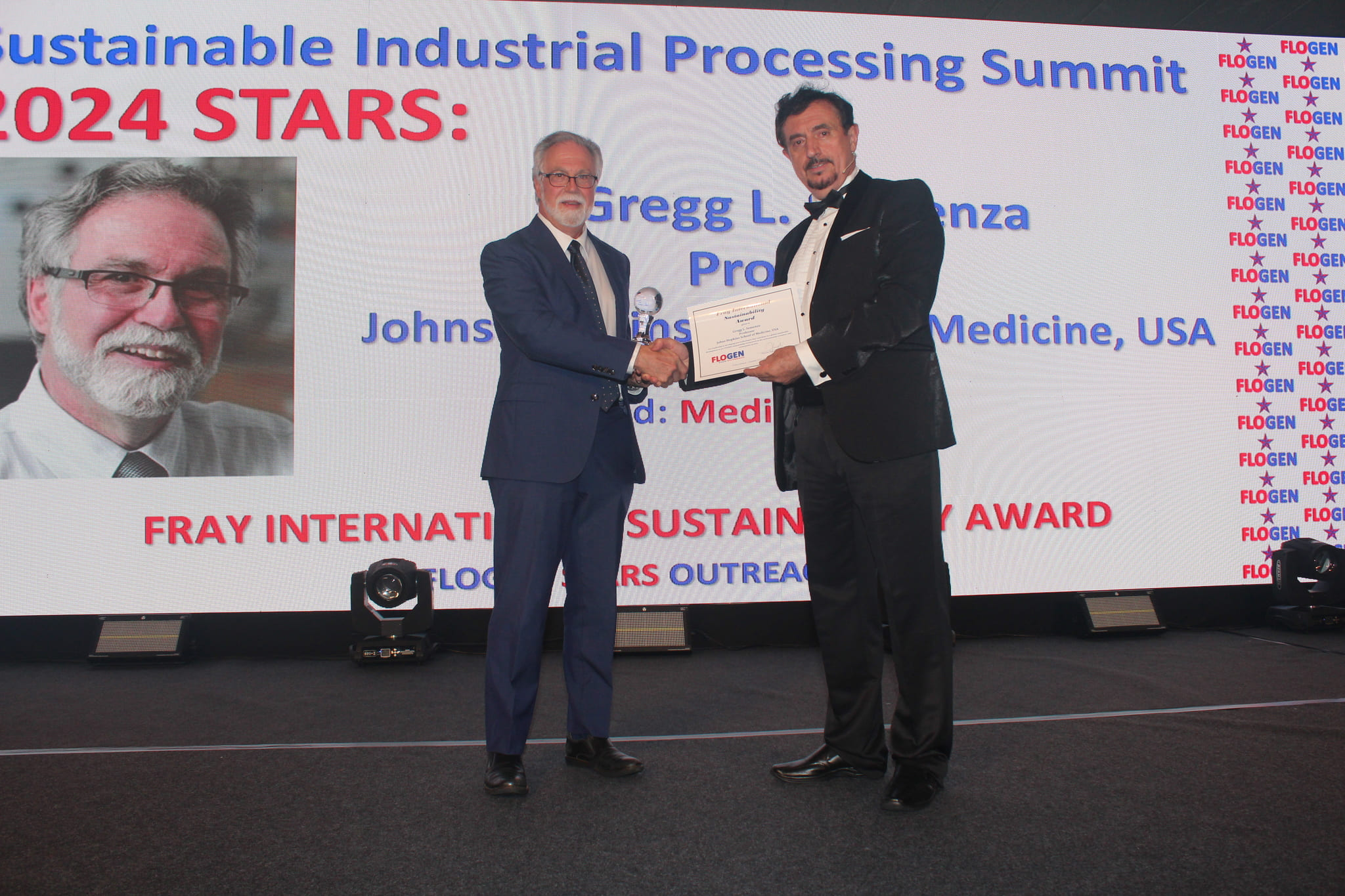
Of course it’s not true that Semenza can’t be reached, he remains a public person and is open to everyone willing to talk about his genius and never about his retractions, predatory scamferences included (Florian Kongoli’s FLOGEN, where Semenza gave a Semenza Award to the Kongoli’s son, read November 2024 Shorts).
Donate!
If you are interested to support my work, you can leave here a small tip of $5. Or several of small tips, just increase the amount as you like (2x=€10; 5x=€25). Your generous patronage of my journalism will be most appreciated!
€5.00

 For Better Science
Science Breakthrough
Nonuniversality of inflammaging across human populations
https://www.nature.com/articles/s43587-025-00888-0
‘Inflammaging, an age-associated increase in chronic inflammation, is considered a hallmark of aging. However, there is no consensus approach to measuring inflammaging based on circulating cytokines. Here we assessed whether an inflammaging axis detected in the Italian InCHIANTI dataset comprising 19 cytokines could be generalized to a different industrialized population (Singapore Longitudinal Aging Study) or to two indigenous, nonindustrialized populations: the Tsimane from the Bolivian Amazon and the Orang Asli from Peninsular Malaysia. We assessed cytokine axis structure similarity and whether the inflammaging axis replicating the InCHIANTI result increased with age or was associated with health outcomes. The Singapore Longitudinal Aging Study was similar to InCHIANTI except for IL-6 and IL-1RA. The Tsimane and Orang Asli showed markedly different axis structures with little to no association with age and no association with age-related diseases. Inflammaging, as measured in this manner in these cohorts, thus appears to be largely a byproduct of industrialized lifestyles, with major variation across environments and populations.’
Does this study challenge the idea that cellular senescence and SASP universally drive inflammaging? While industrialized populations show age-related inflammation, indigenous groups do not—despite aging—suggesting that inflammaging may be driven more by lifestyle and environment than by intrinsic aging processes like senescence. Thus, SASP-related inflammation appears to be context-dependent, not a universal hallmark of aging?
LikeLike
Jones, there is no evidence that senescence increases with age. Markers of senescence are non-specific (shared with other cells types). Try to find in the literature an example where all the markers are present in the same cell, at the required levels, and that those cells increase with age. You won’t. In fact at this point, for anyone who looks at raw data, the evidence to the contrary is the majority.
LikeLike
Yes, I lost interest when it became clear that there was no consensus on which markers reliably indicate senescence. It was particularly frustrating to see researchers naming several markers that are actually known to be transiently expressed by cells, rather than definitive indicators of true senescence or irreversible cell cycle arrest. This lack of clarity and consistency undermines the reliability of the findings and makes it difficult to draw meaningful conclusions from the data.
LikeLiked by 1 person
David Sabatini is organizing a conference in Prage. It’s curious to note that half of the list of the speakers also donate money to his lawsuit in a campaign organized by his mentee Sengupta (Anne Brunet, Celeste Simon, etc). The other half were probably anonymous donors
http://praguemetabolismsymposium.com/
LikeLike
Lol, Karen Vousden and Michael Hall are keynote speakers!
Can you share the donor campaign for comparison ?
LikeLike
I don’t have the full list because the campaign was removed (https://www.gofundme.com/f/our-friend-david-sabatini)
From my notes, Mark Febbraio, Umut Ozcan, George Vlasuk also donated
LikeLiked by 1 person
It must be this Umut Ozcan https://www.pubpeer.com/publications/15D23CB9111B2253B998F75BC4640B https://www.pubpeer.com/publications/0DEB5AE7ADE93274EC0CE0C9DF3041
LikeLike
Ozcan was accused of fraud, sexual harassment and bullying, but Harvard took his side and silenced the whistleblowers.
LikeLike
https://web.archive.org/web/20230203211414/https://www.gofundme.com/f/our-friend-david-sabatini
https://web.archive.org/web/20230110140121/https://www.gofundme.com/f/our-friend-david-sabatini/donations
I’ve not checked if the donators list was also archived .. (I’m at work!)
LikeLike
How do you find archived web pages? I would be very interested to know.
LikeLike
You need to know the original hyperlink and then check Wayback Machine for possible archived copies. I also recommend to.archive important active links there before they get deleted
LikeLike
“[Wen G} Jiang currently has over 60 papers on PubPeer. ” I learned something. Put the name like so into the Pubpeer search box “WEN+G.+Jiang”+OR+”W+G.+Jiang” PubPeer – Search publications and join the conversation.
LikeLiked by 1 person
Cardiff University breakthrough! Waves in the aether (there is no aether), except the waves are detected in Cardiff. PubPeer – Differential SOD2 and GSTZ1 profiles contribute to contrasti…
LikeLike
Science Breakthrough
PSA for the Rapamycin scammers.
Psilocybin treatment extends cellular lifespan and improves survival of aged mice
https://www.nature.com/articles/s41514-025-00244-x
‘Psilocybin, the naturally occurring psychedelic compound produced by hallucinogenic mushrooms, has received attention due to considerable clinical evidence for its therapeutic potential to treat various psychiatric and neurodegenerative indications. However, the underlying molecular mechanisms remain enigmatic, and few studies have explored its systemic impacts. We provide the first experimental evidence that psilocin (the active metabolite of psilocybin) treatment extends cellular lifespan and psilocybin treatment promotes increased longevity in aged mice, suggesting that psilocybin may be a potent geroprotective agent.’
Awesome — the world already feels like a bad shroom trip most days, so we might as well dose away. If psilocybin adds years to our lives and makes them even more surreal, sign me up.
LikeLiked by 2 people
I enjoyed the taurine tennis game recently. They all conjure to mind something along the lines of “Not walking into traffic blindfolded can extend cellular lifespan and improve survival.”
LikeLike
Oh, you know… supplements… it’s like pushing a rope: the end you push wiggles a bit—just enough to write a paper about—but the other end, where it really matters, stubbornly refuses to move.
LikeLike
Before Eric Verdin was Director of the Buck Institute, it was Dale Bredesen https://pubpeer.com/search?q=bredesen
LikeLiked by 1 person
Hope this helps in your confusion.
https://www.cell.com/cell/fulltext/S0092-8674(22)01377-0
No need to thank me.
LikeLike
https://dx.doi.org/10.1126/science.adp0176
Holes punched in mice ears repaired by retinoic acid.
The experimental phenomenon may exist, but the author’s explanation of its evolutionary reasons seems to be nonsense.
News reports on this matter often inappropriately direct it to tissue regeneration unrelated to cartilage, which is not what is being reported in this article.
LikeLike
It seems that Aguzzi removed the post on Twitter/X where he blames his former student.
Or maybe my h-index is too low and I cannot see it.
LikeLike
Yep, Aguzzo deleted the entire thread and his replies.
btw, he still lies about being a PhD.
https://www.oeaw.ac.at/en/m/aguzzi-adriano
LikeLike
Science Breakthrough
Reporting quality, effect sizes, and biases for aging interventions: a methodological appraisal of the DrugAge database
https://www.biorxiv.org/content/10.1101/2025.06.30.660585v2
‘Here we analyzed the DrugAge database, assessing reporting study quality, bias and effect sizes across 667 anti-aging preclinical studies. We found significant shortcomings in reporting of crucial design features such as randomization and blinding, as well as large variation in reporting quality and effects across species. Non-mammal findings typically did not translate to mammals. Although anti-aging interventions may have different effects depending on when they are started, most studies began giving the intervention under investigation very early in the organism’s lifespan. Our findings suggest there is substantial room for improvement in preclinical anti-aging research.’
I’m shocked! SHOCKED!
LikeLike
Retraction Watchdogging
That would be really cool. A nature reserve, sanctuary, for jackals with mental issues. They deserve G_d’s love too. I believe there are some out there.
LikeLike