

Schneider Shorts of 9 May 2025 – Chinese professor in Germany accused of espionage, genius papermiller sanctioned in Norway, Swedish cheater can’t stop cheating, a Big Pharma career cut short, awful corrections in Wiley and Elsevier, a curcumin fail, and finally, old men back with anti-aging tips.
Table of Discontent
Science Elites
- A long chain of ominous incidents – Chinese aeronautics professor in Germany accused of espionage
- No doubt the researcher is hard-working – Filippo Berto both a genius and guilty of fraud in Norway
- There is no Fraud – Omer Nur trolls with fake science and Linköping’s approval
- A research career shaped by scientific curiosity and serendipitous discovery – Jesmond Dalli made full professor at QMUL
- The end of your comfort zone – Bill Sessa drops out of Pfizer after only 3 years
Scholarly Publishing
- Figure is deleted – Wiley and society journal save retraction-striken Srikanta Dash
- Such despicable behaviour – Elsevier fixes papermill forgery with a stealth correction
Retraction Watchdogging
- Requested to explain the duplication and alteration – Johns Hopkins researchers retract claim that curcumin cures Parkinson’s
- Highly similar patterns – Edward Whang loses another paper
Science Breakthroughs
- Gerogenes and gerosuppressors – Guido Kroemer, Carlos Lopez-Otin and friends are back with even more hallmarks
Science Elites
A long chain of ominous incidents
The German investigative journalists of Corrective reported on 5 May 2025 about the alleged Chinese spy and her successful career as professor at the Technical University (TU) Munich, and her lawsuits in Germany against her former employer, the German Aerospace Center (DLR, the counterpart to US NASA) Translated:
“It is September 2014 and Z. wants to take part in a workshop in Guangzhou to use sensor data in Earth observation. This is her research area at the DLR. […]
After the workshop, she plans to attach a vacation of three days. This is how it emerges from a report that she will later send to her employer. But after her arrival there is no sign of life from the researcher.
In her report, Z. writes later: “After arriving at Xi’an Airport, my work bag was stolen on September 6, 2014 with laptop, cell phone, bank cards, passport and German residence permit (…). So the trip had to be completely re-scheduled.” […]
An entire department is tasked with warding off spy cases at the DLR. The formulation “laptop stolen” in combination with a trip to China, puts the team on alert: historically, there were numerous cases in which the alleged loss of a laptop or the sudden disappearance of sensitive data are connected to espionage.”
In September 2014, Z’s boss at DLR made sure all her access was restored. But:
“At that time, nobody at the DLR suspected that the case with the laptop will only be the beginning of a long chain of ominous incidents around the young scientist. […] In 2022 they will make a grave decision: they will dismiss Z. and issue her with a house ban.”
Ever since, Z has been suing DLR in court until a settlement was achieved in February 2025, according to which she quit DLR with mutual trust and agreement to concentrate on her professorship at TU Munich.
Z may be not named, but the Correctiv articles contains tons of hints. If you Google for “china dlr tu münchen“, the first hit is this Correctiv article, the second is second-hand reporting about this Correctiv article, and the third search result is the institutional profile of a TU Munich professor with a Chinese name, closely followed by her Wikipedia page.
It’s Xiaoxiang Zhu, since 2015 professor for Signal Processing in Earth Observation, member of the Board of Directors of Munich Data Science Institute at TU Munich, and winner of many awards and fellowships. Her official CV page declares that Zhu (just like Z) used to work at DLR until 2022, and is PI and Director of the AI4EO International AI Future Lab and gave a TED Talk in 2019, just like the unnamed Z in the Correctiv story.
I wrote to Zhu and asked her to comment on this strange association, but received an out-of-office reply until 8 May 2025. The next day, on 7 May 2025, I received a letter from Zhu’s lawyer, the Berlin-based law firm Schertz Bergmann, which specialises on representing political and industrial elites and celebrities (including frivolous lawsuits against satire magazine Titanic). Rest assured this lawyer is not cheap. However, the letter was not even properly addressed to me, but most obviously mass-sent to every journalist who read the Correctiv story and had questions.
Let me just say it was not exactly a letter of denial to correct Zhu’s false association with Z. Instead, the law firm announced their plans to sue Correctiv, and warned never to quote Correctiv‘s reporting or refer to “Z”, even without naming her. It ended with a threat that the Berlin law firm will sue everyone who reports about receiving their legal letter.

Back to the mysterious professor Z. Obviously at TU Munich (where Z raised millions in external funding) nobody cares about what DLR found:
“”There is an urgent suspicion that Prof. Dr. Z. has specifically exploited her activity in the DLR and unfolded activities in order to spy on – in some cases in collusive interaction with other people – and pass on this information to unauthorized third parties, possibly also to foreign secret services.”
The document mentions an “overall picture” that suggests “urgent suspicion of science espionage”, possibly “also in collaborative cooperation with her network”. It could not be ruled out that under Z.’s responsibility some security-relevant knowledge was leaked to outsiders”.
In 2017, in recognition of one of her awards, Z requested and received access license to data from the so-called Terrasar X satellite – classified as highly sensitive and developed by DLR with Airbus’s military division:
“At the corresponding license, three other people stated as users, including her husband and guest scientist W., both from China and also employed at Z.’s group”
Z’s husband W (who had to leave DLR in 2023 “because he secretly took audio recordings with his phone“) is of course never ever Yuanyuan Wang, since 2021 Guest Professor at Zhu’s AI4EO lab, even if the official CV fits perfectly (the website was working on 6 May 2025, but was then deleted).
Correctiv narrates that in 2017 a streaming connection was established to syphon a huge amount data to a TU Munich server under Z’s supervision. In May 2022, a hacker attack on the DLR server happened, and for some reason Z forgot to notify her superiors.
The problem is that the espionage charges were raised only internally, there has been no criminal investigation against Z yet. But as Correctiv hinted, German secret services are very much on Z’s case.
Z’s group at TU Munich employs FORTY people, and:
“Rumours circulate among the employees about alleged abnormalities on the servers under Z’s responsibility. It is the time shortly after the start of the Russian invasion in Ukraine. Experts assume that China could attack Taiwan in the near future. […]
A year ago, a person from Z.’s direct work environment at TUM reports to CORRECTIV. They wonder whether their research at this lab could fall into the hands of the Chinese military.
Their boss, Z., has a relevant history, and has been surrounded by doctoral students and guest scientists from military facilities in China for years.”
Indeed, despite Z’s otherwise incredibly impressive CV omits where she did her BSc degree, which was at the National University of Defense Technology in Changsha, China’s most important military facility. Several Chinese candidates sponsored by the China Scholarship Council whom Z tried to recruit to DLR failed security screens and were rejected. Until 2023, Z collaborated with the University of Wuhan, which is part of Chinese military satellite programme.
But that being Germany, the legal hurdles for someone to be officially called a “spy” are huge. Hopefully Correctiv will win in court.
No doubt the researcher is hard-working
The Italian papermiller and “the most productive researcher in Europe” Filippo Berto (now full professor at the Sapienza University of Rome) has been found guilty of fraud by his past employer, the Norwegian University of Science and Technology (NTNU) in Trondheim, Norway. He retracted seven papers so far, listed on his Wikipedia profile. You can read about Berto’s papermilling in the coda in the article below, the NTNU investigation was announced a year ago (see April 2024 Shorts):

Karimipour Saga III: All roads lead to Rome
“The academic career of D’Orazio is tightly coupled to that of Karimipour since she hosted him at Sapienza. Of the 57 papers she declared authorship for, 25 (44%) are published together with Karimipour.” – Maarten van Kmapen

And now, the reporting by Norwegian higher-education magazine UA from 5 May 2025 (DeepL-translated):
“An independent investigation committee was set up to assess whether Berto had committed scientific misconduct. On April 11, the investigation committee completed its report, which was submitted to the faculty for final consideration.
The investigation report concludes that Filippo Berto has acted scientifically dishonest, but that there is no basis for concluding that there has been an institutional failure at the Faculty of Engineering Science. […]
In particular, there have been double and triple publications that have been highlighted as problematic in Berto’s articles. […]
According to the committee, it has not been possible to examine most of the scientific articles Berto has published while at NTNU. According to Cristin, the number of articles is 715. […]
“Of the articles examined by the committee, they found several cases of double, and sometimes triple, publication of the same research results, analyses and text without references to previous work.
It also appears that there have been deliberate attempts to hide the reuse by changing titles, introductions, co-authors and references. In addition, we find examples of inclusion and exclusion of co-authors that violate recognized standards for co-authorship, since the researcher appears to have included authors whose contribution has been insignificant,” writes the review committee. […]
Both the Investigation Committee and the Research Ethics Committee also recommend that NTNU contact the relevant journals to have the remaining articles withdrawn.”
715 papers for a dude aged just 47, and they still think that maybe he did the research and wrote them all by himself. UA quotes from the investigative report:
“It should also be emphasized that although reuse of text is a clear and serious violation of recognized research ethics norms, it should not be considered as serious as falsification, fabrication or plagiarism, they write.”
No falsification or plagiarism of stolen images here at all, perish the thought:
Hamid Reza Bakhsheshi-Rad , Aliakbar Najafinezhad, Esah Hamzah , Ahmad Fauzi Ismail, Filippo Berto, Xiongbiao Chen Clinoenstatite/Tantalum Coating for Enhancement of Biocompatibility and Corrosion Protection of Mg Alloy Journal of Functional Biomaterials (2020) doi: 10.3390/jfb11020026

Reese Richardson: Figure 2D. There is yellow text that appears to be partially obscured by the “Mg alloy” portion of the image, as if this portion has been superimposed over another image. There are some apparently duplicated regions”
Actually, yes, legally papermilling doesn’t count as falsification, fabrication or plagiarism. It doesn’t count at all and is the perfect crime. See the case of Anders Hagfeldt, the Rector of the University of Uppsala in Sweden:

Swedish rector Anders Hagfeldt pronounced innocent of papermilling
“The board’s conclusion is therefore that the deviations regarding figure 2b and 2c in article 1 constitute serious deviations from good research practice”

UA also quotes this:
“We have found no basis to claim that the researcher has participated in the sale of co-authorship or that there are irregularities in the data used, but recent public statements may warrant further investigation.”
Right… Is this evidence admissible, of Pippo buying from a russian papermill (it literally says in russian that his authorship position was “sold”):
Alexey V. Panin , Marina S. Kazachenok , Sergey V. Panin , Filippo Berto Scale levels of quasi-static and dynamic fracture behavior of Ti-6Al-4V parts built by various additive manufacturing methods Theoretical and Applied Fracture Mechanics (2020) doi: 10.1016/j.tafmec.2020.102781

Of course that paper is not retracted, being in an Elsevier journal and part of a Special Issue edited by Berto himself.
Finally, NTNU had to cover for their own failures in connection with Berto, so in order to avoid repaying the embezzled public grants they pronounced:
“The investigation committee also emphasizes that Berto and the other involved researchers at NTNU, as far as it is possible for them to assess, have contributed very valuable research in their fields.
“There is no doubt that the researcher is hard-working and recognized in his field, and has contributed significantly to NTNU’s research and research infrastructure during his tenure,” the committee writes.”
Hard-working. Berto. Reminds me of his Sapienza colleague and MDPI editor Enrico Sciubba, who also says that those who don’t engage in papermilling are stupid and lazy:
The perfect MDPI editor
“I know you cannot understand such matters, since you appear to have strong mother-related problems that most likely have denied you of a satisfactory sexual life”, _ Enrico Sciubba, Editor-in-Chief
Here is the rest of Pippo Berto’s PubPeer record.
There is no Fraud
In late 2020, Omer Nur (or Nour), associate professor of Physical Electronics and Nanotechnology at Linköping University in Sweden, was found guilty of research misconduct, together with his mentor at the same university, Magnus Willander. The findings of the Swedish National Board for Assessment of Research Misconduct (NPOF) were based on my notification and my reporting of the PubPeer evidence. Read here:
Omer Nour and Magnus Willander guilty of research misconduct
“The Board assesses that there are no scientifically acceptable explanations for why the notified researchers have fabricated research results in the manner that has occurred in the notified articles. Raw data also does not support the reported results. [..] In summary, the Board finds therefore that the notified researchers have been guilty of misconduct in…
Both men remained in their professorial jobs in Linköping. Some of Nur’s and Willander’s papers were retracted ( see March 2023 Shorts). Now, you would think that a man in a hole would know when to stop digging, and a man found guilty of research fraud stop publishing fake science with papermillers. But not Nur!
Here is Nur in 2022, with some Yemeni assistant professor named Mohammed Mannaa, who recycled data from his earlier paper with a different set of coauthors:
Haifa Mohammed Alghamdi , M. M. Abutalib , A. Rajeh , Mohammed A. Mannaa , Omer Nur , E. M. Abdelrazek Effect of the Fe2O3/TiO2 Nanoparticles on the Structural, Mechanical, Electrical Properties and Antibacterial Activity of the Biodegradable Chitosan/Polyvinyl Alcohol Blend for Food Packaging Journal of Polymers and the Environment (2022) doi: 10.1007/s10924-022-02478-2
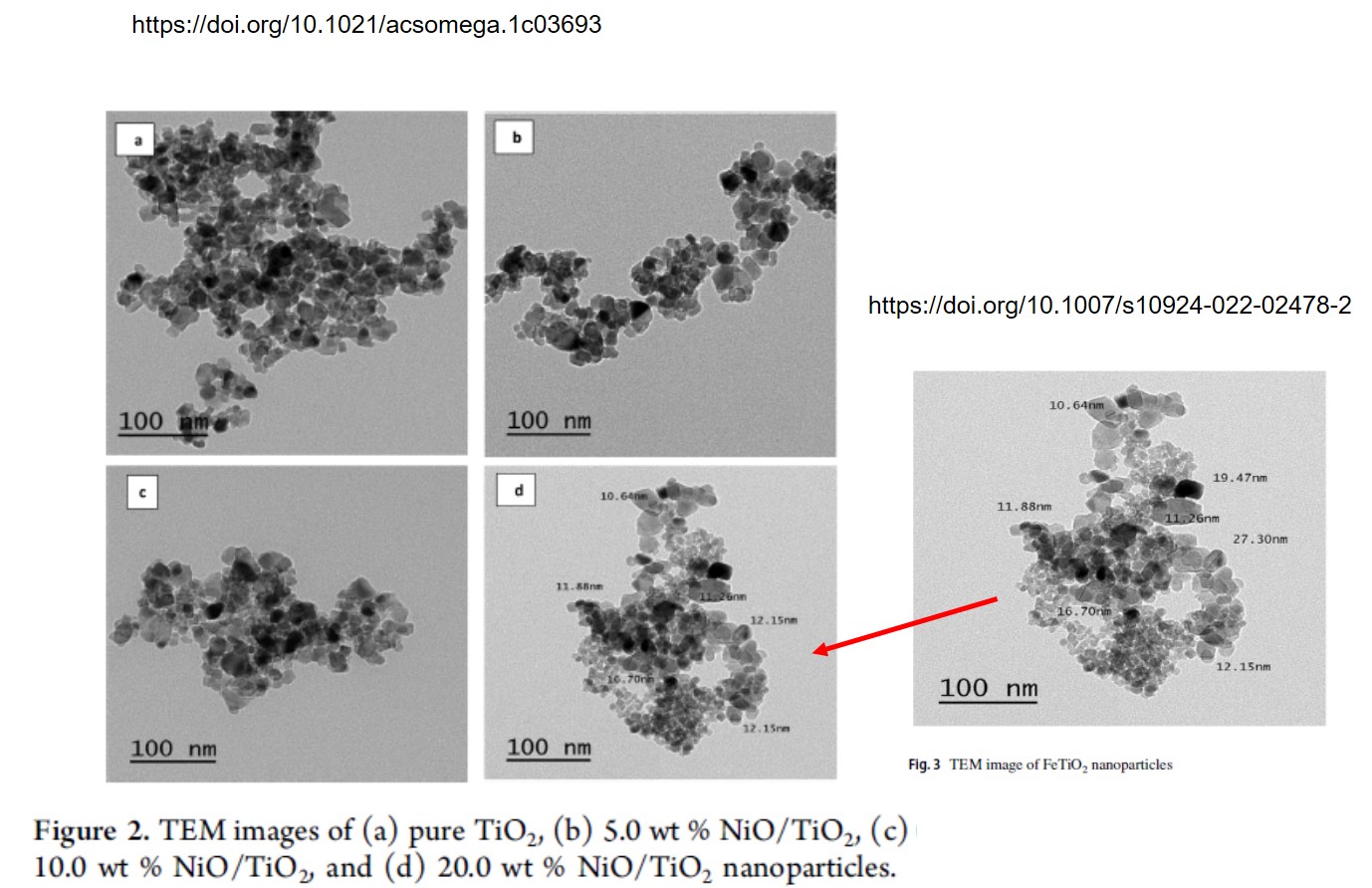
Mohammed A. Mannaa, Khaled F. Qasim, Fares T. Alshorifi, Salah M. El-Bahy, Reda S. Salama Role of NiO Nanoparticles in Enhancing Structure Properties of TiO and Its Applications in Photodegradation and Hydrogen Evolution ACS omega (2021) doi: 10.1021/acsomega.1c03693
Manna’s older paper was fixed in April 2024 with a Correction for another duplication in Figure 3, which of course “does not alter the main findings or results of the study.”
Veziroglu Journal of Papermill Energy
Mu Yang and other sleuths celebrate the scholarly publishing business of the late T Nejat Veziroglu, laureate of Santilli-Galilei Gold Medal for Lifetime Commitment to True Scientific Democracy
And at Elsevier’s International Journal of Hydrogen Energy, jointly run by the Veziroglu family and papermills, all hope is lost:
M.M. Abutalib , Haifa Mohammed Alghamdi , A. Rajeh , Omer Nur , A.M. Hezmad , Mohammed A. Mannaa Preparation of rGO/FeMoO4 as high-performance photocatalyst for degradation of malachite green, phenol and H2 evolution under natural sunlight International Journal of Hydrogen Energy (2022) doi: 10.1016/j.ijhydene.2022.07.189

Thallarcha lechrioleuca: “Fig.10 Unexpected similarity”
It continued in the same vein, with some Hessa Alsalmah from the Female Section of the Imam Mohammad Ibn Saud Islamic University in Saudi Arabia.
Hessa A. Alsalmah , A. Rajeh, M. O. Farea , Omer Nur Synthesis and characterization of PEG/CS‐AgNO3 polymer nanocomposites for flexible optoelectronic and energy storage applications Polymer Composites (2024) doi: 10.1002/pc.28118

Archasia belfragei: “Figure 1 contains two XRD patterns with identical noise signal”
Another one, in Elsevier’s papermill-only journal Ceramics International:
Hessa A. Alsalmah , Adel Bandar Alruqi , Omer Nur , A. Rajeh Developing polymer nanocomposite films of ZnO/NiFe2O4 nanohybrids, polyvinyl pyrrolidone, and chitosan for flexible electromagnetic applications and energy storage devices Ceramics International (2024) doi: 10.1016/j.ceramint.2024.05.190


In 2022, Nur and Willander collaborated with an Iranian papermiller named Mohammad Hasanzadeh, who, as it happens, also supplied Ukrainian customers Taras Kavetskyy, Oleh Smutok and Arnold Kiv, read here:

Taras Persidskyy and Arik of Negev, Shahed Hunters
“He has embarked on a path of unacceptable slander, not only against me, but also against my colleagues (Prof. Oleg Smutok, Prof. Arnold Kiv, Prof. Vladimir Solovyov). We have all the necessary evidence to bring Leonid Schneider to justice for slander and moral turpitude.” – Taras Kavetskyy.
For Nur and Willander, Hasanzadeh recycled data from his older paper Farschi et al 2021:
Nasrin Razmi, Mohammad Hasanzadeh , Magnus Willander , Omer Nur Electrochemical genosensor based on gold nanostars for the detection of O157:H7 DNA Analytical Methods (2022) doi: 10.1039/d2ay00056c
“Analytical Methods is publishing this expression of concern in order to alert readers that concerns have been raised over the integrity of the data in Table 2 and Fig. 4. The measurements reported in the article, including the limit of detection and linear range, were found to have been calculated without reference samples and may be incorrect.
The data in Fig. 4 was first published, in part, in Fig. S13 of https://doi.org/10.1039/D1RA04764G.
The authors have been contacted but have not yet been able to provide additional data to verify their results. An expression of concern will continue to be associated with the article until a conclusive outcome is reached.”
Expression of Concern, 23 January 2025
Linköping whistleblower under attack from May Griffith’s lawyers
Former Linköping professor May Griffith set lawyers upon a former colleague who dared to protest about her research practices on my site. Jaywant Phopase is ordered to delete official documents I made available for download, retract his complaints to journals and pay Griffith a compensation. Or else.
Regarding Razmi et al 2022, there was no previous evidence on PubPeer. Someone notified the journal. Someone must have notified Linköping University also. And it seems, they did, and hit a wall. On 2 May 2025, Nur sent me this message:
“The raw data has been sent to LiU and it has been checked and there is no Fraud. I think you should be carefully before accusing somebody for fraud, you have the right to raise your suspension but no to incriminate others without checking the raw data.”
I invited his university to deny that they indeed found all evidence presented above as fake, and Nur’s papers as completely fine. Silence.
I placed a new notification with NPOF.
Linköping investigation: Tiwari trips over Sharma’s fraud
The last act of the Ashutosh Tiwari travesty at Linköping University (LiU) in Sweden took place. Tiwari, the fake professor and master of predatory conferences, tripped only over his vanity of gift co-authorship on 3 papers by his Allahabad mate Prashant Sharma, a shameless nanotechnology data faker with presently 26 retractions.
A research career shaped by scientific curiosity and serendipitous discovery
In the UK, Jesmond Dalli has been made Full Professor by the Queen Mary University of London (QMUL) . Dalli did PhD with Mauro Perretti, QMUL professor and William Harvey Research Institute (WHRI) director, and then postdoc with the Harvard professor Charles Serhan. SEVENTY of their papers are being questioned on PubPeer, with fraud allegations in the room, read here and May 2022 Shorts:
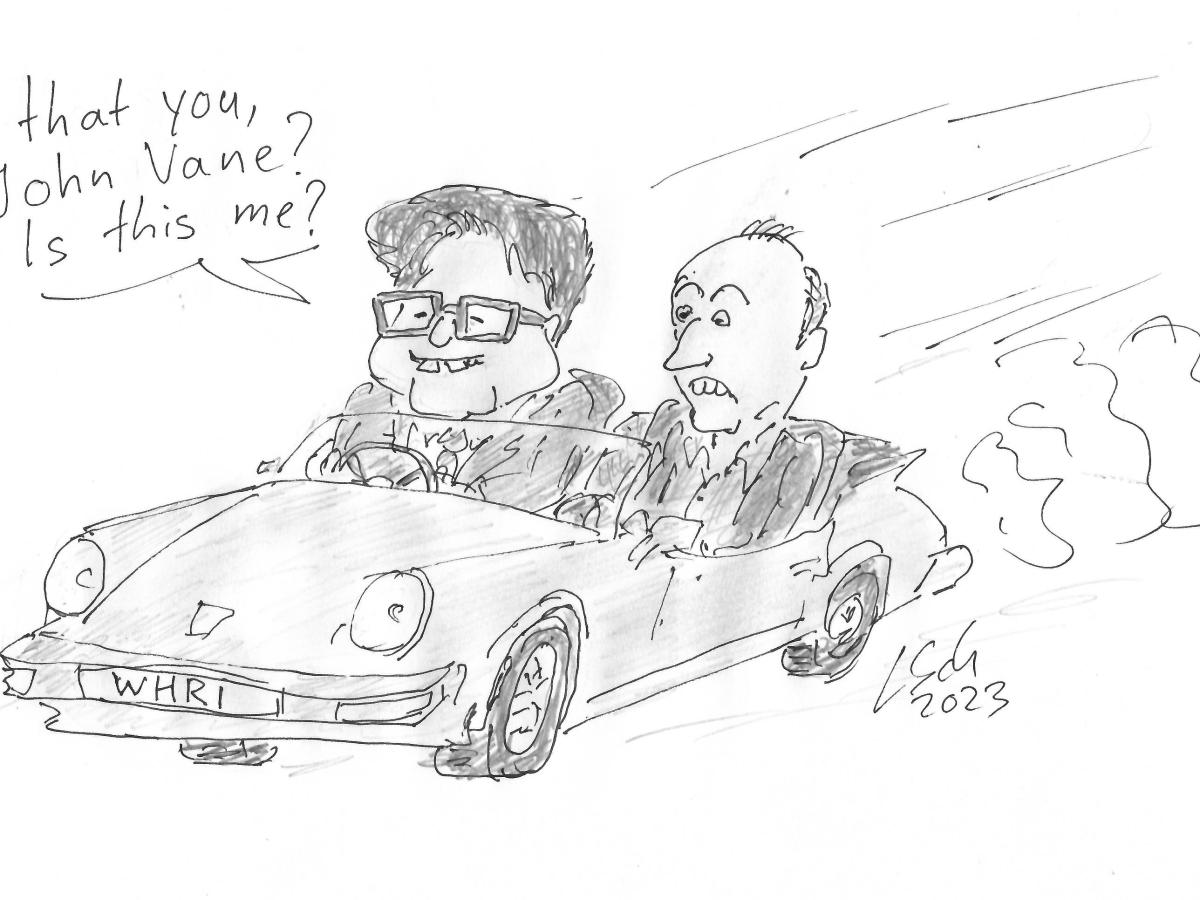
Queen Mary and John Vane’s Cowboys
Welcome to the the William Harvey Research Institute in London. Meet two proteges of its founder, the late Nobelist Sir John Vane: Chris Thiemermann and Mauro Perretti. Then meet their own rotten mentees, especially Salvatore Cuzzocrea and Jesmond Dalli.
In late 2023, QMUL dismissed all past, present and specifically also future evidence against against Dalli’s research as “vexatious” (see November 2023 Shorts), meaning this banana university threatened to persecute everyone at QMUL who should dare to criticise Dalli.
And now, the party began. WHRI proudly announced on social media on 1 May 2025:
“Professor Dalli shared his scientific journey, which began on the island of Malta, where he earned a B.Sc. (Hons) in Chemistry and Biology, followed by an M.Sc. in Biology—both with a focus on marine biology.
Jesmond later pursued his Ph.D. at the William Harvey Research Institute, part of Queen Mary Faculty of Medicine and Dentistry, under the mentorship of Professor Mauro Perretti. This marked the beginning of a research career shaped by scientific curiosity and serendipitous discovery.
Following his doctoral studies, he joined the laboratory of Professor Charles N. Serhan at Harvard Medical School and Brigham and Women’s Hospital. There, he held a faculty position and served as co-director of two NIH-funded lipid mediator profiling cores, further deepening his expertise in the emerging field of pro-resolving mediators.
Jesmond’s research centres on the molecular pathways through which specialised pro-resolving mediators (SPMs) restore tissue homeostasis, regulate inflammation, and promote repair. His work bridges fundamental discovery with translational impact, as reflected in his portfolio of patents—several of which are currently licensed for clinical development.
He has authored over 180 peer-reviewed publications, holds an H-index of 80, and his work has been cited more than 19,500 times. His contributions to science have earned him numerous accolades, including the Eicosanoid Research Foundation Young Investigator Award and Fellowships with both the Royal Society of Biology and the British Pharmacological Society.”
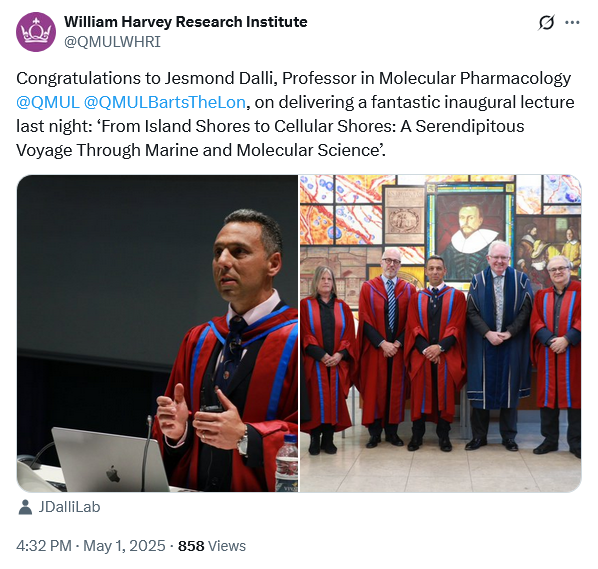
We don’t know if QMUL and WHRI celebrated Dalli’s inauguration with ritual sacrifices of whistleblowers and critics, but with those scholarly psychos you never know.
The end of your comfort zone
In the Big Pharma, a resignation.
William C Sessa used to be professor at Yale University, but in 2022 he switched to the pharma giant Pfizer, to work as SVP and Chief Scientific Officer at Internal Medicine Research Unit. He recently featured in this article by Sholto David, as coauthor of Wang Min (who used to run a one-man-papermill at Yale):
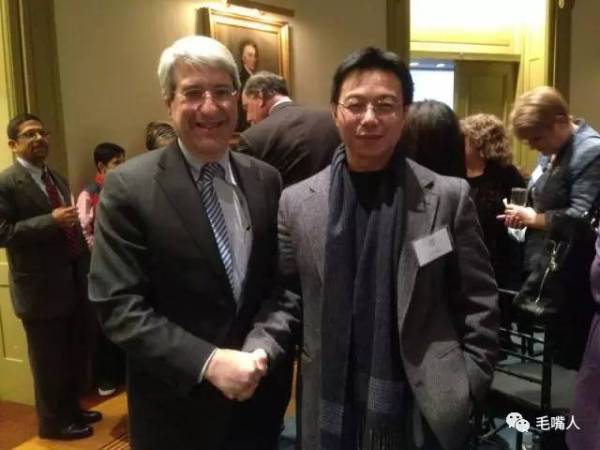
Yale Fayle
“An attractive new prospect: Install the Chinese paper mill directly at Yale University, where research oversight is presumably less stringent than at the PRC and NIH funds are more easily accessed to piss up the wall.” – Sholto David

Two weeks ago, Sessa posted this on LinkedIn:
“After having a fulfilling career in academia, I followed the idea that “life begins at the end of your comfort zone” and joined #Pfizer in 2022. Indeed, it has been a wonderful 3 + years but it is time to move on to my next chapter. It has been an incredible journey working with top notch colleagues in Internal Medicine and throughout the organization. I am humbled by the passion and dedication of the Internal Medicine team and its scientific partners. I have learned much from this experience and am grateful for the opportunity to be part of its success in the discovery and development of new therapies for common disease.”
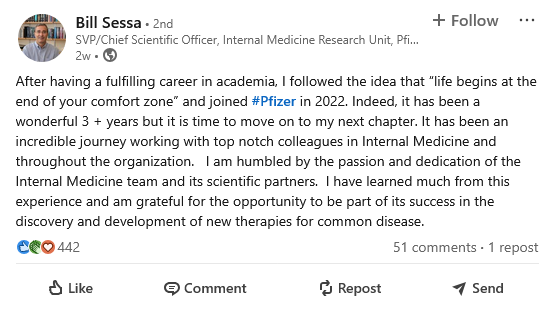
Such a loss for Pfizer.
Here is Sessa’s PubPeer record, much of it without Wang Min. Two with Brown University professor Jack Elias, one badly fake common paper featured in September 2024 Shorts. Here another one, diligent quality science:
Won-Kyung Cho , Chang-Min Lee , Min-Jong Kang , Yan Huang , Frank J Giordano , Patty J Lee , Terence K Trow , Robert J Homer , William C Sessa , Jack A Elias , Chun Geun Lee IL-13 receptor α2-arginase 2 pathway mediates IL-13-induced pulmonary hypertension AJP Lung Cellular and Molecular Physiology (2013) doi: 10.1152/ajplung.00101.2012

Sessa also collaborated with Dario Alessi of University of Glasgow in UK:
M J Lee , S Thangada , J H Paik , G P Sapkota , N Ancellin , S S Chae , M Wu , M Morales-Ruiz , W C Sessa , D R Alessi , T Hla Akt-mediated phosphorylation of the G protein-coupled receptor EDG-1 is required for endothelial cell chemotaxis Molecular Cell (2001) doi: 10.1016/s1097-2765(01)00324-0
Fig 6F

Worse, Sessa was seen with the Italian cheater Giuseppe Cirino (and with Stefano Fiorucci):
Mariarosaria Bucci , Fiorentina Roviezzo , Vincenzo Brancaleone , Michelle I Lin , Annarita Di Lorenzo , Carla Cicala , Aldo Pinto , William C Sessa, Silvana Farneti , Stefano Fiorucci , Giuseppe Cirino Diabetic mouse angiopathy is linked to progressive sympathetic receptor deletion coupled to an enhanced caveolin-1 expression Arteriosclerosis, Thrombosis, and Vascular Biology (2004) doi: 10.1161/01.atv.0000122362.44628.09

Also appreciate the fake gel in Sessa’s PNAS paper Bucci et al 2005 with Cirino and the Nobelist Louis Ignarro.

Fake data and real pomegranate juice in Nobelist Louis Ignarro’s papers
Louis J. Ignarro knew how to monetize his 1998 Nobel Prize for discovery of nitric oxide as molecular cell signalling agent. He made many millions selling dietary supplement for Herbalife and pomegranate juice for POM Wonderful Company. Some of that found its way (without proper conflict of interest declaration) into Ignarro’s peer reviewed papers. Those,…
And now look at this:
J P Gratton , J Fontana , D S O’Connor , G Garcia-Cardena, T J McCabe , W C Sessa Reconstitution of an endothelial nitric-oxide synthase (eNOS), hsp90, and caveolin-1 complex in vitro. Evidence that hsp90 facilitates calmodulin stimulated displacement of eNOS from caveolin-1 Journal of Biological Chemistry (2000) doi: 10.1074/jbc.m001644200

Awful, no? Imagine this kidn of research continued at Pfizer, would they care? Here is Sessa with his Yale colleague and sexual harasser Michael Simons:
Tara Bancroft , Mohamed Bouaouina , Sophia Roberts , Monica Lee , David A. Calderwood, Martin Schwartz , Michael Simons, William C. Sessa, Themis R. Kyriakides Up-regulation of thrombospondin-2 in Akt1-null mice contributes to compromised tissue repair due to abnormalities in fibroblast function Journal of Biological Chemistry (2015) doi: 10.1074/jbc.m114.618421

Read about Simons and other unsavoury Yale professors here:

Dirty Old Men
Does being a science genius entitle you to sexual harassment, as academic authorities in Yale and elsewhere insist? Let’s look at papers by Michael Simons, Joseph Schlessinger and Arnold Levine.
Maybe the next one wasn’t “an oversight involving the inadvertent duplication” which “occurred in the final stages of image production and doesn’t affect the quantification or interpretation of the experiment“, like the June 2024 Correction claimed:
Jean Philippe Gratton , Michelle I Lin , Jun Yu , Erik D Weiss , Zao Li Jiang , Todd A Fairchild , Yasuko Iwakiri , Roberto Groszmann , Kevin P Claffey , Yung Chi Cheng , William C Sessa Selective inhibition of tumor microvascular permeability by cavtratin blocks tumor progression in mice Cancer Cell (2003) doi: 10.1016/s1535-6108(03)00168-5

Anyway, Pfizer is probably better off without Sessa. He will sure find a new job soon.
Scholarly Publishing
Figure is deleted
Look what Wiley and the learned society called International Association for the Study of the Liver, have corrected. It was led by the Hepatiic C researcher Srikanta Dash, and coauthored by his fellow professors at Tulane University in New Orleans – Fredric Regenstein, Robert Garry, Frank Bastian, Virendra Joshi (now elsewhere in New Orleans), the last author however from elsewhere: Swan Thung, professor at Icahn School of Medicine at Mount Sinai. Flagged by Elisabeth Bik in 2021:
Srikanta Dash, Ramesh Prabhu , Sidhartha Hazari , Frank Bastian , Robert Garry, Weiping Zou , Salima Haque , Virendra Joshi , Fredric G. Regenstein, Swan N. Thung Interferons α, β, γ each inhibit hepatitis C virus replication at the level of internal ribosome entry site‐mediated translation Liver international (2005) doi: 10.1111/j.1478-3231.2005.01082.x

Several panels look more similar to each other than expected.”


Two panels in this figure appear to overlap with panels in another paper by the same group, i.e.: Ramesh Prabhu et al., Experimental and Molecular Pathology (2004),”
On 20 February 2025, Wiley and the Editor-in-Chief Luca Valenti (who has his own little PubPeer record of bad science) issued this unhinged Correction:
“Corrections to Figure 6
Figure 6 is deleted. Data in Figure 7 confirm the results that were previously shown in Figure 6. HCV IRES inhibition conclusion is also supported by data shown in Figure 5, Figure 10 and Figure 11. These corrections do not alter the conclusions of the manuscript.
[…]
Corrections to Figure 8
Figure 8 is deleted. Data shown in Figure 5 confirm the results that were previously shown in Figure 8. EMCV-IRES inhibition by IFN is also supported by data shown in Figure 10. These corrections do not alter the conclusions of the manuscript.”
There was also a correction to Figure 9 and corrections to the text to accommodate for the removal of the fraudulent figures 6 and 8. The conclusions that everything Dash ever published was totally fraudulent, remain unaffected indeed. Srikanta Dash has over 20 fake papers on PubPeer, several were already retracted, in some cases nothing at all was done.
Here is the above mentioned paper by the same team, from which some data was reused:
Ramesh Prabhu , Virendra Joshi , Robert F Garry , Frank Bastian , Salima Haque , Fredric Regenstein, Swan Thung , Srikanta Dash Interferon alpha-2b inhibits negative-strand RNA and protein expression from full-length HCV1a infectious clone Experimental and Molecular Pathology (2004) doi: 10.1016/j.yexmp.2004.01.004

Orange boxes: In the top part of the figure, the left panels look very similar. […]
Green boxes: In the bottom part of the figure, the left panels look very similar.”


Another one, again in the learned society journal American Journal of Pathology, featuring another Tulane professor, Luis Balart (who died in 2019 aged 70, credited with having “helped develop a cure for hepatitis C“):
Partha K. Chandra , Lili Bao , Kyoungsub Song , Fatma M. Aboulnasr , Darren P. Baker , Nathan Shores , William C. Wimley , Shuanghu Liu , Curt H. Hagedorn, Serge Y. Fuchs , Tong Wu , Luis A. Balart , Srikanta Dash HCV infection selectively impairs type I but not type III IFN signaling The American Journal of Pathology (2014) doi: 10.1016/j.ajpath.2013.10.005


This one was successfully corrected:
Sidhartha Hazari , Partha K Chandra , Bret Poat , Sibnarayan Datta , Robert F Garry , Timothy P Foster , Gus Kousoulas , Takaji Wakita , Srikanta Dash Impaired antiviral activity of interferon alpha against hepatitis C virus 2a in Huh-7 cells with a defective Jak-Stat pathway Virology Journal (2010) doi: 10.1186/1743-422x-7-36

Green boxes: The two Mock panels appear to look very similar
Pink boxes: The two IFN- panels appear to look very similar, although their gated percentages are different”

Red boxes: Two panels appear to look more similar than expected.”

Actinopolyspora biskrensis: An image in Figure 8A of this paper seems to also appear in another paper published at approximately the same time in the same journal. The two images seem to be described differently.”
The Correction from 1 November 2024 was very strange, basically a copy-paste of what Dash wrote to the editor:
“Following publication of the original article [1], the authors identified that an image in Fig. 6 under column 24, row Huh-7.5 expressing a control antibody also was published in a separate Virology Journal article, “Impaired antiviral activity of interferon alpha against hepatitis C virus 2 in Huh-7 cells with a defective Jak-Stat pathway,” S. Hazari et al., Virology Journal 2010, 7:36. https://doi.org/10.1186/1743-422X-7-36 . This duplicated image appears in Fig. 8 under column 24, row IFN-alpha(+) in S. Hazari et al. I am the corresponding author on this S. Hazari et al. publication and will request that the duplicated image in Fig. 8 be deleted from this publication in a separate letter.”
That other paper in the same BMC journal by Springer Nature, again by Dash and Garry, was also corrected:
Partha K Chandra , Sidhartha Hazari , Bret Poat , Feyza Gunduz , Ramesh Prabhu , Gerald Liu , Roberto Burioni, Massimo Clementi , Robert F Garry, Srikanta Dash Intracytoplasmic stable expression of IgG1 antibody targeting NS3 helicase inhibits replication of highly efficient hepatitis C Virus 2a clone Virology Journal (2010) doi: 10.1186/1743-422x-7-118

Elisabeth Bik: “Figure 3. Red boxes: One of the GAPDH lanes appears to show the same area twice, but stretched differently
Blue arrows: Sharp vertical transitions appear to be visible in multiple panels but not always between the same lanes.”
Here is Dash’s bizarre Correction from 1 November 2024:
“Following publication of the original article [1], the authors identified that an image in Fig. 6 under column 24, row Huh-7.5 expressing a control antibody also was published in a separate Virology Journal article, […] This duplicated image appears in Fig. 8 under column 24, row IFN-alpha(+) in S. Hazari et al. I am the corresponding author on this S. Hazari et al. publication and will request that the duplicated image in Fig. 8 be deleted from this publication in a separate letter.”
At least this one by Dash and his Tulane buddies Regenstein and Garry in Springer Nature, was retracted, noteworthy in the same BMC journal:
Sidhartha Hazari, Lizeth Taylor , Salima Haque , Robert F Garry , Sander Florman , Ronald Luftig , Frederic Regenstein , Srikanta Dash Reduced expression of Jak-1 and Tyk-2 proteins leads to interferon resistance in hepatitis C virus replicon Virology Journal (2007) doi: 10.1186/1743-422x-4-89


The retraction was issued on 19 April 2025:
“The Editor-in-Chief has retracted this article because of multiple image overlaps between and within in Figs. 2 and 3a and overlaps between R-CON-15, R-CON-17 and R-CON24 panels in the top row and their counterparts in the bottom row in Fig. 3c. The authors were unable to provide the original data on request. Srikanta Dash agrees to this retraction. Frederic Regenstein, Ronald Luftig, Salima Haque, Robert F Garry and Sander Florman did not respond to correspondence about this retraction. The Editor has been unable to find current email addresses for Lizeth Taylor and Sidhartha Hazari.”
The fabrication Datta et al 2011 in the same BMC journal was not even corrected, and neither was Poat et al 2010, also in Virology Journal, but its counterpart in PLOS One was retracted:
Bret Poat, Sidhartha Hazari1, Partha K. Chandra1, Feyza Gunduz, Luis A. Balart, Xavier Alvarez, Yong Zhang, Michael J. Holtzman, Srikanta Dash SH2 modified STAT1 induces HLA-I expression and improves IFN-γ signaling in IFN-α resistant HCV replicon cells PLOS One (2010) doi: 10.1371/journal.pone.0013117

Blue boxes: One of the panels in Figure 7A looks similar to a panel in Figure 1C of the PLOS ONE paper.
Green boxes: One of the panels in Figure 7A looks similar to a panel in Figure 1C of the PLOS ONE paper.”
Bret Poat , Sidhartha Hazari , Partha K Chandra , Feyza Gunduz , Xavier Alvarez , Luis A Balart , Robert F Garry, Srikanta Dash Intracellular expession of IRF9 Stat fusion protein overcomes the defective Jak-Stat signaling and inhibits HCV RNA replication Virology Journal (2010) doi: 10.1186/1743-422x-7-265


Cyan boxes: Two panels that do not appear to show the same experiment also look similar.”
Now, in the classic papermill style, Dash has been selling or gifting authorships. Because look what Correction PLOS One initially published in November 2010:
“The authors wish to add two authors to the byline, Dr. Yong Zhang and Dr. Michael J. Holtzman […]”
Michael Holtzman is endowed professor of medicine and director of division at Washington University in St. Louis.
On 31 March 2022., PLOS One issued an Expression of Concern about “western blots in Figs 2, 5 and 7, and microscopy images in Figs 1C, 6 and 8.” The Retraction was published on 5 November 2024:
“After publication of the Expression of Concern [3] on this article [1, 2], additional concerns were raised about results presented in Figs 1 and 11. Specifically:
- In Fig 1B, the blot appears similar to the GADPH and HCV blots in Fig 7 when cropped along the right-hand edge, and when the GADPH and HCV blots in Fig 7 are cropped along the bottom edge.
- In the PKR panel in Fig 11, when contrast is adjusted, the area directly around the bands does not appear to match the overall background of the panel for which no background noise could be detected.
In response to the concerns listed above and in [3], the corresponding author stated that the underlying data for the experiments in question are no longer available.
In light of the extent of the concerns listed above and in [3] that cannot be resolved in the absence of the original underlying data, and which question the reliability of the reported results and conclusions, the PLOS ONE Editors retract this article.
SD did not respond to the final editorial decision. BP, SH, PKC, FG, LAB, and XA either did not respond directly or could not be reached.”
PLOS One also pulled this forgery by Dash, Garry and the late suchitrBalart:
Rajesh Panigrahi , Sidhartha Hazari , Sruti Chandra , Partha K. Chandra, Sibnarayan Datta , Ramazan Kurt , Craig E. Cameron , Zhuhui Huang , Haitao Zhang , Robert F. Garry, Luis A. Balart, Srikanta Dash Interferon and ribavirin combination treatment synergistically inhibit HCV internal ribosome entry site mediated translation at the level of polyribosome formation PLOS One (2013) doi: 10.1371/journal.pone.0072791


Blue boxes: Two panels appear to look very similar
Orange boxes: Two panels appear to look very similar”

Actinopolyspora biskrensis: “A band seems to have been used in Figure 2 and Figure 7 to represent different conditions.”
An Expression of Concern was issued on 31 March 2022, to warn about “similarities in some of the microscopy images in Figures 1A and 1D.” After more was found, a Retraction arrived on 5 August 2024:
“After publication of the Expression of Concern on this article [1, 2], additional concerns were raised about results presented in Figs 2 and 7. Specifically:
- The EGFPN1 GFP RBV panel in Fig 2A appears similar to the eIF2α RBV panel in Fig 7A.
- In Fig 7A:
- ○ The PKR IF-N-α panel appears similar to the eIF2α IF-N-α panel.
- ○ The PKR RBV panel appears similar to the IMPDH RBV panel.
In response to the concerns listed above and in [2], the corresponding author stated that the underlying data for the experiments in question are no longer available.
In light of the extent of the concerns listed above and in [2] that cannot be resolved in the absence of the original underlying data and which question the reliability of the reported results and conclusions, the PLOS ONE Editors retract this article.”
Why Dash remains professor in New Orleans is a mystery. Maybe they waited for Trump and RFK Jr to appreciate such science? Maybe now NIH grant money will rain over Dash?
To my astonishment, Dash never featured on Retraction Watch (although 6 of his retractions are listed in the RW Database). Dash’s other retractions were:
- Partha K Chandra , Anup K Kundu , Sidhartha Hazari , Sruti Chandra , Lili Bao , Tara Ooms , Gilbert F Morris, Tong Wu, Tarun K Mandal, Srikanta Dash Inhibition of hepatitis C virus replication by intracellular delivery of multiple siRNAs by nanosomes Molecular Therapy (2012) doi: 10.1038/mt.2012.107, Retraction 14 December 2024 due to “findings of image duplication in identical or altered fashion involving Figures 3A, 3D, 6B, 6C, and 7E of the original article, including misrepresentation of overlapping images.“
- Ramesh Prabhu , Padmaja Vittal , Qinyan Yin , Erik Flemington , Robert Garry, William H. Robichaux , Srikanta Dash Small interfering RNA effectively inhibits protein expression and negative strand RNA synthesis from a full-length hepatitis C virus clone Journal of medical virology (2005) doi: 10.1002/jmv.20391 , Retraction 4 April 2024 due to “publication concerns which were raised by third parties regarding Figure 3.“
- Ramesh Prabhu, Robert F Garry , Srikanta Dash Small interfering RNA targeted to stem-loop II of the 5′ untranslated region effectively inhibits expression of six HCV genotypes Virology Journal (2006) doi: 10.1186/1743-422x-3-100, Retraction 26 July 2021 for duplications in Figures 4 and 6, and because “the article also shows significant overlap with a previously published article“.
- Sidhartha Hazari , Asha Patil , Virendra Joshi , Deborah E. Sullivan , Cesar D. Fermin , Robert F. Garry , Richard M. Elliott , Srikanta Dash Alpha interferon inhibits translation mediated by the internal ribosome entry site of six different hepatitis C virus genotypes The Journal of general virology (2005) doi: 10.1099/vir.0.81132-0, Retraction 27 May 2021, “following a report from a reader, and subsequent investigation into duplication of images in Fig. 2 of the article.”
- Yucel Aydin , Milad Chedid , Srinivas Chava , Donkita Danielle Williams , Shuanghu Liu , Curt H. Hagedorn , Suchitra Sumitran-Holgersson , Krzysztof Reiss , Krzysztof Moroz , Hua Lu , Luis A. Balart , Srikanta Dash Activation of PERK-Nrf2 oncogenic signaling promotes Mdm2-mediated Rb degradation in persistently infected HCV culture Scientific Reports (2017) doi: 10.1038/s41598-017-10087-6, Retraction 1 September 2021 because “Figure 2: the background of some of the blots appear to be unexpectedly clean” and “Figure 9A: the Core panels […] appear to partially overlap.”
Did you notice the coauthor on that last retracted paper by Dash – the Swedish cheater Suchitra Sumitran-Holgersson, who was found guilty of fraud and unethical experiemnts on children? These people are just attracted to each other.
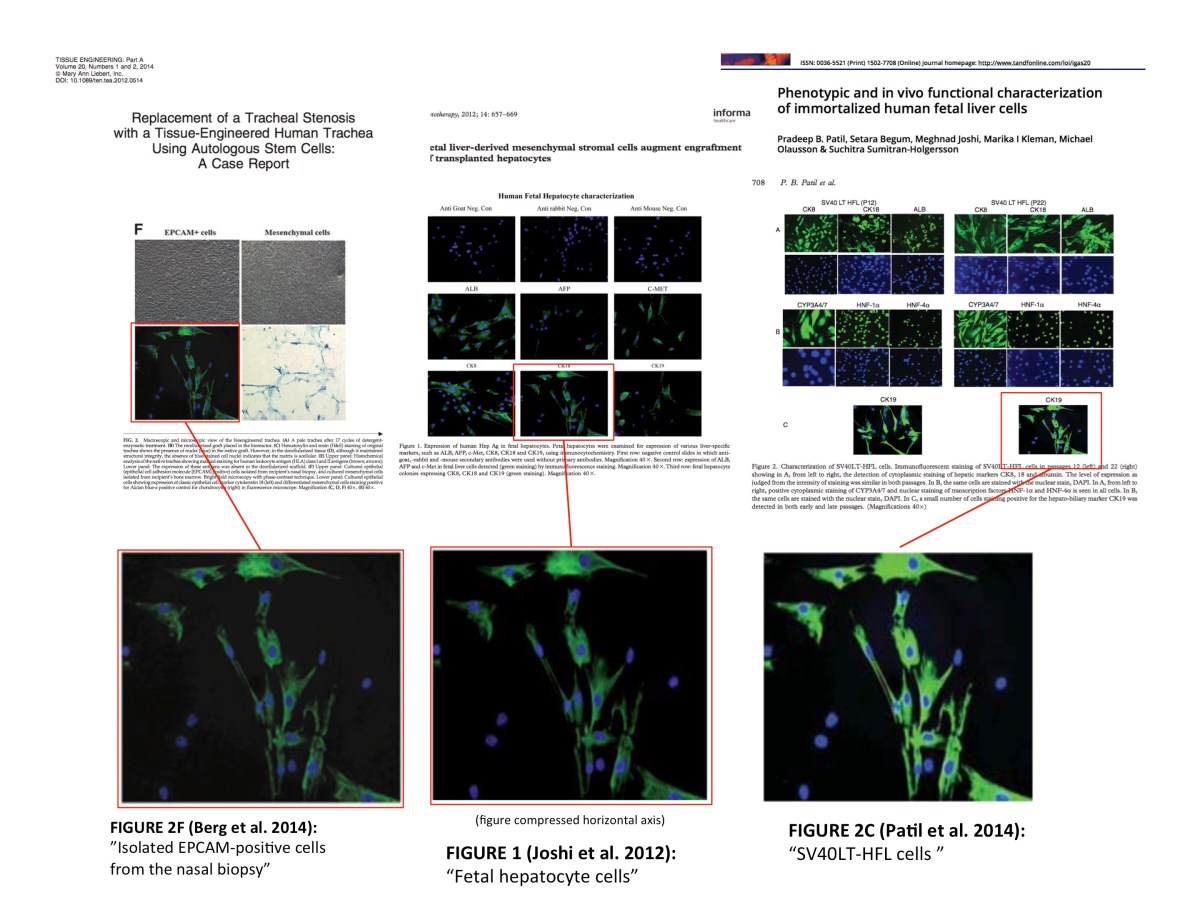
Sumitran-Holgersson and Olausson to retract 8 papers for research misconduct
Bad news for regenerative medicine enthusiasts, the data manipulating biologist Suchitra Sumitran-Holgersson and her surgeon partner Michael Olausson, both professors at the University of Gothenburg (GU) in Sweden. They were previously found guilty of breach of medical ethics and patient abuse for their experiments with “regenerated” decellurised veins, which incidentally serve as basis for an EU-funded…
Such despicable behaviour
An Elsevier journal issued a stealth correction for a fake paper. It was originally flagged by Mu Yang on X in June 2024. The coauthor B.M. Alotaibi has over 20 fake papers on PubPeer, the coauthor Abdullah Al-Sehemi has 100 papers on PubPeer.
Muhammad Zeshan , Haifa A. Alyousef , Albandari W. Alrowaily , B.M. Alotaibi , Abdullah G. Al-Sehemi , Muhammad Imran Saleem Hydrothermal fabrication of ZnTe/g-CN nanocomposite for supercapacitor application Diamond and Related Materials (2024) doi: 10.1016/j.diamond.2024.111307

Moreover, could the authors explain the following abnormalities on the Zn peak at 8.5 KeV, on Fig 2d:
How can the x axis present a vertical “bump” under the peak (a) ?
What does the “satellite dot” on the left correspond to (b)?
The Zn label doesn’t have a “shadow” on the right like the other labels (c). Has it been modified or maybe pasted there? If so, why did the authors have to make this modification?
Can the authors explain why the right foot of the peak presents an orthogonal angle with the baseline (d)?”
Almost a year later, someone just replaced this Figure 2 and another fake figure. No correction or other editorial notice was issued. The editorial manipulation was noticed on 7 May 2025:

I contacted Elsevier and the journal’s Editor-in-Chief Ken Haenen, Vice-Rector for Research at Hasselt University in Belgium. Elsevier announced:
“This will be assessed and investigated by Prof. Haenen with the support and advice provided by the Elsevier ethics team.“
Haenen assured:
“To make it clear, it is simply impossible for an Editor-in-Chief to “simply” ask for changes in a published version of a manuscript, nor would I ever do so. Once a manuscript is accepted, it goes out of the hands of the editors and no further changes can be made. In case of errors, only a Corrigendum can be issued, always referring to the original publication that remains online. The quality of the journal stands or falls with high ethical standards to which the whole editorial DRM team adheres itself to. I’m appalled by the suggestion that any editor of this or any other journal would be involved in such despicable behaviour.”
Well, someone did the sleath correction.
The Incorrigible Elsevier
“I woke up seeing Elsevier’s giant middle finger in front of my face.” – Mu Yang

Anyway, about the peer review in this journal, here is something by the same author Muhammad Imran Saleem with Al-Sehemi and a certain A.M.A. Henaish (russia-affiliated, almost 50 fake papers on PubPeer), please read February 2025 Shorts about these two gentlemen:
Misbah Ramzan , Areej S. Alqarni , Khursheed Ahmad , Abdullah G. Al-Sehemi , A.M.A. Henaish , Muhammad Aslam , Muhammad Jahangir Khan , Muhammad Imran Saleem Hydrothermally fabricated MoTe2/rGO as a proficient electrocatalyst for robust oxygen evolution reaction Diamond and Related Materials (2024) doi: 10.1016/j.diamond.2024.111364

I wonder if Haenen sees the problem with those silly hand-drawn peaks also.
Retraction Watchdogging
Requested to explain the duplication and alteration
US scientists discovered that curcumin cures Parkinson’s. Now that paper is retracted, having been previously flagged by Mu Yang.
The lead author Wanli Smith is professor of psychiatry at Johns Hopkins University, Tim Moran is another psychiatry professor, and their superior Christopher Ross is Director of Division of Neurobiology at Johns Hopkins University.
Dejun Yang , Tianxia Li , Zhaohui Liu , Nicolas Arbez , Jianqun Yan, Timothy H. Moran , Christopher A. Ross, Wanli W. Smith LRRK2 kinase activity mediates toxic interactions between genetic mutation and oxidative stress in a Drosophila model: Suppression by curcumin Neurobiology of Disease (2012) doi: 10.1016/j.nbd.2012.05.020

The retraction from 3 May 2025 was short:
“This article has been retracted at the request of the Editor-in-Chief. / An investigation conducted on behalf of the journal by Elsevier’s Research Integrity & Publishing Ethics team found image duplication and alteration issues, with two images in Fig. 5e being reused, recoloured, and stretched. The authors were requested to explain the duplication and alteration in Fig. 5e but were unresponsive. The Editor has lost confidence in the findings of the article and has determined that it should be retracted.”
Quite possibly it is Professor Moran who is the problem here. He has more on PubPeer.


Gary J. Schwartz (not to be confused with Gary K Schwartz) is now professor at Albert Einstein College of Medicine.
Highly similar patterns
Yet another retraction for the Harvard and Boston University associate professor Edward Whang, who currently has almost 30 papers on PubPeer.
In December 2022 Shorts, I wrote how Elsevier’s editor reacted to the sleuth Claire Francis submitting evidence of Whang’s forgeries – by attacking first the sleuth, and then me. In February 2023, Retraction Watch reported about 5 retractions for Whang which referenced an investigation by Harvard Medical School and Brigham and Women’s Hospital. In June 2023, Whang retracted another paper, Duxbury et al 2004 (with his mentee Mark Duxbury, now surgeon at the Ross Hall Hospital in Edinburgh, UK).
And here is the recent retraction for Whang:
S-S Liau, A Jazag , K Ito , E E Whang Overexpression of HMGA1 promotes anoikis resistance and constitutive Akt activation in pancreatic adenocarcinoma cells British Journal of Cancer (2007) doi: 10.1038/sj.bjc.6603654


The retraction appeared on 30 April 2025:
“The Editor-in-Chief has retracted this article. After publication, concerns were raised regarding some of the data presented in the figures, specifically:
- Fig. 3A total AKT blot appears highly similar to Fig. 3B total AKT in the authors’ earlier study [1];
- Fig. 4B BxPC3 Empty PLKO.1 Lentivirus and Control shRNA Lentivirus plots appear to share some highly similar patterns.
The Editor-in-Chief therefore no longer has confidence in the presented data.
S-S Liau, A Jazag and E E Whang disagree with this retraction. K Ito has not responded to any correspondence from the editor or publisher about this retraction.”
Funnily, Whang’s other fake papers remain standing, untainted by retractions. Like the one mentioned above:
Siong-Seng Liau, Amarsanaa Jazag , Edward E. Whang HMGA1 is a determinant of cellular invasiveness and in vivo metastatic potential in pancreatic adenocarcinoma Cancer Research (2006) doi: 10.1158/0008-5472.can-06-1460


This one at least received an Expression of Concern:
Mark S Duxbury, Hiromichi Ito, Eric Benoit, Michael J Zinner , Stanley W Ashley, Edward E Whang Overexpression of CEACAM6 promotes insulin-like growth factor I-induced pancreatic adenocarcinoma cellular invasiveness Oncogene (2004) doi: 10.1038/sj.onc.1207775


The Editorial Expression of Concern from July 2023 was “to alert readers that overlap has been noted between the actin bands of figures 2A and 4B”, but sadly, nothing can be done because “the authors have been unable to provide the original data.”
Science Breakthroughs
Gerogenes and gerosuppressors
The two toxic old men of anti-aging, Guido Kroemer (aged almost 64) and Carlos Lopez-Otin (aged 67), gather again a team of old anti-aging clowns to reference their own fake anti-aging crap for yet another load of “Hallmarks of aging” bollocks in Cell, which of course will be cited by every fellow anti-aging scammer out there.
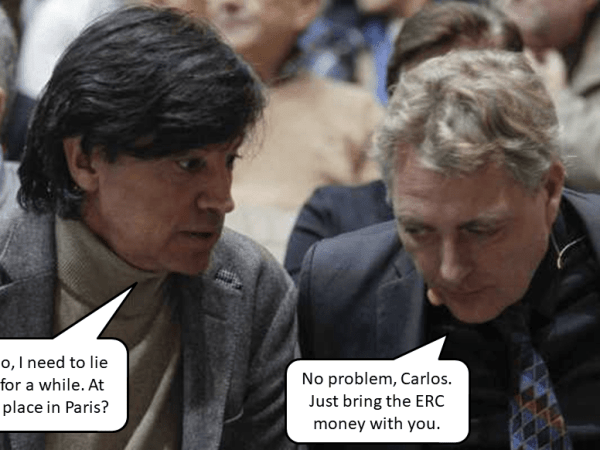
Lopez-Otin and Kroemer: birds of a feather flock together
Following my reporting, the cancer researcher Carlos López-Otín abandoned his ERC-funded 36-member-strong “Degradome” lab at the University of Oviedo in Spain and moved in with his collaborator in Paris, France, Guido Kroemer. Yet Lopez-Otin’s data integrity issues seem as poppycock compared to what Kroemer and his life partner Laurence Zitvogel dished out to the scientific…
Look at them, so worried about getting old again:
Guido Kroemer, Andrea B. Maier , Ana Maria Cuervo , Vadim N. Gladyshev , Luigi Ferrucci , Vera Gorbunova , Brian K. Kennedy , Thomas A. Rando , Andrei Seluanov , Felipe Sierra , Eric Verdin , Carlos López-Otín From geroscience to precision geromedicine: Understanding and managing aging Cell (2025) doi: 10.1016/j.cell.2025.03.011
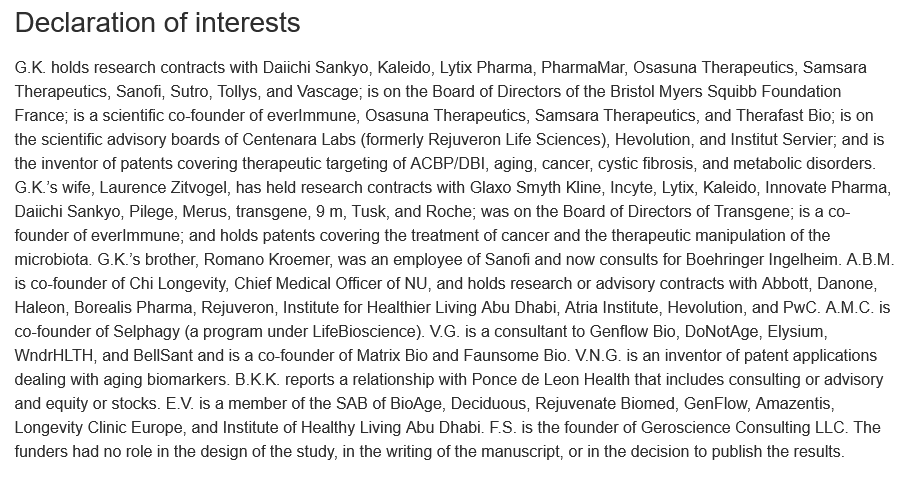
You may have heard of oncogenes and oncosuppressors, genes which either cause or prevent cancer development, so now we are educated about the genetic entities called “Gerogenes and gerosuppressors” which “interact with environmental, behavioral, and psychological risk factors” like fake data on PubPeer and bullshit anti-aging cures pushed by some aging quacks.
Now, who joined Carlos and Guido here? Well, Tom Rando (aged 68) whose bad science featured in this article:
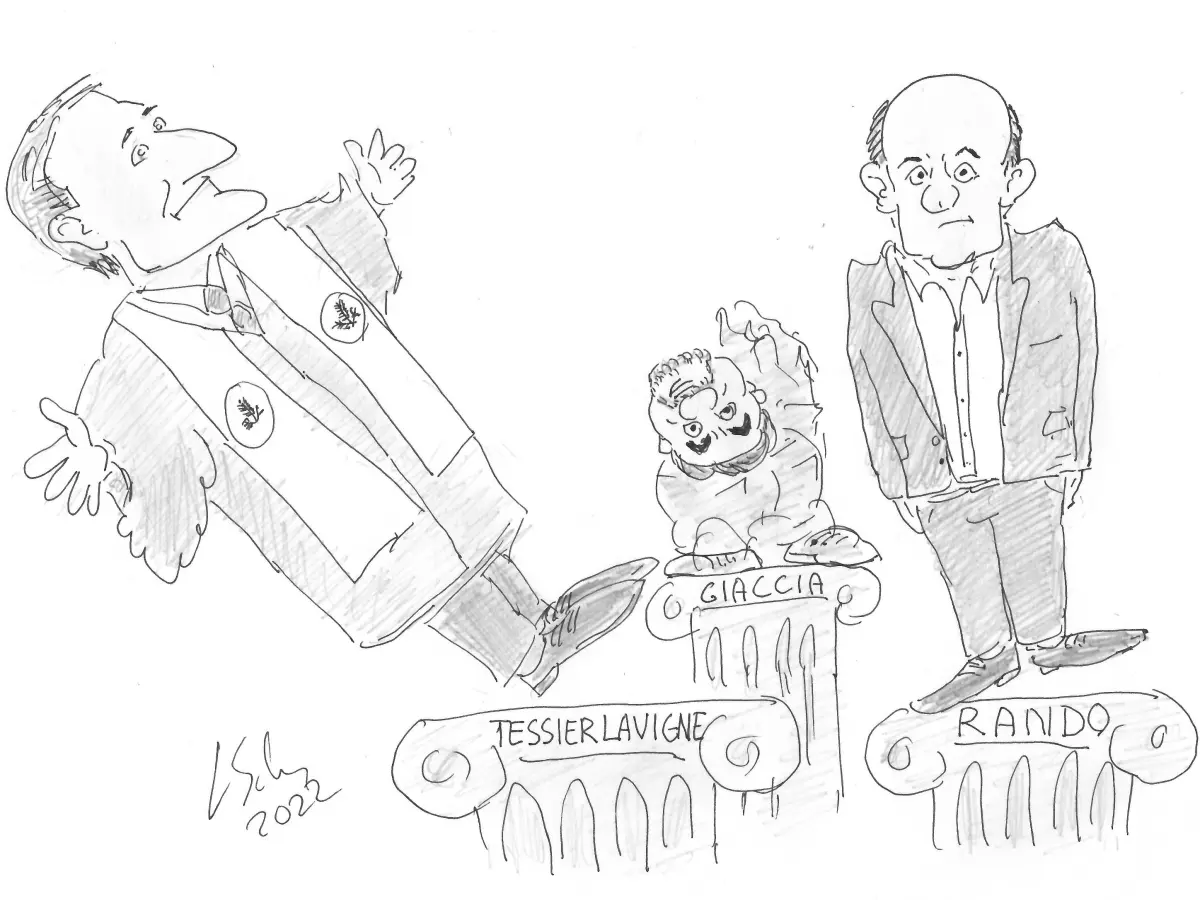
Toppling Giants in Stanford
Everyone is talking about Stanford’s President Marc Tessier-Lavigne now. OK, let’s talk about him, and how Stanford deals with research fraud. And then let’s talk about Thomas Rando.
Then we have Eric Verdin (aged 67), about whose dodgy science and anti-aging business activities you can read in March 2024 Shorts; Andrei Seluanov (aged 55) and his wife Vera Gorbunova (age secret), about whose badly aged science you can read in July 2022 Shorts, plus another US-based russian anti-aging enthusiast, Vadim Gladyshev (aged 59).
Heads and hearts
“Imagine what effect might ensue from a young donor body (say, in her 20’s) nourishing with her young blood 24/24, 7/7 the head of an aging body recipient!” – Sergio Canavero

Luigi Ferrucci (in his 60ies) is director of the National Institute on Aging (NIA) and also an associate of Steve Horvath (the COI-free anti-aging entrepreneur who eats metformin to stay young and sells epigenetic age kits to stay rich).
The by far youngest on board is the owner of the Chi Longevity anti-aging clinic in Singapore, Andrea Maier, accompanied by Brian Kennedy (aged 58), her fellow professor at National University of Singapore, who is in turn a mentee of Leonard Guarente. Here, also David Sinclair is on board:
Brian K Kennedy , Monica Gotta , David A Sinclair , Kevin Mills , David S McNabb , Mala Murthy , Sally M Pak , Thierry Laroche , Susan M Gasser, Leonard Guarente Redistribution of Silencing Proteins from Telomeres to the Nucleolus Is Associated with Extension of Life Span in S. cerevisiae Cell (1997) doi: 10.1016/s0092-8674(00)80219-6

Susan Gasser: “They are indeed repetitive, but that was the logic of the paper […] these are digital compositions of individual nuclei. This is true for all these images.”
Here is Kennedy with former NCI director Ned Sharpless and the late anti-aging entrepreneur Judith Campisi:
Marco Demaria , Monique N. O’Leary , Jianhui Chang , Lijian Shao , Su Liu , Fatouma Alimirah , Kristin Koenig , Catherine Le , Natalia Mitin , Allison M. Deal , Shani Alston , Emmeline C. Academia , Sumner Kilmarx , Alexis Valdovinos , Boshi Wang , Alain De Bruin , Brian K. Kennedy , Simon Melov , Daohong Zhou , Norman E. Sharpless, Hyman Muss, Judith Campisi Cellular Senescence Promotes Adverse Effects of Chemotherapy and Cancer Relapse Cancer Discovery (2017) doi: 10.1158/2159-8290.cd-16-0241

And this:
Michael G Garelick , Vivian L MacKay , Aya Yanagida , Emmeline C Academia , Katherine H Schreiber , Warren C Ladiges, Brian K Kennedy Chronic rapamycin treatment or lack of S6K1 does not reduce ribosome activity in vivo Cell cycle (2013) doi: 10.4161/cc.25512

Then we have Ana Maria Cuervo (aged 58), professor at Albert Einstein College of Medicine, and old collaborator of Laurie Glimcher and Claudio Hetz. In 2013, she and her faculty colleague Roman Perez-Soler retracted the paper Ling et al 2011 for “image mishandling in several figures” (as reported by Retraction Watch), because the student Yi-He Ling accepted full responsibility, and “in view of the reproducibility of the original data by a third party, the authors continue to stand by the conclusions of the article“. Here are some of her other problematic papers:
Lauren R. Kett , Barbara Stiller , Megan M. Bernath , Inmaculada Tasset , Javier Blesa , Vernice Jackson-Lewis , Robin B. Chan , Bowen Zhou , Gilbert Di Paolo , Serge Przedborski , Ana Maria Cuervo , William T. Dauer α-Synuclein-independent histopathological and motor deficits in mice lacking the endolysosomal Parkinsonism protein Atp13a2 The Journal of neuroscience (2015) doi: 10.1523/jneurosci.0632-14.2015

Dysdera arabisenen: “There might be a mistake in either Fig 4 or Fig 10. See the identical image.”
And this:
Benjamin Caballero , Mathieu Bourdenx , Enrique Luengo , Antonio Diaz , Peter Dongmin Sohn , Xu Chen , Chao Wang , Yves R. Juste , Susanne Wegmann , Bindi Patel , Zapporah T. Young , Szu Yu Kuo , Jose Antonio Rodriguez-Navarro , Hao Shao , Manuela G. Lopez , Celeste M. Karch , Alison M. Goate , Jason E. Gestwicki , Bradley T. Hyman , Li Gan , Ana Maria Cuervo Acetylated tau inhibits chaperone-mediated autophagy and promotes tau pathology propagation in mice Nature Communications (2021) doi: 10.1038/s41467-021-22501-9

Bledius furcatus: “Fig 1g – raw data, several values are duplicated,”
These men and the few women who accompany them will soon find a medical solution to live forever, so that death will never separate them from their money.
Donate!
If you are interested to support my work, you can leave here a small tip of $5. Or several of small tips, just increase the amount as you like (2x=€10; 5x=€25). Your generous patronage of my journalism will be most appreciated!
€5.00

 For Better Science
“Anyway, Pfizer is probably better off without Sessa. He will sure find a new job soon.”
This approach worked very well for Tessier-Lavigne, right? He is now running a new startup on AI-guided drug discovery (or something). I am sure some area of biology can be identified also for Sessa where he has absolutely no expertise, and then raise a billion or two. Success is guaranteed.
LikeLiked by 2 people
In June 2023, Whang retracted another paper, Duxbury et al 2004 (with his mentee Mark Duxbury, now surgeon at the Ross Hall Hospital in Edinburgh, UK).
Ross Hall Hospital, 221 Crookston Rd, Glasgow G52 3NQ
General surgery in Glasgow | Ross Hall Hospital
Mark Duxbury
LikeLiked by 1 person
Isn’t Scotland part of England anyway?
Unlike some, Ukrainians have their own language 🙂
LikeLike
Scottish people have two indigenous languages, Gaelic and Scots. “Sholto” is a Scottish Gaelic name. Scotland is part of the United Kingdom which was confirmed by a referendum in 2014.
LikeLike
I was joking, referring to how western Europeans treat Ukraine.
Isn’t Ukraine part of russia?
Isn’t whatever they speak just a russian dialect?
Wasn’t “Kiev” the original birthplace of russia?
Do these Ukrainians even have any history or culture of their own?
Ask this for Scotland or Ireland and the whole world will gather to lynch you.
LikeLiked by 2 people
15 May 2025 Editor’s Note, Cancer Research for Mark Duxbury.
Editor’s Note: A Novel Role for Carcinoembryonic Antigen-Related Cell Adhesion Molecule 6 as a Determinant of Gemcitabine Chemoresistance in Pancreatic Adenocarcinoma Cells | Cancer Research | American Association for Cancer Research
The editors are publishing this note to alert readers to a concern about this article (1). In Fig. 2A, the image used to represent CEACAM6 in the psi(-) sample was also used to represent CEACAM6 in the psiControl sample.
LikeLiked by 1 person
15 May retraction for Mark Duxbury and Edward E Whang, Harvard.
Retraction: Prostaglandin E2 Enhances Pancreatic Cancer Invasiveness through an Ets-1-Dependent Induction of Matrix Metalloproteinase-2 | Cancer Research | American Association for Cancer Research
Another 15 May retraction for Edward E Whang, Harvard.
Retraction: HMGA1 Is a Determinant of Cellular Invasiveness and In vivo Metastatic Potential in Pancreatic Adenocarcinoma | Cancer Research | American Association for Cancer Research
LikeLiked by 1 person
Second 15 May 2025 retraction for Edward E Whang, Harvard, from the journal Cancer Research.
Retraction: HMGA1 Is a Determinant of Cellular Invasiveness and In vivo Metastatic Potential in Pancreatic Adenocarcinoma | Cancer Research | American Association for Cancer Research
LikeLike
15 May 2025 Editor’s Note, this time in Clinical Cancer Research, as opposed to Camcer Research, for Mark Duxbury.
Editor’s Note: RNA Interference Demonstrates a Novel Role for Integrin-Linked Kinase as a Determinant of Pancreatic Adenocarcinoma Cell Gemcitabine Chemoresistance | Clinical Cancer Research | American Association for Cancer Research
LikeLike
15 May 2025 Editor’s Note for Edward E Whang from the journal Clinical Cancer Research (not to be confused with its sister journal from the same accident prone American Association for Cancer Research stable of schmublications).
Editor’s Note: HMGA1 Is a Molecular Determinant of Chemoresistance to Gemcitabine in Pancreatic Adenocarcinoma | Clinical Cancer Research | American Association for Cancer Research
LikeLike
I saw the most recent “hallmarks of ageing” or “pillars” … predictably, these people never get tire of writing and reading their own bullshit.
LikeLiked by 1 person
Science Breakthrough
AD… cured, no prevented even! Again… first time this year!? HIV meds rule!
Association of nucleoside reverse transcriptase inhibitor use with reduced risk of Alzheimer’s disease risk https://alz-journals.onlinelibrary.wiley.com/doi/10.1002/alz.70180
LikeLike
This is laughable. Did you notice the x- and y-axes? The y-axis is re-scaled (e.g. from 1.00 to 0.92) to exaggerate the effect, and the x-axis time scale on most of them is in days, not years. And that’s just a cursory glance without scrutinizing the actual patient-level data.
LikeLiked by 1 person
Yes, but I already thought the whole proposal was preposterous.
System-wide treatment with NRTIs for Alzheimer’s disease? Yeah, sure!
Then again, repurposing anti-HIV drugs seems to be a trend now.
Macular degeneration, arthritis, Alzheimer’s—you name it.
Inflammasome inhibition is supposedly an off-target effect of some NRTIs.
If I recall correctly, side effects of NRTIs include nausea, vomiting, diarrhea, fatigue, headache, insomnia or dizziness, mitochondrial toxicity, lipodystrophy, bone marrow suppression, renal toxicity, and so on.
Personally, I’d rather be on THC or CBD for inflammasome inhibition.
But then again—who can really tell the difference between Alzheimer’s and the memory of a determined stoner?
LikeLike
News Release 8-May-2025
HIV drugs offer ‘substantial’ Alzheimer’s protection, new research indicates Peer-Reviewed Publication
https://www.eurekalert.org/news-releases/1083000
Disclaimer: AAAS and EurekAlert! are not responsible for the accuracy of news releases posted to EurekAlert! by contributing institutions or for the use of any information through the EurekAlert system.
LikeLike
Diamond and Related Materials EiC Ken Haenen has four papers flagged on PubPeer. All are authored by mass-frauds Rabah Boukherroub and Sabine Szunerits, see this Lille Papermille ForBetterScience article. Three of the papers contain the pair’s usual fabrications, with only one of them marked with an EoC.
Haenen also is involved with Boukherroub and Szunerits in his role as EiC. The two published a paper in Diamonds and Related Materials with made-up microsocpy images. Or maybe the authors very accidentally used the control image to stand in for two experimental conditions, after rotation and stretching. That little oversight got corrected 2023-12, the same month that institutional investigations in the pair’s work started.
Last year I contacted Haenen because the Diamond paper is also part of a series of five papers that are connected by the re-use (over nearly 7 years!) of a single mage that is each time described differently. And each of these papers has its own additional problems. Like this Wiley paper that additionally shows re-use of microscopy images, some also after rotation. Wiley accepted a correction that ‘fixed’ part of the re-use, but then slapped the paper with an EoC pending institutional investigation.
The Diamond paper does not (yet, 6 months later) have an EoC.
LikeLiked by 1 person
The links did not come out.
Haenen PP entries: https://pubpeer.com/search?q=authors%3Ahaenen
Diamond Szunerits paper: https://pubpeer.com/publications/3B720943A573F9666383ABF95FA595#3
Wiley EoC paper linked to Diamond paper: https://pubpeer.com/publications/5D1EE3A27CE5970EB3CEA246CAC543#3
LikeLiked by 1 person
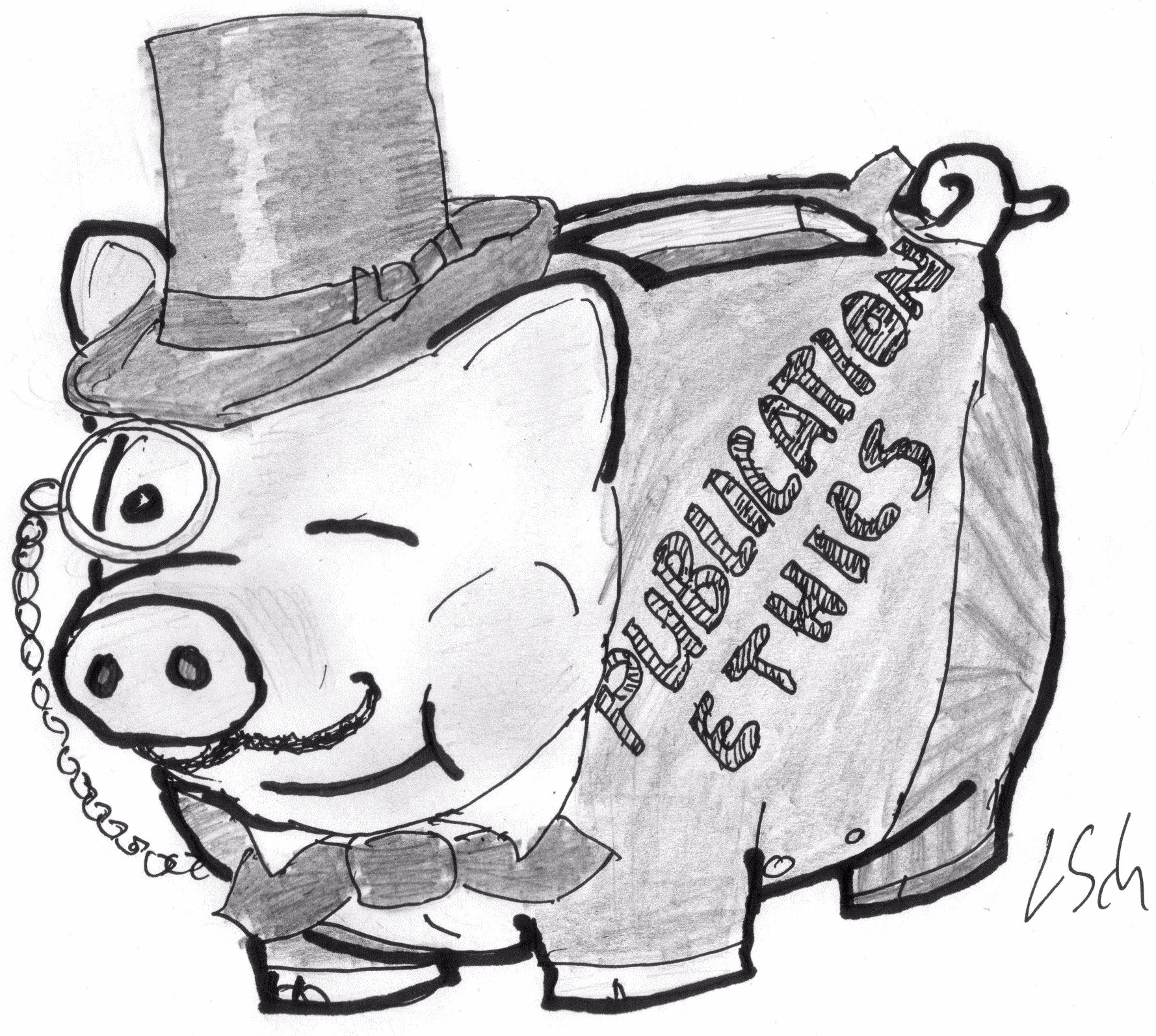
Wow. Now all this chest beating by Kenny the Pub Ethics Champion looks a bit ridiculous.
LikeLike
It seems that the editors of the Journal of Consumer Research have silently retracted this fraudulent paper by Diederik Stapel, aka have conducted a so-called stealth retraction. The DOI of this paper does not exist anymore and there are no traces at the website of the publisher, nowadays OUP, that this paper was published in June 2011. The Levelt report states on page 80 that this paper is based on fraud. This press release still exists. https://www.sciencedaily.com/releases/2011/06/110615120351.htm
LikeLiked by 1 person