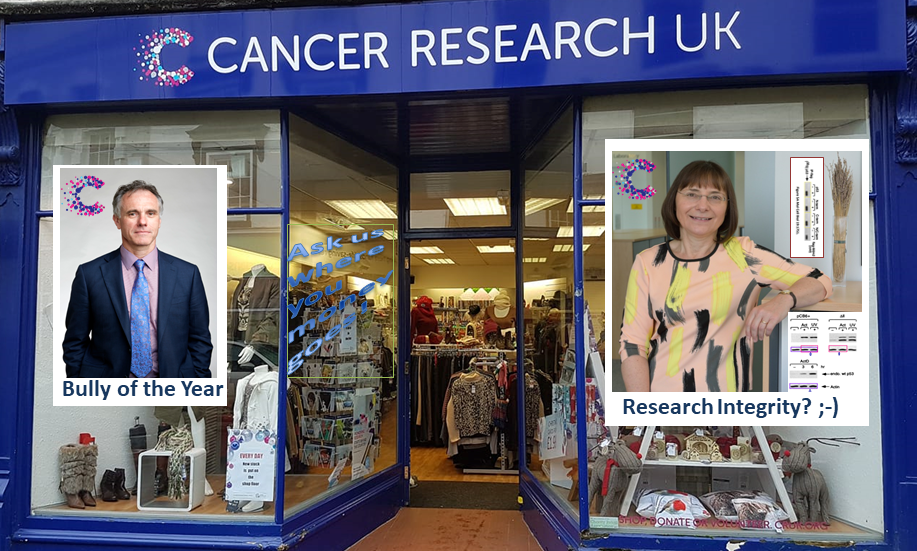

If you are a British cancer researcher, chances are you will be applying to the charity Cancer Research UK (CRUK) for funding. Here a tip how you can succeed getting that money British people donate to cancer research: be open about having published some fraud, and you will receive a conspirational nod.
Don’t believe me? The University of Manchester-based immunologist Silvia Bulfone-Paus receives CRUK funding despite past massive misconduct findings and forced resignation as institute director in Germany, after 13 retractions (read more here). More recently, CRUK announced to have no inclination whatsoever to investigate the accusations of bullying and research misconduct in the Manchester CRUK institute of Richard Marais.
CRUK Chief Scientist Karen Vousden never replied to the cries for help posted as comments under my article, but as I demonstrate below, she has good reasons to be disinterested in this affair. Both Vousden and Marais are mentees of the late Chris Marshall, a legend of British cancer research. Marshall’s lab was at ICR London; this CRUK-funded cancer research centre has its own issues with research integrity and bullying, but what with ICR’s past and present leadership (Alan Ashworth and Paul Workman) being part of the problem, you can’t expect much.
Richard Marais: “Feel the power”
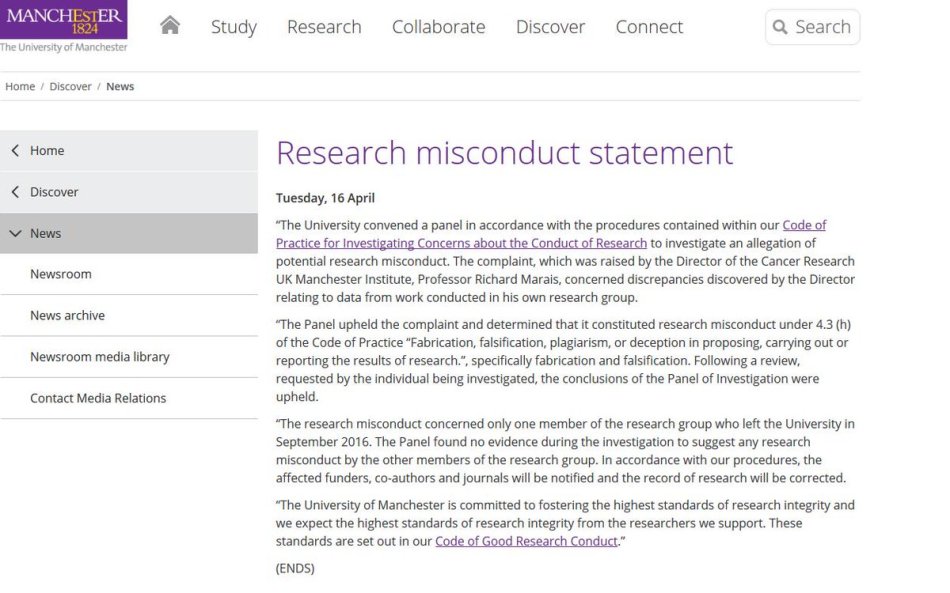
Regarding the Marais affair in Manchester (a deleted press release, overruled misconduct findings and cancelled retractions, all because the accused former Marais postdoc Romina Girotti lawyered-up), complaints like this were posted in the comment section on my site:
“I had the misfortune to work with Richard Marais who has literally made my life hell. He was insecure in the extreme, to the point that anyone who managed to do their job well, who had friends in work or generally just got on with people, became the subject of his vitriol. […] I was denigrated and humiliated constantly, when eventually, I made a bullying/harassment case to HR. My story was swept under the carpet because he was the director of the Institute“.
Or this comment:
“for so many years, we have been cordial to a man who used every chance to humiliate us in public and to block our careers. We are and we were ashamed to describe the details of what we witnessed and tried hard to forget. When so many former Marais alumni posted in this blog what Richard Marais has done to them, we had to confront our cowardice. As others, we felt that nobody would care about our pain and suffer, likely as an effect of the many times we were told, especially by Richard, that we were nobody.”
Here a comment from a clinician:
“Richard Marais can push his lab members to suffer whatever is necessary to make his own way. Richard Marais can ask his postdocs to sit on his chair “to feel the power”. Richard Marais can call his postdocs “bodies” (on their back) because they are only occupying space in his lab and “not producing”. […] Richard Marais’ hate towards clinicians is ridiculous and he enjoys making their life miserable in his lab“.
Marais really does not sound like a nice person:
“Marais has made a career out of bullying his trainees, establishing fear as a policy in his lab, making students and postdocs cry and humiliating them. He used to brag about it and nobody dared to stop him. Human resources staff were accomplices of it. He also bragged about his expensive life and frequent first class flights and felt good by asking British Airways staff “do you know who I am?”. Truly pathetic. He enjoyed having tearful students presenting 2h-straight presentations at lab retreats with their voice broken. As a ‘good bye’ from his lab people were given the last instruction: you cannot work in melanoma and your ideas belong to me. “
How exactly is it good for science to usurp a research field as you own private fiefdom and to ban others from working on melanoma? How exactly is this beneficial for patients and their families, whose charity funds Marais’ research and his gigantic salary? Yet this suppression of science is apparently exactly what Marais is free to do:
“He pushes junior PIs to not do research projects that might have competing interests with his lab. A former CRUK MI PI was asked to change his research focus to lung cancer and stop any melanoma work because it was competing with him.”
Bullying and research misconduct often go hand in hand. How else do you sanction lab members who refuse to produce the results you want to see as PI? Marais was described as “a total bully which let his postdocs to fight like gladiators to publish first (likely at the cost of quality)”.
In this regard, see this CRUK insider comment, about Marais and his CRUK Manchester colleague (and ex-wife) Caroline Springer:
“Caroline Springer selectively deletes data she does not like at lab meetings. Richard Marais approves this. Staff members can’t argue against her decisions. […] Filing a complaint puts our job in jeopardy. Caroline also runs her lab in a suspicious manner, hiding information for a part of her group and viceversa. She selects the experiments she wants to present in papers and meetings at Wellcome Trust and hides how many negatives there were. This has been ongoing for several years.”
One unrelated commenter said something similar:
“I’ve sat at their joint Springer/Marais lab meetings thinking they are the worst scientists I’ve ever met. Not only they cherry pick the data they want, they force their staff to “decrease” the IC50 of a shitty LOX compounds orders of magnitude within a week time so they can reach their ‘milestones’ for Wellcome Trust. As if you could do magic. No research integrity at all.“
This criticism by former lab member goes into a different direction:
“Neither Richard Marais nor Caroline Springer have truly supported women in science. Quite the opposite, they have both banned them from working in similar research fields. It is ironic that Richard is an invited speaker of Women in Science Conferences“.
The Athena SWAN (Scientific Women’s Academic Network) award is just an undeserved trophy for Marais, as other CRUK Manchester commenter confirms and adds:
“His post docs get yelled at routinely, they cry in the bathroom, they are afraid to speak of truth and live in fear of Richard’s fury.
The fact is, CRUK MI has lost too many good staff since Richard took the directorship. I have had conversations with the leavers where they confessed that they can not work for such a director anymore without self loathing. […] Occasionally, people were brave enough to make official complains regarding Richard’s bullying […], but HR (directly managed by Richard) never responded.”
It gets worse:
“I have witnessed terrible scenes: women crying because of their public humiliation in front of their lab mates, Richard Marais enjoying seeing them crying while thinking they are weak. Those were tears of frustration and impotence. […] While Lab meetings were bad, private meetings could be worse because there were no witnesses. […] Fear has fueled our silence. Fear to lose our jobs, to be excluded from conferences, to not publish again, to not get funding for our research. […]
Note: Take this description and multiply by 3, that is the accurate description of Caroline Springer“.
There are more comments, in same vein: bullying, harassment, lab members reduced to tears, alumni banned from working on melanoma, unreliable preclinical and clinical research. CRUK informed me that they forwarded the issue to University of Manchester, obviously on assumption that the university will continue doing the same as they did before: nothing. Maybe this comment will with time grow into something which will make the crooks of CRUK stop and think:
“I am writing as someone who has raised over £5,000 for Cancer Research UK in sponsored runs in the last 10 years. I lost my wife to breast cancer in 2014. Another fundraiser passed on the link to your blog to me. I am deeply upset about these accusations against the professors in Manchester. If any of them are true I feel very betrayed.”
Another CRUK fundraiser demanded their £10k back: “I’ll give it to somewhere deserving“.

Karen Vousden: lifelong learning of data integrity
As it is common with the rotten fishes, they stink from the head down. Marais is one example, but let’s move one floor higher, to the top executive offices. Meet the official Chief Scientist of CRUK, Karen Vousden, internationally influential p53-oncosuppressor protein researcher, formerly director of the CRUK Beatson Institute in Glasgow and now at The Crick in London, and her exciting PubPeer record.
The PubPeer evidence is rather old, but being a busy scientist and CRUK exec, Professor Vousden has yet to find time to address the concerns. Let us start with this vintage p53 paper from the Vousden lab.
M Ashcroft, MHG Kubbutat, KH Vousden Regulation of p53 function and stability by phosphorylation Molecular and Cellular Biology (1999) doi: 10.1128/mcb.19.3.1751
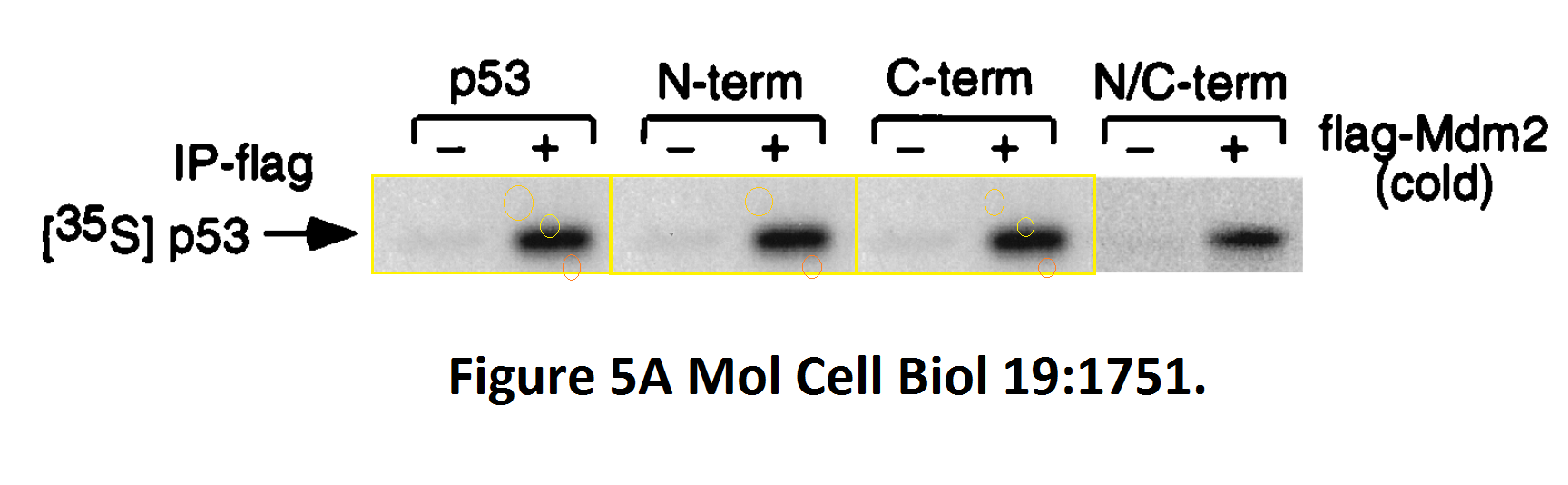
All three lane pairs are same, as background pattern makes evident. That assay and the entire paper should have been disposed as radioactive waste, yet it was never even corrected.

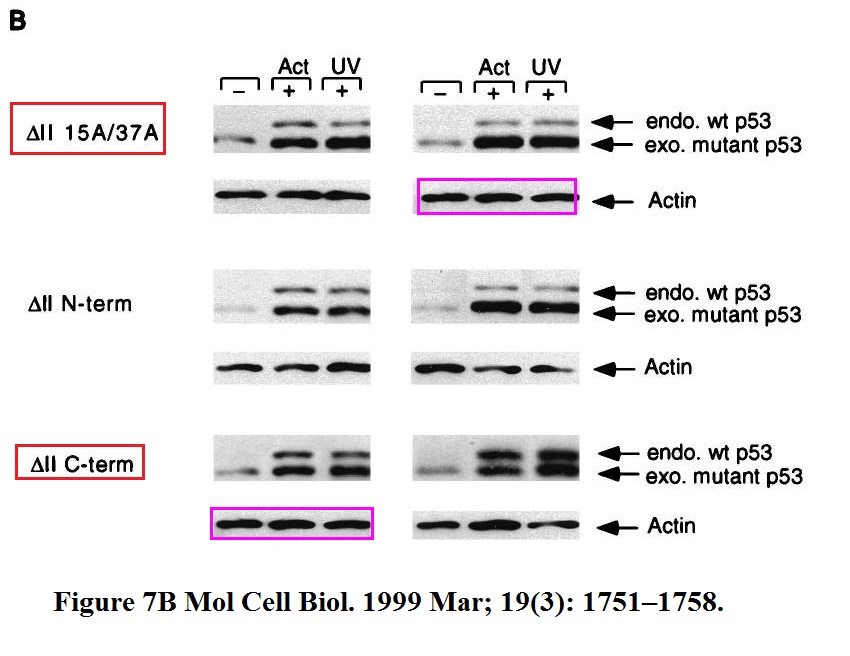
The first author Margaret Ashcroft is now professor in Cambridge. Many Vousden lab alumni moved on to become today’s science elites. In the greater scheme of things, what do some fabricated gels matter?
p53 induces cell cycle arrest via protein p21, and this of course was studied by the Vousden lab in detail. Another vintage classic:
S Bates, KM Ryan, AC Phillips, KH Vousden Cell cycle arrest and DNA endoreduplication following p21Waf1/Cip1 expression Oncogene (1998) doi: 10.1038/sj.onc.1202104
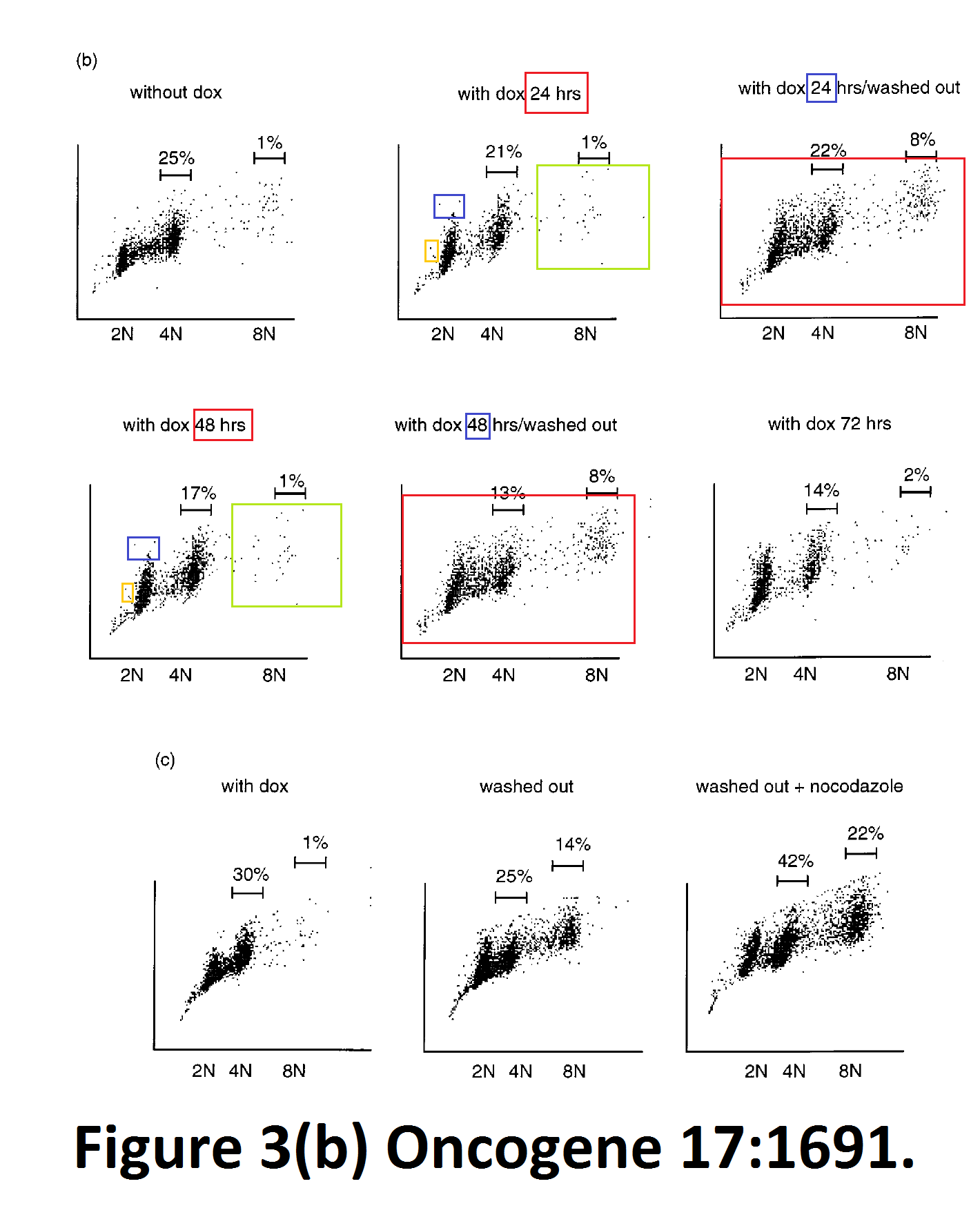
Apparently, some flow cytometry files got accidentally duplicated. Yet the green/blue labelled ones are not identical. They seem to derive from the same FACS measurement file, but re-gated. Something unlikely to happen by a mistake of oversight, indeed such manipulations are much present in the papers of the unashamed data manipulator Giorgio Zauli.
The evidence is 3 years old, nothing has happened since. Worth noting that the first author and former Vousden mentee Stewart Bates became a senior executive scientist at GlaxoSmithKline. A similar thing happened in another Vousden paper, with Bates as coauthor:
AC Phillips, S Bates, KM Ryan, K Helin, KH Vousden Induction of DNA synthesis and apoptosis are separable functions of E2F-1 Genes & Development (1997) doi: 10.1101/gad.11.14.1853

Also here same flow cytometry sample was apprently re-gated by software, and wham, one experimental sample became two utterly different ones. It is worth mentioning who another coauthor on that Vousden lab is: Kristian Helin, then at IEO in Milan, where he published a number of papers now discussed on PubPeer. You can read about Helin’s stellar and more recently less stellar career in cancer research here. You know, birds of a feather flock together.
In this vein, Vousden demonstrated her attitude to gel splicing and loading controls in this paper contributed with the US star cancer researcher Arnold Levine (who also doesn’t care much how his papers get made):
MH Kubbutat, RL Ludwig, AJ Levine, KH Vousden Analysis of the degradation function of Mdm2 Cell growth & differentiation: AACR (1999) Vol. 10, 87-92

The last lanes on the Mdm and p53 gels is spliced on. But there is no splicing on the loading control GFP. That last lane is very important, it namely shows that for that last sample (a certain deletion mutant Mdm protein), highlighted bands are much weaker or much stronger than with the wildtype or other mutants. But how do we know if that last sample is unadulterated, since it is spliced on and the loading control comes from a separate gel?
There are other examples of problematic gel splicing in Vousden papers, eg this Blagosklonny et al Carcinogenesis 2001. The practice was never actually accepted, after all this is exactly why good scientists load their samples on same gel, and check that same gel for equal loading: to be able to compare the signals properly. But some scientists already already “know” the result, you know.
Another star US collaborator one should have been careful with is Pier Paolo Pandolfi (here his PubPeer record).
R Bernardi, PP Scaglioni, S Bergmann, HF Horn, KH Vousden, PP Pandolfi PML regulates p53 stability by sequestering Mdm2 to the nucleolus Nature cell biology (2004) doi: 10.1038/ncb1147
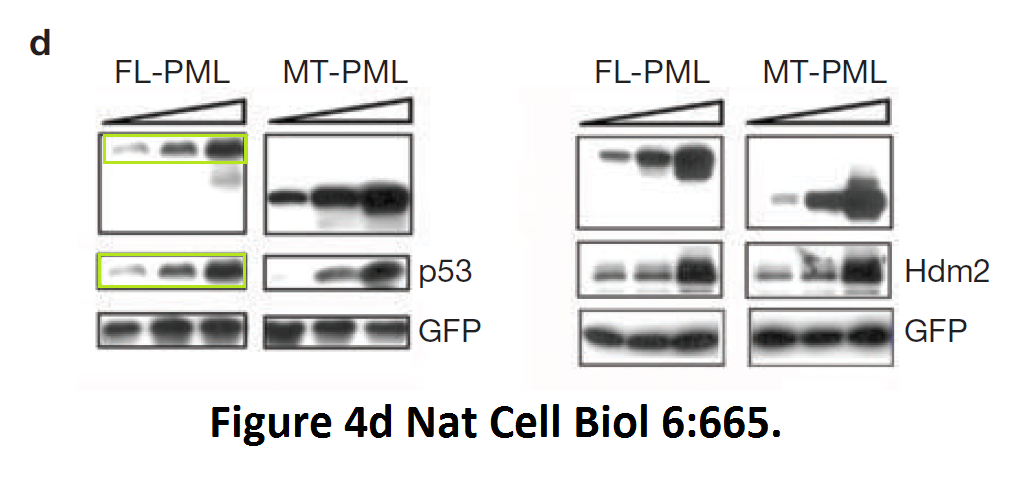
An accident? Can one really confuse PML protein image with that of p53, and then crop it? In this case, Vousden is the p53 expert, the experiment might have been made in her Beatson lab.
Just when Vousden was moving from Glasgow to The Crick in London, she published this paper with her Beatson Institute colleagues:
P Lee, AK Hock, KH Vousden, EC Cheung p53- and p73-independent activation of TIGAR expression in vivo Cell Death and Disease (2015) doi: 10.1038/cddis.2015.205

The last three bands of the TIGAR and CDK4 gels share many common features and artefacts to manifest the suspicion that they show the same signal. It is not clear if they are different film exposures of same western blot, or digitally processed duplications. In any case, it is not clear how that could have happened by chance or mistake.
Maybe Vousden is just unlucky with who she works with. In 1989, she published a paper in The Lancet, which was immediately retracted by her two coauthors John Tidy and Paul Farrell, for being irreproducible. However, Vousden’s name is not on the retraction notice, she just stayed out of it:

Now one could think: well, the sins of youth. The Vousden lab surely matured and does only the bestest and the most reliable of sciences now. Although it does seem Professor Vousden still has very little understanding of the concept of data integrity. This paper Labuschagne et al Cell Metabolism 2019 was published just 2 months ago:

A PubPeer commenter Plukenetia Lehmanniana jumped to Vousden’s defence:
“Would it be nice to also see the Ponceau staining? Certainly. Is there any reason to believe that this is anything other than a well-done experiment? In my opinion, no. “
My reply “no reason at all” with a hyperlink to Vousden’s PubPeer record did not pass moderation. It is namely unscientific and slanderous.
Now here is an idea: maybe certain CRUK top scientists would be more useful volunteering in CRUK charity shops?
Donate!
If you are interested to support my work, you can leave here a small tip of $5. Or several of small tips, just increase the amount as you like (2x=€10; 5x=€25). Your generous patronage of my journalism, however small it appears to you, will greatly help me with my legal costs.
€5.00


I think in principle I should apply for Cancer Research UK funding next year.
Will let you know what happens.
LikeLike
In that first pic of Caroline Springer, it looks like a drunken lab ladette may have barfed on her dress. My god. Hey big-pharma, do you really want to buy LOX inhibitors from this woman?
LikeLike
https://www.eacr.org/mike-price-award/previous-winners
2018 Mike Price Gold Medal Award winner: Karen Vousden
In good company
2014 Mike Price Gold Medal Award winner: José Baselga
Top Sloan Kettering Cancer Doctor Resigns After Failing to Disclose Industry Ties
Top Cancer Doctor, Forced Out Over Ties to Drug Makers, Joins Their Ranks
Memorial Sloan Kettering Leaders Violated Conflict-of-Interest Rules, Report Finds
Not one squeak about this from The European Association for Cancer Research
LikeLike
Failing to declare conflicts of interest suggested taking a look at the data.
Cancer Cell. 2009 Apr 7;15(4):315-27. doi: 10.1016/j.ccr.2009.02.011.
TGF-beta increases glioma-initiating cell self-renewal through the induction of LIF in human glioblastoma.
https://www.cell.com/action/showPdf?pii=S1535-6108%2809%2900042-7
Silvia Pen˜ uelas,1,4 Judit Anido,1,4 Rosa M. Prieto-Sanchez,1,4 Gerard Folch,1,4 Ignasi Barba,2 Isabel Cuartas,1,4
David Garcı´a-Dorado,2 M. Antonia Poca,3 Juan Sahuquillo,3,5 Jose Baselga,1,4,5 and Joan Seoane1,4,5,6,
* 1Medical Oncology Program
2Cardiovascular Program
3Neurosurgery Program
Vall d’Hebron University Hospital Research Institute, 08035 Barcelona, Spain
4Vall d’Hebron Institute of Oncology, 08035 Barcelona, Spain
5Autonomous University of Barcelona, 08035 Barcelona, Spain
6Institucio´ Catalana de Recerca i Estudis Avanc¸ ats (ICREA), 08010 Barcelona, Spain.
Problematic data:-
Figure 3D.
Much more similar than you would expect.
Figure 2E.
Much more similar than you would expect.
Figure 2D.
Much more similar than you would expect.
LikeLike
Cancer Res. 2008 Nov 15;68(22):9221-30. doi: 10.1158/0008-5472.CAN-08-1740.
Phosphatidylinositol 3-kinase hyperactivation results in lapatinib resistance that is reversed by the mTOR/phosphatidylinositol 3-kinase inhibitor NVP-BEZ235.
https://cancerres.aacrjournals.org/content/68/22/9221.article-info
AUTHOR INFORMATION
Pieter J.A. Eichhorn1, Magüi Gili1, Maurizio Scaltriti1, Violeta Serra1, Marta Guzman1, Wouter Nijkamp2, Roderick L. Beijersbergen2, Vanesa Valero1, Joan Seoane1,3,4, René Bernards2, and José Baselga1,3
1Medical Oncology Program, Vall d Hebron Institut de Oncologia, Barcelona, Spain; 2Division of Molecular Carcinogenesis and Center for Biomedical Genetics, The Netherlands Cancer Institute, Amsterdam, the Netherlands; 3Autonomous University of Barcelona, Barcelona; and 4Instituciŏ Catalana de Recerca i Estudis Avançats (ICREA), Barcelona, Spain
Requests for reprints:
José Baselga, Vall d’Hebron University Hospital, P. Vall d’Hebron 119, Barcelona, 08035 Spain. Phone: 01134-932746085; Fax: 01134-932746059; E-mail: jbaselga@vhebron.net
Figure 5A. Much more similar than you would expect..
LikeLike
Clin Cancer Res. 2007 Jan 1;13(1):81-9.
4E-binding protein 1, a cell signaling hallmark in breast cancer that correlates with pathologic grade and prognosis.
https://clincancerres.aacrjournals.org/content/13/1/81.article-info
Federico Rojo1, Laura Najera1, José Lirola1, José Jiménez1, Marta Guzmán3, M. Dolors Sabadell2, Jose Baselga3 and Santiago Ramon y Cajal1
Authors’ Affiliations: Departments of 1Pathology, 2Gynecology, and 3Oncology, Vall d’Hebron University Hospital, Barcelona, Spain
Requests for reprints:
Santiago Ramon y Cajal, Department of Pathology, Vall d’Hebron University Hospital, Passeig Vall d’Hebron, 119-129 08035 Barcelona, Spain.
Figure 1. Much more similar than you would expect.
Are Jose Baselga’s publications a horrible fantasy, or just run of the mill for high ups in “Cancer Research”?
LikeLike
Oncogene. 2004 Apr 29;23(20):3721-5.
p73-alpha is capable of inducing scotin and ER stress.
Terrinoni A1, Ranalli M, Cadot B, Leta A, Bagetta G, Vousden KH, Melino G.
Author information
1
Biochemistry Laboratory, IDI-IRCCS, Department of Experimental Medicine and Biochemical Sciences, University of Rome ‘Tor Vergata’, 00133 Rome, Italy.
Figure 1.
LikeLike
“what with ICR’s past and present leadership (Alan Ashworth and Paul Workman) being part of the problem, you can’t expect much.”
You hyper link to Paul Workman refers to one about the present CEO and President of ICR
https://www.icr.ac.uk/our-research/researchers-and-teams/professor-paul-workman
“Professor Paul Workman FMedSci, FRS is Chief Executive and President of The Institute of Cancer Research (ICR).”
There is another article: https://forbetterscience.com/2018/09/06/fake-data-untouchable-men-and-guilty-women-at-icr-london/
According to the Retraction Watch database:
http://retractiondatabase.org/RetractionSearch.aspx#?auth%3dWorkman%252c%2bPaul
Paul Workman has a 2019 retraction for “Falsification/Fabrication of Image” and a
2019 correction in Molecular Cancer Therapeutics for “Concerns/Issues About Image”.
https://mct.aacrjournals.org/site/misc/edboard.xhtml
Deputy Editors
Yubin Kang
Akash Patnaik
Puja Sapra
Paul Workman
Surely that is a Conflict of Interest?
Such conflicts of interest have recently been documented at Retraction Watch:-
inside a journal.
https://retractionwatch.com/2019/10/31/plos-one-realizes-an-academic-editor-had-a-conflict-of-interest-that-the-publisher-says-it-now-tries-harder-to-avoid/
inside an institute.
https://retractionwatch.com/2019/10/29/no-possible-fraudulent-explanation-frequent-co-author-tasked-with-clearing-colleagues-of-image-manipulation/
Paul Workman takes the biscuit as he was in charge of investigating himself in his own institue.
Your link to Alan Ashworth gives his UCSF webpage.
https://cancer.ucsf.edu/people/profiles/ashworth_alan
“Prior to joining UCSF in January 2015, he served as Chief Executive of the Institute of Cancer Research (ICR) and the Director of the Breakthrough Breast Cancer Research Centre in London, United Kingdom.”
Problematic data Alan Ashworth.
Some may be simple mistakes, others are more involved.
https://pubpeer.com/publications/22A0D80CF891EEFEB7C23332484780
https://pubpeer.com/publications/CECD3E767BD0AFA9DDB1BA919F663F
https://pubpeer.com/publications/261D475F6640FC59C9A867EC7F5DD2
https://pubpeer.com/publications/40975CCD671ACC13843AC53551942C
https://pubpeer.com/publications/67F39E13B7C8B51E8F8F34D70AFF84
https://pubpeer.com/publications/509134CE1EE1E6A1C7DEA161CB77CB
https://pubpeer.com/publications/C2570E46E89E6746B01CF962D728A8
LikeLike
To call ICR past president Ashworth a bully would be an English understatement. I also understand he was very much into WomenInSTEM issues. In any case, nobody was sad when he was departed for California. Ashworth left behind his right hand man Chris Lord, who is now ICR professor. Lord published lots of hilariously fabricated stuff, have a look on PubPeer or here:
https://forbetterscience.com/fake-data-untouchable-men-and-guilty-women-at-icr-london
But of course Workman is the wrong man to investigate Lord, you saw how Workman investigated himself.
LikeLike
Has anyone seen D1ck Marais these days. I heard through the grapevine that he takes much needed mental health time away from work breaks. Translation:- taking business class flights to the Caribbean, where for a while, just for a while, he can brainwash himself that there isn’t a sh1t storm happening at CRUK MI. You see Richard, yes we know you read this blog, when Romina lawyered up, unbeknownst to her I imagine, she set a precedent. I look forward to the day where we will watch the tears roll down your face. This time it won’t be an Oscar winning performance you made in the Summer (probably you greatest achievement). But rather one where you are in the dock at court and you are checkmate. Slimy bstrd. Stop waisting the money of every day people and resign along with all your cronies in cahoots.
LikeLike
There is hope: a class action lawsuit against Richard Marais and possibly CRUK will be presented in court very soon. Marais hides terrible crimes at the ICR and CRUK Manchester, why nobody talks about it? CRUK authorities actively ignore our S.O.S messages … We want Richard Marais OUT and in jail!!
LikeLike
CRUK careless with donors’ contributions?
The money.
https://kclpure.kcl.ac.uk/portal/en/persons/farzin-farzaneh(1e1e3bfb-d4bc-4223-bdc3-63f46dd77c05)/projects.html?ordering=upmProjectOrderByEndDate&descending=true
KHP Centre Award – Non-Clinical Training Award
CRUK – Cancer Research UK
Parker, P., Ciccarelli, F., Dazzi, F., Farzaneh, F., Hayday, A., Maher, J. et al.
£3,771,843.89
1/04/2017 → 30/03/2023
Research Grant Studentship
The scientific quality.
https://retractionwatch.com/2019/11/04/exclusive-kings-college-london-finds-poor-research-practices-but-no-misconduct-in-two-recent-cases/#more-118381
“The Panel has requested that Professors Farzaneh and Mufti provide notices of correction, publish errata, and/or provide amended figures to the following scientific journals: Molecular Therapy, Blood, Haematologica, Molecular and Cellular Biology, and Molecular Cancer Research.”
Farzin Farzaneh penultimate author.
Data in Toxicol Lett. 2009 Dec 15;191(2-3):118-22 looks very like data in J Leukoc Biol. 2005 Aug;78(2):503-14, yet experiments different.
Toxicol Lett. 2009 Dec 15;191(2-3):118-22. doi: 10.1016/j.toxlet.2009.08.012. Epub 2009 Aug 19.
RACK-1 overexpression protects against goniothalamin-induced cell death.
Inayat-Hussain SH1, Wong LT, Chan KM, Rajab NF, Din LB, Harun R, Kizilors A, Saxena N, Mourtada-Maarabouni M, Farzaneh F, Williams GT.
Author information
1
Toxicology and Biocompatibility Laboratory, Faculty of Allied Health Sciences, Universiti Kebangsaan Malaysia.
J Leukoc Biol. 2005 Aug;78(2):503-14. Epub 2005 May 3.
Functional expression cloning reveals a central role for the receptor for activated protein kinase C 1 (RACK1) in T cell apoptosis.
Mourtada-Maarabouni M1, Kirkham L, Farzaneh F, Williams GT.
Author information
1
School of Life Sciences, Keele University, Keele, ST5 5BG, UK.
J Biol Chem. 2001 Apr 13;276(15):12068-75. Epub 2001 Jan 11.
Selective cleavage of BLM, the bloom syndrome protein, during apoptotic cell death.
http://www.jbc.org/content/276/15/12068.long
Oliver Bischof‡§,¶‖, Sanjeev Galande‡§, Farzin Farzaneh¶, Terumi Kohwi-Shigematsu‡ and Judith Campisi‡**
-Author Affiliations
From the ‡Life Sciences Division, Lawrence Berkeley National Laboratory, Berkeley California 94720 and the ¶Department of Molecular Medicine, The Rayne Institute, Guy’s, Kuig’s and St. Thomas’ School of Medicine, King’s College, London SE5 9NU, United Kingdom
Figure 5E. Much more similar after horizontal flip than you would expect.
LikeLike
J Biol Chem. 2001 Apr 13;276(15):12068-75.
Figure 4B. So subtle no wonder the authors didn’t notice anything awry.
LikeLike
“The first author Margaret Ashcroft is now professor in Cambridge. Many Vousden lab alumni moved on to become today’s science elites. In the greater scheme of things, what do some fabricated gels matter?”
Cancer Res. 2008 Jan 15;68(2):545-52. doi: 10.1158/0008-5472.CAN-06-4738.
Regulation of angiogenic factors by HDM2 in renal cell carcinoma.
https://cancerres.aacrjournals.org/content/68/2/545.article-info
AUTHOR INFORMATION
Veronica A. Carroll, and Margaret Ashcroft
Cell Growth Regulation and Angiogenesis Laboratory, Cancer Research UK Centre for Cancer Therapeutics, Surrey, United Kingdom
Requests for reprints:
Margaret Ashcroft, Cell Growth Regulation and Angiogenesis Laboratory, Cancer Research UK Centre for Cancer Therapeutics, The Institute of Cancer Research, Sutton, Surrey SM2 5NG United Kingdom.
Figures 3A and 5A. Much more similar than you would expect.
http://www.med.cam.ac.uk/ashcroft/publications/
page 2
Role of hypoxia-inducible factor (HIF)-1alpha versus HIF-2alpha in the regulation of HIF target genes in response to hypoxi, insulin-like growth factor-I, or loss of von Hippel-Lindau function: implications for targeting the HIF pathway. Carroll V.A., Ashcroft M. Cancer Res (2006) 66(12):6264-70.
LikeLike
Cancer Res. 2008 Jan 15;68(2):545-52.
Figures 3A, 3B and 5A. much more similar than you would expect.
LikeLike
Cancer Res. 2005 Jun 1;65(11):4918-28.
Identification of novel small molecule inhibitors of hypoxia-inducible factor-1 that differentially block hypoxia-inducible factor-1 activity and hypoxia-inducible factor-1alpha induction in response to hypoxic stress and growth factors.
Chau NM1, Rogers P, Aherne W, Carroll V, Collins I, McDonald E, Workman P, Ashcroft M.
Author information
1
Cell Growth Regulation and Angiogenesis Team, Cancer Research UK Centre for Cancer Therapeutics, Institute of Cancer Research, Sutton, Surrey, United Kingdom.
Figure 6A. Unexplained straight edges.
LikeLike
Correction. Apologies, but it gets so confusing!
Cancer Res. 2008 Jan 15;68(2):545-52.
Figures 1B, 3A, and 5A. much more similar than you would expect.
LikeLike
Cancer Res. 2008 Jan 15;68(2):545-52.
Figure 5A. Light areas between lanes in 2 panels (obscured by colored rectangles in previous illustrations).
Figures 1A and 1B seem to be redundant.
LikeLike
Cancer Res. 2008 Jan 15;68(2):545-52.
What a surprise! Karen Vousden, with who Margaret Ashcroft has 8 publications https://www.ncbi.nlm.nih.gov/pubmed/?term=vousden+ashcroft
is an advisory editor for Cancer Research.
https://cancerres.aacrjournals.org/site/misc/edboard.xhtml
Advisory Editors
Joan S. Brugge
Joe W. Gray
Olufunmilayo I. Olopade
Bert Vogelstein
Karen H. Vousden
Another advisory editor, Joan S. Brugge, failing to spot problematic data in her own publications:-
https://pubpeer.com/publications/6CE8F1E7F5A7E25CD432BAAA1FBA79
https://pubpeer.com/publications/DBFE7B98B7768975FAD80C5E683D1E
https://pubpeer.com/publications/4C49546A4C0ABA201295238C1B4F55
https://pubpeer.com/publications/BAF18135586E647112068B9F4A0E76
https://pubpeer.com/publications/E359F999D709275C90E6ECFD96460C
https://pubpeer.com/publications/F86C8354CA74DC6F3D3F0A74CB4C94
https://pubpeer.com/publications/DB17C4419B955088F48218A9709E4A
LikeLike
M Ashcroft, MHG Kubbutat, KH Vousden Regulation of p53 function and stability by phosphorylation Molecular and Cellular Biology (1999) doi: 10.1128/mcb.19.3.1751
https://pubpeer.com/publications/B518680DD43B568C9DA7F41F9BBE54
Margaret Ashcroft writes:
” Clearly, we need to resolve this as soon as possible before any further action is taken.”
Why isn’t Margaret Ashcroft deeply concerned about the data rather than seeing the problematic being pointed out?
Why shouldn’t action be taken?
Why is Margaret Ashcroft trying to influence the outcome of any inquiry?
———- Forwarded message ———
From: Margaret Ashcroft m.ashcroft@medschl.cam.ac.uk
Date: Tue, Oct 22, 2019 at 6:20 AM
Subject: Re: Highly problematic NIH-funded data Mol Cell Biol. 1999 Mar;19(3):1751-8. Precedence for retracting old paper from Mol Cell Biol.
To: claire Francis claire.francis1492@gmail.com, Francis.Collins@nih.hhs.gov Francis.Collins@nih.hhs.gov, karen.vousden@crick.ac.uk karen.vousden@crick.ac.uk, michael.way@crick.ac.uk michael.way@crick.ac.uk
Cc: Linda Gough cope_administrator@publicationethics.org, Roger Davis roger.davis@umassmed.edu, ptontonoz@mednet.ucla.edu ptontonoz@mednet.ucla.edu, Fiona Watt – UKRI MRC fiona.watt@mrc.ukri.org, Frances Rawle – UKRI MRC Frances.Rawle@headoffice.mrc.ac.uk, Fiona Godlee fgodlee@bmj.com
Dear All,
I am deeply concerned to see this email, and the issue raised with the data highlighted data in our 1999 paper.
We take data integrity very seriously.
Original autorad data were catalogued in files along with auditable lab books and held at the NCI. I left the NCI in 2000.
Around that time, raw data/autorads were photographed and made up by the publications Department at NCI as print on paper figures.
I have been in contact with Karen (Vousden) to source the original data in order to address this issue.
Clearly, we need to resolve this as soon as possible before any further action is taken.
Best wishes, Margaret
Professor Margaret Ashcroft PhD, FRSB, MRCR (Hon)
University of Cambridge, UK
Tel: +44 (0) 1223 762024
Email: m.ashcroft@medschl.cam.ac.uk
Personal Secretary: Mrs Deborah Passey (works Tues and Thurs 9.30am-12noon)
Tel: +44 (0)1223 762048
Email: dp568@medschl.cam.ac.uk
From: claire Francis claire.francis1492@gmail.com
Sent: 22 October 2019 00:05
To: Francis.Collins@nih.hhs.gov
Cc: Linda Gough; Roger Davis; ptontonoz@mednet.ucla.edu; Fiona Watt – UKRI MRC; Frances Rawle – UKRI MRC; Fiona Godlee; michael.way@crick.ac.uk; karen.vousden@crick.ac.uk; Margaret Ashcroft
Subject: Highly problematic NIH-funded data Mol Cell Biol. 1999 Mar;19(3):1751-8. Precedence for retracting old paper from Mol Cell Biol.
Highly problematic NIH-funded data Mol Cell Biol. 1999 Mar;19(3):1751-8. Precedence for retracting old paper from Mol Cell Biol.
Mol Cell Biol. 1999 Mar;19(3):1751-8.
Regulation of p53 function and stability by phosphorylation.
Ashcroft M1, Kubbutat MH, Vousden KH.
Author information
1
ABL Basic Research Program, NCI-FCRDC, Frederick, Maryland, USA.
This work was sponsored by National Cancer Institute, DHHS, under contract with ABL. https://pubpeer.com/publications/B518680DD43B568C9DA7F41F9BBE54
Problematic data:-
Figure 5A.
https://pubpeer.com/publications/B518680DD43B568C9DA7F41F9BBE54#1
Figures 7A and 7C.
Figure 7B.
LikeLike
“CRUK Chief Scientist Karen Vousden never replied to the cries for help posted as comments under my article, but as I demonstrate below, she has good reasons to be disinterested in this affair.”
https://www.nature.com/articles/d41586-019-03529-w
“Other organizations have decided to do publication checks internally. After the Beatson Institute in Glasgow, UK, had to deal with a retraction in 2012, it hired a dedicated integrity offer, former molecular biologist Catherine Winchester, to check all papers destined for publication by eye. “It took only a short time for the more junior scientists to shed their fear that they were being policed, but there was immediate buy-in from senior PIs,” she says. “Now everyone is really grateful for the service.””
https://www.crick.ac.uk/research/find-a-researcher/karen-vousden
“In 2002 she returned to the UK to become the Director of the CRUK Beatson Institute in Glasgow, moving back to London in 2016 to take up the role of Chief Scientist at CRUK and Group Leader at the Francis Crick Institute.”
” [Beatson] hired a dedicated integrity offer, former molecular biologist Catherine Winchester, to check all papers destined for publication by eye”.
“destined for publication” is a convenient formula so that Karen Vousden’s publication were not subjected to scrutiny.
The British are really quite clever that way.
LikeLike
How much did CRUK pay management consultants to come up with that name, or was it their own idea?
LikeLike
Dear Leonid,
Very interesting article, thank you. I agree with nearly all of it, including of course any image splicing, duplications, flipping, cloning etc. However, there is one important exception:
“Loading control is from a different gel, a very bad practice. And yet, nobody cared, in 2019.”
This is not correct, in the vast majority of cases it is inappropriate to perform a loading control on the same membrane as your protein of interest. This is because they are expressed at different levels in cells by several orders of magnitude. At the level where you are able to detect your protein of interest, you more often that not be way outside of the linear range for the typical loading controls you demand. There is a lot of evidence to demonstrate this and that what you and others (yes including Nature Research, though curiously and thankfully rightly, they do not enforce it) are ruling, is actually a worse practice:
LikeLike
It is a strange argument. Like saying: I will not buy myself a watch because cheaper watches are not precise enough for me. Instead, I will ask a man with a Rolex and trust him to tell me the right time of the day.
LikeLike
Was that an evidence based argument?
Please read and consider the following carefully. Let’s return to the science and make the evidence (nicely explained here https://pubpeer.com/publications/2D084E91EDC85D6C23BC63ACF5E6A8 , PMIDs: 25540176; 24738055; 25852189; 30800670; 25059473; 23709336; 24023619; 18571732; 21186791; 23454168; 24561642) clear. It is simple:
Protein of interest: I load 20 ug of protein in Lane 1 and get a signal of 0.5, and load 40 ug of protein in Lane 2 and get a signal of 1. This is good, nice and in the linear range. Typical for many proteins of interest.
Beta-actin: I load 20 ug of protein in Lane 1 and get a beta-actin signal of 5, and load 40 ug of protein in Lane 2 and get a signal of 7.5. This is clearly non-linear. When loading greater than 1-5 ug of protein for typical loading controls beta-actin, GAPDH, etc these are ALWAYS non-linear (PMIDs: 25540176; 24738055; 25852189; 30800670; 25059473; 23709336; 24023619; 18571732; 21186791; 23454168; 24561642). They are too highly expressed relative to a typical protein of interest.
What happens if we use this loading control as a reference?
Well, Lane 1: 0.5/5 = 0.1, Lane 2: 1/7.5 = 0.133. So Lane 1: Lane 2 = 0.1 : 0.133 i.e. the normalization isn’t working, and is distorting the data, actually making it worse!
Clearly not good. If our loading control was linear, and they should always be close to linearity to avoid being detrimental, then we would have got the desired value of 0.5/5 : 1/10 = 0.1 : 0.1 i.e. 1 : 1.
So what can be done if you want to use beta-actin but still detect our protein of interest? Clearly we need to load less protein to get back in to the linear range for beta-actin, and many studies have shown this needs to 1-2 ug, 5 ug at a push. The same applies for many other commonly used housekeepers. But at these levels, how many proteins of interest are you going to detect? Not so many.
So this necessitates that these western blots for protein of interest and beta-actin are performed on different gels with different levels of protein, if you want your loading control to be useful – you do, right? You CANNOT always perform all your western blots for the proteins you want to probe for on the same membrane for these reasons! Please stop pushing this idea, it is wrong.
There are of course other appropriate ways to do loading and transfer control (e.g. good linear total total protein stains), but your criticism of “loading control libraries” and demand for “loading controls on every membrane” is clearly fallacious.
Get it? Like I said, easy.
LikeLike
Are you a Western Blot Truther, Tom?
Get it? Like I said, easy.
LikeLike
How do read the above and the 11 references cited, which have come to the opposite conclusion to the non-evidenced based one you preach, and continue to write that controls like actin, GAPDH etc must be performed on every membrane?
LikeLike
11 references as opposed to thousands of papers saying otherwise? Discussion thread closed here, Tom. Please continue on PubPeer. Try my own papers!
LikeLike
One way to potentially get around these issues is to use a LiCor (or fluorescent imaging) so that you can quantify protein of interest and loading control on same blot.
Alternatively do mass-spectrometry 🙂
Here is a review on quantifying images on immunoblots here http://stke.sciencemag.org/content/8/371/rs2.
Frankly there is also a strong argument for using multi-loading controls.
LikeLike
Dear Dr. Rune Linding,
Thanks for your comment. Indeed, the Science Signaling article you cite is one of the 11 western blot methodology papers I have quoted here and is excellent. I would urge you to review this further and the other papers I have cited. While you are right fluorescent secondaries can have a broader linear range, these papers show this issue of saturation is also a problem with fluorescent secondaries. As these describe, a major culprit is saturation when transferring. If you load > 5-10 ug, transfer of abundant proteins such as actin and GAPDH often reaches maximum capacity on the membrane (even with higher capacity PVDF) and so does not properly correlate to the amount that was actually in the gel. Differences in loading between lanes are still underestimated. Hence why this is a problem for all detection methods (but is minimized using total protein stains as controls for loading and transfer, as discussed), and why we cannot perform all our western blots on one membrane with the same protein loading if we want them all to be meaningful and not misleading. One size does not fit all!
In fact the Janes et al paper you link, Figures 4, 5 and 9 nicely show, in their words, ‘Quantifying partially saturated immunoblots can markedly underestimate differences between samples’. These are not trivial issues, which completely invalidate Leonid’s arguments about ‘loading control libraries’.
But unfortunately Leonid won’t engage when people show him the evidence, despite this being one of his favorite things to criticize in papers. Instead he tells us there are ‘thousands of papers’ to support what he claims (I’ve searched hard and read all the western blot methodology papers I can find), which is certainly a gross alternative fact. I’m surprised he doesn’t want to defend his accusations regarding tens of thousands of westerns blots in life sciences papers, or at least, embrace the evidence like a scientist and climb down from this position. He directs me to his own papers, when, well, they tell us nothing regarding the issues raised.
LikeLike
J Biol Chem. 2001 Sep 7;276(36):33861-8. Epub 2001 Jul 11.Cell transformation by the E5/E8 protein of bovine papillomavirus type 4. p27(Kip1), Elevated through increased protein synthesis is sequestered by cyclin D1-CDK4 complexes.O’Brien V1, Grindlay GJ, Campo MS.
Author information
1Beatson Institute for Cancer Research, CRC Beatson Laboratories, Garscube Estate, Glasgow G61 1BD, Scotland, United Kingdom.
Figure 1. Much more similar than expected.
LikeLike
Virology. 2008 Aug 1;377(2):408-18. doi: 10.1016/j.virol.2008.04.036 2 comments on PubPeer (by: Cynodon Maritimus) . Epub 2008 Jun 2.The E6E7 oncoproteins of cutaneous human papillomavirus type 38 interfere with the interferon pathway.Cordano P1, Gillan V, Bratlie S, Bouvard V, Banks L, Tommasino M, Campo MS.
Author information
1The Institute of Comparative Medicine, University of Glasgow, Glasgow G61 1QH, UK.
Figure 1A.
Figure S2.
Cross-over event:
https://forbetterscience.com/2018/10/11/who-cures-cancer-in-photoshop/
LikeLike
Well done Leonid. Marais today announced his resignation as director of CRUK MI. This follows on shortly from the recent disclosure that Caroline Springer’s funding will not be renewed (supposedly to be appealed). I guess with a projected shortfall of £150m at CRUK, the damage to trust created by the likes of Marais, Springer and their peers mean they’re not too big to fall afterall. Or perhaps it’s all just a string of co-incidences. They’ll still leave with their huge pensions and accolades intact (if not their reputations) mind, which is a shame. How about justice for Girotti. Her career has been destroyed because of this man and yet where finally is the evidence of her misconduct. CRUK: it’s not too late to do the right thing and investigate the multiple allegations of bullying that have come to the surface on this excellent forum. UoM never washes its dirty laundry in public, prefers gagging orders.
LikeLike
Aren’t gagging orders the standard method in the U.K.? Universities spend enough on them.
https://www.theguardian.com/education/2019/apr/17/uk-universities-pay-out-90m-on-staff-gagging-orders-in-past-two-years
https://www.independent.co.uk/news/education/education-news/universities-uk-gagging-orders-scandal-sexual-misconduct-bullying-a8874401.html
When there money shortfalls why don’t the higher-ups ever take a pay cut? The usual method in such cases is to make lower paid workers redundant. You need many more lower paid workers to be made unemployed to make up for one of the higher paid managers.
Still the general public keeps putting money in the charity boxes.
LikeLike
The high-ups continue to support and lavish praise on him, which makes them as bad as him. If people with power and secure positions won’t stand up to bullies, who will?
LikeLike
If true, this is fantastic news for those who have suffered at the hands of Marais and Springer. Although I have considerable sympathy for the people in their labs who will find themselves out of work soon. This is some kind of justice, although not necessarily for GIrotti. It’s disappointing that UoM or CRUK don’t take this opportunity to make an example of the pair like the Wellcome trust did with Nazneen Rahmanhttps://www.theguardian.com/science/2018/aug/17/top-cancer-scientist-has-35m-in-grants-revoked-after-bullying-claims
After this incident, Wellcome conducted a survey on bullying. The culture hopefully will change from the machismo-fuelled one it is today where rock star scientists strut the stage puffed up on concocted studies whipped out of their lab. This culture was created by CRUK and Wellcome. Time to undo it. Worldwide cancer, Yorkshire Cancer and Northwest Cancer do it differently. Support them.https://yorkshirecancerresearch.org.ukhttps://www.nwcr.orghttps://www.worldwidecancerresearch.org
LikeLike
Thanks for this article and your insights. Personally, I don’t think there’s anything wrong with the Labuschagne 2019 figure. Tom20 is a 16 kD protein, and therefore might have run at the very bottom of the gel. The bottom part of a gel can look weird on membranes and show bending patterns you don’t see in the rest of the gel. Yes, for a publication I myself would have rerun the samples, but not everybody cares about appearance.
As for the marks at the side: it’s the protein marker. In our lab we use a anti-rabbit-HRP that aspecifically binds to marker bands. Our anti-mouse-HRP does not. Hence, in some stainings you see the marker, in others not. Something like that probably has happened here as well.
LikeLike
Pingback: David Argyle: can bullying lead to bad science? – For Better Science
Pingback: The English science supremacy – For Better Science
Pingback: Kristian Helin gets the perfect job – For Better Science
Mol Cell Biol. 2004 Nov; 24(22): 10083–10098.doi: 10.1128/MCB.24.22.10083-10098.2004PMCID: PMC525491PMID: 15509808
Interferon Regulatory Factor 1 Binding to p300 Stimulates DNA-Dependent Acetylation of p53David Dornan,1,† Mirjam Eckert,2 Maura Wallace,2 Harumi Shimizu,1,† Eleanor Ramsay,2 Ted R. Hupp,1 and Kathryn L. Ball2,*
Author information
CRUK p53 Signal Transduction Group,1 CRUK Interferon and Cell Signalling Group, Cell Signalling Unit, Cancer Research Centre, University of Edinburgh, Western General Hospital, Edinburgh, United Kingdom2
CRUK p53 Signal Transduction Group,1 CRUK Interferon and Cell Signalling Group, Cell Signalling Unit, Cancer Research Centre, University of Edinburgh, Western General Hospital, Edinburgh, United Kingdom2
*Corresponding author. Mailing address: CRUK Interferon and Cell Signalling Group, Cell Signalling Unit, Cancer Research Centre, University of Edinburgh, Western General Hospital, Crewe Road South, Edinburgh EH4 2XR, United Kingdom. Phone: 44 (0) 131-777-3500. Fax: 44 (0) 131-777-3520. E-mail: ku.ca.de@llaB.nyrhtaK.†Present address: Genentech Inc., South San Francisco, CA 94080.
Problematic data figure 2A. Much more similar after vertical compression than expected.
LikeLike
Mol Cell Biol. 2004 Jun; 24(12): 5606–5619.doi: 10.1128/MCB.24.12.5606-5619.2004
PMCID: PMC419867PMID: 15169919
Docking-Dependent Regulation of the Rb Tumor Suppressor Protein by Cdk4
Maura Wallace and Kathryn L. BallAuthor information CRUK Laboratories, University of Dundee Medical School, Dundee DD1 9SY, United Kingdom
CRUK Laboratories, University of Dundee Medical School, Dundee DD1 9SY, United KingdomCorresponding author. Mailing address: CRUK Laboratories, University of Dundee Medical School, Dundee DD1 9SY, United Kingdom. Phone: 01382 425 582. Fax: 01382 496 363. E-mail: k.l.ball@dundee.ac.uk
Presently here: Kathryn Ball | The University of Edinburgh Chair in Biochemistry and Cell Signalling
Cancer Research UK Edinburgh Centre
MRC Institute of Genetics & Molecular Medicine
Kathryn.Ball@ed.ac.uk
Problematic data figure 6. Much more similar than expected.
LikeLike
Additional problematic Mol Cell Biol. 2004 Jun; 24(12): 5606–5619.
More problematic data figure 6B.
LikeLike
Yet more problematic data figure 6B Mol Cell Biol. 2004 Jun; 24(12): 5606–5619.
Figure 6B. “Vector” and “Cyclin D1 and CdK4” Rb panels. Much more similar than expected.
Some of the timings are different.
LikeLike
Bit more problematic data this time figure 1C Mol Cell Biol. 2004 Jun; 24(12): 5606–5619.
Problematic data figure 1C. Much more similar than expected.
LikeLike
Some more problematic data this time figure 7C Mol Cell Biol. 2004 Jun; 24(12): 5606–5619.
Problematic data figure 7C. Much more similar after horizontal flip than expected.
LikeLike
EMBO J. 2002 Dec 16; 21(24): 6771–6780.
doi: 10.1093/emboj/cdf684PMCID: PMC139104PMID: 12485998
PDK1-dependent activation of atypical PKC leads to degradation of the p21 tumour modifier protein
Mary T. Scott, Angela Ingram, and Kathryn L. Ball1
Author information
Cancer Research UK Laboratories, University of Dundee Medical School, Dundee DD1 9SY, UK 1Corresponding author e-mail: k.l.ball@dundee.ac.uk
Problematic data figure 7. Much more similar and different than expected.
Problematic data figure 1D. Much more similar than expected.
LikeLike
Pingback: The Hupp and Ball Game – For Better Science
Mol Cell Biol. 2002 Dec; 22(23): 8135–8143. PMCID: PMC134058 PMID: 12417717
doi: 10.1128/MCB.22.23.8135-8143.2002
Biallelic Mutations in p16INK4a Confer Resistance to Ras- and Ets-Induced Senescence in Human Diploid Fibroblasts
Thomas J. Huot,1,† Janice Rowe,1 Mark Harland,2 Sarah Drayton,1 Sharon Brookes,1 Chandra Gooptu,2 Patricia Purkis,3 Mike Fried,4 Veronique Bataille,5 Eiji Hara,6 Julia Newton-Bishop,2 and Gordon Peters1,*
Author information
Cancer Research UK London Research Institute, Lincoln’s Inn Fields, London WC2A 3PX,1 Cancer Research UK Genetic Epidemiology Laboratory, St. James University Hospital, Leeds LS9 7TF,2 Cancer Research UK Skin Tumour Laboratory, Centre for Cutaneous Research, Royal London School of Medicine, London E1 2AT,3 Dermatology/Twin Research and Genetic Epidemiology Unit, St. Thomas Hospital, London SE1 7EH,5 Paterson Institute for Cancer Research, Christie Hospital NHS Trust, Manchester M20 4BX, United Kingdom,6 University of California at San Francisco Comprehensive Cancer Center, San Francisco, California 941154
*Corresponding author. Mailing address: Cancer Research UK London Research Institute, Lincoln’s Inn Fields, London WC2A 3PX, United Kingdom. Phone: (44) 0207 269 3049. Fax: (44) 0207 269 3479.
E-mail: gordon.peters@cancer.org.uk
†Present address: T.J.H. Genopole, 91057 Evry Cedex, France.
Data in Mol Cell Biol. 2002 Dec; 22(23): 8135–8143 from EMBO J. 2002 Jun 17; 21(12): 2936–2945,
yet there are differences which don’t make sense.
Problematic data figure 3B. Much more similar and different than expected.
EMBO J. 2002 Jun 17; 21(12): 2936–2945.doi: 10.1093/emboj/cdf289PMCID: PMC126048PMID: 12065407
INK4a-deficient human diploid fibroblasts are resistant to RAS-induced senescence
Sharon Brookes, Janice Rowe, Margarida Ruas, Susana Llanos, Paula A. Clark, Martine Lomax, Marion C. James, Radost Vatcheva,1 Stewart Bates,2 Karen H. Vousden,2 David Parry,3 Nelleke Gruis,4 Nico Smit,4 Wilma Bergman,4 and Gordon Peters5
Author information
Molecular Oncology and 1Human Cytogenetics Laboratories, Cancer Research UK London Research Institute, Lincolns Inn Fields, London WC2A 3PX, UK, 2NCI-FCRDC, Frederick, MD 21702-1201, 3DNAX Research Institute, Palo Alto, CA 94304-1104, USA and 4Department of Dermatology, Leiden University Medical Centre, 2333 AL Leiden, The Netherlands
5Corresponding author e-mail: gordon.peters.
Senior author is dead, but the extant authors could clear up the problematic data.
https://www.crick.ac.uk/news/2016-09-07-gordon-peters-1948-2016
LikeLike
https://news.cancerresearchuk.org/2016/09/29/a-tribute-to-dr-gordon-peters/
“His work led to the development of a group of drugs called CDK4 inhibitors, which are now used to treat cancer patients. These drugs work by regaining control of how and when cancer cells divide, blocking them from making any more divisions. In some patients, this can stop their tumour from growing.”
Propaganda central. Stop the hagiography!
How come Gordon Peters has more than a few problematic papers in prominent journals?
Others slipping in problematic data behind his back?
https://www.crick.ac.uk/news/2016-09-07-gordon-peters-1948-2016
“Gordon built on this finding, devoting the rest of his career to the study of cyclin dependent kinases and their inhibitors, particularly the INK4a/ARF locus, and their role in transformation and senescence. His studies of human INK4a-deficient cells demonstrated that unlike in mice, senescence is dependent on INK4a but not ARF. ”
Really? Many of the problematic papers are on the topic of CDK4, and INK4a/ARF?
Pubpeer record Gordon Peters:-
https://pubpeer.com/publications/DB1E566CB50EB2E8F5059CFC9F332C
https://pubpeer.com/publications/DF83C19548268CD886B82B9FC80EA5
https://pubpeer.com/publications/1B029AE23B2FD215C2FCFF7D1D949F#1
https://pubpeer.com/publications/26DC4E7F93CFA6B5AA2CCB013BFB6F#1
https://pubpeer.com/publications/E4097CD8A9CC9E3C712946E122301A#1
https://pubpeer.com/publications/176BBBF32CEB08321FD91D6B3CF4A7
https://pubpeer.com/publications/6391D27F252B0A534E58C1DDDFE339#2
https://pubpeer.com/publications/A51E1714ADEDFE63D4A90D71BAE806
LikeLike
Cancer Cell . 2003 Oct;4(4):301-10. doi: 10.1016/s1535-6108(03)00242-3.
Tumor suppressor p16INK4a determines sensitivity of human cells to transformation by cooperating cellular oncogenes
Sarah Drayton 1, Janice Rowe, Rebecca Jones, Radost Vatcheva, Darren Cuthbert-Heavens, John Marshall, Mike Fried, Gordon Peters
Affiliation1Molecular Oncology Laboratory, Cancer Research UK London Research Institute, Lincolns Inn Fields, London WC2A 3PX, United Kingdom.
PMID: 14585357 DOI: 10.1016/s1535-6108(03)00242-3
Problematic data figure 1.
Step, but no vertical splice in Beta-ARF/p16 panel, yet vertical splices apparent in all 7 other panels.
This makes comparison between the non-spilced and the 7 spliced panels problematic.
LikeLike
Gordon Peters as fellow-traveller (middle-author).
Cancer Res . 2001 Nov 1;61(21):8005-13.Direct relation between BCR-ABL tyrosine kinase activity and cyclin D2 expression in lymphoblasts
M W Deininger 1 , S A Vieira, Y Parada, L Banerji, E W Lam, G Peters, F X Mahon, T Köhler, J M Goldman, J V Melo
Affiliation
See: https://pubpeer.com/publications/11CD6B394C5CC0B0DD36A3DCB210C9
Very similar data for different cell lines, same data between two papers, and same data for different proteins.
LikeLike
Cancer Res . 2001 Nov 1;61(21):8005-13.
Oh! It’s got an Eric Lam in it!
https://retractionwatch.com/2021/05/28/imperial-college-london-researcher-fired-for-research-misconduct/
LikeLike
Nat Cell Biol. 2001 May;3(5):445-52.
doi: 10.1038/35074506.
Stabilization of p53 by p14ARF without relocation of MDM2 to the nucleolus
S Llanos 1 , P A Clark, J Rowe, G Peters
Affiliation
Problematic data figure 6b. Much more similar than expected.
Previously noted at Pubpper:
https://pubpeer.com/publications/1B029AE23B2FD215C2FCFF7D1D949F#1
LikeLike
https://www.cancerresearchuk.org/about-us/our-organisation/how-we-spend-your-money
Our CEO, Michelle Mitchell, was paid £215,500 base salary between April 2020 and March 2021.
“Base salary” implies there is more.
LikeLike
https://en.wikipedia.org/wiki/Michelle_Mitchell
No science whatsoever. Management all the way.
LikeLike
Apoptosis. 2005 Mar;10(2):301-11. doi: 10.1007/s10495-005-0804-8.
Nuclear BAG-1 expression inhibits apoptosis in colorectal adenoma-derived epithelial cells
J D Barnes 1, N J Arhel, S S Lee, A Sharp, M Al-Okail, G Packham, A Hague, C Paraskeva, A C Williams
Affiliation
1Cancer Research UK Colorectal Tumour Biology Research Group, Department of Pathology and Microbiology, School of Medical Sciences, University of Bristol, Bristol, UK.
PMID: 15843891
DOI: 10.1007/s10495-005-0804-8
Figure 3A. Much more similar than expected.
LikeLike
Additional problematic data Apoptosis . 2005 Mar;10(2):301-11.
Figures 1B and 3A. Much more similar and different than expected.
LikeLike
Another professor Ann C Williams “Bag-1” paper.
Int J Cancer . 2003 Sep 1;106(3):364-71. doi: 10.1002/ijc.11257.
The retinoblastoma protein interacts with Bag-1 in human colonic adenoma and carcinoma derived cell lines
Nathalie J Arhel 1, Graham Packham, Paul A Townsend, Tracey J Collard, Akram M H-Zadeh, Adam Sharp, Ramsey I Cutress, Karim Malik, Angela Hague, Chris Paraskeva, Ann C Williams
Affiliation
1Cancer Research UK Colorectal Tumour Biology Research Group, Department of Pathology and Microbiology, University of Bristol, School of Medical Sciences, Bristol BS8 1TD, United Kingdom.
PMID: 12845674
DOI: 10.1002/ijc.11257
https://pubpeer.com/publications/4D4CAE2CC16006D3E149A9821F44B2#2
Figure 1.
Third author, Paul A Townsend already has 4 retractions.
http://retractiondatabase.org/RetractionSearch.aspx?#?auth%3dPaul%2bA%2bTownsend
Presently professor University of Manchester.
https://www.research.manchester.ac.uk/portal/en/researchers/paul-townsend(38f8617a-b808-4372-bd02-b3fa9477fafa).html
LikeLike
Br J Cancer. 2003 Oct 6; 89(7): 1358–1365.
Published online 2003 Sep 30. doi: 10.1038/sj.bjc.6601266
PMCID: PMC2394298
PMID: 14520472
Increased NF-κB DNA binding but not transcriptional activity during apoptosis induced by the COX-2-selective inhibitor NS-398 in colorectal carcinoma cells
H J M Smartt,1 D J E Elder,1,3 D J Hicks,1 N A Williams,2 and C Paraskeva1,*
Author information
1Cancer Research UK Colorectal Tumour Biology Research Group, Department of Pathology and Microbiology, School of Medical Sciences, University of Bristol, University Walk, Bristol BS8 1TD, UK
2Department of Pathology and Microbiology, Division of Immunology, School of Medical Sciences, University of Bristol, University Walk, Bristol BS8 1TD, UK
*Cancer Research UK Colorectal Tumour Biology Research Group, Department of Pathology and Microbiology, School of Medical Sciences, University of Bristol, University Walk, Bristol BS8 1TD, UK.
E-mail: c.paraskeva@bristol.ac.uk
3DJE Elder’s current address: Department of Biochemistry, School of Medical Sciences, University of Bristol, University Walk, Bristol BS8 1TD, UK.
Figure 3. Much more similar than expected.
Figure 2A. Much more similar than expected.
Figures 2B and 4A. Much more similar than expected.
LikeLike
https://www.bristol.ac.uk/cellmolmed/news/2017/chris-retirement-party.html
“The Faculty’s Dean, Professor George Banting was on hand to say a few words. He and Chris have worked together since the early 1980s when they worked at the Imperial Cancer Research Fund in Lincoln’s Inn Fields where they shared a lab space for a time.
Chris moved to Bristol to take up a Lectureship in 1984 and has been a core member of the School for 33 years. He became a Senior Lecturer in ’91 and was then promoted to a Chair in ’93, which George added ‘shows the esteem in which he was held at the time and still is.’
Chris became one of the leading researchers in bowel cancer, and as George said ‘he didn’t just sit on his backside and do the science, he got out there and communicated the importance of his work and that of others to the wider community, and has done so very effectively over many years.’
He has been an extremely popular lecturer and tutor, with a reputation for telling a few dodgy jokes. He had to be persuaded to take on the role of Head of School, but has done an exceptional job, setting the bar high for recruiting and has shown strong support for staff and students in his time in the role.”
The data:-
https://pubpeer.com/publications/4E6177BECC4DBE4E6BAE78261804F8
https://pubpeer.com/publications/4D4CAE2CC16006D3E149A9821F44B2
https://pubpeer.com/publications/5CBA604150F4205D56815D5DD904E4
https://pubpeer.com/publications/E068225A6269127191351A856E38BC
https://pubpeer.com/publications/CA4B8E68C04D8C8773F40D21413F74
https://pubpeer.com/publications/049921D2622EF394B61DBA6CD043F3
https://pubpeer.com/publications/997637442972A31C485620DABDED74
https://pubpeer.com/publications/578ABD906FF7405242D0F50CAF9B63
LikeLike
Pingback: Croce begat Calin, and Calin begat Girnita… – For Better Science
M Ashcroft, MHG Kubbutat, KH Vousden Regulation of p53 function and stability by phosphorylation Molecular and Cellular Biology (1999) doi: 10.1128/mcb.19.3.1751
Another problematic publication for Margaet Ashcroft.
PubPeer – Growth Factor-Mediated Induction of HDM2 Positively Regulate…
LikeLike