
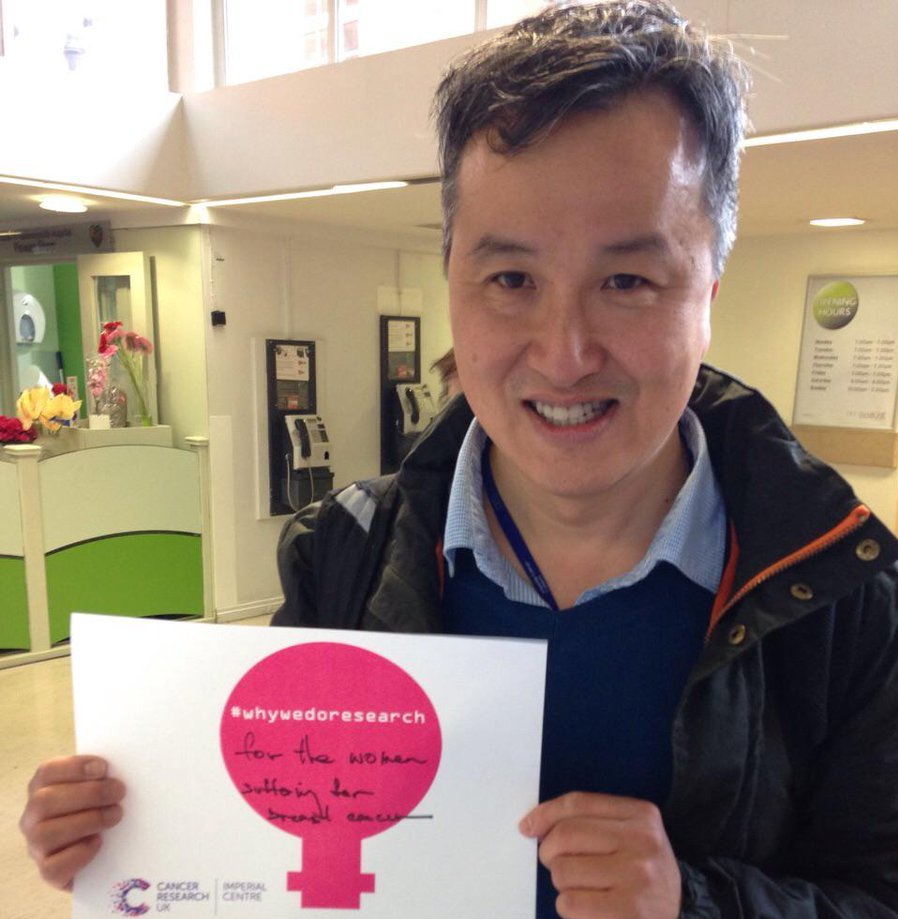
Another instalment from the series “Curing Cancer with Photoshop“. This time, the hero is Eric Lam, breast cancer researcher and professor of molecular Oncology at Imperial College in London. Lam’s lab consists by his own count of “12-18 researchers”, Imperial had to stress that it “is made up from 15 females”. However, a number of problematic papers from Lam lab have male first authors.
This cancer fighting hub at Imperial is funded by British national funders Medical Research Council (MRC), Cancer Research UK and Biotechnology and Biological Sciences Research Council (BBSRC). Major research focus is on the Forkhead Box proteins, in particular FOXM1, a transcription factor implicated in cancer development. A pedestrian approach many cancer researchers take, where similar-looking papers on slightly varying topics of the same gene are produced, none of them too unorthodox or earth-shattering to attract scrutiny as to how those results came to be. Lam’s science is not controversial for that, and with 250 papers it is the combined quantity and mediocrity which let his research stand unquestioned. Yet if one does look closely, as the data integrity sleuth Clare Francis did and posted it on PubPeer, one finds duplicated western blot bands and irregularly spliced gels. Maybe it is a novel molecular pathway of FOX proteins, to be harnessed for a cancer cure?
What this article shows, is actually nothing scandalous. It is simply the boring banality of bad science in cancer research which PubPeer is full of. Lam is just one of many successful academic oncologists who knows what is needed to successfully publish papers in respectable society journals.
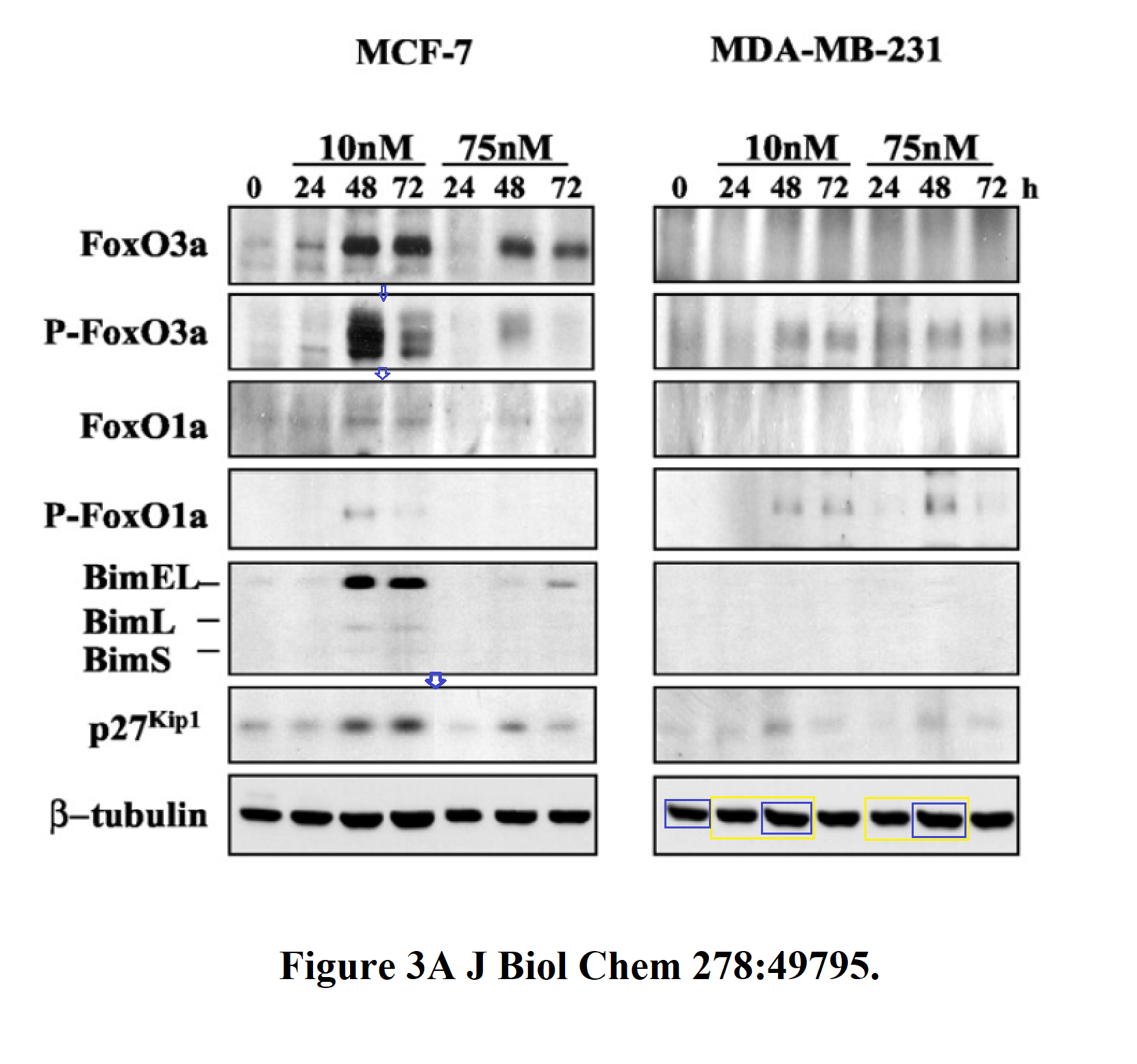
We can start with an early work from Lam lab, where Sunters et al J Biol Chem 2003 proved that FOXO3a and FOXO1a proteins are involved in apoptosis of cancer cells treated with a chemotherapeutic agent. Not really a surprising result, under the circumstances, but it still needed some tweaking. In a certain cancer cell line, this paclitaxel treatment had a bizarre effect of duplicating, or even triplicating gel bands inside the loading control. Apparently, an extracellular Photoshop-defence mechanism against undesired results gets activated, which then provides FOXO3a and FOXO1a phosphorylation in a tubulin-western blot band-dependent matter. Amazing science at the forefront of war on cancer at Imperial.
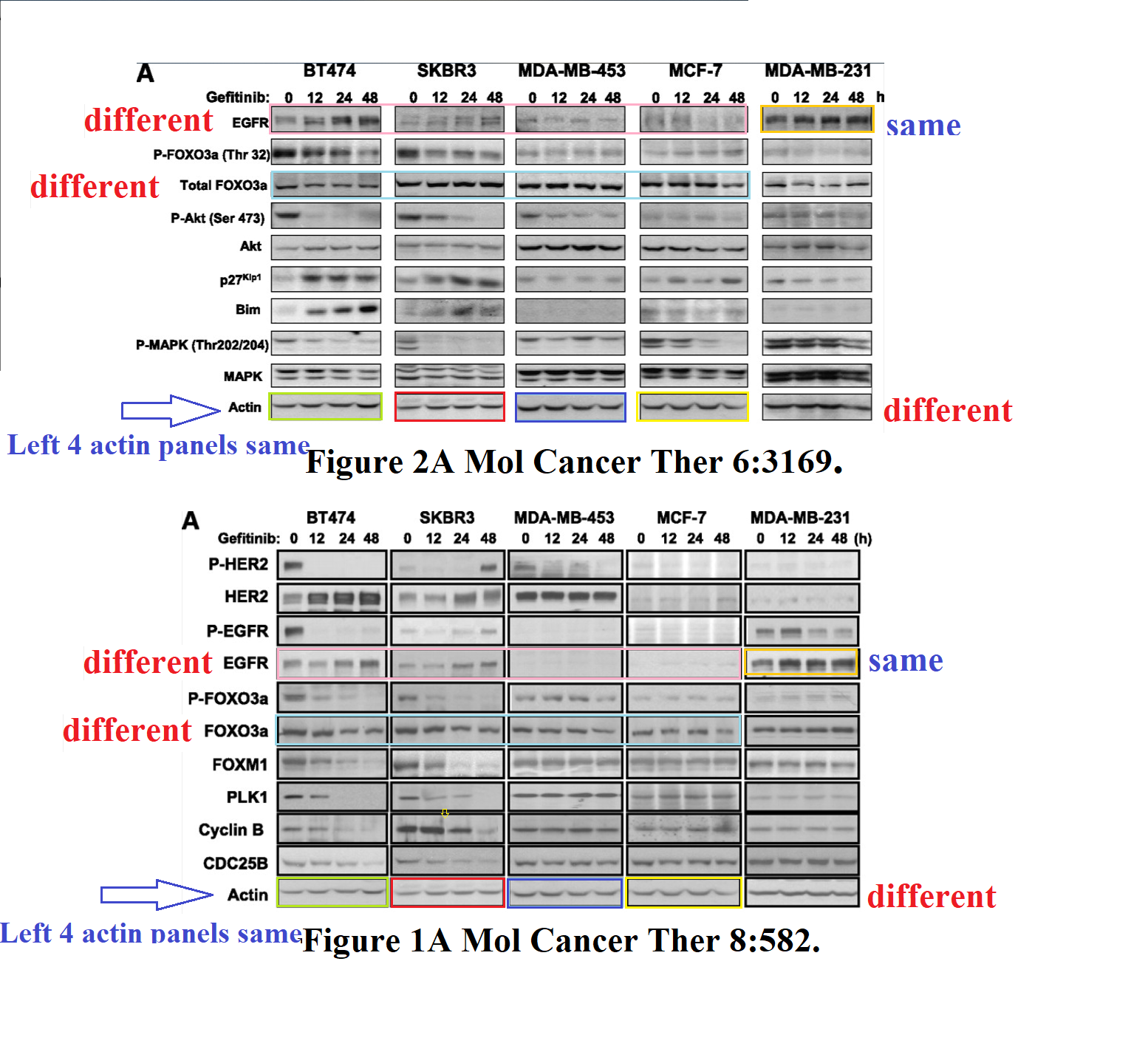
The Fernandez De Mattos et al, Mol Cancer Ther, 2008 paper from the Lam lab is also an interesting example in this regard. Who would have expected that the chemotherapeutic agent cisplatin will not only reduce the phosphorylation of FOXO3a protein, but also lead to a duplication of a p-FOXO3a gel band? Serendipitous discoveries like this is what drives cancer research!

Or this paper Francis et al, Int J Oncology, 2009, where Lam found out the key role of FOXM1 in breast cancer. The effect is that universal, that cancer cell lines produce identical western blots even when treated with utterly different pharmacological inhibitors, and in different publications. This is why two western blot panels from that paper are found in Mc Govern et al, Mol Cancer Ther, 2009, another Lam paper published by American Association for Cancer Research (AACR).

The effect spreads even further inside the McGovern et al 2009 paper. 4 loading controls were re-used, but not the fifth one because it apparently already was delegated to moonlight in the parallel Francis et al 2009 paper.
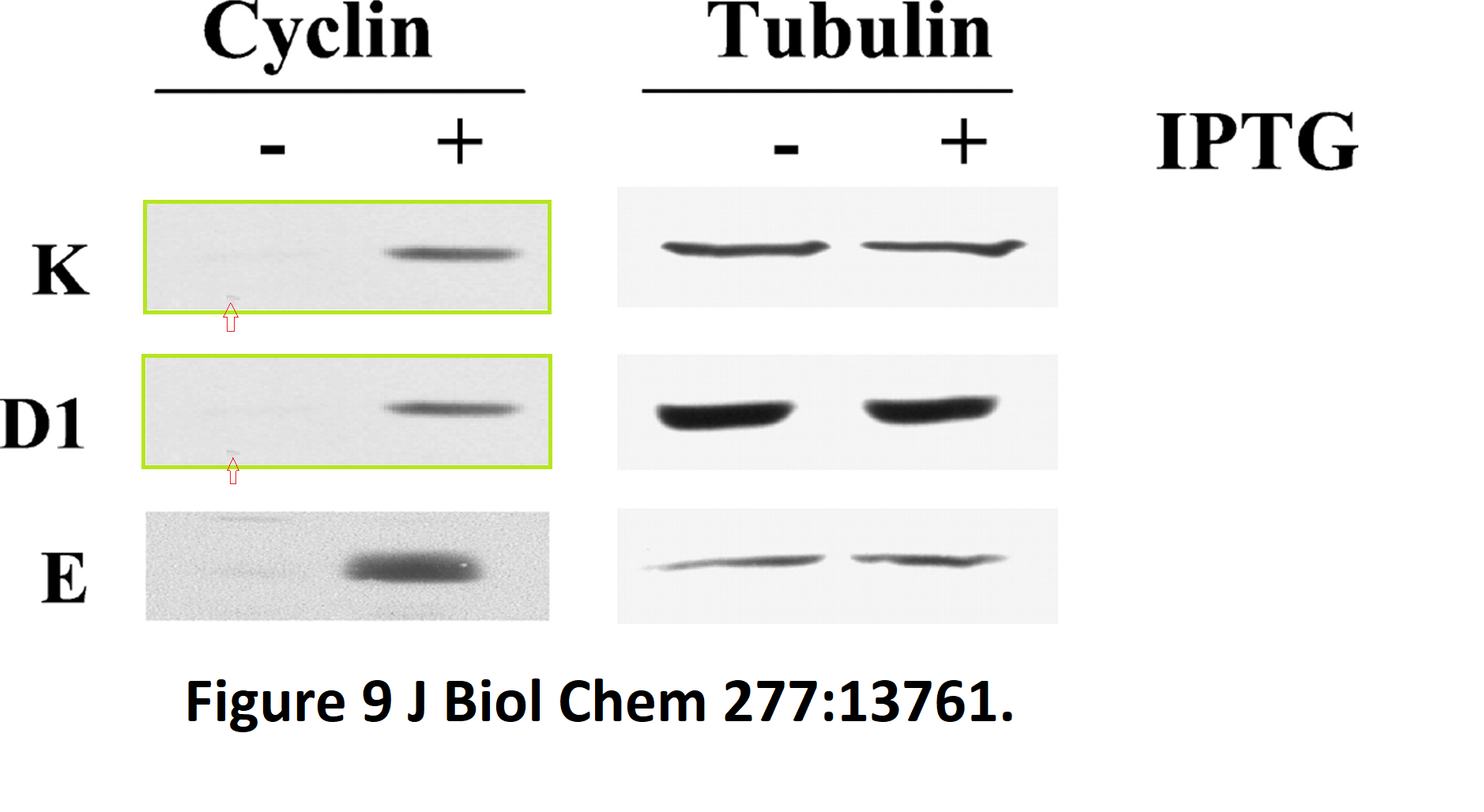
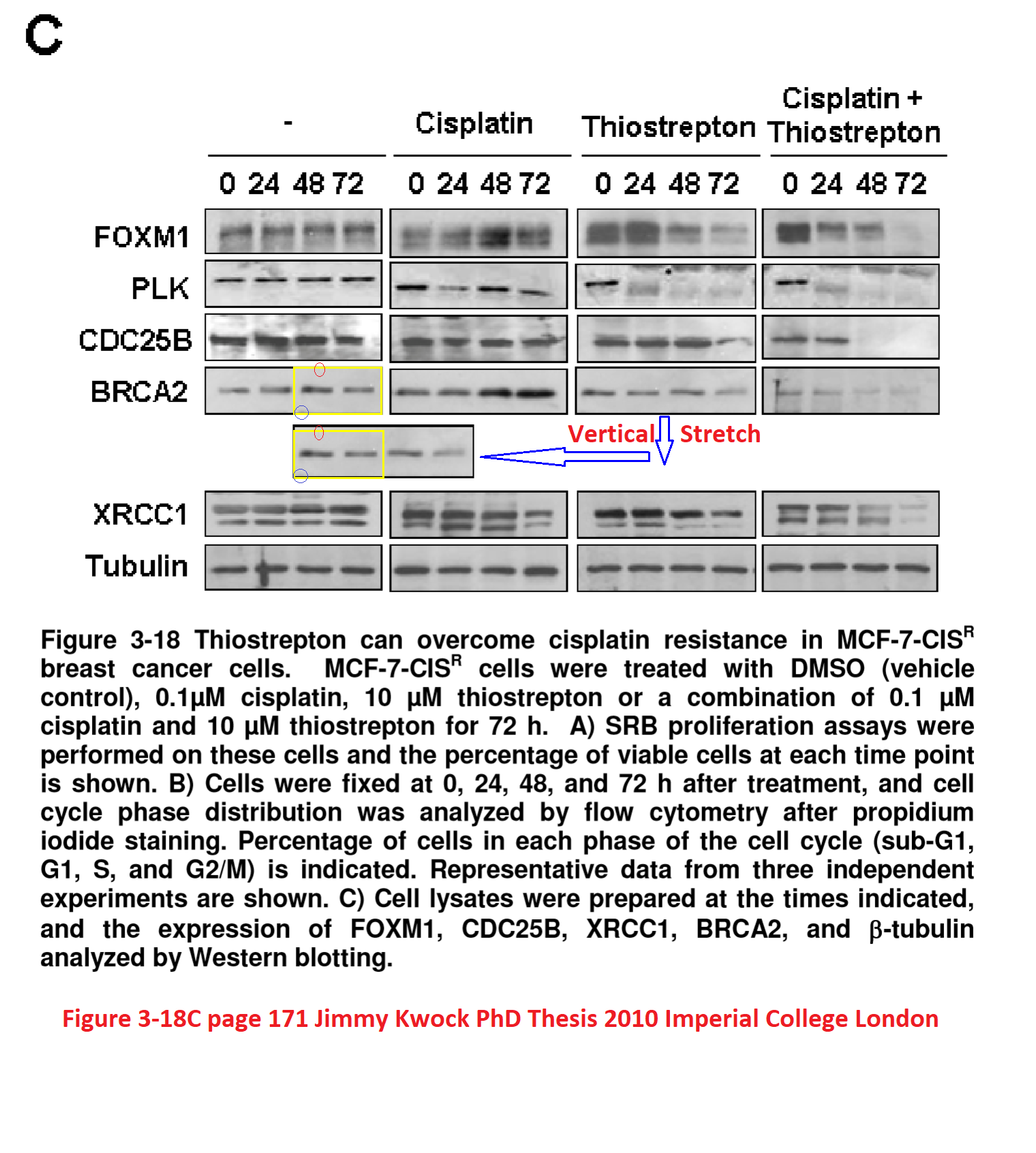
The following Lam study gives insights into his mentorship practice. Jimmy Kwok did his PhD udner Lam and is now head of London oncology division with the private healthcare provider HCA Healthcare UK. He is also a registered Ashtanga yoga instructor and helps cancer patients by selling them his books on yoga. There is lots for Kwok to mediate on himself though, for example on his paper Kwok et al Mol Cancer Research 2010 and his PhD thesis from same year.
Can yoga explain that western blot bands showing the expression of an oncogene look identical between control and chemotherapeutic agent-treated cells? Especially that these gels bands were squeezed vertically to look smaller when the therapy began?

The exactly same figure, with same duplication, is present in Kwok’s PhD thesis, supervised by Lam. The thesis also has other issues, like those amazing reproducible flow cytometry plots, despite different time points:

This was what Lam published together with another Imperial colleague, Simon Wagner (who is now with University of Leicester). The paper Batlle et al Mol Immunology 2009, published with Elsevier, proves that in the end, anything goes and nothing matters. Nobody cares, or looks, or actually peer reviews. Some brightness touch-up suffices to make results from different experiments interchangeable inside the same figure. Leukaemia solved, the easy Imperial way.

Other concerns in Lam’s papers are hidden irregular gel splicing, mismatching loading controls, which both make western blot results rather unreliable, or occasional duplications like in Barnouin et al J Biol Chem 2002.
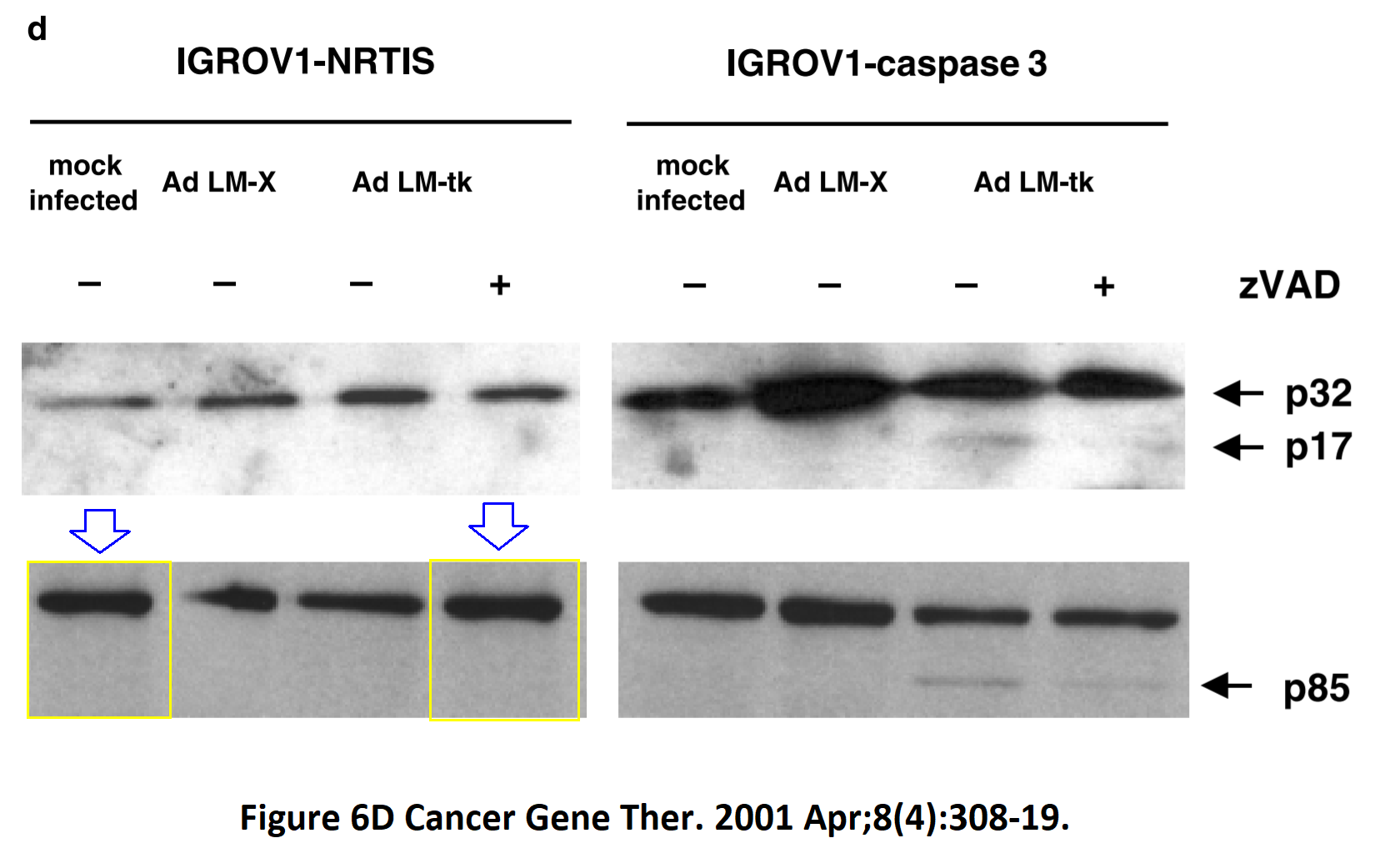
The bigger problem is that in cancer research, all these issues in Lam’s papers are nothing special. None of them. Those problematic western blots Lam published are boringly common. Just in UK, there are many other cases of photoshopped cancer research discussed on PubPeer, my site alone documents ICR London, Cardiff University , or even another lab at Imperial. Even more, Lam’s own superior Iain McNeish, Head of Division of Cancer of Department of Surgery and Cancer at Imperial published something rather inappropriate in his own youth, also at Imperial, in McNeish et al, Cancer Gene Ther, 2001. This is just one example of duplicated gel bands in that paper of his, more is on PubPeer.

Even more can be found on PubPeer in the works in of McNeish et al 2001 last author, Nick Lemoine, formerly professor of molecular pathology at Imperial and now Chair of the Bart’s Cancer Institute in London. That was also mostly posted by pseudonymous sleuth Clare Francis, who also informed the universities involved. Not that anyone cares, just like with ICR, also on Bart’s case it will the institute director investigating himself. Lemoine is also Chair of trustees at MRC, in case anyone is concerned about MRC’s attitude to research integrity, they can complain to Professor Lemoine.
It is basically a culture of mutual back-scratching and one hand washes the other in cancer research. Lam might be not the biggest shark in the pond, but one quickly sees that those above him and at the helm of British cancer research are, let’s put it this way, conflicted themselves. Yet this kind of bad science quickly leads to clinical trials, with millions of pounds, dollars or euros wasted, where thousands of cancer patients are given false hope and subjected to potentially dangerous therapies based on a flimsy, unreliable or plain fake lab data. Those same people unable to present a convincing western blot without the help of Photoshop, keep asking the public to donate to cancer research.
Maybe this is why there is so little progress relative to the enormous financial effort worldwide. What if the really radical approach to war on cancer would be not throwing good money after bad in Moonshot programmes, not inventing new crazy theories of cancer, not stripping patients of basic protection so new methods can be quickly tested on them on a hunch, but introducing some basic research integrity for a change? It would cost very little, in fact it would liberate enormous sums which more honest scientists could use for better science.
Update 25.11.2018. Same day and just a couple of hours after this article appeared, Lam’s Head of Department Iain McNeish went to PubPeer to share the results of an investigation on his own problematic paper with Nick Lemoine, in this comment. In brief, the gel band duplications were confirmed and original data was not available. This was exactly the reason why Imperial and Bart’s Cancer Institute decided not to retract or even to correct the paper. And anyway, some of the duplicated bands were, as McNeish said, “only control lanes”. McNeish announced to be now in charge of monitoring and punishing exactly same transgressions as his own paper shows.
In Britain, goats are appointed gardeners, by other goats.
Quote by McNeish:
“None of these issues in my opinion change the conclusions made in the papers. I see no merit in retracting these important publications or publishing an erratum at this late stage, although agree that there have been errors made in producing the figures.
It should also be noted that the original data was no longer available for review. […] The investigation stated that the conclusions made from the published studies were valid and important, even accounting for these reporting errors.
I recommend that measures are put in place to avoid such issues surrounding research data quality and reporting in future. […]
As first author, I accept the findings of this investigation. The Division of Cancer at Imperial College has now established a data integrity committee that will investigates suspected data irregularities and also to review the current practices relating to research data storage and reporting.”
Donate!
If you are interested to support my work, you can leave here a small tip of $5. Or several of small tips, just increase the amount as you like (2x=€10; 5x=€25). Your generous patronage of my journalism will be most appreciated!
€5.00

 For Better Science
Pingback: Imperial Piss-Take – For Better Science
Fresh problematic data for Jimmy Kwok and Eric W Lam.
PubPeer – FOXM1 confers acquired cisplatin resistance in breast cancer…
Scroll up!
LikeLike
Another one for Eric Lam. Has Eric been eating too much Spam? It is not good for the eyesight.
https://pubpeer.com/publications/F713EA285567F3870833A9B72D59B0#12
Scroll up!
LikeLike
Eric and Bruno do a nice little number here. Nimble footwork. Some cells stay, and some cells go. How to explain that?
https://pubpeer.com/publications/8DE0B851F7700006EA89F367977211#5
LikeLike
New one for Eric Lam. PubPeer – Paclitaxel targets FOXM1 to regulate KIF20A in mitotic catas…
LikeLike
Same data. PubPeer – Phosphorylation independent eIF4E translational reprogrammin…
LikeLike
Eric Lam doesn’t know that blots have to follow suit.
PubPeer – ATM and p53 regulate FOXM1 expression via E2F in breast canc…
Scroll up!
LikeLike
The U.K.’s loss is China’s gain!
PubPeer – Modulation of oxidative phosphorylation augments antineoplas…
LikeLike
One for R Charles Coombes without Eric Lam.
PubPeer – Detection of Wilms’ tumor antigen–specific CTL in tumor-dra…
LikeLike
Eric Lam collaborating very successfully recently:-
PubPeer – Targeting amphiregulin (AREG) derived from senescent stromal…
PubPeer – The senescence-associated secretory phenotype is potentiated…
PubPeer – Targeting SPINK1 in the damaged tumour microenvironment alle…
LikeLike
Second chances! No ad hominem blacklisting! Every paper on its own merit!
LikeLike
Eric Lam pushing the limits! Way to go!
PubPeer – KDM4 Orchestrates Epigenomic Remodeling of Senescent Cells a…
PubPeer – Senescent Stromal Cells Promote Cancer Resistance through SI…
Onwards and upwards!
LikeLike
Eric Lam playing the triangle!
PubPeer – H19/let-7/LIN28 reciprocal negative regulatory circuit promo…
LikeLike
More percussion instruments!
PubPeer – The Critical Role of Dysregulated RhoB Signaling Pathway in…
LikeLike
Problematic data Imperial college. Professor Michael J Seckl, ancient and modern.
PubPeer – Crosstalk with lung fibroblasts shapes the growth and therap…
PubPeer – Fibroblast growth factor-2 induces translational regulation…
PubPeer – ATR and CDK4/6 inhibition target the growth of methotrexate-…
PubPeer – Targeting the phosphoinositide 3-kinase p110-α isoform impai…
PubPeer – Targeting autophagy sensitises lung cancer cells to Src fami…
PubPeer – Critical role for lipid raft-associated Src kinases in activ…
PubPeer – Two distinct phosphoinositide 3-kinases mediate polypeptide…
PubPeer – [D-Arg1,D-Trp5,7,9,Leu11]Substance P coordinately and revers…
LikeLike
Another one for E W-F Lam , R C Coombes, but it is O.K.. It is already sedimentary rock, and the journal will most likely explain it away.
PubPeer – Fibroblast growth factor 7, secreted by breast fibroblasts,…
LikeLiked by 1 person
Another retraction for Eric W Lam.
Retraction Note: KDM4 orchestrates epigenomic remodeling of senescent cells and potentiates the senescence-associated secretory phenotype | Nature Aging
LikeLike
Eric Lam, a bad penny?
https://pubpeer.com/publications/B2120ACA48B85496AAB9FA1609D5F8
LikeLike
Can the J Biol Chem ever throw out the rubbish?
PubPeer – H2O2 induces a transient multi-phase cell cycle arrest in mo…
LikeLike
More J Biol Chem rubbish here:
PubPeer – RNF168 cooperates with RNF8 to mediate FOXM1 ubiquitination…
LikeLike
Retraction for Eric Lam.
https://aacrjournals.org/mct/article/25/3/510/774803/Retraction-FOXO3a-Mediates-the-Cytotoxic-Effects
LikeLike
Four 1st March Expressions of Concern, MCT, for Eric Lam
Volume 25 Issue 3 | Molecular Cancer Therapeutics | American Association for Cancer Research https://share.google/dyqRPHKjvy0uraLGG
Scroll down to the Expression of Concern section.
LikeLike
2nd March 2026 retraction for Eric Lam in Cancer Research.
Retraction: Senescent Stromal Cells Promote Cancer Resistance through SIRT1 Loss-Potentiated Overproduction of Small Extracellular Vesicles | Cancer Research | American Association for Cancer Research https://share.google/dFSEhp20iqHtDZC0u
LikeLike
Two 3rd March 2026 Expressions of Concerns for Eric Lam in Molecular Cancer Research.Expression of Concern: FOXM1 Confers Acquired Cisplatin Resistance in Breast Cancer Cells | Molecular Cancer Research | American Association for Cancer Research https://share.google/WMlQKyhXbM7oWH4z1Expression of Concern: The p38 MAPK-MK2 Axis Regulates E2F1 and FOXM1 Expression after Epirubicin Treatment – PubMed https://share.google/vIAiOwFevvQEAxUXH
LikeLike
Pubpeer record Eric W F Lam 08.03.2026, international reach.
PubPeer – Search publications and join the conversation.
He done good, Imperial done even better! Bad penny, even better pounds! Why would it ever be otherwise?
LikeLike
Only 4 retractions for Eric W Lam to date, 08.03.2026:-
Retraction Note: KDM4 orchestrates epigenomic remodeling of senescent cells and potentiates the senescence-associated secretory phenotype –
PubMed Retraction: FOXO3a Mediates the Cytotoxic Effects of Cisplatin in Colon Cancer Cells | Molecular Cancer Therapeutics | American Association for Cancer Research
Retraction: Senescent Stromal Cells Promote Cancer Resistance through SIRT1 Loss-Potentiated Overproduction of Small Extracellular Vesicles | Cancer Research | American Association for Cancer Research
Retraction Note to: FOXM1 modulates 5-fluorouracil sensitivity in cholangiocarcinoma through thymidylate synthase (TYMS): implications of FOXM1–TYMS axis uncoupling in 5-FU resistance | Cell Death & Disease
Eric Lam is quids in, Imperial is quids in! That’s how it works, it wouldn’t work if it were not like that.
Imperial will say that only one retraction is in a journal it cares about, Nature Aging, and the other three are in drossy journals, that only people in the trade care about.
LikeLike
” Yet if one does look closely, as the data integrity sleuth Clare Francis did and posted it on PubPeer, one finds duplicated western blot bands and irregularly spliced gels. “
If you put “eric w. f. lam” OR “e. w. f. lam” altogether into the search box of Pubpeer and press the search icon , or press RETURN
you get a few more entries.
PubPeer – Search publications and join the conversation.
LikeLike