
The cancer research journal Oncogene issued on October 16th 2017 an Editorial on the topic of research integrity:
“The importance of being earnest in post-publication review: scientific fraud and the scourges of anonymity and excuses”.
The editorial contains a list of 8 common excuses dishonest authors used to escape responsibility for manipulated data. It was authored by David Sanders, virologist and professor at the Department of Biological Sciences at the Purdue University in West Lafayette, Indiana, US, as well as Justin Stebbing, professor of cancer medicine and oncology at the Imperial College London, UK, who is also one of the two Editors-in-Chief (EiC) of the journal Oncogene.
Sanders is one of these rare brave academics who is unafraid to call out scientific misconduct while his peers hide in the bushes and instead even point fingers at whistleblowers like him. As the newspaper USA Today wrote earlier this year, Sanders made himself a very powerful enemy, the star US cancer researcher with Italian origins, Carlo Croce:
“But that didn’t stop Sanders from alleging that Dr. Carlo Croce, a prominent cancer researcher at Ohio State University, falsified data or plagiarized text in more than two dozen articles Croce has authored. For the past two-plus years, Sanders has contacted scientific journals in which the articles appeared to alert them of his concerns. Earlier this month, he went more public with his claims in an investigative piece by the New York Times that delved into years of ethics charges against Croce.
“There are, and I anticipate there will be additional, consequences for my career,” Sanders said Tuesday afternoon while sitting in his office inside the Hockmeyer Hall of Structural Biology at Purdue.
This isn’t the first time Sanders has publicly accused a scientist of bad behavior. In 2012, Sanders had an article by a former colleague retracted on the basis that the colleague used their former deceased research partner’s data in the paper without permission”.
A long article appeared in The New York Times prior to that, “Years of Ethics Charges, but Star Cancer Researcher Gets a Pass“, detailing the case of Carlo Croce and the role of Sanders the whistleblower, and the Ohio State University, who were mostly covering up the affair. Croce hit back: he is now suing the newspaper, and in separate lawsuit, also Sanders at a New York court, as reported by Retraction Watch.
Hence, Sanders knows first-hand what research misconduct is and how to act upon it. Indeed, the editorial was his idea, and his co-author Stebbing joined afterwards. As Sanders wrote to me:
“The impulse for the editorial and the list was from me. We discussed the inclusion of particular items and how they were described together”.
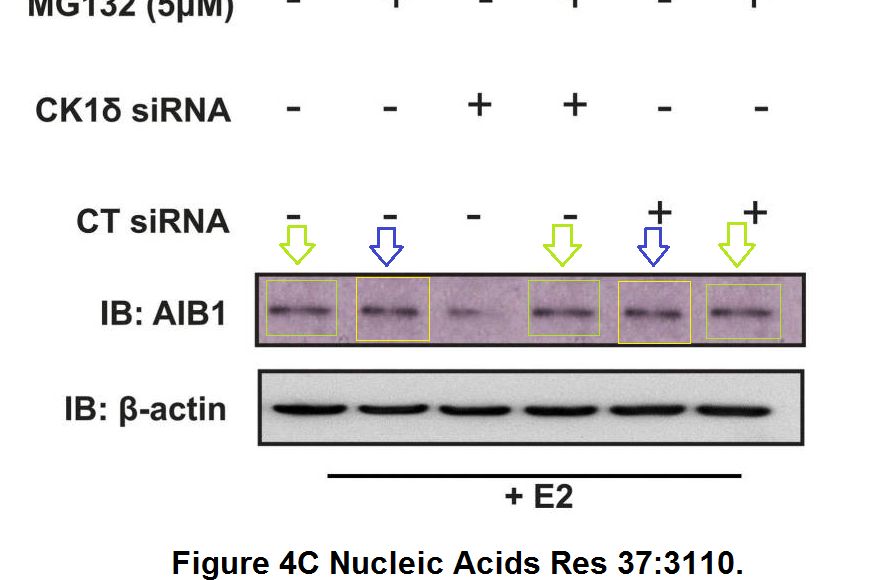
Stebbing indeed is not much of a whistleblower, quite the opposite, he can be in fact seen as victim of such. His own publication was heavily criticised on PubPeer, for suspected western blot band duplications. And the piquant bit is: Stebbings, together with his first author Georgios Giamas (now Reader in Biochemistry at the University of Sussex, UK) offered on PubPeer explanations which sound very much as what he himself has been ridiculing in the Sanders & Stebbing editorial in his journal Oncogene.
[2.11.2017, 18:40: a section referring to a newspaper article dealing with clinical events was removed upon email request from Justin Stebbing. He announced to me also to address the PubPeer concerns and provide original gel images in the comment section below]
This was the above-mentioned paper:
Georgios Giamas, Leandro Castellano, Qin Feng, Uwe Knippschild, Jimmy Jacob, Ross S. Thomas, R. Charles Coombes, Carolyn L. Smith, Long R. Jiao, Justin Stebbing
CK1delta modulates the transcriptional activity of ERalpha via AIB1 in an estrogen-dependent manner and regulates ERalpha-AIB1 interactions
Nucleic Acids Research (2009) doi: 10.1093/nar/gkp136
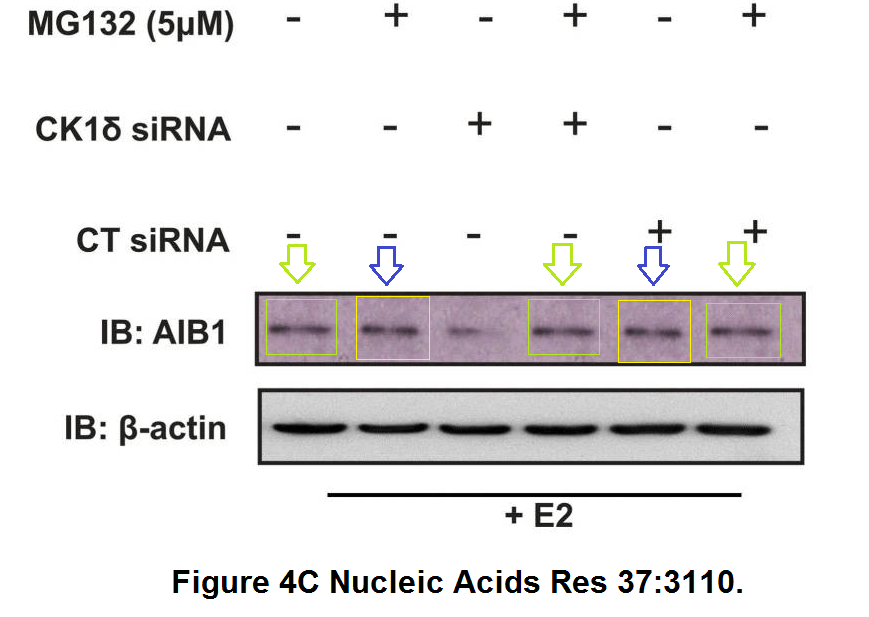
The paper’s co-author Uwe Knippschild, professor at the surgery department of the University Clinic Ulm, Germany, who had some own papers flagged on PubPeer, commented:
“I also would like to thank you very much for your critical comments. I will contact the corresponding authors. Thereafter, I will reply as soon as possible“.
There was no follow up from Knippschild’s side about this paper, but Giamas and Stebbing did engage in a debate with their critics.
Now follows the list of the lame authors’ excuses from Sanders & Stebbing, Oncogene 2017 (copyright NatureSpringer), and the justifications offered by Giamas and Stebbing on PubPeer regarding their own paper in Nucleic Acids Research (NAR). The comparison is illustrated with PubPeer evidence.

i. ‘Nothing to see here. Move along.’ Even though the evidence of image duplication or plagiarism is in many cases overwhelming, some authors refuse to admit that there was any problem with their article.
Giamas and Stebbing on PubPeer that there is indeed no reason to suspect duplciations:
“Amongst the thousands gels / blots / immunofluorescence and other experiments that I (GG) have personally performed the last ~17 years (as I am sure it has happened for other scientists) there were occasions that certain results/data were indeed ‘strangely similar’ (i.e. protein bands running in an identical way, 2 different cells looking alike under the microscope, etc)”.
ii. ‘My dog ate the data.’ Certainly having the original data would help resolve the issues and clearly this excuse has greater validity as more time passes. But sometimes the image manipulation/plagiarism is so evident, that the lack of the original data cannot be an exonerating circumstance.
The Imperial College mandates: “Primary data is the property of Imperial College and should remain in the laboratory where it was generated for as long as reference needs to be made to it and for no less than ten years“. Giamas and Stebbing suggested however on PubPeer that the 8 year-old data might be unavailable:
“Unfortunately, as you can imagine, due to the fact that these data are quite old, it will be very difficult (if not impossible) to trace the original blots and recall who exactly was involved in the execution of the specific experiments”.

iii. ‘If you look hard enough, you can find a trivial difference between two supposedly duplicated images.’ First, the standard should be how likely is it that two images could be so similar and yet have distinct origins. Artifacts that can introduce small differences can occur during image processing. Also, different exposures of the same data can produce apparent image differences; again the standard should be about the probability of similarity.
According to Stebbing, similar-shaped bands can indeed be produced by chance, when the same blotting apparatus is used (in fact, their German colleague Roland Lill suggested the same very recently, also on PubPeer). As Giamas and Stebbing explained on PubPeer:
“In this case, whether this was due to a technical issue (for example, the quality of the SDS-PRECAST-GEL used, or whether during the semi-dry blot transfer something went wrong, or something else…), as I mentioned before it is difficult to be 100% certain as it is impossible to recall how the exact blot(s) were executed ~8 years ago. Interestingly, we recently had an incident using a semi-dry blot device, where there was a problem with the upper stainless-steel plate (surface/electrodes) of the equipment. As a result, ALL our membranes were coming up with the same ‘background’ signal (noise) that affected the proper visualisation/analysis of the proteins run in different lanes (there was actually a sort of an identical spotted (marked) pattern in all of the protein bands making them look ‘strangely similar’ (whether this was due to something that was previously stuck in the steel surface, or a problem with the specific part affecting the current flow, heat generation etc…”.
iv. ‘It was only a control experiment.’ How many scientists have not had an unexpected result in a ‘control’ experiment that actually led to some insight? If control experiments were unimportant, why were they included in the article in the first place? Connected to this sophistry is: ‘The data duplication does not affect the results.’ The said error may not affect the main conclusions of the research but all data presented should be considered results. Moreover, identified errors, especially if they occur more than once in a single paper or in several papers by the same author(s) undermine the trust of the Editors in any results presented by the author(s). See the Lady Bracknell quotation.
v. ‘It was the fault of a junior researcher.’ This could very well be true. It is sad when the research of a laboratory group is undermined by one unscrupulous person. However it remains to be asked, how did such obvious image duplications escape the attention of the other co-authors? To qualify as an author of a paper one must have approved the final version. If research misconduct was not identified then this does not reflect well on the integrity of, and care and attention paid by the co-authors.
vi. ‘The responsible researcher is from another country and therefore unfamiliar with the standards expected in scientific publications.’ First, of course, this argument is highly insulting to the many researchers from other countries who do not engage in such activities. Second, if a laboratory director is concerned about the understanding of standards by researchers in one’s group from other countries, then one is responsible for inculcating the proper values into those researchers and displaying an extra level of scrutiny of their products. Again, see the Lady Bracknell quotation.
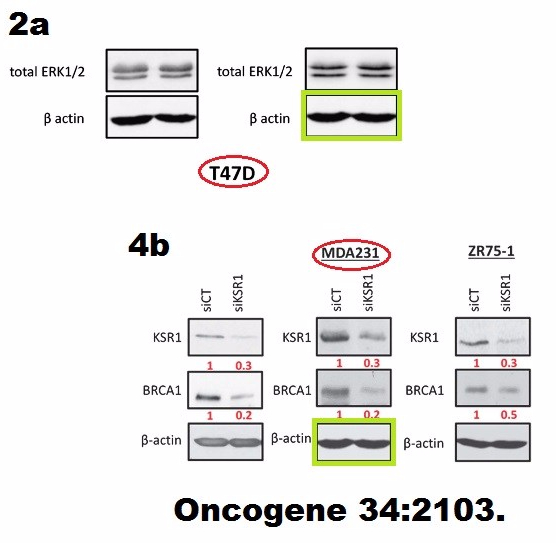
A reply Giamas left on PubPeer regarding his common paper with Stebbing in Oncogene (Stebbing et al 2015) covered all 3 above points 4-6. It assigned the blame for a failed loading control to a junior co-author from China:
“Regarding the ‘actin’ labelling in the KSR1 paper, our previous postdoc student working on this project (Dr Hua Zhang) has confirmed that this is a mislabelled blot. Indeed this actin blot is representative of the T47D cell line (and NOT the MDA231). However, the relative MDA231 blot looks relative similar, meaning that equal and therefore comparable protein amounts have been loaded and therefore the interpretations/conclusions are the same (as most actin blots should look like following proper bradford quantification). Apparently, during the preparation of the supl. figure, he accidentally used the wrong actin blot and we apologise for this“.

vii. ‘The results have been replicated by ourselves or others, so the image manipulation is irrelevant.’ Data are included in an article for a reason. Science is based upon a certain level of trust, but it is not all-encompassing. If the data do not represent the experiments described, then that trust has been violated, and no rationalization about final outcomes should affect judgment about the culpability of the authors.
Indeed, Giamas and Stebbing opened their defence on PubPeer with declaring that all results were reproduced, which probably means any eventual data manipulations become utterly irrelevant:
“First of all, let me confirm that we have repeated these experiments (as we do for every single one) at least 3x times; therefore, the results/conclusions presented in this manuscript are valid and reproducible”.

viii. ‘Someone is out to get me.’ Perhaps true but irrelevant. By implying that if not for the fact that one was being targeted, the behavior would be considered acceptable, one traduces the entire scientific community. Such practices are neither common nor worthy of toleration.
Possibly in a similar vein, Giamas commented on PubPeer:
“I feel honoured (in a way) that you spent your time, going through all my publications to date. Thank you for pointing out things that potentially require further clarification/corrections.
I can assure you that we will carefully look into these ASAP and proceed with any corringedum / erratum requested by the respective journal.
More importantly, I want to re-emphasise the accuracy and scientific integrity of our published data/results, using the specific protocols, reagents, etc employed and referenced in each case”.
Giamas and Stebbing already had to correct a paper Melaiu et al PLOS One 2014 they authored collaboratively with another lab from Italy, for microscopy image duplication (below).

The Sanders & Stebbing editorial contains this bit, one wonders if Stebbing put it in, with his own papers in mind:
“Some accusations are clearly false, but it is the responsibility of the journal to investigate all allegations made. A few of the excuses listed above may occasionally be valid in some context”.
Certainly he will ruthlessly investigate the issues in Stebbing et al 2015, being the Editor-in-Chief of the journal Oncogene where it was published. And as for his paper in Nucleic Acids Research: the journal showed little evidence of any interest to do anything at all about a similarly problematic case from France. “Nothing to see here. Move along.”
Update 3.11.2017.
I exchanged several emails with Justin Stebbings, where he indicated to be inclined to share the original gel scans. In the email one he forwarded to me this communication he received from an editor of Nucleic Acids Research:
“I have finally taken the time to review your response. Thank you for taking the time to produce such a detailed report and for repeating the experiments. We are satisfied with your response and the evidence provided and agree that the figures have not been unethically altered. We now consider this case closed”.
Update 24.11.2020
Obviously nobody cares about data manipulation, Giamas is now even Imperial Medicine visiting professor, so this says it all. But Stebbing is in growing trouble over his activities as a doctor to wealthy celebrities. Back when this article was first published, he wrote to me asking to remove a mention of this 2017 Telegraph article, about him being investigated by General Medical Council (GMC).
Stebbing asked me not to reference from that news piece so that my readers won’t learn that he “has had practising privileges permanently withdrawn by some Harley Street clinics“, that he attempted “to give chemotherapy to a patient close to end of life, against the advice of colleagues“, and that he “treated patients at the London Claremont Clinic with an immunotherapy drug called pembrolizumab” while charging extra payment, prescribing the drug “indiscriminately” and with an “absence of trial data and clinical assessments”. This is why
“HCA, the country’s largest private care provider, has informed Prof Stebbing’s patients that from September they will no longer be allowed to receive treatment from a man who has published more than 550 peer-reviewed papers and been nicknamed “God” by some former patients.“
GMC also placed Stebbing “under ongoing investigation over his fitness to practise and ruled he must be supervised in all of his clinical posts until November” 2018. This becomes relevant again because BMJ reported in September 2020 an update on the GMC investigation that Stebbing
“faces allegations at a medical practitioners tribunal of failing to provide good clinical care to 11 patients between March 2014 and March 2017. […] The allegations, involving privately paying, terminally ill patients, include lack of informed consent,overestimation of the prognosis of treatment, poor judgment on the dosages and timings of treatments, acting outside national guidelines, and failing to take on board the concerns of colleagues.”
Donate!
€5.00

 For Better Science
Stealth correction for :
Angeliki Ditsiou , Chiara Cilibrasi , Nikiana Simigdala , Athanasios Papakyriakou , Leanne Milton-Harris , Viviana Vella , Joanne E. Nettleship , Jae Ho Lo , Shivani Soni , Goar Smbatyan , Panagiota Ntavelou , Teresa Gagliano , Maria Chiara Iachini , Sahir Khurshid , Thomas Simon , Lihong Zhou , Storm Hassell-Hart , Philip Carter , Laurence H. Pearl , Robin L. Owen , Raymond J. Owens, S. Mark Roe, Naomi E. Chayen, Heinz-Josef Lenz, John Spencer, Chrisostomos Prodromou, Apostolos Klinakis, Justin Stebbing, Georgios Giamas
The structure-function relationship of oncogenic LMTK3
Science Advances (2020) doi: 10.1126/sciadv.abc3099
Comment by Cheshire:
“Near the supplemental information: “Correction (2 April 2021): In Fig. 5D, the tubulin bands for T47D and MDA-MB-231 cells were inadvertently identical. The PDF and HTML have been updated with the correct version of Figure 5.””
LikeLike
“23 comments on “Oncogene EiC Justin Stebbing, a hypocrite of research integrity?” but only your new one is visible. Is this an artifact of the other comments being so old (3.5 years)? I will go see if the Internet Archive has them…
LikeLike
I think it’s because there are page breaks for comments, can you check if you can open others?
LikeLike
https://www.medscape.com/viewarticle/957357
Oncologist Suspended After Ignoring Colleagues’ Dissenting Views, Tribunal Hears
LikeLike
“World-renowned oncologist Professor Justin Stebbing was suspended by a private health care provider after he ignored the “dissenting views” of colleagues and restrictions placed on his practice to give chemotherapy to a cancer patient, a medical tribunal heard.
Prof Stebbing, a cancer medicine and oncology professor at Imperial College London with a private practice in Harley Street, has an international reputation for his innovative treatments which has led to wealthy, terminally-ill cancer patients from around the world turning to him in the hope of extending their lives.”
https://www.medscape.com/viewarticle/957357
Well, some may disagree with Stebbing being “world-renowned” and having an “international reputation” as a genius as the article claims. It seems his scam is very similar of that of Paolo Macchiarini back in Italy: tell terminally ill cancer patients you can cure them in exchange of a lots of cash, keep abusing them till their miserable deaths while telling them they are about to get cured.
But the Imperial College approves of all that, and the research fraud.
LikeLike
https://www.dailymail.co.uk/news/article-10067005/Professor-offered-false-expensive-hope-dying-cancer-patients.html
https://www.medscape.com/viewarticle/960334
LikeLike
“Having previously had 1,200 patients under his care and with earnings running to millions of pounds a year, on Monday he applied to dissolve the company through which he did much of his private work.”
“That Stebbing has a brilliant medical mind, there can be little debate.
After a first-class degree in medicine at Oxford University, he trained in the United States before returning to London, first at the Royal Marsden and then at Imperial College and its linked NHS Trust.
At the height of the pandemic he even wrote a series of papers on coronavirus, one examining how easily it could be transmitted by touching a ball – be it a football, a cricket ball or a golf ball.”
LikeLike
https://www.dailymail.co.uk/news/article-10067005/Professor-offered-false-expensive-hope-dying-cancer-patients.html
“As well as a £3.5million north London townhouse, company accounts show that in 2017 and 2018 he received dividend payments of £2.2million and £1.6million.
But this week he applied to Companies House to dissolve Justin Stebbing Ltd, a process often undertaken when a company is no longer active.”
Justin Stebbing has already had the money, dissolving the company won’t change that.
Perhaps “Sir Michael Parkinson, who he [Justin Stebbing] treated for prostate cancer” should reconsider his position as a supporter. Sir Michael Parkinson is a celebrity in the U.K., but why do we need to know a celebrity’s opinion about cancer treatments. Sir Michael Parkinson was famous for interviewing other celebrities (about as far removed from real life as you can get), he wasn’t a clinician, epidemiologist, nurse, or researcher even.
Sir Michael Parkinson dines out on his reputation as a straight-talking Yorkshireman, but he knows “nowt” (nought, nothing) as the say in Yorkshire!
LikeLike
According to the Oncogene’s own website Justin Stebbing is 1 of the 2 Editors-in-Chief.
Second of the two below.
https://www.nature.com/onc/editors
LikeLike
Of the associate editors of Oncogene
Olivier Pardo, Imperial College London, UK has appeared on Retraction Watch.
https://retractionwatch.com/2015/06/30/jbc-cancer-paper-felled-by-duplication-is-one-authors-second-retraction-this-month/
“The Oncogene paper has four authors in common with the retracted JBC paper: Pardo is the first author on both, and Arcaro, Salerno and Seckl are co-authors on both.”
LikeLike
Two other associates editors of Oncogene:-
Georgios Giamas, University of Sussex, UK
and
Leandro Castellano, Imperial College London, UK
are first and second authors of the paper which prompted this article, with Justin Stebbing as senior author lest we forget! What a cozy, self-supporting close-knit cabal, or would that be unfair to cabals?
https://pubpeer.com/publications/1CCAC58543784D1B17C8416A6D97C2
LikeLike
https://www.thetimes.co.uk/article/oncologist-nicknamed-god-gave-futile-treatment-to-dying-patients-jr8f0kblb
“A world-renowned oncologist dubbed “God” because of his pioneering work has been found guilty by a medical tribunal of providing inappropriate treatment to dying patients.
Professor Justin Stebbing, a cancer medicine and oncology professor at Imperial College London with a private practice in Harley Street, had been accused of failing to provide good clinical care to 12 patients. This included giving treatment when doing so was futile.
The decision by the Medical Practitioners Tribunal Service was a devastating blow to Stebbing’s reputation. He was found guilty of 33 out of 36 charges, 30 of which he had admitted. The remaining three were not fully proven.
Sharon Beattie QC, for the General Medical Council, said that Stebbing had failed to consider the “dignity” of patients.”
LikeLike
I predict this will have exactly zero consequences for Oncogene, given that this journal is run by Stebbing mafia at Imperial.
LikeLike
https://www.dailymail.co.uk/news/article-10073991/Top-oncologist-gets-blistering-tribunal-ruling-treatment-terminally-ill-cancer-patients.html
“In a scathing 95,000-word judgment, the Medical Practitioners Tribunal Service panel also hit out at two of the country’s most eminent oncologists who gave expert evidence in support of Stebbing.
It said one, Professor Karol Sikora, had given evidence that was ‘fundamentally incompatible with his duties as an independent and impartial expert’.”
LikeLike
Sikora is the country’s most eminent oncologist? I knew English science supremacy was exaggerated, but this…
LikeLike
Wait, what – Sikora, the UK’s best-known Covidiot, is also incompetent as an oncologist?
I am SHOCKED.
https://www.theguardian.com/commentisfree/2021/jan/01/false-hope-pandemic-dangerous-disinformation
LikeLike
https://www.medscape.com/viewarticle/958838
“A leading oncologist has told a medical tribunal that he was unaware Professor Justin Stebbing had joined the team of a company where he was appointed chair.
Dr Nick Plowman, who’s a defence witness in the case, told a Medical Practitioners Tribunal Service (MPTS) fitness to practise hearing that Prof Stebbing had no role in Oncology Commercial Services (OCS) despite his name and bio appearing alongside his own on the company’s website.”
Been caught out.
LikeLike
I wonder if the Medical Practitioners Tribunal Service will sanction Professor Karol Sikora, and Dr Nick Plowman.
https://www.medscape.com/viewarticle/958751
“A leading oncologist “regretted” co-signing a letter to the former chair of the GMC because it appeared he and another cancer expert had wanted the case against Professor Justin Stebbing stopped, a medical tribunal heard.
Dr Nick Plowman said it had been “foolish” to put his name to the letter to Dame Clare Marx after being instructed as a defence witness but he’d become concerned by delays in the case.”
Dr Nick Plowman said it “foolish”, but doe he think it was wrong?
LikeLike
I always thought that expert witnesses were supposed to give impartial evidence to the court, and are “called” to give their evidence, not “instructed”. Clients instruct lawyers to act. Lawyers do not act by themselves. If the lawyers had indeed “instructed” Dr Nick Plowman, those instructions came from their client.
LikeLike
With people like:-
Professor Justin Stebbing,
Professor Karol Sikora,
Dr Nick Plowman,
Professor Georgios Giamas and
Dr. Leandro Castellano
something is rotten in the state of Denmark.
http://www.sussex.ac.uk/lifesci/giamaslab/
Also, Visiting Professor
Imperial College
Faculty of Medicine
Department of Surgery and Cancer
Hammersmith Hospital Campus
London, W12 0NN, UK
Email: g.giamas@imperial.ac.uk
http://www.imperial.ac.uk/people/l.castellano
LikeLike
From Stebbing – Facts Determination FINAL:
Professor Sikora did not declare in his expert reports that he had previously had sight of patient summaries before his formal instruction as an expert, nor that he had canvassed opinion from a number of colleagues. The Tribunal found that Professor Sikora fell foul of his expert’s declaration in every conceivable respect.
False assertions
Professor Sikora falsely asserted in his supplementary reports that a number of the GMC experts had changed their opinion following the joint experts’ meetings, when they patently had not.
In cross-examination, Professor Sikora was simply unable to maintain this criticism and had no option but to concede that none of them had changed their opinion at all.
The Tribunal found this particularly troubling and an unnecessary diversion in the case. The reasons for Professor Sikora making such false assertions were entirely inexplicable. The Tribunal was puzzled as to why he had made such fundamental errors and only conceded them after sustained cross-examination in which he was directed to the documentary evidence which contradicted his assertions.
Dr Plowman
At the conclusion of his evidence, Ms O’Rourke, on behalf of Professor Stebbing, stated that they wished to disavow Dr Plowman as an expert witness and that they would not seek to rely on ‘a single word’ he said. She stated that the basis for this was that he had not read the material, was unprepared, made factual errors, and introduced new matters, such as introducing an aspect to Patient G’s medical history that did not exist.
Further, the Tribunal found that his evidence was neither independent nor impartial, and that his evidence and approach were fundamentally incompatible with his duties as an expert witness, for the following reasons:
• He co-signed the letter authored by Professor Sikora sent to Dame Clare Marx, as set out above, and at no point prior to being asked in cross-examination on this very point did he declare that he had done so;
• He failed to declare, prior to being asked in cross-examination on this point, that he and Professor Stebbing were part of a team of five members of a commercial oncology enterprise of which Dr Plowman was the Chairman. This was compounded by his inability to accept the requirement to disclose this to the Tribunal as a potential conflict of interest;
• Professor Stebbing referred Patient L to Dr Plowman on 2 April 2017. In a medical note and letter of that date, Dr Plowman said that treatment had been approved by a “properly constituted HSC GI MDT on 16 March 2017”. When questioned about this it transpired that Dr Plowman would have had no way of knowing that the MDT had occurred save for accepting the word of Professor Stebbing. It appeared to the Tribunal to be an odd choice of words to record for the benefit of medical colleagues that the MDT was ‘properly constituted’, when MDTs can only take place and be recorded if they are properly constituted. This suggested to the Tribunal that Dr Plowman was aware that the constitution of the MDT was in question and that he was attempting to corroborate Professor Stebbing’s story that the MDT had taken place. Further, Dr Plowman was told in cross-examination that Professor Stebbing had admitted the paragraphs of the Allegation relating to this patient and the backdating of the MDT form.
• Notwithstanding this, and to the surprise of the Tribunal, Dr Plowman insisted on being re-examined the following day on this point as he had reviewed the papers overnight. Having done so, he remained adamant that Patient L’s case was discussed at a fully formed MDT on 16 March 2017. He said it was egregious to suggest otherwise. The Tribunal found that Dr Plowman knew that Dr Slevin and Professor Hochhauser (MDT monitors) had not approved the treatment yet he persisted in maintaining that it had been approved at the purported fully formed MDT on 16 March 2017 and therefore should have been given. The Tribunal was dumbstruck that an experienced medical professional would maintain that a falsely drafted MDT form was proof that it had occurred.
LikeLike
Source please?
Also, did nobody at the GMC panel bother to ask England’s Top Oncologist Professor Sikora why he keeps lying about being a professor for over a decade already?
https://www.theguardian.com/science/2009/may/22/karol-sikora-honorary-professor-imperial-college
LikeLike
The source as stated above is “Stebbing – Facts Determination FINAL” a public document available on request from the Medical Practitioners Tribunal Service
LikeLike
https://www.lse.co.uk/news/in-brief-bb-healthcare-acknowledges-claims-against-director–dqcy6bsjvphfx5p.html
Fri, 8th Oct 2021 06:48 Alliance News
BB Healthcare Trust PLC – London-based investor in healthcare business – Acknowledges recent press coverage of findings by a General Medical Council statutory committee against Justin Stebbing, oncologist at Imperial College London and BB Healthcare director, for providing “inappropriate treatment” to 12 terminally-ill cancer patients.
Advises a further announcement will be made when it has more information.
Current stock price: 193.00 pence
LikeLike
29th October 2021 Retraction.
https://academic.oup.com/nar/advance-article/doi/10.1093/nar/gkab845/6414044?searchresult=1
Nucleic Acids Research, Volume 37, Issue 9, 1 May 2009, Pages 3110–3123, https://doi.org/10.1093/nar/gkp136
Following initial allegations of image manipulation in 2017 in the above article (1) the journal investigated the matter and did not find conclusive evidence to support the allegations. When further allegations were raised in 2021, the journal referred the matter to the authors’ institutions and an Expression of Concern was published in NAR (2). The Editors of the journal are now retracting the article for the following reasons:
The authors have been unable to produce the original raw image files for either the journal or the institutions.
The authors’ institutions conducted a formal investigation, and the official report dated 26-Aug-2021 concludes: ‘although the results themselves are not in question (having been verified by the subsequent repeat experiments carried out by the authors), the paper should still be retracted on the basis that the original data is no longer available, and was not available in 2017 when these concerns were first raised.’
REFERENCES
1. Giamas G., Castellano L., Feng Q., Knippschild U., Jacob J., Thomas R.S., Coombes R.C., Smith C.L., Jiao L.R., Stebbing J. CK1δ modulates the transcriptional activity of ERα via AIB1 in an estrogen-dependent manner and regulates ERα–AIB1 interactions. Nucleic Acids Res. 2009; 37:3110–3123.
Fox K.R., Stoddard B.L. Editorial Expression of Concern on article ‘CK1δ modulates the transcriptional activity of ERα via AIB1 in an estrogen-dependent manner and regulates ERα–AIB1 interactions’. Nucleic Acids Res. 2021; 49:3602.
LikeLike
Imperial College, the home institution, is begrudging in its recommendation for retraction.
“The authors’ institutions conducted a formal investigation, and the official report dated 26-Aug-2021 concludes: ‘although the results themselves are not in question (having been verified by the subsequent repeat experiments carried out by the authors)”
That belongs to 1984.
Doublethink is the ability to hold two contradictory ideas in one’s mind and to believe both of them. In 1984, it is a tool used by the central government called the Party in order to manipulate an entire society. This society is called Oceania and in which Doublethink is a normal way of thinking and is practiced by all.
LikeLike
The conclusions that Profs Stebbing and Giamas are toxic crooks whose careers are built on dishonesty and deception, are indeed not affected.
LikeLike
Earlier Justin Stebbing retraction.
Click to access 2020.11.30.20190926v1.full.pdf
http://retractiondatabase.org/RetractionSearch.aspx#?auth%3dStebbing%252c%2bJustin
LikeLike
https://ethos.bl.uk/OrderDetails.do?uin=uk.bl.ethos.406930
2004 PhD not freely available.
“Full text unavailable from EThOS.
Please contact the current institution’s library for further details.”
LikeLike
It’s a British thing. Once a PhD thesis is suspected of being fraudulent or unethical, it disappears forever in vaults and nobody on the planet can access it, even if you arrive in person at the university library.
See cases here:
https://forbetterscience.com/2018/02/07/ucls-decellurised-tracheas-strong-and-stable/
https://forbetterscience.com/2019/07/15/questionable-activities-of-uk-company-celixir-by-patricia-murray/
LikeLike
https://uat.standard.co.uk/news/london/justin-stebbing-london-cancer-doctor-harley-street-suspended-misconduct-b973007.html
By Ross Lydall@RossLydall
21 December 2021
An eminent cancer doctor has been suspended from practising for nine months but escaped being struck off after being found guilty of misconduct.
Professor Justin Stebbing, who worked primarily in the private sector in Harley Street but also at Imperial College NHS trust, was told of the sanction on Monday by the Medical Practitioners Tribunal Service.
He is currently on holiday in the Caribbean and his barrister, Mary O’Rourke QC, said: “He is not intending to appeal.”
She had previously told the tribunal that a lengthy suspension was likely to result in him losing his contract at Imperial College London university.
On Monday afternoon, as the panel reconvened to decide whether to agree to the General Medical Council’s request to make the suspension start immediately, Ms O’Rourke requested a delay to enable Professor Stebbing to “put his affairs in order” for a “seamless departure”.
But later on Monday the tribunal decided that the suspension should start immediately.
Panel chairwoman Margaret Obi said in a written statement: “The tribunal determined that an immediate order of suspension is necessary for the protection of the public and is otherwise in the public interest.”
Professor Stebbing had previously admitted adopting a “cavalier” approach in the way he treated some patients. He also admitted sending “inappropriate” emails to a dying patient he nicknamed LMT (Little Miss Trouble).
Documents published by the MPTS on Monday morning announced the nine-month suspension.
It shows the panel rejected erasing Professor Stebbing from the medical register and instead decided on a nine-month suspension as there was a public interest in permitting him to return to practice “as soon as possible”.
Tribunal chair Hassan Khan said: “The tribunal took the view that a period of suspension would send a clear signal to Professor Stebbing, the public, and the wider profession in order to reaffirm the standards of conduct and behaviour expected of all registered doctors.
“The tribunal considered the mitigating factors in this case, including that the earliest relevant events took place approximately seven years ago, that Professor Stebbing has shown genuine remorse, has acknowledged his wrongdoing, and has taken considerable steps towards remediation.
LikeLike
Hurray! Dr Stebbing is saved! English justice wins!
LikeLike
Pingback: Croce begat Calin, and Calin begat Girnita… – For Better Science
One for Justin Stebbing. PubPeer – Sustained expression of miR-26a promotes chromosomal instabi…
LikeLike