

This is the second Part of Maarten van Kampen grand opus which began with a single special issue at the Elsevier journal Engineering Analysis with Boundary Elements (EABE), and then went all over the place because there is so much papermill fraud going on.
The second part is dedicated to one German man: Timon Rabczuk, the Vice-president of the Bauhaus University of Weimar. Again, Maarten was helped by Alexander Magazinov and Tu van Duong.
This was Part I:

Karimipour Saga I: Setting Boundaries
“The business of selling authorships and citations needs a steady supply of paper-shaped vehicles. It is most efficient to produce these in assembly lines that focus on a narrow topic.” – Maarten van Kampen

The Bauhaus University refused all communication.
Karimipour Saga: Vietnamese Bauhaus
By Maarten van Kampen
In Part I of the Karimipour Saga we discussed a series of fraudulent special issues. The last special issue in the series, Recent trends and new developments in Molecular Dynamics and Lattice Boltzmann Methods, was published in the journal Engineering Analysis with Boundary Elements (EABE) and is a cesspit of fraud. The special issue was originally edited by Arash Karimipour and Amir Mosavi, but the name of that last editor suddenly disappeared from the EABE website somewhere in November last year.
The first special issue in the series, Recent Advances in the Modeling of Nanotubes within Nano-Structures / Systems, was edited by amongst others apex-papermiller Ali J. Chamkha and our current subject, Timon Rabczuk.
Bottom of the barrel: Nanofluids & Chamkha
“Did you know that Chamkha is “Ranked in the World’s Top 0.02267% Scientist”? Or that he “Completed all degrees in a record time of five years”?” – Maarten van Kampen
Rabczuk’s name also popped up in Part I in connection with a Saudi-Arabian affiliation scam. We now make a detour from Karimipour to take a look at the work of Rabczuk, showing him to be very well-connected to the actors of Part I.
Rabczuk is currently running a special issue that is still open for submission. And its papers will be published in… EABE. As is more often the case, EABE is confused about its special editors: Rabczuk’s name is missing as editor on the actual call for papers, bottom-right:

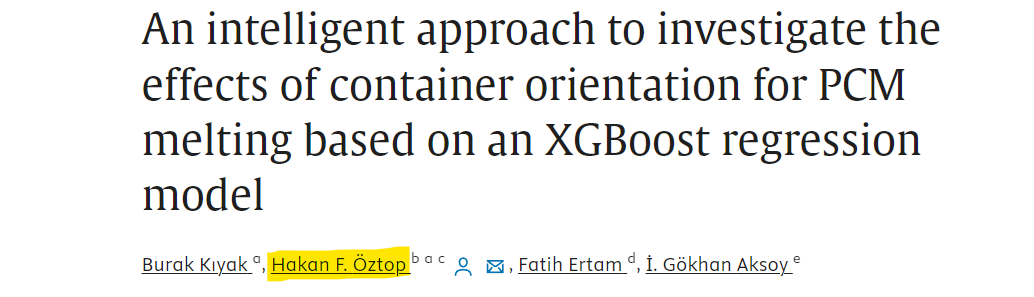
The above special issue can be used to make a few more bridges to part I. One of its papers, An intelligent approach to investiate the effects of container orientation for PCM…, is authored by Hakan Öztop. Öztop earned a small part in this FBS piece on Ali J. Chamkha, Rabczuk’s co-editor on the Act I special issue. He currently has 8 papers flagged on Pubpeer. Two of these earned an Expressions of Concern because they were published in the Act 2 special issue [1, 2]! Finally, a quick glance at his EABE special issue paper showed significant self-plagiarism, see PubPeer.
But back to Rabczuk:
Curriculum Vitae
Timon Rabczuk‘s CV can be found on his webpage at the Bauhaus University of Weimar:
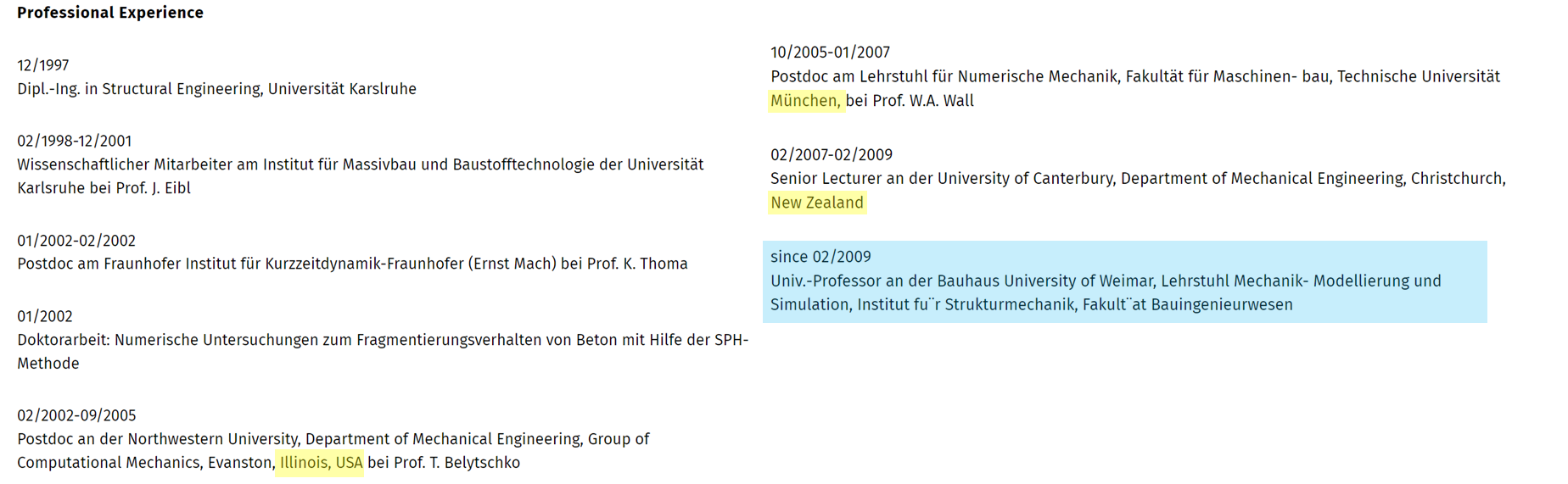
Rabczuk received his engineering education in southern Germany, concluding it with a PhD in 2002 at the Fraunhofer Institute in Freiburg. After this he went twice abroad, first for a 3 year post-doc position at Northwestern University (Illinois, USA), and later for a 2 year stay in New Zealand. In 2009 he settled back in Germany, receiving a full-time professorship at the Bauhaus University of Weimar. In the past 15 years he has made his career there and since June 2023 he can call himself Vice President of Research and Projects of Bauhaus University.
The most interesting part about a CV is the information that is not there. So let’s dig a tiny bit deeper. Rabczuk’s ResearchGate profile shows a nice list of affiliations:

The Bauhaus affiliation we obviously recognize. But what about the rest that are completely missing from his CV?
King Saud
Let’s start with the King Saud University in Saudi Arabia. The Spanish newspaper El Pais revealed last year that Saudi universities were paying up to 70,000 dollar/year to have ‘Clarivate highly cited’ scientist commit affiliation fraud. And Rabczuk happens to be one of the 12 German professors this investigation identified, see our Friday Shorts. It is often not easy to tell the main affiliation of a researcher, with Rabczuk’s affiliation list above above a good example of the complications. Clarivate took to simply asking the listed researchers for their affiliation. And as a result corrupted scientists could get loads of Saudi money by, well, lying about their affiliation.
In the case of Rabczuk his Clarivate record looks like this:
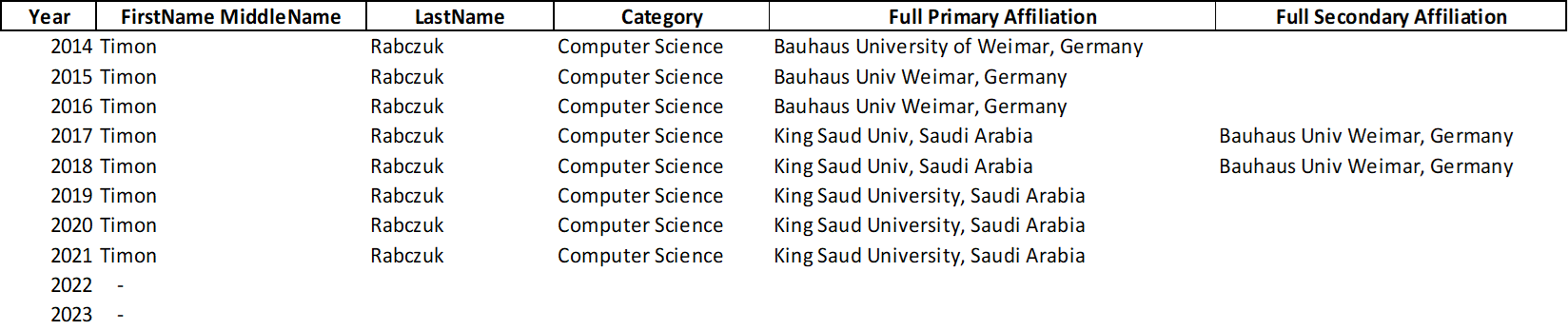
In 2014 Rabczuk was first listed as highly cited researcher and for the first three years he was content with his Bauhaus affiliation. In 2017 and 2018 King Saud became his primary affiliation, with Bauhaus still second. And in the 2019-2021 period he moved fully to Saudi Arabia, dropping the secondary attribution to “his” Bauhaus university. In 2022 Rabczuk no longer made it into Clarivate’s list of Highly Cited Researchers, possibly because of being delisted as he appears cited in equal measure in 2022.

The Highly Cited Researchers of Clarivate
“here is my advice to Clarivate: better get lost. ” – Alexander Magazinov

The Saudi bit is completely missing from his CV, which just shows a full-time employment as professor at Bauhaus University. And in his publication record on OpenAlex we can see that only in 2018 he started signing a fraction of his papers with a (virtual) King Saud affiliation: 0% (2017), 11% (2018), 19% (2019), 8% (2020), and 3% (2021).
Affiliation trickery like the above is often very much unappreciated by the university that is paying for its full time professor. Take the case of this Dutch professor Vincenzo Fogliano who was also feeding from the King Saud trough: it took just two weeks before he had to relinquish control of his group.
[Bauhaus University is aware, but their silence indicates they are happy with their Vice President. Maybe his governance colleagues hope for Saudi affiliation for themselves? -LS]
Double Vietnam
In Rabczuk’s affiliation list we also find two Vietnamese universities: Duy Tan and Ton Duc Thang University. And you can probably feel where this is going: like Karimipour, Rabczuk has a keen interest in advancing Vietnamese science from the goodness of his heart.
Due to this charitable behavior he became the subject of a flattering article in a major Vietnamese newspaper, aptly headlined “Lying about affiliations to promote university rankings“. The authors address the stellar rise of Vietnamese universities in the Shanghai Ranking. They show that it is just a bubble inflated by contributions from non-Vietnamese researchers who sign their papers with Vietnamese affiliations. The article singles out a number of authors:
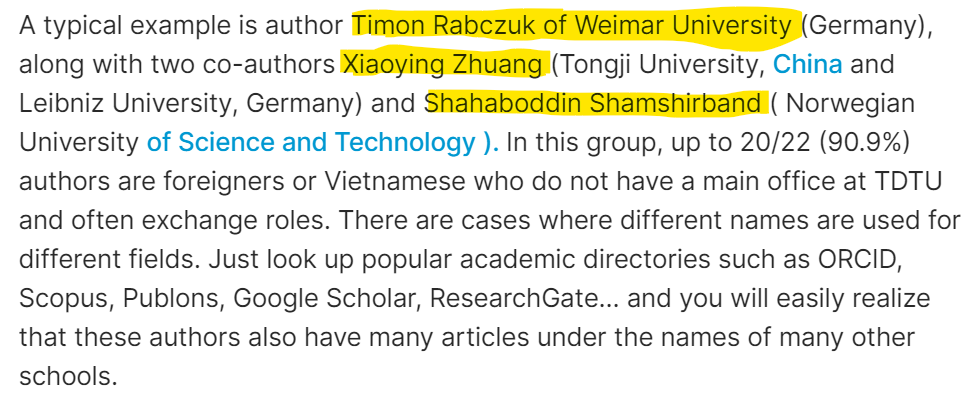
And yes, the author first mentioned is our Rabczuk. And number two is… his wife Xiaoying Zhuang. Zhuang is incidentally also Rabczuk’s most frequent co-author, featuring on more than 25% of his ~940 papers! And she is not only professor in Tongji University in China, but she is also Professor for Mechanics and Chair of Computational Science and Simulation Technology at the University of Hannover in Germany.
Number 3 in the list is the papermill fraudster Shahaboddin Shamshirband, whom Alexander Magazinov described as “one of the most retracted researchers ever, for over forty of his “research pieces“:

Wiley: Committed to integrity? Get out!
“We have initiated post-acceptance peer review with independent reviewers… ” – Wiley.
In the ‘Lying about affiliations’ newspaper article it is noted that the authors are affiliation-fluid: they publish with a range of affiliations and sometimes even change affiliation between submission and publication. Take the below Rabczuk paper:
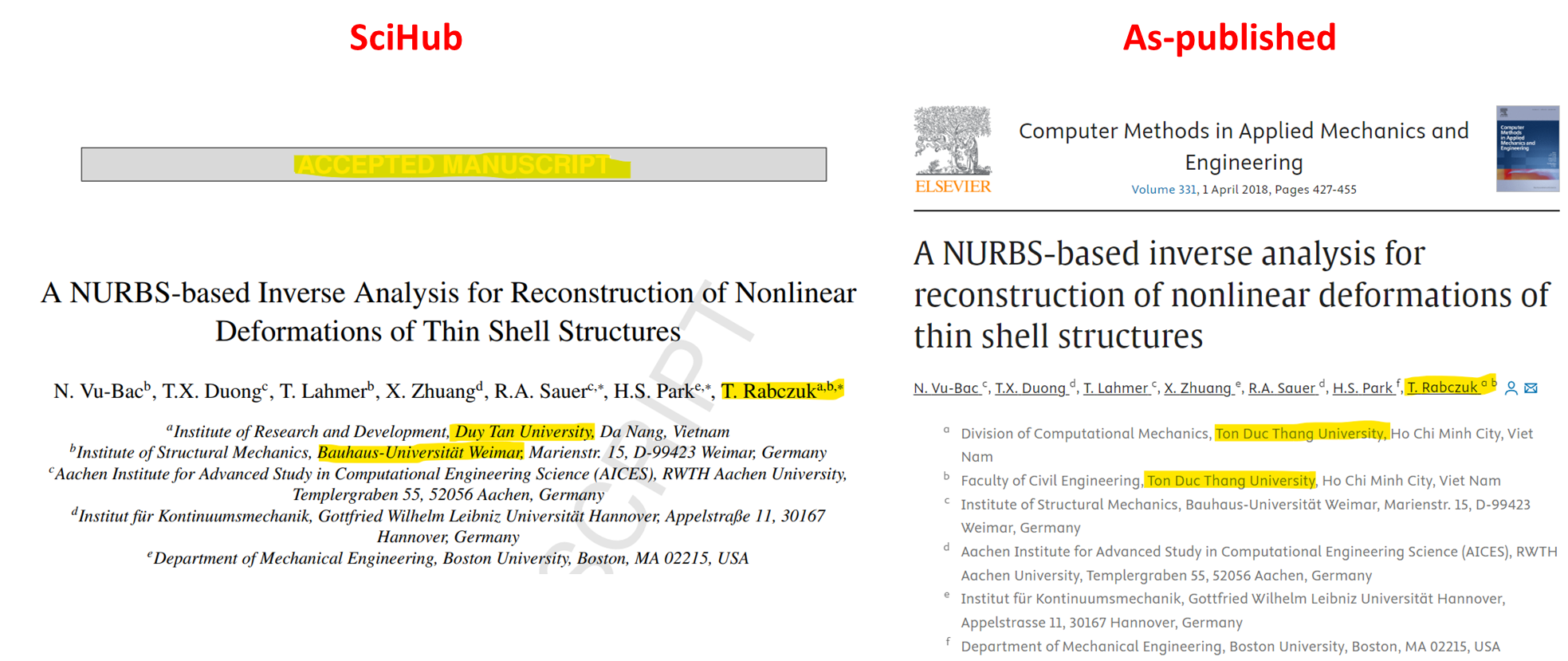
In the SciHub ‘Accepted’ version Rabczuk is affiliated with Duy Tan University and his actual Bauhaus employer. But in the as-published version he became affiliated with… Ton Duc Thang University. Is there maybe a spot market for affiliation fraud, with authors rapidly switching affiliation based on fluctuating rewards?
The above affiliation fraud is in itself already very bad, but it gets even worse. In the acknowledgements of the paper one can find the following:

The authors acknowledge support by the European Union through the the ERC COMBAT project. This was a project run by Bauhaus University that got a 2 million euro grant from the EU between 2014 and 2019. And guess who the principal investigator is:

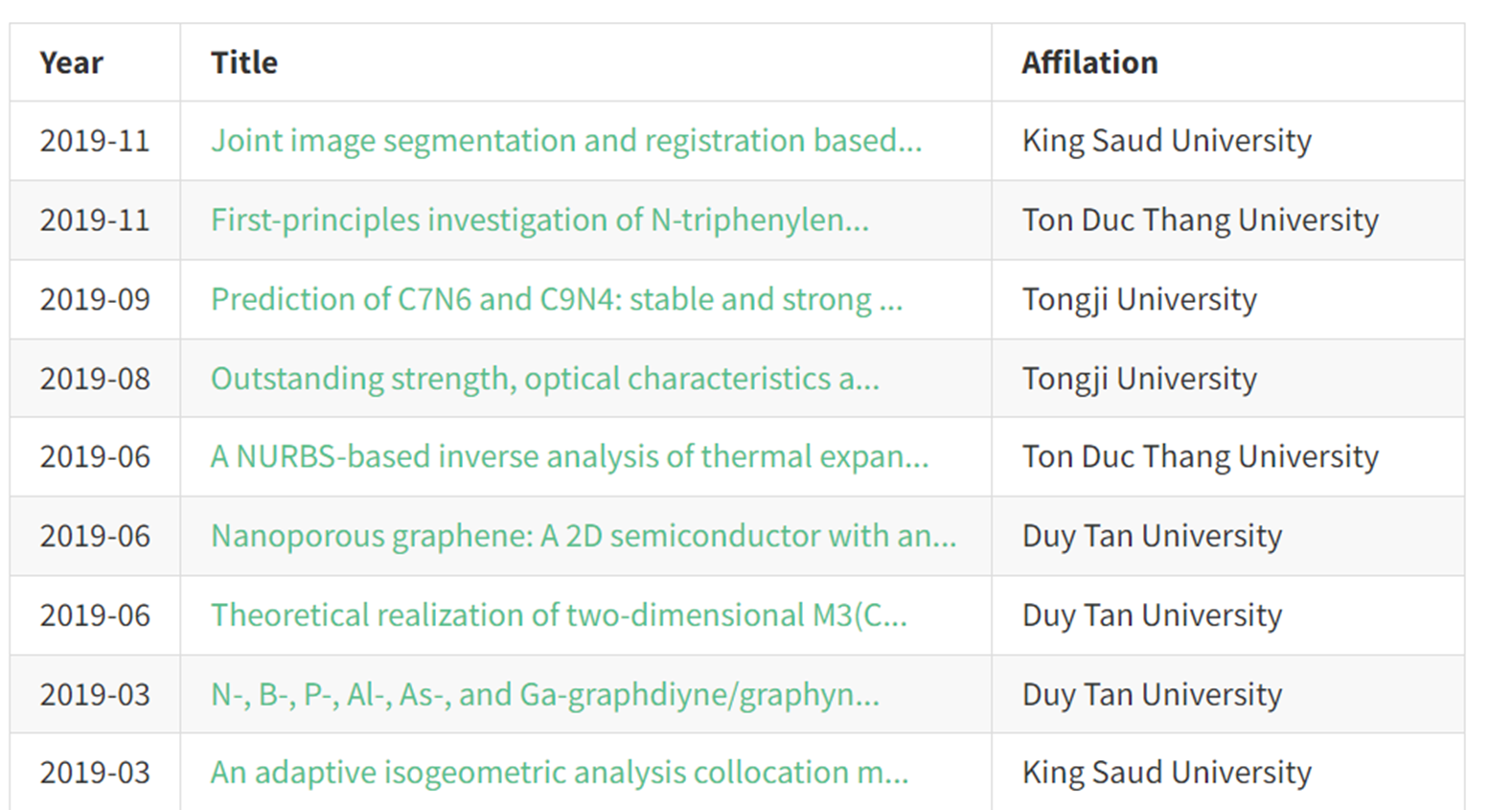
Yes, Rabczuk is the principal investigator. Our PI professor is happily accepting 2 million euro of European money, whilst at the same time optimizing his return-on-investment on a Vietnamese affiliation scam and cashing in on his ‘highly cited researcher’ accolades by also posing as King Saud researcher. And no, this was not a single mistake. There are 32 papers listed on PubPeer that were funded by Rabczuk’s EU project, but where he was using his more profitable affiliations in Saudi Arabia and Vietnam:
It is also worth noting that between 2014 and 2019, this Saudi-Arabian academic was participating in another €2 million-heavy EU grant: the Horizon 2020 project named “Environmentally best practices and optimisation in hydraulic fracturing for shale gas/oil development (BESTOFRAC)“. And although Saudi Arabia is fittingly oil-rich, he decided to author his first paper on the project’s publication list with a Vietnamese affiliation:
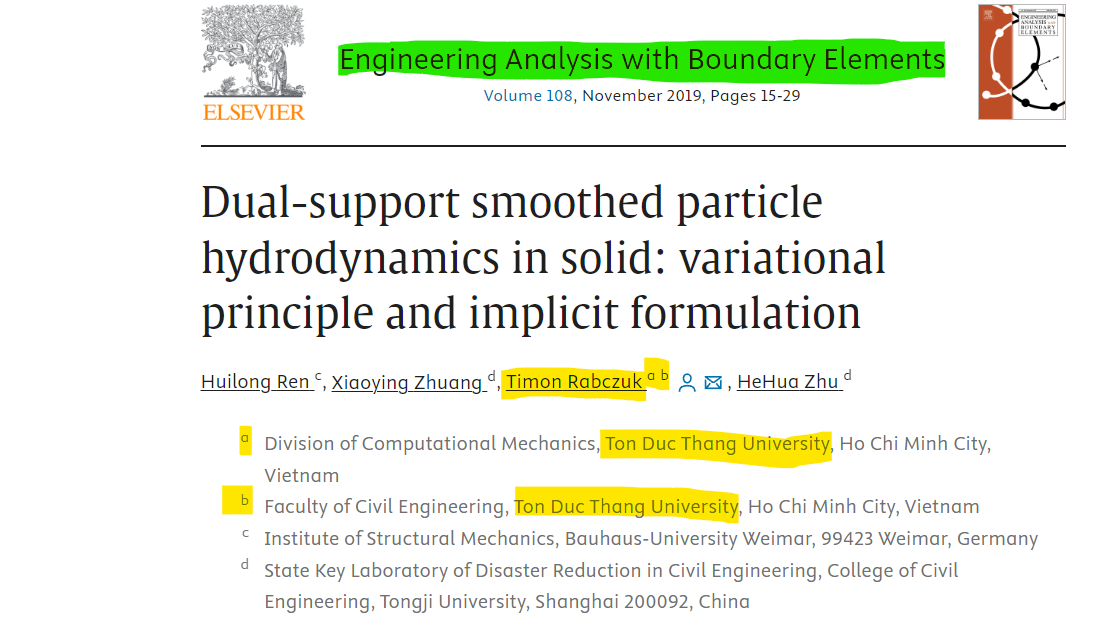
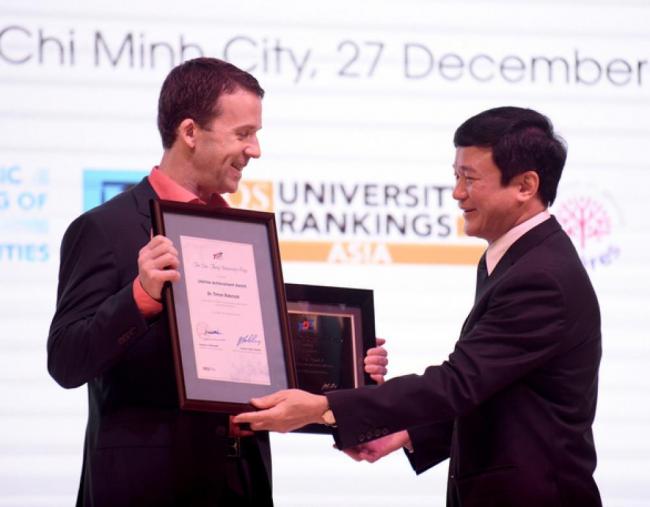
Rabczuk’s Vietnamese affiliation milking is, however, far more professional than that of Arash Karimipour. For one, he received the prestigious Ton Duc Thang University Price for the excellent rankings that the university obtained. And there are photographs of the price giving ceremony that show that Rabczuk has actually visited Vietnam!

I find it interesting that none of his CVs mention this brilliant award, not even the ‘Honors and Awards’ section of this one. What is also rather astonishing is that none of his CVs mention his second full professorship at Ton Duc Thang University:
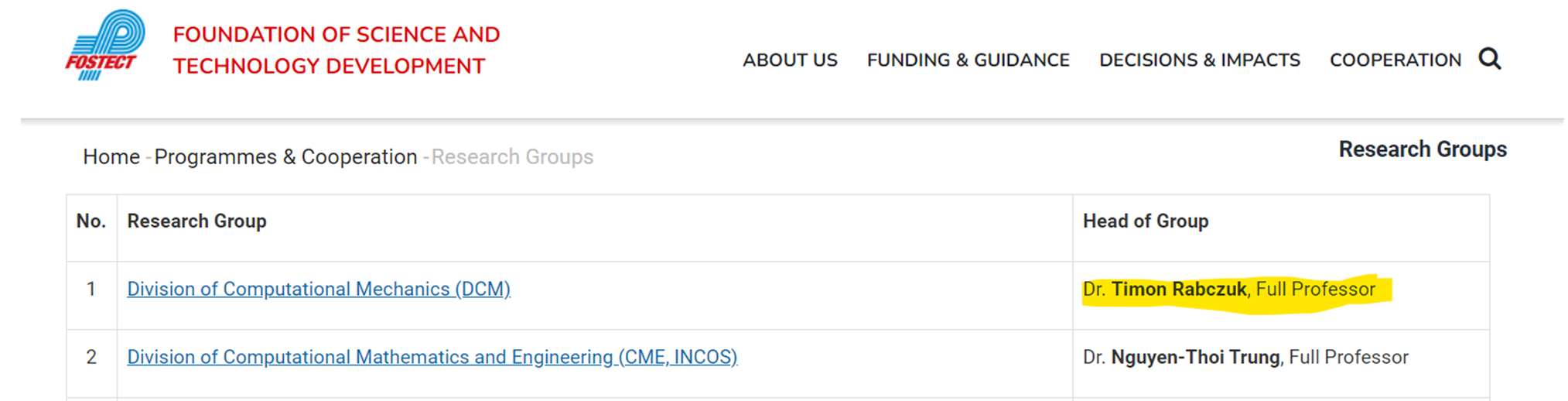
A full professorship does not seem a small thing. Imagine your CV: Bauhaus full professor, Bauhaus Vice President, and Ton Duc Thang full professor. Let’s hope his Tongji, King Saud, and Duy Tan affiliations are virtual or fake, otherwise Rabczuk would never have time for some well-deserved vacation…

Chen bacon sausage and Chen; Chen egg Chen Chen bacon and Chen…
Smut Clyde chases the ubiquitous multifaced Chen twins.

A highly cited paper
Clarivate’s Highly Cited Researchers list is filled with two types of researchers: famous influential bigwigs, and outright frauds. In citation lists, also garbage floats up because fraud is effective, making these lists highly enriched with dubious types. I want to discuss here one of Rabczuk’s highly cited papers. And it actually comes in a trio:
| Date | Title | Authors |
| 2020.06 | COVID-19 Pandemic Prediction for Hungary; A Hybrid Machine Learning Approach | Gergő Pintér, Imre Felde, Amir Mosavi, Pedram Ghamisi, Richard Gloaguen |
| 2020.10 | COVID-19 Outbreak Prediction with Machine Learning | Sina Faizollahzadeh Ardabili, Amir Mosavi, Pedram Ghamisi, Filip Ferdinand, Annamária R. Várkonyi-Kóczy, Uwe Reuter, Timon Rabczuk, Peter M. Atkinson |
| 2020.11 | Coronavirus Disease (COVID-19) Global Prediction Using Hybrid Artificial Intelligence Method of ANN Trained with Grey… | Sina Faizollahzadeh Ardabili, Amir Mosavi, Shahab S. Band, Annamária R. Várkonyi-Kóczy |
The topmost paper was submitted first and is published in MDPI’s Mathematics. It is one of these bombshell papers that takes the scientific community by surprise: it has accrued more than 220 citations, making it Mathematics‘ most-cited paper of 2020 and its second-most cited paper of all time. And then came Rabczuk’s paper, published in MDPI’s Algorithms. It also caused a splash, becoming Algorithms‘ most-cited paper of 2020 and its fifth-most cited paper of all time. And these accolades did certainly not go unnoticed, with MDPI’s Algorithms proudly posting the achievements on their Twitter/X account:

So did MDPI really struck gold here?
In the author list we see on all three papers a very familiar name: Amir Mosavi! We met him in Part I as the second special editor of Karimipour’s EABE special issue. Apart from being its editor he also turned out to be bulk citation beneficiary of that same SI.
Fittingly, Mosavi used to be sponsored by the German government as “Green Talent” and Alexander von Humboldt Fellow for his activities as Research Fellow at Bauhaus University Weimar and at the Thuringian Institute of Sustainability in the neighbouring town of Jena. Yes, really: our EABE special editor Mosavi was employed at Rabczuk’s own Institute of Structural Mechanics (ISM) at the Bauhaus University.
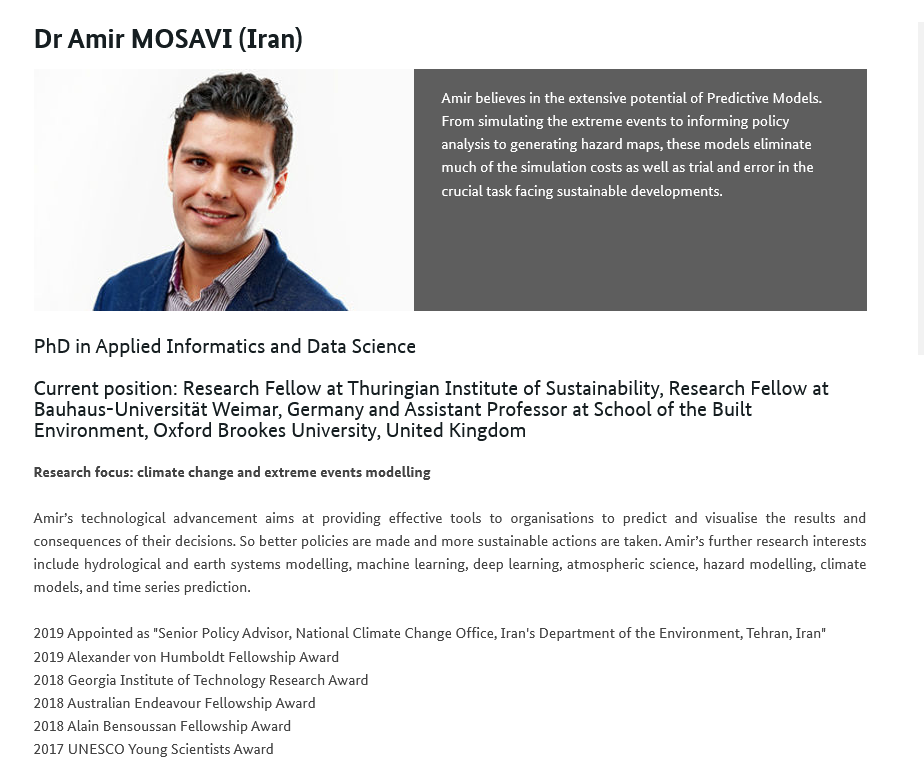
In the author list of the 2020.11 paper we also see a certain “Shahab S. Band“. That name may not directly ring a bell, but it is the new stage name of Shahaboddin Shamshirband whom we met above in the Lying about affiliations article. Shamshirband drew lots of negative attention on Retraction Watch, and after scoring some 41 retractions he was in dire need of a less recognizable name. Our Rabczuk has published 14 papers with Shamshirband and ~20 with Amir Mosavi. We even have this paper where all three sit cozily together, with Mosavi sporting his Bauhaus affiliation:
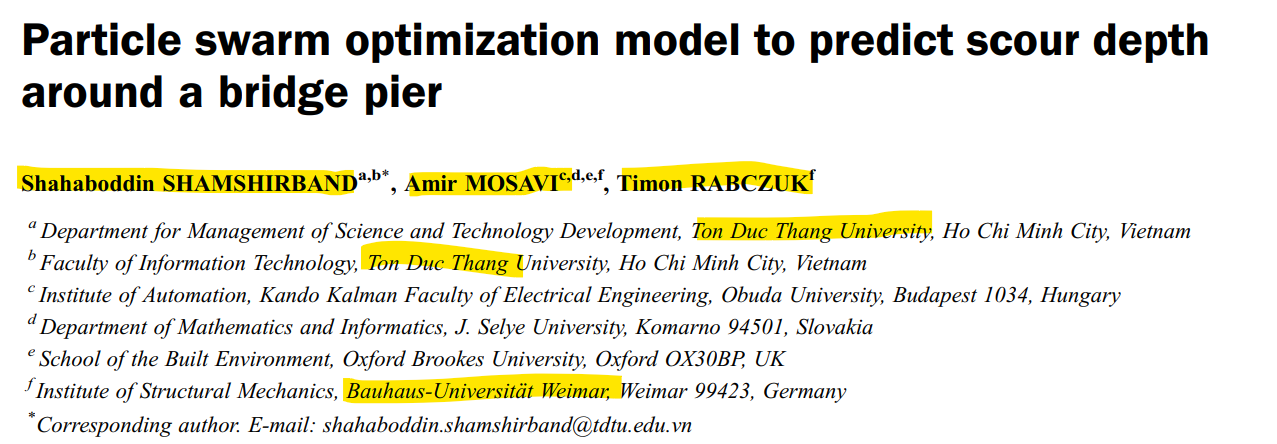
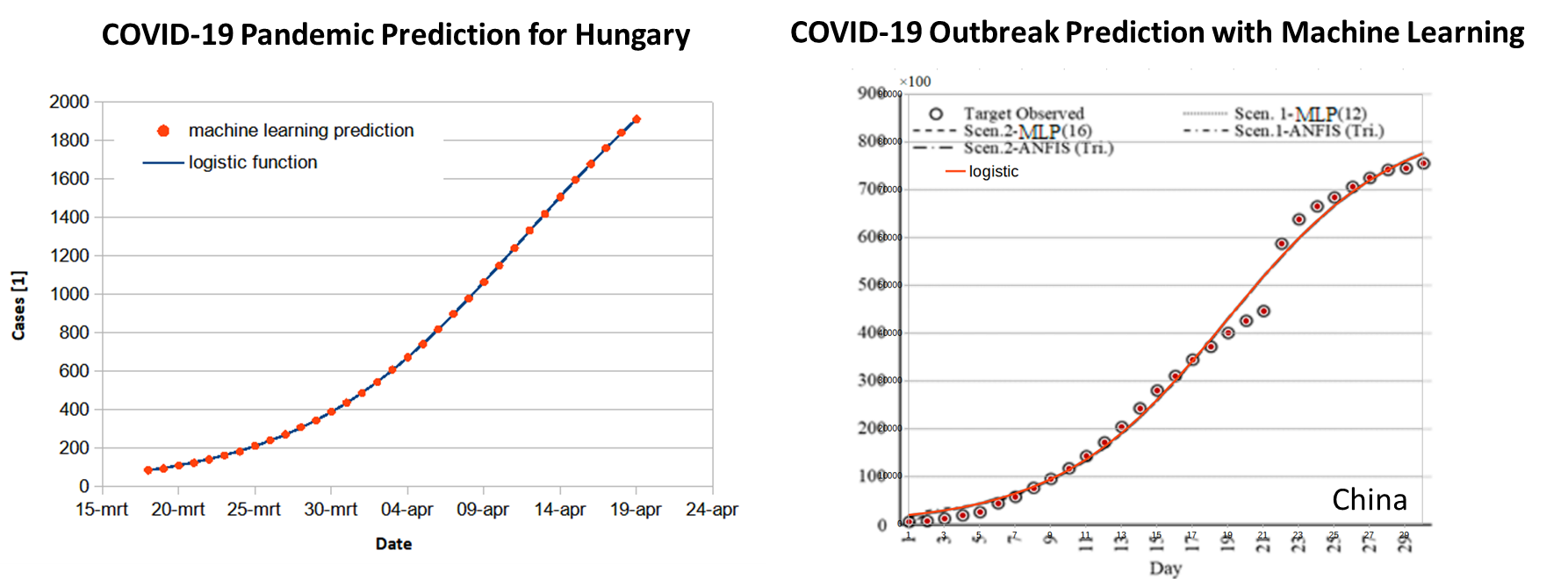
Finding Mosavi and Shamshirband as authors on these COVID papers is obviously a bad omen. And what also does not help is that the first two papers only share two authors. Both papers use identical machine learning models that output identical curves. Which raises prickly questions about author contributions.
Since it is mean and ad hominem to discredit papers based on their authors, we will also take a look at their content. And we can fortunately do that in an academic and peer-reviewed way by citing the January 2024 MDPI Algorithms (really!) paper by Károly Héberger. It is titled Frequent Errors in Modeling by Machine Learning: A Prototype Case of Predicting the Timely Evolution of COVID-19 Pandemic, and that mentioned ‘prototype case’ happens to be… Rabczuk’s COVID paper. The author uses strong imagery in his work, namely that of a sick horse:
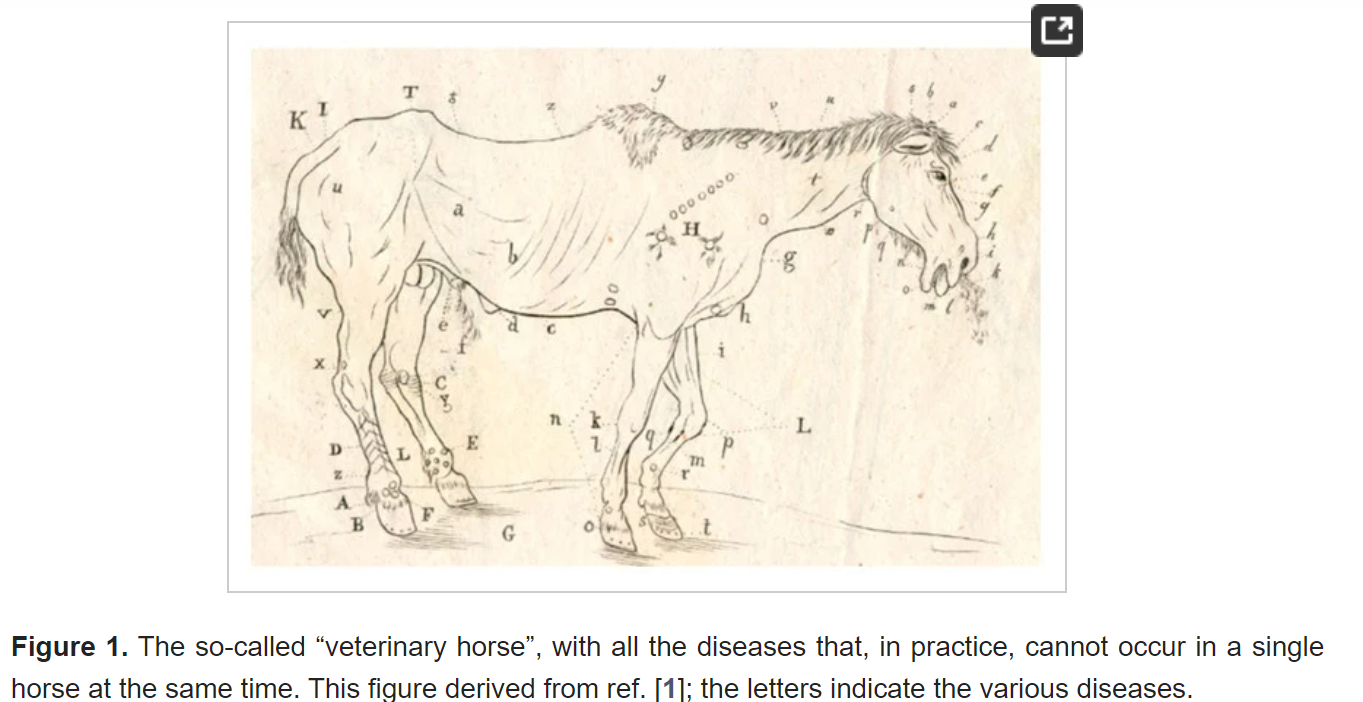
Take this quote from the introduction (highlights mine):
“One of its figures includes a sick horse, on which all the external and internal horse diseases are indicated that can affect the animal during its life (Figure 1). Naturally, such an animal cannot exist; still, it is used figuratively in the Hungarian language (“állatorvosi ló”, i.e., “veterinary horse”). One cannot find a scientific article that commits all possible (known) errors, but a recent, highly cited paper [2] can be used as a prototype for illustrative purposes.“
Károly Héberger (10.3390/a17010043)

Russkiy Mir at Elsevier and MDPI
Alexander Magazinov presents you two russian professors whom Elsevier and MDPI consider respectable: a Lt Colonel of putin’s mass-murdering army, and a machine-gun totting rascist. Both buy from papermills.
With Ref. [2] being Rabczuk’s highly-cited COVID product. Since this is an academic discourse, the author has to be careful and polite in his wording. Take this snippet (highlights mine):
“The authors honestly admit the fallacious modeling in the discussion section, but then they conclude that “machine learning [is] an effective tool to model the outbreak”. Why? Why did the editor and the reviewers not notice this? Even less understandable is the next statement that occurs twice in the paper: “a genuine novelty in outbreak prediction can be realized by integrating machine learning and SEIR models”, especially if we see that no such integration was involved in the study.
The only plausible explanation for such contradictions can be that neither the editor nor the reviewers read the manuscript fully, if the authors. The authorship is to be determined by the Vancouver criteria as prescribed by the ethical guide of MDPI“
Károly Héberger (10.3390/a17010043)
The author politely makes the point that the paper makes false claims, that neither editor, reviewers, nor authors read the manuscript, and that at least some of these things go against authorship and ethical guidelines of MDPI. On For Better Science we can be far more explicit: the three papers are not only incompetently written and erroneous, they are pure fakes. These stronger concerns were posted on PubPeer some half a year earlier and the editors of both Algorithms and Mathematics were informed in May 2023. When reaching out at the end of January 2024, I learned that their investigation was still ongoing.
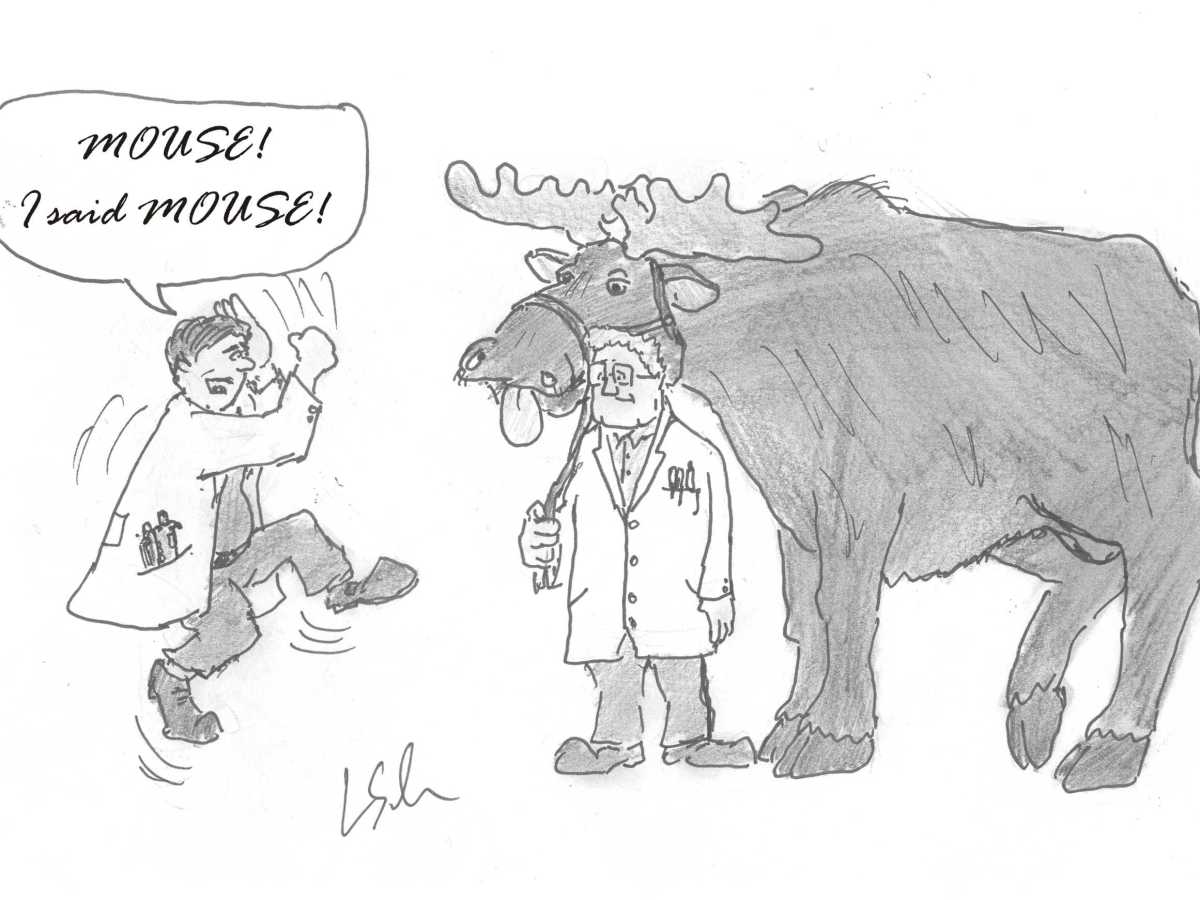
Bottom of the barrel: BatDolphin-based sparse fuzzy algorithm
“BatDolphin-based sparse fuzzy algorithm, cat swarm optimization, honey bees optimization, moth amalgamated elephant herding optimization, fitness sorted moth search algorithm, improved tunicate swarm optimization, lion algorithm, deer hunting optimization, various rider optimization schemes, grey wolf optimization, cuckoo search, and finally a bat algorithm. Such a zoo of names immediately raises suspicion, and for a good…
All three papers state to use a machine learning algorithm to predict future COVID case numbers based on a limited number of historical data points. The claim is that these machine learning algorithms do this accurately and generalized, without the need to choose a specific extrapolation function. If that is not enough, the neural networks are optimized with nature-inspired “Grey Wolf” and “Imperialist Competitive” algorithms. In Rabzcuk’s paper the general machine learning algorithms are contrasted with the limited effectiveness of fitting predefined functions. Except that the machine learning algorithms of the first two papers exactly reproduce one of the authors’ predefined (logistic) fits for each and every case. And in the last paper the machine learning models magically change their mind and output a pure quadratic function. And that is just lazy fabrication.

There are many fun observations to make about the Rabzcuk’s paper:
- It was posted to 12 preprint servers that often did not match the topic. The one posted to BodoArXiv (History of the middle ages) got even retracted, or rather, deleted completely.
- The authors submitted the paper to eight preprint servers after the paper was published in the open access journal Algorithms. Creating a novelty “postprint” publication?
- Many of the (bought?) citations went to these preprints, with e.g. the SSRN version thus far receiving 64 citations. Without preprints the main paper would have received more than 100 citations extra, making it actually the 3th most cited Mathematics paper of all time.
- Rabczuk’s paper was the only one in the MDPI special issue “Feature Papers in Evolutionary Algorithms and Machine Learning” (archived link). Amir Mosavi was obviously special editor, together with three other authors on the paper. MDPI must have been properly embarrassed as the above SI disappeared some time after me reporting the paper.
- The authors of the 2020 paper cite a 2013 article in the Bangladeshi International Journal of Agriculture and Crop Sciences. The journal features on Beall’s list and since 2018 its webpages serve porn (not suited for work). [85] Reshadsedghi, A.; Mahmoudi, A., Detection of almond varieties using impact acoustics and artificial neural networks. Int. J. Agric. Crop Sci. 2013, 6, 1008.
- The authors were hell-bent to get the above paper cited. The same paper got also published in Modern applied physics by the publisher Canadian Center of Science and Education. This publisher incidentally also features on Beall’s list, but is still operational. We can therefore still appreciate this important work, although it now comes with different authors: [84] Khalesi, S.; Mahmoudi, A.; Hosainpour, A.; Alipour, A. Detection of Walnut Varieties Using Impact Acoustics and Artificial Neural Networks (ANNs). Mod. Appl. Sci. 2012, 6, 43. And no, the paper was not relevant.
- The author contributions state that Timon Rabczuk contributed to the software, validation, formal analysis, investigation, resources, and data curation. But something must have gone terribly wrong with the software and validation of this highly-cited paper, as the paper’s authors failed to find the best logarithmic fit (PubPeer).
In conclusion, Rabczuk is a highly cited author who combines a Vice President of Research position with two full professorships in different countries. He receives his money from (EU) funding and it is not really credible that he does not receive money for his Saudi-Arabian, Vietnamese, and Chinese affiliation scams. And he is author on an extremely highly cited paper that is utterly fraudulent.
I thank all my donors for supporting my journalism. You can be one of them!
Make a one-time donation:
I thank all my donors for supporting my journalism. You can be one of them!
Make a monthly donation:
Choose an amount
Or enter a custom amount
Your contribution is appreciated.
Your contribution is appreciated.

 For Better Science
Grey wolf optimisation! Drink!
https://pubpeer.com/publications/D97AAA4C5EB99F3B2EC06C6D656370
LikeLiked by 1 person
When I google Mosavi many affiliations come up with his name. Just to be sure, is this his Google Scholar profile? https://scholar.google.ca/citations?user=NoyaZEsAAAAJ&hl=en . If yes, Mosavi is also in the grey wolf optimization business. But it should not be too surprising. Because it has a lot in common with Mirjalili, who has spent his academic life making small additions to well-known optimization methods, naming each addition after a different animal and thus becoming a professor in Australia. When I compare both names, I can see both spent some time in Obuda University, Hungary. When you go to Mirjalili’s profile ( https://scholar.google.ca/citations?hl=en&user=TJHmrREAAAAJ&view_op=list_works ), you will see that after defining the method with a new animal name for each simple addition, he got tired of animals and now names inanimate objects. Fortunately there are enough different inanimate objects in the world. Not to mention papermill and citationmill activities.
LikeLike
It is obviously better for ones health to only drink on metaheuristic retractions. But maybe we can toast on this groundbreaking Mexican-Indian addition to the field:
https://pubpeer.com/publications/810E12AD6595947DC0FA93224F2552
I am open for worse.
LikeLike
I just snorted with laughter: “price giving ceremony” 😂
“neither the editor nor the reviewers read the manuscript fully” – Many such cases.
LikeLike
Obviously a German full professor salary is so unsatisfactory that Rabczuk felt the necessity to round it up with extra emoluments even from that cutthroat regime of Saudi Arabia. Because pecunia non olet.
LikeLike
No no no. I wish to reiterate before lawyers arrive that of course Prof Rabczuk could never be paid by Saudi, Chinese and Vietnamese for these affiliations. He is an incorruptible man of high honour and principles.
Since he never took bribes, he must have abandoned his German affiliation in favour of others because he hates Bauhaus University, Germany, EU, their stupid human rights values, and adores totalitarian regimes of China, Vietnam and Saudi Arabia.
How about a russian affiliation now, Prof Rabczuk?
Rafi Luque has one.
LikeLike
Absolutely, there is no more decent and humble human being to walk on Earth. Gets paid and grants from EU and in practice donates them to such poor and democratic countries like Saudi Arabia and China.
LikeLiked by 1 person