Schneider Shorts 11.08.2023 – Spoiled in a damaged box
Schneider Shorts 11.08.2023 - a science superstar corrects a paper, Royal Society of Chemistry corrects an even better paper, a whistleblower acquitted, a cheater whitewashed, with Hindawi mass-retractions, duped MIT investors, and finally, a wrong editor to solve fraud issues.
Schneider Shorts of 11 August 2023 – a science superstar corrects a paper, Royal Society of Chemistry corrects an even better paper, a whistleblower acquitted, a cheater whitewashed, with Hindawi mass-retractions, duped MIT investors, and finally, a wrong editor to solve fraud issues.
Table of Discontent
Scholarly Publishing
An explanatory note – Why Tony Tiganis is the wrong editor to deal with fraud
Molecular and Cellular Biology (MCB) used to be a society journal, owned by the American Society for Microbiology. In December 2022, the journal has been sold to Taylor & Francis, and a new Editor-in-Chief appointed: Tony Tiganis, biochemistry professor at the Monash University in Melbourne, Australia.
Now Tiganis announced to submit a correction to himself for approval.
“The panels in Fig 4a correspond to Fig. 6a and were used by mistake due to a labelling error. This will be corrected with the publisher“
I am sure the Editor-in-Chief will approve of the intended correction. Dr Tiganis can also correct this paper of his, and explain how the figure remains meaningful despite the spliced-on gel lanes:
To be fair, Tiganis’s co-authors here are Barbara Kahn and Benjamin Neel. the former is not to be trusted with science, and I wrote about the latter in earlier Friday Shorts. The PubPeer-recorded issues with Tiganis’s papers are mostly about inappropriately spliced or duplicated western blots. Yet also for this Cell paper, Neel placed the responsibility for the fudged immunohistochemistry with Tiganis:
Tiganis: “We apologise for this error. We will correct this figure with the publisher“
This study by Tiganis, Kahn and Neel will need a new correction:
Kim Loh , Atsushi Fukushima , Xinmei Zhang , Sandra Galic , Dana Briggs , Pablo J. Enriori , Stephanie Simonds , Florian Wiede , Alexander Reichenbach , Christine Hauser , Natalie A. Sims , Kendra K. Bence , Sheng Zhang , Zhong-Yin Zhang , Barbara B. Kahn , Benjamin G. Neel , Zane B. Andrews , Michael A. Cowley , Tony Tiganis Elevated hypothalamic TCPTP in obesity contributes to cellular leptin resistanceCell Metabolism (2011) doi: 10.1016/j.cmet.2011.09.011
Another co-author you met above, UC Davis professor and department Vice-Chair Fawaz Haj, also seems to be a regular collaborator of Tiganis:
I’m not sure this can be fixed with a correction. Tiganis replied on PubPeer twice, both times his comments were moderated for some reason. The deleted Tony comments were:
“The senior author on this paper is Fawaz Haj and all the experimental work was undertaken in his lab”
Now what kind of attitude to research integrity do you expect from the MCB Editor-in-Chief Tiganis? Clare Francis alerted him to the case of a problematic French INSERM researcher and local politicianStéphane Dalle (his growing PubPeer record here), specifically this paper in MCB, with very similar manipulations as in Tiganis’s own papers:
“Thank you for alerting us to this data inconsistency. We will be alerting the senior author to provide an explanatory note and if possible rectify the matter“
A lot of papermill fraud ends up being cited in meta-studies and literature reviews. In rare cases, those writing such reviews and meta-analyses actually read what they are citing.
René Aquarius, a postdoc at the Radboud University, posted this on PubPeer:
“Dear authors,
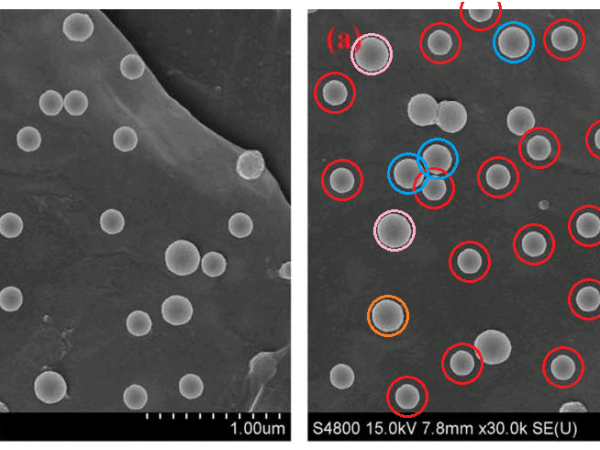
While working on a systematic review we included several of your papers. When analyzing the figures in these studies, we noticed a considerable overlap between figures published in different studies. We’ve lined up all the overlaps we’ve found so far in the attached figures at the bottom of this message, including the ones specified below related specifically to this study.
In this study we found an overlap between figure 1, panel A and:
PMID 26163325, figure 1, panels D & G
PMID 25894080, figure 1, panel A
For transparency: we will also notify the journals that published your papers with our findings
Best, René Aquarius”
The “author” of the criticised study, Chih-Zen Chang, replied on PubPeer:
“Dear sir: Thanks for the comments. The figures were original at all. The particles looks similar, but the brightness, distance and contours were different , under the high power field. Thanks again. We apologize for unable to. offer the original films, caused they were spoiled in a damaged box.“
“Now no-one wants ForBetterScience to become an all-Papermill channel. And we cannot really expect to shame or inspire scriveners in the academic-ghostwriter industry to seek out more constructive applications for their talents, so the point of exposing them is not immediately obvious.” -Smut Clyde
In earlier Friday Shorts, I wrote about Kostya “Ken” Ostrikov, the Ukrainian-born professor at Queensland University of Technology in Australia, who published a fake paper with some Iranians.
When contacted a few months ago, Ostrikov replied immediately and explained to me:
“I am only trying to help very few young and aspiring people who do not have world-class opportunities for scientific research in their countries and want to build careers internationally, so to say “escape” for a better opportunity. […]
I have immediately checked the comment and contacted the first and corresponding author to carefully check the XRD spectra highlighted in the comment, and the original data.
I also carefully explained them the proper actions to take to respond to the comment, make corrections if this is just an error (e.g., in data processing, etc.) which does not affect the conclusions of the work“
And this was what Ostrikov did. On 28 July 2023, he achieved a Correction:
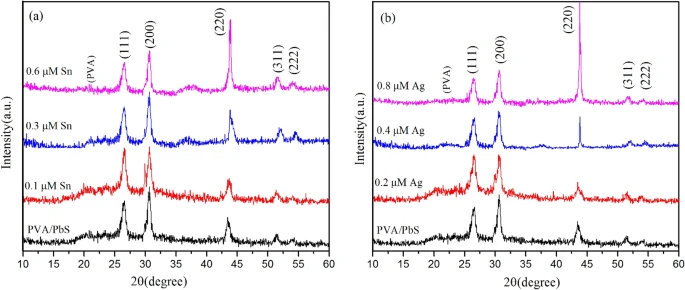
“The original version of this Article contained errors in Figure 1. During preparation of Figure 1 some of the data has been inappropriately superimposed. As a result, in Figure 1A a section of the spectrum for the “0.6 μM Sn” condition overlapped with a corresponding section in the spectrum of the “0.3 μM Sn” condition. A section of the spectrum for the “0.8 μM Ag” condition overlapped with corresponding sections in the spectra for “0.4 μM Ag” in Figure 1B, and “0.6 μM Sn” and “0.3 μM Sn” conditions in Figure 1A.”
The bad Figure 1 was replaced with this new version:
However, the new Figure 1b is fake also. Worse, the problem was already flagged on PubPeer in April 2023. But hey, Scientific Reports already accepted the correction, and Kostya is a self-professed science superstar, so the case is closed.
This time, Ostrikov did not reply to my email. Not yet.
Confirmed by an investigation from the affiliated institution
Another inappropriate correction, this time for some Indian crooks led by Amita Verma from University of Allahabad, with a hefty PubPeer record and a list of retractions. The Royal Society of Chemistry (RSC) now looks very stupid and incompetent. Aneurus Inconstans previously wrote about Verma and her colleagues:
And from “Figure 5 of yet another paper by same group (Yadav et al 2017 Biomed Pharmacother) published a year before. Treatment and topic were different.“
“The authors have provided a replacement figure for consideration and say that the new data does not affect the conclusions of the paper. The Royal Society of Chemistry has asked the affiliated institution to investigate this matter and establish whether the replacement images provided by the authors provide an accurate representation of the experiments that were conducted, and confirm the integrity and reliability of the new data provided.“
Now behold, the resulting Correction from 28 July 2023:
“The authors regret that there was an error in Fig. 3 whereby incorrect wound healing images were used. This was due to poor management of a large dataset of photographs and we apologize for this purely unintentional error. The correct Fig. 3 is provided herein. The accuracy and integrity of the replacement images in Fig. 3 have been confirmed by an investigation from the affiliated institution.“
Photographic representation of the wound healing process in the excision wound model, showing the control (Group 1), standard drug (Group 2), ZnOTP1% treated (Group 3) and ZnOTP2% treated (Group 4) at 0, 3, 6, 9, 12, 15 and 17 days post wounding.
This correction supersedes the information provided in the Expression of Concern related to this article.
The Royal Society of Chemistry apologises for these errors and any consequent inconvenience to authors and readers.“
Incredible, eh? But it’s even worse, as one PubPeer commenter noted:
“I do not understand the first row of the corrected Figure. It uses just one image for all four conditions, but these should be four separate wounds, presumably on four separate mice.“
Indeed, this first row make no sense at all, even if one disregards all the other issues. It only proves the authors don’t even understand what exactly they were faking. But it passed institutional investigation, and peer review at RSC and another publisher. It is YOU who does science wrong.
Smut Clyde goes nanotechnology again and disagrees with Royal Society of Chemistry and the Chinese authorities on how honest a researcher Mi-Cong Jin is.
Elisabeth Bikblogged about mass retractions at Hindawi:
“A simple search on the Hindawi website shows that the number of retractions might be even much higher. Hindawi retracted its first paper in 2009. From 2009 to 2019, Hindawi retracted an average of 26 papers per year. But in 2022, the publisher published 351 retractions, and in 2023 that number skyrocketed to 3936 – and it is only August!
Retractions of Hindawi papers, 2009-August 2023.
Elisabeth also has a the list of papermill-affected journals and their retractions, all with the same retraction notice which mentions “Inappropriate citations – Incoherent, meaningless and/or irrelevant content included in the article – Peer-review manipulation“:
BioMed Research International [142 papers retracted]
Computational and Mathematical Methods in Medicine [423]
Computational Intelligence and Neuroscience [585]
Contrast Media & Molecular Imaging [138]
Disease Markers [120]
Evidence-Based Complementary and Alternative Medicine [459]
Journal of Environmental and Public Health [216]
Journal of Healthcare Engineering [396]
Journal of Nanomaterials [42]
Mathematical Problems in Engineering [210]
Mobile Information Systems [190]
Oxidative Medicine and Cellular Longevity [45]
Scanning [46]
Scientific Programming [84]
Security and Communication Networks [241]
Wireless Communications and Mobile Computing [437]
Parashorea tomentella continues their investigation of Hindawi’s uneasy collaboration with Chinese papermills. Can it be solved with the promised 511 retractions?
Elisabeth discusses some of the papermill publications, and also invites you to join the hunt:
“As a side project, the search term “No data were used to support this study” returns over 8,000 results in Google Scholar, many of which are on the Hindawi.com site. One has to appreciate that no data was harmed to create these fake papers! Many of these papers deserve scrutiny, so if you have some free time, please help by writing some critical reviews on PubPeer.
Industry Giants
Help Syrian refugees
New reporting on the case of the fraudulent Open Agriculture Initiative (OpenAg) business with phony “food computers” by the MIT and its Media Lab. Basically, the former MIT researcher Caleb Harper claimed to have created a magic box where all possible foods can grow, which he proved by buying veg in a supermarket and stuffing those into his box to be photographed. As it happens, MIT Media Lab used to be sponsored by the convicted paedophile and billionaire pimp Jeffrey Epstein. In earlier Friday Shorts, I previously wrote about this scam and the former MIT researcher Babak Babakinejad who was fired for blowing the whistle. He then sued the university.
“The university, through its lawyers in recent court hearings, has denied that there was any research misconduct and has fought efforts to force the college to disclose OpenAg’s fundraising information. But in July, a judge ordered the school to disclose to prosecutors “any fundraising goal(s) established by MIT for the project; and … the total amount raised for the project.”
While the judge’s order doesn’t say MIT must disclose names of donors, the university’s own website shows that at least 14 corporate sponsors gave money to the project. Contracts reviewed by the Business Journal for a handful of those deals show that at least $4.9 million was raised, although the actual amount raised may be significantly higher, since those contracts only cover three of the 14 donors listed on MIT’s website. […]
The project also appears to earned a grant of nearly $250,000 from the U.S. State Department in July 2017 to share the technology with a university in Vietnam, according to a government website and an associated purchase order obtained by the Business Journal. According to a person involved in the partnership, no technology was ever sent to Vietnam as a result. While it’s unclear whether MIT ever actually spent any of the grant money, it wasn’t until September 2022 — more than two years after the project was shut down, and a month after the Business Journal published a cover story on OpenAg — that the university appears to have quietly “deobligated,” or cancelled the disbursement of, the grant money.”
Among Open Ag industry sponsors were Indian textile manufacturer Welspun ($1.6 million), Italian chocolate maker Ferrero ($250,000), US retailer Target Corp. ($3 million) and others including “General Mills, Google, National Geographic, Unilever, IDEO and Lee Kum Kee.”
This is really mean:
“It’s unclear when the university became aware of allegations of research misconduct at OpenAg. A letter in May 2018 from Babakinejad, the researcher now suing MIT, to MIT’s general counsel’s office raised doubts about the research methods more than a year before those allegations became public. But according to an October 2019 report by IEEE Spectrum, there was evidence in early 2017 that a widely publicized project to send food computers to help Syrian refugees did not work.”
MIT is busy hushing up the affair. Harper was let go, the whistleblower was sacked, Epstein is dead, can we please just forget and move on? Also about the investor money?
News in Brief
Philadelphia Inquirerreports: “Steven Houser, a prominent Temple University heart-disease scientist involved in a bitter research feud with longtime colleague Arthur Feldman, has settled a federal lawsuit against Feldman and the school, and is retiring in June. Terms of the settlement were not disclosed. […] Still unclear is the status of a university investigation into possible misconduct on more than a dozen studies on heart disease, at least nine of which were co-authored by Houser“. You can read the background of this story here:
In the case of Italian exosome researcher Christina Frezza (read earlier Friday Shorts here and here) and his fake exosomes in Frezza et al Cell 2006, his current employer University of Cologne in Germany made a decision. Oliver Höing, PA of the Vice-Rector for Research, informed me (translated): “As part of administrative assistance, the University of Padua has confidentially sent us its investigation report on the case you have reported (https://forbetterscience.com/2023/04/21/schneider-shorts-21-04-2023-so-much-work -of-high-quality/#frezza) concluding that there was no scientific misconduct. From the point of view of the Good Scientific Practice Commission of the University of Cologne, there is therefore no sufficient suspicion to initiate an investigation.” The trick is to always try to avoid an investigation. So this is how scientists at Universities of Padova and Cologne are expected to do science:
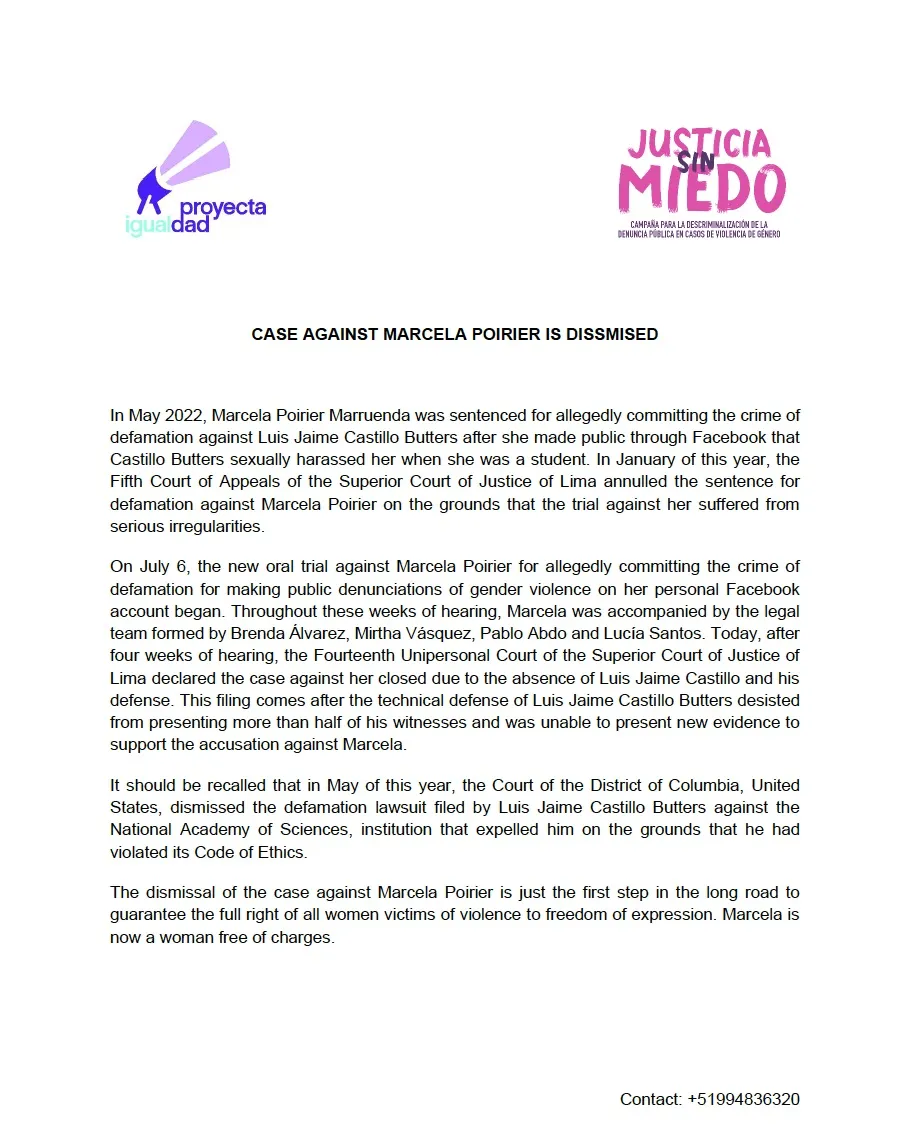
Michael Balterreported on 7 August 2023: “This morning in Lima, Peru, a judge dismissed a long-running defamation case by archaeologist Luis Jaime Castillo Butters against Peruvian anthropologist Marcela Poirier, whose only crime was to expose his misconduct. The dismissal comes on the heels of Castillo’s loss in a defamation suit he had filed in U.S. federal court against the National Academy of Sciences and its president, Marcia McNutt, after the NAS kicked him out after its own investigation into his behavior. […] The judge in the Lima suit dismissed the case with prejudice (meaning it cannot be refiled) after Castillo and his attorney failed to appear in court.” Read about the backstory on Balter’s blog and my summaries here.
Press release shared by Balter
One-Time
Monthly
I thank all my donors for supporting my journalism. You can be one of them! Make a one-time donation:
I thank all my donors for supporting my journalism. You can be one of them! Make a monthly donation:
“Meanwhile, I submitted the suspicions which you formulated in context with the work of Prof. Frezza to an expert for the subject, who came to the conclusion that the similar-looking images you marked are not identical.”
So Cologne investigated and found nothing wrong. Which may simply have been confirmed by Padova. What an affront!
Yes, they used a two-pronged approach to avoid a proper investigation. In Cologne, they had an “expert”. In Padova, they did what they always do in Italy, probably declared the evidence as inadmissible because the PubPeer comments are anonymous.
Following the publication of this article [1], concerns were raised regarding the results presented in Figs 1 and 5. Specifically,
In Fig 1A, the following bands appear similar:
○ The band representing K/R in the mPTP1B panel and the band representing Con in the Tubulin panel
○ The bands representing KO and D/A in the Tubulin panel
The Fig 5A Tubulin panel of this article [1] appears similar to lanes 2–13 of the Fig 3C STAT3 panel of [2] when rotated 180°. The corresponding author commented that he is not aware of rearranging, splicing, or cutting of blots during figure preparation and that the original data underlying Figs 1 and 5 are no longer available. Instead, the corresponding author provided supporting data from repeat experiments, which are available in the S1, S8, and S9 Files provided with this notice. In the absence of the original underlying data, the concerns with Figs 1A and 5A cannot be fully resolved and these results should be interpreted with caution.
In following up on these issues, the authors provided the available underlying data for other figures in the article (S2–S7 Files).
The PLOS ONE Editors issue this Expression of Concern to notify readers of the above concerns and to relay the available data provided by the corresponding author.
The Fig. 5A Tubulin panel reports material from [2], published in 2011 by Bettaieb et al, under a CC-BY 4.0 DEED license. At the time of publication of this Expression of Concern, this article [1] was republished to update the Fig 5 legend to provide correct attribution.
References
1.Matsuo K, Bettaieb A, Nagata N, Matsuo I, Keilhack H, Haj FG (2011) Regulation of Brown Fat Adipogenesis by Protein Tyrosine Phosphatase 1B. PLoS ONE 6(1): e16446. pmid:21305007
2.Bettaieb A, Liu S, Xi Y, Nagata N, Matsuo K, Matsuo I, et al (2011) Differential regulation of endoplasmic reticulum stress by protein tyrosine phosphatase 1B and T cell protein tyrosine phosphatase. Journal of Biological Chemistry, 286 (11): 9225–9235. pmid:21216966














 For Better Science
Your ‘no investigation’ accusation towards the University of Cologne is wrong. As you wrote in your shorts (https://forbetterscience.com/2023/04/21/schneider-shorts-21-04-2023-so-much-work-of-high-quality/#frezza):
“Meanwhile, I submitted the suspicions which you formulated in context with the work of Prof. Frezza to an expert for the subject, who came to the conclusion that the similar-looking images you marked are not identical.”
So Cologne investigated and found nothing wrong. Which may simply have been confirmed by Padova. What an affront!
LikeLike
Yes, they used a two-pronged approach to avoid a proper investigation. In Cologne, they had an “expert”. In Padova, they did what they always do in Italy, probably declared the evidence as inadmissible because the PubPeer comments are anonymous.
LikeLiked by 1 person
Tony Tiganis corrects.
https://www.jci.org/articles/view/175163
LikeLike
17 November 2023 correction for Tony Tiganis.
https://www.tandfonline.com/doi/full/10.1080/10985549.2023.2277100
LikeLike
An explanatory note – Why Tony Tiganis is the wrong editor to deal with fraud
Does anybody have an explanation for this? PubPeer – The T-cell protein tyrosine phosphatase is phosphorylated on…
LikeLiked by 1 person
Tony Tiganis wrote that non-authors should contact the other authors for the data, although he is himself penultimate author. There is more wrong with the paper. PubPeer – Pancreatic T cell protein-tyrosine phosphatase deficiency am… and PubPeer – Pancreatic T cell protein-tyrosine phosphatase deficiency am…
LikeLike
Another curious Tony Tiganis paper. PubPeer – DNA replication stalling attenuates tyrosine kinase signalin…
LikeLike
“Another co-author you met above, UC Davis professor and department Vice-Chair Fawaz Haj, also seems to be a regular collaborator of Tiganis”
21 December 2023 Expression of Concern.
https://journals.plos.org/plosone/article?id=10.1371/journal.pone.0296401
Following the publication of this article [1], concerns were raised regarding the results presented in Figs 1 and 5. Specifically,
In Fig 1A, the following bands appear similar:
○ The band representing K/R in the mPTP1B panel and the band representing Con in the Tubulin panel
○ The bands representing KO and D/A in the Tubulin panel
The Fig 5A Tubulin panel of this article [1] appears similar to lanes 2–13 of the Fig 3C STAT3 panel of [2] when rotated 180°. The corresponding author commented that he is not aware of rearranging, splicing, or cutting of blots during figure preparation and that the original data underlying Figs 1 and 5 are no longer available. Instead, the corresponding author provided supporting data from repeat experiments, which are available in the S1, S8, and S9 Files provided with this notice. In the absence of the original underlying data, the concerns with Figs 1A and 5A cannot be fully resolved and these results should be interpreted with caution.
In following up on these issues, the authors provided the available underlying data for other figures in the article (S2–S7 Files).
The PLOS ONE Editors issue this Expression of Concern to notify readers of the above concerns and to relay the available data provided by the corresponding author.
The Fig. 5A Tubulin panel reports material from [2], published in 2011 by Bettaieb et al, under a CC-BY 4.0 DEED license. At the time of publication of this Expression of Concern, this article [1] was republished to update the Fig 5 legend to provide correct attribution.
References
1.Matsuo K, Bettaieb A, Nagata N, Matsuo I, Keilhack H, Haj FG (2011) Regulation of Brown Fat Adipogenesis by Protein Tyrosine Phosphatase 1B. PLoS ONE 6(1): e16446. pmid:21305007
2.Bettaieb A, Liu S, Xi Y, Nagata N, Matsuo K, Matsuo I, et al (2011) Differential regulation of endoplasmic reticulum stress by protein tyrosine phosphatase 1B and T cell protein tyrosine phosphatase. Journal of Biological Chemistry, 286 (11): 9225–9235. pmid:21216966
LikeLike
“Barbara Kahn and Benjamin Neel. the former is not to be trusted with science”
06 May 2024 Nature editorial Expression of Concern for Barbara Kahn
Editorial Expression of Concern: Leptin stimulates fatty-acid oxidation by activating AMP-activated protein kinase | Nature
LikeLike
“Barbara Kahn and Benjamin Neel. the former is not to be trusted with science”
Bad penny: PubPeer – Regulation of early events in integrin signaling by protein…
LikeLike