

Maarten van Kampen follows the previous reporting of Alexander Magazinov to tell you more about a certain Ali Chamkha.
His papers often look like from papermills, evidenced by unlikely co-authorships, inappropriate citations and tortured phrases like “unmitigated warming discrepancy” (for absolute temperature variation). Chamkha also set up his own predatory journal with a known predatory publisher. He uses this journal to generate oodles of citations to his own garbage papers, and abuses his editorial positions in “proper” journals for same purpose. Boring? Heard it before? Well, this dude is peer-reviewing ERC grants exactly because he is so highly published and highly cited.
A year ago, in February 2022, Chamkha educated the world via Elsevier that
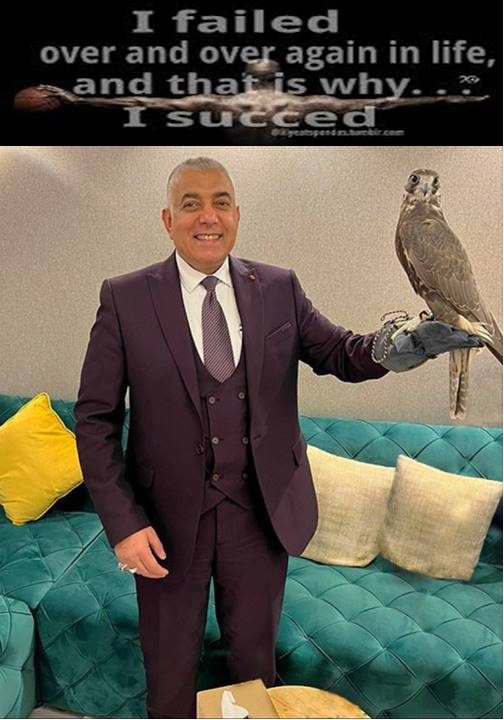
“Ali J. Chamkha is a Distinguished Professor of Mechanical Engineering and Dean of Engineering at Kuwait College of Science and Technology. […]
He has authored and co-authored over 950 publications in archival international journals and conferences. Professor Chamkha was included in the World’s Top 2% Scientists 2020 and 2021 lists (by Stanford University) with a Global Rank #20 out of a total of 109,724 and Rank #1 at the Arab World level in Mechanical Engineering and Transports category with a composite score of 4.5451205. His score puts him in the top 0.01822755% worldwide.”
In 2020 Magazinov reported to Wiley a “Special Issue” in the journal Mathematical Methods in the Applied Sciences, one of the guest editors was Chamkha.
The papers in this Special Issue (spreadsheet here) were utter garbage, authored, or rather bought off a papermill, some known fraudsters among the authors. Wiley put the issue on hold, for two years, the 94 papers remain online, unretracted yet never assigned to a journal volume. The peculiarity of these papers was that they generously attributed citations to Chamkha (no less than 348 times!) as well as to other notorious papermillers and citation scammers.
More about Chamkha here:
Wiley: Committed to integrity? Get out!
“We have initiated post-acceptance peer review with independent reviewers… ” – Wiley.

And now, over to Maarten van Kampen:
Bottom of the barrel: Nanofluids & Chamkha
By Maarten van Kampen
When starting my science detective “career” I promised myself to stick to respectable journals, basically for self preservation. When going low enough, Hindawi or Elsevier’s Microprocessors and Microsystems level, the swamp is so deep that drowning is nearly inevitable. Or, worse, one could become a disillusioned and cynical science journalist (we won’t be pointing fingers here). Then Alexander Magazinov introduced me to Ali Chamkha and showed me how much delight there can be at the bottom….
Addition 2023-09-10: I recently became aware of the 2021-11 Vietnamese news article Who is Vietnam’s ‘No. 1 scientist’? You may guess!
Ali J. Chamkha
Ali Chamkha is a Very Important Person. He has his own vanity domain alichamkha.net (complete with motivational meme gallery!), a personal motto (“Where it is to be, it is really up to me!“), and a CV that counts one-hundred-eleven pages of densely packed achievements.
Did you know that Chamkha is “Ranked in the World’s Top 0.02267% Scientist“? Or that he “Completed all degrees in a record time of five years“? And that he is listed on page 136 of the 2nd edition of Who’s Who in Science and engineering? Shifting to page 155 and 207 for respectively the 3th and 5th edition?


The story of Chamkha’s scientific research success is stellar. His h-index grew from 75 in 2019 to over 100 now, a feat that is proudly broadcast on his LinkedIn account. And did you know he authored over a 1000 papers, letting him publish one paper every three days for the last four years? In short, Chamkha is a highly successful, be it somewhat vain, researcher.
There is obviously also a darker side. Back in 2020 Alexander found that Chamkha abused a special issue to extort some 348 citations to himself. In fact, his citation rigging was so extensive that Clarivate removed his entry as ‘Highly Cited Researcher’.

The Highly Cited Researchers of Clarivate
“here is my advice to Clarivate: better get lost. ” – Alexander Magazinov
So let’s start looking at the citation patterns.

Citation patterns
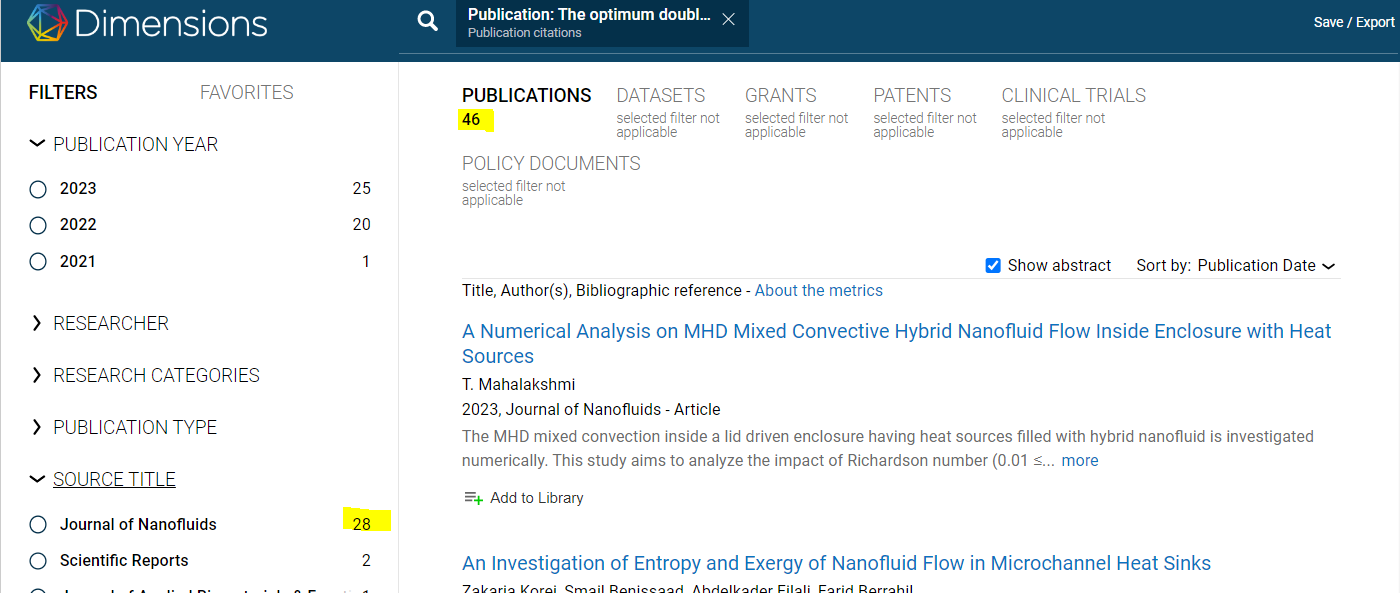
Using Dimensions it is easy to find all the papers published by Chamkha. And with a bit more work one can find all the papers citing these. A typical result for a single paper is reproduced below. This specific Chamkha paper received 46 citations in its ~1.5 years of existence, with 28 of them coming from the Journal of Nanofluids. This level of performance is judged by Dimensions as exceptional, or more exactly: 22 times higher than average. The paper is extremely niche: a heat diffusion simulation using a very specific geometry and nanofluid composition.
Compared to other publications in the same field, this publication is extremely highly cited and has received approximately 22 times more citations than average.
https://badge.dimensions.ai/details/id/pub.1141688217
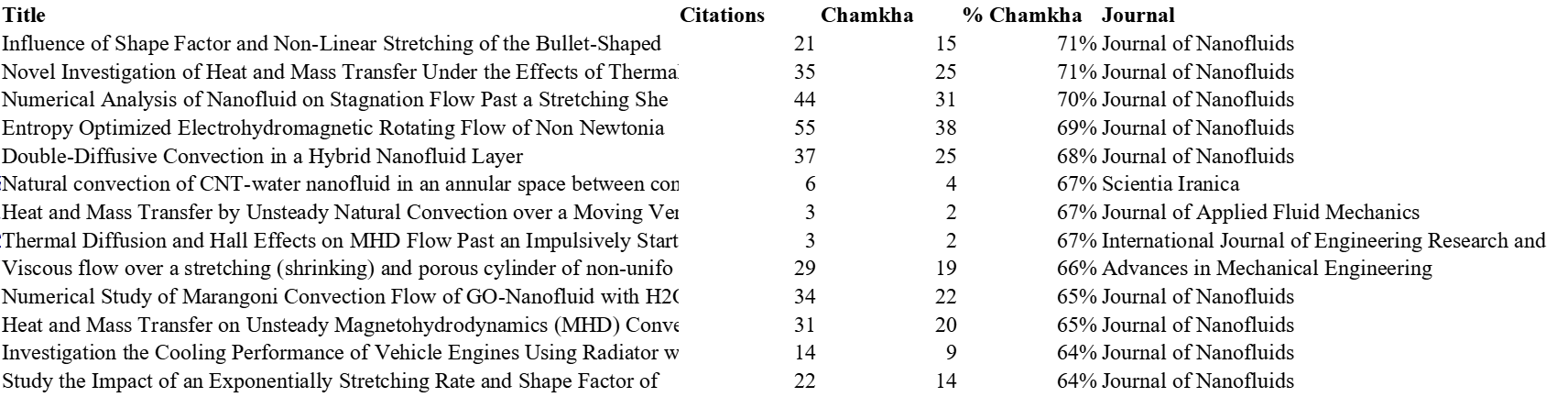
When looking at the longer list of citing papers (included above) an obvious pattern stands out: papers that cite Chamkha cite him a lot. In absolute numbers this paper in Springer’s “The European Physical Journal Plus” is the winner: 101 of the 279 citations (36%) go to Chamkha. It is, however, by far not alone in batch-citing this specific author. Strikingly, many of the citation-laden papers come from a very specific journal: the Journal of Nanofluids. A selection of those is flagged on PubPeer.
In the figure below I have plotted the number of citation to Chamkha coming from the Journal of Nanofluids, binned per half year. The journal exists since 2012 but it took until 2019H1 for Chamkha to receive his first and single citation. After another one year lull something remarkable happens in the second half of 2020: Chamka suddenly receives 200 citations. This citation count increases in time and for the yet-incomplete 2023-H1 Chamkha has already raked in more than 900 citations from the Journal of Nanofluids. To put this in perspective: 95% of the 2023 papers cite Chamkha one or more times, at an average of over 10 citations/paper.

Looking into journal’s homepage and Chamkha’s detailed CV, one finds the following achievement on page 8:

That obviously explains a lot…
Journal of Nanofluids
The Journal of Nanofluids is the bottom of the barrel. It is an /allegedly) free-to-publish Open Access journal from American Scientific Publishers (ASP), a publishera that features on this archived copy of Beal’s list of predatory publishers. The journal is not a COPE member, although it does some COPE window dressing on its submission page.
It may also come as no surprise that the Journal of Nanofluids is not the only ASP publication that is involved in citation scams. Smut Clyde pointed me to two articles on Scholarly Kitchen. The first article discusses a 2018 “expression of concern” from Clarivate for citation manipulation in four journals, three of which are from ASP. The second article dives into these three ASP journals and is definitely worth a read. Expect the usual: ASP journals citing other ASP journals to inflate their impact factor, the “Founder, President, and CEO” Hari Singh Nalwa also being editor-in-chief, and him publishing papers in his own journals with his kids as co-authors. Quote from that article: “All hail the Chief!”.
Did you notice Chamkha’s second Editor-in-Chief position for the Journal of Computational and Theoretical Nanoscience? Yes, also ASP!
Thus far it is just sadness so close to the bottom: the usual fraud, citation rigging, and ego-inflation of ‘researchers’. But then I found this article in the Journal of Nanofluids:
Adela Svobodova-Sedlackova, Alejandro Calderón, Camila Barreneche, Rebeca Salgado-Pizarro, Pablo Gamallo, A. Inés Fernández A Bibliometric Analysis of Research and Development of Nanofluids Journal of Nanofluids (2023) doi: 10.1166/jon.2023.1924
The paper, published 2023-02, is authored by six researchers from the University of Barcelona. It analyses the field of nanofluids by means of a bibliometric analysis, identifying amongst others influential authors, journals, and citation networks. And it reads like a parody…
Let’s start with their identification of the ‘Top 10 Nanofluids authors’:
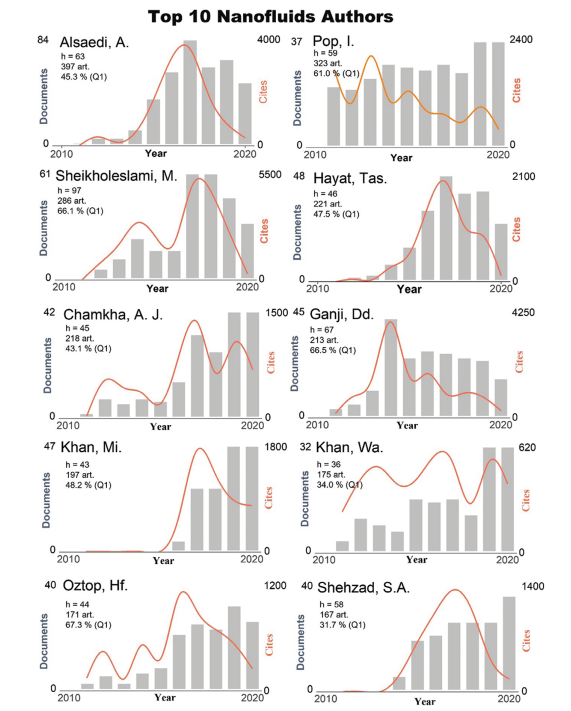
This Top 10 is a true Who’s Who in academic fraud, with literally every author being —very— problematic. To make this statement more quantitative the table below counts the number of PubPeer entries and retractions for each Top 10 author. One can click on the name to find the PubPeer entries and, if necessary, by that find that those are mostly a bad thing.
| Author | PubPeer | Retract. | Reason | Link | Reason |
| Alsaedi | 39 | 6 | 2, 3, 4, 5 | FBS 1 | 1: paper milling |
| Pop | 5 | 0 | 2: review fraud | ||
| Sheikholeslami | 18 | 7 | 2,4,5,6 | FBS 2 | 3: invalid results |
| Hayat | 55 | 5 | 2,3,4,5 | FBS 1 | 4: citation injection |
| Chamkha | 7 | 0 | FBS 2 | 5: duplicate publishing | |
| Ganji | 4 | 1 | 6 | arXiv | 6: plagiarism |
| Khan, Mi. | 15 | 5 | 1, 2, 3 | ||
| Khan, Wa. | 11 | 1 | 1 | ||
| Oztop | 4 | 0 | FBS 2 | ||
| Shehzad | 3 | 1 | 4,5 | ||
| Afrand | 44 | 0 | FBS 3 |
Take for example our Number 1 author Ahmed Alsaedi: he sports 39 PubPeer entries and 6 retractions for review fraud, citation injection, double publishing and papers with invalid results (e.g. numerical results not matching the equations). This is a tad worse than an ‘honest mistake’. There is also a more qualitative bad sign: Alsaedi, Mohsen Sheikholeslami (no. 3), and Tasawar Hayat (no. 4) feature in a For Better Science (FBS) article on fraud in fuzzy logic and nanofluid research:


Our citation-cheating EiC Ali J. Chamkha occupies the 5th position in the list. Incidentally, his 6th place neighbour Davood Domiri Ganji was already called out in 2010 for using his editor position to inflate the impact factor of his his own journal.
The authors appear completely oblivious to this all and instead make observations like (emphasis mine):
“Also, it is interesting the high growth of some authors, such as the case of Sheikholeslami, M. or Hayat, T., since 2017–2018. Likewise, Khan, M., despite starting to publish in the field of nanofluids in 2016, is among the top ten authors list. With more than 197 articles and 5351 accumulated cites (h-index 43). From this analysis, it can be seen the high impact of the nanofluids researchers in the scientific community with high productivity authors.”
Things become even more embarrassing when the authors start to look at the quality of the work. After concluding that Sheikholesami and Hakan Oztop are the highest quality Top 10 authors (with 66% of their papers published in Q1 journals) they bring in Masoud Afrand. Afrand could not make it into the Top 10 based on his output, so the authors give him a special mention for… quality! Afrand managed to publish 69% of his papers in top-25% journals. And indeed, the Who’s Who would not have been complete without him…
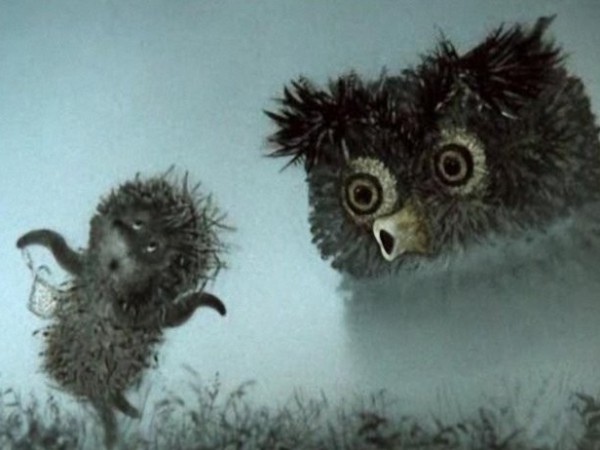
Maybe stop accepting submissions, Herr Prof Dr Sauer?
Who needs science if you can have a 75 paper strong special edition by Afrand and Karimi? A guest post by Alexander Magazinov.
Afrand has 44 papers listed on PubPeer, making him second only to Hayat. The issues are the usual, citation scams and copious ‘re-use’ of data. Afrand also features in two FBS articles. In the first Alexander Magazinov observes how around 2015 Afrand suddenly started churning out template-like Nanofluid papers that show ‘poor bookkeeping’ and ‘interesting’ citation patterns. Please appreciate the contrast between our Barcelona authors’ observation of “interesting the high growth of some authors” and the quote below from Magazinov’s article:
“The main story about them is plain and simple: they appeared out of nowhere around 2015 and began churning out nanofluid-themed papers.”
A. Magazinov on FBS
Afrand also happened to be receiving 110+ citations from a special edition guest-edited by… Chamkha!
Wiley: Committed to integrity? Get out!
“We have initiated post-acceptance peer review with independent reviewers… ” – Wiley.
Afrand’s second FBS appearance is not better. Here he himself features as the guest editor of a special issue, receiving 350+ citations from it whilst at the same time launching another special edition. After some prodding Elsevier started an investigation that already found that the reviewers of the former issue consistently insisted on the addition of citations to their own work.

Undeterred, the Barcelona researchers identify authorship clusters, nicely mapping out the tight cooperation between sets of fraudsters. Their picture is based only on shared authorships and therefore incomplete. One can look also at citations, and as Smut Clyde noted:
“In what is becoming a recurring theme, the recipients of this citational largesse included Tasawar Hayat and Ahmed Alsaedi, reflecting the frequency of their collaborations with Sheikholeslami.”
Smut Clyde on FBS
The collaboration between clusters 1 and 2 thus is far tighter than Fig. 7 suggests…
One can not only rank authors, but also journals. The bibliometric researchers again make a Top 10, reproduced below. The Journal of Nanofluids of our 5th place author Chamkha is proudly put on a matching 5th place. And as it happens, in 2021 Alexander Magazinov already had something bibliometric to say about their number 2 journal, Journal of Thermal Analysis and Calorimetry.

The conclusions don’t make things better. The authors correctly note that the nanofluids research has shifted away from Western countries and that nowadays Iran, India, and China are in the lead. Based on the authorship clusters above they state:
“The bibliometric analysis reveals that there are four main researcher clusters performing studies about nanofluids. It should be highlighted that there is low interaction between them. By summarizing the most relevant authors and contributions around the world, this study helps researchers and institutions to find high-quality investigations and research groups driving the research outside their cluster. This fact helps to strengthen and progress towards a robust, coherent, and homogeneous research field.”
I strongly doubt that the authors’ identification of these clusters really “helps researchers and institutions to find high-quality investigations and research groups“. And one can only hope that at least some of them will stay in their own cluster instead of making it a homogeneous field of research fraud.
In all, the Barcelona paper reads like an analysis of a mafia network. Naming every mobster and correctly splitting them up in their respective clans. But the Barcelona authors fail to see that they are studying not scholarly genius but organized crime. And all of this is published in a predatory journal ran by one of the ‘influential researchers’ they celebrate.
In my initial cynicism I suspected this to be no coincidence. Cheaters like Chamkha seem to be driven by self-importance. And one can feel important by having a bloated CV and a high h-index, but nothing beats being listed in a paper as “distinguished”. Number 4 Hayat has his “Bio-Bibliometric Portrait of Dr. Tasawar Hayat, Distinguished Professor of Mathematics“, written in 2021 by a dentist at the King Saud bin Abdulaziz University for Health Sciences in Saudi Arabia, Ikram Ul Haq. Of course also the Distinguished Professor Chamkha needs hagiography as well. Thus, in Ghalambaz et al “A scientometrics investigation of magnetic nanofluids” 2022, Chamkha is identified as “the most productive author (104 publications) and also the most cited author in the field (2029 citations) with the highest H-Index (33)“. The “Bibliometric Analysis of Research and Development of Nanofluids” from our Barcelona researchers seemed to be a nice follow-up to that, lauding Chamkha, his journal, and his friends as top-of-the-bill.
I do however think that this is just a case of six naïve researchers stepping into a new and fraud-infested field*, learning the hard way that there is often no relation between bibliometric indices and reality. And that adding the term ‘retracted’ to one’s searches and installing the PubPeer plugin can be very beneficial for the quality of a bibliometric analysis. And reading FBS, of course! And that is, in a Schadenfreude way, very amusing.
Conclusion
It is very crowded at the bottom of the research barrel with many self-important cheaters dressing up in 100+ h-indices and 100+ pages CVs. The absurdity and vanity of it all is definitely worth a laugh. However, this fraud business has consequences beyond fooling a few (or even many) researchers.
How would you feel when finding out that your ERC grant proposal was judged by Ali J. Chamkha, likely chosen because of his impressive h-index and CV?
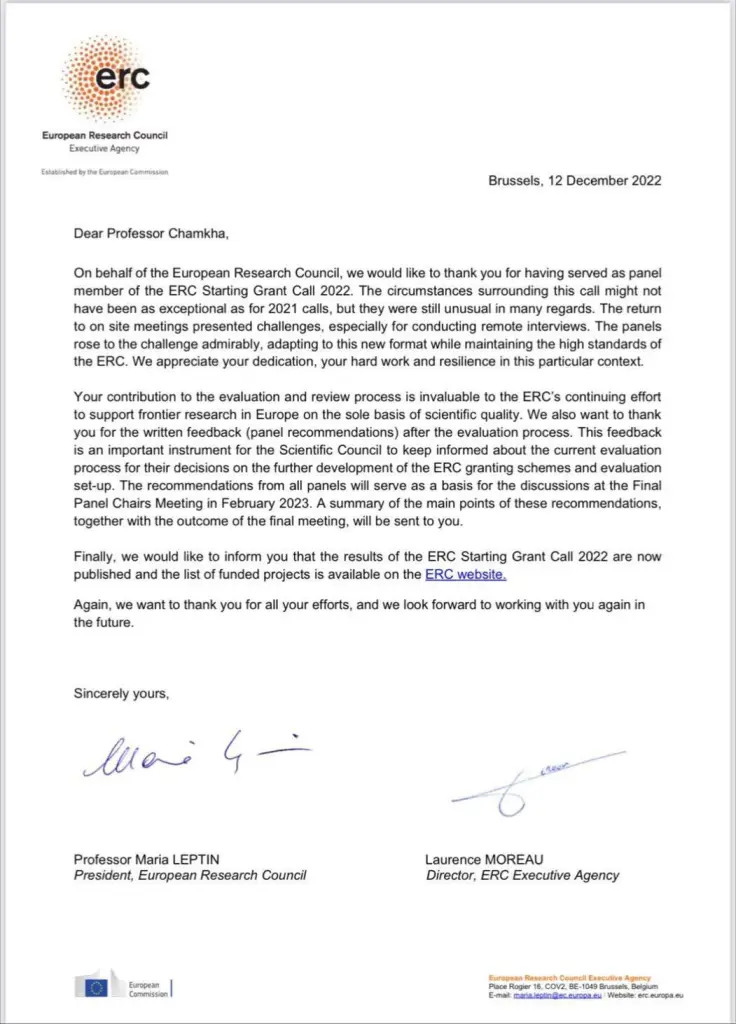
On 12 December 2022, the President of the European Research Council (ERC) Maria Leptin thanked a panel member in a letter:
“Dear Professor Chamkha.
On behalf of the European Research Council, we would like to thank you for having served as panel member of the ERC Starting Grant Call 2022. […] We appreciate your dedication, your hard work and resilience in this particular context.
Your contribution to the evaluation and review process is invaluable to the ERC’s continuing effort to support frontier research in Europe on the sole basis of scientific quality. We also want to thank you for the written feedback (panel recommendations) after the evaluation process. […]
Again, we want to thank you for all your efforts, and we look forward to working with you again in the future.”
Now ERC is investigating the Chamkha affair. Magazinov was informed:
“We have transferred your email to our colleagues of the Integrity Standing Committee, which is dealing with information and allegations concerning scientific misconduct and other breaches of research integrity.“
* My own bibliometric analysis shows that the six authors only cited the Top 10 fraudsters six times (0.1% level), with the citations going to just four distinct papers. Of these four, three are review papers. They thus seem to be well-separated from the nanofluids field, with their interest likely being driven by their research on the use and storage of solar heat. The second author used bibliometric analysis techniques before in his 2019 thesis, there linked to solar energy storage. The choice for a predatory, non-COPE, pay-to-publish journal remains questionable, though. I dearly hope the authors do not have to pay an article processing fee for the retraction of their paper.
2023-12 Addendum
It is nearly the end of the year and there seem to be some questions in the commenting section. Hence a quick analysis of 2023, plus a comparison with 2022:

The above metrics come from OpenAlex. 2023 was again a good year for Chamkha, with his yearly citation count growing from 7550 in 2022 to 7990 now.
Chamkha’s works are most loved by authors publishing in the Journal of Nanofluids, just like the year before. In fact, this journal contributes more than 3x as much citations to Chamkha’s work as any other journal and nearly 20% of Chamkha’s citations are received from it. And this is not only because of the large number of papers citing him, but mostly because those papers cite Chamkha a lot. In 2022 this was still 15x per paper, in 2023 this dropped somewhat to 10 times per paper. The decline in citations per paper is however more than made good for by the larger number of papers citing him in 2023. There is, however, some worrying decline in the fraction of Journal of Nanofluids papers that cite Chamkha. In 2022 this was still 95%, but the number dropped to 91% in 2023. And any great leader/EiC knows that once’s popularity should stay above the 90%.
The 2022 and 2023 citing journal rankings look very different, apart from the thrustworthy Journal of Nanofluids. This suggests that for one or the other reason groups of papers appear in journals that specifically cite Chamkha in large numbers.

 For Better Science
“And that is why I succed” is a funny typo. I won’t have objections if it eventually resolves in an unintended way.
LikeLike
As an working scientist I always laugh when I see people bragging about their “1000 publications!”
If you have published a thousand papers your average actual scientific contribution on each paper is close to zero…
LikeLiked by 3 people
And with 3,256 (last count in PubMed, but it increases every 3 minutes), the average contribution is below zero… You’ve probably recognized D. Raoult ! Not even the time to read them…
LikeLiked by 1 person
I received some spam today linking to https://research.com/scientists-rankings/mechanical-and-aerospace-engineering
I couldn’t help but notice #18…
Of course, those who know “the game” (ahem, scam), recognize #5, #8, #26, and several others too. Embarrassing anyone would consider publishing this “ranking” and hawking via unsolicited emails.
LikeLike
#5 Mohsen Sheikholeslami
#4 Ibrahim Dincer
https://pubpeer.com/publications/F3D2246955CF2BC9113490F5D9BE9B
“This article, cited 661 times to date, according to Dimensions, exhibits a curious citation pattern.
200 of its citations (more than 30%) are from International Journal of Hydrogen Energy, where it is published, and where its single author has an editorial position.”
LikeLike
First raised in the comments of last year April 1st Shorts:
Since then, the order changed a bit, the essence hasn’t.
The answer is simple, “Our team is lead by professor Imed Bouchrika,” which, as far as I remember, rang a bell to either Leonid or to Smut Clyde.
LikeLike
how mush is the value of your contract to trash scientists? how much I can pay you to damage someone? for instance how much u got for the defamation of Chamcha? u guys do a great job. devoted and lots of free time. I bet you get unemployment social support.
LikeLike
how much I can pay you to damage someone?
You can donate as much $$$ to Leonid as you like, though it is not easy to direct his attention in particular directions.
Or you could donate to me, and I guarantee to spend the money to damage my own liver.
LikeLike
“However, this fraud business has consequences beyond fooling a few (or even many) researchers.”
As an example of fake researchers, suggesting solutions to politicians, D.D. Ganji, recently spoke these words in a meeting (of “top 1% most cited scientists of the world”) with Islamic Republican president (an uneducated individual) “[my suggestion] is to use Python [referring to the programming language] a world web network which has amazing capabilities … we don’t have abilities to predict future at the moment but we can do so with help of Python’s world web capabilities …”
Read more here:
https://amp.dw.com/fa-ir/%D9%BE%D8%A7%DB%8C%D8%AA%D9%88%D9%86-%DA%AF%DB%8C%D8%AA-%D9%88%D8%A7%DA%A9%D9%86%D8%B4%D9%87%D8%A7-%D8%A8%D9%87-%D8%AC%D9%84%D8%B3%D9%87-%D8%B1%D8%A6%DB%8C%D8%B3%DB%8C-%D8%A8%D8%A7-%D8%AF%D8%A7%D9%86%D8%B4%D9%85%D9%86%D8%AF%D8%A7%D9%86-%D8%A8%D8%B1%D8%AA%D8%B1-%D8%AC%D9%87%D8%A7%D9%86/a-65298946
LikeLike
I recently became aware of a 2021-11 Vietnamese news article reporting on Ali J. Chamkha (thanks Alexander Magazinov!). It is titled ‘Who is Vietnam’s ‘No. 1 scientist’?’ (yes, you guessed right) and can be found here: https://thanhnien.vn/nha-khoa-hoc-so-1-cua-viet-nam-la-ai-1851398376.htm.
LikeLike
Hi Maarten,
How are your numbers when you consider other editorials? what number says?
Chamkha is not an exception. All editorials get citations. If not they will not serve a minute.
Can you prove that Chamkha is the only one? As far as I see all editorials get citations and other privileges.
A judge may ask such questions as a consequence of calling a scientist fraud under a fake name. Believe me. I been there.
LikeLike
So we went from
He has over 40000 citations. 200 and a couple of reviews or 5 citations wont count.
to “every editor does it”?
And since there are plenty of citation kartels we also should not be bothered about those? But maybe just join the game of gaming the system?
LikeLike
Can you tell me your name and address?
Chamkha has a name and address.
if you are correct you must present your name and address.
Then the game will be fair and we all play.
LikeLike
My name is at the top of the article and above each of my replies. I find you asking for my address scary, please do not do that.
LikeLike
Alex’s and your addresses are essential for the court letters.
You dont have to be scared if you did not do anything wrong.
We may arrange the Alex’s court in Kazakhstan. U know he lives in Kazakistan in the neighbourhood of Jeffrey Beall in Almati.
LikeLike
You idiot.
Get off my website and back to whatever bumhole you crawled out from.
Banned now.
LikeLike
Prof. Chamkha is a great scientist. Why jealousy? he published around 100 articles this year and progressing well. I learned a lot from him. Please do not make nagative talk about great professors.
LikeLike
I will answer with a counter -question:
Why shouldn’t we make even more fun of that pompous lying crook Ali Chamkha?
LikeLike
This article points out large scale citation fraud by Chamkha. Is there maybe something you want to say about that?
LikeLike
There is a belief that the efforts to damage Chankha or his associates will go somewhere. But in fact such activities make him more resilient and eventually more successful. Think about it. He will do better and more sophisticated citations. At the end of the day he is the winner. He is one everyone talk about him. He is enjoying it.
LikeLike
He is not acting as a reviewer for ERC or any other serious agency anymore. Which leaves more time for papermilling, indeed.
LikeLike
Heck. We are looking forward to him writing on convective heat transfer in a nanofluid filling a butthole-shaped cavity with shitty porous medium. Surely a lot of biomedical applications, like enemas.
LikeLike
Assuming the commenter is Samrand Saeidi, then this forbetterscience article and reference therein may be useful: https://forbetterscience.com/2023/03/21/bottom-of-the-barrel-batdolphin-based-sparse-fuzzy-algorithm/
Triggered by papers:
https://doi.org/10.1016/j.ijhydene.2019.01.020
Artificial Bee Colony (ABC) optimization
https://doi.org/10.1016/j.enconman.2020.113550
Dragonfly algorithm (DA)
LikeLike
Hi Marteen, as I see Chamkha is an active scientist in a particular field and get citations in that field. He also indicates that he is ranking expert so he knows how to get publicity for his work to be cited. What is problem with that? why do you call this fraud? how this can be fraud? and other question; why are you criticising nature inspired computer algorithms like Artificial Bee Colony (ABC) and optimisation Dragonfly algorithm (DA), 1000s of 1000s engineering problems had been solved by them and shown better performance. Are you evolutionary algorithms expert? if as an expert you say these algorithms are not good then I will take your words for that.
LikeLike
With respect to the Journal of Nanofluids timing is important. The citation deluge started the moment Chamkha became editor. And it is not a subtle step, he is suddenly cited >200x more than his usual 0-1 times per half year.
Additionally I got authors providing links to their review reports, see e.g. https://mstracker.com/reviews.php?id=166056&aid=357023. The reviewer extorts a large number of citations to Chamkha papers.
Finally, as, supporting evidence: the publisher has been called out before for citation manipulatin practices and has even been blacklisted for that.
Wrt the ‘nature inspired algorithms’ I invite you to read https://link.springer.com/chapter/10.1007/978-3-030-60376-2_10 and later papers from these authors. A few initial papers in the field did add to our knowledge. But the big majority (all?) of the later swarm optimization algorithms are just perturbations with one or more animals dragged in.
LikeLike
“timing is important.”
you use coincidence in your favor. Just the time he starts to bloom in the field he gets citations. and same time by coincidence he becomes editor. He has over 40000 citations. 200 and a couple of reviews or 5 citations wont count. Please look into scale. Your reasoning wont fit into the scale. Your evidence to call someone a fraud is not adequate. Have you checked other EU citizen editorials and compared the pattern of their citations? please reevaluate your judgement and see the entire picture in science. If you dont cite an editorial you cant get published. Its a norm in science.
Scientist use nature inspired algorithm for comparative analysis and produce new results. This is science. One single article that criticizes a huge movement wont count. If this article is correct why big publishers publish new nature inspired algorithms, and why new algorithms get used by 10000 scientists in their fields.
LikeLike
I assume this is Ali Chamkha’s sockpuppet again. No, of course nobody reads For Better Science, you are so right.
And for no reason at all Chamkha’s personal website was deleted and you all flocked to complain here.
Cute.
LikeLike
“Grey Wolf, Firefly and Bat Algorithms: Three Widespread Algorithms that Do Not Contain Any Novelty”
then why 14000 citations? then why around 60000 coauthors (experts in the field) used it to solve their problem? How come Ant colony of Marco Dorigo is good but Bees and wolf are bad?
LikeLike
Except these thousands of “experts” are just akin to astrologers, homeopaths or Twitter tech bros.
In this sense, engineering is much simpler to assess than many other disciplines: either you present a production-ready solution, or you go f*ck off.
All the 14000 citations you mentioned fall in the second category. And, by the way, Dorigo with his AntNet, too (at least as far as I know the state of things).
LikeLike
Dear ‘Nature Inspired Researcher’,
He has over 40000 citations. 200 and a couple of reviews or 5 citations wont count. Please look into scale. Your reasoning wont fit into the scale
I did look at the scale. We are nearly at the end of 2023 and Chamkha has extrated 1560 citations from ‘his’ Journal of Nanofluids. Dimensions thinks that Chamkha will ‘earn’ 8500 citations this year. Hence nearly 20% of his citation income is from citations extorted from authors in the Journal of Nanofluids. I would call this significant.
LikeLike
“then why 14000 citations?”
The question answers itself. The whole point of this research area is to allow its contributors to generate citations for the benefit of one another’s careers.
“then why around 60000 coauthors (experts in the field) used it to solve their problem?”
This is the stage where a citation would be useful, showing someone solving a real-world problem with these methods, not just churning out garbage papers.
LikeLike
Lukewarm radiating has numerous demands in medicinal disciplines.
It also accentuates the white blood cells and amputates the wasting merchandise.
The language of a great scientist, sure! Indeed a worthwhile subject for learning from him!
https://pubpeer.com/publications/38E0B765B990C2E2B78A02C71C897C
LikeLiked by 2 people
English is not their mother tongue. It is natural. Stop bullying researchers. Even the bible has typos.
LikeLike
The Bible is written with capital B. Learn some English.
LikeLike
A moron using a name of an amazing mathematician whom I happen to know. This shameless buttock can get a cup of my piss for breakfast, then fuck off and get lost.
LikeLike
I believe the commenter has again missed the point. The text in the cited paper by Chamkha et al. is not only unreadable because of it bad language. It is also plagiarized from a paper by other researchers. And the bad language is just a cheap and likely automated way to hide the plagiarism.
Original source:
In thermal radiation energy transfer between two bodies depends upon absolute temperature variation. Thermal radiation has important applications in biomedical field, because of its application in biomedical area effect of thermal radiation with double diffusion has become an important topic to many researches.
Plagiarized and paraphrased by Ali J. Chamkha et al.:
<Despite that, in heat radiation, strength of energy transport in the midst of two masses is decided upon unmitigated warming discrepancy. Lukewarm radiating has numerous demands in medicinal disciplines. Since its utilization in medicine therapy, effect of thermally radiation with doubling diffusion becomes a significant explore topic to lots of experimenters.
And so on.
LikeLike
I am not your friend anymore after seeing your misconducts. You are not welcome to Tel Aviv anymore. Ron is disappointed.
LikeLike
You hide your IP you smelly Chamkha sockpuppet. You are banned from this site now and I suggest Alex tells Dr Ostrover that Chamkha stole his identity for nefarious purposes.
LikeLike
Behold as the hourglass of fate turns, revealing the precipice upon which thou now stand. Bear witness, for the reckoning approaches swiftly, when thy lord and liege, upon learning of the ignominy thou hast heaped upon his lineage and sacred seat, shall mete out judgment with unrelenting wrath. Prepare, for the sands of time shall mark the passage of thy doom, and we shall ascertain whose soul is consigned to oblivion first.
LikeLike
Hi Jones, other fake member,
ChatGPT for here too? I thought you do ChatGPT only for your Pubpeer comemnts.
LikeLike
You mad, bro?
LikeLike
“M. Klauco” has been banned from further commenting here.
LikeLike
just out of curiosity you are not afraid of lawsuits? why always target a non EU citizen?
LikeLike
To repeat:
This article points out large scale citation fraud by Chamkha. Is there maybe something you want to say about that?
LikeLike
Just out of curiosity: are you perchance a Chamkha sockpuppet? Surely you have stolen enough cash to sue me. Bring it.
Further astroturfing comments by Ali will be deleted.
LikeLike
U hide under fake names and some of you fake being in Kazakistan.
And you pick on scientist. One day someone will come to bust your asses.
LikeLike
Try to keep your homoerotic fantasies about our asses under control, Samrand.
LikeLike
As they say in Hungary,
Tűnsz el, te hülye bunkófasz!
LikeLike
Oh, stop it, Alex, or people might start assuming you work at Harvard.
LikeLike
I received this email from someone using same name and email address (Samrand Saeidi, samrand@chem.u-szeged.hu), yet the IP address is not in Hungary, but in Gliwice, Poland:
“Hello Sir
Please delete my name (Samrand Saeidi) and my wife (Sara Najari) as soon as possible. you can check the link as follows: https://forbetterscience.com/2023/03/08/bottom-of-the-barrel-nanofluids-chamkha/
Someone is abusing our academic reputation. We have never written any comments for anyone.
Please delete our name ASAP otherwise I will take serious action against you.”
LikeLike
Another email from Samrand Saeidi using Hungarian university email (samrand@chem.u-szeged.hu) and writing from Gliwice in Poland:
“I am an industrial researcher. Neither Dr. Sara Najari nor I know the individuals mentioned on your website, and we have never interacted with them. We are flabbergasted by the comments that have been posted under our names. How did you accept these comments without our email approval? You have not followed any points of your comment policy in this instance. Therefore, if you do not remove these baseless and meaningless comments, I will report you. I have enough solid proof to block your webpage easily.
FYI, we had the same story with Retraction Watch one year ago and contacted they totally deleted our name within a few hours.
Remove these baseless comments ASAP and update me, and I will check it.
Best Regards
Sam”
In this regard, in this very dodgy paper Saeidi declares as his second affiliation “Biotechnology Center, Silesian University of Technology, 8 Krzywousty St., 44-100 Gliwice, Poland”
https://pubpeer.com/publications/9073BF20AF69D7286D95492766C92F
And here he is:
https://www.polsl.pl/rie3/samrand-saeidi/
LikeLike
Thank you Leonid, for enlightening me about this website (Pubpeer.com). I had no idea that such an interesting website existed.
LikeLike
How to write a study outside of your expertise and turn it into a study of your expertise.
https://pubpeer.com/publications/88E05E5ED29D514BF7348C585050C9
LikeLike
How come! Samrand Saeidi introduces himself as a frequent reader of retractionwatch and even writes to Ivan last year, and such person has no idea about Pubpeer? to me, he seams to be a frequent Pubpeer user.
LikeLike
I do belive that you are using a fake identity. There is only one Samrand Saeidi, and that’s me.
LikeLike
Samrand Saeidi’s boss András Sápi (a coauthor of other article) is also an expert in image manipulation: https://pubpeer.com/publications/964B6451CE9A3ECA76FA4878DCBBC2
LikeLike
Well, I found your post because I saw this guy showing off his “citations” on LinkedIn.
https://www.linkedin.com/posts/prof-ali-j-chamkha-374a717_research-citations-habrindex-activity-7147613387600949248-R717 When there is something obvious fishy and the vast majority of the comments are “congratulations” from Middle East/Indian names (no racism here, just the fact and unusual correlations), you know there is something going on. There must be a group of people spamming junk papers and farming citations. After taking a look at his Google Scholar, I decided to google “nanofluids citation fraud”, so here I am. Again, it completely blew my mind when seeing he was invited as the judge for ERC proposals…
LikeLike
Nice to hear you find this page by googling Chamkha! I do belief this page to be much more informative than his LinkedIn account or now-defunct vanity page (https://web.archive.org/web/20230702050616/https://alichamkha.net/) and his CV posted there (https://web.archive.org/web/20230506055356/https://alichamkha.net/wp-content/uploads/2023/03/Prof.-Ali-Chamkhas-CV-January-26-2023.pdf).
LikeLike
As of September 2024, Chamkha is still on the ERC starting grant panel.
As I predicted in February 2023,
LikeLike
But to be fair, also Giulio Cossu, Sara Sigismund and Patricia Agostinis are on ERC panels.
And Ali Chamkha is diversity personified!
LikeLike
Diversity, sure. They’re literally begging for a EU redo of Trump / Musk.
LikeLike