
The World Health Organisation (WHO) recently included Traditional Chinese Medicine into its global medical compendium, thus recognising that dried and powdered bits of rare and endangered animals can cure all possible ailments and diseases. But of course Modern Medicine remains valid also, and in fact the WHO’s International Agency for Research on Cancer (IARC), with its seat in Lyon, France, uses modern technologies to find new cancer therapies. One such digital technology, applied very efficiently all very the world, is based on Photoshop, where images of western blots and other research data get artistically modified to facilitate the publishability of the postulated cancer therapy ideas in respected peer reviewed research journals. It does not really help cancer patients, but the beneficial effect on the academic and industry careers of such scientists is extremely significant and has been extensively validated and reproduced over the years.
The cancer researchers at WHO whose papers contain such impressive manipulations, are Massimo Tommasino, head of Infections and Cancer Biology Group at IARC, and his former junior colleague there Uzma Hasan, now tenured group leader at INSERM in Lyon. Some of their best or worst papers (depending how you judge it) were authored together with an industrial researcher, Jaromir Vlach, working for the Schering-Plough Research Institute which was eventually taken over by the German pharma giant Merck (known in USA as EMD).The evidence was posted on PubPeer by anonymous commenters, one of whom was the pseudonymous Clare Francis, who also alerted me to that case.
Update 3.12.2019: WHO now pronounced that their investigation:
“Found no evidence of scientific misconduct and concluded that the allegations made on PubPeer are not adequately supported and are therefore unfounded”
This was for example what Hasan, Tommasino and Vlach published on the topic of immune system responses, in the elite journal PNAS, Hasan et al 2007:
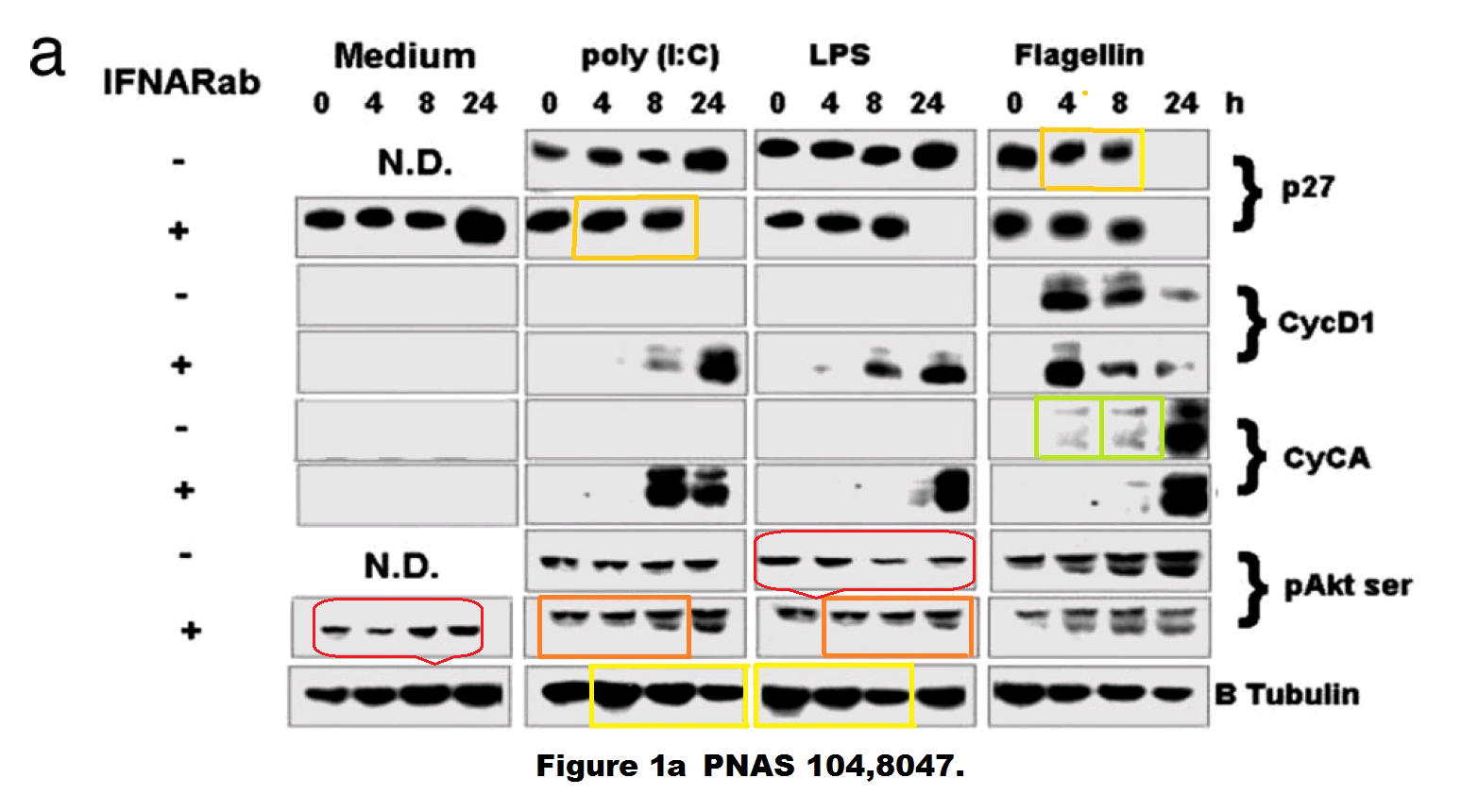
This figure contains a plethora of duplicated gel bands, so much that it is actually almost funny. Who is responsible, we do not know. The contributions say that Tommasino only contributed “new reagents/analytic tools”, while research was designed by Vlach and the two first authors. The first and corresponding author Hasan was at that time already in Tommasino’s IARC department for Infections and Cancer Biology. That PNAS paper of hers contains many other examples of Photoshop activities, like this Figure 5 here:
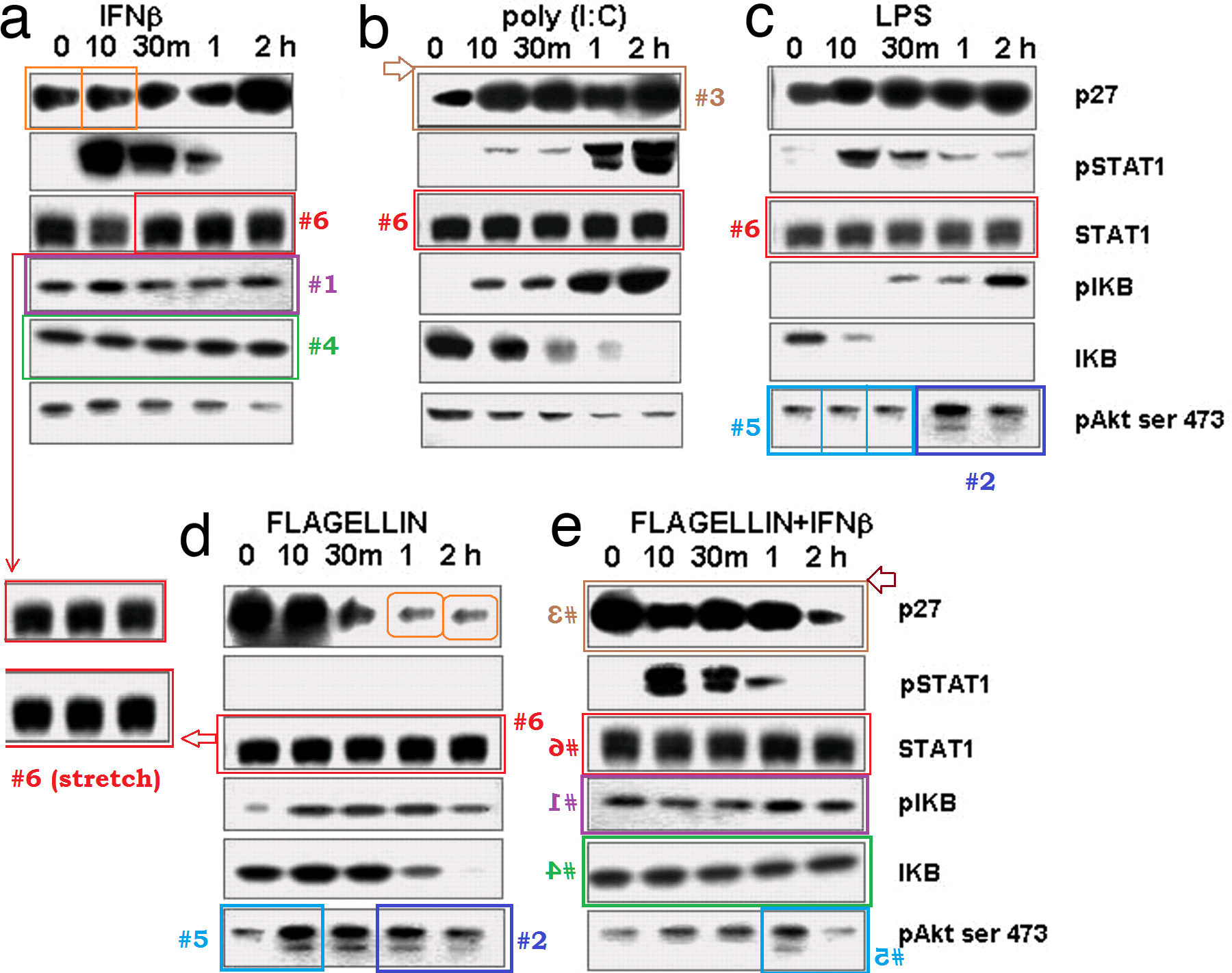
The industry researcher Vlach is the last author and the project designer, but it seems the work was done at IARC, since that this Photoshop tour de force was publicly funded:
“This work was supported by grants from La Ligue Contre le Cancer (Comité de Savoie) and the grant “Applied Tumour Virology” German–French cooperation, German Cancer Research Center (DKFZ), Heidelberg–Cancéropôle du Grand-Est, Besançon.”
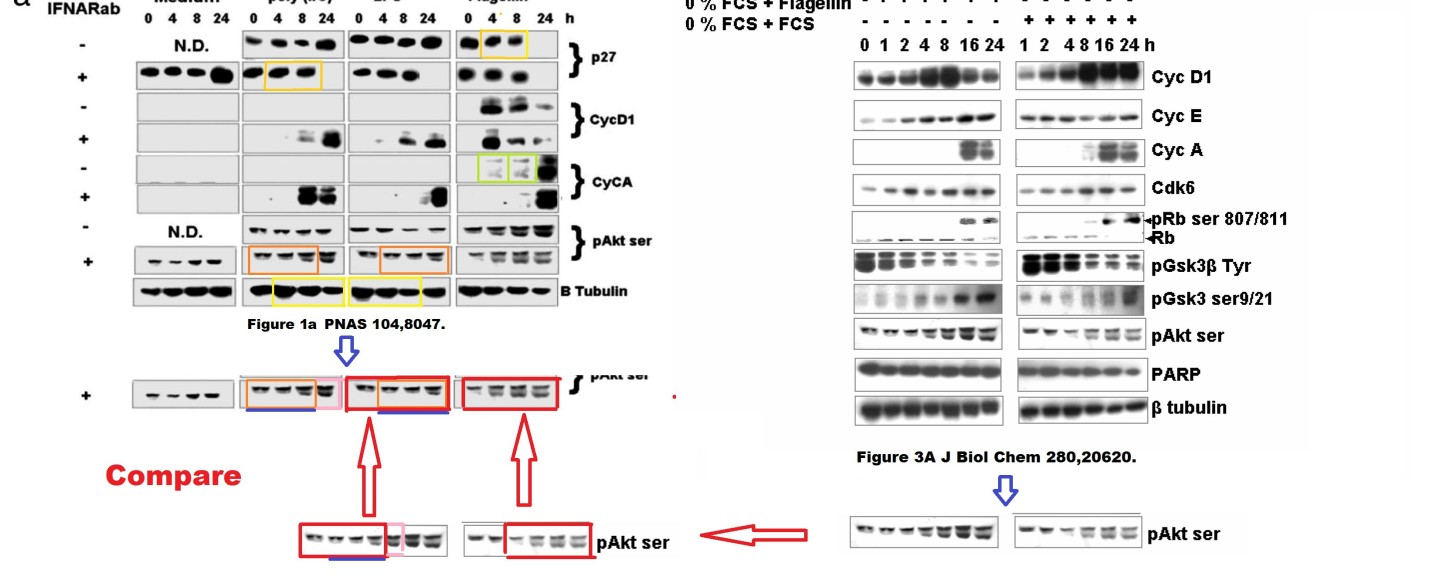
The afore-ridiculed Figure 1A of Hasan et al PNAS 2007 contains elements which previously appeared in a different context, in a different paper and likely also in a different lab where Hasan worked until 2005, at Schering-Plough with Vlach (Hasan et al JBC 2005):
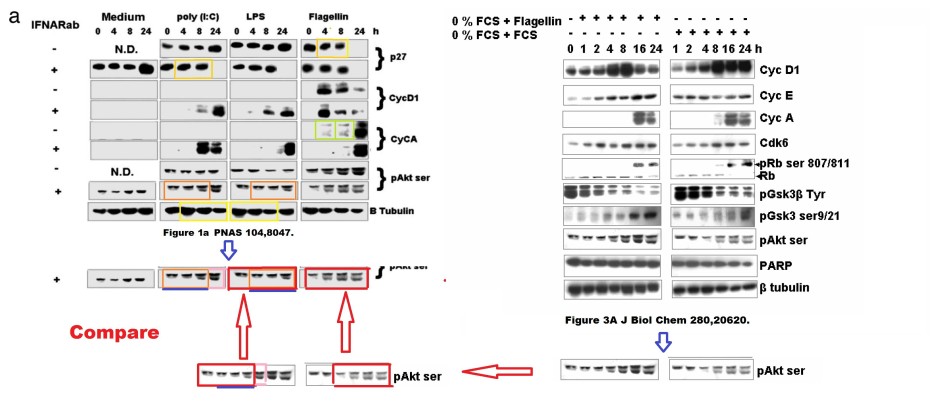
That 2005 paper appeared in the Journal of Biological Chemistry, which is known to be tough on data manipulation, might become a problem for this paper’s three authors. Good for Tommasino that he is not one of them. There is even a duplicated flow cytometry measurement, quantified slightly differently, maybe to obscure similarities.
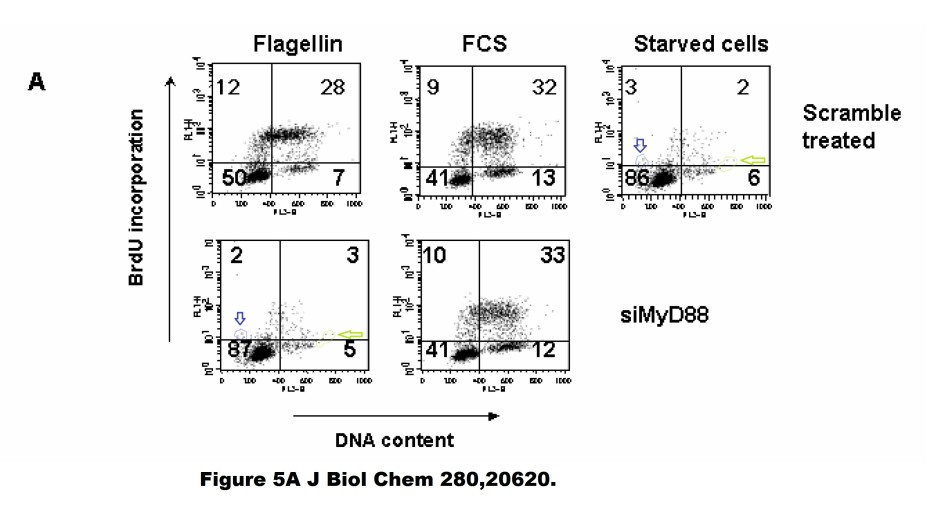
Also this Hasan et al JBC 2005 study contains more of creative tricks which helped the authors elucidate the molecular pathway of Toll-signaling in immune cells. Who knew it happens through post-experimental digital data duplication?
Hasan’s work at Schering-Plough before her move to IARC with Tommasino was truly productive. Look at this interesting figure from Hasan et al J Immunology 2005:
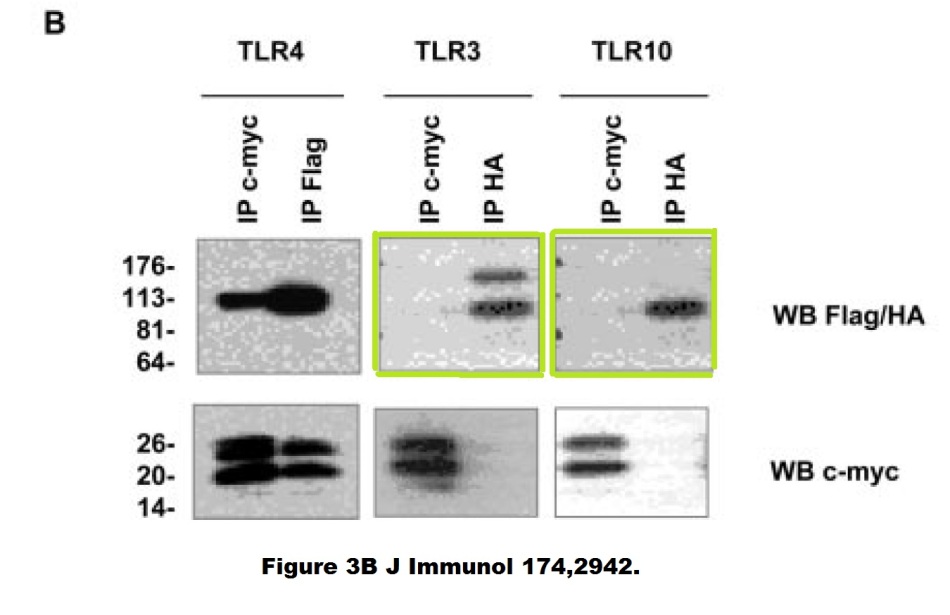
The framed western blot two images for Flag/HA are very similar, except the upper gel band. How can this be? Can someone accidentally reuse same image twice, while accidentally erasing the top band in one of them? There is more to find in that paper also. Tommasino is not coauthor, but is credited with having provided “invaluable advice on this manuscript”, just like in the other Hasan et al JBC 2005 paper from Schering-Plough, now part of Merck.
With Tommasino as last author, but now without Vlach and his pharma industry input, Hasan authored same year 2007 this paper, Hasan et al J Immunology 2007. Also here, Hasan is corresponding author. This IARC study helped us understand how cervical cancer develops and offered “future promise for the prevention of infectious diseases, cancer, and autoimmune diseases“. This is how this promise works, and this is just one example from that paper:
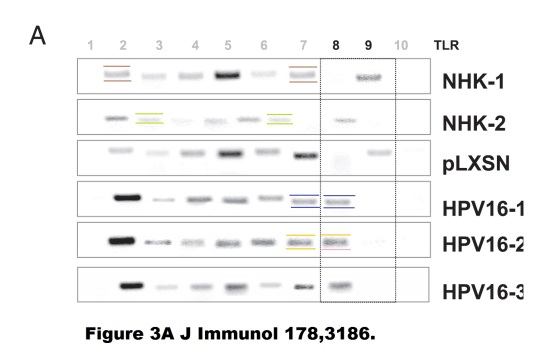
Apparently, by re-using certain western blot bands, a potential prevention therapy for cervical cancer can be established. Amazing research, done by WHO scientists at IARC, with public support:
“The study was supported by grants from La Ligue Contre le Cancer (Comité de la Savoie), “Applied Tumour Virology” German-French cooperation, and Deutsches Krebsforschungszentrum-Cancéropôle du Grand-Est.”
2007 was a particular year in Tommasino’s IARC lab, with a particularly rich harvest of Photoshopped papers in prestigious journals. Also this paper features Hasan as one of coauthors, Mansour et al, Virology 2007., Tommasino is the corresponding author. The study offers insights into mechanisms of cervix cancer progression and suggests how this cancer can be early detected. This is how the clinical approach would work:
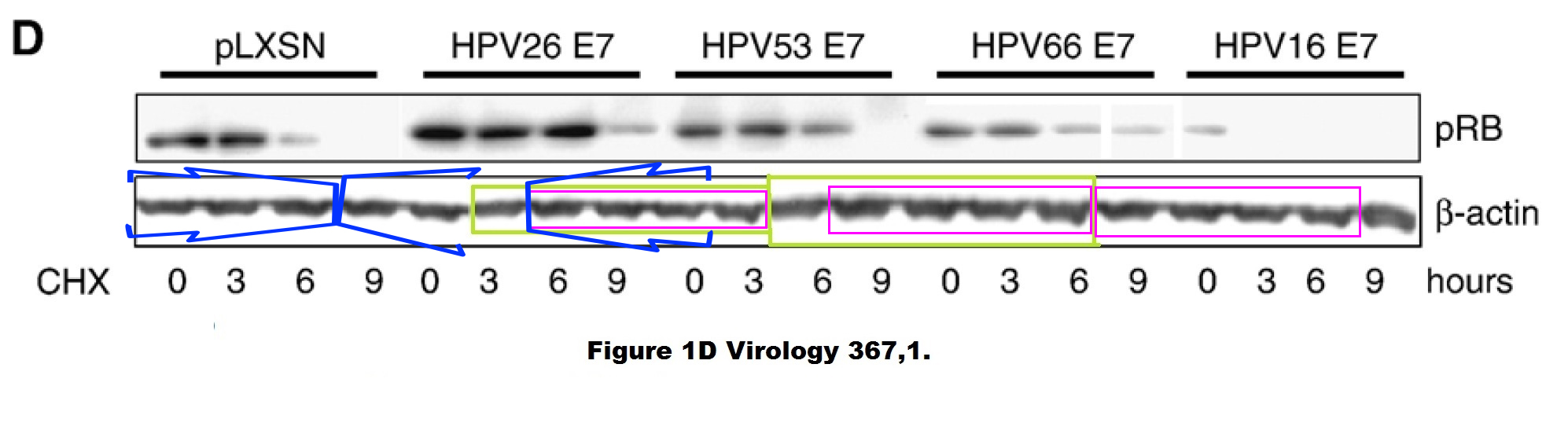
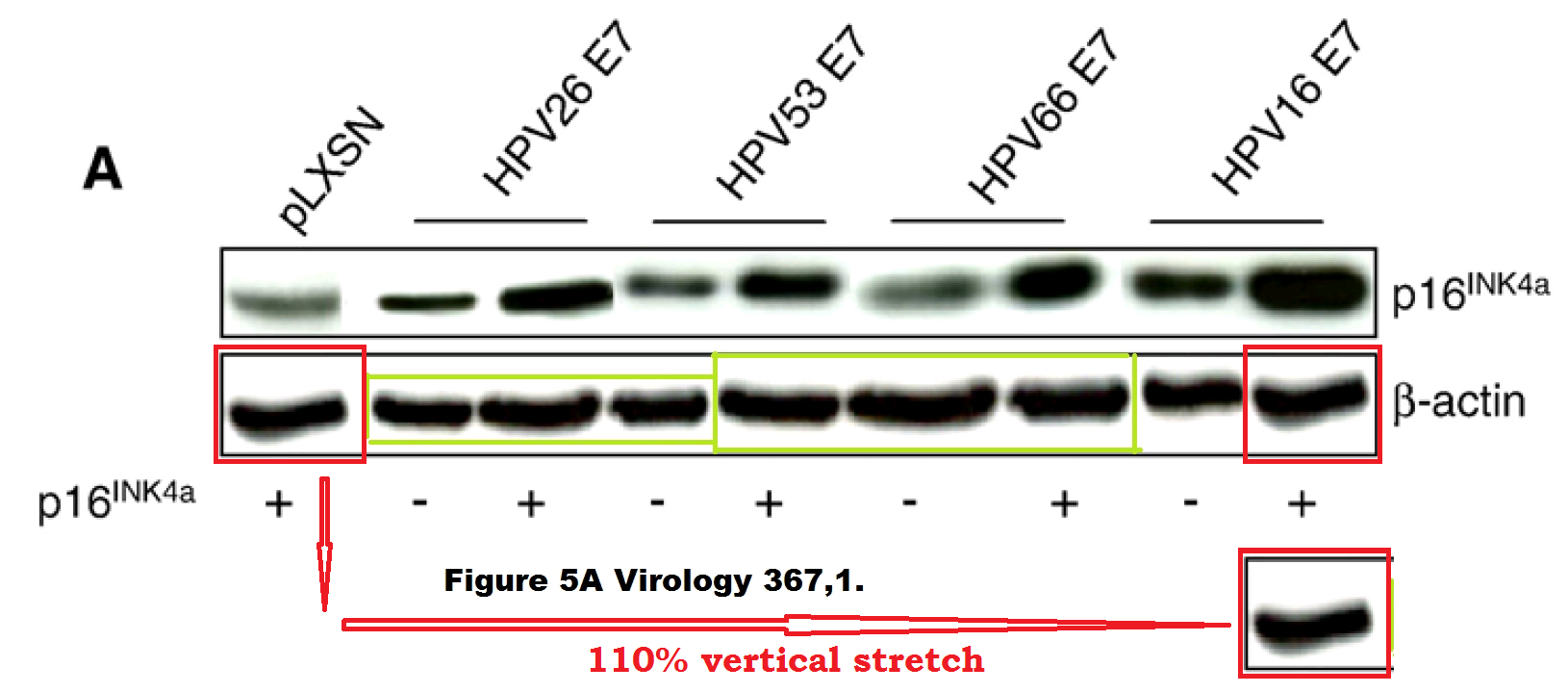
Female patient at risk of cervical cancer will be asked to sit upon the printout of these Photoshopped western blot images, or other examples from that paper. Any resident cervical cancer cells inside the patient will be appalled by such pathetically crude data manipulations of loading controls and die in shame. In case you wonder, why some authors need to manipulate such allegedly unimportant bits of the figure like loading controls: it’s probably because the correct loading controls would have rendered the entire figure as useless or even fraudulent. Hence, cancer is being attacked not with science, but with Photoshop. This is probably exactly what EU Commission had in mind when funding this travesty :
“The study was partially supported by grants from European Union (LSHC-2005-018704) Deutsche Krebshilfe (grant N. 10-1847-To I), and Association for International Cancer Research to MT and a grant from La Ligue Contre le Cancer (Comité du Rhône)”
Tommasino never had a high opinion of loading controls anyway, it seems he saw them as nuisance and tried to make a point of this by publishing such ridiculously Photoshopped stuff. Who is interested in how much sample was loaded where, if the end picture of signal differences and its scientific message is what matters? Nobody, that’s WHO. This is why we find in older Tommasino papers figures like this, in Malanchi et al 2004 or Giarre et al 2001, both passed peer review in Journal of Virology:
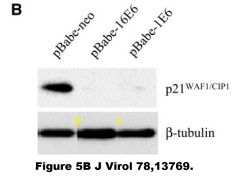
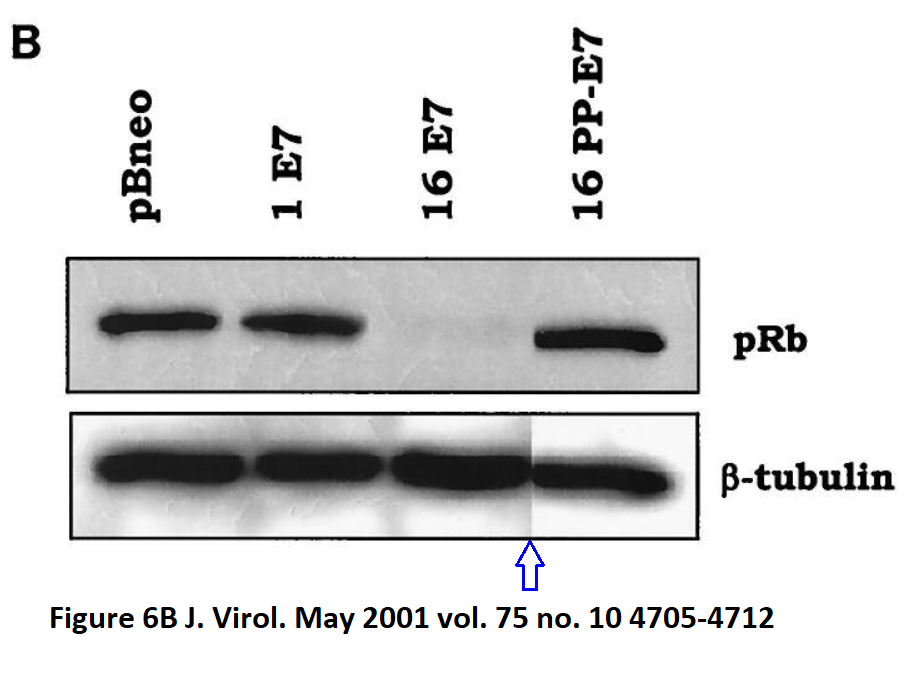
Unfortunately such attitude to research integrity in Tommasino’s department at IARC is not ancient history. The following comes from two relatively recent papers from that lab, Shahzad et al J Virology 2013 and Siouda et al PLOS Pathogens 2014:
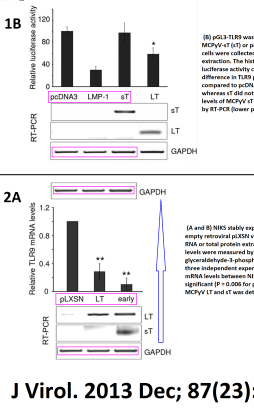
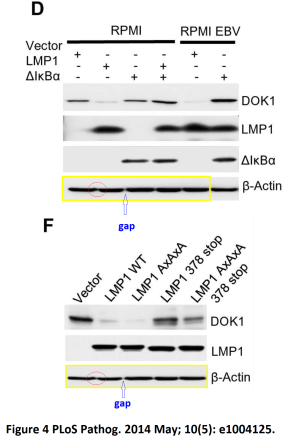
We learn that viruses play a key role in carcinogenesis, and the correct way to clinically intervene on viral infection to prevent cancer is to reuse loading controls for various experiments, to placate some pesky peer reviewers.
Even the EMBO fellow and newly minted INSERM group leader Dr Hasan was back at publishing copy-pasted cancer therapy ideas, at Journal of Experimental Medicine, Hasan et al, JEM, 2012:
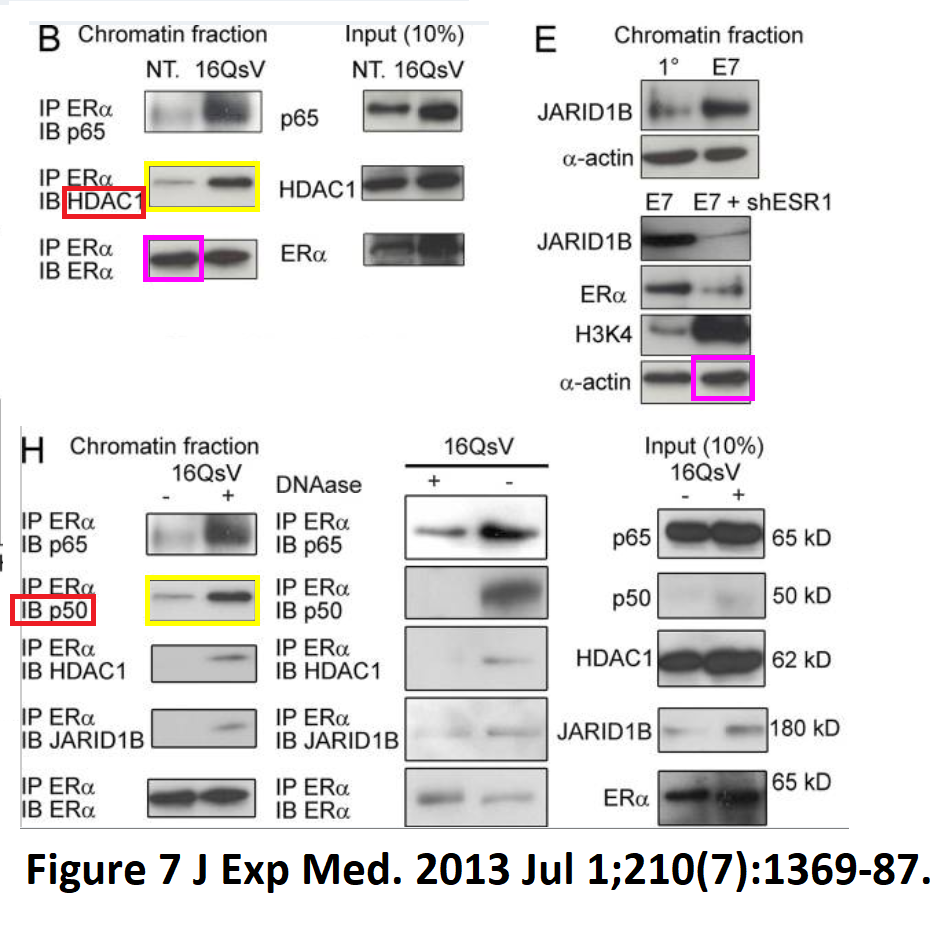
We now see how such creative approach to cancer research literally paid out for Hasan:
“This study was supported by the EMBO Fellowship Program (U.A. Hasan), La Ligue Régionale de la Loire contre le Cancer (U.A. Hasan), la Fondation pour la Recherche Médicale (U.A. Hasan), l’Association Research sur la Cancer (U.A. Hasan), and CLARA Procan Axe II innate sensors platform, Lyon (M. Tommasino)”.
The penultimate author is elite HHMI-funded researcher at Yale, USA, he is also thanked for his advice in several manuscripts by Hasan, Vlach and Tommasino. What will he say of such unconventional approach which as the authors assure, “may provide a novel therapeutic strategy for cervical cancers”?
I informed Merck and WHO Ethics team about those issues in August 2018. Merck replied that they “take such inquiries seriously” and are reviewing the information on Vlach’s publications which I sent them. From WHO, a request for more information arrived, because the PubPeer information was deemed insufficient as such:
“from the links you have posted, we can see the titles of a number of publications but it is difficult to assess what may have happened. We would need to know specifically which data may have been changed, in which publications, when and by whom.”
I replied immediately with explanatory examples, but have not heard from the WHO Ethics Team ever again. My recent two requests for an update went unanswered as of yet.
Update 3.12.2019
In November 2019, I wrote to WHO again. I received a reply: WHO expects PubPeer to remove slanderous evidence against their scientists who did absolutely NOTHING wrong.
This is the statement I received:
“Thank you for bringing your concerns to the attention of WHO. We have reviewed them and an investigation was undertaken into the matter.
The investigation looked at each allegation made and a rigorous approach was adopted further to the IARC Policy on Scientific Misconduct, as publicly available on the IARC internet site.
The allegations relate entirely to gel and blot “splicing”. This was and to a large extent still is common practice to reduce the size and complexity of figures which are illustrations derived from multiple experiments, and not intended to show the results of those individual experiments. Cell Press (http://crosstalk.cell.com/blog/common-pitfalls-in-figure-prepartion) say, “it is OK to remove irrelevant or blank lanes from a gel in order to present your data in a streamlined way to readers, but when you do it, you need to mark it clearly so that there is obvious transparency about how the figure was prepared” (2015). The Journal of Cell Science have suggested that “Any grouping or consolidation of data (e.g. removal of lanes from gels and blots or cropping of images) must be made apparent (i.e. with dividing lines or white spaces) and should be explicitly indicated in the figure legends.” (see http://jcs.biologists.org/sites/default/files/Revisionattachment_JCS.pdf )
It is noted that the splicing was not hidden deliberately, though on occasion it is noted it was less obvious in the printed figure and the figure legends did not always make the splicing clear. These minor errors are common in papers and should be avoided. The authors in question have been informed of what IARC expects and a policy on gels and blots from the Journal of Cell Science has been adopted.
Noting all this, the investigation:
- Found no evidence of scientific misconduct and concluded that the allegations made on PubPeer are not adequately supported and are therefore unfounded,
- Identified a small number of individual cases where errors in the figures require corrections, and
- Advised the authors to provide all available original data for the papers cited on PubPeer to the journal editors for their information.
Further to the above and in line with the IARC Policy on Scientific Misconduct and the investigation, it was determined that the matter could be closed.”
Donate!
If you are interested to support my work, you can leave here a small tip of $5. Or several of small tips, just increase the amount as you like (2x=€10; 5x=€25). Your generous patronage of my journalism will be most appreciated!
€5.00

 For Better Science
http://www.medschool.umaryland.edu/profiles/Perrotti-Danilo/
Career curing cancer (leukemia) in Photoshop
https://pubpeer.com/publications/0D64393FDE0AF3132067E8A71BE331
https://pubpeer.com/publications/AC4548DAB2ED21B39C6ED1DBC21760
https://pubpeer.com/publications/31FF9826FEC27631303D3B438D7729
https://pubpeer.com/publications/142D838D4B89412642395A613C9ED7 correction
https://pubpeer.com/publications/180656AC2CE3D5FBA5804C1AD3C1FD
https://pubpeer.com/publications/21A3146BA7BFAD99AD1C4955335EBC
https://pubpeer.com/publications/47EB99EF32F3765A85243CF105BCD0
https://pubpeer.com/publications/A2EF89C05F01194511C10FE0F72648
LikeLike
http://www.medschool.umaryland.edu/profiles/Rassool-Feyruz/
Curing cancer (“DNA repair) in Photoshop.
https://pubpeer.com/publications/A8319EE705F60FEBD97B562991E6E9
https://pubpeer.com/publications/61E11B437A32BBED515265C50DFA83
https://pubpeer.com/publications/2EFAFDC2307D960F79E54626387A3A
https://pubpeer.com/publications/3435B3A7A2D013AD60DBC50066A462
https://pubpeer.com/publications/FEA7CDFD13C08DC5C16899A06E7A79 2018 retraction
LikeLike
Anil K Jaiswal, University of Maryland, Baltimore, as are Danilo Perrotti and Feyruz Rassool above.
https://retractionwatch.com/2018/11/02/former-university-of-maryland-cancer-researcher-up-to-21-retractions/
Mark A Scheper, University of Maryland, Baltimore.
https://retractionwatch.com/2015/01/29/fraud-retraction-appears-deceased-maryland-dental-researcher/
LikeLike
https://www.pathologie.med.uni-muenchen.de/020wissenschaft/009ag_hermeking/engl_ag_hermeking/index.html
Clumsy in Photoshop.
Disputed, controversial claim.
https://pubpeer.com/publications/876EA56A4549BCAA87455EA00E5A19
https://pubpeer.com/publications/A98EC5073284B00124E31D63E25149
Not a tumor suppressor gene (by third author paper above).
https://pubpeer.com/publications/D1AAB70E95808AAF3270E9437539C1
https://pubpeer.com/publications/2B4278534852139EB5E4CD84A185A7 correction
https://pubpeer.com/publications/10482294F0D626FDB9C907E473F765 correction
https://pubpeer.com/publications/A304BDA2F089260637244CA0499495 image duplication different time points
https://pubpeer.com/publications/317CFBD0B8B99D41A41673FAF0719C image duplication, same data in two publications
https://pubpeer.com/publications/588701E81CB2E29322E14E09EEC643
https://pubpeer.com/publications/10178AD2F9FB11AD0DC7BC8ED14E96 correction
LikeLike
https://www.imp.ac.at/news/detail/article/in-memoriam-hartmut-beug-1945-2011/
Dead and gone, but can the extant authors clear up the mess?
https://pubpeer.com/publications/66A1DD15AAFD9C916B67A345C64246
https://pubpeer.com/publications/C7F170516DEF4D86E240472DAF1DCD#4
https://pubpeer.com/publications/C7F170516DEF4D86E240472DAF1DCD#5
https://pubpeer.com/publications/C7F170516DEF4D86E240472DAF1DCD#6
https://pubpeer.com/publications/461F6B50842AE7A9752B61CCE947CB
https://pubpeer.com/publications/9C90EFF50DB7638DA141E4A5DCA197
https://pubpeer.com/publications/9C90EFF50DB7638DA141E4A5DCA197#7
https://pubpeer.com/publications/7C10145293464589F837E1D7467F13
LikeLike
https://www.dmmd.uzh.ch/en/research/hottiger/groupmembers/hottiger.html
https://pubpeer.com/publications/FEEDC5FD9315488CFE6FB1A1BC2084
https://pubpeer.com/publications/D5D1CE6EB9504975A45215ABED0ED9
https://pubpeer.com/publications/E4349F366F3937A60953F15EDCD95A
https://pubpeer.com/publications/5E459D8CE50B59CC4F60AE1EC95C52
https://pubpeer.com/publications/0E7A617B5EC755133B6B4738F7C5CD
https://pubpeer.com/publications/9E1DC75824ED55E4E05C14678E9D9D
https://pubpeer.com/publications/CB68B9474186EBDFB987388C66E6CB
https://pubpeer.com/publications/86E0D0CFE9F4CF5B7A8781122474D1
https://pubpeer.com/publications/FF923631F649E915E54A361E0030D3
https://pubpeer.com/publications/AB2E6EB277314F8BC3456AC87E1655
LikeLike
https://www.nature.com/articles/cdd201224
Could M Caraglia clear up the mess?
https://pubpeer.com/publications/21B1009E45426F72EC01E54911A584
https://pubpeer.com/publications/133C2C8F5DBFB9C258F40FBEF6E3C6
https://pubpeer.com/publications/5AED52804E018D0AE13040FD371206
https://pubpeer.com/publications/99AFB68AFEC85112AA0071DFEC1AC5
https://pubpeer.com/publications/642BC2258B69D7C85D376000DC9A3F
https://pubpeer.com/publications/2F92CBEB3C347360F05D6A2C4743EE
https://pubpeer.com/publications/D1D0E32E230C73E021691B6E37BBBE
https://pubpeer.com/publications/3E8B34F2EC04C94E1BA0B23E60EC79
LikeLike
https://www.foxchase.org/andres-klein-szanto
Career curing cancer in Photoshop.
https://pubpeer.com/publications/2BB1CBCEEEDE4EBC848A90052C6736
https://pubpeer.com/publications/51C8F4954705C4A76DD1C7CC06B227
https://pubpeer.com/publications/C7206D13D1BF7A88FF793EBDFCC0D6
https://pubpeer.com/publications/41DB11D5F5901720078194BF86FC35
https://pubpeer.com/publications/85485B4C72E20BD09C1F3DAE55AF05#2
Dec 2018 retraction http://cancerres.aacrjournals.org/content/78/24/6908
https://pubpeer.com/publications/8F91463E0052D08EDB3AE9A916CA47
https://pubpeer.com/publications/3AB5B75270BDA3355883FF7D98E2B5 retracted
https://pubpeer.com/publications/DB09C09E8DF6A785A7A2B98A81E283 retracted
https://pubpeer.com/publications/B7802F20D2910825959538519715BF correction
https://pubpeer.com/publications/F9084003ABDCEAAF3CF01808F87CA2 correction
https://pubpeer.com/publications/FEB559BE70D1B9C1821EE6A055BD15 correction
https://pubpeer.com/publications/5535B4B15DC9C2EA122CAD8F5092AA#3
https://pubpeer.com/publications/8E59A296E20E9828CEF3F10AFFDAA7#2
https://pubpeer.com/publications/6529550FD48C9CABD76347A4F28D23#3
https://pubpeer.com/publications/E96F107DE79BDD7DB86FBEA34C9BF3
https://pubpeer.com/publications/086DE5771D987333546D7D78A5A2CB
https://pubpeer.com/publications/596295F8814FC1D6AD1E35D8FF5220
LikeLike
“I replied immediately with explanatory examples, but have not heard from the WHO Ethics Team ever again. My recent two requests for an update went unanswered as of yet.”
Any news from the WHO? It is dragging on. Massimo Tommasino is still publishing so is likely alive (although that is no guarantee).
LikeLike
I did not get any response with my expression of concern sent in October. I will send again. We should continue to put pressure.
LikeLike
https://retractionwatch.com/2019/03/15/all-very-painful-two-retractions-to-watch-for-in-elife-and-plos-one/#more-88300
First of two retractions mentioned.
LikeLike
Guns don’t get much smokier than this:

https://pubpeer.com/publications/D8F75DADF6C38C8D30DC530AB138A1#8
LikeLike
Ah, I see that Zebedee has already noted this image in a nested comment up-stream.
LikeLike
That was only in the lower right corner of the full image. Not so easy to spot.
LikeLike
Pingback: Yogeshwer Shukla’s toxic career of Ayurvedic infusions – For Better Science
2nd 2019 retraction Massimo Tommasino.
.
PLoS One. 2008;3(10):e3529. doi: 10.1371/journal.pone.0003529. Epub 2008 Oct 27.
HPV16 E7-dependent transformation activates NHE1 through a PKA-RhoA-induced inhibition of p38alpha.
Cardone RA1, Busco G, Greco MR, Bellizzi A, Accardi R, Cafarelli A, Monterisi S, Carratù P, Casavola V, Paradiso A, Tommasino M, Reshkin SJ.
https://journals.plos.org/plosone/article/authors?id=10.1371/journal.pone.0003529
Rosa A. Cardone
AFFILIATION Department of General and Environmental Physiology, University of Bari, Bari, Italy
Giovanni Busco
AFFILIATION Department of General and Environmental Physiology, University of Bari, Bari, Italy
Maria R. Greco
AFFILIATION Department of General and Environmental Physiology, University of Bari, Bari, Italy
Antonia Bellizzi
AFFILIATION Clinical Experimental Oncology Laboratory, National Cancer Institute Giovanni Paolo II, Bari, Italy
Rosita Accardi
AFFILIATION Infections and Cancer Biology Group, IARC-WHO, Lyon, France
Antonella Cafarelli
AFFILIATION Department of General and Environmental Physiology, University of Bari, Bari, Italy
Stefania Monterisi
AFFILIATION Department of General and Environmental Physiology, University of Bari, Bari, Italy
Pierluigi Carratù
AFFILIATION Department of Respiratory Medicine, University of Bari, Bari, Italy
Valeria Casavola
AFFILIATION Department of General and Environmental Physiology, University of Bari, Bari, Italy
Angelo Paradiso
AFFILIATION Clinical Experimental Oncology Laboratory, National Cancer Institute Giovanni Paolo II, Bari, Italy
Massimo Tommasino
AFFILIATION Infections and Cancer Biology Group, IARC-WHO, Lyon, France
Stephan J. Reshkin
* E-mail: reshkin@biologia.uniba.it
AFFILIATION Department of General and Environmental Physiology, University of Bari, Bari, Italy
2019 retraction notice 2nd retraction.
https://journals.plos.org/plosone/article?id=10.1371/journal.pone.0218402
Following publication of [1], the following concerns were noted:
Figure 1A: E7 and GAPDH panels appear to contain background irregularities;
Figure 1B: the bands in the total p38 and total JNK panels appear similar, cropped and adjusted for brightness and contrast;
Figure 1C: total ERK1/2 panel contains vertical discontinuities;
Figure 1C: GAPDH panel appears similar to the Figure 1B GAPDH panel 1B;
Figure 2A: E7 panel has a vertical change in background between the nc and +tet lanes;
Figure 2A: GAPDH panel background appears dissimilar between bands;
Figure 4B: Phospho-p38 panel has a vertical change in background between the middle lanes;
Figure 5A: Phospho RhoA and total RhoA panels have been heavily adjusted for brightness/contrast;
Figure 6A: Active RhoA panel has vertical discontinuities between the 3 and 6 hr bands.
The corresponding author does not agree with the concerns raised and provided images in relation to Figure 1B totp38 and totJNK panels, Figure 1C total ERK panel, Figure 2A GAPDH and E7 panels, Figure 4B Phospho-p38 panel, Figure 5A phospho RhoA panel and Figure 6A Active RhoA panel, but these do not satisfactorily resolve the concerns raised for these items. The primary data underlying other figure panels has not been provided, which was attributed to the time that has passed since publication.
In light of the unresolved concerns that question the validity of the study’s findings, the PLOS ONE Editors retract the article.
RAC, MRG, PC, VC, MT, and SJR did not agree with retraction. GB, AB, RA, AC, SM, and AP did not respond.
LikeLike
“I replied immediately with explanatory examples, but have not heard from the WHO Ethics Team ever again. My recent two requests for an update went unanswered as of yet.”
Has the WHO ethics team replied since then?
LikeLike
Afraid not. The last communication was from 30.10.2018, where WHO Ethics Office refused to comment on the evidence. They wrote:
I presume since I had no further information beyond the available PubPeer evidence (which they explicitly declared not to understand), the matter was closed. I now sent another email though.
LikeLike
RE: “Update 3.12.2019
In November 2019, I wrote to WHO again. I received a reply: WHO expects PubPeer to remove slanderous evidence against their scientists who did absolutely NOTHING wrong.
This is the statement I received:
The allegations relate entirely to gel and blot “splicing”. ”
That is not true. The most serious problems were about duplicated images. Very difficult to explain away.
It sounds like the WHO representive(s) who wrote the reply don’t know what they are talking about.
LikeLike
The answer from WHO is very worrying. I also sent an expression of concern, but dit not hear back.
Are there any information regarding the “investigation”? Who from WHO was involved? The “investigation” report should be publicly available.
Rune Linding suggested that this should be reported to The Office of Internal Oversight Services, the internal oversight body of the United Nations. We should! I will do that and hope that more will join.
LikeLike
Answer from the Office of Internal Oversight Services:
Dear Sir,
Thank you for your report dated 19 December 2019 to the Investigations Division, Office of Internal Oversight Services (ID/OIOS).
Your report has been carefully reviewed. Unfortunately, the subject of your complaint falls outside the mandate of ID/OIOS, which deals with misconduct matters involving UN staff and resources. As such, we are unable to assist in your query.
Thank you and best regards.
ID/OIOS
LikeLike
Pingback: Fake vaccine research: new low for science fraud – For Better Science
Pingback: The Monsanto Papers: a wrong book on glyphosate – For Better Science
https://www.msn.com/en-xl/europe/top-stories/who-seeks-best-minds-to-probe-new-pathogens-that-jump-from-animals-to-humans/ar-AANyObB?ocid=msedgdhp&pc=U531
It only applies to zoonoses, not to “Cancer Research”.
LikeLike
https://www.iarc.who.int/news-events/dr-massimo-tommasino-27-august-1958-18-december-2022/
“23 December 2022
Dr Massimo Tommasino (27 August 1958–18 December 2022)
The International Agency for Research on Cancer (IARC) is deeply saddened by the passing of Dr Massimo Tommasino at the age of 64.
Dr Tommasino was a beloved member of the IARC community for 19 years, making indelible scientific contributions in his position as Head of the Infections and Cancer Biology Group (2002–2020) and then as Head of the Early Detection, Prevention, and Infections Branch (2020–2021) until his retirement at the end of 2021.”
“Dr Tommasino contributed enormously to knowledge of the role of human papillomaviruses in carcinogenesis.”
https://bari.repubblica.it/cronaca/2022/12/19/news/e_morto_a_64_anni_massimo_tommasino_era_direttore_scientifico_dellonclogico_di_bari-379785093/
“E’ morto a 64 anni Massimo Tommasino, era direttore scientifico dell’Oncologico di Bari: “La prevenzione era la sua missione” “
LikeLike
Oscar Portillo-Moreno, Domenica Altavilla, now Massimo Tommasino… My writing about their indelible scientific contributions is dangerous for health!
LikeLike
The retirement age in France is 62 years.
The International Agency for Research on Cancer (IARC) is in Lyon, France.
Massimo Tommasino simply retired in 2021 at the age of 62 years.
LikeLike