
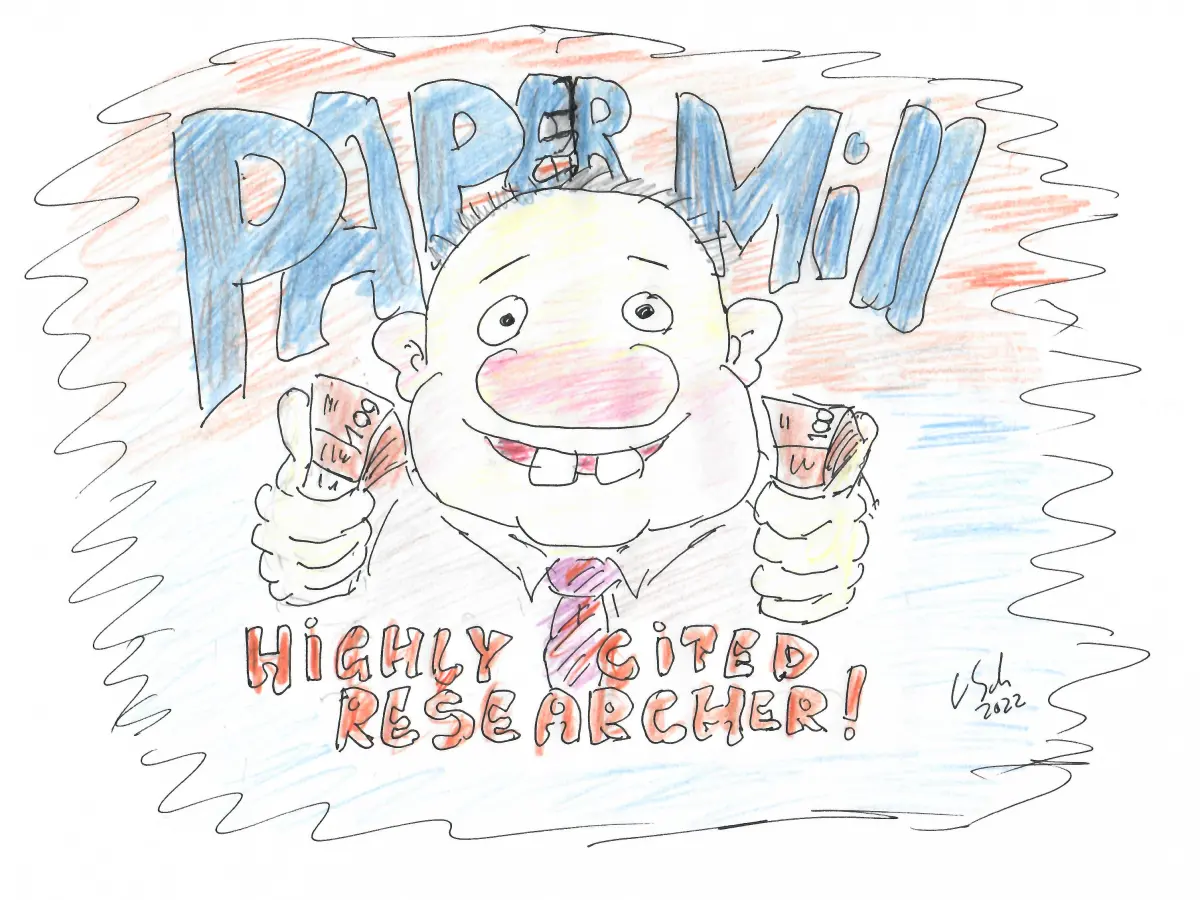
Csaba Szabo, professor of pharmacology at University of Fribourg in Switzerland, was contacted by a Chinese papermill offering him money. All Csaba had to do to earn between $1500 and $5000 a pop was either to ghost-write papers for the papermill or to make sure their products get published in a journal where he is editor. He even received a ready manuscript, and was told he will be paid as soon as the paper is accepted.
We publish here everything.
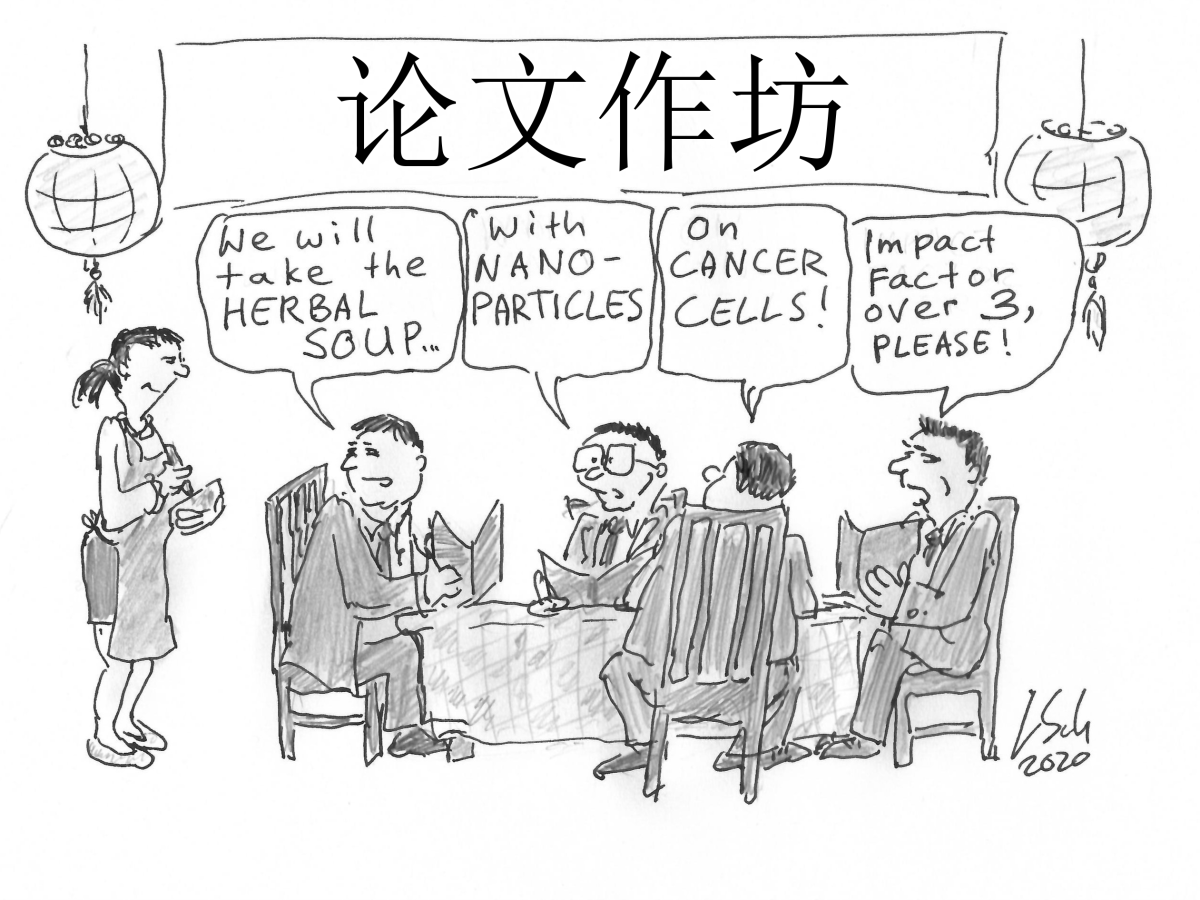
You will be paid US $500-800 for each paper
“Or The author can also put your name to the article to increase your academic popularity, such as adding your name to the second or third author.”

The question is: how many professors would have reacted differently from Dr Szabo? How many members of editorial boards at Elsevier, MDPI or Frontiers are happily lining their pockets with papermill money as you read these lines?

Operation “Publishable Garbage” — A Sting Inside a Papermill
By Csaba Szabo
“Paper Mills” Are Becoming Curiously Fashionable
The blog For Better Science was one of the first to devote an extensive, highly informative investigative report to the problem of papermills. Mainstream journals, including as Nature and Science have covered it, too, in recent years (e.g., Nature 2022, Nature 2023, Science 2023, Nature 2025), as well as academic researchers (e.g. Parker et al 2024, Porter et al 2024, Heathers 2024). Papermills constitute a billion-dollar industry that poison the scientific literature.
The full-service paper mill and its Chinese customers
An investigation by Elisabeth Bik, Smut Clyde, Morty and Tiger BB8 reveals the workings of a paper mill. Its customers are Chinese doctors desperate for promotion. Apparently even journal editors are part of the scam, publishing fraudulent made-up science.
Despite growing concern, surprisingly little is known about how these operations actually function. As far as I am aware, no investigative journalist or sleuth has ever managed to infiltrate one. Smut Clyde imagines that a paper mill is perhaps like a “medieval scriptorium, basing my mental picture on “The Name of the Rose”, with a room full of monks at their separate desks, working on separate tasks”. The “monks” are probably former scientists who have “gone rogue” and now engage in this activity as a primary source of income. But it is also possible that some bona fide academic scientists may have side-gigs as paper-mill paper “creators”.
The Chinese Paper Mill Industry: Interview with Smut Clyde and Tiger BB8
Unlike those fake paper mill products, this interview failed editorial review and journal quality control.
Many papermills thought to operate from countries such as China, Iran, Russia, Belarus, Latvia, or Poland. These organizations appear to have dedicated “marketing arms” tasked with identifying corrupt insiders within academia — individuals willing to accept bribes to push their fake manuscript products into the literature –– preferably into bona fide, indexed journals.
Retraction data supports some unsettling patterns. Quantitative analyses suggest that so-called “Special Issues” organized and reviewed by so-called “guest editors” are significantly more likely than regular editors to serve as entry points for paper mill products (Hanson et al 2023, Bik 2023, Mills et al 2024, Nature 2023). These operations often rely on fake peer-review networks — often impersonating real scientists by using fraudulent email addresses that resemble legitimate ones — to create the illusion of scientific vetting. While much of this remains in the shadows, paper mills occasionally come to light when vigilant sleuths uncover entire families of fake publications — dozens or even hundreds — triggering mass retractions. Some paper mills, however, are bold enough to operate in the open. One such entity, calling itself “International Publisher,” lists official partners and even held a 2016 seminar titled “Rapid Publication in Scopus and Thomson Reuters Journals” at the Biology Faculty of Moscow State University (Abalkina 2021, The Insider 2019).

Cyclotron Branch, Before the Fall
“sadly, no-one could find any other evidence of existence for these festively-named individuals, who may well be Knock-Knock jokes that somehow gained sentience.” – Smut Clyde

Setting Up a Sting Operation
In 2023, I experienced my first personal encounter with a papermill representative. A person identifying herself as “Ms. Kristen” contacted me through my university email. Claiming to represent the “Alliance Academy of Science,” they stated that they had “cultivated strong collaborations with numerous researchers worldwide” and wanted to “extend an invitation for potential collaboration”:
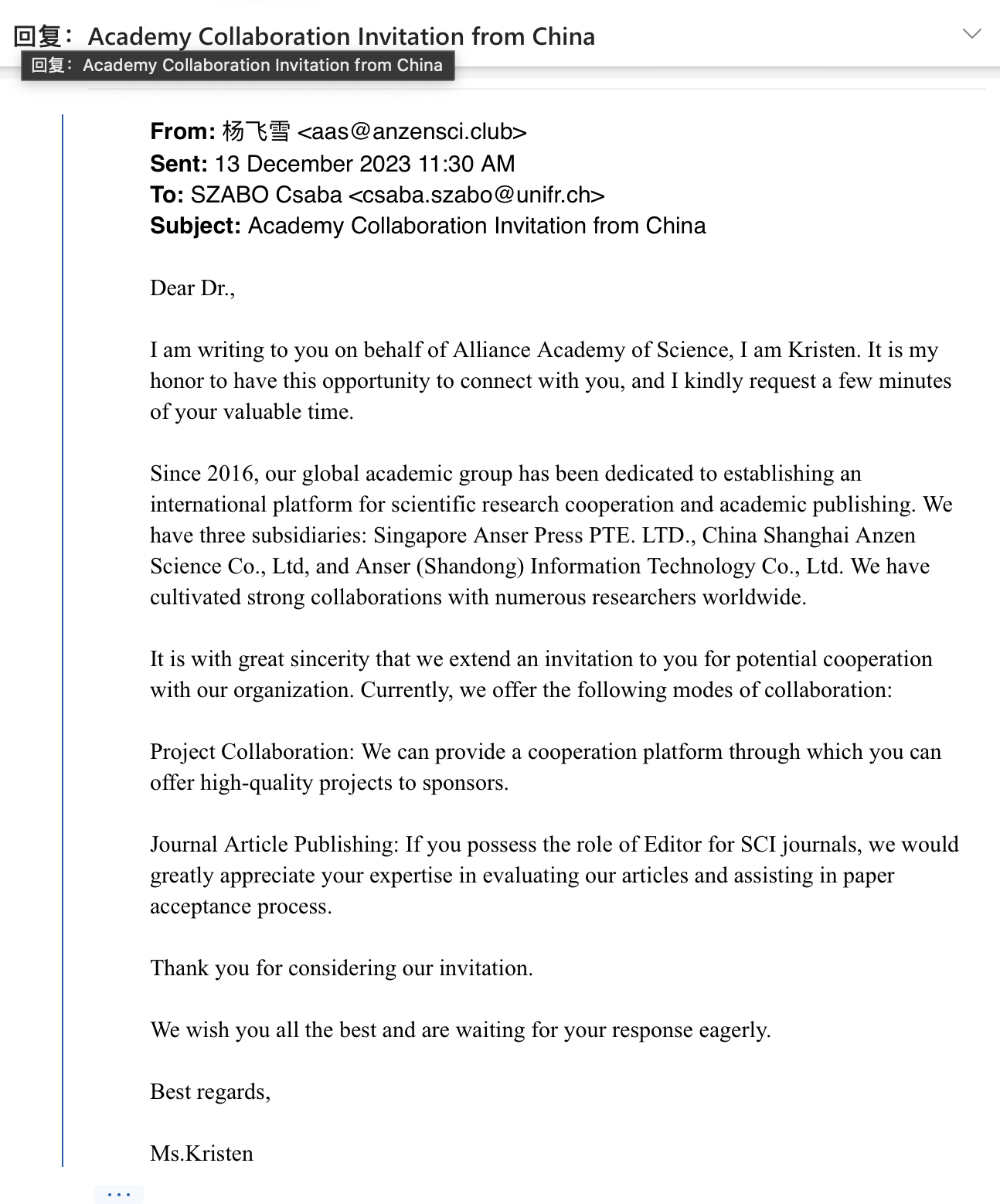
I briefly replied, received a price list in return, and mentioned this interaction in a few short passages in my book Unreliable.
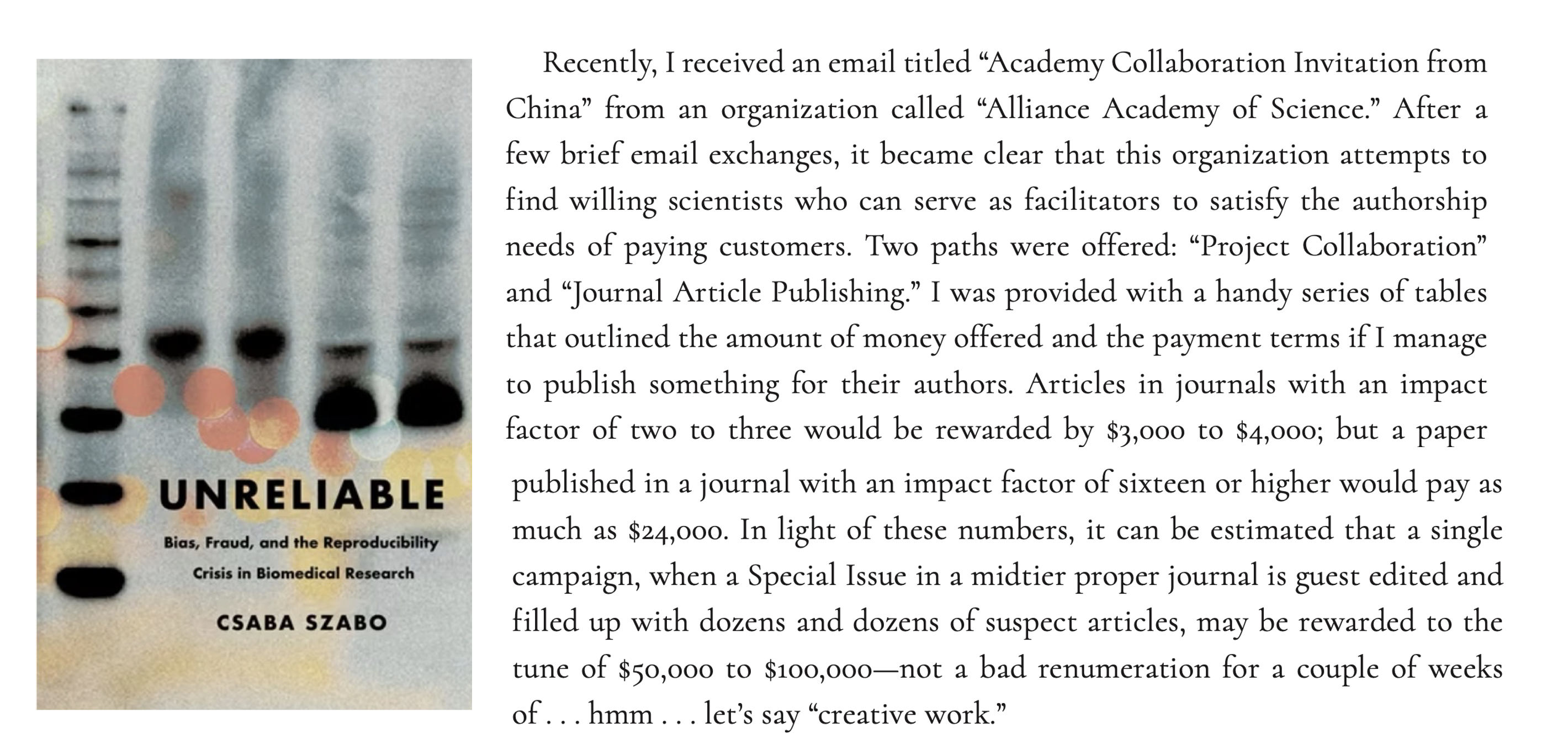
A few weeks ago, it happened again. This time, the email came from a “Julia,” in a similar tone and with familiar phrasing:
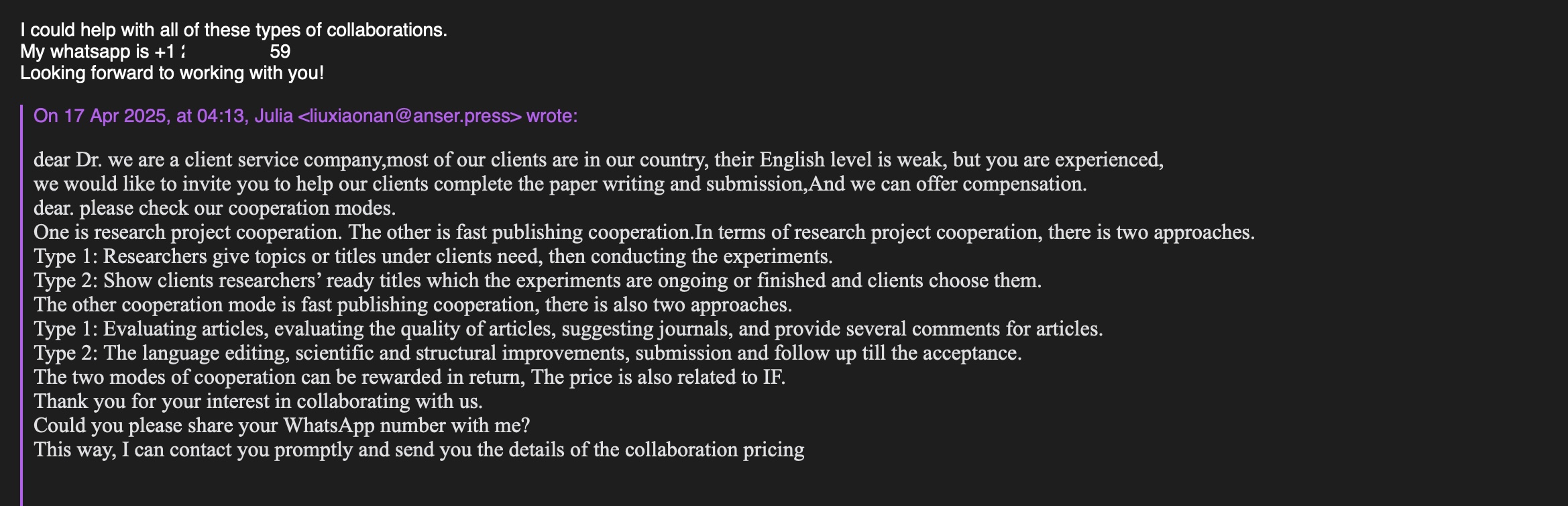
I decided to take the opportunity to investigate it further and reached out to Leonid Schneider at For Better Science. Together, we devised a small “sting operation” to gain first-hand insight into how these paper mills interact with the academic environment they seek to infiltrate to release their “products”. Our plan was simple. I would pretend to be interested in their offer, share just enough information to gain their trust, and attempt to gather as much detail as possible about their business model and payment practices. Ideally, I would also obtain a sample of a paper they were trying to place. Then, following Leonid’s clever suggestion, I would act greedy but also express doubt about whether they would actually pay me — hoping to elicit information about the magnitude of their operation and perhaps even about the names of some of the corrupt academic insiders who work with them.
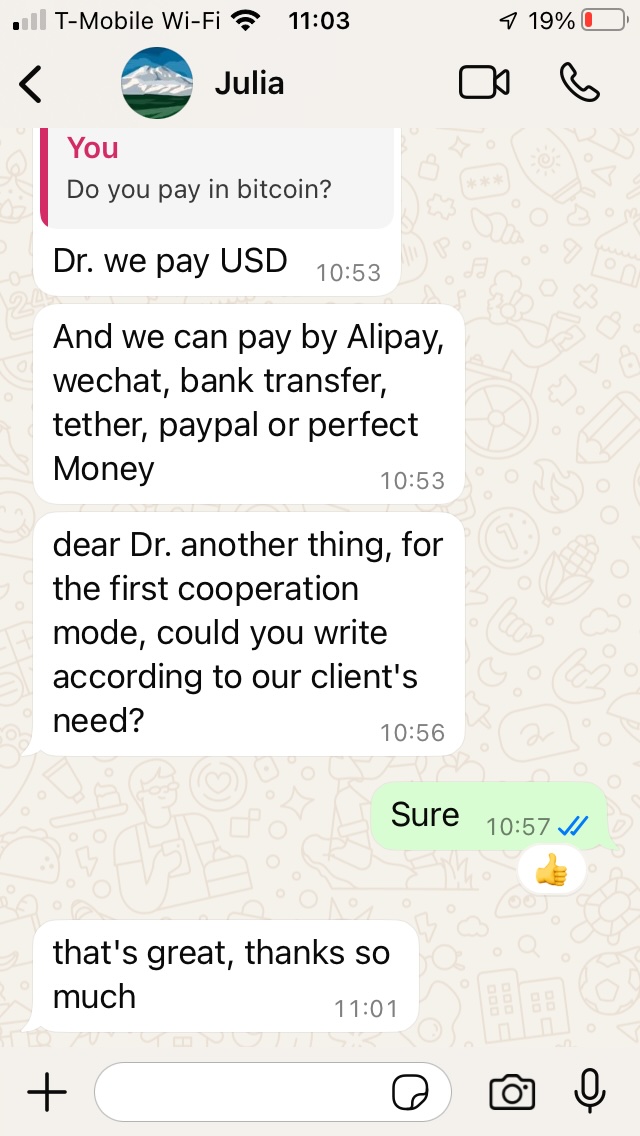
Once I replied to their initial email, they have quickly moved the conversation to WhatsApp. All further communication occurred via text messages, which I have archived as screenshots (one example is shown on the right). A full, word-for-word transcript of the exchange — including several telling images they shared — is provided below. The entire interaction unfolded over approximately 72 hours.
“Julia”:
Hi, dear Dr.
Good time
I’m Julia
Nice to meet you
“Julia” :
dear Dr. I contacted with you by email
Csaba Szabo:
Yes, I am here.
Julia” :
Hi, dear Dr,
Good time dear.
could you share with me your google scholar?
I would like to learn more about the articles you have previously published.🤗
Csaba Szabo:
Professor, Chair of Pharmacology, University of Fribourg
https://scholar.google.ch/citations?user=BwakT0AAAAJ&hl=de
I published 600 papers and have a H-index of 154.
“Julia” :
Dr. we are a client service company, most of our clients are in our country, their English level is weak, but you are experienced, we would like to invite you to help our clients complete the paper writing and submission, And we can offer compensation.
Csaba Szabo:
Please send me more details.
“Julia” :
dear. please check our cooperation modes.
One is research project cooperation. The other is fast publishing cooperation.
Type 1: Researchers give topics or titles under clients need, then conducting the experiments.
Type 2: Show clients researchers’ ready titles which the experiments are ongoing or finished and clients choose them.
Fast publishing cooperation also has two types:
Type 1: Evaluating articles, evaluating the quality of articles, suggesting journals, and providing several comments.
Type 2: The language editing, scientific and structural improvements, submission and follow-up till acceptance.
The two modes of cooperation can be rewarded in return, The price is also related to IF.
Csaba Szabo:
Yes ok I already saw this in your email, but I would need more concrete info to see if this is financially worth my time.
“Julia”:
dear Dr. this is the Price of the first cooperation mode
writing+publishing
At this point, “Julia” sent me the following screenshot:
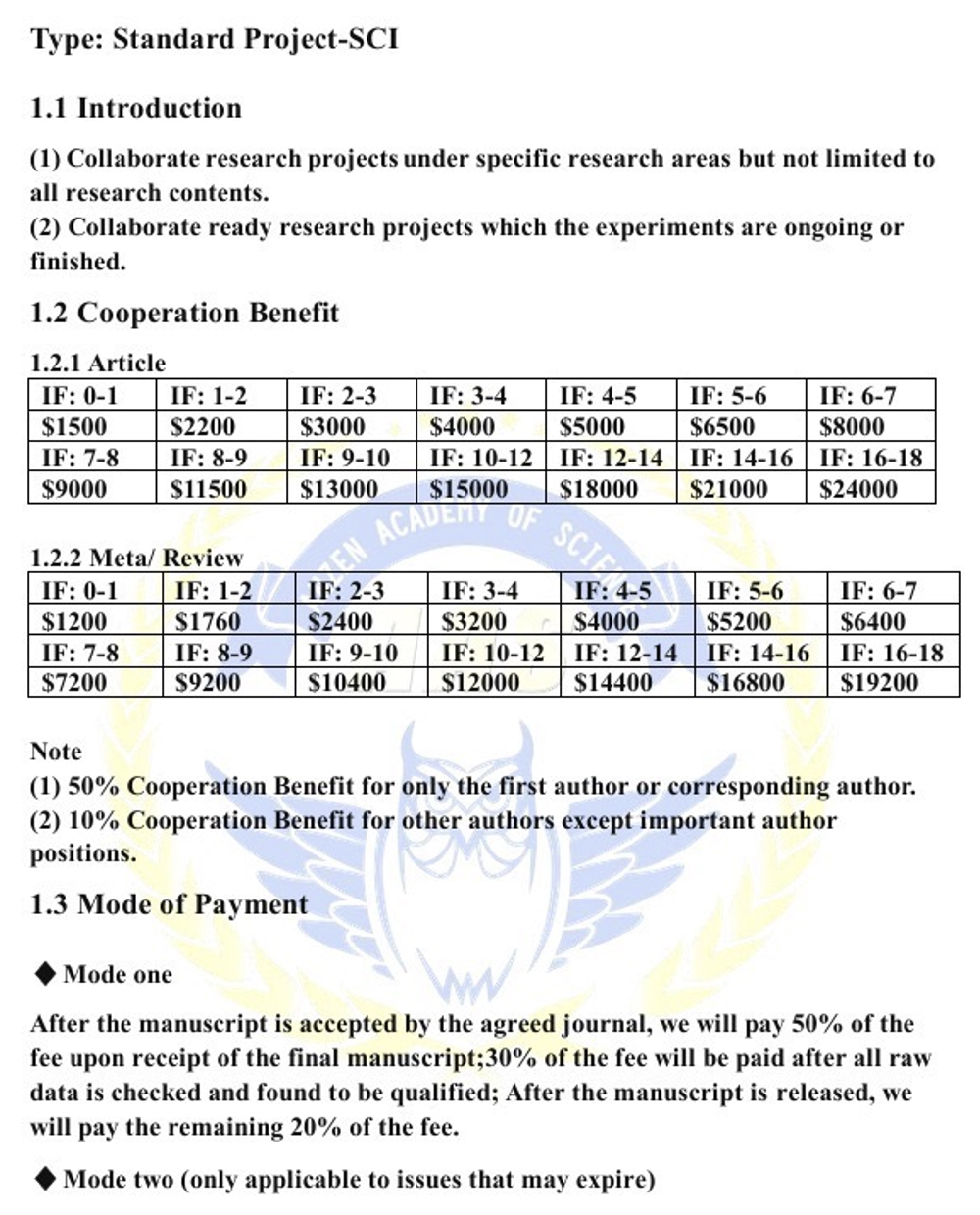
This is actually the first page of a multi-page document that was already sent to me in also in 2023 by “Ms. Kristen”. Each page of this document is shown below:
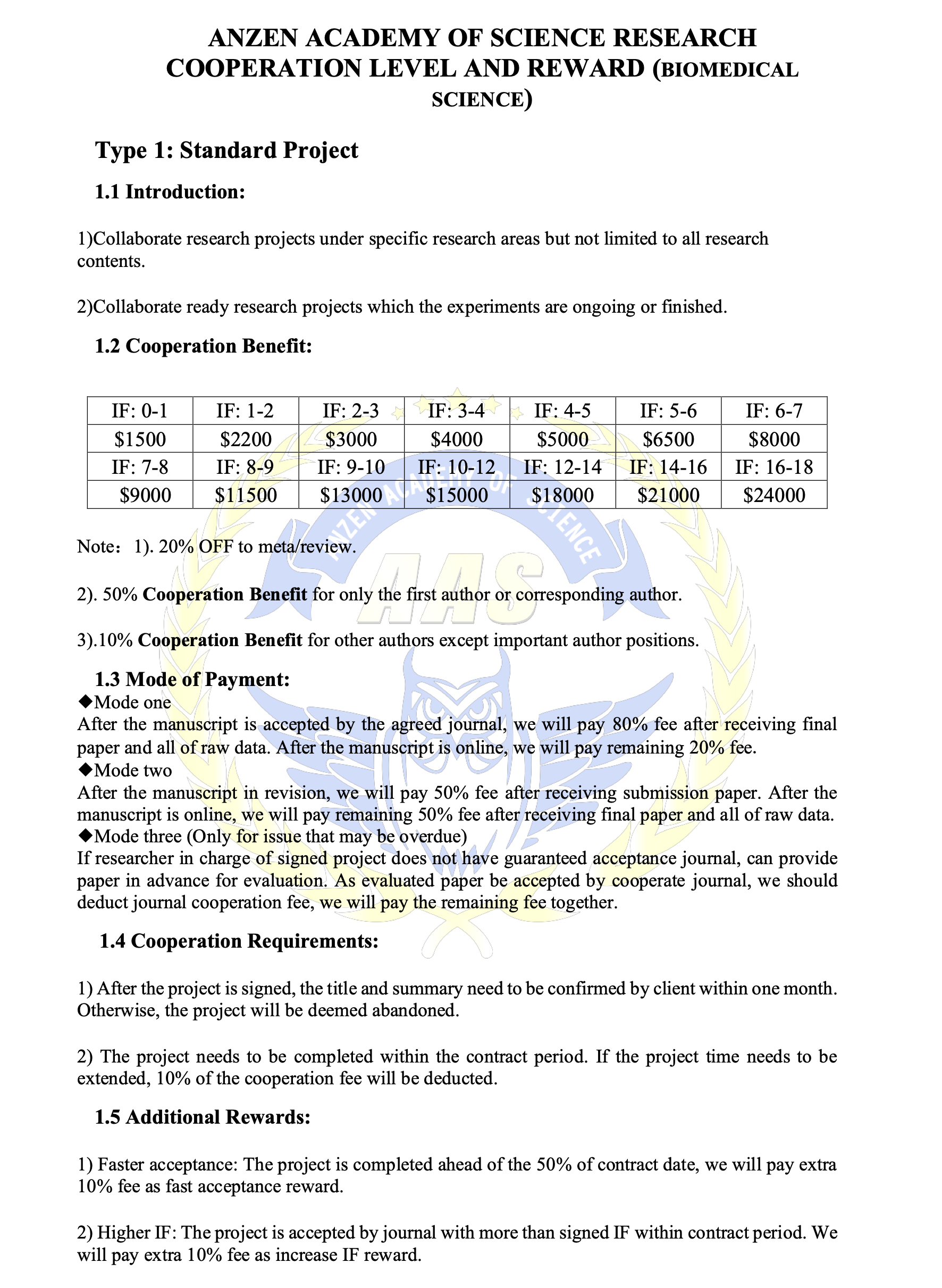
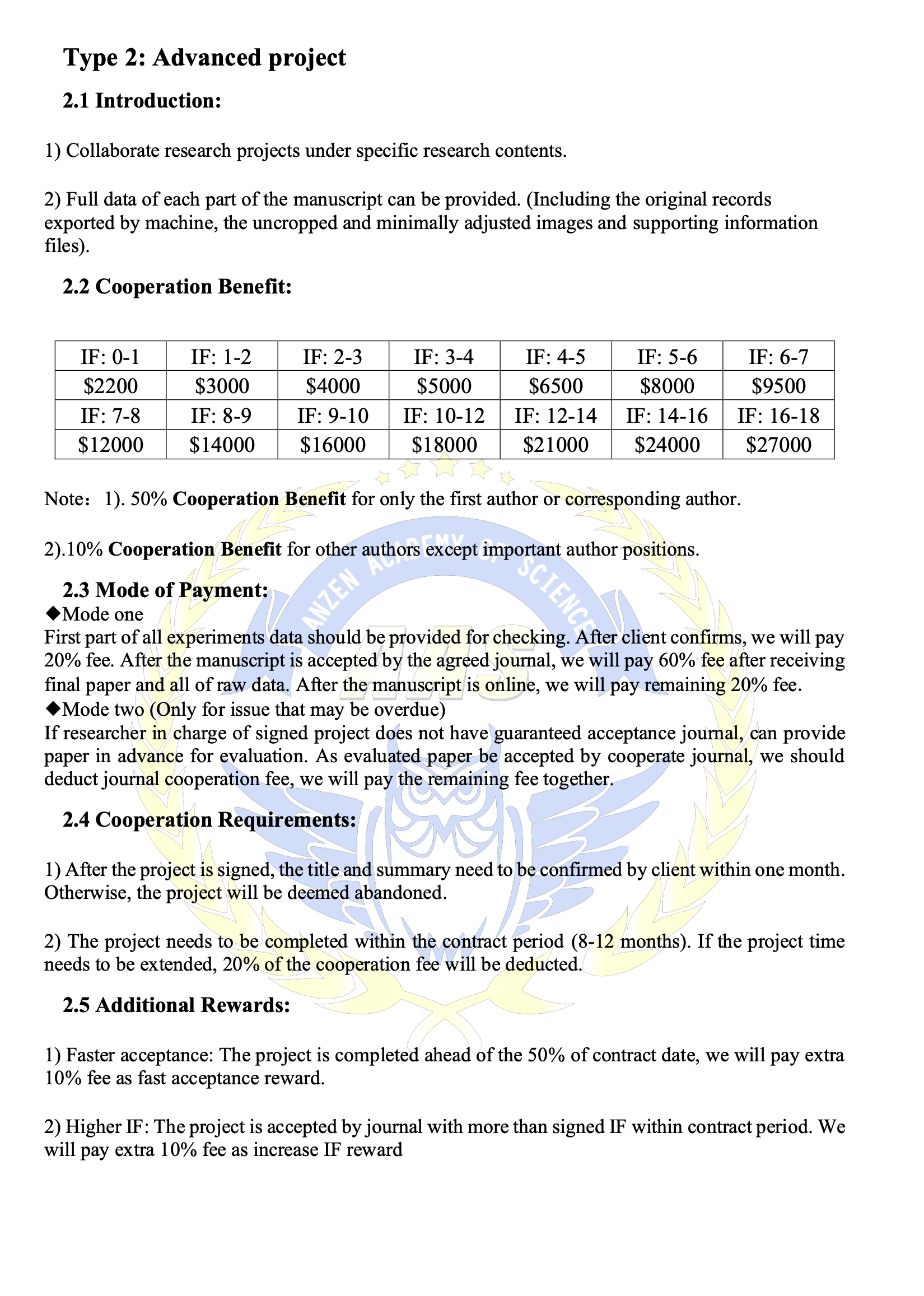
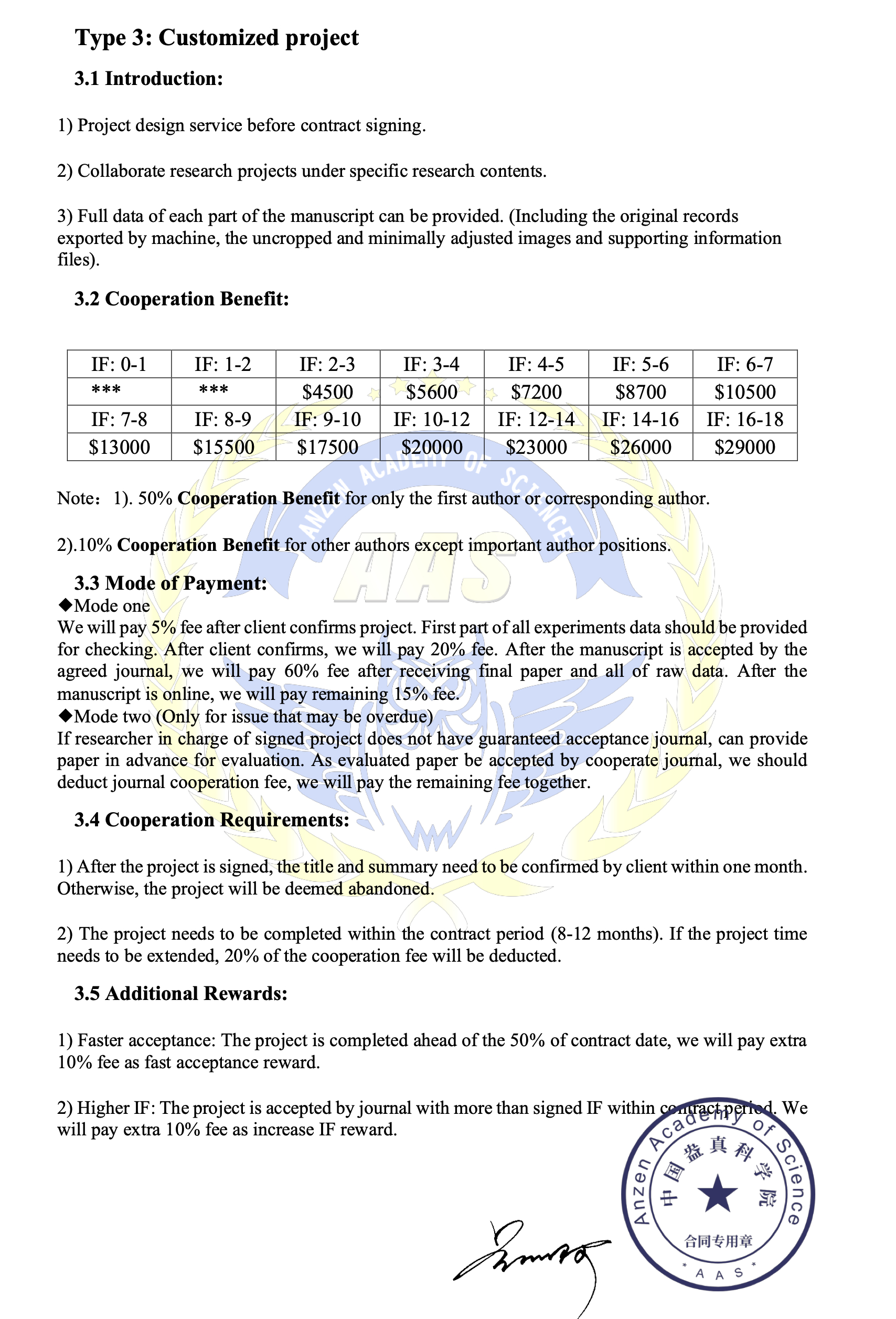
Csaba Szabo:
OK, so the fastest way to do this would be to work on (2) where the project is already finished. In this case you will send me a draft of the manuscript, correct? And my task is to edit it for style and language and make sure it to get published in a journal. Correct?
“Julia”:
dear, you mean the fast publishing cooperation mode, right?
Csaba Szabo:
And what is the organization that will pay me?
“Julia” :
dear. when the paper accepted, we will pay after acceptence
“Julia”:
dear Dr. do you serve as editor in some SCI journals?
Csaba Szabo:
Yes. Geroscience, Molecular Medicine, Nitric Oxide, Mitochondrion.
But who is “we”
And I am sorry, but I don’t understand the price structure. For example if 4-5 meta/ review would give me 4000, but then will I be an author on the paper too or only facilitator of publishing it?
And I don’t understand the 50 and 10% cooperation benefit part.
“Julia”:
our company
plz wait
If our client wants a research article with IF 4-5 and purchases all author positions, and their institution does not allow adding foreign authors, our price is 5000 USD. If the client requires a review article or a meta-analysis, our price will be 5000±1000.
will be 5000 * 80% = 4000 USD.
and we will pay after acceptence
Csaba Szabo:
Do you already have material to be published that I can start on?
“Julia”:
If we have similar manuscripts submit to the journals you are editing, is the probability of acceptance high?
Csaba Szabo):
What do you mean similar?
“Julia” :
Manuscripts similar to the journal’s research scope.
Csaba Szabo:
Yes of course. I can guarantee if the quality is sufficient. But it is easier if I am not an author myself.
“Julia” :
dear. is the probability of acceptance high?
Csaba Szabo:
100%.
“Julia”:
dear Dr. Can you help us get articles accepted in all four of these journals?
Csaba Szabo:
Yes, I have a lot of influence on these boards.
“Julia” (10:31):
👍 that’s great
dear Dr. this is our fast publishing price.

Csaba Szabo:
But these are now lower prices than what was previously quoted. What is the difference?
“Julia”:
dear. this is submission Price, we will provide the client’s manuscript, We hope you can help us with polishing and evaluating the manuscript.
Csaba Szabo:
And in the previous scheme that was more money for me? How is that different? Sorry, I have never done this before.
“Julia”:
dear Dr. Regarding the first type of collaboration, we need you to write the manuscript and submit it. Payment will be made after the article is accepted.
The second type of collaboration is that our client’s manuscript will be sent to you for evaluation. You would assess whether you can help us submit it to a journal where you serve as an editor. If the article is successfully accepted, we will pay you a submission fee.
Csaba Szabo:
Ah ok. In the first form you will supply the data, figures, methods etc?
In the second you supply the whole paper?
And I am not an author in either case. Ok.
Lets start with one of each. Do you have materials ready to go?
“Julia”:
dear Dr. plz wait
if we have any projects related to your research area, we will tell you.
Csaba Szabo:
Okay I wait.
Also it would be nice to have a contract so that I am guaranteed to get my payment.
Do you pay in bitcoin?
“Julia”):
yes, dear
Dr. we pay USD
And we can pay by Alipay, wechat, bank transfer, tether, paypal or perfect Money
“Julia”:
dear Dr. another thing, for the first cooperation mode, could you write according to our client’s need?
Csaba Szabo:
Sure.
“Julia”:
that’s great, thanks so much
Csaba Szabo:
Ok so I wait for a contract for you and some papers and materials I can help with. How soon can you send them?
“Julia”:
dear Dr. I have now asked our colleagues if they have found any projects related to your research field. I will inform you as soon as I receive a response.
Csaba Szabo:
Excellent. Looking forward to a productive relationship. Sometimes I also edit Special Issues in case you have a series of studies in a certain well defined field.
“Julia”:
dear Dr. If you are serving as a guest editor for any special issues, you can also share them with me.
Csaba Szabo:
The journals keep asking me for special issues. If you have a list of scientists or topics that your network is active in, I could propose a special issue. Then perhaps we could publish a series of papers together.
Csaba Szabo:
But I would also need some assurance that your organization is legit and I get my payments as promised. A written contract would be best. But you could perhaps suggest a few scientists or editors that worked with you before and I could get some verification from them that way.
“Julia”:
Dear Dr. I have communicated your request to our project team. If we successfully identify projects related to your research field, our colleague Ariana will send you the project details along with a quotation. Please feel free to reach out at any time if you have any questions.
“Ariana”:
Hello dear Dr, I’m Ariana. From now on, I will be communicating with you regarding the projects.
“Ariana”:
Looking forward to a successful collaboration with you.
Csaba Szabo:
Okay! How shall we proceed?
“Ariana”:
Morning Dr
“Ariana”:
Did Julia explain our collaboration model and pricing to you?
“Ariana”:
I found that you are an editor at GeroScience. Could you help us with submission and acceptance? We have a manuscript we’d like to submit and would like to know if you can assist.
At this point, a complete manuscript, in Word file, was sent via WhatsApp, dealing with the effect of “LncRNA” on “DNAJC3-AS1/hsa-miR-576-5p/SSBP2” in a form of cancer. The manuscript, Sun et al., listed 8 authors, all from China, and contained 5 multi-panel figures.
Zhenni Sun, Mi Zhou, Yasai Yao, Xuehong Chen, Tao Qin, Yafei Han, Lu Yue, Ruyong Yao Regulation of LncRNA DNAJC3-AS1/hsa-miR-576-5p/SSBP2 Axis in Gastric Cancer Migration
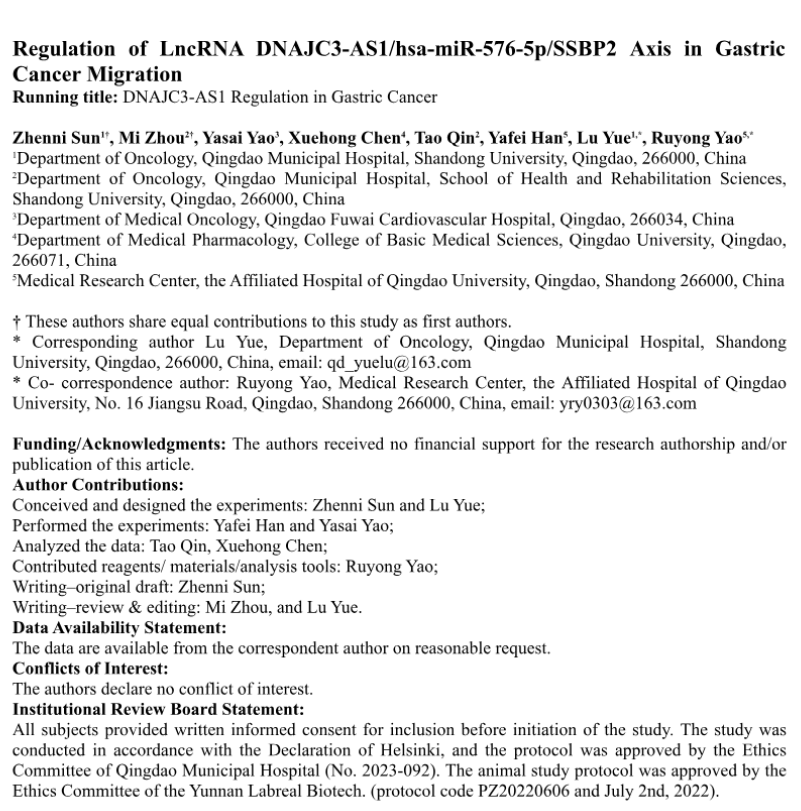
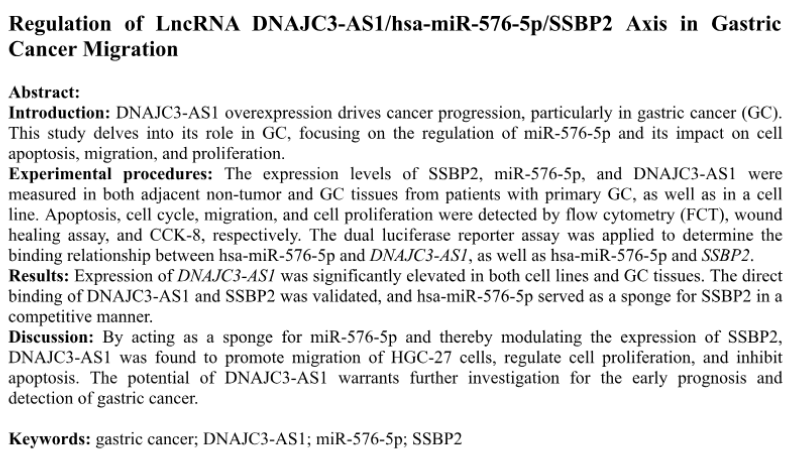
It is identical to this preprint posted on 2 March 2025:
Zhenni Sun , Mi Zhou , Yasai Yao , Xuehong Chen , Tao Qin , Yafei Han , Lu Yue , Ruyong Yao Regulation of LncRNA DNAJC3-AS1/hsa-miR-576-5p/SSBP2 Axis in Gastric Cancer Migration Research Square (2025) doi: 10.21203/rs.3.rs-6124816/v1
The corresponding authors Ruyong Yao from Affiliated Hospital of Qingdao University and Lu Yue from Qingdao Municipal Hospital already have a PubPeer record:
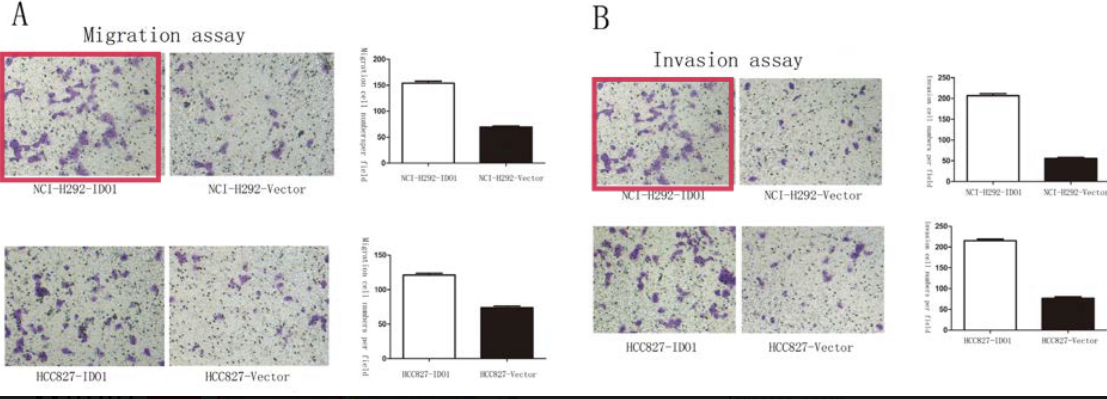
Dongfang Tang , Lu Yue , Ruyong Yao , Lin Zhou , Yuqin Yang , Liming Lu , Wen Gao P53 prevent tumor invasion and metastasis by down-regulating IDO in lung cancer Oncotarget (2017) doi: 10.18632/oncotarget.17408
Another joint study, with Yao’s name differently transcribed:
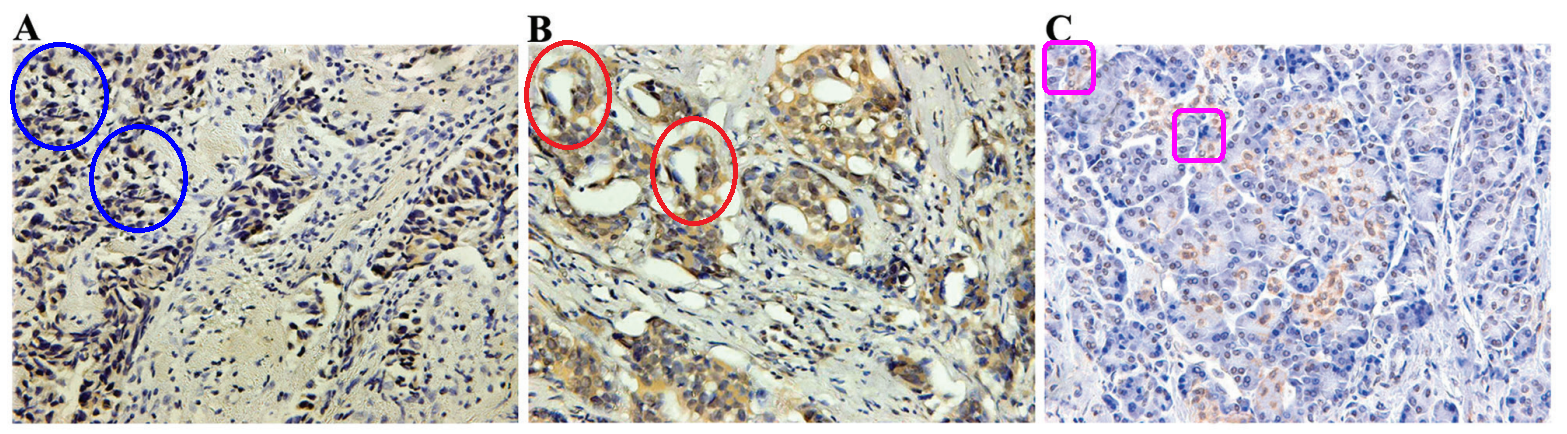
Lu Yue , Zhen‑Ni Sun , Ya‑Sai Yao , Zan Shen , Hai‑Bo Wang , Xiang‑Ping Liu , Fang Zhou , Jin‑Yu Xiang , Ru‑Yong Yao , Hai‑Tao Niu CRM1, a novel independent prognostic factor overexpressed in invasive breast carcinoma of poor prognosis Oncology letters (2018) doi: 10.3892/ol.2018.8316
This is on PubPeer since 2017, by Yao, Yue and the another coauthor of the Anzen papermill manuscript, Yasai Yao:
Xiaoxiao Li , Ruyong Yao , Lu Yue , Wensheng Qiu , Weiwei Qi , Shihai Liu , Yasai Yao, Jun Liang FOXM1 mediates resistance to docetaxel in gastric cancer via up-regulating Stathmin Journal of cellular and molecular medicine (2014) doi: 10.1111/jcmm.12216

And one more for Ruyong Yao:
Xiangping Liu , Bin Zhao , Haibo Wang, Yu Wang , Mengdi Niu , Ming Sun , Yang Zhao , Ruyong Yao , Zhiqiang Qu Aberrant expression of Arpin in human breast cancer and its clinical significance Journal of cellular and molecular medicine (2016) doi: 10.1111/jcmm.12740

[left] Fig 1B from “Down-regulation of BRMS1 by DNA hypermethylation and its association with metastatic progression in triple-negative breast cancer” (Kang et al 2015).
[right] Fig 1.
And two more for Lu Yue:
Zan Shen, Chen Yao , Zifeng Wang , Lu Yue , Zheping Fang , Hong Yao , Feng Lin , Hui Zhao , Yuan-Jue Sun , Xiu-wu Bian , Wenqi Jiang , Xiaomei Wang , Yi Li , Gang Lu , Wai Sang Poon , Hsiang-Fu Kung , Marie Chia-mi Lin Vastatin, an Endogenous Antiangiogenesis Polypeptide That Is Lost in Hepatocellular Carcinoma, Effectively Inhibits Tumor Metastasis Molecular Therapy (2016) doi: 10.1038/mt.2016.56

The conversation continued:
Csaba Szabo:
What is it exactly that you wish me to do?
Csaba Szabo:
Also I never got answers to some of my prior questions. I asked for a contract or some peoples names who worked with you before. To make sure I get paid.
“Ariana”:
For Collaboration Model 1, we need you to write the manuscript according to our requirements, provide us with the author positions, select the journal, handle revisions until the article is accepted, and we will pay you based on the article’s IF.
“Ariana”:
For Collaboration Model 2, if you are an editorial board member of the journal or have connections that can influence the acceptance of the article, we would hope you could assist us in the submission process to expedite the acceptance time.
Csaba Szabo:
Also I never got answers to some of my prior questions. I asked for a contract or some peoples’ names who worked with you. To make sure I get paid.
“Ariana”:
The contract will be sent to you when the collaboration officially begins.
“Ariana”:
The names of other collaborating researchers are considered personal privacy.
I can show you this
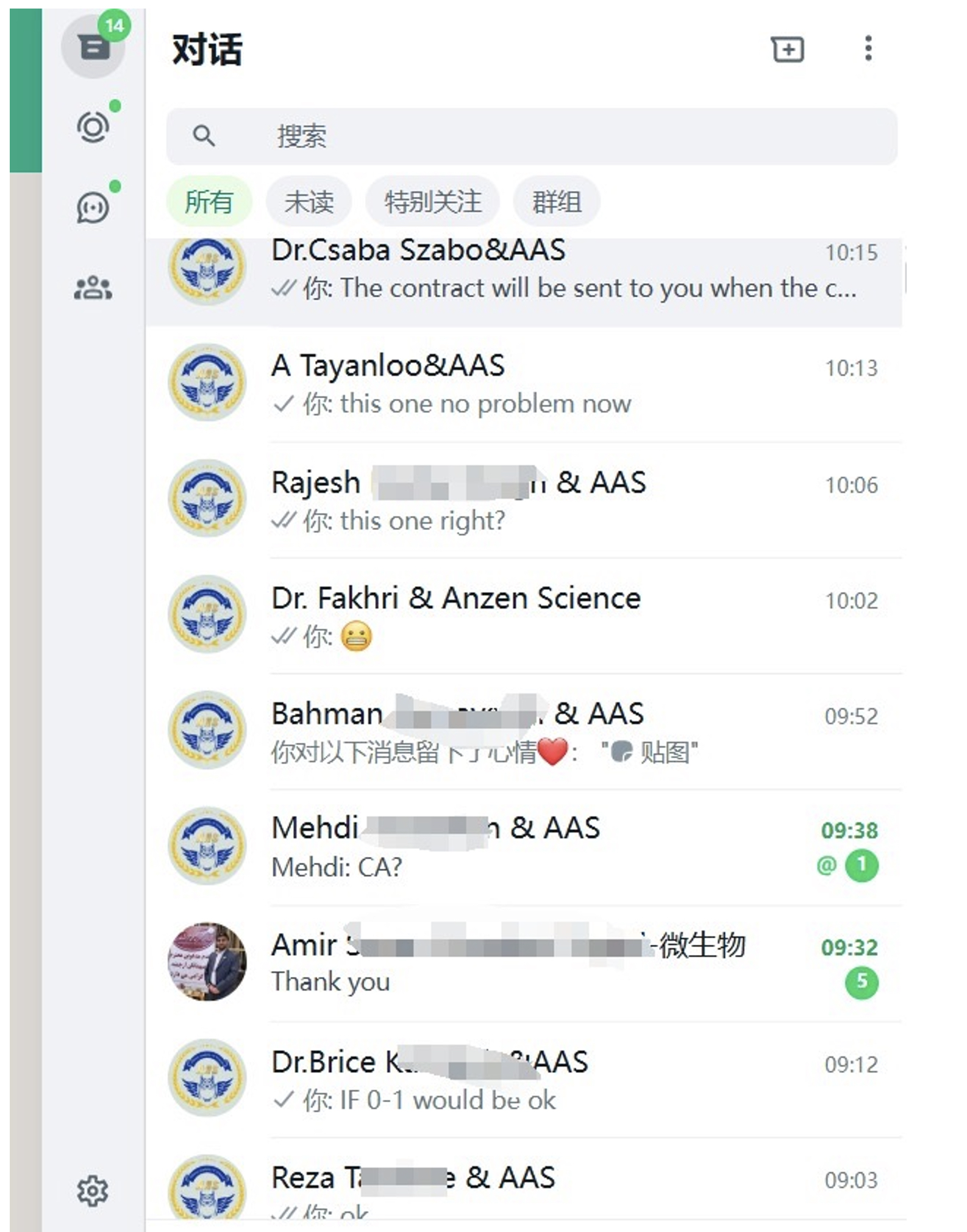
“Ariana”:
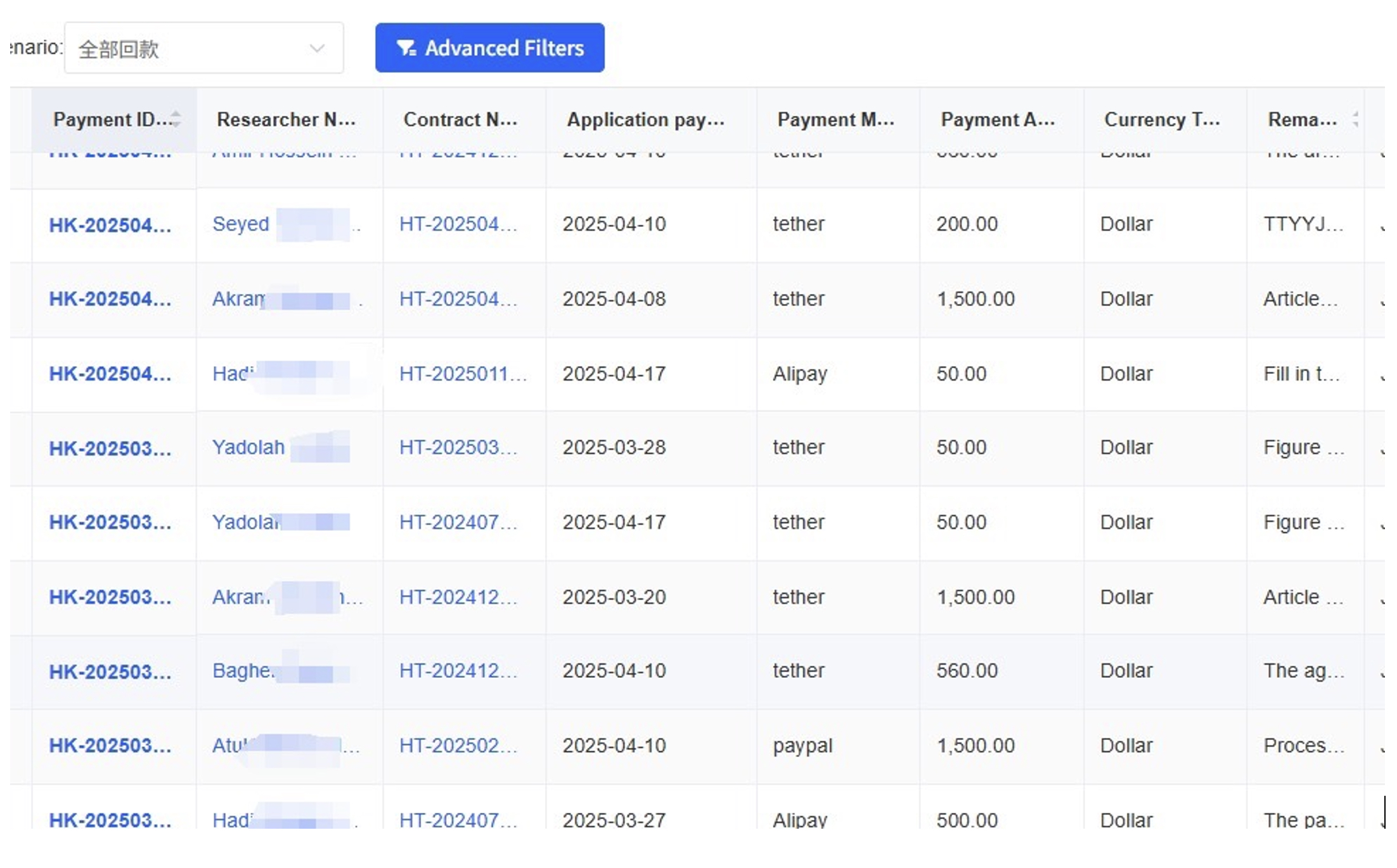
These are partial screenshots of the payment requests.
Csaba Szabo:
You already sent me a paper by Sun et al. So let me understand what am I supposed to do with it. Just make sure GeroScience publishes it? Does your organization have reviewers with email addresses I can use to ensure the outcome you wish? And how much money do I get and when?
“Ariana”:
We hope you can take over this manuscripy and handle the revisions and submission until it is accepted. After the manuscript is accepted, we can pay you $1000 in total (80% after acceptance, 20% after online)
“Ariana”:
hello Dr. what do you think. Can we collaborate?
At this point, I stopped responding and blocked the numbers of “Julia” and “Ariana” on my phone.
What Have We Learned from Operation “Publishable Garbage”?
In just a few days, our modest sting operation managed to uncover several key components of their modus operandi.
They initiate contact through random emails sent to academic scientists — likely by harvesting email addresses from PubMed. The fact that they reached out to me, and then willingly entered into a conversation, suggests that they perform no background checks whatsoever. A simple Google search would have led them straight to Unreliable, and it would have been immediately obvious where I stand on such matters. But as it turns out, greed and sloppiness can make excellent bedfellows.
“Unreliable” by Csaba Szabo – book review and excerpt
Csaba Szabo’s book “Unreliable: Bias, Fraud, and the Reproducibility Crisis in Biomedical Research” – review by Zoltan Ungvari and excerpt.
Our WhatsApp exchange revealed a predatory scheme involving scientific ghostwriting, authorship-for-sale, and manipulation of the peer-review process via bribery. The sale of authorship — especially fraudulent authorship — is textbook scientific misconduct, particularly since its goal is to pad CVs, strengthen grant applications, or secure academic promotions.
Second, the messages — although phrased in flowery terms and use words like “collaboration” — clearly reveal attempted bribery and editorial manipulation. “Julia” implies that I could act as an editor and be paid for getting papers accepted in journals I am affiliated with. This is a direct violation of conflict-of-interest policies and, in the context of a public university, could amount to criminal abuse of office. Privately profiting from editorial influence breaches institutional codes of conduct, national research integrity guidelines, and international anti-corruption rules.
Then there’s ghostwriting — another serious violation. Ghostwriting without acknowledgment contravenes the authorship criteria of ICMJE, COPE, and most major publishers. It deceives reviewers, funders, and readers about who actually conducted and wrote the research.
Additionally, “Julia” proposed that I act as a facilitator, helping manuscripts bypass peer review by using my editorial role to “guarantee” acceptance. This kind of gatekeeping-for-hire undermines the integrity of academic publishing, corrupts editorial independence, and makes a mockery of the already fraying ideal of merit-based peer review. The suggested model of “Fast Publishing Cooperation” (i.e. when the acceleration of a publication is stimulated by a higher bribe structure) makes their whole suggestion even more unethical and illegal.

Polymer Papermillers Taking the Piss
Papermill Industry enters its Logical Growth Phage. Smut Clyde explains what coordination polymer chemistry has to do with chickenshit.
Red Flags and Rotten Infrastructure
Red flags are everywhere. There is no registered entity named “Anzen Academy of Science” — the name itself is fabricated. The use of pseudonyms like “Julia,” who has no listed institutional affiliation, is also telling. The switch from email to WhatsApp raises further suspicion. The fact that they use crypto and obscure payment systems like “Perfect Money” speaks volumes, too — these are classic hallmarks of money laundering operations.
A closer look at the conversation and the attachments they provided reveals more about their structure. It appears there may be a two-tier recruitment system: entry-level scouts cast a wide net by contacting academics en masse (in our case, “Julia”), and once a target shows interest, the contact is handed off to someone more senior — someone presumably closer to the paper mill’s core operation, perhaps already in possession of manuscripts waiting for “placement” (in this case, “Ariana”).
The screenshots they shared suggest a very busy operation. Every 5–10 minutes, there’s communication with someone else. While full identities are obscured, one name stood out: “A. Tayanloo.” This possibly refers to Akram Tayanloo-Beik from Iran, whose publication record in Google Scholar reveals a remarkable scientific Renaissance figure. Curiously, Tayanloo publishes only review articles — over 30 of them since 2021 — on wildly diverse topics: extracellular vesicles and cancer stem cells, the “wonders” of stem cells in COPD, use of zebrafish in autism research, and organ-on-a-chip models for ALS, for example Arjmand et al 2022 , Tayanloo-Beik et al 2022 , Tayanloo-Beik et al 2023, Tayanloo-Beik et al 2024, all with former high-ranking official in Iran’s Ministry of Health, Bagher Larijani (read July 2024 Shorts!).
And is “Dr Fakhri” the infamous Ali Fakhri?

Synthetic Communications with Ali Fakhri and his real or imaginary friends
“the entire dramatis personae seem to have crawled out of our man’s sock drawer, and the page-count of Synthetic Communications would be grievously impoverished without his contributions, whether direct or uncredited.”- Smut Clyde
Another screenshot we managed to extract from Anzen shows a rather dense payment schedule. Over the course of just a few weeks, more than $5,000 was paid out. If that is typical, this organization (or perhaps a single operative in a larger organization?) may be spending upwards of $100,000 per year on its “collaborators.” Some of the payments — $1,500 each — were clearly for entire articles. Others, at $50, were presumably for production of figures. It is possible that different freelancers specialize in fake figure creation, adding another layer of subcontracted fraud to the ecosystem.
Anatomy of a Paper – Mill Manuscript
The manuscript they sent me for “placement” bears all the hallmarks of paper-mill output. The topic — long non-coding RNAs, especially in the context of cancer — is a known papermill favorite, alongside miRNAs, circRNAs and non-coding RNAs (Byrne et al 2019, Bricker-Anthony et al 2023). A quick analysis by Smut Clyde uncovered the usual signs: experimental timelines “telescoped” together, an incorrect equation for xenograft tumor calculations, a reference list largely unrelated to the text but packed with citation-boosting entries. According to Smut, “ImageTwin didn’t recognize any of the images. But if they were algorithmically generated, there is no reason why it should.”

The scientific sea of miR- and exosome-related knowledge
“Whole cohorts of peer-reviewers have been trained to view all these mannerist stylings as what western blots should look like. […] It will be a challenge to convince them otherwise.” – Smut Clyde.
Conclusion: Fraud as a Career Option – Customers and Enablers
It’s clear that any academically corrupt individual — particularly one with editorial connections — could easily “place” dozens of these Anzen products into indexed journals and collect a handsome side income in the process.
Anzen is not a new operation. As noted in introduction, I was first contacted by this same group in 2023. They were already operating then with the exact same pricing structure. (Apparently, paper-mill inflation still lags behind consumer inflation.) They don’t have an official website, of course, but traces of them are visible online as far back as 2021. On Quora, and on Steemit, someone lists an old version of their site. One archived page from four years ago even named a Wu Qingke as Anzen’s co-founder and features a partial list of papers for sale:
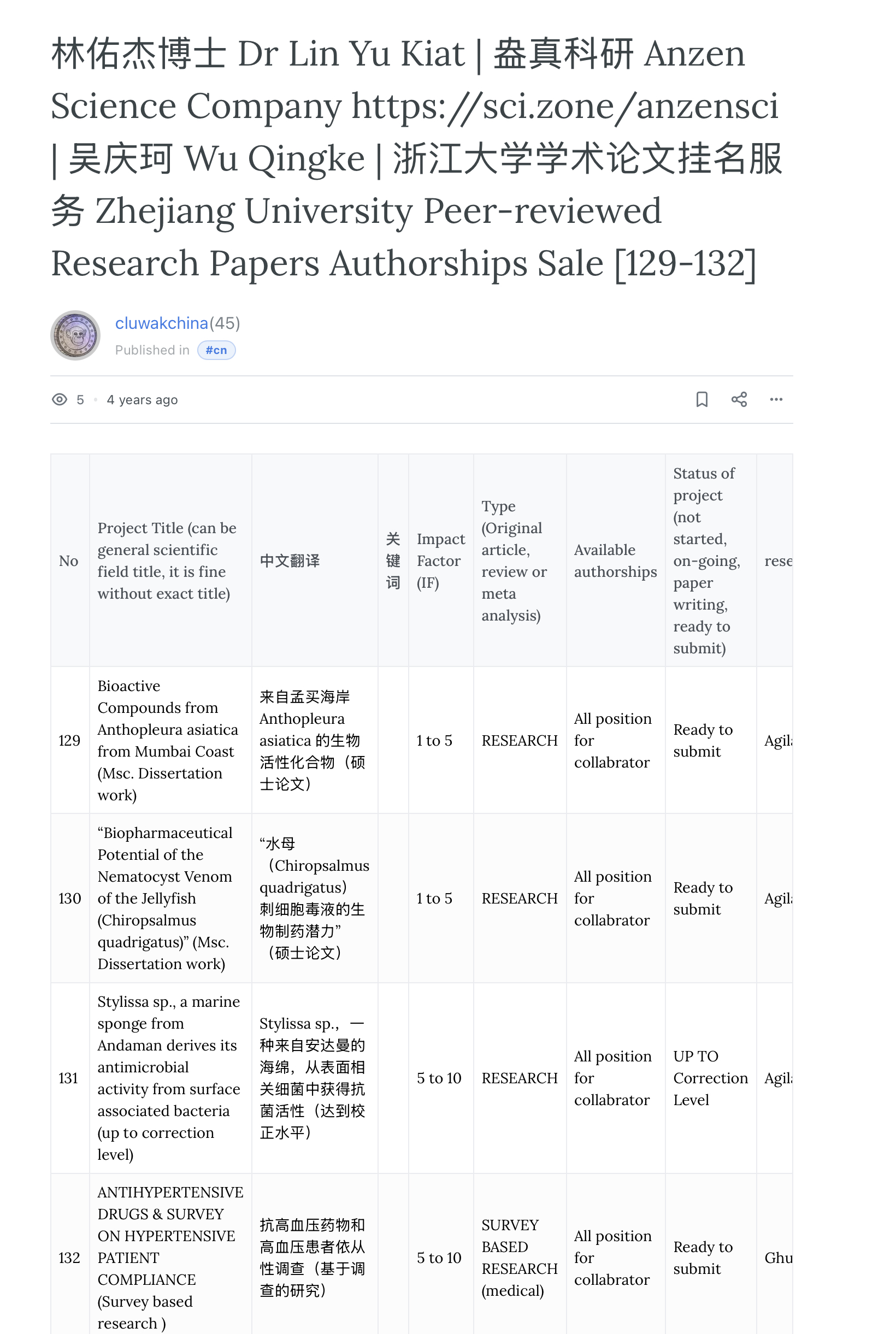
It seems, then, that the Anzen operation is not just in-your-face unethical — it is also thriving. It operates in broad daylight, with zero oversight, zero consequences, and not a single institution, agency, or journal publisher is raising attention to it, let alone trying to shut it down. And this is only one of many organizations –– probably hundreds, if not thousands –– which operates using the same “business model”.
This is part of what’s going on in academic publishing in 2025. This is what we get when publication metrics become goals, rather than indicators. This is what happens when careerist pressure and opportunism form an unholy alliance. Sure, we can point fingers at greed. Sure, we can bemoan the absence of regulation. But let’s not kid ourselves. This rotten ecosystem exists for two simple reasons: (1) there is a large market for it and (2) there are plenty of publication industry insiders who make it possible. The papermills industry needs buyers — scientists willing to pay for fake authorship — but it also needs corrupt editors and reviewers, who work with them, lay their pockets, and push this garbage into the indexed literature. Without customers and without enablers there would be no paper mills. Look at Anzen’s price list: they don’t just aim for lowly journals with Impact Factors of 1-2; they also aim for journals with Impact Factors of 10 and higher. And they pay very handsomely for those. Top-of-the range: $24,000 for a single accepted article in a top journal.
The perfect MDPI editor
“I know you cannot understand such matters, since you appear to have strong mother-related problems that most likely have denied you of a satisfactory sexual life”, _ Enrico Sciubba, Editor-in-Chief
It would be nice to believe that we are dealing with a fringe phenomenon. But this is not the case. The estimates on the extent of the problem vary wildly: some suggest that merely a few percent of the scientific literature is affected, while others claim the number could be as high as 20–40% and the trends show a steady year-to-year increase (Nature 2023, Science 2023, Heathers 2024).
The cancer isn’t on the fringe — it has metastasized into the core.
Donate!
If you are interested to support my work, you can leave here a small tip of $5. Or several of small tips, just increase the amount as you like (2x=€10; 5x=€25). Your generous patronage of my journalism will be most appreciated!
€5.00

 For Better Science
excellent work!
LikeLiked by 2 people
Well done!
Numerous journals are rotten with such corruption. The question is what a researcher can do. For some time I kept binge-flagging fake papers on PubPeer but it’s like trying to stop a flood using a teaspoon. Also, there were 0 consequences when I reported it to journals’ editors & ethics boards. There was no action taken when my university’s rector was notified officially about ongoing papermill operations. Leonid’s article made some waves but quickly the university’s spokesman “debunked” it. I recently learned that a somewhat suspicious “Top 2% cited scholar” was elected to grad student evaluation committee. I spoke about that with a few colleagues but they only shruged as there’s no viable way to report any ethical concerns.
LikeLiked by 1 person
I presume the debunking consisted of: Schneider is a German, a Ukrainian, a Jew, a Green, and a failed scientist. Don’t listen to him. (Applause, standing ovations, hat throwing, vodka bottles popping)
LikeLiked by 1 person
No, it was “Schneider is a ruZZian spy impersonating a Ukraine-supporter, there were 3 Mohammad Bilals not 1 (2 of them involved in scams, btw). We have no evidence for misconduct. We asked Dr Bilal and he said he was a good boy. He was always polute and said good morning. And even if he published several scam papers, maybe the other 300 were actually good? And even if he did something wrong, he did it while working in Poznan so we don’t care. And by the way he was not guilty but at the same time he was the only guilty of misconduct at the whole institution”
LikeLiked by 1 person
I see. Ukrainians and Ukraine-supporters are in reality all russian spies.
Actual russian agents like Mentzen, who want a Poland without Jews, gays, abortions but with putin, those are real Polish patriots.
LikeLike
“there were 0 consequences when I reported it to journals’ editors & ethics boards”
I’m sorry for writting this, but I was even more stupid and naive.
I went back today to the article about Krolczyk and company
Polish science eaten by Papermill Krolczyk – For Better Science
and I found this link in the comments (omanbenson June 5, 2024)
Plenary / keynote speakers – GTSE24′
Check also the Committees
Committees – GTSE24′
These circles cannot be broken. I wrote letters of concern about Jesionowski’s papers to Robert Letcher…🤣🤣🤣
LikeLike
That company called Anzen would be Shanghai Anzen Technology Pty Ltd (上海盎真科技有限公司, Unified Social Credit Code: 91310116MA1JE6YW7K). Publicly available information indicates that Shanghai Anzen is owned by Qingke Wu (吴庆珂) and Shandong Anser (安瑟(山东)控股有限公司, Unified Social Credit Code: 91370102MA3C8H8556), with 95% of Shandong Anser’s equity also belonging to Wu.
Several sources, possibly Wu’s own, show that he earned a master’s degree in science in 2014 and worked for a time as a regional manager at Beijing Biomarker Technologies Co., LTD. before jumping ship in November 2016 to work as a technical engineer at Shandong BIOBASE Bio-Industry Co., LTD.
Wu registered a publisher also called Anser in Singapore in 2020 and operated out of Jinan, Shandong Province (http://anser.press/index.php/index/aboutus , and https://www.anserpress.org/page/overview ), with the aim of making Anser and Anzen appear to be affiliated with a foreign organization. With the same purpose, Wu may have also registered an organization in Malaysia called the Nanyang Science Institute, which I’m not sure survives. Anser Press in Singapore runs many kinds of predatory journals, though this part of the business does not seem to be successful.
An advertisement published in September 2024 (https://mp.weixin.qq.com/s/5IujHOhGPtcfy14zYPPNxA ) shows Wu inviting potential partners to contact him via phone number 📲+86 18615219312 (which is also a WeChat ID).
LikeLiked by 1 person
Interesting, but unsurprising that pepermills started as predatory publishers.
LikeLiked by 1 person
Wow. And I thought this take-down will make them upset. Now I see that probably they will thank me for an excellent advertisement for their highly legitim scientific services. Oh well, live and learn.
LikeLike
But seriously, guys, how do you deal with the fact that individual people are just helpless against a money-hungry publisher. The paper mill industry will thrive no matter what we do due to their wealth combined with academia’s general inability to reapond adequately to new challenges. I feel like there’s nothing to do but sit and cry and re-think career choices.
LikeLike
I think your statement is somewhat contradictory. You say that “individual people are just helpless” and that there is “academia’s general inability to respond adequately” – but academia consists of individuals. So, the root of why academia is helpless is that it consists of dishonest, lazy, and greedy individuals. The problem with this is that everyone understands it and at the same time, no one gives a hoot.
LikeLiked by 3 people
I hate to say it but in the field, any “LncRNA geneA/microRNA/geneB Axis in (insert your favorite) cancer” paper from a Chinese group is a non-read.
Working as an editor at Geroscience has to be a harrowing affair given the avalanche of longevity and aging garbage that is being published. I am familiar with many of the names on the editorial board and am very familiar with their mutual agenda … many are featured on these pages, in fact.
Finally, I have been reading “Capitalism, Alone” (Milanović) and it is interesting to note that certain forms of corruption are endemic, and in fact a feature of certain systems. It would be tedious to enter into further detail except to comment the obvious–that papermills and fake science will always exist, as (for example) “innovation” in capitalism necessarily exists on the edges of legality and morality, while there are financial incentives to do so.
LikeLike
I wrote this some time ago for a different purpose. By now, I feel like doing a ‘Captain Obvious’ sketch…
The rapid proliferation of scientific papermills can be attributed to their alignment with the characteristics of low-risk income opportunities, which tend to spread quickly in networked systems. For both operators and clients, the perceived risks are minimal: papermills often operate anonymously or across jurisdictions with little fear of enforcement, while clients—frequently under institutional pressure to publish—encounter limited scrutiny, particularly when submitting to predatory or low-tier journals. The short-term consequences of participating in these schemes are negligible: papers are often accepted and published with little to no peer review, institutional checks are weak or absent, and metrics like publication count or journal indexing can still be used for promotion, grant eligibility, or academic prestige. In many cases, even when fraudulent activity is suspected, investigations are slow, opaque, or ultimately inconsequential. The incentives for detection and enforcement are often misaligned or lacking entirely, especially in under-resourced institutions. This lack of immediate accountability emboldens both sides of the transaction. As successful cases go unpunished, word-of-mouth within academic networks accelerates their spread, particularly in environments where institutional oversight is weak, and the consequences—if they ever arrive—are too distant or diffuse to deter participation. The model is thus highly scalable and profitable, functioning analogously to other low-risk, high-demand illicit services that exploit gaps between regulation and enforcement.
LikeLiked by 3 people
What else is there to say? I agree. Where you bring up the point of under-resourced institutions I would also point out (the obvious) that there is a disequilibrium of credentials (or power, or various other words) and lack of resources along which this business is occurring, namely the sale of some commodity by those with power to those with less power, for the purposes of increasing the recipient’s power (prestige, position, affluence). It’s interesting to reflect that it is easier to gain prestige from these endeavors while difficult to lose prestige from their discovery (especially in their context–a high profile researcher beyond reproach and strongly protected by their institution, or a low profile researcher in an institute that does not enforce or actively promotes such behavior). The “slow, opaque, or ultimately inconsequential” investigations you reference are hardwired into every governmental and academic institution I can conjure to the imagination. The function of investigatory bodies is to protect the institution and its constituents except to the point that amputation is required to preserve the whole.
LikeLike
Why do you list Poland as one of the countries where paper mills operate? To be clear, I’m not trying to imply you’re wrong. I am aware of instances of scientists at Polish research institutions using the services of foreign paper mills, and Polish universities hiring some of those fraudsters, but do we also have paper mills based in Poland? By which I mean, people who sell bogus publications, citations, etc. who live and work here.
LikeLike
Yes there are.
LikeLiked by 1 person
Now I see a Geroscience connection. Apparently Szabo is now championing the contributions of “senescence” to aging.
LikeLike
We are not “championing” anything in particular. We have published a couple of studies in recent years to study some pathways that we are interested in, using replicative senescence models. These are basic research studies and they show some role of the pathways we investigated. But we are well aware of the fact that a senescence model is not the same as an aging model.
LikeLiked by 1 person
“…well aware of the fact that a senescence model is not the same as an aging model.” This is a relief, because decades of intentionally misinterpreted research and bad story-telling have culminated in a market for purported (and potentially harmful) “life-extending” drugs and millions of research dollars wasted. A handful know it, even less admit it, and the geroscience cabal continue fund each others’ projects as ever.
LikeLiked by 1 person
So this is the way to produce 10s and even 100s papers/year with their respective citations. And it is going to get much worse with the constantly improving AI algorithms that soon will most probably start writing their own papers with own figures indistinguishable from ones based on real studies (if that has not happened yet, of course). And of course with the contemporary science business model nowadays counting H-index and IF only you may very reliably guess whose papers will be published and which will be rejected. Maybe few unmilled or half-milled islands may remain, maybe not…
LikeLike
The scale of the Papermill or fraudsters around the world is particularly huge and shocking. It seems that this company only cooperates with researchers all over the world and makes profits! Strangely enough, why do they need editor help to accept the paper? Was it the Chinese clients junk papers?
LikeLike
“why do they need editor help to accept the paper?” – maybe beacuse editors do the screeening, can suggest reviewers, and make final decisions, no?
LikeLike
The scientist community is stuck in the web woven by publishers. I do not know why publication is important in high IF journals. Universities should publish their work online from where everyone can see full text cite it and it should be evaluated by university. Funding bodies should check the work, not IF of work published by the applicant. I have some experience with Chinese doctors. They are medical doctors and have very tough work life. Still there is requirement from the government to publish to get promotion and to get fund. Therefore, they ask companies to conduct their experiments and publish work with their authorship. Mostly these companies need good writers for their work who can handle submission and revision as well. Companies perform experiments according to their clients. I am not in the favor but the policies like publication dependent promotion and evaluation of solely on the basis of publication IF and numbers making these business to run. It is not about Chinese, Iranian or Russian papermills. Most of the publishers are from west. They also followed these practices but in different way. Influence of big names, relation with editors and reviewers is a common practice. Almost everyone do that. It discourage many scientist when their work is rejected just because they do not have established network with editor and saw bad papers published in the same journal. Overall, the system is bad for publishing work and it is promoting such business.
LikeLike
So, I have a question: who is paying?
In my field a decent niche journal might have an IF 3-4. Consulting the price list above that is $5000. Add the cost of open publication (say, $2000) and I have blown my basic research grant for three years (poorly funded EU country).
Are Chinese researchers so flush with cash that this sort of behaviour becomes practical at scale? I really do not understand who is funding the paper mill industry.
LikeLiked by 1 person
I cannot say how it is globally, but from my experience, Chinese researchers do have the money and capability to fuel the papermill industry (which is not to say that all Chinese researchers are involved – there are many bright and honest ones as well). They typically have funding options at every level (city, province, state), and almost every lab has at least a couple of grants running simultaneously. These grants can cover vaguely described expenses like “language polishing” (and as you saw, the company in question even has an official stamp – which is more than enough). So, you can quite literally and officially order a papermill paper there.
LikeLiked by 1 person
UPD: Just take a look at research papers published by Chinese groups in, e.g., Advanced Functional Materials – almost every second one includes a funding section that spans several lines. This is not to say that all of them were papermilled – the point is simply to illustrate the scale of their funding capabilities.
LikeLiked by 1 person
The authors are paying. Let’s say ten authors are on board in one paper, each pays 1,000 USD on average (it actually depends on the position in the author list), then the total is 10,000 USD. Additionally, each papermill paper is often a “citation vehicle”, which means 10+ individuals pay for getting their unrelated papers cited in the article’s reference list. Assuming the “citation part” just adds 2,000 bucks more, you already have a plus of about 6,000 USD for one single paper. If we assume a papermill company places 500 papers a year, the profit is roughly 300k a year. However, I suspect many papermills are publishing in the order of thousands papers a year. These are roughly the prizes for a 3-4 IF paper, for 10+ IF papers the prices are much higher.
LikeLiked by 1 person
The authors are paying, but I doubt that it comes out of their own pockets: probably – in most cases – it is their institution and/or their granting agency who puts up their money. The same way as when they take a nice holiday disguised as a conference (scamference, i.e. predatory conference), it is their institution and/or their granting agency who pays for the flight and hotel.
LikeLiked by 1 person
Happens even in your area of Switzerland!
LikeLiked by 1 person
Once again we see why authorships should not exist in the first place. Let’s define what is a ‘Conflict of interest’ ? According to Oxford English Dictionary, it is defined as ”a situation where a person’s personal interests or affiliations could potentially compromise their judgement or objectivity in making decisions or conducting actions related to their work or responsibilities”. Since number of papers where one is listed as an author plays a critical role in securing a promotion and associated financial benefits, it is the biggest conflict of interest itself. Authorship (personal interest) creates a strong desire to report premature experiment results (compromise judgement), fosters a ‘funding over finding’ culture and of course a fertile ground for papermills. Best solution is to limit number of publications as suggested by a recent report from Germany (https://osf.io/preprints/psyarxiv/xj2m6_v1) and (even better) remove names from papers and publish under the institutions’ name (unless one publishes independently). This will shift the focus to quality over quantity. Why don’t we see scientists from Pharma taking part in these papermills ? Because their promotions are not based on authorships, yet their performance/science/discoveries can still be evaluated and they still promote. Removing authorships will also erase the guest and ghost authorships.
Although it is sad to see scientists being paid for editing manuscripts and not having their name on them (ghost authorship), I believe this is still much better than guest authorships where the authors (such as department Chairs and senior faculty) get free credits from someone else’s work (often the juniors’) and deceive the scientific community on a regular basis. How bad is it to improve someone’s manuscript and receive credit for the work in the form of a fee ? There are several scientists and physicians in China who have good scientific knowledge and ideas yet they are not able to draft manuscripts in English, sometimes both due to language and also due to lack of training in academic writing. If a Western researcher is willing to help them communicate their scientific findings and get credit for this service in the form of a fee instead of authorship, why not ? In my opinion, most important is to communicate scientific findings accurately and clearly. Once again, I wish there were no authorships and scientists could outsource some of the services to the experts to deliver a good quality manuscript, in the form of fee for service model rather than a (free) authorship for service model.
And yes, trying to open the doors of a journal through paying the Editor is not correct. But what created this ? A system where Editors acted as gatekeepers by giving preference to papers from certain geolocations/affiliations/authors and filtering out others – an equally wrong practice (editorial manipulation) that is unacceptable.
Lastly, according to the NIH/ORI guest authorship is not considered as a misconduct. It is considered as an inappropriate practice but not a misconduct. Writing ca. 10, not paraphrased sentences despite citing the relevant sources is generally plagiarism (taking credit from someone else’s work) but being an author on papers without contributing at all, is not taking credit from someone else’s work thus not plagiarism nor misconduct.
Many of the practices written in this story are clearly wrong and unacceptable. And thank you bringing them to light. At the same time, we should not miss the elephant in the room.
LikeLike
The right reasons for scientists to pursue science are, obviously, discovering new truths and perhaps even improving the world in some way. But ever since modern science began, scientific achievements have always been tied to the individuals who made them. This association is simply part of the “package” scientists sign up for—alongside, admittedly, the remote possibility of winning a Nobel Prize. Even scientists working in pharma companies publish papers in scientific journals under their own names, just like their academic counterparts. And when pharma companies file patents, the inventors’ names (and even their home addresses!) are explicitly listed. It’s just standard practice in their employment contracts that all invention rights are immediately and entirely transferred to their employers.
Changing this system to remove individual recognition entirely, as you suggest, might resolve some problems but would probably deter many (perhaps most) from entering scientific research. To put it simply, I don’t think your proposed solution is feasible, and honestly, I can’t think of anyone in the scientific community—not researchers, funders, journals, or anyone else—who is even considering this approach.
A more realistic and practical solution would be to reform the scientific publishing industry itself, specifically by removing the profit motive. The goal shouldn’t be to reduce the number of publications, but rather to allow every validated result to be published, including negative findings. Journals should return to being owned and operated by nonprofit scientific societies, or alternatively, scientific funding agencies could directly finance journals, requiring awardees to publish their results there as a condition of funding. Replication supplements are another promising idea (I discuss many of these possibilities in my book UNRELIABLE). But the crucial first step must be eliminating profit incentives.
There’s also plenty that institutions could do to change how they evaluate a scientist’s publication record. Instead of prioritizing WHERE something is published, they should pay attention to WHAT is published—focusing on reproducibility, citations by peers, and most importantly, real-world impact. Of course, this requires administrators to gain a deeper understanding of an applicant’s actual scientific contributions, rather than relying on superficial indicators like journal impact factors or the prestige of institutions. Unfortunately, as long as administrators remain either lazy or rushed, they’ll default to misleading proxy metrics.
Regarding the outdated and problematic practice of adding bosses or other non-contributors as authors, this must absolutely stop. Thankfully, there’s already some gradual progress happening here. There have even been successful lawsuits where junior researchers eventually prevailed.
Lastly, concerning language editing services for manuscripts: language editing alone clearly doesn’t warrant authorship and is entirely legitimate. However, you must read between the lines when companies like Anzen discuss such services. Their real aim is to have the collaborating editor push manuscripts through journal acceptance processes—which is a completely separate, unethical, and indeed illegal activity.
LikeLiked by 3 people
Authorship made sense when science was the field of a lone thinker or a small lab group. The days when a single name could be tied to a groundbreaking publication or an idea – like Einstein with the theory of relativity or Marie Curie with the discovery of radiotherapy – are behind us (more on this in ‘Author CRediT score (ACS): An order-independent measure of author contribution based on CRediT statement’).
Authorship in the era of global, interdisciplinary work where some projects involve coders, statisticians, biologists, clinicians, writers and lab technicians, cannot capture the complexity of modern research with a line of names. It became inconsistent and vague by arbitrarily defining who counts (especially as first). Did the fourth author on a 20-person paper really have a comparable contribution to the fourth author on a five-person paper ? If it’s at all necessary, why not simply list the contributions at the end, like movie credits ?. Eliminating the current authorship practice will increase team spirit, diminish the conflicts and shift the focus of the team to discover something meaningful. Even the Nobel Prize is out of synch with modern century science and reinforces an outdated myth of the lone genius while undermining collective contribution. Based on the current authorship criteria, Nobel Prize often commits a form of high-profile ghost authorship, by publicly attributing a discovery to one or two names. If we want to adhere to the current practice, I would encourage listing all the names of the past and current lab members at the award ceremony not to break hearts ! Scientists working in pharma companies do publish under their own names, but a lot less and to the best of my knowledge, in evaluations there is little emphasis on the authorship counts and more emphasis on the quality of the work that has been done. Maybe they will also feel relieved if they can publish under the company name only (like McKinsey reports). In patents they do list ‘some’ of the employers indeed, but again, at least the ones I’m aware of are symbolic. Their manuscript editing is generally done in house by someone (ghost) who is paid to do this or outsourced to professionals (also ghost). They are not interested in generating papers from papermills and they definitely wouldn’t receive editing services from Ariana. I don’t think anyone should enter scientific research for individual recognition. On the contrary, those should rather stay away from scientific research. People work for Apple or NVIDIA, to get joy out of the product they generate from the research they do collectively, for the impact that it makes for humanity, and of course for the generous compensation that they get. They barely get any individual public recognition and I haven’t seen anyone who seem to be upset about it. One of the reasons why removing authorships is not considered is, because there are not many people who have spent enough time outside of academia before they enter academia. Therefore, everyone takes authorship as a norm. However, there is a recent attempt to publish under the lab’s name (https://blogs.lse.ac.uk/impactofsocialsciences/2024/05/08/is-group-authorship-a-better-way-of-recognising-team-based-research/) by someone who was a fellow at Stanford Meta-Research Innovation Center (https://metrics.stanford.edu/people/robert-thibault). It is not the same concept but the rationale is similar.
I agree that scientific publishing industry needs an urgent reform and is a major contributor to the chaos. Prioritizing where research is published over what is published was based on the reasonable assumption that prestigious journals would select only high-quality work via the reviewers who are domain specific experts (while the administrators are not) – yet this has proven false. But as long as authorship stays in its current form, I doubt if it will solve all the problems.
It is great to hear that some progress have been made by junior researchers challenging the addition of bosses and non-contributors as authors. The problem is, these unjustified authorships are often difficult to prove because when questioned they claim to ‘help design the study over several meetings over the phone’ or ‘help drafting the manuscript via multiple verbal discussions’. Good luck with proving otherwise. Another problem is the 2nd co-author gets discouraged to further contribute when the 5th co-author is already on the paper with less contribution and any one between the first and last is given equal weight in evaluations. Her/him seeing her/his name appearing more frequently in the CRediT statement doesn’t serve as a sufficient incentive either. If the authorship criteria will stay as is, putting a limit to the number of authorships could help by setting realistic expectations and diminishing unfair competition. One day is 24 hours and something should push the break for the scientists who have insane number of publications when substantial contribution (current requirement) to each one of them is technically not possible. Therefore authorship in its current form negatively affects team spirit and supports papermills. Lastly, although I’m in favor of grants supporting outsourcing parts of academic work/expertise when necessary without focusing on whose name appears or not, Anzen doesn’t seem to be a kosher service provider but rather seems to be is a sad example of papermill industry. No objection here. And once again thank you for shedding light on that.
LikeLike
Looks like our little story was covered in mighty Science.
https://www.science.org/content/blog-post/inside-scientific-paper-mill
LikeLiked by 1 person
Seems like I am in business now. I just received this highly reasonable offer.
From: Perry Sent: 27 May 2025 10:04 AMTo: SZABO Csaba Subject: Would you be willing to sell the co-authors who purchase the manuscript?Dear Professor Szabo, Csaba,
I hope this email finds you well.
Recently, I learned about the numerous papers you have published in the academic field and am deeply impressed.
We are from Fengkai Group Co.,Ltd and specialize in academic paper consulting services. We are committed to providing scholars with comprehensive services, including professional paper polishing, submission guidance, and academic exchanges, to facilitate the efficient dissemination and transformation of academic achievements. We are well aware of the hardships and difficulties of academic research. Therefore, we have always treated every client with a rigorous and professional attitude, striving to provide them with the best service.
In view of your outstanding achievements in the academic field and our company’s professional capabilities in academic paper services, we sincerely hope to cooperate with you. Do you have any plans to publish new papers in the near future? If so, we sincerely hope to reach a cooperation agreement with you. Regarding the author ranking of the paper, we are willing to obtain the first author, second author, corresponding author or other suitable positions of your article as needed. Therefore, we are willing to pay the corresponding reasonable expenses. Of course, we also have cooperative journals that can provide publication services for your papers to show our respect for your academic contributions and our sincerity in cooperation.
Thank you for considering our offer. We hope to hear from you soon.
Best regards,
Perry
Academic Manager
Fengkai Group Co.,Ltd.
0816-159-2874-8324
guoqijun@tsrfront.com
>>>
Dear Professor Szabo, Csaba,
This month we have approximately 400 clients, among whom 100 are in a similar research field to yours.We need you to provide the number and titles of the articles. If possible, a list would be even better.
When the article is accepted, we will pay the fee for you via paypal Immediately,Or other payment methods that are convenient for you, but it would be best if you told our company in advance.
If the IF of the journal is 3.4(3-4), first author is 720$,second author is 390$,third author is 240$,
corresponding author is 360$,all authors are 1200$.
Regarding the company’s information, we can communicate via video to help you understand our authenticity. Of course, we also welcome you to visit China. Our company is located in Chengdu, China.
This is my whatsapp+86 15756576717, and then I also use wechat 15928748324.
LikeLiked by 1 person
I object to the mathematics here.
” first author is 720$,second author is 390$,third author is 240$, […] all authors are 1200$”
Either they can’t count, or they demand a rebate if you sell them all authorships on your papers?
LikeLike