

Schneider Shorts of 6 December 2024 – a family business with pelvic implants, whitewashing in France, NIH sabotaged from inside, fraud funded in Australia, with Iranian papermills, unethical trials in Sweden, US Congress on COVID origins, and finally, how cannabis consume causes fake data and chocolate avoidance causes diabetes.
Table of Discontent
Science Elites
- A schematic illustration of the real photos – how Sabine Szunerits is being whitewashed in France
- Serious deficiencies – Swedish authorities investigate patient abuse by Max Ortiz-Catalan and Rickard Branemark
- Passion but with humility – family business of Alexander Seifalian and his daughter Amelie
- An important step towards addressing UN’s Sustainable Development Goals – an English lecturer and Iranian papermills
- Obviously botched job – cannabis causes havoc in Spanish lab
- The future of lying – quality work delivered by expensive expert
- A litany of problems – Australian national funder incapable of dealing with fraud
Retraction Watchdogging
- An illustrative, non-quantitative visual – Nigel Greig sabotages NIH from the inside
- None of the retracted citations affect the conclusions – how many retracted references can a fake Iranian review take?
COVID-19
- The lab leak theory – US Congress report presumes COVID-19 escaped form Wuhan virology lab
Science Breakthroughs
- Part of a healthy diet – failure to eat chocolate causes diabetes, warn Harvard and BMJ
Science Elites
A schematic illustration of the real photos
I have some news on the case of France’s superstar nanofabricator Sabine Szunerits and her husband and fellow professor at the University of Lille, Rabah Boukherroub. They are currently being whitewashed by their university, which, that being France, is not entirely unexpected.
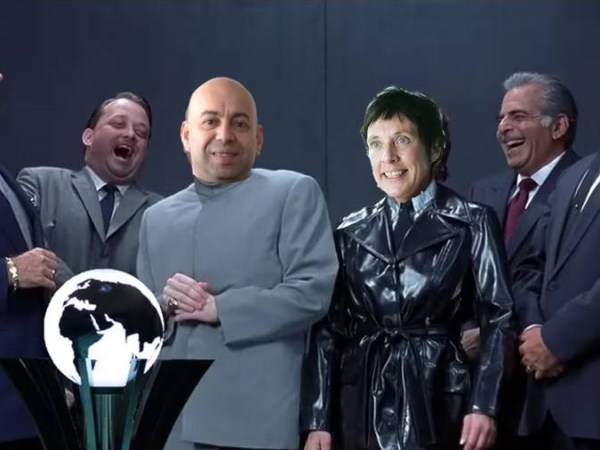
Lille Papermille
French nanotechnologists Sabine Szunerits and Rabah Boukherroub put EU Commission’s money to good use. The EU cannot afford a papermill gap to Iran and China!

We know of these new developments from this PubPeer thread:
Gitashree Darabdhara , Mohammed A. Amin , Gaber A. M. Mersal, Emad M. Ahmed , Manash R. Das, Mohamed B. Zakaria , Victor Malgras , Saad M. Alshehri , Yusuke Yamauchi , Sabine Szunerits, Rabah Boukherroub Reduced graphene oxide nanosheets decorated with Au, Pd and Au–Pd bimetallic nanoparticles as highly efficient catalysts for electrochemical hydrogen generation Journal of Materials Chemistry A (2015) doi: 10.1039/c5ta05730b
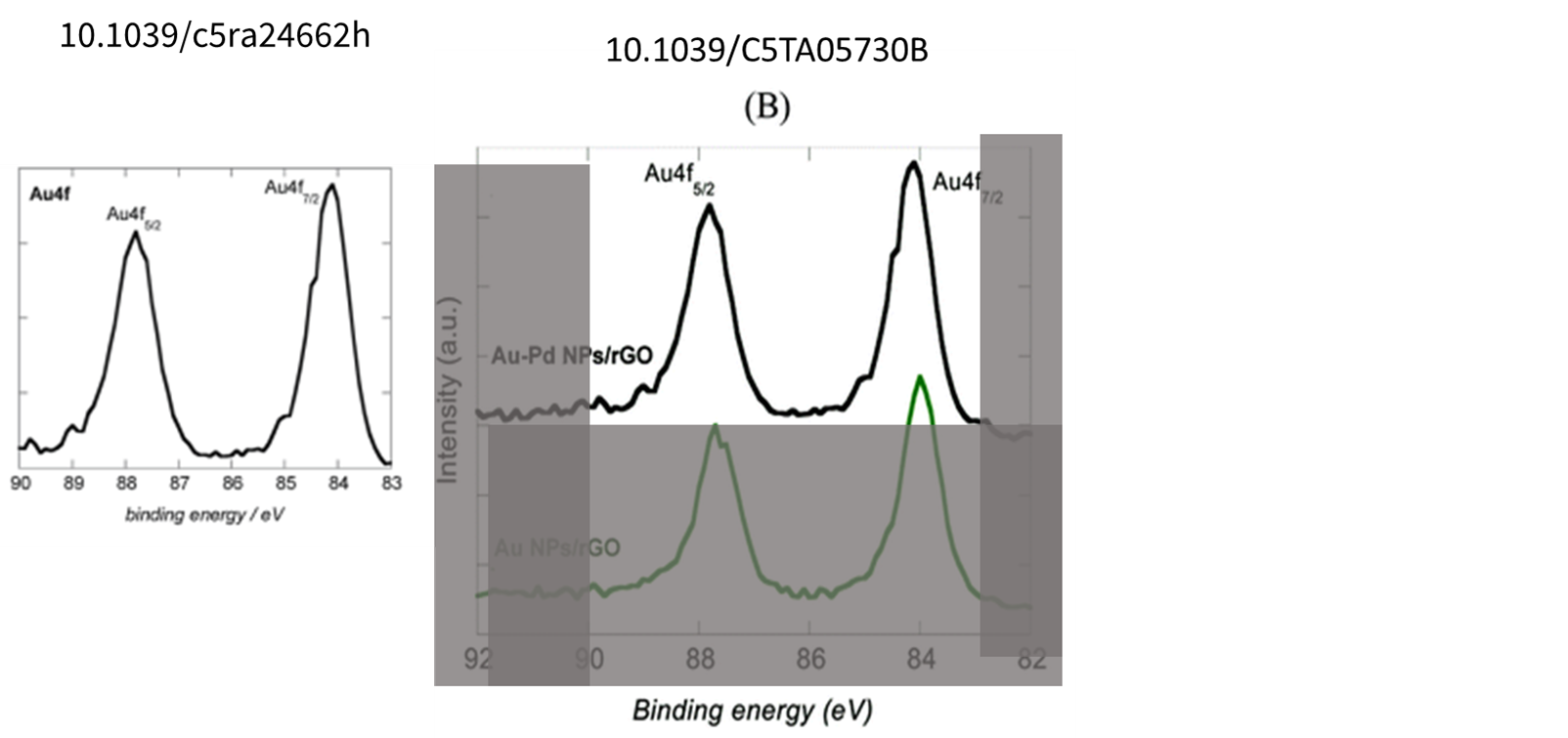
Kostiantyn Turcheniuk , Tetiana Dumych , Rostyslav Bilyy , Volodymyr Turcheniuk , Julie Bouckaert, Volodymyr Vovk , Valentyna Chopyak , Vladimir Zaitsev , Pascal Mariot , Natasha Prevarskaya , Rabah Boukherroub, Sabine Szunerits Plasmonic photothermal cancer therapy with gold nanorods/reduced graphene oxide core/shell nanocomposites RSC Advances (2016) doi: 10.1039/c5ra24662h
At the end of November, PubPeer commenter Bresedium brevipes posted this message:
“Representatives from Lille University and other institutions have thoroughly investigated the XPS data. They have concluded that the XPS data published in JMC-A 2015 is accurate for Au NPs/rGO, Pd NPs/rGO, and Au-Pd NPs/rGO, based on the raw data and log sheets from the analytical station. We will report this to the RSC office.
Corresponding Authors“
Attached were these screenshots of the investigative report signed by the CNRS engineer assistant Martine Trentesaux, i.e., a technician:
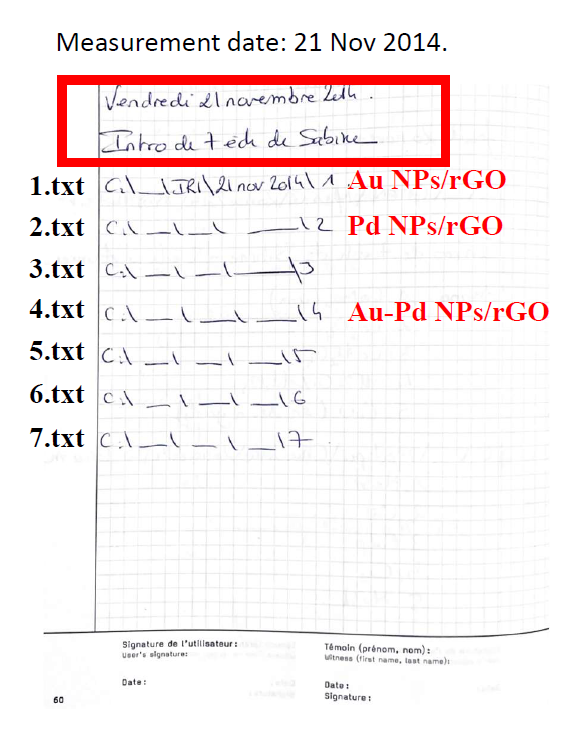
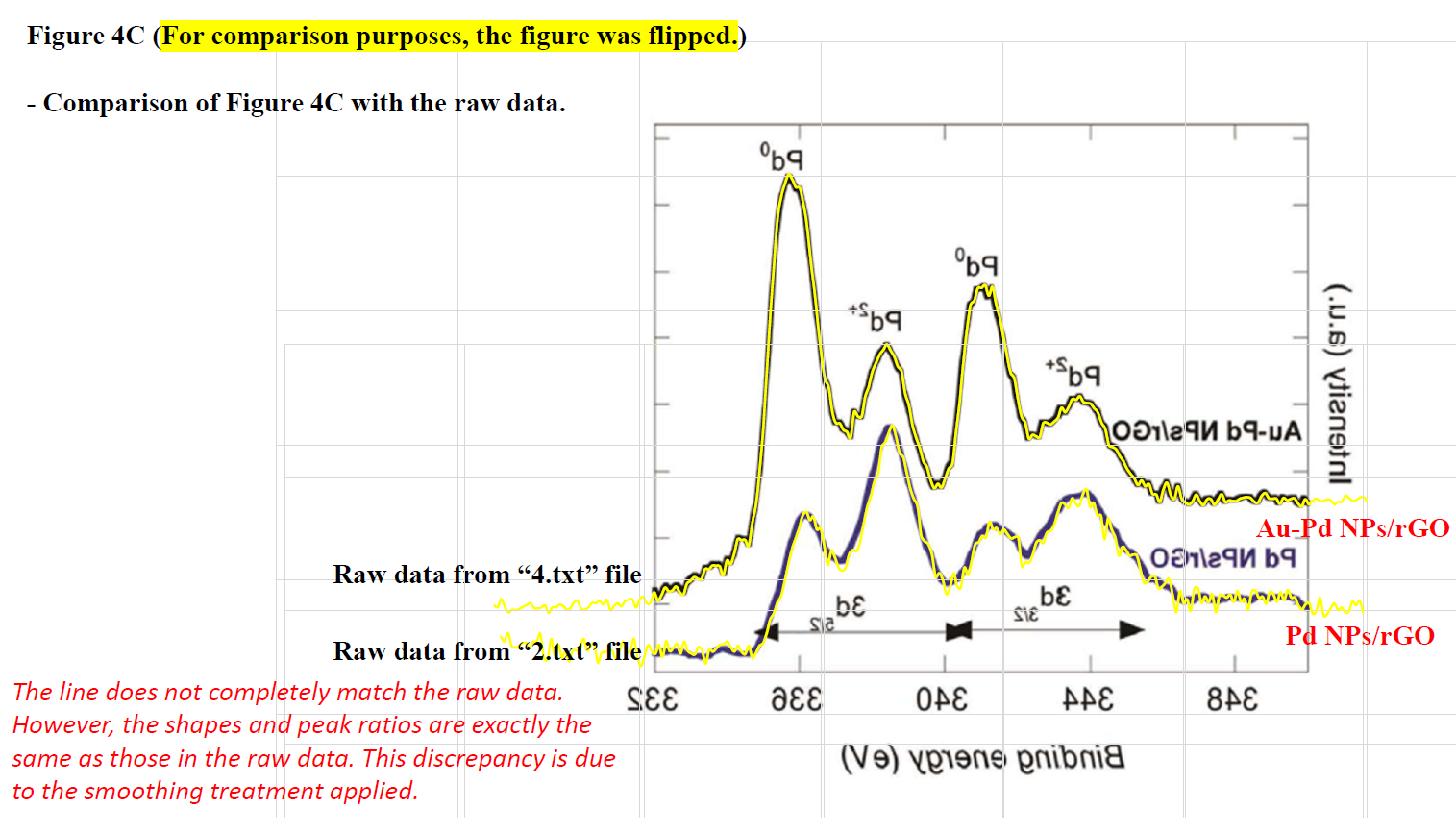
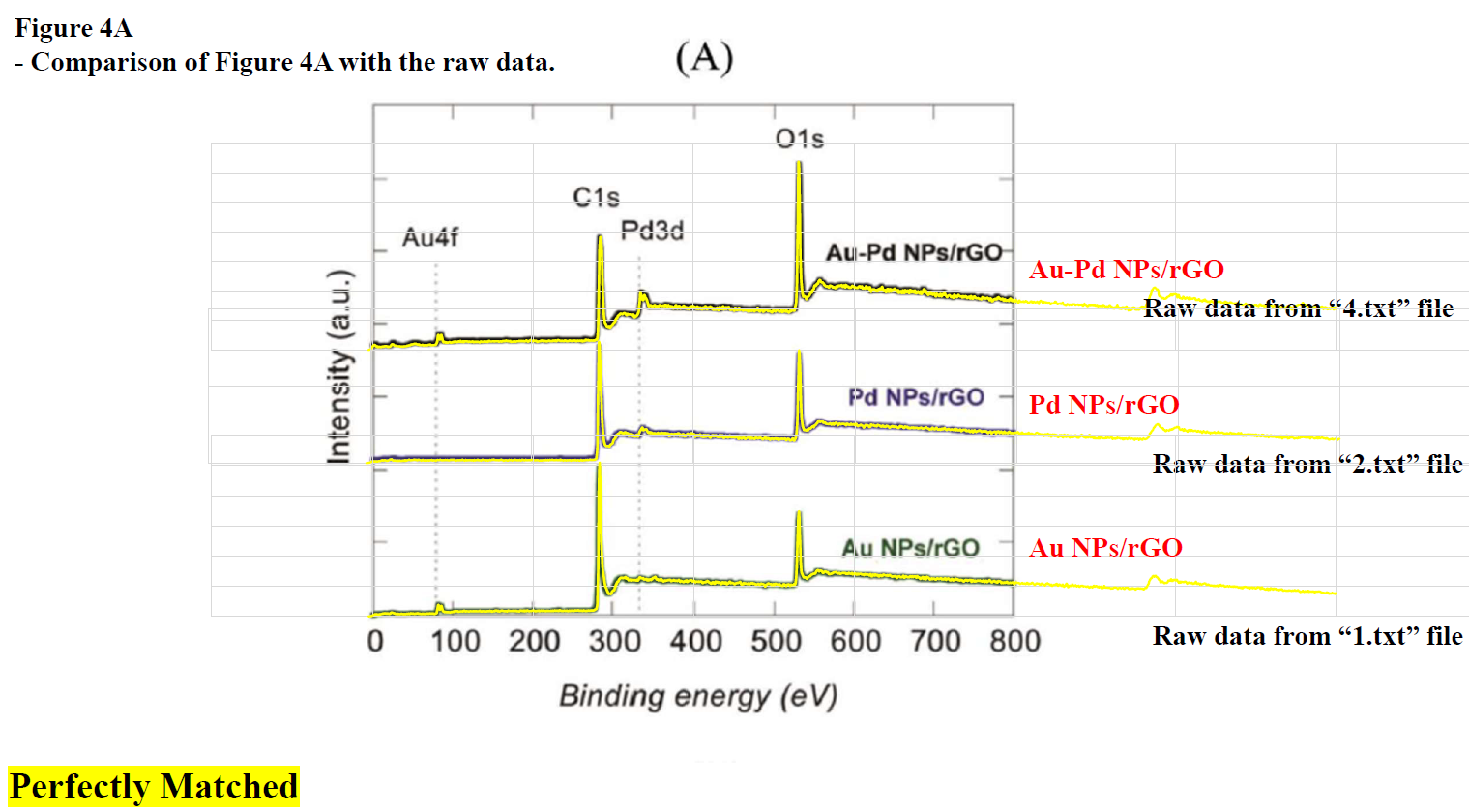


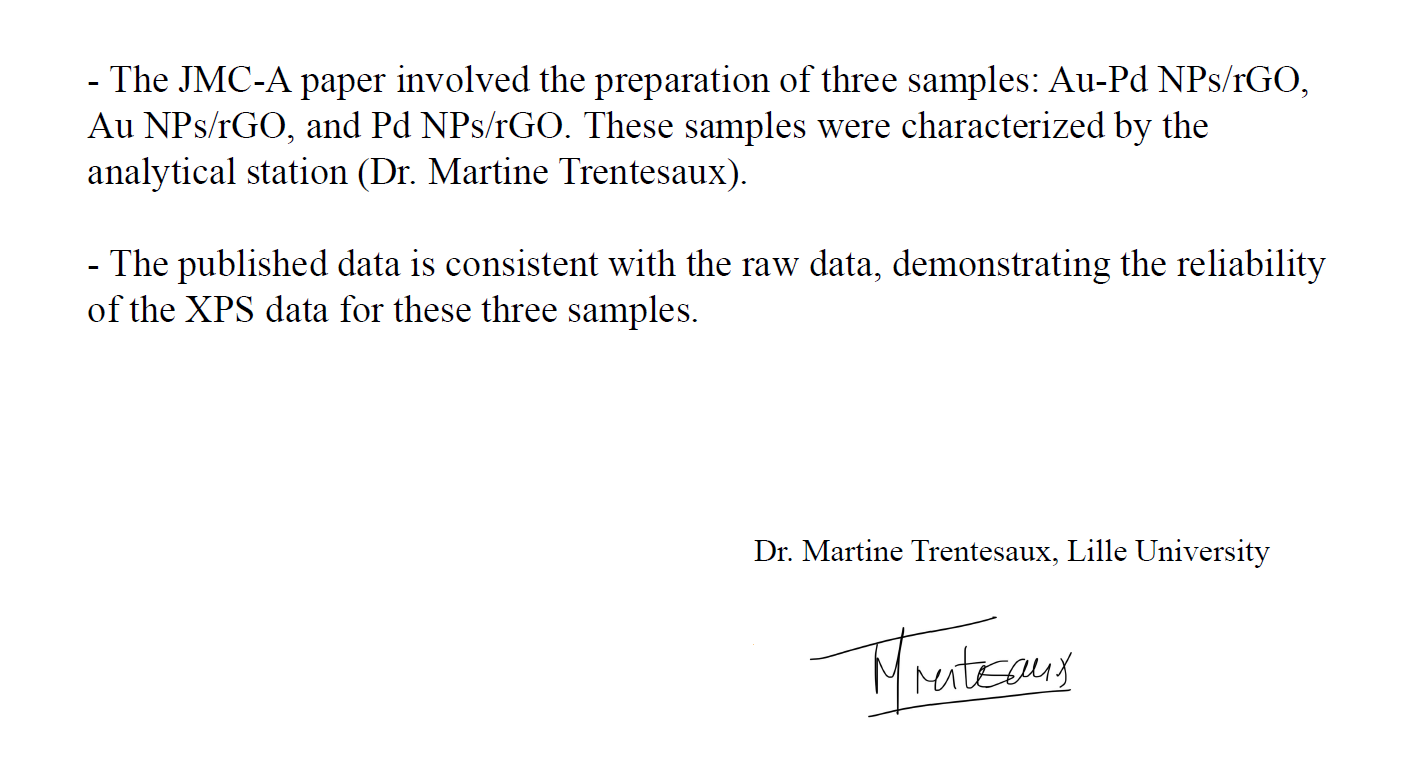
As you see, the Lille report declared the data to be perfectly trustworthy and reproducible because it matches some of the measurements the authors have provided. The fact that this dataset was reused in different papers to stand in for different materials was obviously not subject to the Lille investigation. I contacted Trentesaux and the Lille University, silence. Soon after, PubPeer moderators deleted the comment completely.
In fact, the spectrum was used in 3 papers, as Maarten van Kampen noted:

2. 2015-08 Reduced graphene oxide nanosheets decorated with AuPd bimetallic nanoparticles: a multifunctional material for photothermal therapy of cancer cells
2015-01 Infrared Photothermal Therapy with Water Soluble Reduced Graphene Oxide: Shape, Size and Reduction Degree Effects
2015-10 Plasmonic photothermal destruction of uropathogenic E. coli with reduced graphene oxide and core/shell nanocomposites of gold nanorods/reduced graphene oxide
3. 2015-11 Plasmonic photothermal cancer therapy with gold nanorods/reduced graphene oxide core/shell nanocomposites
You may try thinking like French university officials to understand their logic. Research fraud is to them defined as “fabrication”, e.g. when people draw spectra by hand instead of doing any experiments. Since Szunerits could prove that her lab did at least one experiment once, it is not research misconduct but merely innocent negligence to have used this dataset for different materials in 3 papers, because those results all look similar anyway, thus the conclusions are unaffected. See, now it all makes sense.
Supported by so much understanding from their university, Szunerits and her hubby Boukherroub started to successfully correct their papers. Look at this atrocity:
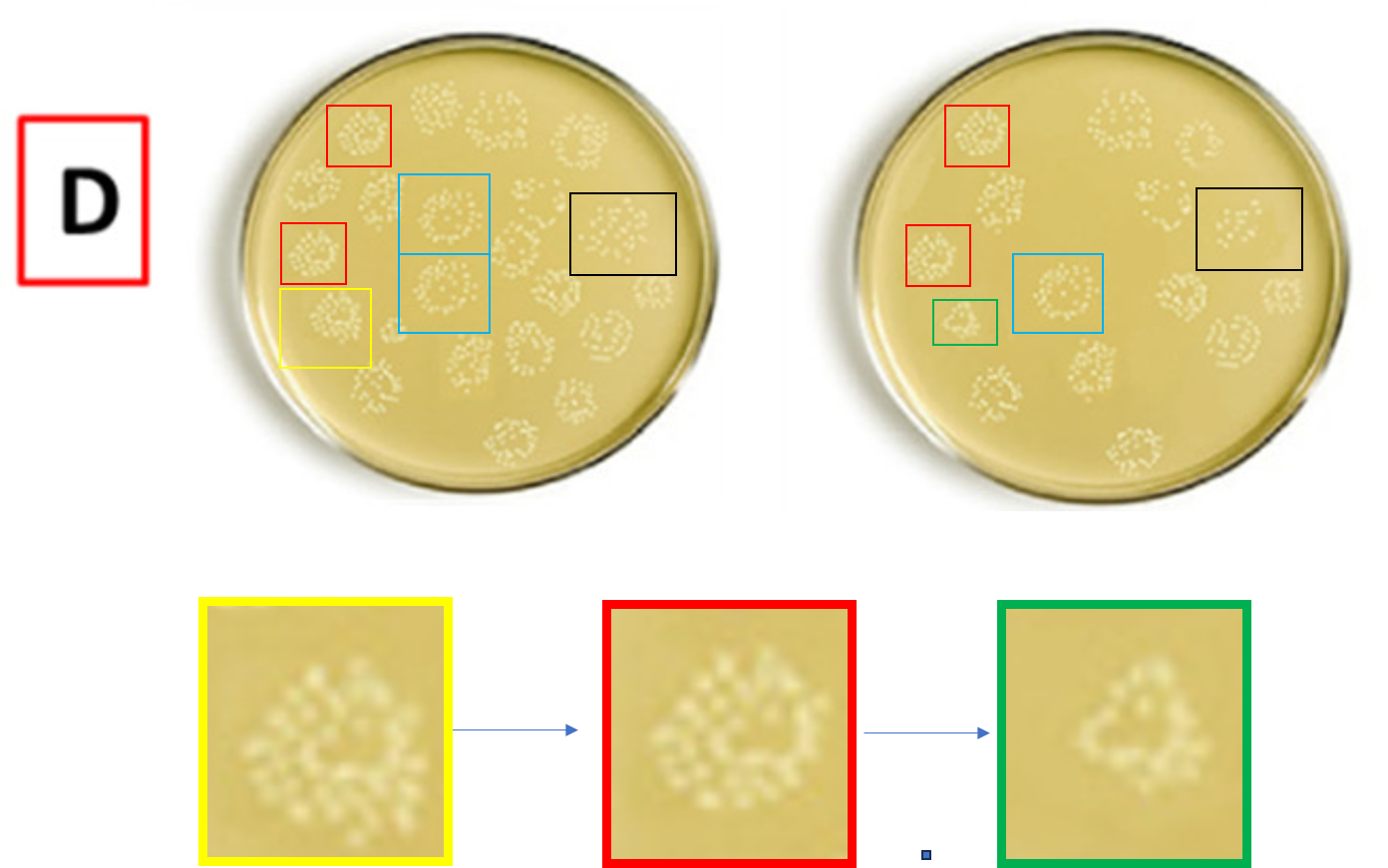
Elizaveta Sviridova , Alexandre Barras, Ahmed Addad , Evgenii Plotnikov , Antonio Di Martino , Dominique Deresmes, Ksenia Nikiforova , Marina Trusova , Sabine Szunerits, Olga Guselnikova , Pavel Postnikov , Rabah Boukherroub Surface modification of carbon dots with tetraalkylammonium moieties for fine tuning their antibacterial activity Biomaterials Advances (2022) doi: 10.1016/j.msec.2022.112697


This is the Corrigendum which Elsevier and the Editor-in-Chief Manuel Salmeron-Sanchez, professor at the University of Glasgow in UK, issued in November 2024 (highlights mine):
“The authors apologize for the incorrect description of the images that have been presented in Fig. 5D. The images of S. aureus colonies of bacteria in Fig. 5D and E. coli colonies of bacteria in Fig. S9 represent a schematic illustration of the real photos. The photos of Petri dishes with S. aureus and E. coli colonies corresponding to the schematic illustration in Figs. 5D and S9, respectively, are provided below and in SI as Fig. S13. The authors would like to apologize for any inconvenience caused. The scientific content remains unchanged. […]
The authors apologize for the incorrect representation and the confusion of the images that have been presented in Figs. S6C and D and S11A (bright-field and fluorescence images for CDs). The confusion occurred due to personal oversights, and the authors take full responsibility for this oversight. […] The scientific content remains unchanged.”
Szunerits is going to be the Plenary Speaker of the Biosensors 2025 conference in Lisbon, May 2025. The meeting is sponsored and organised by the Elsevier journal Biosensors & Bioelectronics, which was founded and run by Anthony Turner, until he was kicked out for all the fraud he committed together with his protege Ashutosh Tiwari. Obviously that journal is still not to be trusted.

Christmas messages from Professor Turner, his ex-protégé under investigation Tiwari, and Elsevier
My earlier article about the fake Linköping University professor Ashutosh Tiwari and his scam of predatory conferences and journals, made quite a splash. Swedish Linköping University (LiU) now opened an investigation into research misconduct and other “improprieties” of their past employee Tiwari. The investigation is likely to include his past patron, bioelectronics professor Anthony “Tony”…

On the minus side, Szunerits will not get to turn the big wheel at the Danube Private University (DPU) in home country Austria, where she is since 2022 in charge of the Life Sciences Technology lab.
In June 2024, DPU and Szunerits won a grant from the EU Commission for the project LungCare (Nanomedicine based approaches for the Treatment and Diagnostic of different Long diseases), run under HORIZON-MSCA-2022-SE-01.
As I was informed, after the DPU leadership saw my article and Szunertis’ PubPeer record (currently 117 threads!), they decided not to host her there. In fact, all mention of Szunerits was erased at DPU, see this record from October 2023 and compare it to February 2024 or now.

Serious deficiencies
In September 2022 Shorts, I reported about a medical scandal unfolding in Sweden which concerned bionic limb prostheses made by Max Ortiz-Catalan and Rickard Brånemark and their company Integrum. The arm prostheses were supposed to be high-tech thought-controlled, but ended up nearly killing patients due to infections.
There are now some new developments, after the investigation by the Chalmers University into the Center for Bionics and Pain Research (CBPR, founded by Catalan) ended. The original coverage by the national newspaper Dagens Nyheter (DN) is paywalled, but there are other sources. Göteborgs-Posten wrote on 25 November 2024 (Google-translated):
“The researchers at Chalmers received worldwide attention for arm prostheses that can be controlled with thought. This year the research center was closed down. […]
Dagens Nyheter writes that Chalmers’ own investigation shows that “the researchers tested a technical solution for pain relief and rehabilitation on a minor patient”, something that lacked permission from the Swedish Medicines Agency. It can constitute an offense that can result in a fine or imprisonment of up to two years, writes DN.In an examination, the newspaper has also mapped how many similar studies the researchers have carried out without permission. They write that it is about “at least 15 such studies in which a total of over 100 people have been included”. […]
Chalmers’ ethics committee also points out that the research center chose to exclude data and subjects when they reported results. The reason was to make the treatments appear more effective, writes DN.
– I treated four or five patients, but we only included the patient who got better from the treatment in the study, says a former researcher at the center to the newspaper. […]
In addition, serious deficiencies have been identified in the work environment and with the leadership. Among other things, it concerns threatening messages from the center’s former manager [presumably Catalan, -LS] to employees.”
The Swedish Medicines Agency reportedly opened an investigation into clinical trials at CBPR. That is also because Chalmers misinformed this authority, as Dagens Nyheter reported on 26 November 2024 (the article has also a timeline of the affair). The university notified the Medicines Agency only about a trial for which the CBPR did apply for an ethics approval. Not about previous 15 earlier trials which lacked permission.
Catalan, who was kicked out as CBPR director, continues celebrating himself on his personal website. He also claims to be Head of Neural Prosthetic Research at the Bionics Institute in Melbourne, Australia. Yet he had to leave there as his contract wasn’t renewed after the Chalmers investigation report came out in May 2024, covered by Retraction Watch.
Together with Branemark, Catalan now opened a prosthesis lab in Ukraine, testing their inventions on mutilated war veterans. Nobody will dare to ask for ethics approvals from Swedish celebrity surgeons under such circumstances for sure.
Passion but with humility
The clown freak show of Alexander Seifalian‘s degenerative medicine continues literally into the next generation. As reminder, the British-Iranian nanotechnologist Seifalian was sacked by UCL in 2017 for having made the plastic tracheas which Paolo Macchiarini (but also Martin Birchall) used to kill people with.
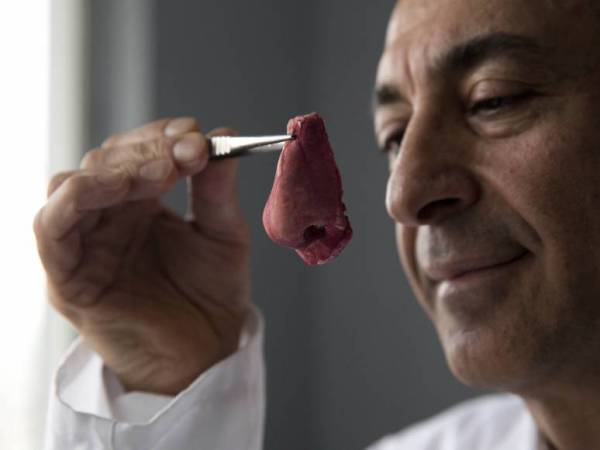
UCL trachea transplant inquiry: scapegoating, obfuscation and a lost nose
In 2017, UCL invited an external expert commission to investigate the deadly trachea transplants performed by the former UCL honorary professor Paolo Macchiarini. An already sacked UCL nanotechnology professor, Alexander Seifalian, whose lab made the two UCL plastic POSS-PCU tracheas in 2011, was announced as the main culprit on UCL side. All this despite Seifalian’s…
More recently, Seifalian was seen papermilling with fellow Iranians, giving keynotes for “bottom-feeding lowlife scamference predators, such as the delightfully-titled Clyto Access“, and founding biotech companies like NanoRegMed to push artificial vaginas made from pig intestine. In 2023, this company received from Innovate UK public funding of almost £300k for “Development of biofunctionalised graphene nerve conduits (NerveGraft) for nerve regeneration“, made from Seifalian’s “patented biodegradable material, BioHastalex“.
Seifalian has a daughter who is ready to step into his shoes and have some patients killed with family-made nano-garbage. Amelia Seifalian is PhD student at the Imperial College, where she was celebrated as a prodigy role model who won the 2022 Young Innovator Award (highlight mine):
“Her project is on the development of a novel pelvic implant to treat prolapse using graphene-based nanocomposite materials and stem cell technology. The award, supported by Innovate UK, KTN, UK Research and Innovation, and the Department for Business, Energy and Industrial Strategy (BEIS), will include funding to support the development of her idea
Pelvic organ prolapse affects half of women worldwide. A previous, unsuccessful treatment using a polypropylene-based mesh resulted in a ban. Amelia is in the early stages of researching a substitute product that would be made using graphene-based nanocomposite material. At the same time, she is proposing stem cell technology to overcome previous issues with the mesh treatment and provide a potential cure for the condition.
Speaking about the award, Amelia said: “It is such an honour to have this fantastic award to accelerate the start of my PhD project at Imperial College London developing a novel surgical adjunct for pelvic organ prolapse surgery using graphene-based nanocomposite materials (Hastalex®) and stem cell technology.”
Amelia already has a track record in the application of nanotechnology in medicine, having published over a dozen papers in the field.”
It is now more than twice that many papers for young Amelia, on all possible topics related to gynaecology, reconstructive surgery, degenerative medicine, but also on COVID-19, Turner Syndrome genetics, nettles and cumin, and even a clinical trial on breast implants (apparently without a proper ethics approval). When her first paper (“Stem cell tracking using iron oxide nanoparticles“, last author daddy) was submitted and published, young Amelia was still at school, studying for her A-levels. But never mind, she declared as her affiliation “UCL Centre for Nanotechnology and Regenerative Medicine”.
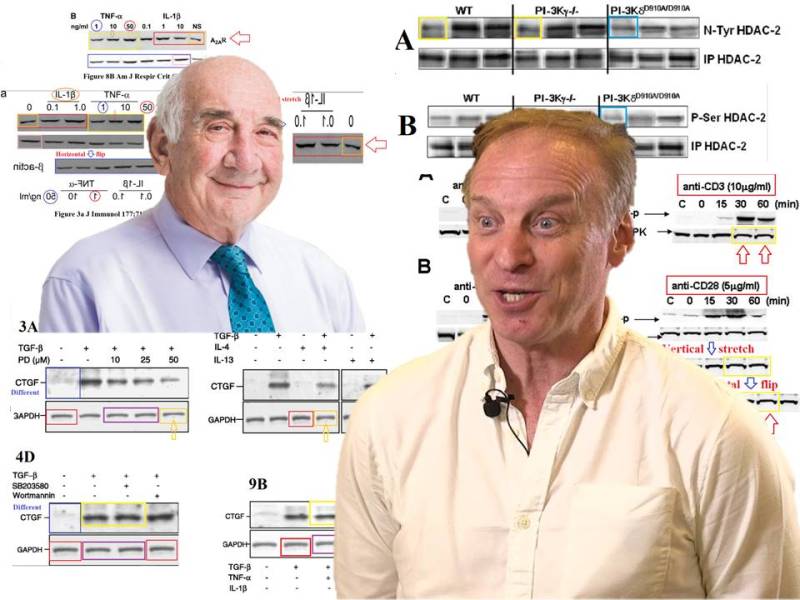
Imperial Adcock – from Barnes to Iran!
“the College would have been well within its rights to reject all of your allegations…”
Since daddy’s plastic trachea seeded with “stem cells” was so efficient in killing people, why indeed not re-enact the infamous vaginal mesh torture and mutilation device from a few years ago, right? Because of course this Hastalex® is manufactured by daddy’s company NanoRegMed, where Amelia is team member. She also owns her own business, Liberum Health, which sells daddy’s pelvic implants, while he is listed as “scientific advisor”. Here are some of Amelia’s Hastalex pelvic implant papers which Imperial College is so proud of:
- Mina Aleemardani , Pariya Zare , Amelia Seifalian, Zohreh Bagher , Alexander M. Seifalian Graphene-Based Materials Prove to Be a Promising Candidate for Nerve Regeneration Following Peripheral Nerve Injury Biomedicines (2021) doi: 10.3390/biomedicines10010073 “The authors declare no conflict of interest.”
- Amelia Seifalian, Alex Digesu, Vik Khulla A Novel Graphene-Based Nanomaterial for the Development of a Pelvic Implant to Treat Pelvic Organ Prolapse Journal of Functional Biomaterials (2024) doi: 10.3390/jfb15110351 “The authors declare no conflicts of interest””
- Amelia Seifalian, Paul I. Stanciu , Alex Digesu , Vikram Khullar Graphene-based nanocomposite materials to provide a surgical solution for the condition of pelvic organ prolapse Medical Hypotheses (2024) doi: 10.1016/j.mehy.2024.111398 “The authors declare that they have no known competing financial interests or personal relationships that could have appeared to influence the work reported in this paper.”
The Innovate UK site quotes young Amelia with this advice:
“I would advise aspiring young entrepreneurs to follow their passion but with humility, and to always seek advice where needed. It’s important to be willing to listen to experts”
The expert being your fraudster daddy whose past inventions tortured people to death.
Alexander Seifalian, UCL’s Persian Scapegoat
UCL has completed the investigation into the affair around their past honorary professor Paolo Macchiarini and the trachea transplants. The report avoids implicating Macchiarini’s partner Martin Birchall. The only guilty party is the nuclear physicist Alexander Seifalian.
The Imperial article also mentions that “Dr Amelia Seifalian is a junior NHS doctor and a part-time PhD student in S&C, under the supervision of Prof Nagy Habib and Prof Vik Khullar (Urogynaecology).” She did indeed join the right lab to abuse patients. The Imperial College professor Nagy Habib was in the news 25 years ago, here The Guardian from 1999:
“A senior consultant has been suspended from his NHS post amid allegations that he breached safety controls while conducting pioneering gene therapy research on dying liver patients.
Nagy Habib, the head of liver surgery at Hammersmith hospital, west London, is said to have injected up to 20 patients with a cocktail of human liver cells and a flu virus before being given permission by the government’s regulatory body, the gene therapy advisory committee (GTAC).
He allegedly failed to explain the risks involved to the private, overseas patients he was treating or to offer them counselling. And, once he had conducted the research, he is said not to have monitored them properly…”
They do always fall on their feet, find each other, and continue with their deeds, no?
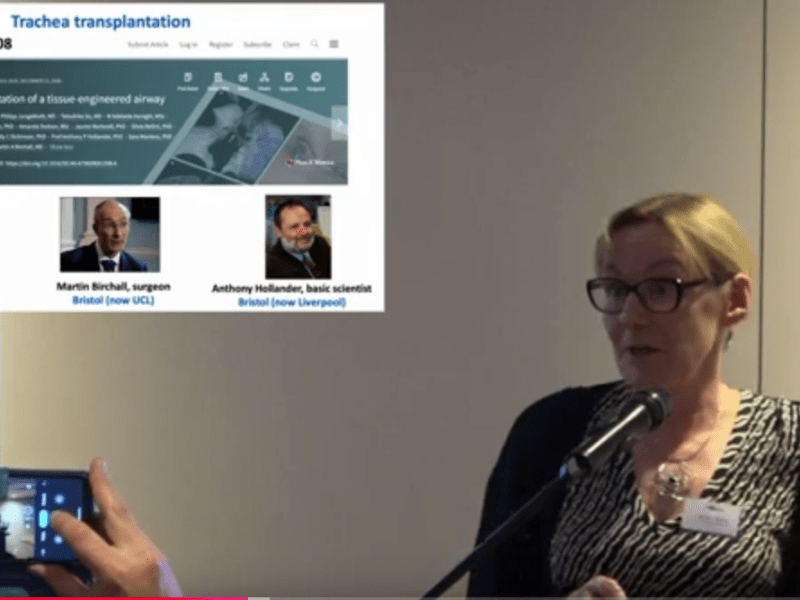
Martin Birchall, Paolo De Coppi, and other clowns of UCL’s degenerative medicine
Several years ago, UCL investigated the Macchiarini affair and found their surgeon Martin Birchall was not only innocent, but also entitled to more money and more patients to experiment upon. Now, Patricia Murray was awarded for exposing this UCL malfeasance, and Sholto David scrutinised UCL papers for data manipulation.
But let’s see what else Seifalian Sr was up to. Well, I did mention papermilling with fellow Iranians. So here it is, of course turmeric-flavoured:
Mercedeh Babaluei, Fatemeh Mottaghitalab, Alexander Seifalian, Mehdi Farokhi Injectable multifunctional hydrogel based on carboxymethylcellulose/polyacrylamide/polydopamine containing vitamin C and curcumin promoted full-thickness burn regeneration International Journal of Biological Macromolecules (2023) doi: 10.1016/j.ijbiomac.2023.124005


The last author announced a correction. This is aptly called “fabrication”:
Seyed Ali Mosaddad , Mohsen Yazdanian, Hamid Tebyanian, Elahe Tahmasebi , Alireza Yazdanian , Alexander Seifalian , Maryam Tavakolizadeh Fabrication and properties of developed collagen/strontium-doped Bioglass scaffolds for bone tissue engineering Journal of Materials Research and Technology (2020) doi: 10.1016/j.jmrt.2020.10.065
Fig 12

And just look at this, Seifalian and Iranian papermill-created artificial skin:
Mazaher Gholipourmalekabadi, Alexander M. Seifalian, Aleksandra M. Urbanska , Mir Davood Omrani , John G. Hardy, Zahra Madjd , Seyed Mahmoud Hashemi , Hossein Ghanbarian, Peiman Brouki Milan , Masoud Mozafari , Rui L. Reis , Subhas C. Kundu , Ali Samadikuchaksaraei 3D Protein-Based Bilayer Artificial Skin for the Guided Scarless Healing of Third-Degree Burn Wounds in Vivo Biomacromolecules (2018) doi: 10.1021/acs.biomac.7b01807


An important step towards addressing the UN’s Sustainable Development Goals
The above paper by Seifalian and the Iranians brings us to their odd coauthor John Hardy, senior lecturer at Lancaster University in UK, who is also on other Iranian papermill fabrications. Hardy can now kiss Seifalian on both cheeks for leading the sleuths to him.
Here another one by Hardy and some of those same Iranian crooks:
Tina Navaei , Peiman Brouki Milan , Ali Samadikuchaksaraei , Hamid Reza Davari, John G Hardy , Masoud Mozafari Design and fabrication of polycaprolactone/gelatin composite scaffolds for diaphragmatic muscle reconstruction Journal of Tissue Engineering and Regenerative Medicine (2021) doi: 10.1002/term.3151


The mentioned Heliyon 2020 paper reusing that data is by Masoud Mozafari, but lacks Hardy as coauthor. Instead it has three French authors, Michael Badawi, Sophie Morisset and Henri Vahabi. In his email, Hardy mentioned:
“I will leave it to the editors of the articles with the Iranian authors to withdraw the papers.”
Yet in latter emails he decided to go for corrections instead:
“a draft correction to “Design and fabrication of polycaprolactone/gelatin composite scaffolds for diaphragmatic muscle reconstruction” had been circulated to the authors; the others are in the pipeline.“
This one must be in the pipeline:
Parmida Ghiasi Tabari , Amirmohammad Sattari , Mohsen Mashhadi Keshtiban , Nushin Karkuki Osguei , John G. Hardy, Ali Samadikuchaksaraei Injectable hydrogel scaffold incorporating microspheres containing cobalt‐doped bioactive glass for bone healing Journal of Biomedical Materials Research Part A (2024) doi: 10.1002/jbm.a.37773

I asked Hardy to explain his Iranian collaborations. Which he did, saying he was once befriended by Sahba Mobini (now postdoc in Florida), who introduced him to Ali Samadikuchaksaraei at Iran University of Medical Sciences. Hyperlinks are Hardy’s:
“Sometime in 2016/2017 I got an invitation to speak at an international conference in Tehran which I accepted; speaking at such conferences is a part of academic life, important for networking, but tricky to schedule in 2016/2017 I also presented research in China, Germany and the UK. Ali was one of the conference organisers, and it was there I met him, Mazaher Gholipourmalekabadi and Masoud Mozafari (who did his PhD in the USA) at the conference dinner at the Milad Tower; it was there we discussed some of our ongoing research, and I agreed in principle to offer insights into some of their research if they ever asked; international engagement is an important step towards addressing the UN’s Sustainable Development Goals.“
You saw how Hardy and the Iranians have been addressing the UN’s Sustainable Goals since. Will you be surprised to learn that Masoud Mozafari (who claims to be visiting professor at University of Oulu in Finland) is a massive papermill fraudster who “coauthored” fake papers with Rajender Varma, Navid Rabiee, Rafael Luque and other infamous papermillers? If interested – Mozafari’s contributions to Iranian papermill industry were mentioned in November 2024 Shorts, June 2024 Shorts and in June 2023 Shorts. Mozafari also engaged in citation farming and identity theft, see the PubPeer threads for Zarrintaj et al 2023 and Zarrintaj et al 2019. His paper Taghizadeh et al 2022 with fellow Iranians and two Germans, the China-based lorian Stadler and Ulrich Schubert of University of Jena, fell prey to the Vickers Curse:
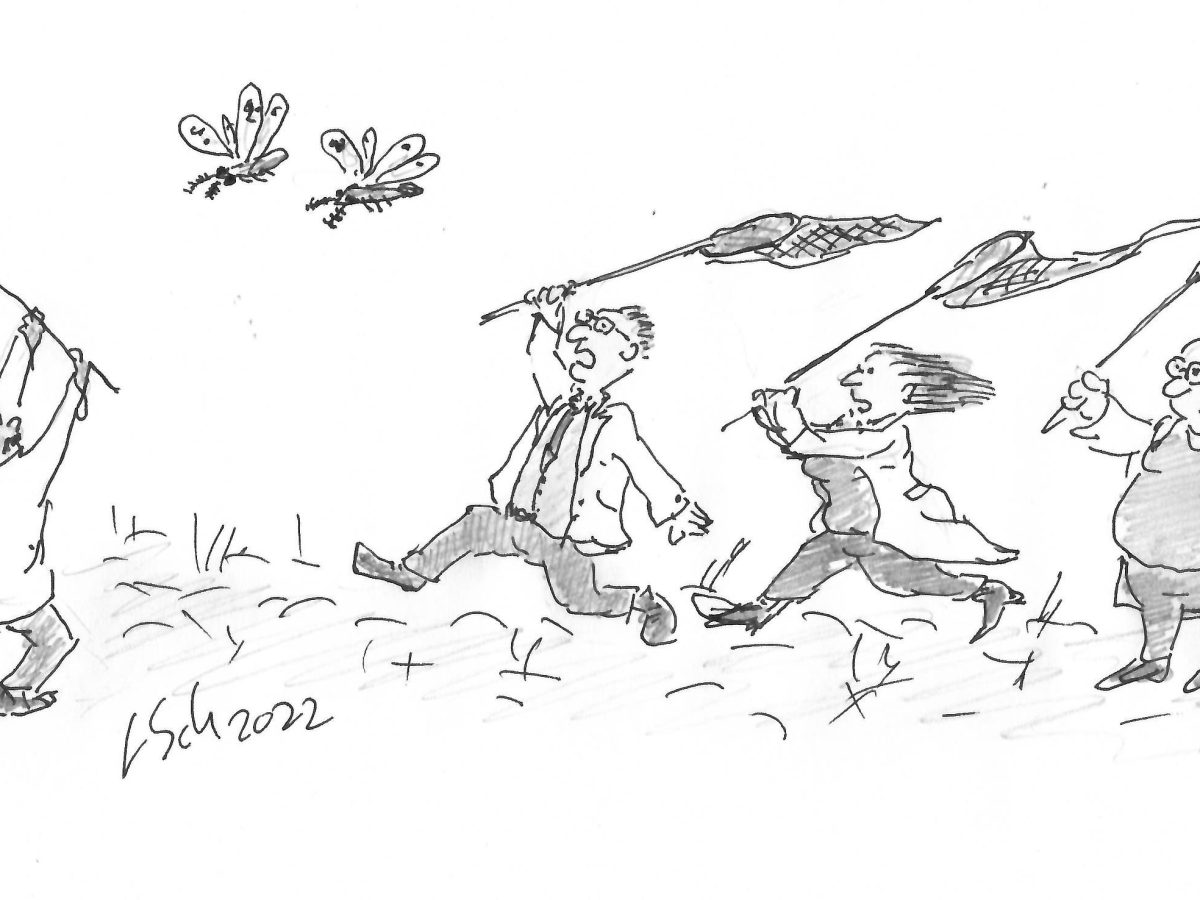
When I’m citing you, will you answer too?
What do moth pheromones on one side have to do with cancer research, petrochemistry, materials science, e-commerce, psychology, forestry and gynaecology on the other? They are separated by just one citation!
Here is Mozafari with Alexander Seifalian:
Hatef Ghasemi Hamidabadi , Zahra Rezvani , Maryam Nazm Bojnordi , Haji Shirinzadeh , Alexander M. Seifalian , Mohammad Taghi Joghataei , Mojgan Razaghpour , Abbas Alibakhshi , Abolfazl Yazdanpanah , Maryam Salimi , Masoud Mozafari , Aleksandra M. Urbanska , Rui. L. Reis , Subhas C. Kundu , Mazaher Gholipourmalekabadi Chitosan-Intercalated Montmorillonite/Poly(vinyl alcohol) Nanofibers as a Platform to Guide Neuronlike Differentiation of Human Dental Pulp Stem Cells ACS Applied Materials & Interfaces (2017) doi: 10.1021/acsami.6b14283

Back to Lancaster. The Iranians can be Hardy blamed here:
Mark D. Ashton , Patricia A. Cooper , Sofia Municoy, Martin F. Desimone , David Cheneler, Steven D. Shnyder, John G. Hardy Controlled Bioactive Delivery Using Degradable Electroactive Polymers Biomacromolecules (2022) doi: 10.1021/acs.biomac.2c00516


Hardy said he asked his coauthors for raw data, and about the duplicated FTIR spectra he suspected “either a copy/paste error, or perhaps very similar owing to the structural similarities in the polymers”. Elsewhere, Hardy also insisted the spectra must look that similar:
Federica Leone, Melike Firlak, Kirsty Challen, Wayne Bonnefin, Barbara Onida, Karen L Wright, John G Hardy In Situ Crosslinking Bionanocomposite Hydrogels with Potential for Wound Healing Applications Journal of Functional Biomaterials (2019) doi: 10.3390/jfb10040050
“Figure 3: The green XRD patterns are labelled as showing different material samples but actually show the exact same trace.”

In his PubPeer comment and email, Hardy informed that the XRD data “is correct“. Later on, he was less sure. Also this study was done entirely in England:
Tekle Pauzaite , James Tollitt , Betul Sopaci , Louise Caprani , Olivia Iwanowytsch , Urvi Thacker , John G Hardy , Sarah L Allinson, Nikki A Copeland Dbf4-Cdc7 (DDK) Inhibitor PHA-767491 Displays Potent Anti-Proliferative Effects via Crosstalk with the CDK2-RB-E2F Pathway Biomedicines (2022) doi: 10.3390/biomedicines10082012

Also that is to be corrected, as Hardy announced.
Obviously botched job
Strange things went on in the lab of the Spanish cannabis researcher Manuel Guzmán, professor at Complutense University of Madrid. Thing which can be only explained either with wilful research fraud or with excessive cannabis consume (which then led to research fraud).
Here the authors postulated cannabis as a therapy for skin cancer:
Cristina Blázquez , Arkaitz Carracedo , Lucía Barrado , Pedro José Real , José Luis Fernández‐Luna , Guillermo Velasco , Marcos Malumbres , Manuel Guzmán Cannabinoid receptors as novel targets for the treatment of melanoma The FASEB Journal (2006) doi: 10.1096/fj.06-6638fje

Guzman replied on PubPeer right away, with a lenghty statement where he admitted the falsification:
“We have checked our lab notebooks and digital files, and have contacted the appropriate study coauthors. Your remarks are correct. For no obvious reasons, there was an unquestionable number of errors during the preparation of this figure, especially regarding the tubulin loading controls. […]
Frankly, we cannot say anything but that we are extremely sorry for this obviously botched job, and so we do apologise to the readers, the journal and the scientific community overall. On more personal grounds, as corresponding author of this paper and as senior scientist for about three decades, I feel desolated for not having detected these flaws in due time and ashamed for this sloppy figure having come out from our lab.
All this said, we believe that the data in this figure still support the notion […] and subsequent reports by many other independent labs confirmed this finding (reviewed in doi: 10.1007/s43440-021-00308-1, 10.3390/cancers14071769, 10.3390/ijms24010859, 10.1111/exd.15144). Hence, being fully honest and with no intention at all to justify our unprofessional behaviour, this certainly inaccurate Figure 1A does not affect the overall findings and conclusions of the paper.“
I suspect Guzman was high when writing this. Now, I think I can explain why the data needed to be forged to prove that cannabinoid drugs cure cancer. Guzman holds a bunch of patents on just that, often together with businesses like GW Pharmaceuticals (which sells cannabis drugs). Already in 2004 he proved that THC from cannabis cures brain tumours, and he patented it already in 2002. Guzman also has a relationship with the company Zelira Therapeutics which sells cannabis as cancer therapy. But Guzman rarely mentions these conflicts of interests in his papers (see for example Costas-Insua et al 2023).
The following cannabis paper from Guzman’s lab was corrected right after its publication to admit that “our observations can be explained by the MAGL inhibitory action of the contaminant present in the batches of commercial URB754” inhibitor which proved to be unspecific for its presumed target monoacylglycerol lipase (MAGL). There authors might need to issue another correction:
Tania Aguado , Eva Romero , Krisztina Monory , Javier Palazuelos , Michael Sendtner , Giovanni Marsicano , Beat Lutz , Manuel Guzmán, Ismael Galve-Roperh The CB1 cannabinoid receptor mediates excitotoxicity-induced neural progenitor proliferation and neurogenesis The Journal of biological chemistry (2007) doi: 10.1074/jbc.m700678200
“Two images in Figure 4C seem to show an overlapping field of view, but are described differently.”

Guzman admitted the manipulation and explained:
“As data quantification in Figures 4A and 4B clearly shows, no significant differences were evident between these two experimental groups. Hence, this mistaken Figure 4C, although certainly erroneous in that particular vehicle-CB1-/- panel, does not affect at all the findings and conclusions of the paper. We do apologise to the readers and the journal for this undeniable error and the possible inconveniences that it may have caused.“
Same stonewalling attitude here:
Luigi Bellocchio, Andrea Ruiz-Calvo , Anna Chiarlone , Magali Cabanas , Eva Resel , Jean-René Cazalets , Cristina Blázquez, Yoon H. Cho , Ismael Galve-Roperh , Manuel Guzmán Sustained Gq-Protein Signaling Disrupts Striatal Circuits via JNK Journal of Neuroscience (2016) doi: 10.1523/jneurosci.1192-16.2016


Guzman admitted the manipulations and declared them irrelevant:
“this mistaken Figure 4E, although certainly erroneous in that particular SP600125/vehicle panel, does not affect at all the findings and conclusions of the paper. […] this mistaken Figure 7A, although certainly erroneous in that particular vehicle/CNO-control panel, does not affect at all the findings and conclusions of the paper. We do apologise to the readers and the journal for this undeniable error and the possible inconveniences that it may have caused.“
The future of lying
In USA, an expert on lying was caught lying.
SF GATE reported on 22 November 2024:
“In an bizarre twist, a Stanford University expert who studies misinformation appears to have created some of his own — while under oath.
On Nov. 1, Jeff Hancock, a well-known and oft-cited researcher who leads the Bay Area school’s Social Media Lab, filed an expert declaration in a Minnesota court case over the state’s new ban on political deepfakes. Republicans have sued to block the ban, arguing it’s an unconstitutional limit on free speech. Hancock defended the law in his declaration, explaining how artificial intelligence makes it easier to fabricate videos and discussed deepfakes’ psychological impacts. But he seems to have made an ironic mistake.
Hancock cited 15 references in his declaration, mostly research papers related to political deepfakes and their impacts. Two of the 15 sources do not appear to exist. The journals he cites are real, as are some of the two citations’ authors, but journal archives show no sign of either paper. The actual journal pages referenced by Hancock have different articles. SFGATE was unable to find the cited papers on Google Scholar, either. “
The article mentions that Hancock is “paid $600 an hour for his expert testimony“.
A litany of problems
In Australia, the national funding agency got a governmental audit because it knowingly wastes public money on fake science. The Sydney Morning Herald reported on 3 December 2024:
“The Australian National Audit Office (ANAO) found a litany of problems at the National Health and Medical Research Council (NHMRC), which hands out about $1.5 billion in taxpayer grants each year.
The audit – published online in late October – highlighted a lack of measures to prevent fraud, or staff with even basic training to spot it. The audit office also found the council had “inconsistent” internal fraud databases, that it relied almost wholly on universities and scientists doing the right thing, and was in breach of its own national code. […]
The report found that the NHMRC had not overseen a single investigation into suspected grant fraud, despite funding at least 41 scientific papers that have been pulled from the scientific record in the past 15 years.
When a case of confirmed research fraud was reported to the NHMRC, it failed to report that case to the police, as it is required to do by its own policy. […]
…the NHMRC had allowed universities to keep things to themselves unless they decided to launch a formal investigation. Even then, the university was not required to hand the investigative report over. […] It maintains two registers of fraud and misconduct in spreadsheets, but they don’t match each other and aren’t fit for purpose, the report found.”
The full report can be found on the ANAO website. Possibly, the fraud case of Gilles Guillemin was central to that audit.
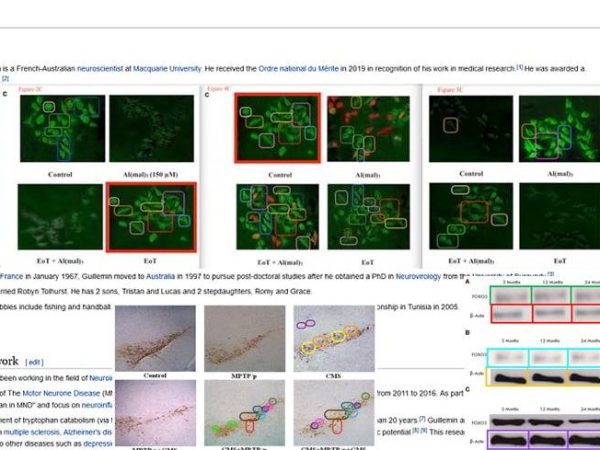
“NONE of the work HAS NOT BEEN DONE in my lab”
“you can make a mistake once, but twice hmmmm I’d like to have my name removed from the potential revised version of this manuscript”, – Prof Guillemin.
The journalist found out that the NHMRC “received 139 research integrity notifications between 2018 and 2023” and acted on only one of them, where “$2.6 million had been spent on research that was never conducted“, i.e. simply stolen. The action consisted of sending newspaper clippings to the Health Minister, the money was then fully recovered.
Retraction Watchdogging
An illustrative, non-quantitative visual
Retraction for Italian scholars at University “G. D’Annunzio” in Chieti, and one certain US-based collaborator at NIH. The paper was previously corrected in 2021 because “the author first and last names were reversed“. The evidence of fake data was originally flagged by Mu Yang and completed by Elisabeth Bik in autumn 2023:
Chiara D’Angelo, Erica Costantini, Nieves Salvador, Michele Marchioni, Marta Di Nicola, Nigel H Greig, Marcella Reale nAChRs gene expression and neuroinflammation in APPswe/PS1dE9 transgenic mouse Scientific Reports (2021) doi: 10.1038/s41598-021-89139-x

A retraction was published on 26 November 2024:
“The Editors have retracted this Article. After publication, concerns were raised regarding areas of high similarity in the green signals in Fig. 1A, B and C. The Authors have been unable to provide the underlying raw data to address these concerns.
Since Fig. 1 represents the validation of the model used in the study, the Editors no longer have confidence in the presented data.
Marcella Reale, Erica Costantini, and Michele Marchioni do not agree to this retraction. Chiara D’Angelo, Nieves Salvador, Marta Di Nicola, and Nigel H. Greig have not responded to any correspondence from the Editors about this retraction.”
But after the retraction, Nigel H. Greig, Senior Investigator at NIH National Institute on Aging (NIA) in Baltimore, responded on PubPeer (highlights mine):
“A concern in relation to Figure 1 was reported on PubPeer – whereby use of AI technology determined similarities in key areas of amyloid-beta (Abeta) deposit staining across coronal brain sections A, B and C from 6-, 12- and 24-month-old Alzheimer (APPswe/PS1dE9) mice in our Scientific Reports 2021 paper (D’Angelo et al., Sci Rep. 11:9711, 2021). This representative figure provided an illustrative, non-quantitative visual of what a mouse brain stained for Abeta deposits looks like under a microscope. Quantitative data in relation to the amount of Abeta present within the cerebral cortex and hippocampus, together with other measures, was provided in Table 1 (with accompanying statistical analyses (N=5-8 mice/group)). The authors provided all raw data to Scientific Reports Editorial Office that formed the basis of reported measures in Table 1. The authors, additionally, offered to provide a new replacement illustrative figure to use instead of Figure 1, as well as raw data for all other results within the article.
Despite the above, the Editorial Board indicated that they had lost confidence in the publication, and came to the decision to retract it. The authors understand their decision – but disagree with it.“
Since Greig is banging on about “quantitative data“, “statistical analyses” and “raw data“, here is another study of his with his Italian colleague Marcella Reale, where someone apparently falsified just those:
Marcella Reale , Erica Costantini , Lisa Aielli , Fabrizio Di Giuseppe , Stefania Angelucci , Mohammad A Kamal , Nigel H Greig Proteomic Signature and mRNA Expression in Hippocampus of SAMP8 and SAMR1 Mice during Aging International Journal of Molecular Sciences (2022) doi: 10.3390/ijms232315097

What is a western blot then? Also a “illustrative, non-quantitative visual“? Another paper by Reale:
Antonia Patruno , Mirko Pesce , Alfredo Grilli , Lorenza Speranza , Sara Franceschelli , Maria Anna De Lutiis , Giovina Vianale , Erica Costantini , Paolo Amerio , Raffaella Muraro , Mario Felaco , Marcella Reale mTOR Activation by PI3K/Akt and ERK Signaling in Short ELF-EMF Exposed Human Keratinocytes PLOS ONE (2015) doi: 10.1371/journal.pone.0139644

But maybe not the Italians should be blamed here, but our Englishman in USA, the good old Nigel Greig, who has over 20 papers on PubPeer, many flagged by Mu Yang. In 2019, Greig retracted a clinical study in PLOS One (Pappola et al 2019) because of “the lack of prospective ethics approval“, because authors “had access to identifying participant information and that the study involved patients from the authors’ clinical practice” and because “the study did not include appropriate controls“.
Here a ancient study by Greig, where Greig’s beloved “quantitative data” and “statistical analyses” were forged by someone who may or may not have been the lead author:
N H Greig , S Genka , E M Daly , D J Sweeney , S I Rapoport Physicochemical and pharmacokinetic parameters of seven lipophilic chlorambucil esters designed for brain penetration Cancer Chemotherapy and Pharmacology (1990) doi: 10.1007/bf00686229

And another vintage classic Greig, again rats were tortured for no other reason but to forge the “quantitative data” afterwards:
T Nariai , J J DeGeorge , N H Greig , S Genka , S I Rapoport , A D Purdon Differences in rates of incorporation of intravenously injected radiolabeled fatty acids into phospholipids of intracerebrally implanted tumor and brain in awake rats Clinical & Experimental Metastasis (1994) doi: 10.1007/bf01753889
Table 6: “SEM values of Radiolabel sn-1 and sn-2 appear identical in all rows.”

But then again, Greig cured Alzheimer’s! The falsified “quantitative data” was flagged by Yang and Bik:
Mohammad A Kamal, Peter Klein , Weiming Luo , Yazhou Li , Harold W Holloway , David Tweedie , Nigel H Greig Kinetics of human serum butyrylcholinesterase inhibition by a novel experimental Alzheimer therapeutic, dihydrobenzodioxepine cymserine Neurochemical Research (2008) doi: 10.1007/s11064-007-9490-y

There is more of this kind of statistical data forgeries in Greig’s papers, for example look at this set:
- Q S Yu , X F Pei , H W Holloway , N H Greig , A Brossi Total syntheses and anticholinesterase activities of (3aS)-N(8)-norphysostigmine, (3aS)-N(8)-norphenserine, their antipodal isomers, and other N(8)-substituted analogues Journal of Medicinal Chemistry (1997) doi: 10.1021/jm970210v
- Q Yu , N H Greig , H W Holloway , A Brossi Syntheses and anticholinesterase activities of (3aS)-N1, N8-bisnorphenserine, (3aS)-N1,N8-bisnorphysostigmine, their antipodal isomers, and other potential metabolites of phenserine Journal of Medicinal Chemistry (1998) doi: 10.1021/jm9800494

But there is of course also falsified microscopy data, for example:
Srinivasulu Chigurupati, Mohamed R Mughal , Sic L Chan , Thiruma V Arumugam , Akanksha Baharani , Sung-Chun Tang , Qian-Sheng Yu , Harold W Holloway , Ross Wheeler , Suresh Poosala , Nigel H Greig, Mark P Mattson A synthetic uric acid analog accelerates cutaneous wound healing in mice PLOS ONE (2010) doi: 10.1371/journal.pone.0010044

M. Yang: “Fig 1 panels seem to overlap.”
Even Claire Francis found bad stuff in Greig’s papers, ehre again the last auhtor is the retired NIH-NIA bigwig Mark Mattson:
C Culmsee , X Zhu , Q S Yu , S L Chan , S Camandola , Z Guo , N H Greig , M P Mattson A synthetic inhibitor of p53 protects neurons against death induced by ischemic and excitotoxic insults, and amyloid beta-peptide Journal of Neurochemistry (2001) doi: 10.1046/j.1471-4159.2001.t01-1-00220.x
Fig 5a

Greig even ended up as coauthor on obvious papermill fabrications like Khandia et al 2022 by the gang of Ghulam Md. Ashraf and Simona Cavalu.
Maybe it doesn’t even need Trump with RFK Jr and Bhattacharya to destroy NIH, its scientists are well capable of doing it themselves. Quite possibly, Greig’s case might rival Eliezer Masliah‘s, also at NIH-NIA.
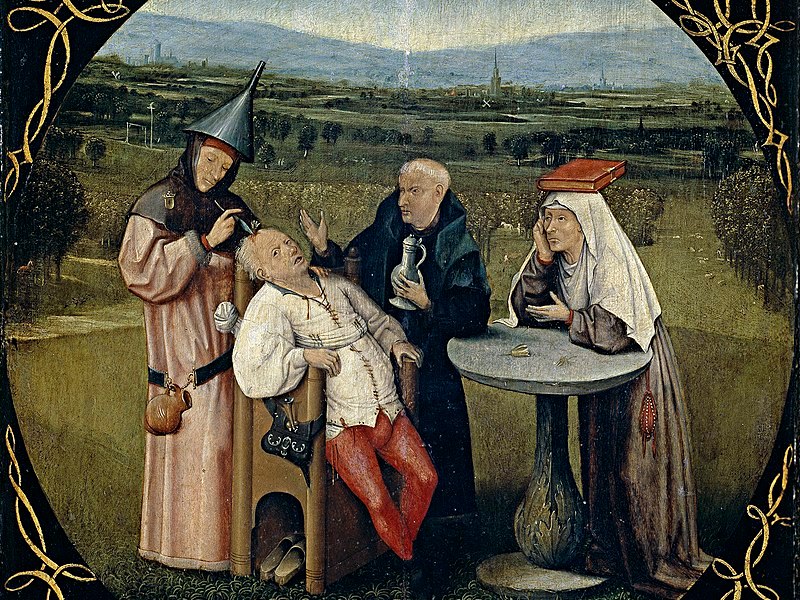
Cerebrolysin: Sharmas, Masliah, and EVER Pharma
“Poking around PubMed (Dysdera the spider is always on the hunt for new hornet’s nests) [..], I came across one image in two papers by Eliezer Masliah. […] By a conservative count, I contributed to about 160 out of 300 slides in the final dossier” – Mu Yang

None of the retracted citations affect the conclusions
A paper by an Iranian agent in Germany was corrected. For the full story aof the papermillers Mohammad Taheri (masquerading as a humble PhD student at University of Jena), his high-ranking associate in Iran Soudeh Ghafouri-Fard (connected to the Iranian regime), and Taheri’s PhD advisor and the University of Jena Ombudsman for research integrity, Aria Baniahmad, read here:

Look What the Cat Dragged In
Meet Mohammad Taheri, PhD, a humble PhD student in Jena, Germany, and his equally unremarkable Iranian associate Dr Soudeh Ghafouri-Fard.

This is their corrected paper:
Mohammad Taheri , Zeinab Shirvani-Farsani , Atefeh Harsij , Mohadeseh Fathi , Sheyda Khalilian , Soudeh Ghafouri-Fard, Aria Baniahmad A review on the role of KCNQ1OT1 lncRNA in human disorders Pathology – Research and Practice (2024) doi: 10.1016/j.prp.2024.155188
The review paper was flagged on PubPeer because 3 of its references were retracted many months before the manuscript was submitted for publication to Elsevier. On 19 November 2024, it received this Corrigendum:
“The authors regret to inform that three papers cited in this review have been retracted. Specifically, the following references have been retracted: in the Introduction, the citation reporting that LncRNAs act as oncogenic or tumor suppressive transcripts (Ref. [10]); the accuracy of this statement is supported by Ref. [11]. In the section discussing the interaction between lncRNAs and miRNAs mediated by the RNA-induced silencing complex and regulation of gene expression (Ref. [16]), this statement is supported by Ref. [18]. Additionally, in the summary of studies reporting the upregulation of KCNQ1OT1 in glioma, including its prognostic roles (Ref. [62] in Tables 2 and 3).
The authors apologize for any inconvenience caused. Importantly, none of the retracted citations affect the conclusions drawn in this review.”
Alexander Magazinov then noticed that two more references were retracted, [19] already in 2021 and [58] in August 2024. The sleuth then wondered:
“How many more of them are needed to put the conclusions into doubt (if there are conclusions, that is)?“
COVID-19
The lab leak theory
What with China rather openly supporting and even arming russia and since recently even North Korea in their war against Ukraine, we all forgot about the COVID-19 pandemic and we certainly stopped caring about finding out where exactly SARS-CoV-2 came from. I mean, we wouldn’t want to provoke China even more, right, look business suffers already as it is because those Ukrainians refuse to die fast enough.
The Lab Leak Theory
A lab leak theory of the COVID-19 origins has enough circumstantial evidence and historical basis to support the urgent need for an independent and unbiased investigation. But until recently, scientists dismissed lab leak as a conspiracy theory. In public at least.
Thus, we all stopped discussing the lab leak theory of the origin of COVID-19, because several science authorities said it suddenly jumped over from some infected animal at a Wuhan market, and it really doesn’t matter that science can’t really prove this with actual scientific evidence (as opposed to scientific eminence).
Now, on 2 December 2024, the US Congress Oversight Committee released its report, titled “After Action Review of the COVID-19 Pandemic: The Lessons Learned and a Path Forward“.
There is also a press release summary:
“COVID-19 ORIGIN: COVID-19 most likely emerged from a laboratory in Wuhan, China. The FIVE strongest arguments in favor of the “lab leak” theory include:
- By nearly all measures of science, if there was evidence of a natural origin it would have already surfaced.
- The virus possesses a biological characteristic that is not found in nature.
- Data shows that all COVID-19 cases stem from a single introduction into humans. This runs contrary to previous pandemics where there were multiple spillover events.
- Wuhan is home to China’s foremost SARS research lab, which has a history of conducting gain-of-function research at inadequate biosafety levels.
- Wuhan Institute of Virology (WIV) researchers were sick with a COVID-like virus in the fall of 2019, months before COVID-19 was discovered at the wet market.
PROXIMAL ORIGIN PUBLICATION: “The Proximal Origin of SARS-CoV-2” publication — which was used repeatedly by public health officials and the media to discredit the lab leak theory — was prompted by Dr. Fauci to push the preferred narrative that COVID-19 originated in nature.
GAIN-OF-FUNCTION RESEARCH: A lab-related incident involving gain-of-function research is most likely the origin of COVID-19. Current government mechanisms for overseeing this dangerous gain-of-function research are incomplete, severely convoluted, and lack global applicability.
ECOHEALTH ALLIANCE INC. (ECOHEALTH): EcoHealth — under the leadership of Dr. Peter Daszak — used U.S. taxpayer dollars to facilitate dangerous gain-of-function research in Wuhan, China. After the Select Subcommittee released evidence of EcoHealth violating the terms of its National Institutes of Health (NIH) grant, the U.S. Department of Health and Human Services (HHS) commenced official debarment proceedings and suspended all funding to EcoHealth.”
To be fair, the report is not entirely balanced. It celebrates Trump unconditionally to the point of contradicting itself: “President-elect Trump’s Operation Warp Speed — which encouraged the rapid development and authorization of the COVID-19 vaccine — was highly successful and helped save millions of lives” followed by “Contrary to what was promised, the COVID-19 vaccine did not stop the spread or transmission of the virus“, blaming FDA for approving these vaccines “to meet the Biden Administration’s arbitrary mandate timeline“, and decrying vaccine mandates for medcial personnel as “not supported by science” and having “caused more harm than good“. And then the report which just postulated that COVID-19 immunity cannot be acquired, states: “Public health officials engaged in a coordinated effort to ignore natural immunity“.
The report also declares the social distancing rules as “arbitrary and not based on science“, claims “no conclusive evidence that masks effectively protected Americans from COVID-19” and that “Prolonged lockdowns caused immeasurable harm to not only the American economy, but also to the mental and physical health of Americans, with a particularly negative effect on younger citizens.“

Viral by Alina Chan & Matt Ridley – Book review
Alina Chan’s book with Matt Ridley on the Origins of COVID-19 is finally out. It is a very informative read!
In my personal view, the whole COVID-19 origin debate is a total mess. I find it beyond idiotic that nearly the only people ready to consider a lab leak theory are the far-right antivaxxers, and that often only because of their racism towards Asians. Had COVID-19 emerged in a russian lab, these people probably wouldn’t bother about the origins question.
Maybe in 50 years, should our civilisation still exist, some sane people will go through records and decide if there is any valid scientific evidence for the proximal origin of COVID-19, i.e. a bat or a raccoon dog or whatever where the virus can be traced back to. Because science also says that it is perfectly feasable to make a virus like SARS-CoV2 in a lab, and in fact the Wuhan Institute of Virology had been working on just that.
Science Breakthroughs
Part of a healthy diet
Once again, the science has spoken: chocolate is good for your health. This time, it was once again proven that dark chocolate (because cocoa flavanols!) prevents diabetes. In fact, NOT eating chocolate CAUSES diabetes.
Chocolate is good for your funding
Chocolate is good for your health, scientists keep saying. This may sound counter-intuitive; given that chocolate is an extremely calorie-rich confectionery, which mostly contains industrially refined cocoa fat and huge quantities of added sugar, a substance finally about to be recognised as the prime cause for the obesity epidemics. A recent clinical study from the…
I wouldn’t normally write about this irresponsible stupidity, but it is from Harvard, was published in The BMJ and now features in all the major news worldwide. Here is CNN reporting on 4 December 2024:
“Eating at least five tiny servings of dark chocolate each week may lower the risk of developing type 2 diabetes by 21%, according to a new observational study. In fact, as dark chocolate consumption increased from none to five servings, so did the benefits, the study found. […]
“Dark and milk chocolate have similar levels of added sugar, fat and calories, but the most important difference is that dark chocolate contains more cacao,” said lead author Binkai Liu, a doctoral student in the nutrition department of Harvard T.H. Chan School of Public Health.”
Also, the cosumers of dark chocolate “did not experience the long-term weight gain seen with milk chocolate“. Here is the study, the authors declare its underlying data to be unavailable to readers:
Binkai Liu , Geng Zong , Lu Zhu , Yang Hu , JoAnn E Manson , Molin Wang , Eric B Rimm , Frank B Hu , Qi Sun Chocolate intake and risk of type 2 diabetes: prospective cohort studies BMJ (2024) doi: 10.1136/bmj-2023-078386
Unsurpringly we learn that Haravrd professor JoAnn Manson receives “investigator initiated grants” from Mars, the chocolate giant which loves to sponsor this kind of research. The flavanol-pusher and Harvard professor Eric Rimm is “on the scientific advisory board and has received research funding from the US Department of Agriculture/US Highbush Blueberry growers commodity group“.
The Guardian explained the design:
“For the study, the team used data from three long-term studies of nurses and healthcare workers in the US. The analysis of food frequency questionnaires taken every four years examined the link between type 2 diabetes and total chocolate consumption in 192,028 people, and chocolate type – dark or milk – in 111,654 people. The average monitoring period was 25 years.”
NPR quoted another coauthor:
“”We are a little bit surprised to see that effect size,” says study author Dr. Qi Sun, an associate professor at Harvard T.H. Chan School of Public Health.”
The New York Times quoted Sun also:
“The results, Dr. Sun added, suggest that a little dark chocolate can be part of a healthy diet.”
Chocolate health: advice by Thomas Lüscher and peer review by Jonas Malmstedt
Christmas season is the time to eat lots of chocolate. And as science teaches us, your confectionery is actually the superfood which will make you healthy, slim and clever. Good for you, good for the chocolate industry which often generously sponsors such scientists. In May 2016, I brought a story about chocolate health research and…
All news drag out other academic chocolate shills in support, who also published crap like this before.
If you are a GP reading this, and you still don’t prescribe dark chocolate, coffee and red wine to your patients: you are a bloody murderer who must be arrested ASAP to protect the public health.
Donate!
If you are interested to support my work, you can leave here a small tip of $5. Or several of small tips, just increase the amount as you like (2x=€10; 5x=€25). Your generous patronage of my journalism will be most appreciated!
€5.00

 For Better Science
Excellent. Taheri’s supervisor is also the Research Ombudsman. Reading that reassured me about the academia. Thank you Germany.
By the way, exactly which UN SDG does it fall under to support Iran’s papermill researchers both in Iran and western universities? Whitewashing such dirty business under the UN tasks reaffirms my confidence in the UN. Thank you UN.
LikeLike
“Congress report presumes COVID-19 escaped form Wuhan virology labScience Breakthroughs”
There is this:
It didn’t happen nowhere, but in a place. Community standards.
“In October 2022, the Chinese virologist Jianguo Wu died, aged 65. He was the former director of the National Key Laboratory of Virology at Wuhan University and dean of Guangdong Provincial Key Laboratory of Virology at Jinan University.”
LikeLike
The phrase ‘The scientific content remains unchanged’ is one of the most puzzling statements I’ve ever encountered.
LikeLiked by 2 people
I suggest writing it on scientists’ tombstones
LikeLike
Not a puzzle if there was no scientific content to begin with, which is a given for any paper where the authors make this claim.
LikeLiked by 1 person
Indeed, the term “scientific” is a leftover from already ancient times.
LikeLike
It seems that one of Amelia Seifalian’s papers is co-authored with Julian Kenyon who was sanctioned by the GMC in 2014 because he “exploited dying patients”: https://www.dailyecho.co.uk/news/11654415.former-winchester-doctor-julian-kenyon-exploited-dying-patients/
Kenyon was struck of the medical register in 2024 for offering unproven treatments, including medicinal cannabis, to another cancer patient: https://www.dailymail.co.uk/news/article-13525605/Harley-Street-doctor-cancer-patient-cannabis-treatment.html
Amelia Seifalian is an Advisor to the company Medisonal that is promoting medicinal cannabis: https://medisonalce.com/about-us/
Medisonal boasts that it is “Focused on making a positive impact on the lives of people who could benefit from unlicensed medicines.”
LikeLike
They do find each other….
LikeLike
An excellent teacher.
https://igcs.org/awards/hextan-ys-ngan/
https://pubpeer.com/search?q=Hextan+Ngan
LikeLike
Manuel Guzmán explained on PubPeer how his money-making with cannabis for cancer is not a COI when he publishes a paper about cannabis for cancer:
” It is true, indeed, that along the last 20+ years I have co-authored several patents and have participated in several collaborative relationships with private companies. However, these activities fall outside the referred Cancers article and, therefore, did not influence at all the study design and realisation. Specifically, I have co-authored 3 patents on cannabinoids in glioblastoma (ES200000323, registered by Complutense University of Madrid in 2000 and licensed to GW Pharma in 2011; PCT/GB2009/050620 and PCT/GB2009/050621, both registered by GW Pharma in 2009), 1 patent on cannabinoids in breast cancer (PCT/GB2012/052565, registered by GW Pharma in 2012) and 2 patents on cannabinoids in neural stem cells (PCT/IL2007/000785, registered by Yissum in 2007; ES2670590T3, registered by Complutense University of Madrid and CIBERNED in 2012 and licensed to Phytoplant Research in 2019). This information is publically available and easy to find on the internet. In addition, I have received grants and personal fees from Zelda Therapeutics for studying and advisoring on cannabinoids in breast cancer (between 2016 and 2020), as well as personal fees from Fundación Canna (since 2017) for collaborating and advisoring on educational programs about the recreational and medicinal uses of cannabis. Hence, owing to both their timing and their scope, I frankly consider that these activities have not exerted any influence on our recent scientific research (published in 2023) about the cross-talk between CB1 receptor signalling in excitatory neurons and glutamate signalling in melanoma cells. Hence, I did not declare them in the referred Cancers article.”
LikeLiked by 1 person
That inappropriately corrected paper by Szunerits and Boukherroub (and some russians) will be retracted.
Turned out, they even stole the petri dish images from the supplier’s page before drawing bacterial colonies on them.
https://pubpeer.com/publications/92E7C2130B0728B017432513DB6D43#6
The EiC of Biomaterials Advances, Manuel Salmeron-Sanchez, just wrote to me:
“I went through this website last weekend and have already informed my publisher about the decision to retract the paper. It should be formal shortly.“
LikeLike
I just noticed that one of the people on Seifalian’s Regenmed company website is UCL’s Ash Mosahebi who co-founded the now dissolved LifePlus Stem Cell company with Mark Lowdell! https://www.nanoregmed.com/
Presumably Dr Mosahebi will provide the expertise in stem cells for the mesh?
Private Eye wrote about the escapades of Lowdell and Mosahebi: https://drive.google.com/file/d/1GqkacrvEMyxzEBGID7EGD9VQDonSCiZR/view?usp=sharing
LikeLike
Regarding the fake bacterial colony counting, it was made from… a stock photo used by reagents suppliers. Calyptranthes clusiifolia found a possible original image source.
LikeLike