

Smut Clyde is an internationally acclaimed expert on fringe pseudoscientists. He now wishes to remind you of the existence of the Italian neurosurgeon Sergio Canavero, who used to be celebrated by all the international media several years ago, when Canavero announced to transplant someone’s head in China to prove that rich people can live and have sex for all eternity using someone else’s bodies.
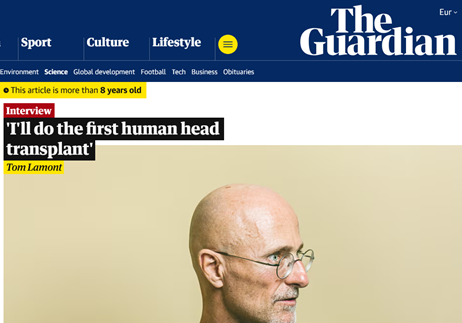
Canavero conquered the media in 2015, just when he was kicked out by his University of Turin in Italy, where he worked for 22 years. He then went to the Harbin Medical University in China where in January 2016 he announced to have successfully transplanted a monkey’s head and to do same with the head of a russian man next:
“The plan for the first human head transplant is on schedule, towards its expected date of realization, Christmas 2017 “
After lots of media brouhaha, press releases and bioethicists demanding to see peer reviewed papers, Canavero fell into obscurity. Hopefully he never actually tried out what he announced, but with China one never knows.
Now, another scholar announced to solve humanity’s greatest problem, that of death separating rich people with their money. As I reported in August 2024 Shorts, the neuroscientist Jean Hébert, professor at Albert Einstein School of Medicine in New York, was hired by the US Advanced Projects Agency for Health (ARPA-H) to begin with “functional brain tissue replacement.” Money is not an issue, Hebert boasts, while announcing experiments on monkeys.
The Einstein professor wrote a book titled “Replacing Aging” where he explained his approach: replacing all organs with lab-grown alternatives or, in case of the brain, by gradual removal of old tissue and injections of stem cells. He also owns a company called BE Therapeutics to market just this.
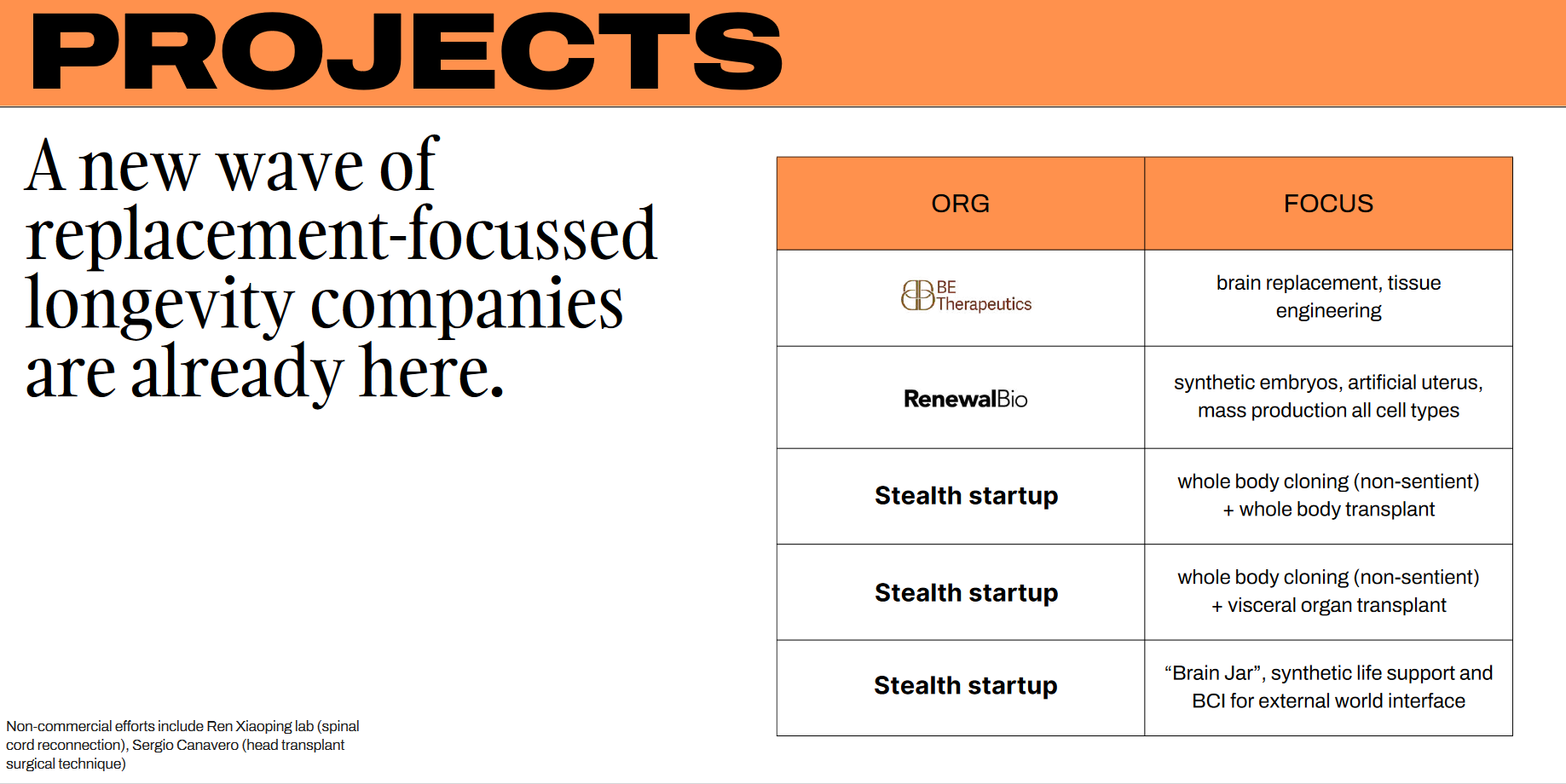
surgical technique)” Source: LBF presentation
In a feature article from MIT Technology Review, we learned that Hebert collaborates with the insane anti-death “charity” Longevity Biotech Fellowship (LBF), who “used data from Hébert’s ARPA-H proposal to argue in favor of extending life with gradual brain replacement for elderly subjects“, and also this:

replace old body with a young genetically identical body. Nerve reconnection likely required.” Source: LBF presentation
Next to “Replacement”, LBF’s other death-defying approaches are “Bioengineering” with gene and stem cell therapies (“curing aging doesn’t break the laws of physics“) and “Biostasis”: “an indefinite pause of aging and biological structure deterioration through low temperature preservation or chemical fixation“. I presume the LBF freaks were inspired by the Soviet “Lenin is always alive” dogma because his chemically-preserved body remains on display at Kremlin for already 100 years. Maybe this is why the russian-born anti-aging bigwig from Harvard, Vadim Gladyshev, collaborates with LBF, next to the russian anti-aging company Gero and its founder Peter Fedichev (read about them here).
Hebert also dispatched his PhD student Seth Kattapong-Graber to act as LBF tutor, next to Amy Wager‘s PhD student Michael Florea, read about Wagers here:
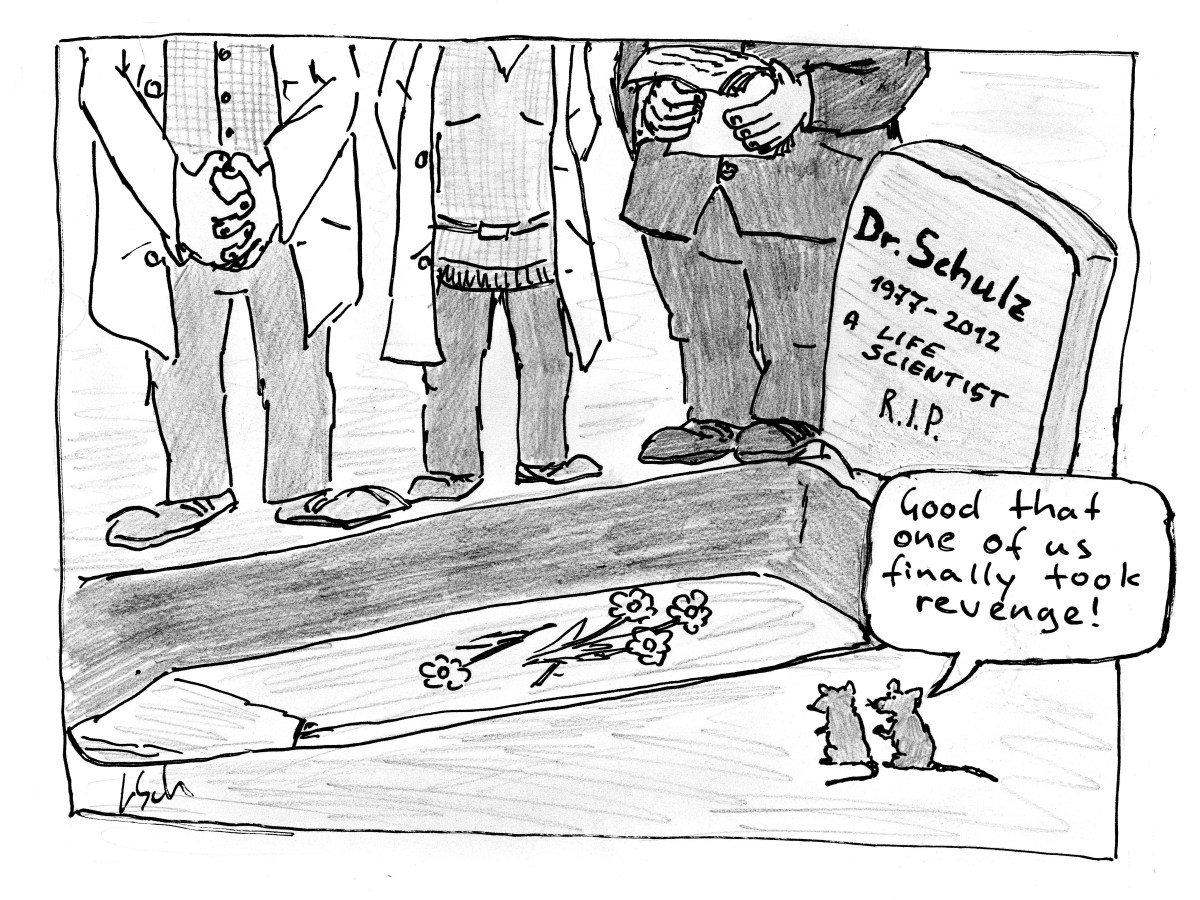
Bleed’em while they’re young
“There’s still a long way to go – blood is complicated. But there are many excellent labs focused on this, so I am optimistic about progress.” – Aubrey de Grey.

Hebert told the visiting Technology Review journalists about his recent “initial experiments with mice, removing small sections of their brains and injecting slurries of embryonic cells“. The study was so groundbreaking, revolutionary and historical, that only MDPI was a good enough venue for it. It is the only research paper in that special issue, the other 3 are reviews.
Alexandra Quezada , Claire Ward , Edward R. Bader , Pavlo Zolotavin , Esra Altun , Sarah Hong , Nathaniel J. Killian , Chong Xie , Renata Batista-Brito , Jean M. Hébert An In Vivo Platform for Rebuilding Functional Neocortical Tissue Bioengineering (2023) doi: 10.3390/bioengineering10020263
In 2022, Hebert published two papers on this topic: one about “neuronal cell grafts at stroke sites“, again in MDPI (a special issue of 3 papers, two others by its sole editor), another Hebert paper from 2022 was titled “Could an old brain be made young again?” and appeared in a certain journal by the dodgy publisher “Scientific Scholar”. It is this journal and its connection to Canavero which Smut Clyde would like to talk to you about.

Heads and hearts
By Smut Clyde
 There are good reasons for the tradition among Mad Scientists for choosing castles on Carpathian mountain-tops for conducting blasphemous experiments that contravene the laws of nature, rather than laboratories underground. One is the relative availability of lightning strikes; the second is to manage the hazard of floods.
Case in point: the Korean researcher C-Yoon Kim, who proved the practicality of body transplants. More specifically, Kim reckoned that he could sever the spine of a laboratory rat and then reconnect it, using fusogens to knit together the broken membranes of each half of each crushed, bifurcated neural axon and its counterpart. It naturally follows that a body can be transplanted from one head to another, because each individual has spinal axons in exactly the same places. All that remains are boring surgical details of plumbing and carpentry.
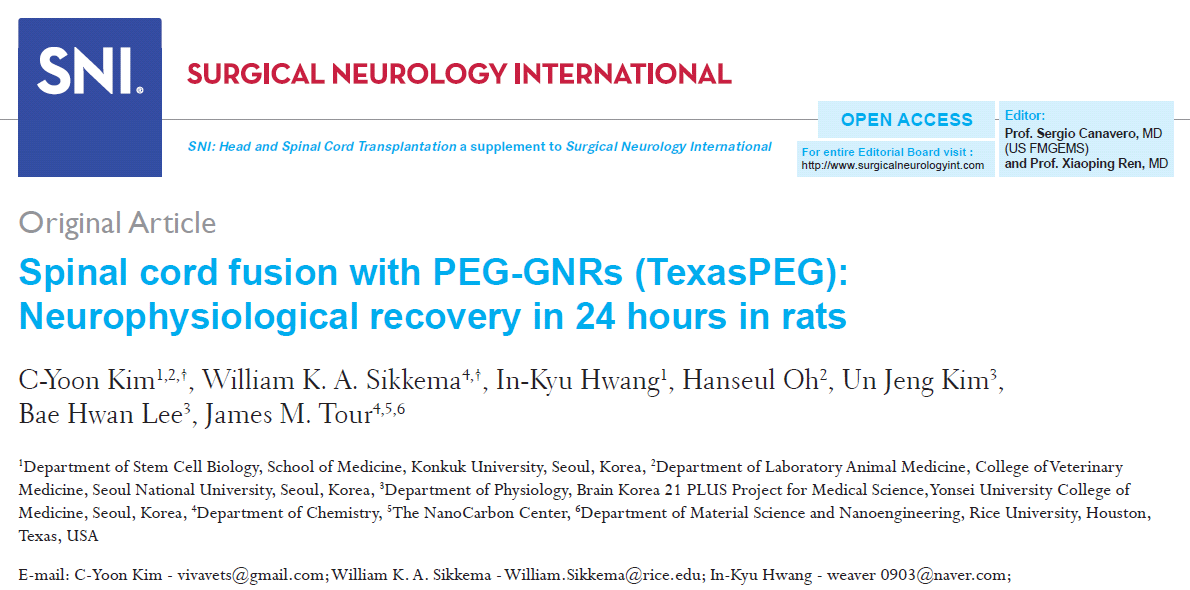
 These magical fusogens are a solution of PEG[polyethylene glycol]-ylated graphene nanoribbons:
“PEG-GNRs were produced by the polymerization of ethylene oxide from anion-edged graphene nanoribbons. These combine the fusogenic potential of PEG with the electrical conducting properties of the graphene nanoribbons”.
The conductivity is important to harness the revivifying power of electricity (I am not making this up: “PEG‑GNRs would achieve both membrane fusion, facilitate initial electrical conduction, and then act as a scaffold for sprouting fibers“). I assume that the solution fluoresces green in the dark.
 The Texan co-authors from the Rice University in Houston, who provided the PEG-GNRs were not concerned that their lead author claims medical-school and veterinary affiliations, but prefers to use a gmail account for correspondence. Nor were they concerned about the absence of raw data or actual rats – for the text informs us of an inundation of Biblical proportions1 that drowned the animals “during a storm that filled the underground lab” and washed all the evidence out in the direction of the ocean. Perhaps the minions were watching for lightning strikes when they should have paid more attention to the water pumps.

 In the Acknowledgements, “The authors thank Prof. Canavero for his invaluable assistance in analyzing the data and coordinating the centers involved in the study.” Sergio Canavero – editor of the 19th September 2016 Special Issue in which the paper appeared – was not concerned either. In the accompanying Commentary he went Full Metal Rotwang and was all “You fools! I’ll show you all!” with fist-shaking denunciations of his disbelieving detractors. Never go Full Rotwang as it always ends with an undignified struggle on the battlements. “Taken by storm” was an unfortunate choice of words.

“Hysteria”? “Misbegotten dogma”?… this is not the usual register of academic discourse, even in editorial advertisements, but Canavero is not a usual scientist and Surgical Neurology International (SNI) is not a normal scientific journal. It is instead the kind of journal that invites a total reality-divorcé to edit special issues.
Here I am indebted to Neuroskeptic’s research. SNI was founded in 2010 by James I. Ausman and a circle of gun-licking fetus-fondling conspiracists2 who were too rightwing for the Medical Sentinal JP&S (which is itself the medical-propaganda vehicle of the John Birch Society). They had previously infiltrated Surgical Neurology – an established, respected journal – and turned it into a vehicle for far-right editorial fiddle-faddle. Until 2009, which is when Elsevier brought in a new Board of Editors and renamed the journal as World Neurosurgery. Undeterred, Ausman et al. set up SNI as a replacement outlet for conspiratorial flakiness: initially published by Medknow / Wolters Kluwer, though at some point they switched to ScientificScholar, a somewhat flaky publisher operating out of Mumbai. One can only speculate about the source of funding. Medical societies were riven. In Neuroskeptic’s conclusion, “This is as close to Shakespearean intrigue as academic publishing gets.”
Notably, SNI included a special category on Body Transplants, i.e. rejuvenation through donor bodies. Please admire Ausman’s 2018 encomium on another of Canavero’s brainfarts; and his Concurring Opinion on a more recent glimpse of Canavero’s active fantasy life (we’ll come back to it later). One aspect of being a god-botherer is the comforting knowledge that ‘ethical approval’ is nugatory because whatever you want to do is already in line with god’s intentions.

 Readers will have realised that Sergio Canavero is the central character of this post (which is in fact a rejuvenated version of a post elsewhere, from seven years ago, transplanted into a new body in the manner of Frankenheimer’s ‘Seconds’).
  But I must also recognise Canavero’s Chinese colleague Xiaoping Ren, who seems to enjoy access to unlimited resources and funding and donor bodies from Harbin Medical University, as this line of research is of interest to China’s geriatric oligarchy. Or oligarchic gerontocracy. There will also be a cameo appearance from Jean Hébert, pioneer of incremental stem-cell-slurry brain replacement technology, who featured in a recent Schneider Shorts.
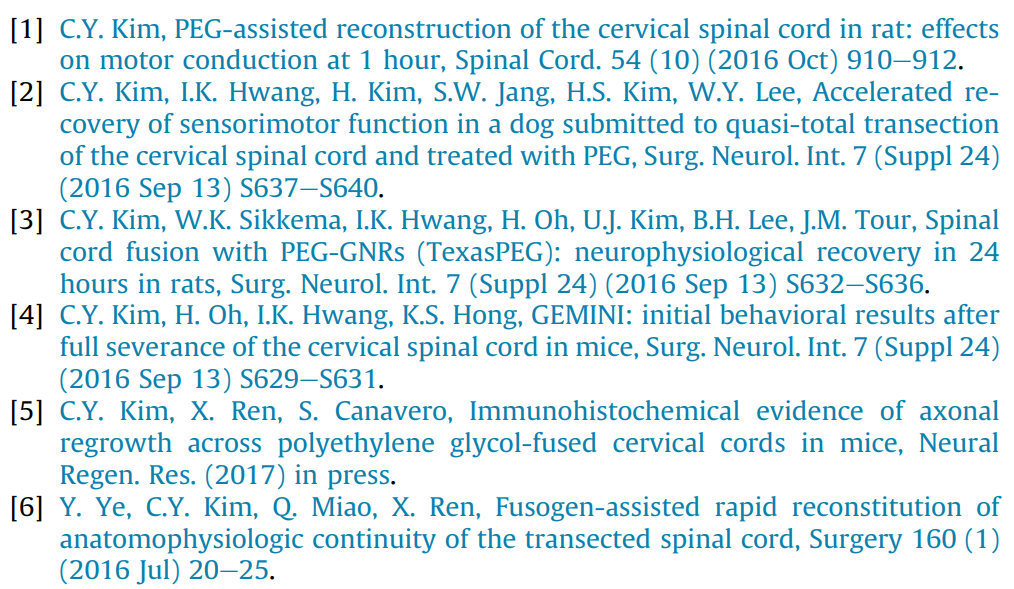 So consider ‘From hysteria to hope‘ (Ren & Canavero, 2017) – an apologia for the body-transplant research program. Published in an Elsevier journal rather than in SNI, so the language is less Rotwangled. Still, to allay their readers’ concerns that severed spinal cords never regenerate Ren cites Kim’s fraudulent claims six times.
It turns out that part of those “details of plumbing and carpentry” for a body transplant is that if you retain the recipient’s larynx and its innervation (for early post-operative recovery of speech), you need to retain most of the recipient’s neck as well: evolution had been drinking that day and the nerves go all over the place. I learned this from Ren’s principle-proving report of a ‘dress rehearsal’ of a body transplant, in which his medical team dismantled two ‘donor’ cadavers, just to time how long it takes to stitch a dead head onto a dead body.

 Curiously, although Canavero repeatedly assures his readers that his Chinese collaborators have perfected a ‘nanoblade’ to minimise the trauma of spinal transection – a.k.a. a GEMINotome – the Subtle Knife was not mentioned here. ‘Nanoblade’ sounds like a weapon that a neo-ninja might wield in Cyberpunk Manga, but it appears to be a knife honed to an edge measured in nanometers so it can cut through cells without them even noticing. On the cellular level, a mere scalpel is about as blunt as a bulldozer blade, crushing or displacing everything in its path.
 Nonetheless, Ren and Canavero used standard surgical cutlery in the dress rehearsal. Similarly, Kim specified an ordinary #11 scalpel for his rat cordotomies, relying on those magical fusogens to help each half-axon to find and knit with its crushed displaced counterpart… he might as well have invited Mrs Spat to sever the rats’ spines, or used a cable.3 But who am I to conclude that Kim’s experiments never happened?
In case you hadn’t noticed, Canavero is happier coining neologisms and acronyms for the eagerly-anticipated transformative technology required for a body transplant than he is actually realising them. Hence ‘nanoblade’. But also HEAVEN (from HEad Anastomosis VENture), and GEMINI (etymology unknown), and BRAVE (BRain Anastomosis VEnture), and PERSEUS (bored now). The acronyms are embedded in his prose like Lego pieces in labrador poop.

 We can return now to that 2022 paper with the Ausman appendage. Curiously, it did not mention the “Cortico-trunco-reticulo-propriospinal pathway (CTRPS)” that dominated Canavero’s earlier work. Now the CTRPS is not recognised in textbooks, and indeed seems to be unknown outside the circle of Canavero and his supporters. It is (I gather) a component of the spinal cord. Most of the spine is white matter, afferent and efferent bundles of myelinated nerve axons, analogous to insulation-wrapped wiring, and Canavero was not entirely sure that he could restore their function after joining the two spinal stumps in a head transplant. But that’s alright, because the white matter doesn’t actually have a function (its supposed importance is a ‘previously misbegotten dogma’).
 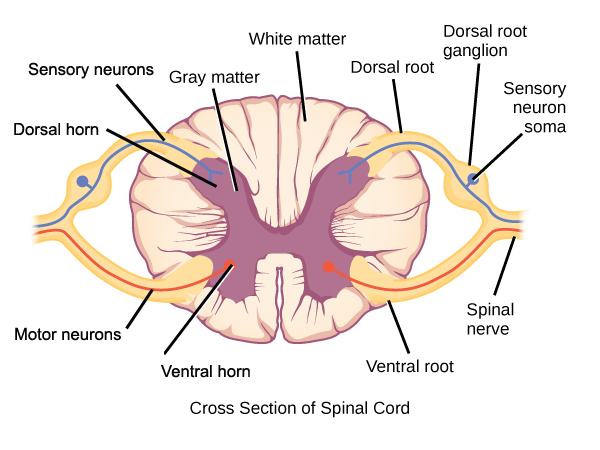 It seems that motor and sensory functions are in fact served by the short, unmyelinated neurons of the butterfly-shape of grey matter within the spinal cord; the fools of the neurology establishment regard this as local circuitry, but this is where the CTRPS resided (until 2022), and where Canavero was confident about grafting severed neurons together.
The 2022 paper includes another departure from its predecessors – this time involving Canavero’s insistence (in 2015) on a 2017 deadline for the first successful body transplant cerebro-somatic anastomosis. In 2016 Canavero blamed the lack of progress on counter-revolutionary saboteurs in the Medical Establishment: his ‘A Call to Arms‘, rather than being a treatise on limb transplants (chiz chiz), was yet another Full Rotwang SNI editorial, where he speculated about the psychological hang-ups that motivate unbelievers and complained about the lack of financial / legal support from aging billionaires and their political fuckpuppets. But it’s not as if Ren at Harbin Medical University is held back by resources or ethical constraints, and his dress-rehearsal butchery was supposed to be followed by now by surgery with living bodies.

But the effect of “Whole brain transplantation in man: Technically feasible” was to reset the clock, as Canavero now abandons the whole concept of neck-down body transplants; after a decade of rhetoric, he now sides with the skeptics, on the grounds that a mere cerebro-somatic anastomosis would leave the recipient with his (or her) original wrinkles and baldness and fading ears and eyes, defeating the whole point of the exercise. 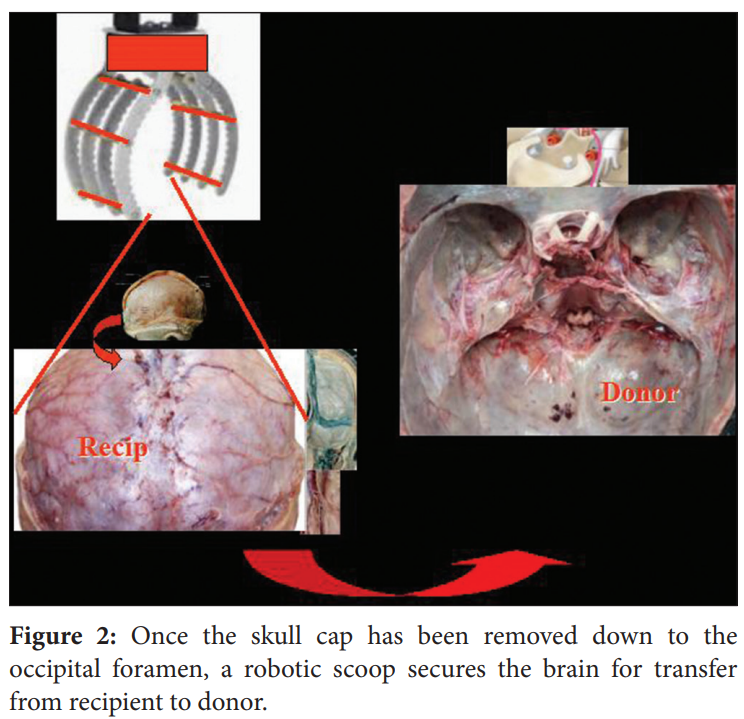 His new ambition is to replace everything except the brain and its surrounding membranes. “Toujours de l’audace!” as Danton said, which translates as “Always drive an Audi”.
Of course this complicates the carpentry, with severed optic nerves to be spliced together… and auditory nerves, and all the other cranial nerves. DON’T DROP IT IGOR!! While Ren’s whole principle-proving dress-rehearsal becomes nugatory; he will have to start again with this new procedure and an as-yet-unbuilt robot brain-scoop. The important thing, though, is that Canavero now has another decade or so to dream up acronyms and fantasy operations without running up against an empirical test.
 Jean Hébert is relevant here, for his well-funded plan to rebuild the age-damaged brain, in an incremental Ship-of-Theseus way, is complementary to Canavero’s fiddle-faddle. One of his papers appeared in SNI with the special-editorial blessing of Canavero and Ren… Leonid covered it in August 2024 Shorts without being fully aware of that journal’s weirdness.4

The underlying fantasy is that stem-cells, injected into the brain as a slurry, will (1) work out that there are gaps in the host’s neural network that require neurons of a given morphology and neurochemistry (GABA or serotonin or whatever); (2) differentiate into that specific cell-type; and (3) adjust their post-synaptic thresholds, to take over the role of the missing cells in maintaining distributed functions like “memory”.  Coincidentally, the concept of progressively destroying a patient’s brain is also the plot of “Masque of a Savage Mandarin“, though without the ‘replacement’ part.
- Does Hébert have any concept of the cellular migrations and transformations that are part of a brain building itself during fetal development?
- Has he noticed the long history of attempts to treat Parkinson’s Disease with injections of stem-cells, primed to turn into replacement dopamine-pathway neurons? [SPOILER ALERT: fuck-all came out of them]
For the grant reviewers, the answers to both questions are ‘No’, and they’re who matter here.
Bonus sex in heaven
If you stare with horrified fascination at Canavero’s lurid fantasies and cannot look away, rejoice, for there is more!

“Imagine what effect might ensue from a young donor body (say, in her 20’s) nourishing with her young blood 24/24, 7/7 the head of an aging body recipient! Yes, life extension on a level that simple, periodic transfusions of young blood have no way to match.
The real concern that needs to be addressed in this letter is whether one day HEAVEN is spun off as a cure for transsexualism (TS). Considering the dearth of donors for many needing new organs, this might seem like pushing the envelope. Yet, it makes sense starting the debate now.
To the casual eye, TSs come in two varieties: male-to-female (MtF) and female-to-male. In this case, common sense would suggest gender reassignment HEAVEN transplant the head of an MtF subject on a female body and vice versa.“

No reference here to the pioneering research of Heinlein (1970) and Reiner (1984); I am disappoint.

Footnotes
- The test of a Biblical proportion is whether it’s measured in cubits. ↩︎
- Including football-industry pimp Joseph Maroon. ↩︎
- Bonus recapitation :

↩︎ - Otherwise, Hébert prefers to publish in MDPI journals. ↩︎

Donate to Smut Clyde!
If you liked Smut Clyde’s work, you can leave here a small tip of 10 NZD (USD 7). Or several of small tips, just increase the amount as you like (2x=NZD 20; 5x=NZD 50). Your donation will go straight to Smut Clyde’s beer fund.
NZ$10.00

 For Better Science
Interesting to see that Smut’s latest contribution touches on the work by Kim, et al., on spinal cord fusion, though the corresponding authors are Lee and Tour. There is a very significant rabbit hole to go down with Tour, h index = 177.
First, the spinal cord fusion claim. As mentioned by Smut, and pointed out in a 2017 PubPeer entry (pubpeer.com/publications/942409EDB301244E64CBCE4D442556) data from a single animal was involved, owing to the flood that destroyed all the others. I think more attention should be directed at Tour than the South Korean team on this one. After all, Tour and his student are the only inventors listed on the granted US patent based on this work, as indicated in the PubPeer entry. It is further notable, I think, that the patent fails to mention that the results/examples provided to support the Claims are based on a single animal, it appears to indicate that the number is five, which we know is not true from the paper. Furthermore – and I am not a statistician – how is it possible to calculate confidence intervals or other statistics on the results when there is only one example? Further evidence that this is garbage belongs to Tour and his student and not so much the South Koreans is provided by the American Chemical Society webinar by Tour and his student Sikkema. If you or a friend have an ACS membership you can watch the recording here: http://www.acs.org/acs-webinars/library/nano-graphene.html.
I suppose that when you have an h index as large as Tour’s you can get away with all sorts of wild ass claims, and that at some point it just adds to your brilliance as opposed to your bullshit. Go to youtube and search “James Tour”. You will find there hours of entertainment, from Tour’s own videos on intelligent design to debates with Lee Cronin to back and forth arguments (real arguing) with “Professor Dave”.
(You may note that the PubPeer entry for this paper has an error in the authors listed. I tried to have this corrected with the mods there but they stated this is the way it is indexed by the publisher and they cannot fix their entry until the publisher addresses the error first)
LikeLike
” Join James Tour and William Sikkema of Rice University as they describe how one drop of graphene nanoribbons dispersed in poly(ethylene glycol) restores near perfect mobility to rats that have had their spinal cords completely severed in two. ”
That’s why paywalls are sometimes a good thing.
LikeLike
Tour has a link on his webpage jmtour.com to a youtube video where you can see the all-famous rodent: youtu.be/nPuYq1JrLCQ?si=ShJfKmPL5qw3ODrV
If you simply go to youtube and search ‘Tour rodent spinal’ you’ll find a couple more videos of this guy selling this crap. I guess he still believes in it since it is still on his website. However, given the ramifications of healing a completely severed spine (Nobels in both chemistry and medicine) you would think that there would be at least ONE MORE FRIGGIN’ PAPER TO FOLLOW THIS BULLSHIT but, alas, there are none. One rat. One paper. Tour has a reputation for throwing a paper or two on a subject and then bailing on it for ever (I think Professor Dave remarks on this in one of his videos), this is a prime example. The student, Sikkema, appears to have disappeared. Too bad, this sort of thing usually leads to a start-up and the PhD recipient and mentor going into business collection VC money together.
LikeLiked by 1 person
Well. Tour may have a video of a miraculously cured rat.
But I have a video of another rat of which I claim it used to be a human before it drank my magic potion (and then its recipe was lost in a fire). Prove me wrong.
LikeLike
Big feud between James Tour and “Professor Dave”. In this video, dave describes possible shenanigan’s (hype/fraud ?) on Tour’s part:
https://www.youtube.com/watch?v=ODgYbmmgOss
LikeLike
I already knew that “Get out” (Jordan Peele 2017) is a very good movie.
But it’s only after reading Smut’s contribution that I slowly realize how outstanding the film really is.
LikeLike
I couldn’t help noticing that Canavero’s most recent papers no longer mention PEGylated graphene as the magic fusogen that will merge bifurcated cells from two different people, and are now all about PEGylated chitosan. It seems that graphene no longer works.
LikeLiked by 1 person
Excellent post, Smut Clyde! I am a subscriber to Leonid’s For Better Science, so I had a chance to read this while hot off the WordPress. I am not a physician or a billionaire, but I recall reading about the earlier adventures of Dr. Ren, the researcher from Harbin, while answering an absurd Quora question in 2016.
Some years back, I worked as a research statistician for the State of Arizona Department of Health Services. I dredged through drug formulary and claims data from the state-funded managed care program for children with special (usually congenital and debilitating) health care needs. I was supposed to do epidemiology, investigating geo-local prevalence of non-infectious diseases, but my highest priority was identifying care providers and durable medical equipment vendors with patterns of anomalous billing for the fraud and abuse team to prosecute. One of the program functionaries had recently married. Her husband had impressive medical research credentials (PhD in microbiology at UCLA or similar prestigious institution in southern California where the weather is wonderful) yet oddly, was no job. He often visited his wife at our office. Eventually, he told me that until recently, he had been employed as the first staff scientist with the world-(in) famous Alcor Life Extension Foundation! They offer full body and head-only cryonic preservation.
Given this post about the (aspirational?) spinal restoration and brain replacement accomplishments of Drs (?) Hebert, Canavero, and Ren, I guess gold standard rejuvenation therapy no longer considers frozen heads to be viable. Kind of scary that Rice University hosts these activities. Rice had a great reputation for electrical engineering in the past.
LikeLiked by 1 person
Wait, what about Rice University and frozen heads?
LikeLike
Dear Smut Clyde – Hébert… The name reminds me of Jacques Hébert (1757-1794), who was guillotined four months before Robespierre… Due to the lack of the marvelous technology you describe, his head could not be replaced…
LikeLike
What do you suggest, Jacques?
LikeLike
I suggest replacing putin’s brain by yours, dear Leonid! And throw away the other one. Also replace Raoult’s by Alexander’s, etc. The world would be better off… A technique with a great future.
LikeLike
Let’s just agree that Putin’s head needs to be cracked open as soon as possible.
LikeLike