Thomas Südhof and AI-powered weapons of micro-duplication
Thomas Südhof, victim of racist and sexist persecution, announced to retract a second paper, "even though the quantitative analyses and conclusions are correct".
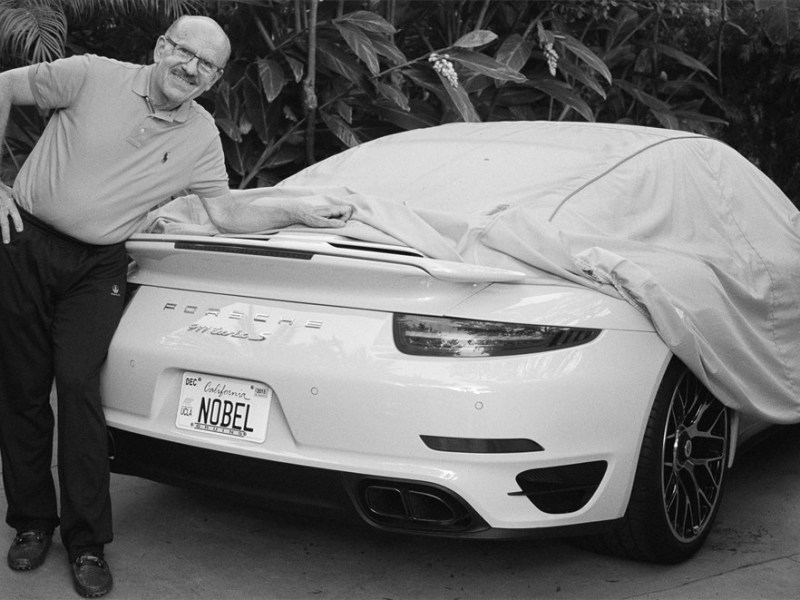
Thomas Südhof ticks all criteria of a persecuted minority. He is a old white German heterosexual male multimillionaire, plus a Nobel Prize laureate and Stanford professor. No wonder he feels persecuted.
Now, the hounded neuroscientist announced to retract a second paper. Which he already corrected while calling his critics all possible things. In German one describes such people beratungsresistent. Meaning, you can present Südhof with any amount of evidence, he will keep dismissing it and just shout at you.
And so Tom shouted at Maarten van Kampen, he shouted at Elisabeth Bik, he shouted at Kevin Patrick (aka Cheshire), he shouted at Aneurus Inconstans and other named and anonymous critics, and at the end he announced to retract the Neuron paper while crediting someone else altogether for finding the problems. Just as he did before and after Maarten convinced Südhof to agree to the retraction of the PNAS paper Lin et al 2023, read here:
The second author of that retracted PNAS paper is Lulu Y Chen, presently group leader at University of California Irvine, is also the first author of the Neuron paper:
“The authors note, “We wish to retract the paper because re-analysis of the original raw data for Figs. 2, 4, and 6 (https://purl.stanford.edu/cp231wr9194) revealed that, although our analyses of the original data are supportive of the conclusions of the paper, unresolvable differences exist between these raw data and the published data source file that cannot be corrected by a simple erratum. In addition, the data source file contained copy-paste errors, and Fig. 1 included shifted data points that occurred during figure drafting. We thank Dr. Daniel Matus of Stanford University for his independent analysis of the primary raw data.””
“The professional bloggers are now trying to turn this into a question of research integrity which is deeply misleading, and claim that they are doing this not for financial gain. Judge for yourself!” – Thomas Südhof, Nobel Prize laureate
The long conflict, which according to Südhof is an ad hominem conspiracy of scientifically-illiterate Scheiderite trolls greedy for money, was about a Cell Press paper briefly mentioned in the article above. This 7 year-old study in Neuron is about to be retracted:
The PubPeer thread started with an admission by the first author and current University of California Irvine group leader Lulu Y. Chen:
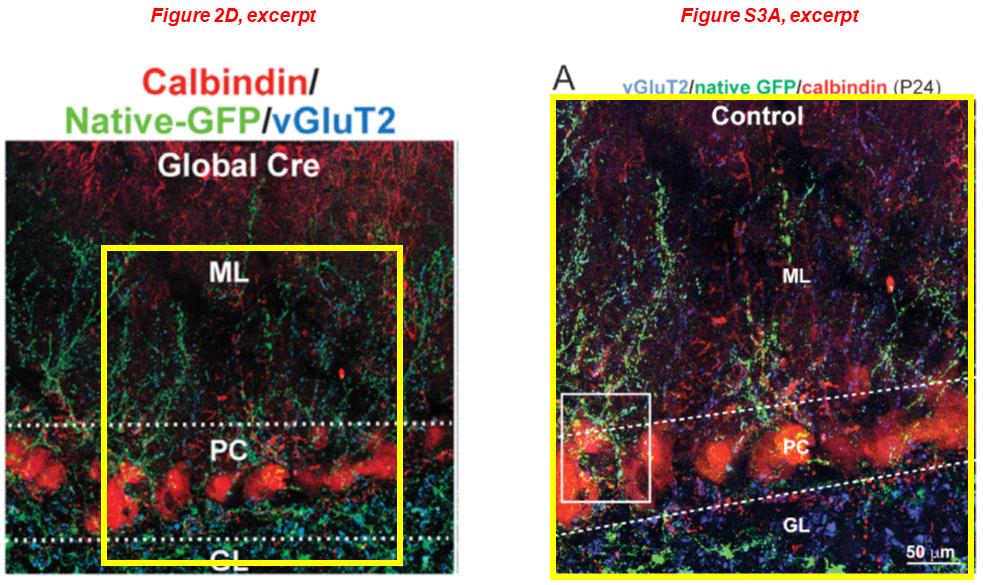
“While analyzing my published papers, I discovered that I inadvertently duplicated a panel from Figure 2D into Figure S3A. This error occurred while assembling the final figure from a previous version of the manuscript & was due to a copy-paste mistake. I apologize on behalf of the group for this—it should not have happened. I am posting this finding preemptively & will issue an errata when I locate the original image.“
The post was not illustrated. Rightly so, because it was not a simple duplication, as Aneurus Inconstans noted:
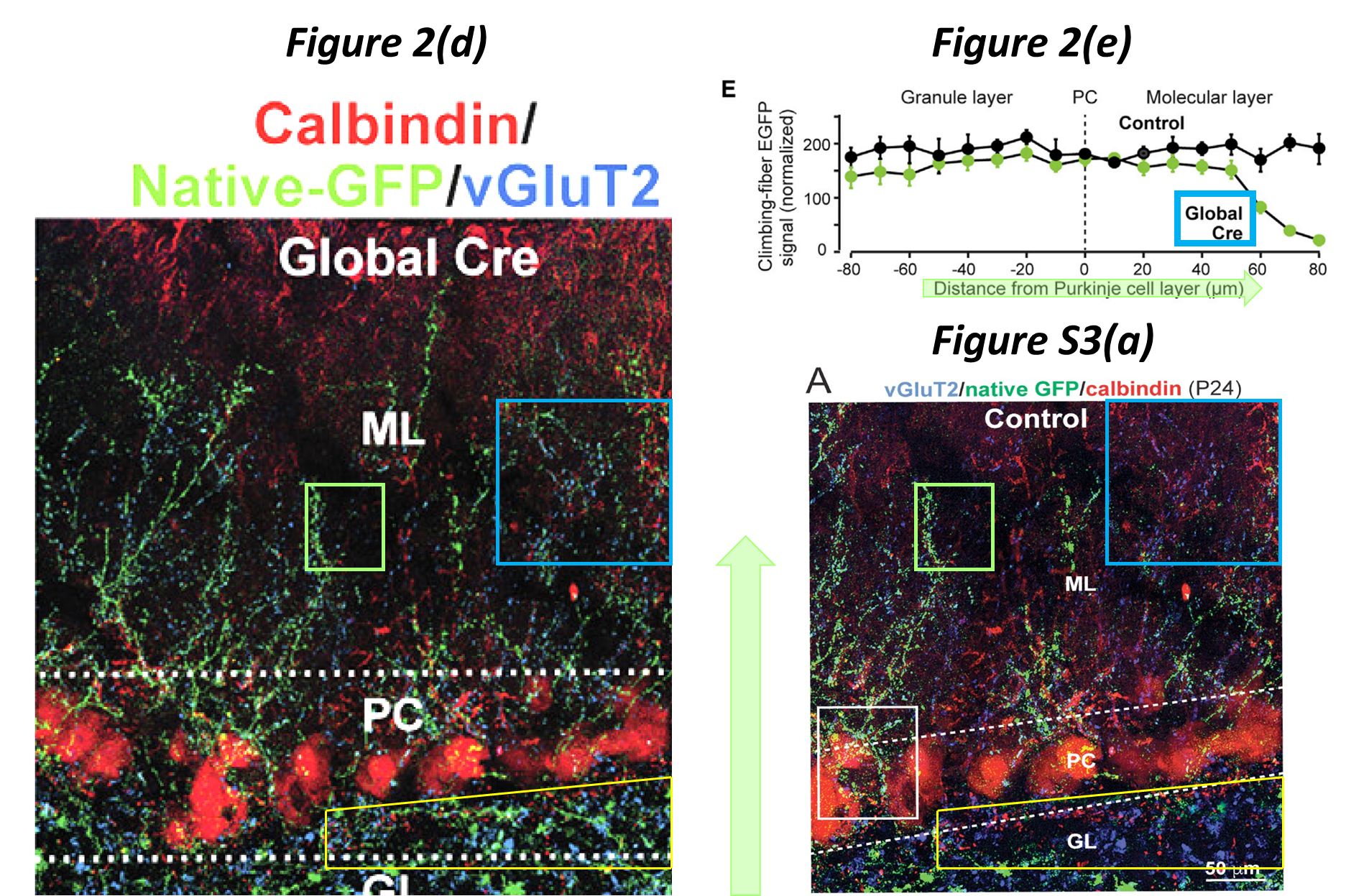
“overlap between Figures 2D and S3A (yellow boxes) discussed by the author Dr Chen [….] The two micrographs seem to differ significantly in the bottom part of the overlapping area for the intensity of Native-GFP and vGluT2 signals.”
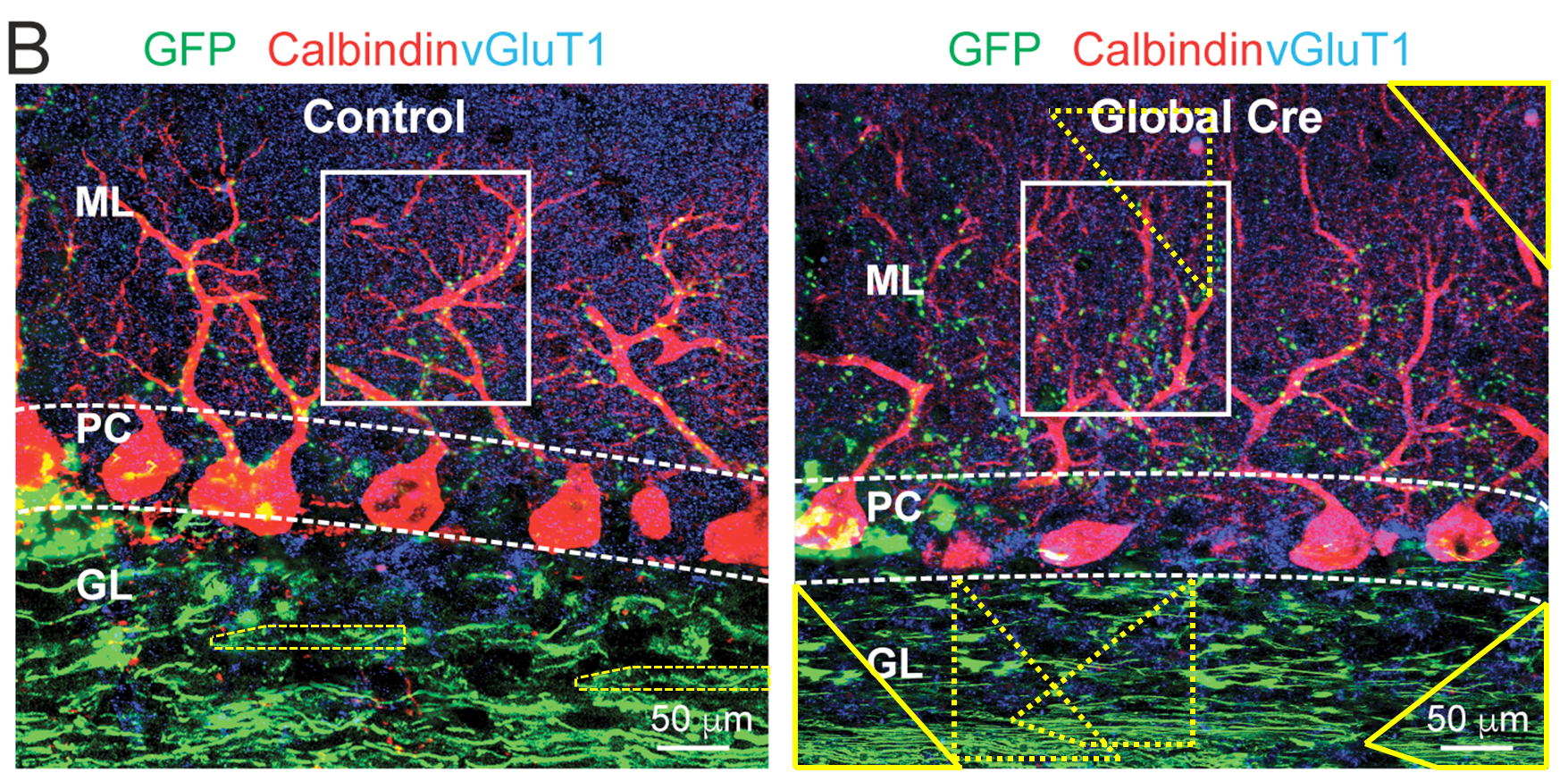
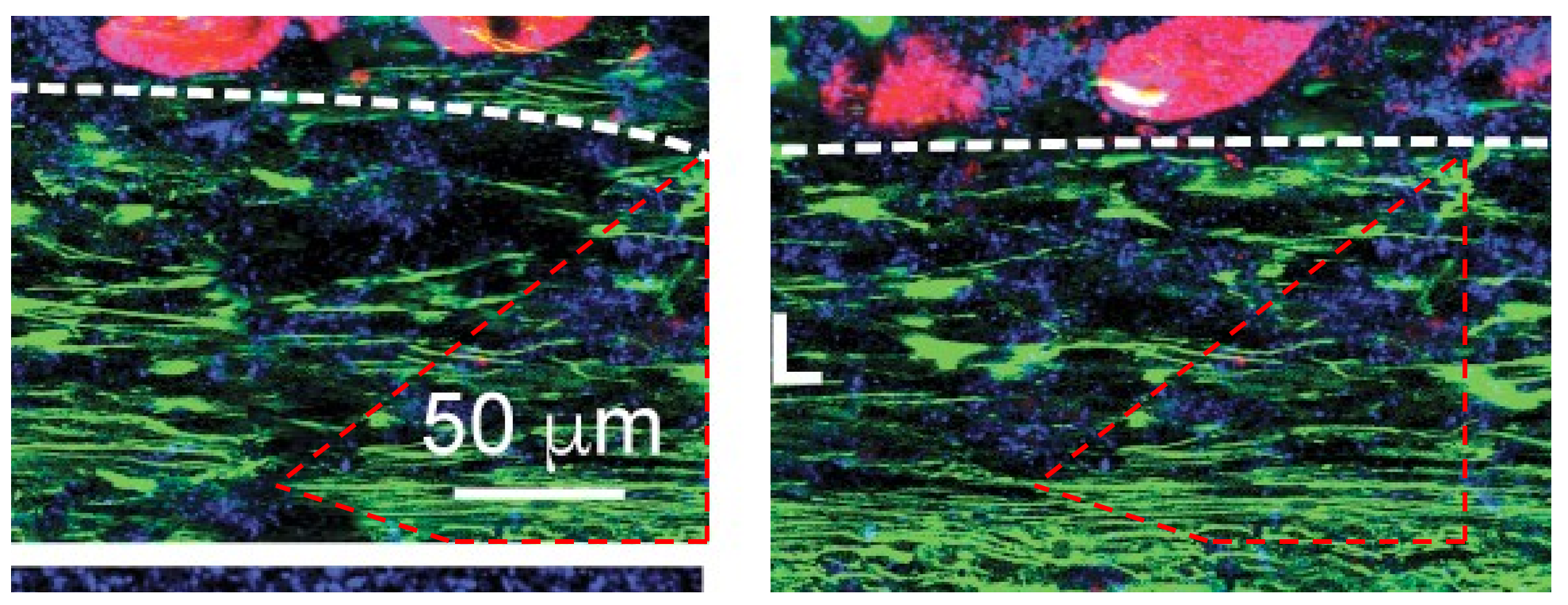
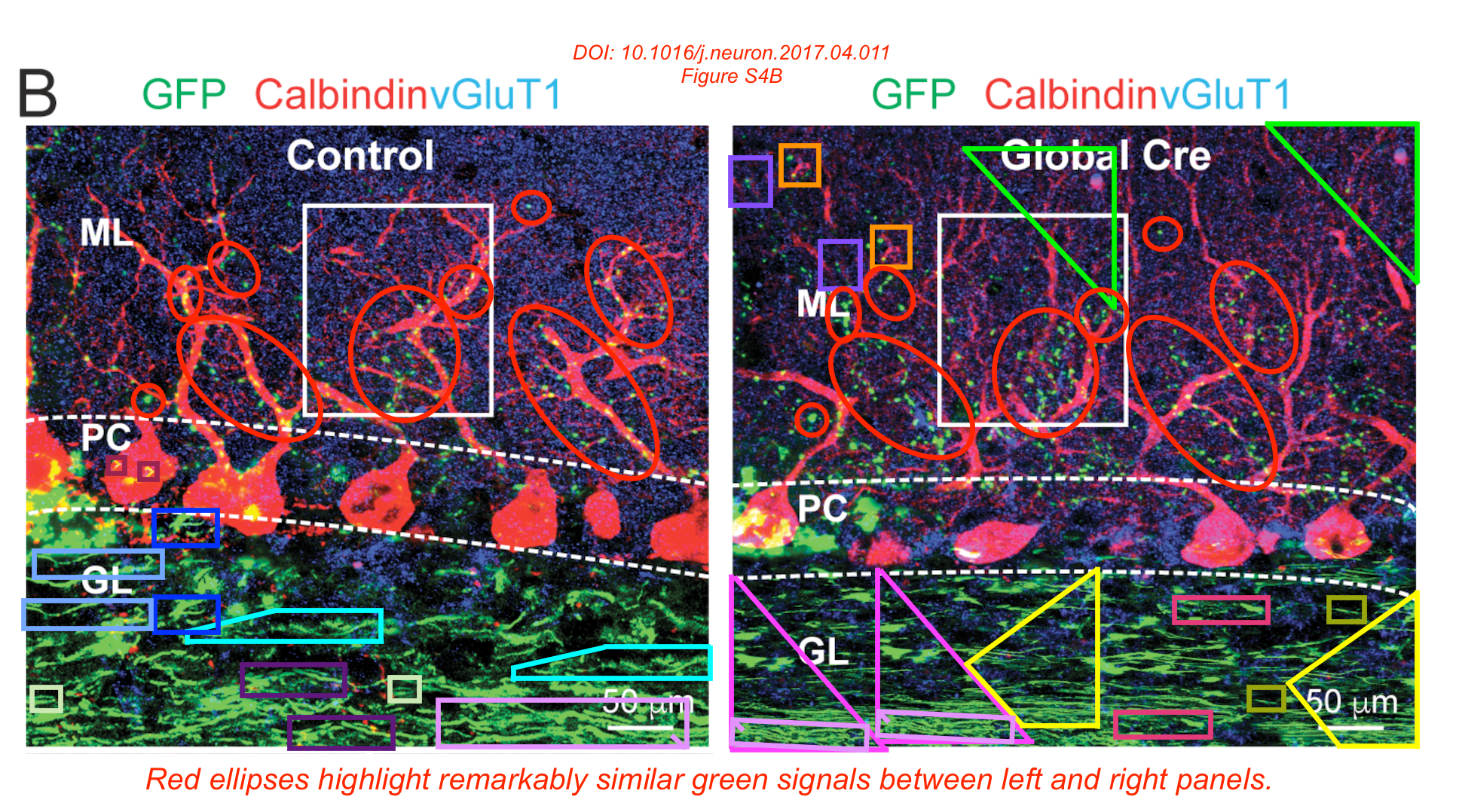
Then Aneurus found small duplicated fragments in Figure S4B, which Maarten van Kampen(commenting as Orchestes quercus) analysed in detail. Clearly, triangular fragments were copy-pasted:
“The cloned regions in Fig. S4b seem to sit at the corners of the image (see #3) and are roughly triangular (#10, #17). The image itself shows tissue layers that are roughly horizontally aligned. It can be that the original ‘Global Cre’ image was rotated. And that when aligning the tissue layers horizontal it was not possible to cut out a rectangular region of the same size as its ‘Control’ counterpart. This then would have left blank triangular regions at the corners of the image. It can be that an author or editor decided to fill in these blank regions by cloning other parts of the image”
Clones, cornered
Chen protested on PubPeer that there can be no image manipulations because “it also makes no sense to do this” and there is no “possible intention“. At the same time, the US neuroscientist and data integrity sleuth Matthew Schrag didn’t seem convinced by Aneurus’s evidence, and commented on PubPeer in April 2024:
“I would be cautious about over-interpreting these artifacts. Cloned patches within images related to microscopy or blot data are often among the more compelling signs of intentional image alteration, however, they can occur for benign reasons. In the current case, the cloned patches are adjacent to annotations, or the corners of images, and not in the focal areas which are essential for the scientific impact of the figure. While I would certainly discourage the use of cloning to remove or alter labels, scale bars, etc in an image, it is unlikely to alter the meaning of the underlying data. Additionally, we have confirmed numerous examples when these types of changes were introduced by journals or publishers (rather than the authors) to bring the figures into the cosmetic palette of the outlet.“
There are cases where publishers took the blame for small fragment duplications upon themselves, but it is not always credible. One high profile case was Go et al 2010 by Paolo Macchiarini, where the research integrity official of his former employer Hannover Medical School (MHH) explained on PubPeer:
“the MHH President requested that we inform you that G. Alexander Patterson, Editor-in-Chief of The Journal of Thoracic and Cardiovascular Surgery, confirmed that this image duplication “occurred during the production process. To be consistent with journal style, the journal manager requested that the ‘2B’ figure label be moved from the lower right corner of the illustration, which is how it was submitted to us, to the lower left corner. The compositor did this and in doing so repeated some of the image area to fill the space. The area of interest is unaffected.”
What the MHH investigator omitted: according to that same editor Dr Patterson, that very paper by Macchiarini is perfectly fine, its animal experiment data is trustworthy, Macchiarini’s trachea transplants have been a scientifical success, and Patricia Murray is fraudulent liar. Read here:
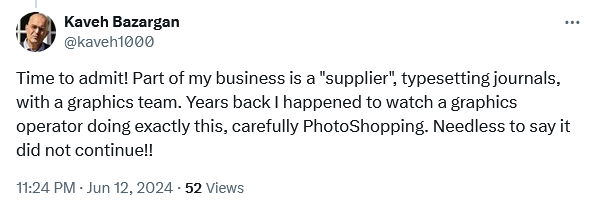
There were also similar corner-clone cases of known cheaters Pier-Paolo Pandolfi and Carlos Cordon-Cardo (read April 2024 Shorts). Two more involved the fallen Stanford President Marc Tessier-Lavigne (see PubPeer threads for Liu et al 2004 and Palmesino et al 2012, the former had other issues (and Elke Stein as coauthor!), and in the latter case the publisher even issued an Erratum stating “it appears these alterations were introduced during production, likely during resizing of the figure locants.” The Erratum didn’t explain why the correct original images have a lower resolution than the published manipulated figures. But then again, there are indeed cases where the fault lies with the publisher, see Chen et al 2004. Kaveh Bazargan has first-hand knowledge of such practices:
However, even if journals may have once occasionally digitally edited figures (e.g., to standardise labelling), in Südhof’s concrete issues of Figure S4b this explanation would make no sense at all. But the Nobel Prize laureate embraced it, in his own blog post:
“When images are inserted into figures and reproduced, the image reproduction process changes its appearance. This is not a manipulation but a consequence of digital processing […] Such micro-duplications are typical image processing artifacts that occurred most likely during article production.”
Yet it turned out that the fragments were not simply cloned, one immunofluorescence signal channel was removed in the process of cloning:
Maarten van Kampen: “the “right version” near the 50 um scale marker completely lacks the blue channel. When looking carefully one can just see a small red region (red arrow) that was not there in the “left version”. This suggests that whomever did the cloning had access to the separate channels.”
Then someone anonymous chimed in to insist that the publisher Cell Press may have used special imaging software to separate the colour channels before stealthily cloning bits of the submitted figure before publication. All behind the backs of a Nobel Prize lab. Another anonymous commenter blamed the Nikon confocal microscope for introducing such “known stiching artifacts” which “can make it look like there are repeated patterns or misalignments in the images, which might mistakenly be seen as data duplications.”
Mad Microscope
Evil conspiring publishers faking figures during copy-editing, microscope software going totally mad and duplicating fragments across an entire field of view – things which serious labs strangely never experience. Occam’s razor does not apply when a much simpler explanation – that lab members forged data again – is unacceptable to one angry old German man.
Maarten could easily disprove the stitching (aka mad microscope) theory:
1. The cloned regions do not border each other. 2. Some of the cloned regions have irregular shapes. 3. In one case the issue affects only one channel.
Südhod however immediately embraced the idea that his confocal microscope falsified his data:
“[Orhcestes quercus] is clearly not familiar with the changes in digital images that occurred especially with the older software used 10 years ago when images are acquired, copied, and reproduced.”
Maarten could put up as much evidence as he wanted, but Doubting Thomas kept refusing it:
“Orchestus (self-identified as Dr. Van Kampen) continues to repeat the same accusations without evidence.”
It got worse. Also Figure S3a was even faker than originally thought.
“A pair of panels in Fig. 2(d) and Fig. S3(a) was found to be duplicated, except that the information in the green fluorescence channels is different. For example, in the bottom area highlighted by the yellow box the green fluorescence is mostly missing from Fig. S3(a). Also in the top-right region indicated by the blue rectangle much of the green fluorescence in Fig. S3(a) is gone.”
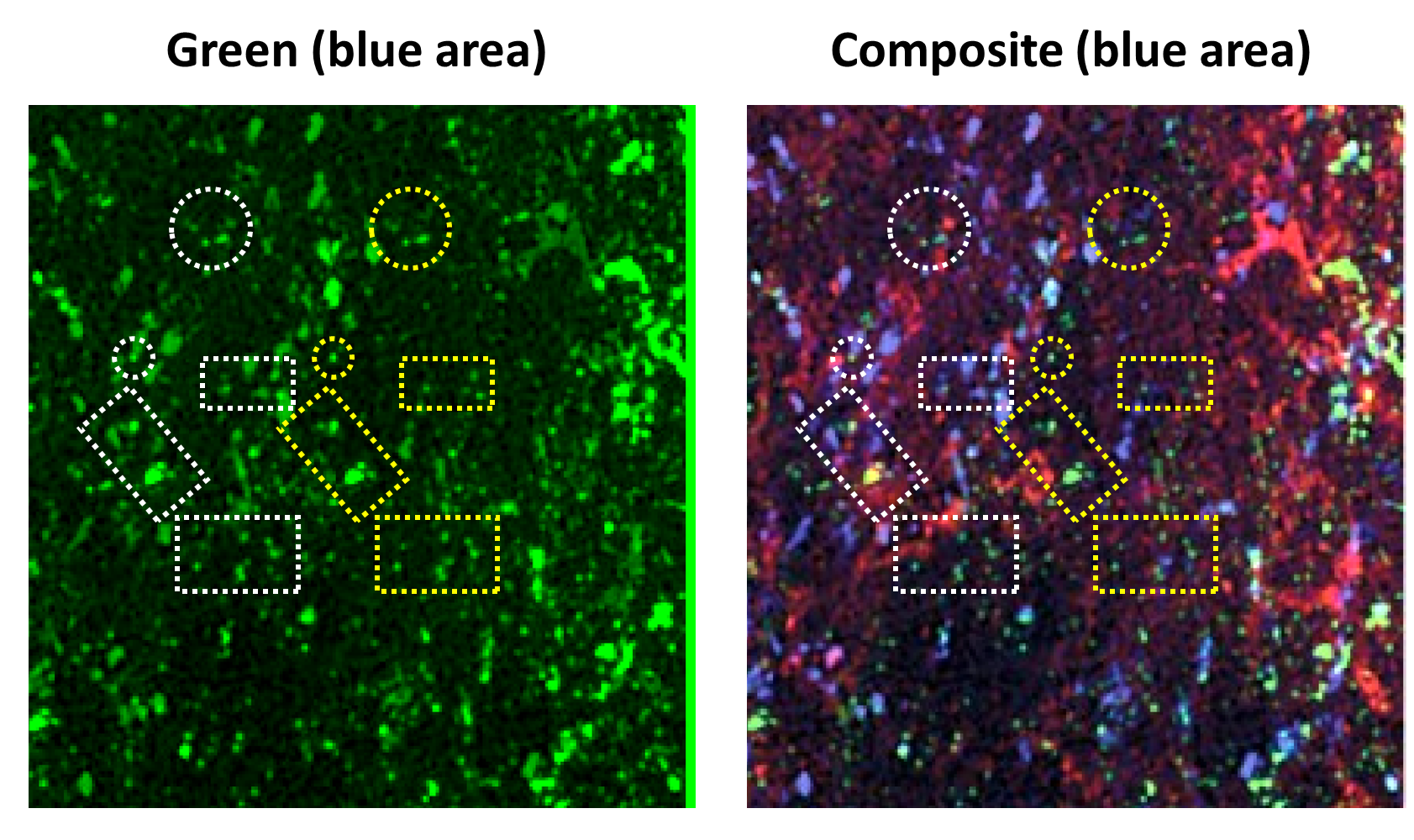
A zoom-in onto the blue rectangle (placed by Maarten) reveals duplications in the green but not in the blue or the red channel:
Doubting Thomas accused Maarten of having sold him out for 30 pieces of silver:
“Orchestes (self-identified as Dr. Van Kampen) continues to use the term ‘cloned’ for image distortions induced by the old Leica confocal software and couples this accusation with broad speculations (‘could have been selected’). His remarks do not take into account a common stitching issue in older confocal microscope software. Repeating the same accusations is not productive, especially if there is no evidence besides observed image distortions and no benefit to the paper by the observed image distortions. Orchestes publicly repeatedly accused my former postdocs of misconduct, often reiterating the same accusations again and again, which does raise the question of motivation.”
Also in May 2024, Lulu Chen had enough and announced the case closed, because a Correction (for Figure S3A alone) was negotiated with Cell Press. Doubting Thomas then added (highlight mine):
“Apart from the non-sensical nature of this accusation (why would someone intent on committing fraud create composite images instead of just recording the wrong image?), the lengthy arguments in Dr. van Kampen’s comments are all speculation and conjecture. Image analysis experts (real ones) have documented such distortions in older instruments before, as discussed above. Repeating the same arguments in ever lengthier comments serves a purpose: to create the appearance of uncertainty, of something being sinister and wrong, even though there is nothing.”
Regarding “experts (real ones)” – the “mad microscope” claims were made anonymously and without any evidence. And what happened to the Nobelist’s previous accusation towards Cell Press?
As Doubting Thomas protested against “Insinuating speculations with fancy graphs“, Maarten summed up again:
Fig. S4(b) “Global Cre”. Some 9% of the panel consists of cloned image data. It may be that the cloning was done to create a visually more appealing image by making up data for missing corners.
Fig. S4(b), “Control”. A region is found duplicated, but only for the green channel.
Fig. 2(d) “Global Cre” and Fig. S3(a) “Control” overlap. However, the S3(a) image shows cloned elements and misses a significant number of green features.
And then another PubPeer commenter, apparently with knowledge in neuroscience, added a motive:
“…generating image data for the global infection from that of the sparse infection or vice versa would be a possible motive. That could be tempting if one of the experiments was not done or did not work as desired.”
Inadvertent Correction
Maarten voiced his concerns to the journal, and on 21 May 2024 he received a reply from Mariela Zirlinger, Editor-in-Chief of Neuron:
“Thanks for the note. I appreciate your bringing this issue to our attention. We’ve been reviewing the matter with the editorial team with the full cooperation of the author. FYI, we just published an author’s correction on this paper: https://www.cell.com/neuron/fulltext/S0896-6273(24)00361-1.
The Correction was published just days before:
“In our published paper, a panel from Figure 2D was inadvertently copy-pasted into Figure S3A instead of the correct panel. We recently identified this error in a newly enabled computational screen of our papers for image duplications. The correct image of Figure 3A is included here. We apologize for the error.”
“the duplication was, in fact, not a duplication. Many green ‘climbing fiber’ features are missing in Fig. S3(a). Additionally cloned elements appeared. […] The authors even dare to write here that “a panel … was inadvertently copy-pasted”. This is most certainly not true: the panel was not copy-pasted, it was ‘adjusted’ and (inadvertently) re-used to represent a different group.“
The case seemed closed or Cell Press. The only reason they even issued that correction is because the authors requested it. Cell Press has a policy of never retracting anything even upon institutional requests, unless all authors ask for it. Which Südhof eventually seems to have done now, we will get to that soon.
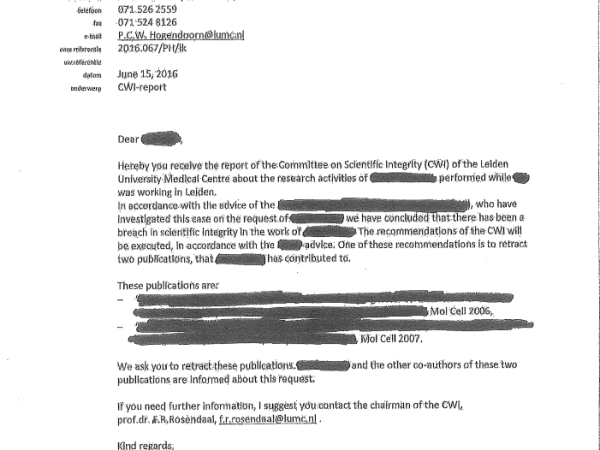
Two and a half years after Maria Fousteri was found guilty of scientific misconduct by her former employer, the Leiden University Medical Center (LUMC), exactly nothing at all happened. ERC and Molecular Cell ignored LUMC letters from June 2016, while Fouster’s British co-authors interfered to save own papers. Of 4 scheduled retractions, none took place.
Südhof would not be Südhof if he didn’t use the opportunity to bully his critics. He posted on PubPeer in May 2024:
“We feel that there is no need for further explanations on PubPeer in response to these repetitive accusations by ‘Orchestus quercus’ and his assistants (self-identified as Dr. Maarten van Kampen), except to point out that an independent imaging expert, Dr. Matthew Schrag, already described earlier the issues that can occur with digital reproductions. All of the PubPeer accusations against our lab and the mistakes we made and didn’t make are accounted for on our website: https://med.stanford.edu/sudhoflab/integrity—pubpeer.html.”
Our dishonest Nobelist again publicly accused Cell Press of forging his data, with Schrag as his witness. Remember this.
“The professional bloggers are now trying to turn this into a question of research integrity which is deeply misleading, and claim that they are doing this not for financial gain. Judge for yourself!” – Thomas Südhof, Nobel Prize laureate
In July 2024, Elisabeth Bik, who found many more image irregularities in Südhof’s papers (read above), which made her prime subject of his wrath, provided her own input also for the Neuron paper:
E. Bik: “Rectangular and triangular boxes reflect potential duplicate elements within each panel The rectangular pinkish box in the bottom right of the left panel appears to match the bottom left of the right panel, albeit rotated 180 degrees. This looks like a duplication between the two panels. Note that several duplications (e.g. the one marked in purple in the left panel) are not simple clone events, since they are similar in the green signal, but differ in blue or red signals. As also pointed out above, this suggests that the clone events were done by someone with access to the single channel signals, ruling out cloning by journal staff. Most notably, I have added red circles and ellipses to reflect that the green signal (fluorescence indicating climbing fibers) in the area above the PC strip appears duplicated between the two panels.”
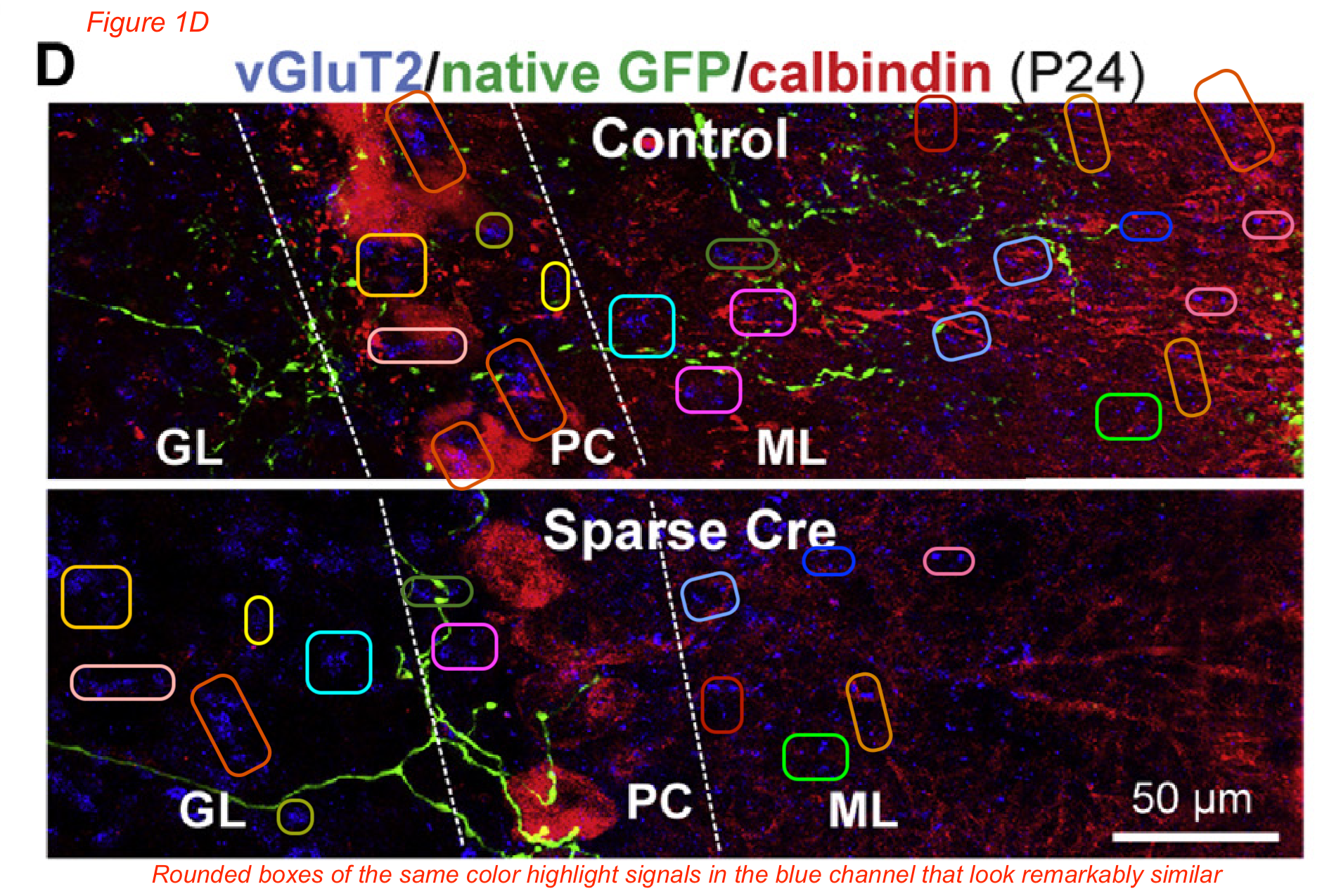
Elisabeth also found this, in Figure 1D:
“Rounded boxes of the same color highlight signals in the blue channel that look remarkably similar Many blue groupings in the top panel can be found in the bottom panel as well.”
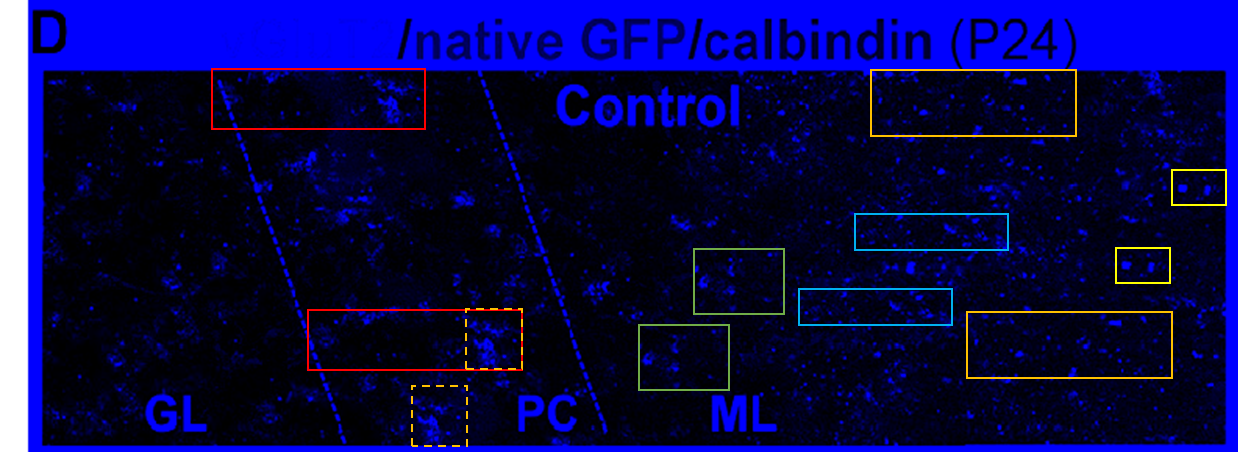
Here is Maarten’s analysis of this Figure 1D, the Control panel showing only the blue channel:
And here is an overlay proving the duplication of the blue channel between the Control and Sparse Cre panel:
For Südhof, the problem clearly lied elsewhere. On his Stanford website in July 2024, he blamed Cell Press again by referencing the Chen et al 2004 paper:
“Accusation: Dr. Maarten Van Kampen, a contributor to the ‘ForBetterScience’ blog, alleges that the incorrectly pasted image in Figure S3A was intentionally manipulated
Resolution: When images are inserted into figures and reproduced, the image reproduction process changes its appearance. This is not a manipulation but a consequence of digital processing. A recent accusation by Dr. Bik on another scientist’s work beautifully shows that such artifacts are common and not produced by image manipulations (see https://pubpeer.com/publications/C9E4F18C603C449A0CD32876B719A5).
Classification: Unfounded
#5, #7 & #9 and multiple posts later (up to #52)
Accusation: In extensive repetitive posts, Dr. Maarten Van Kampen (posting anonymously as ‘Orchestes quercus’) illustrative by multiple annotated images and supported by assisting comments claims that Figure S4B contains tiny subsections that appear to be duplicated within two images and are thus ‘cloned’, i.e. intentionally manipulated within that image.
Resolution: Such micro-duplications are typical image processing artifacts that may have occurred during image stitching or article production. An intentional image manipulation makes no sense because it the effect is to make the image worse, not better.
Classification: Unfounded“
Südhof also described his detractors as such:
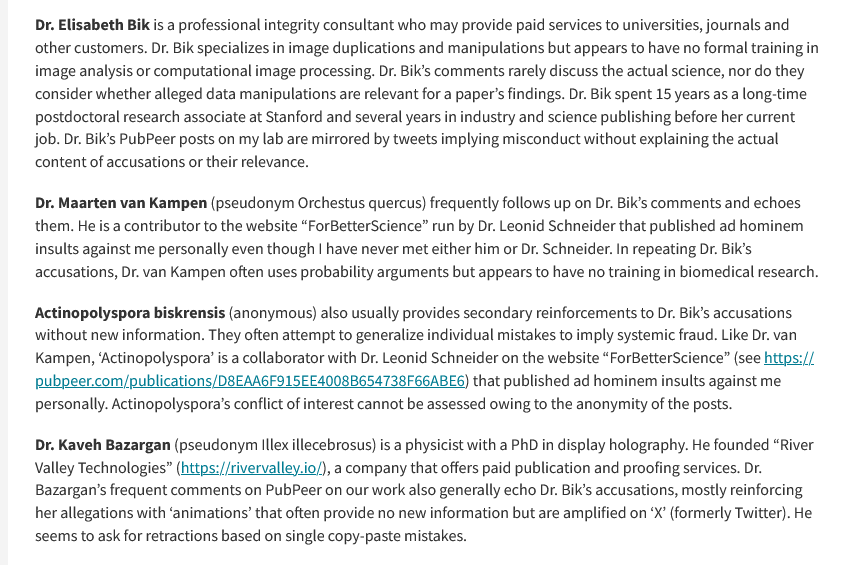
Elisabeth Bik has “no formal training in image analysis or computational image processing.”
Maarten van Kampen “is a contributor to the website “ForBetterScience” run by Dr. Leonid Schneider that published ad hominem insults against me personally even though I have never met either him or Dr. Schneider.”
Actinopolyspora biskrensis, who at the time of Südhof’s writing was not anonymous anymore, but known as Kevin Patrick: “Like Dr. van Kampen, ‘Actinopolyspora’ is a collaborator with Dr. Leonid Schneider on the website “ForBetterScience” (see https://pubpeer.com/publications/D8EAA6F915EE4008B654738F66ABE6) that published ad hominem insults against me personally. Actinopolyspora’s conflict of interest cannot be assessed owing to the anonymity of the posts.“
Everyone out there is a greedy shill working for that evil mastermind Schneider, set on destroying a Nobelist’s reputation to make money. As Südhof once put it: “commentators who may be doing this for financial gain” and “professional bloggers do have a conflict of interest”. I must be the new Soros? As reminder, Südhof is a multimillionaire, who sits on many pharma boards and whose company REATA Pharmaceuticals was sold in 2023 to Biogen for $7.3 BILLION in cash. If anyone is obsessed with money, it’s him.
Invaluable postscriptum
And in August 2024, Südhof suddenly posted the following on his Stanford website, referencing the Neuron paper as #27 (underline mine):
“Furthermore, we recently discovered with the help of an external image analysis expert that representative images in another paper (#27 below) contain inexplicable abnormalities, which again will warrant a retraction of the paper even though the quantitative analyses and conclusions are correct. […]
27. Paper: Chen, L.Y., Jiang, M., Zhang, B., Gokce, O., and Südhof, T.C. (2017) Conditional Deletion of All Neurexins Defines Diversity of Essential Synaptic Organizer Functions for Neurexins. Neuron 94, 611-625.
PubPeer Weblink: A minor copy-paste mistake was initially posted by the lab and later amplified by others https://pubpeer.com/publications/F7C42C356B2E7049FDB68A434EF4F8. However, Dr. Matthew Schrag sugsequently discovered more serious image problems […]
Postscriptum: Based on our analysis with an invaluable contribution of an independent analysis performed by Dr. Matthew Schrag, we at present conclude that this paper has three problems, two minor and one major. First, an inadvertent image duplication error (post #1); second, duplications of micro-areas in cerebellar figures that are likely image processing artifacts (posts #3-67), and third inexplicable duplications of larger image areas in only one channel in Figure 1D and S4B that cannot be explained by image processing artifacts. The third problem is potentially serious and at present cannot be explained by the first author who is responsible for these figures.“
Huh? I thought it was Maarten, Elisabeth, Aneurus and Cheshire who “sugsequently discovered more serious image problems“? While Schrag initially insisted that the duplicated fragments were “unlikely to alter the meaning of the underlying data“? The Transmitter article from 26 August 2024 explained in this regard:
“One of the commenters, Matthew Schrag, assistant professor of neurology at Vanderbilt University Medical Center, described on PubPeer additional apparent image duplication issues and subsequently found more serious concerns after Südhof asked him to review the figures in the paper […] Südhof has “an extraordinarily large body of work that’s been published, and errors are a part of the process,” Schrag says. But the “extent of the problems on this one can’t be explained through benign reasons—or, at least, I can’t come up with a benign reason,” he says. […] Schrag did find “unnatural” issues with some figures, and he says Südhof agreed. Although, Schrag says, “I can’t follow the rationale for why what’s been done has been done.””
There are exactly two comments by Schrag on that PubPeer thread. One is quoted at the beginning of this story, another mentions a case of corner-clones elsewhere. I don’t know what “additional apparent image duplication issues” Schrag described, but he certainly didn’t do this on PubPeer. Others did. Yet Maarten, Elisabeth, Aneurus or other sleuths are never mentioned in The Transmitter story. All credit went to Schrag, as Südhof wants it to be.
Noteworthy: now it is Südhof himself who seems to publicly accuse his former postdoc Lulu Y Chen of research misconduct. Remember how he publicly lashed out at Maarten in May 2024 for insinuating someone in his lab may have manipulated the images?
In this regard, Chen wrote to me:
“The supposed image manipulation does not strengthen the paper’s finding and it’s difficult to conceive of a plausible motive. Though I can’t explain them at present, I intend to replicate the experiment in my own lab.”
She seems to deny to be responsible for those fake figures. So who was? Nobody? I know! Maarten van Kampen!
On 26 August 2024 Chen posted this comment on The Transmitter, where the story of the Neuron retraction was reported (highlights mine):
“I do think it’s unfortunate that Dr. Südhof is under continual attack, & I doubt that any retraction or response will satisfy his partisan & aggressive accusers. I fear that this sort of hostile climate will deter future scientists from entering academia, especially women, minorities, & those currently underrepresented in the scientific community. While the biased & (in some cases) obviouslyeconomically motivated attackers claim to be interested in scientific purity & pursuit of the truth, the reality is they are killing careers.”
Disgusting. I previously asked Südhof to stop with these money insinuation because it sounds to me like antisemitic dog-whistling, but now Chen continues (on his behalf?).
Anyway, let’s wait and see what the retraction notice will say. By the way, Tom’s fellow Nobelist Gregg Semenza now has 11 retractions.
“Even after people have been telling you for, you know, 20 years or more that it’s going to happen, no one expects it.” -Gregg Semenza, Nobel Prize winner 2019
Südhof has currently over 40 papers flagged on PubPeer, often for very serious issues of data manipulation. Here some recent attacks on this defenceless senior citizen by Maarten, Elisabeth and Kevin, from May 2024:
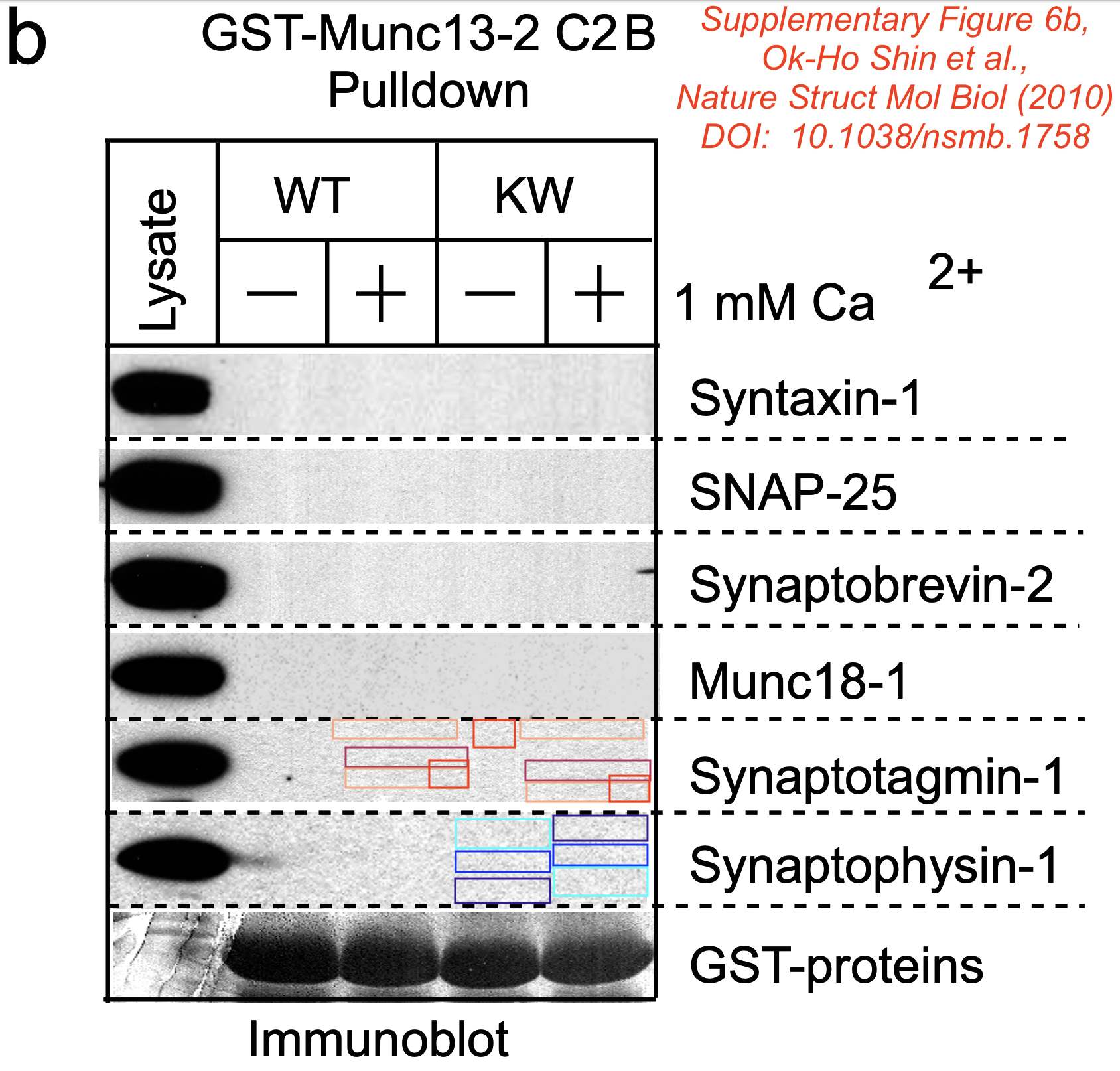
Elisabeth Bik: “Concern about Supplementary Figure 6b: Boxes of the same color highlight areas in the Synaptotagmin-1 and Synaptophysin-1 blots that look remarkably similar”
Südhof replied on PubPeer right away and dismissed Bik’s evidence as “a bizarre accusation“. In another comment, he linked to his rebuttal on his institutional website (screenshot on the left):
“The most likely explanation here is, like for many of the ‘mistakes’ identified by Dr. Bik’s A.I.-powered software, that these random microduplications are simply a reproduction artifact of a digitized image.”
Cheshire aka Actinopolyspora biskrensis aka Kevin Patrick described Südhof’s rebuttal as “non-responsive to the concerns” and containing “several incorrect assumptions and errors.” Südhof retorted: “we have addressed all reasonable questions a person purporting to be concerned about science integrity might ask“, but more importantly, the Nobelist refused to provide raw data despite being asked for it repeatedly. Cheshire explained that the image is objectively manipulated, and that only Südhof can figure out by whom and why:
“This editing may have been done by the authors in an innocent attempt to beautify an image. This editing may have been done by the publisher (or outside vendor) in order to “improve” the appearance. This editing may have been done by the authors in an attempt to generate a less ambiguous result of the original experiment. This may have been done by the authors to misrepresent the results of an experiment.”
Of course there is no outside vendor aka papermill, and Nature family journals aren’t known to falsify the figures of their authors. Which leaves editing by authors. Then Maarten van Kampen joined the debate and supplied this analysis for Südhof:
Maarten van Kampen: “Synaptotagmin-1 band from Fig. 6(b) in its original form, contrast-enhanced, and with a zoom-in on the two largest duplicated regions”
Obviously someone didn’t like some signal on the blot and removed it by copy-pasting blank areas:
“Bottom line: Fig. S6(b) contains rectangular regions that are perfect clones of each other. This cannot have happened by chance. As in: much, much less than one in 10986. And blaming this on “a reproduction artifact of a digitized image” is as believable as saying “the dog ate my homework”.”
Südhof reacted by lashing out at his critic and declaring conclusions unaffected:
“Dr. van Kampen et al. seem to admit that the alleged manipulations have no beneficial effects on the images or paper, but appear to intend on raising ‘suspicions’ and ‘questions’ about my lab’s papers.”
Südhof then added that he left all original data behind at UT Southwestern and never made any digital copies because he was not “not the legal owner“, while hinting that his postdocs may have “kept copies, possibly illegally“. The multimillion-heavy Nobelist then hinted that he doesn’t give a toss what the scientific community thinks because the real authorities, the “journals and institutions“, mostly “agree that these accusations are off the mark, to put it mildly“.
And in July 2024, Südhof blamed the publisher for intentionally introducing those duplications behind his back, by referencing the paper Chen et al 2004 in PNAS, whose corner clones the authors explained with: “the journal edited the labels“.
How Südhof must imagine his interaction with Maarten, Elisabeth, Cheshire and Aneurus
A similar case, with same first author Ok-Ho Shin, now research instructor at the Vanderbilt University. Also flagged by Elisabeth Bik in May:
“Figure 1C: Red and blue boxes highlight lanes in the Syt 1-C2A/B-6W panel that look unexpectedly similar.”“Figure 7: Boxes of the same color highlight lanes or bands that look unexpectedly similar.”
“Figure 2:Boxes of the same color highlight lanes or bands that look unexpectedly similar.”
There, the paper received the number 40, Südhof blamed the modern “AI-driven image reconstructions”, explained that the raw data was left behind at UT Southwestern, and:
“High-magnification images of three examples of the alleged manipulations as shown below reveal three interesting features: First, the bands are clearly identical. Second, the background contains many non-identical features (yellow circles). Third, there is no sign of band ‘splicing’ or other manipulations of the images. […]
To summarize, the magnifications show that the images were not intentionally manipulated and the sporadic band duplications in the Shin et al. (2002) paper are most likely due to image processing artifacts that duplicate matching image elements.”
The gel bands are identical because the software did it. And Südhof again referenced that Chen et al 2004 paper where the corner clone duplications were introduced by the publisher intentionally. Once again, he blames both the publisher and his own imaging software for digitally forging his data.
Afterword
Südhof presumably thinks he is a scientist. So let’s apply some scientific thinking. Assuming it was indeed the various imaging software tools in microscopes, cameras and scanners which do such things, in so many of Südhof’s figures and papers, over decades. Let’s go with this theory, for the argument’s sake. Shouldn’t Professor Südhof be worried that any image acquired with such tools is dodgy? And that therefore NONE of his published science is reliable, by his own admission?
Yet, I don’t think Südhof believes his own bullshit. But because he thinks that he is an entitled genius above all rules, he will keep up this farce for each of his dodgy papers on PubPeer, and in most cases he will succeed avoiding a retraction, simply because of who he is.
I am tired of writing about this frankly very tiresome and obnoxious drama queen. Maybe some other journalists will write something? Don’t you love stories about Nobel laureates? Especially those under attack from violent anti-science trolls paid from dark sinister channels?
“The presence of such articles online have severely affected Dr. Louis J. Ignarro’s public reputation, and his personal life. Dr. Ignarro disputes any accusations of wrongdoing. There was no fabrication of data, although there was a mistaken duplication of data which occurred due to error. None of the data was false.” -J.L. Perez, Esq.
Note: the article reuses earlier material from Friday Shorts, for which I am sure Südhof will now expose me as a plagiarist.
Update 11 February 2025
Merely half a year after the announcement, the paper Chen et al Neuron 2017 was finally retracted. The retraction notice was issued on 10 February 2025:
“This article has been retracted at the request of the authors.
We, the authors of this publication, have decided to retract the paper because we found that the images in Figure 1D and Figure S4B contain aberrations that cannot be explained, and the original data for these figures are missing. Raw data for the other components of the paper are available, and their reanalysis confirmed the conclusions of the paper. We would like to thank M. Schrag for bringing these image aberrations to our attention.”
Totally shameless.
Donate!
If you are interested to support my work, you can leave here a small tip of $5. Or several of small tips, just increase the amount as you like (2x=€10; 5x=€25). Your generous patronage of my journalism will be most appreciated!
Well, look what happened. For Better Science is being read by all the right people.
The Transmitter changed their text (author Shaena Montanari:
Used to be: ““One of the commenters, Matthew Schrag, assistant professor of neurology at Vanderbilt University Medical Center, described on PubPeer additional apparent image duplication issues and subsequently found more serious concerns after Südhof asked him to review the figures in the paper”
Now: “One of the commenters, Matthew Schrag, assistant professor of neurology at Vanderbilt University Medical Center, wrote on PubPeer about additional apparent image duplication issues that others had discovered and subsequently found more serious concerns after Südhof asked him to review the figures in the paper.”
I think this is even worse, insinuating that everything those unnamed others posed on PubPeer was just wrong.
This is what happens when journalists let Nobel laureates dictate their writing.
I would contact Washington Post, NY Times, FoxNEWS, TruthSocial, … as these are clear waste of US/UN public money and Universities including Irvine should pull back on diversity and inclusion that Chen is eluding to ; and treat these fraud individuals fairly and send them where they deserve to be. Poor grad students and post-doc of Tom and Lulu.
Below is a Washington Post article from Tom, and they should include articles about his retractions too
DEI is not a problem here.
Academia is so toxic that it perverts everything.
WomenInSTEM? Everyone appoint your wife/girlfriend postdoc as faculty!
And yes, every fraudster when caught will cry racism. Doesn’t matter if they are Chinese, Indian, Iranian or even Italian. Heck, I know white ENGLISH men once complained of being racially persecuted by me.
Even Tom discovered that he is actually a disadvantaged minority, what with his numerous Asian female lab members.
Your afterword is the best part of the piece. Shit data are shit data, and how they got to be shit is of little interest beyond a small circle of friends/enemies/colleagues of the arrogant twats who took the money and ran. I do imaging for a living, and I watch journals like a hawk when it comes to figures. I also laugh when people say their figure prep and analysis was done with ImageJ – which literally changes every day. Never saw a mad microscope, though. That’s a new one.
#10 Gnoriste longirostris comment accepted August 2024
There is concern about data provided for Figure 3A-J. The raw data has been deposited in Sudhof lab data at Stanford digital library. https://searchworks.stanford.edu/view/nb252dn4150
Below is Figure 3 and the authors lab notes from the depository files that leads you to the electrophysiological traces.
New heights have been reached: intentional image alteration for benign reasons. Gotta start collecting these and in no time will have enough for a book.
I am pretty sure he believes in his own bullshit, that’s the fate of any dictator surrounded by yes-men.
















 For Better Science
Idk if I’d call gimp an advanced image manipulation tool. Most graphics programs beyond ms paint can do rgb channel separation easily.
LikeLike
And the point you tried to make was?
LikeLike
you may get tired of writing about this fake Nobelist, but we never get bored of reading your posts!!! Beautifully written on this one.
LikeLiked by 1 person
Well, look what happened. For Better Science is being read by all the right people.
The Transmitter changed their text (author Shaena Montanari:
Used to be:
““One of the commenters, Matthew Schrag, assistant professor of neurology at Vanderbilt University Medical Center, described on PubPeer additional apparent image duplication issues and subsequently found more serious concerns after Südhof asked him to review the figures in the paper”
Now:
“One of the commenters, Matthew Schrag, assistant professor of neurology at Vanderbilt University Medical Center, wrote on PubPeer about additional apparent image duplication issues that others had discovered and subsequently found more serious concerns after Südhof asked him to review the figures in the paper.”
I think this is even worse, insinuating that everything those unnamed others posed on PubPeer was just wrong.
This is what happens when journalists let Nobel laureates dictate their writing.
LikeLike
Oops. Now it’s clear why Maarten, Elisabeth and Aneurus were deleted.
Ivan Oransky is EiC of The Transmitter
https://www.thetransmitter.org/staff/
LikeLike
Südhof’s explanation about image manipulation is irrepressible and unprofessional.
LikeLike
We must protect fraudulent work in the name of DEI. *ugh*
LikeLike
I would contact Washington Post, NY Times, FoxNEWS, TruthSocial, … as these are clear waste of US/UN public money and Universities including Irvine should pull back on diversity and inclusion that Chen is eluding to ; and treat these fraud individuals fairly and send them where they deserve to be. Poor grad students and post-doc of Tom and Lulu.
Below is a Washington Post article from Tom, and they should include articles about his retractions too
https://www.washingtonpost.com/opinions/too-many-medical-trials-are-moonshots-in-the-dark/2017/01/04/a7d88102-c184-11e6-9578-0054287507db_story.html
LikeLike
DEI is not a problem here.
Academia is so toxic that it perverts everything.
WomenInSTEM? Everyone appoint your wife/girlfriend postdoc as faculty!
And yes, every fraudster when caught will cry racism. Doesn’t matter if they are Chinese, Indian, Iranian or even Italian. Heck, I know white ENGLISH men once complained of being racially persecuted by me.
Even Tom discovered that he is actually a disadvantaged minority, what with his numerous Asian female lab members.
LikeLike
Tom has yellow fever, for sure!
LikeLike
Gold fever more likely.
LikeLike
Your afterword is the best part of the piece. Shit data are shit data, and how they got to be shit is of little interest beyond a small circle of friends/enemies/colleagues of the arrogant twats who took the money and ran. I do imaging for a living, and I watch journals like a hawk when it comes to figures. I also laugh when people say their figure prep and analysis was done with ImageJ – which literally changes every day. Never saw a mad microscope, though. That’s a new one.
LikeLiked by 1 person
Here xou go, an anonymous expert defends the Mad Microscope theory:
https://pubpeer.com/publications/F7C42C356B2E7049FDB68A434EF4F8#70
LikeLiked by 1 person
Well, seems the dog is missing therefore the microscope is next on the list. 😛
LikeLiked by 1 person
did you see this? An expert just noticed another case of fraud from Tom! This open a new case for this Nobel prize whiner
https://pubpeer.com/publications/C22E0805CB0B55CB7388F488611145
#10 Gnoriste longirostris comment accepted August 2024
There is concern about data provided for Figure 3A-J. The raw data has been deposited in Sudhof lab data at Stanford digital library. https://searchworks.stanford.edu/view/nb252dn4150
Below is Figure 3 and the authors lab notes from the depository files that leads you to the electrophysiological traces.
LikeLiked by 1 person
New heights have been reached: intentional image alteration for benign reasons. Gotta start collecting these and in no time will have enough for a book.
I am pretty sure he believes in his own bullshit, that’s the fate of any dictator surrounded by yes-men.
LikeLike
Already aware of https://liorpachter.wordpress.com/2025/06/16/reply-to-reply-to-false-positives-in-the-study-of-memory-related-gene-expression/ ?
LikeLike