

Schneider Shorts of 12 July 2024 – A cancer researcher under terrorist attack, where Retraction Watch went wrong, mass retractions for Indian Editor-in-Thief, a papermiller’s new adventures, a corrected Dana Farberication retracted, obituaries for two great researchers, and finally, a Polish rector proves that Leonid Schneider is a russian bot.
Table of Discontent
Science Elites
- Disinformation, hate, fake news, attacks by foreign intelligence services and internet troll farms – Krolczyk is a victim of a russian conspiracy!
- Elements of terrorism, bullying, defamation and acts that should be illegal in a civilized society – Wafik El-Deiry under attack!
- So amusing I felt compelled to share it – where Retraction Watch went wrong about Mr Behzadi
Scholarly Publishing
- Errors introduced during figure preparation do not impact the conclusions – Dana Farber fabricators fix paper for a second time
- The possible duplications were unintentional – Concern expressed for Fulda and Debatin
- A close relationship in scientific research cooperation – Pau Loke Show’s new adventures
Retraction Watchdogging
- A shock for Pandey – mass retractions for sacked Editor-in-Thief
Obituaries
- This witch hunt killed him – Czechia’s fallen superstar Vojtech Adam is dead
- Kind, smart, resourceful and passionate – Fazlul Sarkar, the fraudster who sued PubPeer, is dead
Science Elites
Disinformation, hate, fake news, attacks by foreign intelligence services and internet troll farms
On 4 July 2024, the Polish magazine Opolska brought a story about the vice-rector of Opole University of Technology Grzegorz Krolczyk, who was recently appointed Chairman of the governmental Council for Innovation in Higher Education and Science.
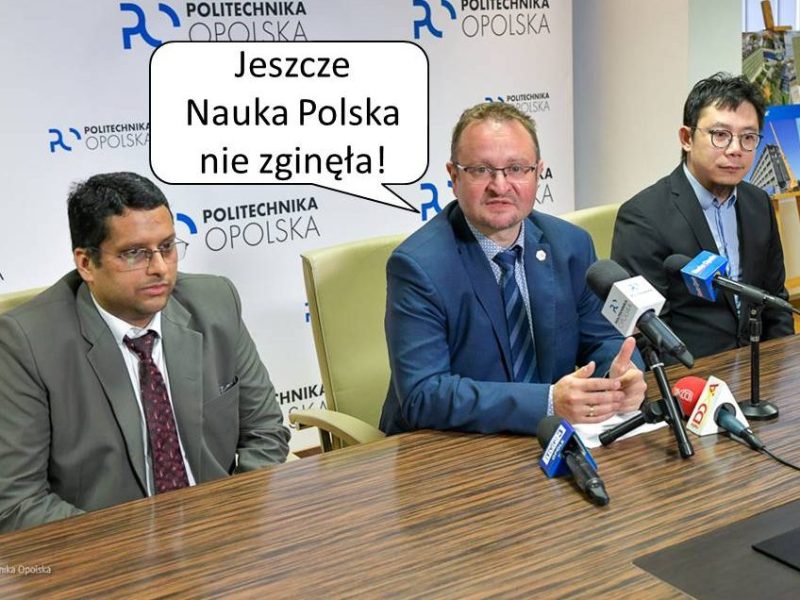
Polish science eaten by Papermill Krolczyk
“Prof. Grzegorz Królczyk, Vice-Rector for Science and Development of the Opole University of Technology, was elected President of the Council for Innovation in Higher Education and Science.”

From Opolska (Google-translated):
“At the beginning of May, in a conversation with PAP, the vice-rector of Opole Polytechnic boasted about the growing number of citations of university employees’ works. He recalled that in 2020 there were 6.7 thousand of them, in 2021-more than 11 thousand, in 2022-14.5 thousand, and in 2023-more than 16 thousand. […]
Professor Grzegorz Korolczyk has an H-index of 60. This is a really impressive result! However, the question is how much it reflects the real value of his work. Because if we measured the results only by this measure, then it would turn out that the vice-rector of Opole Poyltechnic is a better scientist than Sir Roger Penrose, professor of mathematics at Oxford and Nobel Prize winner, who has an H-index of 52!”
Krolczyk’s secret is of course papermilling. I was interviewed by Opolska:
“- His name attracted the attention of one of my colleagues, Dr. Alexander Magazinov. This is a Russian physicist who emigrated to Kazakhstan and tracks the dubious quality of the work of authors from China, Iran or Egypt. It was he who noticed that Professor Krolczyk’s name while scrolling among the co-authors, ” says Dr. Leonid Schneider. {…[
In the article, he accused the Opole Polytechnic vice-rector of being involved in a “paper milling” procedure. He noted that Professor Grzegorz Korolczyk has many collaborations with authors such as Munish Kunar Gupta (H-index 60, 368 papers and about 11.5 thousand citations), or Zhixiong Li (H-index 76, 574 papers and about 19.5 thousand citations). It is worth remembering that these scientists appeared several years ago at the Opole Polytechnic University in an aura of great success. At least, that’s what most Opole editors put it.
“These are two scammers who are known in the media for writing low – value works,” says Dr. Leonid Schneider. “As if that wasn’t enough, Professor Grzegorz Krolczyk brought them to the Opole Polytechnic Institute. So he is sabotaging Polish science because he and his colleagues can get grants for research that doesn’t do much. “
Also interviewed was the Polish emeritus professor and research ethics activist Marek Wronski, you will soon see why this is important. And now, Krolczyk’s rebuttal. Ready?
“In response, Professor Grzegorz Korolczyk said that this publication “is part of a hybrid attack on Polish scientists and the subject of proceedings conducted by the Internal Security Agency. Due to the ongoing investigation, this is my only comment on the matter.”
Therefore, we asked Internal Security Agency to provide information about whether it is actually conducting proceedings on this issue and whether the given text given is getting an X-ray for a hybrid attack on Polish scientists. […] The response from the agency’s press office was brief: “Dear Editor, we kindly inform you that the matter you ask about remains outside the scope of the Internal Security Agency.”“
In a LinkedIn comment, Krolczyk accused Elsevier of “stealing” from him and that his two retractions were “done illegally and against COPE“. He also reminded that “Prof. Li has recently been awarded the OPUS project, and Prof. Gupta has been awarded a scholarship for outstanding young scientists.“

The western blot doctors of Silesia
Three whistleblowers reported the Polish medicine professor Bozena Gabryel and colleagues for data manipulation. Will the universities do anything now?
No wait, it gets much, much better. Krolczyk’s rector of the Opole Polytechnic, Marcin Lorenc, posted a reply to Opolska reporting. It reads exactly in the style of the russian propaganda.
“…common disinformation, hate, fake news, various types of attacks by foreign intelligence services, and internet troll farms […] hybrid attacks from the East most often take place in Poland […] Special services in many countries also create false personas of scientists […] We do not agree and strongly condemn hate, fake news and post-truth. Today such a situation happened to prof. Grzegorz Królczyk, it could happen to any of us tomorrow.”
But not a single word about Krolczyk’s retractions or the evidence of papermilling by him, Li and Gupta.
Much of Lorenc’ rant is an unhinged and rabid attack on Marek Wronski, whom Lorenc accuses of plagiarism which Wronski allegedly committed in 1990ies by publishing same paper twice, in Polish and in English. The Opole rector also says Wronski acted “in violation of ethical principles and contrary to the law” by discussing Krolczyk’s peer reviewed papers without Krolczyk’s permission. On top, since “approximately 100 articles written by Poles are retracted annually“, it was a crime by Wronski to single out Krolczyk. And then Lorenc attributes to Wronski my email to Opole Polytechnic to Wronski, declaring that it was actually Wronski who wrote it and signed as Leonid Schneider! In fact, Lorenc accuses Wronski of being an agent of the russian secret service GRU, which he says invented the identity of Leonid Schneider:
“Dr. Leonid Schneider introduces himself as “an independent journalist of Ukrainian Jewish origin who lives in Germany.” Dr. Schneider uses an address on the Gmail platform for correspondence, and the content of the messages he sent to the management of our university seem to be written by bots: the style and language are far from the standards of official correspondence, the content is full of insults.
“Opolska” reports that Dr. Leonid Schneider has a German doctorate in molecular biology, and after his defence he worked for several years as a scientist in English-speaking countries. His profile on Google Scholar includes publications by at least three people: two from Germany and one from Brazil, as well as publications in which Leonid Schneider is not listed as the author and these are publications by people from the Russian Federation. Looking through his profiles, you may wonder if such a person even exists?”
Lorenc got me. I admit I do not exist. My family will be shocked.
(About Google Scholar: indeed it keeps adding random people with same last name and same initials to my and probably also to your and to Lorenc’s Scholar profile. That’s why I never use it. And in fact Opolska got something wrong, I did postdoc in Italy, not really an English-speaking country)
It ends with a long tirade against the Opolska newspaper which Lorenc apparently wants to shut down and its journalists imprisoned, because look how great the Opole Polytechnic is in the Shanghai Rankings.
In his diatribe, Lorenc often he invokes “truth” in his attacks on critics while twisting and obscuring facts – this is actually the typical style of the soviet newspaper Pravda. In my view, Lorenc is unfit to even supervise a public toilet, never mind a university, because all he can do is to threaten people, while spouting views which border on totalitarian and possibly on racist. He should be reminded that Władysław Gomułka and his fellow communists are long gone, one cannot blame Jews for everything these days.
Elements of terrorism, bullying, defamation and acts that should be illegal in a civilized society
Wafik E-Deiry, director of the Cancer Center at Brown University in USA, posted a reply on PubPeer which in my humble view deserves some kind of prize. You can read about El-Deiry’s achievements in July 2024 Shorts and May 2024 Shorts.
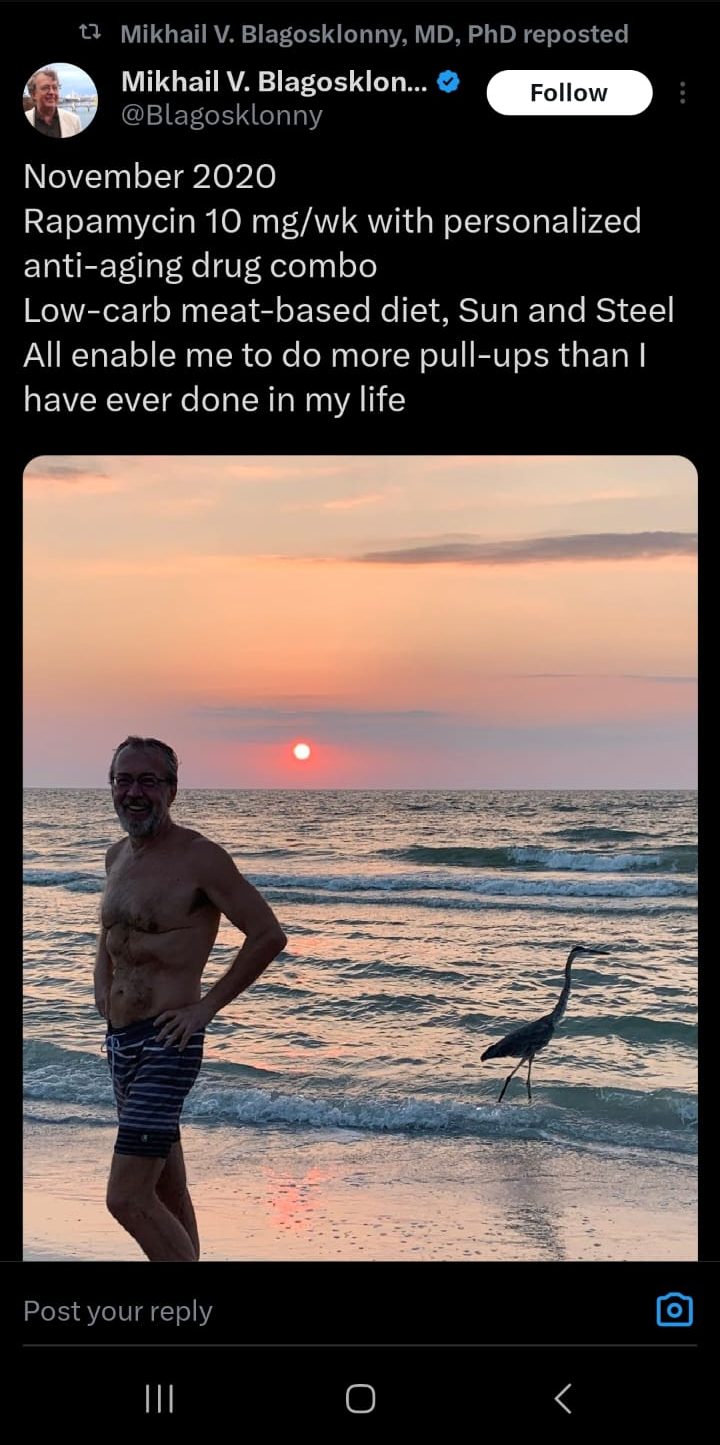
El-Deiry was recently appointed Editor-in-Chief of Oncotarget presumably because the owner and his fellow questionable cancer researcher Misha Blagosklonny has late stage cancer – there was even a press release in January 2024, and an editorial by Blagosklonny himself in the Oncotarget‘s clone journal Oncoscience, “My battle with cancer. Part 1.”
This one was published in a Blagosklonny journal and flagged by Claire Francis in April 2024:
Hairong Cheng , Bo Hong , Lanlan Zhou , Joshua E Allen , Guihua Tai , Robin Humphreys , David T Dicker, Yingqiu Y Liu , Wafik S El-Deiry Mitomycin C potentiates TRAIL-induced apoptosis through p53-independent upregulation of death receptors: evidence for the role of c-Jun N-terminal kinase activation Cell cycle (2012) doi: 10.4161/cc.21670


El-Deiry swiftly threw the first author and the bus and told his critics to contact her. And:
“The paper was being analyzed as the PI was under an open attack by PubPeer going through apparently numerous publications over decades (100’s) to conclude impropriety. The PI who is being targeted in a public was by those who are anonymous is having reputational damage as a result because the attacks are coming faster than anyone can respond. Moreover, the PI has no resources to cover the time to investigate the issues but can say he believes the researcher who was first author of the paper is a person of integrity. The PI did not assemble figures as that is done by the primary researchers in his lab.”
Wait, it gets even better!
“You don’t have the right to publicly damage the reputations of scientists in the way you have been doing. It is clear that my lab and publications have been willfully singled out and targeted in the past week for motivations having nothing to do with the integrity of science or the search for truth. Such barbaric unregulated assault on hard-working people is shameful because of the way it is being done. You don’t have the right to damage people’s reputations that are built over decades in this public way anonymously. There are elements of terrorism, bullying, defamation and acts that should be illegal in a civilized society and certainly within academia. You and the rest of the evil PubPeer mob have been harassing me and bombarding me with email around the clock including on holiday with my family where you have ruined my little time I could spend with them.”
No, it was not a slip-up. On another PubPeer thread, El-Deiry posted something similar.
LanLan Zhou, Wenge Wang , David T Dicker, Robin C Humphreys , Wafik S El-Deiry Prediction of proapoptotic anticancer therapeutic response in vivo based on cell death visualization and TRAIL death ligand-receptor interaction Cancer biology & therapy (2011) doi: 10.4161/cbt.12.4.17174
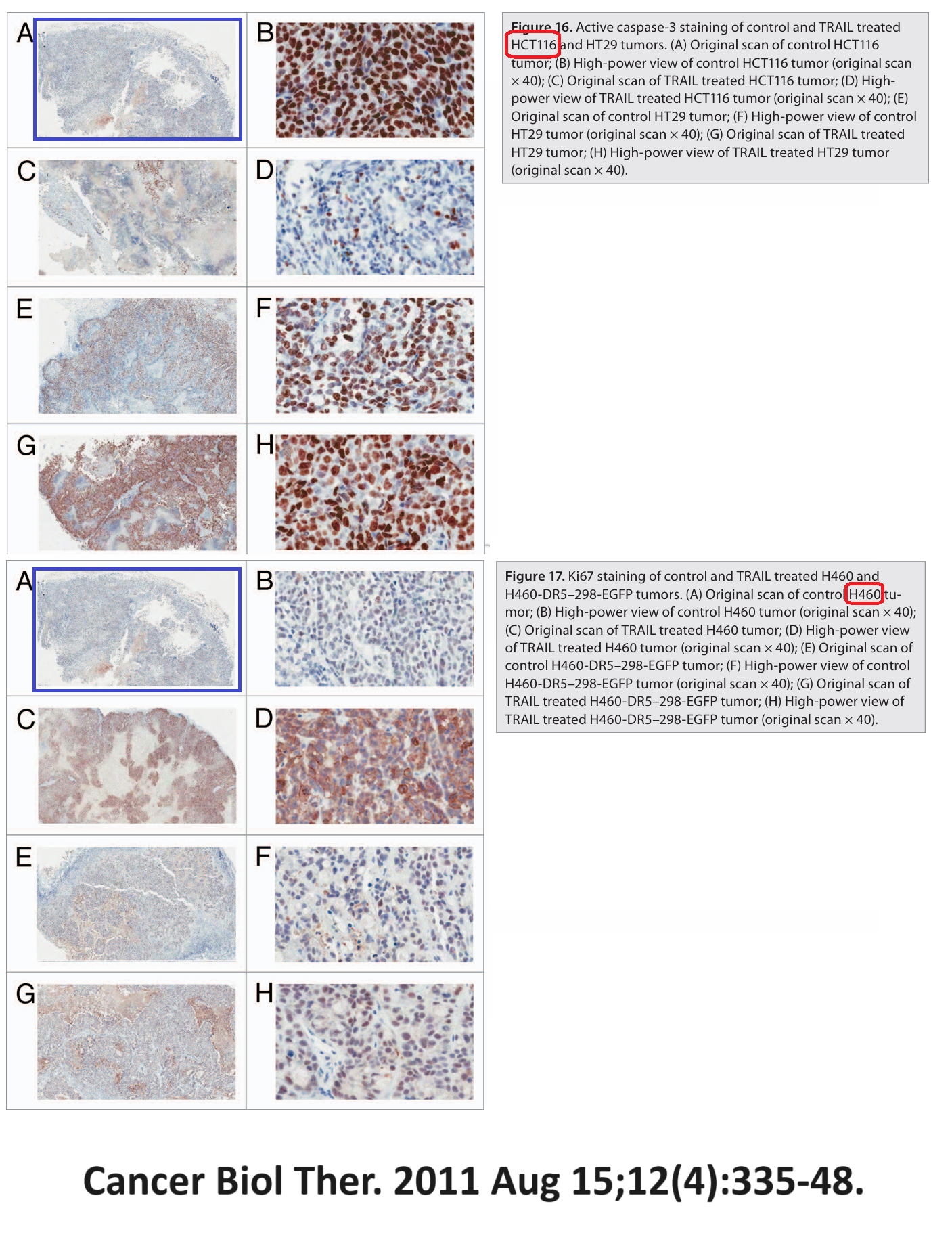
Wafik, the victim of bullying, blackmail and terrorism:
“This is a form of blackmail and terrorism that the scientific community will deal with. We are not naive, or guilty of anything remotely deserving of what you as an anonymous accuser is doing in the public square. […} I will not let you destroy a career of publishing scientific papers dating to when I was in College in 1981. I never expected to be subjected to this type of terrorism, bullying and blackmail by anonymous accusers who are unregulated. “
The Brown University professor hasn’t raised any sexual harassment accusations against his critics yet, but probably soon? And then this oncologist remembered about informed consent:
“I don’t agree with being targeted in a public way which is damaging to a reputation built over 4+ decades. You do not have a right to do that or my consent.”
I think El-Deiry and Lorenc should meet and compare notes on terrorism.
So amusing I felt compelled to share it
On 4 July 2024, Retraction Watch brought this story about Sasan Sadrizadeh, a professor at KTH Royal Institute of Technology in Stockholm in Sweden, and his PhD student, Amirmohammad Behzadi:
“In late May, one of Sasan Sadrizadeh’s doctoral students stumbled upon a paper with data directly plagiarized from his previous work. […] Sadrizadeh told us the methodology reported in the article was “so amusing that I felt compelled to share it” on LinkedIn. In his post, Sadrizadeh calls out “unique Stockholm data magically transformed into an Iraq case study, courtesy of 16 authors from six different countries!” […]
Jianlei Niu, the editor-in-chief of Energy and Buildings, saw Sadrizadeh’s LinkedIn post calling out the similarities in data and reached out to him, Sadrizadeh told Retraction Watch. The paper was later withdrawn.”
This is the original, Bahzadi et al 2023, and this si the now retracted copycat Hassan et al 2024. It is worth visiting PubPeer to understand the full story, i.e. of what exactly was stolen and from exactly whom. The humble PhD student Behzadi is quite likely a papermiller, with an h-index of 26 and almost 2400 citations, more than his PhD mentor Sadrizadeh. Which makes one wonder what Bahzadi’s real function in Sweden is, and who is actually ordering whom around in that Iranian lab at KTH.
So far, Behzadi’s papers were flagged “only” for inappropriate citations to his own and his coauthors’ papers, outside of all scientific context. Also, one of Behzadi’s authors is a certain Pouria Ahmadi, who was seen papermilling with Ibrahim Dincer, read about him here:

Environmental Pseudoscience and Polluted Research
“We are living in a faked world and there is a lot of un-verified avatars. “, Philippe Garrigues, EiC

Ahmadi currently edits a joint special issue at an Elsevier journal with Bahzadi’s mentor in Sweden, Sadrizadeh. And Sadrizadeh is not that kosher either: his own paper Jamshimofid et al 2024 contains inappropriate citations to his coauthors Mohammad Jamshidmofid and Mohammad Olfati. And here is Sadrizadeh with his little PhD student:
Trond Thorgeir Harsem , Behrouz Nourozi , Amirmohammad Behzadi , Sasan Sadrizadeh Design and Parametric Investigation of an Efficient Heating System, an Effort to Obtain a Higher Seasonal Performance Factor Energies (2021) doi: 10.3390/en14248475

I am not sure the Retraction Watch story of honest yet heroic Iranian scholars in Sweden was complete. Funny though who those Iraqi thieves stole from…
Scholarly Publishing
Errors introduced during figure preparation do not impact the conclusions
The Dana Farber Fabricators in Harvard, led by Kenneth Anderson and Ruben Carrasco, achieved to correct an utterly fraudulent paper, twice.
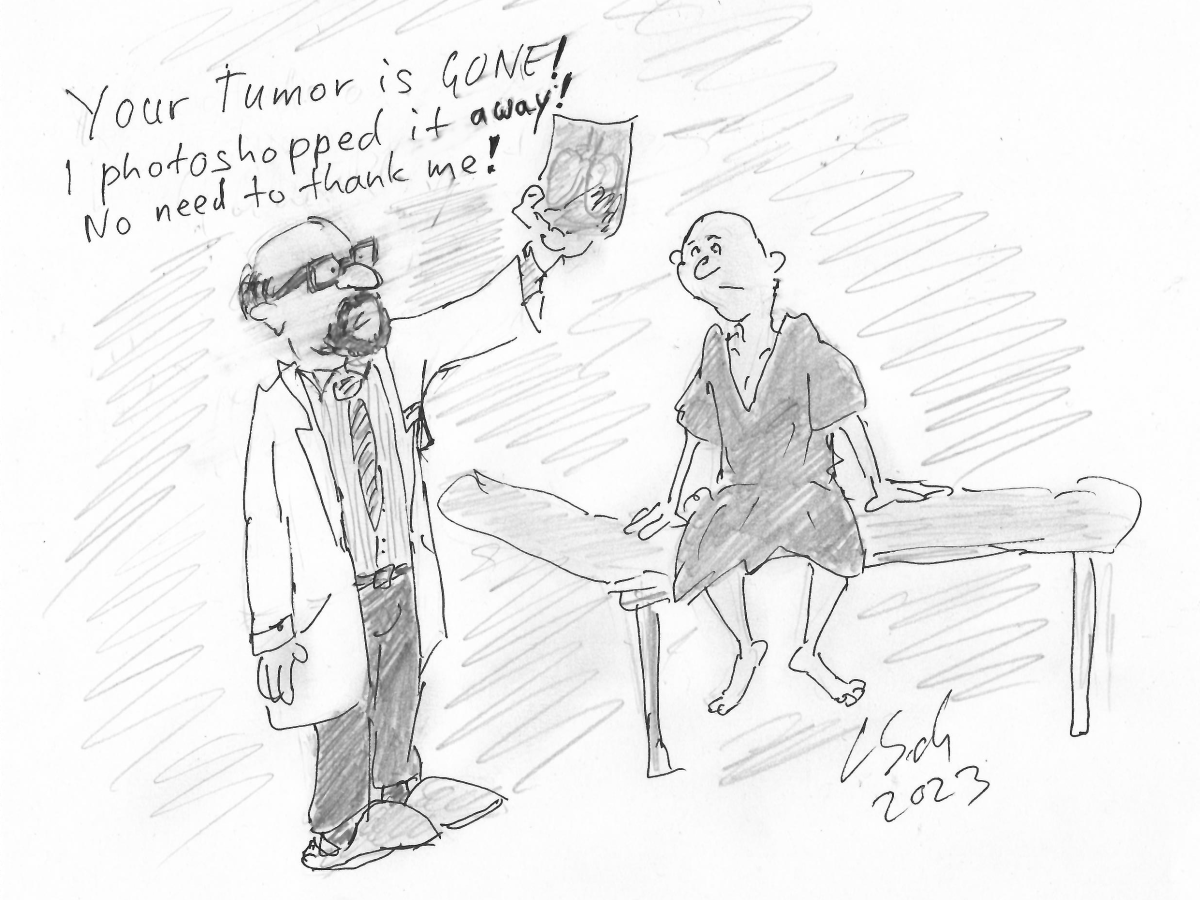
Dana-Farberications at Harvard University
“Imagine what mistakes might be found in the raw data if anyone was allowed to look!” – Sholto David

This is the paper, in an elite Nature family journal, originally flagged by Sholto David:
Di Zhu , Zhongqiu Wang , Jian-Jun Zhao , Teresa Calimeri , Jiang Meng , Teru Hideshima , Mariateresa Fulciniti , Yue Kang , Scott B Ficarro , Yu-Tzu Tai , Zachary Hunter , Douglas McMilin , Haoxuan Tong , Constantine S Mitsiades , Catherine J Wu , Steven P Treon , David M Dorfman , Geraldine Pinkus, Nikhil C Munshi, Pierfrancesco Tassone, Jarrod A Marto Kenneth C Anderson, Ruben D Carrasco The Cyclophilin A-CD147 complex promotes the proliferation and homing of multiple myeloma cells Nature medicine (2015) doi: 10.1038/nm.3867

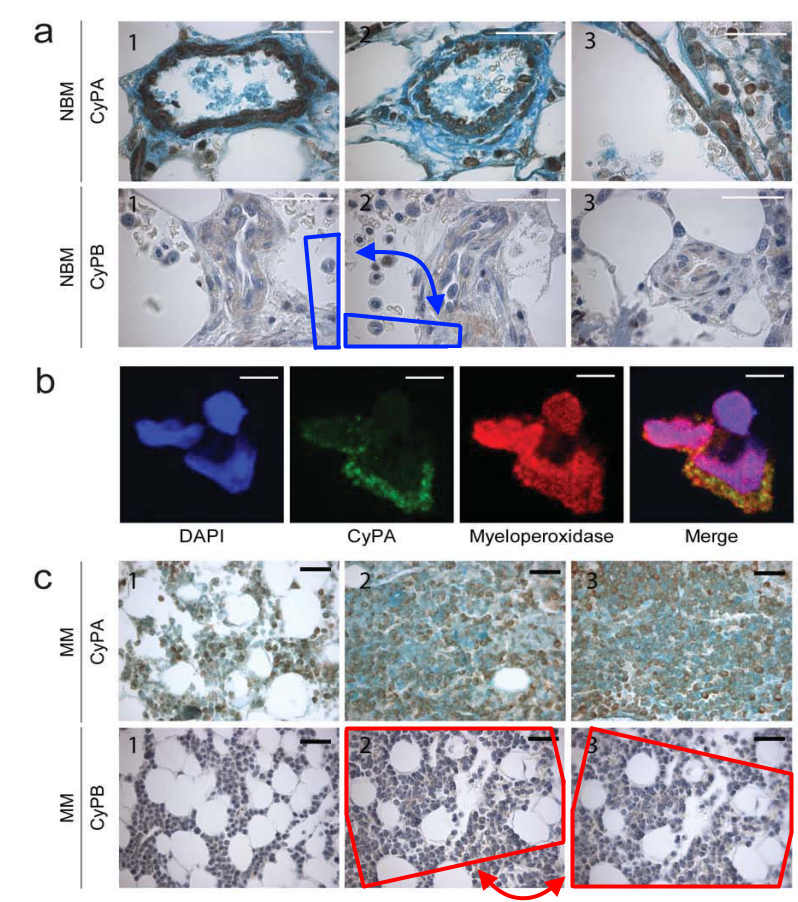
The first Correction was published on 25 January 2024:
“In the version of the article initially published, three pairs of micrographs (in Fig. 5i and Supplementary Figs. 3a and c) inadvertently contained overlapping areas. These figures have been amended with new micrographs and are available as Supplementary Information with this notice.”
Sholto found some issues with the correction:
“The authors provided the data underlying the figures as an Excel sheet attached to the paper, see: Source data to Fig. 2. The raw data does not appear to match what is shown in the paper.“
And elsewhere, obviously Nature Medicine editors were too busy to check it for themselves before correcting:


Obviously a second Correction was in order on 5 July 2024 to reassure everyone:
“Based on a comprehensive review of all data items, additional instances of image reuse or discrepancy between figures and associated data were identified. Duplicate images were found in Supplementary Fig. 8d and Supplementary Fig. 7h (Supplementary Fig. 8d has been corrected), Supplementary Fig. 3c and Fig. 4h (Supplementary Fig. 3c has been corrected), Supplementary Fig. 6a and b (Supplementary Fig. 6a has been corrected), Fig. 1b and Supplementary Fig. 1a (Supplementary Fig. 1a has been corrected), and two images in Supplementary Fig. 1f (Supplementary Fig. 1f has been corrected). Additionally, the lower panel of Fig. 2f was based on an incorrect dataset (source data for Fig. 2f in Supplementary information has been corrected) and the standard deviation bar for BMEC-60 in Fig. 1e was incorrect (Fig. 1e has been corrected). The original and corrected figures can be found in the accompanying Supplementary information. These errors were introduced during figure preparation and do not impact the conclusions of the article.”
The Dana Farber coauthor Constantine Mitsiades also featured in this article:
My Big Fat Greek Ophthalmology
From fake cancer research to fake ophthalmology – just follow Mitsi and Vassiliki and you’ll meet Dementios and other bad eye doctors, including a horrible German we hoped to never see again.
The possible duplications were unintentional
A paper by the fallen ex-president of the University of Kiel in Germany, Simone Fulda, received an Expression of Concern. Her coauthors are her mentor Klaus-Michael Debatin (professor and former Vice-Rector of University of Ulm, about to retire) and Debatin’s other mentee, Irmela Jeremias, currently professor at Helmholtz Center in Munich.
Simone Fulda: Open4Work!
“I am taking this step with a heavy heart and a sense of responsibility for the university since a sufficient foundation of mutual trust no longer remained with some parts of the university to ensure successful cooperation”, – Simone Fulda
This is the paper concerned:
H Ehrhardt , S Häcker , S Wittmann , M Maurer , A Borkhardt , A Toloczko , K-M Debatin , S Fulda, I Jeremias Cytotoxic drug-induced, p53-mediated upregulation of caspase-8 in tumor cells Oncogene (2008) doi: 10.1038/sj.onc.1210666


Obviously it should be retracted. But with 3 German professors involved, two of them at the pinnacle of German academic power, the German authorities are working on inventing reasons to terminate the investigation with no findings of misconduct because papers are too old or senior authors are too uninvolved or conclusions are too unaffected.
But then again, there was massive media coverage of Fulda’s case and resignation in Germany. Hence, the Expression of Concern from 4 July 2024:
“The Editors-in-Chief would like to alert readers that concerns have been raised regarding some of the western blot data presented in figures included in this article, specifically:
- Fig. 1a CADO and CEM-TR a-Tubulin blots appear highly similar.
- Fig. 1a J-TR Casp-8 MTX+ band appears highly similar to Fig. 2e J-TR Casp-8 MTX 72h.
- Fig. 1a CEM-TR and CADO Casp-8 MTX+ bands appear highly similar to Fig. 5c Casp-8 Control group (also treated with MTX) in the same cell lines.
- Figs. 3 and 5c CADO Casp-8 and a-Tubulin blots appear highly similar.
The authors have stated that the possible duplications were unintentional and confirmed that the issues raised do not affect the results and conclusions of the article. The original data are no longer available due to the age of the article (16 years), in line with rules of the German Research Foundation. Readers are therefore advised to interpret these figures with caution.
H Ehrhardt, K-M Debatin and I Jeremias agree to this Editorial Expression of Concern. S Fulda does not agree to this Editorial Expression of Concern. A Borkhardt has not responded to any correspondence from the editor or publisher about this Editorial Expression of Concern. The publisher has not been able to obtain current email addresses for S Häcker, S Wittmann, M Maurer and A Toloczko.”
A close relationship in scientific research cooperation
The papermiller Pau Loke Show gets two retractions and a stealth correction. He also now features in Vietnamese news over his past retractions in Frontiers. First, the corrected paper, flagged in February 2024 right when the paper was published online in an Elsevier journal:
Jun Wei Roy Chong , Kuan Shiong Khoo, Kit Wayne Chew, Huong-Yong Ting, Iwamoto Koji, Roger Ruan , Zengling Ma, Pau Loke Show Artificial intelligence-driven microalgae autotrophic batch cultivation: A comparative study of machine and deep learning-based image classification models Algal Research (2024) doi: 10.1016/j.algal.2024.103400

There was also a “mistake” in Table 3: “the results of the Recall and F1- score are identical.” In July 2024, one of the authors left this anonymous message on PubPeer:
“Thank you for pointing out these two problems, authors corrected these above errors, including image misuse and data issues without correction notice.”
The paper was indeed stealthily corrected, without any notice or trace. Publishers often do that in “pre-publication” stage which apparently is possible for certain respected scholars even months after the paper was published.
Now, Show’s 6th and 7th retraction, both on culinary recipes with black soldier fly larvae, and both in MDPI (sic!):
- Chung Yiin Wong , Yeek Chia Ho, Jun Wei Lim , Pau Loke Show, Siewhui Chong, Yi Jing Chan, Chii Dong Ho , Mardawani Mohamad, Ta Yeong Wu, Man Kee Lam, Guan Ting Pan In-Situ Yeast Fermentation Medium in Fortifying Protein and Lipid Accumulations in the Harvested Larval Biomass of Black Soldier Fly Processes (2020) doi: 10.3390/pr8030337
- Sabrina Hasnol , Kunlanan Kiatkittipong, Worapon Kiatkittipong , Chung Yiin Wong , Cheng Seong Khe , Man Kee Lam, Pau Loke Show, Wen Da Oh , Thiam Leng Chew , Jun Wei Lim A Review on Insights for Green Production of Unconventional Protein and Energy Sources Derived from the Larval Biomass of Black Soldier Fly Processes (2020) doi: 10.3390/pr8050523
Retraction notice Nr 1:
“Following publication, concerns were brought to the attention of the Editorial Office regarding concerns relating to the major scientific errors and the overall validity of the findings [1].
Adhering to our complaints procedure, an investigation was conducted by the Editorial Office and Editorial Board, which included an evaluation of the scientific content and findings of the paper. While the authors fully cooperated with the investigation through the clarification of the complaint, the Editorial Board was unable to satisfactorily verify the integrity of the central findings of this study based on the presented material. As a result, the Editorial Office and Editorial Board decided to retract this article as per MDPI’s retraction policy (https://www.mdpi.com/ethics#_bookmark30) and in line with the Committee on Publication Ethics’ retraction guidelines (https://publicationethics.org/retraction-guidelines).
This retraction was approved by the Editor-in-Chief of the journal Processes.
The authors did not agree to this retraction.”
Retraction 5 July 2024
Retraction notice Nr 2 was similar and appeared on 8 July 2024.
Do papermillers dream of eclectic journals?
“I focus on the sprawling parody literature devoted to the three Es of Energy, Economy and the Environment. Together they […] freeload on the authentic literature on energy efficiency and pollution reduction (while diluting, distracting and discrediting them).” – Smut Clyde

The Vietnamese newspaper Tuoitre reported about Show’s cartel of mutual editing and peer-reviewing on 9 July 2024. Specifically, about the retractions of Show’s associate Vo Nguyen Dai Viet, deputy director of the Institute of Technology Application and Sustainable Development at Nguyen Tat Thanh University. The occasion was the recent retraction for Dai Viet and Show in Frontiers for Te et al 2020, issued on 19 June 2024 (see June 2024 Shorts). Google-translated:
“Analyzing information from dozens of scientific articles published in international journals by the above people in the past few years, we discovered that the authors, reviewers and editors are all related to each other.
Among them, we can see the “pairs”: Vo Nguyen Dai Viet with Pau Loke Show, Chin Kui Cheng, Yasser Vasseghian and Mu. Naushad; Nguyen Thi Dong Phuong and Pau Loke Show.”
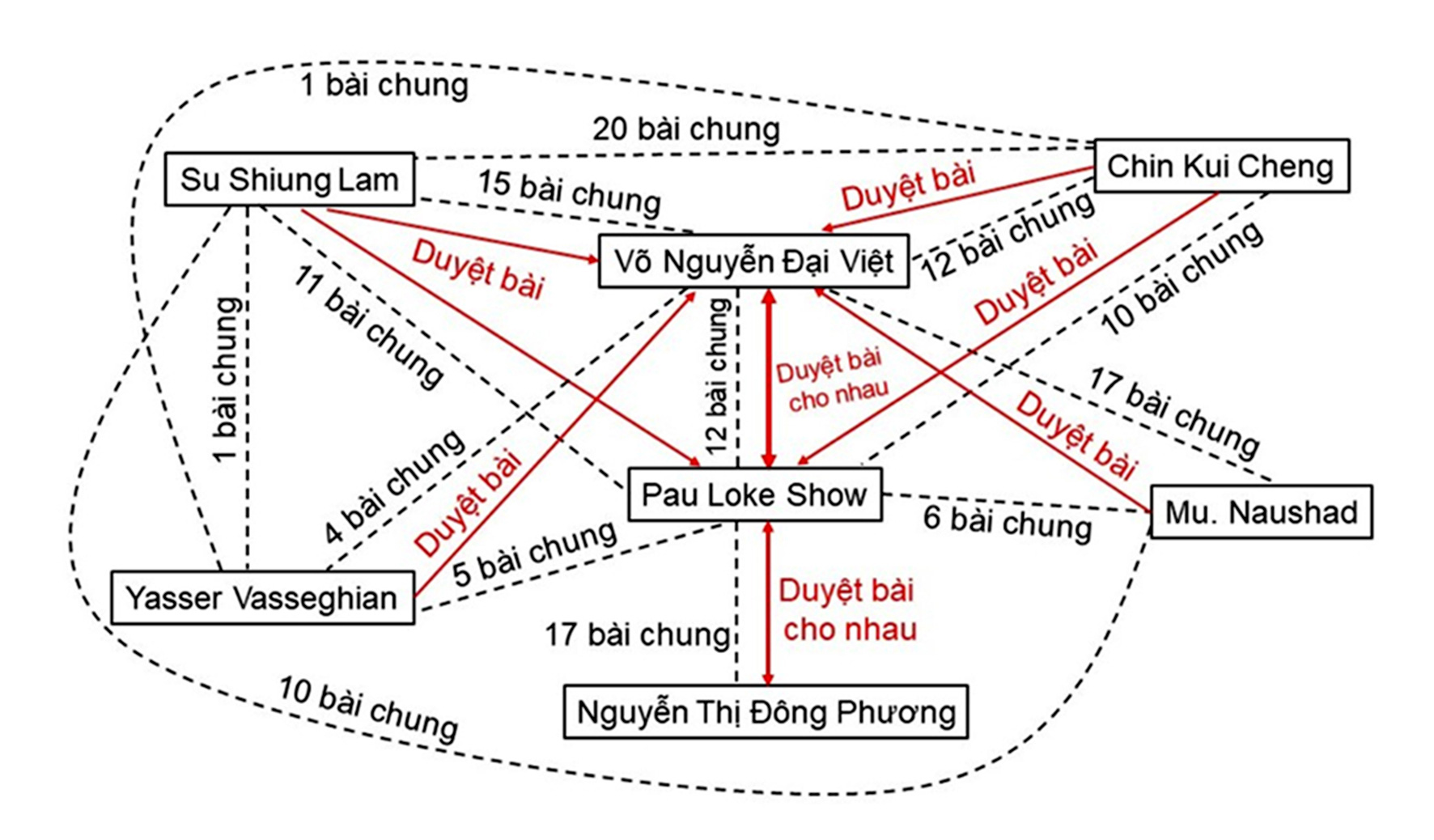
“Dr. Vo Nguyen Dai Viet confirmed that as of June 15, he and Professor Pau Loke Show were co-authors of 12 scientific articles. From 2013 to 2019, Mr. Viet worked at the University of Malaysia Pahang (Malaysia) as a senior lecturer, while Pau Loke Show worked at the University of Nottingham Malaysia.
“Because we are colleagues at the same level and have comparable research directions, Professor Pau Loke Show and I have had a close relationship in scientific research cooperation. We just had our first joint publication in 2020,” Mr. Viet said.”
These people are even proud of their scams.
A follow-up article by Tuoitre from 10 July 2024 interviewed Frontiers PR person Anastasia Long. that indeed Frontiers authors can appoint their own editors and reviewers. And:
“Dr. Vo Nguyen Dai Viet, Dr. Su Shiung Lam and Dr. Pau Loke Show have all been removed from the editorial board of Frontiers in Energy Research journal.
Dr. Viet and Dr. Lam had their names removed earlier this year due to their lack of participation in editorial activities. Dr. Show was clearly informed that he would be fired because of conflicts of interest with authors that he had not declared, as clearly stated in our editorial policy.”
Frontiers speaker also admitted that there was also “possible manipulation of data in the article” in Te et al 2020. Another Tuoitre article from 10 July 2024 addresses the authorship networks in this paper:
“…according to Tuoi Tre’s research, Ms. Nguyen Thi Dong Phuong is a regular co-author of the Pau Loke Show. These two people have shared their names in at least 17 articles before, after and even during the review process of the article that was just retracted by Frontiers Publishing House.
Of the total 21 articles published by reviewer Phuong, up to 80% (17 articles) have the same name as Show. In addition to the articles under her name, Ms. Phuong often reviews Show’s articles. […]
Notably, according to a Vietnamese scholar living abroad, the data in the article by Viet and Show that was just retracted also shows signs of abnormality and is likely fabricated. In the article, experiments 15 to 20 are 6 independent experiments with input variables of the same value for the purpose of evaluating experimental error.
All 6 independent experiments gave identical results, without a single digit difference, from biochar yield to the ratio of each element in biochar.”
Retraction Watchdogging
A shock for Pandey
Mass retractions for the sacked Editor-in-Chief on an Elsevier journal, Ashok Pandey of CSIR in India. He is a noxious papermiller (see PubPeer record) – and a close associate of Pau Loke Show and Jörg Rinklebe, plus other papermillers like Mohammad Taherzadeh and even of Rafael Luque and Changhe Li! See also June 2024 Shorts.
Pandey’s personal website informs us:
“Professor Ashok Pandey is currently Distinguished Scientist at the Centre for Innovation and Translational Research, CSIR-Indian Institute of Toxicology Research, Lucknow, India and Executive Director (Honorary) at the Centre for Energy and Environmental Sustainability – India. Formerly, he was Eminent Scientist at the Center of Innovative and Applied Bioprocessing, Mohali and Chief Scientist & Head of Biotechnology Division and Centre for Biofuels at CSIR’s National Institute for Interdisciplinary Science and Technology, Trivandrum. His major research and technological development interests are industrial & environmental biotechnology and energy biosciences, focusing on biomass to biofuels & chemicals, waste to wealth & energy, industrial enzymes, etc.
Professor Pandey is Adjunct/Visiting Professor/Scientist in universities in France, Brazil, Canada, China, Korea, South Africa, and Switzerland and also in several universities several in India. He has ~1600 publications/communications, which include 16 patents, 108 books, ~850 papers and book chapters, etc with h index of 114 and >57,000 citations (Google scholar).
Professor Pandey is the recipient of many national and international awards and honours, which include Highly Cited Researchers (top 2% in the world), Rank no 1 in India in Microbiology under Enabling and Strategic Technologies sector and No 4 in overall in science and engineering- Elsevier Citation Report (2021); Highly Cited Researchers (h>100), …”
Yogeshwer Shukla’s toxic career of Ayurvedic infusions
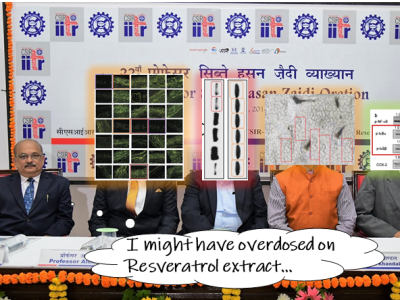
Professor Shukla is a bigwig in Indian toxicology because he uses fresh fruit, tea and curry spices to cure cancer. For maximum effect, his lab resorts to fabricating data in Photoshop.
See how much you can achieve by dedicated and hardworking papermilling. Now, the list of freshly retracted papers coauthored by Pandey, all in the same journal Bioresource Technology:
- “An organic-solvent-tolerant esterase from thermophilic Bacillus licheniformis S-86″ (2009) doi: 10.1016/j.biortech.2008.07.009
- “Hydrolysis of biomass using a reusable solid carbon acid catalyst and fermentation of the catalytic hydrolysate to ethanol” (2015) doi: 10.1016/j.biortech.2015.03.012
- “Genetic modification: A tool for enhancing beta-glucosidase production for biofuel application” (2017) doi: 10.1016/j.biortech.2017.05.126
- “Biotransformation of 5-hydroxymethylfurfural by Acinetobacter oleivorans S27 for the synthesis of furan derivatives” (2019) https://doi.org/10.1016/j.biortech.2019.02.125
- “Lignocellulosic ethanol in India: Prospects, challenges and feedstock availability” (2020) https://doi.org/10.1016/j.biortech.2009.11.049
- “A novel sono-assisted acid pretreatment of chili post harvest residue for bioethanol production” (2016) doi: 10.1016/j.biortech.2016.02.079
- “Genetic and metabolic engineering approaches for the production and delivery of L-asparaginases: An overview” doi: 10.1016/j.biortech.2017.05.057
- “Genetic and metabolic engineering approaches for the production and delivery of L-asparaginases: An overview” (2018) doi: 10.1016/j.biortech.2018.03.127
- “Thermostable xylanases from thermophilic fungi and bacteria: Current perspective” (2019) doi: 10.1016/j.biortech.2019.01.044
- “Pretreatment strategies for enhanced biogas production from lignocellulosic biomass” (2019) doi: 10.1016/j.biortech.2019.122725
- “Valorization of food and kitchen waste: An integrated strategy adopted for the production of poly-3-hydroxybutyrate, bioethanol, pectinase and 2, 3-butanediol” (2020) doi: 10.1016/j.biortech.2020.123515
A recurrent author is a Christian Larroche of Université Clermont Auvergne in France. The retraction notices were all very similar, here is one:
“This article has been retracted at the request of Elsevier’s Research Integrity & Publishing Ethics team and an independent ethics advisor.
A journal-wide investigation identified violations of the journal’s policies on authorship and conflict of interest related to the submission and review of this paper.
Review of the initial submission of this paper was handled by the then journal Executive Editor (Ashok Pandey) and revision required. Upon submission of the revised version, the journal Executive Editor was added as a co-author and the Executive Editor continued to handle the review process, eventually accepting the paper for publication. This compromised the editorial process, and breached the journal’s policies.
This investigation was carried out by Elsevier’s Research Integrity & Publishing Ethics team, independent of the journal editorial board. The findings and recommendations have been confirmed by an independent ethics advisor.
The authors disagree with the retraction and dispute the grounds for it.”
These retractions for Bioresource Technology papers without Pandey as coauthor, reveal something else:
- “Biotechnological applications of inulin-rich feedstocks” (2018) https://doi.org/10.1016/j.biortech.2018.11.031
- “Fabrication of thermostable and reusable nanobiocatalyst for dye decolourization by immobilization of lignin peroxidase on graphene oxide functionalized MnFe2O4 superparamagnetic nanoparticles” (2020) doi: 10.1016/j.biortech.2020.124020
“The former Editor-in-Chief (Ashok Pandey) of the journal was listed as an author on two revisions of the submission of this paper. Although the Editor-in-Chief’s name was removed from the paper after the second revision, he continued to handle the review of this paper and ultimately accepted the paper for publication. This compromised the editorial process and breached the journal’s policies.”
There will probably be more retractions. This by the Editor-in-Thief Pandey and his French buddy Larroche was outright plagiarised (but not yet retracted):
Reeta Rani Singhania, Anil Kumar Patel , Rajeev K. Sukumaran , Christian Larroche , Ashok Pandey Role and significance of beta-glucosidases in the hydrolysis of cellulose for bioethanol production Bioresource technology (2013) doi: 10.1016/j.biortech.2012.09.012

As it happens, Pandey remains Editor-in-Chief of the Springer journal Systems Microbiology and Biomanufacturing. He is accompanied there by his friends Mohammed Taherzadeh (professor at University of Borås, Sweden, see PubPeer record), Christian Larroche, and Anh Tuan Hoang, read about him here:
Elsevier chooses Papermills and Patriarchy, Chief Editor resigns
“Among these candidates that you “vetted” were people with no expertise in the field (either 0 or 1 publication), people with longer PubPeer profiles and more retractions than most people have articles on their CVs, and people whose names appear as authors on sold paper sites. ” – Jillian Goldfarb
Alexander Magazinov notified Springer about Pandey’s retractions at Elsevier, but received no reply.
Obituaries
This witch hunt killed him
Vojtech Adam, once Czechia’s greatest scientist and nanotechnology superstar who almost became rector of the Mendel University in Brno, suddenly died. Extremely young in fact, aged only 42. You can read about the affair of Adam’s cancer theranostics research which ended with research misconduct findings, lab closures, sackings and resignations, here:

Moravian Rhapsody
“Please, can you tell me more about the web page and mechanism behind? Is there any “scheme” of scanning published papers?” asks Professor Vojtech Adam. Yes, it’s Elisabeth Bik.
Here is the obituary, published by Vojtech’s institute CEITEC in Brno on 23 May 2024:
“Our former colleague and head of the Smart Nanodevices research group at CEITEC BUT, an exceptional person, scientist, visionary and a fair man, has passed away. Sometimes in our lives we meet people who appeal to us greatly, who impress us, and Vojta was such a person. He did his job to the fullest, with the highest degree of empathy and consideration for his surroundings. At the same time, he had clear priorities and goals, which he had been gradually fulfilling. […]
A number of his original works are among the most cited works today and arouse considerable scientific interest. In particular, publications from recent years have been published in prestigious scientific journals. This is in spite of several works that have been questioned. Vojta faced these allegations head on and took responsibility for the disputed errors in the figures without hesitation, even though he did not have to, as they did not directly stem from his own scientific errors. This, too, documents his friendly and open nature and his collegiality towards his fellow workers as well as subordinates.”
A CEITEC colleague of Adam’s sent Elisabeth Bik another obituary, with this message:
“He was not behind the misconduct, but this witch Hunt killed him.”
Kind, smart, resourceful and passionate
Also Fazlul Sarkar died, aged 72.
You may recall this former Wayne State University professor with 40 retractions from Retraction Watch. In 2016, two years after his “resignation” from Wayne State, Sarkar famously subpoenaed PubPeer to release the identities of his anonymous critics, won in the first round but failed in the appeal. Retraction Watch also published the investigative report by Wayne State, which ordered those 40 retractions and found Sarkar’s lab guilty of “tailoring results toward specific conclusions, image manipulation, viewing figures and images as merely representative or irrelevant to experimental outcomes, and a reckless disregard of a meaningful use of control groups or control conditions“, of destroying or hiding original data, and of “copying and re-using and manipulating images […] practiced by many if not all lab members.”
Sarkar’s obituary was posted by a funeral company on 6 March 2024. Some Denis Callewaert, founder and CEO of the biotech Oxford Biomedical Research, left this message:
“I was fortunate to know and collaborate with Fazlul for almost 40 years. […] A couple of years later I managed to recruit Fazlul to be the Director of Research at my fledgling biotechnology company. Although he only worked there full time for a year or so – having the desire and talent to work at larger institutions and academia – we continued to collaborate for decades.[…] Fazlul was kind, smart, resourceful and passionate about his research in cancer biology.”
That’s not how almost everyone else remembers Sarkar…
Donate!
If you are interested to support my work, you can leave here a small tip of $5. Or several of small tips, just increase the amount as you like (2x=€10; 5x=€25). Your generous patronage of my journalism will be most appreciated!
€5.00

 For Better Science
it seems bioresource technology is cleaning up some mess! This is not a good sign for future Noble prize winner Pau Loke Show! He worked together with Pandey. More Pandey author – editor conflicts have already been put on pubpeer, others will most likely follow.
LikeLike
I am not 100% sure about this statement: ‘In July 2024, one of the authors left this anonymous message on PubPeer:’
I don´t think it was one of the authors. This alias also critized a pau loke show paper.
LikeLike
‘Krolczyk accused Elsevier of “stealing” from him…’
Even my polish collegues haz lulz. After the hilarity subsided, we discussed irony. What a nice Friday morning.
LikeLike
Tell your Polish colleagues to read Opolska tomorrow!
LikeLike
Can you share the interview here? Or a link? We’ll have a chance to read it.
LikeLike
It was a conversation over the phone rather than a formal interview.
LikeLike
LikeLike
Here is my.rebuttal:
https://opolska360.pl/naukowcy-odpowiadaja-na-atak-rektora-politechniki-opolskiej
Why am I not surprised:
” Marcin Lorenc, the rector of the Opole University of Technology and a recent candidate from the PiS list for the Senate “
LikeLike
https://opolska360.pl/prof-marcin-lorenc-rektor-politechniki-opolskiej-ma-byc-kandydatem-pis-do-senatu
“Prof. Marcin Lorenc, Rector of the Opole University of Technology, is to be PiS’s candidate for the Senate. […]
Prof. Marcin Lorenc assures that the campaign will not interfere with his duties as rector.”
Science is always outside of far right politics,.right?
LikeLike
Marcin Lorenc, by the way.
Comparison of Total Factor Productivity of Rice in China and Japan, by Liting Gao (1), Qianhui Gao (1,*) and Marcin Lorenc (2). Edited by Zhixiong Li and Yongjun Pan.
Legal Challenges in Protecting the Rights of Cruise Ship Crew at the Post COVID-19 Pandemic Era, by by Yanan Yu (1), Marcin Lorenc (2) and Yude Shao (3,*). Edited by Zhixiong Li, Yongjun Pan and Maxim A. Dulebenets.
By the way (RUSSOPHOBIA!!!), Maxim A. Dulebenets:
https://pubpeer.com/publications/73EBBE8FF11AD7DD676BD33C6B4E55
https://pubpeer.com/publications/08CE367D0FA13A0670C019809FE11F
LikeLike
Now it all makes sense. Marcin Lorenc just discovered Chinese papermills thanks to ZX Li. And then we spoiled everything. The man is understandably very upset.
LikeLike
I mean, Lorenc barely publishes. Which is fine. And he’d be just fine without that Chinese shit. But for reasons unknown he decided to accept it. Probably because that was a part of a more extensive kickback from ZX Li for his employment.
LikeLike
And you and your GRU bot Schneider spoiled Lorenc’s plan to become a highly cited researcher. A hybrid attack on Polish science
LikeLike
And it’s very likely that Marcin Lorenc himself is fake, after all! Otherwise, if he is real, what is this in his Google Scholar profile?
https://www.ceeol.com/search/article-detail?id=886309
Summary/Abstract: A man who says his prayers has to firstly well judge himself, his situation,his possibilities and his impossibilities. Only with such knowledge he can take“a spiritual battle” which is the prayer. Each form of conversation with the God introduces a friendly intimacy with Him. People of faith, talking to Creator experience Him, they touch Him up to a merciful unity. A prayer introduces and rises a human being, it means his mind and his heart to the God. Saint Teresa from Lisieux, through her life and her works is showing a way of development of prayer and its meaning for a man indicating at the same time sources from which we can derive during our meeting with the God. These sources are: Word of God, Church tradition and Carmel’s tradition. Saint Teresa from the child of Jesus in this way is modern that she nor in love nor in everyday activities didn’t separate the Earth from the Heaven. She could find a balance, a fulfillment of her life. Teresa is not only a big Saint but also “a model” of dealing for people of our age and her way of living can be sure for everyone because the final aim is the God and our enjoyment having Him in our spirit.
LikeLike
The lengths russian GRU will go to to install a fake bot as a rector of a polish university….
LikeLike
The h-index calculation should be changed to include a reduction for every retraction. I’ll start the bidding at -20 points. With 7 retractions, Pau Loke Show’s h-index would now be -38.
LikeLike
Oh boy and he has some more retractions lined up!
LikeLike
I was a bit surprised to see the Sadrizadeh piece in RW. He seems to be able to understand what is and isn’t ethical from an academic point of view. What I expect from him now is that he and his PhD student Mr. Behzadi, who has an even better profile than him, will practice the same academic ethics that he expects from others and complains about when he doesn’t see it. I think we have a right to expect that now.
He could start by checking how accurate his student Behzadi’s referencing style is in the journal papers written by his name. It is not a very difficult thing to do. Even if he did nothing, if he just reviewed the paper before it was submitted, the inappropriate citations and citation manipulations shown on Pubpeer would not have occurred. I hope he will pay attention from now on. I think we have a right to expect this from Sadrizadeh, who calls on Iraqis to behave ethically.
As for Behzadi. There are three main reasons why Behzadi has even better stats than Sadrizadeh, even though he is still a PhD student. First, as can be seen in Pubpeer, he gives himself a really unnecessary overcitation in almost every article. Of course, this alone is not enough. The second is that he published many articles with Arabkoohsar, who is much more specialized in this business than he is. There are also doubts about how strong and solid the content of these articles is, but so far all that has been done is to follow up on the citations. Arabkoohsar can be called a master of this work alongside Behzadi. Behzadi’s location before Sweden was Aalborg University, where he, like many others under Arabkoohsar, seems to have reached the current statistics with similarly inappropriate citations. The Pubpeer comments show this clearly.
Neither Behzadi, nor the others working under Arabkoohsar, nor Arabkoohsar himself, of course, can reach these statistics on their own. As is evident in many of the articles, these names make unnecessary citations not only to themselves, but to specific names. In return, they earn unnecessary citations. The specific names I am referring to are researchers, mostly in Iran, but also in China and Canada. Of course, I can say that Iranian researchers in other parts of Europe have been similarly noticed in this way in some of their work. One thing is certain, none of the citations are coincidental. I think it is done with mutual interest. An academic article is prepared more like a commercial product than an academic article; “exchange of citations”.
The third and I think the most important one is Pouria Ahmadi, as mentioned in the post. If we can call Arabkoohsar the master of this business, we can definitely call Ahmadi the supreme leader. Arabkoohsar may be the Iranian researcher with the most citations in Denmark in these areas of research for example thermodynamic analysis, thermal systems, energy storage. But next to Ahmadi he is really a junior. Ahmadi’s Google Scholar profile has been closed for a long time. Previously, his position was listed as University of Illinois Urbana Champaign. Then it changed to Tehran University. According to Scopus, Ahmadi has 176 articles, 10513 citations with the h-index of 63. While his GS profile has been closed for a long time, I noticed in the special issue mentioned in the post that his new university is University of Pittsburg at Bradford. When I search his name with his university, I see that his name was announced on the university page on September 20, 2023: https://upb.pitt.edu/posts/news/campus-adds-10-new-faculty-members
However, when I click on his Pittsburgh profile on Google, the page automatically redirects to the general faculty page: https://upb.pitt.edu/academics/mechanical-engineering-technology-bs-faculty . His name does not appear there either. Maybe I couldn’t find it, or maybe Ahmadi is no longer in Pittsburgh. But in the Elsevier special issue, he is still affiliated with Pittsburgh.
All this shows that there is a very huge network. It can be seen just by tracking citations. It probably provides more to its members than citation and paper inflation. But we don’t know these things because they are not recorded like citations and articles.
LikeLike
I have been surprised, many times, about whom RW gives the proverbial megaphone and features prominently. No doubt, there’s an agenda to maximize clicks and likes. So, this kind of superficial reporting is common. Happy to see FBS getting to the heart of the matter, and cutting through the bullshit.
LikeLiked by 1 person
I agree with that. With all due respect to the mission they have, they cover these stories so superficially that they can forget to dig into the names that are being highlighted, as you mentioned. Most of the time they tell the news in a superficial way without telling the back story, which has a negative impact. For example, in the case of Afrand, they only shared texts as an update, but we got the most detailed information about Afrand and Arjmand cases from FBS.
In the current case, we read Sadrizadeh as an ethical figure, which was really surprising. For example, Sadrizadeh liked the RW post from his own account. He was probably proud of it too. I expect him to give similar credit to FBS.
LikeLike
Thank you very much.
Ivan Oransky is a member of the PubPeer advisory board. I humbly suggest he starts using PubPeer.
LikeLike
Regarding the crooked Pouria Ahmadi (A person who knows no shame):
https://pubpeer.com/publications/6B2894A2D030DFAA6F0C87FB662A16
https://pubpeer.com/publications/B509A67333AE32AF2B4E6FAD84D5AF
LikeLike
Very good catch! Many names do the same thing. This is exactly the way Behzadi, Arabkoohsar and many other names I have not mentioned above, but I have come across in many articles! It is exactly the same! They wrote a sentence. This can be a very general sentence. For example “water boils at 100 degrees” or “energy consumption and human population are increasing every day”. Then they define this sentence with one or two references. Or they cite specific studies as references when defining basic thermodynamic formulas. I don’t know if they do this with the help of software, but they definitely do it deliberately. We come across very ridiculous references. And sometimes, as you give an example, the reference mentioned in the text does not match the reference given in the bibliography.
Yes, it is a sickening stupidity, but this stupidity should normally be stopped by the reviewer or editor. But we don’t see it! How can such ridiculous references be overlooked? Or do the editors not want to deal with these things? At the end of the day, this citation trade is getting to the point where these names can become editors of prestigious journals. I have no idea how to overcome this.
LikeLike
RE: “Very good catch!” …
Just for further information; it might be surprising that these guys have (sometimes) published some translated papers which were previously published in (( Persian language )) in some (their) domestic pseudo-journals!
LikeLike
I wouldn’t be surprised. Their most common method I came across is to simulate imaginary and fake systems with supposedly very simple models and publish them in journals with high impact factors. I have no idea how these publications are evaluated and accepted, but I have a lot of doubts.
LikeLike
Well … An example this unpleasant situation is happening by the crooked Editor-in-Thief of Sustainability/MDPI whose name is “Mark A. Rosen” who is well-connected to the papermillers and collects illegitimate money from those authors/papermillers and accepts papers for publication even without peer-review. Please see the below examples.
The main actor (i.e., papermiller) in these dirty games is “Afshin Davarpanah”:
https://pubpeer.com/publications/F5DD5E555BF4079D437E854EA91533
https://pubpeer.com/publications/C32FBCFD118FB13A0291FB6509CC99
https://pubpeer.com/publications/0CDCB2AE2C5916CE5789987A4BAA4B
LikeLike
You hit the bull’s-eye! Dincer’s name is mentioned in this post along with Ahmadi – which is true – but even though Marc Rosen has fewer citations and h-index than Dincer, Marc Rosen is way ahead of Dincer when it comes to Iranian papermilling activities. He is still active with Iran papermilling not only in papermilling activities but also in editorial board activities and conferences as you mentioned. Even this so-called review piece published in 2020 shows that Rosen is the leader in Iranian papermilling with the fake citations he received: https://scholar.google.ca/citations?view_op=view_citation&hl=en&user=gWt3wuUAAAAJ&citation_for_view=gWt3wuUAAAAJ:-qpA3cGbmHsC
The method and strategy is the same in Rosen’s work. The only thing that has changed is the names of the Iranian researchers! And yes, Sadrizadeh and Behzadi are just two of them. Through Ahmadi of course! https://pubpeer.com/publications/E8014394D78C2EDBB7DC1B7D30A91C
I had convinced myself that Rosen was whitewashing the Iranian papermilling business, but I did not know this part: “…who is well-connected to the papermillers and collects illegitimate money from those authors/papermillers…” That’s something interesting!
LikeLike
“I had convinced myself that Rosen was whitewashing the Iranian papermilling business, but I did not know this part: “…who is well-connected to the papermillers and collects illegitimate money from those authors/papermillers…” That’s something interesting!”
Thanks for your informative feedback! Rosen (or the other crooks of his type) won’t do any favor to anyone for “free”, of course…
The sad story behind all these is the fact that they have a well-established network of the employed professors (mainly in the Northern America – US and Canada – also in AU) in which, they manage to get (unreasonable) graduate admissions for some selected idiots with no known qualifications to migrate from East to West!
M. A. Rosen (within Ibrahim Dincer, and two other known criminals) is heading one of those circles actively (Just heard about 10 to 50 thousands dollars per each study permit and so on) …
LikeLike
Thanks for your informative feedback! Rosen (or the other crooks of his type) won’t do any favor to anyone for “free”, of course…
The sad story behind all these is the fact that they have a well-established network of the employed professors (mainly in the Northern America – US and Canada – also in AU) in which, they manage to get (unreasonable) graduate admissions for some selected idiots with no known qualifications to migrate from East to West!
M. A. Rosen (within Ibrahim Dincer, and two other known criminals) is heading one of those circles actively (Just heard about 10 to 50 thousand dollars per each study permit and so on) …
LikeLike
I know that there are too many Iranian researchers in technical fields in almost every university in Canada to be explained by “diversity and inclusiveness”, and that every Iranian researcher who has an academic position wants to hire only Iranians in their team and that they will go to any lengths to do so. In addition, I have also noticed that they do similar processes in Australia, where they give priority in recruitment to as many Iranians as possible in every university they are involved in. Finally, I have also noticed that they do similar processes in Europe, especially in the more wealthy European countries (such as Denmark) after a few months of follow-up. This alone shows that they have a very strong nationalist mentality wherever they are in the world and they don’t hesitate to bend the rules to achieve this. And yet, I have not seen the authorities in Canada, Australia or Europe reacting to this ever-increasing clamor, which is now seriously damaging academic funding. Everyone prefers to remain silent in the face of this Iranian nationalism.
But what you are talking about here is more interesting. If, as you say, professors are really charging between 10 and 50 thousand dollars to accept students from Iran, it shows that there is a much more serious problem. Because those who pay 10 to 50 thousand dollars to be a PhD student in universities can pay even more to be a postdoctoral researcher. And even more to get an academic position. Apart from Canada and Australia, they can also pay to get involved in Western academia through prestigious projects like HORIZON and MSCA for the EU. And once they get academic positions, they can make the same trade for themselves as I mentioned above and prioritize hiring researchers only from Iran. As sickening as it may be, the trends in Canada, Australia and Europe make me think that this idea is not too far-fetched at the moment.
And at some point, not only individuals but also the dirty regimes themselves can make these payments and place their own people in the universities they want. It may not be possible to monitor this monetarily.
And while all these possibilities come to mind, they can also engage in a separate commercial exchange to get so many garbage publications published in high impact factor journals.
LikeLike
Your comments are well respected, and heartfelt …
One may guess that it is also concurred to say “Iranian governmentalism” next to the “Iranian nationalism” …
Haven’t said that part of the “bribe money” goes to some of the domestic (US, CA, AU, and EU) university staff who are working in “Graduate Admission Offices” (including the Head of the Departments in Schools) or even in “ISSOs (International Students and Scholars Office)” who deal with the necessary fabrications (i.e., paperwork, etc.) to “Zip their Mouths” …
Very sad story / All about collusion(s) …
LikeLike
I am not surprised by Behzadi’s past experience in Aalborg Denmark , nor by his high citations and h-idex. I understood that these things were somewhat organized, but I am very surprised that such a large commercial market, from PhD admission to papermilling, and even from what I read here, possibly from postdoctoral researcher to faculty member, is managed from Iran. Just wow… When I look at the amount of money circulated, I feel sorry for every researcher who does their job properly and goes home late.
LikeLike
I don’t think the student offices in Canada know about these things in detail because usually the job advertisement is prepared by the faculty member and the applications are collected through the department secretariat. The professor interviews the people he/she wants and then selects the ones he/she wants (this is where the points you mentioned may come into play). I don’t know how these processes work in places other than Canada. If they are part of this kind of money flow from Iran, they probably know that their lives will not be so easy when this is proven. But these rumors are really very interesting for me. Thanks for all details!
LikeLike
“But these rumors are really very interesting for me.”
“Rumors” and/or “Citations Exchange”!
Thanks as well…
LikeLike
Ashok Pandey has now several papers tagged on pubpeer for editor-author conflicts. He also works together with a former co-EIC from Bioresource Technology: Huu Hao Ngo!
Check it out yourself:
https://pubpeer.com/publications/159D7D591DFDB2E2540DB2F86A847B#1
https://pubpeer.com/publications/AA0785B1A9BB507C935890F2E160B3
https://pubpeer.com/publications/BA778E651C762748241C26FC5A88E5
https://pubpeer.com/publications/B34D4706787FD976CA02EC73239122
But Pandey also has other paper mill friends edit his papers:
https://pubpeer.com/publications/740109B457D8DBB9F3B54233086CD5#1
https://pubpeer.com/publications/9A2F88844DE9D997313313B6E38D4F
https://pubpeer.com/publications/D8AF921786D9B0DE5A155541F69D74
https://pubpeer.com/publications/AC0D6C33109F8858B93629DFF5E879
LikeLike
Interesting that 2 more PI fraudsters (or, more likely, had a lab full of fraudsters) have died, probably earlier than they anticipated. Seen this happen with others accused of fraud, and individuals that get “cancelled” (Thomas Hudlicky in Canada). Conclusion: In science, crime pays, unless your caught, and then it may greatly shorten your life, especially if you have an administration go after you.
LikeLike
Just to set something straight, the last paper in your list regarding A. Pandey does actually not include A. Pandey in the list with authors! His name was added during the review but then removed afterwards; kinda weird no? This one: “Valorization of food and kitchen waste: An integrated strategy adopted for the production of poly-3-hydroxybutyrate, bioethanol, pectinase and 2, 3-butanediol” (2020) doi: 10.1016/j.biortech.2020.123515
LikeLike
Ashok Pandey is all over the news in India: https://www.thehindu.com/sci-tech/science/12-papers-involving-a-scientist-from-csirs-indian-institute-of-toxicology-research-retracted/article68399826.ece
LikeLiked by 1 person
Likewise, the paper-miller Mohammad Taherzadeh (Ashok Pandey’s shadow puppet) will be all over the news in Sweden and IRAN as well …
LikeLike
Oh my, I just realized, he is also an editor here: https://link.springer.com/journal/43393/editors , look who the EIC is!!! Ashok Pandey! And there are other names of paper mill authors and fraudulent editors, eg Eldon R Rene and Gopalkrishnan Kumar !
LikeLike
Ashok Pandey has now 35 (!!) retractions in Bioresource Technology. He officially entered the retraction watchlist leaderboard! (well they still need to add the retractions, but in total he has 37 retractions now). Check his 35 new retractions in BITE here: https://www.sciencedirect.com/search?qs=Retracted%20Ashok%20Pandey&pub=Bioresource%20Technology&cid=271433
LikeLike
We had a zoom meeting with Ivan Oransky last week. It was one-way, he only was interested in himself. But he told us that RW Retraction Database is operated fully manually. His secretary types in each retraction.
LikeLike
Yeah, I figured it had to be something like that. I guess they just add them in batches (every X weeks or so). I wonder if one could more automate it.
LikeLike
Ivan sold the RW database brand to Crossref, guess they will automate it eventually. And then close access.
LikeLike
Wonders will never cease! 16 July 2024 Editorial Expression of Concern for 2001 Br J Haematology paper!
https://onlinelibrary.wiley.com/doi/10.1111/bjh.19641
LikeLike
Dear Leonid,
Concerning Polish science elites it seems that recently I have “located” one more hero https://www.scopus.com/authid/detail.uri?authorId=36660612600 plus https://tinyurl.com/mvvtek4u who reminds Krolczyk – appeared out of nowhere, around 2017, publishes on everything…
Always yours, love the blog, xxx
LikeLike
Thanks! Alex Magazinov immediately found this Boczkaj paper, stricken by The Vickers Curse:
https://doi.org/10.3390/molecules27186112
https://pubpeer.com/publications/223DF757F1B2B3DD18C56243B55A0F
LikeLike
Sasan the research ethics warrior continues his show on LinkedIn. This part is especially amazing: “This situation highlights a VERY important fact: when you challenge #misconduct, #fabricated_papers, #authorship_for_sale schemes, #citation_trading or #citation_manipulation, the response would be whatever to silence you.“
Hello Dr Sadrizadeh, do you know that there is someone in your research group who does the dirty work you condemn on social platforms? I think you should definitely know because your name is on those articles too. Moreover, you are organizing special issues with papermill researchers like Pouria Ahmadi. Isn’t it a bit strange for you to be advocating research ethics?
There are two possibilities: one, we are witnessing the battle of two different papermill clans and Sadrizadeh is trying to use his position and networks in Europe to secure himself. The second is that Sadrizadeh or his supporters Behzadi and Ahmadi are aware of this post on FBS and are trying to play the victim card against a possible report to the KTH by creating fake profiles of their own in advance.
Whichever it is, this brazenness is nauseating. What are you trying to teach people a lesson when your PhD student has accomplished all the things you condemn with great skill and has more citations and h-index than you.
LikeLike
Shit gambit it is called. When your lower-level papermillers (Qusay H / Reza A-S / Patrik V) are toast, you can join beating them and shout “RESEARCH INTEGRITY!!!111” as loud as you can.
LikeLike
I agree, that’s exactly what they do. I just revisited the comments about Sadrizadeh on Pubpeer, for example, and it seems that I don’t know how much the people in charge at KTH read the FBS, but Sadrizadeh and people like him probably check it every day.
He probably deflected the concerns by inserting the RW link in most of the comments about him after his name was mentioned in the FBS. They are well aware of the questionable activities he and his highly successful PhD student are doing and when this is exposed they try to play the victim card instead of responding on Pubpeer. In short, they don’t respond to the allegations and concerns and say “they are deliberately attacking us because we fight for research integrity”.
Well played.
LikeLike
Sasan is stunning! In one of his latest posts you can see Sasan’s relentless battle against the papermill industry! He’s really unbelievable. The professor, who collaborates with papermill researchers and will graduate a papermill researcher as a PhD graduate in his own lab, is virtue signalling on his LinkedIn page. Good luck Sasan, I hope you have won the favour of your nordic colleagues. In case you’re worried, please don’t be, they won’t kick you out no matter what scam you pull.
He’s talking about a rabbit hole. It shouldn’t be hard for Sasan to find a rabbit hole, maybe starting in his own lab?
Of course, it should be noted that we can all follow the adverts in the pictures he posted because they are all in English. Sasan, maybe you could help us with the Persian papermill adverts, have you ever thought about that?
Another update: Ahmadi, whose affiliation with the University of Pittsburgh is listed in Elsevier special issues and on journal editorial boards, is not actually in Pittsburgh. He probably started there, but whatever happened, he continues his academic trade, sorry, academic research at the University of Tehran. He’s finally made his Google Scholar profile visible again. The affiliation on his latest papers is Tehran University.
LikeLike
Sadrizadeh spoke to RW again, or RW went to Sadrizadeh again. Thanks to RW for at least sharing Behzadi’s problematic Pubpeer profile this time. Although there are different adventures of Sadrizadeh and his elite group in the post, I would like to focus here on the part about Behzadi.
While Behzadi declines to respond to RW’s allegations, Sadrizadeh vigorously defends him, and is really pushing the limits.
I am grateful to Sadrizadeh for teaching us about self-citation data in Web of Science and Scopus. However, Sadrizadeh is doing a blatant manipulation here. Yes, Behzadi’s self-citation percentage is low because they do the citation trade in a more professional way, citing each other as a group, mainly Iranian researchers in Iran, Denmark and Canada. Thus, while the self-citation percentage of each profile is low, the overall citation numbers are high. According to Sadrizadeh’s approach, since both Omid Mahian and Pouria Ahmadi have low self-citation rates in Web of Science, we cannot accept these two famous papermill names as papermillers. Yeah, well, that solves the problem. The problem of papermill and citation trade in academia has been solved thanks to Sadrizadeh’s clever approach. Everyone can sleep soundly. By giving these two names as examples, I hope I have shown how absurd Sadrizadeh’s answer is.
Moreover, the fact that the comments on Pubpeer about Behzadi mention self-citation does not change the fact that Behzadi is part of a problematic citation trade. The author at Pubpeer could have just as easily listed Iranian scholars who unnecessarily cite Behzadi. Perhaps he will do so in the future.
Another manipulation by Sadrizadeh, who is a professor at a KTH level university, is that he tries to cover Behzadi’s manipulative method of self citation with a validly reasoned approach to self- citation. This is not good. A KTH professor cannot engage in such a simple manipulation to protect his own student when even his student refuses to speak.
Yes, there are places where self citation is valid. Sadrizadeh defines it well. However, what Behzadi does, as can be seen in the Pubpeer comments, is to define even the basic laws of thermodynamics and the basic terms derived from those laws by referring to his own work. How can Sadrizadeh tolerate such a manipulative approach and try to cover it up?
As unethical as Behzadi’s actions are, Sadrizadeh’s innocent characterisation of this case is equally unethical. I want to repeat, why does Sadrizadeh insist on defending this case with such ridiculous statements when even Behzadi refuses to talk about it?
LikeLike
“Moreover, the fact that the comments on Pubpeer about Behzadi mention self-citation does not change the fact that Behzadi is part of a problematic citation trade. The author at Pubpeer could have just as easily listed Iranian scholars who unnecessarily cite Behzadi. Perhaps he will do so in the future.“
Didn’t even need to write that part. Because in this example it can be seen Behzadi’s unnecessary citations to himself in Pubpeer, as well as his unnecessary references to his colleagues in the citation cartel I mentioned. This is just one example. There are many similar examples that are in Pubpeer and have not yet been included in Pubpeer.
With these and similar methods, the number of self-citations is kept low while the number of general citations is increased. There is no way Sadrizadeh does not know this. He can see this by looking at the citation trends of his colleague Pouria Ahmadi, with whom he publishes special issues.
LikeLike
RW sure loves this guy’s LinkedIn and promoting him. I guess that’s their narrow “window into the scientific process”. Will he become their latest featured “sleuth”?
Maybe I’m stupid or the reporting convoluted and incomplete (wouldn’t be the first time), but … what exactly is going on here? Some low-level scammers’ paper got withdrawn by Elsevier and that started a coordinated online attack on the LinkedIn guy? Forgive my incredulity but that’s a lot of work for a low-level scammer who likely has already republished the withdrawn plagiarized paper in another Elsevier “high impact factor journal”. Why would the plagiarizing scammer bother with these convoluted domain-name machinations and emails? It seems I’m not the only one confused.
What are other possible explanations? We could speculate. Could it be that due to the story’s publicity, the LinkedIn guy’s papermilling coauthor was highlighted, and now the papermill is upset about the attention this is getting? Could it be that the check from the LinkedIn guy’s papermilling coauthors to the paper mill bounced and they’ve sent the collections team to break a few kneecaps? Reminds me the papermill blackmail story reported on FBS.
LikeLike
There’s a third theory that some professors start trolling themselves with their own sockpuppets to play victim.and avoid scrutiny of their own research.
Stand with Joe, I say.
LikeLike
“Forgive my incredulity but that’s a lot of work for a low-level scammer who likely has already republished the withdrawn plagiarized paper in another Elsevier “high impact factor journal”. Why would the plagiarizing scammer bother with these convoluted domain-name machinations and emails?“
I have the same question. That case is certainly suspicious. I agree with Schneider’s theory. They may be trying different ways to portray themselves as innocent and victimised. I wonder what the next cause of victimisation will be. I guess we’ll have to wait for RW’s next interview.
LikeLike
Let’s update with some good news! Energy KTH proudly presents! The renowned paper miller Behzadi successfully defended his PhD thesis and graduated. Although he was bullied by some insolent individuals who called themselves sleuths during his doctoral studies, he was successfully graduated by Christophe Duwig, holy protector of the oppressed Iranians, and Sadrizadeh, who tolerates whatever Behzadi did. So, another Iranian papermiller can now continue to trade papermill freely with a label from Swedish academia. Want academic ethics? Go elsewhere! Leave Duwig’s oppressed Iranians alone! Even if you don’t leave them alone, Duwig will always be there to face you.
This is all for you to keep in your minds: these oppressed people suffered a lot in their life so they can messed up things however they want and support each other from different parts of the world! No one can dare to touch them while Sweden’s true white men around!
LikeLike
I am surprised that Ahmadi’s papers have not been reviewed more carefully by the journals. Many of the publications appear substantially similar, with a consistent pattern of self-citation. There also seems to be a citation network among a group of collaborators who regularly cite each other’s work.
LikeLike
Ahmadi is the leader of the team. His sister (Kamilia Ahmadi) and brother in law (Ahmadreza (Farzin) Ghaffarizadeh) are both computer engineers. They developed a code for optimizing thermodynamic systems for him and he has used that code over and over again and written lots of papers. All papers are similar. He has created a team and they all write papers on the same topic “optimization” all citing each other. It started back in Iran when he was doing his masters degree in Iran University of Science and Technology. I am surprised that journals keep accepting and publishing his papers. I know some names in his team: Mehdi Aliehyaei (M.A Ehyaei), Shoaib Khanmohammadi, Hasan Barzegar Aval. I have also heard that Pouria A. and H. Barzegar Aval did add coauthors in exchange for cash in 2010-12.
LikeLike
Behzadi’s European adventure seems to have come to an end. But don’t worry! it didn’t end badly. On the contrary, everything is going wonderfully for Behzadi. This brilliant recent Ph.D. graduate, whose current Google Scholar profile lists 3363 citations, may not have been able to secure an academic position in Sweden due to the news surrounding him, but it appears he will continue his academic career in Singapore with the prestigious Wallenberg Fellowship, thanks to the Iranian lobby supporting him in Sweden and Swedish figures connected to them. At least for now.
Once again, we see that the problem isn’t committing academic fraud. The problem is failing to find influential Swedish and Scandinavian figures to back you up when you do commit academic fraud. As long as you have the Swedish academic community supporting you, no matter how massive the fraud you commit or how widely it’s exposed, you’ll always be protected.
LikeLike