
Some days ago, Retraction Watch and Science reported about the investigation by Nick Wise into the online dealings of two papermills, one Chinese and one Jordanian.
This is Nick’s guest post on For Better Science about these papermills and the criminal “scientists” they work with. With evidence of papers and authorships being bought and sold, and of editors and reviewers openly asking for bribes. Submitted papers get accepted right when the money is paid. The publishers caught cooperating in this million-dollar-heavy scam are Elsevier and Wiley. Even if a few publications are retracted, hundreds more get published to replace them. A system which can’t be fixed anymore.
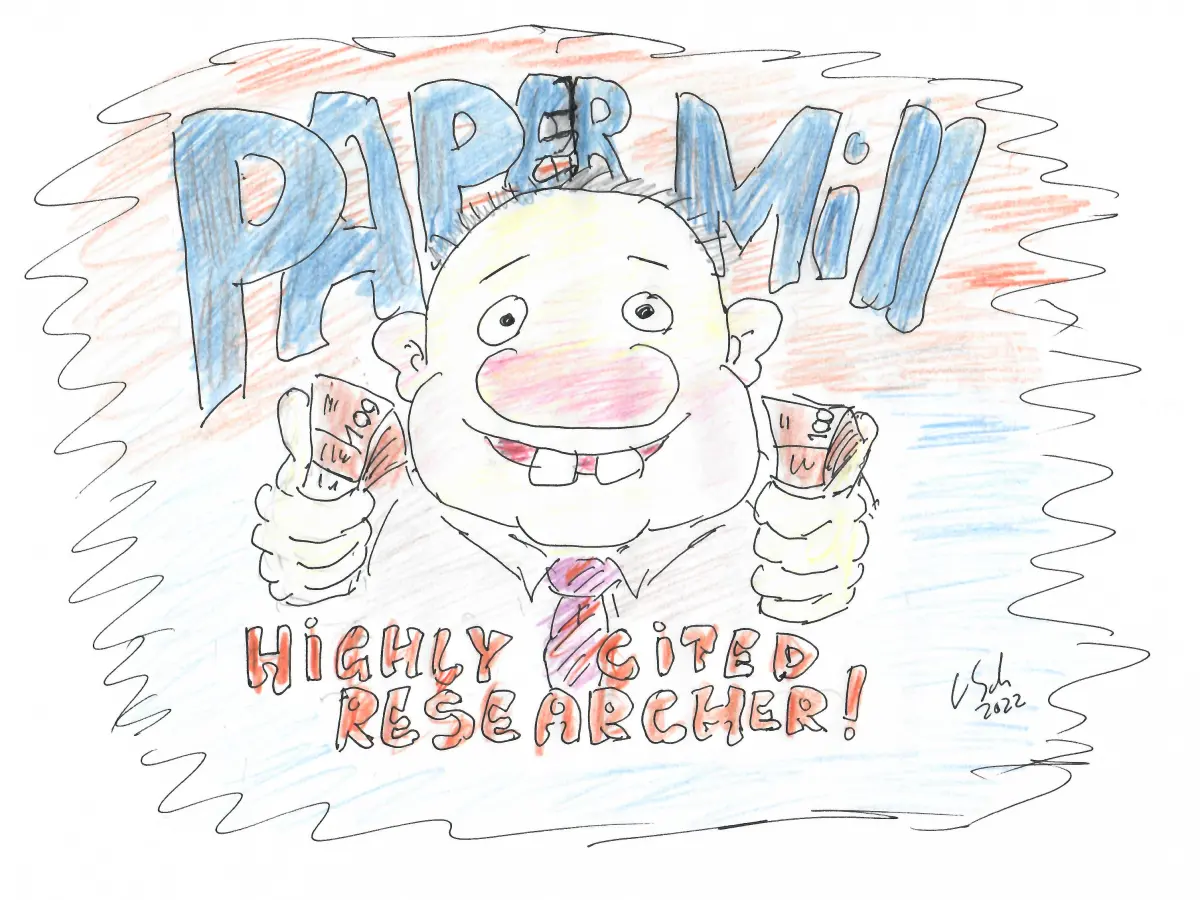
You will be paid US $500-800 for each paper
“Or The author can also put your name to the article to increase your academic popularity, such as adding your name to the second or third author.”

Bribery of journal editors, from China to Jordan
By Nick Wise
Part 1: Olive Fruit Academic
Olive Fruit Academic is (or perhaps was) an academic publishing services company in China. The post introducing themselves on the 21 January 2021 included the following statements:
“Kuaiban has established a deep cooperative relationship with nearly 500 publishing houses at home and abroad, is familiar with the review process of the periodical department, and provides free guidance to cooperative customers;
[translated from Chinese]
For the journals that cooperate with fast publication, the Journal Department provides priority review and priority publication services;
Everyone is welcome to contribute and cooperate.”
As we shall see, what they mean by “a deep cooperative relationship” is bribery.
The company needs to find collaborators of course, and one employee, ‘Jack Ben’, posts on Facebook with that aim.
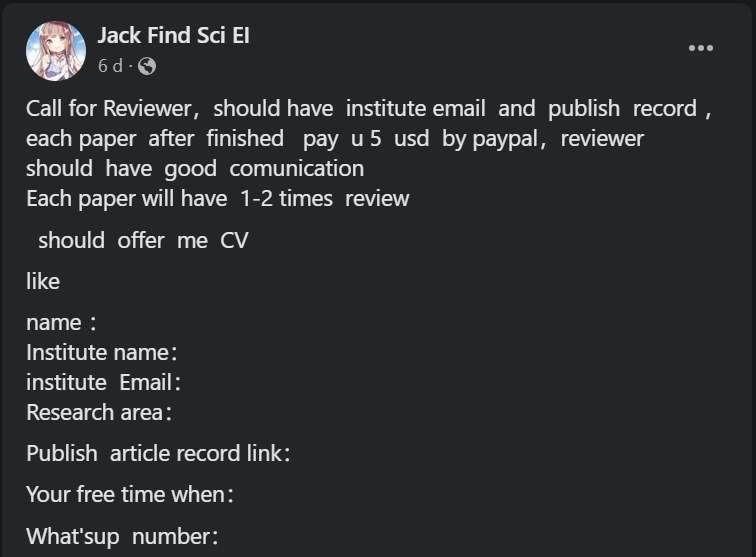
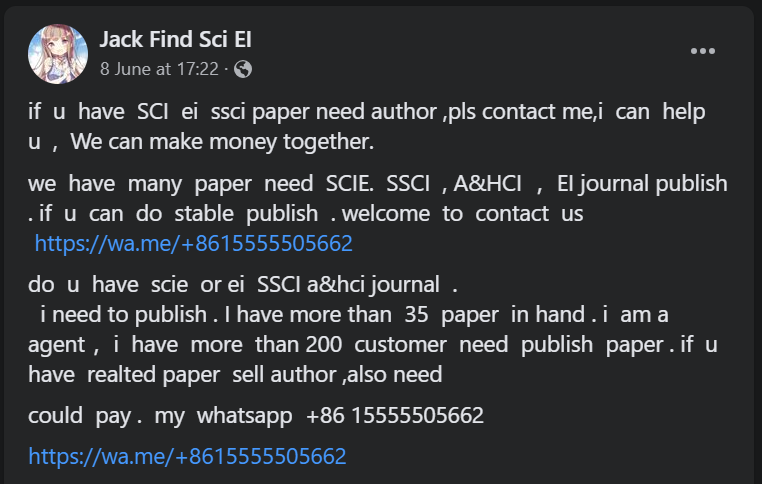
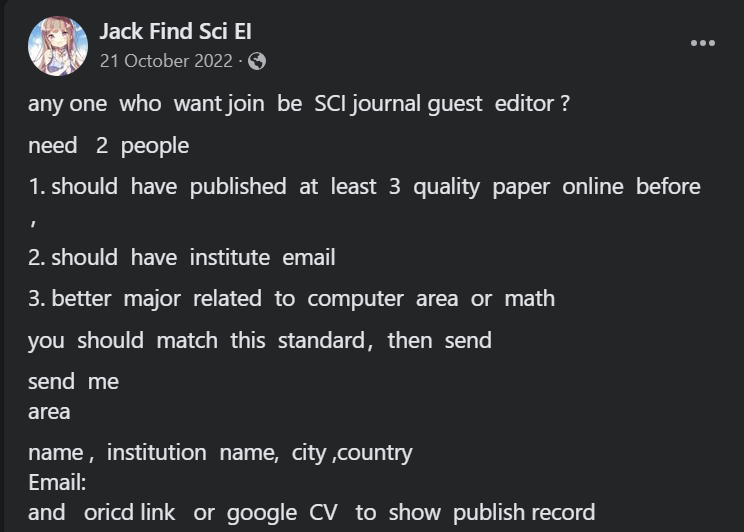
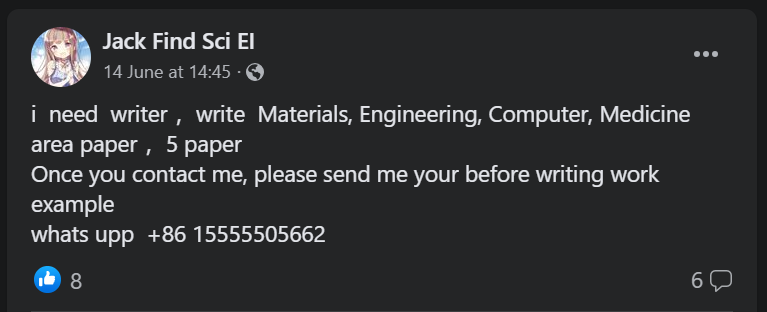
These posts include invitations to writers to provide manuscripts, to authors of papers to sell authorship slots, to current journal editors, potential guest editors, and peer reviewers, whom they are willing to be pay $5 per review. The papermillers know that guest editors and peer reviewers need publishing records and institutional emails to appear reputable.
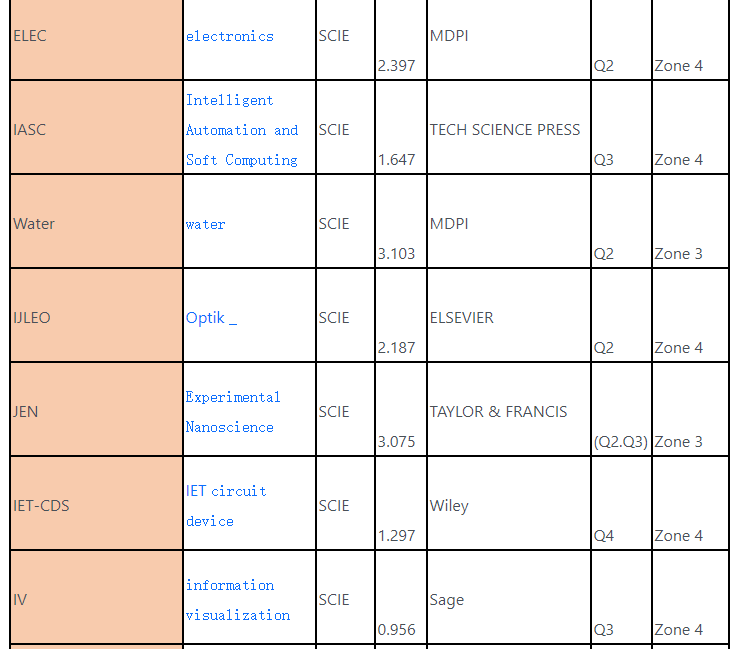
According to the Olive Fruit Academic website, they have had a lot of success in finding collaborators. They posted a table on 30 November 2022 naming around 150 journals (though there are many repeats) which they claim to collaborate with, i.e. the papermill has cooperative editors there. There are journals from every major publisher as well as some smaller ones. Note that some of the journal titles are slightly incorrect as a result of being translated from English to Chinese and back.
The company sometimes solicits authors to submit papers on Facebook as well. Jack Ben posted a call for 100 papers in a Hindawi special issue in the Hindawi journal Scientific Programming, titled “Nonlinear Prediction Systems for Data from a Complex System“. Let’s have a look at this special issue, which has 11 articles and has so far survived Hindawi’s mass retractions.
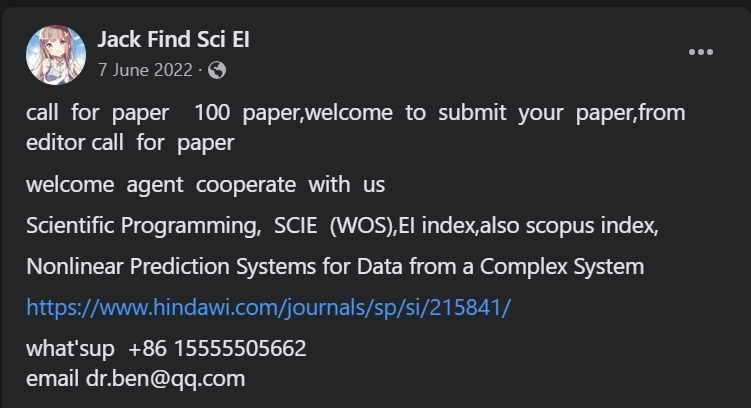
The post was made on 7 June 2022, well before the close of the special issue’s call for papers on the 14th of October. The issue’s lead editor was Wang Jianxing of Chongqing Jiaotong University and the guest editors were Marvin White of Southern University, Louisiana and Yixin Zhou of Shanghai Business School.
There is no one with the name Wang Jianxing listed on Dimensions, however there is a Jianxing Wang at Chongqing Jiaotong University, whose only 3 published papers are in Hindawi special issue’s from last year (all retracted). The email given for ‘Wang Jianxing’ is 631418040232@mails.cqjtu.edu.cn, for which this special issue is its only appearance.
Marvin White’s email address is, somewhat surprisingly, marvin.webb@sus.edu. No one with the name Marvin White or Marvin Webb has any online presence at Southern University, Louisiana and I do not believe Marvin White (or Webb) exists. However that has not stopped him authoring 3 (now retracted) articles in Hindawi special issues. One, in Hindawi’s now deceased Healthcare Engineering, was in a special issue edited by Osamah Ibrahim Khalaf, Malik Alazzam and Kingsley A. Ogudo. Khalaf is directly responsible for 295 and Alazzam for 37 of the papers retracted by Hindawi according to the spreadsheet. The second retracted paper for the fictional Mr White/Webb was in a special issue led by Fahd Abd Algalil (200 retracted papers), and the third features Malik Alazzam as an author and is in a special issue led by Fazlullah Khan (61 retracted papers).

Hindawi Garbage Sorting System, Based on Citations
Parashorea tomentella continues their investigation of Hindawi’s uneasy collaboration with Chinese papermills. Can it be solved with the promised 511 retractions?

Yet Yixin Zhou of Shanghai Business School does appear to be a real person. However, the email address given, treetq@163.com, is the same as the one previously given as the contact email for Olive Fruit Academic on its website. I think it is reasonable to conclude that this special issue was organised entirely by the company. Only Hindawi can see to what extent the editors bothered to pretend that any peer review ever happened.
Jack Ben also requests help publishing specialised papers, presumably if there is no suitable journal candidate in their current list of cooperative journals. On 25 February 2022 he provided the title of one such paper, “Research on Laser Ultrasonic Propagation Characteristics and Quantitative Detection of Delamination of Carbon Fiber Composite”.
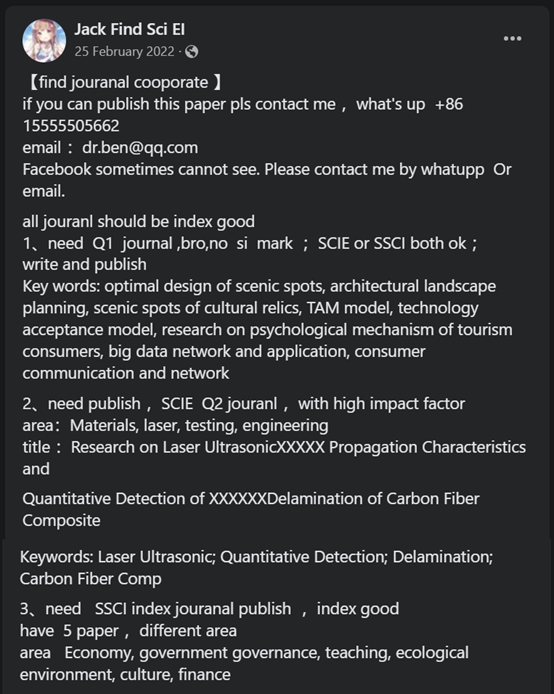
On 4 November 2022, a paper with that title was published in Elsevier’s Optik, and afterwards Optik featured in the table of cooperating journals published on 30 November 2022.
Hong Zhou , Feng Gao , Peng Gu Research on laser ultrasonic propagation characteristics and quantitative detection of delamination of carbon fiber composite Optik (2022) doi: 10.1016/j.ijleo.2022.170173
When Olive Fruit Academic started posting their offers on 21 January 2021, they posted many titles available for authors – although they seem to have stopped now. Post 2 on the website is for just one single paper:

A paper with this title was published on the 1st of August 2021 in Ingenta’s Materials Express:
Xiangyong Cheng , Lan Zhang , Xiqing Liu , Liangpeng Xu , Junjie Liu Folic acid mediated cisplatin magnetic nanodrug targeting in the treatment of oral squamous cell carcinoma Materials Express (2021) doi: 10.1166/mex.2021.2036
Post 6 from the same day is for 27 papers, 12 of which match published papers. These are mostly in Hindawi SI’s but there are also a few in Elsevier, Springer and Francis Press journals. NCA is Springer’s Neural Computing and Applications, though I can only find one title that was published there.
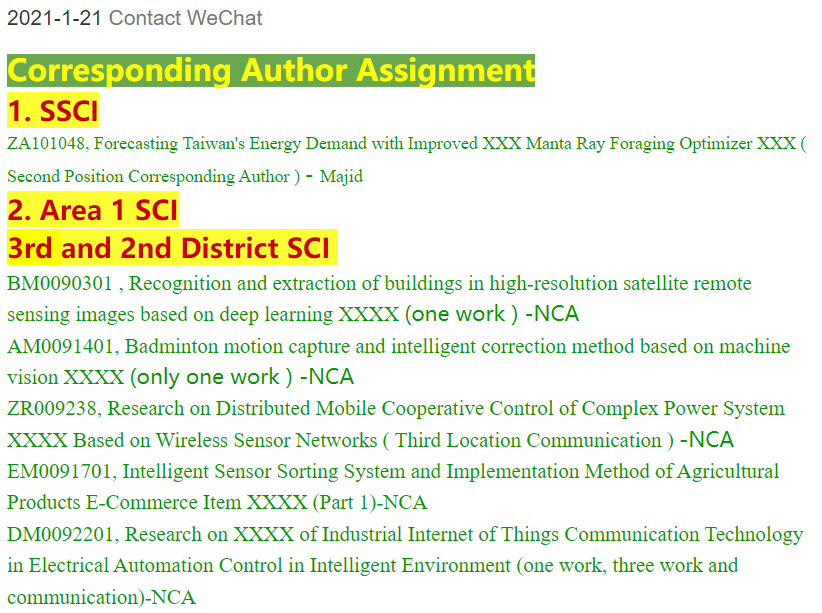
| From post 6 | Matching paper | Journal | Publishers | Notes |
| BM0090301 , Recognition and extraction of buildings in high-resolution satellite remote sensing images based on deep learning XXXX (one work ) -NCA | Yifu Zeng , Yi Guo, Jiayi Li Recognition and extraction of high-resolution satellite remote sensing image buildings based on deep learning Neural Computing and Applications (2022) doi: 10.1007/s00521-021-06027-1 | Neural Computing and Applications | Springer | |
| AM0091401, Badminton motion capture and intelligent correction method based on machine vision XXXX (only one work ) -NCA | Yibo Zhang , Jianjun Tang , Hui Huang Motion Capture and Intelligent Correction Method of Badminton Movement Based on Machine Vision Mobile Information Systems (2021) doi: 10.1155/2021/3256924 | Mobile Information Systems | Hindawi | Not retracted |
| ZR009238, Research on Distributed Mobile Cooperative Control of Complex Power System XXXX Based on Wireless Sensor Networks ( Third Location Communication ) -NCA | Jianxun Wang, Jia Li, Chi Zhang Distributed Mobile Cooperative Control of Complex Power System Based on Wireless Sensor Network International Journal of Frontiers in Engineering Technology (2021) doi: 10.25236/ijfet.2021.031002 | International Journal of Frontiers in Engineering Technology | Francis Press | |
| S05109, Construction and Research of Expression Recognition Technology for Intelligent Service Robot of Nanofiber Flexible Wearable Electronic Skin XXXX (Third Position and Communication) -FC | Feigao Li , Chenyang Li , Yue Liu Construction of Facial Expression Recognition Technology of Intelligent Service Robot Based on Nanofiber Flexible Wearable Electronic Skins Advances in Materials Science and Engineering (2022) doi: 10.1155/2022/8669298 | Advances in Materials Science and Engineering | Hindawi | Retracted |
| ZR011128, Research on the Law of Audience Communication Response and Mechanism Based on Internet Rumor Computer Big Data XXXX (Part 1)-com | Jingjing Jiang , Yao Li , Wenwu Yu , Nan Li , Xiaoxia Tao Audience Dissemination Response Law and Action Mechanism Based on Internet Rumor Computer Big Data Security and Communication Networks (2022) doi: 10.1155/2022/3737527 | Security and Communication Networks | Hindawi | Retracted |
| ZX101048, high-dimensional multi-objective optimization strategy of decision space directional search and XXXX sports training data simulation (second position and communication) | Yuan Cao , Huaqing Mao High-dimensional multi-objective optimization strategy based on directional search in decision space and sports training data simulation Alexandria Engineering Journal (2022) doi: 10.1016/j.aej.2021.04.077 | Alexandria Engineering Journal | Elsevier | Both AEJ papers received on the same day |
| ZX101047, wireless WKNN indoor positioning method based on spatial feature partition XXXX and basketball motion capture (second position and communication) Communications) – AEJ | Jie Zhang , Huaqing Mao WKNN indoor positioning method based on spatial feature partition and basketball motion capture Alexandria Engineering Journal (2022) doi: 10.1016/j.aej.2021.04.078 | Alexandria Engineering Journal | Elsevier | |
| ZX101046, multi-factor authentication protocol under wireless sensor network and XXXX indoor physical exercise identification (second location and communication) – ETI | Jie Zhang , Huaqing Mao Multi-factor identity authentication protocol and indoor physical exercise identity recognition in wireless sensor network Environmental Technology & Innovation (2021) doi: 10.1016/j.eti.2021.101671 | Environmental Technology & Innovation | Elsevier | SI Editors: Anand Paul, Awais Ahmed, Bharat Rawal, Ching-Hsien Hsu |
| ZR006238, the effect of nano-ligament combined with sports rehabilitation training on the treatment effect of ligament injury in basketball players XXXX (second position and communication) -Materials Journal | Xing Tian , Xianliang Wu Nanoligament Combined with Athlete’s Rehabilitation Training on the Therapeutic Effect of Sports Ligament Injury Journal of Nanomaterials (2022) doi: 10.1155/2022/3680983 | Journal of Nanomaterials | Hindawi | Not retracted, SI editor is Awais Ahmed |
| ZQ012299, Research on water pollution XXXX microbial landscape aquatic plant treatment technology (Second position communication) -AJG | Ming Hu , Lei Li Treatment Technology of Microbial Landscape Aquatic Plants for Water Pollution Advances in Materials Science and Engineering (2021) doi: 10.1155/2021/4409913 | Advances in Materials Science and Engineering | Hindawi | Not retracted |
| ZR101149, Optimal Analysis of Tennis Players’ Physical Performance Index Based on Data Mining and Mobile Computing XXXX (Second Position Communication) -WCMC | Shoudong Zhang , Huaqing Mao Optimization Analysis of Tennis Players’ Physical Fitness Index Based on Data Mining and Mobile Computing Wireless Communications and Mobile Computing (2021) doi: 10.1155/2021/9838477 | Wireless Communications and Mobile Computing | Hindawi | Not retracted |
| ZQ005119, Research on Control System of Fire-fighting and Disaster Rescue Robot for High-rise Building Design XXXX (Second Position Communication) – IJSAEM | Junfang Yu Control System of Fire Rescue Robot for High-Rise Building Design Advances in Civil Engineering (2022) doi: 10.1155/2022/7867533 | Advances in Civil Engineering | Hindawi | Retracted |
Some of the papers in Hindawi special issues have been retracted, but not all. This shows that more retractions are required in addition to the 11,000-odd so far. Some of the editors of the special issues are notable. Awais Ahmad, frequent collaborator and protege of Rafael Luque, is an editor of two of the special issues, one for Hindawi and one for Elsevier. So far he has 3 retractions in the Retraction Watch database, all mentioning rogue editors or concerns about authorship.
Elsevier chooses Papermills and Patriarchy, Chief Editor resigns
“Among these candidates that you “vetted” were people with no expertise in the field (either 0 or 1 publication), people with longer PubPeer profiles and more retractions than most people have articles on their CVs, and people whose names appear as authors on sold paper sites. ” – Jillian Goldfarb
The same Elsevier special issue is also edited by Ching-Hsien Hsu (10 retractions in the Retraction Watch database, all for rogue editor or bad peer review), a collaborator of Gunasekaran Manogaran and his papermill (read here).
Finally, post 9 is a table of 31 titles on offer, also posted on the 21st of January 2021. This set has a higher success rate with 28 titles in the table likely matching published articles, too many to list here. Some of the papers have acceptance dates before the post on the website, so either the date of the post is wrong, the editors are able to change authorship incredibly late in the publication process, or the company is selling something it does not have.
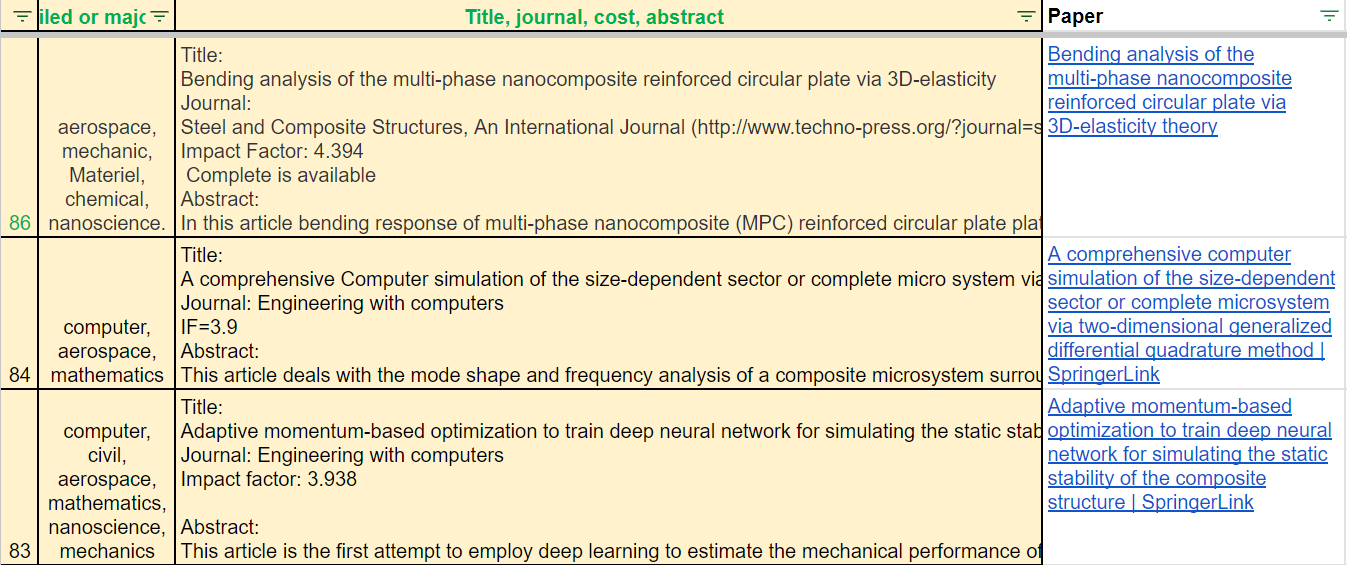
15 of the 31 titles are offered in Springer’s Engineering with Computers, and 13 of them were successfully published there. In addition, one paper advertised for a Taylor & Francis journal also ended up there. The papers are typically an Iran-China collaboration, with 3 of them featuring one of Hamed or Mehran Safarpour, who are authors on two papers already retracted from Engineering with Computers because authorship was advertised for sale on an Iranian website. None of the papers I have identified from this post are retracted yet.

How to quickly write and submit manuscripts to SCI-indexed Journals
“For TCM : Chairman Xi :: Lysenkoism : Stalin, and no Chinese academics are losing their positions because they pretended to vindicate the curative claims of TCM. Thus pratersein, genistein, didymin, helenalin, Tormentic acid and of course Trolline.”

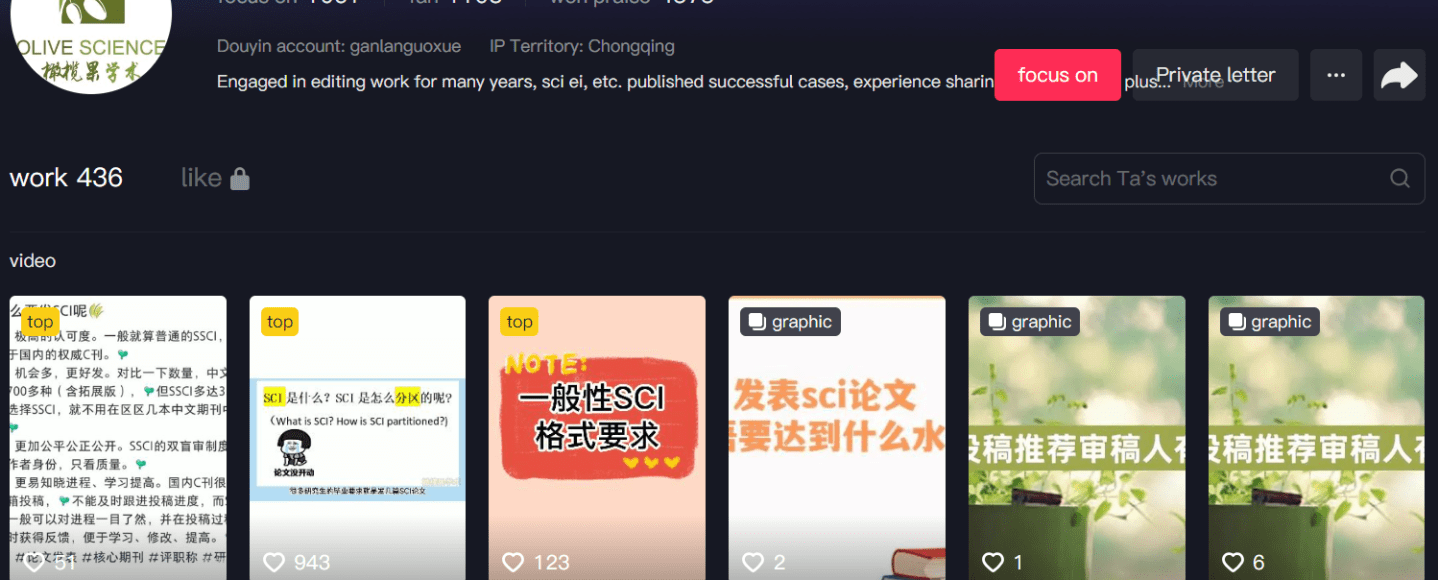
Another way that Olive Fruit Academic advertises is through Tiktok, or Douyin as it is known in China. Most of the posts are advice on how to write an academic paper or how to publish in an SCI journal, however there are also some posts showing proof of acceptance for papers they have worked on.

The post below is a screenshot from Web of Science, backed by a modern take on Chinese traditional music. Despite a lot of blurring, it is easy to identify the paper:
Hang Li , Luwei Bai , Jia Yu , Yongmei Mao , Zhenzhen Hui Research on Model Construction of Electric Energy Metering System Based on Intelligent Sensor Data Advances in Mathematical Physics (2023) doi: 10.1155/2023/1296165
It is from a special issue in Hindawi’s Advances in Mathematical Physics. None of the papers from this issue are retracted.

Another post includes this screenshot, from which this paper can be discerned:
Jinfeng Wei , Yuan Tian , Jingui Geng Research on group behavior model based on neural network computing Computational Intelligence (2022) doi: 10.1111/coin.12403
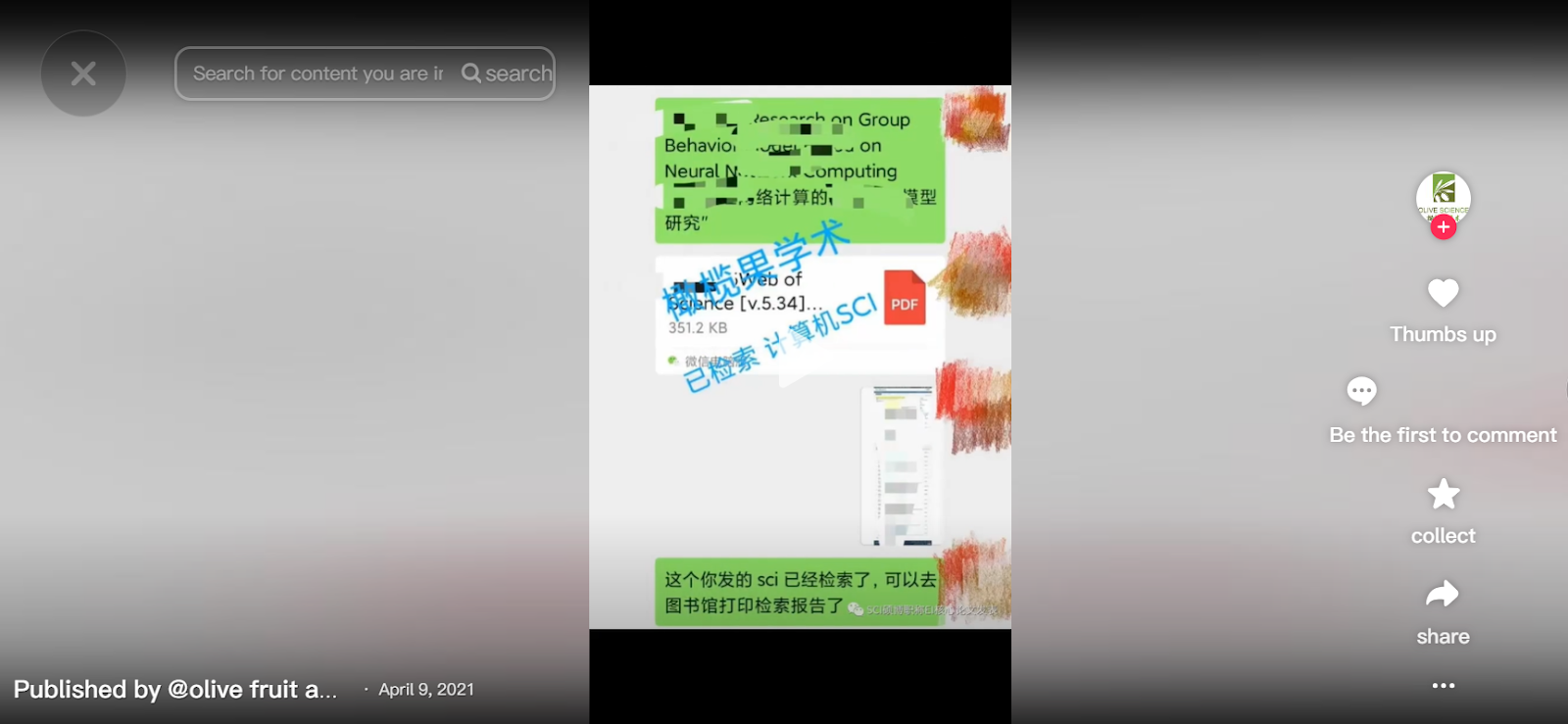
The paper is from a special issue in Wiley’s Computational Intelligence, though we are not told who the editors are. Other papers in that special issue are authored by Oscar Sanjuán Martínez, Rubén González Crespo, Bala Anand Muthu, Deepak Gupta and Victor Hugo C. de Albuquerque, all collaborators with Gunasekaran Manogaran, with 2, 4, 9, 5, 1 and 1 papers retracted so far respectively. All retractions mention fake peer review or rogue editors, and many more are required. You can read more about the Spanish collaborators of Manogaran here in El País.
There are many more posts on the Douyin page, but a Douyin account is required to view them all, I’d encourage anyone who has an account to go through them all and see what they find.
Finally, in order to get the papers the papermill offers and those sent to them published, Olive Fruit Academic needs to convince editors to forget about ethics and accept papers without peer-review. They do this with the promise of money. On 30 October 2021 and 14 May 2022, Jack Ben posted links to two documents (mostly identical) that show how collaborating editors can benefit by working with Olive Fruit Academic.
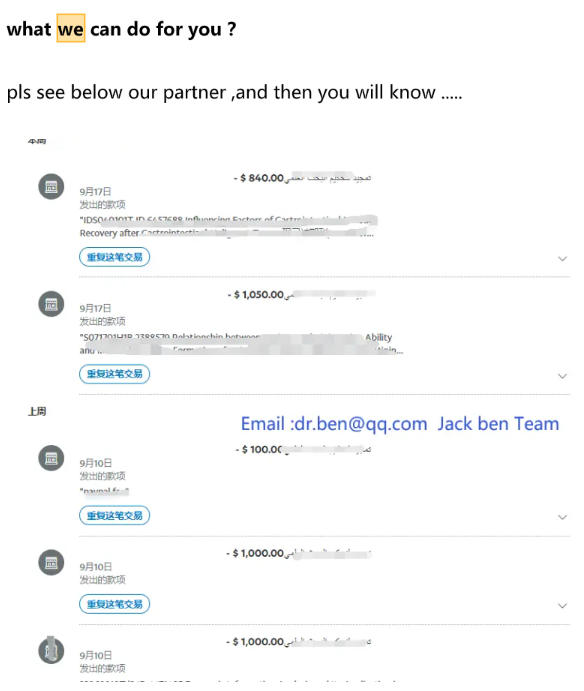

The images above show screenshots of a bank account, presumably one controlled by Olive Fruit Academic, showing repeated payments to someone totalling $8,550 from the 30th July to the 17th of September 2021. Although mostly obscured, the earliest payment has left the recipient’s name untouched, and it appears that this same name is the recipient of all the payments, despite the blurring. Additionally, two of the payments in each image have used the title of the accepted article as the payment reference. The rate is $840 for three of the papers and $1,000 for one of them. Where are those published?
Part 2: Tamjeed

Tamjeed introduces itself on its website as:
“Tamjeed is one of the first and the biggest institutions in the Middle East and Gulf States in the field of services and educational consultancies. We have submitted more than 5000 [papers] in the Middle East and Gulf States in Scopus, Web of Science, and Clarivate Journal rankings. Tamjeed is tailored to Arab researchers and academics in various universities and majors for reviewing their research and publishing them in the best publishing houses.”
The recipient of the financial transactions shown above is تمجيد لتحكيم البحث العلمي, which translates as ‘Glorification [Tamjeed] of scientific research arbitration’

The only person named on the ‘Meet Our Team’ section of the website is Dr. Malik Alazzam, former assistant professor at Aljoun National University, Jordan, and since 2017 editor at Tamjeed, according to his LinkedIn. The office of Tamjeed is also located in Jordan, in the city of Irbid. Tamjeed are very proud of Dr. Alazzam; the pinned post on both their X/Twitter profile and one of their Facebook pages is this news story from a Jordanian news website announcing that Dr. Alazzam has been named as a top 2% scientist for 2022, as well as 2021. He is still there on the latest October 2023 update to the list.

I agree with the article that
“it is noteworthy that Dr. Al-Azzam is an independent researcher who does not belong to any university and has not received support from any Jordanian university, but rather through a personal effort”,
though perhaps not for the stated reasons.
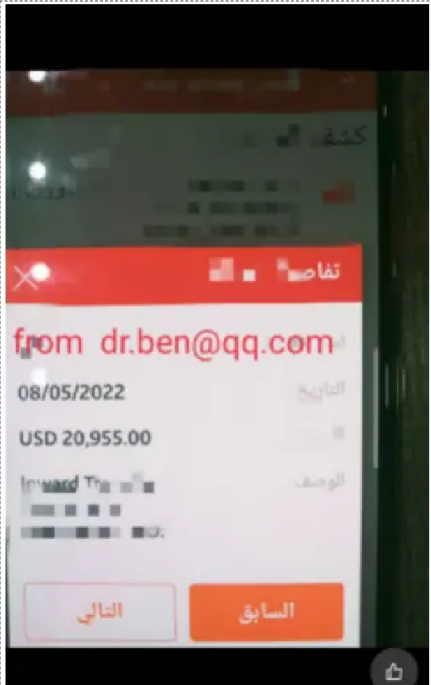
The financial transactions shown earlier are not the only ones in the documents shared by Jack Ben, and they are equally informative. The four screenshots below show multiple transactions for thousands of dollars. The top left is undated (I believe) and is for $7,700. Although heavily blurred, we can make out Amman, Jordan, and Malik Alazzam. In the top right image, parts of the word Jordan can be made out in, as well as perhaps parts of Malik Bader Alazzam as payee, in payments of around $8,000 made every week or two. The bottom left image shows a payment of $16,300 to an M…….zzam in Jordan, and finally there is a payment received of $20,995 from someone whose banking is in Arabic. Whether or not all of the payments are directly to Dr. Alazzam, this snapshot suggests that an academic can easily make $10,000 a month by accepting papers, more than the vast majority of academic salaries, and that the going rate for a single paper is around $1,000.


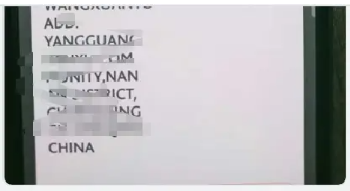
In addition there is a partially obscured image of the address of the sender of the money, who could perhaps be in the Nan’an district of Chongqing.
As mentioned above, several of the bank transfers appear to include the titles of the accepted papers in the payment reference. I have been able to identify two of them.
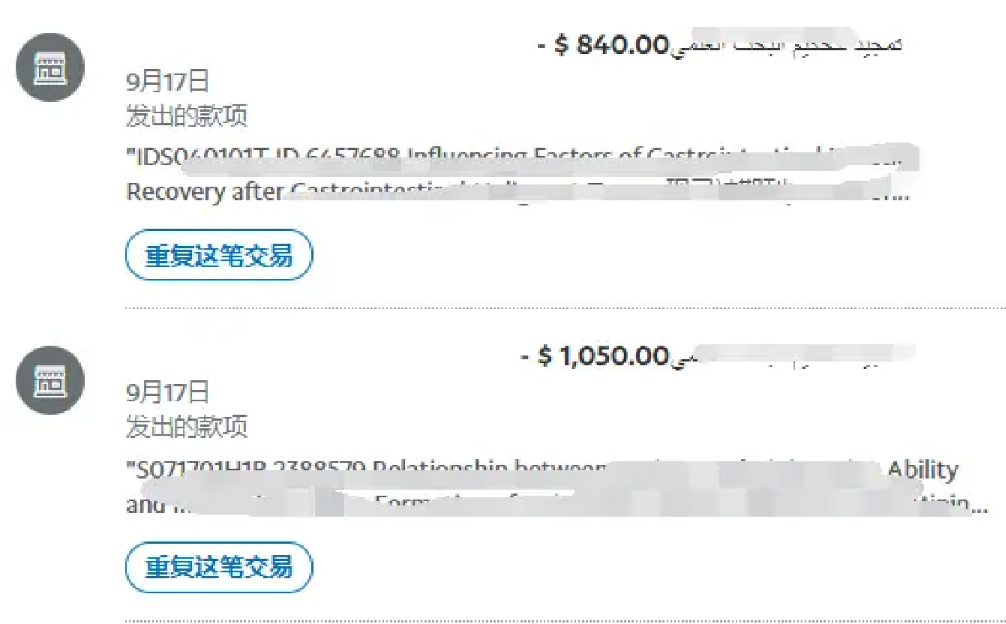
The top paper has article ID 6457688 (retracted), also included in the payment reference.
Liang Wang , Xiaofeng Zhang , Huaping Xu , Yisheng Zhang , Lianghui Shi Influencing Factors of Gastrointestinal Function Recovery after Gastrointestinal Malignant Tumor Journal of Healthcare Engineering (2021) doi: 10.1155/2021/6457688
The academic editor is one Malik Alazzam. The paper is from an Special Issue called “Intelligent Solutions in E-Health and Medical Communication Services” in Hindawi’s Journal of Healthcare Engineering, with editors Osamah Ibrahim Khalaf of Al-Nahrain University, Baghdad, Malik Alazzam of Ajloun National University, Jordan and Kingsley A. Ogudo of the University of Johannesburg. The paper was accepted on 14 September 2021, 3 days before the payment.
The second paper has ID 2388579 (retracted):
Lilei Gao Relationship between Business Administration Ability and Innovation Ability Formation of University Students Based on Data Mining and Empirical Research Mobile Information Systems (2021) doi: 10.1155/2021/2388579
The academic editor is Omar Cheikhrouhou of Taif University, Saudi Arabia. The paper is from an Special Issue called Intelligent Data Analytics for Internet of Things-Based Applications in Hindawi’s Mobile Information Systems, edited by Omar Cheikhrouhou, Jalel Ben-Othman of CentraleSupélec, Paris, and Anand Nayyar of Duy Tan University, Vietnam. The paper was accepted on 15 September 2021, 2 days before the payment.
The first Special Issue is named in a Facebook post by Tamjeed from August 2021, whilst the second isn’t named explicitly, but the journal Mobile Information Systems appears directly below the Special Issue in Journal of Healthcare Engineering.

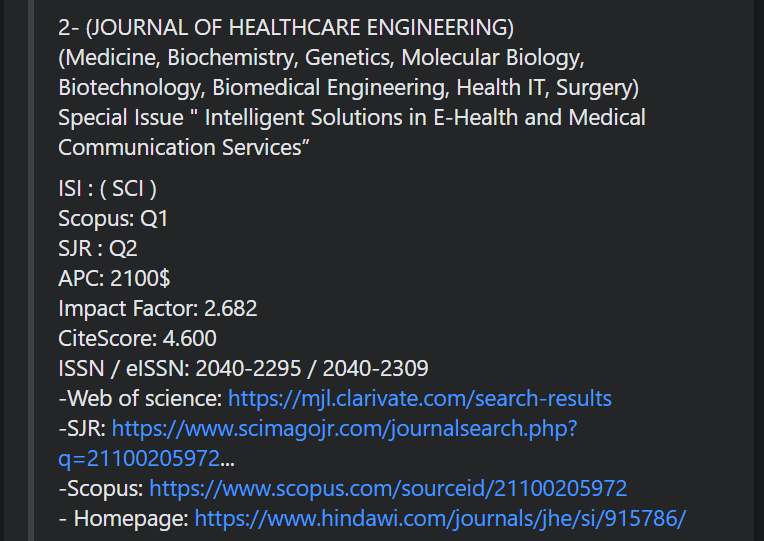
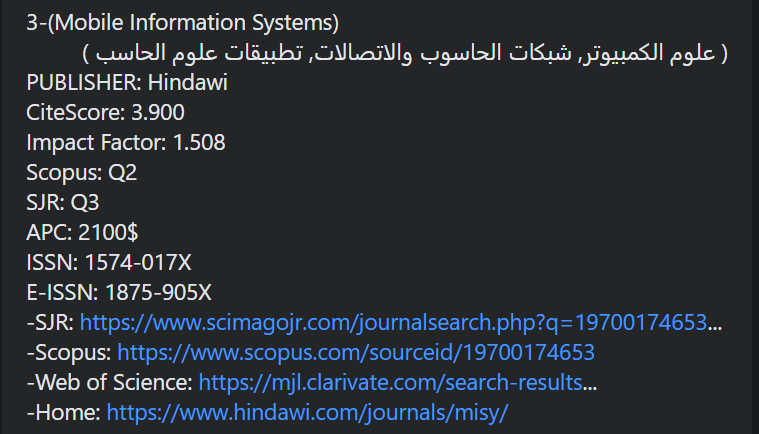
One more paper can be identified from the Tiazin papermill documents. In a screenshot of an email about 7 papers, an email address, wangyong25… is mostly visible.
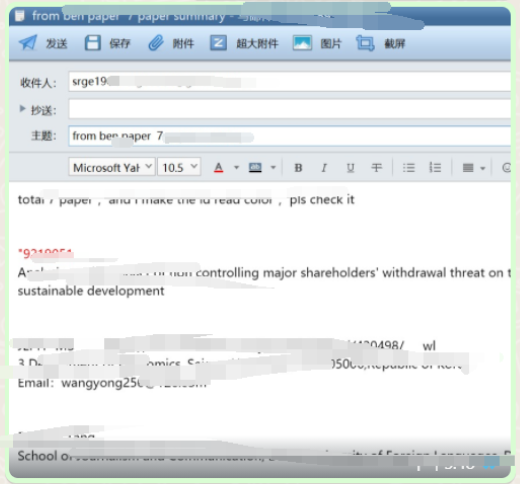
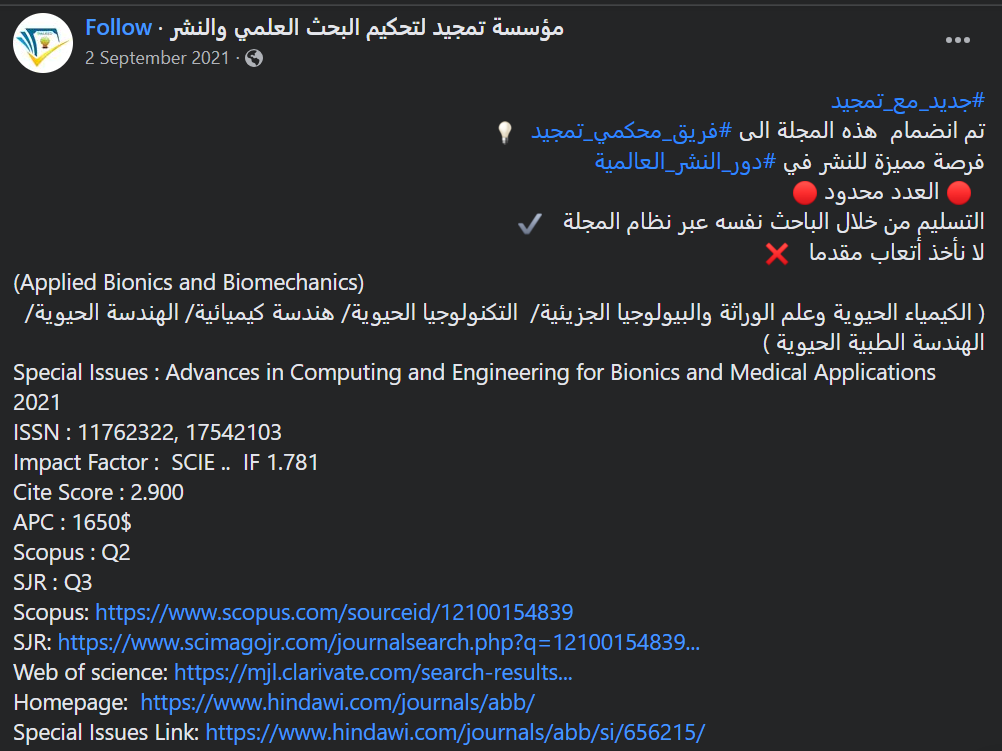
This email address is wangyong256@126.com, the corresponding email address of Yong Wang in this special issue in Hindawi’s Applied Bionics and Biomechanics which was advertised on the Tamjeed Facebook page. Yong Wang’s author position and affiliation – 3 Department of Economics, Sejong University, Seoul 05006, Republic of Korea – are discernable beneath the attempted redaction.
Several other journals and special issues are named in Facebook posts by Tamjeed, as well as in Facebook posts from the personal page of Osamah Ibrahim Khalaf. He is another top 2% researcher who was given a medal last year for being the researcher with the highest H-index (44) at Al-Nahrain University in Baghdad.
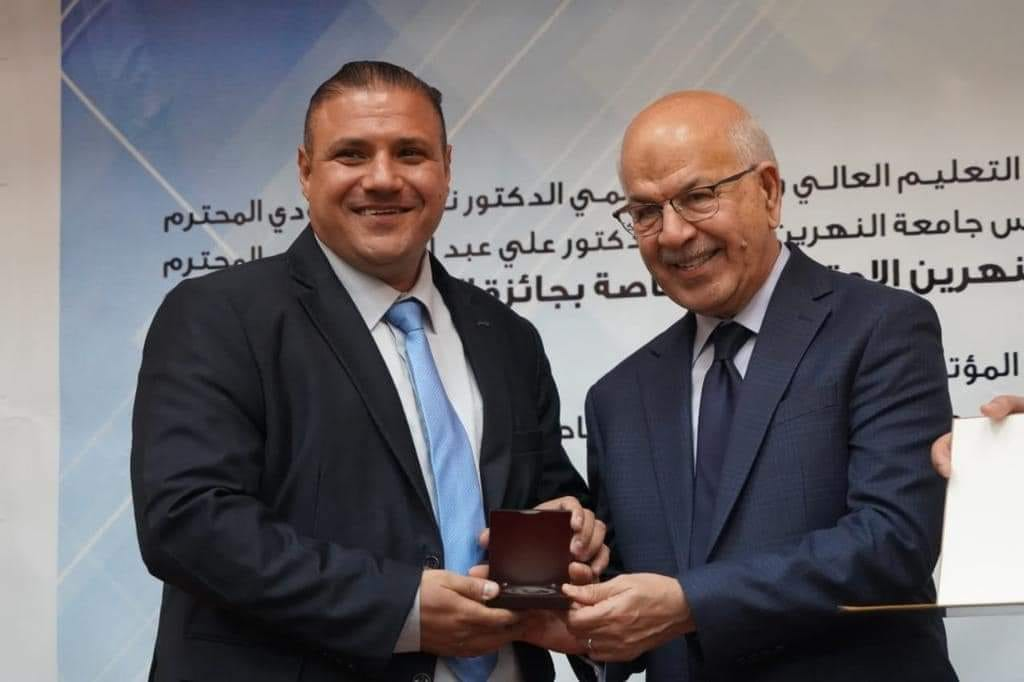
His prodigious rate of publications and citations must be helped by his frequent posting in co-authorship groups on Facebook, asking to ‘collaborate’ and offering to help with publishing fees.

How many other of the world’s top 2% scientists are collaborating with papermills and offering to pay for Article Processing Charges (APC) in return for getting more publications and citations?
Part 3: Conclusions
Olive Fruit Academic is one of many Chinese papermills and publication services companies, arranging publications for their customers at Chinese colleges, universities and hospitals. By bribing editors and paying peer reviewers, they are able to almost guarantee acceptance of their papers. For the editors, this is a very lucrative and almost effortless and risk-free business, as long as someone doesn’t post the bank transfers online. Two of the named special issues in Facebook posts from Tamjeed have over 500 articles in total. Based on the bank transfers shown above, it seems plausible that around half a million dollars may have been transferred to the editors just for those two special issues.
$1,000 may seem a large sum of money for publishing a paper no one is going to read, but if your graduation, promotion and future career depend on having a publication then it could be a small price to pay.
I would like to emphasise that, although most of the articles I have been able to identify are in Hindawi journals, that is just because those articles had the most detail shared. Tiazin and Tamjeed target, seemingly successfully, the journals of all publishers. They may be responsible in part for many of the more high-profile recent cases of mass retractions, including Materials Today Proceedings, Microprocessors and Microsystems, Applied Nanoscience, Optik, dozens of Hindawi special issues and many other journals with a significant PubPeer presence.
Bottom of the barrel: Nanofluids & Chamkha
“Did you know that Chamkha is “Ranked in the World’s Top 0.02267% Scientist”? Or that he “Completed all degrees in a record time of five years”?” – Maarten van Kampen

The information above also shows a glimpse of the connections between different actors working to subvert the publishing process. The papermill Tiazin has many papers that it needs to get published, but requires academics willing to either publish works in journals for which they are already editors, or propose special issues to journals for which they will be guest editors. The papermill does not work with just one group or company, but collaborates with various actors such as Tamjeed, Gunasekaran Manogaran and Awais Ahmad, who I believe operate independently.
There is so much money flowing through this system that I don’t see what will stop the network of papermills and corrupt editors. Anyone caught should be blacklisted but someone else will pop up in their place. The demand for guaranteed publication is not going to go away.
I thank all my donors for supporting my journalism. You can be one of them!
Make a one-time donation:
I thank all my donors for supporting my journalism. You can be one of them!
Make a monthly donation:
Choose an amount
Or enter a custom amount
Your contribution is appreciated.
Your contribution is appreciated.
DonateDonate monthly
 For Better Science
“Some of the editors of the special issues are notable. Awais Ahmad, frequent collaborator and protege of Rafael Luque, is an editor of two of the special issues, one for Hindawi and one for Elsevier.”
There are two Awais Ahmeds / Awais Ahmads. One is Luque’s protege, another is a phrase-torturer with Italian and Korean affiliations. The Hindawi SI is a doing of the former, the Elsevier SI was edited by the latter. The known retractions, as it seems, are for the latter.
LikeLike
There is so much money flowing through this system that I don’t see what will stop the network of papermills and corrupt editors.
Do not block the money-flow.
LikeLike