

Schneider Shorts of 5 January 2024 – with a role model for WomenInStem in Tübingen, a Swedish rector’s Saudi papermiller, universities in US and Europe still valuing scamference medals, medical society with special rules for special people, and why there’s nothing wrong with Chinese blood money.
Table of Discontent
Science Elites
- This process typically takes a few months – Professor Skokowa, in charge of research integrity
- Do not waste your time – more proud recipients of The Tiwari Medal!
- Anders and Abdullah – Uppsala’s Rector Hagfeldt caught with papermillers, again
Scholarly Publishing
- To enhance the visual appearance of the images – MD Anderson’s Francisco Vega clarifies things
- Ethically objectionable – Uygur surveillance papers, paid by Chinese police
Science Elites
This process typically takes a few months
Meet Julia Skokowa (or Yulia Skokova), a young role model for all WomenInSTEM. Since 2014 she is Full Professor and Head of the Division of Translational Oncology at the University Hospital of the prestigious University of Tübingen, Germany. She runs her lab together with her former PhD mentor and her octogenarian husband, “one of the best-known and most successful cancer researchers in the world“, Karl Welte.
Masoud Nasri , Malte Ritter , Perihan Mir , Benjamin Dannenmann , Narges Aghaallaei , Diana Amend , Vahagn Makaryan , Yun Xu , Breanna Fletcher , Regine Bernhard , Ingeborg Steiert , Karin Hahnel , Jürgen Berger , Iris Koch , Brigitte Sailer , Katharina Hipp , Cornelia Zeidler , Maksim Klimiankou , Baubak Bajoghli , David C. Dale , Karl Welte, Julia Skokowa CRISPR/Cas9-mediated knockout enables neutrophilic maturation of primary hematopoietic stem and progenitor cells and induced pluripotent stem cells of severe congenital neutropenia patients Haematologica (2020) doi: 10.3324/haematol.2019.221804
Benjamin Dannenmann , Azadeh Zahabi , Perihan Mir , Benedikt Oswald , Regine Bernhard , Maksim Klimiankou , Tatsuya Morishima , Klaus Schulze-Osthoff , Cornelia Zeidler , Lothar Kanz , Nico Lachmann , Thomas Moritz , Karl Welte , Julia Skokowa Human iPSC-based model of severe congenital neutropenia reveals elevated UPR and DNA damage in CD34+ cells preceding leukemic transformation Experimental Hematology (2019) doi: 10.1016/j.exphem.2018.12.006
In August 2022, the Dannemann et al 2019 paper received a Correction. It was problematic.

More corrections were issued. Because those same images appeared in other papers by Skokowa. Note that her husband Welte is co-author, worth mentioning that when he left Hannover Medical School (MHH) in 2015 for Tübingen, his wife and PhD mentee Skokowa followed Welte there as postdoc.
Benjamin Dannenmann , Maksim Klimiankou , Benedikt Oswald , Anna Solovyeva , Jehan Mardan , Masoud Nasri , Malte Ritter , Azadeh Zahabi , Patricia Arreba-Tutusaus , Perihan Mir , Frederic Stein , Siarhei Kandabarau , Nico Lachmann , Thomas Moritz , Tatsuya Morishima , Martina Konantz , Claudia Lengerke , Tim Ripperger , Doris Steinemann , Miriam Erlacher , Charlotte M. Niemeyer, Cornelia Zeidler, Karl Welte, Julia Skokowa iPSC modeling of stage-specific leukemogenesis reveals BAALC as a key oncogene in severe congenital neutropenia Cell stem cell (2021) doi: 10.1016/j.stem.2021.03.023

Skakowa on PubPeer: “The same iPSC lines of the same healthy donors or CN patients are used in all publications mentioned here. Representative images of these cell lines are presented. For labeling of the cells, classical HE staining was applied.“
Even then, how does Skokowa know the pictures are representative if she only ever made one photo?

A Correction was published in September 2023:
“The originally published version of this manuscript contains representative cytospin images of a granulocytic differentiation of iPSCs derived from a healthy donor (HD) and CN1 patient in Figure 2G that also appear as representative control images in another, previously published manuscript1 and are very similar to representative control images in yet another, previously published manuscript.2
The manuscript for Cell Stem Cell was submitted before (but published after) the other two, and in the confusion the authors neglected to notice that citations for these other two manuscripts ought to have been included.
Also in the originally published version of Figure 2G, a labeling error mistakenly identified the cytospin image of the CN/AML1.2 clone as an image of the CN/AML1.1 clone instead. The label should in fact have read CN/AML1.2.”
And another corrected paper:
Yun Xu , Masoud Nasri , Benjamin Dannenmann , Perihan Mir , Azadeh Zahabi , Karl Welte , Tatsuya Morishima, Julia Skokowa NAMPT/SIRT2-mediated inhibition of the p53-p21 signaling pathway is indispensable for maintenance and hematopoietic differentiation of human iPS cells Stem Cell Research & Therapy (2021) doi: 10.1186/s13287-021-02144-9


The Correction from October 2023 stated:
“In the original Fig. 5A, C the order of the samples was reorganized by cutting the bands from the original blot and putting them in the sequence DMSO, FK866 1nM, and FK866 2nM from left to right, but the vertical lines indicating the cutting positions of the blot were missing.
We have now replaced Fig. 5A, C with the original uncut Western Blot images. Note that the bands marked with the asterisk were excluded from the densitometry analysis of presented Western Blot images due to the poor protein quality of the sample, as indicated by the weak GAPDH signal. For the statistical analysis of the FK866 2nM datasets, we accidentally calculated the p-value of two datasets only instead of the required three, as was calculated for the DMSO and FK866 1nM datasets, respectively. Therefore, we removed the stars indicating the significance of the FK866 2nM datasets from the corresponding densitometry graphs, which doesn’t change the conclusion, because the difference between DMSO and also FK866 2nM treated samples is obvious. We also corrected legends for Fig. 5A, C regarding the analyzed datasets of the presented WB images, for which statistics were performed. […]
None of the aforementioned corrections affect the conclusions of the respective experiments.”
No correction here because Skokowa explained on PubPeer that it is allowed to publish same data twice if your submit the two manuscripts simultaneously and then add references. Seriously.
Julia Skokowa, Birte Hernandez Alvarez , Murray Coles , Malte Ritter , Masoud Nasri , Jérémy Haaf , Narges Aghaallaei , Yun Xu , Perihan Mir , Ann-Christin Krahl , Katherine W. Rogers , Kateryna Maksymenko , Baubak Bajoghli , Karl Welte , Andrei N. Lupas , Patrick Müller , Mohammad ElGamacy A topological refactoring design strategy yields highly stable granulopoietic proteins Nature Communications (2022) doi: 10.1038/s41467-022-30157-2


Finally, the Dannenmann et al 2019 paper, which used “peripheral blood” of unspecified human origin for iPS reprogramming, received this PubPeer criticism:
“In the report by Dannenmann et al. published in Experimental Hematology, it is striking that virtually no ethics statement or ethics committee approval is mentioned. The paper describes for the first time the generation of iPS cells from different patients with congenital neutropenia. The lack of any ethics statement (as well as the failure to mention patients’ details) raises the suspicion that neither informed consent for the iPS generation nor the required ethics committee approval was obtained before these studies were performed. This would clearly infringe good clinical and good scientific practice as well as ethical guidelines, which are mandatory when work involves the use of human subjects. Such a procedure would be unacceptable, and not compliant with ICMJE Ethical Considerations in the Conduct and Reporting of Research.”
Lysmata argentopunctata on PubPeer, October 2022
You may wonder, well, surely the University of Tübingen is on this case. Surely their Good Scientific Practice commission is investigating?
Yeah right.
Skokowa IS the Good Scientific Practice commission. She is the one in charge of Academic Misconduct investigations for all of medicine in Tübingen. Since 2022.
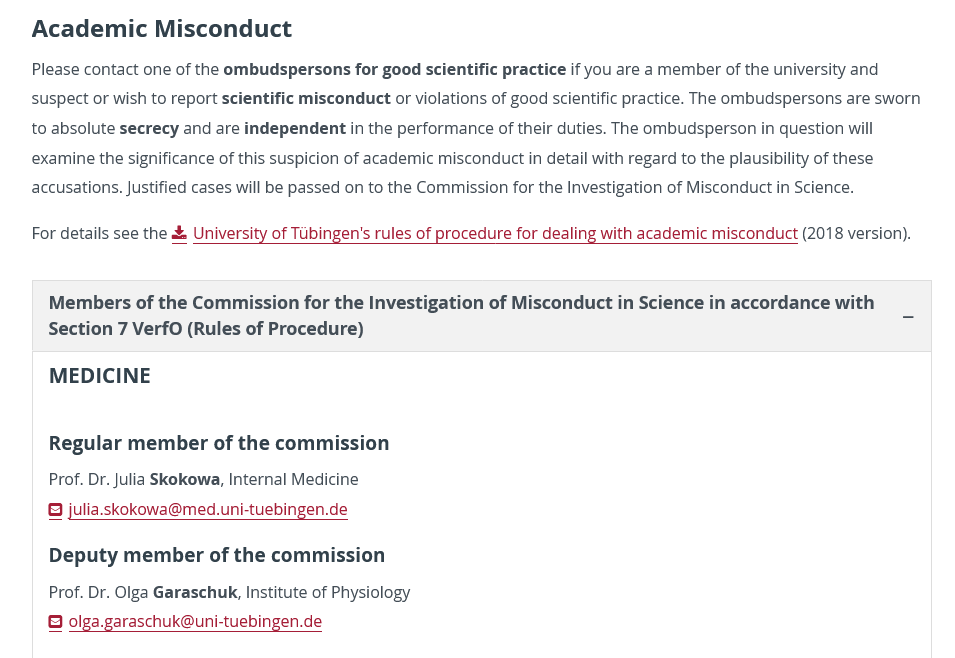
Funny, isn’t it? I wrote to Skokowa and her commission colleagues. Skokowa replied (translated from German):
“To clarify: the cases identified were discussed and clarified intensively with the UKT [University Clinic Tübingen, -LS] ombudsperson and the journals. I also asked to resign from the GWP [good scientific practice, -LS] Commission a few months ago. I informed GWP commission members of my decision. This process typically takes a few months and will be completed in early 2024.“
But really, does it take months to resign? The PubPeer evidence appeared in July 2022, Skokowa replied right after and started to publish corrections. The Ombudsperson she refers to is her fellow UKT professor (and predecessor as GWP Commission member for medicine), Ingeborg Krägeloh-Mann. The Ombudsperson’s task was to forward the case to the GWP Commission, given that the alleged duplications were substantiated and even admitted. Forward to whom? To Skokowa. And Skokowa won’t be resigning for several more months. At some point, all corrections will be negotiated, and there will be nothing to investigate. Case closed without opening. Actually, Skokowa might just as well stay in charge of research misconduct investigations. She is an expert.
Skokowa runs a lab of 21 people, most of them PhD students. She and Welte remained silent when invited to deny the allegation of having performed human experiments without ethics approval.
Which is sad. Because Welte has literal skeletons in his closet, from his past time at MHH in Hannover. His collaborator and successor as clinic director there was a certain paediatric oncologist named Christoph Klein, whose story was reported in 2016 in the national newspaper SZ:
“Dr. Klein treated ten children who suffered from the life-threatening Wiskott-Aldrich syndrome with a course of gene therapy. Eight of the 10 children subsequently developed leukemia, and three of them have since died.”
Hannover Medical School MHH: where doctor careers matter more than patient lives?
Philipp Jungebluth, formerly right-hand man and student of the lethal trachea transplant surgeon Paolo Macchiarini, is threatening another lawsuit against me. This time, he is unhappy about being associated with the 5 trachea transplant operations Macchiarini performed in Italy (only one of these five might still be alive, with a permanent brain damage). Jungebluth freely…

A key problem was disregard for ethics guidelines which led to patients’ death. But Klein sued SZ and partially won, because in Germany it is illegal to criticise doctors who leave their patients dead, parts of the SZ article had to be deleted. Predictably, Professor Klein was whitewashed in full by MHH and by his current employer LMU Munich, where he presently leads the paediatric clinic (what did you expect, really). Since the Klein affair, German journalists never name the perpetrators even if they dare to write about academic and medical scandals again.
One would think that Welte and his wife would be extra careful with ethics approvals after witnessing the Klein affair…
The responsibles at the University of Tübingen so far refused all communication with me.
Do not waste your time
In July 2023, I wrote in Friday Shorts about some scientists and their academic institutions who boasted receiving fake IAAM medals from the scamference fraudster Ashutosh Tiwari.
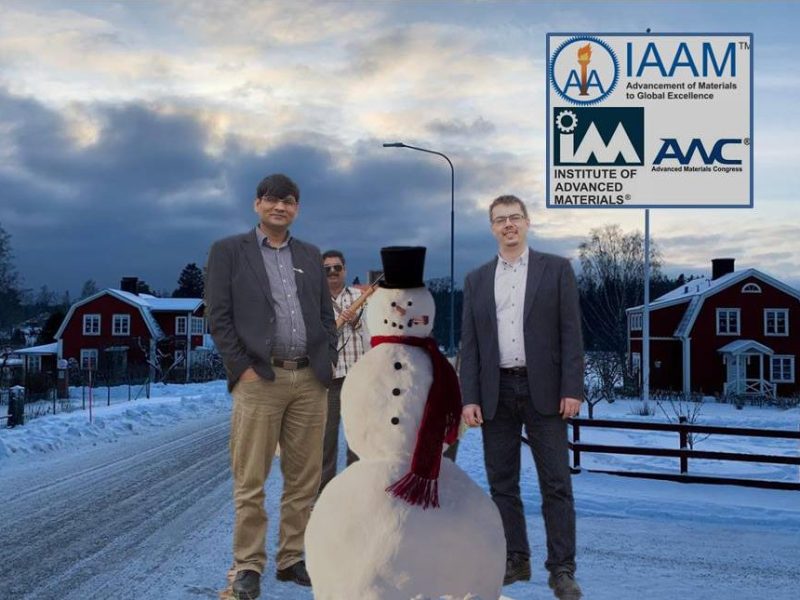
The Indefatigable Ashutosh Tiwari
Four years after Ashutosh Tiwari’s scamferences and research fraud were exposed, his impressive-sounding yet fictional “International Association of Advanced Materials”, or IAAM, still opens doors, hearts and wallets.
I also mentioned a press release by the University of Texas in Dallas from 26 April 2023, celebrating their Endowed Chair Professor Orlando Auciello:
“Dr. Orlando Auciello, professor of materials science and engineering and of bioengineering at The University of Texas at Dallas, has been selected to receive the 2023 International Association of Advanced Materials (IAAM) Scientist Medal, which recognizes scientists for notable breakthroughs and progress in advanced materials science, engineering and technology.
He will receive the award and deliver the Scientist Medal Lecture at the IAAM Fellow Summit in August in Stockholm.
“I am honored by the IAAM Scientist Medal recognition for ‘distinctive contributions toward interfacing the materials for multi-inter-transdisciplinary fields of science, engineering and technology,’” Auciello said.”
Back then, I alerted Auciello’s superiors (also about his other excursions to predatory conferences), but received no reply. Well, they did react, with this social media announcement from September 2023:
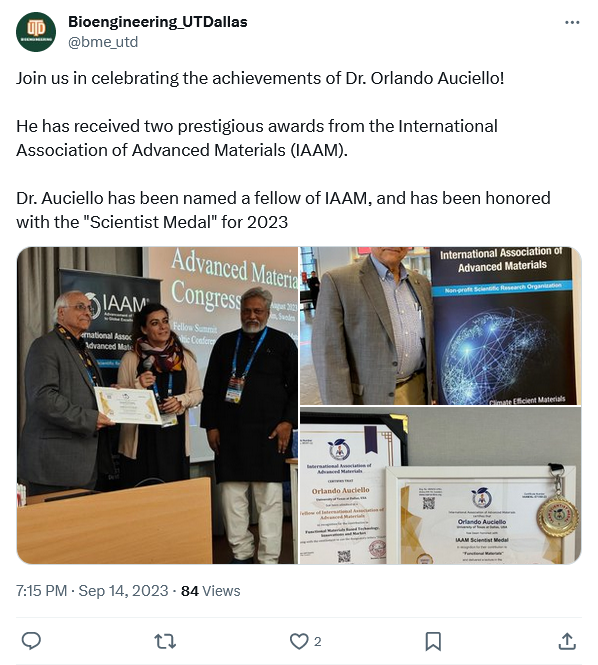
I wrote to UT Dallas again, and received on 30 December 2023 this reply from Auciello, adorned with a quote from Gandhi :
“The Only Fake is you
I am trashing all your new e-mails without reading them, so do not waste your time“Live as if you were to die tomorrow.
Learn as if you were to live forever.”
Mahatma Gandhi”
As it happens, Auciello’s benefactor Ashutosh Tiwari also likes to decorate his scams with India’s revolutionary – for example, the Sweden-based Indian crook opened in 2019 a heart surgery (sic!) business called mHospitals, while connecting it to Gandhi’s 150th birthday! Read here:

New fraud findings and new heart surgery business for Ashutosh Tiwari
Ashutosh Tiwari and his patron Tony Turner were found guilty of research misconduct by Linköping University. Turner is to be sacked as EiC of his Elsevier journal Biosensors and Bioelectronics, a paper he tried to correct there will be retracted. Meanwhile, Tiwari and his LiU colleague Mikael Syväjärvi started a new business: they offer heart…
I presume Tiwari’s bombastic fraud record is exactly why these University of Texas geniuses really think Auciello’s fake IAAM medal has some value, like say, Al Capone’s socks. But not only them! After an endowed Italian in Texas, here is a Greek on a tenure-track in England:
Konstantinos Skalomenos, Lecturer at the University of Birmingham, picked up his medal as well. And look how proud his faculty is:
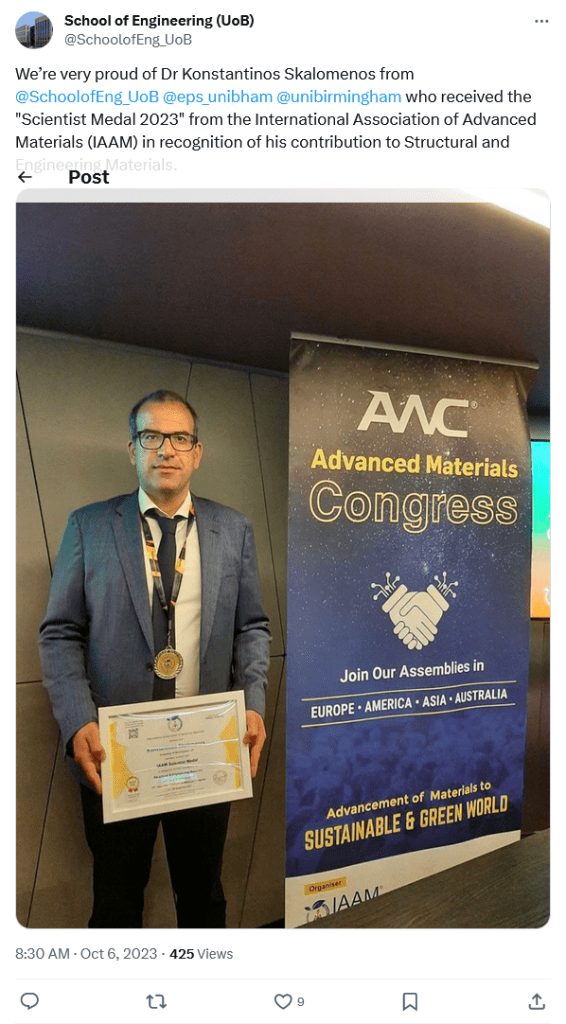
“We’re very proud of Dr Konstantinos Skalomenos from […] who received the “Scientist Medal 2023″ from the International Association of Advanced Materials (IAAM) in recognition of his contribution to Structural and Engineering Materials.” U of Birmingham on X
And here is an extremely proud Swiss researcher! On 31 October 2023, the University of Zurich (UZH) issued a press announcement:
“Sandra Luber has received the IAAM Scientist Medal from the International Association of Advanced Materials. The medal is “awarded to those members of the community who have been involved in research for at least 10 years and have made a significant contribution to the field of Materials science, Engineering & Technology”.
Congratulations!”
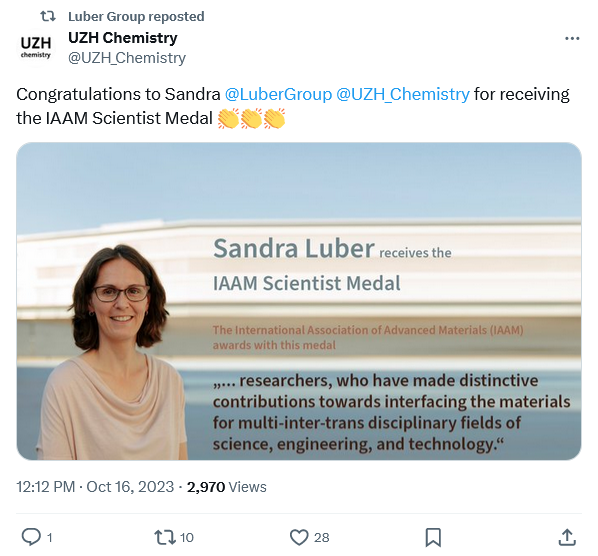
Sandra Luber, UZH’s Associate Professor for Computational Chemistry, swiftly added the IAAM medal announcement to her lab’s website, because she obviously loves receiving and boasting her awards. Any awards. Even worthless ones she or her university paid for:
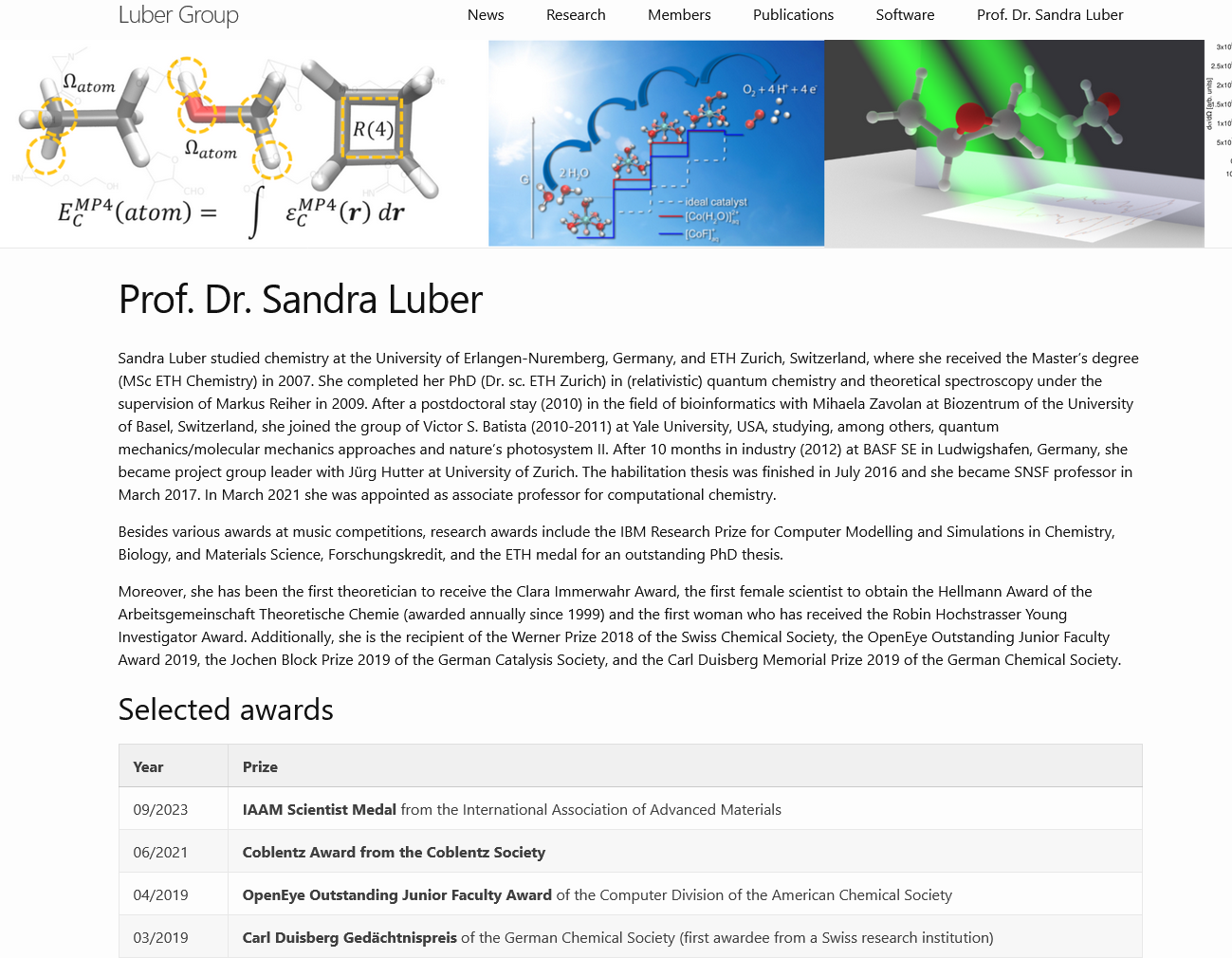
IAAM Scientist Medal from the International Association of Advanced Materials (Source)
Neither Luber nor Skalomenos nor their universities replied, but I guess they silently join Auciello’s message to me. Still, pretty much everyone in their community knows the real non-value of Tiwari’s medal. The shame is theirs.
Anders and Abdullah
Speaking of trash in science. Anders Hagfeldt, the magnificent rector of the University of Uppsala in Sweden, was caught on likely papermilled studies again.

Swedish rector Anders Hagfeldt pronounced innocent of papermilling
“The board’s conclusion is therefore that the deviations regarding figure 2b and 2c in article 1 constitute serious deviations from good research practice”
These are the two papers, both from 2017 when Hagfeldt was active professor at the EPFL in Lausanne Switzerland. The first one was submitted in December 2016 and accepted in March 2017, the other study was submitted to the same Elsevier journal in June 2017:
Hadi M. Marwani , Muhammad Tariq Saeed Chani , Ekram Y. Danish , Kh.S. Karimov , Anders Hagfeldt , Abdullah M. Asiri Tandem Heterojunction Photoelectric Cell Based on Organic-Inorganic Hybrid of AlPc-H2Pc and n-Si International Journal of Electrochemical Science (2017) doi: 10.20964/2017.05.20
Muhammad Tariq Saeed Chani , Kh.S. Karimov , Hadi M. Marwani , Ekram Y. Danish , Waleed Ahmad , Jamil-un Nabi , M. Hilal , Anders Hagfeldt , Abdullah M. Asiri Bulk Heterojunction Tandem Photoelectric Cell Based on p-Si and Phthalocyanine International Journal of Electrochemical Science (2017) doi: 10.20964/2017.10.55

How on Earth did a Swedish professor in Switzerland get to collaborate with fellow scholarls in Saudi Arabia, Pakistan and… Tajikistan?
A clue: the towel-headed Saudi Abdullah M. Asiri is a chemistry professor at the King Abdulaziz Univeristy and a papermiller who publishes fraudulent spectra all the time. Just one example, in an Elsevier journal compeltely overtaken by papermills:
Saima Gul , Zulfiqar Ahmad Rehan , Shahid Ali Khan , Kalsoom Akhtar , Murad Ali Khan , M I Khan , Muhammad Imtiaz Rashid , Abdullah M. Asiri , Sher Bahadar Khan Antibacterial PES-CA-Ag2O nanocomposite supported Cu nanoparticles membrane toward ultrafiltration, BSA rejection and reduction of nitrophenol Journal of Molecular Liquids (2017) doi: 10.1016/j.molliq.2016.12.093

Asiri was even seen publishing papermilled fakes with the fraudsters Rafael Luque, Fatih Sen and Yubing Sun. Asiri is an authority on any topic a papermill has on offer, which allowed him to put his name on over 2000 papers and buy 100k citations, making him a “Highly Cited Researcher” with h-index of 139 (Hagfeldt’s is 170).

Don’t mess with Fatih Sen
Fake nanotechnology is always fun, but it does get extreme here. Word of advice: if you are in Turkey, better don’t point fingers at Professor Fatih Sen’s research. Things get broken easily.
So I am not really sure Hagfeldt will be able to explain that “collaboration” with Asiri and his papermills, if someone asks him to explain, that is. Problem is, the Swedish National Board for Assessment of Research Misconduct (NPOF) only looks at papers with Swedish affiliations, those two papermilled fabrications however bear Hagfeldt’s EPFL affiliation, he only came to Uppsala in 2021. And you can’t seriously expect a Swiss university to be arsed about research misconduct.
But good news: I contacted Hagfeldt’s University of Uppsala, and now received this from the Office of the Registrar:
“your report has been received by the university and has been forwarded to the Legal Affairs Division for handling.“
Maybe it is better if the Rector steps down, it is getting embarrassing.

Yubing Sun: contaminated science, Synchrotron fraud and citation scam
Smut Clyde and TigerBB8 investigate another case of nanotechnology research in China. Connected teams of authors pretended to work on cleaning up the environment of radioactive pollution, and instead released a toxic sludge of fraudulent data and citations.

Scholarly Publishing
To enhance the visual appearance of the images
A medical society journal published by British Division of the International Academy of Pathology and Wiley, decided that research remains kind of reliable even if the authors admitted to have faked the figures.
Only fair, because the paper is from MD Anderson in Houston, Texas, USA, so the editors must have understood it was fake when they accepted it in the first place. The last author is the hematopathology professor Francisco Vega, about whom Elisabeth Bik blogged in June 2023 (also mentioned in Friday Shorts). For this, MD Anderson rewarded Vega that same year with “President Award in Research Excellence”.
Well, here is the research excellence:
Mario L. Marques‐Piubelli , Do Hwan Kim , L. Jeffrey Medeiros , Wei Lu , Khaja Khan , Lorena Isabel Gomez‐Bolanos , Saxon Rodriguez , Edwin R. Parra , Chi Young Ok , Akanksha Aradhya , Luisa M Solis , Yago L. Nieto , Raphael Steiner , Sairah Ahmed, Francisco Vega CD30 expression is frequently decreased in relapsed classic Hodgkin lymphoma after anti‐CD30 CAR T‐cell therapy Histopathology (2023) doi: 10.1111/his.14910
Figure 1, fragments:


In May 2023, Vega replied on PubPeer:
“Dear Dr Bik, Thank you for bringing this issue to my attention. I have attached the original images for your review. The scientific content is not impacted.“
That was his replacement data, highlighting by Bik:

Here the journal’s editors and Wiley entered a dilemma. Yes, the fraud is outrageous and insolent. If the paper was written by non-white people from the Global South, it woudl be retracted in 10 seconds. But this one came from white men at MD Anderson, America’s biggest LEGAL papermill.
The Expression of Concern appeared on 28 December 2023:
“The Expression of Concern has been agreed due to concerns raised by a third party regarding duplicated sections within some of the panels of Figure 1. The authors admitted to these image alterations which were performed to enhance the visual appearance of the images (correcting folded areas or filling in blank spaces). The authors were able to provide the original, unmodified images and stated that they did not want to misrepresent the critical data or to compromise the scientific integrity of the manuscript. However, the modification of the images to change the appearance is clearly against the ethical policy of Histopathology and Wiley’s Best Practice Guidelines on Research Integrity and Publishing Ethics. Therefore, the journal has decided to issue an Expression of Concern to inform and alert the readers.”
You saw those “original, unmodified images” above, right?
Vega has more fake papers on PubPeer, also older stuff with fake gels. Here a new one, also flagged by Bik, and also here the authors uploaded fake raw data on PubPeer:
Mario L. Marques-Piubelli , Luisa M. Solis , Edwin R. Parra , Luis Malpica Castillo , Sushanth Gouni , Ranjit Nair , Dai Chihara , Marina Konopleva , Ignacio I. Wistuba , Swaminathan P. Iyer, Francisco Vega, Paolo Strati BCL-W expression associates with poor outcome in patients with peripheral T-cell lymphoma not otherwise specified Blood Cancer Journal (2021) doi: 10.1038/s41408-021-00549-6
Just one example from Figure 1:

This is what the first author Mario Marques-Piubelli, assistant professor at MD Anderson, presented as “original pictures” (highlights by Bik):


“Dear Dr. Bik, Thank you for your concern. I personally took all these pictures and I can assure they are the original files. Sincerely, Mario L. Marques-Piubelli, MD”
The Nature Portfolio journal did absolutely nothing. Because MD Anderson.
Anil Sood and other questionable stars of MD Anderson
The MD Anderson Cancer Center, part of the University of Texas and located in Houston, is a giant hub of huge cancer research money, even for US standards. They also do a lot of science there, which only purpose seems to be publishing in big journals in order to generate even more money. If there…
Neither Vega nor Marques-Piubelli replied to Bik in the next case, published with Elsevier. Why should they reply, MD Anderson is like the mafia, above all laws and convention, and it has all the top politicians in its pocket.
Mario L. Marques-Piubelli , Yessenia I. Salas , Carlos Pachas , Renato Becker-Hecker, Francisco Vega, Roberto N. Miranda Epstein–Barr virus-associated B-cell lymphoproliferative disorders and lymphomas: a review Pathology (2020) doi: 10.1016/j.pathol.2019.09.006
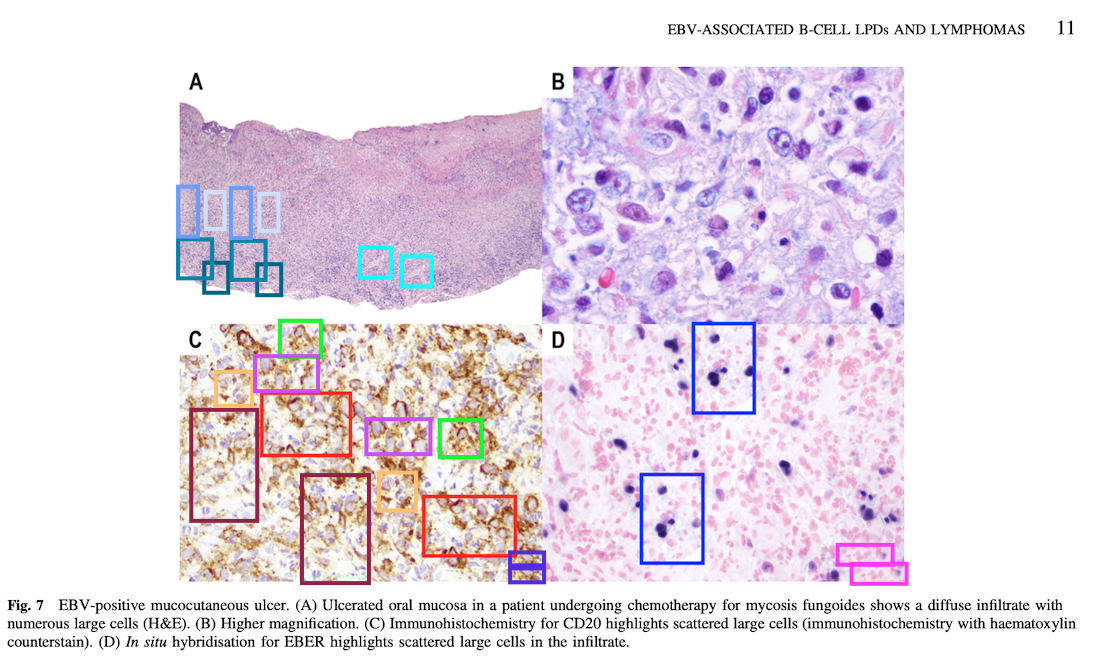
Ethically objectionable
Guardian reported on 29 December 2023:
“In June, Elsevier, a Dutch academic publisher, retracted an article entitled “Analysis of Uyghur and Kazakh populations using the Precision ID Ancestry Panel” that had been published in 2019.
The study by Chinese and Danish researchers used blood and saliva samples from 203 Uyghur and Kazakh people living in Ürümqi, the capital of Xinjiang, to evaluate the use of genetic sequencing technology developed by Thermo Fisher Scientific, a US biotech company, on the two minority ethnic groups. Outlining the need for the research, the authors suggested that better DNA sequencing could help the police identify suspects in cases.”
This is the retracted paper, by scientists from the University of Copenhagen:
H. Simayijiang , C. Børsting , T. Tvedebrink , N. MorlingAnalysis of Uyghur and Kazakh populations using the Precision ID Ancestry Panel Forensic Science International Genetics (2019) doi: 10.1016/j.fsigen.2019.102144
the retraction notice was brief and contained this:
“It has come to light that the studies of the samples collected and used for this research are not covered by the approval H-3-2012-023 of the Danish Ethical Committee referred to in this paper.”
There was a similar case of retractions for China-sponsored Uygur surveillance studies from The Netherlands, read here:

Chinese genetics of Uyghur face prediction
Who would have known that Uyghur DNA, used by Chinese state security for genetics research into racial profiling and face prediction, was obtained under coercion? Four papers by Caixia Li et al are now retracted.
Guardian‘s story continues:
“Concerns have also been raised about a paper in a journal sponsored by China’s ministry of justice. The study, titled Sequencing of human identification markers in an Uyghur population, analysed Uyghur genetic data based on blood samples collected from individuals in the capital of Xinjiang, in north-west China. Yves Moreau, a professor of engineering at the University of Leuven, in Belgium, who focuses on DNA analysis, raised concerns that the subjects in the study may not have freely consented to their DNA samples being used. He also argued that the research “enables further mass surveillance” of Uyghur people.
It appeared in the June 2022 issue of the journal Forensic Sciences Research (FSR), which was acquired by Oxford University Press in 2023. The research was partly supported by a research grant from Xinjiang Police College, and was authored by three of the same scientists as the retracted Elsevier paper.
It has not been formally placed under ethical review by the journal’s editors, or by OUP, which hosts the journal.
Duarte Nuno Vieira, the co-editor-in-chief of FSR, denied that financial support from China’s ministry of justice had any impact on the journal’s editorial policies, calling the suggestion “ethically objectionable”.
This is the perfectly unproblematic paper:
Halimureti Simayijiang , Niels Morling , Claus Børsting Sequencing of human identification markers in an Uyghur population using the MiSeq FGxTM Forensic Genomics System Forensic Sciences Research (2022) doi: 10.1080/20961790.2020.1779967
“In both papers, one of the researchers, Halimureti Simayijiang, was affiliated with China’s state security apparatus via the Xinjiang Police College, exacerbating these concerns.” […]
The University of Copenhagen said Simayijiang was no longer affiliated with the university, having left in 2020. Both the retracted paper, and the paper about which Moreau raised concerns, were submitted before Simayijiang left the university. […] the university had introduced a number of measures to enhance checks on sensitive research, including the establishment of a data management unit and a security checklist for risk assessments of international research.”
And:
“Moreau has raised concerns about dozens of papers. In November, he was awarded the Einstein Foundation prize for “forcefully” advocating for “ethical standards in the utilisation of human DNA data”, according to the judging committee.”
I thank all my donors for supporting my journalism. You can be one of them!
Make a one-time donation:
I thank all my donors for supporting my journalism. You can be one of them!
Make a monthly donation:
Choose an amount
Or enter a custom amount
Your contribution is appreciated.
Your contribution is appreciated.
DonateDonate monthly
 For Better Science
“MD Anderson – America’s biggest legal papermill” 😂 How that can only warrant an expression of concern I will never know.
LikeLike
See https://www.hpdetijd.nl/2024-01-04/raadsels-rond-wetenschappelijke-publicatie-soumaya-sahla/ [in Dutch] for a news article about the unavailability of the Master’s thesis of Soumaya Sahla. This thesis is a source in a book chapter which Soumaya Sahla has published in 2020 together with Mayke Kaag, a full professor at Leiden University. https://link.springer.com/chapter/10.1007/978-3-030-38308-4_3
LikeLike
My science breakthrough of the week:
Meta-analysis: On average, undergraduate students’ intelligence is merely average
https://www.frontiersin.org/articles/10.3389/fpsyg.2024.1309142/abstract
Duh!?
LikeLike
I read the abstract. This Frontiers paper not Duh, it is deeply racist,.sexist, and sociodarwinist. It claims the average IQ of university students dropped compared to 1940ies-1950ies after Blacks, women and working class students were allowed to universities.
LikeLike
I’ve just read that if students more accurately represent the general population, their characteristics will also better reflect the source pool. Hence Duh!
LikeLike
See, you missed out on all the racism, sexism and other crap.
LikeLike
A simple reasoning shows the authors are absolutely correct: average students –> average PhDs –> average scientists (at most) –> on average merely average conclusions via meta-anal…, can find no flaw in their reasoning and logic. Seems they were merely average students at most.
LikeLike
Of course the scientific content is not impacted, it is impossible something non-existent to be impacted. On the other hand, are the skeletons in the Xinjiang Police College closet impacted or just vanished?!
LikeLiked by 1 person
Asiri is a self-proclaimed expert on different areas of Chemistry. He gives contract to be included to different Western universities. You will be surprised to note that how many articles he authored from EPFL. These articles are in very reputed journals. Last year the president of King Abdul Aziz has to depart due to scandal.
LikeLike
Comment to the Skokowa case:
Dear Leonid Schneider, thank you for making these suspicions of scientific misconduct in the papers of the Skokowa group more transparent to the scientific community. Especially, the ethical issues seem to be a potentially major concern that should be clarified. If these issues raised turn out to be true, this would impose a severe damage to a university of excellence like Tuebingen, to patients’ rights and to their trust in clinical research in Germany. The situation is alarming, as the PI is the Director of Tuebingen’s Center for Gene and RNA Therapy and, even more bizarre, a responsible member of the university’s commission for academic misconduct! Obviously, the Tuebingen department has learned virtually nothing from scandals in the past. Skokowa would do well to retract her papers and to step down from positions that require persons of high scientific integrity. It is also within the responsibility of the university’s president and dean to take the appropriate actions.
LikeLike
IAAM award with taxpayers money, Science and Technology department in India who fund from poor tax payers money should be notified and with the institutions authority, which is well known.
https://www.linkedin.com/posts/rameshgardas_fellow-sustainablematerials-cuttingedgeresearch-activity-7118592128414302208-d8eS
LikeLike
Then I suggest you notify them. Someone has to.
LikeLike