

Alexander Magazinov will never make it to being a “Highly Cited Researcher”. So he snipes at scholarly geniuses who achieved this status due to their immense intelligence and superhuman hard work. Even at those already vetted by Clarivate and Retraction Watch!
On 15 November 2022, Clarivate, the metrics company behind the popular jokes called “Journal Impact Factor” and “Highly Cited Researcher”, informed the humanity:
“Clarivate Names World’s Influential Researchers with Highly Cited Researchers 2022 List
[…] This year Clarivate extended the qualitative analysis of the Highly Cited Researchers list, to address increasing concerns over potential misconduct (such as plagiarism, image manipulation, fake peer review). With the assistance of Retraction Watch and its unparalleled database of retractions, Clarivate analysts searched for evidence of misconduct in all publications of those on the preliminary list of Highly Cited Researchers. Researchers found to have committed scientific misconduct in formal proceedings conducted by a researcher’s institution, a government agency, a funder or a publisher are excluded from the list of Highly Cited Researchers.”
In parallel, Clarivate’s new business partners, the world’s only existing, qualified, and infallible research integrity authority, the Watchdogs of Retraction Watch, brought their own article, an interview with some kind of executive at Clarivate named Gali Halevi. Who told Retraction Watch the following:
“In 2019 we began to exclude authors whose collection of highly cited papers revealed unusually high levels of self-citation. Inordinate self-citation and unusual collaborative group citation (citation circles or cabals) can seriously undermine the validity of the data analyzed for Highly Cited Researchers. These activities may represent efforts to game the system and create self-generated status. […]
With the implementation of more filters this year, the number of potential Highly Cited Researcher candidates excluded from our final list increased from some 300 in 2021 to about 550 in 2022.”
My hands hurt now from all the applauding. Thank you Clarivate! Thank you Retraction Watch! Finally all the crooks are expelled and we can all rest assured that whoever earned the badge of “Highly Cited Researcher” must be truly an internationally-acclaimed scientific genius advancing humanity, and never ever some sniveling fraudster who bought his entire CV from papermills.
Hooray!
Under the new Clarivate-Retraction Watch system, Highly Cited Researchers who had to retract their papers are in danger of losing their title. But not necessarily: Halevi explained that “We have always excluded retracted highly cited papers from our analysis“, and if a paper was retracted for what Retraction Watch logged to be not misconduct, then these retractions don’t count.
This is why countless papermill customers and citation buyers who managed to avoid retractions are so far perfectly safe. The trick is simple: instead of buying many authorships, focus on buying many citations. Let the fake papers of others citing you get retracted, this won’t endanger your own Highly Cited Researcher status. Otherwise: only publish in journals where you trust editors to be just like you: stupid, lazy and/or criminal.
Now, Alexander Magazinov wants you to meet some Highly Cited Researchers whose title is currently not in danger of being revoked by Clarivate. Unless Clarivate execs indeed operate by reading blogs, so here we go.

Better get lost, Clarivate: reflections on the 2022 Highly Cited Researchers list
By Alexander Magazinov
First off, let’s look at those who are out of the 2022 list.
- Ji-Huan He and Davood Domiri Ganji, the old El Naschie‘s guard.
- Ali Chamkha, Davood Toghraie, Masoud Afrand and Arash Karimipour, and seemingly all the rest of the magnetohydrodynamics gang.
- The most prominent fractional derivative bullshitters, like Dumitru Baleanu and Abdon Atangana.
- Irrelevant citation plantators: Mohamed Elhoseny, N. Arunkumar, Yu-Ming Chu.
The Men Who Stare at Ketotic Cows
“The References dwell on bovine indigestion, seizures, and the work of N. Arunkumar.” – Smut Clyde, jazz-punk Klezmer musician.

- Even entire great nations are totally absent from the list, for example, Pakistanis. What a disappointment to Tasawar Hayat. Or Romanians. Not sure who could make it to the list besides Baleanu and Simona Gabriela Bungau, but still.
- Didier Raoult. Do I need to say more?
You may get an impression that Clarivate’s exclusions are a result of carefully analyzing a lot of data, building citation graphs, other techniques of network analysis? How about an alternative hypothesis: all exclusions are sourced from a few blogs? That is, the exclusions I am aware of can be attributed to various blog posts. So let’s attach a “failed scientist” label to all those excluded and discuss who is in.
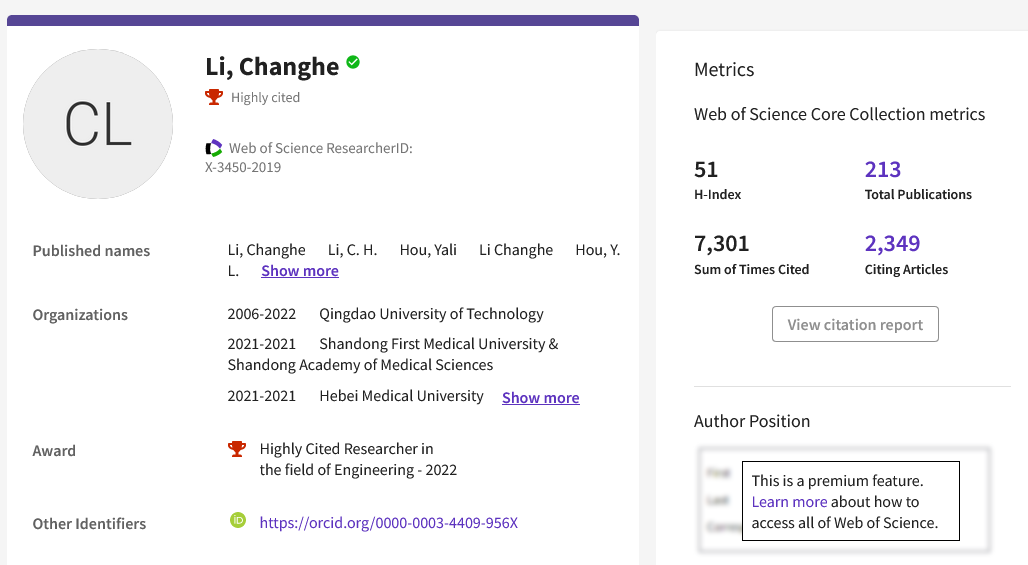
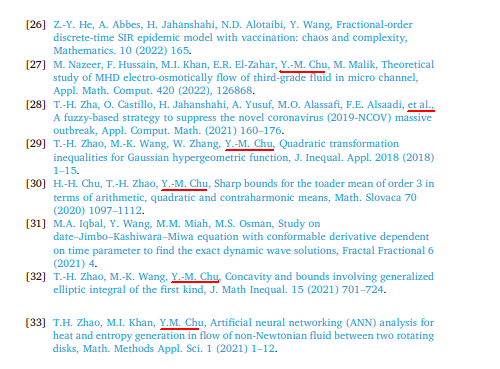
Changhe Li, or a “certain C Li,” whose exercises on cutting, grinding and machining of metals are cited… like everywhere, including biomed. Often together with a “certain YM Chu,” which really makes me wonder how Clarivate could spot one but not another, if they really worked with hard data.
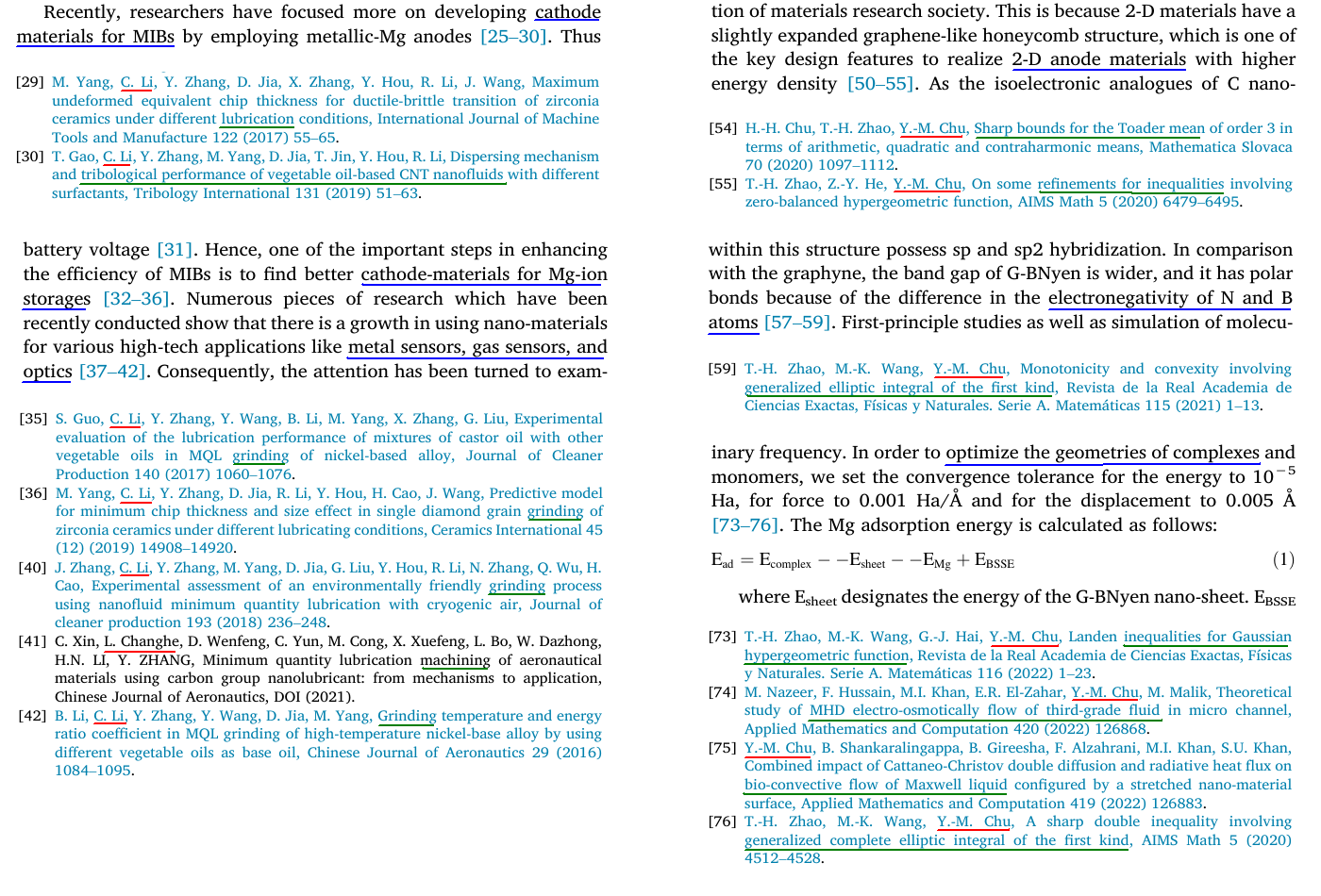
Here, a sizeable batch of citations in a milled product on lithium-ion batteries, co-authored by our friends – management researcher Maria Jade Catalan Opulencia and biologist Abduladheem Turki Jalil together with Indian and Iraqi customers and a mandatory co-author from Iran.
R. Sivaraman , Indrajit Patra , Maria Jade Catalan Opulencia , Rafid Sagban , Himanshu Sharma , Abduladheem Turki Jalil , Abdol Ghaffar Ebadi Evaluating the potential of graphene-like boron nitride as a promising cathode for Mg-ion batteries Journal of Electroanalytical Chemistry (2022) – doi: 10.1016/j.jelechem.2022.116413
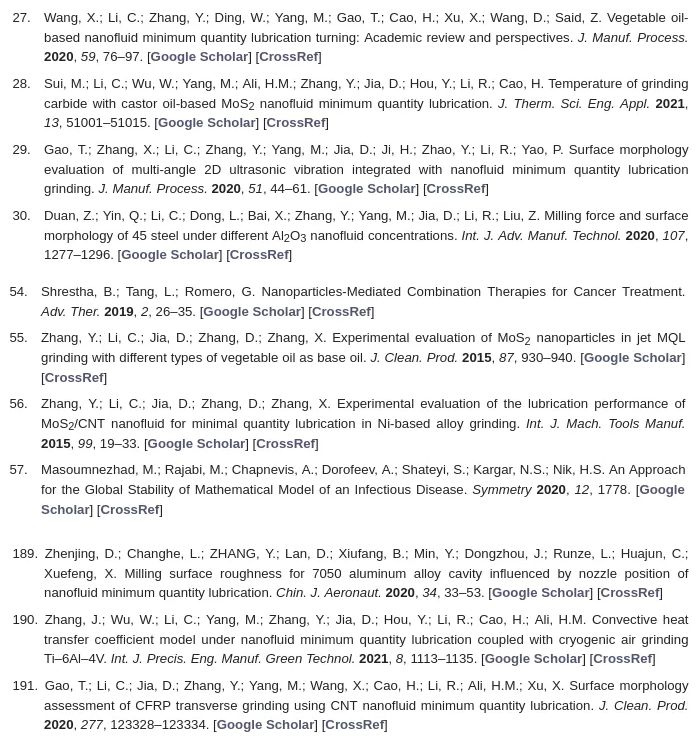
Another batch of citations to Li, also in a milled product, which the Iranian scammers Mahmood Barani, Abbas Rahdar and Ghasem Sargazi offered to eagerly Europeans, Gustavo Ruiz-Pulido, Dora I. Medina, and Francesco Baino.
Gustavo Ruiz-Pulido , Dora I. Medina , Mahmood Barani , Abbas Rahdar, Ghasem Sargazi , Francesco Baino, Sadanand Pandey Nanomaterials for the Diagnosis and Treatment of Head and Neck Cancers: A Review Materials (2021) doi: 10.3390/ma14133706
Carried by Li, his co-authors from Qingdao University of Technology and elsewhere made it into Clarivate’s list: Min Yang, Yanbin Zhang, Dongzhou Jia and Runze Li. Because why not?
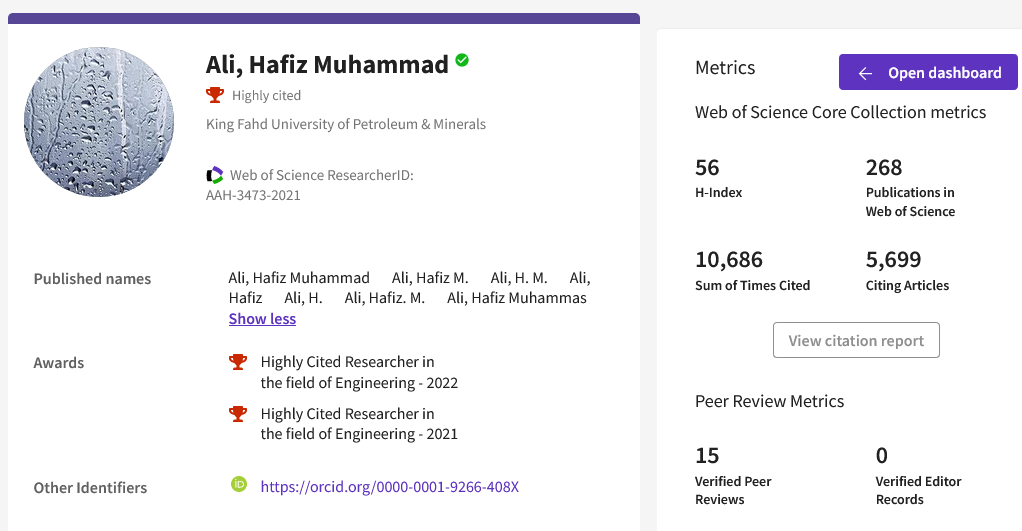
Also a regular co-author of Li, Hafiz Muhammad Ali, is yet another “highly cited” man. Let’s take one of his papers and have a look at its citation statistics.

Hey, what’s the top citing journal? It’s Herr Prof Dr Dirk Uwe Sauer‘s Journal of Energy Storage, and most of the citations indeed come from one single “special issue,” yeah, “Recent Advances in Battery Thermal Management,” edited by Masoud Afrand, Nader Karimi, Cong Qi and Mohammad Arjmand.
Maybe stop accepting submissions, Herr Prof Dr Sauer?
Who needs science if you can have a 75 paper strong special edition by Afrand and Karimi? A guest post by Alexander Magazinov.

Likewise, the names of Sharifpur, Sajadi, Khetib, Cheraghian and Alqaed are not unfamiliar: each left a footprint in that Afrand’s “special issue.” In addition, the same “special issue” boosted Cheraghian’s citation count by quite a bit: by 128 when the issue stood at 74 papers (it has since grown to 84). Which is still inferior to Hafiz Muhammad Ali’s gains from the same source, 150 citations – perfectly reasonable that Ali made it to the “highly cited” list, and Cheraghian did not.
It is hard to understand how Ali has not been picked up by Clarivate if they really analyzed raw data. But if the data was sourced from blogs, that would be an explanation: Ali’s gains, while sizeable, allow him to reach only top-6 beneficiaries, not worthy of being mentioned, except in passing.
By the way, the journals trailing far behind Journal of Energy Storage have also shown their welcoming attitude to Afrand’s gang. Coincidentally, all these journals are published by Elsevier – and it is too tempting to ask this publisher on what terms they are with Afrand and friends.
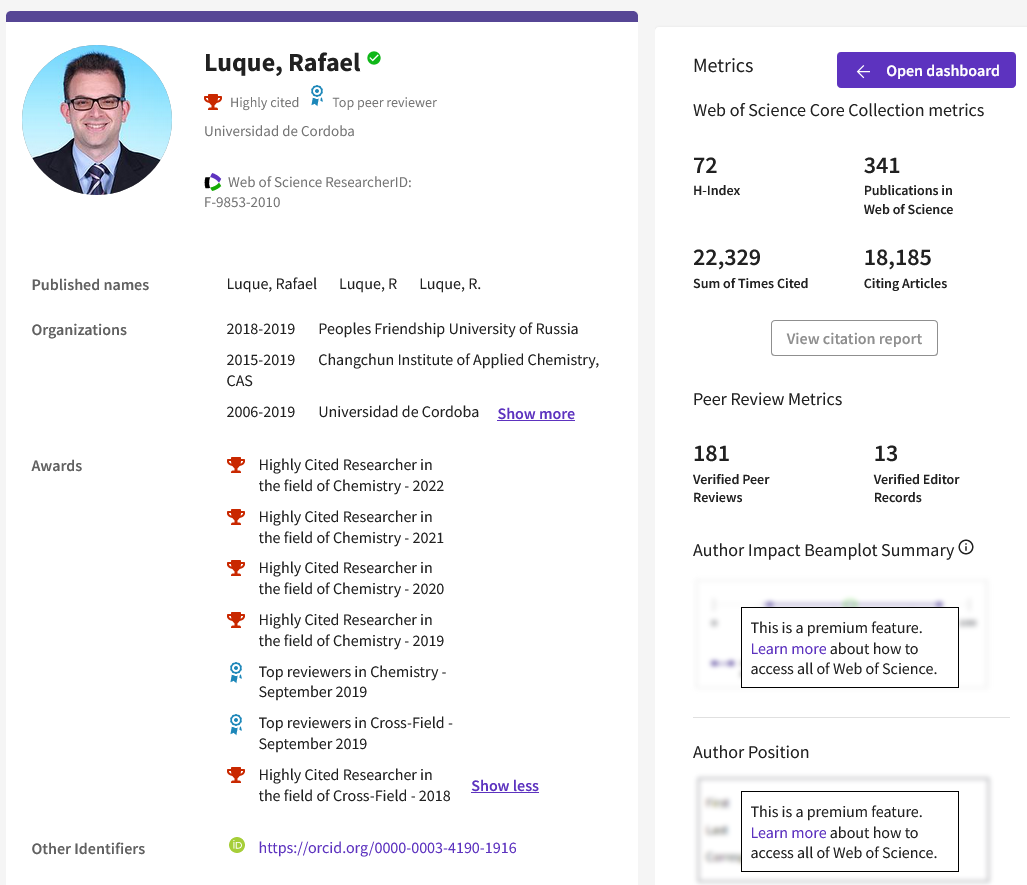
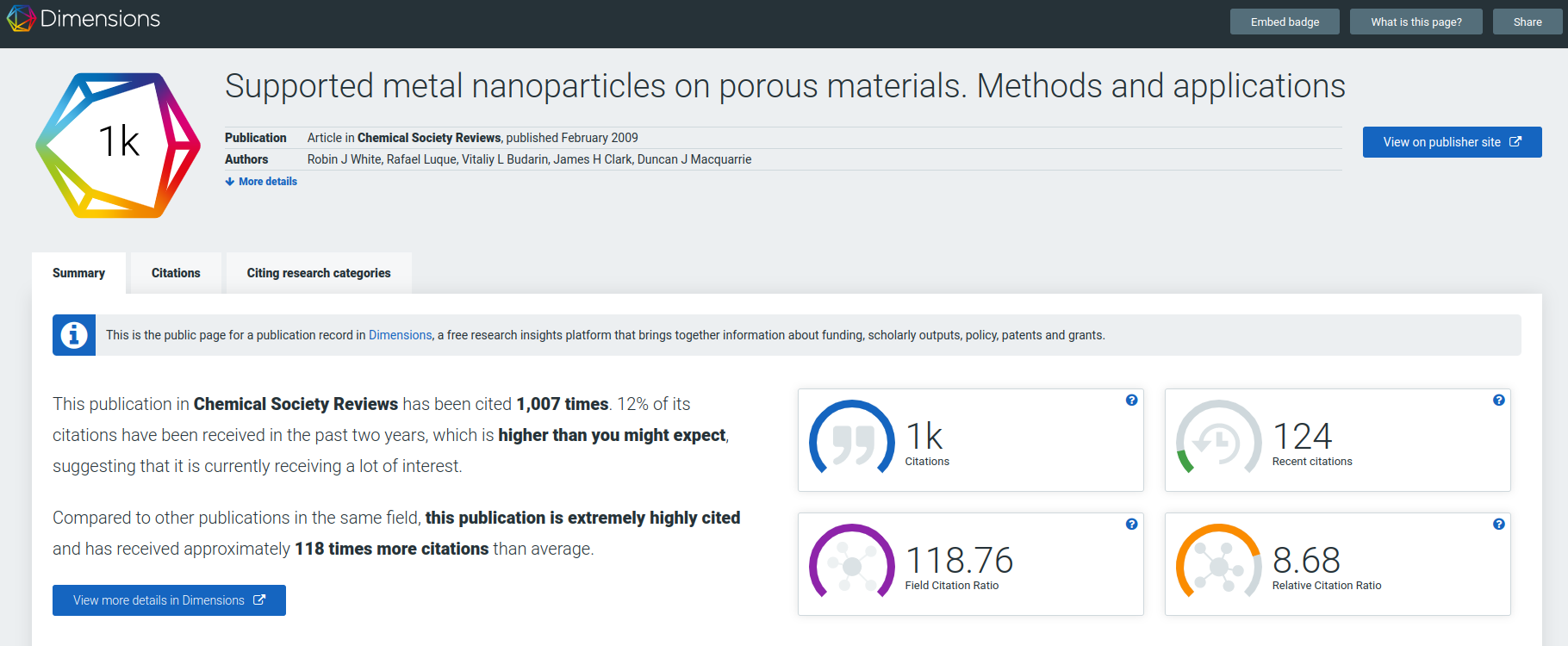
Rafa Luque is of course on the “highly cited” list, no surprise at all. So I have an illustration to his “highly cited” status, a review from 2009 that has just passed the mark of 1000 citations.
Robin J. White , Rafael Luque , Vitaliy L. Budarin, James H. Clark, Duncan J. Macquarrie, Supported metal nanoparticles on porous materials. Methods and applications Chemical Society Reviews (2009) doi: 10.1039/b802654h
Look:
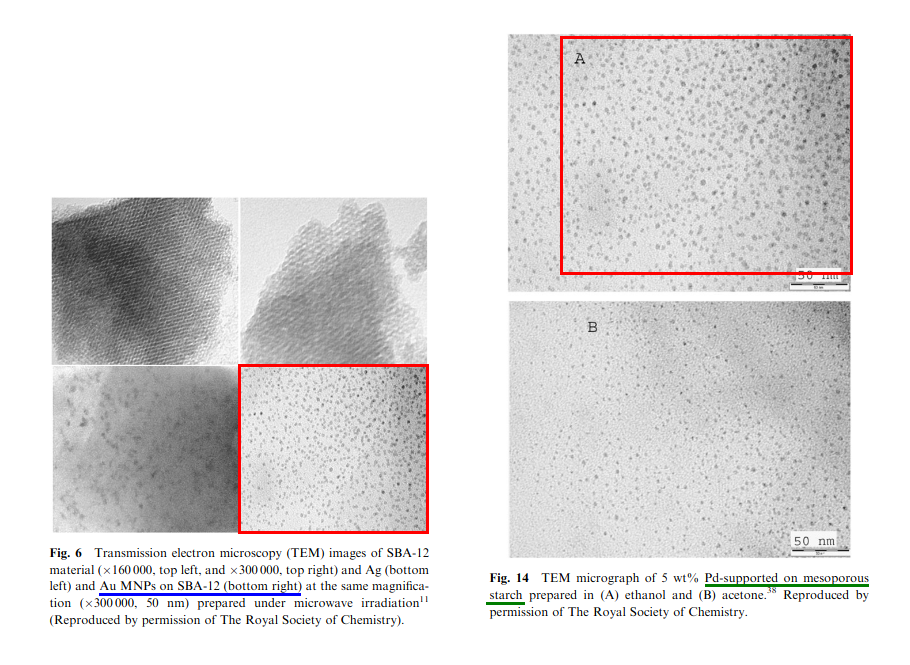
https://doi.org/10.1039/b801754a – Fig. 4
https://doi.org/10.1039/b715508e – Fig. 3
The authors may have paid attention that these images show an overlap, despite representing different materials.“
Is it really just a minor fault on the side of the authors to copy overlapping images that are supposed to show different materials? The two source papers Campelo et al 2008 and Budarin et al 2008 have a common author, who is also a co-author of the review. And it is Luque.
Now, a recent publication by Luque, in Environmental Science and Pollution Research. Here, our Cordoba man as the last author of a forgery sold via some Iranian Telegram channel. This was uncovered by Nick Wise.
Zahra Asadi , Sina Dobaradaran , Hossein Arfaeinia , Mohsen Omidvar, Sima Farjadfard , Rauf Foroutan , Bahman Ramavandi , Rafael Luque Photodegradation of ibuprofen laden-wastewater using sea-mud catalyst/H2O2 system: evaluation of sonication modes and energy consumption Environmental Science and Pollution Research (2022) doi: 10.1007/s11356-022-23253-9
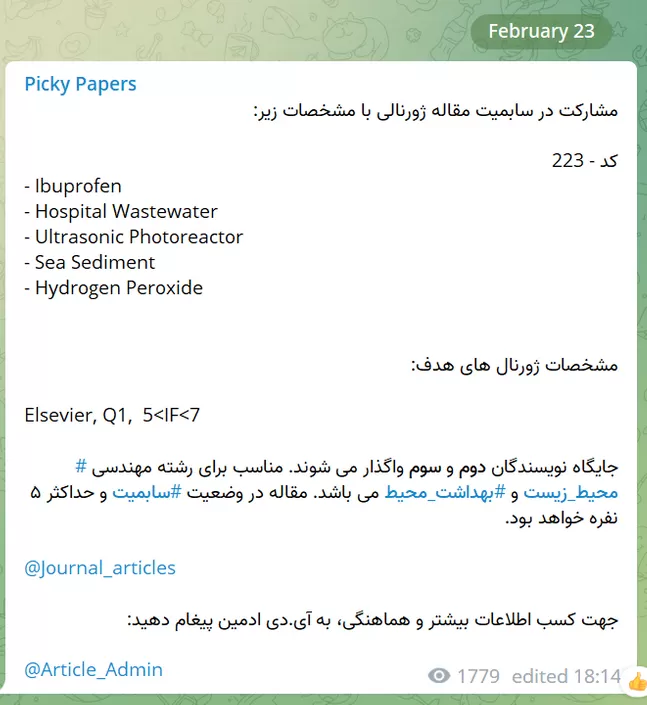
Although the advertisement mentions Elsevier as the target publisher, there is no surprise that the article ended up in Springer’s stable. One of the many possible explanations is that it was submitted to many places, and while an undisclosed Elsevier venue initially demonstrated a higher handling pace, the first to come up with a firm acceptance was Springer.

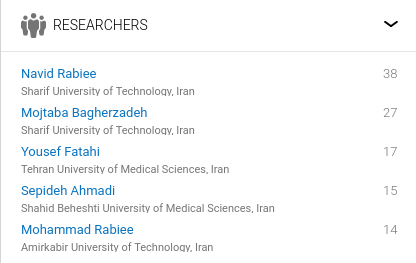
The PubPeer user Paralabrax clathratus noted a weird phrase, “vegetative electron microscopy.” This phrase, apparently, is only known to Google Scholar in one (genuine) paper from 1959 (due to a mishap in two-column text processing), a few obscure studies in local Iranian journals and… in another article-shaped hairball produced by Luque and friends.
Navid Rabiee, Sepideh Ahmadi , Omid Akhavan , Rafael Luque Silver and Gold Nanoparticles for Antimicrobial Purposes against Multi-Drug Resistance Bacteria Materials (2022) doi: 10.3390/ma15051799
Oh, and what’s the primary affiliation of Luque in the Clarivate’s list? Not his native Universidad de Cordoba. Not Xi’an Jiaotong, where Luque indeed had a guest position, a place infamous as the affiliation of the Magnetohydrodynamics milling guru Omid Mahian and a place from where the University of Uppsala rector Anders Hagfeldt (also on the HCR list) sourced an unfortunate fake. Not even People’s Friendship University (RUDN) in Moscow, infamous for both their rector and president officially, on the record, supporting genocide of Ukrainians. It nevertheless hasn’t prevented Luque from signing threats to a fellow miller Saeed Shirazian with a RUDN affiliation, or listing this affiliation on recent papers, as late as August this year.
You will be paid US $500-800 for each paper
“Or The author can also put your name to the article to increase your academic popularity, such as adding your name to the second or third author.”

But ditch RUDN now, behold:

King Saud University, Saudi Arabia! Why not accept a deal to lend your name for a few dozen kilobucks of cash to boost a Middle Eastern trash pit in trash pit rankings?
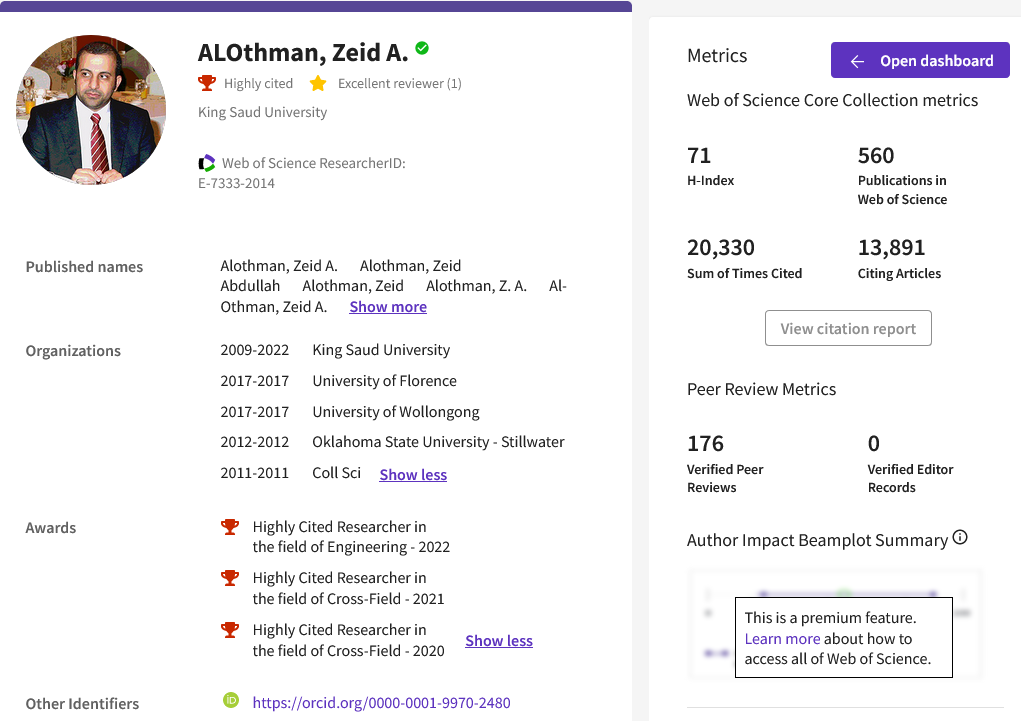
From the same King Saud University, there is another “highly cited” researcher, Zeid A. ALOthman. Who might be grateful to Luque for a few joint papers that were instrumental to his recognition by Clarivate.
Like here:
Xue-Qin Ma , Ya-Qi Shan , Meng-Yao Wang , Zeid A. Alothman , Zhi-Xiang Xu , Pei-Gao Duan , Jun Zhou , Rafael Luque Mechanochemical Preparation of N,S-Doped Graphene Oxide Using (NH4)2SO4 for Supercapacitor Applications ACS Sustainable Chemistry & Engineering (2020) doi: 10.1021/acssuschemeng.0c05918
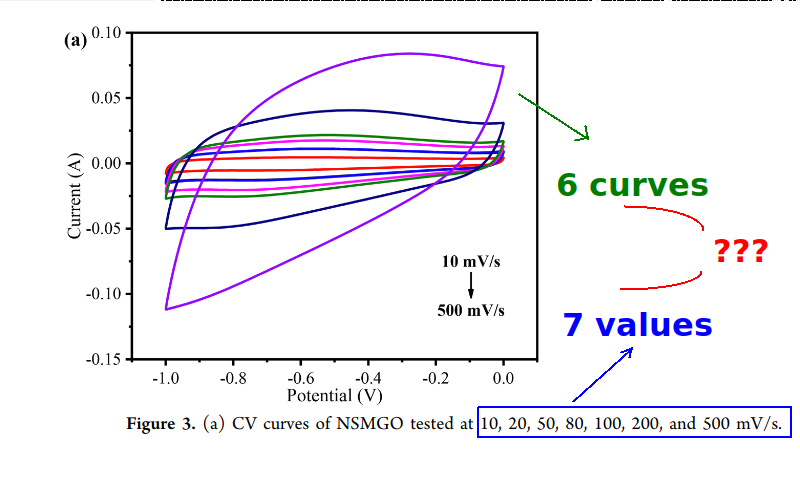
Or, perhaps, joint endeavors with the German professor in China, Florian Stadler, and his magical postdoc Amit Kumar weren’t entirely useless for ALOthman as well:
Amit Kumar , Sunil Kumar Sharma , Ajay Kumar , Gaurav Sharma , Najla AlMasoud , Taghrid S. Alomar , Mu. Naushad , Zeid A. ALOthman , Florian J. Stadler High interfacial charge carrier separation in Fe3O4 modified SrTiO3/Bi4O5I2 robust magnetic nano-heterojunction for rapid photodegradation of diclofenac under simulated solar-light Journal of Cleaner Production (2021) doi: 10.1016/j.jclepro.2021.128137

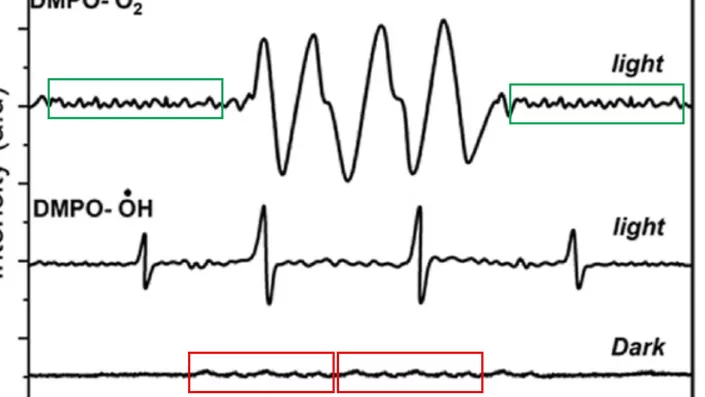
There is more fake data in that paper, visit PubPeer. And you can read about Stadler and Kumar here:
Epileptic spasms of tics and glitches in Krautrock diffractograms
Smut Clyde chases free radicals in a German-run lab in China
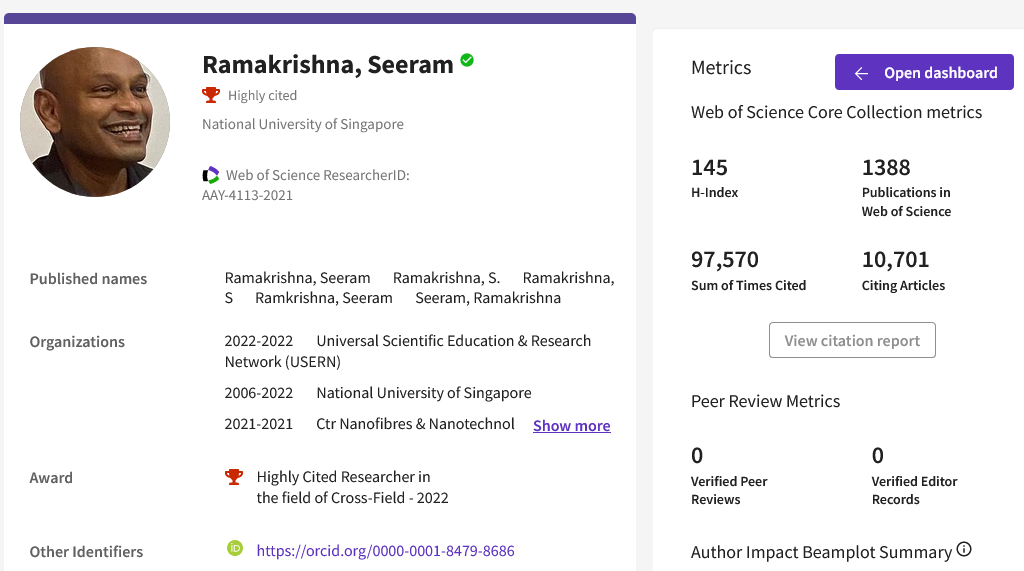
Let’s meet another “highly cited” chemist, Seeram Ramakrishna.
Here, Ramakrishna with Mohammad Arjmand. Remember Arjmand? Yes, the very guy who co-guest-edited the above mentioned scam “special issue” in Journal of Energy Storage with Afrand, Karimi and Qi.
Seyyed Alireza Hashemi, Hamid Reza Naderi , Seyyed Mojtaba Mousavi , Sonia Bahrani , Mohammad Arjmand , Ayrat M. Dimiev , Seeram Ramakrishna Synergic effect of laser-assisted graphene with silver nanowire reinforced polyindole/polypyrrole toward superior energy density Carbon (2022) doi: 10.1016/j.carbon.2021.12.028
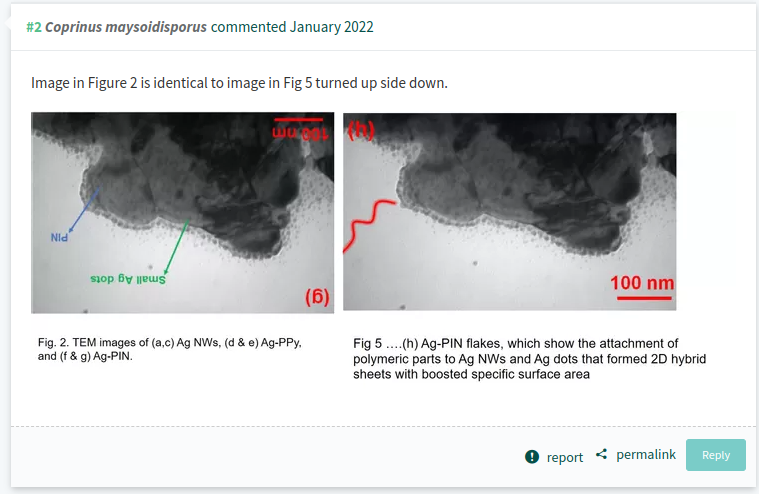

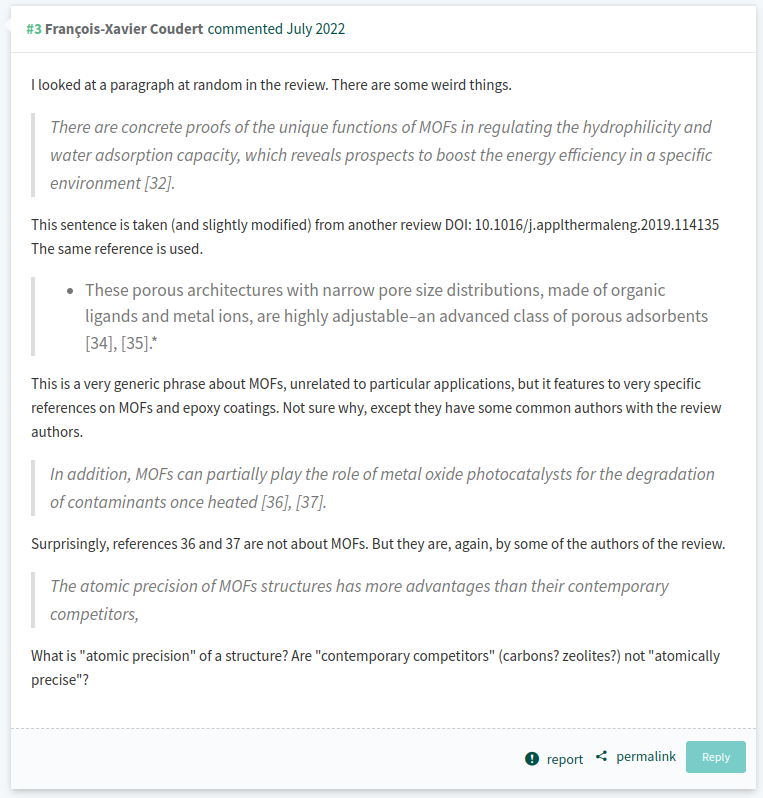
And here with Luque, because maybe that Spanish man is the soul of the team.
Mehdi Moayed Mohseni , Maryam Jouyandeh , S. Mohammad Sajadi , Aleksander Hejna , Sajjad Habibzadeh , Ahmad Mohaddespour , Navid Rabiee , Hossein Daneshgar , Omid Akhavan , Mohsen Asadnia , Mohammad Rabiee , Seeram Ramakrishna , Rafael Luque , Mohammad Reza Saeb Metal-organic frameworks (MOF) based heat transfer: A comprehensive review Chemical Engineering Journal (2022) doi: 10.1016/j.cej.2022.137700
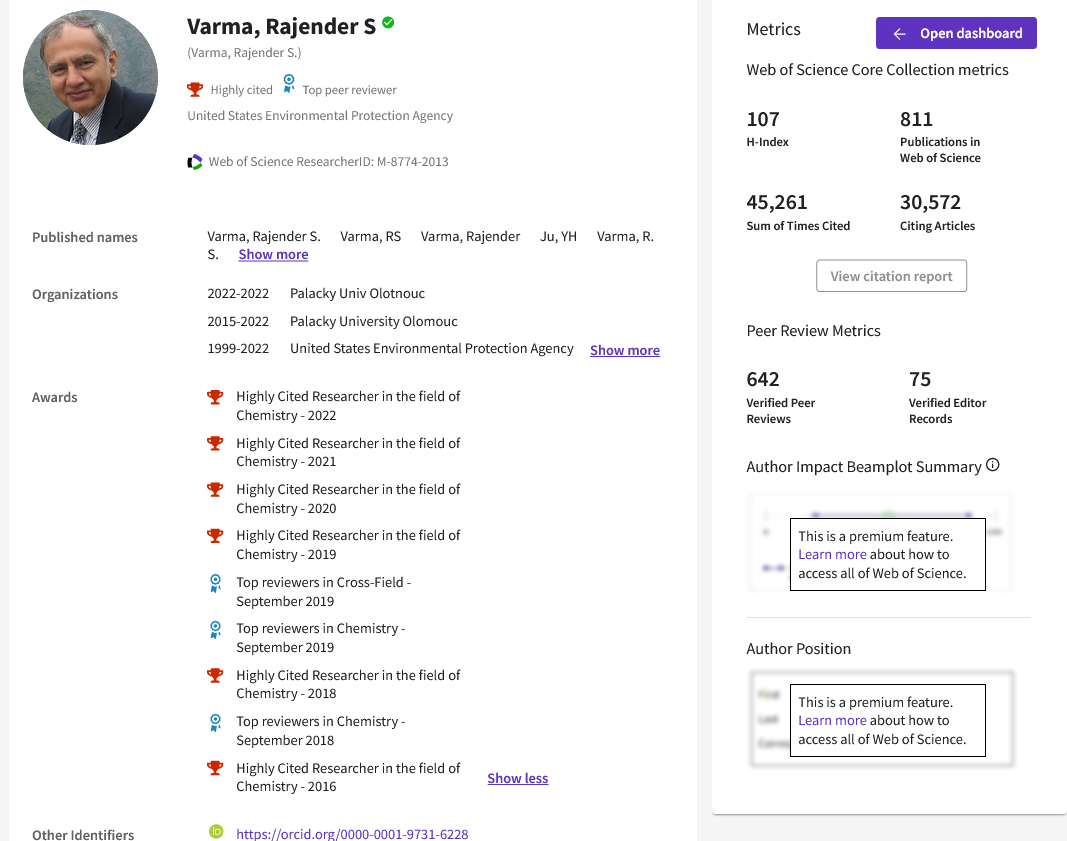
To continue with chemists, how about Rajender S. Varma of US EPA and Palacky University of Olomouc in Czechia, where he closely collaborates with the cheater Radek Zboril?
Here, a citation of a paper on moths and pheromones, authored by Neil J. Vickers, a giveaway of a practice often going hand-in-hand with Iranian papermill activities:
Pejman Ghaffari-Bohlouli , Hafez Jafari , Nayere Taebnia , Ali Abedi , Armin Amirsadeghi , Seyyed Vahid Niknezhad , Houman Alimoradi , Sina Jafarzadeh , Mahta Mirzaei , Lei Nie , Jianye Zhang , Rajender S. Varma , Amin Shavandi Protein by-products: Composition, extraction, and biomedical applications Critical Reviews in Food Science and Nutrition (2022) doi: 10.1080/10408398.2022.2067829
“Sericin is made up of 18 amino acids, 70% of which are hydrophilic with an isoelectric point of around 4, allowing it to absorb considerable amounts of water while remaining partially soluble (Vickers 2017).
…
Step two involves breaking the disulfide bonds with a chemical that are classified as oxidative, reductive, and sulphitolysis based on their reaction mechanism (Vickers 2017).”
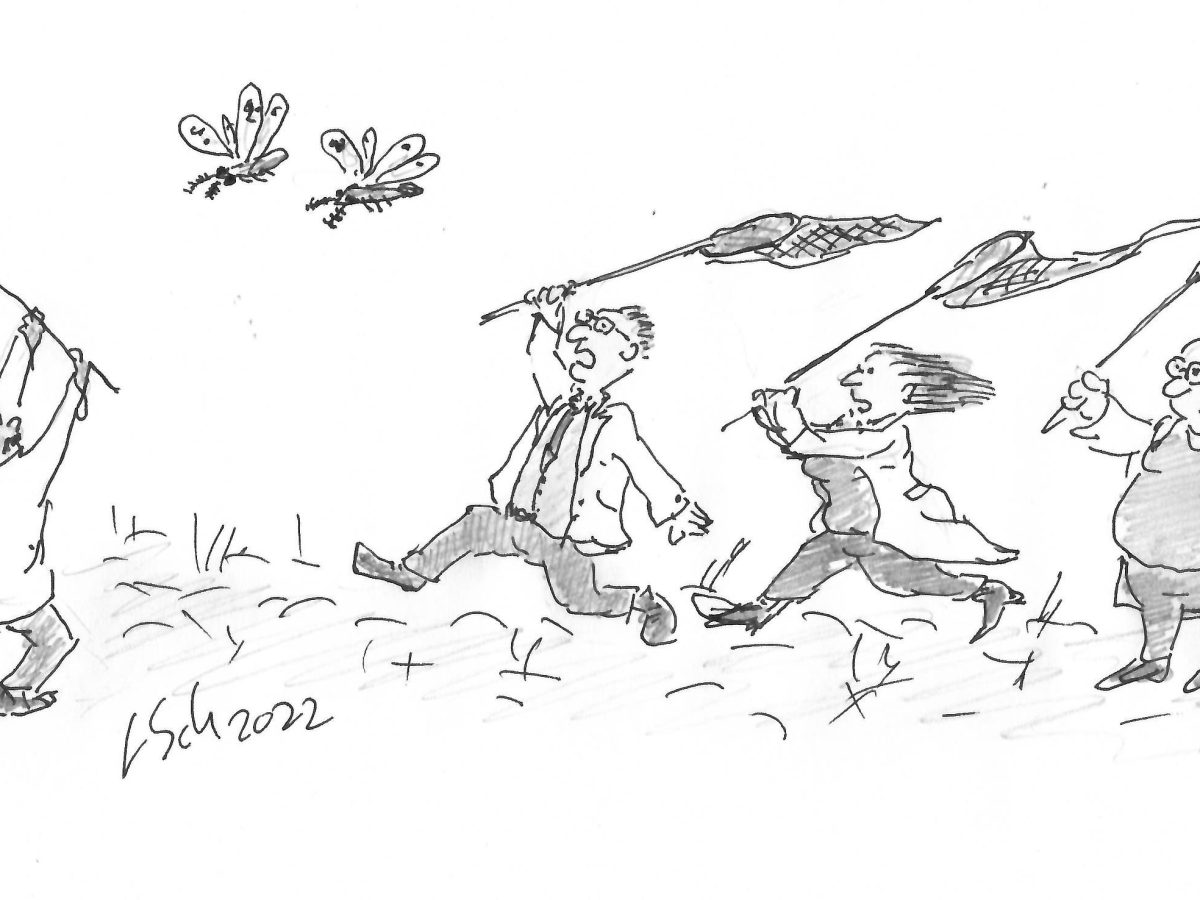
When I’m citing you, will you answer too?
What do moth pheromones on one side have to do with cancer research, petrochemistry, materials science, e-commerce, psychology, forestry and gynaecology on the other? They are separated by just one citation!
Here, joint efforts with our previous hero, Seeram Ramakrishna, resulted in a total mess with scamming scanning electron microscope images:
Zohreh Bakhtiarzadeh , Shamila Rouhani , Ziba Karimi , Sadegh Rostamnia  , Titus A.M. Msagati , Dokyoon Kim , Ho Won Jang , Seeram Ramakrishna , Rajender S. Varma , Mohammadreza Shokouhimehr Hydrothermal self – sacrificing growth of polymorphous MnO2 on magnetic porous – carbon (Fe3O4@Cg/MnO2): A sustainable nanostructured catalyst for activation of molecular oxygen Molecular Catalysis (2021) doi: 10.1016/j.mcat.2021.111603
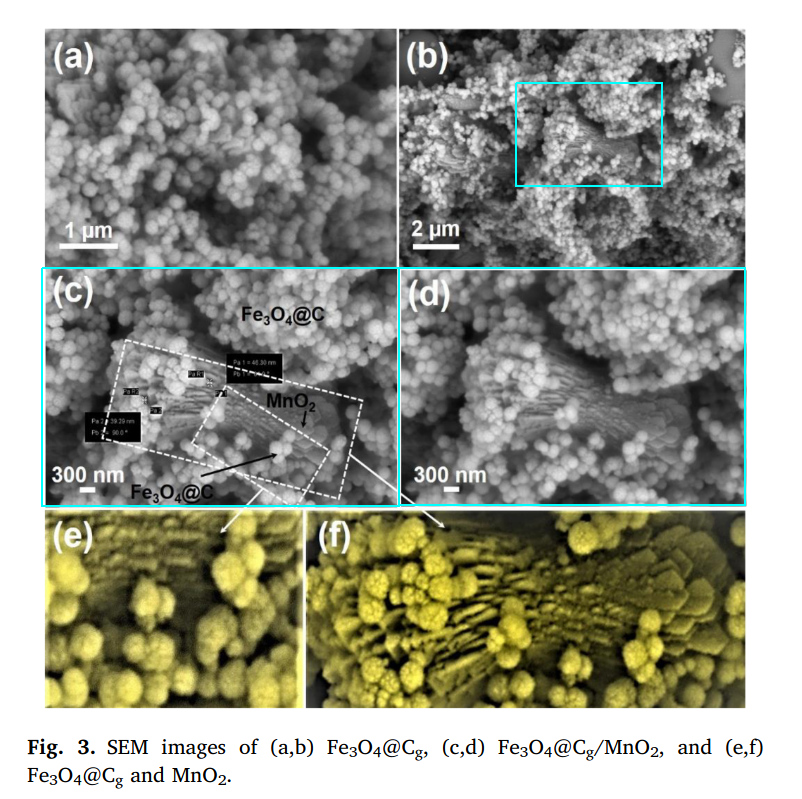
To continue with Varma’s scamming scanning electron microscopy adventures, there are several papers where the instrument is obviously misreported. Like here:
Neda Motamedi , Mahmood Barani , Azadeh Lohrasbi-Nejad , Mojtaba Mortazavi , Ali Riahi-Medvar , Rajender S. Varma , Masoud Torkzadeh-Mahani Enhancement of Thermostability of Aspergillus flavus Urate Oxidase by Immobilization on the Ni-Based Magnetic Metal–Organic Framework Nanomaterials (2021) doi: 10.3390/nano11071759
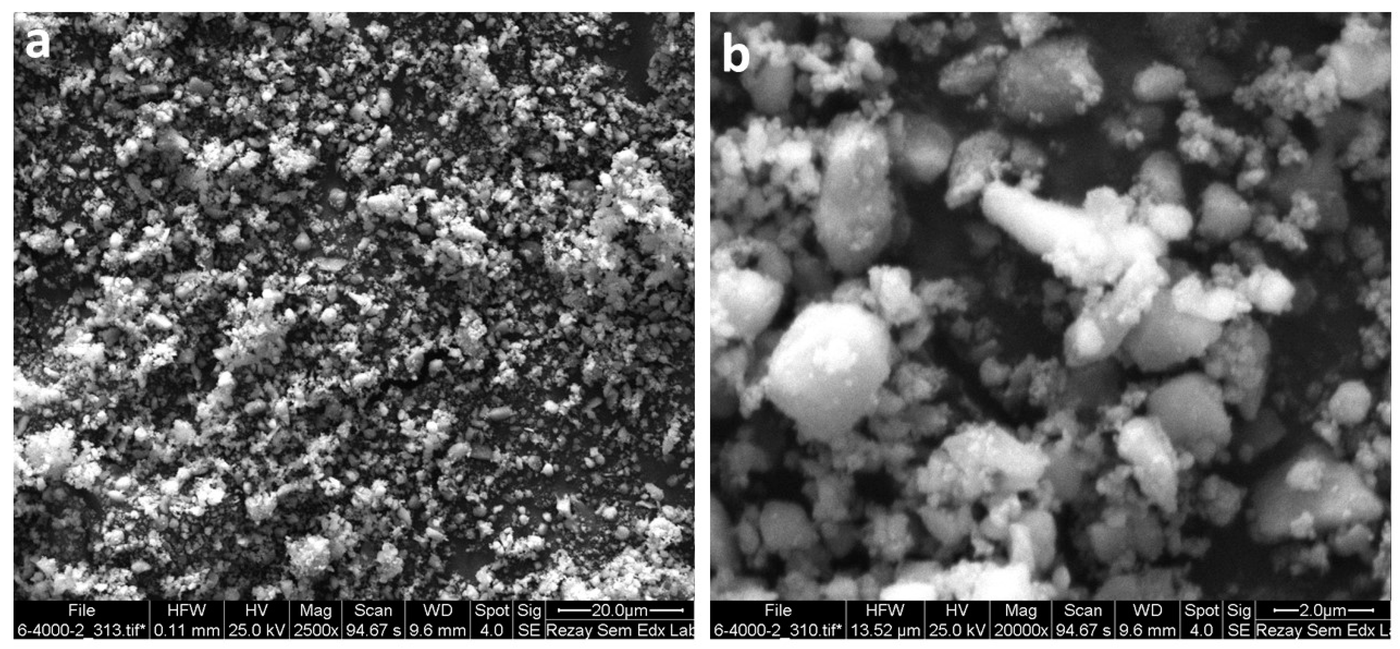
The fact is: the image is obviously coming from a FEI Quanta 200 machine, not a Hitachi one. And the voltage is indicated as 25 kV on the image, not 10 kV, as in the text. Well, I have an idea how it could happen. Maybe, just maybe, this paper-shaped product was assembled by an unnamed student somewhere in Iran? Perhaps this student just had a library of random images to choose from, and even less knowledge about SEM than I have?
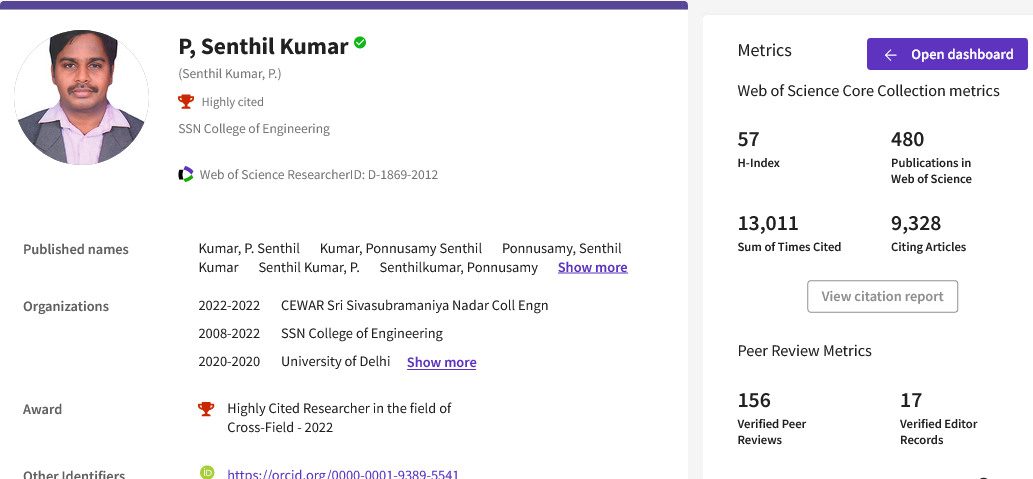
We are not done with chemists yet! Meet Ponnusamy Senthil Kumar from Sri Sivasubramaniya Nadar College of Engineering, Chennai, India. Nah, strike that: from Taif University, Saudi Arabia.

Senthil Kumar has a massive PubPeer record, due to his obsession with tortured phrases and lazily plagiarised reviews. An example, also featuring another “highly cited” researcher, Rajendran Saravanan:
R. Sivaranjanee , P. Senthil Kumar , R. Saravanan , M. Govarthanan Electrochemical sensing system for the analysis of emerging contaminants in aquatic environment: A review Chemosphere (2022) doi: 10.1016/j.chemosphere.2022.133779
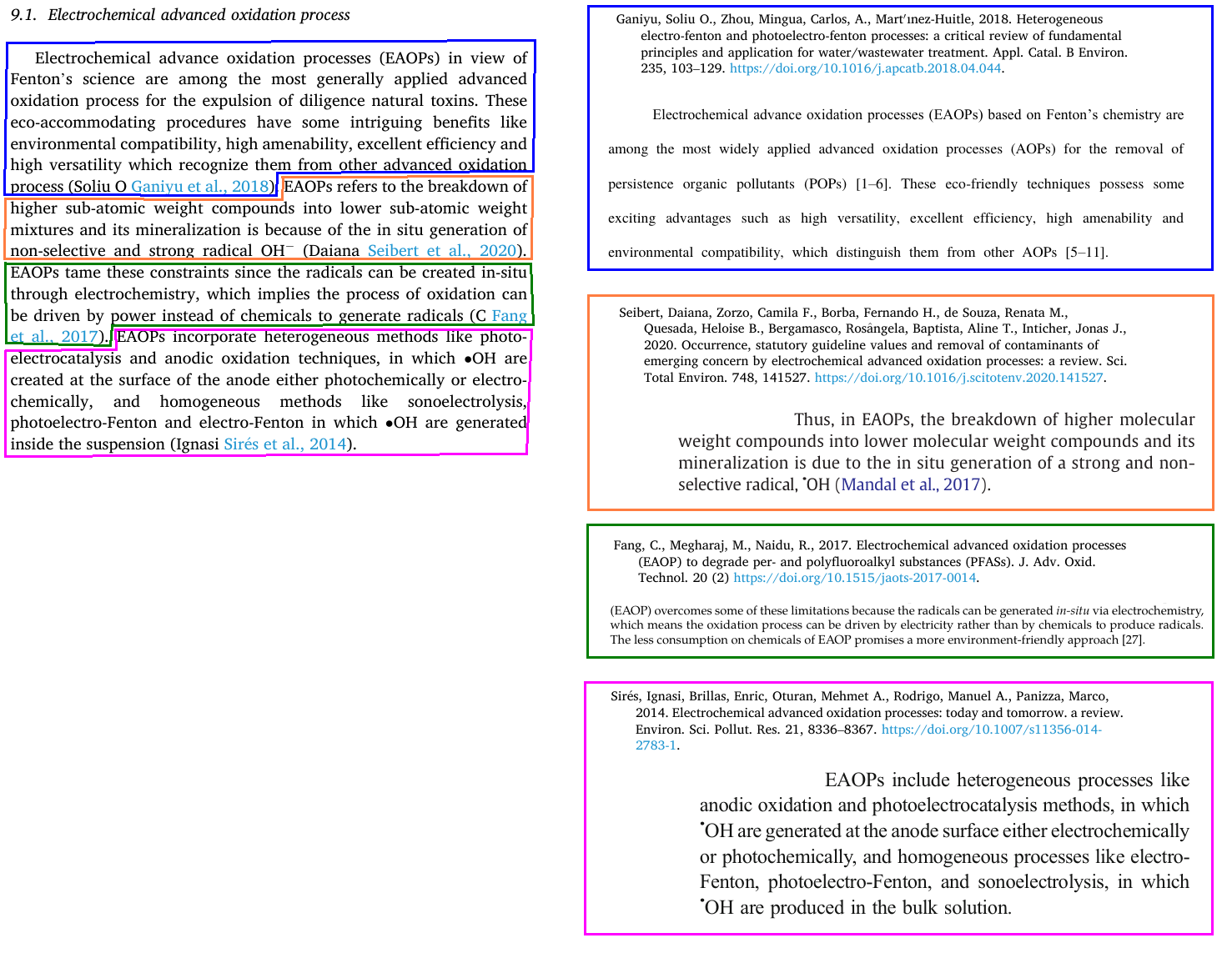
Another one:
A. Saravanan , P. Senthil Kumar , A. Annam Renita Hybrid synthesis of novel material through acid modification followed ultrasonication to improve adsorption capacity for zinc removal Journal of Cleaner Production (2018) doi: 10.1016/j.jclepro.2017.10.109
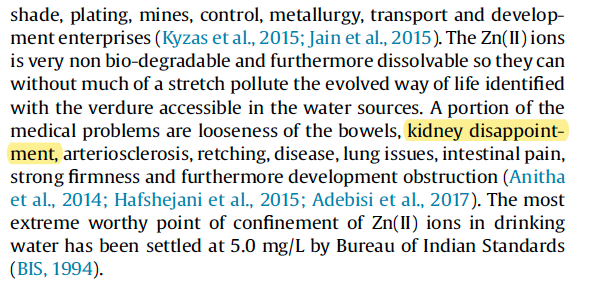
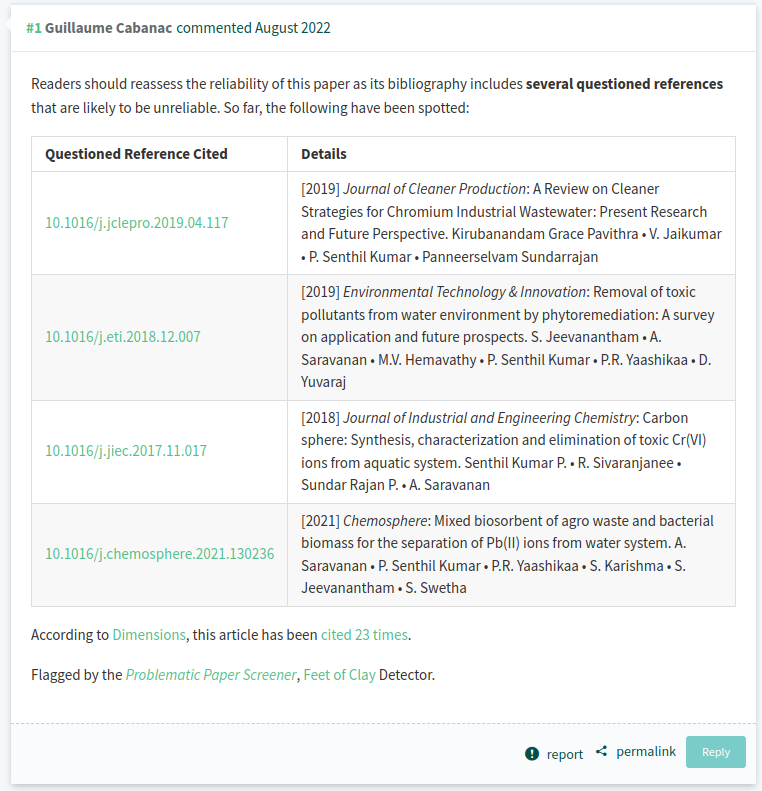
His “looseness of the bowels” didn’t preclude Senthil Kumar from assuming some editorial positions, like in Springer’s Ecological Processes, IOP’s Environmental Research Communications, and, until recently, Elsevier Sustainable Chemistry and Pharmacy. Perhaps it is because of valuable editorial recommendations given by Senthil Kumar to the right and left, his tortured output is indeed highly cited, and citations are therefore well-visible on the Feet of Clay tab of Guillaume Cabanac’s Problematic Paper Screener?
Amina Othmani , Sara Magdouli , P. Senthil Kumar, Ashish Kapoor , Padmanaban Velayudhaperumal Chellam , Ömür Gökkuş Agricultural waste materials for adsorptive removal of phenols, chromium (VI) and cadmium (II) from wastewater: A review Environmental Research (2022) doi: 10.1016/j.envres.2021.111916
Our incomplete tour around highly cited chemists is about to be cut here, but we won’t leave George Z. Kyzas without a honorable mention.
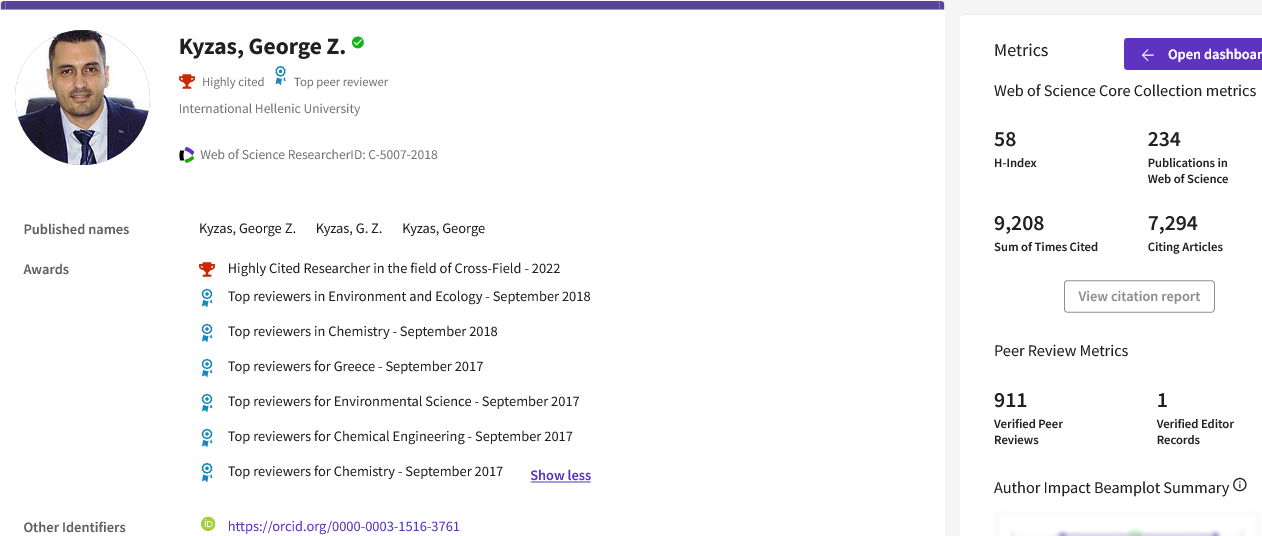
Here, see Kyzas, in a joint venture with Abbas Rahdar, Mahmood Barani and Saman Sargazi (we have previously seen Ghasem Sargazi, most likely a relative of Saman) engaging in very familiar shenanigans.
Saman Sargazi , Zahra Ahmadi , Mahmood Barani , Abbas Rahdar , Soheil Amani , Martin F. Desimone, Sadanand Pandey , George Z. Kyzas Can nanomaterials support the diagnosis and treatment of human infertility? A preliminary review Life Sciences (2022) doi: 10.1016/j.lfs.2022.120539
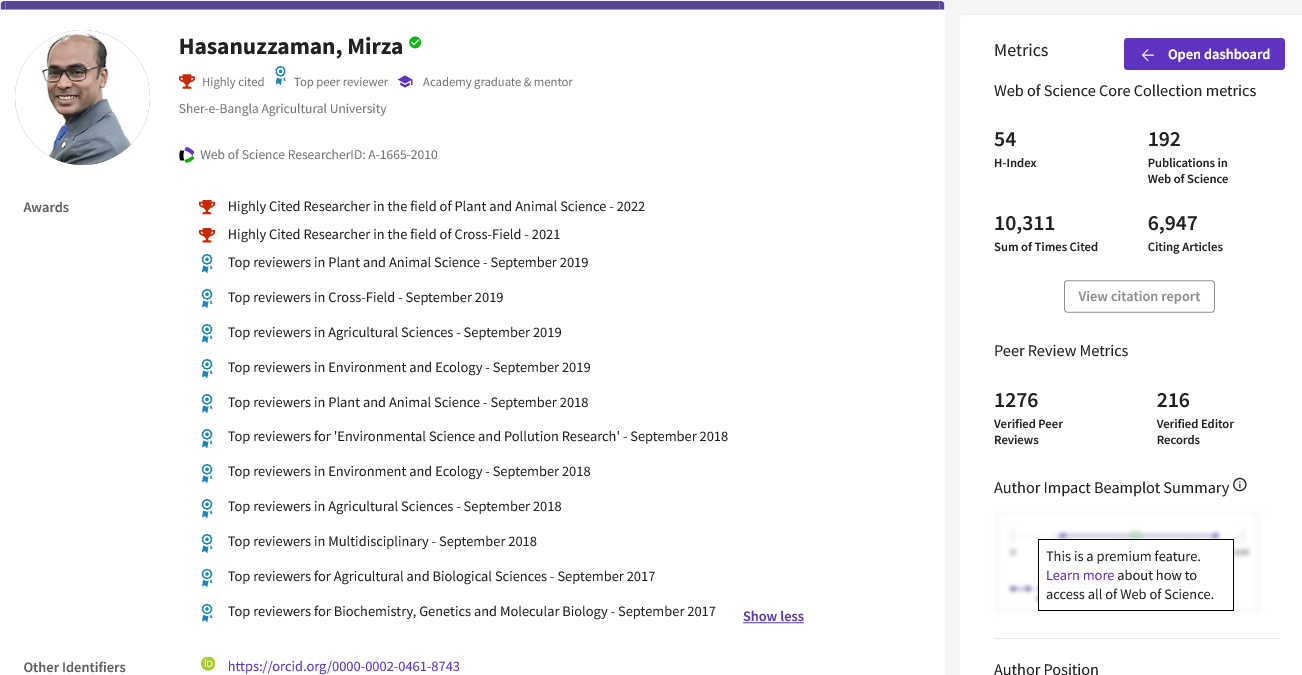
Outside the realm of chemistry, there is a plant scientist Mirza Hasanuzzaman, with this retraction:
“We, the Editors and Publisher of the Journal of Plant Nutrition have retracted the following article:
Integration of phosphorus with organic manures and plant residues on growth and production of hybrid rice,
Tariq Shah, Tayyaba Andleeb & Mirza Hasanuzzaman
Journal of Plant Nutrition (2019)
DOI: 10.1080/01904167.2018.1554679
Since publication, significant concerns have been raised about the integrity of the published data and overlap with the article listed below:
Growth and Productivity Response of Hybrid Rice to Application of Animal Manures, Plant Residues and Phosphorus.
Amanullah, Shams-ul-Tamraiz Khan, Asif Iqbal and Shah Fahad
Front. Plant Sci. (2016) 7:1440.
https://dx.doi.org/10.3389/fpls.2016.01440
When approached for an explanation, the authors did not provide their original data or any necessary supporting information for the observed overlap. As verifying the validity of published work is core to the integrity of the scholarly record, we are therefore retracting the article.
The authors listed in this publication have been informed and Professor Hasanuzzaman and Dr. Andleeb have cooperated with the investigation and agree with this retraction. We have received no response to our questions from Dr. Shah.”
Looking at Hasanuzzaman, I came across one article, co-authored with another “highly cited” researcher, Masayuki Fujita. It has been cited 674 times to date, but what happens if we restrict our view of citing papers to those from PLoS ONE only? Oops, three out of five are retracted, all in a wave of one-hundred-plus retractions due to fake peer review!
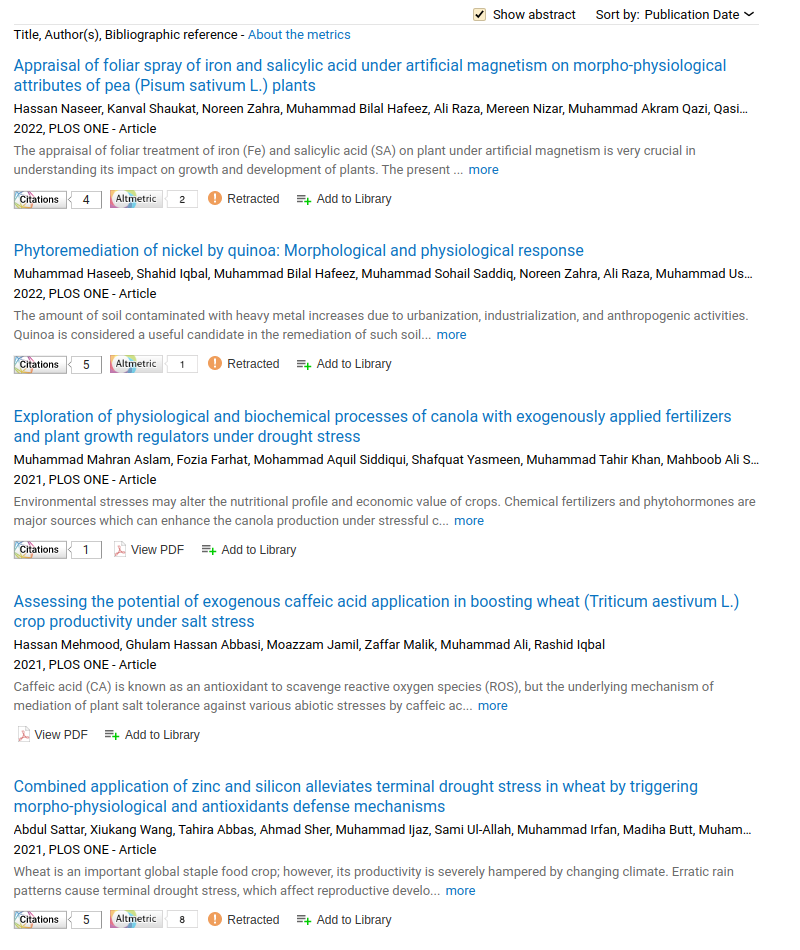
All in all, according to my counts, 15 different Hasanuzzaman papers are cited by 14 PLoS ONE retractions, like this one, this one and this one. Also, 10 papers of Fujita (7 with Hasanuzzaman) are cited in 10 retracted papers. It seems to be an overall trend that retracted PLoS ONE papers indeed show some emphasis on Hasanuzzaman and Fujita.
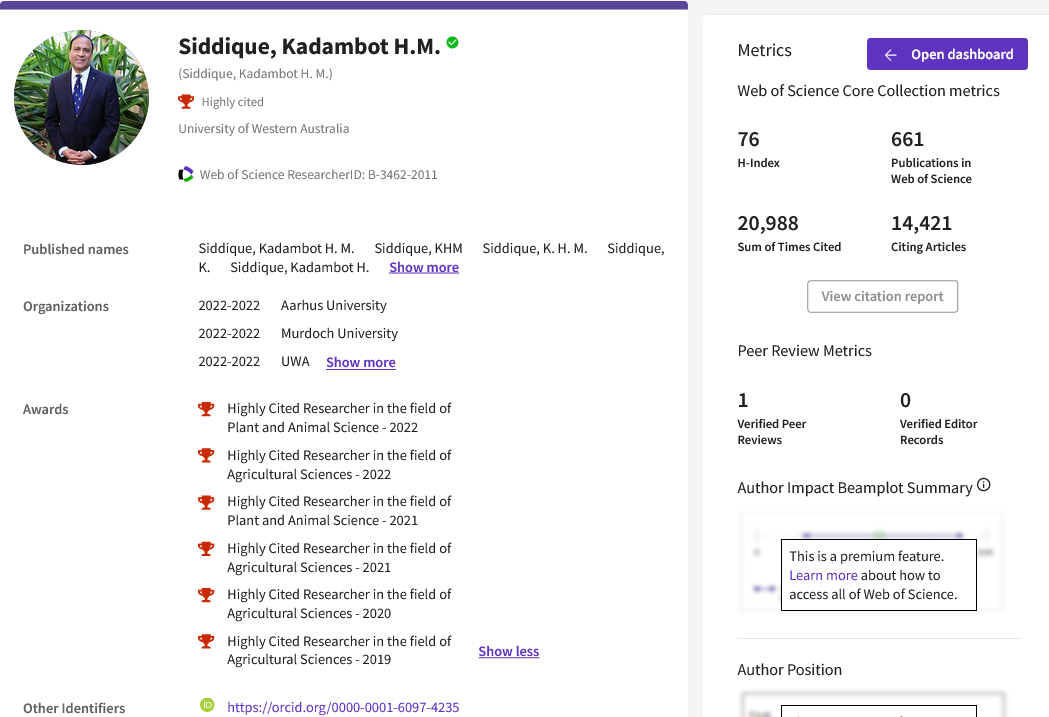
There is another “highly cited” researcher, seemingly over-cited in the same group of papers. A certain Kadambot H.M. Siddique from Australia, 17 papers of whom were cited in 19 PLoS ONE retractions.
Recently Siddique became a victim of the Vickers’ curse, here you go:
Muhammad Khuram Razzaq , Muqadas Aleem , Shahid Mansoor , Mueen Alam Khan , Saeed Rauf , Shahid Iqbal , Kadambot H. M. Siddique Omics and CRISPR-Cas9 Approaches for Molecular Insight, Functional Gene Analysis, and Stress Tolerance Development in Crops International Journal of Molecular Sciences (2021) doi: 10.3390/ijms22031292
“The detection of valid metabolomic markers will enhance stress tolerance in plants [59,61].”
Reference 61 is the Vickers paper about moths.
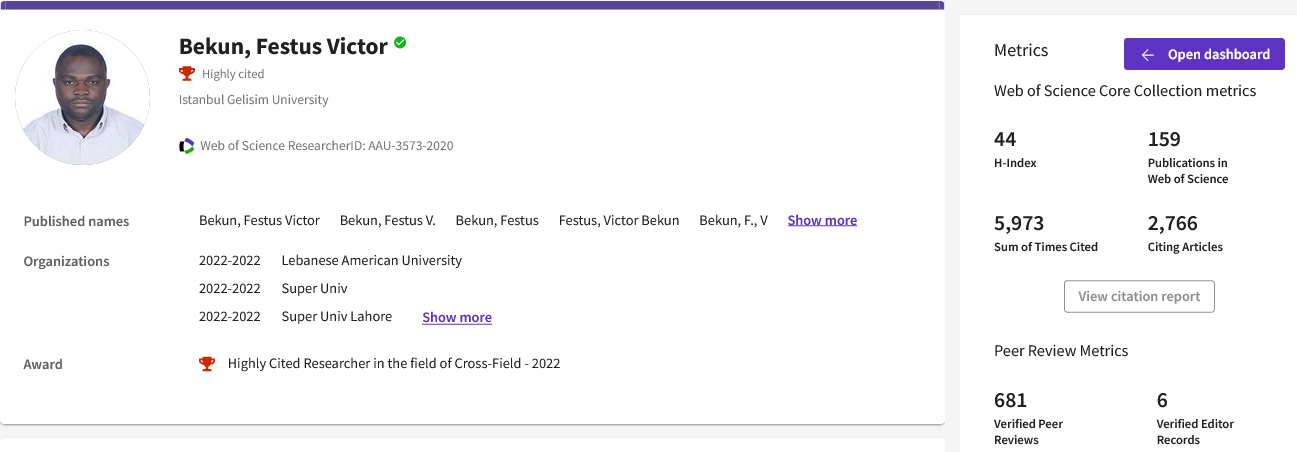
Completely unnoticed, even on PubPeer until recently, probably because no one cares, comes another “highly cited” scientist, Festus Victor Bekun. His current affiliation is Istanbul Gelisim University, Turkey, and the previous one was South Ural State University in Chelyabinsk, Russia, a “university” that used to invite various scammers – Saeed Shirazian and Afrasyab Khan, to name two.
Now remember the Environmental Science and Pollution Research journal that accepted a forgery from Luque? Here, in the same journal, language skills are demonstrated by Bekun and his co-authors:
Abdulrasheed Zakari , Festus Fatai Adedoyin , Festus Victor Bekun The effect of energy consumption on the environment in the OECD countries: economic policy uncertainty perspectives Environmental Science and Pollution Research (2021) doi: 10.1007/s11356-021-14463-8
“Be that as it may, the evaluations on the primary request distinction information arrangement affirmed the dismissal of the invalid theory at a 1% level of noteworthiness for the entirety of the examples and acknowledged elective speculations.”
Whether this awkward sentence can be excused by English-not-being-the-first-language, or whether it is just a product of automated paraphrasing – it is up to your judgement, dear reader.
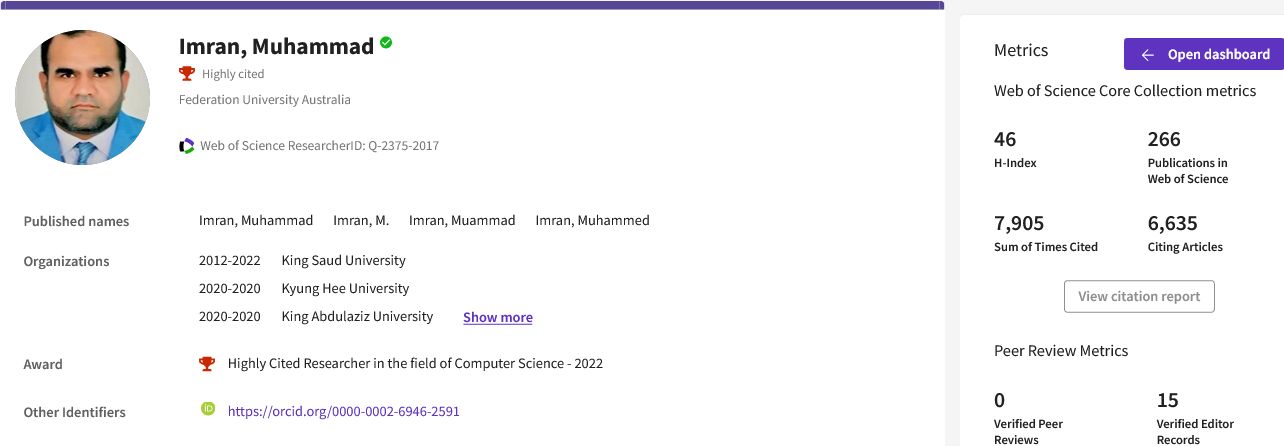
One more great scientist to meet, Muhammad Imran from Australia.
Yasir Mehmood , Farhan Ahmad , Ibrar Yaqoob , Asma Adnane , Muhammad Imran , Sghaier Guizani Internet-of-Things-Based Smart Cities: Recent Advances and Challenges IEEE Communications Magazine (2017) doi: 10.1109/mcom.2017.1600514
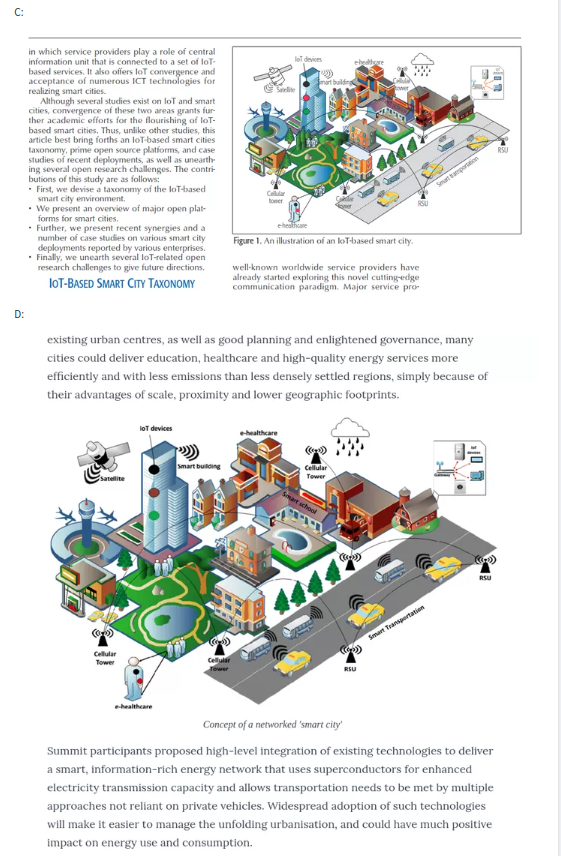
A meaningless compilation of texts from elsewhere plus hijacked illustrations, that’s what makes a perfect highly-cited IoT review paper!
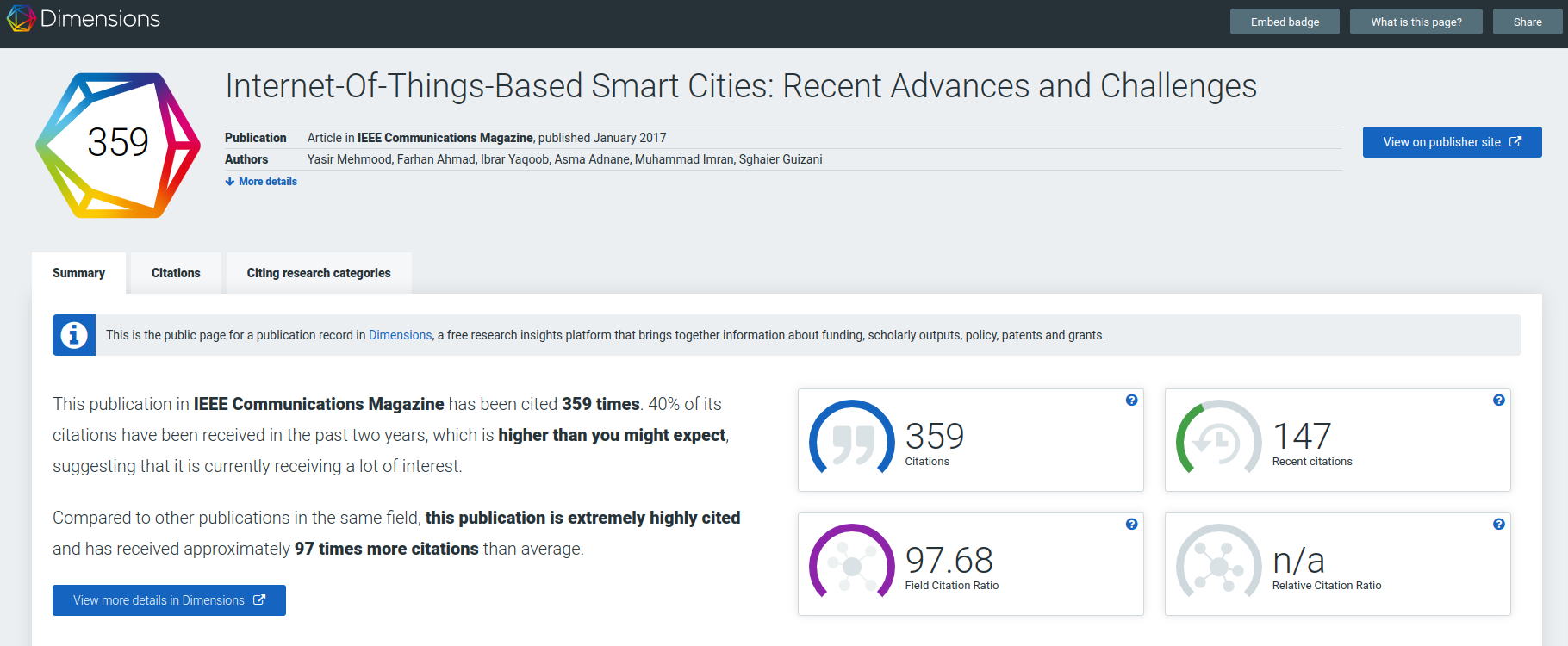
Praised by Clarivate is Mehdi Sharifi-Rad from Kerman University of Medical Sciences. Mehdi’s Dimensions record is unexpectedly void after 2020, a search for his whereabouts revealed only a university page in Persian, also last updated in 2020, his degree is listed there only as M.Sc. Another funny thing is, out of Mehdi’s 72 papers listed on Dimensions, all but one are co-authored by a certain Javad Sharifi-Rad, and the remaining one has a pathetic citation count of four.
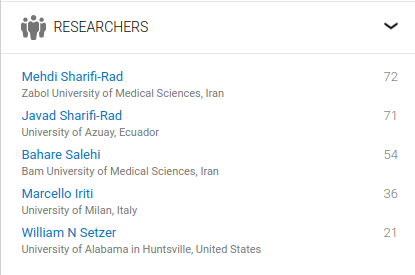
Nevertheless, Javad, who has much more publications to offer and much more citations to count, hasn’t made it to the list. Maybe peevish inside disorder is the cause? Either that or fly slack.
Bahare Salehi , Marina Dimitrijević , Ana Aleksić , Katarzyna Neffe-Skocińska, Dorota Zielińska , Danuta Kołożyn-Krajewska, Javad Sharifi-Rad , Zorica Stojanović-Radić, Selvaraj Milton Prabu , Célia F. Rodrigues, Natália Martins Human microbiome and homeostasis: insights into the key role of prebiotics, probiotics, and symbiotics Critical Reviews in Food Science and Nutrition (2021) –
doi: 10.1080/10408398.2020.1760202
“The authors would like to apologize for their poor judgment” in the retraction notice from June 2022:
“The above article has been retracted due to significant overlap in content with the following previously published papers:
- Olveira, G. and I. González-Molero. 2016. An update on probiotics, prebiotics and symbiotics in clinical nutrition. Endocrinol Nutr 63 (9):482–494. doi: 10.1016/J.ENDOEN.2016.10.011
- Knight, R., C. Callewaert, C. Marotz, E.R. Hyde, J.W. Debelius, D. McDonald, and M.L. Sogin. 2017. The Microbiome and Human Biology. Annu. Rev. Genom. Hum. Genet. 18:65–86. doi: 10.1146/annurevgenom-083115-022438
- Lloyd-Price, J., G. Abu-Ali, and C. Huttenhower. 2016. The healthy human microbiome. Genome Medicine 8:51. doi: 10.1186/s13073-016-0307-y
This is by Smut Clyde about one of the authors of that retracted paper:
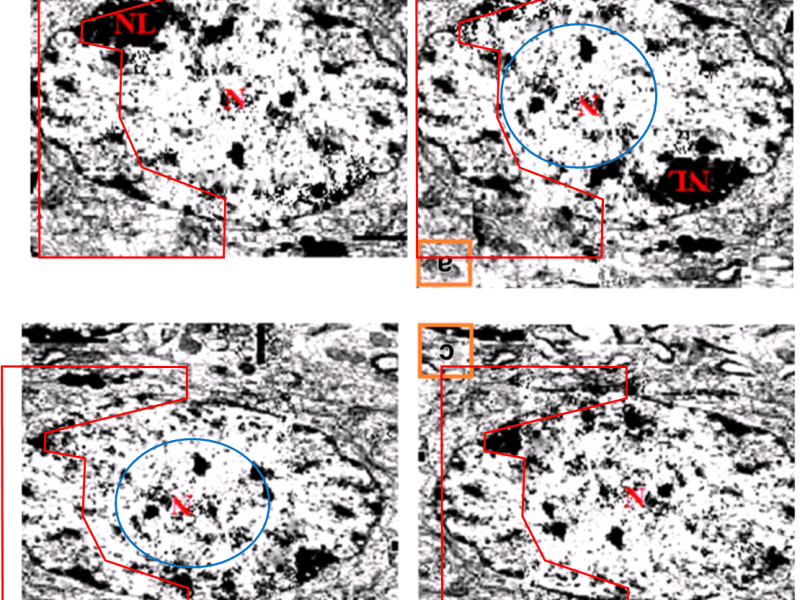
Milton Prabu’s outsourced art gallery
“now we have equipped with our own photo microscopy, we didn’t depend on the out sourcing fellows to take the photography our slides”. – Dr Milton Prabu.
But then again, Mehdi has a retraction, too, and not completely unrelated to the peevish inside disorder paper, as Javad, Bahare Salehi and Zorica Z. Stojanović-Radić are common authors on both retractions. To be more precise, Mehdi’s retraction is actually a withdrawal, and with a hollow withdrawal note Elsevier show us their contempt to tell what exactly happened. The “withdrawn” paper had no less than FIVE authors named Sharifi-Rad:
Javad Sharifi-Rad , Bahare Salehi , Zorica Z. Stojanović-Radić , Patrick Valere Tsouh Fokou , Marzieh Sharifi-Rad , Gail B. Mahady , Majid Sharifi-Rad , Mohammad-Reza Masjedi , Temitope O. Lawal , Seyed Abdulmajid Ayatollahi , Javid Masjedi , Razieh Sharifi-Rad , William N. Setzer , Mehdi Sharifi-Rad , Farzad Kobarfard , Atta-ur Rahman , Muhammad Iqbal Choudhary , Athar Ata , Marcello Iriti Medicinal plants used in the treatment of tuberculosis – Ethnobotanical and ethnopharmacological approaches Biotechnology Advances (2017) doi: 10.1016/j.biotechadv.2017.07.001
“This article has been withdrawn at the request of the author(s) and/or editor. The Publisher apologizes for any inconvenience this may cause.”
Left outside this exposition are, for example, Diego Oliva, Poom Kumam, Arivalagan Pugazhendhi, Amir H. Gandomi. Mark Griffiths has already been featured on For Better Science. And devil it knows whom else we have there: like a larder full of mice, where you can’t remember each one by its name.

Nuttingham Trash University
“I will not by myself, or be instructing or encouraging any other person or howsoever othewise, publish or cause to be published words or otherwise howsoever make statements to others which wrongfully refer to Nottingham Trent University and/or their employees and for any person or any body associated with Nottingham Trent University”
The Retraction Watch post promoting Clarivate’s list triggered a lively discussion, in which nobody appeared too enthusiastic. The key thoughts are best conveyed by copying what the original commentators wrote, so that’s exactly what I am about to do.
“For example, outsized output, in which individuals publish two or three papers per week over long periods, by relying on international networks of co-authors, raise the possibility that an individual’s high citation counts may result from co-authors alone when publishing without the individual in question. If more than half of a researcher’s citations derive from co-authors, for example, we consider this narrow rather than community-wide influence, and that is not the type of evidence we look for in naming Highly Cited Researchers. Any author publishing two or three papers per week strains our understanding of the normative standards of authorship and credit.”
By “lol”
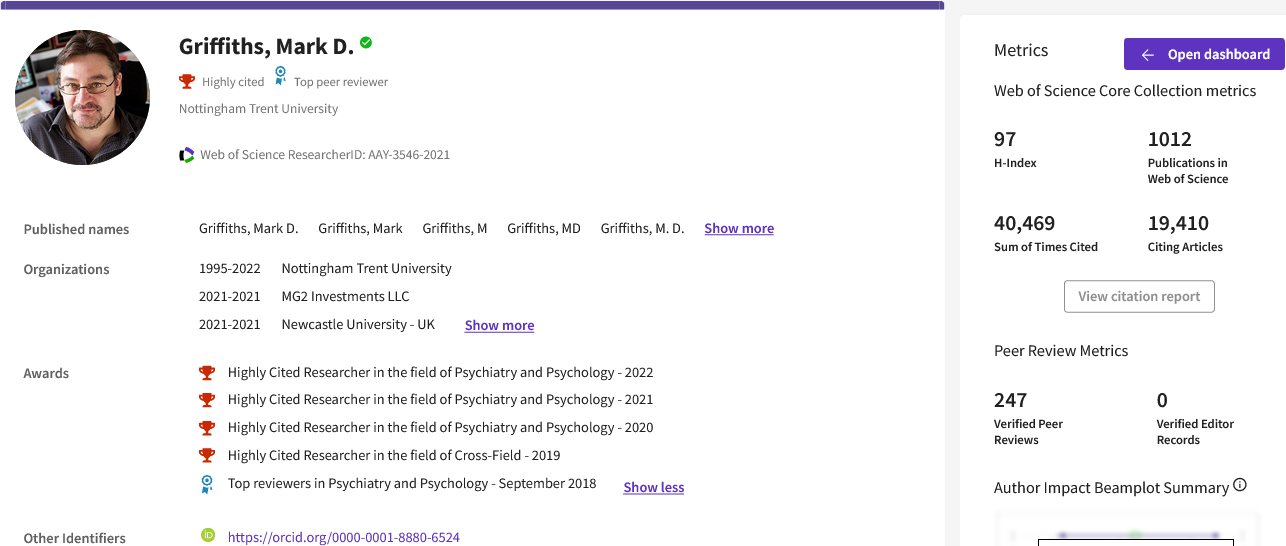
And yet Mark Griffiths is on this list.
“At a glance, the listings under mathematics appear worse than useless, and one would think they would be negatively correlated with other measures. There might in principle be disciplines where this sort of measurement has relevance. But perhaps not in the current state of publishing“.
By “glc”
“A total of 9 highly citied researchers have wrongly indicated their primary affiliation as Taif University in the latest list.
By “Little”
Clairvate should immediately withdraw such misleading list and take necessary [steps] against these dubious researchers.”
Representatives of Clarivate might use this post to further clean up their list next year. But well, it is imminent that new frauds will replace them. So here is my advice to Clarivate: better get lost.
I thank all my donors for supporting my journalism. You can be one of them!
Make a one-time donation:
I thank all my donors for supporting my journalism. You can be one of them!
Make a monthly donation:
Choose an amount
Or enter a custom amount
Your contribution is appreciated.
Your contribution is appreciated.
DonateDonate monthly
 For Better Science
Great work indeed. This Clarivate list is truly a joke, as well as the whole concept of metrics applied to judge research quality. I wonder if any intrepid soul will one day help Leonid to set up a FBS Database with all the names, institutions, nr of flagged papers per group, etc, etc, of all the crooks this website has reported since 2015 up to today.
LikeLike
Great work, thanks alot for all of your efforts.
LikeLike
Bekun’s buddy, one of many “environmental” crabheads in the HCR list.
#GIM congratulates Dr Avik Sinha, Faculty of General #Management and #Economics Area, for being #featured among Top 1% in @Clarivate ‘s list of Highly Cited Researchers (HCR), 2022 and becoming one of the 25 #Indian #researchers who are a part of this highly #prestigious list.
LikeLike
Lo and behold, 1.4k publications in less than 20 years, this makes an average a publication per 5 days for a period of 20 years with every day counted!!! Things are a lot worse than it looks, the Scopus profile of this “genius” is https://www.scopus.com/authid/detail.uri?authorId=57205523298.
LikeLike
This industrial scale perversion of scientific publishing is made explicit.
What is unclear to me is why Clarivate is so generous in granting impact factors to bogus journals, and is turning a blind eye to obvious deviant strategies aimed at boosting their impact factors. What do they gain from that, against the growing risk that the shit will eventually hit the fan and their reputation will be destroyed?
LikeLike
Well, Clarivate is run by its execs.
And here I made a snapshot of their exec board composition.
https://web.archive.org/web/20221126063752/https://clarivate.com/about-us/executive-leadership/
This is the textbook example of the easy come – easy go type of people. The longest stay of any of them at Clarivate is since August 2020, and many are there for less than a year.
Of course the shit can hit the fan. But before it happens, these execs will leave, not without pockets full of cash.
LikeLike
How about Amit Bhatnagar??? How could he have made it to the HCR list? Total scam.
LikeLike
Thanks, took notes.
Meanwhile, you can post whatever concerns you have about Bhatnagar on PubPeer. That would be much appreciated.
LikeLike
Yes, it would be important to make Amit Bhatnagar’s unethical behaviour public.
LikeLike
Amit Bhatnagar already has a substantial pubpeer record by now! It seems he can be linked to a larger papermill. He also became an editor for some journals since then and I am guessing he will use that role to support the papermill. Although, he might be stopped in time as this papermill has been pointed out to all publishers and they are looking into it.
LikeLike
His papers come mainly from international “collaboration” only with little role of his own. Another such researcher is Eveliina Repo from the same University (LUT University, Finland).
LikeLike
Ah, it’s THAT corner. Minions of Mika Erik Tapio Sillanpää. Now things are clearer to me, thanks!
LikeLike
Very good spotting. You could also explore Eveliina Repo’s papers published with Central South University, China, and also those with Iranian researchers. In the case of Amit Bhatnagar, it seems that approximately 90% of his papers arise from “international collaborations”, the content of these should also be scrutinized.
LikeLike
A random spotting featuring Eveliina Repo, who hasn’t (barely?) made it to the HCR list, but anyway.
Published by Hindawi, why not.
Abbasi, S., Mahboob, A., Bakhtiari Zamani, H., Bilesan, M. R., Repo, E., & Hakimi, A. (2022). The Tribological Behavior of Nanocrystalline TiO2 Coating Produced by Plasma Electrolytic Oxidation. Journal of Nanomaterials, 2022.
https://pubpeer.com/publications/9EC11C5809E16A19480D8353903169
LikeLike
Eveliina Repo and so many others were trapped under the supervision of Mika Sillanpää. this is what EU projects and universities should look into their policy! when there is PI and salary comes from projects, under a fix-term contract. this creates the best possibilities for PI’s to demand everything from their employee.
LikeLike
This is all fun and great, Zahra. Sillanpää is as crooked as he gets, without a question. Even if I didn’t care about all the theft and “love affairs” in Lappeenranta, there are heaps of evidence on PubPeer.
But here is the real question: Is Sillanpää the only perpetrator in your story? And that is where I am starting to cast doubts.
For instance, there is no Mika on this paper. But you and Eveliina are there.
Or how did you meet this esteemed man showing off as affiliated to your startup? There are many more questions to be asked about this “iQneiform OY” – but I am not sure if I am a suitable person to ask them.
LikeLike
there are much more story and details than just look into one papers and names.
@magazinovalex contact me directly to tell you more.
LikeLike
Please go ahead. At least one working email address of mine can be found through https://arxiv.org.
No guarantee of response, though.
LikeLiked by 1 person
Once again, the previous message is still in full effect. If you want to tell your story confidentially, just post an email to me. My email address is easily found. The profile name makes it very clear who I am.
LikeLike
and just to add how I met those people that you mentioned:
we are old colleagues knowing each other for more than 20 years, studied at a similar university (Razi University), in the same city, and we kept our scientific work still active together. we worked hard for every single article.
LikeLike
I appreciate your investigation, this is an amazing work. and I am so happy to see this investigation, after all. especially around Finland, but one thing that should be considered is the dynamic nature of life that is happening. Connecting the right dots together, is the key to solving the puzzles and seeing whole the truth.
I will share your articles on my pages, and thanks for your effort on bringing awareness to the truth of what is happening in the realm of papermill.
LikeLike
Sounds like, I trusted the team that I worked and I missed checking what was going on!
LikeLike
Alexander Magazinov is presenting very valid questions about Zahra Safaei. Safaei has created chaos everywhere she has been. Poland, Austria and now Finland. Here in Austria Safaei’s lover professor committed suicide due to her baseless allegations. Safaei also converted to Christianity from Islam which is against the law in her native country Iran.
LikeLike
Mika, I know it’s you. Get the fuck off my website you creepy pervert thief. I leave this comment so people see what lying slanderous scum you are. All follow-up comments of yours will be deleted.
LikeLike
based on my discussion with my team, they sent out the analysis to a private company and the image is the original image provided by the company. and it is not an expensive test.
we did hard work on each article. and we had even no grants for those articles.
I do not know, how it is possible to identify and claim they are the original or made up. this looks very kind of individual opinion or insight. at least, I did not find any tools to help me be sure and double-check the response we received for analysis. any suggestion for this image issue?
LikeLike
I don’t think this case is a matter of opinion. Which dots are here – oak apple or scrophularia? And just in case, there is a distinct possibility that those are not dots at all.
LikeLike
I am not the author of those articles, but I am working closely with my team, and also asking your questions from some other expert researchers to comments. they see the photos differently. based on the morphology at corners and the different symmetry, those photos are not the same.
I understand, that in Iran they use old instruments because of sanctions, and sometimes typo errors and noise should be corrected. but I am sure, based on results from different instruments and overall response, the procedure is correct and repeatable.
by all the discussions around, even though I appreciate raising questions, and looking into mistakes that could be not seen by authors or reviewers, but I still keep my trust in the team they do hard work and have no intention of data manipulation.
We appreciate your effort to create better science, and we consider your comments for the future to avoid misunderstanding or misinterpretation and present our data as clearly as possible. specially because samples are sent out of the lab for analysis, we consider a stronger demand for receiving our results in the future.
Thanks for the point!
LikeLike
This is your team you defend here:


https://pubpeer.com/search?q=%22changiz+karami%22
This is your own paper, without Mika Sillanpää:
https://pubpeer.com/publications/01BF30828EBE1F996E2CB17DE65AEF
In my modest opinion your explanations are bullshit. These papers are fraudulent.
LikeLike
Your opinion is appreciated, and surely, we do better next time and consider such a misinterpretation. But others’ opinions were not the same.
also, sounds like you are connecting the wrong dots. then, even though I appreciate the discussion, but I can’t accept wrong interpretations to ruin others’ reputations unfairly.
Nobody is perfect and anyone can make a mistake. but if the mistake is continuous and stays in a pattern, then it should called fraud. there are a few points to consider in the realm of scientific articles:
1- The group that produces fake data and fake citations. they know what they do.
2- The group that gets freeride publications. they have a kind of authority to benefit from that such as supervisors and PIs.
3- The group that works hard but misses or makes unintentional mistakes and is willing to correct and improve their lack of attention, experience, or infrastructure.
Fraud goes to group No. 1. that their data, their citation, and their connections are meant to create a bias for doing nothing and receiving everything. and benefit of something.
I would be a fan of “For Better Science” if the ideology was to create a constructive atmosphere that leads to better science, point out how we can be better scientists, more attention to details, practice better policy, and avoid and exclude group No 1 and 2; not attacking to all scientists and researchers to ruin their reputation without enough knowledge.
now, I leave the discussion and hope you could find a better way for better science.
LikeLike
I am glad you know those things better than I. Funny that we hear the same clever explanation from other cheaters we catch. Maybe you are right, science is supposed to be this kind of fudged crap.
Maybe you should set up your own research integrity consulting business?
LikeLike
Pingback: Russkiy Mir at Elsevier and MDPI – For Better Science
It would be good to explore the studies by Amit Bhatnagar in detail. Interesting issues would be brought up…
LikeLike
Go ahead then, and tell us what you found! 😉
LikeLike
first retraction for bhatnagar is a fact: https://www.sciencedirect.com/science/article/pii/S0960852422011208?via%3Dihub
LikeLike
By another HCR, Pau Loke Show:
https://doi.org/10.3389/fenrg.2021.627093
Prospects of Bioenergy Production From Organic Waste Using Anaerobic Digestion Technology: A Mini Review
M. N. Uddin, Yasir Arafat Siddiki, M. Mofijur, F. Djavanroodi, M. A. Hazrat, Pau Loke Show, S. F. Ahmed and Yu-Ming Chu.
“A certain YM Chu” is now an expert in chemistry, too. Certified by Frontiers.
LikeLike
Pau Loke Show has coauthored papers with Amit Bhatnagar:
https://www.sciencedirect.com/science/article/pii/S0360128523000011
LikeLike
Amit Bhatnagar doesn’t have a PubPeer record yet. So you need to tell us more
LikeLike
It might be interesting to investigate this Pau Loke Show person more in depth. In 2023 he has published 181 papers but he also reviewed (as a peer reviewer) more than 200 papers in 2023 (there are more, but stopped counting at 200)
LikeLike
Amit Bhatnagar is about to get his first pubpeer entry!
Keep a close eye on it. The entry is part of a huge scandal, more might follow for Amit Bhatnagar.
LikeLike
All the usual stuff. Improper use of citations etc.
LikeLike
For the record, we have this funny piece, fresh from the printing press:
https://doi.org/10.1016/j.fuel.2023.127482
In which
Rajender S. Varma (h) proudly announces his just acquired affiliation to
(h) Institute for Nanomaterials, Advanced Technologies and Innovation (CxI), Technical University of Liberec (TUL), Studentská 1402/2, Liberec 1 461 17, Czech Republic
and
Rafael Luque (i, j) equally proudly announces an old one
(i) Peoples Friendship University of Russia (RUDN University), 6 Miklukho Maklaya str., 117198 Moscow, Russian Federation
and another one, fresh and exotic
(j) Universidad ECOTEC, Km. 13.5 Samborondón, Samborondón EC092302, Ecuador.
(Has Luque accidentally forgotten about his native Cordoba? And how about generous Saudi Arabia?)
LikeLike
Ah, here’s the secret of Luque’s new affiliations. He was shown a door in Cordoba. But that was not because of BS in his papers, but because of him being too greedy. Anyway, whatever it takes.
https://elpais.com/ciencia/2023-03-31/suspendido-de-empleo-y-sueldo-por-13-anos-uno-de-los-cientificos-mas-citados-del-mundo-el-espanol-rafael-luque.html
LikeLike
After four months of this “Schneider Short”, “Spanish Highly Cited Chemist”
stars in an article in “El País” which, as usual,explains absolutely nothing
of the subject nor of the ways in which a “paper” is cooked nor citations are ballooned nor does it mention that all this has been reported for years.
https://elpais.com/ciencia/2023-03-31/suspendido-de-empleo-y-sueldo-por-13-anos-uno-de-los-cientificos-mas-citados-del-mundo-el-espanol-rafael-luque.html
El País alludes, for example, to the issue of non-existent instrumentation “vegetative electron microscopy” but it doesn’t explain how that meaningless group of words
– it does not exist either as an instrumentation or as a technique – gets pushed into body of a scientific paper
“Spanish Highly Cited Chemist” says of himself that he raised “Universidad de Córdoba” to the Shanghai ranking thanks to publishing 110 papers on “Green Chemistry” in last year
and recognizes the use of ChatGPT to make up his papers, thanks to which
“Spanish Highly Cited Chemist” has broken his own record: now he publishes a paper every 37 minutes.
He also provides “know-how” to every second division league universities around the world
The role of “Universidad de Córdoba” is intriguing because institution has endorsed the “modus operandi” of the “Spanish Highly Cited Chemist” since 2018. The institution’s website mentions its inclusion in Highly Cited Researchers of Clarivate Analytics and that, thanks to its research staff, “Universidad de Córdoba” is one of the main Spanish universities that contribute excellence to the science that is done in Spain, making the country -Spain- more visible.
https://www.uco.es/ucci/es/noticias-gen/item/2312-el-investigador-de-la-uco-rafael-luque-entre-los-6000-cientificos-mas-destacados-del-mundo
This chemist got his Ph.D. from “Universidad de Córdoba” in 2005 and promoted to professor of Department of Organic Chemistry of the same university. In 2019 after a vinculation with “Universidad Rey Saúd” was detected, “Universidad de Córdoba” opens a procedure. As a result of disciplinary procedure, University terminated its relationship with the researcher and professor of in 2022 December, 01 after 18 years of fruitful association
Despite having concluded their relationship,”Universidad de Córdoba” continues to host his curriculum as a professor and researcher.
https://www.uco.es/~q62alsor/contact.html
Designed By Weiyi OUYANG and Copyright © Luque Research Group. All Rights Reserved.
Weiyi Ouyang claims a PhD in Fine Chemistry at Universit catholique de Louvain
“El Excelentísimo y Magnífico Sr. Rector” of Universidad de Córdoba at the time,
today is Councilor for University and Innovation of Junta de Andalucía -our political body in Andalucía- The Councilor has not answered to any questions of “El País” journalists so we could be facing a scandal of magnitudes impossible to determine when I write this post, which would affect most of the universities of Andalucía
that could have climbed positions in the university rankings thanks to papermills,
cascading quotes, recycled copy and paste papers with tortured phrases and papers offered for sale in channels at Telegram and Whatsapp.
LikeLike
Guys (For Better Science Team;), I’ve never told you – you are just great!
A little update: “King of Paermillers, Rafael Luque” is not EIC @ Molecular Catalysis any longer.
LikeLike
Thank you!
Indeed, the journal has no EiC anymore. Got rid of Luque in a hurry.
https://www.sciencedirect.com/journal/molecular-catalysis/about/editorial-board
LikeLike
Luque is no longer a lab head at RUDN, according to the English version of the site. Still persists on the Russian version. Archived as of today, 2023-04-18. H/t FX Coudert.
English: https://web.archive.org/web/20230418114308/https://eng.rudn.ru/science/laboratories-and-centers/molecular-design-and-synthesis-of-innovative-compounds-for-medicine/
Russian: https://web.archive.org/web/20230418114352/https://www.rudn.ru/science/laboratories-and-centers/5453
LikeLike
Well, the logical explanation is that Luque asked RUDN to remove his russian affiliation (at least in English) because after all, this doesn’t at all look good in Europe.
However, what i do find inexplicable is how a British Professor of Organic Chemistry at Loughborough University, Andrei Malkov, who left russia in 1992, got listed as the new unit head at RUDN.
https://www.lboro.ac.uk/departments/chemistry/staff/andrei-malkov/
LikeLike
Well, Luque wasn’t removed at all.
He was listed in English a bit later. In fact just minutes ago.
https://web.archive.org/web/20230418114308/https://eng.rudn.ru/science/laboratories-and-centers/molecular-design-and-synthesis-of-innovative-compounds-for-medicine/
https://web.archive.org/web/20230418150410/https://eng.rudn.ru/science/laboratories-and-centers/molecular-design-and-synthesis-of-innovative-compounds-for-medicine/
Malkov was unit head until Luque took over in 2020/2021.
https://web.archive.org/web/20190206070108/https://www.rudn.ru/science/laboratories-and-centers/5453
LikeLike
Regarding Andrei Malkov‘s activities at RUDN, I received this message from Claudia Eberlein, Dean of Science at Loughborough University:
“Thank you for your emails which have been passed to me as Dean of the School of Science. I would like to reassure you that we have looked into the issues that you have raised in your original email. I am comfortable that the concerns you have highlighted are unfounded.”
Now, Malkov’s directorship of the unit at RUDN (which he then passed on to Luque) and his active participation at a RUDN conference in September 2022 are established and even public facts. My concerns were that it is morally wrong of Malkov and his British academic employer to support a terror state which wages a genocidal war against Ukraine. I asked Eberlein again if she and her university really don’t see this war as a problem and support Malkov’s activities in russia.
She retorted:
“Do you understand English? If an allegation is unfounded then that means that investigation has shown that it is not true.”
What is not true? That russia attacked Ukraine and is murdering, torturing and raping its civilians in tens of thousands?
I wonder what the investigation consisted of. Watching russian TV?
LikeLike
As previewed, scandal involving highly cited chemist who worked at “Universidad de Córdoba” but included “King Saud University” in his papers authorship was not an isolated case in Spain. “El País” publishes that more than a dozen scientists who work in Spanish public universities and “OPIs” included a fake vinculation to “King Saud University” in their papers.
Indicate that in Spain full-time teachers are civil servants and receive a salary supplement for exclusive dedication.
Listed Spanish scientists do not work in any academic institution in Saudi Arabia, although they may or may not visit Saudi Arabia to expose well-paid 0day power points during which they travel in jets and stay in high-luxury hotels.
Compared to Germany, France or Italy, this “fake vinculation” issue has spread so much in Spain because a couple of Spaniards were acting as recruiters for King Saud University, with the sole criteria being that researcher appear on Clarivate list.
The figures suggest that we are talking about big big money:
either uS$ 1,500 per paper, although some caught Spanish researchers declare that they have not been paid -suckers- or a single payment of € 70,000 if the inclusion of King Saud was a love forever affaire.
The money is not necessarily used to buy instrumentation or funding support for research group, “El País” article suggests that Saudi chash could have been using to buy villas on our sunny beaches.
“Arabia Saudí paga a científicos españoles para hacer trampas en el ‘ranking’ de las mejores universidades del mundo”
published in “El País” 2023 Apr.18
https://elpais.com/ciencia/2023-04-18/arabia-saudi-paga-a-cientificos-espanoles-para-hacer-trampas-en-el-ranking-de-las-mejores-universidades-del-mundo.html
LikeLike
Around 2004, inbreeding and the low intellectual level of most Spanish universities had major headlines in media.Nobody was understanding how, despite huge amounts of public money invested in R+D+i in Spain, results were so poor.
Regional governments of Spain started programs to attract foreign researchers by offering them contracts that were paid with public money: one of them is ICREA that offered contracts to elite researchers who wanted to work in Catalan research system paid for by Generalitat de Catalunya -public body-
Today Ai Koyanagi, a Japanese psychiatrist who worked at “Sant Joan de Déu” Research Institute and who was publishing ONE paper every three days, has been forced to renounce including “King Abdulaziz University” in her affiliation profile.
Although “Sant Joan de Déu” is private, money used to fund ICREA contracts is public. As I explained, the problem is so widespread in Spain – at the moment there are 11 researchers and only Saudi Arabia academic centers under scoop – because those ones had several recruiters in Spain.
Ai Koyanagi is listed as Clarivate’s Highly Cited Researchers,
she works as Co-Director of the Epidemiology of Mental Disorders and Aging Group in “Sant Joan de Déu”
One of Koyanagi’s fields of research is linking the force that a human hand can exert and the risk of depression.
“Una de las científicas más citadas del mundo, Ai Koyanagi, obligada a renunciar a su polémico contrato con una universidad saudí.”
published in “El País” 2023 Apr.19
https://elpais.com/ciencia/2023-04-19/una-de-las-cientificas-mas-citadas-del-mundo-ai-koyanagi-obligada-a-renunciar-a-su-contrato-con-una-universidad-saudi.html
LikeLike
A few days ago I told you here that at least two university professors would be acting as recruiters of scientists working in Spain and positioned on Highly Cited Researchers list for King Abdulaziz University.
One of recruiters approached Highly Cited Researcher using his corporate email of Polytechnic University of Cartagena and asked to modify her/his main vinculation to research center on Clarivate HCR database.Legal framework would be article 83 of Organic Law of Universities, applicable in the case of collaboration of Spanish university with other entities.
The two recruiters used UP4 Institute of Sciences, a front company that signed the agreements with research institutes or Spanish universities of HCR scientist, get the payments and collected fees from academic institutions in Saudi Arabia.
Recruited HCR scientist had to modify his main vinculation -research center- on Clarivate database and in exchange she/he received US$ 12,000 -first offer- uS$ 18,000 -second better offer- The compromise included funding four papers with fake co-author from King Abdulaziz University included in membership of paper. Surprise is that final contract reflected a payment of uS$ 48,000 per year for which UP4 Institute of Sciences
would profiting uS$ 30,000 per year and HCR recruited author.
UP4 Institute of Sciences was created in 2015
Its accounts deposited in Mercantile Registry refers euR 724,000 -some uS$ 793,627 – as business volume in 2021
So a simple division: 793,627 / 48,000 = around 16 HCR researchers recruited in 2021
Probably there were Saudi Arabian minor payments there from previous years.
As somebody wrote in his profile: “The best is yet to come.”
Stay tuned.
“Un catedrático capta con su empresa tapadera a científicos españoles para que mientan y digan que trabajan en una universidad saudí.”
published at “El País” 2023 Apr. 20
https://elpais.com/ciencia/2023-04-20/un-catedratico-capta-con-su-empresa-tapadera-a-cientificos-espanoles-para-que-mientan-y-digan-que-trabajan-en-una-universidad-saudi.html
LikeLike
I think Alexander Magazinov will like this paper. https://www.mdpi.com/2075-1680/10/3/175
LikeLiked by 1 person
For what it is worth, it might well be absolutely correct!
Yet not even in the worst nightmare would anyone need the results. And if there is a nightmare that is worse than the worst one, and in it one suddenly needs to prove those interval-valued fractional inequalities under that perverted definition of convexity, one would rather do it by hand, as the argument is absolutely trivial.
LikeLike
magazinovalex would love this highly cited one: “Abualigah Laith Mohammad Qasim”
LikeLike
Ah, that one. From the cluster of Amir Gandomi, but who counts them…
Authorship for sale? Check! https://pubpeer.com/publications/DBAB884D8EB92C90B30FD888D0A554
Tortured phrases? Check! https://pubpeer.com/publications/B278FE73B5689E382CC6AA5DDF6181
Vickers Curse? Check! https://pubpeer.com/publications/B834E2720E10F059636768A70DA1D7
Also, improved dwarf mongoose optimization, hybrid modified chimp optimization, chimp-inspired remora optimization and all that shit.
LikeLike
The Vickers Curse is all on the publisher for publishing a short article/report with no keywords resulting the manipulation of the indexing and malfunction of the Endnote. Only those used Endnote cited Vickers. Not the authors fault.
LikeLike
Nope. We know exactly what the victims of Vickers Curse use. It is not Endnote.
LikeLike
Please let me know. I confess that in one of my articles I cited this article with no knowledge about it. You mean 1500 people cited Vickers to earn 5USD (1usd each author)? and Vickers paid 1500 x 5 = 7500 USD for that? who administered that? how this 5USD motivated 1500 people. why not he pay that for a read article not a short report? I am desperate to know. And most importantly Vickers is not retracted?
LikeLike
We decided not to disclose the details yet. Two remarks, however:
1) Vickers is not involved personally. His paper has become an attractor of citations due to a-feature-not-a-bug in we-won’t-say-which-product.
2) There are other citation attractors. Some may even be transient, rather than permanent. For example, “S. Gol, R.N. Pena, M.F. Rothschild, M. Tor, J. Estany, A polymorphism in the fatty acid desaturase-2 gene is associated with the arachidonic acid metabolism in pigs, Sci. Rep. 8 (2018) 1–9” was lucky to attract some irrelevant citations, but it does not anymore. https://pubpeer.com/search?q=%22acid+metabolism+in+pigs%22
LikeLike