
Paolo Macchiarini, the charismatic star surgeon and stem cell pioneer, once lauded for saving lives of suffocating patients, is now really in trouble. Having described himself once in The Lancet as “a wild animal that does not need to be in a cage”, Macchiarini might soon find himself behind bars for medical malpractice. Six of the eight patients, into whom he transplanted artificial tracheas, without having first tried the method in animal models, have died, while another nanopolymer graft recipient is in permanent critical care. The youngest casualty was a two-year old child in the US. The most recent death was that of a Russian patient in Krasnodar, where Macchiarini works as “leading scientist” at the Kuban State Medical University. Also some of those patients of Macchiarini’s, who received cell-free trachea from cadaver donors, are dead or dependent on stents to be able to breathe. Suppressed evidence turned up that the Italian surgeon committed fraud, clinical and scientific misconduct as well as other crimes, while receiving best possible institutional protection at the Swedish elite university, the Karolinska Institute (KI).
Macchiarini revelations are not really a surprise to KI, the scandal actually began to simmer as soon as the Italian surgeon joined KI.
RetractionWatch kept reporting how Macchiarini was first accused of misconduct, found guilty by an internal investigation, only to be almost immediately publicly rehabilitated by the KI directorate in August 2015. Macchiarini was then officially above any suspicions of misconduct and told to be more careful with his research in the future. Science seemingly has corrected itself: everybody move on, nothing to see here.
But then, the media journalists stepped in. Swedish television channel SVT aired in January 2016 a long three-part documentary on Paolo Macchiarini’s work, named “Experimenten” and authored by the journalist Bo Lindqvist. The series reported about the deadly outcomes of experimental transplants of artificial tracheas seeded with patients’ own mesenchymal stem cells. More and more Swedish and international media took attention to the scandal and picked up the story. Even the glamour magazine Vanity Fair wrote a revealing article about Macchiarini, the celebrity-obsessed seducer and a charming liar.
In the midst of the media storm, senior leadership of KI went jumping for cover and distancing themselves from Macchiarini, claiming to have been unaware of the true extent of his misconduct or even that his clinical stem cell research was unrelated to KI.
However, soon heads started to roll at Sweden’s most venerated research institution. The first one to resign was Urban Lendahl, professor of genetics at the Department of Cell and Molecular Biology. Lendahl resigned from his highly prestigious position as Secretary General of the Nobel Assembly and the Nobel Committee in Physiology or Medicine at Karolinska Institutet. He did so because he is apparently about to be investigated himself for his role in the recruitment of Macchiarini and his handling of KI misconduct investigation. As the Chairman of the Nobel Assembly announced on February 7th:
“The Board of Karolinska Institutet has initiated an external investigation concerning the Macchiarini case. As Professor Lendahl anticipates that he may be involved in this investigation, he resigns from his position as Secretary General out of respect for the integrity of the Nobel Prize work”.
The next resignation was by Vice-Chancellor and Rector of KI, Anders Hamsten, who admitted to have “completely misjudged” Macchiarini. There is however enough evidence that this misjudgement by the KI directorate might have been quite deliberate and purposeful, with more energy dedicated to covering up Macchiarini’s misconduct than to protecting his patients from it.
More senior positions at KI might become vacant very soon, given that a new external investigation has been initiated. It is totally outside of KI control (and very understandably so), “furnished with whatever administrative resources are required” and headed by the former president of the Supreme Administrative Court of Sweden Sten Heckscher, who is assisted by the journalist Ingrid Carlberg and the Finnish biochemistry professor Carl Gahmberg. Macchiarini himself already has lost his grant funding, his job contract and his laboratory at KI and is now under police investigation, as I was told by an informed Stockholm scientist.
Bo Risberg, emeritus professor of surgery at the University of Gothenburg, described in the medical newspaper Läkartidningen the handling of the Macchiarini case as “Karolinska’s Ethics Chernobyl“. He kindly provided me with a statement in the form of an open letter, detailing scientific, medical and ethical shortcomings of Macchiarini’s method. The Risberg letter can be read in whole here. Quote:
“The surgeries were all a total disaster with almost all complications imaginable, infection, fistulation, series of reoperations. […] It was stated that the patients were compassionate cases. A closer look reveals that this was not the case.
Remarkable is that PM [Paolo Macchiarini, -LS] bypassed all ethical check-points when he performed these totally unethical operations. PM is apparently lacking an ethics compass. To me as an experienced academic surgeon this a totally unbelievable story.
The material they used (POSS-polyurethan) has never been tested in humans. Vascular grafts made from this material have been tested in sheep by another research group (the inventors), but never trachea”.
While the future might spell doom for the remaining KI directorship and maybe even the institution’s international reputation, it is worth to study how it got there.
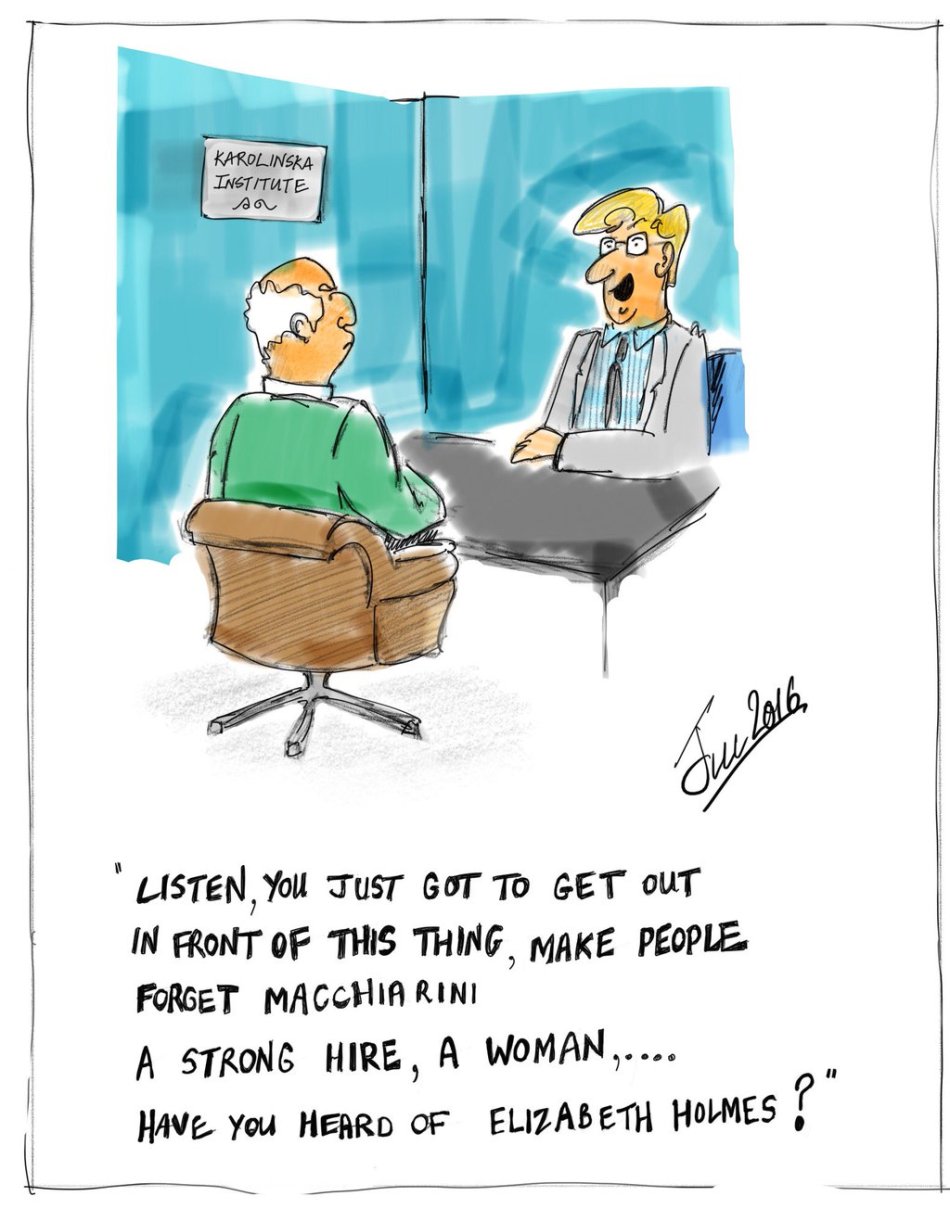 (Guest cartoon by: Jill Howlin)
Macchiarini was recruited in 2010 as guest professor to KI and senior physician at Karolinska University hospital. As the Swedish medical newspaper Dagens Medicin reports, this recruitment was promoted by 14 Karolinska researchers, primarily by Lendahl and Li Felländer-Tsai, head of the Department of Clinical Science, Intervention and Technology (CLINTEC).
Back then, these 14 scientists wrote to KI’s recruitment committee that they expect to have a functional regenerative airway transplant operations up and running in just three months after Macchiarini’s assignment to CLINTEC, at the Ear, Nose and Throat (ENT) clinic of the Karolinska University Hospital, Huddinge. By the turn of the year 2010/2011, the promise went, first Swedish patients should be recruited, followed up by those from wider Europe. According to Dagens Medicin, KI scientists wrote in their recommendation letter:
“To achieve success, decision-making within the Karolinska Institutet and Stockholm County Council must be shortened”.
Indeed, there was a small snag that the surgeon Macchiarini did not have the necessary license to treat patients in Sweden. This formal document (Läkarlegitimation) is issued by the Swedish National Board of Health and Welfare (Socialstyrelsen). To speed things up, the directors of KI requested and promptly obtained a special permit for their newly recruited star. From Dagens Medicin we learn that in 2010 Richard Kuylenstierna, former KI operations manager, and Mats Holmström, professor at the Ear, Nose and Throat clinic, wrote to Socialstyrelsen:
“It is thus important for the Karolinska Institutet and Karolinska University Hospital that he [Macchiarini] is formally given the opportunity to practice medicine in Sweden and that this application is approved.”
This article in Dagens Medicin indicates that follow-up requests for further and extended licence exceptions for Macchiarini’s surgical operations were also swiftly approved. Even in 2012 and 2013, when allegations of misconduct were long known, the clinic kept applying to Socialstyrelsen to grant Macchiarini new exceptions.
In fact, these exceptions requests to allow Macchiarini to operate patients in Sweden were made just as he was persecuted by Italian justice system for corruption and extortion of his patients in Florence.
In September 2012, Macchiarini was arrested by the Italian Guardia di Finanza, waiting for him in front of the operating theatre of the Careggi Hospital. The pioneer of tracheal transplant was recruited to this Florentine hospital in 2008 by the governor of Tuscany, Enrico Rossi, to lead a newly founded research centre. As the local newspaper Corriere Fiorentino reported, Macchiarini was accused at his arrest of attempted fraud, extortion and manipulating patient waiting lists. He was also said to have been abusing the desperate state of cancer patients in order to talk them into expensive private practice treatments, which included substantial fees for himself. In one case he specifically asked for €44,663 of which €25,000 were his personal honorary fee. Macchiarini also was accused of having (unsuccessfully) attempted to sell two cancer patients special treatment in clinics in Hannover, Germany, and London, for a fee of €150,000 and €130,000, respectively. The Florentine hospital directorate defended Macchiarini in a statement:
“As an international prominent scientist Macchiarini has had the honour to publish his results in the prestigious journal The Lancet, and a few weeks ago he was presented in the New York Times as one of the leaders of regenerative medicine”.
There have been also enough warnings from Macchiarini’s peers to stop his dangerous experimenting on living patients.
Pierre Delaere is professor at KU Leuven, Belgium, and specialist in respiratory surgery. In May 2015 he told the Swedish TV channel SVT:
“If you are operating a synthetic trachea you know in advance that the patient will die. After a month, two months, three months, until up to two years, maybe three years at best. But the patient will die”.
Delaere described Macchiarini’s method as
“one of the biggest lies in medical history, because you are doing something that is impossible from a theoretical point of view and not grounded in medical trials. You do new things to people which are destined to fail, so for me this is a criminal act. This is medical torture”.
Yet all scientific and clinical criticisms of Delaere’s were dismissed in 2015 by KI Ethics Council, chaired by the KI professor of Healthcare Ethics, Niels Lynöe. Karolinksa’s medical ethicists apparently found Macchiarini more credible and qualified:
“We find that the issues raised by Professor Delaere are of a philosophy-of-science kind rather than of a research-ethical kind. Accordingly, the Ethics Council concludes that, on the backdrop of the examined issues, Professor Delaere’ s allegations of scientific misconduct are unfounded”.
KI Ethics Council was not only scoffing at such “philosophy-of-science” disagreements, but at the same time apparently dismissing or ignoring the concerns previously raised by some KI scientists about Macchiarini’s data integrity.
In 2014, three KI researchers, namely Matthias Corbascio, Oscar Simonson and Karl-Henrik Grinnemo, have submitted to the KI directorate an Appeal for Investigation. They now describe in an open letter to KI directorate how the evidence for Macchiarini’s misconduct and his endangerment of patient lives was known to the KI leadership since their Appeal in 2014. The three original KI researchers as well as graduate student Thomas Fux write:
“The handling of the investigation of Prof Macchiarini by KI has been a biased farce where because of moral paralysis yet another young patient with a benign diagnosis was operated in the summer of 2014 in Krasnodar, and subsequently also developed severe complications. This is several months after we had informed KI and years after others had submitted repeated warnings dating back to 2011. Up until our warning in February of 2014, several patients had died after horrific complications and mutilating procedures”.
The whistle-blowers insist that Hamsten was already in 2014 well informed about Macchiarini’s misrepresentation of patient true conditions, namely them being “in stable clinical status”, and not at all as “threatened with eminent death or suffocation”, which might have justified untested experimental interventions.
“Prof Hamsten was informed personally in detail on Feb 21, 2014 by Dr Grinnemo of the state of the patients operated on at Karolinska and the gross and serial misrepresentation of their clinical outcome in the articles published by Prof Macchiarini. Prof Hamsten stated that Prof Macchiarini could continue to perform the procedures outside of Sweden, and that only his lab work would continue at Karolinska. At this time it was well known that the surgeries were taking place in Krasnodar, as it was clearly stated in the application for extension of Prof Macchiarini’s guest professorship written by Prof Felländer-Tsai (Head of CLINTEC) in October 2013 and signed by Prof Hamsten in January of 2014. Prof Hamsten was also informed that the rat trachea implantations that were performed by Dr Simonson after the patients had been operated in Stockholm demonstrated catastrophic results. Prof Hamsten then informed Dr Grinnemo that he would discuss these issues with Prof Lendahl (Head of StratRegen and WIRM, Secretary Noble Assembly) and Prof Cardell (Head of ENT), both Prof Macchiarini’s superiors at KI”.
The precise nature of Macchiarini’s data manipulations has not been made public yet, but there is already some PubPeer evidence of suspicious image duplications regarding his 2014 paper in Biomaterials on biocompatibility of his synthetic tracheas.

An internal investigation was set up at KI, led by Bengt Gerdin, professor at the Department of Surgical Sciences, Uppsala University.
Specifically, the suspicion of falsified data in a paper in Nature Communications was raised, where Macchiarini and his devoted acolyte Philipp Jungebluth claimed to have successfully transplanted a tissue-engineered oesophagus in animal experiments. This study would theoretically allow Macchiarini to extend his range of transplants from trachea to oesophagus in human patients, possibly using compassionate case exceptions.
The KI leadership, namely Vice-Chancellor and Rector Anders Hamsten, his Advisor and Chair of Steering Committee for the medical programme Jan Carlstedt-Duke, and Dean of Research at KI, Hans-Gustaf Ljunggren, decreed in August 2015 that Macchiarini did not commit any misconduct, but was solely negligent. Worldwide media (here, New York Times and Science) then went on to report how Macchiarini was exonerated by the KI investigative commission. RetractionWatch invited Macchiarini to contribute a guest post. There, Macchiarini decried being falsely accused, mentioned an “official request from Karolinska Institutet, informing them [RetractionWatch, -LS] of the police investigation now in progress into the leaking of the records” and proclaimed himself an “honest researcher, who wants to see all scientific misconduct eradicated” [abbreviated quote, please also note this text section was corrected -LS).
However, the investigator Gerdin did not at all see Macchiarini as innocent. Gerdin kindly provided me with a rough English translation of his recent article In the Swedish newspaper Dagens Nyheter:
“In May 2015 my statement of opinion was finalized. It showed that Paolo Macchiarini had committed scientific misconduct. Three months later, in August, KI […] chose to free him from all accusations, contrary to my judgment. This was done without showing that I was wrong on any single point”.
Gerdin continues in his newspaper article:
“the truth is that everything that was shown in the three SVT documentaries [summary and video excepts here, -LS] concerning the fraud itself, was found in the investigational material I got from KI more than a year ago. There can only be the interpretation that KI either still does not see that the errors I pointed out reflect research fraud, or that they are now trying to cover up that they have made a wrong decision in August 2015”.
Just as the original whistleblowers, Gerdin lists examples where Macchiarini falsified or misrepresented data on the transplant progress in patients, which the KI leaders chose to believe anyway. In regard to institutional responsibilities for tolerating or even covering up Macchiarini’s misconduct, Gerdin writes:
“Hamsten has already proven to have courage and bravery to admit that he had made an almost total miscalculation and had taken his personal decision based on that. Do the other two who gave him advice and thus are at least as responsible for the decision as him [Carlstedt-Duke and Ljunggren, -LS], have the same courage? As long as these two remain in senior positions, the “good KI” has to accept that it is difficult for anyone outside KI to regain trust and confidence in KI”.
Also Arvid Carlsson, Swedish winner of the 2009 Nobel Prize in Medicine, protested that results of Gerdin’s investigations were “completely swept under the carpet” and voiced his demands for resignations of the KI directorate. Just before Hamsten took his hat, Carlsson told Dagens Nyheter that Lendahl’s resignation was not enough and that the entire direction of the Karolinska Institute should resign, as a kind of “housecleaning”:
“It should be radical and start from the top. We must ensure that these people no longer have any responsible position”.
Also the emeritus surgery professor Risberg demands in his open letter the mass resignation of the KI leaders responsible for the Macchiarini disaster:
“There must be a new crew in the top of both the Karolinska Institute and hospital. The old management and board of directors at the Institute and the management of the hospital have to leave. The sooner the better.
It is not enough that only the vice-chancellor (Anders Hamsten) left. He was not acting alone.
These new leaderships have to start the crisis handling immediately”.
Meanwhile, the Swedish government announced that Karin Dahlman-Wright has been appointed as new acting rector to KI, while Hamsten was said to be assigned a new job at “government offices”.
The Royal Swedish Academy of Sciences expressed its desire to see Macchiarini’s and Jungebluth’s 2011 publication in The Lancet (where the clinical functionality of artificial trachea was allegedly demonstrated) retracted or at least corrected:
“The Academy finds it deeply unfortunate that the well-publicised report about the first operation with an artificial trachea, published in The Lancet in 2011, remains unchanged on the journal’s website. The Academy demands that a supplement is added to the journal, accounting for the further events, the complications and the patient’s death”.
To this, the journal’s editor-in-Chief Richard Horton replied in The Lancet editorial that Macchiarini is to be presumed “innocent until proven guilty”. He recalls that the Italian surgeon was already found not guilty once (by Hamsten & Co), and insists that the results of the new independent investigation must be awaited first. Horton (who is also one of the original founders of COPE) seems to take pity for Hamsten’s media-forced resignation and writes:
“Pre-emptive judgments about Macchiarini’s work would only worsen the reputation of science in the public sphere”.
Why did KI so obviously chose to cover up the misconduct of their star stem cell scientist and surgeon?
First of all, there were solid financial reasons to recruit Macchiarini. As Swedish government decided to concentrate research funding on selected elite universities, Karolinska and its Nobel connection was the prime choice. As the Nobelist Carlsson and his University of Gothenburg colleagues Elias Eriksson and Kristoffer Hellstrand write in the newspaper Dagens Nyheter, one of the prestige areas selected by Swedish Research Council was stem cell research, and for that KI received SEK 30 million (approx €3.2 Million) per year: “which among other things allowed the purchase of Macchiarini”. The grant was for five years initially, but could become permanent if with a favourable subsequent evaluation. Therefore, the Gothenburg scientists write:
“Given the amounts at stake, it is perhaps understandable that KI, when delivering in May 2014 their report on its stem cell research, could not resist the temptation to highlight Macchiarini’s supposedly successful transplants as number two in the list of important breakthroughs. This, despite that they knew that the operations had been stopped because the technology did not work, and despite having been warned that Macchiarini could have been guilty of research fraud”.
Delaere, the Belgian respiratory surgeon, has provided May 2015 in his SVT interview some clues why politicians, media, bureaucrats and even academics and scientists fell for Macchiarini’s grand promises (Delaere confirmed that he stands by this quote in his email to me):
“Because of the hype surrounding stem cells, many people believe in anything when the words “stem cells” turn up, that is what is misleading. It is also misleading that people who do this type of therapies know how to write a paper. They know how to mislead, and how to turn a non-issue to something that can even be published in The Lancet. It is so misleading. You can turn shit into promising research”.
The Author wishes to thank a Stockholm scientist who preferred not to be named, and Jill Howlin, as well as others, for their help in collecting this material. -LS
Update 22.02.2015, 20:40 Macchiarini is about to be sacked by Karolinska, according to Läkartidningen:
KI’s press secretary Claes Keisu confirms that Macchiarini is threatened with dismissal :
»Paolo Macchiarini has today been informed that KI is considering to fire him. The reason is that KI no longer have confidence in him as employee.
Also, the Dean of Research Hans-Gustaf Ljunggren has resigned. He was one of the key KI officials involved in Macchiarini’s acquittal after the misconduct investigation.
Update 26.02.2016, 13:30 The third KI leader, Jan Carlstedt-Duke, chief advisor to the Rector, and responsible for Macchiarini aquittal, has resigned as well (or has been sacked, by the new rector Karin Dahlman-Wright), according to Swedish media.
Update 03.03.2016. According to Dagens Medicin, Swedish minister for research and higher education, Helene Hellmark Knutsson, announced that “a number of members” of the Karolinska Institute’s Board of Directors (the Senate) will be replaced. Exactly who will be dismissed and who will be nominated as new Senate members, is to be decided by the special commission by April 1st. More in English on Radio Sweden:
Update 05.03.2016. The KI new Vice-Chancellor, Dahlman-Wright, issued a statement after her meeting with the Ethics Council. Her quote can be interpreted that the entire Council will be dismissed, and a new Ethics Council established (though members are allowed to re-apply):
“In association with appointing a new council, the present council members will be asked whether they are potentially available to serve in a future organization for ethical questions at KI”.
Update 11.05.2016. SVT reports suggest that Li Felländer-Tsai, prefect and head of the Department of Clinical Science, Intervention and Technology (CLINTEC) is about to lose her position. Reason: she misled funders like the Swedish Research Council and the Heart-Lung-Foundation about the ethics status of Macchiarini’s research. His funding was extended despite that he received in October 2013 an operating ban at Karolinska Hospital, issued by the hospital director Birgir Jakobsson.

 For Better Science
http://www.dn.se/nyheter/sverige/stjarnkirurgen-fran-fakta-till-fusk/
P.Macchiarini become unemployed today, at least in Sweden. Newspapers describe whole story using this occasion. DN asked several involved persons for intereview. Some interesting details are described. For example, that KI was preparing to appoint Macchiarini as full professor in 2012 but stopped the procedure because of his arrest in Italy.
Macchiarini “was searched for interview” .
“Hade inte media visat upp detta så hade mörkläggningen kunnat fortsätta i det slutna systemet.” Translating this:
“If it was not for media who showed it, the hiding (“shadowing”?) could continue in this closed system”.
Power of free media proved to be decisive in this case. How many similar cases are still there and waiting for attention of media?
LikeLike
Pingback: Macchiarini, Birchall, Seifalian and EU-funded human experimenting – For Better Science
Pingback: Macchiarini and the tracheal regeneration scandal, by Pierre Delaere – For Better Science
Pingback: Does The Lancet care about patients? – For Better Science
http://www.science-education.ru/ru/article/view?id=24204
New paper by Macchiarini. Made in Russia.
LikeLike
Well spotted. Macchiarini lists his affiliation as “Karolinska Institute, Advanced Center of translational regenerative medicine (ACTREM)”
LikeLike
Pingback: The stem cell faith healers, or magic inside your bone marrow – For Better Science
Pingback: Image integrity concerns in papers from a Pfizer lab – For Better Science
Macchiarini is back to Sweden and very active once again with several public statements and interviews. Basically it looks like a planned tactics: to wait until pressure fades and to fight back through mass media. He was on national TV in Sweden yesterday http://www.svtplay.se/klipp/8316487/macchiarini-karolinska-kande-till-allt (english)
He also provided interview for Expressen, one of the major newspapers in Sweden.
http://www.expressen.se/nyheter/paolo-macchiarini-karolinska-visste-allt/
According this article, Macchiarini provided them with 7 pages long document where he presents his own version of events. He looks healthy, confident and , yes, I am afraid convincing for people not familiar with the whole story (if any left by now). He mentioned several times results of investigation in Russia about his operations, but results of this “investigation” are not available in any Rusian meadia. In fact, in contrast to what he claims, this was not “investigation” of his work but only a “regular check” of hospital where operations were performed. Results of thsi check can’t be found anywhere, not even clear if it was completed.
LikeLike
Planned yes but recall he has a court date in Florence on 10 May: http://corrierefiorentino.corriere.it/firenze/notizie/cronaca/16_aprile_05/macchiarini-chiede-l-abbreviato-raccontero-mia-verita-78cd9f2c-fb2e-11e5-b3ca-c061e4fe836a.shtml
I can’t be certain but the proceeding may be a plea bargain. At any rate the TV interview suggests he’s been extensively prepared for legal questioning (deposition training), which isn’t crazy under the circumstances. His healthy tan, whether solar or chemical, effectively conceals facial flushing from emotional response – recall one of the interviews with Anders Hamsten in Experimenten where he turned beet red asserting KI had confidence in PM – definitely problematic.
Like all persons he has the right to defense before the law but legal assistance will not change who he is or what he did.
As for Vanity Fair, the accuracy of his CV is not a private matter nor is the wedding to which public persons were invited. You wonder who else was invited: perhaps Christopher Lyles’ mom and sister? Darryl and Mi-Young, Hannah Warren’s parents?
The trial in Krasnodar needs to be audited for compliance with Good Clinical Practices. Among other things it should be determined why the Kuban State Medical University ethics committee did not require revision of the consent form when it approved changes to the protocol (composition of trachea scaffold to make it “better”): http://www.regmedgrant.com/files/protocol11.pdf
Likewise subject selection, hospital database per protocol vs. international video conference: http://www.regmedgrant.com/files/report_videoconf_eng.pdf
Then of course there is the egregious action of allowing the manufacturer’s representative (David Green) to meet with a subject and provide false misleading information about the safety of the investigational synthetic trachea, which hopelessly tainted the process of informed consent.
LikeLike
Pingback: Macchiarini’s patients, the real situation – For Better Science
I would be interested to know what the American FDA has to say about an American company whose CEO was directly involved in personally convincing at least one of Macchiarini’s victims to participate in his experiments, as it was recorded on camera with audio in the above mentioned broadcast on Swedish television. I also wonder what they would say about this company being involved right now with clinical trials with the Mayo Clinic in the US. HART / Harvard Apparatus Regenerative Tech has been recently renamed Biostage.
There are right now people posting on American investment message boards with excitement about this Biostage company. For example Spencer Osborne wrote “Is Biostage Setting The Stage For Regenerative Technology?”, dated May 9 2016 – http://seekingalpha.com/article/3973205-biostage-setting-stage-regenerative-technology
LikeLike
Pingback: “Notification of Suspected Research Misconduct”, by 4 Macchiarini-whistleblowers – For Better Science
Pingback: EU threatens to terminate TETRA Consortium funding for phase 2 trachea transplant trial – For Better Science
Pingback: Brexiting out of EU research and patient rights – For Better Science
Pingback: Pontus Boström: cheater carousel in Sweden – For Better Science
Pingback: Regenerating in Hannover, Part 2: Axel Haverich’s “growing” heart valves – For Better Science
Pingback: Growing hearts in Hannover: a job opening – For Better Science
Pingback: How UCL throat surgeon Martin Birchall misleads patients and tricks public funders – For Better Science
Pingback: Macchiarini investigations outcome: Karolinska University Hospital – For Better Science
Pingback: Macchiarini investigations outcome: the Karolinska Institutet – For Better Science
Pingback: Macchiarini and the bonfire of greed – For Better Science