
The German Press Agency (Deutsche Presseagentur, dpa) is one of the biggest news providers in the world, as such they also hold copyright on many photographs. The money dpa makes is enormous, yet every little counts, and this is why the agency disregards German copyright laws to wrongfully demand cash from those who dpa thinks can’t afford to fight back. Dishonest extortion, by those who profess “credibility is our greatest asset” and being “committed to the facts“.
Well, I didn’t pay dpa a cent, and I kept my images.
In early September 2025, I received a letter from the Hamburg-based law firm KSP Rechstanwälte, full name “KSP Kanzlei Dr. Seegers, Dr. Frankenheim Rechtsanwaltsgesellschaft mbH“, which declares to specialise in “debt collection”. Not in media law mind you, and indeed, it turned out they either don’t understand it or don’t care about it. The letter was dated for 28 August 2025 and started with this accusation of copyright infringement:
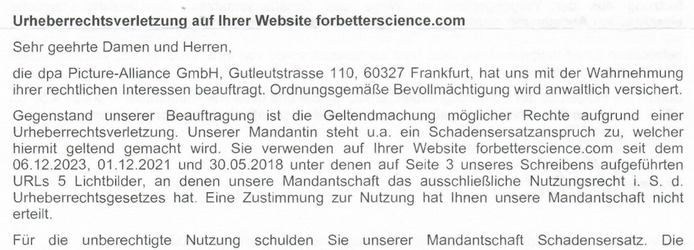
I was accused of having used 3 photographs without permission for which I was to pay a massive financial compensation. These were the articles, it is their cover images which dpa and KSP claimed were subject to copyright infringement:
Sharpless Ned, or how half a mouse died
“The President’s goal of ending cancer as we know it today is grounded, in part, in the work of scientific discovery that Ned Sharpless has led at NCI”


UCL trachea transplant inquiry: scapegoating, obfuscation and a lost nose
In 2017, UCL invited an external expert commission to investigate the deadly trachea transplants performed by the former UCL honorary professor Paolo Macchiarini. An already sacked UCL nanotechnology professor, Alexander Seifalian, whose lab made the two UCL plastic POSS-PCU tracheas in 2011, was announced as the main culprit on UCL side. All this despite Seifalian’s…

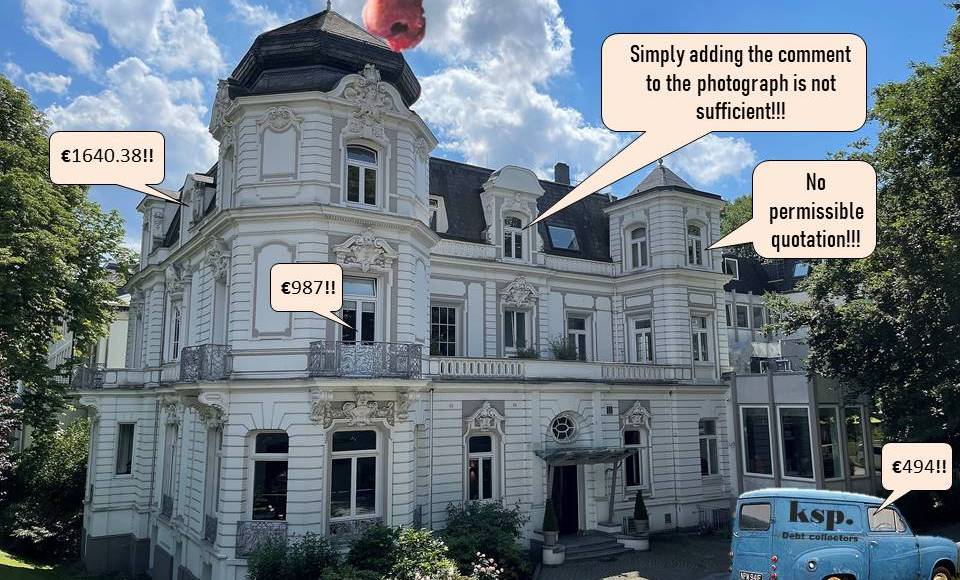
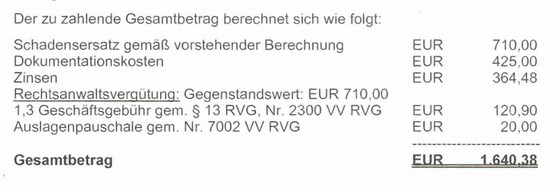
This bill for €1640.38 was attached, combined with threats of further bills and the demand to immediately remove these three images from my website.
So what about these images? Two of the original photos are actually owned by Associated Press (AP), but dpa could later prove that they are entitled to enforce copyright on behalf of AP. Is Schneider guilty then and must pay and delete?
Nope. The claim of copyright infringement was wrong and frivolous. There are laws in Germany, and these apply even for dpa.
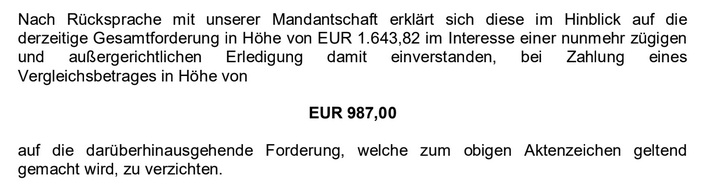
I replied to KSP and contacted my lawyer. And to cut the long story short, I never paid them and their threatened lawsuit didn’t materialise. Instead, on 15 September 2025, even before my lawyer’s rebuttal, KSP replied to my letter with a new offer, where they suggested I could pay only €987 instead of €1644 (while addressing me as “Ms Schneider”, which further shows their incompetence):
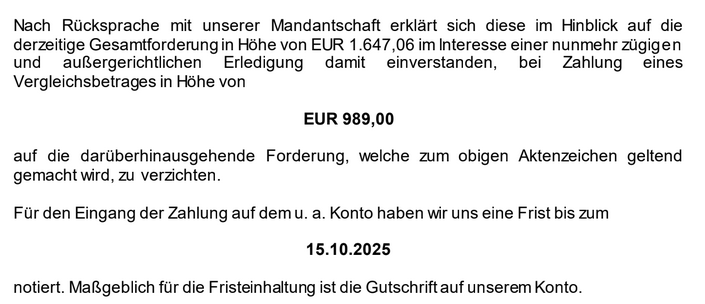
On 1 October 2025, another letter arrived from KSP, where they wanted two euros more (€989):
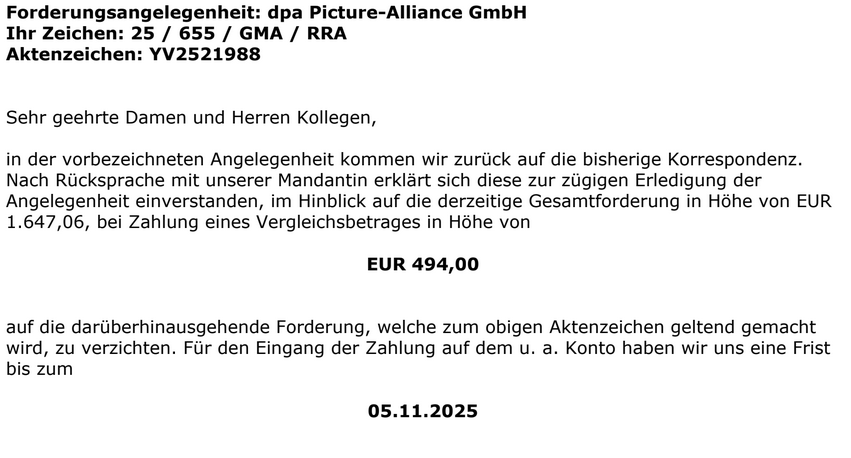
At the end, I paid my own lawyer significantly less than the first dpa/KSP demand, and even less than their second offers. There was also a third offer from KSP, from 22 October 2025. By then it was merely €494, payable before 5 November 2025, but I still didn’t pay. I also never removed the images as KSP kept demanding.
Let me now explain how this affair happened and why my use of these 3 photographs was perfectly legal. According to a €85 bill provided by KSP lawyers, they work with the Munich-based business Image Professionals GmbH which trawls the internet to find possibly copyrighted images. That’s how they “caught” me.
Apparently nobody bothered to actually look at the images I published and compare them with dpa‘s copyrighted originals, and to consult the German copyright laws. That despite KSP lawyers being allegedly very professional and educated, with doctorate degrees and all.
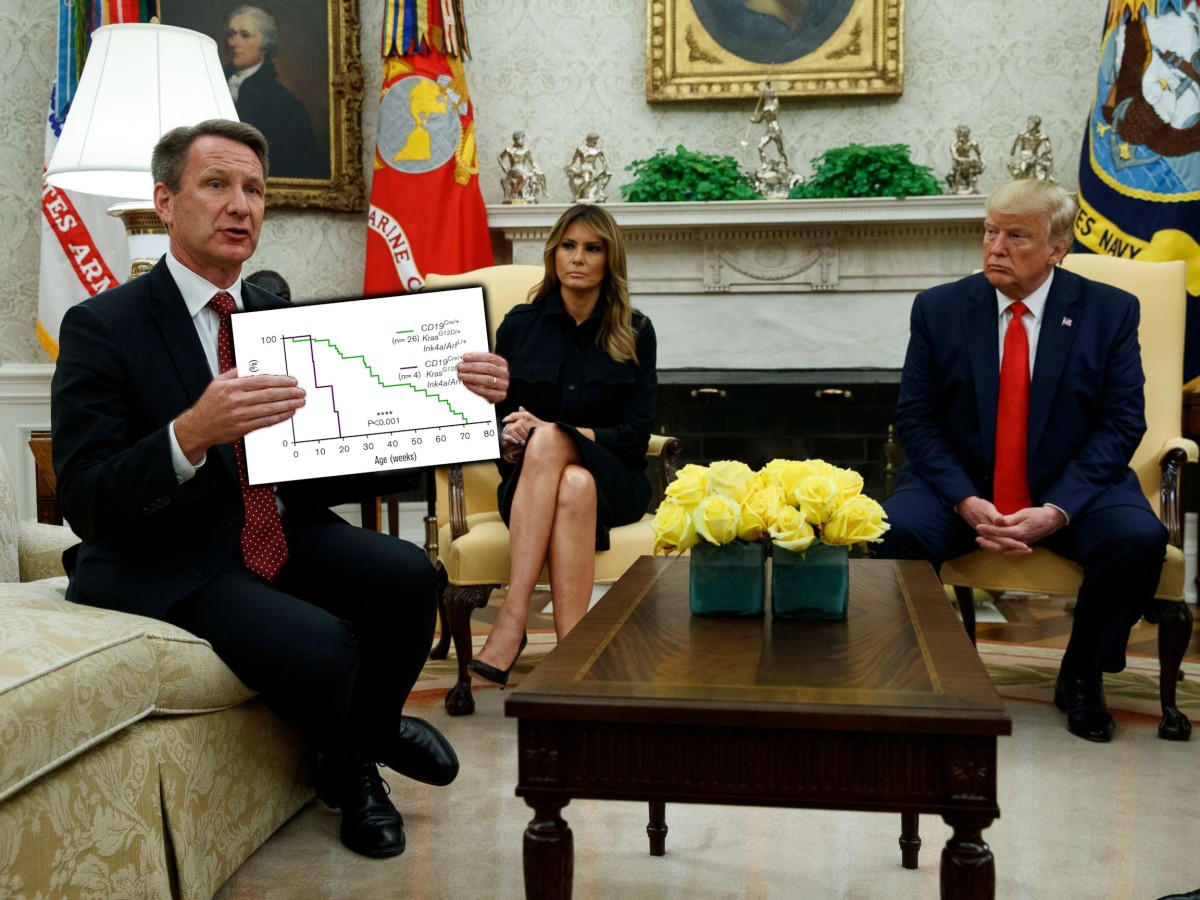
The first image, used in this December 2023 article, was called by KSP “Trump Vaping” (no idea why). In the article, I wrote under the image: “Original photo: Evan Vucci/AP“, the source was credited. Importantly: I didn’t use the same image. We digitally edited it in Photoshop and satirised it for the purpose of my reporting, this counts as art and freedom of expression, and is protected by German law.
Sharpless Ned, or how half a mouse died
“The President’s goal of ending cancer as we know it today is grounded, in part, in the work of scientific discovery that Ned Sharpless has led at NCI”
The article was about the bad science of the US cancer researcher Ned Sharpless, who used to be director of the National Cancer Institute under Trump’s first administration. My lawyer explained to the KSP geniuses (translated):
“The use of the image “Trump Vaping” is justified as a caricature or parody according to § 51a of the German Copyright Act (UrhG).
The image shows Norman Edward “Ned” Sharples next to Donald and Melania Trump. Unlike the original, Mr. Sharples displays a scientifically questionable table from one of his publications (Figure 5C from “Constitutive Ras signaling and inactivation cooperate during the development of B-ALL in mice,” Blood Advances (2017) doi: 10.1182/bloodadvances.2017012211). […]
It is clear that the table shown by Mr. Sharples in the altered image has been inserted retrospectively. The manner of insertion constitutes a parody treatment of the original.
Furthermore, the accompanying article addresses Sharples’ flawed research and his career under Trump – two aspects reflected in the altered image. The sarcastic tone of the text supports the interpretation of the image as a parody. […]
Your client’s interest in protecting an existing legal position with regard to the images fall behind our client’s interest in artistic freedom and freedom of expression.”
The second image, where I wrote underneath “Original photo: Carsten Rehder, picture alliance/dpa“, was about Winfried Stöcker, a xenophobic German multimillionaire who became avid supporter of the extremist party Alternative für Deutschland (AfD), and called to protests against “global fascists who call themselves our government“. I previously wrote about the dodgy science of Stöcker’s former biotech company Euroimmun, but my December 2021 article, which was subject to dpa/KSP copyright claims, was about Stöcker’s self-made COVID-19 vaccine which he illegally injected into fellow covidiots at his own airport in Lübeck.
Also here one would have expected KSP lawyers to have first compared the picture I published to their copyrighted original before claiming copyright on my satirical artwork. My lawyer explained to them:
“The use of the image “Winfried Stöcker” is also justified as a caricature or parody in accordance with §51a of the German Copyright Act (UrhG).
The image shows Winfried Stöcker in front of his Lübeck-Blankensee airport. Unlike in the original, Mr. Stöcker is holding a vaccine syringe in his hand. In addition, a speech bubble puts the words “LubecaVax, get your LubecaVax here… Free marmalade with each shot!” in his mouth. […]
The article accompanying the image discusses Mr. Stöcker, his views on Covid policy, the development of his “vaccine,” and the vaccination campaigns he has carried out in a polemical manner. This reinforces the parodic effect of the image.
As above, the interests of your client fall behind those of our client.”
The case of the third image was less clear, because I used this photograph without modification. I did credit it to AP, but was I allowed to use it? I was indeed.
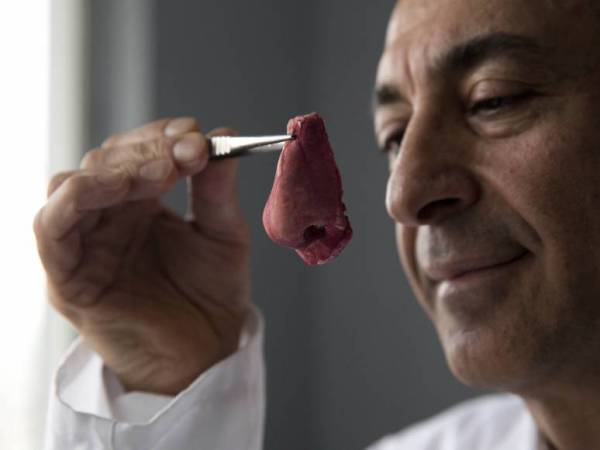
My May 2028 article was about the investigation of the Paolo Macchiarini affair in London. UCL found all their scientists, in particular Macchiarini’s collaborator Martin Birchall, to be innocent. The only officially guilty party at UCL was the Iran-born nanotechnology professor Alexander Seifalian, who was fired and then went on to set up unhinged regmed businesses and publish papermill fraud. Now, at that investigation, UCL decided that all their previous claims about Seifalian’s breakthroughs in growing artificial ears and noses were fraudulent, but the blame was exclusively Seifalian’s and nobody else’s. Never mind it was UCL and their affiliated Royal Free Hospital who invited journalists to stage this fraudulent photo-op where Sefalian held up what looked like a real, living, human nose, a lab-grown nose he allegedly created. In reality, this fraudster made useless plastic grafts which threatened to cause great damage and disfigure his patients even further when implanted.
UCL trachea transplant inquiry: scapegoating, obfuscation and a lost nose
In 2017, UCL invited an external expert commission to investigate the deadly trachea transplants performed by the former UCL honorary professor Paolo Macchiarini. An already sacked UCL nanotechnology professor, Alexander Seifalian, whose lab made the two UCL plastic POSS-PCU tracheas in 2011, was announced as the main culprit on UCL side. All this despite Seifalian’s…
My article was therefore titled: “UCL trachea transplant inquiry: scapegoating, obfuscation and a lost nose“, that picture of Seifalian with the nose was evidence of the fraud which Seifalian and UCL committed on the public. I am not sure the article where I found that photo is still online, there’s for example a 2014 CBS reporting titled: “London scientists grow noses and ears“. The CBS subtitle under the photo was: “Professor Alexander Seifalian poses for photographs with a synthetic polymer nose at his research facility in the Royal Free Hospital in London, March 31, 2014“. In fact, that entire story was produced by AP, as other versions of it (in Denver Post, SBS News, New York Post etc) clearly state, and they all use the same photo of Seifalian with the nose. It was never used in the media since..
Thus, not only I had to show this photograph, I had to preserve it as evidence. Here my lawyer’s reply to KSP:
“The use of the image “Britain Growing Body Parts” is justified as a quotation pursuant to Section 51 of the German Copyright Act (UrhG).
Our client uses the image to support the statement in his article. In the article, he refutes the inaccurate claim that Prof. Alexander Seifalian at University College London had produced artificial noses that looked like natural noses. Instead, he developed plastic noses. The professor was later convicted of fraud and dismissed.
The image shows the professor with an artificial nose that appears to be very natural. It symbolizes the above-mentioned false claim.
As one of the few illustrative examples of the false claim, the image here serves to elaborate on the statements made by our client in his article. It serves as a basis for discussion for our client’s independent statements.
The scope of use is covered by the purpose of the quotation. Our client has also provided the required source reference.
Here, too, the interests of your client fall behind those of our client.”
This means, an image can be under circumstances quoted just like a text passage.
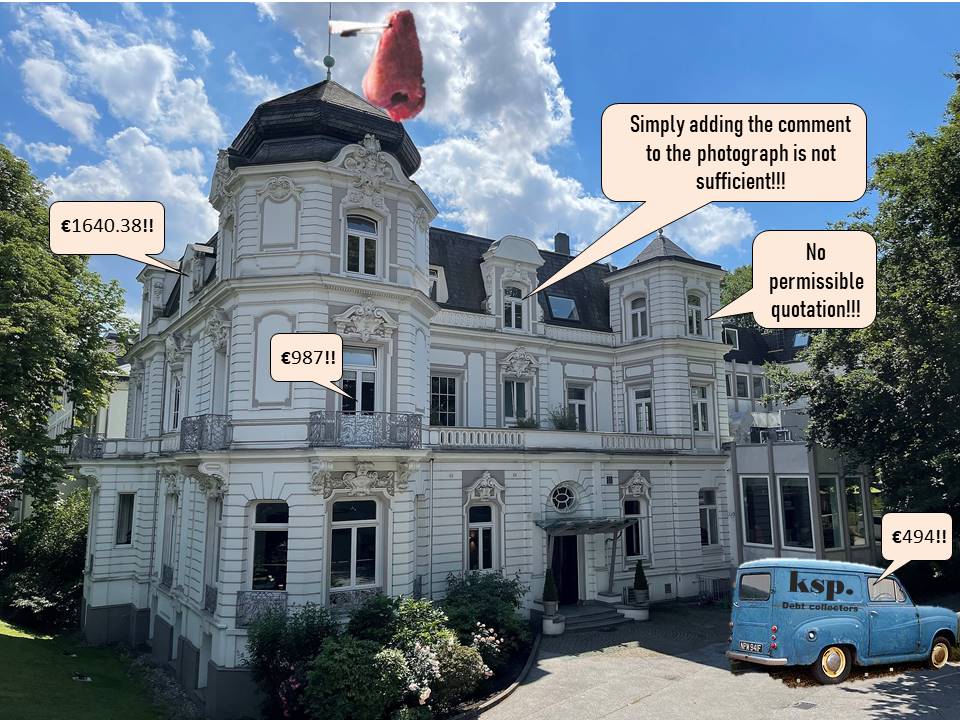
In those 3 letters, KSP lawyers either showed utter incompetence, or they knew they were utterly wrong yet still tried to scare me into submission. When reducing their demand to €987, KSP argued (translated):
“a permissible parody cannot be identified in this publicly available photograph. A parody requires, among other things, that the characteristics of the original work fade in the work used […] Simply adding the comment to the photograph is not sufficient. […]
A permissible quotation is not the case here. This would have required you to deal with the photograph in a concrete manner. […] The comments you refer to do not indicate any such conceptual reference to the photograph.”
The entire article, including its title, is about Seifalian and his plastic noses and other organs, it is impossible to deal with the photograph more. But the KSP lawyers probably never read my article anyway, maybe because it’s in English. And as for parody: the German satire magazine Titanic uses copyrighted photographs with added speech bubbles all the time, but KSP won’t demand money from Titanic because the latter has their own legal team who not only would quash any such vexatious claims, but also sue back for damages.
By the way, it is not the first time my lawyer helped me refute frivolous copyright claims. A certain Arne Müseler made it his business model to post his CC-BY-licensed photos on Wikipedia and then deploy his German lawyer to extort obscene sums for copyright infringement from those who used them. Read here:
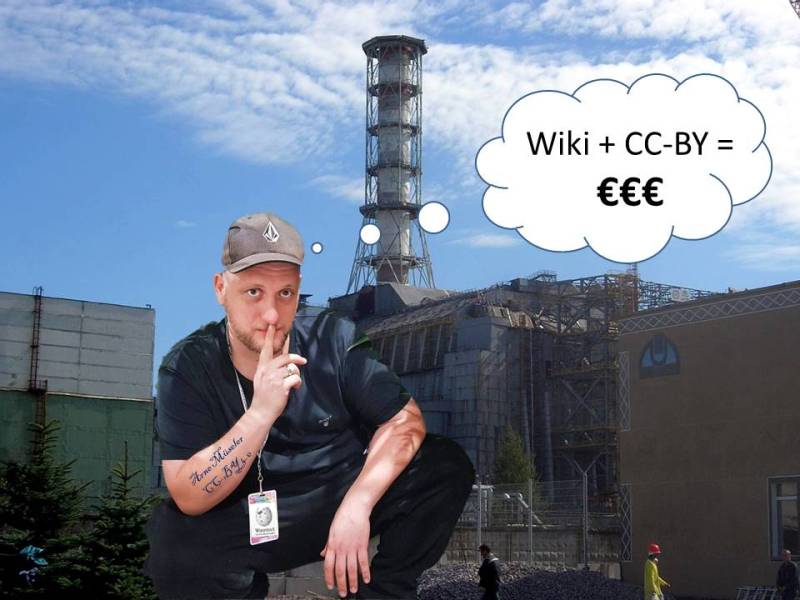
How to earn $$$ with Wikipedia & CC-BY
The photographer Arne Müseler wanted me to pay him almost €6k for embedding his CC-BY Wikipedia picture of Chernobyl reactor. He failed.
Müseler, who initially demanded that I pay him almost €6000, later walked back on his demands and offered me €500 to remove that article. I refused.
My lawyer advised me against suing dpa for damages, not because I didn’t have the law on my side, but for practical reasons. Judges generally tend to side with the financially and legally stronger and more aggressive parties – like every employee, also a judge strives to keep their daily work volume to a minimum. That’s also why I absolutely had to pay a lawyer to refute the KSP claims with a legal letter – if dpa and KSP went to court, and that court assumed that I can’t afford a lawyer, a lazy judge would have taken the easiest path by sentencing me to pay damage to dpa, without ever looking at the actual images or articles. Also, winning in court doesn’t mean getting all your money back. Courts order financial refunds based on official charts, yet lawyers charge by hour, especially for smaller claims. Thus, even if I fully won a damage lawsuit against dpa, I personally would be financially in a bigger net minus that I am now.
In any case, I hope you find this tale of copyright and its exceptions for the purposes of satire, parody and quotation useful for your own purposes, since other countries are likely to have laws similar to Germany. Thus, consider donating, after all, it’s Christmas!
Donate!
If you are interested to support my work, you can leave here a small tip of $5. Or several of small tips, just increase the amount as you like (2x=€10; 5x=€25). Your generous patronage of my journalism will be most appreciated!
€5.00

 For Better Science
Hi Leonid Bravo for keeping your images. Season’s greetings and the very best for you and FBS in the year ahead.
Rob
LikeLiked by 1 person
‘… they work with the Munich-based business Image Professionals GmbH which trawls the internet to find possibly copyrighted images.’
So, did they actually work for dpa, or were they just trying to extort a cease-and-desist fee from you?
It happened to me in the past. https://www.gesetze-im-internet.de/uwg_2004/__8c.html was my friend.
LikeLike
Well, funnily KSP lawyers warned me not to try and contact their client.
I put dpa in cc anyway when I replied.
The result was a reduced offer you saw.
Thus yes, dpa is aware and they see this as an additional revenue.
LikeLike
Well done Leonid. As if it wasn’t hard enough running FBS 😵💫 Impressed that you fought back, I’d have quickly folded.
LikeLiked by 1 person
I think you could / should republish this article on netzpolitik.org, it perfectly fits their main focus and they oftentimes have guest articles.
LikeLike
Send it to them!
LikeLike
Of course, before “paper milling” there was “lawsuit milling” …
LikeLike
Isn’t there a tip line you can call to report these goofs for fraud? Oh, I forgot – lawyers. Dick the Butcher was right about them.
LikeLike