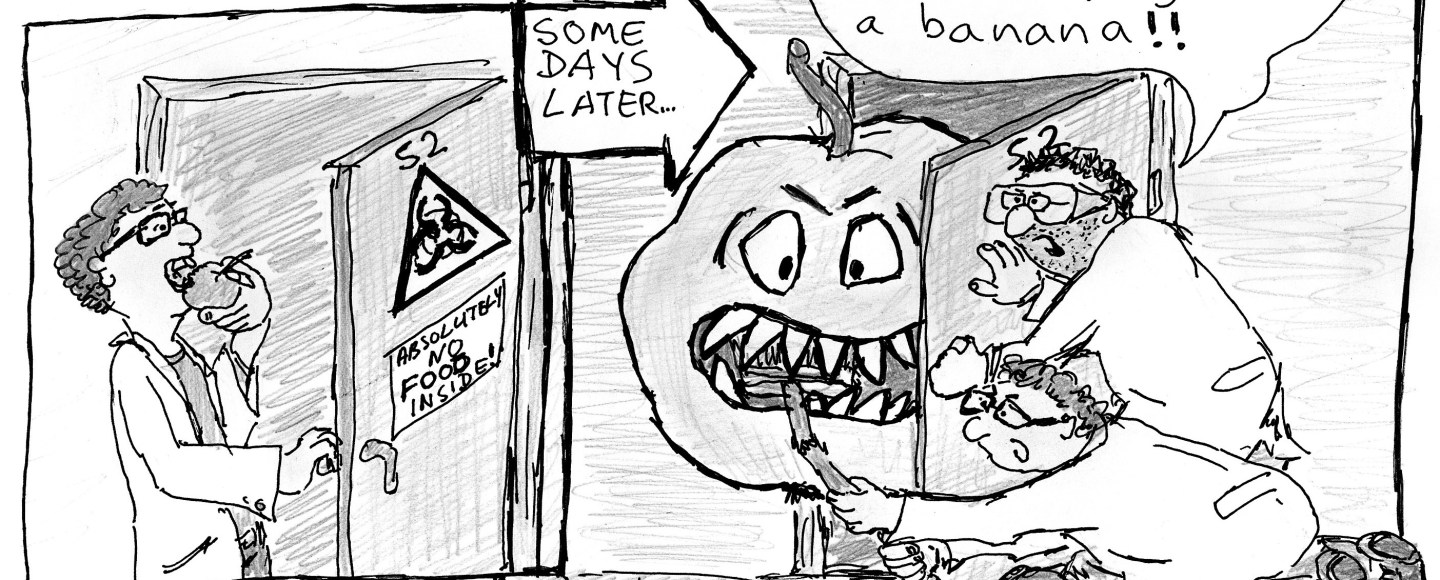

A guest post by an ecologist who works at a European university and specialises in pest management. Both for agricultural and forestry pests which infect crops, and for papermill fraudster pests who infect scientific journals. The problem is that the journals are not just defenceless, but often do not really mind being infected by those papermill parasites.
The author, whose identity is known to me, wishes to remain anonymous. They comment on PubPeer as Orthopyxis integra.
Note: I provided some editing.
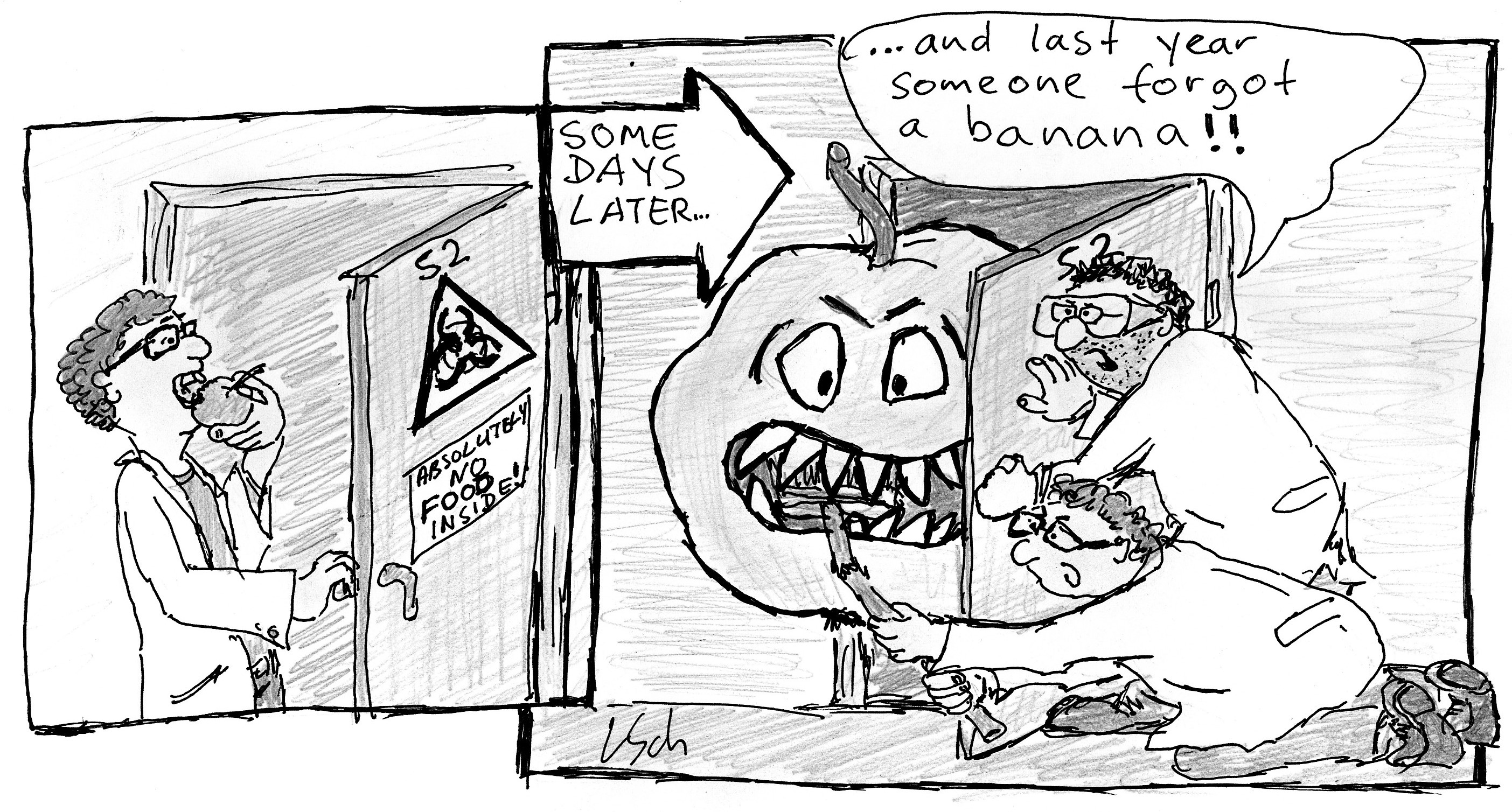
Pest management
By Orthopyxis integra
I work in the areas of pest management and around 2019, I began receiving a flurry of papers to review, all from China, all very similar, featuring the same type of figures, linking single effectors to mechanisms of pathogenicity in agricultural and forest pests via effects on some plant defence pathway. The papers follow a consistent pattern: transcriptome data identify a promising candidate effector secreted by the pest, which is upregulated during infection. Most of the experimental validation of the effector role is done in Nicotiana benthamiana, the tobacco plant. Subsequent inoculations on the target plant crop or host show that silencing of the effector reduces or eliminates the pest’s pathogenic effects. The effector is then linked with some proteins and defensive pathways of the plant hosts.
The pathogens or pests are often nematodes, but they can also be fungi, bacteria, or even plasmids or virus. The hosts can be any agricultural, ornamental or forest plant species.
These papers invariably include photos of N. benthamiana leaves, microscopy images of protein expression or interaction in this model plant, and, of course, tons of Western blots. These papers also always present photos of the affected plant crop, but as carefully curated studio-like photos, never the actual experimental setups, such as greenhouses or growth chambers.
At the 6th or 7th paper on these effectors, I started to feel particularly unimpressed with this type of work, not seeing where all of it was going.
I have almost 100 manpower with me at any time
“WE DONT PAY FOR PAPERS. YOU MUST KNOW THAT THESE BEST IN THE PLANET JOURNALS GO THROUGH RIGOROUS PEER REVIEW” – Abhijit Dey, papermiller

In 2023, I reviewed a submission The Plant Journal entitled “A key virulence effector from pine wood nematode targets host thaumatin-like protein (TLP) to inhibit the salicylic acid pathway”. In this study the authors characterized an effector peptide, which they named BxSCD4, secreted by the pine wood nematode Bursaphelenchus xylophilus, considered a major pest of pine trees. This number 4 in BxSCD4 means there were already 2 or 3 papers about this specific type of effector from the same pest, published or submitted. The authors described BxSCD4 as a “suppressor programmed cell death-4”, and reported its interaction with proteins in the salicylic acid pathway in pines, which suppress its activity. However, I found it puzzling how a “suppressor of programmed cell death” could inhibit a plant defence pathway involved in producing defensive compounds and mentioned that the authors did not quite explain this. Additionally, I pointed out to the editors that the paper closely resembled a previous publication by the same group:
Tong‐Yue Wen , Xiao‐Qin Wu , Long‐Jiao Hu , Yi‐Jun Qiu , Lin Rui , Yan Zhang , Xiao‐Lei Ding , Jian‐Ren Ye A novel pine wood nematode effector, BxSCD1, suppresses plant immunity and interacts with an ethylene‐forming enzyme in pine Molecular Plant Pathology (2021) doi: 10.1111/mpp.13121
The BxSCD4 manuscript was then rejected.
However, a few months later I received a very similar paper from the same authors for review, this time submitted to the journal Plant Cell and Environment, entitled “Pine wood nematode BxNMP1 targets PtTLP-L2 to mediate PtGLU inhibiting self-defence mechanism in Pinus thunbergii”. This paper was almost an exact copy/paste version of the manuscript previously submitted to The Plant Journal, with the exact same photos, graphics, tables etc., but in all the text the effector was changed from BxSCD4 to BxNMP1. I guess the authors decided that an effector named “Nematode Manipulator of pathogenesis-related proteins 1″ (BxNMP1) would raise less questions when relating it to the salicylic acid pathway. I warned the editors about the fraud, sending them the pdf previously submitted to The Plant Journal. I clearly warned the editors of Plant Cell and Environment that I had strong suspicions about the activity of a papermill injecting these papers on the literature. The paper was rejected by this journal. It ends up being published by MDPI in International Journal of Molecular Sciences, this time I had nothing to do with the revision.
Dan Yang , Lin Rui , Yi-Jun Qiu , Tong-Yue Wen , Jian-Ren Ye , Xiao-Qin Wu The Bursaphelenchus xylophilus Effector BxNMP1 Targets PtTLP-L2 to Mediate PtGLU Promoting Parasitism and Virulence in Pinus thunbergii International Journal of Molecular Sciences (2024) doi: 10.3390/ijms25137452
Científicos al borde de un ataque de nervios
Dead men don’t talk. A dead colleague, especially a foreigner, is a perfect scapegoat to blame for fake data in your papers. And in your own PhD thesis.
To my surprise, Plant Cell and Environment recently published a review of all these wonder effectors of the pinewood nematode:
Limei Song , Wenyu Liu , Yafei Ma , Yitong Zhao , Rongzhu Zhao , Jianghua Sun , Bin Zhang Comprehensive Insights Into Pinewood Nematode Effectors: Evolutionary Diversity, Functional Roles, and Implications for Pine Wilt Disease Management Plant, Cell & Environment (2025) doi: 10.1111/pce.15655
The over 30 effectors described on Table 1 of this paper includes BxNMP1, and thus this review includes a paper previously rejected by Plant, Cell & Environment after suspicious of fraud were raised by a reviewer. This leading journal on the area of plant sciences, of the Wiley portfolio, with an impact factor of 6.1, decided to publish a review based on papers they had been previously warned by a reviewer as being fraudulent. Additional another paper included in the review has a record on PubPeer due to suspicious of image manipulation:
Yi‐Jun Qiu , Xiao‐Qin Wu , Tong‐Yue Wen , Long‐Jiao Hu , Lin Rui , Yan Zhang , Jian‐Ren Ye The Bursaphelenchus xylophilus candidate effector BxLip‐3 targets the class I chitinases to suppress immunity in pine Molecular Plant Pathology (2023) doi: 10.1111/mpp.13334

Helichrysum chionosphaerum: “The lower-left western blot in both Figure 5C and Figure 5D appear identical, with only differences in definition, brightness, and contrast.”
Another common type of study frequently published in recent years, and which I have often been asked to review, involves the isolation and testing of some “miracle” biological control agents for various agricultural and forest pests. These studies typically begin with screening of a community of organisms, usually bacteria or fungi, though sometimes of chemical composites (particularly herbal extracts from traditional medicine). Following a painstaking process of isolating and screening dozens or even hundreds of different strains or species, the authors ultimately identify a single isolate which demonstrates superior effects. However, only a minimal information is typically provided about the non-selected strains, which are often relegated to supplementary materials that may be either non-existent or inaccessible. When such supplementary materials are available, they usually contain nothing more than a basic listing of these unselected strains/species. The chosen “superior” biological agent then undergoes detailed characterization, with analysis of its genetics, metabolome, etc.. and identification of potential protein targets in the pest organism. The molecular assays employed are generally complex and sophisticated, while the papers always feature highly polished photographs of both the target pest and cultures of the biocontrol agent.
Comet Hunting
“if you can solve a captcha you should be able to identify fabricated comet assay images. If you can’t, you can absolutely sit this one out, Springer Nature probably has a job for you instead.”- Sholto David

Here is one example, the authors selected one strain of bacteria that they named JCK-1233 out of over 500 as a biocontrol agent against the pinewoode nematode:
Ae Ran Park , Se-In Jeong , Hee Won Jeon , Jueun Kim , Namgyu Kim , Manh Tuan Ha , Mohamed Mannaa , Junheon Kim , Chul Won Lee , Byung Sun Min , Young-Su Seo , Jin-Cheol Kim A Diketopiperazine, Cyclo-(L-Pro-L-Ile), Derived From Bacillus thuringiensis JCK-1233 Controls Pine Wilt Disease by Elicitation of Moderate Hypersensitive Reaction Frontiers in Plant Science (2020) doi: 10.3389/fpls.2020.01023

The bacteria were selected from several locations and hosts. The authors provide a Suplementary Material listing all these 504 strains of B. thuringiensis, but no further information is provided besides the one already in the paper of induced GUS expression. Each one of this strains should have a location, host/habitat from where they were isolated and the date, including the selected JCK-1233. This information is important to add context and understand the ecology of these organisms.

In 2020, coinciding with the publication of the Frontiers paper, a patent for the bacterial strain JCK-1398 was filed by this group of researchers in Korea. The patent was subsequently filed in the USA in 2023. However, the patent does not reference the Frontiers paper. Furthermore, the JCK-1398 strain is not included in the batch of strains described in the Frontiers paper; instead, its number follows immediately after the last strain listed in Table S1. The methodology described in the patent publication for obtaining JCK-1398 is also very similar to the one described in the Frontiers paper.
An in 2024 we have this magnificent STOTEN paper by the same Mohamed Mannaa and his Korean colleagues, with the very same JCK-1398:
Mohamed Mannaa , Ae Ran Park , Jungwook Park , Hee Won Jeon , Hyejung Jung , Hyo Seong Jeon , Gil Han , Jin-Cheol Kim , Young-Su Seo Eco-friendly biocontrol of pine wilt disease: Enhancing tree defense with Bacillus subtilis JCK-1398 for sustainable forest management The Science of the total environment (2024) doi: 10.1016/j.scitotenv.2024.177233

I do not see a reference to the patent previously filed for this bacterium in the STOTEN paper. Regarding the methodology for obtaining the bacterium, the authors cite a paper published in Plant Pathology, not Park et al. 2020 published in Frontiers. There is no detailed information on the exact origin and date of isolation of these strains in this Plant Pathology paper:
N. Kim , H. W. Jeon , M. Mannaa , S.-I. Jeong , J. Kim , J. Kim , C. Lee , A. R. Park , J.-C. Kim , Y.-S. Seo Induction of resistance against pine wilt disease caused by Bursaphelenchus xylophilus using selected pine endophytic bacteria Plant Pathology (2019) doi: 10.1111/ppa.12960
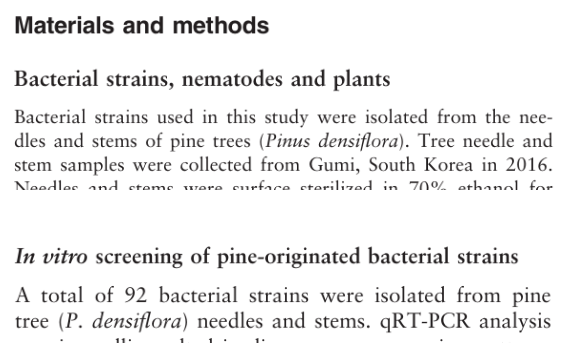
In STOTEN, the authors mention 92 bacterial isolates, and the numbering of these isolates closely resembles that used in the Plant Pathology paper, except for the isolate JCK-1398, as seen in the Supplementary Material of the STOTEN paper.
The discrepancies in the methodology used to obtain strain JCK-1398 are still a mystery to me. My guess is that, since the authors claim that they dispersed the bacteria in the forest using a helicopter, it may have seemed more credible and/or less questionable, if they also stated that the bacterium was originally isolated from the canopy of those same trees in that region of Korea.

It is concerning that there is no mention of permits from the appropriate authorities or any pre-release risk assessments to disperse JCK-1398 in the environment. However, this may not be that bad if we consider that the STOTEN paper is more science fiction than science. It’s difficult to know exactly what these researchers are doing, but my theory, though I could be proven wrong, is that much of this work is fake. Still, they needed bacterial strains to deposit in a type collection to maintain the appearance of legitimacy, and they claim to have deposited the bacteria in a type collection in Korea. This might explain why, in the Frontiers paper, we see Bacillus thuringiensis, one of the most widely used biocontrol agents in the world, and in the STOTEN paper Bacillus subtilis, a well-known model organism that is readily available commercially and present in many laboratories.

Iberian yeast masters do it classic with a flip
“These figures were elaborated by me personally and I remember quite well how I made them. Definitely, the images shown in this figure were cut and pasted from the originals in order to elaborate the figures, the overlapping was done “manually” using GIMP…” – Dr. José R Pérez-Castiñeira

The following study I reviewed last year for Pest Management Science, and I advised rejection because I suspected this was a fraudulent paper, but it was published by this journal anyway.
Md Kamaruzzaman , Lijun Zheng , Shun Zhou , Wenhua Ye , Yongqiang Yuan , Qiu Qi , Yongfeng Gao , Jiajin Tan , Yan Wang , Bingjia Chen , Zhiguang Li , Songsong Liu , Renjun Mi , Ke Zhang , Chen Zhao , Waqar Ahmed , Xinrong Wang Evaluation of the novel endophytic fungus Chaetomium ascotrichoides 1‐24‐2 from Pinus massoniana as a biocontrol agent against pine wilt disease caused by Bursaphelenchus xylophilus Pest Management Science (2024) doi: 10.1002/ps.8205 issn: 1526-4998
This is the advice I gave to the editor, which illustrates the basic problems with this type of papers:
On this work the authors assess the toxicity of extracts of an isolate of Chaetomium ascotrichoides on pine wood nematodes and its virulence to pine seedlings. Cutting things short I think this is a fraudulent paper, with all hallmarks of a paper mill product. The reasons for my opinion are:
- The title and structure of the work follow a standard that I saw in several other papers revised by me or already published. The work starts by a screening on a community of organisms, usually bacteria, fungus or even chemical composites (very often herbs composits from traditional medicine). The results of the surveys are tested in the pine wood nematode (there are a lot of versions for other agricultural pests to), the most deadly is selected and then its specific composition is assessed as well as protein targets in the pest.
- The premisses and rational of this work do not make much sense to forest ecologists and pathologists. The authors considered this mostly saprophytic fungi, known for degrading cellulose as a potential biocontrol agent of the pine wood nematode because they discover it and had some effect on nematodes. That is the only statement of hypothesis. One can test thousands of fungal extracts on nematode/bacteria cultures and have an effect, since fungi are generally known to produce secondary metabolites and antibiotic compounds. I do not see how this knowledge could be applied in the biocontrol of B. xylophilus which is a pine pathogen, and Chaetomium fungi are generally isolated from decomposing cellulosic materials, such as animal dung and deadwood.
- The authors may have isolated the fungi in question from somewhere and characterize it (but I am not absolutely sure about that), but I do not believe that they made all the tests they say they made on the pinewood nematode. They stated “Bursaphelenchus xylophilus was obtained from our collection” very vague about the origin of the nematodes tested; They stated that “Endophytic fungi were isolated from the branches of five-year-old PWN-resistant healthy P. massoniana plants grown naturally” a very vague statement on the origin of the fungi. Then they stated that they isolated 67 fungi in total, but nowhere in the MS there is information on this community of fungi. Isolating all these fungi must have been a crazy big project, I would want to say something about these findings If I made all this work. The pinewood nematode is a mycophagous organisms, information on innocuous or even beneficial fungi within the community is crucial to understand this forest pest. But any of the authors seem to have much work done on forest pathology or the pinewood nematode.
- That is another point of suspicious, who the authors are, and their research is hard to pinpoint, and their cv seem to be a random collection of papers on agricultural pests.
- There is no statistical analysis of the effects of the other different fungi on B. xylophilus. They just selected an obscure species of Chaetomium, it is impossible for any researcher anywhere in the world to replicate this work. But I guess that is the objective, an impossible to replicate work. I think the authors probably isolated this strain of fungi from somewhere because they have a lot of data on the MS on its phylogenetic analysis, while they ignored all the other 66 fungi that they so painstakingly isolated and tested in the pinewood nematode.
- The photos on the MS are useless, images of healthy and witing pines, or healthy of dead B. xylophilus just do not say anything, and do not prove the authors made the work.
I really think Journal should have a better way to filter out fraudulent research before sending it to reviewers. I have been receiving too much of these types of papers lately and I think we all are wasting our time with made up science.
This work was assessed by two other reviewers, one of them was very positive, the other raised serious questions about the analytical procedures. The Editor decision: “major revisions”. They sent me this manuscript for a second round of revision, which I simply ignored.
More recently, I looked at the published paper and found a really dumb image manipulation, and the paper ended up on PubPeer:

Of course the paper has much more problems than lousy images.
The worst part of all of these is that I think journals are on-board with this: Pest Management Science is full of this type of fraudulent papers and is a one of the leading journals on pest management, published by Wiley. After ignoring my advice about not to publish a fraudulent paper, they gave me a “Reviewer Certificate”. They really valued my advice, didn’t they? They even asked me to review two more times, something I simply ignored.
I also found another bad Photoshop job on a very similar paper from this author Md Kamaruzzaman, this time about mold in apples:
Md. Kamaruzzaman , Md. Samiul Islam , Md. Amit Hasan , Razia Sultana , Mohammad Omar Faruque , Chunhao Jiang Characterization of a hypovirulent strain of Botrytis cinerea from apple and quantification of the ICs related gene expression Mycological Progress (2021) doi: 10.1007/s11557-021-01737-1


Here is another such papermilled effector study, with “a potato ribosomal protein, StRPS5, as a target of the P. infestans RxLR effector, Pi16275“:
Jing Liu , Yaping Hu , Xiaoqing Lu , Jifen Xu , Hongyang Wang, Wei Tang, Canhui Li The role of ribosomal protein StRPS5 in mediating resistance of Solanum tuberosum plants to Phytophthora infestans Plant science (2025) doi: 10.1016/j.plantsci.2025.112539

In Fig.3A, the panel for StRPS5-YC+YN Bright apears to have been cropped and resized from Pi16275-YN+YC Bright; the same applies to StRPS5-YC+YN Merge and Pi16275-YN+YC Merge.
The coauthor Hongyang Wang explained on PubPeer that “This is a non-subjective intentional error” which was however “not intentional and does not affect the conclusions of the study“.
Back to the fraud-infested Pest Management Science, here a sleuth expert provided some very helpful analysis:
Jia Tang , Ruoqing Ma , Najie Zhu , Kai Guo , Yiqing Guo , Liqun Bai , Hongshi Yu , Jiafu Hu , Xingyao Zhang Bxy-fuca encoding α-L-fucosidase plays crucial roles in development and reproduction of the pathogenic pinewood nematode, Bursaphelenchus xylophilus Pest Management Science (2020) doi: 10.1002/ps.5497


Pines are very important in the timber industry, also in China, a lot get invested to study pine pests. And where’s a lot of money, there are papermills. Thus, even the literal papermill industry (wood) is connected to the metaphorical papermill industry of fake science.
Quan Li , Yuxin Zou , Jing Chen , Miao Su , Wenjia Jiang , Wenyi Liu , Jinghan Wang , Kai Guo , Hudie Shao , Liqun Bai , Jiafu HuBxy-glp-1 gene in the Notch pathway regulates the reproductive development of the pine wood nematode Journal of Forestry Research (2025) doi: 10.1007/s11676-025-01836-9

I guess fraud in these areas of research doesn’t have such serious consequences for people’s lives as in other areas, such as biomedicine. I mean, you do not kill people with this bad science. It’s not a priority; thus, I think fraudsters are feeling emboldened, and publishers are all too eager to publish this trash. Yet the consequences are still serious: this trend distorts scientific understanding of pests and its management, creates obstacles for solving real-world agricultural problems, wastes valuable research resources, and ultimately is making agricultural and forest pest science a joke.
Donate!
If you are interested to support my work, you can leave here a small tip of $5. Or several of small tips, just increase the amount as you like (2x=€10; 5x=€25). Your generous patronage of my journalism will be most appreciated!
€5.00

 For Better Science
First of all, thank you very much for this article.
As a scientist in the field of medicine, it simply leaves me stunned and pessimistic about the future. The fact that we are currently being flooded with thousands of fake scientific publications, in probably all disciplines, is an absolute horror to me.
The fact that this problem is, of course, economically generated and politically accepted by some countries as hybrid warfare should, in my opinion, also be addressed politically.
Out of pure interest, I recently looked at patent applications in Germany for a technical device that is not yet feasible. There were already dozens of patents that were almost identical and each covered a small part of the entire device. All of them were from China and all were described in rather vague terms.
Our entire development, both scientifically and economically, is being sabotaged by a few undemocratic countries and could lead us to unimaginable problems. I hope that this problem becomes more visible and that we can do something about it.
LikeLike
Well Richard, you will sure be interested to read this:
Guess whose side German courts took in this case. Clue: Correctiv article is offline.
LikeLike
‘… whose side German courts took’…
“Back in the day,” there was a saying: “Don’t make the Germans angry!”
Now, it’s “Don’t make the Chinese dictator angry!” You know—there could be repercussions, even tariffs.
LikeLike
Dear Richard, I’m afraid this problem is economically generated and politically accepted by ALL the countries, both non-democratic and democratic ones.
LikeLiked by 1 person
Easy problem to solve: just assume all papers from China are, in part, wrong unless proven otherwise, and don’t read them. That was my attitude when I was doing research in the USA.
What has surprised me is that you can add other western countries to the list, such as Italy, Greece and Spain.
Given that most Chinese pubs are garbage, I don’t think Chinese biotech is going to overtake western biotech anytime soon.
LikeLike
I wouldn’t be so sure. See the Chinese electronic or automobile industries. And even if they don’t overtake biotech, they have already overtaken the scientific literature. See the editors and editorial boards of most journals. If majority of them is not Chinese, then it is either Indian or Iranian. So, a virtual reality has been created and papers contradicting it or trying to correct this junk are being suppressed.
LikeLike
At some point you would think publishers wake up, but they hardly do. I have seen how they ‘remove’ (rather just don’t extent a contract) editors from journal A because of editorial fraud while at the same time they still list the same editor(s) at other journals. Hard to understand.
LikeLiked by 1 person
I also find it hard to understand when tobacco industry wakes up and stops selling cigarettes, don’t they know it’s such a poison….
LikeLike
– https://pubpeer.com/publications/F6DD3A020DEBAC2C7DB4ED3B91BA1F
– https://pubpeer.com/publications/E71BE29D7DE1F52D61B103AC90665A
– https://pubpeer.com/publications/065E9D73312155C69BB922BCC702D2
– https://pubpeer.com/publications/AB9C00A24DB1DD74BEC2BB100DB33B
– https://pubpeer.com/publications/55492D62595D926BDF0388F85E4BD2
– https://pubpeer.com/publications/F1CD48D9B34142380E5B05D712D416
– https://pubpeer.com/publications/4B8AB40750DF03B9FE8A550390A8E4
– https://pubpeer.com/publications/9A9F71CE8F4C285674C7D47000EB64
LikeLike
– https://pubpeer.com/publications/2B199168969C0CEB5BB4622459CCCA
– https://pubpeer.com/publications/8085931969B9DB0624F452E1785265
– https://pubpeer.com/publications/66E7F9A5F017BE52F53A2CE7FAADB6
– https://pubpeer.com/publications/89096FB56EFA4D7511376DED0583F3
– https://pubpeer.com/publications/769C1D00434608E7BB667466F7E09E
– https://pubpeer.com/publications/8DD9BE91EA6380A30FE959C60D0CA4
– https://pubpeer.com/publications/3651579401B5BD5A04BCF6F95A911C
– https://pubpeer.com/publications/32EE44E5F411B62A9C9C5F7A8BFA50
– https://pubpeer.com/publications/1CC3B2309FB83B70D1AE564D3BEABE
– https://pubpeer.com/publications/D95729B01BB1001A9D70BD19DC94FB
LikeLike
Pest Management Science decided to retract the paper that they had published after being alerted by reviewers to evidence of fraud.
https://pubpeer.com/publications/D79522A7B962491B2FF383B5D2325
“The above article, published online on 11 June 2024 in Wiley Online Library (wileyonlinelibrary.com), has been retracted by agreement between the journal Editors-in-Chief, Yidong Wu, Mithila Jugulam, Ray Hammerschmidt; the Society of Chemical Industry and John Wiley & Sons Ltd. The retraction has been agreed upon following an investigation into concerns raised by a third party regarding inconsistencies in the homology modeling described in the article. A subsequent review and expert reassessment confirmed serious concerns regarding the integrity and reliability of the data presented. Key issues include:
Use of the native crystal structure (PDB 6WLF) while claiming to use a homology model, with no evidence of comparative modeling or validation (Figure 7).
Methodological flaws in molecular docking results, including unrealistic binding interactions, with ligands still present, contradicting the described methods (Figure 8).
Chemically implausible compound identifications, with several reported compounds unlikely to be biogenic or too reactive under the reported conditions (Table 2).
Inconsistencies in data presentation and statistical reporting (Figure 3).
Unambiguous image section duplication (Figure 1C).
While the authors cooperated with the investigation, their response did not resolve the concerns and, in some cases, further undermined confidence in the work. Given the extent and nature of the issues, the editors no longer consider the article’s conclusions to be reliable and have therefore decided to retract the publication. The authors disagree with this retraction.”
This is kind of amusing, and depressing at the same time. Looks like FBS worked its magic.
LikeLike
Thanks Carla!
Nobody reads For Better Science, except the people who decide about retractions. 😉
Found your comment in spam by chance, and saved it!
LikeLike