

Alexander Magazinov followed an international gang of papermillers and citation scammers who specialise in green economy. We already know that the fossil fuel industry regularly pays university professors for green-washing, but at some point one will have to ask if Big Fossil also sponsors Asian papermills in order to discredit all green technologies and all climate-change relevant research.

Salesmen of Green Economy Bullshit
By Alexander Magazinov
In this post, we are going on an incomplete tour around a papermill ring, on top of which, seemingly, sits one Farhad Taghizadeh-Hesary, an Iranian with a Japanese affiliation. Other notable actors (more-or-less, “members of the papermill executive board,” as a good approximation of their status) are Muhammad Mohsin, Muhammad Umair, Lei Chang and Azer Dilanchiev, the latter calling himself “the top economist of Georgia.”
As we will see, this papermilling ring is still going strong, not much affected by retractions to its leaders, like this one to Taghizadeh-Hesary, this “withdrawal” to Taghizdeh-Hesary and Mohsin, two more retractions to Mohsin, and one to Dilanchiev. We will also see (very partial) journal cleanups or singular retractions where some of this ring’s products fall down, but that’s just the normal operational conditions of each and every active papermill.
What is this field about?
Basically, it is all about p-hacking and HARKing out various economical correlations. Which is why there is an infinite stream of articles arguing how “green X” influences “green Y,” maybe through “green U, green V and green W.”
Take this article as an example.
Kanat Abdulla, Balzhan Serikbayeva, Yessengali Oskenbayev, Farhad Taghizadeh-Hesary, Regional Differences in Human Capital and Occupational Choice: Evidence from Mexico, European Journal of Development Research (2022), doi: 10.1057/s41287-021-00497-8

Why did a Japan-based Iranian Taghizadeh-Hesary and his Kazakhstani collaborators choose Mexico? Aren’t there more obvious choices for this authorship roster? Like Japan, Kazakhstan or Iran, or – for that matter – China or russia, all those are countries with a lot of regional differences. Well, the best guess is that Mexico met the predetermined narrative, and some other countries did not.
Likewise, if one set of variables fails to yield a significant result, these “economists” are free to try another set, or a third one, up to infinity, until the dataset is tortured enough to confess in something that is not actually there.
Or, in a similar vein, if a simple regression is insignificant, there are lots of autoregressive models with lags to try out.
And if all possible statistical shenanigans fail, there is the ultimate weapon: to make the data up out of thin air. Like here.
Huizhu Tan , Shuai Huang, Bobur Urinov, Elchin Eyvazov, Yutao Hanhua, Mapping the nexus of digital finance and energy transition in Chinese prefecture-level cities, Energy Strategy Reviews (2025), doi: 10.1016/j.esr.2024.101609

Quite hard to make it more ridiculous than this, but nah, it passed peer-review. As said in my PubPeer comment, “In the statistical description of variables, mean is almost always smaller than the minimum (mathematically impossible), in the remaining case and in one more case, SD is greater than half the difference between the maximum and the minimum (also mathematically impossible). Twice, the minimum is greater than the maximum. Also twice, SD is negative.“
That is why I do not recommend reading all those papers (easily recognizable by their style) as pieces of knowledge. Rather, they are pretty good as records of transactions between various parts of the fraud network. Which is how we are going to look at them in the rest of this blog post.
Citation magnets
Why would a paper on telecommunication security be cited in so many papers in the field of “green economy”? True scientists would come up with thousands of reasons as to why it is not suspicious at all and not worth looking into. But I am no longer a scientist, so I will dig into it a little bit. Here is the citation magnet:
Ullah, K., Rashid, I., Afzal, H., Iqbal, M. M. W., Bangash, Y. A., & Abbas, H.SS7 vulnerabilities—A survey and implementation of machine learning vs rule based filtering for detection of SS7 network attacks. IEEE Communication Surveys and Tutorials, (2020) doi: 10.1109/COMST.2020.2971757
“The Signalling System No. 7 (SS7) is used in GSM/UMTS telecommunication technologies for signalling and management of communication. […] The SS7 exploits can be used by attackers to intercept messages, track a subscriber’s location, tape/redirect calls, adversely affect disaster relief operations, drain funds of individuals from banks in combination with other methods and send billions of spam messages. This paper provides a comprehensive review of the SS7 attacks with detailed methods to execute attacks, methods to enter the SS7 core network, and recommends safeguards against the SS7 attacks.”
Dimensions paints an entertaining picture of a citation explosion in 2023, three years after the article’s publication, back to almost zero right the next year:

Of the top citing journals, none has anything to do with telecommunications security, but they have a lot to do with papermilling and citation stacking. The top two, Elsevier’s Resources Policy and Springer Nature’s Environmental Science and Pollution Research, lost their impact factors in 2024, as reported by Retraction Watch. And the latter is likely familiar to For Better Science readers because of my earlier post:

Environmental Pseudoscience and Polluted Research
“We are living in a faked world and there is a lot of un-verified avatars. “, Philippe Garrigues, EiC

Now, the top citation suppliers to Ullah et al 2020 are exactly those I mentioned above as the suspected top actors of the papermilling cluster. Let’s look at their “studies” brought to light by our Dimensions search. For example, here, a three-in-one, Taghizadeh-Hesary, Mohsin and Chang:
Lei Chang, Muhammad Mohsin, Zhennan Gao, Farhad Taghizadeh-Hesary, Asymmetric impact of oil price on current account balance: Evidence from oil importing countries, Energy Economics (2023), doi: 10.1016/j.eneco.2023.106749
“The inverse OP-CAB relationship corroborates the study by Pan et al. (2023) and Ullah et al. (2020), who also found that OP shocks deteriorated the CAB of the Indian economy.”
SS7 network attacks or oil price shocks to Indian economy, same thing really, nobody cares. There are more nonsense sentences and references, as shown by the first commentator on that PubPeer thread, an anonymous Arhopala denta.
This one, by Umair, is similar.
ChangZheng Li, Muhammad Umair, Does green finance development goals affects renewable energy in China, Renewable Energy (2023), doi: 10.1016/j.renene.2022.12.066
“This research adopts [74] which points to a strong connection between the availability of mineral resources and their sources.”
As a reminder, [74], by Ullah et al 2020, is about defence from network attacks. Mineral resources and green energies in China? Nope.

Also similar is this one, by Dilanchiev.
Yan Zhang, Sidra Bibi, Azer Dilanchiev, Mineral and fossil fuel extraction policies: A diversified portfolio approach to managing price volatility, The Extractive Industries and Society (2023), doi: 10.1016/j.exis.2023.101314
“Because bitcoins bought and paid for in different centuries in functional currency have various face values in the present period, cryptocurrencies would invalidate interest and foreign currency rate adjustments in transactions between nations (Ullah et al., 2020).”
Bitcoins. In different CENTURIES. And SS7 attacks. Somehow.
Let’s have a look at another citation magnet. This paper from Norway about aluminium electrolysis managed to collect only five “green economy” citations so far, but some are quite interesting.
Lundby ETB, Rasheed A, Gravdahl JT, Halvorsen IJ, A novel hybrid analysis and modeling approach applied to aluminum electrolysis process. J Process Control (2021), doi: 10.1016/j.jprocont.2021.06.005
So, who cited this paper?
Qiuyan Fan, Aytan Merdan Hajiyeva, Nexus between energy efficiency finance and renewable energy development: Empirical evidence from G-7 economies, Renewable Energy (2022), doi: 10.1016/j.renene.2022.06.113
“According to Ref. [62] most common calculations, a DOLS calculation indicated that renewable energy consumption had no substantial impact on CO2 emissions in Canada.”
The email address, aytandilanchieva@yahoo.com, suggests that Aytan Merdan Hajiyeva‘s maiden name was Aytan Dilanchieva, and thus that she is likely Azer Dilanchiev’s sister. Given Aytan’s background in history / social studies, it is too hard to rule out the possibility that the paper is Azer’s gift from his papermill.
Another one, same aluminium electrolysis reference.
Hongying Liu, Kuan-Ting Wang, Khurshid Khudoykulov, Tran Duc Tai, Thanh Quang Ngo, Thi Thu Hien Phan, Does Economic Development Impact CO2 Emissions and Energy Efficiency Performance? Fresh Evidences From Europe, Frontiers in Energy Research (2022), doi: 10.3389/fenrg.2022.860427
“As a result, according to (Lundby et al., 2021), financial instruments like credit and savings lead to more high satisfaction and help everyone’s macroeconomic circumstances throughout the globe.”
There are many more ridiculous references there, see the PubPeer thread. Edited by Muhammad Mohsin, what a surprise.
One more.
Wei Zhao, ZhengShan Luo, Qilei Liu, Does supply chain matter for environmental firm performance: mediating role of financial development in China, Economic Change and Restructuring (2023), doi: 10.1007/s10644-022-09410-7
A recent study by (Lundby et al. 2021) examined how green bond issuance statements affected SCM activities, which in turn influenced the social and environmental initiatives undertaken by Chinese listed companies.
This article belongs not to one, but to two special issues at the same time! “The drivers of sustainability in transitional and emerging economies” edited by George Halkos, and “Fiscal Policy Instruments and Green Recovery in the Post-Covid-19 era” edited by – yeah! – Farhad Taghizadeh-Hesary.

To make things worse, it delivers 18 citations to Muhammad Mohsin. Can we say that the identity of at least one reviewer is pretty much out of doubt? And what could this reviewer aim for, except providing smooth editorial process for the papermill’s Chinese customers?

Now, how about a “citation magnet” authored by Taghizadeh-Hesary? This one was catalogued by Smut Clyde:
Moslem Dehghani, Mohammad Ghiasi, Taher Niknam, Abdollah Kavousi-Fard, Mokhtar Shasadeghi, Noradin Ghadimi, Farhad Taghizadeh-Hesary, Blockchain-Based Securing of Data Exchange in a Power Transmission System Considering Congestion Management and Social Welfare, Sustainability (2020), doi: 10.3390/su13010090
Here is how the Dimensions badge of this article currently reads,
“This publication in Sustainability has been cited 212 times. 51% of its citations have been received in the past two years, which is higher than you might expect, suggesting that it is currently receiving a lot of interest.
Compared to other publications in the same field, this publication is extremely highly cited and has received approximately 53 times more citations than average.”
This PubPeer search gives a clue why this paper is highly cited. Another clue is its co-author, Noradin Ghadimi, an established papermiller and citation farmer. He already retracted some papers, for example Nouri et al 2018 for “35 citations […] which have no substantial relevance to the article“, Bagal et al 2018 for plagiarising a paper by some Sayyad Nojavan and adding 18 references to his other papers “during the final part of the revision process“, and Yu et al 2020, for “suspicious changes in authorship between the original submission and the revised version of this paper“. In fact, the authorships for Ghadimi’s paper Azar et al 2022 were sold on the internet.
The rule of thumb here is simple: whoever happened to publish with Ghadimi should never be trusted, and Taghizadeh-Hesary is no exception.

In international affairs and paper mills
Alexander Magazinov would like you to meet an Iranian scholar named Ali Akbar Velayati.
Geological Journal
Let’s return to out-of-context citations to Ullah et al 2020, the SS7 network attacks paper. Nine of citing studies were published in Geological Journal, which puts this journal into the fifth place among citation donors. Here are all the 9 papers in question:
- Shixin Zheng, Ziren Wang, Nexus of financial decentralization and institutional resource consumption efficiency for a carbon neutral society: Policy implication of China, Geological Journal (2023), doi: 10.1002/gj.4782
- Yong Xu, Financial development, financial inclusion and natural resource management for sustainable development: Empirical evidence from Asia, Geological Journal (2023), doi: 10.1002/gj.4825 [retracted March 2024]
- Dong Weng, Qionghua Xia, Nexus between financial inclusion and natural resource management: How human development affects the sustainability practices, Geological Journal (2023), doi: 10.1002/gj.4862
- Meichen Tao, Bo Zhang, Gavkhar Bekmurodova Adkham Kizi, Measuring the management of natural resources and regional sustainable development: Mediating role of green finance in China, Geological Journal (2023), doi: 10.1002/gj.4820 [retracted June 2024]
- Lei Ma, Economic and social impacts of the green energy transition: A pathway towards 100% renewable energy agenda, Geological Journal (2023), doi: 10.1002/gj.4764
- Yingzi Li, Joint impact of technological innovation and energy consumption on natural resource management: Evidence from the Asian developing region, Geological Journal (2023), doi: 10.1002/gj.4811 [retracted June 2024]
- Juan Hui, Qingmei Tan, Trilemma association of natural resources, technology and innovation’s applications in regional growth, Geological Journal (2023), doi: 10.1002/gj.4783
- Gong Chen, Lamu Zhuoma, Xiaowen Xie, Ziqing Xu, The impact of natural resource markets and green financing on financial stability and renewable energy investment efficiency, Geological Journal (2024), doi: 10.1002/gj.4858
- LiJie An, XiuJing Jiang, Zhen Liu, Qiong Li, Socio‐economic impact of natural resource management: How environmental degradation affects the quality of life, Geological Journal (2023), doi: 10.1002/gj.4787 [retracted March 2024]
There are even further commonalities between the reference lists of these “studies.” As the linked PubPeer threads tell, the initial thread that led to this set was “a number of out-of-context citations to a certain M Umair.” The diversity between Umair citations in these cases is negligible: for example, the Umair-authored (Wu et al., 2022) is present in all nine of them.
Other members of the cartel have not missed out on the citation payday here, although what is cited from them demonstrates variability. Actually, the main beneficiary is Mohsin, who is the top citation recipient in seven out of the nine cases, with as many as 21 citations gathered from case 1 alone. And there is a smaller, but more-than-negligible amount of citations goes to Taghizadeh-Hesary, Chang and Dilanchiev.
Only four – less than a half – of these “pieces of scholarly wisdom” have been retracted, for “manipulation of the peer review process“. And that despite their striking similarities, and – most importantly – them all being part of the same special issue, “Nexus of geoenvironment, resource management and regional sustainable development,” edited by Jawad Abbas, Joanna Kurowska-Pysz, Serife Zihni Eyupoglu and Wei Liu.

Actually, a whistleblower, whose name I know, expressed concerns about this special issue back in October 2023. In an email, in which I was among the recipients, they noticed,
“First, background in the journal because as a geologist I subscribe to the ToC and have a good idea of what they publish. They almost never publish these kinds of papers. So having a special issue with papers on statistical analysis of whatever environment nonsense they have is extremely unusual for the journal. It’s not the best journal in the world, but a convenient place to publish some geological findings of local importance. This special issue has nothing to do with geology.
I had another look into some of the papers. They all have exactly the same structures, and nearly identical headings. Some intro, a description of a very rudimentary statistical method, application of that method to publicly available data (often OECD etc), and some obvious conclusions that don’t say anything too particular.
The other thing is that many of those papers have open peer review, see for example this: https://publons.com/publon/10.1002/gj.4649
Reviews are very basic, and once you look at several of them for different papers you see that they all follow the same pattern (numbered lists, dot points, even saying the same things!).
So yes, obviously paper mill.“
The whistleblower then notified the Editor-in-Chief, Ian Somerville, and received this response:
“Based on your alert, we have initiated an investigation and sought explanation from the Guest Editors. Prof. Santosh and I have, over the last few days, been checking the records of the editorial handling and review processing of the papers in this special issue. If we find serious issues with any papers such as the graphical abstract similarity that was pointed out, we will contact the Publisher of the journal and take advice on further steps, including possible retraction of the relevant papers if necessary.
Where “Prof. Santosh” is exactly Madhava Santosh or M Santosh, a prolific spammer and a leader of a pal-review gang – For Better Science audience might have encountered him in June 2024 Shorts, and also in this post by Smut Clyde:

Hear her laughing in earthquake land
“For that marketplace is a labyrinth as large as the academic world, and the Ariadnean thread that traces the path back out of its interior seems to sprout subsidiary threads that lead into plant-based green nanoparticle synthesis or some other side-alley of parascience.” – Smut Clyde

Which might be a factor in the journal’s choice of approach: to retract the right fraction of fraud and let the rest of it stand.
However, to Geological Journal‘s honour, it seems that Santosh is no longer on their editorial board.
International Journal of Hydrogen Energy: cite Umair like there is no tomorrow
Looking for more gems, I made a spreadsheet of articles citing Muhammad Umair three times or more. And gems were there!
The list is heavily Elsevier-dominated – 253 out of 319 – which is not a surprise, keeping in mind the publisher’s welcoming attitude to green-sustainable-environmentalist papermilling, familiar to the readers of this blog. And with 105 entries covering 2023 to 2025, Resources Policy clearly stands out. However, I (rather arbitrarily) chose another soft target, also by Elsevier – International Journal of Hydrogen Energy (IJHE), a papermill-only journal already exposed on For Better Science several times, for example, here and here:
Veziroglu Journal of Papermill Energy
Mu Yang and other sleuths celebrate the scholarly publishing business of the late T Nejat Veziroglu, laureate of Santilli-Galilei Gold Medal for Lifetime Commitment to True Scientific Democracy

It is my strong opinion that IJHE is simply a non-journal which does not deserve to be indexed anywhere – certainly not in Scopus or Web of Science, but it is probably too ridiculous even for the Beall’s list.
For IJHE I got “only” 19 entries, but all of them are very recent: the first few acceptances were in late 2024 as if papermillers made initial attempts to test the journal’s non-existing papermill filter, and in 2025, just as expected, the flow increased.
Now, what’s wrong if 26 out of 27 references are to the benefit of “a certain M Umair”? Nothing, if that’s IJHE, and never mind their relevance!
Ruiqian Su, Ye Xiao, Fadhila Hamza, Zokir Mamadiyarov, Abdul Wahab, Scaling up green hydrogen in China: Economic opportunities and challenges, International Journal of Hydrogen Energy (2025), doi: 10.1016/j.ijhydene.2025.04.126

And the sole remaining reference is to, uhm, Sasan Pirouzi, another papermiller with an established PubPeer record of his own.
Or, who is Tekenef Skrank here?
Jiapei Wei, Yangbin Wu, Sanjar Mirzaliev, Tekenef Skrank, Zeng Ping, Artificial intelligence applications in hydrogen system: Advancing renewable energy utilization for global hydrogen economy and sustainability goals, International Journal of Hydrogen Energy (2025), doi: 10.1016/j.ijhydene.2025.03.350
As best as I can tell, Skrank is a sibling of the non-existing Tekle Demsas, covered in June 2025 Shorts. And bets are open on whether Skrank’s purported email
tekenef835@skrank.com is fake. But all that doesn’t matter: there is never too few citations to Umair!
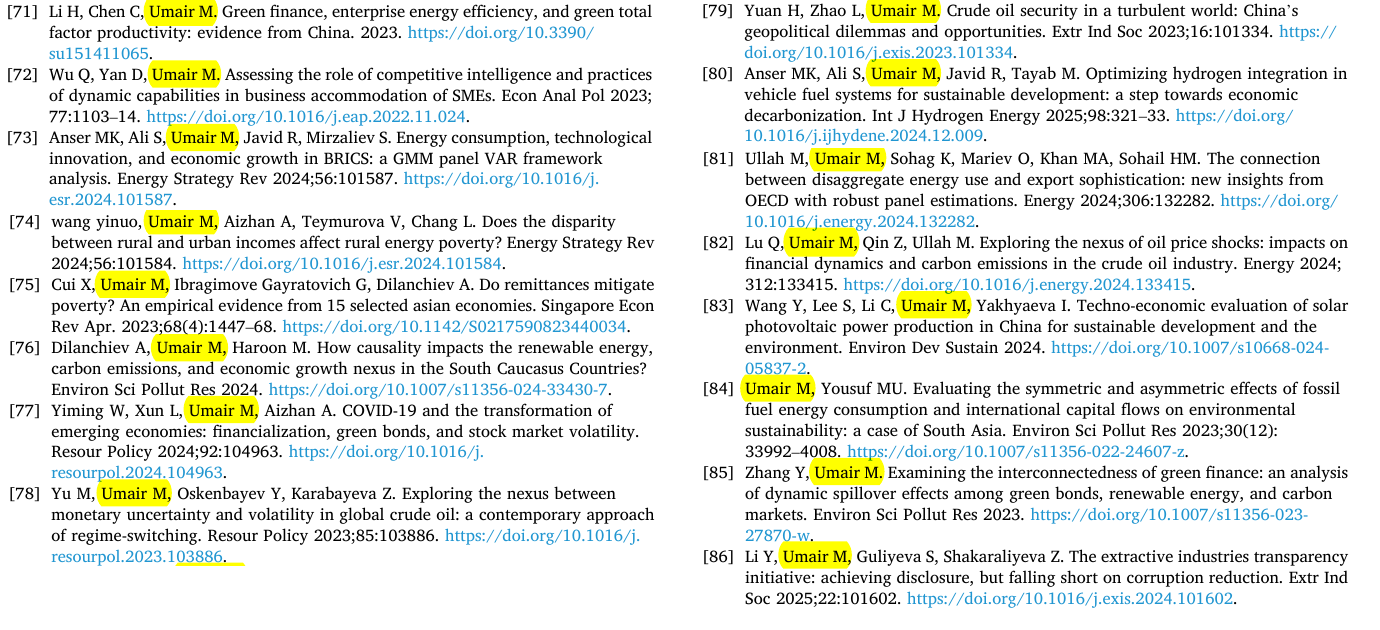
But wow, even IJHE can issue retractions! One of those 19 articles is no more, while all the rest are still standing strong.
Wei Liu, Ting Xue, Nawal Abdalla Adam, Ahola Jero, Hao Yang, Retraction Notice to “Hydrogen economy in China: Integrating biomass for renewable energy transition and economic growth” International Journal of Hydrogen Energy, Volume 121, 23 April 2025, Pages 171-188, International Journal of Hydrogen Energy (2025), doi: 10.1016/j.ijhydene.2025.03.178

[1] and [11] are the same – is the work so important that it needed to be cited twice?
Ref. [2] is clearly out-of-context (it is not related to biomass). The rest is left as an exercise to an interested reader.
The retraction was published on June 3, 2025, and reads,
“This article has been retracted at the request for the Editor-in-Chief.
After publication, the journal received a complaint from Dr. Jero Ahola of LUT University, stating that he was not involved in the article and was included in the authorship without his consent. He also indicated that the email address used for this article was not his genuine email address. Furthermore, the journal noted that only Hao Yang and Jero Ahola were listed as authors in the original manuscript, while Wei Liu, Ting Xue, and Nawal Abdalla Adam were added to the author list during the revision without the editor’s approval, which is a breach of journal policy.
The authors did not provide any explanation for the issues raised. Consequently, the editor feels that the findings of the article cannot be relied upon, and therefore, the article needs to be retracted.”
It is up to the reader’s imagination, how many fraudulent studies could have been reviewed by this fake avatar of the Finnish professor Jero Ahola.
That’s probably enough to feel the flavour, but we will see more examples later in this post.
Energy Strategy Reviews
Pretty much the same is happening in another Elsevier journal, Energy Strategy Reviews (ESR). Both in IJHE (for the majority of cases) and ESR we actually know the handling editors. In IJHE the editors are mostly different: A B Basile handled 5 pieces, Mehdi Najafpour handled three, 5 other known guys, including the russian papermiller Suleyman Allakhverdiev, handled one each. Things are different in ESR, where all 21 citation delivery vehicles to Umair were handled personally by the journal’s Editor-in-Chief Mark Howells, a noble white man from Loughborough University and Imperial College London.
Howells is listed as the Director of “Climate Compatible Growth” Programme, whatever that is. On their site, his bio reads,
“Mark Howells is the CCG Programme Director. He is jointly appointed at Loughborough University and Imperial College, London. Previously at the Royal Institute of Technology in Sweden he set up their prestigious Energy Systems Analysis programme. He led the development of some of the world’s premier open source energy, resource, and spatial electrification planning tools; published in several Nature Journals; coordinated the European Commission’s think tank for Energy; is regularly used by the United Nations as a science-policy expert; and is a key contributor to UNDESA’s ‘Modelling Tools for Sustainable Development Policies’ initiative. His work has contributed to efforts for NASA, IRENA, ABB, the World Bank, and others.
He sits on the advisory panels of leading US and European institutes. Prior to joining academia, Mark had an award winning career with the International Atomic Energy Agency. Mark’s graduate and post-graduate studies were undertaken at the University of Cape Town, South Africa. While there he was an international research affiliate at Stanford’s Program on Energy and Sustainable Development and represented the World Energy Council’s student programme.”
With the right approach to Howells, everything is apparently publishable. Including some crazy machine-generated figures, comparable to those of the famous Frontiers “retat dck” debacle (read about it in Elisabeth Bik‘s blog or February 2024 Shorts).
Xiaoqian Zhang, Linglu Linjin, Pollution havens in high-income emerging nations: Can green energy, financial development and environmental rules change this? Energy Strategy Reviews (2025), doi: 10.1016/j.esr.2024.101635
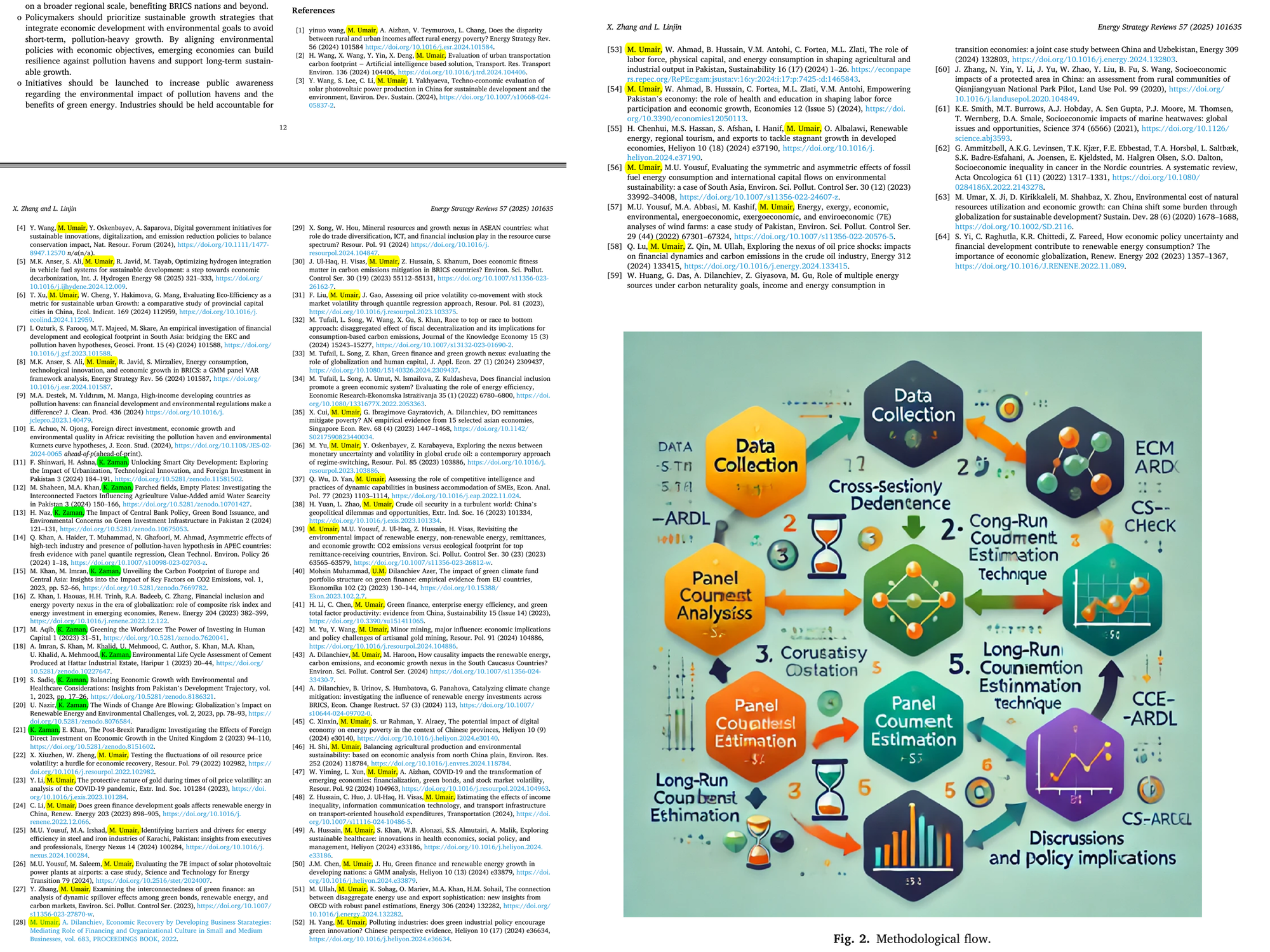
Fig. 2 is machine-generated nonsense. “Discrussions,” sure.
“Discrussions,” “Cross-Sestiony Dedentence,” “Long-Run Coupbenst Ethimation,” and – my favourite one – “Corusatisy 🍑station“! Since professor Howells was fine with this “methodology,” should we assume that its components are in his everyday research toolbox?
Yan Shao, Zhe Yang, Yongbing Yan, Yuan Yan, Feruza Israilova, Nawal Khan, Liu Chang, Navigating Nigeria’s path to sustainable energy: Challenges, opportunities, and global insight, Energy Strategy Reviews (2025), doi: 10.1016/j.esr.2025.101707

To make things worse, Fig. 3 is a computer-generated nonsense. Gadoa, Ransana and Ungala, really?
Pretty much nothing to add here, just this collage.

I asked professor Howells if he is compensated by the papermill for such editorial acceptances, and also notified both his universities. Quite predictably, nobody replied.
Environmental Research: funny retractions
It seems, publishers are scared of Mu Yang, because after her investigation, Elsevier decided to clean up the journal Environmental Research.
Issues of global relevance
“I like ImageTwin, but seeing things with just eyes is like hand-to-hand combat….” – Mu Yang
In the process, two remarkable papers were pulled, and they were not even flagged on PubPeer before. Both apparead in a Special Issue edited by a Thamaraiselvi Kaliannan, who is an associate of the papermiller Kathirvel Brindhadevi, and of couse the latter heavily published in that special issue, which is now plagued by retractions. Now, the two retracted papers relevant to our story heavily cited a certain M Umair. This was published in July 2024:
Shuai Wang, A semi-arid climate’s use of exploratory data analysis (EDA) as a reliable non-parametric method for geochemical mapping, Environmental Research (2024), doi: 10.1016/j.envres.2024.119654

This was a citation delivery vehicle to a certain M Umair.
The retraction from January 2025 went (highlights mine):
“This article has been retracted at the request of the Editor. Post-acceptance, the editor discovered suspicious changes in authorship between the original submission and the revised version of this paper, such that the sole author of the original submission has been replaced by the currently listed sole corresponding author in the published version. The editor reached out to the authors for an explanation, but they failed to provide a satisfactory explanation for these changes. Such authorship changes breach the policies of the journal and, as a result, the editors no longer have confidence in this paper and are retracting it. The journal apologises for not having identified the problematic authorship changes during the review process and for any resulting inconvenience. Furthermore, the currently listed corresponding author had requested exchanging the vast majority of the references in the reference list for completely different citations during the proofing process. This also undermines the scientific credibility of the paper and as a result, the editor also no longer has confidence in it.”
This paper in the same journal was not “retracted”, but “withdrawn”, presumably right after publication in August 2024:
C.U.I. Sheng-Li, C.H.E.N. Ruikai, W.A.N.G. Shuiquan, Examining the Effects of Land Use, Salinity Gradient, and Water Pollution on Greenhouse Gas Emissions in Urbanized Estuaries, Environmental Research (2024), doi: 10.1016/j.envres.2024.119652

This also happened to be a citation delivery vehicle to a certain M Umair.
This was the undated “Withdrawal” notice, also here authorships were sold and the references were replaced, likely to cite Umair:
“This article has been withdrawn at the request of the Editor.
Post-acceptance, the editor discovered suspicious changes in authorship between the original submission and the revised version of this paper. Furthermore, the authors requested substantial and suspicious changes to the title of the article and to the abstract and conclusions section during the proofing process. The editor reached out to the authors for an explanation, but they failed to provide a satisfactory explanation to these changes.
Overall, the editor feels that the findings of the manuscript cannot be relied upon, and the article needs to be withdrawn.”
In comparison, the Elsevier journal Resources Policy retracted exactly ZERO of – attention! – 105 such “articles.”
Travelling salesman
And now let’s watch Taghizadeh-Hesary travelling to various places in post-Soviet republics. It will come as no surprise that we find customers of his papermill wherever he goes. We can only speculate about the reasons, but one possibility is that Taghizadeh-Hesary promotes his “products” where he knows the demand is high. Another one is that the honoraria he receives are just a laundered version of payment for papermill products. Whatever the reasons, we see what we see.
Here, a very recent (30 May 2025) lecture of Taghizadeh-Hesary at Narxoz University in Almaty, Kazakhstan, was announced by Zhanar Argynbayeva, Narxoz University’s vice-president for science and commercialization:
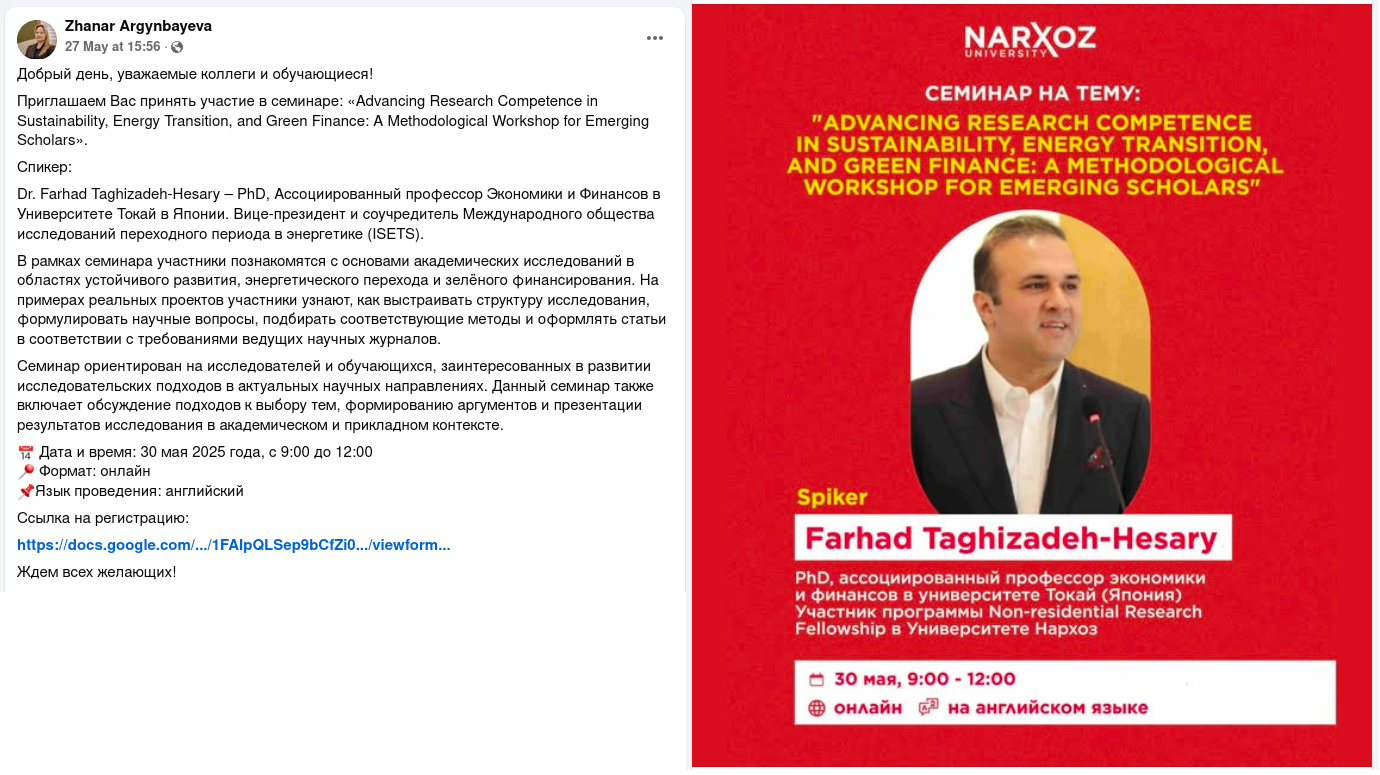
No one should be surprised that Narxoz staff proudly buys stuff from Taghizadeh-Hesary’s papermill. Like this, yet another citation delivery vehicle to Umair.
Lei Qi, Hina Najam, Yessengali Oskenbayev, Sansyzbaev Alisher, Kamla Hairis, Impact of rapid urban construction land expansion on spatial inequalities of ecosystem health in China: Evidence from national, economic regional, and urban agglomeration perspectives, Ecological Indicators (2025), doi: 10.1016/j.ecolind.2025.113196
Now, “Kamla Hairis” is credited with “Project Administration, Funding Acquisition, Manuscript Revision, Writing – Review & Editing.” With that contribution, one expects Hairis to be a senior researcher, with a track record of previous publications. To the utter disappointment, Google Scholar finds no other entries for “Kamla Hairis.” The only mention of this “name” is in the URLs of Indian news pages about Kamala Harris, the 2024 US Presidential candidate.
Speaking of Argynbayeva, her only English-language paper most certainly comes from another papermill, named “Scientific Publications,” aka “tanu.pro”, owned by the Pilipenko brothers in Ukraine. Read here:
Ukrainian papermills – symptom, not a cause
“Prof. Dr. Svetlana Drobyazko, The European Academy of Sciences Ltd and Scientific Publication Service are a symptom, not a cause, of the current problems in academic publishing. ” – Nick Wise

The unmistakable fingerprint is out-of-context references to obscure Ukrainian works, see examples in the dedicated PubPeer thread:
Nurdaulet Zatilla, Saniya Nurdavletova, Zhaniya Khaibullina, Zhanar Argynbayeva, Ardak Yesdauletova, Aquatic security in the sustainable development context of the Central Asian region, Asian Journal of Political Science (2025), doi: 10.1080/02185377.2025.2494776
We now move to Azerbaijan, where a local university called UNEC held “The First International Conference of Researchers in Economics and Social Sciences” in December 2024. There,
“Associate Professor Farhad Taghizade from Tokai University addressed the participants, highlighting the importance and relevance of green economy issues in the modern era.”
Very important and relevant for papermill customers at UNEC in general and, for example, Elchin Eyvazov in particular, who may flaunt a freshly purchased citation delivery vehicle to Umair.
Shasha Yu, Sanjar Mirzaliev, Nawal Abdalla Adam, Elchin Eyvazov, Hao Chang, Assessing the social implications of green hydrogen: An S-LCA for strategic planning and management in renewable energy hubs, International Journal of Hydrogen Energy (2025), doi: 10.1016/j.ijhydene.2025.03.066


There is one more post-Soviet author on the above paper, Sanjar Mirzaliev. Mirzaliev is from the capital of Uzbekistan, Tashkent, where Taghizadeh-Hesary also gave a lecture, as recently as in late February 2025. The venue was the newly established Graduate School of Business and Entrepreneurship (GSBE).

Now meet an associate professor of GSBE, Hayot Berk Saydaliev, papermilling with Taghizadeh-Hesary himself.
Lei Chang, Fanglan Shi, Farhad Taghizadeh-Hesary, Hayot Berk Saydaliev, Information and communication technologies development and the resource curse, Resources Policy (2023), doi: 10.1016/j.resourpol.2022.103123
“In this context, information and communications technology (ICT) is
a catalyst for societal and economic transformation toward fairness,
inclusivity, sustainability, and competitiveness (Ullah et al., 2020).”
What reference could better support this vague sentence than that familiar Ullah et al. 2020 on SS7 network attacks!
Before branching out to GSBE, both Saydaliev and his GSBE boss Ikboljon Kasimov (the direct organizer of Taghizadeh-Hesary’s lecture) were affiliated to Tashkent State University of Economics, where Taghizadeh-Hesary finds even more customers. Like Sanjar Mirzaliev we encountered above. Or like Bobur Urinov, whom we congratulate on purchasing yet another citation delivery vehicle to Umair:
Hui Yang , Zhou Lu, Bobur Urinov, Aydin Mucahit, Zhang Wen, Sustainable financial technologies in hydrogen energy: Transforming investment, risk management, and global markets, International Journal of Hydrogen Energy (2025), doi: 10.1016/j.ijhydene.2025.04.173

The bibliography ends with a batch of references to works of a certain M Umair. Some of them (or all) do not match the in-text description.
Top economist in Georgia
Let’s return to Azer Dilanchiev, affiliated to “School of Business, International Black Sea University, Georgia.” Dilanchiev has a Facebook account, where he boasts his “achievements.” Like here, for being recognized as “top economist in Georgia” by yet another shitty bibliometry-based ranking.

Or, from time to time, Dilanchiev hypes his recent publications. And that, too, is a source of some fun for us!

Now wait, we’ve already seen this IJHE paper – among Muhammad Umair’s citation delivery vehicles!
Muhammad Khalid Anser, Ali Sajid, Rubab Javid, Azer Dilanchiev, Zahoor Ahmed, Evaluating sustainable energy pathways: Economic perspective on advanced hydrogen production, International Journal of Hydrogen Energy (2024), doi: 10.1016/j.ijhydene.2024.10.344
The other paper is this one – and it is also notable! If for nothing else, then because of a co-author, Mariusz Urbański of Czestochowa University of Technology, Poland. Urbański has been previously called out by Anna Abalkina on editing a special issue in MDPI’s Sustainability, which was infiltrated by the russian papermill called “International Publisher”, an episode that got a mention in my earlier For Better Science post.

Zhi-Jiang Liu , Paula Pypłacz , Marina Ermakova , Pavel Konev, Sustainable Construction as a Competitive Advantage, Sustainability (2020), doi: 10.3390/su12155946


The papermilling den of Gliwice
“As you will see, there is a lot of papermilling happening in Gliwice, as if this place has suddenly become attractive to many “researchers” from different corners of the papermilling spectrum. ” – Alexander Magazinov
Medical bro Farzad
As we are taught, it is genetics which determines the ability to do science, thus it is no surprise to learn about Farzad Taghizadeh-Hesary, likely a brother of Farhad.
Farzad stayed in Tehran and currently works at Iran University of Medical Sciences. Despite Farzad’s nominal expertise in biomedical sciences and Farhad’s nominal expertise in economy, the two sometimes join their forces. Here, in line with everyone’s expectations, they produced an article on… fluid dynamics!
Ata Nazari, Jiarong Hong, Farzad Taghizadeh-Hesary, Farhad Taghizadeh-Hesary, Reducing Virus Transmission from Heating, Ventilation, and Air Conditioning Systems of Urban Subways, Toxics (2022), doi: 10.3390/toxics10120796
“Since December 2019, the novel coronavirus disease (COVID-19) has emerged as a significant global concern. It has led to 6,299,323 deaths worldwide as of 6 June 2022 and has evoked an urgent response from all disciplines to control the crisis [1,2,3,4,5].”
Four of the five references in the above sentence are unexpectedly restricted to the much narrower topic of COVID-19 in cancer patients and are self-citations by Farzad Taghizadeh-Hesary.
Here, a superficial cleanup at Elsevier’s Heliyon caught Farzad on phrase-torturing.
Sumel Ashique, Neeraj Mishra, Sourav Mohanto, Ashish Garg, Farzad Taghizadeh-Hesary, B.H. Jaswanth Gowda, Dinesh Kumar Chellappan, Application of artificial intelligence (AI) to control COVID-19 pandemic: Current status and future prospects, Heliyon (2024), doi: 10.1016/j.heliyon.2024.e25754
The retraction notice from February 2025 reads:
“This article has been retracted at the request of the Editor-in-Chief.
An investigation conducted on behalf of the journal by Elsevier’s Research Integrity & Publishing Ethics team found phrases that make some passages in the article difficult to parse. The authors were requested to explain the use of these passages of text but were unable to do so. The Editor has lost confidence in the findings of the article and has determined that it should be retracted.
The authors disagree with retraction and dispute the grounds for it.”
Farzad’s attraction to “narrative reviews,” invariably written by across-the-globe teams of co-authors, cannot be underappreciated. Examples include this piece on green nanoparticles, another COVID-19 piece with (among others) Arshad Farid from Gomal University in Pakistan, an associate of Pau Loke Show, and many more from that gang (as you can see on PubPeer).
But then, how about this fully domestic case report? Just to spot yet another familiar name: Guive Sharifi of Shahid Beheshti University, as his PubPeer record showcases, an associate of Soudeh Ghafouri-Fard. Let’s put it this way: this is yet another demonstration of how the world of scientific fraud is interconnected.

Look What the Cat Dragged In
Meet Mohammad Taheri, PhD, a humble PhD student in Jena, Germany, and his equally unremarkable Iranian associate Dr Soudeh Ghafouri-Fard.
P.S.
The above described papermilling cluster is so stupid that in some parallel universe it could have been even funny. But in our consensual world, it is not: the countries it targets (Kazakhstan, Azerbaijan and Uzbekistan) are the stage of current and possible future natural disasters (think of the Aral sea disaster or rapid desiccation of the Caspian sea). These countries are also basically living off mining and drilling and will continue along this way unless something changes drastically. What does not speed up these changes is the amount of “green economy” bullshit churned out by the customers of Taghizadeh-Hesary and friends; in fact, this bullshit is a form of greenwashing, as policymakers might believe that with growing amount of “research” we are making progress. Except we are heading nowhere.
Donate!
If you are interested to support my work, you can leave here a small tip of $5. Or several of small tips, just increase the amount as you like (2x=€10; 5x=€25). Your generous patronage of my journalism will be most appreciated!
€5.00

 For Better Science
Geological journal and M. Santosh, starting to see a pattern here! And I. Somerville, I think it’s save to state he can’t be trusted either. Nor can Wiley after their latest stunt, clearing M. Santosh if any wrongdoing.
LikeLike
I know reasonable researchers who consider IJHE a ‘not great but not too bad’ journal and publish there. If you don’t spend time analyzing its ToC but access only articles you are interested in via eg. Google Scholar you can live with an impression that the journal is ok. Somewhere deep within that stinky bog of papermill products there are still genuine papers 😀
Elsevier’s quality has deteriorated so much that each time I stumble upon a recent paper they publish I first look through the figures for the signs of data manipulation…
LikeLike
Environmental Science and Pollution Research also published the joint leading number of fabricated comet assays that I posted in my last blog. I didn’t realize it already had such a reputation. It’s hard to keep track of all the bad actors simultaneously.
LikeLiked by 1 person
That journal publishes nothing but junk. Should be closed completely and most papers should be retracted. Many corrupt editors. And the EIC is either part of the fraud or extremely stupid/naive. Why springer hasn’t stopped this journal is a mystery.
LikeLike
Even Applied P̶o̶r̶n̶o̶s̶c̶i̶e̶n̶c̶e̶Nanoscience seems to be alive and relatively well. And, just in case, ESPR is still in Scopus (or am I wrong?) So papermillers in Scopus-oriented countries / institutions aren’t that much affected by ESPR’s delisting.
LikeLiked by 2 people
“Why springer hasn’t stopped this journal is a mystery.“
Because they are busy rewarding the scammers. As the scammer said, it really is a very meaningful recognition.
LikeLike
ESPR is still in Scopus as of May 2025 (/facepalm). Editorial de-listing from WoS 2024. And you know it’s a turd in the punch bowl when even the Chinese blushed and listed it on Chinese Academy of Sciences (CAS) Early Warning Journal Lists (EWL) for “Citation Manipulation, Paper Mill” in 2024. Yet here we are. Its almost like Scopus and Elsevier are somehow related =P
LikeLiked by 1 person
Let’s continue our Discrussions and things will surely improve.
LikeLike
In any case, it is best to hurry and buy a Corusatisy Butt-Station before darker times arrive. At least, there will be something to sit down upon.
LikeLike
Since AI came up with the Corusatisy Butt-Station anyway, I asked it to draw one. Here it is: https://ibb.co/zhHVRFM8
LikeLiked by 1 person
Well, now we know that Sanjar Mirzaliev is an Uzbek papermill customer.
But who the heck are “Sanjaro Mirzalevens” (lol) and “Sanjaror Mirziabre” (lololol)?
https://doi.org/10.1016/j.marpolbul.2025.117922
https://doi.org/10.1016/j.esr.2025.101706
LikeLike
Regarding the second paper by “Sanjaror Mirziabre”, I can only quote Mark Howells.
“I can tell you from what I have just experienced) the truth is not something you are really after – which makes you more easy to understand.”
LikeLike
There’s also an “Ah Cy” from Malawi with a gmail address. And the title about “rhetoric” is beyond stupidity. But that is that.
They haven’t come up with Cy Ka and Bly At yet, which I consider an omission.
LikeLike
When you don’t realize you’re handling YOUR OWN PAPER. What a clownshow could that be?
RETRACTED: Integrated climate, land, energy, and water framework to support the Nationally Determined Contribution updating process
Mariana Rodríguez-Arce a, Jam Angulo-Paniagua a, Luis Victor-Gallardo a, Jessica Roccard a, Jairo Quirós-Tortós a, Kane Alexander b, Mark Howells b
This article has been retracted at the request of the Editor-in-Chief due to an inadvertent handling error by the Editor-in-Chief, who was also an author of the paper. This oversight compromised the impartiality of the peer review process and necessitated the retraction of the paper.
Howells’ advantage here is that he is white, unlike Ashok Pandey, who was caught on similar stuff.
LikeLiked by 1 person