

A reader contracted me with concerns about some hyperprolific researchers at the King Saud University (KSU) in Saudi Arabia. Ten men were listed in Scopus as the top academic performers of this prestigious school, which is positioned as 90th university worldwide in 2024 Shanghai Ranking.
So here is the list of these 10 great men. Spoiler: they are all papermillers.

Saudi Arabia is a souvereign state, but it is not a nation, best described as a family business owned in full by its ruling monarchs of the House of Saud. There are no human rights or personal freedoms, no pluralism of opinions, no civil society, no cultural or scientific foundation to build on, just obscene amounts of money from climate-killing fossil fuels. And because money buys everything, the Saudi monarchs want to have it all.
They buy greedy football players and greedy scientists like they buy luxury goods from abroad, in fact quite a number of European scholars have their snouts in the Saudi money trough (see SIRIS report and May 2023 Shorts). Many of these Highly Cited Researchers, like Rafael Luque and Damia Barcelo are ruthless papermillers, El Pais dedicated in 2023 an entire article to their Saudi scams. And the German university vice-rector Timon Rabczuk even happens to be a “Distinguished Scientist” at KSU:
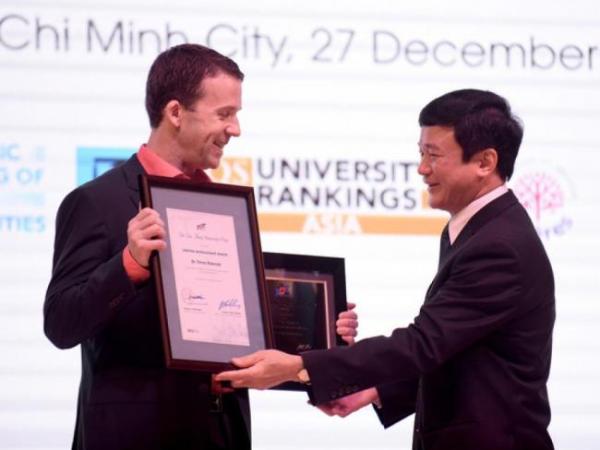
Karimipour Saga II: Vietnamese Bauhaus
“[Timon Rabczuk] is happily accepting 2 million euro of European money, whilst at the same time optimizing his return-on-investment on Vietnamese affiliation scam and cashing in on his ‘highly cited researcher’ accolades by also posing as King Saud researcher.” – Maarten van Kampen

But this article is not about greedy superstars from Europe. The following ten men publish more than Nobel Prize laureates. And yet you never heard of them. In fact, they just arrived from nowhere, having suddenly gone from almost no papers at all to dozens and even hundreds, a paper every 2-3 days.
1. Riaz Ullah

Riaz Ullah (Scopus, Google Scholar) hails from Pakistan and lists himself on LinkedIn merely as “researcher” at KSU. He published 162 papers in 2024 alone.
Ullah has over 20 papers on PubPeer, 7 of them were already retracted according to Scopus. Here is one such retraction:
Haroon Rahim, Abdul Sadiq , Riaz Ullah , Ahmed Bari , Fazli Amin , Umar Farooq , Naeem Ullah Jan , Hafiz Majid Mahmood Formulation of Aceclofenac Tablets Using Nanosuspension as Granulating Agent: An Attempt to Enhance Dissolution Rate and Oral Bioavailability International Journal of Nanomedicine (2020) doi: 10.2147/ijn.s270746

The retraction from 15 December 2023 mentioned that “concerns were raised regarding the duplication of an image from Figure 3 with an image from an unrelated article” (Rahim et al 2017, coauthored by Ullah), and that “features of the image presented in Figure 3B were not part of the original image“.
Here another retraction for Dr Ullah of Department of Pharmacognosy at KSU:
Najeeb Ur Rahman , Wasim Bahadar , Sultan Alam , Muhammad Zahoor, Ivar Zekker , Farhat Ali Khan , Riaz Ullah , Essam A. Ali , H. C. Ananda Murth Activated Sawdust-Based Adsorbent for the Removal of Basic Blue 3 and Methylene Green from Aqueous Media Adsorption Science & Technology (2022) doi: 10.1155/2022/4551212

Actinopolyspora biskrensis: “While Figure 2 can be viewed as a schematic rather than experimental results, why did the authors seemingly reuse the same image (with different magnifications, coloring, etc.) to represent each step when they had access to the experiment at each step as described in the text?”
The paper was retracted in the many-thousand-retractions campaign at Hindawi with a standard retraction notice, later on the journal was sold to Sage.
This in MDPI was not retracted, even after the authors admitted to papermilling. You may notice it is a totally different field of research to the above papers by Ullah, but papermill beggars can’t be choosers:
Nausheen Nazir, Muhammad Zahoor , Riaz Ullah , Essan Ezzeldin, Gamal A. E. Mostafa Curative Effect of Catechin Isolated from Thunb. Berries for Diabetes and Related Complications in Streptozotocin-Induced Diabetic Rats Model Molecules (2020) doi: 10.3390/molecules26010137


Muhammad Zahoor explained on PubPeer:
“Dear Editor As I told before we are not expert in this field and what the expert has send to us (after payment) we have incorporated in the paper. Even I am unable to explain what these figure meant. “
This was fittingly published in KSU’s own Saudi Journal of Biological Sciences at Elsevier, which was however discontinued by KSU in 2024:
Sumaira Naz , Muhammad Zahoor , Muhammad Naveed Umar, Fatmah S. AlQahtany , Yousif M. Elnahas , Riaz Ullah glucose-6-phosphatase inhibitory, toxicity and antidiabetic potentials of 2-picolylamine thioureas in Swiss albino mice Saudi Journal of Biological Sciences (2020) doi: 10.1016/j.sjbs.2020.09.048

Zabelia umbellata: “In figure 1. there appears to be an overlap in slide A and C (different concentrations) of Compound I (blue), and slides C for compound II and compound III appear to be the same (green).”
And here is Ullah again doing nanoparticles, with another papermill professional, Muhammad Rizwan (read October 2024 Shorts), do appreciate the title:
Najlaa S. Al-Radadi , Abdullah , Shah Faisal , Amal Alotaibi , Riaz Ullah , Tahir Hussain , Muhammad Rizwan , Saira , Nasib Zaman , Madiha Iqbal , Arshad Iqbal , Zafar Ali Zingiber officinale driven bioproduction of ZnO nanoparticles and their anti-inflammatory, anti-diabetic, anti-Alzheimer, anti-oxidant, and anti-microbial applications Inorganic Chemistry Communications (2022) doi: 10.1016/j.inoche.2022.109274


Ginger cures literally every disease, when smeared onto nanoparticles.
2. Mohamed Elshikh
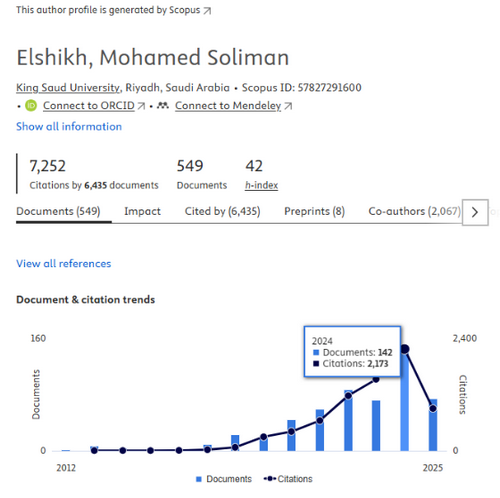
Mohamed Soliman Elshikh (Scopus, Google Scholar) claims an unspecified “employment” at KSU since 2010, he published 141 papers in 2024. His PubPeer record stands at 17 papers and 6 retractions (according to Scopus), all in PLOS One:
- Sohail Irshad , Amar Matloob , Shahid Iqbal , Danish Ibrar , Zuhair Hasnain , Shahbaz Khan , Nabila Rashid , Muhammad Nawaz , Rao Muhammad Ikram , Muhammad Ashfaq Wahid , Abdulrahman Al-Hashimi , Mohamed S. Elshikh , Zeng-Hui Diao Foliar application of potassium and moringa leaf extract improves growth, physiology and productivity of kabuli chickpea grown under varying sowing regimes PLOS ONE (2022) doi: 10.1371/journal.pone.0263323 ; Retracted 31 August 2022
- Fatima Farooq , Nabila Rashid , Danish Ibrar , Zuhair Hasnain , Rehmat Ullah , Muhammad Nawaz , Sohail Irshad , Shahzad M. A. Basra , Mona S. Alwahibi , Mohamed S. Elshikh , Helena Dvorackova , Jan Dvoracek , Shahbaz Khan Impact of varying levels of soil salinity on emergence, growth and biochemical attributes of four Moringa oleifera landraces PLOS ONE (2022) doi: 10.1371/journal.pone.0263978 ; Retracted 31 August 2022.
- Muhammad Shahid Nisar , Shahbaz Ali , Tassaduq Hussain , Hassan Ramzan , Yasir Niaz , Inzamam Ul Haq , Faiza Akhtar , Mona S. Alwahibi , Mohamed S. Elshikh , Hazem M. Kalaji , Arkadiusz Telesiński , Mohamed A. A. Ahmed , Marwa I. Mackled Toxic and repellent impacts of botanical oils against Callosobruchus maculatus (Bruchidae: Coleoptera) in stored cowpea [Vigna unguiculata (L.) Walp.] PLOS ONE (2022) doi: 10.1371/journal.pone.0267987 ; Retracted 31 August 2022
- Hasnain Abbas , Muhammad Ashfaq Wahid , Abdul Sattar , Shahbaz Atta Tung , Muhammad Farrukh Saleem , Sohail Irshad , Jawaher Alkahtani , Mohamed Soliman Elshikh , Mumtaz Cheema , Yunzhou Li Foliar application of mepiquat chloride and nitrogen improves yield and fiber quality traits of cotton (Gossypium hirsutum L.) PLOS ONE (2022) doi: 10.1371/journal.pone.0268907 ; Retracted 31 August 2022
- Amna Saeed , Ansar Hussain , Muhammad Ifnan Khan , Muhammad Arif , Muhammad Mudassar Maqbool , Hassan Mehmood , Muhammad Iqbal , Jawaher Alkahtani , Mohamed Soliman Elshikh The influence of environmental factors on seed germination of Xanthium strumarium L.: Implications for management PLOS ONE (2020) doi: 10.1371/journal.pone.0241601 ; Retracted 19 April 2023
- Yumna Sadef , Tayyaba Javed , Rimsha Javed , Adeel Mahmood , Mona S. Alwahibi , Mohamed S. Elshikh , Mohamed Ragab AbdelGawwa , Jawaher Haji Alhaji , Rabab Ahmed Rasheed Nutritional status, antioxidant activity and total phenolic content of different fruits and vegetables’ peels PLOS ONE (2022) doi: 10.1371/journal.pone.0265566 ; Retracted 18 December 2024
All these botanicals were retracted with the same notice:
“The PLOS ONE Editors retract this article [1] because it was identified as one of a series of submissions for which we have concerns about authorship, competing interests, and peer review. We regret that the issues were not addressed prior to the article’s publication.”
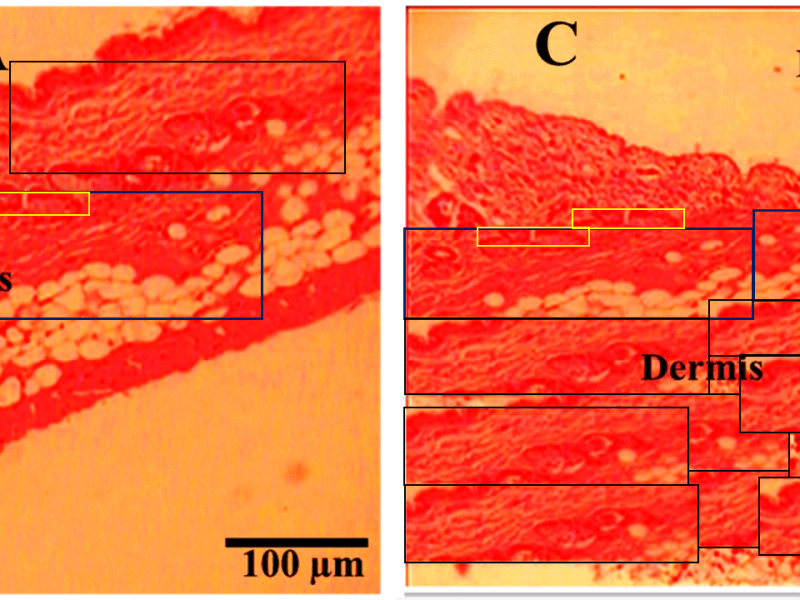
Niyaz Ahmad’s technician did it
“it makes more sense when you have consumed twice the recommended dose of San Pedro cactus and spent four hours staring at paisley wallpaper, or so I hear from a friend.” – Smut Clyde.

In fact, once again KSU’s own journal helps to visualise this authorship market in operation. One coauthor paid after publication:
Madiha Rani , Rizwan Ullah , Mona S Alwahibi , Mohamed S Elshikh , Mohamed Ragab AbdelGawwad , Adeel Mahmood Health risk assessment by toxic metals in little egrets () and food chain contaminations Saudi Journal of Biological Sciences (2022) doi: 10.1016/j.sjbs.2021.08.106

Adeel Mahmood was the corresponding author on the pre-proof but was replaced with the new author, Mohamed Ragab AbdelGawwad, and Mohamed S. Elshikh as corresponding authors.”
Just look at this:
J. Arumugam , Amal George , A. Dhayal Raj , A. Albert Irudayaraj , R.L. Josephine , S. John Sundaram , Amal M. Al-Mohaimeed , Wedad A. Al-onazi , Mohamed Soliman Elshikh , K. Kaviyarasu Construction and Characterization of Photodiodes prepared with Bi2S3 Nanowires Journal of Alloys and Compounds (2021) doi: 10.1016/j.jallcom.2021.158681

Tetraphleps parallelus: “Fig. 1. (a) Identical and abnormal XRD pattern.”
In Ramesh et al 2021, Elshikh is the last author. He used tortured phrases like “electrostatic fascination“, “overwhelming metals“, “particle trade” and the ever-popular “watery arrangement” there.

The incredible collaborations of Renaissance men and women
Nick Wise and Alexander Magazinov on the authorships-for-sale market on social media. Merely $700 for the 7th position on some paper way outside your expertise!

3. Mohammad Javed Ansari

Mohammad Javed Ansari (Scopus, Google Scholar) is one of those actually listed as faculty member at KSU website. This assistant professor and “Chair of Engineer Abdullah Ahmad Bagshan for Bee Research” published 141 papers in 2024.
Ansari has almost 50 papers on PubPeer, and a whooping 29 retractions (according to Scopus). Many retractions happened in PLOS One, for the same reason as for Elshikh: “concerns about authorship, competing interests, and peer review.”
His collaborators include such papermill celebrities like Maria Jade Catalan Opulencia, Abduladheem Turki Jalil, and even the Germany-based papermill addict Reza Akhavan-Sigari (e.g., Jasim et al 2022). Read about the latter here:
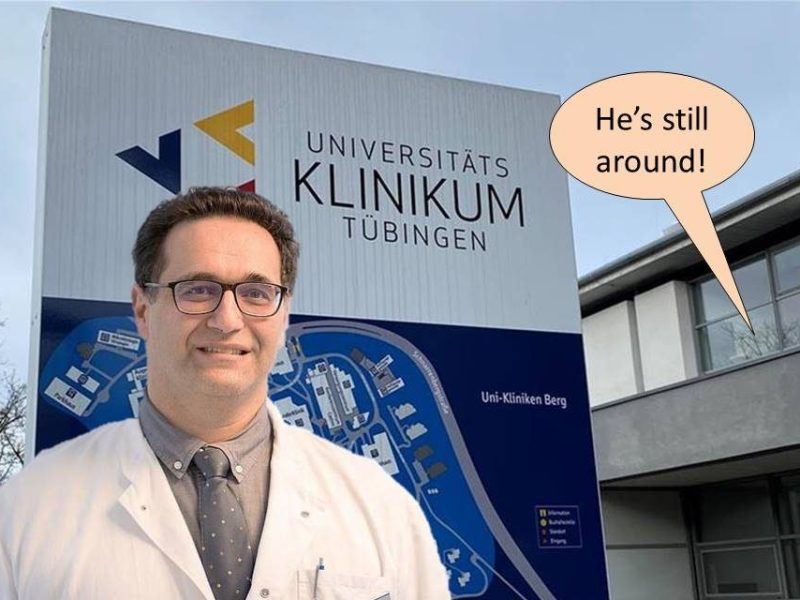
Gardening goats and external papermills in Tübingen
One shooting and one falling star of University Clinic Tübingen. Meet the research ethics champion Julia Skokowa and the eternally affiliated Renaissance Man Reza Akhavan-Sigari,

Here is one by Ansari with Turki Jalil and Wanich Suksatan, nothing to do with bees, but lots with papermills:
Hendrik Setia Budi , Alla Davidyants , Mohammad Rudiansyah , Mohammad Javed Ansari , Wanich Suksatan , Mohammed Q. Sultan , Abduladheem Turki Jalil , Milad Kazemnejadi Alendronate reinforced polycaprolactone-gelatin-graphene oxide: A promising nanofibrous scaffolds with controlled drug release Materials Today Communications (2022) doi: 10.1016/j.mtcomm.2022.104108


For example, this fabrication authored by Ansari and the Slovakian papermiller Marian Brestic (read December 2022 Shorts) was retracted:
Debojyoti Moulick , Dibakar Ghosh, Yogita Gharde , Arnab Majumdar , Munish Kumar Upadhyay , Deep Chakraborty , Subrata Mahanta , Anupam Das , Shuvasish Choudhury , Marian Brestic, Tahani Awad Alahmadi, Mohammad Javed Ansari , Shubhas Chandra Santra , Akbar Hossain An assessment of the impact of traditional rice cooking practice and eating habits on arsenic and iron transfer into the food chain of smallholders of Indo-Gangetic plain of South-Asia: Using AMMI and Monte-Carlo simulation model Heliyon (2024) doi: 10.1016/j.heliyon.2024.e28296
From the retraction from 3 February 2025:
“Post-publication, an investigation conducted on behalf of the journal by Elsevier’s Research Integrity & Publishing Ethics team discovered suspicious changes in authorship between the original submission and the revised version of this paper. During Revision, five authors were removed from the author list of the revised paper without explanation and without exceptional approval by the journal editor, which is contrary to the journal policy on changes to authorship. […]
The authors disagree with the retraction and dispute the grounds for it.
Shake the Stupid Tree and see what falls out
“Does this mean it’s time for an update on the bogus-citation economy? Leonid thought it is, and now you all must suffer for his misdirected priorities. ” – Smut Clyde
Several other PLOS One papers by Ansari and Brestic were retracted: Dar et al 2021, Günal et al 2021, Bashri et al 2021, There’s another papermill fabrication with Brestic in the grant Saudi Journal of Biological Sciences: Kubar et al 2021, that is of course not in danger of retraction.
Here is Ansari with Supat Chupradit and other professional papermillers, led by Ehsan Kianfar, on a paper sold on the internet:
Supat Chupradit , M. Kavitha , Wanich Suksatan , Mohammad Javed Ansari , Zuhair I. Al Mashhadani , Mustafa M. Kadhim , Yasser Fakri Mustafa , Shafik S. Shafik , Ehsan Kianfar Morphological Control: Properties and Applications of Metal Nanostructures Advances in Materials Science and Engineering (2022) doi: 10.1155/2022/1971891

The title and the abstract in the offer are more similar to those of the present paper than one may expect.”
Also do appreciate the references in Hachem et al 2022 by Ansari with and to Kianfar. Other coauthors of Ansari’s include the russian papermiller Dmitry Bokov (e.g., Chen et al 2022, Rezaie et al 2022, or Ansari et al 2022, also read the reporting about Bokov by The Insider), or this:
Tahereh Rezaei , Mehdi Rezaei , Sara Karimifard , Farzaneh Mahmoudi Beram , Mohammad Sedigh Dakkali , Maryam Heydari , Soheil Afshari-Behbahanizadeh , Ebrahim Mostafavi , Dmitry Olegovich Bokov , Mohammad Javed Ansari , Bahareh Farasati Far, Iman Akbarzadeh, Chaiyavat Chaiyasut Folic Acid-Decorated pH-Responsive Nanoniosomes With Enhanced Endocytosis for Breast Cancer Therapy: Studies Frontiers in Pharmacology (2022) doi: 10.3389/fphar.2022.851242


Hoya camphorifolia: “Figs 6C, 6D. Rectangles of points are replicated within panels, between panels and between figures, sometimes after 90-deg or 180-deg flips. Distributions of cells stop abruptly at the vertical and horizontal axes, in a way that is hardly biological. On the lower-middle panel of 6C, the horizontal line is narrowed across part of the width, as if it had been over-drawn.”
Again Ansari with Bokov, Tukri Jalil, Suksatan and Chupradit:
Mohammad Javed Ansari , Dmitry Bokov , Alexander Markov , Abduladheem Turki Jalil , Mohammed Nader Shalaby , Wanich Suksatan , Supat Chupradit , Hasan S. AL-Ghamdi , Navid Shomali , Amir Zamani , Ali Mohammadi , Mehdi Dadashpour Cancer combination therapies by angiogenesis inhibitors; a comprehensive review Cell Communication and Signaling (2022) doi: 10.1186/s12964-022-00838-y

Alexander Magazinov: “An offer of authorship-for-sale called “Medicine # 17” has been spotted on a certain web page no later than November 05, 2021. See the archived snapshot.
The title and the abstract in the offer are more similar to those of the present paper than one may expect.”
Similar situation with Budi et al 2021 by Ansari, Suksatan and Chupradit, authorships were sold online. Ansari with his fellow papermill professional Muhammad Mubashir, in KSU’s own journal:
Musarrat Ramzan , Mehvish Akram , Ashfaq Ahmad Rahi , Muhammad Mubashir , Liaqat Ali , Shah Fahad , Jiri Krucky , Sami Al Obaid , Mohammad Javed Ansari , Rahul Datta Physio-biochemical, anatomical and functional responses of Helianthus annuus L. and Brassica juncea (Linn) to cypermethrin pesticide exposure Journal of King Saud University (2022) doi: 10.1016/j.jksus.2022.102210

Dysdera arabisenen: “Same-color boxes indicate sections that are more similar than expected.” (Fig 7)
4. Saikh Mohammad
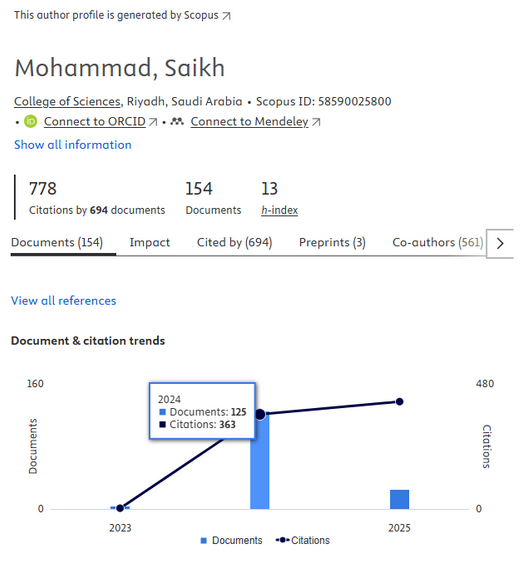
Saikh Mohammad (Scopus, ResearchGate) and/or Saikh Mohammad Wabaidur (Scopus) are quite possibly the same person – both are located inside the Department of Chemistry at KSU. Together, they gather 35 entires on PubPeer and one retraction which featured in February 2025 Shorts.
Saikh Mohammad also coauthored papers with the papermiller, sexual harasser, bully and thief Mika Sillanpää; their most recent paper was published days a few days ago in Scientific Reports, with Sillanpää proudly sporting his University of Aarhus affiliation in Denmark. Read about Sillanpää here:
Here is Saikh Mohammad on a literal fabrication, i.e. hand-made study:
Muhammad Moazzam Khan , Syed Imran Abbas Shah , Muhammad Ammar Hassan Shah , Muhammad Najam-ul-Haq , Nouf H. Alotaibi , Saikh Mohammad , Imran Zada , Muhammad Naeem Ashiq, Suleyman I. Allakhverdiev Fabrication of covellite supported spinel oxide CuCo2O4 hybrid nano-composite electrode for efficient overall water splitting Journal of Electroanalytical Chemistry (2024) doi: 10.1016/j.jelechem.2024.118450


In a Corrigendum from September 2024, the authors replaced the obviously fake graphs with less obviously fake ones, and warned that “this change will have no change on scientific discussion and integrity of the text.” You can read about the coauthor and russian academican Suleyman Allakhverdiev here, three more of his common papers with Saikh Mohammad is mentioned there (Alotaibi et al 2024a, Alotaibi et al 2024b, Albaqami et al 2024, all with hand-drawn spectra):
Veziroglu Journal of Papermill Energy
Mu Yang and other sleuths celebrate the scholarly publishing business of the late T Nejat Veziroglu, laureate of Santilli-Galilei Gold Medal for Lifetime Commitment to True Scientific Democracy
More corrected hand-drawn spectra, a facile fabrication:
Muhammad Rafeeq , Syed Imran Abbas Shah , Karam Jabbour , Shakoor Ahmad , Muhammad Abdullah , Razan A. Alshgari , Saikh Mohammad , Muhammad Fahad Ehsan , Ghazala Yasmeen , Muhammad Naeem Ashiq Facile fabrication of Nd2O3/Sm2O3 nanocomposite as a robust electrode material for energy storage applications Journal of Energy Storage (2024) doi: 10.1016/j.est.2024.111580


In their Corrigendum (forward-dated to August 2025), the authors replaced the hand-forged data, and declared to “remain committed to maintaining the highest standards of scientific transparency and integrity.”
Whether Saikh Mohammad Wabaidur is the same person as Saikh Mohammad or not – his papers have similar problems of hand-drawn spectra:
Muhammad Zahir Iqbal , Umer Aziz , Salma Siddique , Sikandar Aftab , Saikh Mohammad Wabaidur Effect of distinct organic ligands on hierarchical porous manganese-based MOFs for battery-supercapacitor hybrid Materials Science in Semiconductor Processing (2023) doi: 10.1016/j.mssp.2023.107511

To be fair, not everything published by Saikh Mohammad is hand-drawn. Sometimes just-copy-pasted:
Balachandran Subramanian, K. Jeeva Jothi, Mohamedazeem M. Mohideen , R. Karthikeyan , A. Santhana Krishna Kumar, Ganeshraja Ayyakannu Sundaram , K. Thirumalai , Munirah D. Albaqami , Saikh Mohammad , M. Swaminathan Synthesis and Characterization of Dy2O3@TiO2 Nanocomposites for Enhanced Photocatalytic and Electrocatalytic Applications ACS Engineering Au (2024) doi: 10.1021/acsengineeringau.4c00025


5. Sulaiman Ali Alharbi

Sulaiman Ali Alharbi (Scopus, ResearchGate) is professor at KSU, specialising in bacteriology. He published 120 papers in 2024, has almost 40 papers on PubPeer and 10 retractions, all of them in PLOS One for “concerns about authorship, competing interests, and peer review” (including Dar et al 2021 and Bashri et al 2021, both with Ansari and Brestic), or in Hindawi for “systematic manipulation of the publication and peer-review process“.
Here one such retracted Hindawi paper, it was originally sold on the internet:
R. Srinivasan , T. Lalitha , N. C. Brintha , T. N. Sterlin Minish , Sami Al Obaid , Sulaiman Ali Alharbi , S. R. Sundaram , Jenifer Mahilraj Predicting the Growth of F. proliferatum and F. culmorum and the Growth of Mycotoxin Using Machine Learning Approach BioMed Research International (2022) doi: 10.1155/2022/9592365


This was retracted recently, with Alharbi’s regular coauthor, the Indian papermiller Kathirvel Brindhadevi (read August 2024 Shorts):
Sushmitha Shankar , Anusha Narayana Murthy , P. Rachitha , Vinay B. Raghavendra , N. Sunayana , Arunachalam Chinnathambi , Sulaiman Ali Alharbi , Nagaraj Basavegowda , Kathirvel Brindhadevi , Arivalagan Pugazhendhi Silk sericin conjugated magnesium oxide nanoparticles for its antioxidant, anti-aging, and anti-biofilm activities Environmental Research (2023) doi: 10.1016/j.envres.2023.115421

The retraction from 15 April 2025 mentioned “problems with the XRD pattern, figure 3a“, and
“Furthermore, unauthorised authorship changes were made when the revised version of this paper was submitted, following suggestions for relatively minor revisions from the reviewers and Guest Editor, with authors Arunachalam Chinnathambi, Sulaiman Ali Alharbi, Nagaraj Basavegowda and Kathirvel Brindhadevi being added to the paper.”
Also Rachitha et al 2023 by Alharbi and Brindhadevi was retracted, the future-dated August 2025 retraction notice mentioned fake data and “an unauthorised authorship change […] with authors Geetha Nagaraj, Tahani Awad Alahmadi, Sulaiman Ali Alharbi and Rajasree Shanmuganathan being added to the paper to replace another author who was deleted“.
These papers (before retraction) featured in this article:
Issues of global relevance
“I like ImageTwin, but seeing things with just eyes is like hand-to-hand combat….” – Mu Yang
This artwork in the same Elsevier journal was flagged in February 2025 with an Expression of Concern and awaits retraction:
Arivalagan Pugazhendhi , S.K. Kamarudin , Arunachalam Chinnathambi , Sulaiman Ali Alharbi , Ramya G Investigation of bionano additives in red algae Cyanidioschyzon merolae ultrasonified MgO/MWCNT catalyzed biodiesel in optimized engine performance Environmental Research (2024) doi: 10.1016/j.envres.2024.119352

Also Alharbi’s paper Raman et al 2023 was retracted in January 2025. it is clear he gets his authorships form a papermill, and there he encountered such professional fraudsters like Gautam Sethi (Zhang et al 2017, Wang et al 2020, read also April 2024 Shorts), and a certain Brit called Milton Wainwright (e.g., Zhou et al 2021, Abalkhil et al 2017, or the retracted Hafeez et al 2021 and Sattar et al 2021). You absolutely must read about Wainwright here:
Stratosfear
“Here we see a somewhat phallic balloon-like structure which has presumably collapsed under low pressure. A “proboscis” is seen emerging from the left of the main cell which has two, nostril-like openings. At the top of the collapsed “balloon” is a sphincter-like opening.” – Milton Waiinright
6. Mohammed Bourhia

Mohammed Bourhia (Scopus, Google Scholar) is actually not directly affiliated with KSU, but is pharmacology professor at Hassan II University in Morocco. Yet he is papermilling so intensively with KSU authors that both Scopus and WOS databases index him as top KSU author. In 2024, he published 118 papers.
Bourhia’s PubPeer record is however surprisingly modest – just five papers. Here is one with the KSU researchers Riaz Ullah (mentioned above) and Syed Saeed Ali:
Abdelfattah EL Moussaoui, Mohammed Bourhia, Fatima Zahra Jawhari, Hamza Mechchate, Meryem Slighoua, Ahmed Bari, Riaz Ullah, Hafiz Majid Mahmood , Syed Saeed Ali, Samir Ibenmoussa , Dalila Bousta, Amina Bari Phytochemical Identification, Acute, and Sub-Acute Oral Toxicity Studies of the Foliar Extract of Withania frutescens Molecules (2020) doi: 10.3390/molecules25194528

https://doi.org/10.3390/molecules25194528
https://doi.org/10.14202/vetworld.2021.457-467
https://doi.org/10.1155/2020/1976298
https://doi.org/10.1016/j.sjbs.2021.08.057“
Here is something impressive:
Abdelfattah EL Moussaoui , Mohammed Bourhia, Fatima Zahra Jawhari , Imane Es-safi , Syed Saeed Ali , Ahmed Bari , Hafiz Majid Mahmood , Dalila Bousta , Amina Bari Withania frutescens. L Extract: Phytochemical Characterization and Acute and Repeated Dose 28-Day Oral Toxicity Studies in Mice BioMed Research International (2020) doi: 10.1155/2020/1976298

Mycosphaerella arachidis: “Figure 6, 7, and 8: There are overlapping areas between images which should be unique.”
The Moroccan coauthor Abdelfattah El Moussaoui replied on PubPeer with a long nonsense text which ended with:
“Finally, we would like to thank you very much for this verification after the publication of the research work, and for using this technology. And we hope that you will find all the answers to your questions and comments.“
Bourhia’s paper Chebbac et al 2022 fell prey to The Vickers Curse.
The Vickers Curse: secret revealed!
How did an editorial about insect pheromone communication get to receive 1200 irrelevant citations, almost all from papermills? Alexander Magazinov reveals The Secret of The Vickers Curse!
7. Asad Syed

Asad Saghir Syed (Scopus, ReserchGate) is associate professor at Department of Botany and Microbiology at KSU. He published 111 papers in 2024, and has 23 papers on PubPeer and 8 retractions according to Scopus, including with Mukesh Kumar Awasthi (Liu et al 2023, Xu et al 2023).
Syed’s specialty is polluting literature with fake nanotechnology, for example for cleaning up environmental pollution.
Here a nice paper of his:
Zarafshan Shahzadi , Khunish Bibi , Kiran Nawaz , Sadia Akram , Asad Syed , Sajjad Hussain Sumrra , Muhammad Zubair , Muddassar Zafar , Nayab Arif , Hind A. AL-Shwaiman , Muhammad Nadeem Zafar Comparative study of un-doped CeO 2 and metal (Mn, Co, Fe)-doped CeO 2 nanostructures for the removal of golden yellow dye from synthetic wastewater International Journal of Environmental Analytical Chemistry (2024) doi: 10.1080/03067319.2024.2391951

Together with the fraudster S. Sudheer Khan, hand-drawn in a hurry:
T. Jiteshwaran , B. Janani , Asad Syed , Abdallah M. Elgorban , Islem Abid , Ling Shing Wong , S. Sudheer Khan Interfacial engineering of BiVO4/PANI p-n heterojunction for enhanced photocatalytic degradation of p-nitrophenol: Pathway, toxicity evaluation and mechanistic insights Surfaces and Interfaces (2024) doi: 10.1016/j.surfin.2024.104361

Dysdera arabisenen: “Fig 5a: The traces stick out the borders significantly.”
Sudheer Khan has several fake papers with Seyedfeaured prominently here:

Nanodandruff and synthetic spectroscopy
The story of two data fabricators and Elsevier regulars, Sudheer Khan and Ali Fakhri. Smut Clyde brings them together in this new guest post about nanotechnology
Some more fake spectra by the KSU professor:
Aqsa Tehseen , Maira Liaqat , Tahir Iqbal , Iqra Maryam , Sumera Afsheen , Muhammad Shehzad Sultan , Asad Syed , Abdallah M. Elgorban , Ling Shing Wong Design, fabrication, and analysis of Bi2O3/MnO2 hybrid nanomaterials for advanced photocatalytic applications Journal of Physics and Chemistry of Solids (2024) doi: 10.1016/j.jpcs.2024.112014

Tetraphleps parallelus: “Fig. 2. Abnormal and identical noise and peak in (a) XRD spectra of pristine Bi2O3 and pristine MnO2 and [(b)] XRD spectra of Bi2O3/MnO2 (1–7 wt %) based composites.”
Here is something in that great KSU journal:
Sathya Rengasamy , Mohan Raj Subramanian , Varalakshmi Perumal , Shakambari Ganeshan , Manal M. Al Khulaifi , Hind A. AL-Shwaiman , Abdallah M. Elgorban , Asad Syed , Ushadevi Thangaprakasam Purification and kinetic behavior of glucose isomerase from RSU26 Saudi Journal of Biological Sciences (2020) doi: 10.1016/j.sjbs.2019.12.024

Syed’s collaboration with the russian papermiller Rustem Zairov (Sohail et al 2024) was mentioned in this article from January 2025. The KSU professsor also worked on Bassey et al 2024 with the Nigerian fraudster Hitler Louis (yes, real name, read October 2023 Shorts). Syed was also seen together with the papermill giants Mika Sillanpää (Syed et al 2021) and Rajender Varma (Kokilavani et al 2022, with Sudheer Khan).
I, Rajender Varma, Highly Cited Researcher
“I could not comprehend the situation where a university picks up on individuals with an extraordinary and sterling performance and basically destroy one of the top European institutions. ” – Raj Varma
8. Rashid Iqbal

Rashid Iqbal (Scopus, Google Scholar) is like Bourhia not directly affiliated with KSU, but with the Western Caspian University in Azerbaijan and University of Bahawalpur in his home country Pakistan. But because he papermills so excessively with the Saudis, the databases list him as a KSU researcher.
Iqbal published 94 papers in 2024. He also specialises on fake nanotechnology and has a modest PubPeer record of 7 threads, and 2 retractions (according to Scopus).
This was coauthored with the aforementioned KSU scholar Mohamed Elshikh and Iqbal’s fellow Pakistani papermiller Muhammad Rizwan (read October 2024 Shorts) and retracted:
Sehrish Arafat , Javed Iqbal, Banzeer Ahsan Abbasi , Shumaila Ijaz , Tabassum Yaseen , Ghulam Murtaza , Rafi Ullah , Farishta Zarshan , Zakir Ullah , Zulfiqar Ali Sahito , Saeedah Musaed Almutairi , Mohamed S. Elshikh , Saltanat Aghayeva , Muhammad Rizwan, Rashid Iqbal Phyto-assisted synthesis of zinc oxide nanoparticles using Bauhinia variegata buds extract and evaluation of their multi-faceted biological potentials Scientific Reports (2024) doi: 10.1038/s41598-024-72250-0


The fresh retraction from 4 June 2025 referred to “XRD spectra in Figure 4” and “high image similarity across publications between the SEM images of Zinc oxide nanoparticles (ZnONPs) in Figure 6 and nickel oxide nanoparticles (NiONPs) in Figure 5A-B” in a 2020 paper by some Javed Iqbal. Here are the two Iqbals again:
Zakir Ullah , Javed Iqbal, Banzeer Ahsan Abbasi , Farhat Gul , Sarfaraz Ali , Sobia Kanwal , Reem M. Aljowaie , Ghulam Murtaza , Rashid Iqbal, Tariq Mahmood Eco-friendly Synthesis of Iron Oxide Nanoparticles Using Parietaria alsinifolia Extracts and Evaluation of Biological Applications Applied Biochemistry and Biotechnology (2025) doi: 10.1007/s12010-024-05151-7

This by R Iqbal and Elshikh wasn’t retracted yet, even if it was exposed as scientifically nonsensical. Maybe because it features the Rector of the University of Agriculture in Krakow, Poland, Sylwester Tabor:
Arooj Ali, Syed Raza Ali , Riaz Hussain, Rashida Anjum , Qiang Liu , Mohamed S. Elshikh , Noorah Alkubaisi , Rashid Iqbal, Sylwester Tabor , Marek Gancarz Comparative study of silica and silica-decorated ZnO and ag nanocomposites for antimicrobial and photocatalytic applications Scientific Reports (2025) doi: 10.1038/s41598-025-89812-5

Eucephalobus striatus: “SEM images, Image for sample a. C-SiO2 NPs and ZnO-SiO2 NCs shows the same exact features”, Fig 3
What is it with Polish university leaders and Asian papermills…
Nobelium Bilalski, a Gdansk papermiller
“To date, he has authored over 700 peer-reviewed articles, 150 book chapters, 25 edited books, and 10 editorial-type scientific articles in various areas of Science and Engineering. Dr. Bilal has a h-index of 94 with 34 000 citations (Google Scholar).”
9. Khalid Mujasam Batoo

Khalid Mujasam Batoo (Scopus, Google Scholar) is full professor at KSU’s Institute for Nanotechnology.
He published 89 papers in 2024, has over 30 papers on PubPeer and two retractions both from May 2024, and both for plagiarism (Rao et al 2024, Suryanarayana et al 2024).
Many Batoo papers show clear evidence of massive citations marketing, with huge blocks of irrelevant references added, e.g. in Batoo et al 2024, Ali et al 2024, Saadh et al 2024 or Hsu et al 2024.
Here a paper by the KSU professor Batoo:
Muhammad Junaid , Mansoor Khan , Noor Ul Ain , Khalid Mujasam Batoo , Sajjad Hussain Electrical and magnetic characteristics of barium doped bismuth ferrite via sol–gel auto combustion technique Results in Chemistry (2023) doi: 10.1016/j.rechem.2023.101208


Naturally, there are also hand-drawn spectra:
Muhammad Junaid , Khalid Mujasam Batoo , Muhammad Farzik Ijaz , Bouchaib Zazoum Physical vapour deposition fabrication of MoO3‐based photoanode for water splitting to generate hydrogen Luminescence (2024) doi: 10.1002/bio.4821

More of that art:
Khalid Mujasam Batoo , Eyhab Ali , Shaymaa Abed Hussein , Subhash Chandra , Alzahraa S. Abdulwahid , Saja Hameed Kareem , Muhammad Farzik Ijaz , Alaa A. Omran , Mohammed Kadhem Abid , Ahmed Alawadi UiO-67 metal-organic frameworks with dual amino/iodo functionalization, and mixed Zr/Ce clusters: Highly selective and efficient photocatalyst for CO2 transformation to methanol Journal of Molecular Structure (2024) doi: 10.1016/j.molstruc.2024.138492


seems to be detached from the baseline”
In the same Elsevier journal:
Khalid Mujasam Batoo , Eyhab Ali , Baydaa Abed Hussein , Ayadh Al-khalidi , Usama S. Altimari , Sajjad Hussain , Saja Hameed Kareem , Mohammed Kadhem Abid , Ahmed Alawadi , Ali Ihsan The cooperative performance of iodo and copper in a Zr-based UiO-67 metal-organic framework for highly selective photocatalytic CO2 reduction to methanol Journal of Molecular Structure (2024) doi: 10.1016/j.molstruc.2024.137927

Dysdera arabisenen: “Fig 3: Red arrows point to left-leaning peaks”
Here, a photo of a bacterial plate was stolen from Open University and then edited and used by the papermill in at least two papers with unrelated authors:
Nayab Nadeem, Aqsa Habib, Shabeeb Hussain , Abu Sufian , Ishaq Ahmad , Fozia Noreen , Arslan Mehmood, Furqan Ali, Khalid Mujasam Batoo , Muhammad Farzik Ijaz Ecofriendly Synthesis of Silver Nanoparticle for Phytochemical Screening, Photocatalytic and Biological Applications Journal of Inorganic and Organometallic Polymers and Materials (2024) doi: 10.1007/s10904-024-03326-7


Papermills must use pictures sparingly, as there aren’t that many of them:
Sabih Qamar , Majid Niaz Akhtar , Khalid Mujasam Batoo , Emad H. Raslan Structural and magnetic features of Ce doped Co-Cu-Zn spinel nanoferrites prepared using sol gel self-ignition method Ceramics International (2020) doi: 10.1016/j.ceramint.2020.02.246

Dysdera arabisenen: “Fig 4 a,d,e overlap. Experimental conditions differ.”
This, in the same papermill-only journal, was successfully corrected by Elsevier:
Mohd. Hashim , D. Ravvinder Nayak , Ateeq Ahmed , Shalendra Kumar , Sagar E. Shirsath , Mukhlis M. Ismail , S.K. Sharma , Muntasir Ali Alayasreh , Ravi Kumar , D. Ravinder , R.B. Jotania, Sher Singh Meena, Khalid Mujasam Batoo Structural, dielectric, electric and magnetic properties of magnesium substituted lithium nanoferrites Ceramics International (2023) doi: 10.1016/j.ceramint.2023.07.056

“1/ SEM images for samples with x=0.2 and x=0.8 are identical (red rectangles).
2/ The SEM image of the sample with x=1.0 is manipulated from the SEM image of the sample with x=0.8 (yellow rectangles).”

2/ EDX spectra for samples with x=0.6 and x=1.0 are identical (Cyan rectangles).”
The Corrigendum for September 2023 replaced data in Figures 3 and 4, but left two identical EDX spectra in because who cares.
Should Batoo ever have to answer for his papermill fraud and start blaming collaborators or students or Jews, this one author paper drives home the message:
Khalid Mujasam Batoo Structural and electrical properties of Cu doped NiFe2O4 nanoparticles prepared through modified citrate gel method Journal of Physics and Chemistry of Solids (2011) doi: 10.1016/j.jpcs.2011.08.005


10. Abdullah Alodhayb (with Saravanan Pandiaraj)
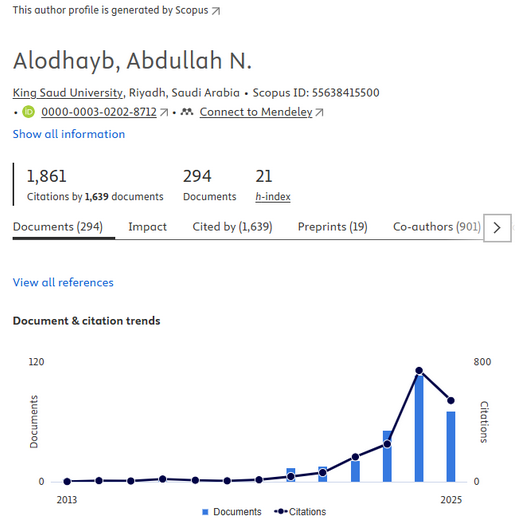
Last one is Abdullah Alodhayb (Scopus, Google Scholar), who is associate professor at KSU and works on biosensors. He published 87 papers in 2024, has 10 threads on PubPeer and one retraction – Khoqeer et al 2023, authored with his KSU colleague, the assistant professor Saravanan Pandiaraj (who briefly got mentioned in this article from December 2024).
Here is Alodhayb’s paper with his friend Pandiaraj and Pau Loke Show, who is the center of a gigantic papermill and peer review network vortex.
Aparna Sajeev , Aleena Mary Paul , Ravi Nivetha , Kannan Gothandapani , Tamil Selvi Gopal , George Jacob , Muthumareeswaran Muthuramamoorty , Saravanan Pandiaraj , Abdullah Alodhayb , Soo Young Kim , Quyet Van Le , Pau Loke Show , Soon Kwan Jeong, Andrews Nirmala Grace Development of CuN electrocatalyst for hydrogen evolution reaction in alkaline medium Scientific Reports (2022) doi: 10.1038/s41598-022-05953-x


Alodhayb and Pandiaraj with fake spectra again:
Tamil Selvi Gopal , Soon Kwan Jeong , Tahani A. Alrebdi , Saravanan Pandiaraj , Abdullah Alodhayb , Muthumareeswaran Muthuramamoorthy , Andrews Nirmala Grace MXene-based composite electrodes for efficient electrochemical sensing of glucose by non-enzymatic method Materials Today Chemistry (2022) doi: 10.1016/j.mtchem.2022.100891

And here are the two boys again:
K. Ambujam , A. Sridevi , Saravanan Pandiaraj , Abdullah N. Alodhayb Synthesis of Zn2+:LaMnO3 perovskites nanoparticles by facile co-precipitation approach: Physicochemical characteristics and supercapacitor application Materials Science and Engineering: B (2024) doi: 10.1016/j.mseb.2024.117617


Alodhayb in a Saudi-Chinese-Canadian-Japanese-British cooperation, thanks to a papermill:
Yong-Lang Liu , Lu-Fang Wu , Chong Wu, Shofiur Rahman , Abdullah Alodhayb , Carl Redshaw , Paris E Georghiou, Takehiko Yamato A facile and sensitive hexahomotrioxacalix[3]arene-based fluorescent sensor for the detection of trace amounts of 2,4,6-trinitrophenol The Science of the total environment (2024) doi: 10.1016/j.scitotenv.2023.168209

Reese Richardson: “The test strip for 10 μM in Figure 9 and the test strip with TNP crystals (D) in Figure 10 appear very similar, with the same patterns in the paper of both.”
Update 26.08.2025.
Abdullah Alodhayb sent me two long emails, which I reproduce below, in the comment section.
The first email started with “First, let me thank you for your efforts to support research integrity — a value I also share and uphold in my own work“, and the second ended with:
“Your post has caused significant reputational harm not only to me personally but also in the eyes of my students, who look to me for guidance and integrity.
For these reasons, I must respectfully but firmly request that you remove my name entirely from the article. Allowing it to remain in association with false accusations causes ongoing and serious harm to my professional reputation, my family, and my students.
Finally, I ask that you treat the attached communications as private and confidential evidence provided solely for the purpose of resolving this matter. They should not be shared or published without my permission.”
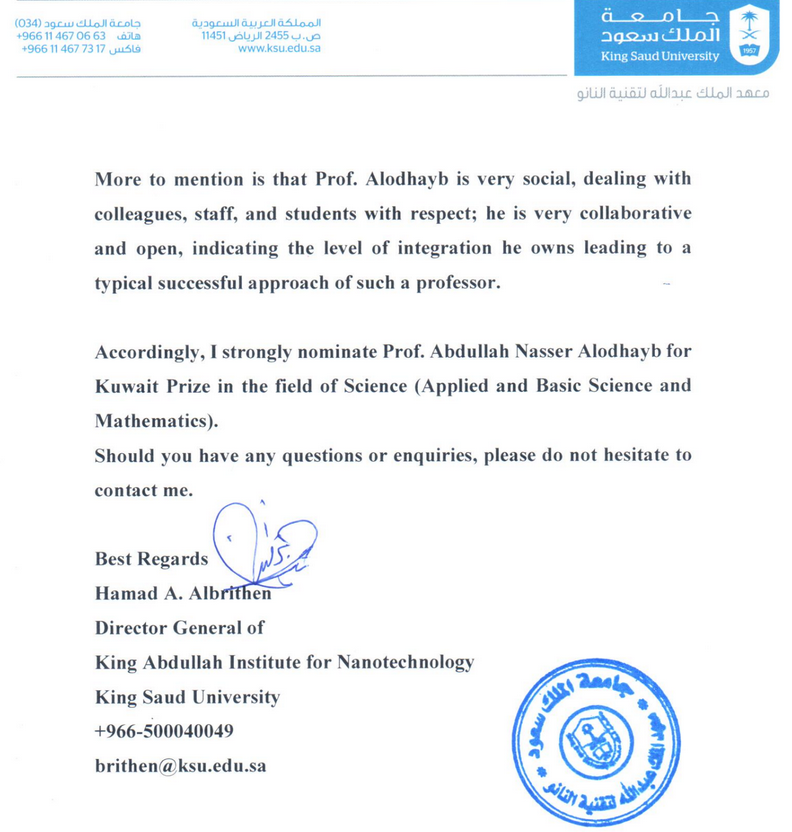
Alodhayb even provided a nomination for the Kuwait Prize, which was signed by Hamad Albrithen, Director General of King Abdullah Institute of Nanotechnology at the KSU:
Albrithen is coauthor with Alodhayb and Paniaraj on this papermill trash:
Kannan Gothandapani , R Sofia Jeniffer , Gopal Tamil Selvi , Venugopal Velmurugan , Abdulaziz K. Assaifan , Khalid E. Alzahrani , Hamad Albrithen , Muthumareeswaran Muthuramamoorthy , Saravanan Pandiaraj , Sudhagar Pitchaimuthu , Abdullah N. Alodhayb , Andrews Nirmala Grace Nickel nanoparticles supported on carbon surface as an electrocatalyst for hydrogen evolution reaction International Journal of Hydrogen Energy (2024) doi: 10.1016/j.ijhydene.2023.08.027

As my reader noted, all these men have something in common, beyond being connected to KSU. Of course they are all men, papermilling may be equal opportunity in Romania, even in Iran we know of successful female papermillers (Soudeh Ghafouri-Fard for example), but in Saudi Arabia every scholar is expected to have a penis. Some of these highly-publishing plonkers don’t even have a profile website at KSU, but even for those who do, we can’t be sure they even have an actual lab or anyone to do experiments in it. Maybe this is why they all rarely serve as first or corresponding authors, which conveniently also saves money, as those authorship positions are the most expensive in the papermill business. Often these men are the only Saudis in a multinational team of authors, and yet they acknowledge Saudi grant funding, which is often the only source of funding listed.
Basically, a bunch of pillocks, most likely unable to even read their own papers. Never mind understand them, or rather understand how abysmally stupid and fraudulent those papers are.
But what if this is the future of science?
With big thanks to the reader BJC for a tip and background research.
Donate!
If you are interested to support my work, you can leave here a small tip of $5. Or several of small tips, just increase the amount as you like (2x=€10; 5x=€25). Your generous patronage of my journalism will be most appreciated!
€5.00

 For Better Science
Oh yeah, THAT entity, for which no amount of jokes is too much, and which can as well be called a home porno studio.
How about this “Zuleima Karpyn” sporting an email prof714@rambler.ru?
Anna Abalkina wrote to the real Karpyn, who happens to be an associate dean at Penn State (I was part of the correspondence), who said that the papermiller Alexey Mikhaylov approached her for co-authorship, but she never replied, because Mikhaylov’s email was too stupid (and as I saw it, it was indeed too stupid).
LikeLiked by 2 people
This is just not to lose the track. Azerbaijan is gradually becoming a hotspot of papermilling, and I have difficulty not to blame whatever recent big green(hog)washing conferences that recently took place there.
https://doi.org/10.1080/00036846.2024.2364087
Daniel Balsalobre-Lorente
(d) Azerbaijan State University of Economics, Research Methods Application Center (UNEC);
(f) Department of Applied Economics I, University of Castilla La Mancha, Spain;
(g) Faculty of Economics and Management, Department of Management and Marketing, Czech University of Life Sciences Prague, Prague, Czech Republic;
(h) Economic Research Center (WCERC), Western Caspian University, Baku, Azerbaijan
LikeLike
I agree, most of the papermilling in Azerbaijan may be organized from Iran because when I looked at the hyperprolific profiles and problematic articles Azerbaijan, I see mostly profiles with Iranian names. Its universities are backward, it is not a center of attraction and as far as I have looked, it neither pays well nor has high research budgets. So the only reason why papermill names might be attracted to it is because it is a country that has not made a name for itself before, like Iran and China.
Fx when I looked at the profiles in Azerbaijan, I didn’t see cases like Iranian groups in Canada coming to prominence with papermilling, or white men in Europe promoting themselves and their institutions by employing Iranian papermills and citationmills. Judging from their English pages, I also didn’t see any azerbaijani university news that boasted of papermilling names. I guess no one in Azerbaijan cares about rankings and naturally the number of articles and citations.
In addition to the established Iranian papermill groups in central European countries, Turkey and Poland have been important new papermilling locations where Iranians have been able to make a clean break especially with Marie Curie and EU funding, but Azerbaijan is a newcomer. I hope we will not face a new papermilling country.
LikeLike
Sounds familiar. Amin Mousavi Khaneghah (Schneider Shorts 31.01.2025 – Falsified narrative as part of cognitive war – For Better Science) was affiliated with Azerbaijan State Oil and Industry University, Baku, between October 2020 and July 2024 ((6) Amin M. | LinkedIn). He published more than 80 papers with this affiliation between 2018 and 2024. Does the name of this university ring a bell?
LikeLike
Not so much, as best as I can tell. OpenAlex brings up a name of at least one active papermiller there, and with extra care it might be possible to uncover one, two or three more. But pretty much that’s it.
LikeLike
Daniel Balsalobre-Lorente has 1 retraction: https://www.frontiersin.org/journals/environmental-science/articles/10.3389/fenvs.2021.816519/full
LikeLiked by 1 person
These 10 authors and these thousands of fake publications are very useful as they are neatly collected and catalogued. Since it is 100% guaranteed that ALL of them are papermill ‘products’, sleuths can study them, flag them, find out the style of different papermills (which one uses copy/paste figures, which one creates figures by AI, what is the style of making multi-panel figures, writing style; are they doing reference milling, who are the benefactors… Also they can track down “collaborators” on these papers, whose publications will also contain 100% papermilled materials. One can also study how long it will take until every single one of these “papers” is retracted.
LikeLike
Good point! The only problem is the resources available – there seems to be vastly more people-hours producing this crap than there are science sleuths-hours available.
Same with journal/publisher integrity offices – I recently got a response from a managing editor that oversees several journals run by a professional society that he devotes one morning per week to investigate all ethical issues that come from the society’s journals. So there’s one person’s few hours per week available for dealing with integrity issues vs. millions of petrodollars worth business of producing integrity issues 😛
LikeLike
Also… This will help to generate home-grown AI-generated scientific garbage to boost the Saudi economy. No need to pay for Russian, Indian, Latvian, Azeri etc. papermill factories anymore.
https://babl.ai/saudi-arabia-launches-global-center-for-ai-to-strengthen-digital-leadership/
LikeLiked by 1 person
This blog reminds me to this award to Han Brunner, since 1 September 2020 a member of LOWI https://lowi.nl https://kingfaisalprize.org/professor-han-grrit-brunner/
LikeLike
“What is it with Polish university leaders and Asian papermills…” – there’s a huge incentive from the government to “climb up in world rankings” and if you look for example into THE WUR criteria: https://www.timeshighereducation.com/world-university-rankings/world-university-rankings-2024-methodology you can quickly realize that the easiest way to convert money to ranking increase is to force international co-authorship, hire international staff and enroll international students. The first case leads directly to a pressure and/or encouragement of publishing with as many international colaborators as possible, making people good clients of papermills, the second case leads to hiring fraudsters which is exemplified by the Gdansk Polytechnic Nobelium program: https://pg.edu.pl/badawcza/centra/naukowe/cmp/laureaci-nobelium 5/12 awardees have questionable publication integrity record, the third case leads to enrollment of foreign students, with a portion of them being either clients or participants of papermilling networks, leading to monstrosities like:https://pubpeer.com/publications/FAFC82AD88A15A0183A92B278DBD6F or https://pubpeer.com/publications/8A3DC4F7A2541A1E86A0649F938F3E
Polish universities in general don’t have enough reputation and money to offer to attract real “Top 2% cited scholars” but it’s enough to attract fraudsters, especially from Iran and Pakistan, who get the “Top 2%” badge for their papermilling. And if your sole goal is to climb that freakin ladder of world rankings, it does the same work at a fraction of the cost 😛
LikeLiked by 1 person
Good point, but it’s only part of the story. You have to add the entire evaluation system which promotes either cheating or some less unethical behavior, such as “publication cooperatives”, either local or international. The more publications and citations you have, the more fruits you get – degrees, positions, grants, awards. It works both for individuals and for institutions – see the IDUB program. Taking into account the money that IDUB provides, the cost of hiring geniuses from Pakistan or Iran is an excellent investment. But its not only our local Polish problem. In the last 2-3 decades the whole scientific world has fallen into this trap. See e.g. the last publication by the leading science sleuths
‘Stamp out paper mills’ — science sleuths on how to fight fake research
Or actually entire For Better Science.
LikeLiked by 1 person
On that note: https://www.nature.com/articles/d41586-025-01824-3?utm_source=cw_reaction&utm_medium=email&utm_campaign=cw_newsletters
LikeLike
On that note: https://www.nature.com/articles/d41586-025-01824-3
LikeLike
It’s a sad situation. Middle eastern authoritarians wanted to use their money for scientific prestige. And in some sense they achieved it, exactly the same way that China did. Publishing garbage and buying citations. It’s the same kind of hollow achievement enjoyed by their sports teams. But I think there are alternatives that could have been more productive. For example, Dubai really did build the tallest building in the world, prestige being harder to game in the tall building industry (although I suppose people have tried to game the metrics by adding dubious spires and so on). My point being, they really could have taken this money and achieved something scientifically or technically impressive. A Saudi moon mission, particle accelerator, fusion reactor, or something would have been a better spend of this money. Perhaps if they’d set the cash aside for a scientific discovery (new antibiotic class?) rather than frittering it away on natural products and materials research, something good could have come from this. Focusing on solving real problems might have helped. Artemisinin came out of People’s Liberation Army project, with a pretty obvious ideological bent.
I think the corruptness and tribalism of the Saudi regime are headwinds to achieving anything useful, but failure on this scale wasn’t inventable. Publishing industry has much to answer for.
LikeLiked by 3 people
The only upside is that this type of paper is very easily spotted and identified as complete garbage. Nobody will mistake it for a real paper. So if they want to waste their money for it, what can I say. It is their money. They are wasting it on lots of other things.
But what I wrote earlier stands: you and other sleuths can use these papers as a training ground. Because, even if it does not have any clearly detectable image duplications, even then you know it is 100% fake and papermilled. So you can develop new ways to spot them even if they come out clean from an imagetwin check.
LikeLike
Even easier: researchers in several countries are such frequent offenders that it is up to them to prove their publications are not crap. I cut entire sections of the world out of my literature searches, and will continue to do so. That doesn’t make me a bad person, does it?
LikeLike
I highly support you in this.
All their achievements are hollow. Achievements that are achievable by money and nothing else. If they would just invest this type of money in some real achievements
LikeLike
Today, Abdullah Alodhayb decided to bombard me with email. He send this to me twice:
“Dear Dr. Leonid Schneider,
First, let me thank you for your efforts to support research integrity — a value I also share and uphold in my own work. That said, I must respond to the article “King Saud’s Men,” where I was accused of being part of a “Saudi-Chinese-Canadian-Japanese-British cooperation, thanks to a papermill.” This claim is false and deeply damaging. I earned my PhD in Canada (where I spent nine years) and have legitimate, well-documented collaborations with colleagues in Canada, China, Japan, and the UK — supported by invitations, research visits, and email communications. The retracted paper mentioned was part of an entire special issue withdrawn by the journal; neither I nor my co-authors were ever found guilty of misconduct, and we provided all requested data. I have established collaborations with researchers in China, including two research visits that are fully documented through official invitations, photographs, and email communications. I also maintain active research links with Tokyo University in Japan, where all contributions to joint publications are transparently documented through email and project communications. Such unfounded accusations cause serious harm to me personally, to my family, and to my career. I lead an active research lab with students and colleagues, and I remain committed to transparency and integrity. I invite Dr. Schneider to visit my lab and I am fully prepared to share all documentation of my international collaborations. I can provide all communications with all of my colleagues where I actively participated in the preparations of the papers “
Followed by:
“In my previous message, I made clear that the claims made against me are false and damaging, and I stated that I would be happy to provide documentation to demonstrate the legitimacy of my academic career and research collaborations.
As promised, I am now sharing supporting evidence, including:
These attachments are only examples. I have many more emails, documents, and records that further demonstrate my active collaborations and direct involvement in all stages of research.
I also want to emphasize that I have supervised 3 PhD students and 5 Master’s students, and I currently have 5 graduate students actively working in my laboratory. I hold five patents in the field of sensing and nanotechnology. Your post has caused significant reputational harm not only to me personally but also in the eyes of my students, who look to me for guidance and integrity.
For these reasons, I must respectfully but firmly request that you remove my name entirely from the article. Allowing it to remain in association with false accusations causes ongoing and serious harm to my professional reputation, my family, and my students.
Finally, I ask that you treat the attached communications as private and confidential evidence provided solely for the purpose of resolving this matter. They should not be shared or published without my permission.
I trust that, given this documentation, you will take the necessary steps to address this matter promptly.”
LikeLike
Alodhayb indeed provided the letters.


The nomination for the Kuwait Prize was signed by Hamad Albrithen, Director General of King Abdullah Institute of Nanotechnology, who is coauthor on this papermill trash:
Kannan Gothandapani , R Sofia Jeniffer , Gopal Tamil Selvi , Venugopal Velmurugan , Abdulaziz K. Assaifan , Khalid E. Alzahrani , Hamad Albrithen , Muthumareeswaran Muthuramamoorthy , Saravanan Pandiaraj , Sudhagar Pitchaimuthu , Abdullah N. Alodhayb , Andrews Nirmala Grace Nickel nanoparticles supported on carbon surface as an electrocatalyst for hydrogen evolution reaction International Journal of Hydrogen Energy (2024) doi: 10.1016/j.ijhydene.2023.08.027
Dysdera arabisenen: “Fig 2: As illustrated in the close-up, EDX a and c have identical baseline between 1 and 3.5 KeV.”
LikeLike
Now Alothayb is bombarding me with emails asking me to remove the above Kuwait Prize nomination screenshot. I guess Albrithen is upset?
LikeLike
This article is very true 💯% correct. I fully support this article. I personally know some of the people mentioned in that article and they are certified scientific frauds. Too much evidences against them are there with me also. This article was a very small part of that all fraud. But small things in a right way can lead to big results. Keep it up and all the support with the author.
About Kuwait award I must say such awards are there to support culprits by the culprits.
LikeLike
You missed one more king of paper mills, Dr. Assiri of King Abdul Aziz University, Jeddah. He published and average of 2 papers in a day.
LikeLike