

Schneider Shorts of 23 May 2025 – Germany’s papermill experts announce lawsuits, Canada’s researcher of the year, how a learned society acted urgently, Iranian papermiller’s second identity, cruel retractions, and finally, why it’s sometimes hard to defend scientists from Trump.
Table of Discontent
Scholarly Publishing
- Defamation and damage to business – AI, greed and fraud in Bernhard Sabel’s book
- A matter of urgency – Society for Endocrinology corrected a paper from Italy
Science Elites
- Not going down without a fight – David Sinclair fights to save lives
- Scientific asylum – Aix-Marseille University welcomes US applicants
- We’re doing great things – Mohammad Arjmand is Researcher of the Year
Retraction Watchdogging
- Duplication was confirmed – no mercy for Sam Yoon
- In Iran may be deleted – the second identity of Davood Toghraie
- A heart-wrenching event – lament for a lost paper
- Make your platform a beautiful one – Zhihan Lv fails everywhere
Scholarly Publishing
Defamation and damage to business
Bernhard Sabel, psychology professor at the University of Magdeburg and Germany’s greatest hero in the fight against papermills (or “criminal science publishing gangs”, as he insisted on calling them, see September 2022 Shorts), inventor of a revolutionary papermill detection tool celebrated by Science and German national newspapers (see May 2023 Shorts), wrote a book about papermill fraud. At least he is the book’s official author. Questions about authorship are met with threats of defamation and damage lawsuits.
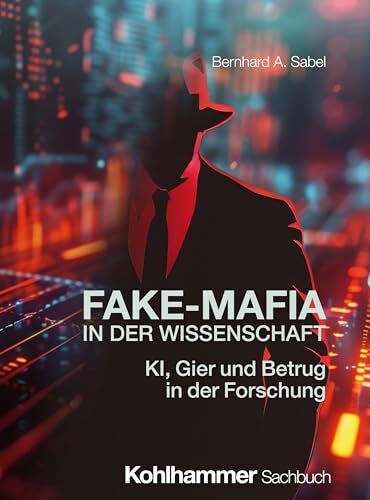
The book is titled “Fake mafia in science – AI, greed and fraud in research” and was published in October 2024.
It was celebrated by Roland Seifert, professor at Hannover Medical School (MHH) and Editor-in-Chief of the Springer-Nature-published journal Naunyn-Schmiedeberg’s Archives of Pharmacology (NSAP):
“The book, written in a compact and easy-to-read manner, is a very suitable gift for every scientist; as a warning, a reminder and a call to do everything in one’s power to prevent the spread of paper mills
Seifert in BIOSpektrum
and to combat them. But science and university politicians and
representatives of scientific funding organisations and publishers should also read the book, because things are also happening at these levels that promote the spread of paper mills.”
Even today NSAP seems to be unable to stop publishing papermill fraud, despite Seifert’s and Sabel’s earlier call to action:
Bernhard A. Sabel & Roland Seifert How criminal science publishing gangs damage the genesis of knowledge and technology—a call to action to restore trust Naunyn-Schmiedeberg’s Archives of Pharmacology (2021) doi: 10.1007/s00210-021-02158-3
You can read about Seifert’s journal and its papermill problem here:
An attractive and “natural” target for fraudsters
“In the various excellent texts on paper mills the question is discussed why Naunyn-Schmiedebergs Archives of Pharmacology has become a target for fake papers. I oppose the assumption that we simply want to fill pages with pseudo-scientific content. We actually look for quality and good science.” – Prof Dr Roland Seifert, Editor-in-Chief


Dark Satanic Papermills
Smut Clyde investigates two more Chinese paper mills. One teamed up with an obscure Italian publisher, the other offers access to respectable society journals. How much of published and allegedly peer reviewed science is real?

Despite Sabel’s expert input, Chinese papermills banned and Egyptian papermills acted upon at NSAP, now Iranian papermills took over? Kahki et al 2025 spoke of “DNA harm“, a tortured version of “DNA damage”, Mohammadi et al 2025 and Doghish et al 2025 cited retracted papermill products out of context, plus other curcumin travesties like Einafshar et al 2025 – nobody at all raised an eyebrow at NSAP. This was published in January 2025:
Amir Bavafa , Maryam Izadpanahi , Elham Hosseini , Mehrdad Hajinejad , Mahsa Abedi , Fatemeh Forouzanfar, Sajad Sahab-Negah Exosome: an overview on enhanced biogenesis by small molecules Naunyn-Schmiedeberg’s Archives of Pharmacology (2025) doi: 10.1007/s00210-024-03762-9


Yes, the Vickers Curse struck. The NSAP study also referenced retracted papers.
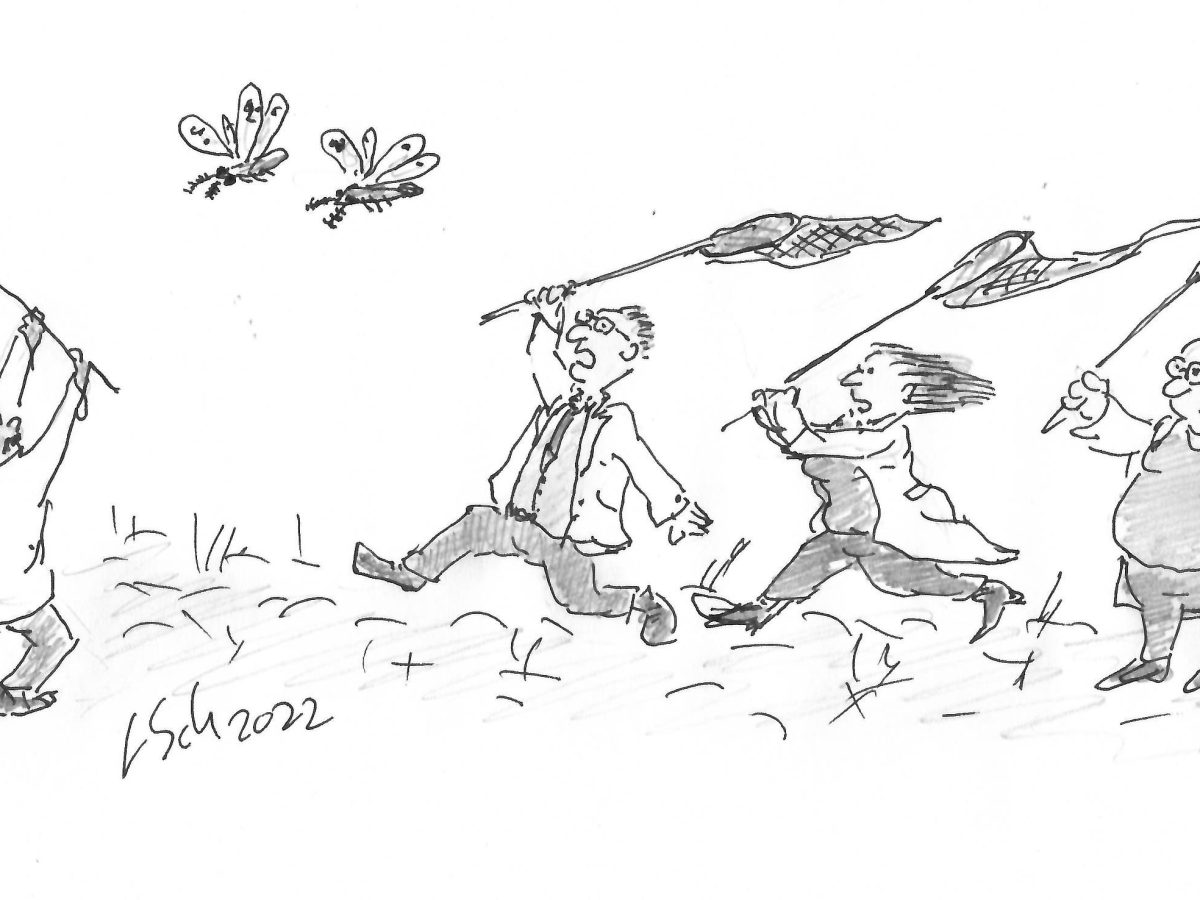
The Vickers Curse: secret revealed!
How did an editorial about insect pheromone communication get to receive 1200 irrelevant citations, almost all from papermills? Alexander Magazinov reveals The Secret of The Vickers Curse!

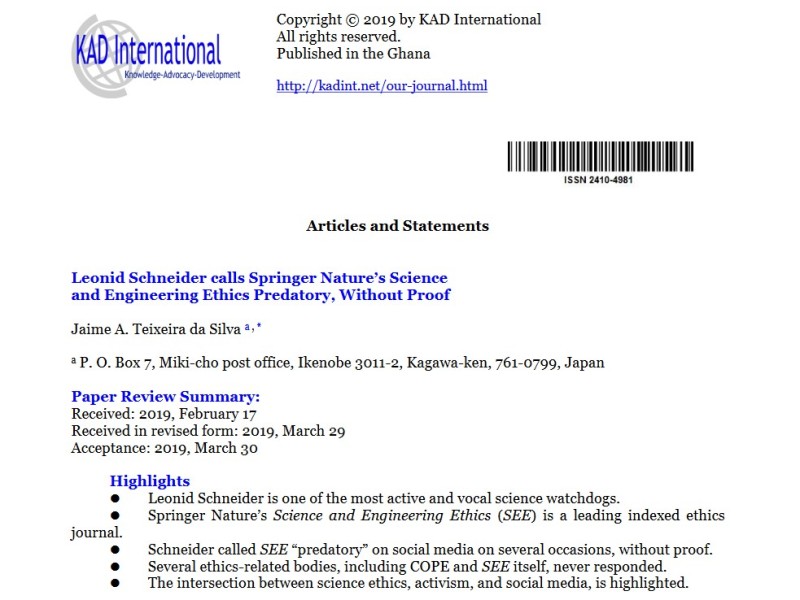
But that’s OK because Seifert’s journal can always counterbalance papermill trash with unhinged drivel like Jaime Teixeira da Silva‘s “Is it time for a paper mill blacklist?“, also from January 2025. Again at NSAP, Sabel joined forced with that nutcase Teixeira da Silva (other masterpieces here, here, here, here, and especially here) to produce this outpour of knowledge about “an ethical/moral […] responsibility of editors, journals, and publishers“:
Jaime A. Teixeira Da Silva , Timothy Daly , Jens C. Türp , Bernhard A. Sabel, Graham Kendall The undeclared use of third-party service providers in academic publishing is unethical: an epistemic reflection and scoping review Naunyn-Schmiedeberg’s Archives of Pharmacology (2024) doi: 10.1007/s00210-024-03177-6
Editors and other real papermill heroes
“Long story short, we investigated our published papers and then retracted those with data integrity issues. That is it.” – Dr Heather Smith, Editor-in-Chief
But I completely digressed, apologies, I was planning to talk about Sabel’s book! Even though only Sabel’s name decorates the book’s cover, the publisher Kohlhammer mentions that the Magdeburg professor was assisted by a certain Armin Fuhrer, a “self-employed journalist and book author“:
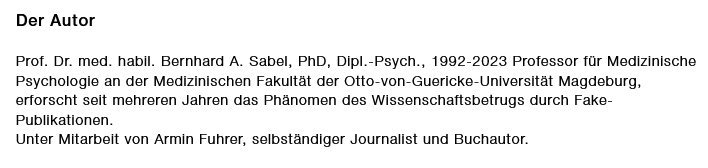
Not just on the cover, also in book reviews and on shop websites Sabel is listed as this book’s author, often as the only author, with Fuhrer either never mentioned, or briefly mentioned at the end, only sometimes (like on Amazon) is Fuhrer is properly listed as “assistant” coauthor. In a relevant January 2025 interview, Sabel never mentions Fuhrer and seems to claim the sole authorship for himself: “That’s why I wrote this book“.
But maybe Studibuch know something: they list only Fuhrer as author, and it is Sabel who is not mentioned.
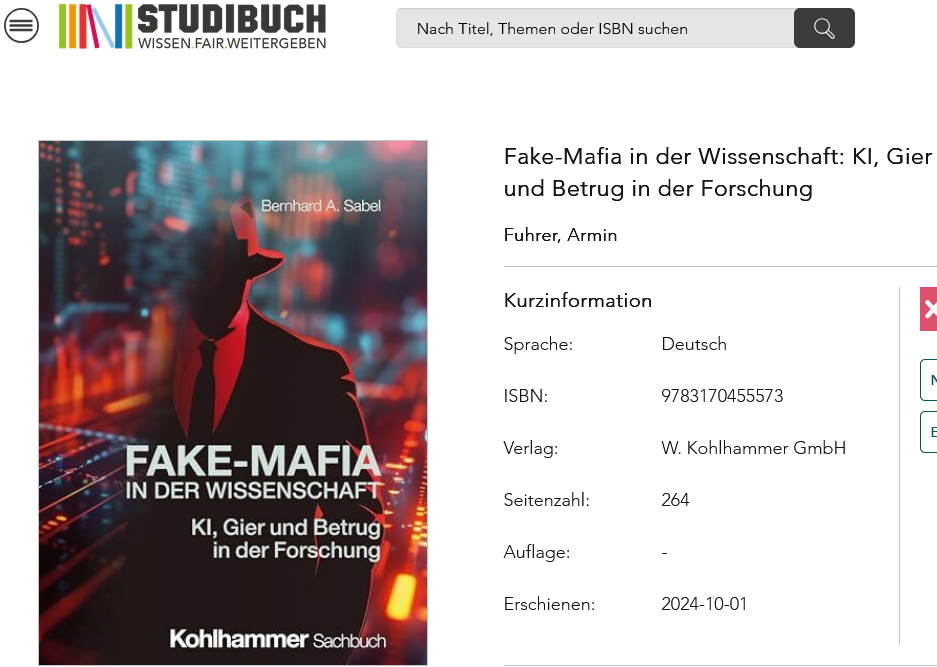
On his own website, Fuhrer lists this book, and several others: various biographies, and history books about Hitler and other Nazis. This note is interesting:
“A total of around 20 books have now been created, which I wrote as author, co-author or ghostwriter.”
I wanted to know who really wrote that book, Sabel or Fuhrer. Sabel never replied to my emails. But Fuhrer did:
“If you would do some serious research before making any accusations, you would easily realise that I am mentioned in the book as a co-author, even with a photo. Surprise!
Apart from that, I have written around 25 books under my own name (arminfuhrer.de), plus a four-digit number of articles. It’s all news to you, right? Do you realise that you are about to be charged with defamation and damage to business? That could be expensive…
I expect an apology from you by 12 noon on Friday and a correction with Prof. Sabel, otherwise you will receive a letter from the public prosecutor’s office.”
In the next email, Fuhrer announced a criminal lawsuit should I quote the above email. And further lawsuits should his or Sabel’s coauthorship be questioned.
I merely tried to clarify the contributions by Sabel and Fuhrer to that book. It was difficult, because Fuhrer, the man of words and culture, chose to forgo a civil conversation and instead kept throwing around very unspecific insults about my person while threatening me with lawsuits. Yet he mentioned this:
“The fact that Prof. Sabel gives the interviews is because he is responsible for the study that the book is about and can represent the results better than me.”
Followed by this in the next email:
“The study on which the book is based was performed by Sabel – so of course he is named as the main author. What else?“
The Chinese Paper Mill Industry: Interview with Smut Clyde and Tiger BB8
Unlike those fake paper mill products, this interview failed editorial review and journal quality control.
Fuhrer obviously referred to this study by Sabel, a papermill-detection tool which was swiftly debunked by proper experts, I wrote about it in May 2023 Shorts:
Bernhard A. Sabel, Emely Knaack, Gerd Gigerenzer, Mirela Bilc Fake Publications in Biomedical Science: Red-flagging Method Indicates Mass Production medRxiv (2023) doi: 10.1101/2023.05.06.23289563
No wonder Gerd Gigerenzer sings praises to Sabel’s book (“An eye-opening book, absolutely worth reading!“). These old professorial men are absolutely ridiculous in their narcissism.
At some point I had to ask Fuhrer if he even knew who I was. His educated and professional reply was:
“Of course I know who you are – that immediately makes me sceptical. I realise that, sensationalism-horny that you are, you think you can make a big scoop. The truth is that you will embarrass yourself to the bone, put a serious dent in your career as a ‘science journalist’, but above all it threatens to be very expensive for you. After all, the publisher, Prof Sabel and I will sue you for damages and will undoubtedly be proved right. […] Either you do yourself some good and keep your hands off it or you’ll burn yourself badly.“
An offer I won’t be able to refuse, from a person who just (co-)wrote a book about, well, literally “fake mafia”. How ironic. Also: Sabel never objected to Fuhrer’s lawsuit threats on his behalf – draw your own conclusions. Tough guys.
All considered, to me at least it seems that Fuhrer might have been the book’s main author, and Sabel may have merely assisted him. But officially, it’s the opposite!
Maybe Fuhrer will next write Sabel’s autobiography? I suggest as title “Sextropolis: Bernard Sabel und das wilde Magdeburg der Zwanzigerjahre“.
A matter of urgency
A learned medical society acted on a fraudulent paper. Its coauthor is Antonino Belfiore of University of Catania in Italy, he has his own very worrisome PubPeer record, and just featured in May 2025 Shorts. The corresponding author is Marcello Maggiolini of University of Calabria, he has over 30 fake papers on PubPeer, and his collaboration with Belfiore was mentioned in this article:

The Name of the Foes
“I am Jorge de Burgos. I believe research should pause in searching for the progress of knowledge. Right now, we don’t need more papers, we rather need more knowledge by going through a continuous and sublime recapitulation to figure out what is true and what is fake” – Aneurus Inconstans

The sleuth Aneurus Inconstans notified this journal (published by the Society for Endocrinology) and its chief editors in February 2023 already:
Paola De Marco , Enrica Romeo , Adele Vivacqua , Roberta Malaguarnera , Sergio Abonante , Francesco Romeo , Vincenzo Pezzi , Antonino Belfiore , Marcello Maggiolini GPER1 is regulated by insulin in cancer cells and cancer-associated fibroblasts Endocrine Related Cancer (2014) doi: 10.1530/erc-14-0245


“Figure 7C, 7G, 7I and 7J: all the loading controls present duplicated bands (boxes of same color).”
Right away, on 13 February 2023, the sleuthz received a reply from this journal#s publishing executive Alison Pope:
“Dear Dr Inconstans,
Thank you for your email.
Endocrine-Related Cancer takes publishing ethics extremely seriously and as such we will investigate this as a matter of urgency. We will notify you of the outcome of our investigation in due course.”
The urgent investigation resulted in this Corrigendum from 18 October 2023:
“The authors and journal apologise for errors in the above paper, which appeared in volume 21 part 5, pages 739–753 (October 2014). The error relates to Figs. 6 and 7 given on page 747, in which control blot images were unintentionally duplicated. The authors repeated the experiments, supplied uncropped full blots, and supplied corrected figure artwork which is given in full belowa [sic!]“.
Unintentionally duplicated. Happens to everyone. In fact, even to the Editor-in-Chief Matthew Ringel of Ohio State University in USA:
Nicole Guzman , Kitty Agarwal , Dilip Asthagiri , Lianbo Yu , Motoyasu Saji , Matthew D. Ringel , Michael E. Paulaitis Breast Cancer–Specific miR Signature Unique to Extracellular Vesicles Includes “microRNA-like” tRNA Fragments Molecular cancer research (2015) doi: 10.1158/1541-7786.mcr-14-0533

Unintentional duplications also happen to the Deputy Editor Marta Karbonits of Queen Mary University of London In UK:
Sayka Barry, Eivind Carlsen , Pedro Marques, Craig E. Stiles, Emanuela Gadaleta, Dan M. Berney, Federico Roncaroli , Claude Chelala , Antonia Solomou , Maria Herincs, Francisca Caimari , Ashley B. Grossman, Tatjana Crnogorac-Jurcevic, Oliver Haworth, Carles Gaston-Massuet, Márta Korbonits Tumor microenvironment defines the invasive phenotype of AIP-mutation-positive pituitary tumors Oncogene (2019) doi: 10.1038/s41388-019-0779-5

And here:
Ashutosh Rai , Soujanya D. Yelamanchi , Bishan D. Radotra , Sunil K. Gupta , Kanchan K. Mukherjee , Manjul Tripathi , Rajesh Chhabra , Chirag K. Ahuja , Narendra Kumar , Akhilesh Pandey, Márta Korbonits , Pinaki Dutta, Carles Gaston-Massuet Phosphorylation of β-catenin at Serine552 correlates with invasion and recurrence of non-functioning pituitary neuroendocrine tumours Acta Neuropathologica Communications (2022) doi: 10.1186/s40478-022-01441-5

In December 2023, Karbonits’ coauthor Ashutosh Rai admitted on PubPeer that an “editorial error happened during the preparation of figure panel during few rounds of editorial submission“, assured that “this correction has no impact on the results or conclusions” and that’s why no correction was published till today. This one by Karbonits and Patrick Mehlen (read October 2023 Shorts) was at least corrected:
Angela R. Garcia-Rendueles , Miguel Chenlo , Fernando Oroz-Gonjar, Antonia Solomou , Anisha Mistry, Sayka Barry, Carles Gaston-Massuet, Montserrat Garcia-Lavandeira , Sihara Perez-Romero , Maria Suarez-Fariña , Alberto Pradilla-Dieste , Carlos Dieguez , Patrick Mehlen, Márta Korbonits, Clara V. Alvarez RET signalling provides tumorigenic mechanism and tissue specificity for AIP-related somatotrophinomas Oncogene (2021) doi: 10.1038/s41388-021-02009-8

The Correction from November 2023 fixed “an error in Figure 6B“, which of course had “no impact on the results or conclusions presented in this paper.”
But all this nothing compared to all that fraud Maggiolini has published (especially with Sebastiano Ando).
Science Elites
Not going down without a fight
We all want to defend science from Trump fascism, but sometimes it’s not so straightforward.
On 17 May 2025, The Boston Globe brought an article about the defunding of Harvard, titled “‘A bloodbath’: Trump administration moves to terminate hundreds of federal grants at Harvard“.

Never-ageing Anti-aging to cure COVID-19
Scientists David Sinclair and Michael Lisanti have an ingenious solution to COVID-19: anti-aging drugs. If a disease kills old people, stop being old!
Harvard has hundreds of scientists, many of them decent people who don’t engage in fake science and bullshit business scams. But it had to be a greedy, dishonest anti-aging cheater whom we are expected to support now.
“For David Sinclair, a high-profile genetics professor at Harvard Medical School known for his research on longevity, the grant terminations in his lab hit close to home. His partner’s mother is dying of ALS, a debilitating neurodegenerative disease; and one of two grants cut in his lab was for a star postdoctorate researcher who was making progress reversing ALS symptoms in animals. Using artificial intelligence to speed that research, they thought they might have something in time to save his partner’s mother.
“We’re racing against time to find a way to help ALS patients, including my partner’s mom, who’s now hanging on for dear life on a breathing machine at our house,” said a shaken Sinclair.
“And I haven’t told her yet. I just can’t tell her,” he added. “I mean, what do you say?”
That five-year, $200,000 NIH grant was only in its second year and paid the salaries of three researchers.
The other grant terminated was also in its second year, a five-year, $1.5 million award expanding Sinclair’s trailblazing work reversing certain signs of aging in mice to see if it could be broadly applied to other aspects of aging. It was the lab’s main source of income.
“We’re not going down without a fight. I‘m mobilizing my resources to find funding so we can continue the research,” Sinclair said. “We haven’t found it yet.”
David Sinclair was stopped from finding a cure to save his mother-in-law. What the actual f***. Sinclair, of all people.
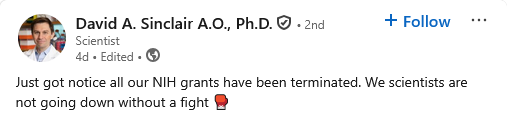
The guy was even exposed as a crook by the Wall Street Journal (read also December 2024 Shorts).
The original sins of Leonard Guarente
“Without specific and credible allegations of research misconduct, MIT is unable to take any action.”
Scientific asylum
In this regard, US scientists who lost their grants or even their jobs are being welcomed in Europe. Readers of For Better Science need not apply though. Nature reports on such offers, in an article from 21 May 2025:
“In April, Aix-Marseille University in France announced its €15-million Safe Place for Science initiative. Its aim is to hire 15–20 US researchers working on areas being targeted for cuts by the Trump administration, such as climate change or vaccines. “We really believe that science is international,” says university president Eric Berton. “It is important to show these people they are not alone. We want to offer scientific asylum to our colleagues,” he adds. The university received nearly 300 applications for the spots.”
Liberté, Égalité, Fraternité – only for Raoult and French elites
“Didier Raoult, the IHU institute, and Eric Chabrière all decided to sue Leonid Schneider for defamation and insults, which they claim to be present in this article. They also sued me, because I translated it into French and put it on my blog ” – Alexander Samuel
Now, what Nature doesn’t tell you: before you write your application to Berton and his Aix-Marseille Universiyt (AMU), you should know what Berton values in a scientist. Because Berton’s personal friend is the former IHU Marseille director and AMU professor Didier Raoult, who was allowed by Berton to push chloroquine quackery for COVID-19 and to perform experiments on countless people without an ethics approval for many years. After the scandal erupted in public, Berton personally covered up his university’s investigative report because it found Raoult and his colleagues guilty (read November 2024 Shorts).
Berton also protects Raoult’s associate Eric Chabriere, an antisemtite and a bullying psycho who threatened violence to Raoult’s critics on social media, including Raoult’s daughter, see May 2023 Shorts and here:

France’s Ugly Brown Derriere
“legions d’honneurs, prix, promotion…. Le champ du cygne de ce système politico médical qui n’a plus le choix que de se soutenir mutuellement. Patience, en d’autre temps, on a donné des médailles aux derniers combatants. On connait la fin” – Capitaine Eric Chabriere.
Also, Berton installed a far-right conspiracy theorist as his ethics committee coordinator: Audrey Calvo, who threatened me with lawsuits when I tried to report a a case (read June 2024 Shorts). She also attacked a whistleblower who complained about threats of violence from Calvo’s buddy Charbiere (read November 2024 Shorts). Berton fully supports Calvo’s actions.
American fraudsters, bullies, and patient abusers, come to Marseille! Berton and Calvo will meet you with open arms.
We’re doing great things
At the University of British Columbia (UBC), the Iranian papermiller and assistant professor in engineering Mohammad Arjmand is now celebrated as “Researcher of the Year”. That’s because other Canadian researchers are too stupid to work with papermills and to run peer review and citations rings. Read about Arjmand here:
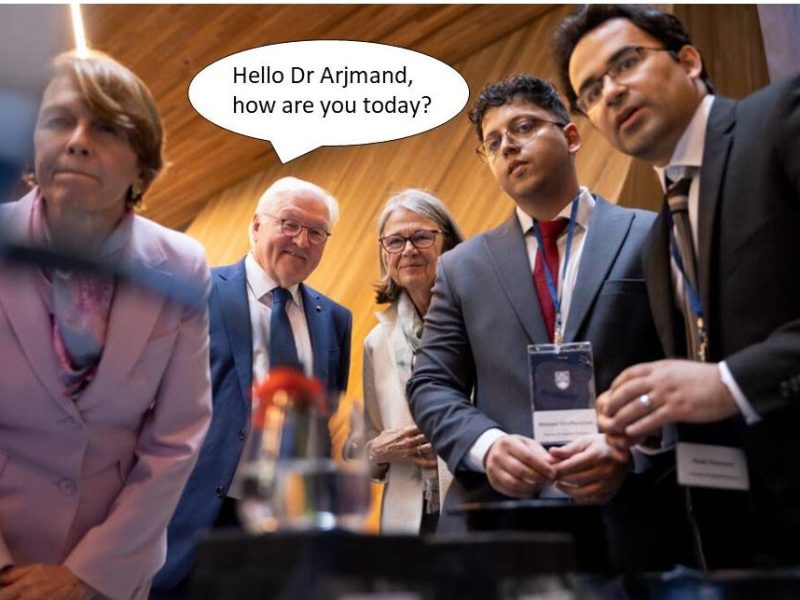
Dr. Mohammad Arjmand showcases his work to German President Steinmeier
“The German President and delegation members also spoke with researchers working on challenges relating to clean energy,…”
UBC announced on 8 May 2025:
“Three UBC Okanagan faculty members have been recognized for their outstanding research commitment and achievements through the university’s annual Researcher of the Year awards.
Dr. Mohammad Arjmand in the Natural Sciences and Engineering category, [and 2 others, -LS] were announced today as the 2025 Researchers of the Year at a formal celebration of research excellence.
This year marks the 20th anniversary of the prestigious awards, which recognize faculty members making the world a better place through scholarly and creative pursuits. Award recipients epitomize excellence and are leaders in their respective fields and disciplines.
This year’s three recipients perfectly exemplify the vision and aspirations of UBC Okanagan research, says Dr. Suzie Currie, Vice-Principal and Associate Vice President, Research and Innovation.”
The announcement quotes Arjmand whose polymer research is said to be “helping save space in landfills while also protecting the environment“:
“We’re doing great things. We’ll continue doing great things,” Dr. Arjmand says. “We have a nourishing and thriving environment at UBCO and I hope even more researchers are clamouring to come here, to do this work, to help society and the world.”
Yes, scores of Iranian papermillers are clamouring to come to UBC already, thanks to Arjmand holding the door open.
This is the kind of “vision and aspirations” which VP Currie fell in love with:
Farhad Ahmadijokani , Rahman Mohammadkhani , Salman Ahmadipouya , Atefeh Shokrgozar , Mashallah Rezakazemi , Hossein Molavi , Tejraj M. Aminabhavi , Mohammad Arjmand Superior chemical stability of UiO-66 metal-organic frameworks (MOFs) for selective dye adsorption Chemical Engineering Journal (2020) doi: 10.1016/j.cej.2020.125346

Tetraphleps parallelus: “Identical noise and peak in XRD patterns”
The study also declared CO2 to be an “organic dye”, merely to cite some papermill rubbish by Arjmand and Seeram Ramakrishna. Also Arjmand’s paper Soleimanpour et al 2023 is a citation delivery vehicle to himself and his papermilling friends. More epitomized excellence:
Farhad Ahmadijokani , Shima Tajahmadi , Addie Bahi , Hossein Molavi , Mashallah Rezakazemi , Frank Ko , Tejraj M. Aminabhavi , Mohammad Arjmand Ethylenediamine-functionalized Zr-based MOF for efficient removal of heavy metal ions from water Chemosphere (2021) doi: 10.1016/j.chemosphere.2020.128466

Tetraphleps parallelus: “Fig. 7. (b) Identical XRD patterns for different samples.”
Here is Arjmand with Milad Kamkar and other papermillers:
Seyed Mohammad Amin Ojagh , Majed Amini , Sierra Cranmer-Smith , Farzaneh Vahabzadeh , Mohammad Arjmand , Kam C. Tam , Orlando J. Rojas , Milad Kamkar, Theo G.M. Van De Ven Crystalline and Hairy Nanocelluloses for 3D Printed Hydrogels and Strongly Structured Cryogels ACS Sustainable Chemistry & Engineering (2023) doi: 10.1021/acssuschemeng.3c00180

Alexander Magazinov: “Fig. 6a, col. 5 – it is not clear what the inset is supposed to show, but at least it is from the same sample.
Fig. 6b, col. 4 and 5 – a feature in the cyan circle has roughly the same size, which cannot happen with the scale bars as shown.
Fig. 6c, col. 5 – the same feature as above is present in the inset, which is impossible, since the samples are different.”
Arjmand’s study Ghaderi et al 2023 has similar problems. With Kamkar, Sara Rostami (associate of papermill titans Arash Karimiour and Davood Toghraie), and Arjmand’s associate Stefan Wuttke, who recently edited a special issue in Wiley, where Arjmand’s and Kamkar’s common papers passed peer review with flying colours:
Ahmadreza Ghaffarkhah , Seyyed Alireza Hashemi , Sara Rostami , Majed Amini , Farhad Ahmadijokani , Ali Pournaghshband Isfahani , Sameer E. Mhatre , Orlando J. Rojas , Milad Kamkar , Stefan Wuttke, Masoud Soroush , Mohammad Arjmand Ultra‐Flyweight Cryogels of MXene/Graphene Oxide for Electromagnetic Interference Shielding Advanced Functional Materials (2023) doi: 10.1002/adfm.202304748

Alexander Magazinov: “Incompatible scale bars between Figs. 5b and 5c (superimposed below to facilitate comparison).”
There is much more on PubPeer for Arjmand’s “creative pursuits”, which is exactly why he became UBC’s Researcher of the Year.
Retraction Watchdogging
Duplication was confirmed
The Columbia University professors Sam Yoon (now S. Sunghyun Yoon, see June 2024 Shorts for explanation) and his wife Sandra Ryeom lose another paper. The cruel bit is: normally this kind of duplication in an old study wouldn’t be even dignified with a correction. Especially with those important co-authors. Read about Yoon here:

Memorial Sloan Kettering Paper Mill
“Why do successful and apparently intelligent surgeons feel the need to play pretend at biology research? Has Sam S. Yoon ever performed an invasion or migration assay? […] if this is how he “supervises” his research does anyone trust his supervision of surgery?” – Sholto David

This is the paper, its coauthors include Tyler Jacks , the Harvard Medical School professor Peter Park, and David Kirsch, professor at University of Toronto in Canada and Duke University in USA.
Sam S Yoon , Lars Stangenberg , Yoon-Jin Lee , Courtney Rothrock , Jonathan M Dreyfuss , Kwan-Hyuck Baek , Peter R Waterman , G Petur Nielsen , Ralph Weissleder , Umar Mahmood , Peter J Park , Tyler Jacks , Rebecca D Dodd, Carolyn J Fisher , Sandra Ryeom, David G Kirsch Efficacy of sunitinib and radiotherapy in genetically engineered mouse model of soft-tissue sarcoma International journal of radiation oncology, biology, physics (2009) doi: 10.1016/j.ijrobp.2009.02.052

The retraction arrived on 15 May 2025 and likely referred to an institutional investigation:
“This article has been retracted at the request of the Editor.
The journal’s Editor received correspondence expressing concerns at the presentation of duplicated images in Figure 5B. These concerns are listed on PubPeer at https://pubpeer.com/publications/B5B26FA84B9F7E34133519187F969F#1.
Following an investigation and discussion with the corresponding author, duplication was confirmed, and original raw data was not available for further examination. Due to this, the Editor made the decision to retract.”
The joke is that Tyler Jack’s other papers are evidently much more problematic, yet there is no danger of a retraction:
What Elsa Flores and Tyler Jacks taught each other
“PCR reactions run on agarose gels commonly look similar due to artifacts introduced by the agarose gel and comb.” Dr Elsa R Flores, Associate Director, Moffitt Cancer Center
Kirsch has some other problematic papers with Yoon on PubPeer (but also with Anil Sood!). Also Park has other things on PubPeer:
Tae-Min Kim , Wei Huang , Richard Park , Peter J. Park, Mark D. Johnson A developmental taxonomy of glioblastoma defined and maintained by MicroRNAs Cancer Research (2011) doi: 10.1158/0008-5472.can-10-4117

Mycosphaerella arachidis: “Figure 6: Unexpected similarity between two blots after 180° rotation”
Another one by Mark and University of Massachusetts professor Mark Johnson:
Xiuli Jiang , Hongyan Xing , Tae‐Min Kim , Yuchae Jung , Wei Huang , Hong Wei Yang , Shengye Song , Peter J. Park , Rona S. Carroll, Mark D. Johnson Numb regulates glioma stem cell fate and growth by altering epidermal growth factor receptor and Skp1-Cullin-F-box ubiquitin ligase activity Stem Cells (2012) doi: 10.1002/stem.1120


In Iran may be deleted
The Iranian papermiller (or likely even papermill operator) Davood Toghraie suffered three more retractions. But he has a backup plan.
All three retractions happened in the same Elsevier journal undergoing spring cleaning.
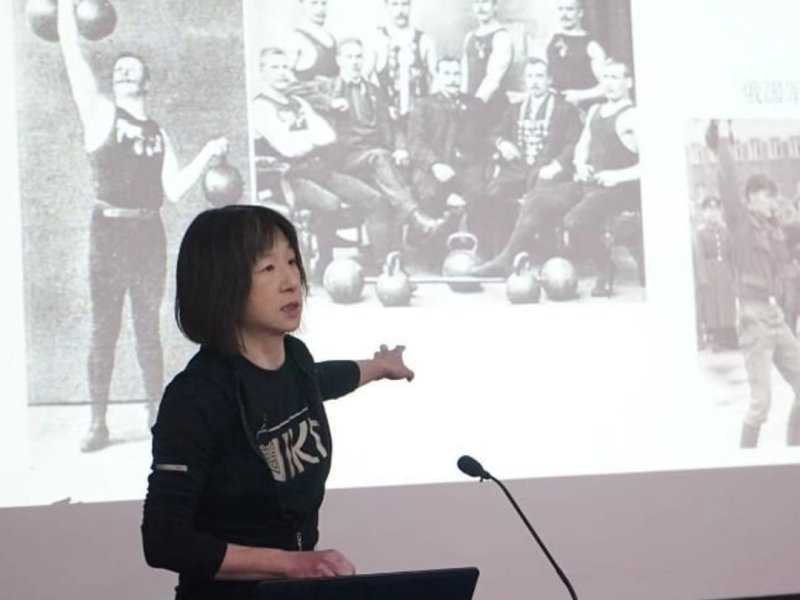
Journal of Molecular Liquids vs One-Man Papermills
Mu Yang catches two crooks, Ayman Atta and S Muthu, who flooded one Elsevier journal (and several others) with ridiculous hand-drawn fraud. Whom to believe, the peer review, or your own eyes?
These two were coauthored with the papermillers Supat Chupradit and Wanich Suksatan:
Yanpeng Shang , Reza Balali Dehkordi , Supat Chupradit , Davood Toghraie , Andrei Sevbitov , Maboud Hekmatifar , Wanich Suksatan , Roozbeh Sabetvand The computational study of microchannel thickness effects on H2O/CuO nanofluid flow with molecular dynamics simulations Journal of Molecular Liquids (2022) doi: 10.1016/j.molliq.2021.118240
“Post-publication, the editor discovered suspicious changes in authorship between the original submission and the revised version of this paper. The paper was originally submitted by Davood Toghraie with Reza Balali Dehkordi as the First Author. During revision, the authors Yanpeng Shang (New First Author), Wanich Suksatan, Supat Chupradit, and Andrei Sevbitov were all added to the revised paper without explanation…”
Retraction 14 May 2025
The second retracted paper was flagged by Alexander Magazinov as a citation vehicle to the notorious citation-buyer Yu-Ming Chu. Maarten van Kampen noticed that it was one of five very similar papers by Toghraie:
Shanshan Jiang , Saade Abdalkareem Jasim , Svetlana Danshina , Mustafa Z. Mahmoud , Wanich Suksatan , Davood Toghraie, Maboud Hekmatifar , Roozbeh Sabetvand Molecular dynamics simulation the effect of initial pressure on the phase transition performance of coated AlH3 nanoparticles in the presence of an oxygenated medium Journal of Molecular Liquids (2022) doi: 10.1016/j.molliq.2022.119183
” Svetlana Danshina (Russia) is a general dentist and medical candidate. She publishes on an eclectic range of topics and earned a place on Dissernet for a number of purchased authorships. Wanich Suksatan (Thailand) is a lecturer of nursing with 152 papers on everything, including a few retractions for authorship fraud (1, 2). Finally, Mustafa Z. Mahmoud appears to be a medical doctor, authoring 129 papers of which 58 in 2022 alone. Who says that intricate molecular dynamics (MD) simulations on the oxidation of nanoparticles is only within the reach of trained physicists?”
Maarten van Kampen
The retraction from 14 May 2025 mentioned:
“The paper was originally submitted by Davood Toghraie as both the First and Corresponding Author.
During revision, the authors Shanshan Jiang (New First Author + Additional Corresponding Author), Saade Abdalkareem Jasim, Svetlana Danshina, Mustafa Z. Mahmoud, and Wanich Suksatan were all added to the revised paper without explanation….”

Karimipour Saga I: Setting Boundaries
“The business of selling authorships and citations needs a steady supply of paper-shaped vehicles. It is most efficient to produce these in assembly lines that focus on a narrow topic.” – Maarten van Kampen

The third retracted paper zhihawas coauthored by a fictional person: Aliakbar Karimipour doesn’t exist in real life, only a s a sockpuppet of the Iranian papermill fraudster Arash Karimipour (be aware that there is another, Texas-based Arash Karimipour who is real but papermills about concrete only).
Amirhosein Mosavi , Maboud Hekmatifar , As’ad Alizadeh , Davood Toghraie , Roozbeh Sabetvand , Aliakbar Karimipour The molecular dynamics simulation of thermal manner of Ar/Cu nanofluid flow: The effects of spherical barriers size Journal of Molecular Liquids (2020) doi: 10.1016/j.molliq.2020.114183
“The paper was originally submitted by Davood Toghraie (Original Corresponding Author) with Maboud Hekmatifar as the First Author.
During revision, the authors Amirhosein Mosavi (New First Author + Corresponding Author), As’ad Alizadeh and Aliakbar Karimipour (Additional Corresponding Author) were all added to the revised paper without explanation”
Retraction 14 May 2025
Now, with all these retractions, what is Toghraie’s plan B, you wish to know?
It seems aside of his nanotechnology and materials science papermilling, Toghraie went into medicine. Under a different name!
In the following medical study on stem cells for sports injuries, a certain medical practitioner from Iran, a D. T. Semirumi of Islamic Azad University, left behind this email address as corresponding author: Toghraee@iaukhsh.ac.ir
Hongying Yu, M. Habibi , K. Motamedi , D.T. Semirumi, A. Ghorbani Utilizing stem cells in reconstructive treatments for sports injuries: An innovative approach Tissue and Cell (2023) doi: 10.1016/j.tice.2023.102152

This email address belongs however to the nanotech papermill owner, Davood Toghraie:
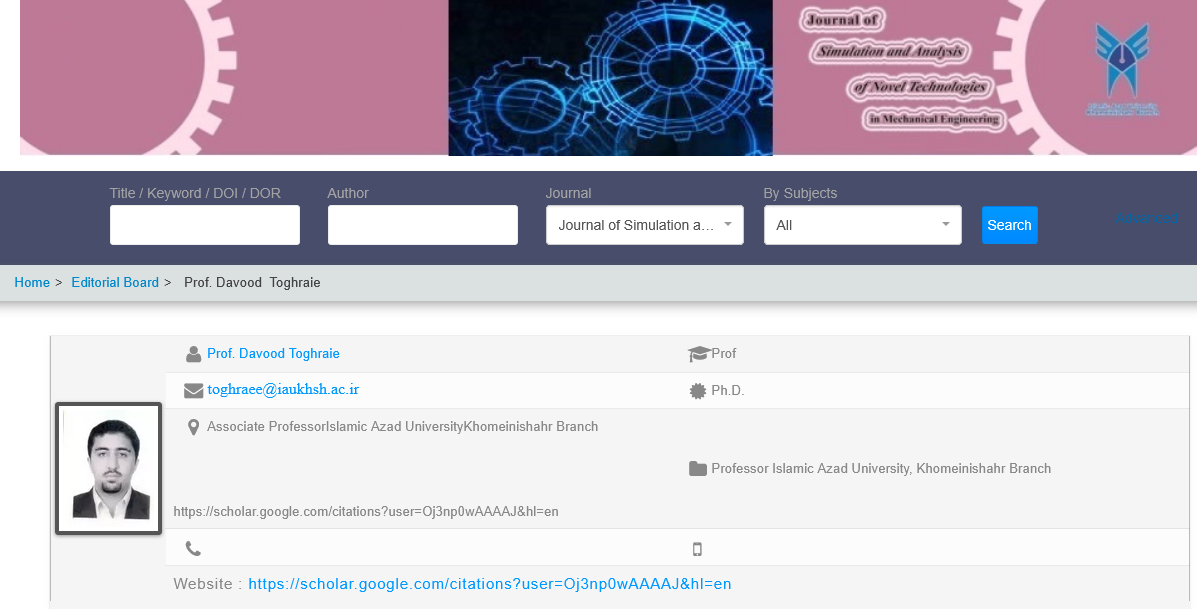
To which D.T. Semirumi responded on PubPeer with:
“My full name is davood Toghraie Semirumi and semirumi is Surname suffix that in Iran may be deleted. best regards”
In Iran, people with similar names must also share the same university email address, right.
When experienced nanotech papermillers dabble in medicine, dentistry and zoology, only silly nonsense comes out:

The paper also contains many nonsense references, “drawn from a familiar constellation of ‘citation magnets’.”
There is more garbage by this mysterious D.T. Semirumi, or D.T. Semiromi as he sometimes writes himself. For example, this study about the health benefits of peach juice laced with nanoparticles:
P. Guo , A. Abdollahpour , M.H. Jazbizadeh , D.T. Semiromi The amount of improvement and therapeutic effect of sports health by increasing the viscosity of peach juice through reverse osmosis and polymer membrane Food Bioscience (2023) doi: 10.1016/j.fbio.2023.103330
Elsevier links the profile of D.T. Semiromi to the ORCID profile of Davood Toghraie of Islamic Azad University. There is also a clinical paper about pomegrenade juice by a D. Semiromi of Islamic Azad University, Han et al 2023, titled “An investigation of the performance of polyamide membrane for the concentration of pomegranate and effect on the physical and sports health of patients with physical weakness: A novel study”. Returning to D.T. Semiromi, whose scholarly interests don’t stop either et engineering nor at medicine:
Aoqi Xu, Seyed Abdolhassan Johari, Amir Hossein Khademolomoom, Mohsen Tavakoli Khabaz, Rajabov Sherzod Umurzoqovich, Saeed Hosseini , D.T. Semiromi Investigation of management of international education considering sustainable medical tourism and entrepreneurship Heliyon (2023) doi: 10.1016/j.heliyon.2022.e12691
It was a citation delivery vehicle to Changhe Li, plus “a starting of references that involve N.K.A, Dwijendra, or a predatory hijacked journal.” And of course, D.T. Semiromi’s email address belongs to Davood Toghraie:

Quite likely, the more retractions Davood Toghraie collects, the more papers D.T. Semiromi (or Semirumi) will publish.
A heart-wrenching event
A funny retraction in the Dove Press journal International Journal of Nanomedicine, once run by the fraudster and papermiller Thomas Webster, until he was sacked both as professor by his US University and as Editor-in-Chief the publisher Taylor & Francis.
Thomas Webster to save the world with COVID-19 nanoparticles
The world is in the grip of COVID-19 pandemic. Thousands dead, infection rates explode, nations in lockdown. Perfect timing for troll scientists to offer their bullshit cures. Like Thomas Webster of Northeastern University.
The masterpiece is from China, and it was flagged on PubPeer just recently, in February 2025:
Xiaofeng Yang , Yingying Liu , Yanna Zhao , Meihua Han , Yifei Guo , Haixue Kuang, Xiangtao Wang A stabilizer-free and organic solvent-free method to prepare 10-hydroxycamptothecin nanocrystals: in vitro and in vivo evaluation International Journal of Nanomedicine (2016) doi: 10.2147/ijn.s102726


Sholto David: “Also see Figure 5 and Figure 6 three images are unexpectedly repeated.”
Right away, the last author Xiangtao Wang calmed the sleuth down:
“Dear Sholto David, thang you very much for your kind comments on Fig 1C of this paper. I am sure that this picture is a true picture obtained directly from TEM and it is real and feasible. It is normal that the nanoparticles prepared from the same materials and drugs to display similar particle size and morphology.“
On the other issues, Wang assured that “it is acceptable to use the same picture in Fig 5 and Fig 6“, and even if not, “this does not affect the reliability and conclusions of this part of work“.
On 15 May 2025, the retraction arrived:
“We, the Editor and Publisher of International Journal of Nanomedicine, have retracted the published article.
In February 2025, concerns were raised by a third party regarding potential duplications in Figure(s) 1C, 5 and 6. The authors then contacted the journal to explain that figure(s) 5 and 6 were the incorrect images. They additionally confirmed that Figure 1C was an amended image included in error; the authors then requested retraction.
As verifying the validity of published work is core to the integrity of the scholarly record, we are therefore retracting the article. The corresponding author listed in this publication has been informed.”
The funny bit is that Wang continued to argue even after the retraction, but to a different tune:
“I realized that the photo used in the Fig 1C had been slightly altered.
It turned out that [a “mended” photo was inadvertently left in the data for this article.]
From a purely technical point of view, the cloned particles in Fig 1C had no effect on the overall findings and conclusions of the paper […] In order to maintain academic integrity, we wrote the journal to request to retract this paper.
Whether it’s for me or for my research team, this is a heart-wrenching event and a heavy lesson to take.
We sincerely apologize for this error and our oversights and express our regret to the readers, peers, and editorial team.”
Make your platform a beautiful one
PLOS One retracted two Chinese papers on the topic of medicine after I notified them that the handling editor Zhihan Lv was a) a papermill fraudster and b) a computer engineer with zero training in medicine or life sciences. At the time of my notification, Lv has just been sacked as professor at Uppsala University in Sweden, where he was found guilty of fraud and document forgery. Read here:
“They happened before I joined Uppsala University”
“There are therefore grounds for suspecting that there have been such serious deviations from good research practice that the matter should be referred to the National Board for Assessment of Research Misconduct for further investigation.”
Since then, Lv has been paying random Pakistanis to threaten me with lawsuits and make frivolous DMCA-Take-Down claims. On 3 November 2024, several messages arrived. First, a Muhammad Affan simply wrote: “Please remove the content“. Then, a Muhammad imran specified that he wanted the above article removed:
“I hereby the legal representative of my client Zhihan LV.I am contacting you to make a removal request about the infringing content uploaded on your website without any permissions from the rights owner.[…]
We are requesting that remove these infringing links from your website to make your platform a beautiful one.“
A Muhammad Affan sent the exact same message on the same day. In December 2024, a Tauqeer Ahmed referred to DMCA to demand a removal of that same article:
“The defamatory post in question was posted on your website without knowing the truth. The post contains false and damaging statements that have caused significant harm to the reputation and well-being of the company. […]
Thank you for your cooperation. We hope to resolve this matter amicably and without resorting to legal measures.“
The same message was sent to me in March 2025 by an Ali Abbas.
Then they tried with WordPress directly, but failed:
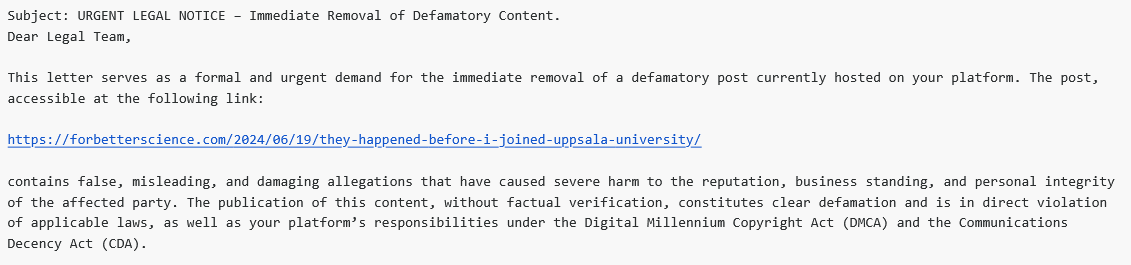
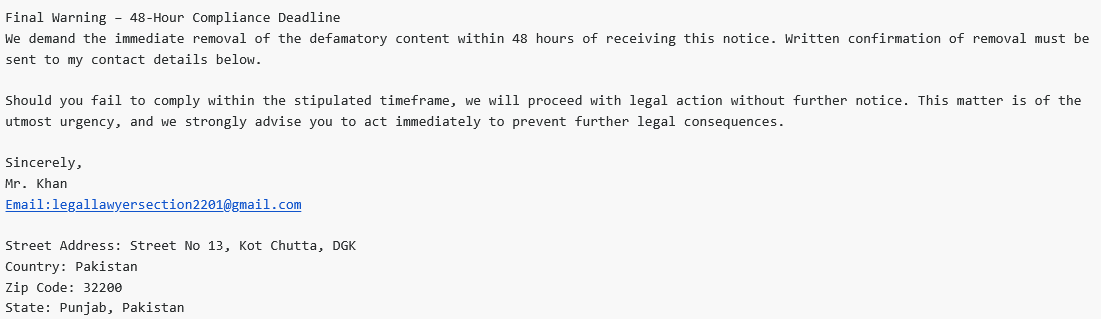
Never mind that Uppsala University sacked him – LV continues using their affiliation, see Wang et al 2025 from February this year.
But I promised you two retractions of the biomedical papers that fraudster Lv edited (most likely for a bribe from a papermill). One was on hand surgery, the other was something with rats, both edited by Lv when he was still a research associate for computer science at UCL in London:
- Lili Zhao , Jianing Yang , Weiwei Liu Application and effect evaluation of nursing quality target management in free flap transplantation for hand injury PLOS One (2021) doi: 10.1371/journal.pone.0245097
- Yafang Li , Yiqiang Qiao , Huanhuan Wang , Zao Wang Intraperitoneal injection of PDTC on the NF-kB signaling pathway and osteogenesis indexes of young adult rats with anterior palatal suture expansion model PLOS One (2021) doi: 10.1371/journal.pone.0243108
The first paper was retracted on 9 April 2025, the second one was retracted on 23 April 2025. Both had the same retraction notice:
“The PLOS One Editors retract this article [1] because it was identified as one of a series of submissions for which we have concerns about peer review integrity and potential manipulation of the publication process. These concerns call into question the validity and provenance of the reported results. We regret that the issues were not identified prior to the article’s publication.”
I now expect more lawsuit threats from Mr Khan and his friends.
Donate!
If you are interested to support my work, you can leave here a small tip of $5. Or several of small tips, just increase the amount as you like (2x=€10; 5x=€25). Your generous patronage of my journalism will be most appreciated!
€5.00
Donate!
If you are interested to support my work, you can leave here a small tip of $5. Or several of small tips, just increase the amount as you like (2x=€10; 5x=€25). Your generous patronage of my journalism will be most appreciated!
€5.00

 For Better Science
David Sinclair: “I‘m mobilizing my resources to find funding so we can continue the research,” Sinclair said. “We haven’t found it yet.”
So, no one is buying into his ‘vision’? How strange.
LikeLike
“So, no one is buying into his ‘vision’?” Which time? Maybe flushing millions of dollars down a research toilet is a mistake you can learn from eventually?
LikeLike
As the largest university endowment worldwide(~$52 billion) , Harvard boasts a number of wealthy donors including Michael Bloomberg and hedge fund billionaire John Paulson, with Mark Zuckerberg, Bill Gates, and Ken Griffin among its megadonors.
I’d reckon there’s someone out there who could use a couple of million in tax write-offs.
Even Sinclair himself could easily fund the project (his estimated net worth is $25 million).
And he’s whining about $1.7 million in withdrawn grants? That’s hardly a vote of confidence if you’re unwilling to invest your own money in your work.
LikeLiked by 2 people
I made an additional comment about NSAP’s latest piece of art by Bavafa and colleagues (https://doi.org/10.1007/s00210-024-03762-9) on PubPeer, which was somehow moderated and not published. Some of their published figures have been “created with BioRender.com.” BioRender clearly indicates that “An academic license is required for publishing in journals or wider databases” (https://help.biorender.com/hc/en-gb/articles/17605388551197-Licensing-and-usage-of-figures-made-in-BioRender). Since I do not see any “BioRender” watermark on any of the figures, I assume they were created under a valid premium license. I am interested to learn how they have obtained a BioRender license from Iran, and whether BioRender bros have been making exceptions in trading with sanctioned countries, supposing the authors have not infringed on copyright laws. Note that a free trial does not quality for journal publication (https://help.biorender.com/hc/en-gb/articles/17605455021853-Publishing-in-a-journal-while-using-BioRender-s-free-trial-What-you-need-to-know).
LikeLike
Another proof that Canadian universities are Iranian engineering schools. I don’t know how much clearer the FBS article about Arjmand could have been. In Canada, there was only a small outcry and nothing else. It goes on as if nothing happened and Arjmand gets an award. Unbelievable. I’m really curious, what exactly does Arjmand have to do to be fined for academic misconduct? If he confessed himself, they would probably give him an integrity award.
I wish the Canadians who reacted to Trump’s dream of states could have reacted in a similar way to engineering departments becoming Iranian universities. Not just UBC, but all Canadian universities are academic trash. Not for research and innovation, but for bringing more Iranians into the country with Canadian funds.
LikeLike