Schneider Shorts 29.11.2024 – All organs are similar and identical
Schneider Shorts 29.11.2024 - an Alzheimer's biotech in free fall, an Israeli Scientist explains the unexplainable, a German fraudster indicted, with a butterfly bully, good fellows and bad fellows, inconsistencies in PLOS One, and finally, with some hot chocolate to clean your brain.
Schneider Shorts of 29 November 2024 – an Alzheimer’s biotech in free fall, an Israeli Scientist explains the unexplainable, a German fraudster indicted, with a butterfly bully, good fellows and bad fellows, inconsistencies in PLOS One, and finally, with some hot chocolate to clean your brain.
Table of Discontent
Science Elites
A Bond villain – Dorothy Bishop quits The Royal Society because of Elon Musk
Dorothy Bishop, the emeritus professor of psychology of Oxford University, has resigned as Fellow of the Royal Society. She did so in protest against the membership of the far-right oligarch Elon Musk.
“Although there are procedures that allow a fellow to be expelled from the Royal Society, I have been told this has not happened for over 150 years. It seems that election as a Fellow of the Royal Society, like loss of virginity, is something that can’t readily be reversed.
This brings us, then, to the case of Elon Musk, who was elected as a Fellow of the Royal Society in 2018 on the basis of his technological achievements, notably in space travel and electrical vehicle development. Unfortunately, since that time, his interests have extended to using social media for political propaganda, while at the same time battling what he sees as “woke mind virus” and attacks on free speech. Whereas previously he seemed to agree with mainstream scientific opinion on issues such as climate change and medicine, over the past year or two, he’s started promoting alternative ideas. […]
…via informal email contacts, a group of 74 Fellows formulated a letter of concern that was sent in early August to the President of the Royal Society, raising doubts as to whether he was “a fit and proper person to hold the considerable honour of being a Fellow of the Royal Society”. The letter specifically mentioned the way Musk had used his platform on X to make unjustified and divisive statements that served to inflame right-wing thuggery and racist violence in the UK.
Bishop addresses Musk’s antivaxxery and climate change denialism activities on X. She also mentions Musk’s monkey torture program called Neuralink, where “at least 12 young, healthy monkeys were euthanized as a result of problems with Neuralink’s implant” (read December 2022 Shorts). And as for Musk’s allegedly successful human experiment which all the global media celebrated: “The main concern was lack of transparency.” We are expected to believe that oligarch who now even owns the US government that everything he does to people is good and right.
Bishop’s blog post ends with:
“Any pleasure I may take in the distinction of the honour of an FRS is diminished by the fact it is shared with someone who appears to be modeling himself on a Bond villain, a man who has immeasurable wealth and power which he will use to threaten scientists who disagree with him. Accordingly, last week I resigned my FRS. I don’t do this in the expectation of having any impact: in the context of over 350 years of Royal Society history, this is just a blip. I just feel far more comfortable to be dissociated from an institution that continues to honour this disreputable man.”
The news of Bishop’s resignation reached The Guardian, the Royal Society was reportedly upset that she broke rho Society’s rules by venting her concerns about Elon Musk in public after the Society’s lawyer confidentially determined the oligarch did nothing whatsoever which may have breached the Society’s rules.
All organs are similar and identical
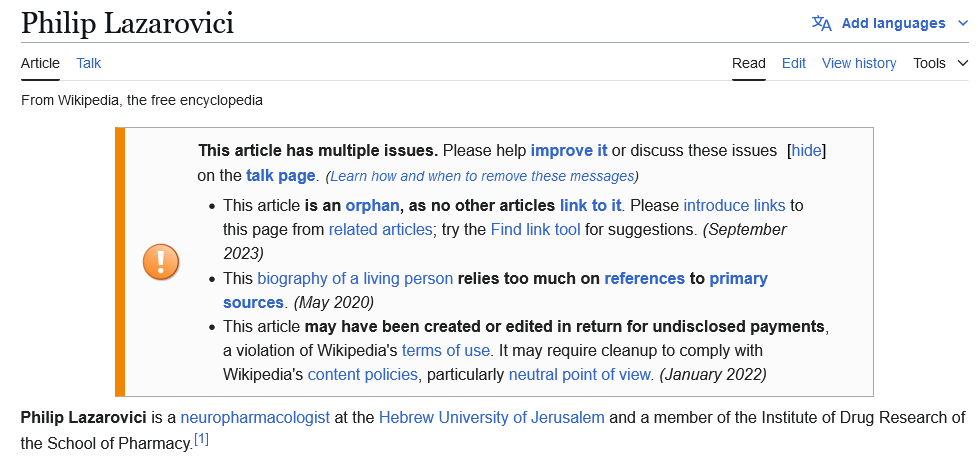
Meet Philip Lazarovici, professor of a neuropharmacology at the Hebrew University of Jerusalem in Israel. The 73 year old is far from retiring: he works on designing polymer nanoparticles “for regenerative medicine” and on curing “neurological disorders using human umbilical cord stem cells“, and will you kindly stop laughing now please? Lazarovici’s Wikipedia page is currently flagged with a note suggesting someone had paid to create it. We won’t point fingers at any Israeli professors.
The sleuth Morty (aka Indigofera tanganyikensis) stumbled upon Lazarovici while following up an issue of an incorrect use of Nrf2 antibodies, where the lab of Pandu R. Gangula at Meharry Medical College in USA, ended up studying an unrelated protein with wrong molecular weight for many years. The result is on PubPeer, Morty found other serious issues in Gangula’s papers.
As Morty followed the Nrf2 antibody lead, he reached Lazarovici. Here:
Indigofera tanganyikensis: “A panel of micrographs has been reused from an older publication (Li, Y et al., 2018; Int J Mol Med). The experimental conditions are different for the identical micrographs.)
As you see, there are no common authors between the Lazarovici paper from 2024 and the Chinese study from 2018. Whom to blame for that?
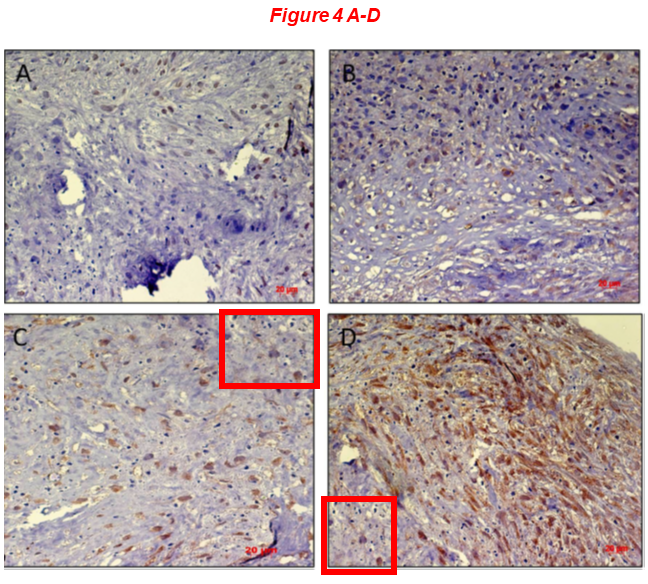
Indigofera tanganyikensis: “A flow cytometric dot plot has been duplicated in FIgure 1 and 6. The control is different. In Figure 4A,B, at least three cases of micrograph duplications are seen. In Figure 8G, a micrograph has been duplicated and modified.”
Indigofera tanganyikensis: “In Figure 7, a micrograph has been duplicated and presented differently. In Figure 9, a micrograph has been duplicated, modified (rotated) and presented differently.”
Recall that reuse of a figure from an unrelated paper, which we were ready to blame on that Chinese collaborator Wenhua Zheng. Well, turns out it was Lazarovici’s own lab which does such things!
Indigofera tanganyikensis: “Three micrographs in Figure 2 have been taken from an older publication […]. Two micrographs in Figure 3 have been taken from the mentioned paper. Furthermore, at least two internal duplications in one micrograph in Figure 3 are seen.”
This was the other paper, it is from China and there isn’t even one author in common:
“focusing on duplications of structures out of the blood vessels area that can be observed in every section is biologically meaningless and redundant to the topic of the manuscript. We are pleased with the high quality of our Pharmaceuticals paper and that scientists in the field of Matrigel tube formation provide similar and or identical results for angiogenic and anti-angiogenic compounds using the common community criteria. We welcome PubPeer to learn the field and to develop new AI-angiogenic specific tools to deep our understanding but whithout unjustified, and non-transparent allegations of misconduct. Sincerely yours, Prof. Philip Lazarovici“
Smut Clyde summarised Lazarovici’s explanations with: “If someone copied images from an earlier paper, they would also copy the original description, because they would never dream of falsifying that description. These images have different descriptions, therefore they must have come from different experiments.“
Furthermore, Dorothy Bishop noticed:
“This article has the peer review published with it, and shows something remarkable. Reviewer 1 (anonymous) says ” The similarity index report is my bigger concern. It shows 44% similarity content which must be revised to bring it to an acceptable limit.” Could this be referring to results from a plagiarism checker? It would seem so. The authors reply:
So a plagiarism check reveals plagiarism, and instead of rejecting the paper, the editor, Fedora Grande, agrees that the authors can change some words to synonyms. Beyond belief! Well, it would be but then this is MDPI.”
Yep, the Israeli lab stole a fake study from Chinese fraudsters and are proud of themselves.
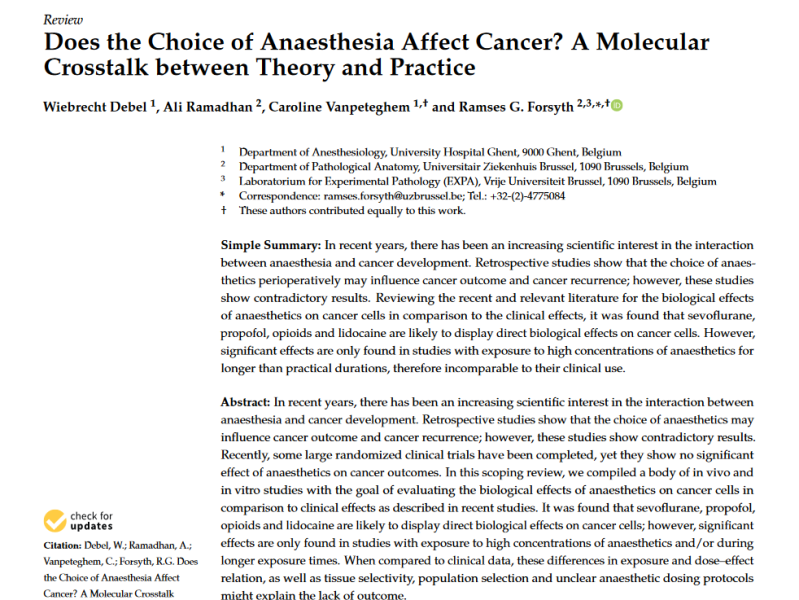
Morty reviews a review, on an important topic and written by Belgian scholars. Turns out, it is mostly referencing fraudulent and papermilled trash from China.
“In summary, your claim of identity is meaningless since photomicrographs of slices from all organs are similar and/or identical as presented in atlases of mice anatomy and pathology“
The Lahiani paper is also based on data stolen from other people or recycled from older Lazarovici studies, but the Hebrew University professor didn’t comment here:
A micrograph in Figure 2 and many of the micrographs in Figure 4 have been taken from an older publication (Mohammad Abid Sheikh et al., 2014; PlosOne).“In Figure 1, three of the micrographs have been taken from an older publication from the same research group.” [Lankri et al 2017]“A micrograph in Figure 1 has been reused from an previous publication (Cohen, G et al., 2014; J Mol Neurosci). The micrograph has been modifed.”
Is there a point to report all this to the Hebrew University? After all, for them Lazarovici is an “acclaimed neuropharmacologist”
“His groundbreaking work provided Israeli scientific community with pharmacological knowledge towards development of different drugs and elucidation of their mechanism of action.”
Fraud in two cases and attempted coercion
A few days ago, the German state prosecutor opened a criminal investigation against a former star scientists of German academia: the Technical University Dresden (TUD) psychology professor Hans-Ulrich Wittchen, who in 2021 was found guilty of massive research fraud. The journalist Jan-Martin Wiarda reported about that in Tagesspiegel on 6 November 2024, and then in more detail on his own blog (translated):
“Last week, the Dresden public prosecutor’s office announced on request that, after three years of investigations, they had filed charges against the protagonist of the scandal before the Economic Criminal Chamber of the Federal Republic of Germany The district court filed charges of fraud in seven cases, attempted fraud in two cases and attempted coercion. […] Upon request, the TU Dresden said that disciplinary proceedings under civil service law had been initiated against Wittchen, which were suspended after the Dresden public prosecutor’s office determined. The outcome of the proceedings must be awaited “as the results are crucial for the disciplinary proceedings”.”
Lorenza Colzato was a rising star of psychology and a role model for Women in STEM. All Dutch media and even some local German newspapers talk about her now. But I want to talk about her husband Bernhard Hommel instead.
Wittchen’s fraud was reported five years ago by two internal whistleblowers, in 2022 they received a badge of honour from the university. This is what it was about:
“Wittchen raised 2.5 million euros in funding from the Federal Joint Committee for the so-called “PPP study”. The abbreviation “PPP” stands for “Staffing in Psychiatry and Psychosomatics”, which is to be collected empirically as a basis so that the Federal Joint Committee can then set nationwide minimum staffing requirements for the facilities. […]
Wittchen is said to have instructed [Jens Strehle] and his colleague, Martin Holst, several times to “duplicate” the data. Which in reality is equivalent to the order would have been to manipulate and distort them. That’s what Strehle and Holst say, and that’s what an investigative commission later finds. […]
Strehle wants out of the project. He turns to another Dresden psychology professor, Daniel Leising, who is considered to have integrity at the TUD. Leising, Strehle hopes, could help him help you find another position within the university.
What he doesn’t know: that Leising himself has been watching Wittchen with increasing suspicion for years, but that he has so far lacked concrete evidence of scientific misconduct. Leising recognizes the possible explosiveness of what Strehle reports to him. With his approval, they bring in another psychology professor, Stefan Scherbaum. Together they record everything Strehle reports. And encourage him to officially report Wittchen.”
They turn to the then-Ombudsman, Achim Mehlhorn, himself a former TUD rector. I also had the displeasure to interact with Mehldorn in another fraud case, it was swiftly resolved by Mehldorn of dismissing the evidence and finding me guilty of research misconduct. Read here:
Sonia Melo, the Portuguese cheater scientist and her former US-boss Raghu Kalluri issued some days ago a biorxive preprint, which sole purpose is to defend their discredited Nature paper from 2015. There, they originally claimed to have found a unique biomarker for early pancreatic cancer, a much hailed promise to save lives of many cancer…
“Mr. Mehlhorn said that if the results of this important study were not significantly changed by the data inserted, then perhaps the matter should not be made too much of a big deal after all,” remembers Strehle. And: “The TUD already has a hard enough time in the excellence competition,” Leising quotes Mehlhorn”
After someone tipped off the media and the first reports arrived in early 2019 (beginning with Buzzfeed Germany), TUD opened an investigation. Wittchen, who previously denied that any data manipulations took place, now swiftly accused Strehle of forgery and announced to sue him and Holst (who was ordered to resign from his PhD student position). The university refused to protect the whistleblowers, but it allowed Wittchen to destroy evidence, as an investigative committee led by a lawyer from Hamburg found out:
“Meanwhile, the two whistleblowers report that Wittchen repeatedly went to the file folders with the investigation protocols, which were apparently for months still around in the institute. The investigative commission reported that it later “came across changes in quite a few documents.” There were a number of subsequent changes to the project documents “that may have been made after the allegations of data manipulation were made.””
As the investigation dragged on, Holst’s short-term contract expired and he became unemployed. Thanks to Leising, he found another job. Wittchen was at all times in close contact with the then-rector Hans Müller-Steinhagen:
“Müller-Steinhagen had been aware since 2015 at the latest that trust in Wittchen had been significantly damaged in parts of the psychology department. So Leising and his colleague Sebastian Pannasch say it in agreement. Both had repeatedly sought discussions with Müller-Steinhagen on this topic, sometimes together with others Colleagues. The reactions were rather negative. “We couldn’t stop him from again seeking advice from Wittchen in the next phase of the excellence initiative. He is also ‘not a criminal’, but simply ‘tricky’.” This is how Leising quotes Müller-Steinhagen’s reactions at the time. “
Steinhagen apparently also tried to influence the investigation on behalf of Wittchen. In early 2021, German media reported that the investigative commission accused Wittchen of research fraud and financial embezzlement (including employing his unqualified daughter for €40k a month), a criminal investigation was recommended. Which now finally opened.
Wittchen in turn sued TUD, the trial is still ongoing. In 2024, also Leising received a Badge of Honour from his university.
Competitive and self-loathing
After a long hiatus, the journalist Michael Balter published a new case of bullying in academia, in an article from 11 November 2024. The accused is a butterfly researcher: Akito Kawahara, University of Florida professor and since 2023 director of the Florida Museum’s McGuire Center for Lepidoptera and Biodiversity. Balter writes:
“…former members of his lab give him very negative reviews. Says one, in a comment echoed by the testimonies of all six former lab members I talked to:
“Akito knows how to find top talent, and over the years I’ve seen these brilliant, kind, top of their field researchers break down, doubt themselves, become severely depressed, and question themselves and their intelligence. I have sat in too many meetings listening to capable people who belong in science question whether they deserve to be there. I’ve seen friends break down and cry, and very young students put in dangerously ethical situations that could ruin the rest of their careers.”
A number of common threads run through what I was told by former lab members:
Kawahara routinely belittled students and other junior scientists both privately, in conversations with them about their work, as well as publicly in lab meetings.
Kawahara routinely misappropriated (some say stole) research ideas from his own students, used them to submit his own grants or gave them to other students or colleagues who then did the work and earned research publications.
Kawahara routinely demoted students in the list of authors on publications who in some cases had done most or even all of the research being reported.
Kawahara routinely failed to provide supervision and guidance to students and other colleagues, leaving them for long periods of time to fend for themselves.
Kawahara collected and imported insect specimens from Ecuador and other locations before permits to do so were officially approved, and encouraged students and colleagues to do the same.
Kawahara, deliberately or not, reinforced the feelings of students and other colleagues that they were at fault for failing to progress in their work, and failed to provide a nurturing environment in which young scientists could flourish.”
Former lab members complained to Balter that they “were all intentionally isolated, manipulated to be competitive and self-loathing“, to “produce higher output (# of papers, grants, awards) for Akito.” Kawahara’s strategy was described as: “Get a lot of graduate students that you don’t help at all, have them pump out a bunch of papers, and attach your name on [them] since they are your students.””
Apparently, on 15 November 2024 Kawahara had a meeting with his students were he asked them to publicly “neutralize” the allegations in Balter’s blog.
Industry Giants
Difficult decision to discontinue
The US American phenomenon of Cassava Sciences is hopefully about to end now. It was all rather Trumpian: the biotech company was totally fraudulent, their patent drug for Alzheimer’s was utter nonsense, everything they said or wrote was fake and fabricated, and yet when some sleuths exposed it, the sleuths were attacked by a far-rght mob of believers who kept investing in Cassava no matter what. Especially Elisabeth Bik was targeted, simply for being a woman.
What now? This is the company’s long-awaited announcement from 25 November 2024, about the outcome of the phase 3 clinical trial with their Alzheimer’s drug made from algae:
“Simufilam did not show a significant reduction in cognitive or functional decline versus placebo in patients with mild-to-moderate Alzheimer’s disease in the ReThink-ALZ Phase 3 study […]
Cassava Sciences, Inc. (NASDAQ: SAVA, “Cassava”, the “Company”), a clinical-stage biotechnology company focused on developing a novel, investigational treatment for Alzheimer’s disease (AD) dementia, today announced that the topline results from the Phase 3 ReThink-ALZ study of simufilam in mild-to-moderate AD did not meet each of the pre-specified co-primary, secondary and exploratory biomarker endpoints. The co-primary endpoints were the change in cognition and function from baseline to the end of the double-blind treatment period at week 52, assessed by the ADAS-COG12 and ADCS-ADL scales, comparing simufilam to placebo.”
As a reminder, previously Cassava’s fraudulent preclincial papers were retracted, its founders Remi Barbier and his wife Lindsay Burns sacked (see July 2024 Shorts), Cassava’s scientist Hoau-Yan Wang was found by his City University of New York guilty of fraud (see October 2023 Shorts) and then indicted by the federal grand jury “for defrauding the U.S. National Institutes of Health (NIH) of approximately $16 million in federal grant funds” by having “engaged in a scheme to fabricate and falsify scientific data in grant applications made to the NIH” (see July 2024 Shorts). In September 2024, Cassava settled with the Securities and Exchange Commission having been caught falsifying the results of the previous clinical trial with simufilam. And still, Cassava was allowed to go ahead with the phase 3 trial on over 800 patients. Now the new CEO Rick Barry announced:
“…the loss of cognition in the placebo group was less pronounced than was previously reported in other placebo-controlled studies in AD. […] We have made the difficult decision to discontinue ReFocus-ALZ, given the nature of today’s reported results”
In 2013, PLOS One editorial office posted this comment under the article:
“It recently came to our attention that the Academic Editor Bharat Aggarwal had collaborated and co-authored different publications with the senior author of the article over the four years that preceded this submission.”
Now, Bharat Aggarwal is a fraud legend. He was kicked out at MD Anderson, slapped with several retractions, returned to India, and continued faking curcumin stuff there (see this blog post by Reese Richardson from January 2024). His fellow curcumin pusherAjay Goel used to be at Baylor University, and is pushing curcumin at City of Hope (his PubPeer record here). Their coauthors include Mehdi Shakibaei, professor at an elite German university, LMU Munich, and Ali Mobasheri, now professor at the University of Oulu in Finland.
When the concerns about the forged data and rigged peer review arose, the paper was freshly published. Now it is too old to be retracted, so here is an Expression of Concern from 22 November 2024 (highlight mine):
“After this article [1] was published, concerns were raised about Fig 3 and Fig 6.
Specifically:
In Fig 3:
○ In the HCT116+ch3 cells, panel E (60h) appears similar to panel F (72h), when rotated 180 degrees.
○ Panel D (48h) from the HCT116+ch3 cells appears similar to panel e (40h) from the HCT116WT cells in Fig 4A of [2].
○ Panel C (36h) from the HCT116+ch3 cells appears similar to panel d (20h) from the HCT116WT cells in Fig 4A of [2].
In Fig 6A, there appear to be horizontal background discontinuities in lanes 3 and 4 of the pro-caspase-8/cleaved-caspase-8 HCT116+ch3 panel when levels are adjusted.
The corresponding author acknowledged the above concerns but stated that the original data are no longer available. In the absence of the raw data, the issues with these figures cannot be resolved.
In light of the above concerns, the PLOS ONE Editors issue this Expression of Concern.”
See, PLOS One had to wait 10 years so that the original data was officially no longer available. The issue cannot be resolved anymore.
Here another paper by this same team, this time pushing resveratrol:
“I am Jorge de Burgos. I believe research should pause in searching for the progress of knowledge. Right now, we don’t need more papers, we rather need more knowledge by going through a continuous and sublime recapitulation to figure out what is true and what is fake” – Aneurus Inconstans
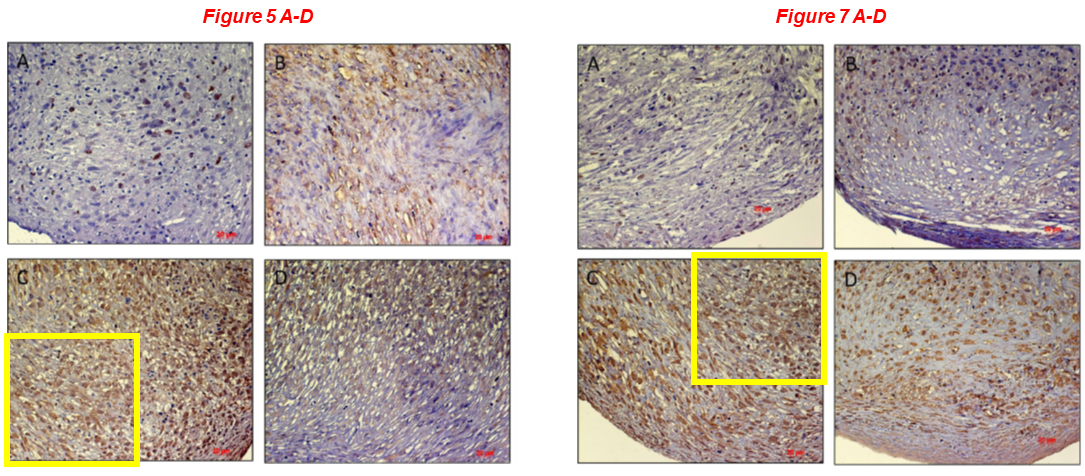
Aneurus inconstans: “Figure 4C and 4D: “(C) Strong collagen type I staining was found at 21 days (IS = 3; ES = +++). (D) Very strong collagen typeI staining was demonstrated at 28 days (IS = 4; ES = ++++).”
“Figure 4B: “Moderate collagen type I staining was observed at 14 days (IS = 2; ES = ++).” Figure 6C: “Weak RUNX2 staining was observed at 21 days (IS = 1; ES = +9).”“Figure 5C: “Very strong collagen type II staining was demonstrated at 21 days (IS = 4; ES = ++++).” Figure 7C: “Very strong lubricin staining was demonstrated at 21 days (IS = 4; ES = ++++).”
Mobasheri and his Italian friends again, this time flagged by Mu Yang:
Ochna membranacea: “Three pair of images overlapped from figure 4 and figure 6, but they all collected from different treatment.”
Retraction Watchdogging
The issues cannot be resolved
Elsewhere, PLOS One dares to retract old papers by German scientists. The affected researchers are Jürgen Eberle and Peter Daniel, both at Charité Berlin. Read about them here:
New season of the popular German TV series, ” Charité”, this time set in the early 21st century! Will Jürgen ever become professor? Will Bernd ever allow science to self-correct? Will Christoph ever catch his mechanical pursuer?
“After this article [1] was published, concerns were raised about results presented in Figs 3, 4, 6, and 7. Specifically:
The following panels appear similar:
○ The Fig 3A Bak, Bax and ꞵ-actin panels of this article [1] and the Fig 3A Bak, Bax and ꞵ-actin panels of [2].
○ The Fig 6A Mel-2a VDAC panel and the Fig 6A A357-Bcl-2 VDAC panel.
○ The Fig 6A A375 Mock Bcl-xAK panel and the Fig 6A A375 Bcl-2 Bcl-xAK panel.
○ The Fig 6B Mel-2a Bak panel and the Fig 6B A357-Bcl-2 VDAC panel when flipped vertically.
○ The Fig 7A Bcl-2 panel of this article [1] and the Fig 5A Bcl-2 panel of [2] despite being used to represent results obtained from different cell lines.
The Fig 4A Control DU145 Bax-EGFP and Bcl-xAK OFF DU145 Bax-EGFP panels appear to partially overlap.
The corresponding author responded to queries about the above, stating that they were unable to provide the raw data. In the absence of the raw data the issues with these figures cannot be resolved.
In light of the above concerns which question the reliability of the published results, the PLOS ONE Editors retract this article.
JE agreed with the retraction. MP, AMH, BG, PTD, and ES either did not respond directly or could not be reached.”
As you see, this 2012 paper was retracted for the very same reasons for which the 2013 curcumin fraud by the Aggarwal gang was exempt from a retraction at the same journal. Go figure.
Competing interests
Another retraction in PLOS One, for a set of Ukrainian authors, plus some Hungarians:
“After this article [1] was published, the following concerns were raised:
The article [1] contains citations, including by the last author, that do not support the statements in which they are cited.
There are concerns about competing interests and peer review.
A member of the PLOS ONE Editorial Board reviewed the article [1] and noted concerns about the data and analyses that were not fully resolved in post-publication discussions with the corresponding author, including a lack of unit root and cointegration tests, concerns about the interpretation of R2 and unclear reasoning for the estimation strategy.
The PLOS ONE Editors retract this article [1] due to the above concerns. We regret that the issues were not addressed prior to the article’s publication.
LV, TLM, and EY did not agree with the retraction. TGM and ZL either did not respond directly or could not be reached.”
That one was flagged on PubPeer by Alexander Magazinov for inappropriate citations, including to the authorLorant David Denes of Hungarian University of Agriculture and Life Sciences, a papermiller and creepy troll who suffered some retractions recently (read August 2024 Shorts). As it happens, Denes was the handling editor of the Ukrainian paper above, and guess who was the editor of Denes’ own paper? László Vasa of Szechenyi Istvan University, the coauthor of the Kazakh paper!
The retraction was published on 15 August 2024, over “concerns about authorship, competing interests, and peer review” and because “the reported methodology the study appears to be based on single point data with no replicates collected during sampling“.
As it happens, here is another Ukrainian paper at PLOS One edited by Vasa:
The last author Wadim Strielkowski is however Czech and affiliated with the Prague Business School (and with many other places worldwide, including two in russia, see here and here). As Magazinov found out, while the above paper was in editorially handled by Vasa, that Hungarian and Strielkowski had a joint paper in peer review in an Elsevier journal (Zheng et al 2023).
Using them in a reckless way
Elsevier must have issued the order to the International Journal of Hydrogen Energy (IJHE), which is owned by the Veziroglu family and is an utter fraud- and papermill cesspool, to retract at least some papers. But you can’t expect even a minimum of a professional behaviour from Veziroglu Sr (Tejat) and Veziroglu Jr (Emre), so this is the kind of retractions they issued:
Retraction from 19 November 2024, signed by Abdul Qayoom Mugheri
The DOI links above were all broken, I fixed them. They list 5 papers by Abdul Qayoom Mugheri in IJHE (including the above) which all received the same retraction notice. In June 2024, Mugheri retracted a paper in a Springer journal, for similar reasons, the notice also mentioned “An investigation by the University of Sindh has also ruled that the authors did not have permission to publish the data presented in this article.”
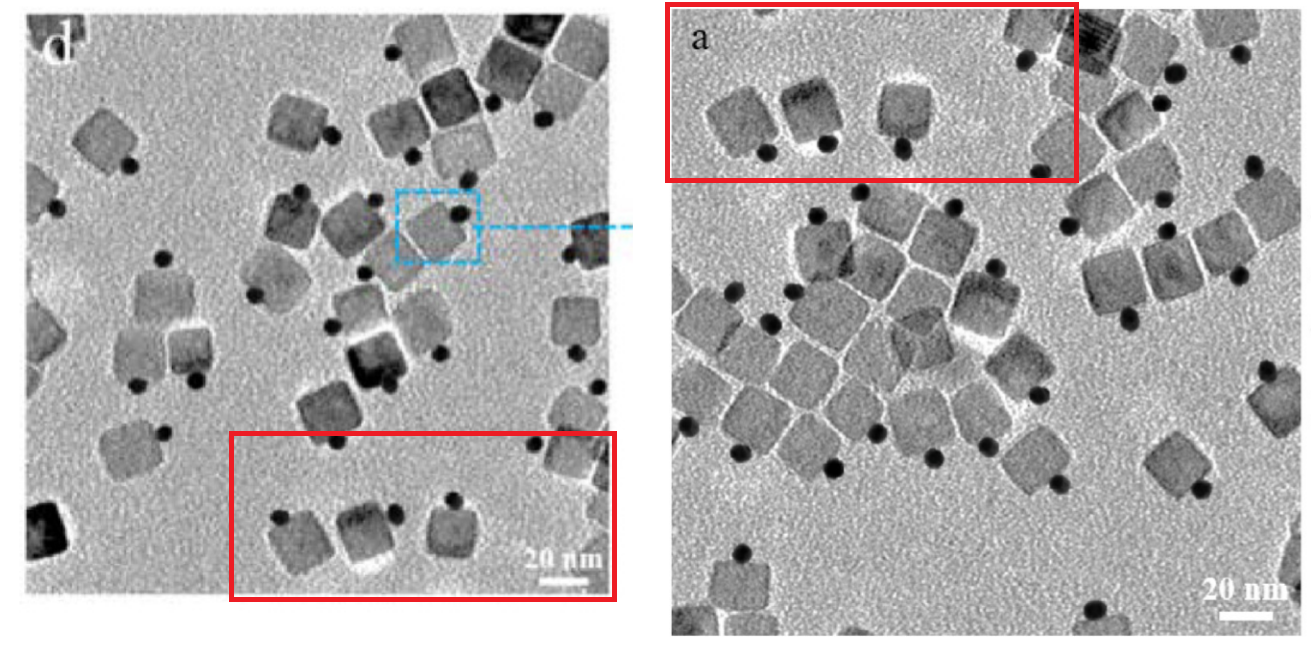
Another retraction in IJHE, the paper was flagged by Smut Clyde in January 2022:
Hoya camphorifolia: “Fig 1d (“TEM image for CuFe2O4/CdSe-3 composite”) and 7a (“TEM image … for CuFe2O4/CdSe-2 after 6 reaction cycles”). They appear to be overlapping details of a single larger image, that have been adorned with black spots – different block spots in the overlapping area.”
Also, as Smut Clyde noted:
“The References are nonsensical. The most charitable explanation is that the authors obtained a pre-existing list of generic references and slotted entries from it into the [citation here] gaps in the manuscript, more or less at random. The same list is used in numerous Ceramics International papers, producing the same incongruous absurdities – e.g. Li et al (2021), Zhou et al (2021).“
The brief and totally not unhinged retraction notice from 19 November 2024 was attributed to Li Feng:
“I found that my team and our collaborators have used the wrong images and pictures in their experiments, or they were using them in a reckless way.”
Önder Metin had a rogue PhD student whom he trusted “to ensure their academic growth”. But “mistakes were made by mistake”, conclusions are never affected. Yet those who still complain, will pay dearly.
Those were the only these 6 retractions which IJHE allowed in 2024, before that, the last retractions in that journal appeared in 2018. All ten of them affected some A. Salar Elahi and had the same text celebrating Veziroglu’s borderless wisdom and integrity:
“This article has been retracted at the request of the Editor-in-Chief.
After a thorough investigation, the Editor has concluded that the acceptance of this article was based upon the positive advice of at least two illegitimate reviewer reports. The reports were submitted from email accounts which were provided to the journal as suggested reviewers during the submission of the article. Although purportedly real reviewer accounts, the Editor has concluded that these were not of appropriate, independent reviewers.
This manipulation of the peer-review process represents a clear violation of the fundamentals of peer review, our publishing policies, and publishing ethics standards. Apologies are offered to the reviewers whose identities were assumed and to the readers of the journal that this deception was not detected during the submission process.”
According to his PubPeer record and Retraction Watch, the Iranian scholar Salar Elahi by now managed to achieve over 60 retractions.
However, manipulation of the peer-review process is actually a default setting at IJHE (read November 2024 Shorts). It is quite possible that those Salar Elahi retractions in 2018 and the new ones in 2024 only happened because someone failed to pay.
But hey, with 6 retractions in 6 years, the confidence into IJHE (impact factor 8.1) has been fully restored.
“The authors listed for this article were changed post-acceptance. The publisher was contacted by individuals claiming to be the original authors and was notified that their email account had been compromised, which lead to the change at the listed authorship. The identity of the individuals who contacted the journal could not be confirmed. Following additional investigation of the peer review process for this article, the parties have concluded that this article was originally accepted solely on the basis of a compromised peer review process. Therefore, the article must be retracted. The listed authors disagree with the retraction.”
The non-profit biomedical journal eLife has been recently delisted by Clarivate and won’t get an impact factor. However, this journal was originally founded in protest of exactly this kind of science metrics. The reason for the delisting, as reported by Science on 13 November 2024:
“Clarivate, which operates the influential Web of Science database, said a review determined the journal’s novel publishing model adopted in January 2023—which includes public peer review but no final decision on whether a manuscript is accepted or rejected—does not meet its standards for peer review.
The decision could put eLife’s financial viability at stake, says Randy Schekman, the journal’s founding editor, who left its editorial board after opposing the new publishing model. The open-access journal charges authors whose manuscripts it reviews $2500 each, a key source of revenue. “Not that I give a damn about impact factor, but … its sudden withdrawal will precipitate a drop in submissions,” he says. […]
eLife publishes every manuscript it sends out for peer review regardless of whether the reviewer comments are positive or negative; the reviews are then posted with the article, which are free to read. eLife editors also characterize the article’s strength of evidence.
Manuscripts the editors designate as “incomplete” or “inadequate” still appear under the eLife banner, and Clarivate found this unacceptable,”
“I never agreed to collaborate with this organization. END OF STORY!” – Sir J Fraser Stoddart “I do not know what your business is, and I find the email below highly offensive.” – Morten Meldal
Indeed, garbage papers which failed peer review in eLife are added to CVs and even advertised in press releases as successful publications in that journal. Case at hand, the Chinese data Jujube promoted in News Medical as a cure for Alzheimer’s and Parkinson’s:
“In a recent study posted to eLife, a team of researchers evaluated the neuroprotective and rejuvenating effects of non-extracted simple crush powder of Zizyphi spinosi semen (ZSS) in preventing neurodegenerative diseases and enhancing cognitive function in aged mice. […]
This powder significantly reduced Aβ, tau, and α-synuclein oligomers, restored synaptophysin levels, increased BDNF expression, promoted neurogenesis, and improved cognitive and motor functions in various mouse models.
Additionally, ZSS powder decreased DNA oxidation and cellular senescence in aged mice, enhancing cognitive performance to levels similar to those of young mice. “
eLife describes that paper as “reviewed preprint” which was not revised, the negative reviewer reports are published.
The Jujube berries were provided by the Chinese company Auropure LifeScience Co. The authors own their own supplement company, as the conflict of interests statement reveals:
“Takami Tomiyama is a founder of Cerebro Pharma Inc., and Tomohiro Umeda and Ayumi Sakai are/were members of that company. NOMON Co., Ltd. is a subsidiary of Teijin Ltd. and has the same address as Teijin. Kei Yamana and Ryota Nakajima belong to both NOMON and Teijin. Cerebro Pharma and Teijin funded this study, discussed the research plans and results, and jointly applied for a patent on ZSS.”
Kei Yamana is in fact the CEO of NOMON, which currently sells Wasabi to improve cognitive functions.
Reach for a treat
Chocolate once again proved as a magic cure for everything, this time by scholars from the University of Birmingham in UK.
Chocolate is good for your health, scientists keep saying. This may sound counter-intuitive; given that chocolate is an extremely calorie-rich confectionery, which mostly contains industrially refined cocoa fat and huge quantities of added sugar, a substance finally about to be recognised as the prime cause for the obesity epidemics. A recent clinical study from the…
“A cup of cocoa could protect you from the negative effects of fatty comfort foods during times of stress, new research suggests. […] a small study has found that drinking cocoa (the key ingredient in chocolate) high in flavanols with a fatty meal can mitigate some of the impact the food has on the body. […]
Dr Catarina Rendeiro, assistant professor in nutritional sciences at the University of Birmingham, and leading author, said: “We know that when people are stressed, they tend to gravitate towards high-fat foods.
“We have previously shown that fatty food can impair the body’s vascular recovery from stress.
“In this study, we wanted to see if adding a high-flavanol food to the fatty meal would alleviate the negative impact of stress in the body.””
And they succeeded. This is the study, published by the Royal Society of Chemistry:
Rosalind Baynham , Jet J. C. S. Veldhuijzen Van Zanten, Catarina Rendeiro Cocoa flavanols rescue stress-induced declines in endothelial function after a high-fat meal, but do not affect cerebral oxygenation during stress in young, healthy adultsFood & Function (2024) doi: 10.1039/d4fo03834g
“For the study, researchers gave 23 healthy adults two butter croissants with 10g salted butter, 1.5 slices of cheddar cheese and 250ml whole milk for breakfast, and either a high-flavanol cocoa or a low-flavanol cocoa drink.
After an eight-minute rest period, the group was asked to complete a mental maths test which increased in speed for eight minutes, alerting them when they got an answer wrong […]
The researchers also found that eating fatty foods with the low-flavanol drink when stressed reduced blood vessel function, and lasted up to 90 minutes after the stressful event was over.
But the cocoa drink high in flavanols prevented the decline in blood vessel function following stress and fat consumption, the study published in the journal Food And Function found.”
Professor Jet Veldhuijzen van Zanten is quoted with advice to “reach for a treat when stressed“.
Christmas season is the time to eat lots of chocolate. And as science teaches us, your confectionery is actually the superfood which will make you healthy, slim and clever. Good for you, good for the chocolate industry which often generously sponsors such scientists. In May 2016, I brought a story about chocolate health research and…
It was a continuation of an earlier study by same authors, published in MDPI:
Rosalind Baynham , Jet J.C.S. Veldhuijzen Van Zanten , Paul W. Johns , Quang S. Pham , Catarina Rendeiro Cocoa Flavanols Improve Vascular Responses to Acute Mental Stress in Young Healthy AdultsNutrients (2021) doi: 10.3390/nu13041103
The new study found that “flavanols […] do not impact cerebral oxygenation“, which is a bit unfortunate given this previous and much acclaimed discovery of Catarina Rendeiro:
Gabriele Gratton , Samuel R Weaver , Claire V Burley , Kathy A Low , Edward L Maclin , Paul W Johns , Quang S Pham , Samuel J E Lucas , Monica Fabiani , Catarina Rendeiro Dietary flavanols improve cerebral cortical oxygenation and cognition in healthy adultsScientific Reports (2020) doi: 10.1038/s41598-020-76160-9
Also in 2020, Rendeiro decided that red wine is as good for your health as cocoa because red wine flavanols “have the potential to improve vascular health in at risk human populations, particularly in regard to lowering systolic blood pressure.” Before focussing on cocoa, Rendeiro advocated for blueberries as flavanol source for improving “vascular function in healthy men” (Rodriguez-Mateos et al 2013) and for “spatial memory improvements” in mice (Rendeiro et al 2012). Blueberries are incidentally is yet another food industry market.
Chocolate however is a much bigger market. Rendeiro early on proved that dietary levels of cocoa flavanols “improve spatial memory performance” (Rendeiro et al 2013) and “lead to significant reversals of age-related deficits on spatial memory and learning” (Rendeiro et al 2012).
Eat as much chocolate as you can, it’s good for your health.
Donate!
If you are interested to support my work, you can leave here a small tip of $5. Or several of small tips, just increase the amount as you like (2x=€10; 5x=€25). Your generous patronage of my journalism will be most appreciated!
I read “Reach for a treat” with great interest.
First of all, I have nothing to do with those researchers or the line of investigation. But I’m confused about what’s the problem with those papers. You may consider that the topic is over advertised, OK, but as long as they have no fraudulent data, why questioning them at this point?
Because chocolate is NOT good for your health no matter what science keeps saying. In fact, often such researchers receive money from Mars or Nestle and forget to declare it. See my linked articles.
Well, I am not defending Plos One, but an EOC for the curcumin fraud is better than nothing. There are journals out there which will NEVER issue an EOC, no matter what. For example, I’m still in shock that Endocrinology never addressed the papers below:
PubPeer – Western Diet Modulates Insulin Signaling, c-Jun N-Terminal K…
PubPeer – A central role for neuronal adenosine 5′-monophosphate-activ…
PubPeer – Regulation of Cbl-associated protein/Cbl pathway in muscle a…
PubPeer – Osteocalcin reverses endoplasmic reticulum stress and improv…
PubPeer – Both early and delayed treatment with melanocortin 4 recepto…
PubPeer – Melanocortin 4 receptor activation protects against testicul…
Re: Cassava … the notion that removing β-amyloid will delay or reverse Alzheimer’s disease is as elegant and sophisticated as the notion that raking the autumn leaves will somehow delay winter.
I can understand why academics continue to waste taxpayer money on this nonsense to keep their careers afloat but, for the life of me, can’t understand why investors would continue to throw their millions away on this utter fantasy.




















 For Better Science
I read “Reach for a treat” with great interest.
First of all, I have nothing to do with those researchers or the line of investigation. But I’m confused about what’s the problem with those papers. You may consider that the topic is over advertised, OK, but as long as they have no fraudulent data, why questioning them at this point?
LikeLike
Because chocolate is NOT good for your health no matter what science keeps saying. In fact, often such researchers receive money from Mars or Nestle and forget to declare it. See my linked articles.
LikeLiked by 2 people
Then it’s good they didn’t use chocolate but cocoa. Not the same thing (check the nutritional facts)
(not arguing against the lack of disclosure!)
LikeLike
Yes, luckily the times when dark chocolate was fed to patients as medicine are over.
Now it’s cocoa.
Because flavanols.
LikeLike
Hello, respected Dr. Leonid Schneider. Your article was reprinted by WeChat official account.https://mp.weixin.qq.com/s/h2xef0-hhcFT-YhtWLhkHQ
LikeLike
Dear Dr. Leonid Schneider, I believe this has already been approved by you, right?
LikeLike
Well, I am not defending Plos One, but an EOC for the curcumin fraud is better than nothing. There are journals out there which will NEVER issue an EOC, no matter what. For example, I’m still in shock that Endocrinology never addressed the papers below:
PubPeer – Western Diet Modulates Insulin Signaling, c-Jun N-Terminal K…
PubPeer – A central role for neuronal adenosine 5′-monophosphate-activ…
PubPeer – Regulation of Cbl-associated protein/Cbl pathway in muscle a…
PubPeer – Osteocalcin reverses endoplasmic reticulum stress and improv…
PubPeer – Both early and delayed treatment with melanocortin 4 recepto…
PubPeer – Melanocortin 4 receptor activation protects against testicul…
LikeLike
Ah, Mario Saad and Francesco Squadrito. Maybe we should remind the journal
LikeLike
Re: Cassava … the notion that removing β-amyloid will delay or reverse Alzheimer’s disease is as elegant and sophisticated as the notion that raking the autumn leaves will somehow delay winter.
I can understand why academics continue to waste taxpayer money on this nonsense to keep their careers afloat but, for the life of me, can’t understand why investors would continue to throw their millions away on this utter fantasy.
LikeLiked by 1 person