Schneider Shorts 26.07.2024 – A catharsis for science in Porto
Schneider Shorts 26.07.2024 - a sleuth conference in Porto, one cat's week of fame, retractions for various famous luminaries in UK, USA and Switzerland, and finally, a Jesus miracle of turning old mice into supermodels.
Schneider Shorts of 26 July 2024 – a sleuth conference in Porto, one cat’s week of fame, retractions for various famous luminaries in UK, USA and Switzerland, and finally, a Jesus miracle of turning old mice into supermodels.
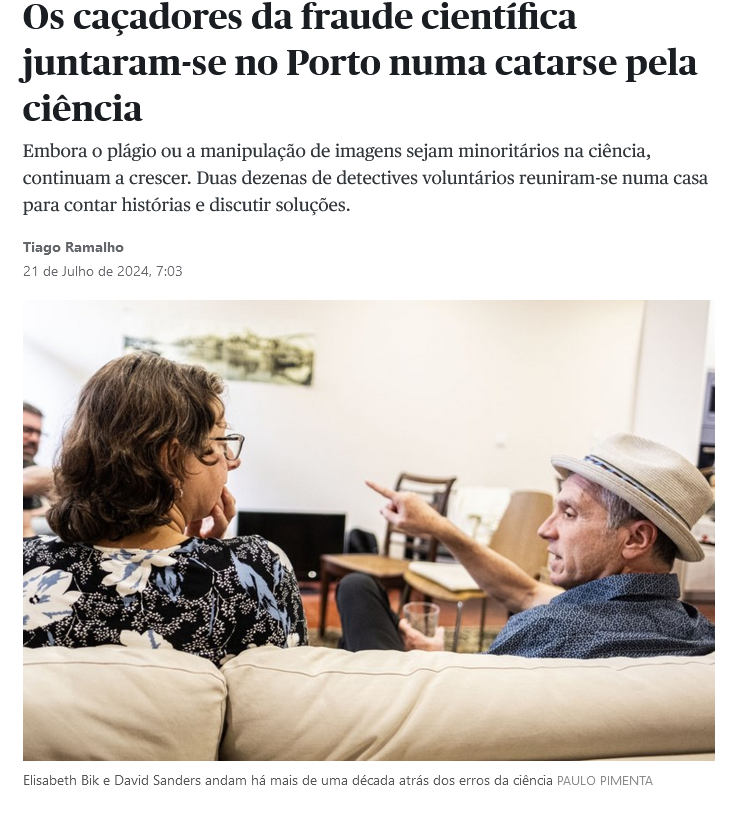
I was in the lovely Portuguese city of Porto just recently – meeting many of my colleagues, the best data integrity sleuths there are. It was our second in-person meeting, after the 2023 event in Prague. Not everyone from our growing sleuthing team could make it to Portugal, but most did, plus some significant others. And: our meeting isn’t secret anymore, because Portuguese journalists were invited and they now published an article in Publico, on 21 July 2024, headlined “Scientific fraud hunters gathered in Porto in a catharsis for science“.
Translated:
“No one gets paid for hunting down suspicious images and graphs from published studies, Least of all the volunteer “detectives” who have helped uncover cases of plagiarism, image manipulation or even accidental mistakes that were published to escape the scrutiny of scientific journals. It’s not a new problem, but the detective community has grown. And the number of fraudulent articles has also increased, argue seven detectives gathered on the long sofa (one of those in “L”-shaped) of a small guest house in Porto. “It’s easy to do and no one is really punished. You can get away with a lot of things”, says Rene Aquarius, a researcher at the Radboud University Medical Center (Netherlands).
“Where to start?”, one wonders in the basement of this accommodation. Over the course of two weeks, two dozen of these scientific fraud hunters visited a discreet house in downtown Porto, to get to know each other, discuss trends, techniques and, of course, tell stories that provoke laughter, but also dismay – there are personal attacks, recurring insults and even lawsuits.”
Some of the sleuths present agreed to be named and even photographed:
“David Sanders, a researcher at Purdue University (United States), had a long legal dispute with a famous cancer researcher, Carlo Croce, from Ohio University (United States) […]
Kevin Patrick doesn’t mind giving his name, because his work has nothing to do with science – he himself has no background in the field. Those who visit these forums will know this American by another name: Cheshire, like the cat in Alice in Wonderland. He is responsible for this second meeting of detectives, after the trip to Prague last year. This time Porto is hosting this meeting, with long conversations on the huge sofa. The background noise is noticeable: vegetables are cut at the beginning of the conversation, which only ends when lunch is practically on the table”.
Little did the journalists know: the weirdo cooking that vegan lunch was the by far most hated individual in science today. He whose name can’t be spoken, as everyone perusing For Better Science knows.
“Fraud in science is by no means prevalent. But it has been gaining ground in other formats besides classic plagiarism or image manipulation. Nick Wise, from the University of Cambridge (UK), turns to his computer to give an example: buying places as an author in a scientific article. He searches on Facebook and finds an advert: more than 1000 dollars to be the first author of the article, 100 dollars if you want to be the fifth author.
Academics want to publish scientific papers, they want their names on the papers. The more papers you have, the more productive you seem and the more likely you are to get a job or promotion. It’s a huge incentive for people to buy authorship,” explains Nick Wise.
Another growing problem is called “paper mills.” As the name suggests, these are small companies responsible for mass-producing scientific articles. Rene Aquarius got his start in this fraud-hunting world thanks to one such case. While working on a systematic review of animal studies on a particular disease, he found more than 600 scientific articles~an unusually surprising number. “We thought it was suspicious,” he recalls. “We’re still analyzing it, but so far 30 percent of the literature published in our field has problems.”
No one does this full time except Elisabeth Bik, one of the best-known scientific detectives and one who has been repeatedly cited as an encouragement to others to venture down this path. “
Papermill sleuths Reese Richardson and Nick Wise (who were both present at the Porto meeting and even photographed for the Publico article) learned from the best and created world’s most cited cat. Richardson blogged about it on 18 July 2024. It started with a social media advertisement which Wise found:
The June 28, 2024 advertisement claiming “we help you to boost your citations” with proof aplenty.
“The advertisement links to several success stories consisting of unredacted “before” and “after” screenshots of clients’ Google Scholar profiles. These clients had apparently bought anywhere between 50 and 500 citations each. […]
Example “before” and “after” citation counts for one apparent client. By paying this company for their services, this client doubled their h-index and quadrupled their citation count.
How was this company so effective at manipulating citation counts? […]
Inspecting citations to these clients revealed dozens of papers authored by such celebrated names as Pythagoras, Galileo, Taylor and Kolmogorov. The papers were not published in any journal or pre-print server, only uploaded as PDF files to ResearchGate, the academic social networking site. They had since been deleted from ResearchGate, but Google Scholar kept them indexed.”
Those papers were Mathgen-produced nonsense, their sole purpose was to carry citations to papers from paying customers. So Richardson and Wise went to ResearchGate to make a cat famous. Not just some cat, but a cat named Larry, belonging to Richardson’s grandparents.
“First, we generated 12 papers (using Mathgen) with Larry Richardson as the sole author. We then generated an additional 12 papers not authored by Larry, editing the LaTeX document of each paper so that each cited every one of Larry’s 12 papers (12 papers with 12 citations each = 144 citations with an h-index of 12). Next, we uploaded the papers to ResearchGate, all under the same profile.”
They created a fake yet “verified” .edu email account to make it easier. Then, Larry the Cat (not that one) was added as author manually to satisfy ResearchGate‘s requirement that only authors can upload papers.
Bypassing one of ResearchGate’s research gates is as easy as clicking “Add more authors”.
They waited for Google Scholar to scrape the ResearchGate data, and, success: 132 citations and h-index of 11 for Larry Richardson, the cat!
And this how even you can inflate your Google Scholar profile easily! Well, not for long, a week later the fun was over. Reese added this update on 24 July 2024:
“Google Scholar has removed all of Larry’s original papers and citing papers and with them, his citations! […] Larry held the title of world’s highest cited cat for exactly one week. His papers (and citations) remain intact on his ResearchGate profile. […]
Curiously, Google Scholar has not removed any of the fake papers citing the paper mill’s clientele. Google Scholar could still fix their part of the citation manipulation problem, but as of right now, they have instead taken targeted action against a cat.”
Retraction Watchdogging
Authors’ institution did not respond to our request to begin an investigation
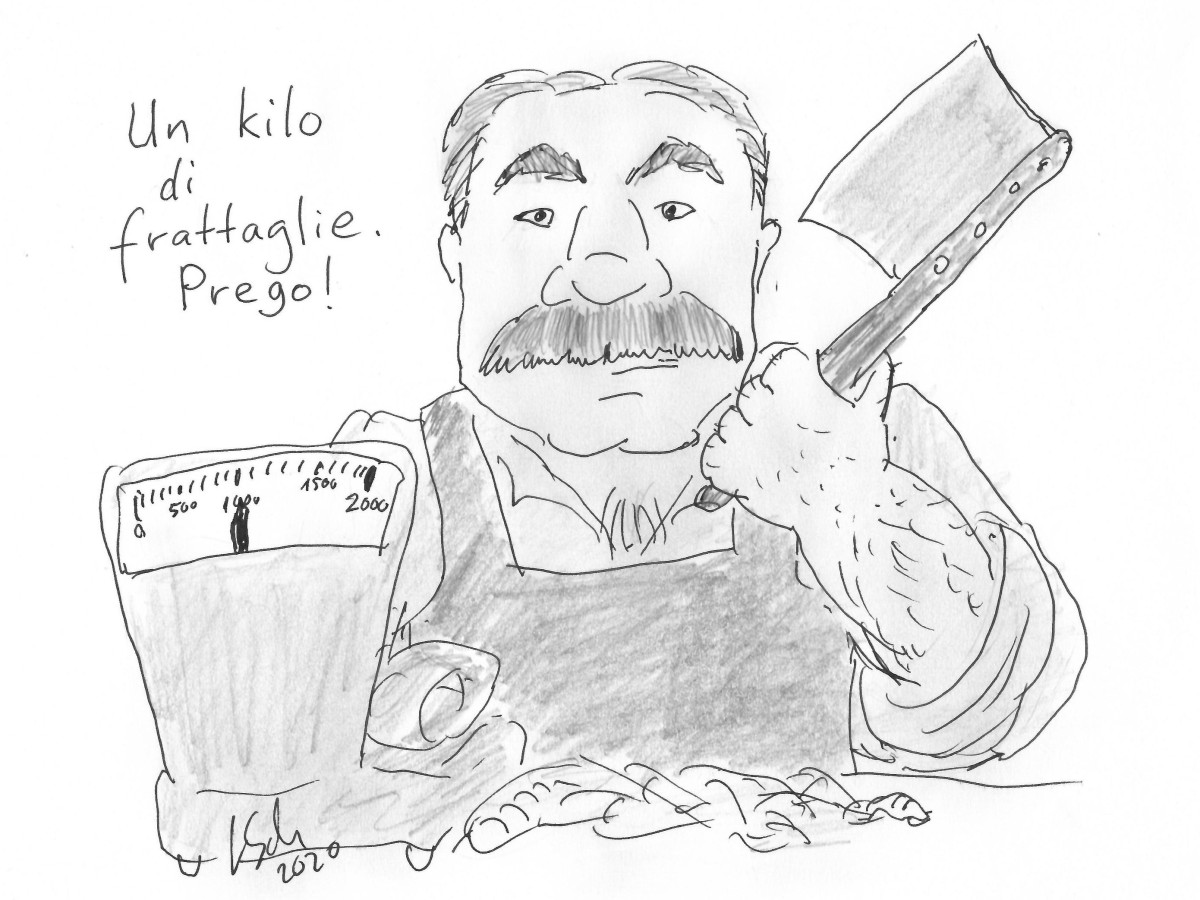
A retraction for a certain Italian medicine professor named Stefano Fiorucci, about whom I wrote here (since he is suing that bad surgeon Gabrio Bassotti who is suing me):
“…request for preventive seizure made on 12.4.2024 by the Public Prosecutor in charge, concerning the article under indictment, still accessible on the website called forbetterscience.com, although it appears to have been removed from the blog.repubblica.it website (referred to in the indictment)…”
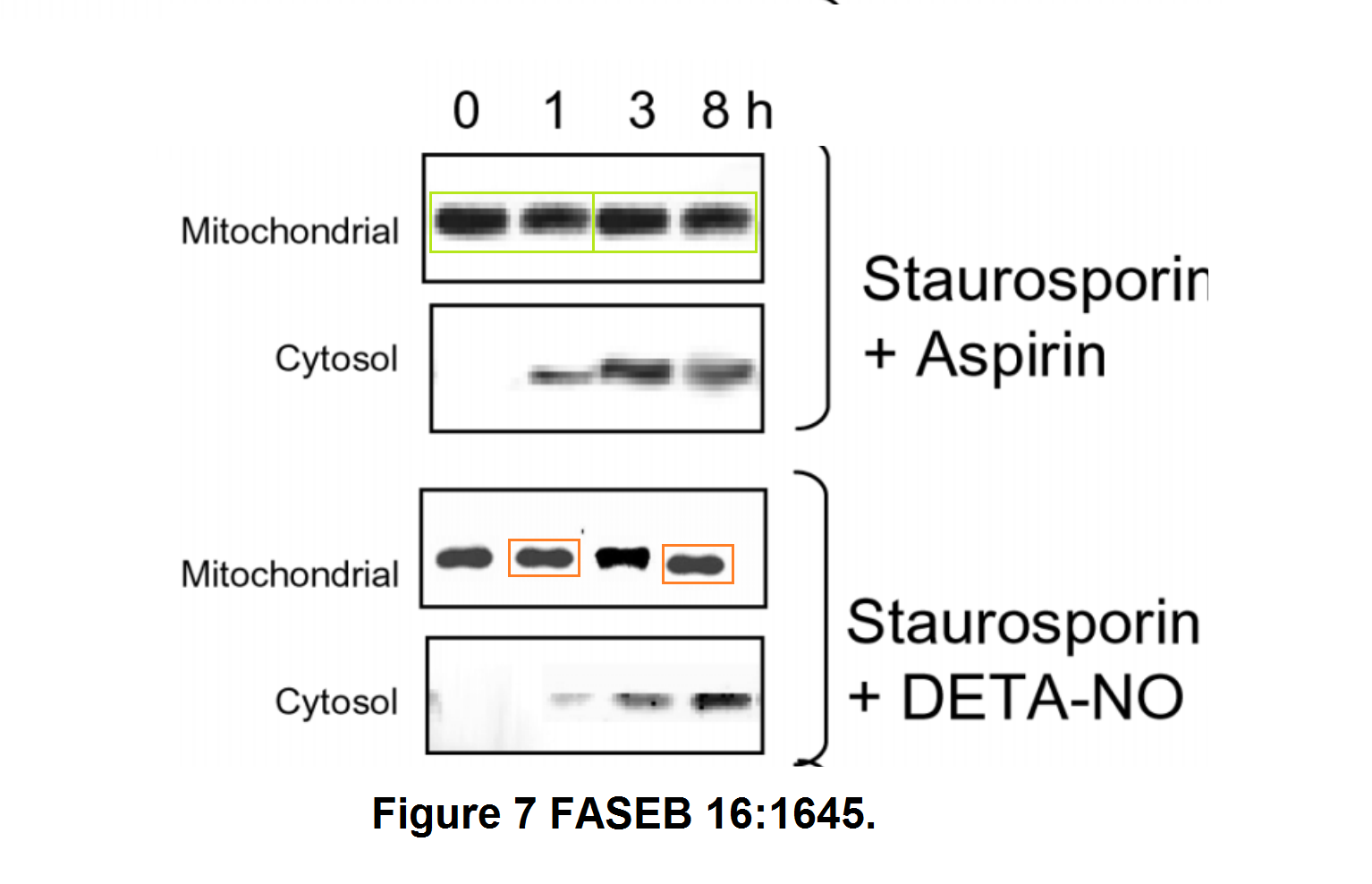
“The retraction has been agreed due to concerns raised by a third party regarding the similarity of blots in Figure 7. The authors did not respond to inquiries by either the society or the publisher. In addition, the authors’ institution did not respond to our request to begin an investigation. An investigation by the society and the publisher determined that there is overwhelming evidence that images in Figure 7 were manipulated. Because the images in question were imperative to the conclusions presented in the article, all parties agreed the article must be retracted.”
The referenced and unresponsive institution of the corresponding author Fiorucci is the University of Perugia in Italy. Why should they investigate indeed. This university promoted Bassotti instead of investigating him, and he still sued them. Italy is a crazy place for science, I suspect they only investigate and sanction whistleblowers there.
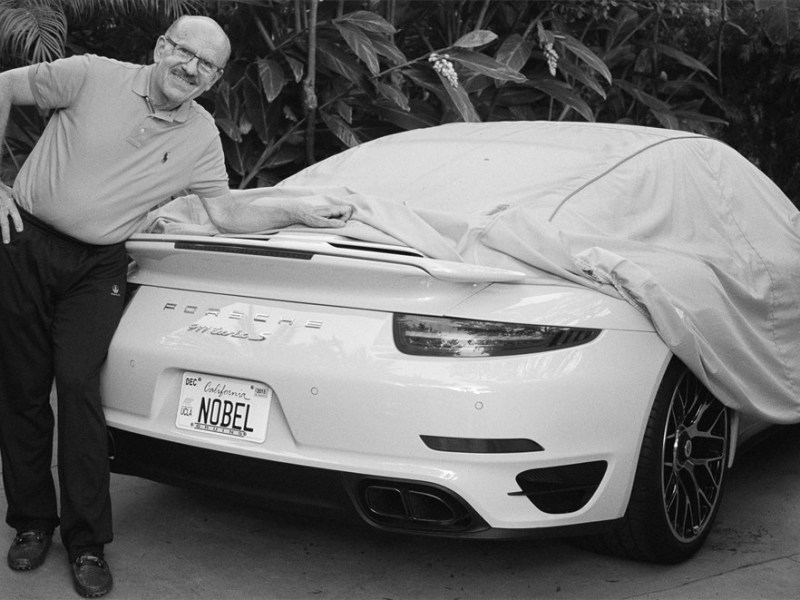
Fiorucci trained under two superstars. One was the Italo-American cheater and Nobel Prize laureate Louis Ignarro, I wrote about their common papers here:
“The presence of such articles online have severely affected Dr. Louis J. Ignarro’s public reputation, and his personal life. Dr. Ignarro disputes any accusations of wrongdoing. There was no fabrication of data, although there was a mistaken duplication of data which occurred due to error. None of the data was false.” -J.L. Perez, Esq.
The other famous mentor of Fiorucci’s was Sir Salvador Moncada, FRS, FRCP, FMedSci, former director of the UCL Wolfson Institute, trained by dodgy Nobel Prize laureate Sir John Vane. Moncada himself almost got the 1998 Nobel Prize, which then Ignarro got instead. And you may recall: Moncada is the last author of the now retracted paper.
This is already the fifth retraction for Moncada, as I briefly wrote in February 2024 Shorts. In 2012, Retraction Watchwrote about three retractions from his UCL lab:
“Assegid Garedew, formerly a senior research investigator in Salvador Moncada‘s group, stepped down earlier this summer in the midst of an investigation that should be completed soon, Moncada tells Retraction Watch. […] Moncada tells us:
There has been an investigation at UCL which is about to be completed. It indicates that the person solely responsible for the fraud leading to the retraction of the three papers is Dr Garedew. He has admitted this and resigned as a senior research investigator in my group on the 19th June. We do not expect to retract any other paper from this laboratory since Dr Garedew was not involved in any of the other research projects.“
In the Retraction Watch universe, the world is simple, fair and justice is always served. The junior fraudster is always fired and the highly decorated white male senior PI is usually the victim. But as it happens, not only was Moncada’s expectation to limit it to 3 retractions wrong, also: two out of five of his present retractions are without that naughty Garedew. And there is even more on PubPeer, waiting for editorial action.
Not only useless, but dangerous publications
A retraction for some bigwigs in USA. Another co-author is a certain US professor named James A. McCubrey, an associate of the Ferrarese cheaters Giorgio Zauli and Luca M. Neri:
“The Ethics Commission of the University of Ferrara, in response to the request for opinion presented by Prof. Giorgio Zauli (registered on 1 June 2018, Repertory no. 60/2018 – Prot. n. 66968) does not detect any violations of the University Code of Ethics.”
Fig 6A “Apparent duplication of mice. However the illumination signal has probably been changed.”
A PubPeer user shared a message from the Nature-family journal Leukemia, which they received in November 2014:
“Thank you for your email and apologies for the delay in getting back to you. The authors of this article have provided the Editors with a higher resolution version of the figure in question, which clearly shows that there is no duplication. We appreciate you bringing this issue to our attention.”
Ten years on, no new things came to light, yet something happened. A retraction was published on 18 July 2024:
“The Editors-in-Chief have retracted this article after concerns were raised about the data. In Figure 6a, several images of mice appear to have been duplicated, while the bioluminescence signals of these images differ. As a result of these issues, the Editors-in-Chief no longer have confidence in the reliability of these data or the conclusions presented in the article.
D H Mak and J McCubrey stated that they neither agree nor disagree with this retraction. M Konopleva and M Andreeff disagree with this retraction. The remaining authors did not respond to correspondence from the Publisher about this retraction.”
The 81 year old Michael Andreeff of MD Anderson in Houston, Texas and his former postdoc Marina Konopleva (now at Albert Einstein College of Medicine in New York) have many common papers on PubPeer. I wrote about some of their problematic papers here:
A breast cancer foundation celebrates its research heroes. Read now here about how great US scientists from Harvard, MIT, Weill Cornell and MD Anderson cure cancer.
And in January 2024 Shorts, I wrote about Elisabeth Bik’s findings of massive image fraud in a paper Konopleva coauthored with her MD Anderson colleague, Mario Marques-Piubelli.
Andreeff has a russian name, but he is a German. MD Anderson celebrates him as “a pioneer in flow cytometry since 1971, when he established the first flow cytometry laboratory at the University of Heidelberg“. Konopleva is russian and trained in St Petersburg. She came to USA as Andreeff’s postdoc, then became a faculty member at MD Anderson. I will let you speculate about the exact nature of their relationship to each other.
Tell me who are your friends and I will tell you who you are. Andreeff published together with Carlo Croceand George Calin, their common utterly fake paper Garzon et al 2007 has been corrected in 2022.
Indigofera tanganyikensis: “Figure 5: How to explain the broken gating lines and axis? Figure 6: Western immunoblotting should not be a cut-and paste collage. “
Indigofera tanganyikensis: “This publication was an important basis for further clinical studies of Bardoxolone for treatment of chronic kidney disease. The phase 3 study failed due to safety issues. In Figure 4c, the Western immunoblots are questionable. In Figure 5b, there is a discontinuity in the p-AMPK blot, but not in the control AMPK blot.”
“In Figure 8, data has been duplicated and presented as something else.”
Andreeff’s and Konopleva’s PubPeer record is old, but when you suffer no consequences, you continue as before. Study from 2023:
“Figure 7G. Much more similar (different exposures) than expected for 2 different cell lines.”
Gautam Borthakur is another professor at MD Anderson. This is how they chose their people, I’m afraid. This is fresh and dodgy also, will anyone ask for raw data?
Oncotarget, the somewhat controversial OA journal, switched from pretend-soliciting my services to threatening to sue me for defamation. Their lawyer writes my disrespect caused them financial damage.
And here is Andreef celebrating in 2017 the papermill-infested garbage journal Oncotarget, just before it was delisted by Clarivate. Just because the owner Mikhail Blagosklonny published Andreev’s and Konopleva paper without any proper peer review:
Dr. Blagosklonny has done an outstanding job swimming against the stream because most journals that have very fast turnaround times lack good peer review, and therefore the quality of papers is not good. This is different for Oncotarget due to its editor who has previously done this for cell cycle. And, consequently, he’s publishing excellent papers that people are eager to get out for a variety of reasons.
So, I think it’s an excellent model, but it completely depends on the quality of the editor and chief. There are so many junk journals and hundreds and hundreds of new journals that have no peer review. Therefore, the publications in these journals are not only useless, but dangerous, because most of the statements are probably flawed and will never be reproduced.
I personally like this particular journal, Oncotarget, and I will certainly continue to publish there, especially data that we need to get out. For instance, for filing patents or for particular grant purposes, where we don’t want to go through peer reviews that may easily last six to 12 months.”
Correction November 2019: “Due to errors in image assembly, a western blot (TSC2) in Figure 3B was accidentally duplicated. […] The authors declare that these corrections do not change the results or conclusions of this paper.”
The Haybäck paper is one of those that I am proudest of
Congratulations to Adriano Aguzzi on his first retraction!
The prion researcher Adriano Aguzzi used to describe his Pubpeer critics as “lowlifes”, and himself as a victim of a lynch mob. But after Elisabeth Bik helped him find even more mistakes in his papers, Aguzzi changed his stance.
What do you say to that. His University of Zürich and the university hospital took great care that poor professor Aguzzi suffers no consequences despite his fudged figures or his made-up PhD degree. But at one journal, the editors apparently refused to do as they were told. And the paper was already corrected!
The paper was criticised on PubPeer for gel splicing and image duplication already in July 2013:
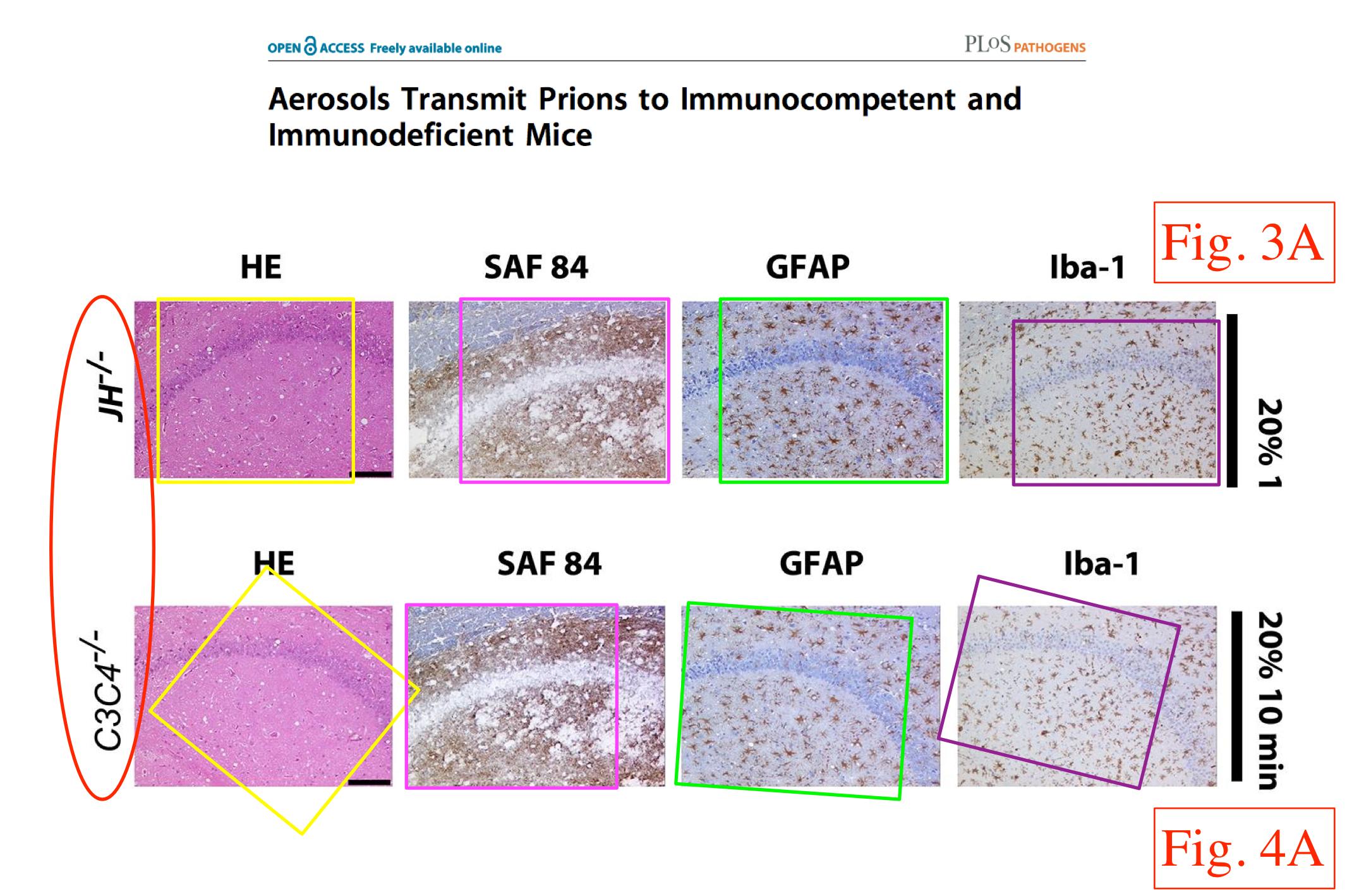
“microscopy images that are reused to represent two different mouse strains (JH-/- and C3C4-/-) in Figs. 3A and 4A”
This was Aguzzi’s reaction on PubPeer back in 2013:
” it became clear that some of the self-appointed “peers” are more interested in mud-slinging than in post-publication review and quality control of science. I see no need to defend my work against a group of anonymous detractors who negate a priori my integrity, yet are not even prepared to identify themselves. Suffice it to say that Mathias Heikenwälder and I have gone carefully through all original data and we confirm that none of the alleged “manipulations” were performed. We stand fully by the findings which we have reported. […] What we are NOT going to do is to engage in shouting match with anonymous individuals who make libelous and unfounded accusations. Please note that I will NOT make any further comments or communications on this forum.“
I also have written about the first author of that paper, Johannes Haybaeck, now professor at Medical University of Graz in Austria, in February 2024 Shorts. In brief: at around 2020, Haybaeck was sacked by a university in Germany because of “hundreds of false findings at the pathology department at Magdeburg University Hospital”, specifically, because of Haybaeck’s “39 cases […] had serious physical consequences for patients. In nine cases there was suspicion of negligent homicide.“:
“Under the responsibility of the former head of the institute, Johannes H., between 2016 and November 2019, 694 tissue samples were incorrectly diagnosed in the pathology department at the university hospital between 2016 and November 2019 – in 52 with clinical consequences for those affected. After the incidents became known, the University Hospital dismissed Johannes H. and reported particularly serious cases. The house also arranged for a total of 5,855 tissue samples to be re-examined by external institutes.”
Back to the retracted paper. In 2015, Haybaeck agreed “that a mistake may have occurred” and announced that “a correction will be published in the PLoS Pathogens paper.” Indeed, a Correction was published in February 2016, and mentioned:
“The authors would like to correct Figs 3, 5 and 6. In Fig 3, an error was introduced during the preparation of the figure for publication. […] The authors also wish to clarify that the original blots for Figs 5E and 6D contained redundant lanes which they had removed from the images while preparing the figures. […] The authors confirm that these changes do not alter their findings.”
Also in February 2016, Aguzzi returned to PubPeer to insult his critics some more:
“It is, however, also true that the anonymity of PubPeer is occasionally being used for libel and defamation – sometimes by fellow scientists with an axe to grind, and sometimes because some people gloat in bringing down “famous” luminaries. […] Now, I have been active in research since 1982. Over the past 34 years, I have published >450 paper. Notwithstanding the error in Fig. 3A, the Haybäck paper is one of those that I am proudest of. Our discovery of aerosols as prion vectors has led to a significant reassessment of the safety procedures for lab work with prions. […] In summary, if my scientific legacy will turn out to be a better protection from occupational hazards for students, postdocs, and lab technicians, well, that is a legacy that was worth working for, and one that I am proud of.”
This retraction must really hurt this famous luminary. Issued on 18 July 2024:
“After this article [1] was published and subsequently corrected in [2], the corresponding authors informed the journal editors of additional concerns in the published results. Editorial assessment identified issues in Figures 1, 3 and 4. Specifically:
The top right region of the Fig 1H C57BL/6 HE panel appears similar to the bottom left region of the far left panel in Fig 3C in [1] and [2].
The top right region of the Fig 1H C57BL/6 GFAP panel appears similar to the bottom left region of the second from right panel in Fig 3C in [1] and [2].
The right side of the Fig 1H C57BL/6 Iba-1 panel appears similar to the left side of the far right panel in Fig 3C in [1] and [2].
The Fig 3A JH-/- HE panel in [1] appears similar to the Fig 4A C3C4-/- HE panel when rotated 45°.
The Fig 3A JH-/- SAF84 panel in [1] appears similar to the Fig 4A C3C4-/- SAF84 panel.
The Fig 3A JH-/- GFAP panel in [1] appears similar to the Fig 4A C3C4-/- GFAP panel.
The Fig 3A JH-/- Iba-1 panel in [1] appears similar to the Fig 4A C3C4-/- Iba-1 panel.
The bottom right region of the Fig 3B LTβR-Ig SAF84 panel in [1] and [2] appears similar to the bottom left regions of the JH-/- SAF84 panel in Fig 3A in [1] and the C3C4-/- SAF84 panel in Fig 4A when rotated 150°.
The top right region of the Fig 3B muIgG Iba-1 panel in [1] and [2] appears similar to the bottom left region of the Fig 4B Newborn tga20 Iba-1 panel.
The corresponding author, AA, stated that several images were acquired of each tissue specimen and pictures were incorrectly assigned to genotypes. They also noted that, in addition to the concerns above, the following panels are incorrect:
The Tga20 GFAP and C57BL/6 SAF84 panels in Fig 1H.
The LTβR-Ig HE, GFAP and Iba-1 panels, and the muIgG HE, SAF84 and GFAP panels in Fig 3B.
The second from left panel in Fig 3C.
The Newborn tga20 HE, SAF84 and GFAP panels in Fig 4B.
The Newborn tga20 Kaplan Meyer curve in Fig 4B.
The corresponding author, AA, stated that they identified the original paraffin blocks and the original archive description of the individual genotypes for many of the mouse groups and they provided images generated from new cuts from these blocks re-stained for HE, SAF54, Iba-1 and GFAP.
The corresponding authors requested retraction of the article. In light of the extent of concerns and errors listed above that question the reliability of the reported results and conclusions, and in accordance with the request of the corresponding authors, the PLOS Pathogens Editors retract this article.
All authors agreed with the retraction. AA and LS stand by the article’s findings. AA and LS apologize for the issues with the published article.”
Knowing how this diva’s bloated ego works, it is unlikely Aguzzi requested the retraction entirely on his own accord. Thank you, PLOS Pathogens.
Science Breakthroughs
There’s lots of snake oil out there
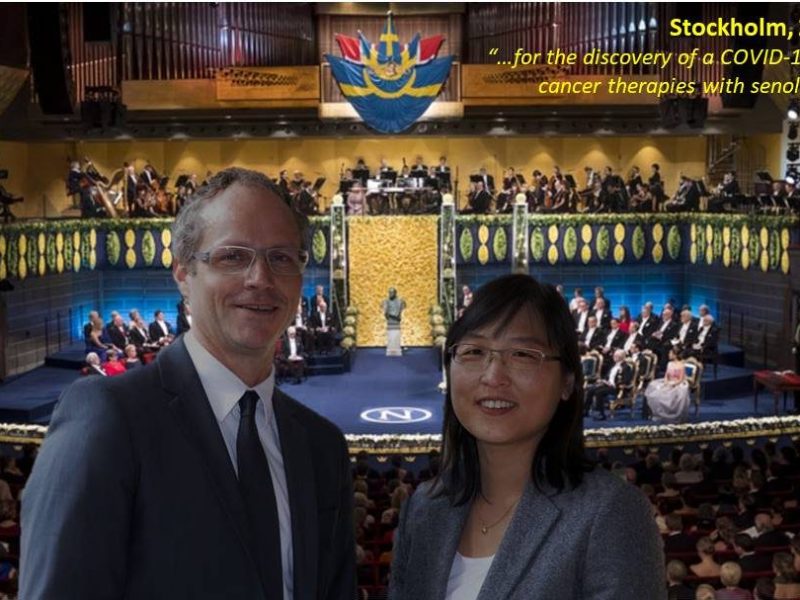
Old age has been cured, the miracle drug will soon hit the market. It’s in Nature and all over the news since last week.
“A drug has increased the lifespans of laboratory animals by nearly 25%, in a discovery scientists hope can slow human ageing too.
The treated mice were known as “supermodel grannies” in the lab because of their youthful appearance.
They were healthier, stronger and developed fewer cancers than their unmedicated peers.
The drug is already being tested in people, but whether it would have the same anti-ageing effect is unknown.”
The miracle drug is an antibody against interleukin-11 (IL-11), because a genetic IL-11 knock-out turned old shabby mice into sexy young cat-walking supermodels who already angled several famous football players and Formula 1 drivers as boyfriends. The life extension was “20-25% depending on the experiment and sex of the mice.“
The last author Stuart Cook, professor at Duke-NUS (National University of Singapore), who patented the stuff and owns a company called Enleofen, which develops anti-Il-11 drugs. In 2020, Cook’s company licenced its anti-IL-11 antibody for fibro-inflammatory diseases to the German pharma giant Boehringer Ingelheim. Fittingly, Cook’s institutional profile says he “discovered a critical role for the IL-11 cytokine in fibrosis and inflammation.” What was evolution, that stupid old bag, thinking when inventing IL-11, such an evil molecule… Good thing Prof Cook is there to fix things.
A BBC journalist spoke to Cook:
“He told me: “I try not to get too excited, for the reasons you say, is it too good to be true? “There’s lots of snake oil out there, so I try to stick to the data and they are the strongest out there.” He said he “definitely” thought it was worth trialling in human ageing, arguing that the impact “would be transformative” if it worked and was prepared to take it himself. “
Please, Dr Cook, take as much as you can swallow. This is the Nature paper:
Anissa A. Widjaja , Wei-Wen Lim , Sivakumar Viswanathan , Sonia Chothani , Ben Corden , Cibi Mary Dasan , Joyce Wei Ting Goh , Radiance Lim , Brijesh K. Singh , Jessie Tan , Chee Jian Pua , Sze Yun Lim , Eleonora Adami , Sebastian Schafer , Benjamin L. George , Mark Sweeney , Chen Xie , Madhulika Tripathi , Natalie A. Sims , Norbert Hübner , Enrico Petretto, Dominic J. Withers, Lena Ho, Jesus Gil, David Carling, Stuart A. Cook Inhibition of IL-11 signalling extends mammalian healthspan and lifespanNature (2024) doi: 10.1038/s41586-024-07701-9
“A.A.W., B.C., B.K.S., S.S. and S.A.C. are co-inventors of a patent family that includes: WO2022090509A (methods to extend healthspan and treat age-related diseases) and WO2018109174 (IL-11 antibodies). S.S. and S.A.C. are co-founders and shareholders of Enleofen Bio Pte Ltd and VVB Bio Pte Ltd. A.A.W. had consulted for VVB Bio on work unrelated to the study presented here. J.G. has acted as a consultant for Unity Biotechnology, Geras Bio, Myricx Pharma and Merck KGaA. Pfizer and Unity Biotechnology have funded research in the J.G. laboratory unrelated to the work presented here. J.G. owns equity in Geras Bio. J.G. is a named inventor in MRC and Imperial College patents related to senolytic therapies (the patents are not related to the work presented here).”
I wrote about Unity Biotechnology and their failed senolytics drugs before, at the end of this article:
In that article, I also mentioned a problematic paper by Cook’s coauthor Jesus Gil, professor at the Imperial College London in UK. Incidentally, Cook is visiting professor at Imperial. And BBC says that research was done at both Duke-NUS and MRC Laboratory of Medical Science at Imperial, which is Gil’s department. In October 2022 Shorts, I wrote about Gil’s retraction in Oncogene for data manipulation, and I also discussed some other of his dodgy papers on PubPeer.
New things came to light since. This was found by Sholto David:
Nicolás Herranz , Suchira Gallage , Massimiliano Mellone , Torsten Wuestefeld , Sabrina Klotz , Christopher J. Hanley, Selina Raguz , Juan Carlos Acosta , Andrew J. Innes , Ana Banito , Athena Georgilis , Alex Montoya , Katharina Wolter , Gopuraja Dharmalingam , Peter Faull , Thomas Carroll , Juan Pedro Martínez-Barbera , Pedro Cutillas , Florian Reisinger , Mathias Heikenwalder , Richard A. Miller, Dominic Withers, Lars Zender, Gareth J. Thomas, Jesús Gil mTOR regulates MAPKAPK2 translation to control the senescence-associated secretory phenotypeNature Cell Biology (2015) doi: 10.1038/ncb3225
Mycosphaerella arachidis: “Figure 7A and Supplementary Figure 7A: An image of cells is duplicated (there is a slight difference in the framing).”
In April 2024, Gil announced on PubPeer to publish a Correction, which appeared on 22 May 2024:
“…duplicated due to an error in figure preparation. […] The errors are in presentation only and do not affect the conclusions of the study. “
More Gil duplications found by Sholto:
Scott Haston, Estela Gonzalez-Gualda , Samir Morsli , Jianfeng Ge , Virinder Reen , Alexander Calderwood , Ilias Moutsopoulos , Leonidas Panousopoulos , Polina Deletic , Gabriela Carreno , Romain Guiho , Saba Manshaei , Jose Mario Gonzalez-Meljem , Hui Yuan Lim , Daniel J. Simpson , Jodie Birch , Husayn A. Pallikonda , Tamir Chandra , David Macias , Gary J. Doherty, Doris M. Rassl, Robert C. Rintoul, Massimo Signore, Irina Mohorianu, Arne N. Akbar, Jesús Gil, Daniel Muñoz-Espín, Juan Pedro Martinez-Barbera Clearance of senescent macrophages ameliorates tumorigenesis in KRAS-driven lung cancer Cancer Cell (2023) doi: 10.1016/j.ccell.2023.05.004
Mycosphaerella arachidis: “Figure 4: C’ and D” have very similar DAPI staining for images taken from different experimental groups.”
In November 2023, the last author and Gil’s London neighbour at UCL, Juan Pedro Martinez-Barbera, announced to publish a correction. Then he didn’t.
This couldn’t be corrected because the last author and Gil’s former postdoctoral mentor, the Imperial College professor Gordon Peters, died in 2016, and the first author tried to pass off unrelated gels as original raw data:
“Figure 2A: More similar than expected after flip the image horizontally.”
This is from the times when Gil was still pipetting in the lab, his coauthor Carlos Cordon-Cardo has a huge PubPeer record himself:
Clare L Scott , Jésus Gil , Eva Hernando , Julie Teruya-Feldstein , Masako Narita , Dolores Martínez , Tapio Visakorpi , David Mu , Carlos Cordon-Cardo , Gordon Peters , David Beach , Scott W Lowe Role of the chromobox protein CBX7 in lymphomagenesisProceedings of the National Academy of Sciences (2007) doi: 10.1073/pnas.0608721104
“Figure 1c. Much more similar than expected.”
Another Jesus miracle of duplication, rots on PubPeer since 2017. Jesus’ coauthor is a problematic Belgian named François Fuks (read about him in December 2023 Shorts):
One Jesus allegedly cured the blind and the lame, and rose the dead. Another Jesus turns old mice into supermodels while pocketing senolytics money. You now saw how Jesus does science.
Donate!
If you are interested to support my work, you can leave here a small tip of $5. Or several of small tips, just increase the amount as you like (2x=€10; 5x=€25). Your generous patronage of my journalism will be most appreciated!
Did Google remove Larry as an author automatically, or only after there was some kind of publicity – e.g. someone could have seen something on the web about this, and manually pulled it? If you were to make a similar Scholar profile for Barry the guinea pig, and told no-one about it, would it still be there …?
Controversy has surrounded several recent papers from Dr. Friedhelm Herrmann’s laboratories in Berlin and Ulm, Germany. Following the discovery that some of the data in a paper appearing in 1996 in the Journal of Experimental Medicine were fabricated, suspicion over other papers from this group was raised. Subsequently, some, but not all, coauthors on many of the group’s papers, including several published in BLOOD, have requested that their names be removed from the work(s).The authors’ requests and our own review of the German Joint Commission’s report on the matter have led the Editor to conclude that data was indeed falsified. As a result, the BLOODJournal regrets to inform its readers that the following publications have been retracted:
F Hermann, M Andreeff, H-J Gruss, MA Brach, M Lübbert, R Mertelsmann
Interleukin-4 inhibits growth of multiple myelomas by suppressing interleukin-6 expression.


















Larry’s H index is interesting.
Did Google remove Larry as an author automatically, or only after there was some kind of publicity – e.g. someone could have seen something on the web about this, and manually pulled it? If you were to make a similar Scholar profile for Barry the guinea pig, and told no-one about it, would it still be there …?
LikeLike
it would still be there yes. The publicity made them act.
LikeLike
German physician doing it it.
Priv.-Doz. Dr. rer. nat. Jürgen Eberle: Klinik für Dermatologie, Venerologie und Allergologie – Charité – Universitätsmedizin Berlin (charite.de)
Best not to try to do science.
PubPeer – Mutual regulation of Bcl-2 proteins independent of the BH3 d…
Stamp collecting.
PubPeer – Disruption of the VDAC2-Bak interaction by Bcl-x(S) mediates…
LikeLike
Juergen Eberle.
https://pubpeer.com/publications/7C52FB433D7502FC314AE8AFD457D5
LikeLike
No dropping the baton with Juergen Eberle.
https://pubpeer.com/publications/AD7CAFA697CA18DC16360D63F0D540#3
LikeLike
Juergen Eberle during the time of the pandemic.
https://pubpeer.com/publications/176FC793A8E9BD5C4D3596EE333349#2
LikeLike
Juergen Eberle amongst others.
An M Dump publication.
https://pubpeer.com/publications/C4F766C06B5DDA4DA3EC2995FBE0AD#4
LikeLike
There’s highbrow, middlebrow, and the Journal of Investigative Dermatology.
Juergen Eberle
https://pubpeer.com/publications/274776677AB8AFFE9910ED5D220495#1
The Journal of Investigative Dermatology does everything except investigate the data, because why should it?
LikeLike
Juergen Eberle PLoS One paper becomes problematic in itself.
https://pubpeer.com/publications/9BCB9EA248D10902E64F7776933EDD#4
LikeLike
Another giant of German dermatology.
https://med.miami.edu/faculty/ralf-paus-md-dsc-frsb
http://retractiondatabase.org/RetractionSearch.aspx?AspxAutoDetectCookieSupport=1#?AspxAutoDetectCookieSupport%3d1%26auth%3dPaus%252c%2bRalf
LikeLike
Prof. Dr. med. Christos C Zouboulis
Dr Christos Zouboulis – LPG Medical
“His Departments have been decorated with the title « Germany land of ideas – 2009 place of excellence » for the work on skin stem cells.”
PubPeer – PI3K/AKT Signaling Pathway Is Essential for Survival of Indu…
PubPeer – Mitochondrial-Associated Cell Death Mechanisms Are Reset to…
PubPeer – Identification of Biomarkers of Human Skin Ageing in Both Ge…
PubPeer – Propionibacterium acnes Activates the NLRP3 Inflammasome in…
LikeLike
“The 81 year old Michael Andreeff of MD Anderson in Houston, Texas”
1999 retraction of 1991 paper.
Correction for vol. 78, p. 2070 – ScienceDirect
Controversy has surrounded several recent papers from Dr. Friedhelm Herrmann’s laboratories in Berlin and Ulm, Germany. Following the discovery that some of the data in a paper appearing in 1996 in the Journal of Experimental Medicine were fabricated, suspicion over other papers from this group was raised. Subsequently, some, but not all, coauthors on many of the group’s papers, including several published in BLOOD, have requested that their names be removed from the work(s).The authors’ requests and our own review of the German Joint Commission’s report on the matter have led the Editor to conclude that data was indeed falsified. As a result, the BLOODJournal regrets to inform its readers that the following publications have been retracted:
F Hermann, M Andreeff, H-J Gruss, MA Brach, M Lübbert, R Mertelsmann
Interleukin-4 inhibits growth of multiple myelomas by suppressing interleukin-6 expression.
Blood, 78 (1991), p. 2070
LikeLiked by 1 person