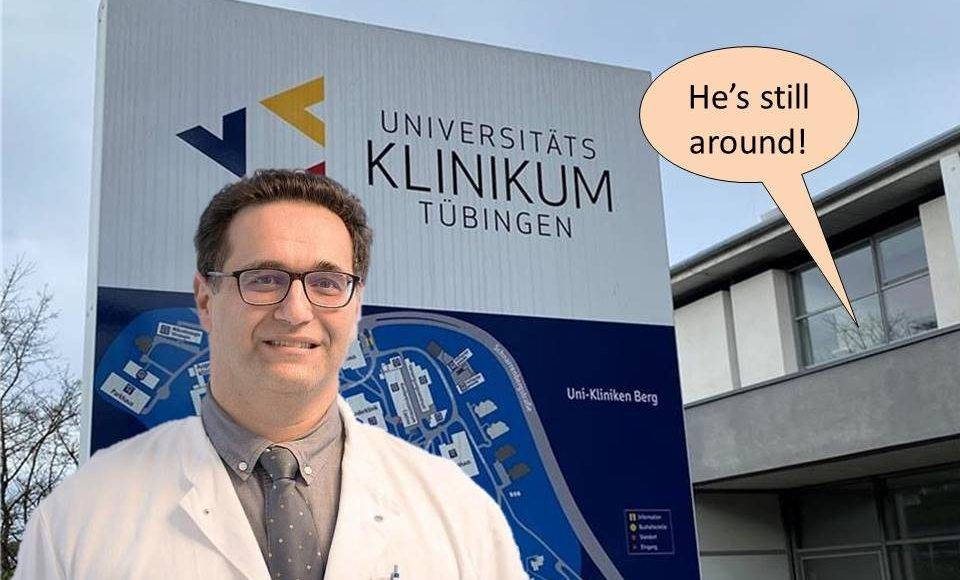

The Eberhard Karl University of Tübingen in Germany is an ancient and an elite university. Other, pedestrian universities may have problems with bad science, ethics breaches, nepotism and outright papermill fraud, but certainly not such an elite place of knowledge and learning as the University of Tübingen.
And indeed, this is how they see things there. No need for any action whatsoever. Instead, critics are ordered to show manners and respect.
The following is a significantly extended and updated material which you may have read in Friday Shorts from June 2023 and January 2024.
Part I: Goat as Gardener
Meet Julia Skokowa (or Yulia Skokova), a 48 year old role model for all WomenInSTEM. Originally from russia, she is since 2014 a Full Professor and Head of the Division of Translational Oncology at the University Hospital of the prestigious University of Tübingen, Germany. She runs her lab together with her former PhD mentor and her octogenarian husband, Karl Welte, born 1942 and described as “one of the best-known and most successful cancer researchers in the world“. In October 2022, Skokowa was appointed as Founding Director of the Gene and RNA Therapy Center (GRTC) at the University of Tübingen. She is her university’s brightest rising star.
But there are things the university needs to diligently take care of. This:
Masoud Nasri , Malte Ritter , Perihan Mir , Benjamin Dannenmann , Narges Aghaallaei , Diana Amend , Vahagn Makaryan , Yun Xu , Breanna Fletcher , Regine Bernhard , Ingeborg Steiert , Karin Hahnel , Jürgen Berger , Iris Koch , Brigitte Sailer , Katharina Hipp , Cornelia Zeidler , Maksim Klimiankou , Baubak Bajoghli , David C. Dale , Karl Welte, Julia Skokowa CRISPR/Cas9-mediated knockout enables neutrophilic maturation of primary hematopoietic stem and progenitor cells and induced pluripotent stem cells of severe congenital neutropenia patients Haematologica (2020) doi: 10.3324/haematol.2019.221804
Benjamin Dannenmann , Azadeh Zahabi , Perihan Mir , Benedikt Oswald , Regine Bernhard , Maksim Klimiankou , Tatsuya Morishima , Klaus Schulze-Osthoff , Cornelia Zeidler , Lothar Kanz , Nico Lachmann , Thomas Moritz , Karl Welte , Julia Skokowa Human iPSC-based model of severe congenital neutropenia reveals elevated UPR and DNA damage in CD34+ cells preceding leukemic transformation Experimental Hematology (2019) doi: 10.1016/j.exphem.2018.12.006
In August 2022, the Dannemann et al 2019 paper received a Correction. It was problematic.

More corrections were issued. Because those same images appeared in other papers by Skokowa. Note that her husband Welte is co-author. Worth mentioning that when he retired from his high offices at Hannover Medical School (MHH) in 2014/2015 and returned as senior professor to Tübingen where he graduated, his wife and PhD mentee Skokowa followed Welte there, to become a full professor, aged merely 38.
Benjamin Dannenmann , Maksim Klimiankou , Benedikt Oswald , Anna Solovyeva , Jehan Mardan , Masoud Nasri , Malte Ritter , Azadeh Zahabi , Patricia Arreba-Tutusaus , Perihan Mir , Frederic Stein , Siarhei Kandabarau , Nico Lachmann , Thomas Moritz , Tatsuya Morishima , Martina Konantz , Claudia Lengerke , Tim Ripperger , Doris Steinemann , Miriam Erlacher , Charlotte M. Niemeyer, Cornelia Zeidler, Karl Welte, Julia Skokowa iPSC modeling of stage-specific leukemogenesis reveals BAALC as a key oncogene in severe congenital neutropenia Cell stem cell (2021) doi: 10.1016/j.stem.2021.03.023

Skakowa on PubPeer: “The same iPSC lines of the same healthy donors or CN patients are used in all publications mentioned here. Representative images of these cell lines are presented. For labeling of the cells, classical HE staining was applied.“
Even then, how does Skokowa know the pictures are representative if she only ever made one photo?

A Correction was published in September 2023:
“The originally published version of this manuscript contains representative cytospin images of a granulocytic differentiation of iPSCs derived from a healthy donor (HD) and CN1 patient in Figure 2G that also appear as representative control images in another, previously published manuscript1 and are very similar to representative control images in yet another, previously published manuscript.2
The manuscript for Cell Stem Cell was submitted before (but published after) the other two, and in the confusion the authors neglected to notice that citations for these other two manuscripts ought to have been included.
Also in the originally published version of Figure 2G, a labeling error mistakenly identified the cytospin image of the CN/AML1.2 clone as an image of the CN/AML1.1 clone instead. The label should in fact have read CN/AML1.2.”
And another corrected paper:
Yun Xu , Masoud Nasri , Benjamin Dannenmann , Perihan Mir , Azadeh Zahabi , Karl Welte , Tatsuya Morishima, Julia Skokowa NAMPT/SIRT2-mediated inhibition of the p53-p21 signaling pathway is indispensable for maintenance and hematopoietic differentiation of human iPS cells Stem Cell Research & Therapy (2021) doi: 10.1186/s13287-021-02144-9


The Correction from October 2023 stated:
“In the original Fig. 5A, C the order of the samples was reorganized by cutting the bands from the original blot and putting them in the sequence DMSO, FK866 1nM, and FK866 2nM from left to right, but the vertical lines indicating the cutting positions of the blot were missing.
We have now replaced Fig. 5A, C with the original uncut Western Blot images. Note that the bands marked with the asterisk were excluded from the densitometry analysis of presented Western Blot images due to the poor protein quality of the sample, as indicated by the weak GAPDH signal. For the statistical analysis of the FK866 2nM datasets, we accidentally calculated the p-value of two datasets only instead of the required three, as was calculated for the DMSO and FK866 1nM datasets, respectively. Therefore, we removed the stars indicating the significance of the FK866 2nM datasets from the corresponding densitometry graphs, which doesn’t change the conclusion, because the difference between DMSO and also FK866 2nM treated samples is obvious. We also corrected legends for Fig. 5A, C regarding the analyzed datasets of the presented WB images, for which statistics were performed. […]
None of the aforementioned corrections affect the conclusions of the respective experiments.”
No correction here because Skokowa explained on PubPeer that it is allowed to publish same data twice if your submit the two manuscripts simultaneously and then add references. Seriously.
Julia Skokowa, Birte Hernandez Alvarez , Murray Coles , Malte Ritter , Masoud Nasri , Jérémy Haaf , Narges Aghaallaei , Yun Xu , Perihan Mir , Ann-Christin Krahl , Katherine W. Rogers , Kateryna Maksymenko , Baubak Bajoghli , Karl Welte , Andrei N. Lupas , Patrick Müller , Mohammad ElGamacy A topological refactoring design strategy yields highly stable granulopoietic proteins Nature Communications (2022) doi: 10.1038/s41467-022-30157-2


Finally, the Dannenmann et al 2019 paper, which used “peripheral blood” of unspecified human origin for iPS reprogramming, received this PubPeer criticism:
“In the report by Dannenmann et al. published in Experimental Hematology, it is striking that virtually no ethics statement or ethics committee approval is mentioned. The paper describes for the first time the generation of iPS cells from different patients with congenital neutropenia. The lack of any ethics statement (as well as the failure to mention patients’ details) raises the suspicion that neither informed consent for the iPS generation nor the required ethics committee approval was obtained before these studies were performed. This would clearly infringe good clinical and good scientific practice as well as ethical guidelines, which are mandatory when work involves the use of human subjects. Such a procedure would be unacceptable, and not compliant with ICMJE Ethical Considerations in the Conduct and Reporting of Research.”
Lysmata argentopunctata on PubPeer, October 2022
Which is funny given that in June 2023 Skokowa was celebrated by the German science magazine Spektrum for her ethical research. She was quoted with “we generate iPS cells from the blood of patients with these diseases or leukemia“.
You may wonder, well, surely the University of Tübingen is on this case. Surely their Good Scientific Practice Commission is investigating?
Yeah right.
Skokowa used to be the Good Scientific Practice Commission, she alone was personally in charge of Academic Misconduct investigations for all of medicine in Tübingen. Since 2022, and until early 2024.
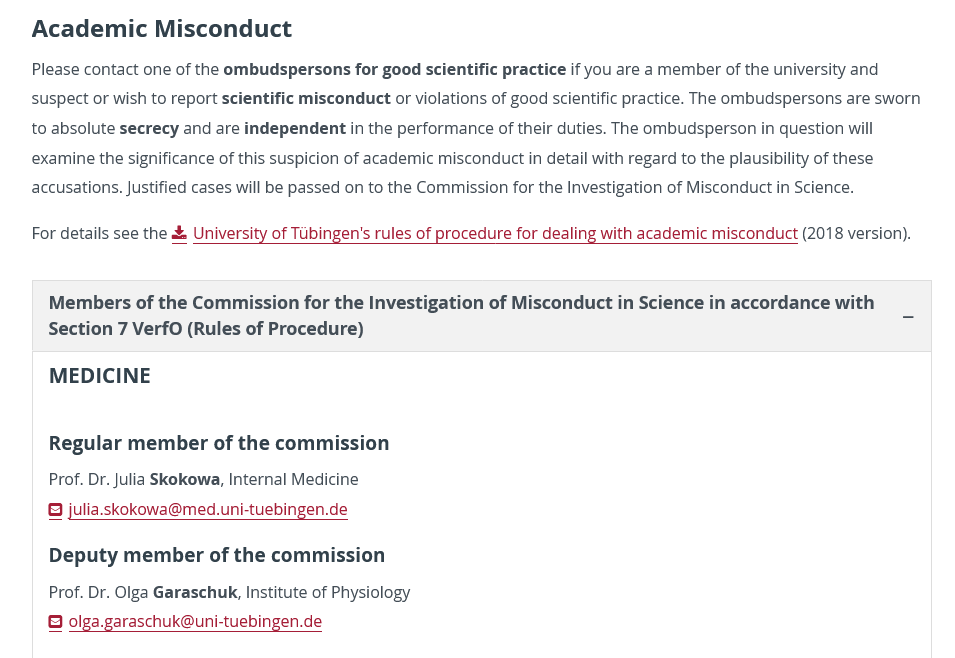
Funny, isn’t it? In December 2023, I wrote to Skokowa and her commission colleagues. Skokowa replied (translated from German):
“To clarify: the cases identified were discussed and clarified intensively with the UKT [University Clinic Tübingen, -LS] ombudsperson and the journals. I also asked to resign from the GWP [good scientific practice, -LS] Commission a few months ago. I informed GWP commission members of my decision. This process typically takes a few months and will be completed in early 2024.“
But really, does it take months to resign? The PubPeer evidence appeared in July 2022, Skokowa replied right after and started to publish corrections. The Ombudsperson she refers to is her fellow UKT professor (and predecessor as GWP Commission member for medicine), Ingeborg Krägeloh-Mann. The Ombudsperson’s task was to forward the case to the GWP Commission, given that the alleged duplications were substantiated and even admitted. Forward to whom? To Skokowa.
At some point, all corrections will be negotiated, and there will be nothing to investigate. Case closed without opening.
Skokowa runs a lab of 21 people, most of them PhD students. She and Welte remained silent when invited to deny the allegation of having performed human experiments without ethics approval.
Which is sad. Because Welte has literal skeletons in his closet, from his past time as dean and board member of MHH in Hannover. His collaborator and successor as clinic director there was a certain paediatric oncologist named Christoph Klein, whose story was reported in 2016 in the national newspaper SZ:
“Dr. Klein treated ten children who suffered from the life-threatening Wiskott-Aldrich syndrome with a course of gene therapy. Eight of the 10 children subsequently developed leukemia, and three of them have since died.”
Hannover Medical School MHH: where doctor careers matter more than patient lives?
Philipp Jungebluth, formerly right-hand man and student of the lethal trachea transplant surgeon Paolo Macchiarini, is threatening another lawsuit against me. This time, he is unhappy about being associated with the 5 trachea transplant operations Macchiarini performed in Italy (only one of these five might still be alive, with a permanent brain damage). Jungebluth freely…

A key problem was disregard for ethics guidelines which led to patients’ death. But Klein sued SZ and partially won, because in Germany it is illegal to criticise doctors who leave their patients dead as I had to learn the hard way. Parts of the SZ article had to be deleted. Predictably, Professor Klein was whitewashed in full by MHH and by his current employer LMU Munich, where he presently leads the paediatric clinic (what did you expect, really). Since the Klein affair, German journalists never name the perpetrators even if they dare to write about academic and medical scandals again.
One would think that Welte and his wife would be extra careful with ethics approvals after witnessing the Klein affair…
The responsibles at the University of Tübingen initially refused all communication with me. But Skokowa did leave the GWP Commission at some point in January 2024. And so did, a bit later, her deputy Olga Geraschuk. Also the Ombudsperson Krägeloh-Mann stepped down.
The Bielefeld Conspiracy
“During your studies, it should be taught that, for example, you critically question your data, handle it transparently and immediately disclose weak points.” – Prof Katharina Kohse-Höinghaus
On 12 February 2024, I placed a Freedom of Information inquiry with the University of Tübingen and their University Clinic, asking about the ethics approval and the patient consent of the Skokowa paper Dannemann et al 2019. I wanted to know if those exist, and if so, I asked for the approval’s number and a copy of patient consent (without personal data). In Germany, universities are subject to Freedom of Information laws of their relevant federal states. In the case of Tübingen, the Informationsfreiheitsgesetz (IFG) of the state of Baden-Württemberg applies, according to which the public institution (here, the University and the University Clinic Tübingen) must provide me with a reply no later than after a month.
The university simply ignored my emails.
On 20 February 2024, I contacted the relevant IFG-insitution of Baden-Württemberg, Der Landesbeauftragte für den Datenschutz und die Informationsfreiheit Baden-Württemberg (LfDI), with a complaint that my IFG inquiry was being ignored by the University of Tübingen. To explain: such offices are responsible simultaneously for protecting and for releasing information, and since in Germany all information is deemed private they end up protecting everything and releasing nothing unless you can afford to sue through all courts. In my previous experience with other universities in other federal states I never received any information whatsoever, because everything connected to published research is confidential and not for public, to protect the academic freedom (I am not making this up). But at least those other LfDI offices replied to tell me, even if to deny the information.
The Baden-Württemberg LfDI however refused all communication. But right after my email to them, the press office of the University Clinic Tübingen finally admitted my Freedom of Information inquiry.
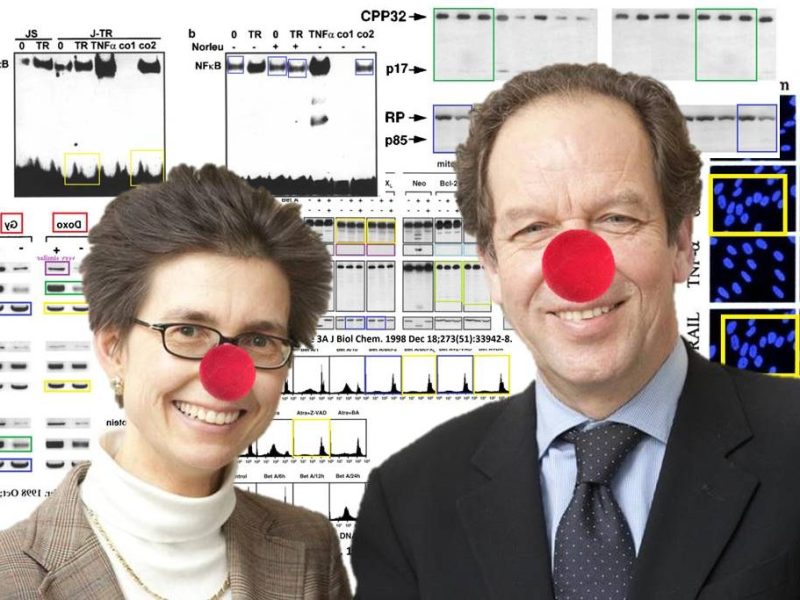
Fulda & Debatin: Reproducibility of Results in Medical and Biomedical Research
“Basic and advanced training for researchers should focus much more on self-reflection, openness and a culture of error acceptance.”
Exactly one month later, on 20 March 2024, I received a reply from Jürgen Rottenecker, former deputy of the university chancellor and now head of the division Development, Structure and Legal Affairs. Translated:
“We confirm receipt of your emails regarding the LIFG regarding Professor S.
In principle, we investigate any allegations of possible violations of good scientific practice and we have our established procedures for this. These include in particular the involvement of the ombudspersons, if necessary the Ombuds Commission. However, we make it clear that we take the presumption of innocence until proven wrongdoing. In addition, investigation procedures are carried out under the premise of confidentiality and results are only passed on to appropriate bodies (this could be the DFG, for example) once the facts have been fully clarified.
Regarding your request regarding the LIFG regarding the release of documents from the ethics committee, we would like to point out that the LIFG is not relevant for us as a university in this regard – it is about research. There is therefore no legal right to have documents handed over. It is not possible to release them via the University Hospital anyway, as these are university documents for which it is not responsible.
Finally, we can inform you that an examination carried out in the meantime did not reveal any evidence for your accusation of isolating human cells without the assessment of an ethics committee.
Furthermore, we make it clear that we attach great importance to respectful communication on a factual level. In our opinion, statements such as (also in the subject of emails) “Goat as a gardener” or references to spouses have nothing to do with a factual query or statement.
For us, this request has been resolved and we will not comment further on the matter.”
I don’t think that Skokowa’s marriage to Welte or her function at the GWP-Commission are totally irrelevant. But Rottenecker’s legalese formulation regarding the ethics approval is interesting. Here it is in original German:
“…dass eine zwischenzeitlich durchgeführte Prüfung keine Anhaltspunkte für den von Ihnen geäußerten Vorwurf einer Isolierung menschlicher Zellen ohne die Bewertung einer Ethikkommission ergeben hat.”
Rottenecker claims that the extraction of patients’ blood did receive an ethics approval. But for genetic interventions, especially for generation of induced pluripotent stem (iPS) cells from human tissue, one needs an extra approval. What about it then? Omitted in Skokowa’s application?
The university lawyer also never addresses my request for the patient consent to the iPS experiments, maybe because there never was one, as suspected? Also, Rottenecker never says WHEN the ethics approval was issued. Maybe afterwards, for example after criticism about its absence was raised on PubPeer? This I believe would be actually a criminal act by the university, if true.
Rottenecker chose not to deny those suppositions. You will meet him again in Part II.
(The last text section about Rottenecker’s statement was edited on 18.04.2024, based on inside information I received)
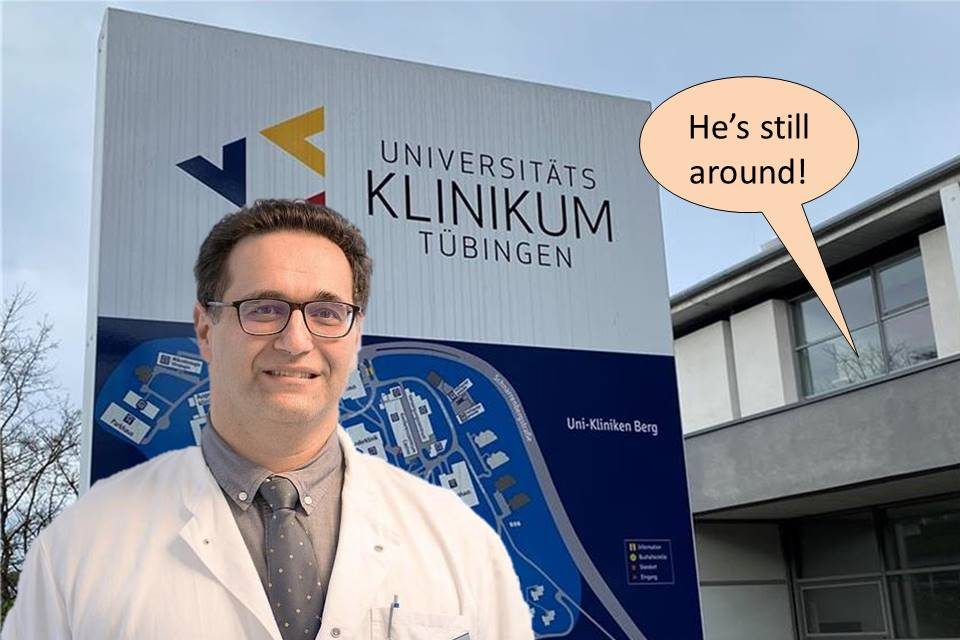
Part II: The External Papermill
Our next hero is a former clinician of the University Clinic Tübingen and, according to all evidence, an avid user of Iranian papermills – Reza Akhavan-Sigari.
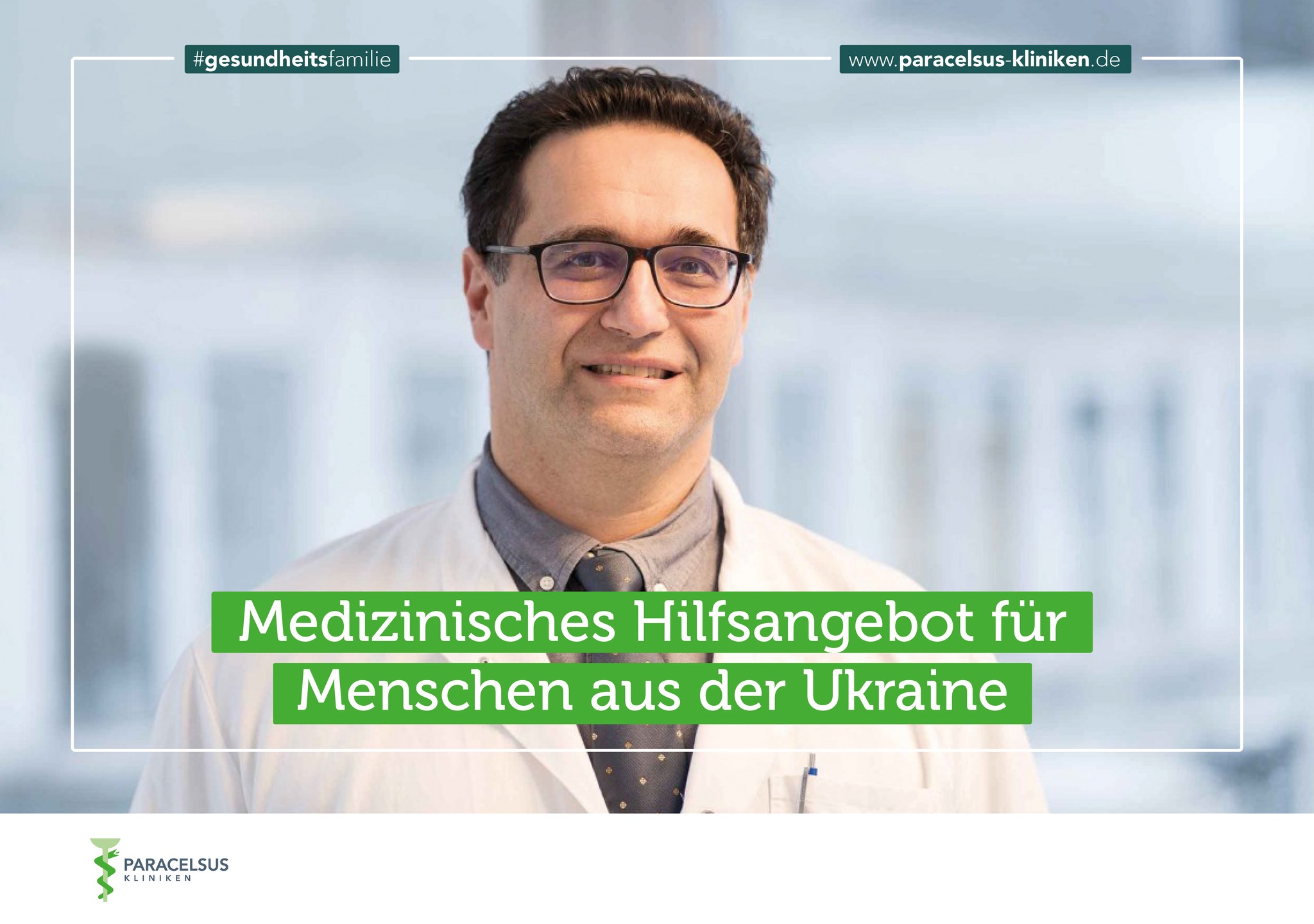
Akhavan-Sigari spent his entire career in Germany – he studied medicine in Göttingen, worked for almost a decade years in Hannover, until he returned to Göttingen as senior physician. In parallel, he worked for several years at two universities in Iran, as consultant surgeon. At the University Clinic Tübingen he worked as senior physician in Tübingen for just one year (2019-2020). Since then, Akhavan-Sigari works as medical director of the neurosurgery clinic at the privately-owned Paracelsus Clinic in Bremen, operating spines and offering treatment to injured Ukrainians even.
An announcement of his recruitment from 19 March 2021 mentioned (translated):
“Most recently, he was senior physician in complex spinal surgery at the University Hospital of Tübingen. He was also senior physician at Azad University in Tehran for many years, where he is also vice dean of research. PD Dr. med. Akhavan-Sigari is still very active academically, is currently supervising several doctoral students at the University of Tübingen, regularly gives lectures and is active in student teaching. As a reviewer for internationally recognized specialist journals and author of numerous medical publications, he is very familiar with modern treatment methods. Regular participation in international research projects also underlines his neurosurgical expertise. “All of these activities and the knowledge gained from them primarily benefit the patients,” says PD Dr. med. Akhavan Sigari.”
Quite possible this bit about Akhavan-Sigari’s “several doctoral students at the University of Tübingen” was not true. But we are here to talk about his “regular participation in international research projects“.
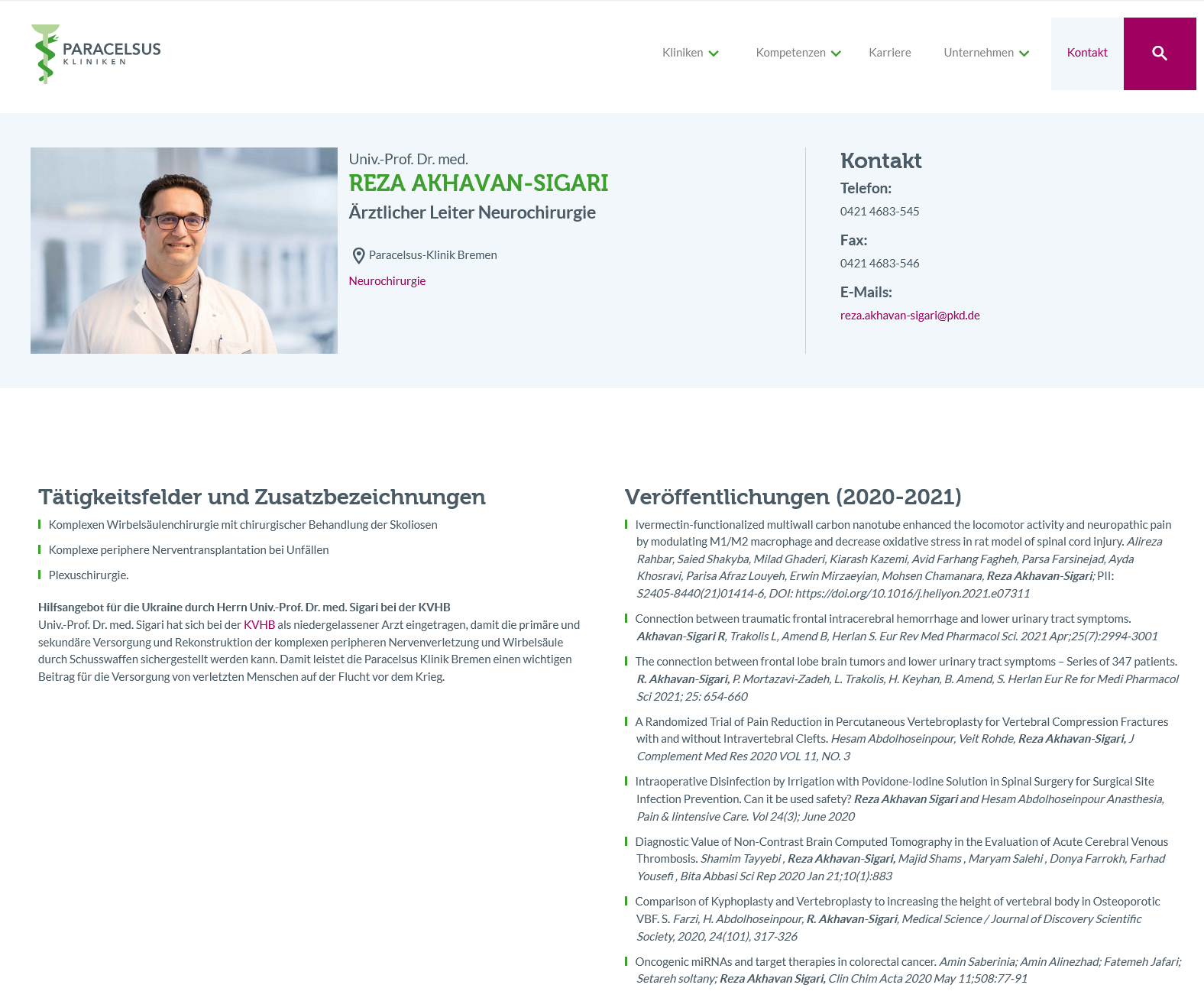
As it happens, Akhavan-Sigari is not listed on the webpage of the Paracelsus Clinic’s neurosurgery department anymore, not as medical director, nor as any kind of employee. He disappeared completely between March and September 2023.
And here is the likely reason: after office hours, the great spine surgeon Akhavan-Sigari turns into an oncologist, an immunologist, a urologist, and even into an organic chemist or an expert in nanotechnology! And in that parallel life, he remains affiliated with his old academic employer the University Clinic Tübingen, forever! The best bit: the University Clinic knows and totally does not mind.
German Authorities on Papermills and Whistleblowing
“I am not familiar with Iranian papermills!” – Prof Dr med Henning Madry, Saarland University.
In June 2023, Alexander Magazinov sent a message to the University of Tübingen in Germany, reporting several papers by Akhavan-Sigari which most obviously were sold by an Iranian papermill. There were 6 papers, originally found by Nick Wise, which Magazinov reported to the university. None of them has anything to do with Akhavan-Sigari’s “official” expertise of neurosurgery, even remotely. In fact, these “studies” have nothing to do with any kind of science, and are just pseudoscientific buzzword gibberish produced by papermills:
Mustafa M. Kadhim , Nazanin Sheibanian , Danial Ashoori , Maryam Sadri , Bahareh Tavakoli-Far , Ramona Khadivi , Reza Akhavan-Sigari The drug delivery of hydrea anticancer by a nanocone-oxide: Computational assessments Computational and Theoretical Chemistry (2022) doi: 10.1016/j.comptc.2022.113843
“Summary: citations to irrelevant and / or unreliable literature with the only purpose to boost the citation statistics of certain researchers; most notably, Changhe Li.”
K. Harismah , S.A. Shahrtash , A.R. Arabi , R. Khadivi , M. Mirzaei , R. Akhavan-Sigari Favipiravir attachment to a conical nanocarbon: DFT assessments of the drug delivery approach Computational and Theoretical Chemistry (2022) doi: 10.1016/j.comptc.2022.113866
“Summary: citations to irrelevant and / or unreliable literature with the only purpose to boost the citation statistics of certain researchers; most notably, Changhe Li.”
Saade Abdalkareem Jasim , Indrajit Patra , Maria Jade Catalan Opulencia , Kadda Hachem , Rosario Mireya Romero Parra , Mohammad Javed Ansari , Abduladheem Turki Jalil , Moaed E. Al-Gazally , Mahin Naderifar , Mehrdad Khatami , Reza Akhavan-Sigari Green synthesis of spinel copper ferrite (CuFe2O4) nanoparticles and their toxicity Nanotechnology Reviews (2022) doi: 10.1515/ntrev-2022-0143


“Summary: citations to irrelevant and / or unreliable literature with the only purpose to boost the citation statistics of certain researchers; most notably, Yu-Ming Chu and Changhe Li (and, collaterally, frequent collaborators of the above-mentioned persons).”
Needless to say, Changhe Li, Yu-Ming Chu and Abduladheem Turki Jalil are known papermilling fraudsters who pay money for both papers and citations.
And here is evidence that authorships for Akhavan-Sigari’s papers were sold on the internet:
Shunshun Bao , Mohammad Darvishi , Ali H Amin , Maysoon T. Al-Haideri , Indrajit Patra , Khadisha Kashikova , Irfan Ahmad , Fahad Alsaikhan , Zahraa Haleem Al-qaim , Moaed E. Al-Gazally , Bahman Abedi Kiasari , Bahareh Tavakoli-Far , Akmal A. Sidikov , Yasser Fakri Mustafa , Reza Akhavan-Sigari CXC chemokine receptor 4 (CXCR4) blockade in cancer treatment Journal of Cancer Research and Clinical Oncology (2023) doi: 10.1007/s00432-022-04444-w

“Summary: authorship for this article was offered for sale on a third-party site before publication.”
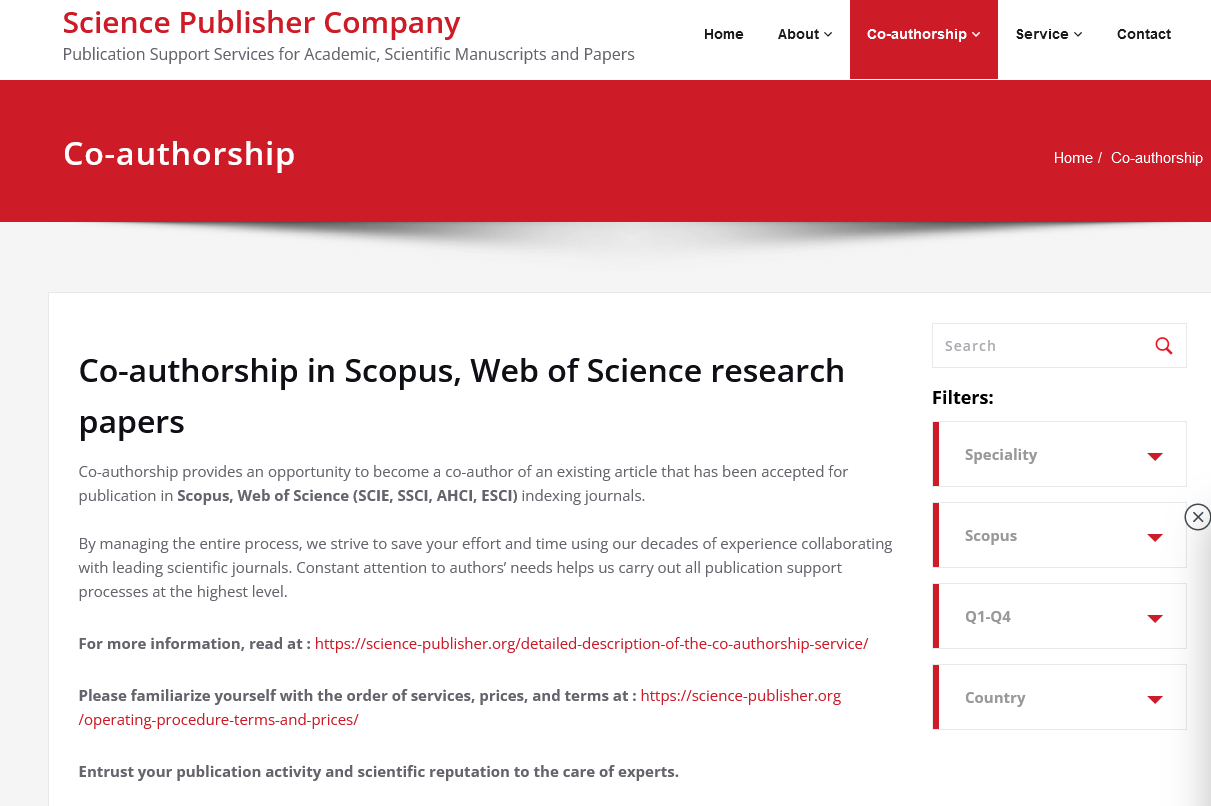

Maysoon T. Al-Haideri , Reza Mannani , Roghayyeh Kaboli , Farshad Gharebakhshi , Shahram Darvishzadehdeldari , Safa Tahmasebi , Fatemeh Faramarzi , Juan Carlos Cotrina-Aliaga , Sahar Khorasani , Mina Alimohammadi , Mohammad Darvishi , Reza Akhavan-Sigari The effects of methotrexate on the immune responses to the COVID-19 vaccines in the patients with immune-mediated inflammatory disease: A systematic review of clinical evidence Transplant Immunology (2023) doi: 10.1016/j.trim.2023.101858

“Summary: authorship for this article was offered for sale on a third-party site before publication.”
Maysoon Al‐Haideri , Talar Ahmad Merza Mohammad , Shahram Darvishzadehdeldari , Zahra Karbasi , Mina Alimohammadi , Fatemeh Faramarzi , Sahar Khorasani , Ashkan Rasouli , Safa Tahmasebi, Mohammad Darvishi , Reza Akhavan‐Sigari Immunogenicity of COVID‐19 vaccines in adult patients with autoimmune inflammatory rheumatic diseases: A systematic review and meta‐analysis International Journal of Rheumatic Diseases (2023) doi: 10.1111/1756-185x.14713

“Summary: authorship for this article was offered for sale on a third-party site before publication.”
There is much more on PubPeer for Akhovan-Sigari. Like here, with the papermill fraudster from Saudi Arabia named Fuad Ameen (read about him here), where Nick Wise counted 42 out of 115 nonsense-references to Ameen himself, 22 for Abduladheem Turki Jalil, plus quite a lot for YM Chu, CH Li and other papermilling fraudsters:
Fuad Ameen, Fadaa Alown , Mohammed Fanokh Al-Owaidi , T Sivapriya , Andrés Alexis Ramírez-Coronel, Mansour Khat , Reza Akhavan-Sigari African plant-mediated biosynthesis of silver nanoparticles and evaluation of their toxicity, and antimicrobial activities South African Journal of Botany (2023) doi: 10.1016/j.sajb.2023.03.010

And here is Germany’s top neurosurgeon Akhavan-Sigari with the papermill fraudster Mika Sillanpää – a thief, liar and bullying psychopath who was sacked in Finland for sexual harassment and financial crimes. Read here:
Now behold, what a great chemistry study by Sillanpää and Akhavan-Sigari:
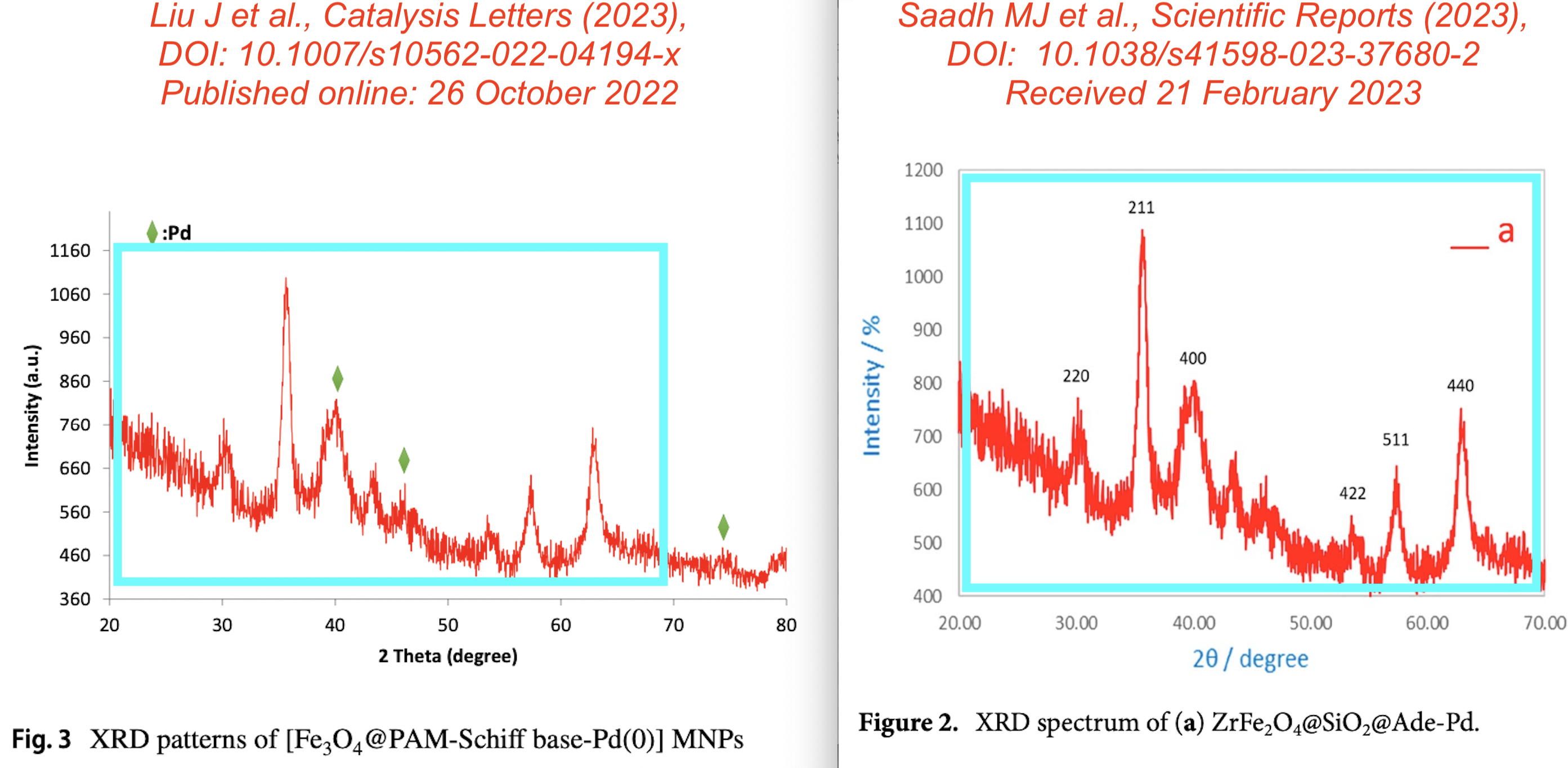
Mohamed J. Saadh, Hussam Elddin Nabieh Khasawneh , Geovanny Genaro Reivan Ortiz, Muhammad Ahsan, Dinesh Kumar Sain , Kareem Yusuf , Mika Sillanää , Amjad Iqbal, Reza Akhavan-Sigari Synthesis and characterization of ZrFe2O4@SiO2@Ade-Pd as a novel, recyclable, green, and versatile catalyst for Buchwald–Hartwig and Suzuki–Miyaura cross-coupling reactions Scientific Reports (2023) doi: 10.1038/s41598-023-37680-2
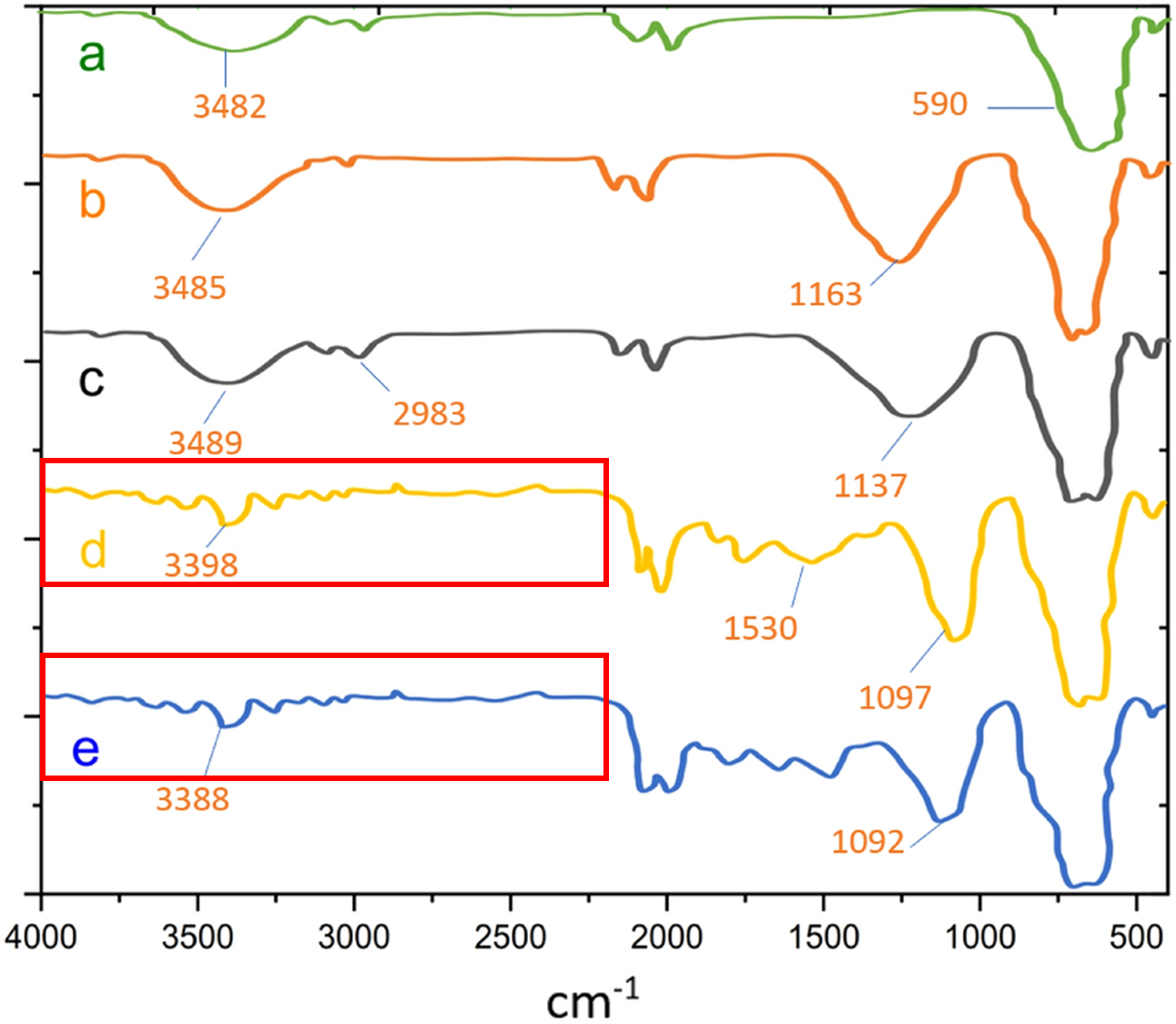
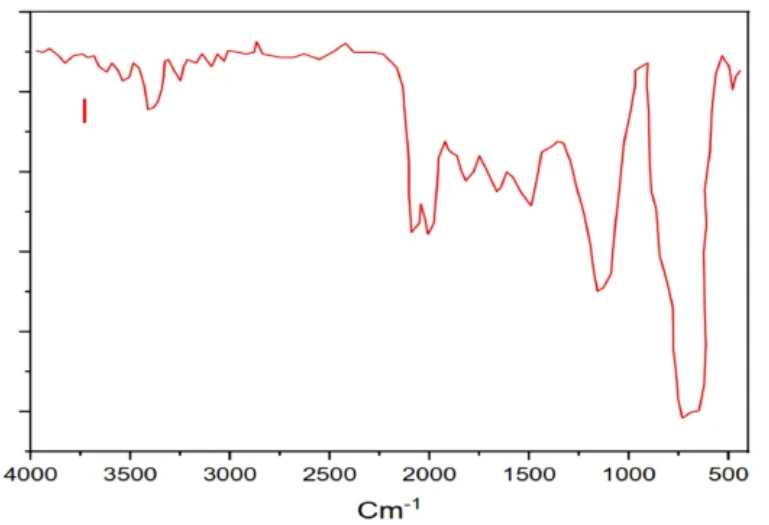
Elisabeth Bik found even more, for example this stolen figure:
Now you probably want to know how the University of Tübingen, whose affiliation Akhavan‐Sigari used in all those papers, reacted? How they cracked down on all this papermill shenanigans to clear their reputation?
Jürgen Rottenecker, the man you encountered above valiantly defending the privacy and honour of his University of Tübingen, informed Magazinov on 19 June 2023:
“For reasons of responsibility, I have been approached in the Central Administration about your concern. I would therefore like to inform you as follows: The person you informed us about is no longer a member of the University of Tübingen. Therefore, for legal reasons, it is not possible for us to carry out any misconduct examinations, should this be your concern. Otherwise, we are aware that scientific publications are discussed in PubPeer in the sense of a peer review process. However, the scientific institution at which the person is currently working is responsible for a misconduct check.“
That is of course completely false, and embarrassing for a lawyer. The university whose primarily affiliation was used on the offending papers is primarily responsible for the investigation. Simply because they have access to relevant files and raw data. But of course, the temptation not to do anything is strong.
That is in fact exactly how Anders Hagfeld, the rector of the University of Uppsala in Sweden, escaped responsibility for his own papermilling, because his earlier employer refused to investigate:

Swedish rector Anders Hagfeldt pronounced innocent of papermilling
“The board’s conclusion is therefore that the deviations regarding figure 2b and 2c in article 1 constitute serious deviations from good research practice”
In any case, Akhavan‐Sigari works (by now used to work) in a private hospital which is run by a family-owned Swiss investment fund named Porterhouse. To expect this business to investigate Sigari’s papers is ridiculous. I asked Rottenecker if he meant to say that NOBODY is responsible for investigating this case, he announced to look into my arguments, and never replied on that matter again.
They don’t really hide this papermill affair – they boast it. At the time of writing, University of Tübingen openly displays Akhavan-Sigari’s papermill fabrications from 2021-2023 as their own research output (archived version here). The official list of his achievements contains no works related to neurosurgery, but instead stuff like this:
- “Green synthesis of spinel copper ferrite (CuFe2O4) nanoparticles and their toxicity” (with appermill fraudsters Turki Jalil and Maria Opulencia); doi: 10.1515/ntrev-2022-0143
- “Synthesize of pluronic-based nanovesicular formulation loaded with Pistacia atlantica extract for improved antimicrobial efficiency” (again with Turku Jalil) doi: 10.1016/j.arabjc.2023.104704
- “DFT assessments of BN, AlN, and GaN decorated carbon cage scaffolds for sensing the thiamazole drug” doi: 10.1016/j.diamond.2023.109800
- “Molecular insights into the sensing function of an oxidized graphene flake for the adsorption of Avigan antiviral drug” doi: 10.1016/j.comptc.2023.114240
- “Porous Cu-MOF nanostructures with anticancer properties prepared by a controllable ultrasound-assisted reverse micelle synthesis of Cu-MOF” doi: 10.1186/s13065-022-00804-2
- “Sensing functions of an iron-doped boron nitride nanocone towards acetaminophen and its thio/thiol analogs: A DFT outlook” doi: 10.1016/j.diamond.2023.109749
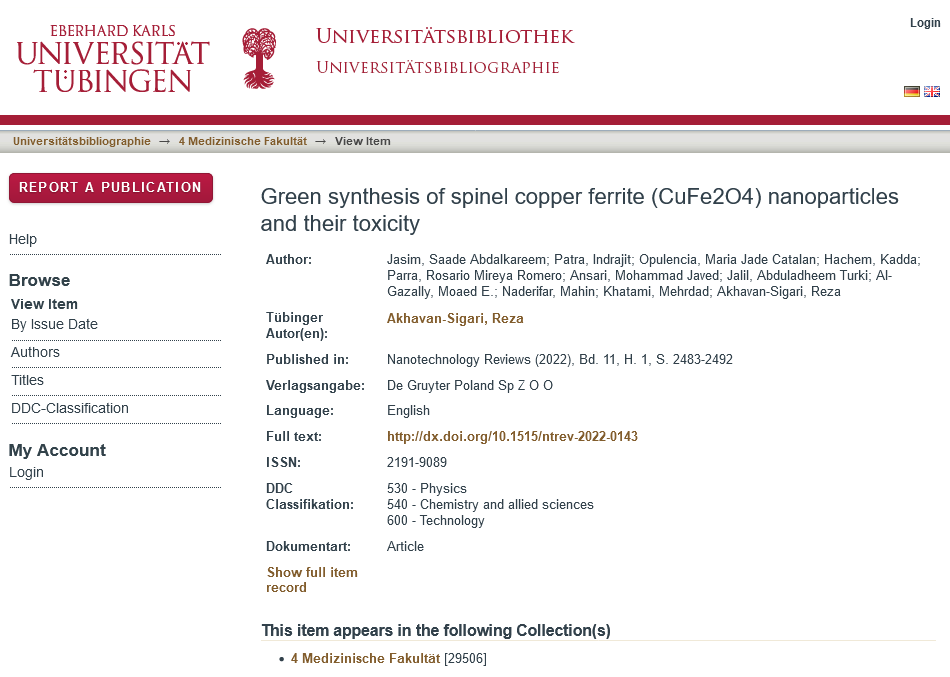
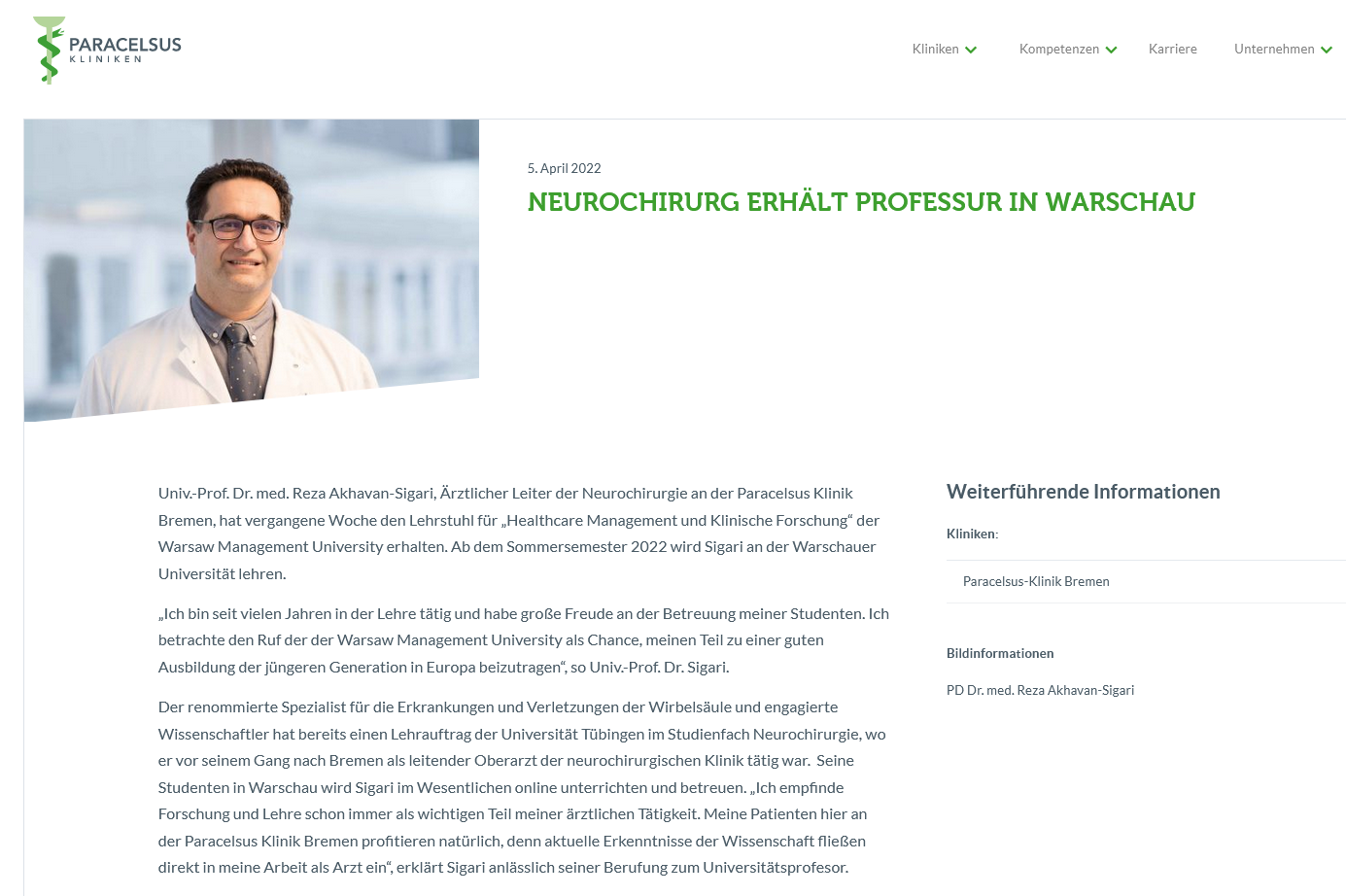
A grand scholar needs a grand title. The Paracelsus Clinic presented Akhavan-Sigari as “Univ.-Prof. Dr. med.” Let me explain what this “University-Professor” title usually means. After every interested doctor, engineer, architect and lawyer in Germany bought himself an adjunct professorship somewhere (usually abroad) in order to call himself “Prof Dr” for reasons of vanity and self-promotion, “real” professors holding actual faculty chairs at universities became upset and started to call themselves “Univ-Prof” as not to be devalued by the imposters.

So where is Akhavan-Sigari holding a faculty chair then? In April 2022, the Paracelsus Clinic proudly announced (translated):
“Univ.-Prof. Dr. med. Reza Akhavan-Sigari, Medical Director of Neurosurgery at the Paracelsus Clinic Bremen, received the Chair for “Healthcare Management and Clinical Research” from the Warsaw Management University last week. From the summer semester of 2022, Sigari will teach at the University of Warsaw.
“I have been teaching for many years and I really enjoy looking after my students. I see the reputation of the Warsaw Management University as an opportunity to contribute my part to a good education for the younger generation in Europe,” says Univ.-Prof. dr Sigari.”
Thing is, while Sigari is indeed listed as one of the teachers for Master of Business Administration (MBA) courses at the Warsaw Management University, they never explicitly say he is a professor there. In fact, the Polish college seems to believe Sigari is a professor in Tübingen:
“He is now chief physician in Neurosurgery at Paracelsus Clinic in Bremen/ Germany and gives lectures in Neurosurgery at Tuebingen Medical Center in Germany.”
A external teaching appointment for an MBA course at a Polish teaching-only college is definitely not a faculty chair. At best it is comparable with a degree of guest lecturer or adjunct professor. Not what “Univ-Prof” title was meant to signify.

The incredible collaborations of Renaissance men and women
Nick Wise and Alexander Magazinov on the authorships-for-sale market on social media. Merely $700 for the 7th position on some paper way outside your expertise!

Sigari never replied to my emails. And why should he reply. He stopped being extremely well-paid senior doctor in Bremen and his recent papermill trash was retracted in March 2024.
Mohamed J. Saadh , Roxana Yolanda Castillo-Acobo , Hala Baher , Jayasankar Narayanan , Jessica Paola Palacios Garay , Michelle Naomi Vera Yamaguchi , José Luis Arias Gonzáles , Juan Carlos Cotrina-Aliaga , Shaik Vaseem Akram , Natrayan Lakshmaiya , Ali H. Amin , Mohamed Mohany , Salim S. Al-Rejaie , Muhammad Ahsan, Abolfazl Bahrami, Reza Akhavan-Sigari The protective role of sulforaphane and Homer1a in retinal ischemia-reperfusion injury: Unraveling the neuroprotective interplay Life Sciences (2023) doi: 10.1016/j.lfs.2023.121968
The Retraction notice from 28 March 2024 stated:
“This article has been retracted at the request of Editor-in-Chief, based on an anonymous complaint to the journal that: 1). The company mentioned in the method providing experiment material stated they never provided the authors related materials; 2). There are signs of image manipulation in the paper.
An in-house image investigation has identified evidence for image manipulation in Figs. 3B, 3D, 3J, 3L, 5E, and 5G. The Editor asked the authors for an explanation. The corresponding author replied that his assistant confused the names of two companies when purchasing the experimental materials. As regards image manipulation in Fig. 3 and 5, the corresponding author replied that the lab assistant who prepared the data “may imagine enhancing the beauty of the team’s images”. Furthermore, the corresponding author also confessed that the flow cytometry data in Fig. 3G and 5B “have been wrongly replaced due to the high similarity with their data output”.
Elisabeth Bik noticed:
“A closer inspection using ImageTwin reveals that a lot of the images in this retracted paper appear to have been copied from older papers. Some Western blots have been duplicated as well.”


But you heard Rottenecker in June 2023: University of Tübingen announced to do nothing at all about Akhavan-Sigari past use of their affiliation on his papermilled garbage. In fact, they had no problem whatsoever with him to continue. Which he duly did. Submitted 24 October 2023, published 20 January 2024:
Hui Wang , Narayanan Jayasankar , Tamilanban Thamaraikani , Patrik Viktor , Mohamed Mohany , Salim S. Al-Rejaie , Hasan Khalid Alammar , Enaam Anad , Farah Alhili , Sinan F. Hussein , Ali H. Amin , Natrayan Lakshmaiya , Muhammad Ahsan, Abolfazl Bahrami, Reza Akhavan-Sigari Quercetin modulates expression of serum exosomal long noncoding RNA NEAT1 to regulate the miR-129-5p/BDNF axis and attenuate cognitive impairment in diabetic mice Life Sciences (2024) doi: 10.1016/j.lfs.2024.122449

Rounded cyan boxes highlight a group of EdU-stained cells present in three different panels, but surrounded by other cells.”


Also:
“In this study, 129 eight-week-old healthy male C57BL/6J mice were procured from the Shanghai Model Organisms Center®. […] All animal procedures adhered to the Institutional Animal Care and Use Committee guidelines of the Medical Center Tuebingen (2023-3-1PN).”
Does the University of Tübingen perform animal experiments for Asian customers? Rottenecker and other Tübingen bigwigs did not deny this assumption. I guess they might sell this as their industrial collaboration with Iran and China.
The Iranian coauthor Abolfazl Bahrami declared as his affiliation “Biomedical Center for Systems Biology Science Munich, Ludwig-Maximilians-University, Munich, Germany“, where he apparently did postdoc before returning to Iran as assistant professor. The press office of this elite university LMU refused all communication with me.
But Bahrami insisted on PubPeer that the experiments were indeed performed in Tübingen, calling all criticism “irrational”. As for stolen images in his paper, he explained:
“I would like to emphasize that our research involved collaboration with colleagues from different institutions, half of whom contributed to the biocomputational aspect of the study, specifically RNA data analysis. As a result, the need to report their outputs alongside our laboratory findings necessitated the inclusion of repetitive images to accurately convey our results. […] I want to reaffirm our team’s dedication to scientific integrity and transparency.”
In the same comment, Bahrami provided “all relevant repetitions of exosomes”, an endless stream of pictures. Which Smut Clyde swiftly exposed as fake:


Bik then found more images which were stolen and then additionally falsified:

“The HFD+Exos_QCT panel (right panel in FIgure 4A) appears to contain several repetitive areas. These correspond to areas that are not present in Chen’s 2020 original photo.”
Bahrami also wrote this:
“It is worth noting that some experimental procedures, such as stainings in a common sample series, can yield comparable results, further contributing to the perceived likeness. For example, I have randomly searched in a search engine and selected an article and with a glance look found similar points.”
The paper he “randomly searched”, or possibly was supplied with by his helpful papermill, was Bai et al 2023, and this Bahrami posted as proof that image duplications are actually EXPECTED in serious science:

In another comment, Bahrami tried another lie:
“It’s possible that my extended absence due to health reasons, which necessitated over a year of treatment, contributed to inadvertent errors and confusion among my students who assisted in the research. […] Prior to my health battle, I was meticulous in ensuring minimal interference in our research processes. However, the circumstances surrounding my illness necessitated a shift in focus, and I may not have been as vigilant as usual. […] It was my intention to provide the best possible images, albeit at significant personal and financial cost. The realization that these efforts may have contributed to my illness is deeply disheartening.”
No reader, he is not ill. Being a lying thieving crook is not a health disorder. As a reminder, neither his nor Akhavan-Sigari’s former employers, the two German elite universities, give a flying toss about all this. Even if their affiliations are on this paper as part of the lie.
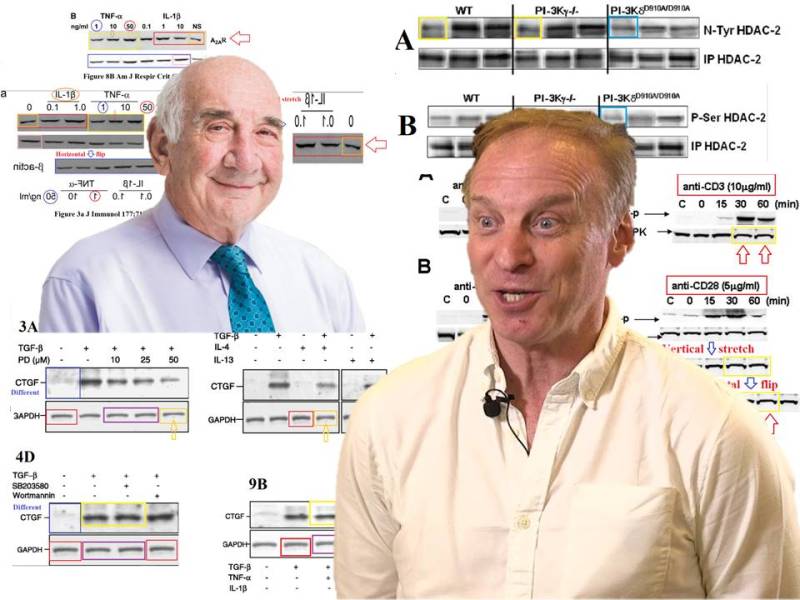
Imperial Adcock – from Barnes to Iran!
“the College would have been well within its rights to reject all of your allegations…”
Here another paper by this duo, published in October 2023 and 4 months after the University of Tübingen was alerted to the affiliation misuse. With “16 authors, 17 affiliations, from 9 different countries (Jordan, Saudi Arabia, Peru, Canada, India, Egypt, Iraq, Germany, Poland)“:
Mohamed J. Saadh, Amera Bekhatroh Rashed , Azfar Jamal , Roxana Yolanda Castillo-Acobo , Mohammad Azhar Kamal , Juan Carlos Cotrina-Aliaga , José Luis Arias Gonzáles , Abdulaziz S. Alothaim , Wardah A. Alhoqail , Fuzail Ahmad , Natrayan Lakshmaiya , Ali H. Amin , Dhuha Ghassan Younus , Gregorio Gilmer Rosales Rojas , Abolfazl Bahrami, Reza Akhavan-Sigari miR-199a-3p suppresses neuroinflammation by directly targeting MyD88 in a mouse model of bone cancer pain Life Sciences (2023) doi: 10.1016/j.lfs.2023.122139

Green arrows: differential splicing is observed, where some blots, but not all, show a sharp vertical background transition suggestive of splicing.
Red arrows: Two lanes in the p-IkBa (ser32) panel look unexpectedly similar”

Pink boxes: The panels in this figure look remarkably similar to those in Figure 2A of Cao et al. Molecular Medicine (2022) 28:163, DOI: 10.1186/s10020-022-00597-z, published before this paper was submitted.
I have only marked the Merge images, but the similarities are also visible in the single channels.
Note that Sham and treatment are switched.”
Recently, Magazinov sent the University of Tübingen a list of papers, all published after his initial notification from June 2024, all with the neurosurgeon Akhavan-Sigari as last author and all giving his affiliation as “Department of Neurosurgery, University Medical Center Tuebingen, Tuebingen, Germany“. Plus the Polish one – Collegium Humanum Warsaw Management University. Never a mention of his actual then-employer, the Paracelsus Clinic in Bremen. Enjoy the titles:
- “Decellularized human amniotic membrane loaded with epigallocatechin-3-gallate accelerated diabetic wound healing” doi: 10.1016/j.jtv.2023.11.008, Received 24 September 2023
- “Mesenchymal stem cells and their extracellular vesicles in urological cancers: Prostate, bladder, and kidney” doi: 10.1002/cbin.12098, Received: 19 July 2023
- “Translational research of new developments in targeted therapy of colorectal cancer” doi:10.1016/j.prp.2023.154888, Received 22 July 2023
- “Progressing nanotechnology to improve targeted cancer treatment: overcoming hurdles in its clinical implementation” doi: 10.1186/s12943-023-01865-0, Received 02 July 2023
- “Reduced expression of miR-221 is associated with the pro-apoptotic pathways in spermatozoa of oligospermia men” doi: 10.1016/j.jri.2023.104159, Received 20 August 2023
- “MicroRNA-155 and cancer metastasis: Regulation of invasion, migration, and epithelial-to-mesenchymal transition” doi: 10.1016/j.prp.2023.154789, Received 23 July 2023
- “Sensing the formaldehyde pollutant by an enhanced BNC18 fullerene: DFT outlook” doi: 10.1016/j.chphi.2023.100306, Received 13 August 2023
- “Explorations of structural and electronic features of an enhanced iron-doped boron nitride nanocage for adsorbing/sensing functions of the hydroxyurea anticancer drug delivery under density functional theory calculations” doi: 10.1016/j.physb.2023.415445, Received 8 September 2023
- “Role of microRNA-146a in cancer development by regulating apoptosis” doi: 10.1016/j.prp.2023.155050, Received 10 August 2023
- “Quercetin modulates expression of serum exosomal long noncoding RNA NEAT1 to regulate the miR-129-5p/BDNF axis and attenuate cognitive impairment in diabetic mice” doi: 10.1016/j.lfs.2024.122449, Received 24 October 2023
- “Dual role of mesenchymal stem/stromal cells and their cell-free extracellular vesicles in colorectal cancer” doi: 10.1002/cbf.3962 – Received 30 December 2023
- “LncRNAs involvement in pathogenesis of immune-related disease via regulation of T regulatory cells, an updated review” doi: 10.1016/j.cyto.2024.156585 (Received 24 May 2023, Accepted 20 March 2024).
Neither Magazinov nor myself were ever dignified with a reply to this new list. You might wonder, why doesn’t University of Tübingen stop this fraudulent shitshow. Why do they refuse to contact the publishers and demand at least the removal of their misused affiliation?

Look What the Cat Dragged In
Meet Mohammad Taheri, PhD, a humble PhD student in Jena, Germany, and his equally unremarkable Iranian associate Dr Soudeh Ghafouri-Fard.
After all, the German Cancer Research Centre (DKFZ) in the neighbouring Heidelberg was in a similar situation with their own Iranian alumnus: Mostafa Jarahian. Also he kept misusing his old DKFZ affiliation for papermilling, and after Magazinov notified DKFZ, they contacted the publishers and Jarahian’s papers were retracted (read here and here, there was also later reporting by Retraction Watch who as usual credited the investigation to themselves). But the Univeristy of Tübingen obviously does not want to see Akhavan-Sigari’s papers retracted.
Possibly it is about money. Although the universities in Baden-Württemberg don’t receive extra state money for extra papers anymore, there is still internal money distribution going on between university departments, depending on who published more (by number and likely also by journal impact factor). Thus, I wrote to the Dean of Medical Faculty Bernd Pichler and to Marcos Tatagiba, director of the Department for Neurosurgery where Akhavan-Sigari remains eternally affiliated with. No reply.
I presume they are happy with receiving money for Akhavan-Sigari’s papermilling. Which gets taken away from other departments in Tübingen, but this is their own problem, why don’t they get their own papermill, those losers.
A perfect crime. It is nobody’s money which gets embezzled here, right?
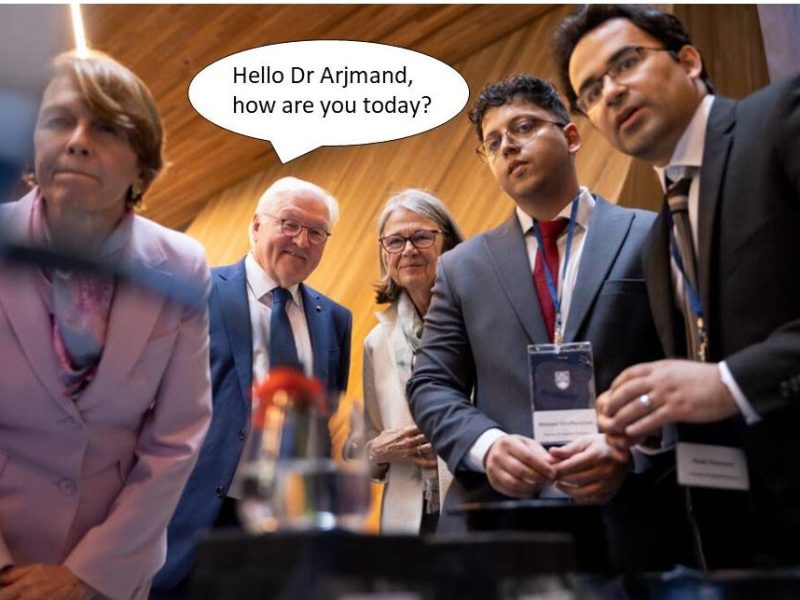
Dr. Mohammad Arjmand showcases his work to German President Steinmeier
“The German President and delegation members also spoke with researchers working on challenges relating to clean energy,…”
To conclude, here is Akhavan-Sigari’s answer to the question “Who would you like to spend an evening with?”:
“Jens Spahn, Gerhard Schröder, Donald Trump, Silvester Stallone.“
Maybe he can add them all to his next research paper.
I thank all my donors for supporting my journalism. You can be one of them!
Make a one-time donation:
I thank all my donors for supporting my journalism. You can be one of them!
Make a monthly donation:
Choose an amount
Or enter a custom amount
Your contribution is appreciated.
Your contribution is appreciated.
DonateDonate monthly
 For Better Science
Crazy stuff.
Although I don’t know how the word “respectful” is allowed on this site.
LikeLike
It was a quote!
LikeLike
Science is rotten(ecker).
LikeLiked by 2 people
Since 2007, the “Excellence Initiative” has been created in Germany to promote cutting-edge research in the country. That means that every 5 to 6 years (in 2007, 2012 and 2019 so far) extra billions of euros are injected into the German academic system by the federal government and the state governments. The money is awarded along three different lines of funding: 1) universities as whole entities; 2) clusters of excellence, where different universities collaborate; 3) PhD programs. Line 1) determines what are the elite universities. The University of Tübingen and LMU Munich, mentioned in Leonid’s article here, are (currently) elite universities together with TUM Munich, Heidelberg, HU Berlin, FU Berlin, TU Berlin, Hamburg, Karlsruhe, Konstanz, Bonn, Aachen and Dresden. The status of “elite university” can be mantained of lost at every round. In the past also Freiburg, Göttingen, Cologne and Bremen reached that status. Despite line 1) is the most prestigious, lots of money are delivered also along lines 2) and 3), and each university compete in this gold (or Geld) rush. This race is won upon the amount of papers published and overall metrics, of course. Thus, it comes as no surprise that also in Germany research fraud is ramping up. The recent cases in Kiel, Ulm, Heidelberg, Magdeburg, Dresden, Bielefeld, etc., reported here at For Better Science represent and alarming hint.
LikeLiked by 2 people
I suggest someone look into Leuphana University of Lüneburg and its research on sustainability. Although it is easy to find figure manipulations, the frauds on sustainability science get away with publishing rubbish articles with the help of their fraud network of journals. Leuphana University of Lüneburg wont let in any foreign researcjers, they prefer keep the fraud local.
LikeLike
Network of frauds, e.g., Jens N, Stefan Sch, Christian W, Henrik W,……., publishing in the journals of their friends true rubbishes that they cannot publish anywhere else. Systematic fraud is that. Clean misconducts. and millions of euros in their own pockets, cashing EU and German money. They maintain closed networks and only hire female PhD students and early career researchers to better dominate.
[the full names were removed -LS]
LikeLike
Not to forget a certain Klaus K, a friend of Rafa Luque, Chris Len and Raj Varma. The one who got a mention in this edition of Shorts.
LikeLike
Skokowa is founding director of Gene and RNA Therapy Center (GRTC). Its Scientific Advisory Board.
Christopher Baum, former MHH president who personally whitewashed Jungebluth and Macchiarini and had to resign over charges of nepotism.
Alberto Auricchio
Correction: “During the assembly of Figure 3, A and B, of this manuscript, bands from the paraplegin immunoblot were cut out and placed on a blank background to eliminate background signal.”
Another paper:
Luigi Naldini
Correction: “During figure preparation for this article, the authors inadvertently duplicated representative flow plots within Figure 3A (gated plot on left and lower right plot) and within Figures 4A and 4B (CTRL, AML17 and 126OE, AML17).”
https://pubpeer.com/publications/34D46C416B866C0E93AF21915421AC
https://pubpeer.com/publications/D5881EC00F27E728798A0892B8CA08
LikeLike
Paracelsus Institute??? Philippus Aureolus Theophrastus Bombastus von Hohenheim has at least one worthy successor!
LikeLike
you say that ‘Rottenecker claims that the extraction of patients’ blood did receive an ethics approval’, which n.sq. from the quote you translated. He only claims that there was no extraction without board approval, which could also mean they just invented data they claimed to have measured in human cells. just a minor detail though. thanks for your work!
LikeLike
Yes it is quite possible.
LikeLike
Following this report: https://pubpeer.com/publications/964B28C616131E4C1EDE09EB3A37D4 on the work of Akhavan-Sigari, I was informed that the article: “The paths toward non-viral CAR-T cell manufacturing: A comprehensive review of state-of-the-art methods” https://www.sciencedirect.com/science/article/pii/S002432052400273X
had been previously published as: https://www.frontiersin.org/journals/immunology/articles/10.3389/fimmu.2022.867013
after major paraphrasing. They are basically same article.
Same papermill with one author is common.
LikeLike
Most of the articles of Reza Akhavan-Sigari, e.g., “Progressing nanotechnology to improve targeted cancer treatment: overcoming hurdles in its clinical implementation” https://molecular-cancer.biomedcentral.com/articles/10.1186/s12943-023-01865-0 are written by Chehelgerdi brothers and soled by them to 10-20 coauthors. None of the international coauthors have any related background.
LikeLike
I know Reza personally, he is a great scientist, he would be happy to give an interview to resolve the false claims and issues. These are all a misunderstanding. He is a great mentor with extensive knowledge. I am shocked to read these. Lets all sit together and talk it over.
LikeLike
Funny, the great scientist never replied to my emails! Must have been too busy papermilling.
LikeLike
Prof. Reza did not receive any emails. He is always quick to answer. Perhaps your email goes to spam box. Please try again with an academic email and use a correct subject. As I said it is all a misunderstanding and can be resolved through mutual respect and communication. We should be cool about it. Authors make equal contributions for internationalisation purposes. We are all professional researchers. I am an student and have no funding, but would take part when invited to contribute. I will maintain and expand my collaboration with Prof. Reza. Peace out brothers.
LikeLike
Patrik Viktor: get lost you annoying Hungarian papermiller.
https://pubpeer.com/search?q=%22patrik+viktor%22
LikeLike
Oh, and hello Partik, pardon, Patrik Viktor. How much did you pay for your authorship here? https://molecular-cancer.biomedcentral.com/articles/10.1186/s12943-023-01865-0
LikeLike
My colleagues and I believe that Pubpeer publicity increase our research impact, it is in fact a positive sign that our research received attention and sometimes jealousy. It later increases our citations, reads and downloads and eventually our impacts. I advice to read our papers before judging the content. We break the borders and initiate internationalisation and brotherhood among nations. I invite you for a face-to-face scientific debate instead of anonymous-cow-ard comments. Peace out my brothers n sisters.
LikeLike
You are drunk, right?
LikeLike
Quite a lot of cultural references here, as I am told. Cows, peacing out… biztos a személyazonosságodban, Partik úr?
LikeLike
Busted:
https://pubpeer.com/search?q=authors%3A+%22Leonid+Schneider%22
Former research criminal is now independent journalist. Busted big time. I wonder how long you can keep up this blog on.
LikeLike
You are an idiot. I will let your comment stand so everyone will see what an utter idiot Patrik Viktor.is, and laugh.
LikeLike
Holla Patrik,
Agreed with your suggestion.
When and where and for how long should we all sit together and talk it over?
Please advise and stay under Reza’s D’s permission though.
Be well…
LikeLike
Maybe expected behavior, if you live in an authoritarian regime.
LikeLike
Research shows Pubpeer comments increase impacts, is it not correct? please elaborate dear expert colleagues. From what I see, the successful papers are noted and discussed in Pubpeer including your own articles. Sometimes they get a retraction note which doubles the record and you will end up with two articles with same titles. Even professor Magazinov commented on his own paper to increase its impact. I will follow your guideline and start to comment on my own articles.
LikeLike
Hey Patrik,
Hope you are doing well.
Sorry for asking, but where are you originally from, please?
Kindest regards,
N.
LikeLike
Dear “Not Mis Neda Rousta”, race here is not a topic, we work to break the borders. In science race aint matter. BTW, the real Mis Neda Rousta wont be happy you are commenting with her identity.
LikeLike
Dear real Patrik V.,
In science, real or unreal “Mis Neda Rousta” aint matter.
You’ve stated that: “…, we work to break the borders.”!
Could you please kindly clarify what “borders” you are talking about? and how could you be able to break them? Really?
Thanks,
N.
LikeLike
Dear researchers!
The person above referring to Viktor Patrik is not him, I am Viktor Patrik, sent to me today, Please take the stands and fake man that is said in my name as null and void. I have taken the necessary steps.
Greetings,Patrik
LikeLike
Nobody believes you, you lying papermilling idiot. But I will let this comment stand for others to laugh at your abysmal stupidity.
PS: your IP is in Slovenia,
LikeLike
Dear Leonid,
I totally agree with you. This guy (Viktor Patrik) is not trust-able at all. He needs to curb himself appropriately.
LikeLike
Sadly, another retraction in progress for Patrik just posed in Pubpeer:
https://pubpeer.com/publications/73F3B2DB05BB3AB061AC99E4426985
LikeLike
Second article of Patrik Viktor Retracted:
https://www.sciencedirect.com/science/article/pii/S0378778824004705?via%3Dihub
Similarly, all the papers of Qusay Hassan are plagiarised.
LikeLike
A related Retraction Watch report:
https://retractionwatch.com/2024/07/04/elsevier-withdraws-plagiarized-paper-after-original-author-calls-journal-out-on-linkedin/
LikeLike