“During your studies, it should be taught that, for example, you critically question your data, handle it transparently and immediately disclose weak points.” - Prof Katharina Kohse-Höinghaus
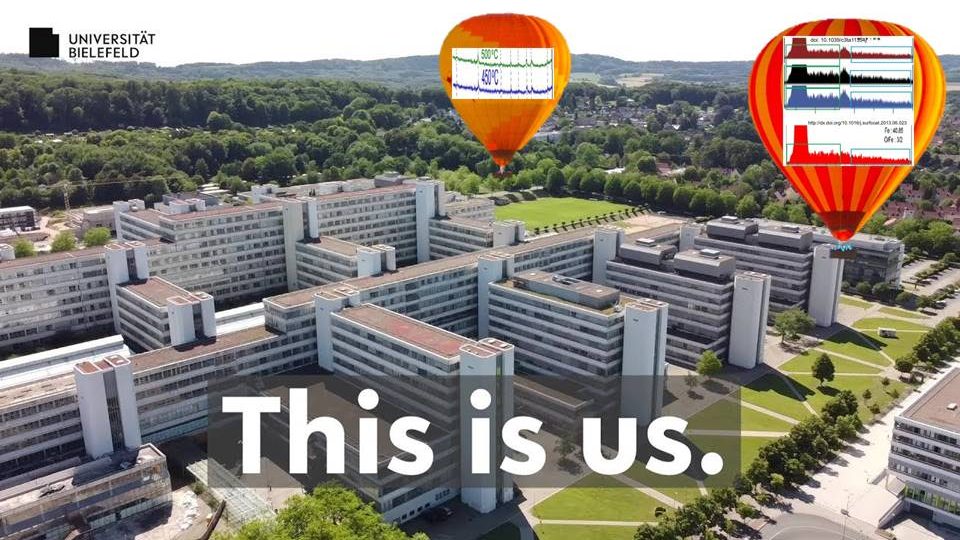
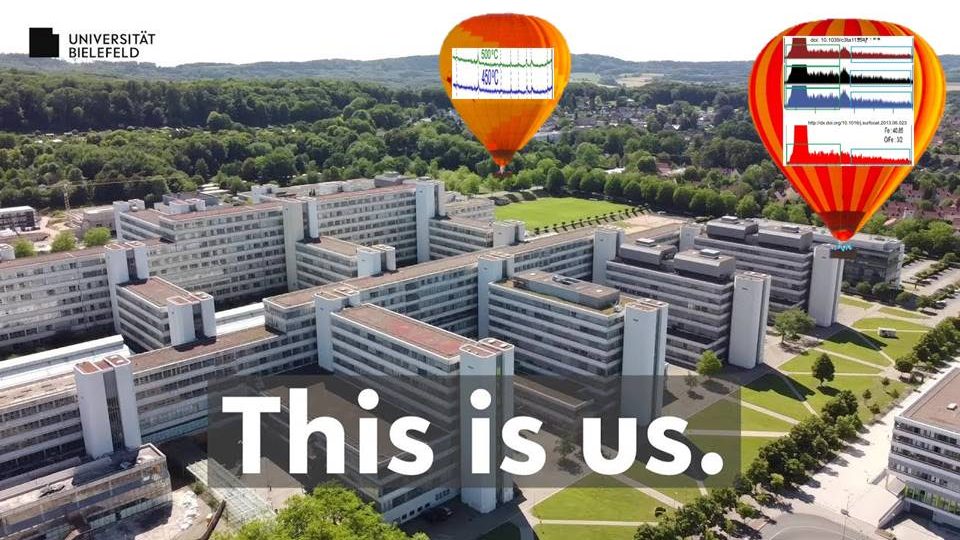
The Bielefeld conspiracy postulates that the German town of Bielefeld does not exist. It is supposed to be located somewhere in Westphalia, a rural and conservative region where most people never go voluntarily to avoid dying from boredom. Bielefeld conspirators claim that their town has a football team and a university, but I will prove to you that at least the latter claim is a lie.
No real university would behave so irrationally and so silly.
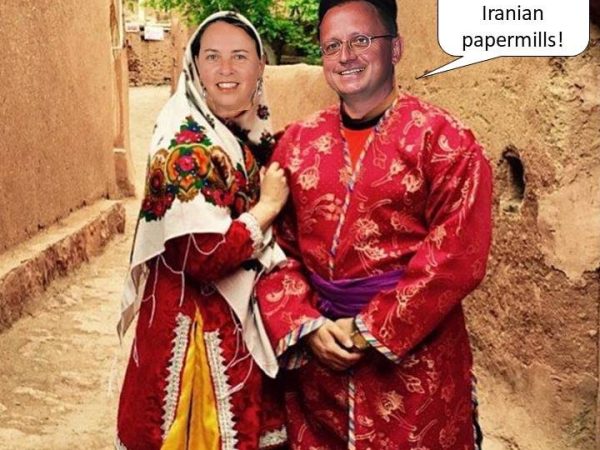
The cast of the Bielefeld Circus has 4 main characters.
Katharina Kohse-Höinghaus, since 2017 retired as emeritus professor for physical chemistry of the University of Bielefeld, although the university pretends even today she still runs her lab. She is a nationally and internationally renowned expert, member of Academies in Germany and China, Senator of the biggest German research institutions, President of learned societies, and an awardee of major science awards (CV here). If anyone can distinguish a real XRD spectrum from a fake one, it’s Professor Kohse-Höinghaus!
Patrick Mountapmbeme Kouotou, former PhD student of Kohse-Höinghaus, sponsored by the German Academic Exchange Service (DAAD) from 2011-2014. Presently Associate Professor at the University of Maroua and the director of a research centre at the University of Ebolowa, Cameroon (LinkedIn profile).
Zhen-Yu Tian, former postdoc of Kohse-Höinghaus, sponsored by Alexander von Humboldt Foundation 2010-2013, now professor at the Institute of Engineering Thermophysics of Chinese Academy of Science and the University of Chinese Academy of Sciences in Beijing (LinkedIn profile). Hosted Kouotou after both left Bielefeld.
Wolfgang Eisefeld, adjuct professor for theoretical chemistry and Ombudsman for Good Scientific Practice at the University of Bielefeld, and a fearless defender of the honour of the all three above.
Now, three papers from Bielefeld, flagged by the PubPeer user Thallarcha lechrioleuca. First, a pair which shares spectra duplicated between and inside the papers:
“Fig.4 The same spectra but atomic concentrations are different.” “Three EDX spectra show unexpected similarity (but only for some part) to spectrum reported in another paper““The same spectra were used 3 times in two papers for 3 different samples.” “Strange fragment of blue pattern.”
Fun fact: co-author Henning Vieker, who also completed his award-winning PhD with Kohse-Höinghaus in 2014, is a conservative CDU politician and since 2022 mayor of his home town of Espelkamp near Bielefeld (just like his father before him!). Disclaimer: I am a member of the Green party, so I am sure the Bielefeld academics will have their own conspiracy theories ready. Vieker’s office never replied to my email. Maybe Espelkamp doesn’t exist either.
Paper Number 3, without Kohse-Höinghaus, but all authors declare a University of Bielefeld affiliation, and acknowledgement: “The authors thank Prof. Katharina Kohse-Höinghaus for helpful discussion“. Tian is corresponding author:
“Fig.2 Two identicl patterns for different samples”
Now, you should be aware that Kouotou’s and Tian’s mentor Kohse-Höinghaus is one of Germany’s highest authorities on the topic of research integrity. Ten years ago, she was appointed by then-President of Germany Christian Wulffas member of national Science Council (Wissenschaftsrat), tasked with designing the “Recommendations on Academic Integrity” for German research institutions. A local newspaper quoted the Bielefeld professor in April 2015:
“The chemist is particularly interested in integrity in science. In April, the Science Council recommended strengthening a culture of scientific integrity. The concept of integrity is intended to develop the focus beyond the rules of good scientific practice towards a comprehensive culture of honesty and quality at scientific institutions. “What is allowed in science and what is not, is not as easy to answer as many people believe,” says Kohse-Höinghaus. “During your studies, it should be taught that, for example, you critically question your data, handle it transparently and immediately disclose weak points.””
This is the result, see the Wissenschaftsrat’s press release (“We need more than rules” – Science Council recommends strengthening a culture of scientific integrity“) and the entire Position Paper (“Recommendations of Scientific Integrity“), issued in April 2015. Among other things, it requested the appointment of a research integrity Ombudsman in all universities and research institutions. It also proposed the creation of a German Research Ombudsman institution, which is in place now. As it happens, my last interaction with the German Research Ombudsman was about them apparently endorsing papermills and opposing whistleblower protection, read here:
This attitude of incompetence by the German Research Ombudsman is not an accident. It is intended. Explicitly excluded in that 2015 Position Paper was the idea that this national Ombudsman institution should be allowed to admit whistleblower notifications, investigate cases, or sanction research misconduct. This, I was told back then by the Wissenschaftsrat, is exclusively the task of local Ombudspeople at universities. The Wissenschaftsrat experts were strongly opposed to the idea of a German version of the US-American HHS-ORI, the German institution they proposed was meant to be completely toothless, and indeed it is. You will soon see why this was important for people like Kohse-Höinghaus.
Back in 2015 I contacted the press speaker and all members of that Wissenschaftsrat committee, including Kohse-Höinghaus. Nobody wanted to explain their antipathy against a proper research integrity authority in Germany. I wrote about this strange situation in an article for Laborjournal.
As it happens, a certain oncology professor Simone Fulda was at that time a Wissenschaftsrat member. She recently resigned as President of the Kiel University over massive data forgery in her papers, it was in national news and I was made responsible for this tragedy. maybe this is why the Wissenschaftsrat now assured me she was not involved in the design of the 2015 Position Paper. But they still don’t name the authors, so I can’t check.
“I am taking this step with a heavy heart and a sense of responsibility for the university since a sufficient foundation of mutual trust no longer remained with some parts of the university to ensure successful cooperation”, – Simone Fulda
Fulda and many others never replied to me back then, but Kohse-Höighaus did, since she is indeed one of the authors. She told me she was busy travelling and didn’t have time to explain her Position Paper to me.
Almost a decade later, in November 2023, I wrote to Kohse-Höinghaus again. This time not about some abstract and general stuff, but about specific research integrity problems in her own lab. Even with her name on the papers.
I sent Kohse-Höinghaus Kouotou’s and Tian’s PubPeer links and introduced myself as independent science journalist, with a link to For Better Science. I suggested to retract those papers. Germany’s grand expert for research integrity replied to me (translated):
“Please tell me a little more about yourself. Normally I don’t like to respond to email contacts that don’t seem professional (gmail? no information about the person? links that it’s better not to click on in unknown emails?). I saw the comments on pubpeer.com and checked the original images. In my opinion everything is in order. How do you prove that data is fake? It would be more appropriate if you first suggested an investigation in such an initial message.”
And investigated it all was, by an Ombudsman of Kohse-Höinghaus’ liking.
Before we get to meet the fourth member of this travesty show, it is worth having a look at other works by Kouotou and Tian:
“Fig.1 shows two XRD patterns which are different only in the regions of main peaks. The peak width is used to determine “crystallitessize” which are listed as difefrent in these two patterns.”
Right: “There are some anomalies in the EDS spectra including sudden contrast changes and repetitive noise in the baseline.“
Koutou admitted on PubPeer that the spectra were forged. By a student!
“The data analysis and graphics were performed by the first author currently student under my Supervision. We thank the reviewer for this remarque. […] The unusual fragment observed in the published version of the graph may due to the poor experience in XRD data processing by the student. […] I am already in contact with the RSC Publishing Ethics about that issue.”
“Fig.3 EDS specrum with two rectangle regions of different contrast. One of these rectangles cuts the top of noise in the spectrum, possibly also with some extra peaks.”
Also here, Kotou replied on PubPeer and again blamed the first author for the manipulation. He again provided replacement data.
On 24 November 2023, I published some of the PubPeer material in Friday Shorts and then sent the link to the Bielefeld chemistry professor and Ombudsman Wolfgang Eisfeld. I also made a formal notification of suspected research misconduct, reporting the PubPeer threads three papers by Tian and Kouotou, plus another pair of papers by Tian, with two coauthors with Bielefeld affiliation: Vieker the Mayor, and one Andre Beyer, a faculty member at the university’s physics department. There are some very dodgy and likely copy-pasted spectra:
“Significant part of data published in this paper is copied form 3 years earlier paper, 2016. http://dx.doi.org/10.1016/j.apcatb.2015.12.034 Note some cut on the upper side of noise in teh green pattern. As if the blue pattern was paste dinto this figure as image.”
Zoom-in. Are those spectra really machine- and not hand-drawn?
The Ombudsman replied to me on 27 November 2023 (translated):
“Thank you very much for your comment, which I will of course follow up on. And now, First of all, a note from me. My job is to do this and very to bring the two sides into discussion about serious allegations convey. My own position here has to be strictly neutral. I hope for the cooperation of all sides.
Honesty and therefore credibility is our greatest asset in science and therefore the accusation of conscious deception and of data falsification is also the most serious. Accordingly, one should also deal with allegations responsibly. Therefore I would like to ask you to justify your suspicions scientifically, so that an expert can check this independently if necessary. Accusations of this kind can be expected that they are substantiated, that they adhere to good scientific practice just like one expects this from scientific studies. As soon as I receive detailed argumentation for your suspicions, I will forward it to those affected and ask for a statement. When this statement is available, we can start the discourse and hopefully clarify what is going on here. Should thereafter substantiated suspicions remain, I will have to have initiate an examination by an independent expert commission which then would have to competently clarify the matter. In the meantime, I would like to ask you to refrain from making further public allegations in this case without supporting these in accordance with good scientific practice.
I thought the PubPeer evidence speaks for itself, and a professor of chemistry should be able to understand this evidence of fake spectra? What game was Eisfeld playing?
We had a similar case in Dresden, it ended with resignation of the lab head Brigitte Voit as institute director and as Ombudsperson of the Leibniz Association. And with retractions. And with findings of research misconduct by negligence against said ex-Ombudsperson.
I wrote back, explaining the issues but haven’t received any reply from Eisfeld ever again. In early 2024, Kouotou started replying on PubPeer, blaming his first authors for forgeries (as quoted above). Also Tian suddenly posted lenghty replies, with figures, denying that anything was out of order. Tian stated:
“Foremost, I would like to assure that no intentional data manipulation has occurred. The experiments, data analysis and graphics for both papers were carried out for the publication by Patrick Mountapmbeme Kouotou during his stay as a DAAD Fellow in Bielefeld. The lab books in paper format of my and my CVD group collaborators from that time are, to the best of my knowledge, at least in part still kept in Bielefeld. Some co-authors of the papers, which were submitted more than 10 years ago, are meanwhile working in different countries.
Meanwhile, the senior author has handed over the former laboratories to her successor and is a senior professor since 2017. Laboratories, instruments and computers from that time have not been conserved, and hard disks with information older than 10 years have been regularly discarded in a controlled fashion by the IT manager of the lab.”
Tian insisted that the noise pattern is the same because it is supposed to be:
Tian: “They are different from each other, even in highest magnification, in the regions of interest of the comment. We also would like to remark that differences should be small since thin films deposited under similar conditions with the temperature as a variable were analyzed on the same type of substrates in the same configuration with background of an uncoated substrate in all cases.”
He also explained why the blue spectrum was sheared at the top: “these bars were removed in the revised version. There is no strange pattern in the original figure, and no manipulation has occurred.”
Problem is, that the two blue spectra do not show the same measurement. Tian also defended figures which were not even criticised. Other PubPeer users, especially Thallarcha lechrioleuca and Maarten van Kampen replied, proving that the suspicious spectra were indeed absolutely identical. As these overlays prove:
Maarten also referred Tian to a similar case:
“The whole argument very much reminds me of discussions on the work of Magnus Willander and Omer Nur. Take e.g. a look at the arguments in this PubPeer post. Also see that the paper has by now been retracted
On ForBetterScience one can read snippets of the expert reports that lead to the downfall of the above and other papers that showed ‘repeating noise’. Below a screenshot of two relevant ones:
You or your co-author re-used the same XRD spectrum three times after scaling. This can be an honest mistake that requires correcting. Your explanation of them being not identical is, well, less honest.”
“The Board assesses that there are no scientifically acceptable explanations for why the notified researchers have fabricated research results in the manner that has occurred in the notified articles. Raw data also does not support the reported results. [..] In summary, the Board finds therefore that the notified researchers have been guilty of misconduct in…
“My name is Prof. Wolfgang Eisfeld and I am ombudsman of Bielefeld University where the experiments challenged above were carried out. The main authors of this publication contacted me right after the accusations appeared. They could not explain at first why the published spectra showed the criticized similarities and asked me for a neutral investigation. They were sure that none of the collaborators of this study did any undue data manipulation but could not rule out a mistake. During my investigation, the authors were very cooperative and did everything in their power to find out the truth. They recovered the original experimental data used to plot the spectra for the figures and provided them to me for an independent analysis. They also dug out original lab journals and, where possible, recording protocols from the measuring instruments which were in part hosted by collaboration partners. This was a huge effort since the lab does not exist anymore and was replaced by a new lab of the successor of Prof. Kohse-Höinghaus.
First of all, the independent analysis showed that the provided data reproduce the spectra in the published paper. It also revealed that the noise patterns of the different experiments are clearly different. The resolution of the published figures is entirely insufficient to see the noise in detail. However, there are extremely similar noise features visible. At first, the authors could not explain this phenomenon. Finally, they found the reason in the way the experiments are carried out. The explanation is given above and is in short that one single background spectrum was recorded and subtracted from the measurements of the sample. Thus, the noise features all data traces have in common are actually the noise of the background recording. After I was given this explanation, I contacted an independent expert who was not involved in these experiments. The expert confirmed that the procedure of removing the support background is standard and could lead to the phenomenon observed here. He also explained to me how this could be avoided and also provided a simulation to me, which demonstrated the problem. Furthermore, he explained to me that these XRD are routine measurements taking little effort and it would make absolutely no sense and take much more effort to manipulate the spectra as claimed in the above accusations.
After this rather involved investigation, I came to the conclusion that the initial suspicion of data fraud is false. I found absolutely no indication of any undue data manipulation and closed the case.”
This is completely bizarre, and frankly insane. The insane part was to post this internal-use bullshit on a public platform. If you whitewash people, do this hush-hush, and don’t expose yourself to ridicule with silly explanations!
But now I know why Eisfeld never replied to me again: he must have found me guilty of research misconduct, just as his strange initial email to me threatened. And indeed, I asked, and the university didn’t deny it. Not my first time a German ombudsman finds me guilty, read here:
Sonia Melo, the Portuguese cheater scientist and her former US-boss Raghu Kalluri issued some days ago a biorxive preprint, which sole purpose is to defend their discredited Nature paper from 2015. There, they originally claimed to have found a unique biomarker for early pancreatic cancer, a much hailed promise to save lives of many cancer…
There are several problems with Eisfeld’s PubPeer posts. First of all, he never shared that original data which in his view proved that all allegations were false. Second, his mysterious expert is anonymous. But the experts on PubPeer are not. Sylvain Bernès, a French group leader in Mexico, found a whole list of “inconsistencies or inaccuracies” in Eisfeld’s explanation. Also Angus J. Wilkinson, professor of materials science at University of Oxford, didn’t sound at all convinced.
Maarten van Kampenrejected Eisfeld’s anonymous expertise while signing in his name:
Maarten van Kampen: “The XRD pattern of the current 2013-06 paper (left, 300oC) is (practically) identical to the 400 and 450oCpatterns in the 2013-07 paper (right): after vertical scaling both the peaks and the noise exactly match (see animations in #6). At the same time the 2013-06 300oC pattern is very different from the blue 2013-07 350oC pattern. The 2013-07 paper mentions that successful deposition was only possible at ~350oC and higher, see highlight. It worries me that XRD patterns exactly reproduce between conditions that the authors themselves show to give different results, or possibly no growth at all. This in papers published within months from each other.”
Other PubPeer users found additional concerns in those papers – outright unscientific nonsense in Kouotou et al 2013, which the last author Kohse-Höinghaus should have noticed yet she didn’t:
“The XPS presented in Fig 5 has consistency issues. A C-O/C=O contribution this large, comparable to the lattice oxygen, on a supposedly iron oxide sample is illogical.”
“So the authors claim that the as-prepared, alpha-Fe2O3 thin film contains huge amounts of carbon? Furthermore, the amount of adventitious carbon is claimed to be the same as the amount of carbonaceous species…which are comparable in amounts to that of lattice oxygen? None of this is consistent with the claimed thin film structure.”
Eisfeld also broke the rules. The same rules he preached to me. §19, §20 and §21 of the Bielefeld guidelines clearly state the Ombudsman was supposed to pass on the case for investigation to his university’s Commission for good scientific practice. Instead, he investigated it himself, with his anonymous secret expert.
But then again, the chemistry professor Eisfeld was the only one qualified indeed! The Bielefeld commission wouldn’t be able to investigate this case: none on the four members is from the field of natural sciences. There is a historian, two sociologists, and a sports scientist. The other Bielefeld Ombudsman, Christoph Gusy, is a law professor. The top responsible, the Vice-Rector for Research Christiane Fuchs, is an economist. It is quite likely that they and other senior figures in Bielefeld sent Eisfeld on a mission to save Kohse-Höinghaus’ honour, at all costs.
Nobody ever replied to me from the University of Bielefeld, why should they, they just found me guilty of research of research misconduct. I also contacted DAAD and Humboldt Foundation which sponsored Kouotou and Tian. Humboldt Foudnation didn’t reply. DAAD told me never to write to them again and hinted they side with Eisfeld’s assessment.
Only the German Research Council (DFG) replied and indicated to open an investigation.
One-Time
Monthly
I thank all my donors for supporting my journalism. You can be one of them! Make a one-time donation:
I thank all my donors for supporting my journalism. You can be one of them! Make a monthly donation:
DFG-Investigation? I’m afraid this will result in even more proof of the Bielefeld Conspiracy Theory.
In this case, one should contact German playwright Tom Peuckert, author of the brillant play “Luhmann” – premiere in Theater Bielefeld, 2005! There is also a radio play version, I highly recommend it to German readers:
“Mit Luhmann spielt man das Theater des Zweifelns noch einmal durch. So entstehen die Beobachter. Und der Humor. Luhmanns ironische Noblesse im Umgang mit Andersdenkenden – nur starke Charaktere werden das nicht als schallende Ohrfeige empfunden haben. Die Quintessenz der Bielefelder Weisheit: Der gesellschaftliche Spielraum des Menschen ist klein, seine sozialen Wünsche sind riesengroß. Im Grunde eine komische Situation.”
Imagine what Peuckert could make of models as Kose-Höinghaus, Kouotou, Tian and Eisfeld…









 For Better Science
DFG-Investigation? I’m afraid this will result in even more proof of the Bielefeld Conspiracy Theory.
In this case, one should contact German playwright Tom Peuckert, author of the brillant play “Luhmann” – premiere in Theater Bielefeld, 2005! There is also a radio play version, I highly recommend it to German readers:
“Mit Luhmann spielt man das Theater des Zweifelns noch einmal durch. So entstehen die Beobachter. Und der Humor. Luhmanns ironische Noblesse im Umgang mit Andersdenkenden – nur starke Charaktere werden das nicht als schallende Ohrfeige empfunden haben. Die Quintessenz der Bielefelder Weisheit: Der gesellschaftliche Spielraum des Menschen ist klein, seine sozialen Wünsche sind riesengroß. Im Grunde eine komische Situation.”
Imagine what Peuckert could make of models as Kose-Höinghaus, Kouotou, Tian and Eisfeld…
LikeLike