"together with my colleagues we are actively analyzing the points raised on pubpeer." - Claudio Schneider
"we will evaluate Pubpeer comments" - Giannino Del Sal
Giannino Del Sal and Claudio Schneider (no relation to me) are two great Italian cancer researchers, the former is a mentee of the latter.
Both men are EMBO members, Schneider is professor of at the University of Udine, Del Sal is professor at University of Trieste, both located in the same northern Italy province Friuli-Venezia Giulia. Del Sal is additionally since recently affiliated with the IFOM Institute of Molecular Oncology in Milan (Disclaimer: I worked there as postdoc, 2008-2012). There are also other mentees of Schneider who made impressive academic careers with bad science.
Clare Francis had a look at some old papers, the ones that established Schneider’s and Del Sal’s reputations as titans of cancer research.
Here are their often overlapping PubPeer records now, for Schneider and for Del Sal. With rotten stuff like this:
Or the next study, featuring the University of Milan professor Roberto Mantovani, who has his own PubPeer record and is the nephew of the Milanese bigwig Alberto Mantovani, about whom I briefly wrote here:
Meet two grand cancer researchers from Milan: Pier Paolo Di Fiore and Pier Giuseppe Pelicci. Then decide if you want to give them your tax and charity money.
The first author and Del Sal’s mentee is a Fiamma Mantovani (certainly related to Alberto and Roberto) who is presently an associate professor at the University of Trieste. She did her PhD in the lab of a certain Trieste virologist named Lawrence Banks, whom you’ll meet in the Coda of this article.
Here, again with the same Mantovani clan member, another joint effort by Del Sal and the IRCSS Regina Elena National Cancer Institute Rome professor Giovanni Blandino:
Now a paper from Schneider’s lab, featuring Roberta Benetti, a mentee of Schneider and associate professor at his University of Udine, where she collaborates with another mentee of Schneider, Claudio Brancolini (more on him later). You met Benetti at the very beginning, as the first author of another manipulated paper. Also be informed that she is being celebrated in Italy for discovering a magic cancer cure with the microRNA miR-335, which is said to replace chemotherapy. It was based on her paper Scarola et al 2010, co-authored with Schneider and Benetti’s husband, the Udine professor Stefan Schoeftner.
Schneider explained on PubPeer that the duplicated data was irrelevant anyway:
“Thus excluding the replicate both control and experimental time courses remain intrinsically consistent We would like to remark that the graphical bug introduced in the Fig.5A does not alter the essence of the result.”
Here, I am not sure if Benetti can be blamed for the graphical bug, because Spain’s infamous super-fraudster Susana Gonzalez is on the paper!
Martin Monte and Claudio Schneider: “We see and agree we have replicated in Fig.4B the MAGE blot without specifying that it is the same blot corresponding to Fig4A. After more than 17 years, we think we introduced the MAGE panel in both Fig4A and Fig4B to render Fig4B more uniform in its capture by the reader side-by-side with Fig4A or, alternatively, it was an inadvertent error. […] this graphical bug does not alter in any way the essence of the result.”
I am sure this nasty duplication also was also meant to render the Figure 4 “more uniform”:
This one, in Nature no less, is indeed an insult. The first author Paola Zacchi spent her entire career in Trieste, and is now #opentowork on LinkedIn:
“The upper (28S) bands in lanes 1 and 3 appear to be very similar.”
It is worth mentioning that Schneider’s and Del Sal’s Israeli collaborator Ze’ev Ronai, Chief Scientific Advisor at the Prebys Medical Discovery Institute in La Jolla, USA, has his own PubPeer record of fake science. Like this:
There was even more, but that fraud won’t be retracted, because the paper already received an Erratum in 2005:
“There was an error in the article title by Lopez-Bergami et al. The correct title is “RACK1 Mediates Activation of JNK by Protein Kinase C.””
Maybe the Receptor for RACK1 was the guilty party for the photoshop fraud, hence the Erratum to the title? One of Ronai lab’s papers, Buschmann et al Cell 2000, was retracted in 2002 because the authors could not reproduce their own results, the first author got the whole blame by his colleagues Ronai and Serge Fuchs (now professor at University of Pennsylvania). Well, maybe Thomas Buschmann was framed, because look:
But I digress and must return back to Friuli, Italy. Even without PubPeer, Schneider knew there were problems with some of his papers – half a year ago he issued a correction for a study not flagged on PubPeer before:
Correction March 2023: “Page 2598, Fig. 2B, right: The published actin blot was taken from a different experiment and inserted by mistake. The corrected blot should appear as shown below. This change does not alter the results or conclusions of the study.”
Also Del Sal knew of problems in his papers. He had to correct a collaborative study already in 2014:
Maura Sonego , Monica Schiappacassi , Sara Lovisa , Alessandra Dall’Acqua , Marina Bagnoli , Francesca Lovat , Massimo Libra , Sara D’Andrea , Vincenzo Canzonieri , Loredana Militello , Marco Napoli , Giorgio Giorda , Barbara Pivetta , Delia Mezzanzanica , Mattia Barbareschi , Barbara Valeri , Silvana Canevari , Alfonso Colombatti , Barbara Belletti , Giannino Del Sal , Gustavo Baldassarre Stathmin regulates mutant p53 stability and transcriptional activity in ovarian cancerEMBO Molecular Medicine (2013) doi: 10.1002/emmm.201201504
Corrigendum from 2014: “The authors of the above research article have informed the journal that an error occurred during assembly of the graphs shown in Figure 8G. The new Figure 8G below contains the correct graphs and replaces panel G of the original figure. The original statistical analyses and the P-values obtained remain valid. In any case, this mistake does not affect the results and conclusions of the paper.“
The authors forgot to inform the journal that a gel was forged also, which still does not affect the results and conclusions:
I wrote to Schneider and Del Sal on 24 August 2023. The next day, on 25 August 2023, Schneider replied to me:
“Dear dr. Schneider, thanks for your email, together with my colleagues we are actively analyzing the points raised on pubpeer.
Just minutes later, Del Sal replied also:
“Dear Dr. Schneider, thank you for your note, we will evaluate Pubpeer comments.“
Some responses on PubPeer followed, but neither has ever replied to my emails again. Especially when their mentees started to post fake raw data. Look at this beauty by Schneider’s mentees Benetti and a certain Argentinian called Martin Monte whose name you keep encountering.
In September 2023, Monte, now back in Argentina as CONICET-funded group leader at University of Buenos Aires, posted the following reply on PubPeer. It was co-signed by Schneider, “in behalf of all authors“:
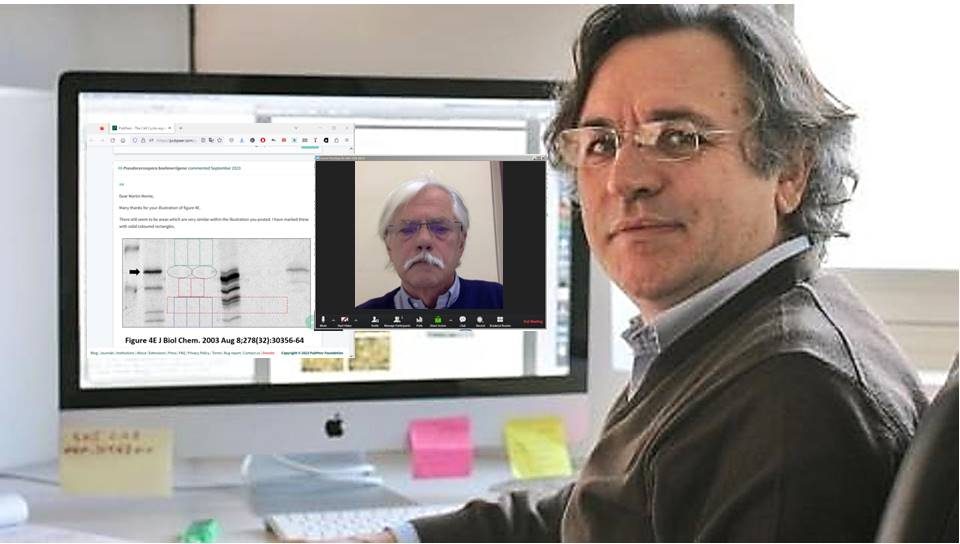
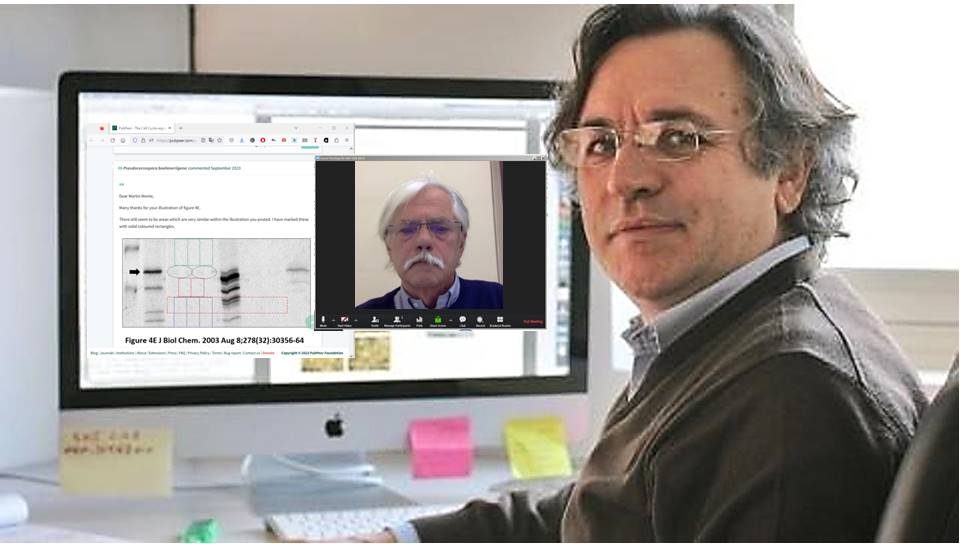
“I fully support efforts towards enhancing the quality of the images that are being published, but in this case I have to disagree. The pattern indicated in the figure does not follow the logical geometry of the performed experiment. Probably, the software used to scan and analyze the image did not take into account the lines where an electrophoresis runs. If this is considered, the implied similarity does not exist (see the highlighted ovals). However, we do observe the presence of repeated pairs of points in the background of the image (see the highlighted rectangle), which could be artifacts from the image acquisition process or something that we cannot verify 20 years later. I extend my gratitude for your dedication to maintaining data accuracy and integrity. “
The image posted by Monte was fraudulent. This is how bad it was:
There was more wrong with that paper. But Monte, Schneider and Del Sal remained silent. Another paper by same team, and look, the cancer miracle healer St Roberta of Udine is there as well:
How can one half of a loading control gel be identical to the other half, just mirrored? Does this affect any conclusions? Silence.
But don’t blame Benetti alone. Monte continued publishing forged data in Argentina, I mentioned his collaboration with his colleague in Buenos Aires, Mario Galigniana, in last Friday Shorts. Here an example:
And now, another successful mentee of Schneider you already encountered above – Claudio Brancolini, who progressed under Schneider’s tutelage to a full professor at the same University of Udine. Based on faux science like this:
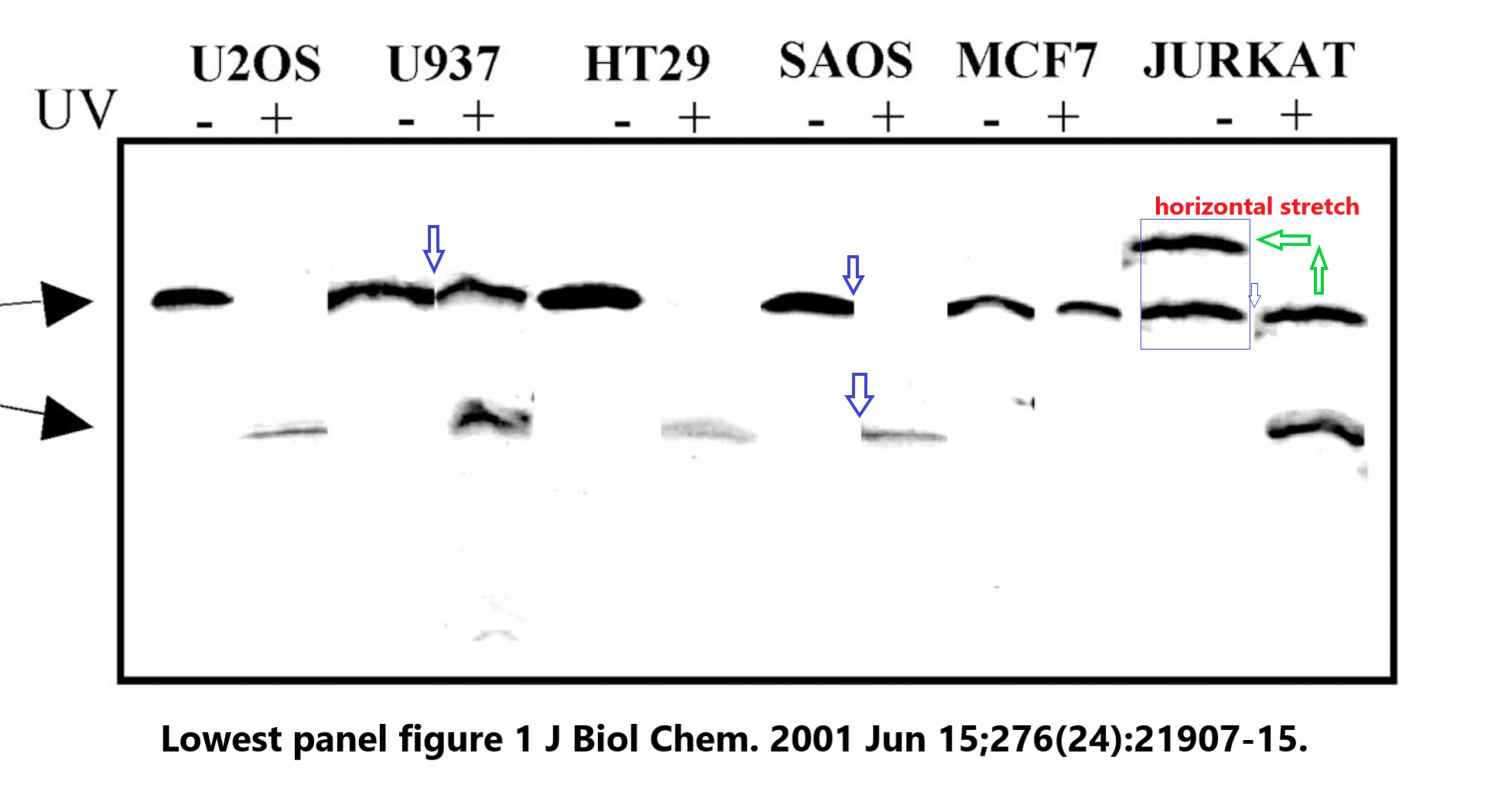
“Bands often have vertical, straight ends between minus and plus UV treatments. Upper Jukat bands are much more similar than expected after a horizontal stretch of the rightmost band.”
Brancolini explained on PubPeer (highlights mine):
“Dear Anonymus
As you can imagine, going back more than 20 years is not easy. I will try to remember. The picture shows a rapid validation screen of the antibody against caspase-2 that we developed towards the end of the last century. As you can see, there is no loading control, and the reviewers did not ask for it at that time, given the nature of the experiment. At that time, these validations were done with immunoblot strips, which were then hybridized with antibodies or different fractions of the purification cycle, also to evaluate the titer. As far as I remember, the figure in question is a compilation of these strips. It shows that the antibody we made recognizes caspase-2 and its processed form. The same result is found in other figures confirming the goodness of the antibody, and we have used this antibody in many other publications. This antibody also benefited the scientific community, as we sent aliquots of it to various colleagues upon request. I cannot rule out the problem of double banding. It is possible that a mistake was made in scanning and assembling of figure. For this I deeply apologize to the entire community. I think you will agree that this has no bearing on the scientific outcome of the work in question. If it is really necessary for the future of science, since we no longer have access to these very old data, we can repeat the experiment with Jurkat cells.”
The man just admitted data forgery but insists it doesn’t affect the conclusions because the scientific community is already greatly indebted to him. And here, same first author Gabriela Paroni, now researcher at Mario Negri Institute in Milan:
Now let’s meet Del Sal’s colleague in Trieste and an Englishman in Italy, Lawrence Banks. This virologist is Director-General of the International Centre for Genetic Engineering and Biotechnology (ICGEB) there. Banks studied and did PhD in Leeds and then went to London, where he made it to independent researcher at the Ludwig Institute for Cancer Research. Yet since 1990, he is at ICGEB, Trieste.
Banks also has a PubPeer record one should be worried about, except that he isn’t. Here a simple, but shifty example:
Elisabeth Bik: “Concerns about Figure 1B. The bottom panel appears to contain many repetitive features in the left two lanes.”Bik: “Concern about Figure 3. The two Ponceau membranes look remarkably similar, with water-color-like features in the parts where they might appear different.“
Banks never replied to my emails. But he does reply to journal editors:
The lead editor of Virology shared this reply by Banks with Clare Francis and decided the case closed:
“It is an old fashioned CAT assay – having run many of these around that time if several are run in the same tank there can be very similar patterns of migration. Looking closely at the image in question I feel very confident that the spots highlighted are in fact not the same.“
One must take an Englishman by his word, no?
Banks also collaborated with Alan Storey, a former professor at Queen Mary University London and University of Oxford, who left academia in 2013 and works since as medical writer for changing businesses. Storey’s many forgeries are recorded on PubPeer, and his paper with Banks (Jackson et al 2020) was discussed in the following article about editorial inaction:
Now, we don’t know if Lawrence Banks had to go to Italy because he was that dishonest, or if going to Italy made his dishonesty worse, or maybe both. We also can only speculate why Claudio Schneider happened for years to be blind to the shenanigans by his mentees, while heaving them into professorships in Italy and abroad.
But really, maybe something is wrong in a country where even the minister of health is caught with fake science, where university rectors like Giorgio Zauli of Ferrara engage in massive research fraud and then abuse power and politics to defame, threaten and silence critics, and where entire universities turn into steaming fraud factories to match Chinese and Iranian papermills. As rector magnificus Salvatore Cuzzocrea did to University of Messina:
“The University of Messina was, in short, a good business that appealed to many, including organized crime on both sides of the Strait of Messina.” – Aneurus Inconstans
Giorgio Zauli’s rectorship term ends. Will research fraud, media harassment and whistleblower persecution be a thing of the past at the University of Ferrara? Ma dai, basta cazzate.
Every great man, or woman, has a few skeletons in the cupboard, or as the Germans say, has a few dead bodies in the cellar.
The problematic data (skeletons/dead bodies) will feed the narrative that they are great men and women. The journals will play their part. By ignoring the problematic data the journals help them sleep better at night. Everybody lives happily for ever after, the great men and women, the journals preserving their profits. It is the best of all possible worlds.
A paper in Genes & Development, nice, very glossy paper, better than a small, lesser book from the Bible. Genes & Development is on record as being dead set against doing anything about the appalling data.
Such a golden and untouchable oldie!
How myths are born. It’s not about the data, but about how much you believe.
Claudio Schneider, Lawrence Banks, Giannino Del Sal and Claudio Brancolini are all professors, Claudio Schneider and Lawrence Banks are senior professors, directors of institutes in Trieste for years. They are the “establishment”. How is the “establishment” going to act against the “establishment”?
Italy does not even have the equivalent to toothless wonder of the US Office of Research Integrity (ORI).
I think we are expecting a miracle if we believe that any official criticism of Claudio Schneider, or Lawrence Banks. That criticism would have to come out of their own mouths
Claudio Schneider, Lawrence Banks, Giannino Del Sal and Claudio Brancolini have been very wise. Friulia is a lovely part of Italy. The Dolomite mountains, Trieste is warm even in the winter because of the Adriatic sea. According to Italians the people in Friulia are modest, and more logical than average. We know that Lawrence Banks does not come from those parts, but the northern island of Britannia, the edge of civilisation, where they paint themselves with blue dye on Friday nights; what of the others? Do they come from Friulia?
The growth-arrest specific genes (Gas genes) were put forward in the 1990s and early 2000s by Claudio Schneider as another way to cause cell cycle arrest, potential alternatives to the cyclin- dependent kinase inhibitors. The Gas genes were quite a big deal when they were first described.
The problematic data about Gas2 and Gas3 displayed in this post leave me in doubt that their alleged nature is real. Why should two genes suffer a rash of problematic data?
It may turn out that Claudio Schneider’s group kept the real data in a shoe box and Nature will be ever so kind, as it was the Dalla-Favera, who was allowed to correct 2 figures years after publication, and let Claudio Schneider reach into the shoe box and pull out the real data.
By allowing Dalla-Favera to correct after so many years Nature is denying the data, and denying any way of keeping an order in the scientific record.
When there is so much problematic data, which Nature allowed with a correction, that is obfuscation by Nature. Is Nature going to obfuscate again for Claudio Schneider’s and Giannino Del Sal’s sake?
The authors cannot admit duplication in one figure, but nevertheless are allowed to repeat experiments now, not using data from the time of the original publication
Also allowed to explain a rotation in another figure. The 2023 correction uses 2 images claimed to be from 1999. The only clear differences between the two images are areas in one image which lie outside the other image. What a surprise!
Martin Monte , Roberta Benetti, Giacomo Buscemi, Peter Sandy , Giannino Del Sal , Claudio Schneider The Cell Cycle-regulated Protein Human GTSE-1 Controls DNA Damage-induced Apoptosis by Affecting p53 Function Journal of Biological Chemistry (2003) doi: 10.1074/jbc.m302902200
They would be able to see what people were saying about their journal and institute. Perhaps, being ever so slightly proactive, they woukd start to “read/look at” the comments and decide what has been going on.
They are not asleep at the wheel at Genes & Dev, but staffed by people who don’t understand the data. That’s one ploy to ignore problematic data. The more hurdles the better.
In such a manner sedimentary rock is formed, at first compressed sand, then over time, having “stood the test if time”, it becomes sandstone.
An unstated consequence of aberrant sandstone formation is unemployment. When they are “finding a way through”, making up convenient “stepping stones”, adding to their “H-index”, you won’t be finding those “results”, or acquiring the convenient “stepping stones”.
Everybody should carry out audits of their scientific field, or beyond that once they get the hang of it. It is not an added extra.
If you think that somebody in your field is always publishing all the time, but is nevertheless third rate, look at their data.
Carlo Croce sprung to mind.
Darwinian selection for those who make it up is at work. Good scientists are naive by nature, but that should not blind them to the fact that Darwinian selection is at work on them.
The only effective tool there is to Darwinian selection is to point out problematic data. The system, institutes and journals, will react, if slowly and sometimes weakly, but it is the only tool we have.
The authors will be allowed to repeat experiments. Nature will say that it is not responsible for low resolution images which it published, which make it too difficult to be sure of anything. It will also say that the flip and re-sizing is a quirk of nature itself.
Everybody lives happily ever after.
I am in two minds about whether any of Claudio Schneider’s, or Giannino Del Sal’s, papers will be corrected, or retracted. Many reasons for the journals, home institutions to do nothing. The journals are conflicted businesses, the home institutions are conflicted businesses, they want to keep their reputations, fees, grant money…
Journals, especially Nature, are always publishing papers about dinosaurs, hardly experiments, yet cannot deal with 20-year-old data. The longer the problematic data remains in the literature the worse it gets. “Standing the test of time” will be used as evidence that the data are corr C.
Am J Pathol. 2011 Jul;179(1):349-66. doi: 10.1016/j.ajpath.2011.03.036. Epub 2011 May 19.
Effects of age and heart failure on human cardiac stem cell function
Daniela Cesselli 1, Antonio P Beltrami, Federica D’Aurizio, Patrizia Marcon, Natascha Bergamin, Barbara Toffoletto, Maura Pandolfi, Elisa Puppato, Laura Marino, Sergio Signore, Ugolino Livi, Roberto Verardo, Silvano Piazza, Luigi Marchionni, Claudia Fiorini, Claudio Schneider, Toru Hosoda, Marcello Rota, Jan Kajstura, Piero Anversa, Carlo A Beltrami, Annarosa Leri
Affiliation
1Center for Regenerative Medicine, Udine Medical School, Udine, Italy. daniela.cesselli@uniud.it
PMID: 21703415 PMCID: PMC3175070 DOI: 10.1016/j.ajpath.2011.03.036
This paper is a claim that there are adult human cardiac stem cells (it is in the title).
Note the pre-penultimate author.
Antepenultimate is standard for your intended meaning (as I understand it). There does appear to be a word “prepenultimate” with various more or less technical meanings, none of them the one you intend.
Blood. 2007 Nov 1;110(9):3438-46. doi: 10.1182/blood-2006-11-055566. Epub 2007 May 24.
Multipotent cells can be generated in vitro from several adult human organs (heart, liver, and bone marrow)
Antonio P Beltrami 1, Daniela Cesselli, Natascha Bergamin, Patrizia Marcon, Silvia Rigo, Elisa Puppato, Federica D’Aurizio, Roberto Verardo, Silvano Piazza, Angela Pignatelli, Alessandra Poz, Umberto Baccarani, Daniela Damiani, Renato Fanin, Laura Mariuzzi, Nicoletta Finato, Paola Masolini, Silvia Burelli, Ottorino Belluzzi, Claudio Schneider, Carlo A Beltrami
Affiliation
1Centro Interdipartimentale Medicina Rigenerativa, University of Udine, Piazzale Santa Maria della Misericordia, 33100 Udine, Italy. beltrami@uniud.it
PMID: 17525288 DOI: 10.1182/blood-2006-11-055566
N Engl J Med. 2001 Jun 7;344(23):1750-7. doi: 10.1056/NEJM200106073442303.
Evidence that human cardiac myocytes divide after myocardial infarction
A P Beltrami 1, K Urbanek, J Kajstura, S M Yan, N Finato, R Bussani, B Nadal-Ginard, F Silvestri, A Leri, C A Beltrami, P Anversa
Affiliation
1Department of Medicine, New York Medical College, Valhalla 10595, USA.
PMID: 11396441 DOI: 10.1056/NEJM200106073442303
Conclusions: Our results challenge the dogma that the adult heart is a postmitotic organ and indicate that the regeneration of myocytes may be a critical component of the increase in muscle mass of the myocardium.
No, the heart is a postmitotic organ. Our hearts to not regrow. Newts’ hearts can regrow, but we are not newts.
2018 Expression of Concern.
In the issues of June 7, 2001, and January 3, 2002, we published articles1,2 from the laboratory of Dr. Piero Anversa; at that time, the laboratory was located at the New York Medical College. In 2007, Anversa moved his laboratory to Brigham and Women’s Hospital, a major teaching hospital of Harvard Medical School. An institutional investigation into work done in the laboratory while Anversa was at Brigham and Women’s Hospital has found evidence consistent with fabrication of data and image manipulation. During the investigation, evidence was uncovered that is consistent with image manipulation in the 2001 article noted above. We are communicating with the authors of the 2001 and 2002 articles and with institutional officials at the New York Medical College concerning the veracity of the data presented therein. While we await the results of these communications, we are publishing this Expression of Concern to indicate that the data presented in the articles named above may not be reliable
Adult cardiac stem cells are multipotent and support myocardial regeneration
AP Beltrami, L Barlucchi, D Torella, M Baker, F Limana… – cell, 2003 – cell.com
The notion of the adult heart as terminally differentiated organ without self-renewal potential
has been undermined by the existence of a subpopulation of replicating myocytes in normal …
Cited by 4612
Evidence that human cardiac myocytes divide after myocardial infarction
…, A Leri, CA Beltrami, P Anversa – … England Journal of …, 2001 – Mass Medical Soc
Background The scarring of the heart that results from myocardial infarction has been interpreted
as evidence that the heart is composed of myocytes that are unable to divide. However, …
Cited by 2232
Human cardiac stem cells
…, S Cascapera, AP Beltrami… – Proceedings of the …, 2007 – National Acad Sciences
The identification of cardiac progenitor cells in mammals raises the possibility that the
human heart contains a population of stem cells capable of generating cardiomyocytes and …
Cited by 1258
Antonio P Beltrami, Udine, Italy also led to Costanza Emanueli, Imperial College, London, England.
Keep going Antonio P Beltrami, you are doing very well! By such networks of problematic data shall we know them.
“Lineage tracing” is an important method. Problematic data occurs in clusters created by real people. There are ramifications.
Claudio Schneider and Giannino Del Sal led to Martin Monte, who in turn led to Mario D Galigniana, Buenos Aires.
Claudio Schneider led to Antonio P Beltrami, Udine, who in turn led to Paolo Madeddu, University of Bristol, Costanza Emanueli, Imperial College, London, and Rajesh Katare, now head of department, Physiology, University of Otago, New Zealand.
Claudio Schneider and Giannino Del Sal have done science service!
What I imagine now is that the home institutions, Universities of Bristol, Imperial College, University of Otago, CONICET (Argentina), Universities of Udine and Trieste, will be hunting the people who pointed out their fraud, and organising support groups/hugging sessions for their employees, who were only following corporate guidelines and culture.









Indeed there is something very wrong. Thanks for posting
LikeLike
Every great man, or woman, has a few skeletons in the cupboard, or as the Germans say, has a few dead bodies in the cellar.
The problematic data (skeletons/dead bodies) will feed the narrative that they are great men and women. The journals will play their part. By ignoring the problematic data the journals help them sleep better at night. Everybody lives happily for ever after, the great men and women, the journals preserving their profits. It is the best of all possible worlds.
LikeLike
“..paper with Banks (Jackson et al 2020) was discussed in the following article about editorial inaction.”
Jackson etc al 2000.
https://pubpeer.com/publications/F2D636777C93F3A7B20984459C3BC1
A paper in Genes & Development, nice, very glossy paper, better than a small, lesser book from the Bible. Genes & Development is on record as being dead set against doing anything about the appalling data.
Such a golden and untouchable oldie!
How myths are born. It’s not about the data, but about how much you believe.
LikeLike
“..[Martin] Monte, now back in Argentina as CONECET-funded group leader at University of Buenos Aires.”
CONECET, or CONICET?
https://www.conicet.gov.ar/?lan=en
LikeLike
Typo, corrected
LikeLike
Claudio Schneider, Lawrence Banks, Giannino Del Sal and Claudio Brancolini are all professors, Claudio Schneider and Lawrence Banks are senior professors, directors of institutes in Trieste for years. They are the “establishment”. How is the “establishment” going to act against the “establishment”?
Italy does not even have the equivalent to toothless wonder of the US Office of Research Integrity (ORI).
I think we are expecting a miracle if we believe that any official criticism of Claudio Schneider, or Lawrence Banks. That criticism would have to come out of their own mouths
LikeLike
Claudio Schneider, Lawrence Banks, Giannino Del Sal and Claudio Brancolini have been very wise. Friulia is a lovely part of Italy. The Dolomite mountains, Trieste is warm even in the winter because of the Adriatic sea. According to Italians the people in Friulia are modest, and more logical than average. We know that Lawrence Banks does not come from those parts, but the northern island of Britannia, the edge of civilisation, where they paint themselves with blue dye on Friday nights; what of the others? Do they come from Friulia?
LikeLike
England’s reputation when down the tubes with the rise of the ladette’s.
LikeLike
The growth-arrest specific genes (Gas genes) were put forward in the 1990s and early 2000s by Claudio Schneider as another way to cause cell cycle arrest, potential alternatives to the cyclin- dependent kinase inhibitors. The Gas genes were quite a big deal when they were first described.
The problematic data about Gas2 and Gas3 displayed in this post leave me in doubt that their alleged nature is real. Why should two genes suffer a rash of problematic data?
LikeLike
The Gas1 gene does not seem to behaving in this paper:
https://pubpeer.com/publications/446B0F1596F79D9922DFAF537CFA41
More problematic data same group of authors.
https://pubpeer.com/search?q=Saverio+bettuzzi
LikeLike
“One of Ronai lab’s papers, Buschmann et al Cell 2000, was retracted in 2022…”
Shouldn’t that be 2002?
LikeLike
thanks, fixed.
LikeLike
It may turn out that Claudio Schneider’s group kept the real data in a shoe box and Nature will be ever so kind, as it was the Dalla-Favera, who was allowed to correct 2 figures years after publication, and let Claudio Schneider reach into the shoe box and pull out the real data.
https://www.nature.com/articles/s41586-023-06284-1
By allowing Dalla-Favera to correct after so many years Nature is denying the data, and denying any way of keeping an order in the scientific record.
When there is so much problematic data, which Nature allowed with a correction, that is obfuscation by Nature. Is Nature going to obfuscate again for Claudio Schneider’s and Giannino Del Sal’s sake?
LikeLike
Another 2023 case of obfuscation by Nature.
Correction by a bigwig of a 1999.
https://www.nature.com/articles/s41586-023-06446-1
The authors cannot admit duplication in one figure, but nevertheless are allowed to repeat experiments now, not using data from the time of the original publication
Also allowed to explain a rotation in another figure. The 2023 correction uses 2 images claimed to be from 1999. The only clear differences between the two images are areas in one image which lie outside the other image. What a surprise!
LikeLike
“Also Del Sal knew of problems in his papers. He had to correct a collaborative study already in 2014”
https://pubpeer.com/search?q=Baldassarre+
Gustavo Baldasarre has a Pubpeer list as long as your arm. That’s what it takes to be elected president of “Sic”.
https://www.ilpopolopordenone.it/Friuli-Occidentale/Il-medico-del-Cro-Gustavo-Baldassarre-eletto-presidente-della-Sic
LikeLike
Martin Monte , Roberta Benetti, Giacomo Buscemi, Peter Sandy , Giannino Del Sal , Claudio Schneider The Cell Cycle-regulated Protein Human GTSE-1 Controls DNA Damage-induced Apoptosis by Affecting p53 Function Journal of Biological Chemistry (2003) doi: 10.1074/jbc.m302902200
It keeps on giving!
https://pubpeer.com/publications/B3FE56B6A8C8CC8A1B07B4DD0F50FB#11
Scroll up for earlier observations.
LikeLike
“How can one half of a loading control gel be identical to the other half, just mirrored?”
Because it can in a parallel universe unconstrained by physics.
LikeLike
“How can one half of a loading control gel be identical to the other half, just mirrored?”
Because it can in a parallel universe not constrained by physics.
LikeLike
If the journals and home institutions ever managed to look at the foot of Pubpeer pages they would see:-
https://pubpeer.com/journals
https://pubpeer.com/institutions
They would be able to see what people were saying about their journal and institute. Perhaps, being ever so slightly proactive, they woukd start to “read/look at” the comments and decide what has been going on.
I think that will be in a parallel universe too.
LikeLike
https://scholar.google.com/scholar?hl=en&as_sdt=0%2C5&q=schneider+del+sal&oq=schneider+del+#d=gs_qabs&t=1696062715287&u=%23p%3DKh0Zp2Dif4cJ
518 citations
https://scholar.google.com/scholar?hl=en&as_sdt=0%2C5&q=schneider+brancolini+gas3&btnG=#d=gs_qabs&t=1696062504734&u=%23p%3DPoCnVP11ST0J
143 citations.
https://scholar.google.com/scholar?hl=en&as_sdt=0%2C5&q=schneider+brancolini+gas3&btnG=#d=gs_qabs&t=1696062530636&u=%23p%3D3NcQshazWhEJ
65 citations
Most people would be happy with any of these.
LikeLike
Lawrence Banks as penultimate author, Genes & Dev 2000
https://scholar.google.com/scholar?hl=en&as_sdt=0%2C5&q=storey+banks&btnG=#d=gs_qabs&t=1696063140082&u=%23p%3DDStgkbKJAoMJ
421 citations.
They are not asleep at the wheel at Genes & Dev, but staffed by people who don’t understand the data. That’s one ploy to ignore problematic data. The more hurdles the better.
In such a manner sedimentary rock is formed, at first compressed sand, then over time, having “stood the test if time”, it becomes sandstone.
LikeLike
An unstated consequence of aberrant sandstone formation is unemployment. When they are “finding a way through”, making up convenient “stepping stones”, adding to their “H-index”, you won’t be finding those “results”, or acquiring the convenient “stepping stones”.
Everybody should carry out audits of their scientific field, or beyond that once they get the hang of it. It is not an added extra.
If you think that somebody in your field is always publishing all the time, but is nevertheless third rate, look at their data.
Carlo Croce sprung to mind.
Darwinian selection for those who make it up is at work. Good scientists are naive by nature, but that should not blind them to the fact that Darwinian selection is at work on them.
The only effective tool there is to Darwinian selection is to point out problematic data. The system, institutes and journals, will react, if slowly and sometimes weakly, but it is the only tool we have.
LikeLike
https://scholar.google.com/scholar?hl=en&as_sdt=0%2C5&q=monte+Schneider+del+sal&oq=#d=gs_qabs&t=1696075077089&u=%23p%3DIYxFzULLAroJ
99 citations. That’s quite a lot of citations.
They all add up to success.
LikeLike
Predictions:-
EMBO J will retract:
https://pubpeer.com/publications/211B629BF1B79BF8ABA4DC344D721E
Mol Biol Cell will retract:
https://pubpeer.com/publications/38E8A445B2126CCE93EE5BE5BCF9C6
J Biol Chem will retract:
https://pubpeer.com/publications/B3FE56B6A8C8CC8A1B07B4DD0F50FB
Mol Cell Biol will retract:
https://pubpeer.com/publications/11001B97070C275419F1E6BF6F3AD4
Nature will either do nothing, or issue a correction for:
https://pubpeer.com/publications/EAFC2E7FB75B47F0EBA2402C88D4DF
The authors will be allowed to repeat experiments. Nature will say that it is not responsible for low resolution images which it published, which make it too difficult to be sure of anything. It will also say that the flip and re-sizing is a quirk of nature itself.
Everybody lives happily ever after.
LikeLike
Nobody will retract anything. The papers are old.
LikeLike
I am in two minds about whether any of Claudio Schneider’s, or Giannino Del Sal’s, papers will be corrected, or retracted. Many reasons for the journals, home institutions to do nothing. The journals are conflicted businesses, the home institutions are conflicted businesses, they want to keep their reputations, fees, grant money…
Journals, especially Nature, are always publishing papers about dinosaurs, hardly experiments, yet cannot deal with 20-year-old data. The longer the problematic data remains in the literature the worse it gets. “Standing the test of time” will be used as evidence that the data are corr C.
LikeLike
With Tony Tiganis as Editor-in-Chief Mol Cell Biol it is not a surprise that the 2010 Mo Cell Biol paper will not even be corrected.
https://pubpeer.com/search?q=Tiganis
LikeLike
Claudio has retired, and Giannino isn’t far off retirement. Does any of it matter?
They have been successful. Time to fully recognise that.
LikeLike
And they installed the new generation of cheaters into professorships. Indeed, time to retire and be proud.
LikeLike
04 October 2023 Expression of Concern for a Trieste paper in Nucleic Acids Research.
https://academic.oup.com/nar/advance-article/doi/10.1093/nar/gkad844/7288821?login=false
It will be like water off a duck’s back.
LikeLike
04 October 2023 Editor’s note for a Trieste paper in Nucleic Acids Research.
https://academic.oup.com/nar/advance-article/doi/10.1093/nar/gkad854/7288820?login=false
LikeLike
Am J Pathol. 2011 Jul;179(1):349-66. doi: 10.1016/j.ajpath.2011.03.036. Epub 2011 May 19.
Effects of age and heart failure on human cardiac stem cell function
Daniela Cesselli 1, Antonio P Beltrami, Federica D’Aurizio, Patrizia Marcon, Natascha Bergamin, Barbara Toffoletto, Maura Pandolfi, Elisa Puppato, Laura Marino, Sergio Signore, Ugolino Livi, Roberto Verardo, Silvano Piazza, Luigi Marchionni, Claudia Fiorini, Claudio Schneider, Toru Hosoda, Marcello Rota, Jan Kajstura, Piero Anversa, Carlo A Beltrami, Annarosa Leri
Affiliation
1Center for Regenerative Medicine, Udine Medical School, Udine, Italy. daniela.cesselli@uniud.it
PMID: 21703415 PMCID: PMC3175070 DOI: 10.1016/j.ajpath.2011.03.036
This paper is a claim that there are adult human cardiac stem cells (it is in the title).
Note the pre-penultimate author.
Those cells are no longer thought to exist.
https://www.statnews.com/2018/10/14/harvard-brigham-retractions-stem-cell/
LikeLike
Circ Res. 2009 May 22;104(10):1225-34. doi: 10.1161/CIRCRESAHA.109.195859. Epub 2009 Apr 23.
Multipotent progenitor cells are present in human peripheral blood
Daniela Cesselli 1, Antonio Paolo Beltrami, Silvia Rigo, Natascha Bergamin, Federica D’Aurizio, Roberto Verardo, Silvano Piazza, Enio Klaric, Renato Fanin, Barbara Toffoletto, Stefania Marzinotto, Laura Mariuzzi, Nicoletta Finato, Maura Pandolfi, Annarosa Leri, Claudio Schneider, Carlo Alberto Beltrami, Piero Anversa
Affiliation
1Center for Regenerative Medicine, University of Udine, Italy.
PMID: 19390058 DOI: 10.1161/CIRCRESAHA.109.195859
A very unlikely story. Note the same crowd.
LikeLike
Haven’t people unlearned anything?
LikeLike
Antepenultimate is standard for your intended meaning (as I understand it). There does appear to be a word “prepenultimate” with various more or less technical meanings, none of them the one you intend.
Please excuse my pedanticism.
LikeLike
Many thanks for clearing that up.
LikeLike
Blood. 2007 Nov 1;110(9):3438-46. doi: 10.1182/blood-2006-11-055566. Epub 2007 May 24.
Multipotent cells can be generated in vitro from several adult human organs (heart, liver, and bone marrow)
Antonio P Beltrami 1, Daniela Cesselli, Natascha Bergamin, Patrizia Marcon, Silvia Rigo, Elisa Puppato, Federica D’Aurizio, Roberto Verardo, Silvano Piazza, Angela Pignatelli, Alessandra Poz, Umberto Baccarani, Daniela Damiani, Renato Fanin, Laura Mariuzzi, Nicoletta Finato, Paola Masolini, Silvia Burelli, Ottorino Belluzzi, Claudio Schneider, Carlo A Beltrami
Affiliation
1Centro Interdipartimentale Medicina Rigenerativa, University of Udine, Piazzale Santa Maria della Misericordia, 33100 Udine, Italy. beltrami@uniud.it
PMID: 17525288 DOI: 10.1182/blood-2006-11-055566
Really?
LikeLike
N Engl J Med. 2001 Jun 7;344(23):1750-7. doi: 10.1056/NEJM200106073442303.
Evidence that human cardiac myocytes divide after myocardial infarction
A P Beltrami 1, K Urbanek, J Kajstura, S M Yan, N Finato, R Bussani, B Nadal-Ginard, F Silvestri, A Leri, C A Beltrami, P Anversa
Affiliation
1Department of Medicine, New York Medical College, Valhalla 10595, USA.
PMID: 11396441 DOI: 10.1056/NEJM200106073442303
Conclusions: Our results challenge the dogma that the adult heart is a postmitotic organ and indicate that the regeneration of myocytes may be a critical component of the increase in muscle mass of the myocardium.
No, the heart is a postmitotic organ. Our hearts to not regrow. Newts’ hearts can regrow, but we are not newts.
2018 Expression of Concern.
In the issues of June 7, 2001, and January 3, 2002, we published articles1,2 from the laboratory of Dr. Piero Anversa; at that time, the laboratory was located at the New York Medical College. In 2007, Anversa moved his laboratory to Brigham and Women’s Hospital, a major teaching hospital of Harvard Medical School. An institutional investigation into work done in the laboratory while Anversa was at Brigham and Women’s Hospital has found evidence consistent with fabrication of data and image manipulation. During the investigation, evidence was uncovered that is consistent with image manipulation in the 2001 article noted above. We are communicating with the authors of the 2001 and 2002 articles and with institutional officials at the New York Medical College concerning the veracity of the data presented therein. While we await the results of these communications, we are publishing this Expression of Concern to indicate that the data presented in the articles named above may not be reliable
LikeLike
What a laugh!
https://people.uniud.it/page/antonio.beltrami
Presentazione:
Professore Associato, Patologia Clinica, Dipartimento di Medicina,
Associate Professor of Clinical Pathology
Recapiti:
Istituto di Patologia Clinica
C.S.L. P01
Azienda Sanitaria Universitaria Friuli Centrale,
P.zzle S. Maria della Misericordia, 15
33100 Udine
ITALY
https://scholar.google.co.uk/scholar?hl=en&as_sdt=0%2C5&q=beltrami+anversa&oq=
Adult cardiac stem cells are multipotent and support myocardial regeneration
AP Beltrami, L Barlucchi, D Torella, M Baker, F Limana… – cell, 2003 – cell.com
The notion of the adult heart as terminally differentiated organ without self-renewal potential
has been undermined by the existence of a subpopulation of replicating myocytes in normal …
Cited by 4612
Evidence that human cardiac myocytes divide after myocardial infarction
…, A Leri, CA Beltrami, P Anversa – … England Journal of …, 2001 – Mass Medical Soc
Background The scarring of the heart that results from myocardial infarction has been interpreted
as evidence that the heart is composed of myocytes that are unable to divide. However, …
Cited by 2232
Human cardiac stem cells
…, S Cascapera, AP Beltrami… – Proceedings of the …, 2007 – National Acad Sciences
The identification of cardiac progenitor cells in mammals raises the possibility that the
human heart contains a population of stem cells capable of generating cardiomyocytes and …
Cited by 1258
LikeLike
Antonio P Beltrami, Udine, Italy, led to Paolo Madeddu, University of Bristol, England.
Something to be said for Antonio P Beltrami.
https://www.bristol.ac.uk/people/person/Paolo-Madeddu-c6fb7687-13a9-41d9-bdb5-a2cfad1db973/
https://pubpeer.com/search?q=Paolo+madeddu
LikeLike
Antonio P Beltrami, Udine, Italy also led to Costanza Emanueli, Imperial College, London, England.
Keep going Antonio P Beltrami, you are doing very well! By such networks of problematic data shall we know them.
https://www.imperial.ac.uk/people/c.emanueli
https://pubpeer.com/search?q=Costanza+emanueli
LikeLike
“Lineage tracing” is an important method. Problematic data occurs in clusters created by real people. There are ramifications.
Claudio Schneider and Giannino Del Sal led to Martin Monte, who in turn led to Mario D Galigniana, Buenos Aires.
Claudio Schneider led to Antonio P Beltrami, Udine, who in turn led to Paolo Madeddu, University of Bristol, Costanza Emanueli, Imperial College, London, and Rajesh Katare, now head of department, Physiology, University of Otago, New Zealand.
Claudio Schneider and Giannino Del Sal have done science service!
LikeLike
What I imagine now is that the home institutions, Universities of Bristol, Imperial College, University of Otago, CONICET (Argentina), Universities of Udine and Trieste, will be hunting the people who pointed out their fraud, and organising support groups/hugging sessions for their employees, who were only following corporate guidelines and culture.
LikeLike
“Coda
Now let’s meet Del Sal’s colleague in Trieste and an Englishman in Italy, Lawrence Banks.”
Lawrence Banks in the mix! What a laugh!
https://pubpeer.com/publications/B140AC4DE0A8D2AC7EE2CA45E4E7C7
LikeLike
https://pubpeer.com/publications/211B629BF1B79BF8ABA4DC344D721E#8
Figures 2, 3, 4, 5, 6 and 7 have been re-assessed. No further action will be taken
LikeLike
Amazing how accommodating EMBO J is with EMBO members.
LikeLike
21 November 2023 Trieste retraction.
Two Baralles out of three authors.
https://academic.oup.com/nar/advance-article/doi/10.1093/nar/gkad1123/7420633
LikeLike
Lawrence Banks (amongst others), Trieste,
Retraction in PLoS One.
https://journals.plos.org/plosone/article?id=10.1371/journal.pone.0298249
LikeLike
It’s always lovely to see Giannino Del Sal’s work.
PubPeer – Mutant p53 potentiates the oncogenic effects of insulin by i…
LikeLike
“Edited by Carol Prives,”
LikeLike
Another outstanding piece of work with Giannino Del Sal on board. At the helm we have Gustavo Baldassarre.
PubPeer – Stathmin regulates mutant p53 stability and transcriptional…
Gustavo Baldassarre – Centro di Riferimento Oncologico IRCCS
PubPeer – Search publications and join the conversation.
LikeLike
EMBO J is a certain kind of vehicle.
PubPeer – Regulation of p53 activity in nuclear bodies by a specific P…
LikeLike
Something is out of kilter. PubPeer – Mutant p53 improves cancer cells’ resistance to endoplasmic…
LikeLike
Another case of titsy-turvy. PubPeer – Sterol regulatory element binding protein 1 couples mechanic…
LikeLike
Branching out into the heart! 2 years and 4 months and nothing happens. PubPeer – Targeting prolyl-isomerase Pin1 prevents mitochondrial oxida…
LikeLike