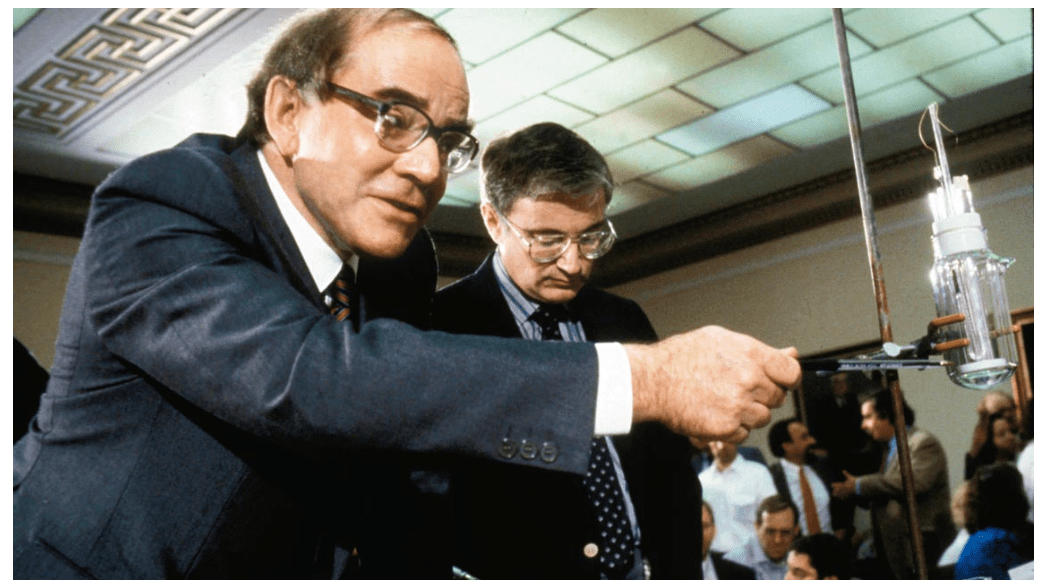

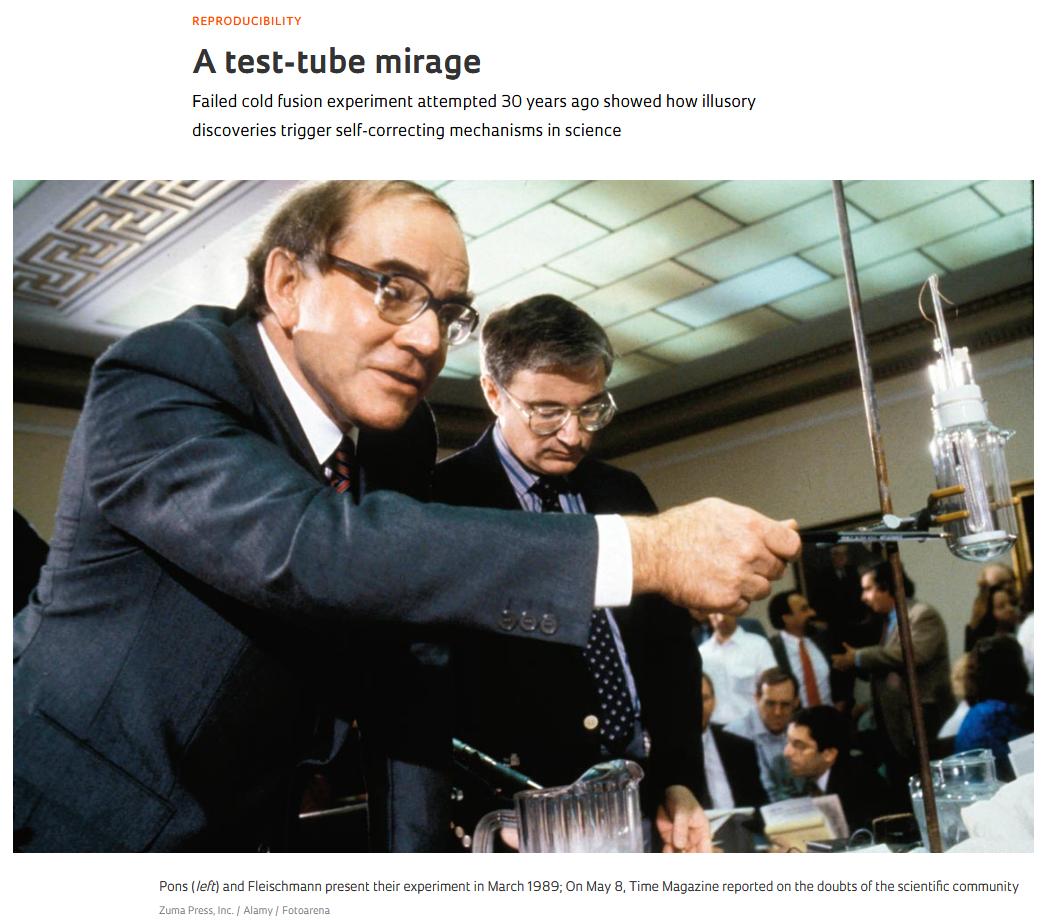
Sylvie Coyaud, the legendary veteran journalist from Milan, reported the most exciting news: EU Commission is now investing almost € 10 Million into the equivalent of porcine aeronautics, or maybe of alchemy as some described it: Cold Fusion. Specifically, the money will go into two projects to revisit the ridiculous “discovery” of Martin Fleischmann and Stanley Pons, who in the 1980ies shocked the world with their claim to have achieved nuclear fusion in a table-top device, basically in a water tub. A reliable, cheap and 100% ecologically clean source of virtually inexhaustible energy, too good to be true, and of course it was. Since then, the scientific community eventually concurred that the results were not reproducible, and Cold Fusion became a cautionary tale of scientific hype and hubris, and only some obscure quacks and loonies kept toiling on that field, claiming magical breakthroughs.
Not anymore, because look what the EU Commission just did.
First, some backstory on where Cold Fusion came from.
Nineteen eighty-nine
You might have heard of the experimental ITER fusion reactor, and indeed there are still some continuing efforts with the boring normal fusion, which is at least real since this is how the Sun generates its energy and which explains why life on Earth, including Fleischmann and Pons, was able to evolve in the first place. The problem with the normal, “hot” fusion seems to be that the only way to get more energy out of an Earth-based fusion setup than initially invested, is to set it off as a thermonuclear hydrogen bomb. Which is probably not practical as civil energy source. Terrestrial fusion reactors like ITER consume much more energy then they deliver, plus there is a danger of instability, what with the, you know, radioactive plasma.
Hence, the magic of Fleischmann and Pons, which you can read about at lenght on Wikipedia. In brief, Fleischmann, back then at University of Southampton, UK, and Pons of University of Utah, USA, drew on some ideas from 1920ies to design a table-top electrolytic device consisting of a calorimeter with a palladium electrode dunked into deuterium-rich “heavy water”. Lo and behold, the scientific duo reported that the temperature in the vessel rose way above the normal level without any excess energy being applied. A miracle, cold fusion has happened! No radiation was measured, but who cares. The 1989 study almost made it into Nature, but somehow ended up in the Journal of Electroanalytical Chemistry, where this practical joke evaded all suggestions of retractions, which is in turn the reason why we can have the good things of today, like the Hermes and CleanHME consortia.
Two years after the initial 1989 announcement, enough money was burned through to declare Cold Fusion dead, but its corpse never went cold, pardon the pun. There was really more than enough evidence of irreproducibility, and yet Fleischman and Pons did not agree and set lawyers upon critical colleagues and journalists, demanding retractions from them. In fact, 10% of the $5 million grant Pons received for his National Cold Fusion Institute went to fund his lawyers. Having failed to deliver in USA, the duo went in 1992 to France, where they ran the IMRA Lab, a Toyota subsidy (Japan was much into Cold Fusion back then). The entire IMRA institute, back then allegedly trice as big as it is now, was apparently dedicated to working on nothing but Cold Fusion. The new directors Fleischmann and Pons burned through around £ 12 million of Toyota money, and still nothing. Cold Fusion remained elusive. Fleischmann died in 2012, Pons is still alive, but as US American not qualified for EU grants, very unfortunate. More recently, Google tried its hand at Cold Fusion, burned through $10 million by 2019, still nothing. So the EU Commission is now throwing a similar amount of cash onto the pyre, all to celebrate the memory of Fleischmann and Pons.
The Fleischmann and Pons Revival Band
One of the two lucky grant recipients is the “Breakthrough zero-emissions heat generation with hydrogen-metal systems” (HERMES) consortium with €4 million, funded from November 2020 to October 2024. It is led by Pekka Peljo, affiliated with the Universities of Turku and Aalto (Finland), plus other scientists (also Finland), TU Munich (Germany), CNRS (France), Imperial College London (UK), Brno University of Technology (Czechia) and University of Limerick (Ireland). They don’t hide whose ideas they will be implementing, here the official project description summary:
“In 1989, electrochemists Martin Fleischmann and Stanley Pons made headlines with their claim to have produced excess heat using a simple apparatus working at room temperature. Their experiment involved loading deuterium in a palladium metal. As many experimenters failed to replicate their work, cold fusion remains a controversial topic in the scientific community. Nevertheless, a vociferous minority still believes in this elusive phenomenon. Since 2015, Google has been funding experiments into cold fusion. Although no evidence has been found for this phenomenon, it is clear that much pioneering research remains to be conducted in this poorly explored field.”
I think this is at least honest. Give us €4 million and we promise you to burn it like others burned cash on cold fusion before. Sure you could give this money to proper, serious, research projects instead, but we here do better bullshittery and have fancier universities behind us. And Peljo has the best facial hair of all, admit it.
Update 11.12.2020: as reply to my inquiry to University of Turku, Hermes coordinator Pekka Peljo provided a list of consortium partners:
Aliaxander Bandarenka, Technical University of Munich
Jan Macak, Central European Institute of Technology, Brno, Czech Republic
Frederick Maillard, LEPMI/CNRS, France
Tanja Kallio, Aalto University, Finland
Matthias Vandichell, University of Limerick, Ireland
Stephen Skinner, Imperial College, UK
Update 18.12.20 Peljo clarified that Fleischmann & Pons results were actually reproduced:
“two out of 24 experiments produced excess heat“.
His reference is a 2014 book which authors “worked with Martin Fleischmann and benefitted from his guidance” and openly admit to have written the book “to honour the memory of Martin Fleischmann“. Perfectly unbiased, if you ask me.
The Genius of Celani
The other consortium is “Developing a new source of clean energy” (CleanHME), which receives over €5.5 million from the EU Commission from August 2020 to July 2024. The project summary does not mention Fleischmann & Pons or Cold Fusion at all – unlike young loons like Peljio and his Hermes colleagues, the organisers of CleanHME are namely old loonies who are used to be ridiculed and tread carefully. The official project coordinator is an elderly Polish gentleman, Konrad Czerski of the University of Szczecin. Here is his 2013 presentation on a working Cold Fusion table-top reactor:
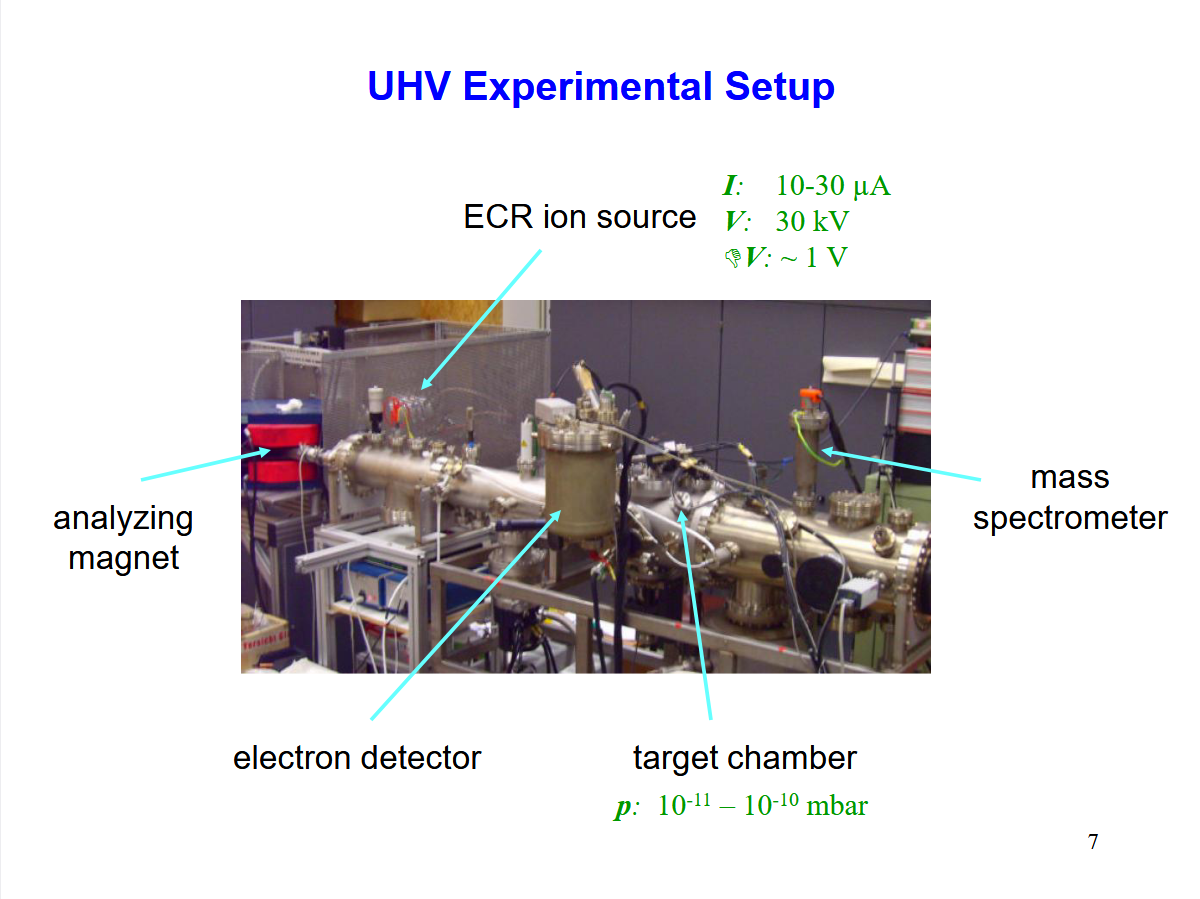
The consortium uses circumstantial language to descibe what it’s about, in fact a non-expert like myself would not notice anything:
“With climate change being a major global concern in recent times, new efficient clean energy sources are in high demand, and there has been a rise in the use of many of them, such as solar or wind generators. One very promising energy source is hydrogen–metal energy (HME), which could be used for small mobile systems as well as in stand-alone heat and electricity generators. Unfortunately, little research has been conducted concerning HME. The EU-funded CleanHME project aims to change this.”
Maybe CleanHME wanted to hide who really runs it, but not from Sylvie Coyaud: the man namely is the famous Francesco Celani of National Institute for Nuclear Physics, a reincarnation of Fleischmann’s ghost, obsessed with Cold Fusion for already 30 years, with very little as scientifically useful outcome. This is how Celani is described on his own website, highlights his:
“Francesco Celani arrived at the study of “Cold Fusion“, LENR [low energy nuclear reactions, -LS],, out of “distrust”, as he himself tells us. Indeed, he has always embraced Descartes’ “methodological skepticism” and has always been inspired by the desire for “truth “. Just as Eugene Franklin Mallove denounced in the past the falsification of the data on the “Cold Fusion” experiment by MIT (due to the interests of the establishment of that university linked to the funds for nuclear fission research they already enjoyed), to Francesco Celani we must, recently, also [verb missing already in original Italian, -LS] the courage of the dissemination of the two internal documents, which he himself accidentally discovered, relating to two NASA research on “Cold Fusion“, (that of Martin Fleischmann and Stanley Pons), which validated the results already years ago.
Francesco Celani, in his decades-long work as an Experimental Physicist, has always been animated by a truly scientific spirit (also a worthy interpreter of the tradition of Galileo Galilei’s experimental method). […]His previous participation in the Live Open Science (LOS) methodology, founded by the working group of the ” Martin Fleichmann (sic!) Memorial Project ” in 2012, is unchanged, indeed further strengthened.”
Sounds like Celani is perfectly sane and not at all a conspiracy theorist and an alchemy-inclined looney with an obligatory Galileo complex, no? I cannot imagine a more appropriate scholar to hand over your €5.5 million, but then again, the grant proposal passed peer review, so there.
Now, that weird Martin Fleischmann Memorial Project (MFMP) which Celani (aka the new Galileo) collaborates with, was set up by an Englishman named Paul Hunt and his son Ryan in 2012 after the prophet’s death and as a Celani-fanclub. The rest of the team and their clever plans to manufacture Cold Fusion using Celani’s guidelines, which they call “New Fire” (including photos of the table-top apparatus!) can be found online here. Mysteriously, just when CleanHME funding period started in November 2020, the entire MFMP website quantumheat.org was erased, even the archived records at Wayback Machine wiped clean. As if someone was suddenly ashamed of his friends. But here is something I saved from Google cache for the EU Commission’s perusal: the homepage, the about MFMP page (where it seems the departing soul of Fleischmann entered Celani’s New Fire apparatus or something:
“This last August, just weeks after Martin Fleischmann died, an Italian physicist named Francesco Celani demonstrated a breakthrough experiment at two international conferences”
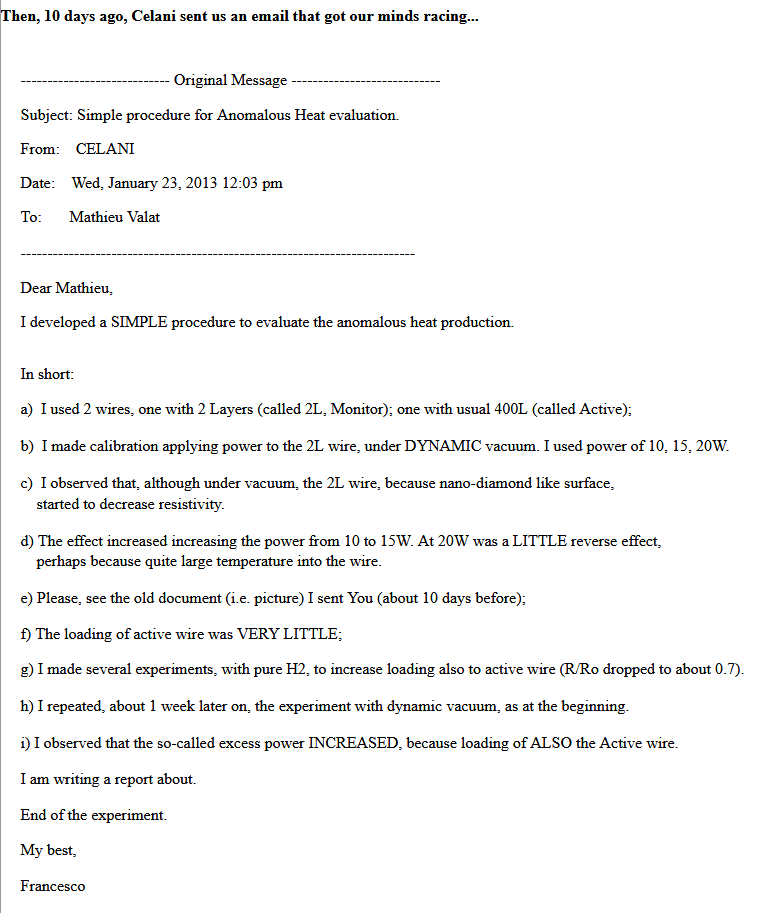
And, best of all: “The Genius of Celani” page, with an exact instruction by Celani himself on how to build the Cold Fusion machine:
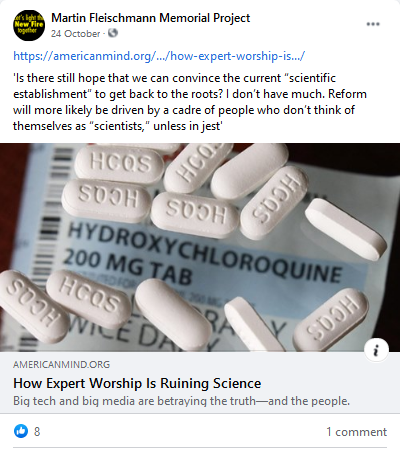
Otherwise, because quacks and loonies always cross-pollinate each other, here are Celani’s MFMP mates posting covidiocies about hydroxychloroquine, ivermectine and Vitamin D on Facebook and Twitter, in between covering CleanHME and Hermes.
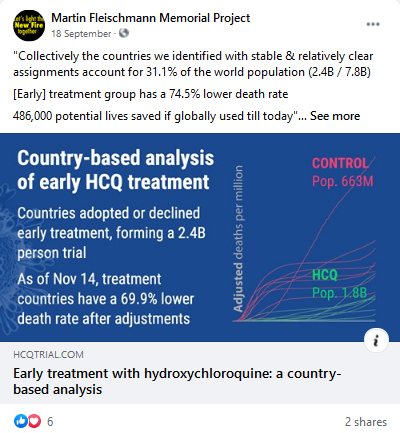


Of course Celani and Czerski are not the only ones behind CleanHME, there are also others: Italian, French, Slovakian and Belgian companies, CNRS again, University of Uppsala (Sweden) and other academic institutions in Italy, Poland and Slovenia. Then there is also the seriously named Institute for Solid-State Nuclear Physics (Germany), which is however not really an academic research institution but some business run by Czerski and partners. After the genius Celani and the coordinator Czerski, other key men of CleanHME (Cold Fusion does not work with womenfolk around apparently) are Peter Hagelstein (MIT professor and Cold Fusion enthusiast since 1989), Jirohta Kasagi (emeritus at University of Tohoku, Japan, and qualified Cold Fusion replicator), Matej Lipoglavsek (Stefan Institute, Ljubljana, Slovenia), Dimiter Alexandrov (Lakehead University, Canada) and Jean-Paul Biberian (another old-school Cold Fusion enthusiast, emeritus at University of Marseille, France, why am I not surprised about Marseille and loonies…)

Seriously, here is the CleanHME meeting programme: not a single woman among the scientific members, pun intended (there seem to be some women doing accounting, management and other secretarial duties). I am by now convinced that a presence of a menstruating person can derail the particle flux in a palladium electrode or something.
Update 18.12.2020 Pekka Peljo, when asked to comment on the scientific reputation of Celani and his CleanHME colleagues, wrote to me:
“But if CleanHME can produce these replications [of their own past results, LS], I’m prepared to keep an open mind. […] they plan to shoot some particles (protons, alphas, maybe neutrons, if I remember correctly) on their materials. This is something that is very much outside of my understanding, but the presentations on this topic during their kick-off meeting were convincing.”
Worth a try!
This Cold Fusion joke is back where we started in 1989: nobody in the scientific community will dare to make fun of Cold Fusion again, now that the EU Commission funds it with €10 million. That is because, with rare exceptions like the Liverpool professor Patricia Murray, academics are often chickenshits, even as full professors always afraid they will be defunded, depublished, delisted and demoted if they say anything to disturb the harmonic flow of scientific bullshittery. Others simply see everything as a potential source of some grant money. Just last year, the Johns Hopkins professor Steven Salzberg taught the public to respect cold fusion research:
“As the scientists themselves pointed out, even though their experiments didn’t produce cold fusion, “this exploration of matter far from equilibrium is likely to have a substantial impact on future energy technologies.” In other words, if we keep trying, who knows what we might find?“
This is a very typical academic argument. There is no stupid or useless research, because when scientists do something, something useful will surely come out of it. This is by the way exactly the reason why the EU Commission decided to bury €1 Billion for something as silly as a computational simulation of a brain, the Human Brain Project flagship. In the worst case the project will provide employment to hundreds of scientists, and they can’t really burn the entire billion without delivering something, anything. Worth remembering that other research projects, with actual science and sanity behind them, received rejections and some such unlucky scientists lost jobs.
So while we may laugh at the €10 million wasted on jokes like Cold Fusion, think of those good and honest scientists who were told to shove their grant proposals. Of course the real reason for the failure of Cold Fusion in the last 30 years was that two respectable scholars simply made it up, there never was anything but their fantasies and criminal energy. A clear case of research fraud with exactly zero consequences for Fleischmann and Pons because this is how academia understands things.
There is no fraud in science
Research misconduct, dear reader, is a very novel invention. Believe it or not, it virtually did not exist before 1990ies. That is not to say scientists started to fake data only recently, of course not. But the academic concept that a scholar, who is the intellectual and moral apex of human evolution, would ever wilfully falsify research results was incomprehensible back in those days. The affairs of Robert Gallo plus that of Theresa Imanishi-Kari and David Baltimore (read here), which started in 1980ies, then progressed into initial misconduct findings, to end with full acquittal in mid-1990ies, eventually woke up the academic community from its blissful idyllic slumber. Nowadays, scientific misconduct is something everyone is aware of, especially sicne it is not just junior scientists, but even some professors who are occasionally found guilty of it.
And yet the actual existence of research fraud is something scientists still struggle to believe in. Sure, there was the Dutch psychologist Diederik Stapel, who admitted to have faked all his research, accepted the sack without fighting back, and even wrote a book about his research fraud, which made Stapel the one and only research fraudster in the entire history of modern science. I am not exaggerating, look up any journalistic piece on research fraud, and it will be always Stapel as the only example.
Those countless others, while guilty of research misconduct and data fakery, are definitely not fraudsters. How so? Well, for one, unlike Stapel, they never admitted to fraud. For another, they officially never intended to deceive, but merely cut corners, took shortcuts, doped a bit, misinterpreted, beautified and guesstimated, but important is: they really believed in their scientific results and faked data in good faith, which is apparently a scientifically objective proof that those results must have been real! Hence: conclusions not affected, the sacred mantra of academic corruption.
This is exactly why the STAP affair (this Guardian article was written by me, it was the first ever case of research fraud I covered as journalist, starting in January 2014) still involved several respectable labs claiming the results of Haruko Obakata‘s magical stem cell reprogramming were actually real. The Japanese Obokata was eventually ousted as a fraudster, but not, for example, her Harvard mentor, STAP mastermind and pathological bullshitter Charles Vacanti. Because, if something has been published by respectable professors in a respectable peer reviewed journal, it cannot be made-up, by definition. It can be sloppy, falsified, even irreproducible, but it cannot be invented out of thin air. Scientists don’t do such things, they are incapable of lowly fraud like mere mortals. Science does not work like this. There must have been something real, because why would they falsify results otherwise, right?
This is exactly why the murderous fraud committed by the surgeon Paolo Macchiarini with “stem cell”-regenerated trachea transplants is everything but history. Sure, Macchiarini is a crook, and guilty of research misconduct and deadly patient abuse, but the official version is: even if Macchiarini is bad, his science is probably very valid. Because it was published in The Lancet (even more so, since it was not retracted). This is also why human experiments with Macchiarini-style trachea transplants continue, what his past collaborators did however was to extinguish all association with the bad guy. As one of Macchiarini-investigators at UCL once told me: “but what if it works?“
The EU Commission wasted €5 million on Macchiarini’s clinical trial which never happened, because the affair exploded thanks to journalist investigation and the murderous surgeon was sacked by the Karolinska Institutet. Which meant nothing else that the EU Commission had to invest another €7 million into another clinical trial, with similar trachea transplant technology, but now led by Macchiarini’s once closest ally turned bitter rival, the UCL professor Martin Birchall. That clinical trial was also terminated before it began, thanks to the work of Patricia Murray (the UK public funders haven’t given up yet though!). Nevertheless, the EU Commission invested €2 million into the a different clinical trial, using a similar regmed technology but on “stem cell” regenerated veins, run by a company founded by Macchiarini’s former collaborator at University of Gothenburg, the unsackable Suchitra Sumitran-Holgersson. Whose qualifications to obtain that EU grant were the research misconduct and patient abuse she was previously found guilty of, regarding exactly this same research.
So you see, there is definitely some bureaucratic a desire to prove fraudulent research right by throwing more public money at it, sometimes even given to the very same people. Apparently, there are enough conspiracy nutters, greedy crooks and wilful abettors in the scientific community to approve such research projects via peer review.
This is why it is perfectly logical that the EU Commission will now invest €10 million of public money into a Fleischmann-Pons revival project of Cold Fusion. I expect their next investment will be into the magical semiconductor technology once invented by Jan-Hendrik Schön, heck, for all I know it’s probably already happening.
Update 10.12.2020
For more Cold Fusion insanity, do read Smut Clyde‘s follow-up article here. It also features Andrea Rossi!
Update 14.12.2020
Pekka Peljo now wrote to me again, explaining the history of his Hermes project and the connection to Celani’ CleanHME (with which Hermes did a joint kick-off meeting):
“There are very conflicting results on cold fusion, so when writing the proposal, our starting point was: what if Fleischmann and Pons really saw something? Fleischmann especially is still very respected within the field of electrochemistry: https://www.wiley.com/en-us/Developments+in+Electrochemistry%3A+Science+Inspired+by+Martin+Fleischmann-p-9781118694435
According to Scopus, he’s still getting more citations per year than I am.
So when I saw the Nature paper by the Google funded project (https://www.nature.com/articles/s41586-019-1256-6), and the FET Proactive call, I started to think if there would be something we could do. The idea is to approach the topic with an open mind. And it’s not enough to see something strange once. We need to be able to replicate it, and then try to understand, why something strange is happening. But because it’s a high-risk project, we need to have some other outcomes.
I believe that there is a chance that we may see some strange effects. Otherwise I would no have spend quite a bit of time writing the proposal in the first place. But we have to be prepared for failure. We have identified three research lines that looked interesting to us, and where we had some fresh ideas. But I think it’s still a high probability that we won’t see anything strange. But if we do see something strange, we need to be able to reproduce it, try to identify alternative reasons, systematic errors etc. That’s why are assembling an external advisory board, to receive feedback on what other explanations there could be for unexpected results.
About CleanHME, I’ve seen the presentations during their kick-off meeting, but I haven’t spent time checking the background of the partners. Their approach is also very different from ours. But if they are able to produce results that can be reproduced, I’m willing to keep an open mind.“
This is, Celani and his CleanHME partners all claim to have already achieved one kind of cold fusion or another in their experiments in the past 30 years. I wonder if Dr Peljo read their publications, like this stroke of genius?
Donate!
If you are interested to support my work, you can leave here a small tip of $5. Or several of small tips, just increase the amount as you like (2x=€10; 5x=€25). Or would you rather donate to the Martin Fleischmann Memorial Project?
€5.00

 For Better Science
Pingback: Ivermectin now against COVID-19, why… – For Better Science
Pekka Peljo wrote:
So we will burn the 4 M€ we got from the EU, but we are sure we can get some interesting science done, even if we fail to see any anomalous reactions.
This post has attracted the attention of some people involved in the HERMES project, so, as a European citizen, I would like to take this opportunity to let them know my expectations.
4 MEuros is about 1 cent for each European citizen. Not so much, but I’d wish my cent be burned on some interesting science, not on pseudo-science. So the sooner the HERMES team decides that there is nothing controversial about CF, just a bunch of artifacts misinterpreted by Fleischmann and Pons and all their emulators, the larger the probability that my cent goes in really interesting science.
Experience has shown that refuting the reality of CF by trying to replicate the experimental results claimed by cold-fusionists is futile. The “vociferous minority [which] still believes in this elusive phenomenon” will always explain the lack of any anomalous heat by lacks of reproducing the exact experimental condition and/or sample material used in the original experiments..
The only way to get rid of this endless rhetorical pattern is to show that all the cold-fusionist were deluded, starting from F&P onward. The 1992 four-cells boil-off experiment provides a unique opportunity to prove that F&P were absolutely wrong, just by looking at their documents, no other experiments are required. This analysis would only absorb a minor share of the EU fund, the rest could be available for more interesting research.
The 1992 boil-off experiment is reported in two papers both entitled “Calorimetry of the Pd-D2O system: from simplicity via complications to simplicity” (1,2), and sometimes called, for the sake of brevity, “Simplicity Paper”.
This experiment can be considered the cornerstone of cold fusion. In 2018, Jed Rothwell, CF/LENR librarian and most active public supporter of the field, wrote in his introduction to the Letters from Martin Fleischmann to Melvin Miles (3): McKubre pointed out that Fleischmann was a master of theory and mathematics, in ways that people with post-1940s educations seldom attain. Fleischmann would often point to something and say “that is obvious” when it was not a bit obvious to McKubre. Fleischmann’s mathematical analysis of calorimetry was far more complex than most people’s. He told me he preferred simple hardware and complicated “software” — by which he meant computation; thinking and running equations in his head. Not computers, which, as I said, he distrusted. Hand in hand with his analytical legerdemain, he strongly believed in simple, direct experiments, such as the boil-off technique and graphs that spoke for themselves. He liked nothing better than an experiment stripped down to its essentials, so that it could not be refuted. The title of his major paper says it all: “From simplicity via complications back to simplicity.”” [added bolds]
The 1992 boil-off experiment reports two sensational conclusions (1): “the excess rate of energy production is about four times that of the enthalpy input” and “following the boiling to dryness and the open-circuiting of the cells, the cells nevertheless remain at high temperature for prolonged periods of time”. Both these conclusions come from the observation of the time-lapse video recorded during the experiment. The “Simplicty Paper” reads: “It is therefore necessary to develop independent means of monitoring the progressive evaporation/boiling of the D2O. The simplest procedure is to make time-lapse video recordings of the operation of the cells which can be synchronised with the temperature-time and cell potential-time data. […] As it is possible to repeatedly reverse and run forward the video recordings at any stage of operation, it also becomes possible to make reasonably accurate estimates of the cell contents.” [added bold] Therefore, the two authors based their conclusions on the information provided by just a video recording, the crucial parts of which are available on internet (4,4a).
In conclusion, the 1992 boil-off experiment is not only the most important test in the CF history, but it is also the best documented by the authors themselves. Participants in the HERMES project are in the lucky situation of looking at the exact same information used by F&P to draw their sensational conclusions, which were also selected in 2004 by the CF top experts to be submitted to DoE for a second evaluation of the entire field (5,5a). So I hope they will take into consideration the opportunity to spend some time in closely looking at the available data of this fundamental work of the two CF pioneers before embarking on expensive and inconclusive experimental replications.
(1) http://www.lenr-canr.org/acrobat/Fleischmancalorimetra.pdf
(2) https://www.sciencedirect.com/science/article/pii/037596019390327V
(3) http://lenr-canr.org/acrobat/Fleischmanlettersfroa.pdf
(4) https://i.imgur.com/jm50iLc.jpg
(4a) https://www.lenr-forum.com/forum/thread/2746-fp-s-experiments-discussion/?postID=97131#post97131
(5) https://www.newenergytimes.com/v2/government/DOE2004/DOE-2004.shtml
(5a) https://www.newenergytimes.com/v2/government/DOE2004/7Papers.shtml
LikeLike
More info on the1992 Four-cell Boil-off experiment.
“Heat after Death” (1) is the title of a paper presented by F&P at the ICCF4 in December 1993. This was the name chosen to identify the phenomenon reported as the second claim in the conclusions of their “Simplicity Paper” (2): “following the boiling to dryness and the open-circuiting of the cells, the cells nevertheless remain at high temperature for prolonged periods of time, Fig 8”.
Fig.8 shows the temperature curve of Cell 2 zoomed in the short period of a few hours before the complete evaporation of the electrolyte. Two vertical lines mark the instants in which, according to the two authors, the cell becomes half and completely dry. Moreover a note on the graph states that the “Cell remains at high temperature for 3 hours”. Well, this interpretation and the subsequent statement are false: the two electrochemists have misplaced the arrows by more than 2 hours, as can be easily seen by comparing the time axis of Fig.8 and the time shown on the video frames (3,3a).
In the next years, the HAD phenomena became one of the most popular legends in the CF/LENR mythology and mentioned in other reports and reviews, but the only experimental evidence shown was always the same wrong graph from the F&P’s “Simplicity Paper”, redrawn in many ways (4,4a).
Cold-fusionists have continued to proclaim this legend for almost 30 years. I’m curious to see how long it will take to the electrochemists of the prestigious institutions involved in the HERMES project to spot such an elephant in the room.
(1) https://www.lenr-canr.org/acrobat/PonsSheatafterd.pdf
(2) https://www.lenr-canr.org/acrobat/Fleischmancalorimetra.pdf
(3) https://i.imgur.com/X2q1TWv.jpg
(3a) https://www.lenr-forum.com/forum/thread/2746-fp-s-experiments-discussion/?postID=100435#post100435
(4) https://i.imgur.com/cZpX7AR.jpg
(4a) https://www.lenr-forum.com/forum/thread/5850-f-p-s-experiments-%E2%80%93-30-years-after-cf-announcement/?postID=106070#post106070
LikeLike
Pekka Peljo wrote: “My understanding is that it is very hard to obtain the threshold conditions, especially the high loading ratio of D/Pd. This is summarized in the review chapter 13 in this book. https://www.wiley.com/en-us/Developments+in+Electrochemistry%3A+Science+Inspired+by+Martin+Fleischmann-p-9781118694435
and this was also the conclusions of the Google funded project.
Somehow this is claimed to be related to materials science of the Pd-D, and apparently impurities can have a huge effect.
The chapter for example reports a series of experiments, where two out of 24 experiments produced excess heat.”
Another thing is, that it reportedly takes up to 3 months of electrolysis to get some strange effects. These experiments have been done using bulk palladium electrodes, …
– End quote –
The book used by Pekka Peljo to understand CF was intended to honor the memory of Martin Fleishmann and Chapter 13 “Cold Fusion After A Quarter-Century: The Pd/D System” is authored by two of his closest friends and major protagonists of the field.
I hope not to hurt any sensitivity by making this comparison, but expecting to obtain some excess heat, or to see any other anomalous effect, giving credence to what is reported in that book is like trying to repeat the “The Multiplication of the Loaves and Fish” on the basis of what is written in the Holy Gospel of St. Matthew and St. John. And Fleischmann was not even Jesus, nor a proclaimed saint. Notwithstanding, the “vociferous minority”, who proclaims the reality of CF, believes he performed miracles, that is, by definition, something contrary to natural laws.
In this respect, cold fusion goes far beyond pseudo-science, having acquired all the characteristics of a religious belief. The acolytes of this new religion gather periodically and tell each other their prodigious achievements. During these meetings, they proclaim the “Heroes of the year” (1), and considers themselves as “comrades in arms” of some sort of secret sect (video (2), Celani at 4:36). Well, now the situation is far better for them, the European comrades are openly funded by EU so they no longer need to meet in secret so as not let the banks know that they are spending the lent money in cold fusion activities.
Similarities between cold fusion and a religious belief also includes some kind of miraculous relic or talisman. As reported in the cited Chapter 13, the Saint Graal of cold-fusionists is the good (or type A) palladium used by F&P in their earliest experiments and that, in the memory of CF believers, guaranteed them a high rate of successful replications. Now, a team of electrochemists from some of Europe’s most prestigious scientific institutions are on the verge of searching for this Graal, as if they were medieval knights. This is surreal. As amply demonstrated by his 1992 boil-off experiment, MF was wrong and so were his apostles. This is the only fact to understand in cold fusion.
Before leaving the solid land of common sense to explore exotic territories, the scientists, who have had the unexpected fortune of getting a lot of public money from European contributors, have the duty to examine the documentary evidences that are before their eyes. Instead of submitting their own experimental results to the external advisory board anticipated by Pekka Peljo (even more people called upon to work on this fairytale), the experts of HERMES project should act themselves as advisory board for the results claimed by F&P in 1992. They are all electrochemists, so they have the necessary expertise, and the available documentation is more than enough to express a well informed and definitive opinion on that kind of experiments, instead of relying on the CF gospel told by close friends of F&P.
Before burning the entire European fund into pseudoscientific activities, Pekka Peljo and his partners should look personally at the 1992 videos (3a,3b,3c), interpret by themselves what really happened inside the 4 cells and share their conclusions publicly.
(1) http://lenr-canr.org/acrobat/McKubreMCHabriefhist.pdf
(2) https://www.youtube.com/watch?v=jSzOsDdape4
(3a) https://www.youtube.com/watch?v=mBAIIZU6Oj8
(3b) https://www.youtube.com/watch?v=n88YdKYv8sw
(3c) https://www.youtube.com/watch?v=Tn9K1Hvw434
LikeLike
this is the complete list of ITER achievments so far, at a cost of 50B Usd:
list
BEGIN
-chicken spat
END
So, if a few eccentrics want 10m eur for alternative research, they are welcome.
vitD and ivermectine, btw, are documented to some extent here, for SCIENTISTS;
c19study.com
as compared to the below complete scientific list for masks and lockdowns:
list
BEGIN
-chicken spat
END
senile joe his masters, bigtech, stole the election btw
dont know why i feel i should mention this to our authors, just a hunch
LikeLike
Your forgot the Soros-Gates conspiracy with 5G vaccines. Now get off my site.
LikeLike
“Whether Cold Fusion or Low-Energy Nuclear Reactions, U.S. Navy Researchers Reopen Case Spurred on by continued anomalous nuclear results, multiple labs now working to get to bottom of story” https://spectrum.ieee.org/cold-fusion-or-low-energy-nuclear-reactions-us-navy-researchers-reopen-case “NASA Detects Lattice Confinement Fusion” https://www1.grc.nasa.gov/space/science/lattice-confinement-fusion/ “NSF/EPRI Workshop Summary” http://newenergytimes.com/v2/government/DOE1989/19891019-ERAB-Goodwin-report-on-NSF-EPRI.pdf
LikeLike